• NovartisThe Court of Appeal recently issued a decision concerning
    the issues that should be considered when granting an interim injunction.  The
    proceedings related to Novartis' product zoledronic acid, which was used to
    treat osteoporosis.  This product was covered by a supplementary protection
    certificate (an SPC), as well as two use patents.  Hospira, a generics company, started
    revocation actions against these two patents and obtained a marketing
    authorisation for zoledronic acid to treat a number of conditions, including
    osteoporosis.

    Soon after becoming aware of the marketing
    authorisation, Novartis wrote to Hospira requesting an undertaking that no
    product would be sold before the expiry of the SPC, which was duly given by
    Hospira.  A subsequent letter requested confirmation that if the claims were
    found to be valid in revocation proceedings, the product would not be launched
    even after the lapse of the SPC.  This confirmation was not given.  Instead, as both patents were found to be
    invalid in the revocation action, Hospira indicated their intention to launch
    the product after the lapse of the SPC.

    HospiraNovartis appealed the revocation decision and started
    infringement proceedings concerning the two use patents and applied for an
    interim injunction to prevent Hospira's launch.  In response to this application, Hospira
    argued that once a decision on the merits had been given, a party needs an
    arguable case on appeal for an injunction to be granted and that it would not
    be right to equate such a case with a good arguable case on the merits at the
    start of proceedings.  It was argued that
    different considerations applied once trial had taken place.  The court of first
    instance held that the case was plainly arguable and that Novartis was more at
    risk of suffering larger losses.  However, the appeal on the revocation was not
    nugatory and did not have a strong prospect of success.  Instead, the appeal was arguable and could
    inflict uncompensatable harm on either side.  Further, it was said that Novartis should have
    started infringement proceedings earlier to allow a conclusion to be reached in
    good time.  An injunction was therefore
    not granted.  Novartis subsequently appealed
    against the decision on the granting of the injunction.

    The Court of Appeal held that there was not a clear
    view on the merits, as the appeal had a realistic prospect of success.  The
    exercise of discretion should therefore not be approached on the basis that the
    merits are clear in favour of one side or the other.  It was further held that
    the previous decision on the merits should not affect the balance of hardships
    considered when granting an injunction.  This balance fell in Novartis' favour,
    based on the damage that would be suffered by Novartis if an injunction was not
    granted being more certain and greater in magnitude than the damage to Hospira
    if an injunction was granted.

    The facts that Hospira was also selling zoledronic
    acid for other, less profitable diseases and that the public would be
    disadvantaged by an injunction were deemed to be irrelevant.  It was held that
    an appeal in cases such as this should be expected and that generic companies should
    have to disclose their intentions to the innovator in time for an appeal to
    take place, or expedite proceedings accordingly.  The decision at first instance
    could not be expected to determine Hospira's freedom to sell the product.  The
    Court of Appeal therefore found in Novartis' favour and granted an interim
    injunction.

    This decision therefore sets a precedent for
    interim injunctions pending appeal to be granted even if the relevant patents
    were found invalid at first instance.

    This
    report comes from European Patent Attorneys at WP
    Thompson & Co.
    , 55 Drury Lane, London UK.  Further details and
    commentary can be obtained from Gill Smaggasgale,
    a partner at the firm.

  • By Kevin E. Noonan

    Supreme Court Building #2The Supreme Court
    on Monday declined to grant certiorari in
    Momenta Pharmaceuticals v. Amphastar Pharmaceuticals,
    a case involving a split in authority that has arisen among Federal Circuit
    judges regarding the scope of the "safe harbor" provisions on 35
    U.S.C. § 271(e)(1).  Specifically, two
    panels of the Court, both consisting of Chief Judge Rader and Judge Moore, have
    come to different interpretations of the statute with regard to post-approval
    activities.  In Classen Immunotherapies, Inc. v. Biogen IDEC, (where the Court earlier
    refused to grant certiorari in a case
    styled Glaxo Smith Kline v. Classen
    Immunotherapeutics
    ), a majority of the merits panel (Chief Judge Rader
    joined by Judge Newman) held that post-approval activity did not fall within
    the safe harbor (over a vigorous dissent by Judge Moore).  In contrast, in the Momenta case, the panel majority (Judge Moore joined by Judge Dyk)
    found that such activity does fall
    within the scope of the statute (over an equally vigorous dissent by Chief
    Judge Rader), giving the statutory language a broad reading compelled,
    according to Judge Moore, by the Supreme Court's decision in Merck KGaA v. Integra Lifesciences I, Ltd., 545 U.S. 193, 202 (2005).

    Momento PharmaceuticalsTo briefly recap,
    the Momenta decision arose in the
    context of a District Court grant of a preliminary injunction to Momenta in
    litigation between two ANDA filers.  Momenta
    entered the marketplace after ANDA litigation with the patent holder, Aventis,
    over Lovenox (enoxaparin), a specific formulation of heparin.  As explained in the opinion, heparin (unlike
    most drugs) is not "a single defined molecule" but rather a
    heterogeneous mixture of molecules that differ in "the length of the
    polysaccharide chain" and the "component disaccharide units and the
    corresponding distribution of disaccharide unit sequences in the polysaccharide
    chains."  This affects its molecular
    weight distribution as well as the distribution of uronic acid moieties.  Enoxaparin is the result of fragmentation of
    native heparin into a "diverse set" of oligosaccharides.  Accordingly, FDA approval for ANDA filers
    required five "criteria" or "standards of identity" to be
    met, including "[e]quivalence in disaccharide building blocks, fragment
    mapping, and sequence of oligosaccharide species" identified by specific
    enzymatic treatment and physical/chemical analyses of the drug product,
    including separation and spectroscopy.

    Although Amphastar
    filed its ANDA first, Momenta was first to market.  Perhaps tellingly, the Federal Circuit
    described the genesis of this lawsuit as follows:

    Being the
    only generic version of enoxaparin has it benefits:  its sales generated
    revenues of $260 million per
    quarter
    .  . . .  The approval of Amphastar's version of enoxaparin,
    and the resultant ruinous competition of another generic version of the drug,
    threatened this unique market position.  Understandably
    unwilling to give up a billion dollars in yearly revenue, Momenta initiated the
    present litigation two days after Amphastar received final FDA approval to
    market its generic enoxaparin.

    The legal basis for
    the suit was infringement of U.S. Patent No. 7,575,866, assigned to Momenta, which claimed
    methods for analyzing heparin and specifically low molecular weight heparins
    such as enoxaparin.  The opinion cited
    claims 6 and 15 as being "representative" of the '886 patent claims
    that Momenta asserted against Amphastar:

    6.  A method for analyzing an enoxaparin sample
    for the presence or amount of a non naturally occurring sugar associated with
    peak 9 of FIG. 1 that results from a method of making enoxaparin that included
    β-eliminative cleavage with a benzyl ester and depolymerization, comprising:
    providing an enoxaparin sample that has been exhaustively digested with two or
    more heparin degrading enzymes; using a separation method to determine, in the
    enoxaparin sample that has been contacted with two or more heparin degrading
    enzymes, the presence of a structural signature associated with the non
    naturally occurring sugar associated with peak 9 of FIG. 1 that results from a
    method of making enoxaparin that includes .beta.-eliminative cleavage with a
    benzyl ester and depolymerization; and making a determination about the
    enoxaparin sample based upon a comparison of the determination of the presence
    of a structural signature associated with the non naturally occurring sugar
    associated with peak 9 to a reference standard for enoxaparin, wherein the
    determination based upon the comparison to the reference standard regards the
    quality of the sample, to thereby analyze the enoxaparin sample.

    15.  A method for analyzing an enoxaparin sample
    for the presence or amount of a non naturally occurring sugar associated with
    peak 9 of FIG. 1 that results from a method of making enoxaparin that included
    β-eliminative cleavage with a benzyl ester and depolymerization, comprising:
    providing an enoxaparin sample that has been exhaustively digested with two or
    more heparin degrading enzymes; using a separation method to determine, in the
    enoxaparin sample that has been contacted with two or more heparin degrading
    enzymes, the presence of a structural signature associated with the non naturally
    occurring sugar associated with peak 9 of FIG. 1 that results from a method of
    making enoxaparin that includes .beta.-eliminative cleavage with a benzyl ester
    and depolymerization; and making a determination about the enoxaparin sample
    based upon a comparison of the determination of the presence of a structural
    signature associated with the non naturally occurring sugar associated with
    peak 9 to a reference standard for enoxaparin, wherein the level of one or more
    structural signatures associated with the non naturally occurring sugar
    associated with peak 9 of FIG. 1 is determined, to thereby analyze the
    enoxaparin sample.

    The Federal
    Circuit characterized Momenta's complaint as alleging that Amphastar infringed
    the '886 patent by complying with FDA requirements for testing its enoxaparin
    product as part of the quality control necessary for making this drug.  Judge Moore's opinion vacated the preliminary
    injunction and remanded using language that made it very unlikely that the
    District Court would be able to grant the injunction (see Patent Docs post).  Chief Judge Rader's dissent directed his contrary
    analysis not only to the specific matter before the Court but also opined more
    broadly (see "Momenta Pharmaceuticals Inc. v. Amphastar Pharmaceuticals, Inc.: 'The Rest of the Story'").

    Amphastar's
    defense in opposing the injunction was that its activities fell within the "safe
    harbor" of 35 U.S.C. § 271(e)(1):

    It shall
    not be an act of infringement to make, use, offer to sell, or sell within the
    United States or import into the United States a patented invention (other than
    a new animal drug or veterinary biological product (as those terms are used in
    the Federal Food, Drug, and Cosmetic Act and the Act of March 4, 1913) which is
    primarily manufactured using recombinant DNA, recombinant RNA, hybridoma
    technology, or other processes involving site specific genetic manipulation
    techniques) solely for uses reasonably
    related to the development and submission of information under a Federal
    law which regulates the manufacture, use, or
    sale of drugs or veterinary biological products
    .

    (emphasis added).

    The District Court
    rejected this contention because the infringing activity occurred after Amphastar received
    regulatory approval, the Court interpreting the statute to be limited to
    otherwise infringing acts that were performed in order to obtain approval (while acknowledging
    that the information was, ultimately, submitted to the FDA).  According to Judge Moore's opinion, the
    District Court interpreted the meaning of the statute with reference to its
    legislative history.  This was the source
    of the District Court's error, according to Judge Moore.

    Rather than
    addressing Momenta's arguments that the answer to the question before the Court
    was mandated by the earlier Classen decision,
    the majority turned instead to its own independent interpretation of the
    statute.  In the majority's view, the "plain
    meaning" of the statutory language was clear (and did not justify resort
    to the statute's legislative history; indeed, the panel majority deemed any such
    recourse to the legislative history to be improper, quoting United States v. Ron Pair Enters., Inc.,
    489 U.S. 235, 240 (1989), for the proposition that the "inquiry must cease
    if the statutory language is unambiguous and 'the statutory scheme is coherent
    and consistent.'").  Selectively
    quoting from portions of the legislative history, the opinion noted that the
    statute was enacted to "balance the need to stimulate innovation against
    the goal of furthering the public interest."  H.R. Rep. 98-857, pt.
    2, at 2714 (Aug. 1, 1984).  In citing the
    statute, the majority highlighted the clause reading that the safe harbor was "solely for uses reasonably related to the
    development and submission of information under a Federal law
    ,"
    which was enough to put an end of it:  "Congress could not have been
    clearer in its choice of words," and thus "any activity"
    included acts taken after approval (provided that there was information
    submitted under a Federal law).  Moreover, for the majority, it was
    significant that Congress did not limit (expressly) the scope of the safe
    harbor to the Food, Drug and Cosmetic Act but "broadly" included
    within the scope of the safe harbor "any federal law" that "regulates
    the manufacture, use, or sale of drugs."  This interpretation is consistent with the majority's
    parsing of the rest of the statute, citing portions of the provision that do specifically reference the
    FDCA (referring to animal drug or veterinary biological product[s]" and by
    reciting in § 271(e)(2) the specific provisions of the FDCA relating to
    submission of an ANDA. For the majority, the fact that Congress included
    express reference to provisions of the FDCA relating to obtaining approval
    under § 271(e)(2) for infringement made it improper to "import" that
    limitation into the safe harbor provisions of § 271(e)(1).  Calling their's the "only coherent and
    consistent interpretation of" provisions of § 271(e)(1) relating to "a
    Federal law which regulates the manufacture, use, or sale of drugs," the
    majority declared its analysis of the scope of the safe harbor to be "complete":

    When the
    intent of Congress is expressed so clearly and consistently throughout the
    statute, there is neither the need nor the occasion to refer to the legislative
    history.  Id.  The
    scope of the Hatch-Waxman safe harbor does not stop at activities reasonably
    related to development of information submitted in an ANDA. Instead, the safe
    harbor applies "to the development and submission of information under a
    Federal law which regulates the manufacture, use, or sale of drugs or veterinary
    biological products."  As long as
    the allegedly infringing use is "for uses reasonably related" to the
    development and submission of that information it is not an act of
    infringement, regardless of where that requirement resides in the law.

    The panel majority
    cited two specific instances where the Supreme Court ruled on the meaning of §
    271(e)(1) in a manner consistent with its interpretation:  Eli Lilly & Co. v. Medtronic, Inc.,
    496 U.S. 661, 666 (1990), and Merck KGaA v. Integra
    Lifesciences I, Ltd.
      In the Lilly case, the Court
    interpreted the safe harbor to include testing of medical devices because
    (despite the "clear and unambiguous language of the statute" that the
    safe harbor was limited to drugs) in the Court's view, regulation of medical
    devices fell within the ambit of the FDCA.  And in Merck, the Supreme Court "reaffirmed
    this expansive view" of the safe harbor, holding that infringement of
    patent claims directed towards activities that were not directly related to
    obtaining data for submission to the FDA, i.e.,
    clinical trials, but extended to basis compound discovery activities, on the
    grounds that Congress had used the word "any" in reciting the
    activities within the scope of the safe harbor.  And the panel majority
    also provided a reminder that Merck
    held that the phrase "reasonably related to the development and submission
    of information" relating to regulatory approval did not require that the
    activities actually resulted in information that was submitted for regulatory
    approval.  Accordingly, the panel
    majority concluded that the Court's Merck
    decision "explicitly rejected the notion that § 271(e)(1) was
    limited 'to the activities necessary to seek approval of a generic drug'"
    so long as "the accused infringer 'has a reasonable basis for believing'
    that the use of the patented invention might yield information that 'would be
    appropriate to include in a submission to the FDA.'"

    AmphastarThe panel majority
    based its decision that Amphastar's activities fell within the safe harbor
    expressly on the Merck
    decision, and in the process distinguished the Federal Circuit's earlier Classen decision (as it had to
    in order to arrive at its contrary conclusion).  Classen,
    the panel majority stated, involved voluntary studies "not mandated by the
    FDA" and that produced "'information that may be routinely reported
    to the FDA, long after marketing approval has been obtained'" (i.e., adverse event information
    that is reported as it is obtained).  That was not this case according to
    the opinion, because the information obtained from infringing Momenta's
    patents was necessary for Amphastar to continue to sell enozaparin (and failure
    to do so could cause FDA to "suspen[d] or revo[ke] Amphastar's approval").
     Accordingly, the opinion stated that "post-approval
    studies that are "reasonably related to the development and submission of
    information under a Federal law which regulates the manufacture, use, or sale
    of drugs" fall within the scope of the § 271(e)(1) safe harbor." 
    And under this interpretation of the law, the majority further held that
    Momenta was not likely to prevail on the merits below.

    Judge Rader's dissent focused on the limited scope of the safe harbor, based on his understanding of
    the fundamental right to exclude embodied in the patent statute and the limited
    exception to that right granted under § 271(e)(1).  ("Thus, exceptions to the traditional
    property remedy amount to a get-out-of-jail-free card for the trespasser.  Accordingly, such exceptions must occur only
    sparingly with awareness that this license allows the wrongdoer free reign to
    continue trespassing.")  That
    limited scope is the result of a balance, expressly struck by Congress, between
    the recompense to patentees who lost patent term during regulatory review
    (comprising the patent term extension provisions of 35 U.S.C. § 156 et seq.) and the benefits to the public
    by legislative override of Roche
    Products, Inc. v. Bolar Pharmaceutical Co
    ., 733 F.2d 858 (Fed. Cir. 1984)
    (preventing any infringing activity prior to patent expiration including
    activities required by the FDA or other government agencies for approval of
    drugs):

    The
    purpose of 271(e)(1) and (2) is to establish that experimentation with a
    patented drug product, when the purpose is to prepare for commercial activity
    which will begin after a valid patent expires, is not a patent
    infringement.  Since the Committee's
    Subcommittee on Health and the Environment began consideration of this bill,
    the Court of Appeals for the Federal Circuit held that this type of
    experimentation is infringement.  In
    Roche Products, Inc. v. Bolar Pharmaceutical Co., 733 F.2d 858 (Fed. Cir.
    1984), the Court of Appeals for the Federal Circuit held that the expiration
    date of a patent claiming that drug product constitutes patent infringement,
    even though the only purpose of the experiments is to seek FDA approval for the
    commercial sale of the drug after the patent expires.  It is the Committee's view that experimental
    activity does not have any adverse economic impact on the patent owner's
    exclusivity during the life of a patent, but prevention of such activity would
    extend the patent owner's commercial exclusivity beyond the patent expiration
    date.

    H.R.
    REP. NO. 98-857, pt. 1, at 45-46 (1984) (emphases added).

    In
    the Momenta case, Judge Rader discerned
    a "strong incentive to invent [around] the patented manufacturing method,"
    that Amphastar eschewed in favor of infringing Momenta's patented method:

    At
    that point, Amphastar stepped in and took Momenta's patented invention without
    permission and used it to manufacture each commercial batch it sells on the
    market.  Indeed Amphastar continues to
    trespass and promises to trespass for years to come.  In fact, as the court repeatedly
    acknowledges, Amphastar is only able to compete with Momenta by taking its
    patented invention.  Amphastar has not
    developed its own method, but instead delights in trespassing and refuses to
    pay a reasonable royalty to make the trespass lawful.

    In
    addition to permitting "this arrogance" to continue, according to the
    Chief Judge, the majority erred by "expanding the limited reach of 35
    U.S.C. § 271(e)(1)" and "ignor[ing] the binding precedent of Classen Immunotherapies, Inc. v. Biogen IDEC."  Those limits, according to Judge Rader, were
    limits in time (pre-marketing approval), type (experimentation) and quantity
    (in an amount that would have "limited impact on the patentee's
    exclusivity during the life of the patent"), none of which limitations
    were satisfied by Amphastar's activities. 
    Importantly, "the authors made clear that section 271(e)(1) would
    not apply to commercial sales, i.e.,
    the 'infringing' product would not enter the market until after the patent's
    life" said the Chief Judge, citing H.R. REP. NO. 98-857, pt. 1, at 45
    (1984) ("This section does not
    permit the commercial sale
    of a patented drug by the party using the drug
    to develop such information, but it does permit the commercial sale of research
    quantities of active ingredients to such party.") (emphasis added).  Accordingly:

    Nowhere
    in the legislative history can this court find any suggestion that § 271(e)(1)
    would apply other than in the limited scenario of conducting de minimis
    experiments pre-approval (i.e., to obtain FDA approval).  Nowhere in the legislative history can this
    court find a hint that an "infringer" could continue to use its
    competitor's patented method in manufacture of each commercial batch for
    contemporaneous sale.  Nowhere in the
    legislative history can this court find any mention of the post-approval,
    continuous, commercial sales allowed by this decision.  Nowhere in the legislative history can this
    court find any suggestion that the mere maintenance or retention of information
    as part of a company's records is considered a submission that would trigger §
    271(e)(1).  In fact, this court makes no
    attempt to examine the legislative history of this section at all — a very
    telling silence.

    As
    a result:

    This
    new interpretation would allow almost all activity by pharmaceutical companies
    to constitute "submission" and therefore justify a free license to trespass.  The FDA can inspect records of any drug
    manufacturer and seller.  See 21 U.S.C. §
    374.  Thus, the drug manufacturer need
    only make a record, which could potentially be inspected by the FDA, and then
    any activity could satisfy this new meaning of "submission."

    While the Supreme Court does not indicate why it
    refused to grant certiorari, consideration
    must be given to the views of the Solicitor General which were expressed upon
    invitation by the court in the GSK v.
    Classen
    Immunotherapeutics
    case.

    According to the Solicitor General's CVSG brief, "further
    review [of the Classen decision with regard to the safe harbor} was "no
    longer warranted" in view of the Federal Circuit's later Momenta decision.  The SG expressed the view that the Classen majority erred when the opinion
    stated "that Section 271(e)(1)'s
    safe harbor encompasses only activities undertaken to obtain the FDA's
    pre-marketing approval of generic products" because "Congress not
    only con­templated that drug manufacturers would conduct post-approval
    scientific studies and clinical trials, but specifically authorized the FDA to
    require such stud­ies in a variety of circumstances."  Thus, any post-approval studies that involve
    the use of patented inventions solely for uses reasonably related to the development
    and submission of information to the FDA should fall within the safe harbor by
    the statute's plain meaning.  The basis
    for the SG's arguments came almost exclusively from the Court's reasoning in
    the Merck decision, which held that any use of a patented invention for
    developing information that could be submitted to the FDA or other regulatory
    agency to obtain marketing approval falls within the scope of the safe
    harbor.  And, according to the SG, there
    is no basis in the statutory language to distinguish eligible post-approval
    activity from pre-approval activity.  The
    SG maintained that the Federal Circuit corrected its error in its Momenta decision by applying the law according to the government's
    position, thus eliminating the need for the Supreme Court to apply correction
    by granting certiorari.

    An
    unfortunate consequence of the Court's refusal to grant certiorari is that whether a particular activity — pre- or
    post-approval — falls within the safe harbor will depend on how a panel is
    constituted.  In his Momenta dissent, the Chief Judge contended that the Court had "already
    decided the meaning of this statute," which if correct would preclude the
    later panel from having come to the opposite conclusion.  That the majority in the Momenta case did come to
    the opposite conclusion was based on Judge Moore being able to distinguish the
    facts and activities in Classen from those
    in Momenta.  However, given the fact-intensive nature of
    the question, it is not unlikely that the next case before the next panel that
    considers the question would (and depending on the panel's constitution,
    perhaps will) make its own distinctions. 
    Unless the entire Court takes the case en banc there will be no firm precedent (despite the SG's
    reassurances to the Supreme Court) upon which litigants will be able to
    rely.  This situation is antithetical to
    Congress's purpose in establishing the Federal Circuit, and provides one more
    example of questions arising before the court that have no consistent answers.  Although Supreme Court review has its own perils (KSR, Bilski, Mayo, Myriad), this question would appear to be one that will only be
    resolved by an unambiguous decision from the Court (which, no matter how it
    comes out on the merits will at least confer the benefits of certainty).

  • Life Sciences Top 50

    By Donald Zuhn

    IPO #2Earlier today, the
    Intellectual Property Owners Association (IPO) announced the release of its 30th
    annual list of the top 300 organizations receiving U.S. patents.  Patent
    Docs
    Readers may recall that the U.S. Patent and Trademark Office stopped
    releasing its annual list of top patent recipients in 2006 in order to
    "discourag[e] any perception that we believe more is better."

    The IPO compiled its list
    by counting the number of utility patents granted during 2012 that listed an
    organization or a subsidiary as the owner on the printed patent.  The IPO noted that if an assignment to an
    organization or its subsidiary was recorded after the patent was printed, the
    patent was not counted, and further, that patents that were granted to two or
    more organizations jointly were attributed to the organization listed first on
    the patent.  The IPO also noted that 253,155
    patents were issued in 2012, which was an increase from the 224,505 patents
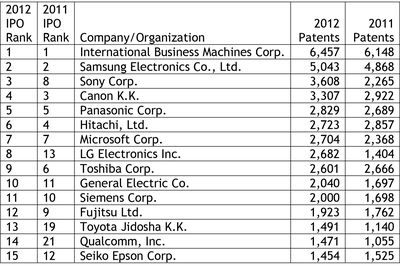
    that issued in 2011.  The top fifteen
    companies on the IPO Top 300 are listed below (click on table to expand):

    Top 15
    Falling out of the Top 15
    in 2012 were Hewlett-Packard Co. and AT&T Corp., which dropped to 16th and
    18th, respectively.

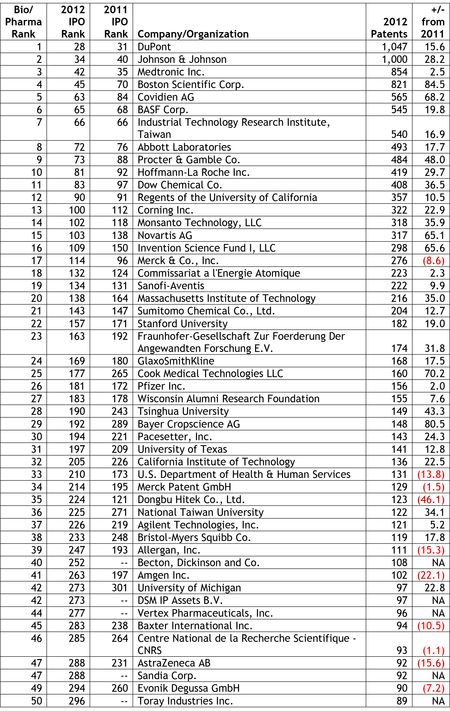
    As in past years, Patent Docs used the IPO's list of top
    patent holders to compile a list of the top "life sciences" companies
    and organizations receiving U.S. patents in 2012.  In the past six years, the number of life
    sciences companies and organizations making the list has gone from 51 in 2006
    to 47 in 2007, 43 in 2008, 47 in 2009, 56 in 2010, 53 in 2011, and 50 last
    year.  Each organization's IPO top 300 ranking
    for 2012 is indicated in the "2012 IPO Rank" column; the IPO top 300
    ranking for 2011 (if available) is indicated in the "2011 IPO Rank"
    column; and the change in number of patents from 2011 is indicated in "+/-
    from 2011."  The Life Sciences Top
    50 is listed below (click on table to expand):

    2012 Top 50 Life Sciences
    Life sciences companies and
    organizations that failed to make the IPO top 300 in 2012 after making it in
    2011 included Cardiac Pacemakers, Inc. (#90 on the IPO top 300 for 2011), Japan
    Science and Technology Agency (256), University of Illinois (274), University
    of South Florida (281), Advanced Cardiovascular Systems, Inc. (283), Genentech,
    Inc. (296), General Hospital Corp. (298), and National Institute of Advanced
    Industrial Science and Technology (299). 
    Becton, Dickinson and Co. and Vertex Pharmaceuticals, Inc. returned to
    the Top 300 after a one year hiatus.

    Please note that some of
    the companies and organizations listed above may be involved in work outside
    the life sciences sector, and therefore, a portion of the patents granted to
    these companies and organizations may be directed to other than life sciences-related
    inventions.  In addition, our list is a
    little inclusive in that we included medical device companies.

    For additional information regarding this topic, please see:

    • "Another Look at IPO Top 300 and Life Sciences Top 53," June 11, 2012
    • "IPO Releases List of Top 300 Patent Holders for 2011," June 7, 2012
    • "IPO Releases List of Top 300 Patent Holders for 2010," June 30, 2011
    • "IPO Releases List of Top 300 Patent Holders for 2009," May 26, 2010
    • "IPO Releases List of Top 300 Patent Holders for 2008," May 14, 2009
    • "IPO Releases List of Top 300 Patent Holders," May 22, 2008
    • "IPO Posts List of Top 300 Patent Holders," April 20, 2007

  • By Sherri Oslick

    Gavel About Court Report:  Each week we will report briefly on recently filed biotech and pharma cases.

    Alza
    Corp. et al. v. Par Pharmaceutical Inc. et al.

    1:13-cv-01104;
    filed June 19, 2013 in the District Court of Delaware

    • Plaintiffs: 
    Alza Corp.; Janssen Pharmaceuticals Inc.
    • Defendants: 
    Par Pharmaceutical Inc.; Actavis Elizabeth LLC; Actavis Inc.

    Infringement
    of U.S. Patent No. 8,163,798 ("Methods and Devices for Providing Prolonged
    Drug Therapy," issued April 24, 2012) following a Paragraph IV
    certification as part of Par's filing of an ANDA to manufacture a generic
    version of Alza's Concerta® (methylphenidate hydrochloride, used to treat
    attention deficit hyperactivity disorder). 
    View the complaint here.


    Kissei
    Pharmaceutical Co. Ltd. et al. v. Hetero USA Inc., et al.
    1:13-cv-01091;
    filed June 17, 2013 in the District Court of Delaware

    • Plaintiffs: 
    Kissei Pharmaceutical Co. Ltd.; Watson Laboratories Inc.; Actavis Inc.
    • Defendant:  Sandoz
    Inc.

    Kissei
    Pharmaceutical Co. Ltd. et al. v. Sandoz Inc.

    1:13-cv-01092;
    filed June 17, 2013 in the District Court of Delaware

    • Plaintiffs: 
    Kissei Pharmaceutical Co. Ltd.; Watson Laboratories Inc.; Actavis Inc.
    • Defendants: 
    Hetero USA Inc.; Hetero Labs Limited; Hetero Labs Ltd., Unit III

    The
    complaints in these cases are substantially identical.  Infringement of U.S. Patent No. 5,387,603 ("1,5,7-Trisubstituted
    Indoline Compounds and Salts Thereof," issued February 7, 1995) following
    a Paragraph IV certification as part of Hetero's filing of an ANDA to
    manufacture a generic version of Watson's Rapaflo® (silodosin, used to treat benign
    prostatic hyperplasia).  View the Hetero complaint here.


    AbbVie Inc.
    v. Mylan Pharmaceuticals Inc.

    1:13-cv-01072;
    filed June 14, 2013 in the District Court of Delaware

    Infringement
    of U.S. Patent Nos. 6,232,333 ("Pharmaceutical Composition," issued
    May 15, 2001), 7,141,593 ("Pharmaceutical Formulations," issued
    November 28, 2006), and 7,432,294 (same title, issued October 7, 2008)
    following a Paragraph IV certification as part of Mylan's filing of an ANDA to
    manufacture a generic version of AbbVie's Norvir® (ritonavir, used to treat
    human immunodeficiency virus (HIV) infection). 
    View the complaint here.


    Insite Vision
    Inc. et al. v. Mylan Pharmaceuticals Inc. et al.

    3:13-cv-03720;
    filed June 14, 2013 in the District Court of New Jersey

    • Plaintiffs: 
    Insite Vision Inc.; Merck Sharp & Dohme Corp.; Inspire
    Pharmaceuticals, Inc.; Pfizer Inc.
    • Defendants: 
    Mylan Pharmaceuticals Inc.; Mylan Inc.

    Infringement
    of U.S. Patent Nos. 6,861,411 ("Method of Treating Eye Infections with
    Azithromycin," issued March 1, 2001), 6,239,113 ("Topical Treatment
    or Prevention of Ocular Infections," issued May 29, 2001), 6,569,443 (same
    title, issued May 27, 2003), and 7,056,893 (same title, issued June 6, 2006),
    licensed to Inspire (now Merck), following a Paragraph IV certification as part
    of Mylan's filing of an ANDA to manufacture a generic version of Merck's
    AzaSite® (azithromycin, used to treat bacterial conjunctivitis).  View the complaint here.


    Senju
    Pharmaceutical Co., Ltd v. Apotex Inc. et al.

    1:13-cv-04132;
    filed June 14, 2013 in the Southern District of New York

    • Plaintiff: 
    Senju Pharmaceutical Co., Ltd.
    • Defendants: 
    Apotex Inc.; Apotex Corp.; Ista Pharmaceuticals, Inc; Bausch & Lomb
    Inc.

    Infringement
    of U.S. Patent No. 6,335,335 ("Prolonged-Action Eye Drop," issued
    January 1, 2002) following a Paragraph IV certification as part of Apotex's
    filing of an ANDA to manufacture a generic version of Senju's Istalol® (timolol
    maleate ophthalmic solution, 0.5%, used treat elevated intraocular pressure in
    patients with ocular hypertension or open-angle glaucoma).  View the complaint here.

  • CalendarJune 25, 2013 – AIA Impact on Section 103 and Non-Obviousness:
    Navigating Timing Changes, Post-AIA Treatment of KSR, and Secondary Considerations to Meet Patent Validity
    Requirements
    (Strafford) – 1:00 – 2:30 pm (EDT)

    June 25-26, 2013 – Maximising
    Pharma Patents
    (C5 (UK)) – London, England

    June 26, 2013 – The Supreme
    Court Decision(s) in Myriad: What Did
    the Justices Say? What Does It Mean for Industry?
    (Foley
    & Lardner) – 12:00
    to 1:15 pm (Eastern)

    July 1-2, 2013 – TTS Europe (TTS Ltd. and Wellcome Trust) – London, UK

    July 10, 2013 – CLS Bank v. Alice Corp.: Navigating Patent
    Eligibility of Software-Related Inventions Absent Clear Guidance
    (Strafford) – 1:00 to 2:30 pm (EDT)

    July
    10-12, 2013 – Fundamentals of Patent Prosecution
    2013: A Boot Camp for Claim Drafting & Amendment Writing
    (Practising
    Law Institute) – San Francisco, CA

    July 11, 2013 – Biotechnology Patents at the U.S. Supreme
    Court: 2012-2013 Term
    (McDonnell
    Boehnen Hulbert & Berghoff LLP) – 10:00 to 11:15 am
    (CT)

    July 15-16, 2013 – Global Patenting Strategy and Practice (American Conference
    Institute) – New
    York, NY

    July 15-19, 2013 – Patent Law Summer
    Intensive
    (Benjamin N. Cardozo School of Law) – New York, NY

    July 17-18, 2013 – Legal
    and Regulatory Summit on Generic Drugs
    (American Conference
    Institute) – New York, NY

    July 28-30, 2013 – 2013 Annual Meeting & Conference (National Association of Patent Practitioners) – San
    Diego, CA

    July 31 to August 2, 2013 – Advanced Patent Law Seminar (Chisum Patent Academy) – Seattle, WA

    August 5-7, 2013 – Advanced Patent Law Seminar (Chisum Patent Academy) – Seattle, WA

    ***Patent Docs is a media partner of this conference or CLE

  • New York #1American Conference
    Institute (ACI) will be holding its Legal
    and Regulatory Summit on Generic Drugs on July 17-18, 2013 in New York,
    NY.  ACI faculty will help attendees:

    • Adapt to the implementation
    and economic impacts of the Generic Drug User Fee Amendments
    • Understand the
    opportunities and challenges presented by the Health Care Reform Law's provisions
    on generic drug reimbursement
    • Prepare for the viability and exposure of product liability claims against
    generic companies
    • Comply with new FDA
    regulations and comprehend the impact of structural changes at FDA's Office of
    Generic Drugs
    • Devise tactics to
    overcome REMS roadblocks
    • Anticipate the
    possible repercussions of the U.S. Supreme Court's pending decision on reverse
    settlement payments in the Watson case
    • Understand the partnership
    decisions that can advance your biosimilars agenda
    • Grasp the nuances
    of breaking developments in Hatch-Waxman litigation that extend beyond IP

    BrochureIn particular,
    ACI's faculty will offer presentations on the following topics:

    • The politics and policy of the generic drug
    industry: Understanding the role of the 113th Congress in shaping the future of
    generic pharma
    • The game changer: Analyzing the legal and
    business impact of the generic drug user fee amendments
    • Breaking developments in Hatch-Waxman
    litigation . . . Paragraph IV disputes and beyond
    • Examining branded-generic alliances that
    maximize the potential of biosimilars and minimize investment risks
    • Reverse payments update: Key strategies to
    bring to the settlement table
    • The evolution of authorized generics
    agreements including new controversies under health care reform
    • A view from the bench: The judges speak on
    major developments in case law impacting the pharmaceutical industry
    • Developing strategies for bypassing
    roadblocks to REMS-controlled drugs access
    • How generic companies are defending against
    evolving theories of products liability law following Pliva v. Mensing
    • Protecting your company from price erosion
    through improved pricing reimbursement strategies tailored to the generics
    industry
    • Insights from the office of generic drugs
    • Eyes on the 180-day prize: Identifying current
    and future trends to successfully position your generic pipeline strategy

    Two pre-conference workshops
    will be held on July 16, 2013.  The first,
    entitled "Industry Roundtable:
    Addressing the Day to Day Legal, Regulatory, and Business Challenges of Generic
    Manufacturers," will be offered from 10:00 am to 12:00 pm.  The second, entitled "Business Development Master Class: In-House
    Counsel Perspectives on Selecting and Evaluating Outside Counsel,"
    will be offered from 2:00 pm to 4:00 pm.

    ACI - American Conference InstituteThe agenda for the Legal and Regulatory Summit on Generic Drugs
    can be found here,
    and additional information about the post-conference workshops can be found
    here.  A complete brochure for this conference,
    including an agenda, detailed descriptions of conference sessions, list of
    speakers, and registration form can be obtained here.

    The registration
    fee for the conference is $2,295 (conference alone), $2,695 (conference and one
    workshop), or $2,895 (conference and both workshops).  Those registering by June 26, 2013 will
    receive a $200 discount.  Those
    interested in registering for the conference can do so here,
    by e-mailing CustomerService@AmericanConference.com, by calling 1-888-224-2480,
    or by faxing a registration form to 1-877-927-1563.

  • By
    Andrew Williams

    When
    is a combination of two separate treatments for a particular disease obvious-to-try,
    such that it is rendered obvious for the purposes of patentability?  The Supreme Court answered this question in KSR Int'l Co. v. Teleflex Inc., 550 U.S.
    398 (2007), when it said that "obvious to try might show that [the
    combination] was obvious . . . [if] there are a finite number of identified,
    predictable solutions."  Id. at 421.  Therefore, the answer appears to turn on
    predictability.  Correspondingly, in its
    third Novo Nordisk A/S v. Caraco Pharm.
    Labs. Ltd.
    opinion, rendered earlier this week, the Federal Circuit found
    no error in the lower court's finding that the synergistic effects of two Type
    II Diabetes treatments were predictable, thereby rendering the combination
    obvious.  However, at the same time, the
    Court appeared to criticize almost all of the studies by (or cited by) Novo
    that supported this "obvious" synergistic effect, and found that
    there were plenty of other studies that had contradictory results.  This, of course, begs the question that, if
    such unexpected results were predictable before the invention, why were they so
    difficult to establish after the invention. 
    Judge Newman provided a dissent to the obviousness determination because
    she felt that the lower court did not address the correct question:  "whether
    it was obvious that the combination of metformin and repaglinide would exhibit
    synergism and that the combination would be 800% more effective than the
    additive effect of the components separately."  She found sufficient evidence in the record
    to answer this question in the negative, and would therefore have upheld the
    validity of the patent.

    Novo NordiskAs
    alluded to above, this Novo case has
    had an extensive history, including a stop last year at the Supreme Court.  We provided analysis at the time of the
    Supreme Court's opinion (see "Caraco Pharmaceutical Laboratories, Ltd. v. Novo Nordisk A/S (2012)"), as well as the two previous Federal Circuit opinions (see "Novo Nordisk A/S v. Caraco Pharmaceutical Laboratories, Ltd. (Fed. Cir. 2010)" and "Novo Nordisk A/S v. Caraco Pharmaceutical Laboratories, Ltd. (Fed. Cir. 2012)"),
    so this post will only provide enough introduction for the proper context of
    this case.  Novo markets the drug PRANDIN®
    for the treatment of Type 2 (adult-onset) diabetes.  Repaglinide is the active ingredient in
    PRANDIN®, and the use of repaglinide in combination with metformin
    is covered by U.S. Patent No. 6,677,358 ("the '358 patent").  The previous Supreme Court decision stemmed
    from Caraco's ANDA filing to market a generic Repaglinide monotherapy, which
    contained a Section viii statement to "carve-out" the '358 patent's
    claimed method of use.  However, because
    Novo had provided a use code for the Orange Book listing broad enough to cover
    the non-patented uses, the FDA rejected Caraco's carve-out label.  Ultimately, the Supreme Court held that 21
    U.S.C. § 355(j)(5)(c)(ii)(I) provided an ANDA applicant an opportunity to
    challenge inaccurate use codes and designations, and as a result, the use code
    for PRANDIN® now reads "Patented Method of Using Repaglinide in
    Combination With Metformin as Indicated For Improving Glycemic Control in
    Adults with Type 2 Diabetes Mellitus." 
    Nevertheless, according to statements made during the oral argument for
    the present case, Caraco had not been successful in receiving FDA approval for
    the Repaglinide monotherapy.  Therefore,
    the validity of claim 4 of the '358 patent was apparently the only remaining obstacle
    for the approval of Caraco's ANDA.

    Claim
    4 of the '358 patent reads:

    4.    A method for treating
    non-insulin dependent diabetes mellitus (NIDDM) comprising administering to a
    patient in need of such treatment repaglinide in combination with metformin.

    Repaglinide
    falls within the functional class referred to as "insulin secretagogues,"
    which work by stimulating insulin release from pancreatic beta cells.  There are two subclasses of secretagogues:
    meglitinides (of which repaglinide is an example) and sulfonylureas (of which
    glyburide is an example).  However, according
    to a prior art article, Wolffenbuttel B.H.R. et al., Eur. J. Clin. Pharmacol. 45(2):113-16 (1993), repaglinide "differs
    from the sulfonylureas in its molecular structure, profile of action, and
    excretion mechanism."  For example,
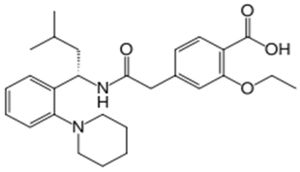
    the structure of repaglinide is:

    Repaglinide
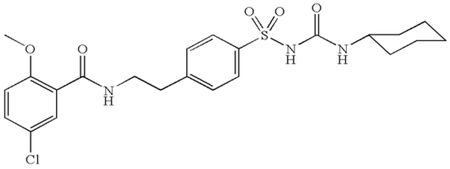
    while
    the structure of  glyburide is:

    Glyburide
    Metformin,
    on the other hand, falls within the functional class of "insulin
    sensitizers," a class which works to reduce insulin resistance by acting
    on the liver to reduce insulin production. 
    This improves sensitivity in muscle and fat tissue.

    Repaglinide
    was found to be rapid and short acting, and therefore quickly eliminated from
    the body.  Therefore, its value as a
    pharmaceutical was questioned. 
    Nevertheless, the inventors of the '358 patent conducted a study on
    Australian patients ("the Moses Study") which showed that, when given
    the combination of repaglinide and metformin, the fasting plasma glucose ("FPG")
    levels of patients that had failed on metformin alone decreased eight times
    lower than what was typically achieved by metformin alone.  This was particularly surprising, because repaglinide
    on its own actually tended to increase patient's FPG levels.  Therefore, the scientists concluded that the
    combination therapy yielded a synergistic effect (instead of an additive
    effect), because the effect of the combination exceeded the sum of the
    separately administered effect.

    Based
    on the Moses study, Novo filed a provisional application, to which the '358
    patent claimed priority.  During
    prosecution of the resulting non-provisional patent application, the examiner
    rejected the claims four times, reasoning that it would have been obvious to
    try combining the two drugs, because it was predictable that there would be at
    least an additive effect.  In its fifth
    response, Novo filed a declaration by Dr. Sturis, in which he disclosed results
    of a test with "Zucker obese rats." 
    The rats were divided into four groups, one of which received a placebo,
    two of which received either repaglinide or metformin alone, and the last of
    which received the combination.  The
    blood glucose levels were measured at various time points, and the area under
    the curve calculated.  According to the
    results, the combination therapy proved to be more effective than the "hypothetical
    additive effect" of the two drugs, with a p-value of 0.061 (just shy of
    statistical significance).  However, when
    the final time point of 120 minutes was considered alone, the p-value related
    to the synergistic effect was 0.02, in other words, it was statistically
    significant.  The examiner withdrew the
    rejection based solely on Dr. Sturis' declaration, and the patent ultimately
    issued as the '358 patent.

    Caraco Pharmaceutical LaboratoriesAs
    also alluded to earlier, Caraco filed an ANDA in 2005 requesting approval to
    sell a generic version of repaglinide. 
    Caraco certified that that the '358 patent was either invalid or not
    infringed, and after Novo filed suit alleging that claim 4 was infringed,
    Caraco counterclaimed that the patent was, inter
    alia
    , obvious and unenforceable.  The
    lower court sided with Caraco on both of these points, and Novo appealed.

    Obviousness: Obvious
    to Try

    Novo's
    strongest argument related to the obviousness of claim 4 was that the lower
    court did not properly review the scope and content of the prior art.  Specifically, the lower court considered that
    the closest prior art was the combination therapy using metformin and
    sulfonylurea, but did not consider repaglinide's known efficacy as a
    monotherapy.  The lower court justified
    its analysis because the sulfonylureas are secretagogues, just like repaglinide,
    and therefore repaglinide (supposedly) would have a similar mechanism of
    action.  And, because the combination of
    metformin and one of the sulfonylureas were well known in the art to produce
    beneficial, and even synergistic, results, it would have been predictable that
    the claimed combination would also have had synergistic results, at least enough
    to make the combination obvious to try. 
    The Federal Circuit found no clear error with this finding.

    However,
    as highlighted by Judge Newman's dissent, repaglinide is not structurally
    similar to the sulfonylureas, and the action profile of these two subclasses in
    the body are different.  Instead of
    finding support that these chemically distinct molecules would behave similarly
    on pancreatic beta cells, the District Court apparently assumed that because
    the effect that these two subclasses have on such cells is similar (stimulating
    insulin release), they must act in the same way.  But the lower court apparently did not consider
    the Wolffenbuttel article, which suggested just the opposite — that the two
    subclasses act differently.  Also,
    according to Judge Newman, not all sulfonylureas exhibit synergy when combined
    with metformin, thereby making the predictability of the repaglinide/metformin
    synergy even more suspect.  As Judge
    Newman put it, the District Court concluded that one skilled in the art would "perhaps"
    have expected the synergistic results of the claimed combination, but "perhaps"
    is not sufficient to overcome the clear and convincing evidentiary hurdle.

    Perhaps
    more surprising, all of the studies that Novo cited as demonstrating the
    unexpected synergistic results were criticized by the District Court.  Other than the Moses study, which showed an
    eight-fold reduction in FPG levels, the lower court did not find a single study
    that established that the repaglinide/metformin combination would be
    synergistic.  For example, it was pointed
    out that the Sturis declaration study in rats did not result in a statistically
    significant outcome as the experiment was designed, and the only way to obtain a
    significant result statistically was to cherry pick the data from the last time
    point (120 minutes).  In addition,
    another study (the Pfeiffer study) compared insulin sensitivity of eleven
    patients, and the combination therapy resulted in a 35% improvement over
    patients on metformin alone.  However,
    these results were downplayed because of the small sample size.  Even the Moses study itself was criticized
    because the near-term and long-term benefits observed were "generally
    inferior" to those of the combination of metformin with
    sulfonylureas.  In fact, the lower court
    noted that other tests contradicted the positive results obtained from these
    three cited studies.  It is curious that
    the lower court could have made a determination that such a synergistic result
    was predictable so as to make the combination obvious to try when it apparently
    had concerns with any study used to find unexpected result after the fact.

    To
    be clear, the Federal Circuit thought that the record was clear that there
    were, in fact, synergistic results based on the combination.  In fact, during oral argument, when Caraco's
    counsel appeared evasive on acknowledging that such synergistic results existed,
    Judge Newman told him that "[i]f your case turns on whether there is or is
    not synergism, I think you might as well sit down."  Not to be outdone,
    during the same questioning regarding whether there were synergistic results,
    Judge Dyk exclaimed:  "The answer is "yes," of course there is
    synergistic results  . . . Why are you
    fighting that?  Isn't that true? . . . The
    record establishes it, what are you arguing . . . I don't know why you are
    fighting this."  Therefore, the only
    question should have been whether these synergistic results were predictable,
    and it is unclear that they were.

    As
    Judge Newman pointed out, the lower court and the majority used the inventors'
    exceptional intellect against them, because they had tried this particular
    combination.  However, the proper legal
    test is not whether it would have been "obvious to try" for the
    inventors, but rather whether one skilled in the art would have found the
    combination obvious to try.  If the
    former were the case, Judge Newman explained, than "[s]uch a thesis would
    expunge patentability for all except random observations."  It appears that the Court may have used hindsight
    reasoning to reach its conclusion, which is of course inappropriate.

    Burden
    of Proof

    Novo
    also argued that the District Court misallocated the burden of persuasion,
    thereby forcing Novo to "overcome" Caraco's "prima facie"
    case of obviousness.  The argument was
    based primarily on the particular wording in the lower court's opinion.  Nevertheless, the Federal Circuit did not
    agree.  Instead, after Caraco had
    presented its case, Novo had the burden of production to come forward with
    evidence to rebut the "prima facie" case.  Nevertheless, the burden of persuasion never
    shifted, remaining with Caraco to establish obviousness by clear and convincing
    evidence.

    Deference
    to the Office

    Novo
    finally argued that the District Court should have deferred to the examiner's
    original findings that the cited studies demonstrated unexpected results of
    synergy.  As support, Novo cited to Kappos v. Hyatt, 132 S. Ct. 1690
    (2012).  However, the Federal Circuit
    pointed out that Novo inverted the holding of that case, which instead stated
    that no deference should be given to the Office's factual findings when those
    findings are contradicted by new evidence. 
    Novo appeared to be suggesting that the reverse also holds, and that if
    there is no new evidence, there should deference given.  This does not necessarily follow.  But, more importantly, the Hyatt case, and others like it, were
    concerned with review of a PTO rejection in Federal Court, not with an alleged
    infringer's challenge to an issued patent. 
    Instead, the presumption of validity applies to such a patent, but no
    additional deference to the Patent Office's findings need be given.

    Inequitable
    Conduct

    The
    lower court had also found that the '358 patent was unenforceable due to
    inequitable conduct during its prosecution. 
    These allegations stemmed from the Sturis Declaration.  Specifically, Caraco alleged that not
    informing the Patent Office that Dr. Sturis' original test protocol did not
    include looking at individual time points, and that therefore none of the
    findings originally sought were statistically significant, amounted to fraud on
    the Office.  In addition, the prosecuting
    attorney, Dr. Richard Bork, made statements suggesting that the Sturis
    Declaration provides clear evidence of synergy, which according to Caraco
    overstated the evidence.  Because the
    examiner acknowledged that the rejection was withdrawn because of the Sturis
    Declaration, Caraco continued, the Therasense
    "but for" materiality standard was satisfied.  The District Court agreed with Caraco.

    The
    Federal Circuit was less convinced. 
    First, with regard to the Sturis Declaration, the Court found that the
    omission of the original test protocol was slightly troubling, but that it did
    not qualify as "but for" materiality. 
    This was not a case in which adverse results were hidden in favor of
    more positive data.  Nor did the omission
    undermine the opinion stated in the declaration.  Bascially, Dr. Sturis was accused of failing
    to notify the Patent Office that the original test plan did not include the
    data calculation at 120 minutes.  Even
    though this ideally should have been disclosed, the Federal Circuit found it to
    be a non-material omission.  Moreover,
    with regard to Dr. Bork's statements during prosecution, the Court found them
    troubling but not material.  Important in
    this determination was that Dr. Bork referred to Dr. Sturis' test results as "evidence"
    rather than "proof."  In fact,
    during oral argument, the panel noted that such grandiose statements are often
    made by attorneys, and did not even Caraco's counsel make the same type of
    statements before the Court? 
    Nevertheless, going forward, it is probably advisable for anyone
    prosecuting before the Office to speak of "evidence" when referring
    to test data, and to avoid making the conclusion that the data is definitive
    proof.

    It
    would, therefore, appear that the saga of Novo v. Caraco is coming to a
    close.  With claim 4 of the '358 patent
    invalidated, there would appear to be no more barriers remaining to the
    approval of Caraco's ANDA.  Of course,
    there is always the possibility of another trip to the Supreme Court, however
    unlikely that may be.

    Novo Nordisk A/S v.
    Caraco Pharmaceutical Laboratories, Ltd.
    (Fed. Cir.
    2013)

    Panel:
    Circuit Judges Newman, Dyk, and Prost
    Opinion
    by Circuit Judge Prost; opinion concurring in part and dissenting in part by Circuit
    Judge Newman

  • By
    Kevin E. Noonan

    MyriadThe
    Supreme Court's decision in the Myriad case has been almost universally
    hailed as being a great victory for patients, doctors, personalized medicine, and research.  Precluding patenting for "merely"
    isolated human DNA, while permitting cDNA to be patent-eligible, is seen as
    being a rational compromise ("The Supreme Court got it exactly right,"
    according to amicus Eric Lander of the Broad Institute) and no less a legal
    luminary than Nina Totenberg has said that the decision has "enormous implications for the future of personalized
    medicine and in many ways is likely to shape the future of science and
    technology."  Medical practitioners
    and media pundits agree: with this decision, the Court swept away a significant
    barrier to patient access for BRCA gene tests and, by implication, genetic
    testing more generally.  Indeed, several
    genetic analysis companies (including Ambry Genetics, and of course Dr. Harry Ostrer, the
    only plaintiff with standing to sue), announced plans to offer BRCA gene
    testing.

    The natural question to ask is:  are
    all these "experts" correct?  The answer may surprise you.  During oral argument before the Federal Circuit the first time the case
    came before the appellate court, Gregory Castanias, representing Myriad, argued that the
    plaintiffs did not have standing to bring the lawsuit under the doctrine of
    redressability.  The plaintiffs would not
    be able to perform genetic diagnostics on the BRCA genes, according to Mr.
    Castanias, because Myriad's patents contained additional method claims of
    different scope (other than the claims targeted by plaintiffs in their lawsuit)
    that Myriad could assert against Dr. Harry Ostrer.  Specifically, the District Court and the
    Federal Circuit recognized that the claims put at issue by plaintiffs were
    generally directed broadly to "comparing" a patient's BRCA gene
    sequence with a wildtype sequence, which failed the then-prevailing "machine
    or transformation" test for patent-eligibility of method claims.  Claim 1
    of U.S. Patent No. 6,033,857 is illustrative of the invalidated claims:

    1.  A method for identifying a mutant BRCA2
    nucleotide sequence in a suspected mutant BRCA2 allele which comprises
    comparing the nucleotide sequence of the suspected mutant BRCA2 allele with the
    wild-type BRCA2 nucleotide sequence, wherein a difference between the suspected
    mutant and the wild-type sequences identifies a mutant BRCA2 nucleotide
    sequence.

    Whether Mr. Castanias is correct depends on how the
    Court's Mayo v. Prometheus and Myriad decisions affect the
    patent-eligibility of these remaining claims.  These claims include claims 3, 4, and 9 of U.S. Patent 5,709,999:

    3.  A method for detecting a germline
    alteration in a BRCA1 gene, said alteration selected from the group consisting
    of the alterations set forth in Tables 12A, 14, 18 or 19 in a human which
    comprises analyzing a sequence of a BRCA1 gene or BRCA1 RNA from a human sample
    or analyzing a sequence of BRCA1 cDNA
    made from mRNA from said human sample with the proviso that said germline
    alteration is not a deletion of 4 nucleotides corresponding to base numbers
    4184-4187 of SEQ ID NO:1, which comprises analyzing
    BRCA1 RNA from the subject
    and wherein a germline alteration is detected by
    hybridizing a BRCA1 gene probe which
    specifically hybridizes to nucleic acids containing at least one of said
    alterations and not to wild-type BRCA1 sequences to RNA isolated from said
    human sample
    and detecting the presence of a hybridization product, wherein
    the presence of said product indicates the presence of said alteration in said
    RNA and thereby the presence of said germline alteration in said sample.

    4.  A method for detecting a germline
    alteration in a BRCA1 gene, said alteration selected from the group consisting
    of the alterations set forth in Tables 12A, 14, 18 or 19 in a human which
    comprises analyzing a sequence of a BRCA1 gene or BRCA1 RNA from a human sample
    or analyzing a sequence of BRCA1 cDNA
    made from mRNA from said human sample with the proviso that said germline
    alteration is not a deletion of 4 nucleotides corresponding to base numbers
    4184-4187 of SEQ ID NO:1,wherein a germline alteration is detected by obtaining a first BRCA1 gene fragment from a
    BRCA1 gene isolated from said human sample and a second BRCA1 gene fragment
    from a wild-type BRCA1 gene
    , said second fragment corresponding to said
    first fragment, forming single-stranded
    DNA from said first BRCA1 gene fragment and from said second BRCA1 gene
    fragment
    , electrophoresing said
    single-stranded DNAs on a non-denaturing polyacrylamide gel
    , comparing the mobility of said
    single-stranded DNAs on said gel to determine if said single-stranded DNA from
    said first BRCA1 gene fragment is shifted relative to said second BRCA1 gene
    fragment
    and sequencing said
    single-stranded DNA from said first BRCA1 gene fragment having a shift in
    mobility
    .

    9.  A method for detecting a germline
    alteration in a BRCA1 gene, said alteration selected from the group consisting
    of the alterations set forth in Tables 12A, 14, 18 or 19 in a human which
    comprises analyzing a sequence of a BRCA1 gene or BRCA1 RNA from a human sample
    or analyzing a sequence of BRCA1 cDNA
    made from mRNA from said human sample with the proviso that said germline
    alteration is not a deletion of 4 nucleotides corresponding to base numbers
    4184-4187 of SEQ ID NO:1, wherein a germline alteration is detected by forming a heteroduplex consisting of a first
    strand of nucleic acid selected from the group consisting of BRCA1 gene genomic
    DNA fragment isolated from said sample, BRCA1 RNA fragment isolated from said
    sample and BRCA1 cDNA fragment made from mRNA from said sample and a second
    strand of a nucleic acid consisting of a corresponding human wild-type BRCA1
    gene fragment
    , analyzing for the
    presence of a mismatch in said heteroduplex
    , and sequencing said first strand of nucleic acid having a mismatch.

    Claim 10 from U.S. Patent No. 5,710,001:

    10.  A method for screening a tumor sample
    from a human subject for a somatic alteration in a BRCA1 gene in said tumor
    which comprises gene comparing a first sequence selected form the group
    consisting of a BRCA1 gene from said tumor sample, BRCA1 RNA from said tumor
    sample and BRCA1 cDNA made from mRNA from
    said tumor sample
    with a second sequence selected from the group consisting
    of BRCA1 gene from a nontumor sample of said subject, BRCA1 RNA from said
    nontumor sample and BRCA1 cDNA made from
    mRNA from said nontumor sample
    , wherein a difference in the sequence of the
    BRCA1 gene, BRCA1 RNA or BRCA1 cDNA from said tumor sample from the sequence of
    the BRCA1 gene, BRCA1 RNA or BRCA1 cDNA from said nontumor sample indicates a
    somatic alteration in the BRCA1 gene in said tumor sample,  wherein the nucleic acid sequence is compared
    by molecularly cloning all or part of
    the BRCA1 gene from said tumor sample and from said nontumor sample to produce cloned nucleic acids and sequencing the cloned nucleic acids.

    Claim 9 of U.S. Patent No. 5,753,441:

    9.  A method for screening germline of a
    human subject for an alteration of a BRCA1 gene which comprises comparing
    germline sequence of a BRCA1 gene or BRCA1
    RNA from a tissue sample from said subject
    or a sequence of BRCA1 cDNA made from mRNA from said sample
    with germline sequences of wild-type BRCA1 gene
    , wild-type BRCA1 RNA or
    wild-type BRCA1 cDNA, wherein a difference in the sequence of the BRCA1 gene,
    BRCA1 RNA or BRCA1 cDNA of the subject from wild-type indicates an alteration
    in the BRCA1 gene in said subject, wherein a germline nucleic
    acid sequence is compared by amplifying
    all or part of a BRCA1 gene
    using a primer
    specific for a specific BRCA1 mutant allele
    and detecting the presence of an amplified product, wherein the
    presence of said product indicates the presence of said specific allele.

    And claim 4 of U.S. Patent No. 6,033,857:

    4.  A method for diagnosing a
    predisposition for breast cancer in a human subject which comprises comparing
    the germline sequence of the BRCA2 gene or the
    sequence of its mRNA
    [= cDNA] in a tissue sample from said subject with the
    germline sequence of the wild-type BRCA2 gene or the sequence of its mRNA,
    wherein an alteration in the germline sequence of the BRCA2 gene or the
    sequence of its mRNA [= cDNA] of the subject indicates a predisposition to said
    cancer, wherein the detection in the alteration in the germline sequence is
    determined by an assay selected from the group consisting of
        (a) observing shifts
    in electrophoretic mobility
    of single-stranded DNA on non-denaturing
    polyacrylamide gels,
        (b) hybridizing a BRCA2 gene probe to genomic DNA
    isolated from said tissue sample,
        (c) hybridizing an allele-specific probe to genomic
    DNA of the tissue sample,
        (d) amplifying
    all or part of the BRCA2 gene
    from said tissue sample to produce an
    amplified sequence and sequencing the
    amplified sequence
    ,
        (e) amplifying
    all or part of the BRCA2 gene from said tissue sample using primers for a specific BRCA2 mutant allele,
        (f) molecularly
    cloning all or part of the BRCA2 gene
    from said tissue sample to produce a
    cloned sequence and sequencing the cloned sequence,
        (g) identifying a mismatch between (1) a BRCA2 gene
    or a BRCA2 mRNA isolated from said tissue sample, and (2) a nucleic acid probe
    complementary to the human wild-type BRCA2 gene sequence, when molecules (1)
    and (2) are hybridized to each other to form a duplex,
        (h) amplification of BRCA2 gene sequences in said
    tissue sample and hybridization of the amplified sequences to nucleic acid
    probes which comprise wild-type BRCA2 gene sequences,
        (i) amplification of BRCA2 gene sequences in said
    tissue sample and hybridization of the amplified sequences to nucleic acid
    probes which comprise mutant BRCA2 gene sequences,
        (j) screening for a deletion mutation in said
    tissue sample,
        (k) screening for a point mutation in said tissue
    sample,
        (l) screening for an insertion mutation in said
    tissue sample, and
    (m) in situ
    hybridization
    of the BRCA2 gene of said tissue sample with nucleic acid
    probes which comprise the BRCA2 gene.

    The italicized portion of these claims constitute
    affirmative limitations that are more than merely comparing two sequences, the
    deficiency that formed the basis for the Federal Circuit to affirm the District
    Court's invalidation of these claims.  As
    stated in Justice Thomas' opinion:

    [T]his case
    does not involve patents on new applications of knowledge about the BRCA1 and
    BRCA2 genes.  Judge Bryson aptly noted that, "[a]s the first party
    with knowledge of the [BRCA1 and BRCA2] sequences, Myriad was in an excellent
    position to claim applications of that knowledge.  Many of its unchallenged
    claims are limited to such applications."

    These methods are clearly "applications"
    of the "knowledge of the [BRCA1 and BRCA2] sequences" and constitute
    applications to which the unchallenged claims are limited.  The Court's Myriad decision not only does not
    preclude patent-eligibility for these claims, it affirmatively suggests that
    claims to such applications (particularly when directed to using cDNA) are the
    type of claims the Court believes do not suffer from the deficiencies the Court
    found attached to claims to "merely" isolated genomic DNA.

    Supreme Court Courtroom_cBut what of the effects of the Court's Mayo decision?  Recall that Justice Breyer's opinion (like Myriad, for a unanimous Court) mandates
    that to be patent eligible a claim cannot merely recite a law of nature and
    direct that it be applied.  Claims
    to "a process that focuses upon the use of a natural law must also contain other
    elements or a combination of elements, sometimes referred to as an 'inventive
    concept,' sufficient to ensure that the patent in practice amounts to
    significantly more than a patent upon the natural law itself."  Here, the "law of
    nature" would putatively be the correlation between certain alterations
    in the sequence of the BRCA 1 or BRCA 2 genes with an increased risk or
    predilection for developing breast or ovarian cancer.  An important part of the Court's reasoning
    concerning the patent-ineligibility of the claims at issue in Mayo is that the limitation(s) in the
    claims relating to detection methods were not specified or limited to any
    specific methods.  Moreover, both
    administration of 6-thioguanine (6-TG) to patients and assaying blood from such
    patients for 6-TG or its metabolites was "well-understood, routine and
    conventional" and had been "previously
    engaged in by researchers in the field."  In Mayo,
    "scientists already understood that the levels in a
    patient's blood of certain metabolites, including, in particular, 6-thioguanine
    and its nucleotides (6–TG) and 6-methyl-mercaptopurine (6–MMP), were correlated
    with the likelihood that a particular dosage of a thiopurine drug could cause
    harm or prove ineffective," circumstances that supported the Court's
    determination regarding what was "well-understood,
    routine and conventional."

    Myriad's
    method claims differ in two important ways from the claims in Mayo with regard to these
    considerations.  First, even the Supreme
    Court acknowledged that Myriad had "discovered the precise location and
    sequence of two human genes, mutations of which can substantially increase the
    risks of breast and ovarian cancer" and that this discovery was "a
    medical breakthrough."  It seems
    evident that methods directed to previously undetected BRCA genes cannot be "well-understood,
    routine and conventional."  And
    another aspect of the Court's decision in Mayo, that administering 6-TG to
    patients constituted a "pre-existing" audience (doctors) who had been
    performing the administration step in the prior art, cannot be the case here where the Court
    recognized that the BRCA genes were unknown prior to Myriad's "discovery."

    In addition, unlike Myriad's invalidated method
    claims or the claims at issue in Mayo,
    how genetic alterations correlated
    with cancer risk are detected in the remaining Myriad method claims is recited with specificity.  A
    consequence of this specificity is that Myriad's claims have a much more narrow
    scope and thus exert a much more restricted preclusive effect than the claims
    in Mayo.

    And the Court's other concern in Mayo, that the claims at issue "threaten
    to inhibit the development of more refined treatment recommendations (like that
    embodied in Mayo's test), that combine Prometheus' correlations with later
    discovered features of metabolites, human physiology or individual patient
    characteristics" are contravened here because these claims are all limited
    to detecting specific mutations disclosed in Myriad's patent
    specifications.  New mutations and their
    detection fall outside the scope of these remaining claims and thus what is "preempted"
    by Myriad in these claims is both properly within the scope of the patent
    disclosure and does not pose the impediment that raised concern with the Court
    in Mayo.

    In view of these considerations, it should
    be clear that any "victory" claimed by the ACLU or Public Patent
    Foundation is of the Pyrrhic variety; tragically, the women patients, whose
    banner was used to engender sympathy and support from the public and press
    (with attendant publicity from The New
    York Times
    to People and Marie Clare) are in no better a position
    than they were before the Court's decision.  As for Myriad, the fact that they can
    sue unlicensed purveyors of BRCA gene testing doesn't mean that they will.  Under circumstances where asserting their patent rights throughout this case
    put the patent rights of many biotechnology companies at risk for patents
    Myriad itself admitted were not critically important to protect their
    commercial interests, it would be regrettable if Myriad did not defend their
    remaining method claims with the same vigor and tenacity.

  • By Michael Borella

    In an example of judicial reasoning rolling downhill, the U.S. Patent and Trademark Office's Patent Trial and Appeal Board (PTAB) has struck down claims directed to a computer-implemented business method as failing to meet the requirements of 35 U.S.C. § 101.  Applying the Supreme Court's test of Mayo v. Prometheus, and with a nod to the Federal Circuit's recent CLS Bank v. Alice decision, the PTAB panel found Versata's claims encompassing unpatentable abstract ideas, and lacking additional meaningful limitations that would thwart preemption of these ideas.

    Procedurally, this case followed an unusual path.  In 2007, Versata sued SAP, alleging infringement of U.S. Patent No. 6,553,350.  At trial, SAP was found to infringe, and Versata was awarded lost profits and reasonable royalty damages.  Both parties cross-appealed to the Federal Circuit, which affirmed the infringement and damages verdicts.  However, before the Federal Circuit's decision came down, SAP petitioned the U.S. Patent and Trademark Office under the America Invents Act's (AIA's) Covered Business Method Patent Review Program (this case was the first ever under the Covered Business Method Patent Review Program, and was filed on September 16, 2012, the day that the program became available), contending that several of Versata's claims were invalid under (among other sections of the statute) § 101.

    One of the claims at issue, claim 17, reads as follows:

    17.  A method for determining a price of a product offered to a purchasing organization comprising:
        arranging a hierarchy of organizational groups comprising a plurality of branches such that an organizational group below a higher organizational group in each of the branches is a subset of the higher organizational group;
        arranging a hierarchy of product groups comprising a plurality of branches such that a product group below a higher product group in each of the branches in a subset of the higher product group;
        storing pricing information in a data source, wherein the pricing information is associated, with (i) a pricing type, (ii) the organizational groups, and (iii) the product groups;
        retrieving applicable pricing information corresponding to the product, the purchasing organization, each product group above the product group in each branch of the hierarchy of product groups in which the product is a member, and each organizational group above the purchasing organization in each branch of the hierarchy of organizational groups in which the purchasing organization is a member;
        sorting the pricing information according to the pricing types, the product, the purchasing organization, the hierarchy of product groups, and the hierarchy of organizational groups;
        eliminating any of the pricing information that is less restrictive; and
        determining the product price using the sorted pricing information.

    This rather lengthy claim is virtually devoid of physical structure.  The only conceivable "hardware" recited by claim 17 is the data source.  Thus, not unlike the business method claims of Bilski v. Kappos and CLS Bank, Versata's claim could arguably be performed as a series of mental steps or with pencil and paper.

    Unlike the District Court, the panel construed the claims using the Office's "broadest reasonable interpretation" (BRI) standard during the PTAB trial.  Versata argued that the panel had erred in doing so, and should instead adopt the District Court's narrower construction.  The panel, however, disagreed.

    Noting that the proceeding was before the Office rather than a court, and that Versata had the opportunity to amend its claims, the panel concluded that using the BRI standard was proper.  The panel noted that use of the BRI standard facilitated the notice function of a patentee's claims.  Specifically, the BRI standard would "encourage inventors to amend their claims to remove uncertainties and over breadth of claim scope."

    Versata also challenged the PTAB's use of the BRI standard as exceeding the Office's rulemaking authority.  The panel found this line of reasoning unavailing as well.  Instead, the panel noted that in passing the AIA, Congress granted the Office broad new rulemaking authority to "establish and govern the new reviews and the relationship of the reviews to other proceedings under title 35" in order to provide a viable alternative for litigating patents.  Thus, the panel concluded that the Office had proper authority to implement the BRI standard during post-grant reviews, and that this authority furthered existing policies encouraging clarity of claim scope.

    Turning to the claims themselves, the panel construed a number of claim terms, including the term "data source."  Versata asserted that this term refers to a computer database, while SAP contended that the term was broad enough to cover "any data source that may be different from a conventional database."  Ultimately, the panel construed the term as requiring use of a computer storage medium because the specification defined the field of invention as limited to computer-based pricing of products.  Still, the panel noted that adopting either construction would have no impact on the analysis of patent-eligibility under § 101.

    With respect to that analysis, the panel began by noting the difficulty of applying § 101, but focused its analysis on the law set forth by Gottschalk v. Benson and Prometheus.  The former held that claims reciting an algorithmic abstract idea with "no substantial practical application except in connection with a digital computer" are unpatentable even if they recite some computer structure, because they effectively would be "a patent on the algorithm itself."  The latter held that claims including a law of nature are unpatentable unless the claims also recite additional features encompassing "more than a drafting effort designed to monopolize the law of nature."

    The panel quickly determined that the claimed process was directed to "determining a price using organizational and product group hierarchies, which are akin to management organizational charts."  This, the panel decided, was a "disembodied concept," and was capable of being performed mentally or on paper — an abstract idea.  With that out of the way, the panel carried out a three-step analysis, examining the claim for meaningful limitations.

    First, the panel found that computer implementation of an abstract idea is not enough to meet the requirements of § 101.  Comparing Versata's claims to those of Benson, the panel determined that even if a computer is required to implement the Versata invention, "[t]he mere recitation of computer implementation or hardware in combination with an abstract idea, however, is not itself a significant, meaningful limitation on the scope of the claims."  Thus, the panel concluded that, like Benson, the claims were directed to an abstract idea performed by a computer.

    Second, the panel determined whether this computer implementation itself included a "contribution to the arts that lies not in the type of computing device or processing environment employed."  Finding that the claimed process could be performed by a well-known, general-purpose computer, the panel answered this question in the negative.

    Third, the panel found no additional meaningful limitations.  Based largely on expert testimony, the panel found that any additional steps recited by the claims consisted of merely routine and conventional activities.  While noting that it was improper to combine the inquiries of § 101, with those of § 102 and § 103, the panel agreed with SAP's expert that "the additionally claimed steps of storing, retrieving, sorting, eliminating and receiving are well-known, routine, and conventional steps."  Consequently, the panel concluded that the claims preempted the abstract idea recited therein, and were patent-ineligible.

    Perhaps the most perplexing aspect of the reasoning leading to this conclusion is the panel's insistence that they did not combine the subject matter eligibility, novelty, and obviousness tests.  Nonetheless, they went straight on to compare a claimed invention to prior art when considering the subject matter eligibility of the claims.  Undoubtedly, this rationale is the red-headed step child of Prometheus, which influenced the Federal Circuit in CLS Bank, and now has risen at the PTAB.

    This case also illustrates how some federal judges, and now some PTAB panels, have soured on the general purpose computer.  General-purpose computing has grown dramatically over the last 25 years, replacing special-purpose computing in many fields and applications.  Much of the Internet, which is a major driver of the U.S. economy, is based on general purpose computing.  Still, the courts and the Office have lately taken to finding that implementing an algorithm on such a computer does not create a special purpose computer, as held by the Federal Circuit in 1994's In re Alappat.

    But software patents are far from extinct.  One common thread through Bilski, CLS Bank, and this case is that broadly-drafted business method claims are likely subject to attack under § 101, even if they recite some computer structure.  If anything, these cases provide a roadmap for drafting claims that would pass muster under § 101.  For instance, tying together software steps with particular hardware components may provide limitations that a court finds "meaningful."

    Nonetheless, cases like this one exemplify that the viability of many computer-implemented patents is uncertain.  Markets abhor uncertainty.  If the goal of the patent system is to encourage disclosure of important inventions in which organizations and individuals invest, there is a disconnect between this objective and the current state of the law.

    SAP America, Inc. v. Versata Development Group, Inc. (P.T.A.B. 2013)
    Panel:  Administrative Patent Judges Medley, Tierney, and Elluru
    Final Written Decision by Administrative Patent Judge Tierney

  • IPO #2The
    Intellectual Property Owners Association (IPO) will offer a one-hour webinar entitled
    "Reverse
    Payments: Impact of U.S. Supreme Court on Hatch-Waxman Litigation"
    on June 20, 2013 beginning at 4:30 pm (ET). 
    A panel consisting of Jeffery
    Cross of Freeborn & Peters; Albert Foer, president and founder of the
    American Antitrust Institute; and Lawrence Rosenberg of Jones Day will consider
    such questions as:

    • How
    will the "rule of reason" structure evolve in these cases?
    • What
    are the new rules for counseling generic companies considering launching a
    challenge?
    • Will
    the number of patent challenges by generic companies decline?
    • How
    will plaintiffs in antitrust cases meet post-Twombley pleading standards?
    • What
    will be the role of the merit of the patent?
    • Is
    Chief Justice Roberts' correct in his dissent that the "court's attempt to
    limit its holding to the context of patent settlements under Hatch-Waxman will
    not long hold"?

    The
    registration fee for the webinar is $120 (government and academic rates are
    available upon request).  Those
    interested in registering for the webinar can do so here.