• UIC LawThe Center for Intellectual Property, Information & Privacy Law at the University of Illinois Chicago School of Law, World Intellectual Property Organization (WIPO), and Kuhnen & Wacker will be holding a virtual seminar on "International IP Practice" from 7:15 am to 3:15 pm (CDT) on October 21, 2022.  The program will bring together speakers to provide instruction on the issues of contemporary significance covering patents, trademarks, and design rights, and will provide sessions on:

    • Unified Patent Court (UPC)
    • Strategies for Patent Cooperation Treaty (PCT) Filing
    • Key Developments in International Patent & Trade Secret Law & Policy
    • Featured Speaker — Andrei Iancu of Irell & Manella LLP; former Director, U.S. Patent & Trademark Office
    • Key Developments in International Trademark & Design Law

    Additional information about the program, including an agenda and list of speakers, can be found here.  Those interested in registering for the conference online can do so here.  The registration fee is $125 (there is no registration fee for UIC students, faculty, adjunct professors, staff, IP Center advisory board members, and government attendees).

    Patent Docs is an Institutional Partner of the UIC School of Law IP Center.

  • Sagacious IPSagacious IP will be offering a webinar entitled "How Unitary Patents Shall Change IP Filing and Management" on October 12, 2022 from 5:00 pm to 5:45 pm (CET).  Bart van Wezenbeek and Devika Saini of Sagacious IP will explain the differences that the UPC/UP will bring and will also provide insights to several questions on the topic, including:

    • What is UPC/UP and why is the change being introduced?
    • How will patent filers/third parties be affected by opting for UP?
    • How will the existing EP patent owners be affected by the change?
    • How those outside Europe will be affected by the change?
    • What is a Unitary Patent and how to apply for it?
    • What are the advantages, disadvantages, and alternatives of the UP?
    • How does having a UP affect transfer and licensing of the patent?
    • What are the fees and how will the filing challenges be managed?
    • How to obtain information about the status of a UP?
    • How will the IP services be affected?

    There is no registration fee for this webinar.  However, those interested in registering for the webinar, should do so here.

  • Woodsford, Mathys & Squire, and Bristows will be offering a live webinar entitled "The UPC: A game changer for European patent assertion" on October 12, 2022 at 11:00 am (ET).  Myles Jelf of Bristows, Andreas Wiettzke of Mathys & Squire, and Robin Davis of Woodsford will look at the practicalities of pan-European patent protection, what attendees need to know now about the Unified Patent Court (UPC), the benefits of engaging (and indeed the risks of failing to engage) with the UPC, and what attendees and/or their clients need to be doing now, ahead of the UPC's imminent inception.

    Those wishing to register for the webinar can do so here.

  • Biotechnology Innovation Organization (BIO)The Biotechnology Innovation Organization will be offering a webinar entitled "Proposal to Extend the WTO TRIPS IP Waiver to Therapeutics and Diagnostics Related to COVID-19" at 12:00 pm (ET) on October 12, 2022.  Justin Pine, Senior Director, International Affairs, Biotechnology Innovation Organization (BIO) will moderate a panel consisting of Tatjana Sachse of Sidley Austin and Brian Pomper of Akin Gump.  The panel will explore from a DC and Geneva-based angle the current state of this proposed extension of the IP Waiver to therapeutics and diagnostics and the potential implications to the global innovative biotech community at large.

    Those interested in registering for the webinar, can do so here.

  • By Kevin E. Noonan –

    Federal Circuit SealThe Federal Circuit affirmed the Patent Trial and Appeal Board's (PTAB) Final Written Decision (FWD) in an inter partes review (IPR) that Mylan Pharmaceuticals failed to show the claims of U.S. Patent No. 7,326,708 were either anticipated or rendered obvious by the asserted prior art, in Mylan Pharmaceuticals Inc. v. Merck Sharp & Dohme Corp.

    The claimed subject matter at issue was sitagliptin dihydrogenphosphate ("sitagliptin DHP"), a dihydrogenphosphate salt of 4-oxo-4-[3-(trifluoromethyl)-5,6-dihydro [1,2,4]triazolo[4,3-a]pyrazin-7(8H)-yl]-1-(2,4,5-trifluorophenyl)butan-2-amine:

    Image
    This compound is useful for treating non-insulin dependent (Type 2) diabetes based on its activity as a dipeptidyl peptidase-IV inhibitor.  Claims 1-4, 17, 19, and 21-23 of U.S. Patent No. 7,326,708 were challenged in the IPR.

    Mylan argued that International Patent Publication No. WO 2003/004498 (equivalent to another Merck patent, U.S. Patent No. 6,699,871) anticipated the claims at issue in the IPR.  Specifically, the '498 application disclosed dipeptidyl peptidase-IV inhibitors for treatment of diseases such as Type 2 diabetes.  The application disclosed 33 species of these inhibitors, including sitagliptin.  Also disclosed were the preparation of pharmaceutically acceptable salts (as a class) and hydrates thereof, including but not specifically directed to phosphoric acid.  The Board rejected Mylan's anticipation argument because the '498 application did not disclose all of the limitations in the challenged claims (specifically a 1:1 sitagliptin DHP salt), based inter alia on "evidence, both experimental and from the technical literature, undeniably showed that 1:1 sitagliptin DHP does not form every time sitagliptin and DHP were reacted" (which was the basis for the Board rejecting Mylan's inherent anticipation argument).

    The Board also rejected Mylan's obviousness assertions, based on the combination of the '498 application with two scientific publications:  Brittain, which disclosed the "pharmaceutical importance and prevalence of crystalline hydrates of pharmaceutical compounds"; and Bastin, which disclosed "salt selection and optimization procedures during the development of pharmaceutical compounds."  For claims 1, 2, 17, 19, and 21-23 the Board held that Merck was able to antedate the '498 application under pre-AIA 35 U.S.C. § 102(a), and while the related '871 patent was available as prior art under pre-AIA § 102(e), application of the reference was prohibited under pre-AIA § 103(c) because the '871 and '708 patents were commonly owned or subject to an obligation for assignment.

    With regard to claim 3 (directed to the (S)-configuration of sitagliptin) and claim 4 (directed to the (R)-configuration), the Board found that none of the cited references disclosed (S)-sitagliptin and thus claim 3 was not obvious.  Regarding (R)-sitagliptin recited in claim 4 the Board found that "Mylan provided no rationale to explain why a person of ordinary skill would have been motivated to make the claimed crystalline monohydrate form of 1:1 sitagliptin DHP of claim 4 and failed to show that a skilled artisan would have had a reasonable expectation of success in making the crystalline monohydrate form of the 1:1 sitagliptin DHP salt."

    The Federal Circuit affirmed in an opinion by Judge Lourie, joined by Judges Reyna and Stoll.  Regarding Mylan's anticipation argument, the Court held the Board's decision was supported by substantial evidence, based in part on the testimony of Mylan's own expert witness that the '498 application did not expressly disclose sitagliptin DHP nor the production of dihydrogenphosphate salts.  The panel also found substantial evidence supported the Board's determination that the '498 application did not inherently anticipate the sitagliptin dihydrogenphosphate claimed in the '708 patent.  This decision distinguished the circumstances here from those in In re Petering (relied upon by Mylan), on the basis that Petering was based on their being only a limited number of members of the class of compounds. 301 F.2d 676, 681 (C.C.P.A. 1962).  In this case, the evidence of record showed that the 33 disclosed dipeptidyl peptidase inhibitors could result in 957 combinations with various pharmaceutically acceptable salts, under circumstances where another Mylan expert admitted that "salt formation is an unpredictable art that requires a 'trial and error process.'"  While not ruling on what would or could constitute a limited class that would satisfy the Petering standard the Court held that the proper standard was not met under these circumstances.

    In considering the Board's decision on obviousness grounds, the Court first considered and rejected Mylan's argument concerning whether Merck's experimental evidence and the status of the '871 and '708 patents under pre-AIA §§ 102(a) and 102(e) precluded assertions of the '498 application as prior art.  Once again, the Court held that the Board's decision was supported by substantial evidence, including that the '498 application did not disclose 1:1 sitagliptin DHP and thus could not and did not disclose a monohydrate of the salt.

    Finally, with regard to claims 3 ((S)-sitagliptin) and 4 ((R)-sitagliptin), the panel also found the Board's decision supported by substantial evidence.  The FWD held that Mylan failed to establish a motivation to combine the '498 application and the Bastin reference and that the skilled artisan would not have had any reasonable expectation of success had the reference been combined.  Considering claim 3 (again relying on Mylan's expert's testimony that the (S)-sitagliptin enantiomer was not disclosed in the '498 application, the panel held the Board was correct in concluding that Mylan had "advanced no expected or theoretical benefit to making the (S)-enantiomer of 1:1 sitagliptin DHP, and that the general disclosure on diastereomers in [the '498 application] encompasses millions of potential compounds and salts with no motivation to make the (S)-enantiomer with a reasonable expectation of success, particularly in an unpredictable activity like salt formation."  Similarly, the Court held the PTAB's decision regarding claim 4 was also supported by substantial evidence that there would have been no motivation to combine the cited references nor any reasonable expectation of success in doing so (yet again relying on Mylan's expert's testimony in this regard and also Merck's expert regarding the art teaching away from hydrates due to their unpredictability).  (In an aside, the opinion also affirms the Board's consideration of secondary indicia of non-obviousness).

    While there is nothing particularly earth-shattering or precedent-setting in the Court's precedential opinion, it does illustrate once again the difficulty parties have in overcoming the presumption of substantial evidence in IPRs (and the advantages to be accrued by attempting to avoid IPR institution in the first place).

    Mylan Pharmaceuticals Inc. v. Merck Sharp & Dohme Corp. (Fed. Cir. 2022)
    Panel: Circuit Judges Lourie, Reyna, and Stoll
    Opinion by Circuit Judge Lourie

  • By Donald Zuhn

    USPTO Announces New Patent Public Search Tool

    PPUBSIn a Patent Alert email distributed to stakeholders last month, the U.S. Patent and Trademark Office announced the replacement of four legacy search tools — the Public-Examiner's Automated Search Tool (PubEAST), Public-Web-based Examiner's Search Tool (PubWEST), Patent Full-Text and Image Database (PatFT), and Patent Application Full-Text and Image Database (AppFT) — with the Office's new  Patent Public Search (PPUBS) tool.  That replacement took effect on September 30.

    The Office noted that PPUBS provides for more convenient, remote, and robust full-text searching of all U.S. patents and U.S. patent application publications.  Additional information about PPUBS, including FAQs, training resources, and other information to assist stakeholders in transitioning to the new tool, can be found on the Patent Public Search webpage.

    The Office also noted that existing links to U.S. patents and U.S. patent application publications in PatFT and AppFT have been terminated following the retirement of those services (which unfortunately has broken a lot of links on Patent Docs).  The Office also noted that stakeholders using PPUBS can directly access U.S. patents and U.S. patent application publications and can set up links for direct document access to such patents and published applications on a webpage or document (a step-by-step guide to performing these functions can be found here:  Patent Public Search-Setting up external searches PDF).


    USPTO Extends After Final Consideration Pilot 2.0

    USPTO SealIn a Patent Alert email distributed to stakeholders last week, the U.S. Patent and Trademark Office announced that the After Final Consideration Pilot (AFCP) 2.0 has been extended to September 30, 2023.  The Office indicated that the AFCP 2.0 is part of the USPTO's ongoing effort towards compact prosecution and increased collaboration between examiners and stakeholders.

    The AFCP, which was implemented in April 2012 (see "USPTO to Assess After Final Consideration Pilot Program"), modified in May 2013 (see "USPTO News Briefs"), and extended several times since then, provides examiners with a limited amount of non-production time — three hours for utility and reissue applications — to consider responses filed following a final rejection.  The requirements for participating in the AFCP 2.0 are as follows:

    (1) a transmittal form that requests consideration under AFCP 2.0 (the Office suggests that applicants use form PTO/SB/434);

    (2) a response under 37 CFR 1.116, including an amendment to at least one independent claim that does not broaden the scope of the independent claim in any aspect;

    (3) a statement that the applicant is willing and available to participate in any interview initiated by the examiner concerning the accompanying response (according to the Office, "willing and available" means that the applicant is able to schedule the interview within ten (10) calendar days from the date the examiner first contacts the applicant);

    (4) any necessary fees (e.g., a request filed more than three months after the mailing of a final rejection must include the appropriate fee for an extension of time under 37 C.F.R. § 1.136(a)); and

    (5) the required papers must be filed via the EFS-Web.

    Additional information regarding the AFCP 2.0 program can be found on the Office's AFCP 2.0 webpage.


    USPTO Extends Cancer Immunotherapy Pilot Program

    Cancer MoonshotIn a notice published in the Federal Register (87 Fed. Reg. 58772) last week, the U.S. Patent and Trademark Office announced that it has extended the Cancer Immunotherapy Pilot Program, which allows patent applications pertaining to cancer immunotherapy to be advanced out of turn for examination.  The pilot program, which was implemented in June of 2016 and has been extended four times previously, is being extended to January 31, 2023 (see "USPTO Implements Pilot Program to Support President's National Cancer Moonshot").

    The notice indicates that the requirements of the pilot program have not been modified.  Under the pilot program, applications containing at least one claim reciting a method of treating a cancer using immunotherapy will be advanced out of turn for examination if the applicant files a grantable petition to make special, with the goal of completing examination of the application within twelve months of special status being granted.

    In order to participate in the pilot program, an applicant must satisfy the following requirements:

    (1) File a petition to make special under 37 C.F.R. § 1.102(d) in a non-reissue, nonprovisional utility application filed under 35 U.S.C. § 111(a), or an international application that has entered national stage under 35 U.S.C. § 371.  The petition must be filed at least one day prior to the date that notice of a first Office action (which may be an Office action containing only a restriction requirement) appears on PAIR, or with a Request for Continued Examination (RCE).  For applications in which the claimed cancer immunotherapy is the subject of an active Investigational New Drug (IND) application, a petition to make special may be accepted any time prior to appeal or final rejection.  The Office recommends that applicants use form PTO/SB/443 for filing the petition, as the form contains check boxes that will allow the applicant to comply with several certification requirements under the new pilot program.

    (2) The application cannot contain more than three independent claims, more than twenty total claims, or any multiple dependent claims.  For applications not meeting this requirement, an applicant must file a preliminary amendment to cancel the excess claims or multiple dependent claims at the time the petition to make special is filed.

    (3) The application must include at least one claim to a method of treating a cancer using immunotherapy.  The notice explains that such claim must "encompass[] a method of ameliorating, treating, or preventing a malignancy in a human subject wherein the steps of the method assist or boost the immune system in eradicating cancerous cells."

    (4) If restriction is required, the applicant must agree to make an election without traverse in a telephonic interview, and elect an invention directed to a method of treating a cancer using immunotherapy.  The applicant will be given two working days to respond to an examiner's request for an election, and in the event that the applicant fails to respond within that period, the examiner will treat the first group of claims directed to a method of treating a cancer using immunotherapy as being constructively elected without traverse.

    (5) The application cannot have been previously granted special status.

    (6) The petition to make special must be filed electronically via the EFS-Web (and the document description "Petition for Cancer Immunotherapy Pilot" must be selected for the petition).

    (7) If the application has not been published, the applicant must file a request for early publication in compliance with 37 C.F.R § 1.219 with the petition to make special (or a rescission of a nonpublication request if one was filed).

    For the purposes of the pilot program, the Office has waived the fee for a petition to make special under 37 C.F.R. § 1.102(d).


    USPTO Unveils USPTO-FDA Collaboration Initiatives Webpage

    In a Patent Alert email distributed to stakeholders last week, the U.S. Patent and Trademark Office announced the unveiling of a new webpage for collaboration efforts between the USPTO and the U.S. Food and Drug Administration (FDA).  The Office noted that the USPTO-FDA Collaboration Initiatives webpage contains the latest USPTO news, blog articles, reports, and USPTO engagements with the FDA and the public.  On the new webpage, the Office states that:

    The USPTO is focused on ensuring our patent system incentivizes and protects the investments essential for bringing life-saving and life-altering drugs and biologics to market.  At the same time, the USPTO is focused on ensuring our system, as a whole, is not used to improperly delay getting more affordable generic drugs and biosimilars into the hands of Americans who need them.

    USPTO-FDA Webpage banner

  • AanquaAnaqua and will be offering a webinar entitled "Are You Prepared for the Unitary Patent?" on October 4, 2022 at 11:00 am (ET).  Vanessa Stephan, Kelly Crawford, and Rahul Kumar of Anaqua will cover how to best prepare for the introduction of the Unitary Patent and Unified Patent Court in the spring of 2023, including the following topics:

    • An introduction and overview to the Unitary Patent and the Unified Patent Court;
    • What decisions will need to be made on existing European patents and existing applications and when;
    • An overview of AQX enhancements (including data fields & workflow) and our recommended best practices in preparation for the Unitary Patent law and Unified Patent Court proceedings; and
    • An overview of the UPC opt-out service, including timing.

    Those interested in registering for the webinar can do so here.

  • JuristatJuristat will offer a one-hour webinar entitled "What's Trending at the PTAB: The Top Firms, Companies, Experts, and More" on October 19, 2022 at 1:00 pm (ET).  The webinar will examine the data to uncover trends to help attendees grow their post-grant practice, hire the best experts, and optimize litigation at the PTAB, including the following:

    • Leading firms and attorneys in PTAB proceedings
    • Top companies – and which are the fastest growing filers
    • Most and least common CPC classes
    • Most experienced (and most expensive) experts
    • Juristat's new PTAB Expert Search tool, which helps firms take control of their expert witness selection and opposition research.

    Those interested in registering for the webinar can do so here.

  • By Donald Zuhn

    Federal Circuit SealEarlier this month, the Federal Circuit affirmed the grant of summary judgment in favor of the U.S. Patent and Trademark Office by the U.S. District Court for the Eastern District of Virginia, finding that the USPTO did not err in its interpretations of 35 U.S.C. § 154(b)(1)(C)(iii) and did not violate the Administrative Procedure Act by refusing to award additional patent term adjustments for (C) delay for U.S. Patent Nos. 9,522,476 and 9,927,796.  At issue in the consolidated appeal was subsection (C) of § 154(b)(1), which provides patent term adjustments for delays associated with appellate review, and which reads as follows:

    Subject to the limitations under paragraph (2), if the issue of an original patent is delayed due to . . .
        (iii) appellate review by the Patent Trial and Appeal Board or by a Federal court in a case in which the patent was [1] issued under a decision in the review [2] reversing an adverse determination of patentability,
        the term of the patent shall be extended 1 day for each day of the pendency of the proceeding, order, or review, as the case may be.

    (The meanings of the two numbered and italicized were at issue in the consolidated appeal.)

    The issuance of the '476 and '796 patents, which are directed to power saws having a safety feature that stops the saw blade upon contact with flesh, was delayed by appeals to the Patent Trial and Appeal Board before allowance.  With regard to the '476 patent application, claim 11 was finally rejected by the Examiner as being obvious, and SawStop appealed the rejection to the Board.  The Board concluded that the Examiner failed to make the initial factual findings required to demonstrate a prima facie case of obviousness of claim 11, but nevertheless affirmed, finding the claim to be obvious based on a new ground of rejection.  On remand, SawStop reopened prosecution, filed several amendments and a Request for Continued Examination, and eventually secured an allowance of claim 11.  The USPTO did not award any PTA for the time on appeal, SawStop sought reconsideration of the Office's determination, the Office denied that request, and SawStop filed a complaint in the Eastern District of Virginia to challenge the Office's determination.  The District Court granted summary judgment to the USPTO, finding that because claim 11 was subject to a new ground of rejection on appeal, the '476 patent was not "issued under a decision in the review reversing an adverse determination of patentability," and therefore was not eligible for PTA under § 154(b)(1)(C)(iii).

    With regard to the '796 patent, claim 1 was finally rejected by the Examiner for anticipation and provisional non-statutory double patenting, and claim 2 was finally rejected for anticipation.  SawStop appealed the rejections to the Board, which affirmed the rejections of claim 1 and reversed the rejection of claim 2, and SawStop appealed the anticipation rejection of claim 1 to the District Court for the District of Columbia, which reversed that rejection.  On remand, the Board noted that claim 1 remained rejected for provisional non-statutory double patenting, and rather than filing a terminal disclaimer or rewriting claim 2 as an independent claim, SawStop filed an RCE and continued prosecution, filing several amendments to the claims, and eventually secured an allowance.  The USPTO again did not award any PTA for the time on appeal and SawStop filed a complaint in the Eastern District of Virginia to challenge the Office's determination.  The District Court granted summary judgment to the USPTO, finding that because claim 1 remained subject to the outstanding provisional double patenting rejection and was thus unpatentable both before and after appeal to the District Court, the '796 patent was not entitled to PTA for SawStop's appeal because the appeal did not "revers[e] an adverse determination of patentability" as required by 35 U.S.C. § 154(b)(1)(C)(iii).  The District Court also found that because claim 1 was eventually cancelled and thus did not issue in the patent, the '796 patent did not "issue under" an adverse determination of patentability as that phrase is used in 35 U.S.C. § 154(b)(1)(C)(iii).

    SawStop appealed both District Court decisions to the Federal Circuit.  The opinion begins by citing the Federal Circuit's decision in Chudik v. Hirshfeld, 987 F.3d 1033, 1039-40 (Fed. Cir. 2021), for the proposition that:

    [T]he most natural meaning of the words "appellate review by the Patent Trial and Appeal Board or by a Federal court in a case in which the patent was issued under a decision in the review reversing an adverse determination of patentability," when applied to an examiner's unpatentability ruling, requires that "the patent issue under a Board decision that reversed the examiner's unpatentability ruling or under a court decision that reversed a Board unpatentability ruling in the matter."

    Citing Supernus Pharms., Inc. v. Iancu, 913 F.3d 1351, 1353 (Fed. Cir. 2019), the Court also notes that "[t]ype C adjustments are for delays that are . . . due to . . . successful appeals."

    Regarding the '476 patent, SawStop contended that because the Examiner's rejection of claim 11 was overturned on appeal, even though the Board issued a new ground of rejection, this qualified as "a reversal of a determination of patentability."  The USPTO countered that there was "no reversal of an adverse patentability determination" because claim 11 was unpatentable before and after appeal, and because the Board maintained the unpatentability of claim 11, the '476 patent could not have "issued under" the Board's decision.  The Federal Circuit agreed with the USPTO, finding that:

    The adverse determination of unpatentability remained before and after the appeal to the Board.  The appeal thus resulted in no substantive change in the patentability of claim 11.  Such a substantive change is required by the language of the statute itself: the reversal of a "determination of patentability" requires a determination that the claim in question is substantively allowable, not just free of a particular rejection.

    Noting that "the claim as issued was not the same as the claim 'under a decision in the review,'" the Court added that "[t]he statutory requirement [that "the patent was issued under a decision in the review"] is not met if the claim that ultimately issues differs substantively from the claim under review."  "Because claim 11 of the '476 patent application was subject to an adverse determination of patentability both before and after the appeal, and because the claim issued only after significant substantive post-appeal prosecution and amendment," the Federal Circuit affirmed the District Court's determination that the '476 patent did not "issue[] under a decision in the review reversing an adverse determination of patentability" as required by § 154(b)(1)(C)(iii).

    Regarding the '796 patent, SawStop contended that § 154(b)(1)(C)(iii) only requires "an adverse determination of patentability," and not "that 'all' rejections of a particular claim be reversed."  The Court noted, however, that "the singular reversal referenced in the statute is the determination of patentability of the claim under appellate review, not a basis for a rejection or number of rejections" (emphasis in opinion).  The opinion states that:

    The problem with Sawstop's position is that the PTO's "adverse determination of patentability" of claim 1 of the '796 patent was based on two grounds: double patenting and anticipation.  Sawstop only appealed anticipation without addressing the provisional double patenting rejection.  As a result, the District Court for the District of Columbia understandably did not address the double patenting rejection.  Sawstop's success in reversing the anticipation rejection left the provisional double patenting rejection in place.  Claim 1 of the '796 patent was thus unpatentable both before the appeal (because of anticipation and double patenting) and after the appeal (because of double patenting).

    SawStop, however, argued that the remaining rejection did not affect "patentability" because it was non-statutory and provisional, adding that the rejection did not have any force or effect until the obviousness-rendering reference issued and was thus not a rejection that it could appeal or the District Court could affirm or reject.  The Federal Circuit disagreed, noting that SawStop had appealed the double patenting rejection to the Board.  The Court also noted that "the only claim that was subject to the decision under review was claim 1, which was cancelled and thus not part of the issued patent," concluding that "[t]he '796 patent therefore did not issue under a decision in the review."  The Federal Circuit therefore affirmed the District Court's determination that the '796 patent also did not "issue[] under a decision in the review reversing an adverse determination of patentability" as required by § 154(b)(1)(C)(iii).

    Finding that the USPTO did not err in its interpretations of § 154(b)(1)(C)(iii) and did not violate the APA by refusing to award additional patent term adjustments for (C) delay for the '796 and '476 patents, the Federal Circuit affirmed the District Court's decisions granting summary judgment in favor of the USPTO.

    SawStop Holding LLC v. Vidal (Fed. Cir. 2022)
    Panel: Circuit Judges Newman, Linn, and Chen
    Opinion by Circuit Judge Linn

  • By Kevin E. Noonan –

    The Federal Circuit soon will have the opportunity to decide a question left open during a recent spate of opinions involving the judicially created doctrine of obviousness-type double patenting (OTDP):  the effect patent term adjustment (PTA) can (or should) have on creating circumstances where OTDP will operate to find a patent invalid in the absence of a timely filed terminal disclaimer.

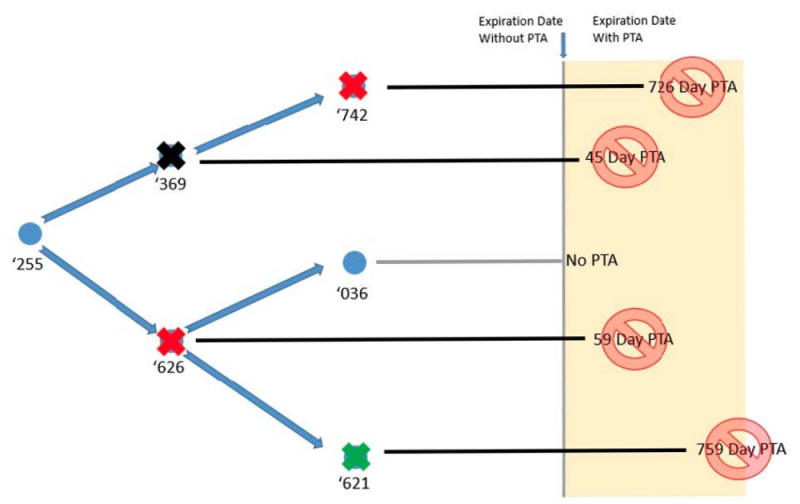
    The issue arose in a series of ex parte reexaminations over five patents owned by Cellect, U.S. Patent Nos. 6,424,369; 6,452,626; 6,982,742; and 7,002,621, that involve "solid state image sensors which are configured to be of a minimum size and used within communication devices specifically including video telephones" according to the '621 patent (only 4 of these patents were invalidated, the fifth not having any PTA that raised the issue).  The chronological situation is set forth in an exhibit from Cellect's brief in its Federal Circuit appeal brief:

    Image
    There was no dispute that the claims in these applications were patentably indistinct.  The Board issued four Decisions on Appeal affirming the reexamination division's invalidation of the '369, '626, '621, and 742 patents, all on the grounds that the provisions of 35 U.S.C. § 154(b)(2)(B),

    "No patent the term of which has been disclaimed beyond a specified date may be adjusted under this section beyond the expiration date specified in the disclaimer"

    mandated that a terminal disclaimer be filed under circumstances where obviousness-type double patenting arose due to extension of patent term as PTA, i.e., that OTDP must be determined after application of PTA.  (It will be recalled that the Federal Circuit reached a different conclusion with regard to patent term extension (PTE) under 35 U.S.C. § 156 in Novartis AG v. Ezra Ventures LLC, the Court expressly refusing to permit "a judge-made doctrine to cut off a statutorily-authorized time extension.")  Because all of these patents had expired (but Cellect retained the right to sue for prior infringement under 35 U.S.C. § 286), the Board's decision invalidated these patents with no available remedy for Cellect.  In its consolidated decision, the Board emphasized the potential inequities to the public due to the possibility of harassment by different parties owning patents to obvious variants of one another (in the absence of a terminal disclaimer preventing this potentiality) as representing an unjust extension of patent term to the public's detriment; see In re Fallaux, 564 F.3d 1313 (Fed. Cir. 2009)).  Finally, the Board rejected arguments that the Federal Circuit's jurisprudence did not rely on whether or not there was gamesmanship or the potential thereof under Gilead Sciences, Inc. v. Natco Pharma Ltd. but that under In re Longi, the public was entitled to the assumption that it is free to practice what is claimed in the patent and obvious modifications and variants thereof once the patent has expired.  759 F.2d 887 (Fed. Cir. 1985).

    The questions before the Court according to Cellect are summarized in five arguments.  The first is based on the Board's putative legal error in interpreting the statute to justify treating term extension under PTA differently from term extension under PTE.  Second, Cellect argued that application of OTDP in this case was inequitable, due to the lack of remedy as well as there being no unjust extension because Cellect had engaged in no gamesmanship.  Third, Cellect argued as a fallback position that OTDP should be used here to cancel the term extended by PTA rather than invalidating the patents in their entirety.  The final two arguments were that the reexamination had been improperly instituted because there was no substantial new question of patentability and that any ancillary obviousness rejections raised in the reexamination was ultimately based on the OTDP of these patents (which argument the Board argued Cellect had waived).

    Cellect's first argument was based on statutory interpretation.  Cellect argues that both PTA and PTE are statutory grounds for extending a patent term and there was no legal nor logical basis for treating them differently, i.e., the Court should interpret the PTA statute here as the Court had interpreted the PTE statute in Ezra.  Further, Cellect argues that the statutory language for PTA is that the term "shall" be extended (although there have been other instances, e.g. regarding provisions of the BPCIA, see Sandoz Inc. v. Amgen Inc., where "shall" has not been given commanding effect).  Cellect argues that the provisions the Board relied upon were intended for situations where a terminal disclaimer had been filed, not one where PTA creates OTDP (compare the language of the statute regarding a "patent the term of which has been disclaimed" to how Cellect argues the Board interpreted the language regarding a "patent the term of which [may need to be] disclaimed [if adjustment is granted]").  The consequence of the Board's interpretation creates a situation requiring "preemptive" terminal disclaimer filings, Cellect argues which Congress had not intended.  Cellect also cited several district court cases, including Amgen, Inc. v. Sandoz Inc. (D.N.J. 2021), and Mitsubishi Tanabe Pharma Corp. v. Sandoz Inc. (D.N.J. 2021), that had interpreted the Court's Ezra decision to support giving statutory deference to respecting PTA over a "judge-made doctrine."

    Regarding the equities, Cellect argues that the purpose of OTDP was to prevent "unjust timewise extension of patent term" and to prevent "harassing litigation filed by multiple patent owners" for patents on "not-patentably-distinct" inventions.  Cellect's argument emphasizes the unjust extension aspect, which Cellect ties to the gamesmanship the Court recognized in Gilead.  And in this case Cellect contends that "[t]he Board used an equitable doctrine to achieve an inequitable result" because the circumstances provided no basis for Cellect to cure.  In an effort to avoid this outcome, Cellect argues that applying the Board's interpretation to retroactively disclaim the PTA-extended term but not invalidate the patents would not only cure the inequitable effects of the Board's decision but also as precedent notify future applicants who could have the opportunity to decline PTA to avoid invalidation on OTDP grounds.

    The Solicitor's argument emphasized the inequities to the public occasioned by any extension of patentably-indistinct inventions (in view of the government's interpretation of the statute).  The brief cites in opposition the Court's decision in Abbvie Inc. v. Mathilda & Terence Kennedy Institute of Rheumatology Trust, 764 F.3d 1366, 1373 (Fed. Cir. 2014), that OTDP apples whenever there is an extension of patent term for patents claiming patentably-indistinct invention.  The Solicitor also notes that under circumstances where OTDP would invalidate a patent having PTE will not save it and that the differences in the statutes permit PTA to produce OTDP where PTE cannot (because § 156 does not contain the "disclaimer" in § 154(b)(2)(B)).  Regarding Cellect's arguments for forswearing PTA but preserving the patent, PTO cites Boehringer Ingelheim Int'l. GmbH v. Barr Laboratories Inc. that a patentee that had benefited from notice to public of the later expiration date has already obtained an "unjustified advantage."  Finally, the Solicitor argues that the term extension issue here is not dispositive because OTDP also prevents potential harassment by multiple assignees.

    A number of amici filed briefs were filed in favor and against the Board's decision.  Briefs in opposition to the Board's application of OTDP in these circumstance were filed by the Intellectual Property Owners (IPO), the Pharmaceutical Research and Manufacturers of America (PhRMA), and the Biotechnology Innovation Organization (BIO).**  The IPO's brief emphasized that the only reason OTDP arose in this case was the application of PTA, and that the statute mandates extension (and accordingly the Board's decision was contrary to congressional intent).  PhRMA's brief focused on the purpose of OTDP that was to avoid unjust enrichment and that the PTO's "speculative" harassment rationale was inconsistent with Federal Circuit precedent.  BIO's brief discussed the Board's statutory interpretation errors and that the inequitable outcome in this case is inconsistent with the equitable underpinnings of OTDP.

    Briefs in favor of the Board's decision were filed by Alvogen, the Association for Accessible Medicines (AAM), and Samsung.  Alvogen's brief argued that there was no reason OTDP should not apply to PTA because the doctrine was intended to establish term limits on patents to patentably-indistinct inventions.  Gamesmanship is not required under the statute and is an "unstable benchmark" in Alvogen's view.  AAM's brief was entirely outcome-oriented, based on the amici's perspective that patents increase drug costs and the Board's decision was a good one because it reduced patent term (no matter that the patents at issue were not related to drug products).  Finally, Samsung's brief argued that the decision was consistent with the policy bases for the OTDP doctrine and that accordingly there was no inequitable result.  (It should be noted that Samsung is a competitor and is involved in litigation with Cellect on other patents.)

    The deadline for Cellect's Reply brief has been extended to October 18th, and barring further delay should be heard at oral argument within the next 4-6 months.  Thus a decision can be expected in the first quarter of next year.

    From a panel discussion with Jeremy Lowe and Steve Horowitz at the 8th Annual Paragraph IV Disputes Master Symposium in Chicago on September 22, 2022

    *On appeal to the Federal Circuit
    **Patent Docs authors Kevin Noonan and Donald Zuhn participated in filing the BIO brief