• Momentum brochureMomentum will be
    holding the International Congress on
    Paragraph IV Litigation on September 23-24, 2013 in New York, NY.  The conference will offer presentations on

    the following topics:

    • An Examination of
    Recent Circuit and District Court Decisions and Trends in Paragraph IV Disputes
    • FTC Keynote
    Address — The Use of Reverse Settlement Payments to "Pay for Delay"
    • Addressing Recent
    Trends in Citizens Petitions and Dissecting the Impact on Paragraph IV
    Litigation Strategies for Both Patentees and ANDA Filers
    • In-House
    Roundtable — Corporate Views on the Costs, Benefits and Strategies Behind
    Paragraph IV Litigation
    • Judicial
    Perspectives on Paragraph IV Litigation — View from the Bench
    • How to Manage,
    Oversee and Coordinate Multi-Jurisdictional IP Litigation and Overcome Global
    Settlement Obstacles — International Litigation Case Study
    • Comparing and
    Contrasting the Divergent Litigation Pathways of Small vs. Large Molecule
    Products: Examining the Impact of Differing Regulatory Schemes, Challenges
    Created Under the AIA and Lessons Learned from Recent Biosimilars Litigation in
    the US & Abroad — Focus on Biosimilars
    • Impact of the AIA
    on Litigation Strategies for Branded and Generic Pharmaceutical Companies — Spotlight
    Address
    • Label
    "Carve-Outs" and Listing Strategies — Practical Tips for Minimizing
    Downstream Exposure to Paragraph IV Challenges and Drafting Codes to Limit
    Carve -Out Opportunities
    • Claim
    Construction and the Markman Hearing
    — Practical Tips for Ensuring the Best Interpretation of Key Patent Claims and
    Obtaining the Results You Want from the Markman
    Hearing
    • Effective Motion
    Practice in Paragraph IV Disputes — When and How to Successfully Pursue and
    Respond to Motions for Summary Judgment and Preliminary Injunctions
    • Special
    Litigation Considerations for Paragraph IV Disputes Involving Multiple ANDA
    Filers — Litigation Management Strategy Discussion
    • 180-Day
    Exclusivity and Forfeiture — A Dissection of Key Filing Benchmarks and Timing
    Considerations for Counsel on Both Sides
    • "At
    Risk" Launches — Assessing the Pros and Cons of Launching During
    Litigation and Considering the Downstream Impact an "At Risk" Launch
    Can Have on Your Settlement Strategy
    • Paragraph IV
    Appeals — A Litigators Guide to Effectively Preserving Issues for Appeal and
    Keeping Your Case Alive Post -District Court
    • Settlement
    Strategy Discussion — Litigation Strategies for Negotiating a Paragraph IV
    Settlement that Will Withstand Government Scrutiny

    In addition, two pre-conference
    workshops will be offered from 8:30 to 9:30 am on September 23, 2013.  The first workshop is entitled "Preparing
    for and Anticipating a Paragraph IV Challenge: Assessing the Business Risks and
    Legal Costs of a PIV Challenge," and the second is entitled "Paragraph
    IV Mock Trial: Inside a Real-Time Examination of a Company Witness, Inventor
    and Scientist."

    MomentumThe agenda for the International Congress on Paragraph IV
    Litigation can be found here.
     A complete brochure for this conference,
    including an agenda, detailed descriptions of conference sessions, list of
    speakers, and registration form can be obtained here.

    The registration
    fee for the conference is $1,695 (the on-site registration fee is $1,895).  Those registering by August 5, 2013 will
    receive a $100 discount.  Those
    interested in registering for the conference can do so here.

    Patent Docs is a media partner of the International
    Congress on Paragraph IV Litigation.

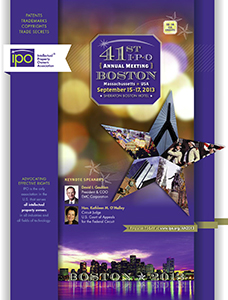
  • BrochureThe Intellectual
    Property Owners Association (IPO) will be holding its 41st Annual Meeting on
    September 15-17, 2013 in Boston, MA. 
    Among the presentations being offered at the annual meeting are:

    • Recent Patent
    Case Law Update
    • AIA: Looking
    Backward and Looking Forward
    • Trends in
    Corporate IP Management – 2013 Corporate Benchmarking Survey Results
    • 10 Things About
    Patent Licensing That You Don't Know, But Wish You Did
    • Back To The
    Future: Trial Practice at the PTAB
    • Biopiracy: Fact
    or Fiction? International Treaty Negotiations Could Affect Your Bottom Line and
    Your IP Rights
    • Bad Faith Filings
    from an International Perspective
    • Navigating the
    Uncertain Waters of Patent Damages and Injunctive Relief
    • Recent
    Developments in International IP
    • The Ins and Outs
    of Corporate Collaborations with Universities
    • Trade Secret
    Enforcement
    • Patent Ethics

    In addition, the
    Hon. Kathleen O'Malley, Circuit Judge, U.S. Court of Appeals for the Federal
    Circuit will present the luncheon keynote on September 17.

    A program for the
    meeting, including an agenda, descriptions of the scheduled sessions, and list
    of speakers, can be obtained here.

    The registration
    fee for the meeting is $500 (government/academic), $975 (IPO members), or
    $1,475 (non-members).  Those interested
    in registering for the meeting can do so here.

  • Strafford #1Strafford
    will be offering a webinar/teleconference entitled "AIA Impact on Section 102 and Prior Art:
    Navigating the Expanded Scope of Prior
    Art and the AIA Exceptions" on August 29, 2013 from 1:00 to 2:30 pm
    (EDT).  Thomas L. Irving and Erika H. Arner of Finnegan Henderson Farabow Garrett
    & Dunner will provide guidance to patent counsel regarding the impact of
    the Leahy-Smith America Invents Act (AIA) on Section 102 and prior art, and
    offer best practices for utilizing prior art in patent applications.  The webinar will review the following
    questions:

    • How has the AIA impacted the scope of prior art?
    • What are the Section 102 exceptions and what is
    the impact on Section 103 art?
    • What practices should counsel employ in order to
    utilize prior art?

    The
    registration fee for the webinar is $297 ($362 for registration and CLE
    processing).  Those registering by August
    2, 2013 will receive a $50 discount. 
    Those interested in registering for the webinar, can do so here.

  • Strafford #1Strafford
    will be offering a webinar/teleconference entitled "Inducement to Infringe in Hatch-Waxman
    Litigation: Lessons from Commil USA v.
    Cisco Systems
    and Bayer Schering v.
    Lupin
    for Pharma Patents" on August 21, 2013 from 1:00 to 2:30
    pm (EDT).  Thomas L. Irving, Dr. David P. Frazier, and Robert F. Shaffer of Finnegan
    Henderson Farabow Garrett & Dunner will provide patent counsel with
    guidance on claim and label language; to proactively coordinate patent,
    regulatory and clinical personnel; and to maintain consistency between claims
    and likely or actual label language throughout patent prosecution and label
    negotiation with the FDA.  The webinar
    will review the following questions:

    • What can be learned from the AstraZeneca
    v. Apotex
    , Bayer Schering v. Lupin, and Commil USA v. Cisco
    Systems Inc.
    decisions?
    • What are the best approaches to maintain
    consistency between claims and likely or actual label language?
    • What steps can be taken to maintain the
    coordination of patent, regulatory and clinical personnel throughout the patent
    prosecution and label negotiation with the FDA?

    The
    registration fee for the webinar is $297 ($362 for registration and CLE processing).  Those interested in registering for the
    webinar, can do so here.

  • By
    Kevin E. Noonan

    NovozymesIt
    has long been a practice in prosecuting a patent application to keep a
    continuation application pending during the term of any granted patent.  This practice is advantageous because it
    permits the patentee to pursue specific claims in a later-filed application to
    a competitor's product that falls within the scope of the invention as
    disclosed in the specification.  Of
    course, this strategy requires that later-filed claims be disclosed in the
    specification as originally filed to satisfy the enablement and written
    description requirements of 35 U.S.C. § 112.  In re Ruschig, 379 F.2d 990 (CCPA
    1967).

    These
    considerations arose in the Federal Circuit's decision in Novozymes v. DuPont Nutrition Biosciences in a patent infringement
    lawsuit involving modified alpha-amylase enzymes.  Alpha-amylases are enzymes produced in
    microorganisms and higher plants and animals (including man) that catalyze the
    breakdown of certain polysaccharides.  The enzymes are used commercially, inter
    alia
    , in detergents, sugar refining, and ethanol production, but as enzymes
    are sensitive to elevated temperatures and pH extremes.  Novozymes' commercial embodiment of this
    enzyme is obtained from Bacillus
    licheniformis
    (BLA) and sold as Termamyl™.

    Traditionally,
    alpha-amylases are stabilized against the deleterious effects of heat and
    extreme pH by complexing with calcium, which "represents an added cost and
    often imposes undesirable effects on industrial equipment."  In an effort to avoid these costs and
    undesirable effects, Novozymes "pursued two parallel strategies in attempting to identify promising mutation sites among the approximately 500 amino
    acids that make up a Bacillus alpha-amylase polypeptide:  rational
    protein design [which attempted to use knowledge and information on the effects
    of mutations in amino acid sequence on protein structure] and random
    mutagenesis [which did not]."  The
    priority application of the patent-in-suit at issue in this case disclosed 17
    amino acid sequence positions identified by rational design and 16 positions
    identified by random mutagenesis that were candidates for amino acid changing
    mutations in two bacterial alpha-amylases:  the B. licheniformis species that comprised the company's Termamyl™ product
    and a species from B. stearothermophilus
    ("BSG"), as well as five other bacterial alpha-amylase species.  As disclosed in the specification of the
    priority document, these changes could involve substitution of the amino acid
    at each of these 33 positions with one of the other 19 naturally occurring
    amino acids, or could involve deletion of the amino acid at that position (a
    total of 20 possible changes for each of the 33 candidate positions).  Accordingly, the total number of variant B. licheniformis species disclosed
    generically in the priority document amounted to about 8.6 x 1042.  In fact, the specification of the priority
    document provided but two specific examples with actual experimental data.  However, many of the substitutions were
    found not to provide variant alpha-amylase enzymes having "improved
    stability at 'high temperatures (i.e., 70-120°C.) and/or extreme pH (i.e., low
    or high pH, i.e., pH 4-6 or pH 8-11), in particular at free (i.e., unbound,
    therefore in solution) calcium concentrations below 60 ppm.'"

    DuPont's
    accused product was a B.
    stearotherophilus
    variant species having an amino acid sequence change at
    position 239 from a serine to a glutamic acid (abbreviated "S239Q").  As noted in the Federal Circuit opinion, "DuPont
    produced approximately 1,500 alpha-amylase variants with substitutions covering
    150 of the 515 amino acid positions in the parent BSG enzyme.  . . .  DuPont then
    screened its panel of 1,500 variants for increased thermostability under
    low-calcium conditions and identified a variant substituted at position 239 [the
    S239Q variant] as the best performer."

    In
    response, Novozymes filed a continuation application that resulted in the patent-in-suit,
    U.S. Patent No. 7,713,723; claim 1 is representative:

    1.  An isolated variant of a parent
    alpha-amylase, wherein:
        (a)
    the variant has at least 90% sequence identity to SEQ ID NO: 6 [BSG
    alpha-amylase],
        (b)
    the variant comprises a substitution of serine at position 239 relative
    to the parent alpha- amylase, using the amino acid sequence of SEQ ID NO: 8
    [BLA alpha-amylase] for determining position numbering, and
        (c)
    the variant has increased thermostability relative to the parent alpha-amylase,
    wherein thermostability is determined at pH 4.5, 90° C. and 5 ppm calcium and
    has alpha-amylase activity

    (emphasis in opinion).

    The District Court granted summary judgment of infringement against DuPont and denied
    DuPont's summary judgment motion of invalidity under 35 U.S.C. § 112
    for failure to satisfy the written description requirement, based on there
    being disputed issues of fact.  (The Court also denied Novozymes' preliminary injunction motion on the grounds that
    there was considerable question of whether Novozymes would prevail on the
    merits in view of DuPont's invalidity challenge.)  The Court submitted to the jury the question of
    whether the claims were invalid under 35 U.S.C. § 112
    for failure to satisfy the enablement or written description requirements, and
    the jury found (using a special verdict form) that the claims were not invalid,
    awarding Novozymes a judgment of more than $18 million.  The Court granted DuPont's JMOL motion, on
    the grounds that the specification did not provide an adequate written
    description of the invention as claimed, relying on both Federal Circuit and
    CCPA precedent including Boston Scientific Corp. v. Johnson & Johnson, 647 F.3d 1353 (Fed. Cir. 2011);
    Billups-Rothenberg
    , 642 F.3d 1031, 1036 (Fed. Cir. 2011); Centocor
    Ortho Biotech, Inc. v. Abbott Labs.
    , 636 F.3d 1341 (Fed. Cir. 2011); Univ.
    of Rochester v. G.D. Searle & Co.
    , 358 F.3d 916 (Fed. Cir. 2004); Purdue
    Pharma L.P. v. Faulding Inc.
    , 230 F.3d 1320 (Fed. Cir. 2000); In re
    Ruschig
    , 379 F.2d 990 (CCPA 1967).

    The
    Federal Circuit affirmed, in an opinion by Judge Schall joined by Judge Bryson,
    with Chief Judge Rader dissenting.  The
    majority opinion rejected Novozymes' contentions that any deficiencies in the
    disclosure in its specification was ameliorated by the general understanding,
    knowledge and skill in the art, citing Snitzer v. Etzel, 465 F.2d 899
    (CCPA 1972), and Union Oil Co. of California v. Atlantic Richfield Co.,
    208 F.3d 989 (Fed. Cir. 2000).  DuPont,
    in contrast, relied on In re Ruschig,
    arguing successfully that Novozymes' disclosure amounted to nothing more than
    an "invitation to experiment," and unsuccessfully at that, pointing
    out that Novozymes' "application fails to disclose a single alpha- amylase
    variant substituted at position 239 that actually exhibits increased
    thermostability, noting that the only disclosed substitution at that position
    (S239W) disclosed in the '723 priority application does not work as required by the '723
    patent's claims."

    The
    majority stated its holding expressly:  "no reasonable jury could find that
    the claims of the '723 patent meet the written description requirement of §
    112, ¶ 1, and that the district court therefore correctly entered judgment as a
    matter of law invalidating those claims."  The opinion contrasts the specificity of the claims with the generic
    disclosure of the specification, noting that Novozymes provided only "generalized
    guidance listing several variables that might, in some combination, lead to a
    useful result."  This determination
    was mandated by "[n]umerous prior decisions" from both the CCPA and
    the Federal Circuit, citing most of the canonical precedent including In re
    Ruschig
    , Boston Scientific Corp. v. Johnson & Johnson, and Univ.
    of Rochester v. G.D. Searle & Co.
    , and distinguishing Snitzer v.
    Etzel
    and Union Oil Co. of California v. Atlantic Richfield Co.  In
    the Snitzer case, the majority noted
    that the specification of the patent at issue provided disclosure of a small number of distinctly recited species,
    in stark contrast to the overwhelming number of species falling within the
    ambit of the '723 patent specification, while in the Union Oil case the specification "defined the claimed gasoline
    compositions in terms of various chemical and physical properties" and
    that "ordinarily skilled petroleum refiners would immediately appreciate
    that the qualitative chemical properties recited in the claims translated to
    specific, manifest compositions that would yield those properties."

    The majority expressly found that the '723
    specification, and the disclosure of the priority document, "contains no
    disclosure of any variant that actually satisfies the claims, nor is there
    anything to suggest that Novozymes actually possessed such a variant at the
    time of filing."  While the opinion
    recognizes distinctions between Novozymes' specification and the deficiencies
    in the specifications in the authorities it cites to support their opinion, "[o]n
    closer inspection these 'analogies fall flat.'"  "Taking each claim — as we must — as an
    integrated whole rather than as a collection of independent limitations, one
    searches the ['723 priority] application in vain for the disclosure of even a
    single species that falls within the claims or for any 'blaze marks' that would
    lead an ordinarily skilled investigator toward such a species among a slew of
    competing possibilities," according to the opinion, and "working
    backwards" from the claims (and the accused product) impermissibly "seeks
    to derive written description support from an amalgam of disclosures plucked
    selectively from the '723 priority application."  Even Novozymes' expert agreed with DuPont that "one could not know
    which, if any, individual substitutions at any of the seventeen sites selected
    by rational protein design would yield increased thermostability without
    actually making and testing the variants," and it was evident that the '723
    specification and its priority document did not disclose the specifically
    claimed thermostable variant.  Further:

    In this case, to actually possess the variant enzymes claimed in the '723
    patent would have required Novozymes to confirm its predictions by actually
    making and testing individual variants or at least identifying subclasses of
    variants that could be expected to possess the claimed properties, which it did
    not do before filing the ['723 priority] application.  At best, the ['723
    priority] application describes a roadmap for producing candidate alpha-amylase
    variants and then determining which might exhibit enhanced thermostability.  A
    patent, however, "is not a reward for the search, but compensation for its
    successful conclusion."  Ariad
    [Pharm., Inc. v. Eli Lilly & Co., 598 F.3d 1336, 1353 (Fed. Cir.
    2010) (en banc)] (quoting University of Rochester, 358 F.3d
    at 930 n.10).  For that reason, the written description requirement prohibits a
    patentee from "leaving it to the . . . industry to complete an unfinished
    invention."  Id.

    Chief
    Judge Rader dissented.  While his
    continued dissatisfaction with the written description requirement was evident
    ("[a]lthough a separate written description requirement, and the vague
    notion of "possession" that it embodies, still troubles me"),
    his dissent does not trod that old ground of disagreement with his
    brethren.  Instead, the Chief Judge
    contends that, having established a separate written description requirement it
    is a question of fact, and the jury deserves deference to its factual
    determinations that should not lightly be overturned by JMOL.  On the facts in this case, Chief Judge Rader
    finds substantial evidence (including expert testimony, the weight and
    persuasiveness of which being particularly within a jury's purview) supporting the jury's
    verdict and thus would let it stand:

    [T]he jury received expert testimony, heard from skilled protein
    engineers, reviewed visual aids and publication excerpts, and examined the
    patent document as guided by those skilled in the art, over an eight day trial.  The jury was given a special verdict form asking whether DuPont had proven by
    clear and convincing evidence that the claims at issue were invalid for lack of
    written description.  . . .  The jury answered in favor of Novozymes, and
    substantial evidence supports this determination.


    Novozymes A/S v. DuPont
    Nutrition Biosciences APS
    (Fed. Cir. 2013)
    Panel: Chief Judge Rader and Circuit Judges Schall and Bryson
    Opinion by Circuit Judge Schall; dissenting opinion by Chief Judge Rader

  • By James DeGiulio

    Biotechnology Industry Organization (BIO)On July 22, BIO hosted the first
    IP and Diagnostics (IPDx) Symposium in Alexandria, Virginia, which was
    organized to open a dialogue regarding the latest developments in diagnostics
    and personalized medicine.  The symposium
    covered a wide range of topics in the field, including obtaining patent
    protection, regulatory & reimbursement, and business development &
    strategic deals.  Despite the range of
    topics, one unifying theme applying to all aspects of this burgeoning field is uncertainty.

    Patent protection in
    diagnostics is crucial, for there is no market or data exclusivity attributed
    to diagnostic testing.  Industry members must
    attempt to predict at an early stage whether patent protection over a
    diagnostic can be achieved, and if the prediction is negative, the diagnostic
    may not be pursued.  This prediction has
    become much more difficult recently, and not unexpectedly at the forefront of
    the symposium discussion was the impact of the recent Supreme Court decisions
    in Mayo and Myriad.  The first panel,
    moderated by Patent Docs author Donald Zuhn of MBHB, was comprised of Patent Docs author Kevin Noonan of
    MBHB, Duane Marks of Roche Diagnostics, and Mary Till of the USPTO, with
    each panelist providing their recommendations on how to successfully navigate
    patent prosecution under the limitations imposed by these Court decisions.  Drafting claims to recite method of treatment
    steps or to include non-natural compositions (such as the transformed cells
    from claim 20 in Myriad) were two
    potential strategies discussed that may avoid § 101 scrutiny under Mayo and Myriad.

    Of course, Myriad
    explicitly exempts cDNA from § 101 scrutiny, which came as a relief to many
    sectors of biotechnology, who consider cDNA as (arguably) the most commercially
    important aspect of so-called "gene patents."  However, the scope of the Myriad decision was the topic of debate
    between the panelists and audience members.  While there was agreement that the Myriad holding is not limited to
    human DNA, there was spirited disagreement regarding its long-term impact on
    patents claiming naturally occurring DNA.  On the one hand, it is true that the
    vast majority of patents covering human DNA are nearing the end of their
    lifespan, thus reducing the significance of the Myriad opinion here.  However, on the other hand, the biotechnology industry must consider the
    possible ramifications beyond human genes, particularly in sectors like
    biofuels that rely on lower-order organisms.  Since the genes of these lower-order organisms often lack introns,
    claims directed to their cDNA will not fall within the exception stated in
    Myriad.

    Further, under Myriad, there are questions regarding
    the fate of isolated polypeptides, stem cells, and all other compositions based
    on natural products.  These compositions
    represent platform technologies for many biotech firms, and this uncertain
    climate is causing hesitation disclosing such technologies in patent
    applications.  The risk of failing to
    secure adequate patent protection may be too great.  The panelists noted the possibility that the
    biotechnology industry shifts away from patenting diagnostic products, moving
    instead towards the trade-secret and/or service provider model.  In this model, samples would be tested
    in-house, and the biotech company would keep the biomarker information and
    diagnostic algorithms as trade secrets.  This
    in-house testing model may also have the added benefit of avoiding any future FDA
    regulation of such diagnostic testing, which represents another unsettled issue
    in the field of diagnostics discussed at the Symposium.

  • By
    Kevin E. Noonan

    Federal Circuit SealEver
    since the Supreme Court handed down its decision in KSR Int'l Co. v.
    Teleflex Inc.
    , 550 U.S. 398 (2007), both the U.S. Patent and Trademark Office
    and the courts have found it easier to render a decision that a claimed
    invention was obvious.  While how the USPTO
    and the courts have implemented the KSR
    obviousness standards have been the subject of some debate, occasionally there
    is a case that illustrates that the nuances of the Court's obviousness rubrics
    can be applied in such a way that comports with the "common sense"
    standard the Court elevated to an analytical tool in KSR.

    Such
    an instance arose in the application of Doran Adler et al.  The case involved an
    appeal of a PTO determination that the claims of USSN 10/097,096 to applicants
    Doran Adler et al. were obvious.  The
    invention relates generally to methods and systems for detecting "pathologies
    of the gastrointestinal tract"; claim 57 is representative:

    57.  A method for displaying in-vivo information,
    the method comprising:
        receiving at a data processor data
    generated by a swallowable in-vivo device transversing a GI tract, the data
    comprising a set of in-vivo images of the GI tract;
        the data processor comparing values
    of the received images to a reference value of blood and to a reference value
    of healthy tissue;
        the data processor causing to be
    displayed the imaged as a color video; and
        the data processor further, based on
    the comparison, causing to be displayed an indication of a position in the GI
    tract of a change in the level of red color content, the change correlating to
    the presence of blood.

    Also
    at issue (but not separately argued) was a system claim (claim 63),
    substantially comprising a system for practicing the method of claim 57.  The cited prior art was the Meron
    (WO 00/22975) reference, which discloses a
    swallowable camera comprising a "means for sensing the presence of blood"
    combined with the Hirata reference (a scientific journal article) that
    discloses an endoscopic comparison of normal and healthy esophageal tissues
    based on colorometric analysis of esophageal varicies detected by comparing "color
    toner and red color sign."

    The
    PTAB affirmed the Examiner's obviousness rejection, in a non-precedential
    decision by APJ Grimes, joined by APJ's Scheiner and Mills, finding that
    despite the absence of an express disclosure of the use of the Meron system to detect blood, the
    combination of Meron's teachings (that a video camera could be miniaturized and
    used to detect GI anomalies "that may be associated with bleeding" in
    the GI tract) with Hirata's disclosure that image comparison could be used to
    detect changes in the red color spectrum of the GI tract led to a
    conclusion of obviousness.

    The
    Federal Circuit affirmed, in an opinion by Judge Wallach joined by Judges Prost
    and Reyna.  The panel cited specific
    findings of fact that the opinion held were supported by substantial evidence:

    12. 
    Hirata discloses that color tone was analyzed by comparing the color
    tone of a defined varices region with the color tone of a defined normal
    esophageal region.

    13. 
    Hirata discloses that the area of red color sign was also determined for
    a defined varices region.

    14. 
    Hirata discloses that, using image processing, both color tone results and
    area of red color sign results could be used
    to select patients with
    varices that have a higher risk of rupture.

    (It
    was uncontested that the Meron reference teaches a swallowable camera.)  The Court found that the Board did not err in
    its obviousness determination, and that the Board did not base its obviousness
    determination on grounds different from those relied upon by the Examiner
    (which would have entitled applicants to a rehearing on the merits).  As set forth in the panel's opinion:

    The primary issue on appeal is whether the
    Board properly found that it would have been obvious in light of the prior art
    to compare reference values for healthy tissue and blood to determine whether
    images of the gastrointestinal tract showed "a change in the level of red
    color content" where that "change correlat[es] to the presence of
    blood," as articulated in the claims at issue.

    The
    appellants argued that their claims embody two comparisons (between patient
    images and an image of healthy tissue or between patient images and blood).  The Court affirmed the PTO's conclusion that
    a "two-prong" assessment as advocated by appellants was merely a "predictable
    variation" on the combination of Hirata and Meron and thus unpatentable
    for being obvious, citing KSR Int'l Co. v. Teleflex Inc., 550 U.S. 398,
    417 (2007) ("If a person of ordinary skill can implement a predictable
    variation, § 103 likely bars its patentability.").  The opinion rejected appellants' attempts to
    distinguish the Hirata reference for failing to teach detection of blood,
    stating (in a footnote) that "substantial evidence supports the Board's
    finding that Hirata teaches identification of a pathology through red color
    image analysis of two reference values" wherein "one of ordinary
    skill in the art would understand that detecting areas with different red color
    values corresponds to blood."

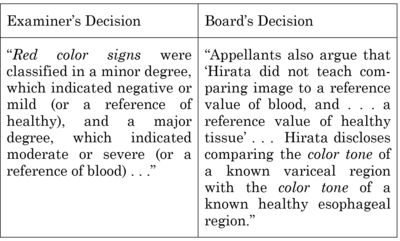
    The
    purported "new grounds of rejection" argument was predicated on appellants'
    contention that the Board's analysis "changed the thrust of the Examiner's
    rejection (Hirata's classification of red color signs); the opinion reproduces
    appellants' comparison between the Examiner's grounds of rejection and the
    rationale set forth in the PTAB's decision:

    Table
    The
    court found that appellants did not identify "specific facts found by the
    Board but not by the examiner, nor [did they] illustrate[] how any such facts
    formed the basis of the Board's rejection."  Accordingly:

    While the Board's explanation may go into more detail than the examiner's, that
    does not amount to a new ground of rejection.  See In re Jung, 637 F.3d
    1356, 1365 (Fed. Cir. 2011).


    In re Adler
    (Fed. Cir. 2013)

    Panel: Circuit Judges Prost, Reyna, and Wallach
    Opinion by Circuit Judge Wallach

  • By Andrew Williams

    Last
    week, two district courts dispensed with lawsuits based on the
    protections afforded by the safe harbor provision of the Hatch-Waxman
    statute.  Both of the cases relied
    heavily on the Federal Circuit case Momenta
    Pharm. v. Amphastar Pharm.
    , 686 F.3d 1348 (2012).  In fact, one of the cases was the Momenta
    case back at the Massachusetts District Court.  The other case was in the Southern District of New York, and in that
    case, the dismissal occurred at the pleadings stage.  Because both cases looked to 35 U.S.C. § 271(e)(1),
    it is useful to review this provision, which reads:

    It shall not be an act of infringement to make, use, offer to sell, or sell
    within the United States or import into the United States a patented invention
    . . . solely for uses reasonably related to the development and submission of
    information under a Federal law which regulates the manufacture, use, or sale
    of drugs or veterinary biological products.

    The
    Federal Circuit Momenta case
    interpreted this language broadly, stating that the "language
    unambiguously applies to submissions under any federal law, providing that the
    law 'regulates the manufacture, use, or sale of drugs.'"  Therefore, according to current Federal
    Circuit jurisprudence, the safe harbor is not limited to pre-approval
    activities (see Momenta); it is not
    limited to information that is actually submitted to the FDA, provided the FDA
    requires that records be maintained for possible inspection (see Momenta); and it is OK if the
    information has alternative uses, such as for fund raising or other business
    purposes (see Abtox, Inc. v. Exitron
    Corp.
    , 122 F.3d 1019, 1030 (Fed. Cir. 1997)).  It is with this understanding that the lower
    courts proceeded.

    Momenta
    Pharma., Inc. v. Amphastar Pharma., Inc.
    , C.A. No. 11-11681-NMG

    Momento PharmaceuticalsLast
    week, the U.S. District Court for the District of Massachusetts granted a
    summary judgment motion of non-infringement in favor of Amphastar (see Memorandum & Order).  This case involved generic versions of
    Aventis' product Lovenox (enoxaparin).  However,
    the patent-in-suit was owned by Momenta, another generic company, and related
    to methods for comparing generic enoxaparin to the branded version.  As a reminder, the procedural posture in front
    of the Federal Circuit was as an appeal of a preliminary injunction.  Because the Court found that the alleged
    infringing activity was protected by 35 U.S.C. § 271(e)(1), it vacated the
    injunction.  In fact, the Federal Circuit
    suggested that "the district court may want to consider whether Momenta's
    admission . . . makes this case amenable to summary judgment of
    non-infringement."  Nevertheless,
    the lower court stayed the case pending a petition for en banc appeal, and a petition for certiorari to the Supreme Court
    in Classen Immunotherapies, Inc. v.
    Biogen IDEC
    , another safe harbor case.  After both of those petitions were denied, the District Court lifted the stay,
    and Amphastar moved for summary judgment the next day.

    AmphastarMomenta's
    position regarding whether the safe-harbor provision applied in this case
    apparently did not change significantly. 
    First, it argued that the FDA did not mandate the use of its patented
    test, and therefore its use by Amphastar was entirely voluntary.  However, as the District Court pointed out, the Federal
    Circuit "explicitly" held that the safe harbor "'does not
    mandate the use of a non-infringing alternative when one exists."  Second, Momenta argued that the required
    record-keeping was not a "submission," and therefore fell outside the
    statute.  However, again, the Court noted
    the Federal Circuit's "express" holding that the FDA's requirement for
    maintaining records that might be inspected was sufficient to satisfy this
    requirement.  Finally, Momenta alleged
    that the use of this information during manufacturing was for commercial purposes,
    and therefore not "solely" for uses related to satisfying Federal
    Law.  However, the Federal Circuit found
    this argument to not be consistent with precedent, citing the Abtox case.  Therefore, the Massachusetts court simply
    applied the holding of Momenta to
    grant the summary judgment motion.

    Momenta
    also argued that Amphastar was liable under 35 U.S.C. § 271(g), which states in
    part: "Whoever without authority imports into the United States or offers to sell,
    sells, or uses within the United States a product which is made by a process
    patented in the United States shall be liable as an infringer, if the
    importation, offer to sell, sale, or use of the product occurs during the term
    of such process patent."  This
    section of the statute is generally directed to importation of a product made
    by a U.S. patented method practiced abroad, and in this case, there was no
    allegation that Amphastar manufactured the drug product
    outside the U.S.  Instead, Momenta argued that the
    language of the statute does not require that the patented process be practiced
    inside or outside the U.S.  This ignores,
    however, another section of that provision that states it only applies when "there
    is no adequate remedy under this title for infringement."  Because 35 U.S.C. § 271(a) applies to the
    making or use of a patented invention within the U.S., the Court reasoned that
    35 U.S.C. § 271(g) does not apply in this case.

    At about the same time that Amphastar
    filed its Summary Judgment motion, Teva filed a motion to dismiss a similar action based
    on the same patents.  In almost an
    identical opinion, the Massachusetts District Court also dismissed this
    case (see Memoradum & Order).

    Teva
    Pharma. USA, Inc. v. Sandoz Inc.
    , Case No. 09 Civ. 10112 (KBF)

    Teva #2The
    U.S. District Court for the Southern District of New York also dispensed of two
    cases last week because of the Hatch-Waxman safe harbor provision (Mylan was
    defendant in the second case), but this time both cases were at the pleading
    stage.  Interestingly, Momenta was a
    co-defendant with Sandoz.  Therefore, the
    parties of this case were basically a mirror image of the Momenta v. Teva
    litigation that was dismissed in Massachusetts.  In
    other words, both parties were able to take advantage of the safe-harbor
    provision in the different litigations (or both parties were burned by it).

    Sandoz #2The
    products in question were generic versions of glatiramer acetate, which is sold
    under the name Copaxone to reduce the frequency of relapses in patients with
    relapsing-remitting multiple sclerosis. 
    Glatiramer acetate is a mixture of polypeptides, and much like with
    Lovenox/enoxaparin in the Momenta
    case, the ANDA filers needed to demonstrate that their active ingredient was
    the same as the branded product. 
    Specifically, the ANDA filers needed to show that the polypeptides in
    their products have the same molecular weight characteristics as those in
    Copaxone.  Teva is the exclusive licensee
    to four patents that claim polypeptide markers and methods for using these
    markers to measure these molecular weight characteristics.

    Because
    the fact pattern was so similar to Momenta,
    the defendants moved to dismiss for failure to state a claim.  The District Court did not, however, start
    with Momenta, but rather it underwent
    a similar analysis as the Momenta court.  First, it started with the text of statute,
    and it found the meaning to be plain and unambiguous.  As a result, the District Court did not need to
    consult the legislative history.  If it
    did, it might have discovered that the intent of Congress was that the statute
    was only meant to apply to pre-approval activity, as Chief Judge Radar
    explained in detail in the Momenta
    dissent.

    The
    District Court then compared the case to Momenta,
    and found that the two cases had "striking similarities."  The Court concluded that the holding of Momenta and its fact pattern support
    dismissal in this case.  "Momenta allows for the elective use of
    patented technology as long as it serves to produce information required under
    federal law."  Teva had not alleged
    that Sandoz or Mylan activity was any different.

    Instead,
    Teva attempted to differentiate this case by relying on another Federal Circuit
    case, Proveris Scientific Corp. v.
    Innovasystems, Inc.
    , 536 F.3d 1256 (Fed. Cir. 2008).  In that case, Innovasystems was making and
    selling a product that could be used by generic drug manufactures to calibrate
    drug delivery devices.  Innovasystems had
    argued that when its product was used by its customers (the generic drug
    manufacturers), they were protected by the safe harbor provision, and therefore
    Innovasystems should also be protected. 
    The Federal Circuit rejected this argument, and pointed out that the "patented
    invention" of Innovasystems was not the type of "patented invention"
    to which § 271(e)(1) refers.  It was important
    that Innovasystems was selling the patented invention to others, and not
    developing information for submission to the FDA.  The District Court concluded that the present case was
    analogous to Momenta, and that Proveris was inapposite to the present facts.  Therefore,  the Court held, "without an exclusion for
    plaintiffs' patented product not being the type of "invention" that
    can fall within § 271(e)(1), plaintiffs failed to state a claim" for the relevant
    counts in the complaints (see Opinion & Order).

  • By Donald Zuhn

    NVCALast week, the National
    Venture Capital Association (NVCA), a trade association representing the U.S.
    venture capital industry, released the results of its MoneyTree Report on venture
    funding for the second quarter of 2013. 
    The report, which is prepared by NVCA and PriceWaterhouseCoopers LLP
    using data from Thomson Reuters, indicates that venture capitalists invested
    $6.7 billion in 913 deals in the second quarter, which constituted a 12%
    increase in dollars and a 2% increase in deals as compared with the first
    quarter, when $6.0 billion was invested in 896 deals (see chart below, which shows total venture funding from the second
    quarter of 2009, when the Great Recession ended
    through the second quarter of 2013; data from MoneyTree Reports; click on chart to expand).

    Venture Funding – Q2 2009 to Q2 2013

    Venture Funding_no title
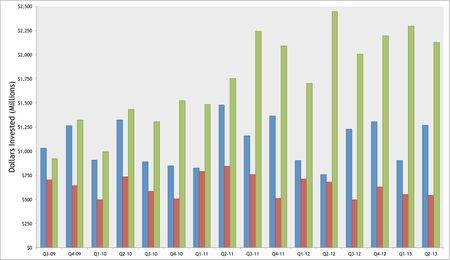
    PricewaterhouseCoopers (PWC)The biotechnology sector rebounded
    in the second quarter to place second behind the software sector, with funding
    increasing by 41% to $1.3 billion and the number of deals rising by 2% to
    103.  The software sector once again took
    the top spot in funding — with $2.1 billion invested — marking the fifth
    straight quarter in which the software sector topped the $2 billion funding
    level (see chart below, which shows venture funding for the biotech (blue), medicial devices (red), and software (green) sectors since the third quarter of 2009, which was the last quarter in which the biotech sector outpaced the software industry; data from MoneyTree Reports; click on chart to expand).  Medical Device investment dropped
    by 1% with respect to both dollars and deals, with $543 million being invested
    in 71 deals.  Overall, eight of the
    seventeen sectors tracked by the NVCA saw decreases in dollars invested in the
    second quarter.

    Venture Funding by Industry – Q3 2009 to Q2 2013

    VF by Industry_no titleBiotechnology funding =
    blue
    ; Medical devices
    = red; Software = green

    Thomson ReutersWith respect to the second
    quarter results, NVCA president Mark Heesen observed that "[i]n many ways
    it feels like the late 1990's with information technology driving venture investment
    and significantly outpacing other sectors when it comes to level of activity
    and momentum."  He also noted that "[l]ife
    sciences investment is poised for a slow and steady recovery, provided we can
    continue to see progress on the regulatory front."

    For additional information regarding this and other related topics, please see:

    • "Biotech Venture Funding Down 33% in First Quarter," April 30, 2013
    • "Annual Venture Funding Drops for First Time in Three Years," February 4, 2013
    • "Biotech Venture Funding Up 64% in Third Quarter," October 29, 2012
    • "Venture Funding in Life Sciences Sector Drops 9% in Second Quarter," July 22, 2012
    • "Biotech Venture Funding Drops 43% in First Quarter," May 3, 2012
    • "Venture Funding Increased 22% in 2011," February 2, 2012
    • "Life Sciences Venture Funding Drops in Third Quarter," October 27, 2011
    • "Life Sciences Venture Funding up 37% in Second Quarter," August 1, 2011
    • "VentureSource Reports 35% Increase in 1Q Venture Funding," April 26, 2011
    • "NVCA Reports Modest Gains in First Quarter Venture Funding," April 19, 2011

    • "NVCA Reports 31% Drop in Venture Funding for Third Quarter," October 17, 2010

    • "NVCA Reports 34% Increase in Venture Funding for Second Quarter," July 22, 2010

    • "NVCA Report Shows First Quarter Drop in Venture Funding," April 20, 2010

    • "Biotech/Pharma Financing Improving, R&D Spending Up," August 31, 2009
    • "NVCA Study Shows Increase in Third Quarter Venture Funding," October 23, 2009

    • "First Quarter Venture Capital Funding at 12-Year Low," April 23, 2009

    • "NVCA Study Shows Decline in 2008 Investment; BIO Study Predicts Biotech Rebound in 2009," February 16, 2009

  • By Sherri Oslick

    Gavel About Court Report:  Each week we will report briefly on recently filed biotech and pharma cases.

    UCB Inc. et al. v. Aurobindo
    Pharma Ltd., et al.

    1:13-cv-01210; filed July 10,
    2013 in the District Court of Delaware

    • Plaintiffs:  UCB Inc.; UCB
    Pharma GmbH; Research Corporation Technologies Inc.; Harris FRC Corp.
    • Defendants:  Aurobindo Pharma
    Ltd.; Aurobindo Pharma USA Inc.

    UCB Inc. et al. v. Accord
    Healthcare Inc. et al.

    1:13-cv-01206; filed July 10,
    2013 in the District Court of Delaware

    • Plaintiffs:  UCB Inc.; UCB
    Pharma GmbH; Research Corporation Technologies Inc.; Harris FRC Corp.
    • Defendants:  Accord
    Healthcare Inc.; Intas Pharmaceuticals Ltd.

    UCB Inc. et al. v. Alembic
    Pharmaceuticals Ltd. et al.

    1:13-cv-01207; filed July 10,
    2013 in the District Court of Delaware

    • Plaintiffs:  UCB Inc.; UCB
    Pharma GmbH; Research Corporation Technologies Inc.; Harris FRC Corp.
    • Defendants:  Alembic
    Pharmaceuticals Ltd.; Alembic Ltd.; Alembic Pharma Ltd.

    UCB Inc. et al. v. Amneal
    Pharmaceuticals LLC et al.

    1:13-cv-01208; filed July 10,
    2013 in the District Court of Delaware

    • Plaintiffs:  UCB Inc.; UCB
    Pharma GmbH; Research Corporation Technologies Inc.; Harris FRC Corp.
    • Defendants:  Amneal
    Pharmaceuticals LLC; Amneal Pharmaceuticals of New York LLC; Amneal
    Pharmaceuticals Co. India Private Ltd.

    UCB Inc. et al. v. Apotex
    Corp. et al.

    1:13-cv-01209; filed July 10,
    2013 in the District Court of Delaware

    • Plaintiffs:  UCB Inc.; UCB
    Pharma GmbH; Research Corporation Technologies Inc.; Harris FRC Corp.
    • Defendants:  Apotex Corp.;
    Apotex Inc.

    UCB Inc. et al. v.
    Breckenridge Pharmaceutical Inc. et al.

    1:13-cv-01211; filed July 10,
    2013 in the District Court of Delaware

    • Plaintiffs:  UCB Inc.; UCB
    Pharma GmbH; Research Corporation Technologies Inc.; Harris FRC Corp.
    • Defendants:  Breckenridge
    Pharmaceutical Inc.; Vennoot Pharmaceuticals LLC

    UCB Inc. et al. v. Glenmark
    Generics Inc. USA et al.

    1:13-cv-01212; filed July 10,
    2013 in the District Court of Delaware

    • Plaintiffs:  UCB Inc.; UCB
    Pharma GmbH; Research Corporation Technologies Inc.; Harris FRC Corp.
    • Defendants:  Glenmark
    Generics Inc. USA; Glenmark Generics Ltd.

    UCB Inc. et al. v. Hetero USA
    Inc. et al.

    1:13-cv-01213; filed July 10,
    2013 in the District Court of Delaware

    • Plaintiffs:  UCB Inc.; UCB
    Pharma GmbH; Research Corporation Technologies Inc.; Harris FRC Corp.
    • Defendants:  Hetero USA Inc.;
    Hetero Labs Limited Unit V

    UCB Inc. et al. v. Mylan
    Pharmaceuticals Inc. et al.

    1:13-cv-01214; filed July 10,
    2013 in the District Court of Delaware

    • Plaintiffs:  UCB Inc.; UCB
    Pharma GmbH; Research Corporation Technologies Inc.; Harris FRC Corp.
    • Defendants:  Mylan
    Pharmaceuticals Inc.; Mylan Inc.

    UCB Inc. et al. v. Ranbaxy
    Laboratories Ltd. et al.

    1:13-cv-01215; filed July 10,
    2013 in the District Court of Delaware

    • Plaintiffs:  UCB Inc.; UCB
    Pharma GmbH; Research Corporation Technologies Inc.; Harris FRC Corp.
    • Defendants:  Ranbaxy
    Laboratories Ltd.; Ranbaxy Pharmaceuticals Inc.; Ranbaxy Inc.

    UCB Inc. et al. v. Sandoz Inc.
    1:13-cv-01216; filed July 10,
    2013 in the District Court of Delaware

    • Plaintiffs:  UCB Inc.; UCB
    Pharma GmbH; Research Corporation Technologies Inc.; Harris FRC Corp.
    • Defendant:  Sandoz Inc.

    UCB Inc. et al. v ScieGen
    Pharmaceuticals Inc. et al.

    1:13-cv-01217; filed July 10,
    2013 in the District Court of Delaware

    • Plaintiffs:  UCB Inc.; UCB
    Pharma GmbH; Research Corporation Technologies Inc.; Harris FRC Corp.
    • Defendants:  ScieGen
    Pharmaceuticals Inc.; Bactolac Pharmaceutical Inc.

    UCB Inc. et al. v Sun Pharma
    Global FZE et al.

    1:13-cv-01218; filed July 10,
    2013 in the District Court of Delaware

    • Plaintiffs:  UCB Inc.; UCB
    Pharma GmbH; Research Corporation Technologies Inc.; Harris FRC Corp.
    • Defendants:  Sun Pharma
    Global FZE; Sun Pharmaceutical Industries Ltd.; Sun Pharmaceutical Industries
    Inc.

    UCB Inc. et al. v. Watson
    Laboratories Inc. – Florida et al.

    1:13-cv-01219; filed July 10,
    2013 in the District Court of Delaware

    • Plaintiffs:  UCB Inc.; UCB
    Pharma GmbH; Research Corporation Technologies Inc.; Harris FRC Corp.
    • Defendants:  Watson
    Laboratories Inc. – Florida; Watson Pharma Inc.; Actavis Inc.

    UCB Inc. et al. v. Zydus
    Pharmaceuticals (USA) Inc. et al.

    1:13-cv-01220; filed
    July 10, 2013 in the District Court of Delaware

    • Plaintiffs:  UCB Inc.; UCB
    Pharma GmbH; Research Corporation Technologies Inc.; Harris FRC Corp.
    • Defendants:  Zydus
    Pharmaceuticals (USA) Inc.; Cadila Healthcare Ltd.

    The complaints in these cases
    are substantially identical.  Infringement
    of U.S. Patent No. RE38,551 ("Anticonvulsant Enantiomeric Amino Acid
    Derivatives," issued July 6, 2004) following a Paragraph IV certification
    as part of defendants' filing of an ANDA to manufacture a generic version of
    UCB's Vimpat® (lacosamide, used as adjunctive therapy in the treatment of
    partial-onset seizures in people with epilepsy aged 17 years and older).  View the Aurobindo
    complaint here.


    Par Pharmaceutical, Inc. et
    al. v. Takeda Pharmaceutical Co., Ltd. et al.

    3:13-cv-03151; filed July 9,
    2013 in the Northern District of California

    • Plaintiffs:  Par
    Pharmaceutical, Inc.; Handa Pharmaceuticals, LLC
    • Defendants:  Takeda
    Pharmaceutical Co., Ltd.; Takeda Pharmaceuticals North America, Inc.; Takeda
    Pharmaceuticals America, Inc.; Takeda Pharmaceuticals U.S.A., Inc.

    Declaratory judgment of
    invalidity and/or non-infringement of U.S. Patent No. 8,461,187 ("Multiple
    PPI Dosage Form," issued June 11, 2013) in conjunction with Par's filing
    of an ANDA to manufacture a generic version of Takeda's Dexilant®
    (dexlansoprazole, used for the treatment of all grades of erosive esophagitis,
    maintaining healing of esophagitis, and treating heartburn associated with
    symptomatic non-erosive gastroesophageal reflux disease).  View the complaint here.


    University of Utah Research
    Foundation et al. v. Ambry Genetics

    2:13-cv-00640; filed July 9,
    2013 in the District Court of Utah

    • Plaintiffs:  University of
    Utah Research Foundation; Trustees of the University of Pennsylvania; HSC
    Research and Development Limited Partnership; Endorecherche; Myriad Genetics
    • Defendant:  Ambry Genetics

    Infringement of U.S. Patent
    Nos. 5,709,999 ("Linked breast and ovarian cancer susceptibility gene,"
    issued January 20, 1998), 5,747,282 ("17Q-linked breast and ovarian cancer
    susceptibility gene," issued May 5, 1998), 5,753,441 ("170-linked
    breast and ovarian cancer susceptibility gene," issued May 19, 1998), 5,837,492 ("Chromosome 13-linked breast cancer susceptibility gene,"
    issued November 17, 1998), 6,033,857 (same title, issued March 7, 2000), 5,654,155 ("Consensus sequence of the human BRCA1 gene," issued
    August 5, 1997), 5,750,400 ("Coding sequences of the human BRCA1 gene,"
    issued May 12, 1998), 6,051,379 ("Cancer susceptibility mutations of BRCA2,"
    issued April 18, 2000), 6,951,721 ("Method for determining the haplotype
    of a human BRCA1 gene," issued October 5, 2005), and 7,250,497 ("Large
    deletions in human BRCA1 gene and use thereof," issued July 31, 2007)
    based on Ambry's offer of laboratory services, including clinical diagnostic
    and genomic services, including testing and analysis of BRCA1 and BRCA2
    genes.  View the complaint here.