• CalendarAugust 21, 2013 – Inducement to Infringe in Hatch-Waxman Litigation: Lessons from Commil USA v. Cisco Systems and Bayer Schering v. Lupin for Pharma
    Patents
    (Strafford) – 1:00 to 2:30 pm (EDT)

    August
    22, 2013 – What are the Implications of CLS
    Bank Int'l v. Alice Corp
    . on Computer-Implemented Inventions?
    (McDonnell
    Boehnen Hulbert & Berghoff LLP) – 10:00 to 11:15 am (CT)

    August 29, 2013 – AIA Impact on Section 102 and Prior Art:
    Navigating the Expanded Scope of Prior
    Art and the AIA Exceptions
    (Strafford) – 1:00 to 2:30 pm
    (EDT)

    September 15-17, 2013 – 41st IPO Annual Meeting (Intellectual
    Property Owners Association) – Boston, MA

    September 16, 2013 – The European Unitary Patent:
    Strategic Considerations for a New Era
    (McDonnell
    Boehnen Hulbert & Berghoff LLP & Nederlandsch Octrooibureau) – Chicago, IL

    September 17-18, 2013 – FDA Boot Camp*** (American Conference
    Institute) – Boston, MA

    September 18, 2013 – Conflicts in Patent Prosecution: Avoiding the
    Ethical Pitfalls Minimizing Risks of Malpractice Liability and Ethics Sanctions
    (Strafford) – 1:00 to 2:30 pm (EDT)

    September 23-24, 2013 – International Congress on
    Paragraph IV Litigation
    *** (Momentum) – New York, NY

    September 26, 2013 – Supreme Court IP Review (IIT Chicago-Kent
    College of Law) – Chicago, IL

    October 1, 2013 – 2013 Intellectual Property
    Continuing Legal Education Seminar
    (DuPont and the Widener
    University School of Law) – Wilmington, DE

    October
    3-4, 2013 – Paragraph IV Disputes*** (American Conference
    Institute) – Chicago, IL

    ***Patent Docs is a media partner of this conference or CLE

  • Widener University School of LawDuPont and the Widener
    University School of Law will be holding the 2013 Intellectual Property
    Continuing Legal Education Seminar on October 1, 2013 at The DuPont Country
    Club in Wilmington, Delaware.  Among the
    presentations being offered at the seminar will be:

    • Learning from the
    2013 Supreme Court Decisions — to be presented by Patent Docs author Dr. Kevin
    Noonan
    • Interface Between
    IP and Antitrust Laws
    • IP Strategies in
    Emerging Markets — India, China, Brazil
    • Ethics in a Post
    AIA World
    • Patent Highlights
    • Post-Grant
    Proceedings under the AIA
    • Proceedings under
    the ITC — Recent Developments Post Tianrui
    • Estimating
    Damages — Which Model to Choose?

    DuPontAdditional
    information about the seminar, including a program, list of speakers can be
    found here.  The registration
    fee for the seminar is $600.  Those
    interested in registering for the seminar can do so here.

  • By Andrew Williams

    Research Foundation of SUNYWhen
    assessing the validity of a patent, you cannot ignore the dependent
    claims.  That was the main takeaway from
    the recent Federal Circuit case, Research Foundation of State University of New York v. Mylan Pharmaceuticals
    Inc
    .  In that case, the lower court
    had invalidated all of the asserted claims of two particular patents as
    inherently anticipated in view of several prior art references.  However, three of these claims were dependent
    claims, and they all had the same additional limitation — "wherein the
    tetracycline compound has substantially no anti-microbial activity in said
    mammal system."  The lower court did not
    address this limitation, so the Federal Circuit vacated the finding of
    invalidity of these three claims and remanded for a determination whether the
    identified prior art references also contained this limitation.  The Court did not, however, fault the lower
    court for overlooking this limitation, but instead placed the blame squarely on
    the patent-asserting parties for failing to highlight this issue in the
    post-trial papers.  The result was
    somewhat academic, in part because the Plaintiffs also asserted a
    later-expiring patent that had been found by the lower court to be valid and
    infringed by Mylan.  The Federal Circuit
    affirmed the remainder of the lower court's findings, with the result being
    that the FDA will not be able to approve Mylan's ANDA until the expiration of
    the infringed patent, which currently will occur on December 19, 2027.

    The
    Federal Circuit opinion did not contain much more detail than the above
    paragraph.  In fact, without that one
    issue, this case most likely would have been a Rule 36 affirmance.  Therefore, for the benefit of the readers of
    this blog, we will provide some context for this case.  The drug at issue is doxycycline, which is
    sold by Galderma Laboratories, L.P. under the brand name Oracea® for the
    treatment of acne rosacea.  There were
    five patents that cover Oracea® that were asserted in this case:  the "Ashley Patents," U.S. Patent Nos. 7,211,267 and 7,232,572; the "Amin Patents,"
    U.S. Patent Nos. 5,789,395 and 5,919,775; and the "Chang Patent," U.S. Patent
    No. 7,749,532.

    Mylan #1In
    October 2008, Mylan submitted ANDA No. 90-855 to market a generic version of
    this drug.  Because doxycycline was an
    old antibiotic, it was not entitled to most of the benefits of the Hatch-Waxman
    scheme at the time of this ANDA filing.  However, Congress subsequently revised the statute, paving the way for
    the Orange Book listing of the Ashley and Amin patents.  Nevertheless, the FDA made a determination
    that these "later-listed" antibiotic patents were not entitled to a 30-month
    stay.  Because the stay was not
    available, Galderma requested a preliminary injunction, which the United States
    District Court for the District of Delaware granted on June 28, 2010.  The FDA then approved Mylan's product on July
    1, and the Chang patent issued on July 6, 2010.  In an effort to invalidate the Chang patent, Mylan filed a declaratory
    judgment action, and the two cases were subsequently combined.

    After
    a trial on the merits, the lower court found that the Ashley patents were not
    infringed by Mylan because Galderma failed to prove that Mylan's ANDA product
    contained an amount of doxycycline that does not significantly inhibit the
    growth of microorganisms.  This outcome
    was based in part on the construction of two claim terms:  "a sub-antibacterial
    amount," which was held to mean "an amount that does not significantly inhibit
    the growth of microorganisms, e.g.,
    bacteria," and "an amount that . . . has substantially no antibiotic activity,"
    which was held to mean "an amount that is effective to treat the papules and
    pustules of rosacea but does not significantly inhibit the growth of
    microorganisms, e.g., bacteria."  The District Court also determined that the word "amount" applies to all parts of the human body.  Therefore, the Court concluded, because there
    are approximately 100,000,00,000,000 bacterial cells in the human body, it
    would be almost impossible for Galderma to prove infringement of a claim that
    required no significant inhibition of any of these microorganisms.  Moreover, Mylan had introduced in vivo studies that showed that the administration
    of its ANDA product significantly inhibited the growth of the bacteria in the
    oral cavity.  As a result, the District Court held
    that the claims of the Ashley patents were not infringed.  Mylan did not, however, prove that these same
    claims were invalid.

    With
    respect to the Amin patents, which were the two patents that were the subject
    of the Federal Circuit opinion, the Court also found that Galderma failed to
    prove that the asserted claims were infringed.  Galderma had failed to prove that Mylan's ANDA product would inhibit the
    production of endogenously produced Nitric Oxide ("NO"), or inhibit the
    expression of inducible Nitric Oxide synthase ("iNOS").  In addition to the non-infringement finding,
    the lower court found that the asserted claims were inherently anticipated by
    several prior art references.  Claim 1 of
    the '395 patent was representative:

    1.  A method for inhibiting nitric oxide production in a mammal system,
    comprising providing to the mammalian system an amount of a tetracycline
    compound sufficient to cause a decrease in the amount of nitric oxide produced
    endogenously by the mammalian-system.

    The
    cited art did not expressly teach that the prior art use of doxycycline
    inhibited NO production or iNOS expression, but the District Court found these to be
    inherent properties of these references.  Half of these references taught the use of lower dosages of doxycycline,
    but the lower court only reviewed the higher dosage references to conclude that
    they all inherently anticipate all of the claimed methods.  However, as indicated above, because the
    dependent limitation, which required that the compound also have no
    anti-microbial activity, was not addressed, the validity finding of these
    dependent claims was in error.  The
    Federal Circuit stopped short of reversing this finding, but instead remanded
    for a determination of not only the teaching of the lower-dosage references,
    but an analysis of whether any of the references inherently disclosed the lack
    of anti-microbial activity.

    Finally,
    the lower court did find that the later issued Chang patent was valid and
    infringed.  However, because the Chang
    patent was not Orange Book listed, the District Court held a separate hearing regarding remedies
    on February 17, 2012.  The Court
    subsequently granted a permanent injunction pursuant to 35 U.S.C. § 283 for
    many of the same reasons that it had previously granted the preliminary
    injunction.  It also held that Galderma
    was entitled to relief under 35 U.S.C. § 271(e)(4)(A), which prevents the FDA
    from approving an ANDA product prior to the expiration of the patent at
    issue.  Mylan had questioned whether such a
    remedy under this section was appropriate because the patent was not listed in
    the Orange Book.  The District Court pointed out,
    however, that the Federal Circuit recently addressed the issue whether Section
    271(e)(2) was available to non-Orange Book listed patents that cover an ANDA
    product, concluding that it is the filing of an ANDA that infringes a patent
    that provides jurisdiction, regardless of whether that patent is listed in the
    Orange Book.  See AstraZeneca Pharmacetuticals LP v. Apotex Corp., 669 F.3d 1370
    (Fed. Cir. 2012).  By extension, the
    lower court held that the Hatch-Waxman remedy of Section 271(e)(4) is also be
    available to a patent holder, regardless of whether the patent at issue is
    Orange Book listed.

    The
    final matter addressed by the lower court was the disposition of the bond that
    Galderma posted upon entry of the preliminary injunction.  Mylan pointed out that the FDA approved its
    ANDA product on July 1, 2010, but the Chang patent did not issue until July 6,
    2010.  Therefore, Mylan contended,
    because the District Court found that Mylan's ANDA product did not infringe either the
    Ashley or Amin patents, it was entitled to be compensated for the time between
    these few days.  The lower court
    disagreed, in part because Mylan had not presented its "winning" argument
    regarding the in vivo data until
    trial, and therefore to a certain extent was to blame for the harm it suffered.

    In
    the end, the remand to determine the validity of the Amin patents was somewhat
    academic, in part because Mylan was found not to infringe the Amin patents
    anyway.  However, Galderma and its
    co-plaintiffs have filed suit against several other ANDA filers seeking to
    market generic versions of this drug.  Therefore, because it is possible that one or more of these ANDA products
    will be found to infringe the Amin patents, the validity of the dependent claim
    may turn out to be relevant after all.

    Research
    Foundation of State University of New York v. Mylan Pharmaceuticals Inc.
    (Fed.
    Cir. 2013)

    Nonprecedential
    disposition
    Panel:
    Circuit Judges Newman, Reyna, and Taranto
    Per
    curiam opinion

  • By Donald Zuhn

    NIHOn Wednesday, the National
    Institutes of Health (NIH) announced
    that the agency had reached an understanding with the family of Ms. Henrietta
    Lacks regarding access to genomic data for the HeLa cell line, which was
    derived from cervical cancer cells taken from Ms. Lacks on February 8, 1951.  Ms. Lacks eventually died of cancer on October 4, 1951.  According to the NIH release, "the understanding
    gives the Lacks family a seat at the table in reviewing applications for controlled
    access to Henrietta Lacks' whole genome data."

    NIH Director Dr. Francis S.
    Collins indicated that the sequencing and posting of the HeLa genome by
    researchers in Germany "brought into sharp relief important ethical and
    policy issues."  In response to
    concerns from the Lacks family, the German researchers took down the HeLa
    genomic data.  Dr. Collins noted that the
    NIH met with members of the Lacks family to listen to their concerns, and
    "arrived at a path forward that respects their wishes and allows science
    to progress."

    HeLa CellsThe result of the discussions
    between the NIH and the Lacks family is a new controlled access policy for full
    genome sequence data from HeLa cells.  Under
    the policy, researchers who agree to the terms set forth in the HeLa Genome
    Data Use Agreement will be able to apply to the NIH for access to HeLa genomic
    data.  In addition, two representatives
    of the Lacks family will serve on a six-member working group that will review
    proposals for access to the HeLa genomic data. 
    NIH-funded researchers who obtain full genome sequence data from HeLa
    cells will also have to deposit such data into a single database for future
    sharing (other researchers are being encouraged to do the same).  Finally, all researchers who use or generate genomic
    data from HeLa cells will now be asked to include an acknowledgement and
    expression of gratitude to the Lacks family in their publications.

    The NIH announcement also
    appeared in the journal Nature, where it was accompanied by a paper on a whole
    genome analysis of the CCL-2 strain of HeLa cells, which identifies an
    insertion of the human papilloma virus near an oncogene that may explain the aggressiveness
    of Ms. Lacks' cancer (Adey et al.,
    "The haplotype-resolved genome and
    epigenome of the aneuploid HeLa cancer cell line
    ," Nature 500: 207–11 (08 August 2013)).

  • Asserts
    Affirmative Defenses and Antitrust Counterclaims and Asks for Declaratory
    Judgment

    By
    Kevin E. Noonan

    Ambry GeneticsOn
    Monday Ambry filed its Answer to Myriad's complaint for patent infringement, and
    asserted patent misuse as an affirmative defense.  Ambry also asked the District Court for a
    declaratory judgment of non-infringement and invalidity of all patents Myriad
    has asserted, and raised antitrust counterclaims under the Sherman and Clayton
    Acts.

    Procedurally,
    Ambry raised no challenge to jurisdiction or venue, but denied that the named
    plaintiffs are the owners or co-owners of the asserted patents, and admitted only
    that it provides genetic diagnostic testing services including for its
    BRCAplus, Breastnext, CancerNext, and OvaNext tests as of June 13, 2013.

    Substantively,
    Ambry's Answer denies that any of the patents were duly and legally issued,
    that the claims are valid or infringed, or that Myriad has suffered any damages.  Ambry contends as affirmative defenses that Myriad
    fails to state a claim for relief, and that the patents are invalid under §§ 102,
    103, 112, that the asserted claims do not recite patent-eligible subject matter
    under § 101, and that Myriad's asserted claims are unenforceable under the
    doctrine of patent misuse.  The Answer
    asserts no factual or legal grounds for any of its affirmative defenses.

    It
    is in Ambry's counterclaims that things get interesting.  Ambry asserts that it is "a CAP-accredited,
    CLIA-certified commercial clinical laboratory, a recognized leader in diagnostic
    and contract genomic services specializing in the application of new
    technologies to molecular diagnostics and genetics research."  Its counterclaims are based on Sections 4 and
    16 of the Clayton Act, 15 U.S.C. §§ 15 and 26, and seek treble damages and
    injunctive relief under the Sherman Act, 15 U.S.C. § 2.  Ambry also seeks a declaratory judgment that
    all claims of the patents asserted by Myriad are invalid and not infringed,
    either directly or through inducement (presumably, under 35 U.S.C. § 271(b)).  There are no allegations of unenforceability
    for inequitable conduct.

    In
    its background facts, Ambry asserts the following allegations:

    • Myriad is maintaining its monopoly in violation of the antitrust laws through
    "bad faith" enforcement of its patents

    These
    assertions are based on Ambry's allegations that Myriad "knows" its
    patents are invalid under the Supreme Court's AMP v. Myriad and Mayo v.
    Prometheus
    decisions and the Federal Circuit's Myriad decision regarding method claims not asserted in this
    litigation.  Ambry characterizes this
    litigation as a continuation of "sharp and overreaching practices to
    wrongfully monopolize the diagnostic testing of human BRCA1 and BRCA2
    genes in the United States and to attempt to injure any competitor who dares
    to challenge Myriad's monopoly."  These "sharp" practices include
    "(1) using research funded by public money to file patents over alleged
    inventions that the Supreme Court and the Federal Circuit have confirmed never
    should have been patented [an ex post
    facto
    argument that ignores the University of Utah's obligations to file
    such patents under the Bayh-Dole Act], (2) using those patents to intimidate
    and chill competition in the BRCA1 and BRCA2 genetic screening
    markets in the late 1990s to ensure monopoly profits, (3) taking patients'
    personal BRCA1 and BRCA2 genetic sequence data and depriving the
    public of access to that data to inhibit competition, and (4) using sales and
    marketing tactics with genetic counselors and payors to intentionally misrepresent
    the accuracy and reimbursement of Ambry's BRCA1 and BRCA2 diagnostic
    tests."  In Ambry's telling of the
    tale, the Utah inventors benefited from international efforts to identify
    breast cancer-specific genes, including identification of chromosome 17 as the
    site of BRCA1 by Mary Claire King.  This,
    in Ambry's telling, was the critical observation, after which "standard
    and well-known techniques could be used to sequence the gene."  This
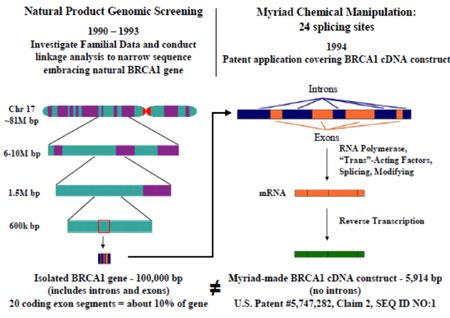
    reading minimizes the vast difference between identifying a chromosome, or even
    a chromosomal region, genetically linked to a disease or disorder and isolating
    and sequencing the gene, as illustrated below (graphic courtesy of Courtenay Brinckerhoff):
    Image
    The
    situation with the BRCA2 gene was similar, according to Ambry, with the
    Stratton group identifying chromosome 13 as the locus of that gene, and the
    collaborative nature of work towards its identification.  In addition, Ambry asserts that the Stratton
    group also isolated and sequenced BRCA2, at about the same time that Myriad
    announced its isolation of the gene.  Ambry
    also emphasizes the amount of "public and private" grant monies
    received by the Skolnick group ("$5 million in 1992, $8 million in 1993,
    and $9 million in 1994"), and later in their complaint alleges that Myriad
    attempted to deprive NIH researchers credit for inventorship (later rectified)
    and royalties (allegedly still owed these inventors).

    Following
    these events, Ambry asserts that Myriad "quickly set out to commercialize
    its discoveries," inter alia, by applying for patents on the isolated
    BRCA1 and BCRA2 genes.  According to
    Ambry:

    These patents rest on patenting the isolated DNA sequence of the
    BRCA1 and BRCA2 genes.  The claims at issue in this case do not
    cover novel diagnostic tools or methods used in genetic testing.  Nor are they analogous
    to patents on novel medical instruments.  Rather, these claims attempt to confer
    upon Myriad the exclusive right to read human BRCA1 and BRCA2 sequences.

    (As in the ALCU's lawsuit, Ambry reduces the actual methods used to determine a
    genetic sequence to merely "reading" a sequence.)  Departing from factual allegations, Ambry
    proceeds to argue that Myriad's claims "either attempt to assert broad
    ownership over all human DNA sequences that can be used to amplify and sequence
    BRCA1 and BRCA2, or merely append routine steps to the patent
    claims, which would necessarily be conducted while assessing the biological
    relationships between mutations in the BRCA1 and or BRCA2 genes
    and the predisposition to cancer."  Further, Myriad's patenting strategy "is an overt attempt to
    convert these natural biological phenomena into patentable inventions using the
    patent language of a 'method' or 'process.'"  "In other words,
    the patent claims are directed to routine biological procedures and
    correlations generically such that it is effectively impossible for anyone in
    the United States in any meaningful way to 'make' or 'use'
    natural forms of isolated DNA molecules encoding the BRCA1 and BRCA2 genes
    in humans without infringing Myriad's patents," features that, in Ambry's
    view should apply to any genetic diagnostic method and, indeed, almost all
    diagnostic method claims.

    Returning
    to its characterization of the facts, Ambry asserts that Myriad "set up
    $30 million diagnostics laboratory" and provided three tests:  a comprehensive
    assessment of both BRCA1 and BRCA 2 (costing $2400); a "single site"
    test for mutations "previously identified in another family member" ($395);
    and a "multisite" test specific for members of the Ashkenazi Jewish
    population.  Ambry also sets out Myriad's
    efforts to assemble "a group of laboratories, health insurers, sales teams
    and doctors to market and sell its tests," resulting in $20 million in
    revenue in the first three quarters of 1997 alone.  At the same time, according to Ambry, Myriad
    was threatening competitors (including those at the Genetic Diagnostic Testing
    Laboratory at the University of Pennsylvania) with infringement lawsuits for
    offering BRCA gene testing, and filed such a lawsuit against the University,
    which settled with an agreement that university laboratories would not offer
    these tests.  Interestingly, Ambry's
    allegations of Myriad's malfeasance include a settlement of litigation between
    Myriad and OncorMed that resulted in Myriad acquiring OncorMed's patents "to
    extend its monopoly."

    • Myriad eschews considerations of affordability, test accuracy and
    recommendations for genetic testing

    These
    allegations are based on the following facts according to Ambry.  Compared with OncorMed, Myriad offered a
    comprehensive rather than a "tiered" approach to testing, thus
    requiring the $2400 test rather than tests of fewer mutations offered by
    OncorMed costing around $500.  (Of
    course, when testing a "naïve" patient, i.e., one whose family
    history with regard to the existence of BCRA gene mutations was unknown, Myriad's
    testing would provide the best information on whether the patient was at risk
    for inherited breast cancer.)  Ambry also
    notes that while OncorMed complied with recommendations of a Federal Task
    Force on Genetic Testing (issued March 1996, at the dawn of the generic testing
    era), Myriad did (and does) not.  (A
    similar situation exists for recommendation from the American Society of
    Clinical Oncologists, issued May, 1996.)  Also in this section of the
    complaint are allegations that Myriad "misses" "up to 12%"
    of certain types of genetic variations (specifically, rearrangements, deletions
    and insertions), citing Congressional testimony from interested parties
    (including Wendy Chung, one of the ALCU plaintiffs) attributing delays in this
    testing to Myriad's "monopoly."

    • There exists significant opposition to Myriad's business model of patenting
    gene sequences and establishing a private database

    This
    portion of Ambry's counterclaims highlights Myriad's decision in 2004 not to
    contribute additional information on BRCA gene mutations obtained through is
    testing to a public repository of breast cancer-specific mutations, and the
    reaction of "[p]oliticians, clinicians, breast cancer advocacy groups and
    commentators" who oppose this decision (including the "Sharing
    Clinical Reports Project").  Also mentioned is the ACLU's lawsuit and the
    Supreme Court's decision invalidating five of nine claims at issue before the
    Court.

    • Myriad is aware that its asserted claims on BCRA1 and BCRA2 genes are invalid
    under recent Supreme Court and Federal Circuit cases

    In
    this portion of the "factual" background for its counterclaims, Ambry
    recites the history and outcomes of the ACLU's Myriad litigation, from the District Court through the Supreme
    Court's June 13th decision, as well as the effects of the Court's Mayo decision on this lawsuit.  (The history of these lawsuits have been
    extensively discussed and Ambry's characterization thereof will not be set
    forth here.)  This history is recited
    here as evidence that "rebuts and presumption [that] Myriad [] brought
    this suit in good faith."

    As
    a consequence of these litigations, Ambry contends that "[Myriad's]
    asserted composition claims are not patent eligible, because they are identical
    to sequences that occur in nature (a variation of the Department of Justice's "magic
    microscope" test not explicitly relied upon by the Court).  According to Ambry, Myriad's asserted claims
    reciting BRCA gene-specific primers "on their faces fail to recite
    patentable subject matter" because the Supreme Court in its Myriad decision "unequivocally
    excluded from patentable subject matter synthetic DNA 'that may be
    indistinguishable from natural DNA.'"  (This is probably Ambry's strongest argument.)  Merely being "synthetic" is not
    enough to render these primers patent eligible, according to Ambry:  "even
    though the probe or the primer may have been synthesized in a laboratory, [it
    is not patent eligible] so long as it mirrors, in whole or in part, the genomic
    DNA of the BRCA1 or BRCA2 genes."

    Turning
    to Myriad's asserted method claims, Ambry's argument is on less firm
    ground.  According to Ambry, these claims
    are also invalid under Myriad (and Mayo) because they recite "two
    biochemical processes [that] were well known in the art."  However, what was "routine,
    well-understood and conventional" in Mayo was not just the type of methods applied in those claims
    but the actual application of the recited methods themselves (i.e., testing
    blood from patients administered 6-thioguanine to determine drug or metabolite
    levels).  Here, in contrast, Ambry's
    argument is that these "two biochemical processes" (amplifying and
    sequencing DNA) were generically
    known, which it true.  But the
    application of these methods to the BCRA genes was not "routine, well-understood
    and conventional" prior to Myriad's patent filing because the subject
    matter, the BRCA genes, were unknown in the art.  Ambry attempts to overcome this logical
    deficiency by equating the BRCA genes to be a "law of nature"; while
    the association of specific mutations with breast cancer may be such a law, the
    genes themselves are not.  In keeping
    with the doctrinal laxness of the Court's Mayo decision, Ambry's arguments in
    this regard include not only subject matter ineligibility but the purported
    lack of novelty and obviousness of Myriad's methods, ignoring the fact that
    none of these deficiencies applies to the knowledge of the BCRA genes'
    existence in the prior art.  Indeed, it
    is much more consistent with the Supreme Court's Myriad decision that such
    claims are patent-eligible, in view
    of the Court's statement that:

    Similarly, this case does not involve patents on new applications of knowledge
    about the BRCA1 and BRCA2 genes.  Judge Bryson aptly noted that, "[a]s the
    first party with knowledge of the [BRCA1 and BRCA2] sequences, Myriad was in an
    excellent position to claim applications of that knowledge.  Many of its
    unchallenged claims are limited to such applications."

    Regardless,
    Ambry contends that Myriad filed its lawsuit "to enforce its invalid patents
    in bad faith in order to keep competitors from entering the market,"
    citing Myriad's intention to maintain the "status quo" (which,
    according to Ambry is Myriad's "wrongful monopoly") as set forth in
    its brief in support of its preliminary injunction motion.  Ambry also asserts as an improper motive for
    the lawsuit its intention to contribute the results of its BRCA gene testing to
    public databases.  In Ambry's view,
    Myriad's failure to do the same constitutes an attempt to use "its invalid
    patents to maintain as secret patients' gene sequences (which do not belong to
    Myriad) in an attempt to limit competition."  And Ambry also asserts that Myriad is using
    the lawsuit to delay market entry by competitors other than Ambry, and to
    incorporate aspects of its own technology into Myriad's testing, resulting in
    an expropriation of "Ambry's superior screening services, which utilize
    more sensitive, efficient and cost-effective next-generation sequencing
    technologies."

    Finally
    in this portion of Ambry's counterclaims is the allegation that Myriad has "market
    power" and that its activities have harmed the market.  This portion of Ambry's counterclaims assert
    that the market is diagnostic genetic testing for BCRA gene mutations in the
    United States, for which "[t]here are no products that are reasonably
    interchangeable substitutes for [BRCA] genetic tests."  BRCA testing is also subject to high barriers
    to entry, including "the various patents Myriad holds, the technological
    know-how for designing and running genetic tests to identify mutations in BRCA1
    and BRCA2, and establishing relationships with genetic counselors
    and hospitals, many of which are already heavily utilizing Myriad's tests."  Myriad has an "over 90% market share"
    for BRCA genetic testing and "possesses the power to control prices and
    exclude competitors."  And the
    public suffers because Myriad's tests are "nearly 100% higher" in
    costs than Ambry's.  Additionally, Ambry
    contends that Myriad's contention that Ambry's testing has "variant of
    unknown significance (VUS)" rates of 10-30% are false, and that Myriad
    knowing this falsity has had its employees conduct a campaign of informing
    genetic counselors of this false VUS rate for Ambry's BRCA testing.  And these allegations (which are used to
    support Ambry's antitrust counterclaims) extend past Myriad:  "Plaintiffs
    in this action are aware of the anticompetitive and exclusionary conduct by
    Myriad [and] that each and every Plaintiff is aware that the claims of the
    asserted patents are facially invalid [and] that each and every plaintiff was
    involved in the decision to bring this lawsuit, notwithstanding that the
    asserted claims are facially invalid."

    Count
    1 of Ambry's counterclaims is brought under Section 2 of the Sherman Antitrust
    Act (against Myriad only).  According to
    this counterclaim:

    126.  Myriad is willfully maintaining its monopoly through exclusionary conduct
    as distinguished from growth or development as a consequence of a superior
    product, business acumen, or historic accident.  Myriad seeks to maintain its
    monopoly position through various anticompetitive conducts described above,
    including through the bad faith enforcement of its facially invalid patents.

    127.  Myriad was aware before filing its Complaint in this action that the claims it
    was asserting are invalid per Myriad and Prometheus.

    128.  Through its exclusionary and anticompetitive conduct, Myriad has acquired and
    maintained its monopoly in the relevant market for genetic testing for patients
    seeking analysis of their full BRCA1 and BRCA2 gene sequences.  Myriad has operated in this manner free from competition because of the high
    barriers to entry that exist in the market, including Myriad's invalid patents,
    the technological know-how to design and run genetic tests, and the actions of
    Myriad's employees.

    Ambry
    alleges it has suffered "substantial injury to its business and property"
    as a consequence, and that "[c]ompetition in the relevant market" has
    similarly suffered "[d]ue to Myriad's anticompetitive conduct."

    Count
    2 is brought under the Sherman Act for "attempted" monopolization for
    substantially the same market behavior, Ambry alleging that Myriad acted "with
    a specific intent to monopolize the relevant market through the assertion of
    facially invalid patent claims and the anticompetitive conduct of its
    employees."

    Ambry does not expressly assert that the patents
    were obtained through fraud, or that the litigation is brought as a sham, but
    rather that the effects of Myriad's assertion of patent claims Ambry asserts
    are invalid under recent Federal Circuit or Supreme Court precedent should
    incur antitrust liability.  In this
    regard no better authority that Chief Justice Roberts may be consulted
    regarding the relevant legal standard:

    The point of patent law is to grant
    limited monopolies as a way of encouraging innovation.  Thus, a patent grants "the
    right to exclude others from profiting by the patented invention."  Dawson Chemical
    Co. v. Rohm & Haas Co., 448 U. S. 176, 215 (1980).  In doing so it provides
    an exception to antitrust law, and the scope of the patent — i.e., the rights
    conferred by the patent — forms the zone within which the patent holder may
    operate without facing antitrust liability.

    This should go without saying, in part
    because we've said it so many times.  Walker Process Equipment, Inc. v. Food
    Machinery & Chemical Corp., 382 U. S. 172, 177 (1965) ("'A patent . .
    . is an exception to the general rule against monopolies'"); United States
    v. Line Material Co., 333 U. S. 287, 300 (1948) ("[T]he precise terms of
    the grant define the limits of a patentee's monopoly and the area in which the
    patentee is freed from competition"); United States v. General Elec. Co.,
    272 U. S. 476, 485 (1926) ("It is only when . . . [the patentee] steps out
    of the scope of his patent rights" that he comes within the operation of
    the Sherman Act); Simpson v. Union Oil Co. of Cal., 377 U. S. 13, 24 (1964)
    (similar).

    The key, of course, is that the patent
    holder — when doing anything, including settling — must act within the scope of the
    patent.  If its actions go beyond the monopoly powers conferred by the patent,
    we have held that such actions are subject to antitrust scrutiny.  See, e.g., United
    States v. Singer Mfg. Co., 374 U. S. 174, 196–197 (1963).  If its actions are
    within the scope of the patent, they are not subject to antitrust scrutiny,
    with two exceptions concededly not applicable here:  (1) when the parties settle
    sham litigation, cf. Professional Real Estate Investors, Inc. v. Columbia
    Pictures Industries, Inc., 508 U. S. 49, 60–61 (1993); and (2) when the
    litigation involves a patent obtained through fraud on the Patent and Trademark
    Office.  Walker Process Equipment, supra, at 177.

    FTC
    v. Activis
    (Roberts, CJ, dissenting).

    The other asserted counterclaims comprise asking
    the Court for a declaratory judgment of non-infringement and invalidity of each
    of the asserted patents.

    Ambry asks for a jury trial, declaratory judgment,
    an injunction under Section 16 of the Clayton Act to prevent Myriad or the
    other plaintiffs from enforcing the patents-in-suit, treble damages on Ambry's
    Sherman Act antitrust counterclaims, and costs and attorneys' fees.

  •     By Donald Zuhn

    National Cancer InstituteLast month, the American
    Association for Cancer Research (AACR) announced that researchers
    at the National Cancer Institute (NCI) had generated a data set of
    cancer-specific genetic variations, which the researchers were making freely available
    to the research community.  The data set
    of coding variants in the NCI-60 panel of cell lines was described in the July
    15 issue of the AACR journal Cancer
    Research
    (Abaan et al., "The
    Exomes of the NCI-60 Panel: A Genomic Resource for Cancer Biology and Systems
    Pharmacology
    ").  The NCI-60 human cancer cell line panel,
    which consists of 60 different cell lines representing cancers of the lung,
    colon, brain, ovary, breast, prostate, and kidney, as well as leukemia and
    melanoma, is used extensively by cancer researchers to discover anti-cancer drugs.  According to the
    article, the genomic variants identified in the NCI-60 panel are being made available at the NCI DTP, CellMiner,
    and Ingenuity
    websites.

    Co-author Dr. Yves Pommier,
    chief of the NCI's Laboratory of Molecular Pharmacology, noted that the data
    set of coding variants constitutes "the largest database worldwide,
    containing 6 billion data points that connect drugs with genomic variants for
    the whole human genome across cell lines from nine tissues of origin, including
    breast, ovary, prostate, colon, lung, kidney, brain, blood, and skin."  He added that "[o]pening this extensive
    data set to researchers will expand our knowledge and understanding of
    tumorigenesis, as more and more cancer-related gene aberrations are discovered."

    The comprehensive list of
    cancer-specific genetic variations was generated by conducting whole-exome
    sequencing of the NCI-60 human cancer cell line panel.  The genetic variations that were identified consisted
    of two types:  type I variants
    corresponding to variants found in the normal population, and type II variants,
    which are cancer-specific.

    Preliminary studies
    conducted by the researchers indicate that the data set has the potential to
    enhance our understanding of the relationships between specific cancer-related
    genetic variations and drug response.  In
    particular, the researchers were able to predict the sensitivity of cells
    harboring type II variants to 103 anti-cancer drugs approved by the FDA and an
    additional 207 investigational new drugs.

    One month prior to the release
    of the NCI-60 panel database, the Genetic Alliance, a network of more than
    1,200 disease-specific advocacy organizations, thousands of universities,
    private companies, government agencies, and public policy organizations, announced
    the launch of an initiative to fill the public information gap caused by the
    lack of available genetic information for the BRCA1 and BRCA2 genes (see "Consortium Launches Public Database of BRCA
    Data
    ").  The Genetic Alliance announcement came on the same day that the Supreme Court issued
    its decision in Association for Molecular Pathology v. Myriad Genetics, Inc.

  • MerckThe UK High Court recently
    gave its judgment in the case of Merck, Sharp & Dohme Corp. and
    Bristol-Myers Squibb Pharmaceuticals Ltd (collectively referred to in the
    judgement as BMS) v Teva Pharma B.V. and Teva UK Ltd (Teva) (decision).  The judgement is interesting as it is one of
    the few so called "quia timet" injunctions that has been issued by
    the UK High Court on the basis of a contention by a patent proprietor that a
    generic pharmaceutical company intends to launch its generic drug whilst the
    patent and SPC under which the drug is protected are still in force.  A quia timet injunction is an injunction to
    restrain harm which has not yet occurred but what is being threatened is
    imminent.

    The patent

    Efavirenz is a drug used to
    control HIV infections and is protected by the patent EP (UK) 0 582 455 (and
    its associated SPC) which is owned by Merck.  The patent will expire on 3 August 2013 and the SPC on 20 November 2013.

    Interim injunction

    Teva #2Teva obtained a marketing
    authorisation for Europe for generic efavirenz in early 2012.  From its actions
    in previous cases, such as the Warner Lambert case concerning generic
    atorvastatin, Teva had a reputation to launch generic versions of a drug while
    the patent and SPC protecting the drug were still in force.  BMS therefore asked Teva what its intentions
    were regarding the launch of generic efavirenz.  Teva replied that its policy
    was to not divulge commercial information to its competitors.  It also pointed
    out that the grant of the marketing authorisation for generic efavirenz permits
    but does not require Teva to market the generic product and that it was Teva's
    policy to not infringe valid patents.

    Dissatisfied with Teva's
    reply, BMS applied to the UK court for injunctive relief alleging that Teva's
    actions to obtain a marketing authorisation for Europe at an unusually early
    time during the patent term and its reluctance to provide details of its
    intentions concerning the launch of generic efavirenz in the UK indicated an
    intention to infringe the patent and SPC.

    Teva countered that the
    claim should be struck out because it was not based on the validity of the
    patent but instead on whether Teva's actions amounted to a threat to infringe.

    Bristol-Myers Squibb #2The judge believed that BMS
    had reasonable grounds for seeking injunctive relief.  In the judge's view, the
    fact that Teva went to the trouble of obtaining a marketing authorisation for
    efavirenz gave a concrete inference that Teva intended to sell efavirenz at
    some time.  Furthermore, the judge found that the fact that Teva obtained the
    marketing authorisation almost 22 months before patent expiry, which is
    unusually early, supported an inference that generic efavirenz was intended to
    be launched before patent expiry.

    An interim injunction was
    therefore granted on 15 March 2012 against Teva to prevent the launch of
    generic efavirenz in the UK.

    Final trial

    At final trial (decision
    issued on 9 July 2013) the only question that was considered was whether Teva,
    by its actions, threatened to infringe EP (UK) 0 582 455 and its associated SPC
    before their expiry and, thus, whether a final injunction for the remaining
    term of the patent and SPC ought to be granted.

    Teva argued that at the
    time the action was brought (February 2012) it did not intend to launch generic
    efavirenz before expiry of EP (UK) 0 582 455 and its associated SPC.  Teva
    presented documentation from its in-house legal and commercial departments
    which, Teva asserted, supported its position.

    The judge summarised the
    test under UK law for granting quia timet injunctions as whether, in all the
    circumstances, there is a sufficiently strong probability that an injunction
    will be required to prevent harm to the claimant occurring that the bringing of
    proceedings by the claimant is justified.  The defendant's intentions before the action is brought are central to
    the assessment.  Important considerations
    are the defendant's subjective intentions and acts and what third parties would
    perceive the defendant's intentions to be.

    In the present case, in
    considering the "third parties perceptions" arm of the test, the
    judge held that when the action was brought, third parties would perceive that
    there was a threat to infringe EP (UK) 0 582 455 and its associated SPC because
    in the past Teva had launched products before expiry and without notice to the
    patentee.  In considering the "subjective
    intentions" arm of the test, during the case Teva had informed BMS that it
    did not "have any plans to supply pharmaceutical products containing
    efavirenz" in the UK before SPC expiry.  However, from internal documents disclosed by Teva during the trial, the
    judge found that Teva was actively considering whether or not to launch its
    generic drug in the UK before the expiry of the SPC.

    The court therefore held
    that it was appropriate to continue the preliminary injunction to restrain Teva
    from infringing the patent and the SPC up to their expiry.

    The judgement provides
    useful guidance for pre-action correspondence which seeks to ascertain when a
    company plans to launch its generic drug. 
    If generics companies withhold such information from patent proprietors
    they may face actions for quia timet injunctions.  Therefore, if a generics company is asked by
    an originator company about its intentions concerning the launch of a generic
    drug, the generic company should consider supplying assurances that generic
    drugs will not be launched while patent rights remain in force.  Such assurance may be given under confidence
    to prevent commercially sensitive information being divulged to competitor
    generics companies.

    This report comes
    from European Patent Attorneys at WP
    Thompson & Co.
    , 55 Drury Lane, London UK.  Further details and
    commentary can be obtained from Gill Smaggasgale,
    a partner at the firm.

  • By Sherri Oslick

    Gavel About Court Report:  Each week we will report briefly on recently filed biotech and pharma cases.

    UCB, Inc. et
    al. v. Sun Pharma Global FZE et al.

    1:13-cv-05514;
    filed August 1, 2013 in the Northern District of Illinois

    • Plaintiffs: 
    UCB, Inc.; UCB Pharma GmbH; Research Corporation Technologies, Inc.; Harris FRC
    Corp.
    • Defendant: 
    Sun Pharma Global FZE; Sun Pharmaceutical Industries, LTD.; Sun Pharmaceutical
    Industries, Inc.

    Infringement
    of U.S. Patent No. RE38,551 ("Anticonvulsant Enantiomeric Amino Acid
    Derivatives," issued July 6, 2004) following a Paragraph IV certification
    as part of Sun's filing of an ANDA to manufacture a generic version of UCB's
    Vimpat® (lacosamide, used as adjunctive therapy in the treatment of
    partial-onset seizures in people with epilepsy aged 17 years and older).  View the complaint here.


    Medical
    University of South Carolina Foundation for Research Development et al. v.
    AstraZeneca Pharmaceuticals LP

    2:13-cv-02078;
    filed July 31, 2013 in the District Court of South Carolina

    • Plaintiffs: 
    Medical University of South Carolina Foundation for Research Development; Charleston
    Medical Therapeutics Inc.
    • Defendant: 
    AstraZeneca Pharmaceuticals LP

    Infringement
    of U.S. Patent No. 6,511,800 ("Methods of Treating Nitric Oxide and
    Cytokine Mediated Disorders," issued January 28, 2003) based on
    AstraZeneca's manufacture and sale of its Crestor® product (rosuvastatin
    calcium, used to treat high cholesterol and atherosclerosis).  View the complaint here.


    Alcon
    Research Ltd. v. Mylan Pharmaceuticals Inc. et al.

    1:13-cv-01332;
    filed July 26, 2013 in the District Court of Delaware

    • Plaintiff: 
    Alcon Research Ltd.
    • Defendants: 
    Mylan Pharmaceuticals Inc.; Mylan Inc.

    Infringement
    of U.S. Patent Nos. 8,268,299 ("Self Preserved Aqueous Pharmaceutical
    Compositions," issued September 18, 2012), 8,323,630 (same title, issued
    December 4, 2012), and 8,388,941 (same title, issued March 5, 2013) following a
    Paragraph IV certification as part of Mylan's filing of an ANDA to manufacture
    a generic version of Alcon's Travatan Z® (travoprost ophthalmic solution, used
    to reduce elevated intraocular pressure in patients with open-angle glaucoma or
    ocular hypertention).  View the complaint here.


    Depomed, Inc.
    v. Banner Pharmacaps Inc. et al.

    2:13-cv-04542;
    filed July 26, 2013 in the District Court of New Jersey

    • Plaintiff: 
    Depomed, Inc.
    • Defendants: 
    Banner Pharmacaps Inc.; Watson Laboratories, Inc.

    Infringement
    of U.S. Patent Nos. 6,365,180 ("Oral Liquid Compositions," issued
    April 2, 2002), 7,662,858 ("Method of Treating Post-Surgical Acute Pain,"
    issued February 16, 2010), 7,884,095 (same title, issued February 8, 2011),
    7,939,518 (same title, issued May 10, 2011) and 8,110,606 (same title, issued
    February 7, 2012) following a Paragraph IV certification as part of Banner's
    filing of an ANDA to manufacture a generic version of Depomed's Zipsor®
    (diclofenac potassium, used for relief of mild to moderate acute pain).  View the complaint here.


    Janssen
    Pharmaceuticals, Inc. et al. v. Actavis Elizabeth LLC et al.

    2:13-cv-04507;
    filed July 25, 2013 in the District Court of New Jersey

    • Plaintiffs: 
    Janssen Pharmaceuticals, Inc.; Grunenthal GmbH;
    • Defendants: 
    Actavis Elizabeth LLC; Actavis, Inc.; Actavis LLC; Alkem Laboratories Ltd.;
    Ascend Laboratories, LLC

    Infringement
    of U.S. Patent Nos. RE39,593 ("1-Phenyl-3-Dimethylaminopropane Compounds
    With a Pharmacological Effects," issued April 24, 2007), 7,994,364 ("Crystalline
    Forms of (-)-(1R,2R)-3-(3-Dimethylamino-1-Ethyl-2-Methylpropyl)-Phenol
    Hydrochloride," issued August 9, 2011) and 8,309,060 ("Abuse-Proofed
    Dosage Form," issued November 13, 2012), licensed to Janssen, following a
    Paragraph IV certification as part of Actavis' filing of an ANDA to manufacture
    a generic version of Janssen's Nucynta® and Nucynta®  ER (tapentadol hydrochloride, used for the
    management of moderate to severe acute pain in adults).  View the complaint here.

  • Vote_rec_blueLast month, the ABA Journal
    began work on its 7th annual list of the 100 best legal blogs (or blawgs) and
    announced that it is seeking the advice of its readers, via the ABAJournal.com
    website, on which blogs to include on this year's Blawg 100.  Last year, Patent Docs was honored to
    be included among five blogs selected in the IP Law category of the Blawg 100 (see
    "ABA
    Journal Announces 2012 Blawg 100
    ").

    Readers interested in
    nominating a particular blog should use the blawg 100 amici form provided on the ABA Journal website.  Additional information about the Blawg 100
    can also be found on the blawg 100 amici form.  The
    nomination period for the ABA Blawg 100 closes on Friday, August 9th.

  • CalendarAugust 5-7, 2013 – Advanced Patent Law Seminar (Chisum Patent Academy) – Seattle, WA

    August 8, 2013 – Analyzing and Adapting to the Supreme Court's
    Myriad Ruling
    (Technology
    Transfer Tactics) – 1:00 to 2:00 pm
    (Eastern)

    August 8-11,
    2013 – 2013 Annual Meeting (American Bar
    Association) – San Francisco, CA

    August 21, 2013 – Inducement to Infringe in Hatch-Waxman Litigation: Lessons from Commil USA v. Cisco Systems and Bayer Schering v. Lupin for Pharma
    Patents
    (Strafford) – 1:00 to 2:30 pm (EDT)

    August
    22, 2013 – What are the Implications of CLS
    Bank Int'l v. Alice Corp
    . on Computer-Implemented Inventions?
    (McDonnell
    Boehnen Hulbert & Berghoff LLP) – 10:00 to 11:15 am (CT)

    August 29, 2013 – AIA Impact on Section 102 and Prior Art:
    Navigating the Expanded Scope of Prior
    Art and the AIA Exceptions
    (Strafford) – 1:00 to 2:30 pm
    (EDT)

    September 15-17, 2013 – 41st IPO Annual Meeting (Intellectual
    Property Owners Association) – Boston, MA

    September 16, 2013 – The European Unitary Patent:
    Strategic Considerations for a New Era
    (McDonnell
    Boehnen Hulbert & Berghoff LLP & Nederlandsch Octrooibureau) – Chicago, IL

    September 17-18, 2013 – FDA Boot Camp*** (American Conference
    Institute) – Boston, MA

    September 18, 2013 – Conflicts in Patent Prosecution: Avoiding the
    Ethical Pitfalls Minimizing Risks of Malpractice Liability and Ethics Sanctions
    (Strafford) – 1:00 to 2:30 pm (EDT)

    September 23-24, 2013 – International Congress on
    Paragraph IV Litigation
    *** (Momentum) – New York, NY

    September 26, 2013 – Supreme Court IP Review (IIT Chicago-Kent
    College of Law) – Chicago, IL

    October
    3-4, 2013 – Paragraph IV Disputes*** (American Conference
    Institute) – Chicago, IL

    ***Patent Docs is a media partner of this conference or CLE