• By Sherri Oslick

    Gavel About Court Report:  Each week we will report briefly on recently filed biotech and pharma cases.

    Purdue
    Pharmaceutical Products L.P. et al. v. TWi Pharmaceuticals, Inc
    .
    1:13-cv-05999;
    filed August 22, 2013 in the Northern District of Illinios

    • Plainiffs: 
    Purdue Pharmaceutical Products L.P.; Purdue Pharma L.P.; Transcept
    Pharmaceuticals, Inc.
    • Defendant: 
    TWi Pharmaceuticals, Inc.

    Purdue
    Pharmaceutical Products L.P. et al. v. TWI Pharmaceuticals, Inc.

    2:13-cv-05003;
    filed August 20, 2013 in the District Court of New Jersey

    • Plaintiffs: 
    Purdue Pharmaceutical Products L.P.; Purdue Pharma L.P.; Transcept
    Pharmaceuticals, Inc.
    • Defendant: 
    Twi Pharmaceuticals, Inc.

    The
    complaints in these cases are substantially identical.  Infringement of U.S. Patent Nos. 8,242,131 ("Methods
    of Treating Middle-of-the-Night Insomnia," issued August 14, 2012) and
    8,252,809 ("Compositions for Treating Insomnia," issued August 28,
    2012) following a Paragraph IV certification as part of TWI's filing of an ANDA
    to manufacture a generic version of Purdue's Intermezzo® (sublingual zolpidem
    tartrate, used to treat insomnia when middle-of-the-night awakening is followed
    by difficulty returning to sleep).  View
    the New Jersey complaint here.


    Life
    Technologies Corp. et al. v. Rea et al.

    1:13-cv-01046;
    filed August 21, 2013 in the Eastern District of Virginia

    • Plaintiffs: 
    Life Technologies Corp.; Life Technologies (Israel) Ltd.; Applied
    Biosystems, LLC; Molecular Probes, Inc.
    • Defendants: 
    Teresa Stanek Rea; Office of the General Counsel

    Review and
    correction of the patent term adjustment calculation made by the U.S. Patent
    and Trademark Office for a series of 36 patents on the basis of improper
    termination of B-delay at the filing of a Request for Continued
    Examination.   View the complaint here.


    Reckitt
    Benckiser Pharmaceuticals Inc. et al. v. Par Pharmaceutical Inc. et al.

    1:13-cv-01461;
    filed August 20, 2013 in the District Court of Delaware

    • Plaintiffs: 
    Reckitt Benckiser Pharmaceuticals Inc.; RB Pharmaceuticals Ltd.; MonoSol Rx
    LLC
    • Defendants: 
    Par Pharmaceutical Inc.; IntelGenX Technologies Corp.; LTS Lohmann Therapy
    Systems Corp.

    Infringement
    of U.S. Patent Nos. 8,475,832 ("Sublingual and Buccal Film Compositions,"
    issued July 2, 2013) and 8,017,150 ("Polyethylene Oxide-Based Films and
    Drug Delivery Systems Made Therefrom," issued on September 13, 2011) following
    a Paragraph IV certification as part of Par's filing of an ANDA to manufacture
    a generic version of Reckitt Benckiser's Suboxone® (buprenorphine hydrochloride
    and naloxone hydrochloride sublingual film, used for the maintenance treatment
    of opioid dependence).  View the
    complaint here.


    Teva Branded
    Pharmaceutical Products R&D Inc. et al. v. Perrigo Pharmaceuticals Co. et
    al.

    1:13-cv-01441;
    filed August 16, 2013 in the District Court of Delaware

    • Plaintiffs: 
    Teva Branded Pharmaceutical Products R&D Inc.; Teva Respiratory LLC; Norton
    (Waterford) Ltd.; Norton Healthcare Ltd.
    • Defendants: 
    Perrigo Pharmaceuticals Co.; Perrigo Co.; Catalent Pharma Solutions LLC

    Infringement
    of U.S. Patent Nos. 7,566,445 ("Medicinal Aerosols and Methods of Delivery
    Thereof," issued July 28, 2009), 7,105,152 ("Suspension Aerosol
    Formulations," issued September 12, 2006), 6,446,627 ("Inhaler Dose
    Counter," issued September 10, 2002), and 8,132,712 ("Metered-Dose Inhaler,"
    issued March 13, 2012) following a Paragraph IV certification as part of
    Perrigo's filing of an ANDA to manufacture a generic version of Teva's ProAir®
    HFA Inhalation Aerosol (albuterol sulfate, used for the treatment or prevention
    of bronchospasm with reversible obstructive airway disease in patients 4 years
    of age and older and for the prevention of exercise-induced bronchospasm in
    patients 4 years of age and older).  View
    the complaint here.

  • Calendar

    August 28, 2013 – Versata v. SAP and Fresenius
    v. Baxter
    : Res Judicata and Collateral Estoppel in Post-grant Proceedings
    and Concurrent Litigation
    (Intellectual Property Owners Association) – 2:00 to 3:00 pm (ET)

    August 29, 2013 – AIA Impact on Section 102 and Prior Art:
    Navigating the Expanded Scope of Prior
    Art and the AIA Exceptions
    (Strafford) – 1:00 to 2:30 pm
    (EDT)

    September 15-17, 2013 – 41st IPO Annual Meeting (Intellectual
    Property Owners Association) – Boston, MA

    September 16, 2013 – The European Unitary Patent:
    Strategic Considerations for a New Era
    (McDonnell
    Boehnen Hulbert & Berghoff LLP & Nederlandsch Octrooibureau) – Chicago, IL

    September 17-18, 2013 – FDA Boot Camp*** (American Conference
    Institute) – Boston, MA

    September 18, 2013 – Conflicts in Patent Prosecution: Avoiding the
    Ethical Pitfalls Minimizing Risks of Malpractice Liability and Ethics Sanctions
    (Strafford) – 1:00 to 2:30 pm (EDT)

    September 23-24, 2013 – International Congress on
    Paragraph IV Litigation
    *** (Momentum) – New York, NY

    September 26, 2013 – Supreme Court IP Review (IIT Chicago-Kent
    College of Law) – Chicago, IL

    October 1, 2013 – 2013 Intellectual Property
    Continuing Legal Education Seminar
    (DuPont and the Widener
    University School of Law) – Wilmington, DE

    October
    3-4, 2013 – Paragraph IV Disputes*** (American Conference
    Institute) – Chicago, IL

    October 15-17, 2013 – Business of
    Biosimilars
    *** (Institute for
    International Research) – Boston, MA

    November 4-5, 2013 – FDA Boot Camp Devices Edition*** (American Conference
    Institute) – Chicago, IL

    November 4-5, 2013 – Trade Secrets: Protecting Your Intellectual Capital and Confidential
    Business Information
    *** (American Conference
    Institute) – Chicago, IL

    November 17-20, 2013 – Creating and Leveraging Intellectual Property in Developing Countries: A Power Tool for Social and
    Economic Growth
    *** (Companies and IP Commission and National
    IP Management Office of South Africa) – Durban, South Africa

    ***Patent Docs is a media partner of this conference or CLE


  • IPO #2The
    Intellectual Property Owners Association (IPO) will offer a one-hour webinar entitled
    "Versata v. SAP and Fresenius
    v. Baxter
    : Res Judicata and Collateral Estoppel in Post-grant Proceedings
    and Concurrent Litigation" on August 28, 2013 beginning at 2:00 pm
    (ET).  A panel consisting of Bernard Knight, General Counsel of the U.S. Patent
    and Trademark Office; Jeffrey Kushan of Sidley Austin; and Scott Daniels of
    Westerman Hattori Daniels & Adrian will examine what happens when
    the Patent Trial and Appeal Board (PTAB) and the Federal Circuit come to
    different conclusions about the same patent at different times.  The panel will also consider the procedural
    stance of the two named cases, enumerate other conflicting situations that are
    likely to emerge, and discuss what legal principles will prevail to solve the
    resulting conundrums.

    The
    registration fee for the webinar is $120 (government and academic rates are
    available upon request).  Those
    interested in registering for the webinar can do so here.

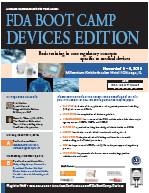
  • Chicago #5American Conference
    Institute (ACI) will be holding its FDA Boot Camp Devices Edition conference on
    November 4-5, 2013 in Chicago, IL.  ACI
    faculty will help attendees:

    • Master the basics
    of the application and approval processes, including 510(k) clearance and PMAs;
    • Navigate the
    complexities of device regulations;
    • Comprehend the
    structure of the FDA and the roles of the three major agency centers:  CDER, CBER, and CDRH;
    • Develop a
    practical working knowledge of clinical trials and IDEs;
    • Learn how devices
    are classified, monitored, and regulated;
    • Recognize the
    pivotal role of labeling and learn how to avoid misbranding and off label
    promotion;
    • See the
    importance of cGMPs and QSRs to the post-approval regulatory process; and
    • Navigate the
    protocols of adverse events monitoring, product withdrawals, and recalls.

    FDA Boot CampIn particular,
    ACI's faculty will offer presentations on the following topics:

    • The basics:
    Understanding and working with the FDA — Jurisdiction, functions,
    organization, and operations;
    • Overview of
    device regulation;
    • Understanding
    clinical trials and the investigational device exemption (IDE);
    • Navigating the
    510(k) clearance process;
    • Comprehending the
    premarket approval process (PMA);
    • Complying with
    general post-market controls;
    • Understanding FDA
    enforcement tools, policies, practices, and trends;
    • Labeling and
    promotion;
    • Medical device
    reporting;
    • Guidance for
    navigating recalls and withdrawals; and
    • Quality system
    regulation.

    A pre-conference
    primer on the "Fundamentals of FDA Device Regulatory Law," will be
    offered on November 4, 2013 from 1:00 to 4:00 pm.  A post-conference master class on
    "Unique Regulatory Schemes for Specialized Devices: Medical Device
    Software and Social Media Considerations in Advertising and Promotion"
    will be offered from 2:00 to 5:00 pm on November 6, 2013.

    An agenda for the
    conference can be found here,
    and more information regarding the workshop and master class can be found here.  A complete brochure for this conference,
    including an agenda, detailed descriptions of conference sessions, list of
    speakers, and registration form can be obtained here.

    ACI - American Conference InstituteThe registration
    fee is $2,295 (conference alone), $2,895 (conference and workshop or master
    class), or $3,295 (conference, workshop, and master class).  Those registering by September 6, 2013 will
    receive a $300 discount, and those registering by October 4, 2013 will receive
    a $200 discount.  Patent Docs readers who reference the discount code "PD
    200" will receive $200 off the current price tier when registering.  Those interested in registering for the
    conference can do so here,
    by e-mailing CustomerService@AmericanConference.com, by calling 1-888-224-2480,
    or by faxing a registration form to 1-877-927-1563.

    Patent Docs is a media partner of ACI's FDA Boot Camp Devices Edition conference.

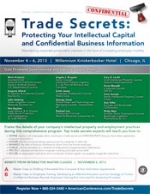
  • Chicago #2American Conference
    Institute (ACI) will be holding a conference on "Trade Secrets: Protecting Your Intellectual Capital and Confidential
    Business Information" on November 4-5, 2013 in Chicago, IL.  The conference will allow attendees to:

    • Define clearly to
    all employees what constitutes a trade secret and demonstrate that you have
    taken substantial measures to protect it;
    •  Ensure that the contracts being used account
    for variances in state law;
    •  Minimize the risks of tortious interference
    claims from the former employer;
    •  Pursue criminal penalties as a method of
    trade secret misappropriation deterrence;
    •  Protect overseas entities from computer
    hacking and trade secret theft; and
    •  Secure an employee's hard drive until a
    computer forensic expert can properly image the hard drive.

    Trade SecretsIn particular,
    ACI's faculty will offer presentations on the following topics:

    • Creating value: Identifying trade secrets
    that are not the secret sauce — Best practices for protecting valuable
    intellectual property;
    • Devising a 50-state game plan: Practical
    strategies for keeping up with changing state laws and navigating conflicting
    jurisdictions;
    • Spotlight on government initiatives: A DOJ
    led discussion;
    • Insulating the company from liability when
    hiring employees from a competitor;
    • The feds are watching: Raising the spectre of
    criminal liability for trade secret misappropriation;
    • Navigating the challenges of the digital
    workplace: Developing comprehensive bring your own device (BYOD) and social
    medial policies;
    • Developing offensive and defensive strategies
    in trade secret litigation;
    • Moving information across borders: Protecting
    your IP rights and valuable trade secrets when working in other countries;
    • Protecting trade secrets and confidential
    information during merger & acquisition transactions; and
    • Utilizing forensics to capture a trade
    secrets thief.

    In addition, two post-conference
    master classes will be offered on November 6, 2013.  The first, entitled "Drafting Enforceable
    Non-Compete & Non-Solicitation Agreements" will take place from 9:00
    am to 12:00 pm, and the second, entitled "Employee Training: Developing an
    Effective Education and Exit Strategy to Protect Confidential Business Records
    Employee Training/Exit Interview/Pre-Screening Processes" will take place
    from 1:30 to 4:30 pm.

    The agenda for the Trade
    Secrets conference can be found here.  More information regarding the post-conference
    master classes can be found here.  A complete brochure for this conference,
    including an agenda, detailed descriptions of conference sessions, list of
    speakers, and registration form can be obtained here.

    ACI - American Conference InstituteThe registration
    fee for the conference is $2,295 (conference alone), $2,895 (conference and one
    master class), or $3,295 (conference and two master classes).  Those registering by September 6, 2013 will
    receive a $300 discount, and those registering by October 4, 2013 will receive
    a $200 discount.  Patent Docs readers who reference the discount code "PD
    200" will receive $200 off the current price tier when registering.  Those interested in registering for the
    conference can do so here,
    by e-mailing CustomerService@AmericanConference.com, by calling 1-888-224-2480,
    or by faxing a registration form to 1-877-927-1563.

    Patent Docs is a media partner of the Trade Secrets conference.

  • By
    Kevin E. Noonan

    Federal Trade Commission (FTC) SealIn
    a move that will surprise almost no one (except perhaps members of the Supreme
    Court majority in FTC v. Actavis),
    the Federal Trade Commission has filed an amicus
    curiae
    brief with the District Court of New Jersey in In re Effexot XR Antitrust Litigation.  This time the issue is not that the parties,
    Wyeth (branded) and Teva (generic) have entered into a reverse payment
    settlement agreement in their ANDA litigation under the Hatch-Waxman Act.  Rather, the agreement the FTC now objects to
    involves Wyeth committing not to launch a so-called "authorized generic"
    form of its branded Effexor XR extended-release product.  As a consequence, Teva will forego entering
    the market with its generic product for two years, but will enter the market
    several years before it would otherwise be able to do so.

    The
    FTC makes three arguments:

    • The Supreme Court's Actavis
    controls and the District Court should apply "traditional" antitrust
    principles under the rule of reason to this agreement.

    • The
    "no authorized generics" agreement as economic effects that will harm
    consumers.

    • These
    economic effects amount to a restraint on trade that raises the same economic
    concerns as reverse payments and has an adverse effect on competition.

    Ignoring
    the now standard incendiary language of the brief (replete with references,
    some of which the Commission gratuitously adds to language from the Court's Actavis opinion, to "monopoly
    profits" as if we were still living in the days of the oil barons), the
    FTC's argument comes down to whether the Supreme Court in Actavis banned cash settlement agreements or more generally ruled
    that settlement agreements in ANDA litigation should always garner antitrust
    scrutiny.  According to the FTC's brief, the
    Supreme Court "rejected a legal rule that conferred 'near automatic
    antitrust immunity' on patent settlements when the alleged anticompetitive
    restraints do not extend beyond the patent's expiration date."  (It should be noted that the "scope of
    the patent" test used by the Second, Eleventh, and Federal Circuits, and
    rejected by the Actavis majority, was
    significantly more detailed and nuanced than the FTC's characterization of
    it.)  The Commission in its argument bootstraps the
    Court's rejection of antitrust immunity for settlement agreements involving "large
    cash payments" to any exchange of other consideration, thus ignoring the
    reality that parties don't settle ANDA litigation (or any other kind) without
    some form of consideration.

    One
    aspect of the agreements under consideration by the District Court is that Teva
    will get something it couldn't get in litigation:  an agreement that Wyeth will
    not launch a competitive authorized generic.  But this is just part of the consideration Teva will obtain for dropping
    its patent challenge, a challenge that represents a much bigger threat to Wyeth
    than winning the challenge presents for Teva.  That should not make the settlement seem nefarious but, applying the FTC's
    standards, it is sufficiently suspicious to warrant antitrust scrutiny because
    it is not limited to the Commission's narrow view of what should be permissible.

    While
    the Commission is correct that the type of licensing agreement at issue in the Effexor case has economic implications,
    the Court did not decide in Actavis
    that such considerations were sufficient to raise antitrust scrutiny, and the FTC's
    position is certainly not mandated by the Court's Actavis opinion.  Indeed,
    Justice Breyer specifically envisioned that settlements in ANDA litigation
    would not be barred by his decision:

    [T]he fact that a large, unjustified reverse payment risks
    antitrust liability does not prevent litigating parties from settling their
    lawsuit.  [ANDA litigation can be settled in] other ways, [] by allowing the
    generic manufacturer to enter the patentee's market prior to the patent's
    expiration, without the patentee paying the challenger to stay out prior to
    that point.

    The
    Court's concern was not with settlements, but with excessive payments:

    Where a reverse payment
    reflects traditional settlement considerations, such as avoided litigation
    costs or fair value for services, there is not the same concern that a patentee
    is using its monopoly profits to avoid the risk of patent invalidation or a
    finding of noninfringement.  In such cases, the parties may have provided
    for a reverse payment without having sought or brought about [] anticompetitive
    consequences.

    And
    the Court expressly rejected the FTC's position that reverse payment settlement
    agreements should be presumptively illegal, stating that "the
    likelihood of a reverse payment bringing about anticompetitive effects depends
    upon its size, its scale in relation to the payor's anticipated future
    litigation costs, its independence from other services for which it might
    represent payment, and the lack of any other convincing justification."  A fortiorari a settlement that does
    not involve a large cash settlement should be even less suspect for antitrust
    purposes.

    Such agreements are not, as the FTC
    alleges in its brief, an attempt to "easily circumvent" the Court's
    decision in Actavis, but rather are a
    rational (and predictable) effort to comply with the Court's admonition that
    ANDA cases be settled in ways that do not involve large cash payments from
    branded to generic drug companies for dropping their patent challenge.  The extent of the Commission's fixation on
    preventing transfer of anything of "value" is illustrated by the
    brief's equation of the licensing agreement here to "gold bullion, stocks
    or real estate," but that is not what the Court said raised legitimate
    antitrust concerns in reverse payment settlements of ANDA litigation.  What for the Commission is merely a means of "avoiding"
    a ban on settlements (that does not exist in the Court's opinion) can be at least
    equally seen as an agreement that falls within the scope of the "alternative"
    settlement arrangements that the Court impliedly sanctioned.

    There is, apparently, one type of
    agreement that the Commission would sanction:  where "the parties in
    Hatch-Waxman patent litigation settle with an agreement that merely sets a date
    for the generic patent challenger's market entry before the patent expiration
    date, without more."  If this is
    what the Commission wanted, it had a ready way to get it:  it could have asked
    the Court to make this limitation plain and explicit.  Instead, it asked that the Court rule these
    agreements of any type to be presumptively illegal, a position the Court
    rejected (and, moreover, in a decision that suggests that settlement agreements
    of much broader scope should survive antitrust scrutiny).

    The
    Federal Trade Commission, as many expected, cannot be trusted to adopt any
    reasonable interpretation of the antitrust laws when it comes to applying them
    in the Hatch-Waxman context.  Despite arguing
    to the Supreme Court that the problem was reverse payment agreements involving
    excessive settlement amounts from branded to generic companies, it is clear
    that the Commission will only be happy when all grounds for settlement in ANDA
    litigation have been eliminated.  As the
    Chief Justice warned in dissent in the Actavis case:

    The irony of all this is that the
    majority's decision may very well discourage generics from challenging
    pharmaceutical patents in the first place.  Patent litigation is costly,
    time consuming, and uncertain.  . . .  Generics "enter this
    risky terrain only after careful analysis of the potential gains if they
    prevail and the potential exposure if they lose."  . . .  Taking
    the prospect of settlements off the table — or limiting settlements to an
    earlier entry date for the generic, which may still be many years in the future
    — puts a damper on the generic's expected value going into litigation, and
    decreases its incentive to sue in the first place.  The majority assures
    us, with no support, that everything will be okay because the parties can
    settle by simply negotiating an earlier entry date for the generic drug
    manufacturer, rather than settling with money.  . . .  But it's a
    matter of common sense, confirmed by experience, that parties are more likely
    to settle when they have a broader set of valuable things to trade.  [citations omitted.]

    Sadly,
    the likely outcome of this ideological crusade against any settlement
    agreements in this type of litigation will be to reduce rather than promote
    generic drug competition.  When an agency
    puts on such blinders to practical reality it is hard to understand how they
    can believe they are acting in the public interest.

  • By
    Kevin E. Noonan

    University of UtahThe
    Federal Circuit, in a split decision, affirmed denial of motions to dismiss on
    jurisdictional grounds and Federal Court joinder rules in University of Utah v. Max-Planck-Gesellschaft zur Forderung der
    Wiessenschaften e.V et al.
    , a decision likely to be
    reviewed by the Supreme Court (if only because the case implicates the Court's
    original jurisdiction over disputes between the states under Article III of the
    Constitution).

    The
    case arose as an inventorship dispute over the "Tuschl" patents, U.S.
    Patent Nos. 7,056,704 and 7,078,196.  The
    University of Utah ("UUtah") was plaintiff, and defendants included
    the assignees and licensees of the patents, including the Max-Planck-Gesellschaft
    zur Forderung der Wiessenschaften e.V., Max-Planck-Innovation GmbH, Whitehead
    Institute for Biomedical Research, Massachusetts Institute of Technology,
    Alnylum Pharmaceuticals, Inc., and the University of Massachusetts ("UMass").  As set forth in the Federal Circuit's
    majority opinion, Dr. Thomas Tuschl, from the University of Massachusetts,
    filed for and obtained the patents-in-suit.  Dr. Brenda Bass, of the University of Utah, claimed that she disclosed the
    inventions claimed in the Tuschl patents at professional conferences attended
    by Dr. Tuschl.  UUtah alleges in the suit
    that Dr. Bass is the sole or at least a joint inventor and, after the
    defendants declined to correct inventorship by agreement UUtah filed suit under
    35 U.S.C. 256 (as well as various state law claims).

    Max Planck GesellschaftsvgDefendant
    U Mass argued in a motion to dismiss that the Supreme Court has original
    jurisdiction because the dispute was between two States (through their
    Universities), citing Article
    III, § 2, cl. 2 of the Constitution:  "In all Cases . . . in which a State
    shall be Party, the [S]upreme Court shall have original Jurisdiction."  In response, UUtah substituted four officials
    for UMass to avoid the original jurisdiction issue.  UMass then argued the case should be barred
    by sovereign immunity, and that UMass was an indispensible party (as an assignee).

    District
    Court Judge Patti Saris denied defendants' motions to dismiss and defendants
    appealed.  The court based its denial of
    UUtah's original jurisdiction argument under Connecticut ex rel. Blumenthal
    v. Cahill
    , 217 F.3d 93, 98 (2d Cir. 2000) because, first, UUtah had amended
    its complaint to recite university officials rather than Massachusetts, and
    that correction of inventorship was not a "core sovereign interest"
    that rose to a dispute between the States.  The District Court also dismissed the argument that UUtah had failed to
    name UMass as an indispensible party because "neither UMass nor Defendants
    would be prejudiced by a judgment rendered in UMass's absence because UMass's
    interests would be adequately represented by the existing defendants, including
    the Named Officials" and that the remedy — ordering the U.S. Patent and
    Trademark Office to correct inventorship — would provide "adequate relief"
    with or without UMass.

    The
    Federal Circuit affirmed, in a decision by Judge Reyna joined by Judge Wallach,
    and a dissent by Judge Moore.  The
    majority addressed the issues squarely:  whether inventorship disputes involving
    state university-assigned patents could properly be brought in federal court
    (instead of the Supreme Court) and whether the suit should be barred under
    sovereign immunity.  In affirming the District Court, the Federal Circuit majority almost ensured that the Supreme Court will
    have another opportunity to correct Federal Circuit patent jurisprudence.  Additionally, the majority held that the District Court did not grant defendants' motion to dismiss for failure to join
    an indispensible party because UMass was not
    indispensible in the action.

    The
    majority begins its opinion recognizing the distinction between private
    assignees and the state, which "typically enjoys sovereign immunity."  This immunity does not extend to suits
    brought by one state against another, however, and States can sue individual
    citizens of other States without raising sovereign immunity issues with the
    State in which an individual defendant resides.  This is not the typical case, according to the
    Court, because there are States in both sides of the dispute.

    The
    defendants raised three issues.  The
    first is jurisdictional:  according to defendants, the District Court did not
    have jurisdiction because a dispute between the States implicates the Supreme
    Court's original (and as noted by the majority, exclusive (28 U.S.C. § 1251(a))
    jurisdiction.  This question the majority
    considers under the law of the regional (here, First) Circuit, which reviews
    decisions on motions to dismiss de novo.  Second, defendants argue that UMass is
    entitled to sovereign immunity as an "arm" of the State.  The question of whether Massachusetts has
    waived its immunity is a question of Federal Circuit law according to the
    majority, citing Regents of the Univ. of N.M. v. Knight, 321 F.3d 1111,
    1124 (Fed. Cir. 2003), which review is also de
    novo
    .  Finally, defendants argued
    that UMass is an indispensible party and UUtah could not bring suit against the
    four University officials under Fed. R. Civ. Pro. 19(b), a question that the
    Court says is a matter to regional circuit law that in the First Circuit is
    decided under an abuse of discretion standard.

    Having
    explicated the procedural niceties, the majority turned to the merits.  On the
    issue of original jurisdiction, the Court affirmed based on its determination
    that UMass is not a real party in interest.  Thus, the question for the majority was whether UUtah's suit is against
    the State of Massachusetts or individuals residing in Massachusetts (where the
    Supreme Court does not have original or exclusive jurisdiction under §
    1251(b)(3)).  Having made this
    distinction based on the identity of the parties, the majority somewhat
    incongruously shifts to a discussion on the weight of the merits of the case
    before them:  "[w]hether original jurisdiction is appropriate depends upon 'the
    seriousness and dignity of the claim,' whether the 'named parties' have another
    forum 'where appropriate relief may be had,' and whether the case raises 'serious
    and important, federalism concerns," citing Illinois v. City of Milwaukee,
    Wis
    ., 406 U.S. 91, 93-94 (1972); Wyoming v. Oklahoma, 502 U.S. 437,
    451 (1992) and Mississippi v. Louisiana, 506 U.S. 73, 77 (1992).  The majority also relies on the Illinois case for the proposition that
    it is appropriate for them to "look behind the named parties and determine
    the real party in interest" in making their ruling.  The Supreme Court jurisdictional standard is
    that the state is "the real, substantial party in interest" wherein judgment
    in the matter would "operate against" the State and thus "adequate
    relie[f] cannot be granted without it," citing Pennhurst State School &
    Hosp. v. Halderman
    , 465 U.S. 89 (1984); Dugan v. Rank, 372 U.S. 609,
    620 (1963); Cunningham v. Macon & Brunswick R. R. Co., 109 U.S. 446,
    457 (1883); as well as Illinois.  The opinion also refers to cases where the
    State has been an indispensible party, not surprisingly under circumstances not
    before the Court here, as well as cases where the State was not an
    indispensible party (Illinois again).

    Here,
    the Court asserted that UUtah is an arm of the State of Utah and that UMass is
    also an arm of the State; accordingly, as originally filed, UUtah's complaint
    might have implicated the Supreme Court's original and exclusive jurisdiction.  That is not the case before the Court,
    according to the majority; Utah amended its complaint by naming the four
    university officials rather than UMass, and thus there are no State defendants
    before the Court.  Thus the case is
    governed by § 1251(b)(3), not § 1251(a), and the Supreme Court does not have
    exclusive jurisdiction.  The mere
    identity of the named defendants is not sufficient to decide the question,
    however, as defendants contended that Massachusetts is a real party in interest
    because UMass's (intellectual) property is at issue and UUtah should not be
    able to avoid Supreme Court jurisdiction by the procedural gambit of
    substituting state officials for the State as defendants.  The majority agreed with the District Court
    that, under Cahill (paradoxically
    Second, not First, Circuit precedent) as well as "other Supreme Court
    precedent," the question of whether a State is a real party in interest is
    whether the question at issue "implicates the State's core sovereign
    interests" with a focus on "the seriousness and dignity of the claim"
    in cases that "implicate serious and important concerns of federalism."  Such "core sovereign interests"
    include "boundary disputes, disputes over water rights, and disputes over
    contracts between states" from relevant Supreme Court precedent.  (In an interesting twist in view of the
    likely trajectory of this case, then-Circuit Judge Sotomayor dissented in Cahill, finding that New York State was
    the real party in interest.)

    Nevertheless,
    the majority applied the rubrics from Cahill
    in deciding that Massachusetts was not a real party in interest here and thus
    that the case did not fall under the Supreme Court's original and exclusive
    jurisdiction under Article III § 2, cl. 2, because even if "the alleged
    injury was caused by actions specifically authorized by State law," the
    inventorship issue did not implicate a "core sovereign interest"
    because the state officials are only defendants under Counts in the complaint
    directed solely to correcting inventorship.  The majority's reasoning was based on the
    inventorship issue being personal to the inventors, and because "States
    cannot be inventors," any question of inventorship is not a "core
    sovereign interest."  Additionally,
    the majority asserted that the defendants (and Judge Moore in dissent) "confuse
    the issue" by implicating ownership into the dispute.  While ownership and inventorship are "closely
    related," the majority refused to equate (without explanation) State
    ownership of patent rights with, for example, water rights or other property
    rights that do implicate "serious and important concerns of federalism"
    which would implicate a State's "core sovereign interests."  The majority also distinguished the Cahill dissent's reasoning on the
    grounds that the relief here, correction of inventorship by the PTO, will not
    compel Massachusetts to act (or not to act); inventorship can be corrected by
    the PTO without any participation by Massachusetts.  The majority conceded that Massachusetts
    would be a "proper" party if named but refused to acknowledge that it
    is an indispensible party because "[w]hile certain of UMass' interests may
    be 'more or less affected by the decision'" the majority apparently did
    not think they would be affected enough (applying an unenunciated standard).

    The
    majority rejected the second issue, sovereign immunity, almost summarily:
    because this is not a suit "by citizens against a State" there was no
    sovereign immunity issue according to the majority, and thus no basis to reverse
    the District Court's refusal to dismiss.

    Finally,
    the majority turned to whether Massachusetts is an indispensible party under
    Fed. R. Civ. Pro. 19(b).  That it would
    be feasible to join UMass is not the issue (the first prong of the test on
    whether a district court should dismiss under Rule 19); the issue is whether
    UMass is an indispensible party.  The
    majority's decision that it is not is entirely consistent with its reasoning
    regarding lack of original jurisdiction by the Supreme Court.  Here, the majority set out the four factors
    used in the First Circuit to decide the question:

    (1) the extent to which a judgment
    rendered in the person's absence might prejudice that person or the existing
    parties;

    (2) the extent to which any prejudice could be
    lessened or avoided by:

        (A) protective provisions in the judgment; (B)
    shaping the relief; or
(C) other measures;

    (3) whether a judgment rendered in the person's
    absence would be adequate; and

    (4) whether the plaintiff would have an adequate
    remedy if the action were dismissed for non-joinder.

    These
    factors must be considered because there is "no per se rule that patent
    owners are automatically indispensable parties — there is no patent-specific
    exception to Rule 19(b)" (a position that should garner approval from the
    Supreme Court if it considers the matter).  The majority held that the District Court did not abuse its discretion
    in ruling against defendants motion to dismiss, despite the fact that the lower
    court relied on precedent not from the First but from the Federal Circuit
    relying on Ninth Circuit law (Dainippon Screen Mfg. Co. v. CFMT, Inc.,
    142 F.3d 1266 (Fed. Cir. 1998)) because in the majority's view the reasoning in
    the Dainippon case was consistent with First Circuit law.  In Dainippon,
    a suit against a wholly owned subsidiary of a named party that was created as a
    holding company for the patent was permissible without joining the
    patent-owning subsidiary (over which the court did not have personal jurisdiction)
    because the subsidiary's interests were adequately represented by the named
    party.  Here, the majority held that
    UMass's interests were adequately represented by the other defendants, who had
    even more to lose (i.e., their
    exclusive ownership interests in the Tuschl patents) by an adverse judgment
    than the State.  Also, UMass had "handed
    sole and exclusive control of this suit over to Alnylam," a named party,
    so there was little or no prejudice to UMass or Massachusetts.  The prospective judgment, a change of
    inventorship by the USPTO, could be adequately rendered in the State's absence,
    and the alternative remedy (the Supreme Court exercising original jurisdiction)
    is not certain (and according to the majority unlikely).  In the face of these distinctions, the
    majority held that the District Court did not abuse its discretion in denying
    defendants' motion to dismiss for failure to join an indispensible party
    (albeit admonishing the District Court to resolve "fact intensive"
    questions regarding joinder under the circumstances that prevail when the base
    returns to the lower court for trial or further proceedings).

    Judge
    Moore filed a vigorous dissent, based on her perception of error in the
    majority's determination that an inventorship dispute involving patents owned
    by state universities is not a "controversy between two or more States"
    and further for failing to hold a patent owner to be an indispensible party.  As to the first question, Judge Moore argued
    that the District Court lacked jurisdiction in what is at root a dispute
    between Utah and Massachusetts through their respective administrative arms in
    their state universities.  Judge Moore
    disagreed with the majority on the merits but her concerns are more importantly
    directed to institutional integrity.  Specifically, the question of whether the issues at stake in the
    litigation are sufficient for the Supreme Court to decide to exercise its
    original and exclusive jurisdiction is a different question of whether that
    jurisdiction exists, which to Judge Moore is a question whose answer comes
    directly from the plain language of the statute (28 U.S.C. § 1251(a)).  Even more important, however, is that whether
    the Court will exercise its jurisdiction is the prerogative of the Court, and
    lower courts cannot and should not act as gatekeepers in deciding which
    questions the Court will be able to consider based on the lower court's
    perception of whether the question involved a "core sovereign interest."  And the fact that UUtah and Dr. Bass had
    alternative avenues (such as filing their own application(s) and provoking an
    interference) is not a sufficient "perceived injustice" to permit the
    Federal Circuit or any lower court to usurp the Supreme Court's prerogatives
    regarding the exercise of its original jurisdiction.

    Judge
    Moore also rejected the majority's view that UMass is not an indispensible
    party, and discredited the majority's conclusion that a change in inventorship
    for the Tuschl patents would not affect the State's interests.  In her view, the majority erred in straying
    from the Court's established precedent that patent owners are indispensible
    parties, and she disagreed with the majority's view that the other defendants
    can adequately represent the university's interests.  After all, she noted, UMass like many other
    universities garner considerable revenues from licensing their patents, and a
    decision by the other parties, for example, to settle by permitting Dr. Bass to
    be named as a co-inventor (or with even more dire consequences to UMass's
    interest, as a sole inventor) would negatively impact UMass's ability or
    opportunity to benefit from patent ownership (at least as against UUtah and its
    licensees if Dr. Bass is a co-inventor, and as against all its present
    licensees if Dr. Bass were to be found to be the sole inventor).

    The
    majority's decision, particularly in the face of Judge Moore's dissent is
    likely to provoke Supreme Court review.  Despite the majority's obeisance to the concept that there is no "patent
    exception" to Rule 19(b), and thus that patent owners are not always
    indispensible parties, it is neither unreasonable or unforeseeable that
    defendants will file a petition for certiorari
    having a Question Presented along the lines of the following:

    Whether the Federal Circuit erred in holding that lower courts are responsible
    in the first instance for deciding whether the Supreme Court has original and
    exclusive jurisdiction in disputes between two or more States acting through
    their state universities.

    In
    view of the Court's history with reviewing Federal Circuit decisions over the
    past decade, it does not take a Supreme Court scholar to compute the
    likelihood of the Court granting such a certiorari
    petition.

    University of Utah v. Max-Planck-Gesellschaft zur Forderung der Wiessenschaften e.V. (Fed. Cir. 2013)
    Panel:  Circuit Judges Moore, Reyna, and Wallach
    Opinion by Circuit Judge Reyna; dissenting opinion by Circuit Judge Moore

  • By Donald Zuhn

    Biotechnology Industry Organization (BIO)Last month, in a letter
    to the U.S. Trade Representative, Ambassador Michael Froman, Biotechnology
    Industry Organization (BIO) President and CEO James Greenwood expressed support
    for the efforts of the Obama Administration to develop a "comprehensive,
    forward-looking Trans-Pacific Partnership (TPP) agreement."  The Trans-Pacific
    Partnership Agreement
    (TPP) is a multilateral free trade agreement
    currently being negotiated by Australia, Brunei, Chile, Malaysia, New Zealand,
    Peru, Singapore, the United States, and Vietnam (Canada, Japan, the
    Philippines, South Korea, and Taiwan have also expressed interest in participating
    in the agreement).

    Accompanying Mr.
    Greenwood's letter was a white paper, entitled "The Trans-Pacific
    Partnership and Innovation in the Bioeconomy: The Need for 12 Years of Data
    Protection for Biologics
    ,"
    which Mr. Greenwood indicated "provides a comprehensive overview of the
    considerations related to an area of critical importance to our members —
    effective legal protections for innovative biological pharmaceutical products."
     Noting that the U.S. enacted a
    biosimilar regulatory pathway (the Biologics Price Competition and Innovation
    Act (BPCIA)) as part of the Patient Protection and Affordable Care Act (PPACA), the letter states that the U.S. regulatory pathway "was developed after
    extensive deliberations by the United States Congress, and balances a number of
    critically important considerations, particularly the need to provide a
    continued, robust incentive for development of new biological products and new
    uses of existing products."  Mr. Greenwood
    urged Ambassador Froman "to draw from this record of experience in
    developing the U.S. system as you engage in deliberations with other TPP
    countries to fashion international standards that will relate to these products
    and our industry."

    The 40-page white paper accompanying
    Mr. Greenwood's letter, which was prepared by BIO, notes that "[t]he
    biotechnology industry is one of the most research-intensive industries," adding
    that "[t]he vast majority of biotechnology companies are small, start-up
    companies that are heavily reliant on private investment capital, lack revenues
    from marketed products, and operate in financial loss positions."  According to the paper, "on average, [it
    takes] more than a decade and in excess of $1.2 billion to bring a biological
    product to market."  Because
    biologic drugs are complex and more difficult to manufacture than small
    molecule drugs, "[t]hey present unique considerations relative to
    pharmaceutical products containing active ingredients made by traditional chemical
    synthesis."

    One of those unique
    considerations involves the ability of innovators to obtain adequate patent
    protection for biologic drugs.  In
    particular, because a generic biologic — or biosimilar — does not have to be
    identical to a biologic, "there is greater uncertainty as to whether an
    innovator's patent rights will cover a biosimilar version of the innovator’s
    product, as compared to a traditional generic drug."  The paper contends that "[w]ithout the
    certainty of some substantial period of market exclusivity, innovators will not
    have the incentives needed to conduct the expensive, risky, and time-consuming
    work to discover and bring new biological products to market."  The paper also indicates that the legislative
    process that resulted in enactment of the BPCIA was "deliberate,
    thoughtful, and driven by rigorous analysis," and points out that
    "[e]xtensive research by noted economists demonstrated that developers of
    innovative biological products require a period of market exclusivity of
    between 12 and 15 years simply to break even on their investments in developing
    a new biological product."

    The paper argues that "[t]o
    encourage continued development of innovative biological vaccines and therapies, it is critically important to
    implement effective standards of IP protection within the TPP region."  BIO's white paper contends, therefore, that "[i]t
    is imperative that the TPP create a set of strong intellectual property
    standards — particularly those governing data protection, patents and trade
    secret protection — that are relevant to biological products."

    For additional information regarding this topic, please see:

    * "Senators Back 12-Year Data Exclusivity Period for Biosimilars and President Obama (Once Again) Does Not," May 9, 2013
    • "U.S. Negotiators on TPP — Don't Trade Away the Biopharmaceutical Research Sector," September 30, 2012
    • "Senators Support Inclusion of 12-Year Exclusivity Period in Free Trade Agreement," September 12, 2011
    • "House Legislators Lobby to Exclude 12-Year Data Exclusivity Period from Free Trade Agreement," August 11, 2011

  • By Donald Zuhn

    USPTO SealLast month, in an opposition brief filed by attorneys for the U.S. Patent and Trademark Office
    and Department of Justice, the Office asked the Supreme Court to deny petitioner's
    writ of certiorari in Finjan, Inc. v. United States Patent and
    Trademark Office
    .  The question
    presented by petitioner was:

    Whether, in proceedings to determine whether
    a pa­tent application should be granted, the United States Patent and Trademark
    Office bears the burden of demonstrating that a prior art printed publication
    that anticipates the invention for which the patent is sought enables a person
    of skill in the art to practice the inven­tion.

    As the Office outlines in
    its brief, the case involves U.S. Patent No. 6,167,520,
    entitled "System and method for protecting a client during runtime from
    hostile downloadables," which issued December 26, 2000.  In 2007, the Office granted a request for ex parte reexamination, and in 2009, the
    examiner rejected all of the claims as being anticipated by a single reference
    (the Endrijonas reference).  Finjan
    appealed the examiner's rejection to the Board, arguing that the Endrijonas reference
    did not enable persons of skill in the art to practice the invention, but the
    Board affirmed the examiner's rejection in 2011, determining that Finjan had
    failed to establish that the Endrijonas reference was not enabling.  Finjan then appealed to the Federal Circuit,
    where it argued that the examiner, in initially rejecting the claims, had not
    established that the Endrijonas reference was enabling, and that the burden of
    demonstrating that the Endrijonas reference was not enabling should not have
    been placed on the applicant.  Following
    the Federal Circuit's decision in In re
    Antor Media Corp.
    ,
    where the Court indicated that it had long held that when an examiner rejects a
    claim as being anticipated by a prior art patent, the patent is pre­sumed
    enabling for purposes of the examiner's prima
    facie
    showing of anticipation, the Court affirmed the Board's decision
    without opinion.

    In response to Finjan's
    contention "that 'the examiner should bear the burden of proving that an
    alleged anticipatory reference is enabled' when that reference is a printed
    publication," the Office argues that such contention "lacks
    merit," and that "[f]urther review is not warranted."  The Office notes that "[o]nce the
    examiner makes an anticipa­tion rejection in compliance with Section 132, the
    burden is on the applicant to demonstrate that the rejection was erroneous,"
    adding that "[o]ne way in which the applicant may do so is by establishing
    that the prior art reference's disclosure would not enable one skilled in the
    art, without undue experimentation, to practice the invention for which the
    applicant seeks a patent."  With
    respect to the presumption of enablement, the Office argues in its brief that
    the presumption:

    [R]eflects the Federal Circuit's recognition
    that requiring the examin­er preemptively to make the detailed findings
    necessary to verify enablement would be "manifestly inefficient,"
    "burdensome," and "entirely unnecessary."  Jung, 637 F.3d at 1363.  Because the enablement inquiry requires an
    analysis of the degree of experimentation necessary to implement an invention,
    "an examiner, who has no access to experts or laboratories, is not in a
    position to test each piece of prior art for enablement in citing it, and
    requiring him to do so would be onerous, if not im­possible."  Antor, 689 F.3d at 1288.

    While noting that Finjan
    "recognizes that the presumption of enablement is justi­fied when the
    allegedly anticipatory reference is an existing patent because an issued patent
    necessarily reflects the PTO's determination that the patent's dis­closures
    enable the invention," the Office states that Finjan contends, by
    contrast, that "printed publications 'do not go through the same scrutiny.'"  However, the Office argues that:

    Whether the prior art is a patent or a
    printed publication, requiring the examiner to determine whether the prior art
    enables the creation of the invention without undue experimentation would force
    the PTO to engage in burdensome preemptive investigation and experimentation in
    order to anticipate and address enablement issues that the applicant might
    choose not to dispute.  And when the
    applicant does dispute enablement, he "is in a better position to show, by
    experiment or argument, why the disclosure in ques­tion is not enabling or
    operative."  Antor, 689 F.3d
    at 1288.

    Although the Office
    acknowledges that "[t]o be sure, the prior PTO scrutiny accorded to an issued
    patent makes that patent likely, as a practical matter, to be enabling,"
    the brief argues that even when the prior art reference is a printed
    publication, "the rationale identified by the Federal Circuit in Antor applies
    with full force," adding that "[i]n any event, if the appli­cant
    chooses to dispute enablement, the PTO must ad­dress that issue before denying
    the patent on anticipa­tion grounds."

    Finjan's petition and the
    Office's brief have been distributed for conference on September 30.

  • By Sherri Oslick

    Gavel About Court Report:  Each week we will report briefly on recently filed biotech and pharma cases.


    Amgen Inc. et
    al. v. Teva Biopharmaceuticals USA, Inc. et al.

    2:13-cv-04911;
    filed August 12, 2013 in the District Court of New Jersey

    • Plaintiffs: 
    Amgen Inc.; Amgen Manufacturing, Limited
    • Defendants: 
    Teva Biopharmaceuticals USA, Inc.; Teva Pharmaceuticals USA, Inc.; Teva
    Pharmaceutical Industries Ltd.

    Infringement
    of U.S. Patent No. 8,058,398 ("Modified G-CSF Polypeptide," issued
    November 15, 2011) based on Teva's manufacture, use, and intended sale of, and
    filing of a Biologics License Application for, its Lonquex® (lipegfilgrastim,
    used to to reduce the duration of severe neutropenia in cancer patients
    undergoing chemotherapy).  View the
    complaint here.


    Novo Nordisk
    Inc. et al. v. Amneal Pharmaceuticals, LLC et al.

    3:13-cv-04915;
    filed August 12, 2013 in the District Court of New Jersey

    • Plaintiffs: 
    Novo Nordisk Inc.; Novo Nordisk Femcare AG
    • Defendants: 
    Amneal Pharmaceuticals, LLC; Amneal Pharmaceuticals of New York, LLC

    Infringement
    of U.S. Patent No. 7,018,992 ("Hormone Composition," issued March 28,
    2006) following a Paragraph IV certification as part of Amneal's filing of an
    ANDA to manufacture a generic version of Novo Nordisk's Vagifem® (estradiol
    vaginal tablets, used to treat atrophic vaginitis due to menopause).  View the complaint here.


    Astrazeneca
    AB et al. v. Wockhardt Ltd. et al.

    3:13-cv-04854;
    filed August 12, 2013 in the District Court of New Jersey

    • Plaintiffs: 
    Astrazeneca AB; Aktiebolaget Hassle; Astrazeneca LP; KBI Inc.; KBI-E Inc.
    • Defendants: 
    Wockhardt Ltd.; Wockhardt USA LLC

    Infringement
    of U.S. Patent Nos. 5,714,504 ("Compositions," issued February 3,
    1988), 5,877,192 ("Method for the Treatment of Gastric Acid-Related
    Diseases and Production of Medication Using (-)Enantiomer of Omeprazole,"
    issued March 2, 1999), and 6,875,872 ("Compounds," issued April 5,
    2005), following a Paragraph IV certification as part of Wockhardt's filing of
    an ANDA to manufacture a generic version of AstraZeneca's Nexium® (esomeprazole
    magnesium, used for the treatment of gastroesophageal reflux disease).  View the complaint here.


    Depomed, Inc.
    v. Banner Pharmacaps Inc. et al.

    1:13-cv-00653;
    filed August 9, 2013 in the Middle District of North Carolina

    • Plaintiff: 
    Depomed, Inc.
    • Defendants: 
    Banner Pharmacaps Inc.; Watson Laboratories, Inc.

    Infringement
    of U.S. Patent Nos. 6,365,180 ("Oral Liquid Compositions," issued
    April 2, 2002), 7,662,858 ("Method of Treating Post-Surgical Acute Pain,"
    issued February 16, 2010), 7,884,095 (same title, issued February 8, 2011),
    7,939,518 (same title, issued May 10, 2011) and 8,110,606 (same title, issued
    February 7, 2012) following a Paragraph IV certification as part of Banner's
    filing of an ANDA to manufacture a generic version of Depomed's Zipsor®
    (diclofenac potassium, used for relief of mild to moderate acute pain).  View the complaint here.


    Supernus
    Pharmaceuticals, Inc. v. Actavis Inc. et al.

    2:13-cv-04740;
    filed August 7, 2013 in the District Court of New Jersey

    • Plaintiff:  Supernus
    Pharmaceuticals, Inc.
    • Defendants: 
    Actavis Inc.; Watson Laboratories, Inc. – Florida; Actavis Pharma, Inc.; Watson
    Laboratories, Inc.; Anda, Inc.

    Infringement
    of U.S. Patent Nos. 7,722,898 ("Modified-Release
    Preparations Containing Oxcarbazepine and Derivatives Thereof,"
     issued May 25, 2010) and 7,910,131 ("Method
    of Treating Seizures Using Modified Release Formulations of Oxcarbazepine," issued March 22, 2011) following
    a Paragraph IV certification as part of Actavis' filing of an ANDA to
    manufacture a generic version of Supernus'Oxtellar XR (oxcarbazepine extended-release
    tablets, used for adjunctive therapy in the treatment of partial seizures in
    adults and in children 6 to 17 years of age). 
    View the complaint here.