• University of MissouriThe University of Missouri School of Law's Center
    for the Study of Dispute Resolution and Journal of Dispute Resolution (JDR)
    will be sponsoring a symposium on "Resolving
    IP Disputes: Calling for an Alternative Paradigm" on October 3,
    2013 at the University of Missouri
    School of Law.  The program will
    offer presentations on the following topics:

    • Disputes with an
    industry focus, including biotechnology and smartphone disputes (panel) —
    includes Patent Docs author
    Kevin Noonan
    • Practical issues
    of resolving disputes before the USPTO (panel)
    • Kenote by Greg
    Gorder, Co-Founder of Intellectual Ventures
    • Transparency in in patent disputes and patent information (panel) —
    includes Patently-O founder Dennis
    Crouch

    A brief agenda for the symposium, including a list of panelists, can be
    found here.  A reception, sponsored by Patent Docs, will follow the symposium.

    There is no
    registration fee for the symposium (or to receive CLE by attending), but those
    interested in attending are encouraged to register.  Those interested in registering, can do so
    here.

  • Strafford #1Strafford
    will be offering a webinar/teleconference entitled "Biosimilars: Navigating FDA's Evolving
    Approval Pathway, Protecting Patents and Trade Secrets" on October
    9, 2013 from 1:00 to 2:30 pm (EDT).  Howard W. Levine of Finnegan Henderson
    Farabow Garrett & Dunner and Patent Docs author Dr. Kevin E. Noonan of
    McDonnell Boehnen Hulbert & Berghoff will provide a drill-down on the FDA's
    2013 draft guidance to navigate the complex standards of the FDA's Biosimilar
    Approval Pathway and address the most challenging issues around patent and
    exclusivity in developing, marketing, and obtaining approval for biosimilars in
    and outside the U.S.  The webinar
    will review the following questions:

    • How will the latest draft guidance impact
    protection for biosimilars?
    • What are the FDA's definitions for "highly
    similar" and "interchangeability"?
    • What are the market protection issues raised by
    patent exchange procedures for biopharmaceuticals?
    • What is the criteria for the 12-year exclusivity
    period?

    The
    registration fee for the webinar is $297 ($362 for registration and CLE processing).  Those registering by September 13, 2013 will
    receive a $50 discount.  Those interested
    in registering for the webinar, can do so here.

  • MBHB Logo 2McDonnell
    Boehnen Hulbert & Berghoff LLP will be offering a live webinar entitled
    "Recent Judicial Decisions
    Impacting Technology Licensing" on October 10, 2013 from 10:00 am
    to 11:15 am (CT).  MBHB attorney Patrick
    Gattari give participants an overview of the judicial decisions and trends in
    technology licensing through a review of current cases involving a number of
    important issues:


    Royalty Disputes and Determinations

    Effects of Bankruptcy

    Patent Exhaustion

    Reasonable and Non-Discriminatory Royalties

    Antitrust Concerns

    Mergers/Demergers

    While
    there is no fee to participate, attendees must register in advance.  Those wishing to register can do so here.  CLE credit is pending for the states of California,
    Georgia, Illinois, North Carolina, New Jersey, New York and Virginia.

  • ABAThe American Bar
    Association (ABA) Section of Science and Technology, Section of Intellectual
    Property Law, and Center for Professional Development will be offering a live
    webinar entitled "Biosimilars and
    the BPCI Act: Where Are We Now and Where Are We Going?" on September
    19, 2013 from 2:00 to 3:30 pm (Eastern). 
    Ken Burchfiel of Sughrue Mion, PLLC; John M. Engel of Engel & Novitt, LLP; William J. Simmons, Ph.D of Sughrue Mion, PLLC; and Krista Hessler Carver of Covington & Burling LLP address
    patent and regulatory issues which arose from implementation of the BPCI Act
    since its implementation and the FDA’s three draft guidance's.  IN particular, the panel will address the
    following issues:

    • When to use biosimilar
    pathway in section 351(k) of the Public Health Service Act versus the biologics
    license application pathway in section 351(a);
    • Regulatory pathway for
    biosimilars and FDA draft guidance on it, including study requirements and user
    fees;
    • Interchangeability and
    state substitution laws;
    • Evolving policy on naming
    of biosimilars;
    • Issues in exclusivity for
    innovative biologics and implications for business strategies;
    • The mechanics of the
    patent litigation process under the BPCIA; and
    • Practical steps to
    prepare for the information exchange process.

    The registration fee for
    the webcast is $95 for members of any of the sections sponsoring the webinar,
    $99 for government attorneys, $150 for ABA members, and $195 for the general
    public.  Those interested in registering
    for the webinar, can do so here
    or by calling 800-285-2221.

  • IPO #2The
    Intellectual Property Owners Association (IPO) will offer a one-hour webinar entitled
    "Filing
    a Post-grant Proceeding with Concurrent Litigation: Strategic Considerations"
    on September 4, 2013 beginning at 2:00 pm (ET). 
    A panel consisting of Erika Arner of Finnegan, Henderson, Farabow, Garrett & Dunner, LLP; Dion Bregman of Morgan, Lewis & Bockius LLP; Juliana Mirabilio, Senior
    Litigation Counsel at Oracle America
    will consider the key issues of stays, claim construction, estoppel,
    joinder, and settlement in post-grant proceedings and concurrent litigation.

    The
    registration fee for the webinar is $120 (government and academic rates are
    available upon request).  Those
    interested in registering for the webinar can do so here.

  • Foley & LardnerFoley
    & Lardner will be offering a web conference entitled "Lessons from the
    Inaugral Year of New Post-Grant Patent Office Proceedings: What Separates the
    Winners from the Losers?" on September 10, 2013 from 1:00 to 2:00 pm (Eastern).  Featured panelists for the web conference
    will include C. Edward Polk, Jr., Chief Litigation Officer at Exela Pharma
    Sciences, LLC (former USPTO Associate Solicitor); Andrew S. Baluch of Foley
    & Lardner LLP (former expert legal advisor to the Under-Secretary &
    Director of the USPTO); and Stephen B. Maebius of Foley & Lardner LLP.  Topics to be covered in the web conference
    will include:


    How will Fresenius v. Baxter (Fed.
    Cir. 2013) impact post-grant proceedings?

    Coordinating parallel litigation, post-grant proceedings, and ex parte
    prosecution;

    What circumstances would make IPR/CBM/PGR a particularly effective arsenal in
    offensive or defensive strategy?

    Top 10 lessons gleaned from case proceedings to date and implications; and

    Discovery and estoppel implications.

    While there is no cost to participate in the
    program, pre-registration is required.  Those
    interested in attending the webinar can register here.

  • By Andrew Williams

    Government Accountability Office (GAO) SealAs
    we have previously reported, the patent system is under attack, and has been
    for quite some time.  Generally, these
    attacks either begin with the assumption that the patent system is "broken,"
    or that conclusion is reached after a review of anecdotal accounts of alleged
    patent abuses.  Rarely are these attacks
    supported by any actual numbers, and there has been a complete dearth of
    scientific or statistically based studies to support them.  Perhaps not coincidently, when passing the America
    Invents Act ("the AIA"), Congress attempted to rectify this situation
    by tasking the GAO (Governmental Accountability Office) to conduct a study of
    the consequences of litigation by non-practicing entities or patent monetization
    entities ("PMEs") (referred to more derogatorily in the mainstream
    press as "Patent Trolls").  The
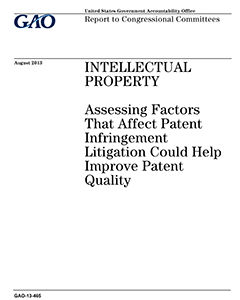
    resulting report, entitled "Intellectual Property: Assessing Factors that
    Affect Patent Infringement Litigation Could Help Improve Patent Quality
    " ("GAO Report"), was sent to the congressional committees on August 22,
    2013.  The Report itself contains some
    observations regarding the increase in patent litigation, some possible
    suggestions explaining these observations, and one recommendation:

    We are recommending that the
    Secretary of Commerce direct the Director of PTO to consider examining trends
    in patent infringement litigation, including the types of patents and issues in
    dispute, and to consider linking this information to internal data on patent
    examination to improve the quality of issued patents and the patent examination
    process.

    GAO
    Report, p. 46.  Even though this was an
    ambitious report, the GAO was upfront with the limitations of its research.  Indeed, the Report noted that the Comptroller
    General sent a letter to the chairs and ranking members of these congressional
    committees before the passage of the AIA, informing them that reliable
    data was either not already available or could not be obtained.  See id.,
    p. 4 n.10.  Nevertheless, far from
    concluding that the patent system was "broken," the conclusions
    actually reached by the GAO suggest that even though there may have recently
    been an increase in low-quality patents, particularly related to software, it
    is not a cause for alarm.  In fact, the
    GAO noted trends in both the federal courts and the Patent Office that are already
    seeking to correct these perceived problems.

    As
    background on the Report, section 34 of the AIA charges the Comptroller General
    to conduct a study that should include the following information:

    (1)    The
    annual volume of litigation described in subsection (a) over the 20-year period
    ending on the date of the enactment of this act.

    (2)    The volume
    of cases comprising such litigation that are found to be without merit after
    judicial review.

    (3)    The impacts
    of such litigation on the time required to resolve patent claims.

    (4)    The
    estimated costs, including the estimated cost of defense, associated with such
    ligation for patent holders, patent licensors, patent licensees, and inventors,
    and for users of alternate or competing innovations.

    (5)    The economic
    impact of such litigation on the economy of the United States, including the
    impact on inventors, job creation, employers, employees, and consumers.

    (6)    The benefit to commerce, if any,
    supplied by non-practicing entities or patent assertion entities that prosecute
    such litigation.

    AIA,
    § 34(b).  Because of the aforementioned
    concerns regarding the existence (or lack thereof) of reliable data, the GAO
    reinterpreted the objectives of its study to be:

    (1)    What
    is known about the volume and characteristics of recent patent litigation
    activity;

    (2)    the views of
    stakeholders knowledgeable in patent litigation on what is known about the key
    factors that have contributed to recent patent litigation;

    (3)    what
    developments in the judicial system may affect patent litigation; and

    (4)    what actions, if any, has PTO recently
    taken that may affect patent litigation in the future.

    GAO
    Report, p. 4.  This deviation is likely
    to draw criticisms that the GAO did not actually conduct the study they were
    tasked to perform.  However, in response
    to the GAO's previously noted concerns, Senator Leahy stated on the record that
    any resulting report should include any limitations on the data and methodology
    used.  See id., p. 4, n.10.  The GAO
    took this opening to develop its own objectives for the Report, which it
    believed were consistent with these noted limitations.  Id.

    GAO Report CoverThe
    data that the GAO used to assess recent patent litigation was obtained from Lex
    Machina, a firm that collects such data.  The Report indicated that Lex Machina used all data for patent infringement
    lawsuits filed between 2000 and 2011, and also selected a random, generalizable
    sample of 500 lawsuits — 100 per year from 2007 to 2011.  This sample size allowed the GAO to make
    conclusions regarding each of these years with a margin of error of ± 10
    percentage points for any particular year, but ± 5 percentage points for all of
    the years.  The GAO also used data
    obtained from speaking with 44 stakeholders, which included 10 representatives
    from operating companies who had been sued in recent years (including
    representatives from software, computer hardware, retailers, and pharmaceutical
    industries); 8 representatives from PMEs that had regularly sued others; 14
    legal commentators, economists, and consultants; representatives from 2
    universities, 2 patent brokers, 4 VCs, and 4 individual inventors.  The GAO clearly attempted to solicit the
    opinions of a representative cross-section of stakeholders.  Nevertheless, any results stemming from these
    interviews must be viewed with caution because of the size of the sample was
    necessarily small, and any data obtained is inherently limited by the biases of
    the particular stakeholders that were consulted.

    Perhaps
    the most interesting results, and likely the most reliable, came from the GAO's
    analysis of the Lex Machina data.  The
    GAO found that patent lawsuits fluctuated slightly between 2000 and 2010, but
    in 2011 there was a 31% increase.  Contrary to the conventional wisdom, however, the GAO found that it was
    operating companies, not PMEs, that brought the majority of patent infringement
    lawsuits in the 2007 and 2011 timeframe.  See GAO Report, p. 17.  In fact, in that timeframe, PMEs and likely
    PMEs were found to have only brought 19 percent the studied lawsuits.  This number does appear to be increasing, with
    PMEs being found to be responsible for 24 percent of the lawsuits in 2011, but the Report did note that this increase was not statistically significant.  Perhaps the common perception regarding PMEs
    stems from the fact that they tended to sue more defendants per suit than
    operating companies.  For example,
    between 2007 and 2011, operating companies sued on average 1.9 defendants per
    suit, whereas for PMEs, the number was closer to 4.1 defendants on average.  In fact, the GAO found that PMEs in this timeframe
    had sued close to 1/3 of all defendants.  The GAO did attribute the increase in patent litigation to the type of
    patents, and not the entities brining suit.  In the 2007 to 2011 timeframe, 46% of all lawsuits involved
    software-related patents, with 64% of all defendants facing such suits.  Unfortunately, the GAO was not able to
    independently determine a cost for all of this litigation, either to the
    parties directly or to the industries involved.  Moreover, the Report noted that it was limited to cases that had been
    litigated, and therefore they were unable to determine the cost of patent
    assertion that occurred outside of the court system.

    As
    for the remainder of the Report, even though the results of the stakeholder
    interviews should be viewed with caution, the observations and conclusions are informative.  There were three key factors identified that
    have likely contributed to the increase in recent patent infringement lawsuits:

    (1)    unclear
    and overly broad patents;

    (2)    the
    potential for disproportionately large damage awards; and

    (3)    the
    increasing recognition that patents are a valuable asset.

    GAO
    Report, p. 28.  The first factor relates
    to the alleged prevalence of low-quality patents.  This view was predominately related to
    software-related patents.  The Report
    identified several reasons why stakeholders believed that these software patents
    were overly broad.  First, the lack of
    clear terminology in the computer software industry has resulted in the use of
    unclear terminology in software patents.  Second, the use of functional language in such patents has allowed the
    patent owners in these industries to claim that their patents not only cover the
    small improvement described, but claim that they cover entire technologies or potential
    future technologies.  Third, even though
    patent infringement is strict liability (being unaware of a patent is not a
    defense to infringement), the presence of such broad patents results in more infringers
    that had no intent to so infringe.  Relatedly, some stakeholders pointed out that the sheer number of
    patents makes it difficult to search for those that might be relevant to a
    particular technology they are developing.  Also, even if the relevant patents are identified, it can be difficult
    to identify the owners, because the Patent Office does not currently require
    notification of changes in ownership.  Interestingly, even though some of the stakeholders interviewed blamed
    PMEs for the rise in patent infringement litigation, others did note that it
    was likely the prevalence of low quality patents that played a bigger factor.

    The
    GAO Report did identify several trends that may have a positive impact on the
    identified increase in patent litigation.  First, the Report noted that the federal court system is implementing
    new initiatives to handle patent cases.  For example, in January 2011, Congress established a pilot program in
    certain districts to encourage expertise among district court judges.  So far, 14 federal districts have been
    designated to participate in this 10-year pilot program.  In addition, in September 2011, the Advisory
    Council for the Federal Circuit issued a model order to address e-discovery
    issues targeted to patent cases.  It is
    too early to tell, however, what impact these e-discovery rules will have.  Finally, the case law is evolving, and as a
    result could address some of these problems.  The Report highlighted recent decisions about what constitutes
    patentable subject matter, or what is required to satisfy the obviousness and
    definiteness requirements.  The Report
    noted that such decision could help combat the identified overly-broad and
    ill-defined patents.

    The Report also noted that the Patent Office has taken steps to improve patent
    quality.  For example, in February 2011,
    the Patent Office issued supplemental guidelines related to the definiteness
    requirement.  These guidelines
    specifically addressed the examination of claims with functional language.  Also, in November 2011, the Patent Office
    began working with the software industry to address the issue of non-uniform
    terminology in software related patents.  In addition, the Office launched a new patent classification
    system in January 2013 called the Cooperative Patent Classification (CPC).  Finally, the Report noted that the Patent
    Office has been working to solve the issue of patent ownership transparency.  Of course, all of these initiatives are in
    addition to the Patent Office's implementation of the post-grant review
    proceedings that are mandated by the AIA.

    As
    indicated at the outset, the only recommendation included in the Report was
    directed to the Patent Office.  Before
    the Report was sent to the congressional committees, the GAO sent a copy to the
    Patent Office to review.  Appendix II of
    the Report is a letter from Acting Under Secretary and Acting Director Teresa
    Stanek Rea to the GAO that commends them for their efforts, and concurs with
    the recommendation.  Specifically, the Patent
    Office's response to the recommendation was:

    The USPTO appreciates GAO's recommendation.  The USPTO currently uses information relating to cases involved in
    patent litigation, and agrees that it would be appropriate to consider making
    better use of such information by examining trends in patent infringement
    litigation.  The USPTO also agrees that
    as part of its ongoing effort to improve the quality of issued patents and the
    patent examination process, it would be appropriate to consider linking trends
    in patent litigation to internal data on patent examination.

    GAO
    Report, App. II.  Perhaps this
    recommendation, along with all of the identified initiatives, will help improve
    the quality of software patents, and as a result help to restore some faith in
    the U.S. patent system.

  • By
    Kevin E. Noonan

    MyriadThe
    Supreme Court, in Bell Atlantic Corp. v. Twombly, 550 U.S. 544, 570
    (2007), and Ashcroft v. Iqbal, 556 U.S. 662 (2009), has in recent years focused the
    requirements for pleadings under the Federal Rules of Civil Procedure and,
    concoimitantly, increased the scope of the bases a party can argue to dismiss a
    claim or counterclaim under Fed. R. Civ. Pro. 12(b)(6) for failure to state a
    legally cognizable claim.  In the latest
    development in the Myriad Genetics v.
    Ambry Genetics
    case, Myriad argues that this legal precedent, as well as
    the principles first enunciated by the Supreme Court in Eastern R.R.
    Presidents Conference v. Noerr Motor Freight, Inc.
    , 365 U.S. 127 (1961), and
    Mine Workers v. Pennington, 381 U.S. 657 (1965) (known as the Noerr-Pennington doctrine), preclude
    Ambry from pursuing its counterclaims that Myriad violated Sections 1 and 2 of
    the Sherman Antitrust Act in bringing suit on several of its BRCA gene genetic
    diagnostics patents (see Myriad's Motion to Dismiss Antitrust Counterclaims).

    Earlier
    this summer, Myriad sued Ambry for patent infringement for offering
    genetic diagnostic tests (including its
    BRCA1, BRCA2, BRCAPlus, BreastNext, OvaNext, and CancerNext products) that
    allegedly infringed claims of U.S. Patent Nos. 5,654,155;
    5,709,999;
    5,747,282;
    5,750,400;
    5,753,441;
    5,837,492;
    6,033,857;
    6,951,721;
    and 7,250,497 (see "Myriad Genetics Files Suit Against Ambry Genetics for Genetic Diagnostic Testing of BRCA Genes").  Ambry answered, and in addition to denying
    Myriad's allegations asserted as affirmative defenses that Myriad's suit
    amounted to violations of the Sherman Act (see "Ambry Responds to Myriad Lawsuit").  In its counterclaims, Ambry asserted the following allegations in
    support of its Sherman Act allegations:

    • Myriad is maintaining its monopoly in
    violation of the antitrust laws through "bad faith" enforcement of
    its patents,

    • Myriad
    eschews considerations of affordability, test accuracy and recommendations for
    genetic testing,

    • There
    exists significant opposition to Myriad's business model of patenting gene
    sequences and establishing a private database, and

    • Myriad
    is aware that its asserted claims on BCRA1 and BCRA2 genes are invalid under
    recent Supreme Court and Federal Circuit cases.

    Ambry GeneticsSpecifically,
    Count 1 of Ambry's counterclaims is brought under Section 2 of the Sherman
    Antitrust Act (against Myriad only).  According to this counterclaim:

    126.  Myriad is willfully maintaining
    its monopoly through exclusionary conduct as distinguished from growth or
    development as a consequence of a superior product, business acumen, or
    historic accident.  Myriad seeks to maintain its monopoly position through
    various anticompetitive conducts described above, including through the bad
    faith enforcement of its facially invalid patents.

    127.  Myriad was aware before filing its
    Complaint in this action that the claims it was asserting are invalid per Myriad
    and Prometheus.

    128. 
    Through its exclusionary and anticompetitive conduct, Myriad has acquired and
    maintained its monopoly in the relevant market for genetic testing for patients
    seeking analysis of their full BRCA1 and BRCA2 gene sequences. 
    Myriad has operated in this manner free from competition because of the high
    barriers to entry that exist in the market, including Myriad's invalid patents,
    the technological know-how to design and run genetic tests, and the actions of
    Myriad's employees.

    Count
    2 is brought under the Sherman Act for "attempted" monopolization for
    substantially the same market behavior, Ambry alleging that Myriad acted "with
    a specific intent to monopolize the relevant market through the assertion of
    facially invalid patent claims and the anticompetitive conduct of its
    employees."

    Significantly,
    Ambry did not expressly assert that the patents were obtained through fraud, or
    that the litigation was brought as a sham, but rather that the effects of Myriad's
    assertion of patent claims Ambry asserts are invalid under recent Federal
    Circuit or Supreme Court precedent should incur antitrust liability.  This failure to allege fraud or sham
    litigation, as well as Myriad's disagreement with Ambry's characterization of
    the scope of judicial opinions on its patents, forms the basis of its motion to
    dismiss.  In its argument, Myriad first
    distinguishes pled facts, which are "accepted as true and viewed in the
    light most favorable to Defendant as the nonmoving party," citing 1-800
    Contacts, Inc. v. Memorial Eye, P.A.
    , Case No. 2:08-CV-983, 2010 WL 988524,
    at *2 (D. Utah Mar. 15, 2010), and legal conclusions, which are not.  Motions to dismiss are properly evaluated on
    the grounds that the asserted claim is "legally sufficient" and "plausible
    on its face," citing Iqbal.  Under the Iqbal standard, "a claim is facially plausible 'when the
    plaintiff pleads factual content that allows the court to draw the reasonable
    inference that the defendant is liable for the misconduct alleged.'"  Iqbal,
    556 U.S. at 678.

    Having
    set out this standard, Myriad then argues that its claims are immune from
    antitrust liability under the Noerr-Pennington
    doctrine, which immunizes actions constituting a petition to the government for
    redress of grievances.  Myriad's claims
    do not fall under the limited exceptions to the doctrine, according to Myriad,
    because they are not "objectively baseless" and the litigation is
    neither a sham nor an attempt to enforce patents obtained by fraud.  In
    particular, Myriad cites to cases, such as Asahi Glass Co., Ltd. v. Pentech
    Pharmaceuticals, Inc.
    , 289 F. Supp. 2d 986, 993 (N.D. Ill. 2003), where
    courts have dismissed sham litigation allegations because "efforts to
    commercialize and/or enforce issued U.S. patents do not give rise to a claim of
    sham litigation absent unusual circumstances such as fraud or known invalidity:

    A firm that has received a patent from the patent office . . . and thus enjoys
    the presumption of validity that attaches to an issued patent, is
    entitled to defend the patent's validity in court, to sue alleged infringers
    ,
    and to settle with them, whatever its private doubts, unless a neutral
    observer would reasonably think either that the patent was almost certain to be
    declared invalid, or the defendants were almost certain to be found not to have
    infringed it, if the suit went to judgment
    .  It is not "bad faith"
    to assert patent rights that one is not certain will be upheld in a suit for
    infringement pressed to judgment and to settle the suit to avoid risking the
    loss of the rights.  No one can be certain that he will prevail in a patent
    suit.

    (emphasis added in opinion).  Myriad asserts that its infringement
    allegations are "more than colorable" and that they are "substantially
    likely to prevail on [its] claim."

    Expanding
    on this argument, Myriad argues that only the "extraordinary circumstances"
    of sham litigation is enough to vitiate Noerr-Pennington
    immunity.  However, mere allegations that
    litigation is a sham is not sufficient; rather, Myriad argues that the Supreme
    Court established a two-prong test for establishing that litigation is a sham,
    in Prof'l Real Estate Investors, Inc. v. Columbia Pictures Indus., Inc.,
    508 U.S. 49, 62 (1993) (abbreviated as "PREI" in Myriad's
    brief).  These prongs constitute an "objective"
    component, established by successfully challenging the legal viability of a
    claim, and a "subjective" component, based on the lawsuit's "economic
    viability" according to Myriad.  The
    "objectively baseless" standard requires a showing that "no
    reasonable litigant could realistically expect success on the merits" and
    that "[i]f an objective litigant could conclude that the suit is reasonably
    calculated to elicit a favorable outcome, the suit is immunized under Noerr,
    and an antitrust claim premised on the sham exception must fail," as this
    test has been applied, inter alia, in
    Bio Technology General Corp. v. Genentech, Inc., 267 F.3d 1325, 1333
    (Fed. Cir. 2001); Cornucopia Prod., LLC v. Dyson, Inc., 881 F.Supp.2d
    1086, 1102-03 (D. Ariz. July 27, 2012); Avery Dennison Corp. v. Continental
    Datalabel, Inc
    ., Case No. 10c2744, 2010 WL 4932666, at *5-6 (N.D. Ill. Nov.
    30, 2010), and Asahi Glass Co.

    The
    existence of "probable cause" (of prevailing) is enough to defeat the
    objective prong of the standard, Myriad asserts, citing PREI ("The existence of probable cause to institute legal
    proceedings precludes a finding that an antitrust defendant has engaged in sham
    litigation . . . [and] irrefutably demonstrates that an antitrust plaintiff has
    not proved the objective prong of the sham exception.").  Satisfaction of this standard does not
    require certainty but rather "a reasonable belief that there is a chance
    that a claim may be held valid upon adjudication" which will be sufficient
    if the action is "one where 'a similarly situated reasonable litigant
    could have perceived some likelihood of success' [] "even in the absence
    of supporting authority where the action is 'based on an objectively good faith
    argument for the extension, modification, or reversal of existing law.'"

    Applying
    these standards, Myriad argues that Ambry has not alleged, nor can Ambry "plausibly
    allege" that Myriad's suit is objectively baseless.  This argument is based on the parties'
    different interpretations of the Federal Circuit and Supreme Court opinions in AMP v. Myriad Genetics.  According to Myriad, "only one of the
    patent claims at issue in AMP — claim 6 of U.S. Patent No. 5,747,282 —
    is asserted against Ambry in this case, and that claim was upheld by the
    Supreme Court."  In addition, that
    claim was considered by the Federal Circuit on remand in view of the Supreme
    Court's decision in Mayo v. Prometheus and the Court found that this claim was
    "patent-eligible [] under §101 [and that] Mayo does not change that
    result."  Further, Myriad argues
    that the Supreme Court held that "all claims directed to 'cDNA' are
    patentable (an assertion that is at the least open to interpretation) and that
    the Court "specifically referenced claim 6 (of the '282 patent) with
    regard to patent eligibility as reciting cDNA.

    With
    this background, Myriad then argues that "[t]o motion to dismiss, Ambry
    must allege sufficient facts to support its claim that it was objectively
    unreasonable for Myriad to have asserted claim 6 of the '282 Patent and other
    similar such claims in this lawsuit despite the fact that claim 6 was upheld by
    the Supreme Court and the Federal Circuit (twice)" which it cannot do because
    "'so long as at least one claim in the lawsuit has objective merit,' a
    lawsuit will not be deemed a sham," citing Trustees of Univ. of Penn.
    v. St. Jude Children's Research Hosp.
    , Civil Action No. 12-4122, 2013 WL
    1499518, at *12, __ F.Supp.2d __ (E.D. Penn. Apr. 12, 2013).  This is also true for the other claims Myriad
    asserts because they were duly issued by the U.S. Patent and Trademark Office
    and thus are entitled to a presumption of validity and were not challenged by the
    plaintiffs in the AMP litigation (and thus not invalidated by the Court).  And, in a footnote, Myriad cites the portion
    of the Court's Myriad opinion where Justice Thomas states that "this case
    does not involve patents on new applications of knowledge about the BRCA1 and
    BRCA2 genes.  Judge Bryson [of the Federal Circuit] aptly noted that, '[a]s
    the first party with knowledge of the [BRCA1 and BRCA2] sequences, Myriad was
    in an excellent position to claim applications of that knowledge.  Many of its
    unchallenged claims are limited to such applications.'"  AMP, 133 S.Ct. at
    2120 (citing Ass'n for Molecular Pathology, 689 F. 3d at 1349)."  There is also no basis for the District Court
    to find Myriad's allegations on its remaining claims to be objectively baseless
    because, according to Myriad, the Federal Circuit had the opportunity to
    invalidate similar claims post-Mayo
    and did not.  Specifically, Myriad cites
    the second Federal Circuit opinion in the AMP v. Myriad case where the Court
    stated that:

    [P]erforming operations,
    even known types of steps, on, or to create novel, i.e.,
    transformed subject matter is the stuff of which most process or method
    invention consists.  . . .  Thus, once one has determined that a claimed
    composition of matter is patent-eligible subject matter, applying
    various known types of procedures to it is not merely applying conventional
    steps to a law of nature
    .

    Ass'n for Molecular Pathology, 689 F. 3d at 1349 (emphasis
    added).  In summary, Myriad argues that:

    The patent claims asserted by Plaintiffs in this action cover either
    synthetically made compositions of matter — namely, specially-engineered
    synthetic DNA synthesized in a laboratory based upon knowledge about the BRCA1
    and BRCA2 genes — or methods of using such synthetic compositions, the
    patentability of which is expressly supported by Supreme Court and Federal
    Circuit authority.  While reasonable minds may be able to differ over the
    precise parameters of these decisions in an evolving area of law, labeling
    either side's view on such issues as "bad faith," "objectively
    baseless," or a "sham" is unsustainable.  Because Ambry's
    antitrust counterclaims are premised on just such facially implausible
    allegations, they are barred by Noerr-Pennington and should be
    dismissed.

    This
    being district court litigation, it can be expected that the parties will
    continue to pursue procedural and substantive advantages in pressing their
    claims and counterclaims.  This case, and
    the issues surrounding patent eligibility of generic diagnostic testing, is not
    only far from over but it is only beginning, once again making overstated claims
    of "victory" by the opponents of gene patenting pathetically premature.

    For additional information
    regarding this and other related topics, please see:

    • "Amici Submit Brief in Support of Ambry Genetics and Gene by Gene," August 27, 2013
    • "Ambry Responds to Myriad Lawsuit," August 7, 2013
    • " Why Does Myriad Think It Can Win BRCA Gene
    Lawsuits?
    " July 30, 2013
    • "Myriad Genetics Files Infringement Suit
    Against Gene by Gene for Genetic Diagnostic Testing of BRCA Genes
    ," July
    10, 2013
    • "Myriad Genetics Files Suit Against Ambry
    Genetics for Genetic Diagnostic Testing of BRCA Genes
    ," July 9, 2013

    "Association for Molecular Pathology
    v. Myriad Genetics, Inc.
    (2013)
    ," June 13, 2013

    "Supreme Court Issues Decision in AMP
    v. Myriad
    ," June 13, 2013

  • By Donald Zuhn

    ACLULast week, the American
    Civil Liberties Union (ACLU), ACLU of Utah Foundation, Inc., Public Patent Foundation
    (PUBPAT), Association for Molecular Pathology (AMP), Breast Cancer Action, and
    AARP submitted an amici curiae brief in two infringement actions brought by Myriad Genetics, Inc. (and the University of Utah Research
    Foundation, Trustees of the University of Pennsylvania, HSC Research and Development
    Limited Partnership, and Endorecherche, Inc.) against
    Ambry Genetics Corp. and Gene by Gene, Ltd. 
    The amici brief was submitted
    in support of Ambry Genetics and Gene by Gene, which have opposed Myriad's motion for a preliminary injunction.  The brief notes that the ACLU and PUBPAT
    represented several individual and organizational plaintiffs, including fellow amici AMP and Breast Cancer Action, in Association
    for Molecular Pathology v. Myriad Genetics, Inc.
    , where the Supreme Court
    held that a naturally occurring DNA segment is a product of nature and not
    patent eligible merely because it has been isolated.  Amici
    indicate that as a result of their participation in AMP v. Myriad, they are "well-positioned to inform this Court
    about the issues raised and decided in the AMP
    litigation and the public interest at stake in invalidating patents that create
    monopolies on genetic information."

    PUBPATAs the brief notes, in AMP v. Myriad, several of the amici challenged fifteen claims in seven of Myriad's patents because Myriad had
    asserted those claims when sending cease-and-desist letters to other
    laboratories that were conducting genetic testing, and that "[t]he decision to
    focus on these claims was by no means a concession that any of Myriad's other
    claims is valid."  The brief also
    notes that the fifteen challenged claims can be subdivided into three
    groups:  nine claims directed to
    "isolated DNA," five claims directed to methods of screening BRCA1 or
    BRCA2 genes, and one claim directed to a method of screening potential
    therapeutics.  Amici point out that only the isolated DNA claims were before the
    Supreme Court, and as a result, "[t]he Federal Circuit's affirmance of the
    district court judgment striking the five method claims therefore stands as the
    law of the case, as does its ruling on the other method claim."

    MyriadThe brief indicates that Myriad has asserted six method claims and four primer claims in its motion for
    a preliminary injunction enjoining Ambry Genetics and Gene by Gene.  Noting that the asserted method claims all
    involve comparing a sequence from a patient sample to a reference sequence, the
    brief first points to representative claim 8 of U.S. Patent No. 5,753,441, which recites:

    The method of claim 1 wherein a germline
    nucleic acid sequence is compared by amplifying all or part of a BRCA1 gene
    from said sample using a set of primers to produce amplified nucleic acids and
    sequencing the amplified nucleic acids.

    The brief then sets forth
    claim 1 of the '441 patent, from which claim 8 depends, which recites:

    A method for screening germline of a human
    subject for an alteration of a BRCA1 gene which comprises comparing germline
    sequence of a BRCA1 gene or BRCA1 RNA from a tissue sample from said subject or
    a sequence of BRCA1 cDNA made from mRNA from said sample with germline
    sequences of wild-type BRCA1 gene, wild-type BRCA1 RNA or wild-type BRCA1 cDNA,
    wherein a difference in the sequence of the BRCA1 gene, BRCA1 RNA or BRCA1 cDNA
    of the subject from wild-type indicates an alteration in the BRCA1 gene in said
    subject.

    The brief then reminds
    the District Court that claim 1 was invalidated by the Federal Circuit in AMP v. Myriad, and suggests that "the question presented to this Court is whether a
    preliminary injunction should issue based on method claims that add routine,
    additional steps — such as 'amplifying' using an unspecified set of primers
    and 'sequencing' — to what is undoubtedly unpatentable subject matter."

    In laying out their
    argument, amici contend that
    "[d]espite the unanimous rulings [by the Supreme Court] in Mayo and AMP, Myriad continues to aggressively defend its monopoly on
    examining the BRCA genes, pointing to patent claims that were not the subject
    of the previous suit but are clearly invalid under those decisions and the
    Federal Circuit's earlier ruling." 
    According to amici, the claims
    being asserted by Myriad are "clearly invalid" because they only add
    "routine, data-gathering steps such as 'amplifying' and
    'sequencing'."

    In discussing the impact of
    the impact of the Supreme Court's decision in Mayo Collaborative Services v. Prometheus Laboratories, Inc., amici
    explain that "Mayo described two
    key factors in determining whether a method is patent-eligible:  whether it is based on an inventive concept,
    and whether the patent ties up the use of the underlying natural phenomena,"
    and conclude that the asserted claims "fail both tests."  With respect to the first test, amici argue that "the method here
    is even less inventive than the methods set out in Prometheus' claims [because]
    Myriad's method claim assesses pure biological facts that do not depend on the
    administration of a man-made drug for their existence."  As for the second test, amici argue that:

    The Court's decision on this motion will also
    affect the ability to engage in basic scientific activities regardless of
    whether the laboratory professional is doing so for the purpose of providing
    breast and ovarian cancer risk testing for patients.  The patent claims that Myriad is asserting are
    not limited to that context.  Any
    scientist who engages in the basic steps of amplifying part of the BRCA1 gene
    and sequencing the amplified segment as part of a research study would violate
    these claims.  As a consequence, these
    patents prevent any scientist from examining or understanding the underlying
    law of nature — whether a particular BRCA1 gene contains an alteration from
    the wild-type — and using that law of nature in any way.

    Amici
    also argue that the granting of a preliminary injunction would violate the
    First Amendment and Patent Clause of the U.S. Constitution by conferring upon
    Myriad exclusive control over a body of knowledge.  In particular, the brief contends that Myriad
    has used its exclusive rights "to amass an enormous amount of information
    critical to the health of every American," and that Myriad "refuses
    to allow others to obtain the information themselves by performing the basic
    methods at issue in this litigation, or to share the information with the
    medical and scientific communities." 
    Amici argue that "[t]he
    claims thus give entire control over a body of knowledge and over pure
    information to Myriad."

    Amici
    further argue that a preliminary injunction would harm the public interest
    because "an injunction would allow Myriad to continue to impede our
    acquisition of greater knowledge about the BRCA1 and BRCA2 genes."  The brief again criticizes Myriad for refusing to
    share its BRCA1 and BRCA2 data with the scientific community, contending that
    "Myriad's conduct flies in the face of the professional ethical standards
    set out by the American Medical Association, which calls on laboratories,
    researchers and providers to publicly share data on genetic variants."  The brief concludes by suggesting that the
    District Court's decision on the preliminary injunction motions will "impact
    whether or not patients and their physicians and genetic counselors have the
    option of seeking testing from the numerous laboratories that are fully capable
    and willing to provide clinical testing of these genes and whether scientists
    can freely engage in research without fear of liability."

    For additional information
    regarding this and other related topics, please see:

    • " Why Does Myriad Think It Can Win BRCA Gene
    Lawsuits?
    " July 30, 2013
    • "Myriad Genetics Files Infringement Suit
    Against Gene by Gene for Genetic Diagnostic Testing of BRCA Genes
    ," July
    10, 2013
    • "Myriad Genetics Files Suit Against Ambry
    Genetics for Genetic Diagnostic Testing of BRCA Genes
    ," July 9, 2013

    "Association for Molecular Pathology
    v. Myriad Genetics, Inc.
    (2013)
    ," June 13, 2013

    "Supreme Court Issues Decision in AMP
    v. Myriad
    ," June 13, 2013

  • By Donald Zuhn

    Baker, BrookIn a white paper released earlier this month, Professor Brook Baker
    of the Northeastern University School of Law argues that current trade
    agreements do not provide data exclusivity for biologics, and therefore, that
    the twelve countries negotiating the Trans-Pacific Partnership Agreement (TPP)
    "can and should apply their minds to potential costs of treaty-mandated
    biologic exclusivity."  In
    determining that the data exclusivity provisions of existing trade agreements
    do not apply to biologics, Prof. Baker (at right) reviewed the North American Free Trade
    Agreement (NAFTA), which applies to the U.S., Mexico, and Canada, the United
    States-Peru Free Trade Agreement (US-Peru FTA), the Dominican Republic-Central
    American Free Trade Agreement (DR-CAFTA), the Korea-United States Free Trade
    Agreement (KORUS), and the United States-Singapore Free Trade Agreement
    (US-Singapore FTA).  With the exception
    of the US-Singapore FTA, which Prof. Baker found to be ambiguous with respect
    to coverage, all of the other treaties contained data exclusivity provisions
    that applied only to pharmaceuticals involving new chemical entities
    (traditional small-molecule, chemically synthesized drugs), and not to pharmaceuticals
    that do not involve new chemical entities (biologics).

    According to the white
    paper, the absence of data exclusivity provisions in these trade agreements
    (with the possible exception of the US-Singapore FTA) is significant because the
    Biotechnology Industry Organization (BIO) and United States Trade
    Representative (USTR) "want to have it both ways."  On the one hand, they:

    [A]rgue repeatedly that biologics are
    different . . . , that they entail different therapeutic risks, that they are
    not protected by patents to the same extent as small-molecule medicines, that
    the research, development, registration, and manufacture of biologics all
    entail greater uncertainties, and thus that the bio-tech industry need
    different provisions on data/market exclusivity than that provided with respect
    to chemistry-based pharmaceutical right holders."

    On the other hand, however,
    they argue that TPP negotiators need not worry about the U.S. proposal for a
    12-year data exclusivity period for biologics because some of the countries
    involved in the negotiations "have already indirectly agreed to data
    exclusivity on biologics in previously trade agreements."  The white paper concludes that such an
    argument is "without merit."

    Notwithstanding the paper's
    conclusion that current trade agreements do not provide data exclusivity for
    biologics, and despite acknowledging that "[t]reating biologics
    differently from traditional small-molecule, chemically synthesized products
    makes a lot of sense," Prof. Baker contends that the 12-year exclusivity
    period provided in the Biologics Price Competition and Innovation Act (BPCIA) is
    "excessive."  In particular, he
    advises TPP negotiators that they might want to "consider alerting the
    U.S. and its public to [the] fact that twelve years of data exclusivity for
    biologics in the TPP would bind the hands of Congress in the future — it would
    lock-in an excessive period of data exclusivity through secret, closed-door negotiations,
    even while the Obama Administration and certain members of Congress are
    reconsidering wisdom of the existing legislation," adding that "[d]ata
    exclusivity for biologics, especially extra-long data exclusivity, is a fool's gamble."  The paper notes that the U.S. is intead expected to propose that
    a 12-year data exclusivity period for biologics be incorporated into the TPP.

    For additional information
    regarding this and other related topics, please see:

    • "BIO Reiterates Support for 12-Year Data Exclusivity Period for Biologics," August 20, 2013
    • "Senators Back 12-Year Data Exclusivity Period for Biosimilars and President Obama (Once Again) Does Not," May 9, 2013
    • "U.S. Negotiators on TPP — Don't Trade Away the Biopharmaceutical Research Sector," September 30, 2012
    • "Senators Support Inclusion of 12-Year Exclusivity Period in Free Trade Agreement," September 12, 2011
    • "House Legislators Lobby to Exclude 12-Year Data Exclusivity Period from Free Trade Agreement," August 11, 2011