• By Kevin E. Noonan

    Pronova BiopharmaLast
    week, the Federal Circuit in a non-precedential opinion, invalidated claims to
    Orange Book-listed patents on omega-three fatty acid formulations in Pronova Biopharma Norge v. Teva Pharmaceuticals USA.  The grounds for reversing the District Court's
    finding that the defendant had not established invalidity under the public use
    statutory bar under 35 U.S.C. § 102(b) was based on the Court's determination
    that Pronova's predecessor in interest had permitted unrestricted use of
    formulations falling with the scope of the claims and disregarded Pronova's
    argument that public use was negated because there was insufficient evidence
    that the use was for the inventions' intended purpose.

    The
    case concerned U.S. Patents Nos. 5,502,077 and 5,656,667 involved in ANDA
    litigation between Pronova and, in separate ANDAs, Teva and Par
    Pharmaceuticals, who propounded Paragraph IV letters contending that these
    patents were invalid and non-infringed by their generic formulations of the
    branded drug Lovaza®.  The drug comprised a formulation of certain
    omega-3 and omega-6 fatty acids derived from fish oils for prevention of heart
    disease and other cardiovascular ailments specifically, hypertriglyceridemia,
    based on evidence of native populations with diets high in fish.  The District Court found the patents
    infringed, not proven invalid by clear and convincing evidence, and not
    unenforceable for inequitable conduct.

    The
    following claims were at issue for the '667 patent:

    20. A pharmaceutical mixed-fatty-acids composition in which
        a)
    at least 80% by weight of the composition is comprised of a combination of
    (all-Z omega-3)-5,8,11,14,17-eicosapentaenoic acid (EPA) and (all-Z
    omega-3)-4,7,10,13,16,19-docosahexaenoic acid (DHA) in a weight ratio of
    EPA:DHA of from 1:2 to 2:1 and

        b)
    (all-Z omega-3)-6,9,12,15,18-heneicosapentaenoic acid is present in an amount
    of at least one percent by weight, [or] wherein at least 85% by weight of the
    composition is comprised of long chain omega-3 fatty acids, [or] wherein the
    EPA constitutes 40 to 60% by weight of the composition and the DHA constitutes
    25 to 45% by weight of the composition, [or] wherein C 20:4 omega-6 fatty acid
    constitutes at least one percent by weight of the composition, [or] wherein C
    22:5 omega-3 fatty acid constitutes at least one percent by weight of the
    composition, [or] wherein the (all-Z omega-3) -6,9,12,15,18-heneicosapentaenoic
    acid is present in an amount of from 1 to 4% by weight, [and]

    wherein the EPA and DHA are present in an EPA:DHA weight ratio of from 1:1 to
    2:1.

    44. 
    A pharmaceutical mixed-fatty-acids
    composition in which
        a)
    at least 80% by weight of the composition is comprised of a combination of
    (all-Z omega-3)-5,8,11,14,17-eicosapentaenoic acid (EPA) and (all-Z
    omega-3)-4,7,10,13,16,19-docosahexaenoic acid (DHA) in a weight ratio of
    EPA:DHA of from 1:2 to 2:1 and

        b) at least 3% by weight of the composition is comprised of
    omega-3 fatty acids other than EPA and DHA that have 20, 21, or 22 carbon
    atoms, [or] wherein the EPA constitutes 40 to 60% by weight of the composition
    and the DHA constitutes 25 to 45% by weight of the composition, [or] wherein
    the EPA and DHA are present in an EPA:DHA weight ratio of from 1:1 to 2:1
    ,
    and wherein the fatty acids are present in ethyl ester form.

    50. A
    pharmaceutical mixed-fatty-acids composition in which
        a)
    at least 90% by weight of the composition is comprised of long chain,
    polyunsaturated, omega-3 fatty acids;

        b)
    at least 80% by weight of the composition is comprised of a combination of
    (all-Z omega-3)-5,8,11,14,17-eicosapentaenoic acid (EPA) and (all-Z
    omega-3)-4,7,10,13,16,19-docosahexaenoic acid (DHA) in a weight ratio of
    EPA:DHA of from 1:1 to 2:1, with the EPA constituting 40 to 60% by weight of
    the composition and the DHA constituting 25 to 45% by weight of the
    composition;
        c)
    at least 4.5% by weight of the composition is comprised of omega-3 fatty acids
    other than EPA and DHA that have 20, 21, or 22 carbon atoms;

        d)
    from 1 to 4% by weight of the composition is comprised of (all-Z
    omega-3)-6,9,12,15,18-heneicosapentaenoic acid; and
        e)
    the composition is in oral dosage form and includes an effective amount of a
    pharmaceutically acceptable antioxidant,
    wherein the fatty
    acids are present in ethyl ester form.

    Teva #2(where
    text in italics was recited in independent claims incorporated into the
    dependent claims) (claim 50 was asserted only against Teva).  Also in the litigation at the District Court
    was claim 9 of the '077 patent; however, this patent expired n March 2013 and
    the Federal Circuit thus did not react any issues regarding this patent.

    The
    facts surrounding defendants' arguments for an invalidating public use involved
    transfer of samples of formulations falling within the scope of the asserted
    claims by Pronova' predecessor in interest in the patents, all of which
    occurred prior to the critical date of the '677 patent.  These transfers included samples sent to Dr.
    Victor Skrinska, with disclosure of the contents of the formulations, with no
    restrictions, confidentiality requirements, or obligations to report the results
    of any experiments performed using the formulations.  Dr. Skrinska analyzed the contents of the
    formulations but did not perform any testing on the clinical use or benefits of
    the formulations (although he did administer capsules of the formulation "to
    himself and others").  There were
    also three other instances of alleged public use:  to Dr. Peterson of General
    Mills; to Dr. Davis of the University of Colorado; and Dr. Nordoy of the
    University of Oregon.  The Federal
    Circuit's opinion states that "the distributions to Peterson and Davis
    were (1) unrestricted; (2) non-experimental; and (3) for purposes of generating
    interest in the product" and that Dr. Nordoy actually performed "an
    experimental bioavailability study" on the formulation.  The District Court held that there was
    insufficient evidence to rebut Pronova's argument that Dr. Nordoy's use was an
    exempted experimental use and that there was also insufficient evidence that
    Drs. Peterson or Davis had used the formulations for their intended purpose and
    thus did not constitute an invalidating public use.  And the District Court further held that Dr.
    Skrinska's use was not invalidating, "apparently [because the District Court agreed
    with Pronova] that an invalidating use of a pharmaceutical compound must be for
    the purposes identified in the patents-in-suit."  The District Court further "discredited"
    Dr. Skrinska's testimony in rejecting defendants' public use argument for
    invalidity.
    Federal Circuit SealIn
    an opinion by Judge O'Malley, joined by Judges Dyk and Wallach, the Federal Circuit
    reversed as to the public use determination, and remanded with instructions
    that the District Court enter judgment in favor of defendants.  Assessing the Court's public use
    jurisprudence in light of relevant Supreme Court precedent, the panel agreed
    with defendants that "[a]n invalidating public use need not be the intended
    use of the invention disclosed or claimed in the patent as long as the
    invention is fully disclosed without restriction."  Under this precedent, the Court asserts that "either
    public accessibility or commercial exploitation" qualifies as public use,
    citing Invitrogen Corp. v. Biocrest Mfg., L.P., 424 F.3d 1374, 1379
    (Fed. Cir. 2005).  The Invitrogen court also held that the Supreme
    Court's "ready for patenting" test (Pfaff v. Wells Electronics,
    Inc.
    , 525 U.S. 55, 67–68 (1998)) applies to public use as well as the
    on-sale bar (and here, the Court says there is no question that the invention
    was ready for patenting at the time of the alleged instances of public use).

    According
    to the panel, the standard for public use is where
    "a completed invention is used in public, without restriction," citing Dey, L.P. v. Sunovion Pharm., Inc., 715 F.3d 1351, 1355
    (Fed. Cir. 2013).  Public use can be
    negated where there exists disclosure under a confidentiality agreement or "similar
    expectations of secrecy," Invitrogen Corp. v. Biocrest Mfg., L.P.,
    424 F.3d 1374, 1379 (Fed. Cir. 2005), or where some but not all aspects of an
    invention are disclosed, citing W.L. Gore
    & Assocs., Inc. v. Garlock, Inc.
    , 721 F.2d 1540, 1549 (Fed. Cir. 1983);
    Janssen Pharmaceutica, N.V. v. Eon Labs Mfg., Inc., 134 F. App'x 425,
    431 (Fed. Cir. 2005) (all aspects of the invention must be disclosed).  The "seminal case" is Egbert v.
    Lippmann
    , 104 U.S. 333, 336 (1881) (the corset case), where the Court posed
    the essential question:  "[w]as the invention's use public in the sense
    that it was made available to others with no limitation or restriction?"  One measure of the extent to which the
    disclosure is confidential (as opposed to "public") is "the
    amount of control which the discloser retains over the invention during the
    uses in question," citing Lough v. Brunswick Corp., 86 F.3d 1113,
    1121 (Fed. Cir. 1996) (insufficient control); Eolas Technologies Inc. v.
    Microsoft Corp.
    , 399 F.3d 1325 (Fed. Cir. 2005) (unrestricted disclosure to
    employees); Beachcombers, International, Inc. v. Wildewood Creative
    Products, Inc.
    , 31 F.3d 1154 (Fed. Cir. 1994) (unrestricted disclosure to party-goers);
    and Moleculon Research Corp. v. CBS, Inc., 793 F.2d 1261, 1265–67 (Fed.
    Cir. 1986) (inventor retained control of puzzle and information).  Finally, the panel cited the "sophistication
    of those to whom disclosure was made" as a factor in the extent to which a
    use is a public use.

    Applying
    these principles, the panel held that the disclosure (by transfer of samples of
    the formulation) constituted an invalidating public use.  Factors supporting this determination were
    that the transfer contained no evidence of confidentiality restrictions and the
    fact that Pronova conceded there was no experimental use involved in this
    transfer.  The panel concluded that the
    transfer was "with no secrecy obligation or limitation for [Dr. Skrinska's]
    unfettered use" and that the shipment of the formulations "made
    public all aspects of the claimed inventions, since it included a certificate
    of analysis revealing the composition of the supplied products."  It was also undisputed that Dr. Skrinska was "one
    highly skilled in the art, with the full ability to know, understand, and fully
    disclose the invention to others" (and that there was evidence at trial
    that Dr. Skrinska had disclosed the
    information he had on the formulations with colleagues and "other members
    of the medical community" without restriction.  In sum (particularly with regard to Pronova's
    argument that Dr. Skrinska had not used the formulation for its intended use):

    Where, as here . . . a compound is provided without restriction to one highly
    skilled in the art, that compound's formulation is disclosed in detail, and the
    formulation is subject to confirmatory testing, no other activity is needed to
    render that use an invalidating one.  Once the formulation was disclosed in full
    to Skrinska, without any restriction on its use, it had been released into the "public
    domain" for purposes of § 102(b).

    Pronova
    Biopharma Norge AS v. Teva Pharmaceuticals USA, Inc.
    (Fed Cir. 2013)

    Nonprecedential
    disposition
    Panel:
    Circuit Judges Dyk, O'Malley, and Wallach
    Opinion
    by Circuit Judge O'Malley

  •         By Sherri Oslick

    Gavel About Court Report:  Each week we will report briefly on recently filed biotech and pharma cases.

    Roche Palo
    Alto LLC et al. v. Mylan Pharmaceuticals Inc.

    1:13-cv-01532;
    filed September 4, 2013 in the District Court of Delaware

    • Plaintiffs: 
    Roche Palo Alto LLC; Genentech Inc.
    • Defendant: 
    Mylan Pharmaceuticals Inc.

    Roche Palo
    Alto LLC et al. v. Watson Laboratories Inc. – Florida

    1:13-cv-01533;
    filed September 4, 2013 in the District Court of Delaware

    • Plaintiffs: 
    Roche Palo Alto LLC; Genentech Inc.
    • Defendant: 
    Watson Laboratories Inc. – Florida

    The
    complaints in these cases are substantially identical.  Infringement of U.S. Patent No. 6,083,953 ("2-(2-amino-1,6-dihydro-6-oxo-purin-9-yl)methoxy-1,3-propanediol
    Derivative," issued July 4, 2000) following a Paragraph IV certification
    as part of defendants' filing of an ANDA to manufacture a generic version of
    Roche's Valcyte® (valganciclovir hydrochloride, used to treat cytomegalovirus
    retinitis and cytomegalovirus disease). 
    View the complaint here.


    Gilead
    Sciences, Inc. v. Merck & Co, Inc. et al.

    3:13-cv-04057;
    filed August 30, 2013 in the Northern District of California

    • Plaintiff: 
    Gilead Sciences, Inc.
    • Defendants: 
    Merck & Co, Inc.; Merck Sharp and Dohme Corp.; Isis Pharmaceuticals,
    Inc.

    Declaratory
    judgment of non-infringement and invalidity of U.S. Patent Nos. 7,105,499 ("Nucleoside
    Derivatives as Inhibitors of RNA-Dependent RNA Viral Polymerase," issued
    September 12, 2006) and 8,481,712 (same title, issued July 9, 2013) based on
    Gilead's anticipated marketing and sale of its sofosbuvir product for the
    treatment of Hepatitis C Virus.  View the
    complaint here.


    Takeda
    Pharmaceuticals USA Inc. v. Par Pharmaceutical Companies Inc. et al.

    1:13-cv-01524;
    filed August 30, 2013 in the District Court of Delaware

    • Plaintiff: 
    Takeda Pharmaceuticals USA Inc.
    • Defendants: 
    Par Pharmaceutical Companies Inc.; Par Pharmaceutical Inc.

    Infringement
    of U.S Patent Nos. 7,906,519 ("Methods for Concomitant Administration of
    Colchicine and a Second Active Agent," issued March 15, 2011), 7,935,731 ("Methods
    for Concomitant Administration of Colchicine and Macrolide Antibiotics,"
    issued May 11, 2011), 8,093,298 (same title, issued January 10, 2012),
    7,964,648 ("Methods for Concomitant Administration of Colchicine and a
    Second Active Agent," issued June 21, 2011), and 8,093,297 (same title,
    issued January 10, 2012) following Par's filing of an ANDA to manufacture a
    generic version of Takeda's Colcrys® (single-ingredient colchicine product,
    used to treat Familial Mediterranean Fever). 
    View the complaint here.


    Genzyme
    Corp. et al. v. Dr. Reddy's Laboratories Ltd. et al.

    1:13-cv-01506;
    filed August 29, 2013 in the District Court of Delaware

    • Plaintiffs: 
    Genzyme Corp.; Sanofi-Aventis U.S. LLC
    • Defendants: 
    Dr. Reddy's Laboratories Ltd.; Dr. Reddy's Laboratories Inc.

    Genzyme
    Corp. et al. v. Sandoz Inc.

    1:13-cv-01507;
    filed August 29, 2013 in the District Court of Delaware

    • Plaintiffs: 
    Genzyme Corp.; Sanofi-Aventis U.S. LLC
    • Defendant: 
    Sandoz Inc.

    Genzyme
    Corp. et al. v. Teva Pharmaceuticals USA Inc.

    1:13-cv-01508;
    filed August 29, 2013 in the District Court of Delaware

    • Plaintiffs: 
    Genzyme Corp.; Sanofi-Aventis U.S. LLC
    • Defendant: 
    Teva Pharmaceuticals USA Inc.

    The
    complaints in these cases are substantially identical.  Infringement of U.S. Patent Nos. RE42,152 ("Aromatic-linked polyamine macrocyclic compounds with anti-HIV activity"
    issued February 15, 2011), 7,897,590 ("Methods to mobilize progenitor/stem cells" issued March 1, 2011), and
    6,987,102 ("Methods to mobilize progenitor/stem cells" issued January 17, 2006) following a Paragraph IV
    certification as part of defendants' filing of an ANDA to manufacture a generic
    version of Genzyme's Mozobil® (plerixafor solution for injection, used in combination
    with granulocyte-colony stimulating factor to mobilize hematopoietic stem cells
    to the peripheral blood for collection and subsequent autologous
    transplantation in patients with non-Hodgkin's lymphoma and multiple myeloma).  View the Dr.
    Reddy's
    complaint here.


    Takeda
    Pharmaceutical Co. et al. v. Mylan Pharmaceuticals Inc. et al.

    1:13-cv-00197;
    filed August 29, 2013 in the Northern District of West Virginia

    • Plaintiffs: 
    Takeda Pharmaceutical Co.; Takeda Pharmaceuticals U.S.A., Inc.;
    Takeda Pharmaceuticals America, Inc.
    • Defendants: 
    Mylan Pharmaceuticals Inc.; Mylan Inc.

    Infringement
    of U.S. Patent Nos. U.S. Patent Nos. 6,462,058 ("Benzimidazole Compound
    Crystal," issued October 8, 2002), 6,664,276 (same title, issued December
    16, 2003), 6,939,971 (same title, issued September 6, 2005), 7,285,668 ("Process
    for the Crystallization of (R)- or (S)-Lansoprazole," issued October 23,
    2007), 7,790,755 ("Controlled Release Preparation," issued
    September 7, 2010), 8,173,158 ("Methods of Treating Gastrointestinal
    Disorders Independent of the Intake of Food," issued May 8, 2012), and
    8,461,187 ("Multiple PPI Dosage Form," issued June 11, 2013) following
    a Paragraph IV certification as part of Mylan's filing of an ANDA to manufacture
    a generic version of Takeda's Dexilant® (dexlansoprazole, used for the
    treatment of all grades of erosive esophagitis, maintaining healing of
    esophagitis, and treating heartburn associated with symptomatic non-erosive
    gastroesophageal reflux disease).  View
    the complaint here.

  • CalendarSeptember 15-17, 2013 – 41st IPO Annual Meeting (Intellectual
    Property Owners Association) – Boston, MA

    September 16, 2013 – America Invents Act (AIA)
    Second Anniversary Forum
    (U.S. Patent and Trademark Office) – 1:00 to 5:00 pm (ET)

    September 16, 2013 – The European Unitary Patent:
    Strategic Considerations for a New Era
    (McDonnell
    Boehnen Hulbert & Berghoff LLP & Nederlandsch Octrooibureau) – Chicago, IL

    September 17-18, 2013 – FDA Boot Camp*** (American Conference
    Institute) – Boston, MA

    September 18, 2013 – Conflicts in Patent Prosecution: Avoiding the
    Ethical Pitfalls Minimizing Risks of Malpractice Liability and Ethics Sanctions
    (Strafford) – 1:00 to 2:30 pm (EDT)

    September
    19, 2013 – Biosimilars and
    the BPCI Act: Where Are We Now and Where Are We Going?
    (American Bar
    Association (ABA) Section of Science and Technology, Section of Intellectual
    Property Law, and Center for Professional Development) – 2:00 to 3:30 pm (Eastern)

    September 23-24, 2013 – International Congress on
    Paragraph IV Litigation
    *** (Momentum) – New York, NY

    September 26, 2013 – Supreme Court IP Review (IIT Chicago-Kent
    College of Law) – Chicago, IL

    October 1, 2013 – 2013 Intellectual Property
    Continuing Legal Education Seminar
    (DuPont and the Widener
    University School of Law) – Wilmington, DE

    October 3,
    2013 – Resolving
    IP Disputes: Calling for an Alternative Paradigm
    (University of Missouri School of Law's Center
    for the Study of Dispute Resolution and Journal of Dispute Resolution) – University of Missouri
    School of Law

    October
    3-4, 2013 – Paragraph IV Disputes*** (American Conference
    Institute) – Chicago, IL

    October
    9, 2013 – Biosimilars: Navigating FDA's Evolving
    Approval Pathway, Protecting Patents and Trade Secrets
    (Strafford) – 1:00 to 2:30 pm (EDT)

    October 10, 2013 – Recent Judicial Decisions
    Impacting Technology Licensing
    (McDonnell
    Boehnen Hulbert & Berghoff LLP) – 10:00
    to 11:15 am (CT)

    October 15-17, 2013 – Business of
    Biosimilars
    *** (Institute for
    International Research) – Boston, MA

    November 4-5, 2013 – FDA Boot Camp Devices Edition*** (American Conference
    Institute) – Chicago, IL

    November 4-5, 2013 – Trade Secrets: Protecting Your Intellectual Capital and Confidential
    Business Information
    *** (American Conference
    Institute) – Chicago, IL

    November 6-8, 2013 – 2013 Fall Intellectual Property
    Counsels Committee (IPCC) Conference
    (Biotechnology
    Industry Organization) – Washington, DC

    November 17-20, 2013 – Creating and Leveraging Intellectual Property in Developing Countries: A Power Tool for Social and
    Economic Growth
    *** (Companies and IP Commission and National
    IP Management Office of South Africa) – Durban, South Africa

    December 9-10, 2013 – Patent Infringement Litigation Summit (Legal iQ (IQPC)) – San Francisco, CA

    ***Patent Docs is a media partner of this conference or CLE

  • Editor's note: The following notice was reprinted
    with permission from Forresters.

    EPOOur August 2013 News item: "EPO divisional
    deadline U-turn in the offing…
    " seems prescient.  We now learn that the EPO has made formal
    proposals to remove the current two-year time limit for filing
    divisionals.

    Instead, the EPO proposes that applicants can file
    divisionals (and divisionals from divisionals) for as long as the original
    application is pending.  The EPO also wants to increase the filing fee for
    second and subsequent generation divisionals.

    The proposals aim for 1 April 2014 to formulate and
    introduce appropriate amended rules.  Under the current proposals, applicants
    with a pending application (not granted, refused or abandoned) on 1 April 2014,
    can use it as the basis for a divisional application, even if the current two
    year limit has expired.

    We recommend that you identify currently pending European
    patent applications where the divisional due date has expired, or will do
    before 1 April 2014.  If you are still
    interested in filing a divisional from any of these, you should slow prosecution
    as much as you can.  There are techniques
    enabling you to draw out EPO procedures, and we would be pleased to advise you
    on those.

  • Biotechnology Industry Organization (BIO)The Biotechnology
    Industry Organization (BIO) will be holding its 2013 Fall Intellectual Property
    Counsels Committee (IPCC) Conference on November 6-8, 2013 in Washington, DC.

    The conference will
    offer presentations on the following topics:

    Wednesday, November
    6:

    Inter
    Partes
    Review Strategy After
    a Year's Worth of Experience (Pre-Conference Workshop)

    Thursday, November
    7:

    • Biosimilars War Games – Business and
    Regulatory Considerations
    • Biosimilars War Games – Preparation for
    Litigation
    • Patent Reform 2.0 — The Next Wave (working
    luncheon)
    • Cases to Watch
    • The Honorable Judge Kathleen M. O'Malley,
    Circuit Judge, U.S. Court of Appeals for the Federal Circuit (keynote speaker)

    Friday, November 8:

    • Does Myriad Matter?
    • Is There a New Paradigm for Indirect Infringement?

    In addition, there
    will be a welcome reception at the Hotel Monaco from 5:30 pm to 7:30 pm on November
    6, and an Odyssey Dinner Cruise
    from 5:30 pm to 10:00 pm on November 7.

    A program agenda for
    this conference, including a list of speakers and descriptions of the
    presentations and events can be obtained here.

    Registration information
    can be found here.  Additional information regarding the
    conference can be found at the conference website.

    BIO IPCC

  • San Francisco #1Legal iQ (IQPC)
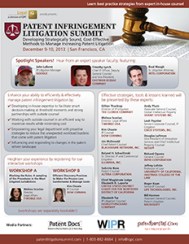
    will be holding a Patent Infringement Litigation Summit on December 9-10, 2013
    in San Francisco, CA.  IQPC faculty will
    help attendees:

    • Develop in-house
    expertise to facilitate smart decision-making at threshold moments and strong
    partnerships with outside counsel;
    • Work with outside
    counsel in an efficient way to maximize results while minimizing cost;
    • Empower your
    legal department with proactive strategies to reduce the unexpected workload
    burdens that come with patent litigation; and
    • Influence and
    respond to changes in the patent reform landscape.

    Brochure CoverIn particular, IQPC
    faculty will offer presentations on the following topics:

    • Organizing the
    legal team: Effective strategies for finding the right counsel &
    establishing strong, efficient working relationships between in-house &
    outside counsel (focus session);
    • Helping the judge
    & jury navigate complicated, technical cases to make well-informed
    decisions;
    • Developing a
    customized in-house approach to handling patent infringement litigation: One
    size does not fit all;
    • Negotiating &
    using alternative fee arrangements to achieve more cost certainty;
    • Making sound
    business decisions: Considerations in evaluating whether to litigate or settle;
    • Developing clear
    expectations & obligations within joint defense groups to maximize value
    & reduce redundancy;
    • Navigating the
    new post-grant review landscape: How to use IPR successfully;
    • Using the ITC's
    new program for early determination of potentially dispositive issues to limit
    unnecessary adjudication in complaints involving standard essential patents or
    NPEs;
    • Strategies for
    early establishment of appropriate discovery limitations to avoid burdensome,
    costly, unnecessary discovery;
    • Safely navigating
    the uncertain damages landscape;
    • In-depth review
    of recent case law: What new developments mean for patent litigation practice;
    • Managing your
    patent portfolio & developing an understanding of the patent landscape to
    avoid unexpected suits; and
    • What you need to
    know about defensive patent aggregation & other proactive practices.

    Two additional
    workshops will also be offered.  The
    first workshop, entitled "Working the Rules: A Sampling of the Procedures
    in the Most Litigated Jurisdiction," will be offered from 7:30 to 9:30 am
    on December 9, 2013.  The second
    workshop, entitled "Efficient Discovery Practices to Make the Process Less
    Cumbersome & Manage Costs" will be offered from 7:30 to 9:30 am on
    December 10, 2013.

    An agenda for the
    conference can be found here (Day 1)
    and here (Day 2).  A complete brochure for this conference,
    including an agenda, detailed descriptions of conference sessions, list of
    speakers, and registration form can be obtained here.

    IQPCThe registration
    fee is $1,399 (conference alone), $549 (either workshop), or $1,899 (conference
    and both workshops).  Those registering
    by October 4, 2013 will receive a $400 discount off the conference alone or
    conference and both workshops, and those registering by November 8, 2013 will
    receive a $200 discount off the conference alone or conference and both
    workshops.  Those interested in
    registering for the conference can do so here.

    Patent Docs is a media partner of the IQPC Patent Infringement Litigation Summit.

  • By
    Kevin E. Noonan

    St. Jude MedicalThe
    Federal Circuit revisited the extent of the safe harbor from the judicially
    created doctrine of obviousness-type double patenting carved out by 35 U.S.C.
    § 121 in St. Jude Medical, Inc. v. Access
    Closure Inc
    .  Unlike earlier
    decisions regarding whether continuation or continuation-in-part applications
    could benefit from the safe harbor, here the Court considered the effects of election-of-species
    requirements on whether there is consonance between claims in one patent over
    those on a related patent in which such a requirement is imposed.

    The
    patents in suit, U.S. Patent No. 7,008,439 (Janzen patent; claims 7, 8 and 9);
    5,275,616, and 5,716,375 (Fowler patents, claim 14 and claim 21, respectively), were directed to apparatus, methods, or both for sealing vascular puncture that
    arises, inter alia, when a vein or
    artery is punctured as part of a medical procedure, and provides an alternative
    to applying direct pressure to seal the wound.  Regarding the Janzen patent, three claims were asserted below and
    considered by the Court in its opinion:

    U.S.
    Patent No. 7,008,439:

    7.  A
    device for closing a puncture in a wall of an artery comprising: an elongated
    member having a distal end, said elongated member sized to be fitted through a
    passageway leading to said puncture so that said distal end is disposed near
    said puncture in said artery, separable plug means for plugging said puncture
    being disposed in said elongated member, movable guide means extending
    longitudinally through said elongated member and said plug means for extension
    through said puncture for guiding said plug means to said puncture, and means
    for ejecting said plug means from said distal end of said elongated member so
    as to place said plug means in blocking relation with said puncture, so as to
    seal said puncture
    [A device as claimed in claim 1], wherein said plug
    means includes an orifice therethrough, said guide means being disposed through
    said orifice, said orifice automatically closing when said guide means is
    removed therefrom.

    8.  A device for closing a puncture in a wall of an
    artery comprising: an elongated member having a distal end, said elongated
    member sized to be fitted through a passageway leading to said puncture so that
    said distal end is disposed near said puncture in said artery, a separable plug
    member for plugging said puncture being disposed in said elongated member, a
    movable guide element extending longitudinally through said elongated member
    and said plug member for extension through said puncture for guiding said plug
    member to said puncture, and an ejecting mechanism for ejecting said plug
    member from said distal end of said elongated member so as to place said plug
    member in blocking relation with said puncture, so as to seal said puncture.

    9.  A method of closing a puncture in a wall of an
    artery made for the purpose of moving an elongated cardiac catheter into the
    artery in which an exterior guide tube is extended through a passage leading to
    the puncture and through the puncture in the wall of the artery and into the
    artery so a to enable the catheter to be guidingly moved through the guide tube
    and into the artery, the method comprising the steps of: withdrawing the
    cardiac catheter and moving the guide tube outwardly so that it no longer
    extends within the puncture, extending a plug having a removable guide wire
    extending longitudinally therethrough so that the guide wire extends from the
    plug through said puncture, moving the plug inwardly along the guide wire into
    blocking relation with said puncture, and withdrawing the guide wire from the
    plug so as to leave the plug sealed in blocking relation with said puncture.

    (where
    the italicized portion of claim 7 recites the limitations of claim 1 from which
    claim 7 is a dependent claim).

    The
    following related patents are relevant to the double patenting issues before
    the Court:

    • Grandparent application,
    USSN 07/746,339, now U.S. Patent No. 5,391,183
    • Divisional
    application USSN 08/318,380, now U.S. Patent No. 5,830,130
    • Continuation
    granted as Janzen patent, second continuation U.S. Patent 5,725,498

    The
    U.S. Patent and Trademark Office imposed a restriction requirement in the '339
    application ("the grandparent application), wherein Group I was directed
    to apparatus claims and Group II directed to method claims.  The Office also imposed an election-of-species
    requirement between Species A, B, and C:

    • Species
    A:  Claims relating to the apparatus
    comprising a solid tissue dilator;
    • Species B:  Claims relating to the apparatus
    comprising a hollow dilator and guidewire;
    • Species C:  Claims relating to the apparatus comprising a guidewire and no
    dilator.

    In
    the '339 application, the Applicant elected Group I, Species B, and claims to
    these embodiments granted in the '183 patent.  In the first divisional application (the '380 application), the examiner
    imposed a similar restriction requirement and applicant elected claims of Group
    I, Species B that granted in the '130 patent.  The '439 patent-in-suit (the Janzen application) contains claims to both
    Group I and Group II, each electing Species C.  And a second continuation (that granted as the '498 patent) contained
    claims to Group II but without election of any particular species.

    Federal Circuit SealThe District Court held that the safe harbor provisions of 35 U.S.C. § 121 protected the claims of
    the Janzen patent from invalidity under obviousness-type double patenting.  The Federal Circuit reversed, in an opinion by
    Judge Plager, joined by Judges Lourie and Wallach, with a concurring opinion by
    Judge Lourie.

    The
    Court reiterated its interpretation of the statute:

    A patent
    issuing on an application with respect to which a requirement for restriction
    under this section has been made, or on an application filed as a result of
    such a requirement, shall not be used as a reference either in the Patent and
    Trademark Office or in the courts against a divisional application or against
    the original application or any patent issued on either of them if the
    divisional application is filed before the issuance of the patent on the other
    application.

    (which
    it opined is "not a model of clarity") that what is required is "consonance,"
    i.e., later-filed applications must
    conform to the "lines of demarcation" set up by a restriction
    requirement, citing Gerber Garment Tech., Inc. v. Lectra
    Sys., Inc.
    , 916 F.2d 683, 688 (Fed. Cir.
    1990).  It is not a violation of
    consonance if two or more non-elected inventions are pursued in a subsequent
    application, the Court noted, citing Boehringer Ingelheim Int'l GmbH v. Barr
    Labs, Inc
    ., 592 F.3d 1340, 1350 (Fed. Cir. 2010), but "a divisional
    application filed as a result of a restriction requirement may not contain
    claims drawn to the invention set forth in the claims elected and prosecuted to
    patent in the parent application."

    As the opinion sets out, the consonance requirement
    is applied to the patent "challenged for double patenting" as well as
    the reference patent.  And here, the
    panel states that consonance "requires
    that the challenged (Janzen) patent, the reference patent, and the
    patent in which the restriction requirement was imposed (the restricted patent,
    i.e. the '183 grandparent patent) do
    not claim any of the same inventions identified by the examiner.  In this case, the question of whether the
    requirement is fulfilled depends on the effect of the election of species
    requirement.  ACI contended below that the
    election was irrelevant to the consonance question, while St. Jude argued that
    the election of species must be considered in determining whether consonance
    was satisfied.  The Court held that not
    only was the election of species relevant but that the result of the combination
    of restriction and election was the identification of six separate, patentably
    distinct inventions:  Group I, Species A; Group I, Species B; Group I, Species
    C; Group II, Species A; Group II, Species B; and Group II, Species C.  Under this standard, the grandparent patent
    contained claims to one invention (Group I, Species C) and the Janzen patent
    contained claims to two other inventions (Group I, Species B and Group II,
    Species B).

    The opinion notes the basis in the regulations for
    election of species requirements (37 C.F.R.
    § 1.146):

    In the
    first action on an application containing a generic claim to a generic
    invention (genus) and claims to more than one patentably distinct species
    embraced thereby, the examiner may require the applicant in the reply to that action
    to elect a species of his or her invention to which his or her claim will be
    restricted if no claim to the genus is
    found to be allowable
    .

    (emphasis
    added
    ).

    The key to the Court's decision in applying the
    statute in this instance is the italicized phrase "if
    no claim to the genus is found to be allowable," i.e., there is no generic
    claim in the grandparent application.  That is the case here, which results in the election of species being a
    restriction of the claims in the grandparent application for purposes of
    applying Section 121.  (The opinion notes that the restriction requirement in
    the grandparent application expressly stated the rule.)  This outcome is a rational one, according to
    the Court:

    It makes
    logical sense that the election of species affected the line of demarcation
    when no claim was generic.  If the election of species did not affect the line,
    double patenting would have prevented the Janzen applicant from obtaining valid
    claims directed to non-elected species.  This result would be unfair since it
    was the examiner, not the applicant, who created the further division of the
    application with the election of species, and the examiner already stated on
    the record that the non-elected species were patentably distinct from the
    elected species.  The unfairness of the result would violate the purpose of the
    safe harbor.

    Access-closureHaving established the parameters of
    the restriction the Court then assessed whether there was consonance.  While the difference in elected species
    distinguished the Janzen patent from the grandparent '339 application, the
    panel found no such distinction with the claims of the second continuation (the
    '498 patent), which contained claims directed to Group II without any limitations as to species.  Accordingly, the claims of this second
    continuation were not consonant with the claims of the Janzen patent, which are
    directed, inter alia, to inventions
    of Group II, Species C.  The claims of
    the Janzen patent were thus not patentably distinct from the claims of the
    second continuation and the Court found them invalid for obviousness-type
    double patenting.

    ACI also appealed the District Court's
    determination that the claims of the Fowler patents were not obvious.  The following are the claims that were at
    issue:

    U.S.
    Patent No. 5,275,616:

    14.  A
    method of sealing an incision formed in the body of a patient wherein the
    incision extends generally from the skin of the patient; through the lumen of a
    blood vessel and into the blood vessel of a patient, the method including the
    steps of:
        forming
    a vessel plug of a material which is absorbable in the body of the patient and
    wherein the vessel plug is formed to include distal and proximal ends therein
    and is dimensioned to be received in the incision; and

        positioning
    the vessel plug in the incision such that the distal end of the vessel plug is
    located proximally of the blood vessel to seal the incision from the flow of
    blood passing through the blood vessel
    , [The method of claim
    9] further including the step of inflating a member on an insertion member to
    identify the location of the blood vessel adjacent to the incision.

    (where
    the italicized portion of claim 14 recites the limitations of claim 9 from
    which claim 14 is a dependent claim); and,

    U.S.
    Patent No. 5,716,375:

    21.  An insertion assembly for sealing an
    incision in the body of a patient wherein the incision extends from the skin of
    the patient into a blood vessel of the patient, said insertion assembly
    comprising in combination:
        a vessel plug which is constructed of a material
    that is absorbable within the body of a patient and which seals the incision
    from the flow of blood therethrough; and
        an elongate positioning member having a passage way
    therein for the receipt of said vessel plug therein, and at least a portion of
    said positioning member is expandable so that it has an outer diameter in use
    which is greater than the diameter of the incision to position said vessel plug
    in the incision proximally of the blood vessel such that said vessel plug
    obstructs the flow of blood through the incision without extending into the
    blood vessel.

    ACI
    argued that these claims were obvious over two prior art references:  a 1988
    scientific journal article to Takayasu, which disclosed a method and apparatus
    for sealing punctures in a liver vein using "a compressed 'gelfoam stick'";
    and a 1971 scientific journal article to Smiley, which disclosed using a
    balloon catheter.  ACI argued that these
    references demonstrated that the problem the Fowler's patents addressed — how
    to restore hemostatis to a punctured blood vessel — was known and that these references
    disclosed methods for solving the problem.  The skilled worker would have had a reasonable expectation of achieving
    the claimed invention by combining the Takayasu and Smiley references and thus
    were obvious under 35 U.S.C. § 103.

    The Federal Circuit agreed with St.
    Jude's argument that their claimed invention contained limitations and features
    not disclosed in the cited prior art that distinguished their claims from the
    hypothetical combination of the teachings of the Takayasu and Smiley
    references.  Rather than combining the
    references, the Court held that the disclosed elements useful for stemming
    blood flow from a puncture -– a gelfoam stick or a balloon -– would be considered
    alternatives and the skilled worker would not combine the references.  Nor was the panel convinced that the skilled
    worker would use an "invasive" balloon rather than non-invasive
    methods (x-ray or ultrasound) used in the art to check the position of the
    gelfoam in the wound.  The Court
    characterized as "a logical chasm" the differences between the art
    and the invention, and further noted that "[e]ven under our "expansive
    and flexible" obviousness analysis (see KSR Int'l Co. v. Teleflex Inc.,
    550 U.S. 398, 415, (2007)), we must guard against "hindsight bias"
    and "ex post reasoning," which "compels [the Court] to
    reject ACI's argument."

    Judge Lourie provided a concurring
    opinion, which agreed with the result but rejected the panel's analysis
    elevating the election of species requirement to a formal restriction.  In Judge
    Lourie's view:

    In a
    nutshell, this case is resolved by the failure of the granted Janzen and '498
    (sibling) patents to maintain consonance with the original restriction
    requirement.  The accompanying requirement for election of species, which
    perhaps raises an issue of first impression, is a complication that should not
    come into play in deciding the appeal.

    According to Judge Lourie, the
    presence of both method and apparatus claims in the Janzen patent is enough to
    vitiate consonance with the grandparent application, which contains claims to
    apparatus ("It is the opposite of consonant.")  That is enough to reach the conclusion
    announced in the panel decision, and thus while Judge Lourie believed that "the
    majority opinion overcomplicates the analysis of this appeal and improperly
    commingles restriction practice with election of species practice," he
    concurred with the decision.

    St. Jude Medical, Inc. v.
    Access Closure, Inc.
    (Fed.
    Cir. 2013)

    Panel: Circuit Judges Lourie, Plager, and Wallach
    Opinion by Circuit Judge Plager; concurring opinion by Circuit Judge Lourie

  • By
    Kevin E. Noonan

    Stanek Rea, TeresaActing Director
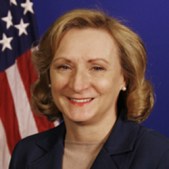
    Teresa Stanek Rea (at right) has notified her colleagues that she will be leaving the
    agency "in the near future."  The text of her announcement reads as follows:

    Dear
    Colleagues,

    It has been a tremendous honor and a true pleasure
    to serve with you as Deputy Director and Acting Director of the USPTO, America's
    own "innovation agency."  It is with deep appreciation and
    gratitude that I inform you that I have decided to leave the agency in the near
    future.

    I joined the United States Patent and Trademark
    Office in March of 2011 as Deputy Director and have been privileged to serve at
    an historic time for this agency.  As deputy to Dave Kappos I was fortunate
    enough to participate as our agency implemented historic patent reforms, as
    well as our ongoing efforts to modernize our entire way of serving and engaging
    our stakeholders and the public in all areas of our operations.  Since I
    became Acting Director we have together endured the difficulties of sequestration,
    but we are weathering that financial storm with clear thinking and bold
    determination.

    My fondest memories of my time with this agency
    will be all of those moments I engaged with each of you on matters large and
    small.  You are some of the most hard-working and dedicated individuals I have
    ever had the privilege of working with, and our stakeholders and the American
    public are better off for your service.  You have exercised true vision in
    ensuring we set the standard for excellence in government, and that is
    reflected in our rapid rise in the rankings of one of the top places to work in
    the federal government.

    It is my anticipation that we will soon welcome a
    new Director who will continue guiding the excellent work of the agency.  Until
    then, I will do everything I can to ensure a smooth transition.

    Thank you for the privilege of serving with you.

    Terry

    Teresa Stanek Rea
    Deputy
    Under Secretary of Commerce for Intellectual Property &
    Deputy
    Director of the United States Patent and Trademark Office
    Department
    of Commerce
    Email:
    Teresa.Rea@uspto.gov
    Phone:
    571-272-8700

    Acting Director
    Rea has led the Patent Office since former Director David Kappos left last
    year, and worked closely with him during his tenure.  She is widely respected for having done an
    excellent job leading the agency, and will be missed.

  • Editor's
    Note:  Yesterday, we reported
    on a perspective, entitled "Patents,
    Profits, and the American People — The Bayh–Dole Act of 1980
    ,"
    that was published in the August 29 issue of the New England Journal of
    Medicine
    .  Earlier today, we received an e-mail from
    Joseph Allen, who noted that he had authored a reply to the NEJM
    article.  His response was originally
    published on IPWatchdog,
    and is being republished here with the permission of IPWatchdog founder
    Gene Quinn.  Patent Docs thanks
    Mr. Allen and Mr. Quinn for allowing us to republish Mr. Allen's response.

    Allen, JoeBy Joseph Allen

    In its August 29, 2013
    edition, the New England Journal of Medicine saw fit to print two "perspective"
    pieces attacking the Bayh-Dole Act.  The primary article is by Dr. Howard
    Markel entitled "Patents,
    Profits, and the American People — The Bayh–Dole Act of 1980
    ."  It repeats previously refuted charges that patenting and licensing federally
    funded inventions harms the public interest.  To give the author due "credit,"
    Dr. Markel does invent some new allegations as well which simply cannot go
    unanswered.

    The Bayh-Dole Act was
    passed because Congress was rightly concerned that potential benefits from
    billions of dollars of federally funded research were lying dormant on the
    shelves of government.  Government funded inventions tend to be very early stage
    discoveries — more like ideas than products — requiring considerable private sector
    risk and investment to turn them into products that can be used by the public.

    Under prior patent polices,
    government agencies took such inventions away from their creators and offered
    them non-exclusively for development.  There were no incentives for the
    inventors to remain engaged in product development.  Not surprisingly, few such
    inventions were ever commercialized even though billions of dollars were being
    spent annually on government R&D.  This failure spurred two Senators
    from opposing sides of the aisle, Birch Bayh of Indiana and Bob Dole of Kansas,
    to form a remarkable partnership seeking a remedy.

    But here's how Dr. Markel
    characterizes the impetus for Senator Bayh's involvement:

    In 1978, a group of constituents representing Purdue University lobbied Bayh to
    seek ways of reaping profits from government allocations for university-based
    research, arguing that although the United States spent billions of dollars
    annually funding more than half of all academic research and owned 28,000 patents,
    it had little to show for the investment.

    Unlike Dr. Markel, I was
    actually in that meeting.  Ralph Davis, who then ran Purdue's technology
    transfer office, is no longer with us to defend himself.  Neither Ralph nor
    anyone else present was looking for "ways of reaping profits from
    government allocations for university-based research." Quite the
    contrary, Ralph said that Purdue had made several promising inventions under
    Dept. of Energy grants which would never benefit U.S. taxpayers unless they
    were effectively licensed and developed.

    This motivation was
    reflected in Senator Bayh's statement on introducing the bill:

    The bill
    addresses a serious and growing problem: hundreds of valuable medical, energy
    and other technological discoveries are sitting unused under government
    control, because the government, which sponsored the research that led to the
    discoveries, lacks the resources necessary for development and marketing
    purposes, yet is unwilling to relinquish patent rights that would encourage and
    stimulate private industry to develop discoveries into products available to
    the public.

    The cost of
    product development exceeds the funds contributed by the government toward the
    initial research by a factor of at least 10 to 1.  This, together with the
    known failure rate for new products, makes the private development process an
    extremely risky venture, which industry is unwilling to undertake unless
    sufficient incentives are provided.

    The
    consequences of our inadequate government patent policy have not gone
    unnoticed.  In the energy area, bureaucratic delays caused by case-by-case
    review of each patent application are now running behind by almost two years. . . .

    But nowhere is
    the patent situation more disturbing than in biomedical research
    programs.  Many people have been condemned to needless suffering because
    of the refusal of agencies to allow universities and small businesses
    sufficient rights to bring new drugs and medical instrumentation to the
    marketplace.  The exact magnitude of this situation is unknown, but we are
    certain that the cases we have uncovered to date are but a small sample of the
    total damage that has been done and will continue to be done if Congress does
    not act.

    Dear
    Colleague letter from Senator Birch Bayh on the introduction of Bayh-Dole,
    Sept. 6, 1978.

    Senator Bayh's wife was
    then suffering from a cancer which would later take her life.  Senator Bayh was
    very grateful for the help she received from the doctors at the National
    Institutes of Health.  His determination to enact Bayh-Dole to ensure that new
    treatments for relieving human suffering were being developed was driven by a
    passionate concern for patients, not "reaping profits."

    Markel repeats the
    discredited allegation that technology licensing was more successful before
    Bayh-Dole than claimed by proponents of the law.  This charge used to be widely
    circulated leading my colleagues Norman Latker and Howard Bremer to look up the
    actual source materials the critics cited.  Perhaps not surprisingly, they
    found the critics were misreading the data.  See "The Bayh-Dole Act and Revisionism Redux," pp.
    9-10.

    Dr. Markel lightly
    dismisses as "[m]ore difficult to confirm" the meticulous work that
    Lori Pressman and her team (which included economists at the Department of
    Commerce) put into a ground breaking study estimating the significant economic
    impact of university patent licensing on the U.S economy.  Lori documented
    the methodology behind the study which until now, no one has challenged.  Perhaps Dr. Markel's "difficulty" would be solved if he actually read
    the paper.  To make it easy, here's the link: "The Economic Contribution of University/Nonprofit
    Inventions in the United States: 1996-2010
    ."

    Adding insult to injury,
    Markel continues:  "Indeed, the law's many critics question how much it has
    actually benefited the economy (as opposed to individuals and stakeholders)
    and the extent of its social costs."

    Here's some data that may
    help Dr. Markel and the other critics:

    • Since 1980
    more than 9,000 new firms have been created around university inventions, more
    than 4,000 of which are still in business.  These companies tend to locate in
    the same state as the university, spurring economic growth.

    • 705 new companies were
    created by university patented inventions in FY 2012 alone, along with 591 new
    commercial products introduced for consumers to use.  Not a bad
    performance in an economy otherwise stuck in the doldrums.

    • There are now more than
    40,000 active licenses and options in place on university inventions, the
    majority of which are with small businesses.

    • No new drugs were
    commercialized when the government took inventions away from universities
    before Bayh-Dole.
      Since then at least 153 are now on the market fighting the scourge of disease
    world-wide according to a study published in the New England Journal of
    Medicine
    .  See "The Role of Public-Sector Research in the Discovery of
    Drugs and Vaccines
    ."

    A new Forbes magazine analysis calculates
    that it now costs $5 billion to develop a new drug — expenses that are borne by
    the private sector.  If the critics ever get their way and succeed in
    undermining Bayh-Dole, we could return to the days when we again pull the plug
    on drugs developed from federally funded research.  One has to wonder
    where those suffering will then turn for relief.  It's unlikely the critics will
    be able to offer them much solace.

    While not in Dr. Markel's
    article, publications covering it surmised from his characterization of its
    legislative history that enactment of Bayh-Dole was "fluke ridden"
    (University of Michigan Health.org) or a "rocky and somewhat inglorious
    road to passage by a lame duck Congress" (Tech Transfer News blog).  Such language reflects a fundamental lack of understanding of the legislative
    process.  Bayh-Dole passed on its merits in the full light of day, not
    through any legislative sleight of hand.

    The bill not only went
    through all of the steps for passing a new law that you read about in civics
    class, it was subjected to additional scrutiny not normally required for
    legislation:  it needed a unanimous vote of approval in the closing days of the
    Congress.  Bayh-Dole was even attacked by its bureaucratic opponents after
    enactment who sought to undermine the new law by wrecking the regulations
    needed for its implementation.  See "The Enactment of Bayh-Dole, An Inside Perspective."

    Dr. Markel saves his "best"
    for last:

    It's time for
    Congress to recalibrate Bayh-Dole.  Profits and patents can be powerful
    incentives for scientists, businesspeople, and universities, but new and
    ongoing risks — including high prices that limit access to lifesaving
    technologies, reduced sharing of scientific data, marked shifts of focus from
    basic to applied research, and conflicts of interest for doctors and academic
    medical centers — should be mitigated or averted through revisions of the
    law.  All Americans should be able to share in the bounties of federally
    funded research.

    Oh my, where to
    begin?  Would Dr. Markel feel better knowing that a survey of academic
    researchers concluded that "patenting does not seem to limit research
    activity significantly, particularly among those doing basic research,"
    with only 1% of their random sample of 398 academic respondents reporting a
    project delay of more than a month due to patents on knowledge inputs necessary
    for their research, and none reporting abandoning of a research project due to
    the existence of patents?  See Final Report to the National
    Academy of Sciences' Committee Intellectual Property Rights in Genomic and
    Protein-Related Inventions: Patents, Material Transfers and Access to Research
    Inputs in Biomedical Research
    (Sept. 20, 2005).

    Would he feel better
    knowing that Bayh-Dole has not shifted the focus of federal R&D from basic
    to applied research?  See "The Bayh-Dole Act and Revisionism Redux," pp.
    11-12.  This is hardly surprising as federal agencies fund research either in
    pursuit of expanding the frontiers of knowledge or to meet their mission
    needs.  With industry abandoning basic research, being able to partner
    with our unparalleled public research institutions is a tremendous competitive
    advantage for the United States.  Bayh-Dole makes this possible.

    Perhaps Dr. Markel will
    feel better knowing that all Americans can only share in the bounty of
    federally funded research when embryonic ideas are taken from the lab and
    turned into new products they can actually use, while creating new jobs and
    companies where they can work.  The United States is leading the world in
    this regard — thanks to the Bayh-Dole Act.

    About
    the Author

    Joesph Allen is a 30-year veteran of national efforts to
    foster public/private sector commercialization partnerships, and author of
    numerous articles on technology management for national publications.  Mr. Allen
    served as a Professional Staff Member on the U.S. Senate Judiciary Committee
    with former Senator Birch Bayh (D-IN), and was instrumental in working behind
    the scenes to ensure passage of the historic Bayh-Dole Act.  Mr. Allen has served as
    the Executive Director of Intellectual Property Owners, Inc., a trade
    association representing major R&D companies, he was involved in the
    creation of the Court of Appeals for the Federal Circuit, and he also served at
    the U.S. Department of Commerce as the Director of the Office of Technology
    Commercialization.  From 1992 until 2004, Mr. Allen was with the National Technology
    Transfer Center (NTTC), becoming President in 1997.  Clients included NASA, the
    Department of Defense, EPA, the Department of Veterans Affairs, and the
    Department of Commerce.  Between 2004 until 2007, Mr. Allen was the Vice President
    and General Manager of the West Virginia High Technology Consortium Foundation.  In 2008, he founded Allen &
    Associates
    to continue to facilitate public/private partnerships
    between universities, federal laboratories, and industry.

    For additional information
    regarding this and other related topics, please see:

    • "NEJM Perspective Calls for Recalibration
    of Bayh-Dole Act
    ," September 10, 2013
    • "Senator Leahy Urges
    NIH to Use March-In Rights on Myriad BRCA Test
    ," July 17, 2013
    • "Patent Docs Author Testifies at Genetic
    Diagnostic Testing Hearing
    ," February 16, 2012
    • "AUTM Survey Shows Significant Increases in University Patent Filings and Issuances in FY2010," October 5, 2011
    • "USPTO Recognizes
    30th Anniversary of Bayh-Dole Act
    ," December 9, 2010
    • "University Start-ups and Licensing Activity Held Steady During Recession," October 7, 2010
    • "AUTM Survey Shows Drop in Issued Patents," March 9, 2010
    • "BIO Comes out
    Swinging against SACGHS Report
    ," February 4, 2010

    • "Patent Haters Take
    Notice! University Innovation Fuels Robust Economic Activity
    ," IPWatchdog, August 7, 2013
    • "Intellectual
    Dishonesty About Bayh-Dole Consequences
    ," IPWatchdog, May 10, 2013
    • "The Good Steward —
    Turning Federal R&D into Economic Growth
    ," IPWatchdog, August 2, 2012
    • "University Tech
    Licensing Has Substantial Impact on Economy
    ," IPWatchdog, December 10, 2012
    • "AUTM Survey:
    University Licensing Strong Despite Economy
    ," IPWatchdog, December 17, 2010
    • "Statement of
    Senator Birch Bayh on the 30th Anniversary of the Bayh-Dole Act
    ," IPWatchdog, December 5, 2010

  • By Donald Zuhn

    New England Journal of MedicineIn a perspective published
    in the August 29 issue of the New England Journal of Medicine, Dr. Howard
    Markel
    outlines the events leading up to the enactment of the Bayh-Dole Act and
    states that "a review of [the Act's] origins and consequences supports the
    idea that policies governing the fast-changing worlds of medicine and
    biotechnology merit frequent reappraisal and reform."  In the article, entitled "Patents, Profits,
    and the American People — The Bayh–Dole Act of 1980
    ,"
    Dr. Markel,
    the George E. Wantz Distinguished Professor of the History of Medicine, and
    Director for the Center for the History of Medicine at the University of
    Michigan, notes that "Bayh–Dole's inspiration was not a perceived need to
    transform the conduct of research but the economic doldrums of the 1970s."  Following a helpful summary of the history of
    the Act, Dr. Markel explains that "[w]hen the Bayh–Dole Act was written,
    its aim was primarily to stimulate economic growth by more efficiently mining
    the untapped scientific riches of hospitals, laboratories, and universities."  He argues, however, that "[m]uch has changed since then."

    While Dr. Markel provides
    no proposed changes to the Act, he contends that "some of the most vexing
    quandaries weren't fully addressed in the original legislation."  As for examples of such
    "quandaries," he suggests that revised legislation should address several
    questions:

    Who should benefit from discoveries pertaining
    to nature or the human body?  . . .  [W]hat conflicts of interest must be
    identified and contained in order to protect patients?  How can scientific discovery proceed if all
    innovations and research tools are patented and the discoverers control access
    to them?

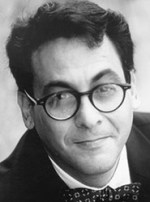
    Markel, HowardDr. Markel (at left) concludes his article by
    declaring that "[i]t's time for Congress to recalibrate Bayh–Dole,"
    adding that "[p]rofits and patents can be powerful incentives for scientists,
    businesspeople, and universities, but new and ongoing risks — including high
    prices that limit access to lifesaving technologies, reduced sharing of
    scientific data, marked shifts of focus from basic to applied research, and
    conflicts of interests for doctors and academic medical centers — should be
    mitigated or averted through revisions of the law."