•         By Sherri Oslick

    Gavel About Court Report:  Each week we will report briefly on recently filed biotech and pharma cases.

    Forest
    Laboratories Inc. et al. v. First Time US Generics LLC

    1:13-cv-01642;
    filed October 2, 2013 in the District Court of Delaware

    • Plaintiffs: 
    Forest Laboratories Inc.; Forest Laboratories Holdings Ltd.; Royalty Pharma
    Collection Trust
    • Defendant: 
    First Time US Generics LLC

    Infringement
    of U.S. Patent Nos. 6,602,911 ("Methods of Treating Fibromyalgia,"
    issued August 5, 2003), 7,888,342 ("Methods of Treating Fibromyalgia
    Syndrome, Chronic Fatigue Syndrome and Pain," issued February 15, 2011),
    and 7,994,220 ("Milnacipran for the Long-Term Treatment of Fibromyalgia
    Syndrome," issued August 9, 2011), all licensed to Forest, following a
    Paragraph IV certification as part of First Time's filing of an ANDA to
    manufacture a generic version of Forest's Savella® (milnacipran hydrochloride,
    used in the management of fibromyalgia). 
    View the complaint here.


    Andrulis
    Pharmaceuticals Corp. v. Celgene Corp.

    1:13-cv-01644;
    filed October 2, 2013 in the District Court of Delaware

    Infringement
    of U.S. Patent No. 6,140,346 ("Treatment of Cancer with Thalidomide Alone
    or in Combination with Other Anti-Cancer Agents," issued October 31, 2000)
    based on Celgene's promotion of its Thalomid® (thalidomide), Revlimid®
    (lenalidomide), and/or Alkeran® (melphalan) products for off-label use in the
    treatment of cancer, including multiple myeloma.  View the complaint here.


    Helsinn
    Healthcare S.A. et al. v. Dr. Reddy's Laboratories, Ltd. et al.

    3:13-cv-05815;
    filed September 30, 2013 in the District Court of New Jersey

    • Plaintiffs: 
    Helsinn Healthcare S.A.; Roche Palo Alto LC
    • Defendants: 
    Dr. Reddy's Laboratories, Ltd.; Dr. Reddy's Laboratories, Inc.; Sandoz Inc.;
    Teva Pharmaceuticals USA, Inc.; Teva Pharmaceutical Industries, Ltd.

    Infringement
    of U.S. Patent No. 8,518,981 ("Liquid Pharmaceutical
    Formulations of Palonosetron," issued August 27, 2013) in conjunction with Dr.
    Reddy's filing of an ANDA to manufacture a generic version of Helsinn's Aloxi®
    (palonosetron hydrochloride intravenous solution, used to prevent chemotherapy
    induced nausea and vomiting).  View the
    complaint here.


    Pfizer Inc. et
    al. v. Apotex Inc., et al.
    1:13-cv-06962;
    filed September 27, 2013 in the Northern District of Illinois

    • Plaintiffs: 
    Pfizer Inc.; Wyeth LLC; Pfizer Pharmaceuticals LLC; PF Prism C.V.; Pfizer
    Manufacturing Holdings LLC
    • Defendants: 
    Apotex Inc; Apotex Corp.

    Infringement
    of U.S. Patent No. 8,372,995 ("Crystalline Solid Forms of Trigecycline and
    Methods of Preparing Same," issued February 12, 2013), licensed to Pfizer,
    following a Paragraph IV certification as part of Apotex's filing of an ANDA to
    manufacture a generic version of Pfizer's Tygacil® (tigecycline injectible,
    used for the treatment of complicated skin and skin structure infections,
    complicated intra-abdominal infections, and community-acquired bacterial
    pneumonia).  View the complaint here.


    Otsuka
    Pharmaceutical Co., Ltd. et al. v. Sandoz, Inc.

    3:13-cv-05788;
    filed September 27, 2013 in the District Court of New Jersey

    • Plaintiffs: 
    Otsuka Pharmaceutical Co., Ltd.; Board of Regents of The University of Texas
    System; University of Houston
    • Defendant: 
    Sandoz, Inc.

    Infringement
    of U.S. Patent Nos. 5,430,057 ("Parenteral Busulfan for Treatment of
    Malignant Disease," issued July 4, 1995) and 5,559,148 (same title, issued
    September 24, 1996), licensed to Otsuka, following a Paragraph IV certification
    as part of Sandoz's filing of an ANDA to manufacture a generic version of
    Otsuka's Busulfex® (busulfan injection, used in combination with
    cyclophosphamide as a conditioning regimen prior to allogeneic hematopoietic
    progenitor cell transplantation for chronic myelogenous leukemia).  View the complaint here.


    Galderma
    Laboratories, L.P. et al. v. Perrigo Israel Pharmaceuticals Ltd. et al.

    3:13-cv-03930;
    filed September 27, 2013 in the Northern District of Texas

    • Plaintiffs: 
    Galderma Laboratories, L.P.; Galderma SA; Galderma Research & Development
    SNC
    • Defendants: 
    Perrigo Israel Pharmaceuticals Ltd.; Perrigo Co.

    Infringement
    of U.S. Patent Nos. 7,820,186 ("Gel Composition for Once-Daily Treatment
    of Common Acne Comprising a Combination of Benzoyl Peroxide and Adapalene
    and/or Adapalene Salt," issued October 26, 2010), 7,964,202 ("Method
    for Treatment of Common Acne," issued June 21, 2011), 8,071,644 ("Combinations
    of Adapalene and Benzoyl Peroxide for Treating Acne Lesions," issued
    December 6, 2011), 8,080,537 (same title, issued December 26, 2011), 8,105,618
    ("Dermatological/Cosmetic Gels Comprising At Least One Retinoid and/or
    Retinoid Salt and Benzoyl Peroxide," issued January 31, 2012), 8,129,362 ("Combination/Association
    of Adapalene and Benzoyl Peroxide for Treating Acne Lesions," issued March
    6, 2012), 8,241,649 ("Dermatological/Cosmetic Gels Comprising at Least One
    Retinoid and/or Retinoid Salt and Benzoyl Peroxide," issued August 14,
    2012), and 8,445,543 ("Combinations of Adapalene and Benzoyl Peroxide for
    Treating Acne Lesions," issued May 21, 2013) following a Paragraph IV
    certification as part of Perrigo's filing of an ANDA to manufacture a generic
    version of Galderma's Epiduo® Gel (adapalene and benzoyl peroxide, used to
    treat acne vulgaris).  View the complaint here.

  • CalendarOctober
    9, 2013 – Biosimilars: Navigating FDA's Evolving
    Approval Pathway, Protecting Patents and Trade Secrets
    (Strafford) – 1:00 to 2:30 pm (EDT)

    October 10, 2013 – Recent Judicial Decisions
    Impacting Technology Licensing
    (McDonnell
    Boehnen Hulbert & Berghoff LLP) – 10:00
    to 11:15 am (CT)

    October 15-17, 2013 – Business of
    Biosimilars
    *** (Institute for
    International Research) – Boston, MA

    October 22, 2013 – Patent 'Trolls' Under Fire: Strategies,
    Tactics and Legislation Impacting University Patents & Licensing
    (Technology
    Transfer Tactics) – 1:00 to 2:00 pm (Eastern)

    October
    23, 2013 – European biotech patent law update (D
    Young & Co) – 4:00 am, 7:00 am, 12:00 pm (EDT)

    October 24, 2013 – Divided Patent Infringement and Inducement:
    Protecting IP Rights — Latest Strategies for Drafting and Prosecuting Claims
    and Allocating Liability
    (Strafford) – 1:00 to 2:30 pm
    (EDT)

    October 29, 2013 – IP Due Diligence in M&A Transactions —
    Conducting IP Investigations and Leveraging Results During Deal Negotiations
    (Strafford) – 1:00 to 2:30 pm (EDT)

    October 29-30, 2013 – European Patent Practice Seminar (John Marshall Law
    School Center for Intellectual Property Law & Kuhnen & Wacker) – Chicago, IL

    October
    31, 2013 – Strategic Use of Patent Reissue After the AIA
    — Correcting Errors in Patents, Determining Whether and When to Pursue a
    Reissue Application, and Mastering the Recapture Rule
    (Strafford) – 1:00 to 2:30 pm (EDT)

    November 4-5, 2013 – FDA Boot Camp Devices Edition*** (American Conference
    Institute) – Chicago, IL

    November 4-5, 2013 – Trade Secrets: Protecting Your Intellectual Capital and Confidential
    Business Information
    *** (American Conference
    Institute) – Chicago, IL

    November 6-8, 2013 – 2013 Fall Intellectual Property
    Counsels Committee (IPCC) Conference
    (Biotechnology
    Industry Organization) – Washington, DC

    November 7, 2013 – On Sale and Public Use Bars to Patentability
    After AIA — Minimizing the Risk of Patent Ineligibility or Invalidation
    (Strafford) – 1:00 to 2:30 pm (EDT)

    November 17-20, 2013 – Creating and Leveraging Intellectual Property in Developing Countries: A Power Tool for Social and
    Economic Growth
    *** (Companies and IP Commission and National
    IP Management Office of South Africa) – Durban, South Africa

    November
    19, 2013 – PTAB or the District Court: Which
    Is the Better Option When Challenging Patent Validity?
    (McDonnell
    Boehnen Hulbert & Berghoff LLP) – 10:00 to 11:15 am (CT)

    December 9-10, 2013 – Patent Infringement Litigation Summit (Legal iQ (IQPC)) – San Francisco, CA

    December 10-11, 2013 – Advanced
    Forum on Patent Litigation
    *** (American Conference
    Institute) – New York, NY

    ***Patent Docs is a media partner of this conference or CLE

  • MBHB Logo 2McDonnell
    Boehnen Hulbert & Berghoff LLP will be offering a live webinar entitled
    "PTAB or the District Court: Which
    Is the Better Option When Challenging Patent Validity?" on November
    19, 2013 from 10:00 am to 11:15 am (CT). 
    MBHB attorneys Alison J. Baldwin and Dr. Sarah E. Fendrick will provide
    strategies to help guide participants in choosing the best invalidity
    proceeding option for their clients.  The
    webinar will also address the following questions:


    What are the similarities and differences between the various PTAB invalidity
    proceedings?

    What are the risks and benefits of the different PTAB proceedings?

    Are PTAB proceedings a better option than the district courts?

    While
    there is no fee to participate, attendees must register in advance.  Those wishing to register can do so here.  CLE credit is pending for the states of
    California, Illinois, New Jersey, New York, North Carolina, and Virginia.

  • Strafford #1Strafford
    will be offering a webinar/teleconference entitled "On Sale and Public Use Bars to Patentability
    After AIA — Minimizing the Risk of Patent Ineligibility or Invalidation"
    on November 7, 2013 from 1:00 to 2:30 pm (EDT). 
    Thomas L. Irving of Finnegan
    Henderson Farabow Garrett & Dunner and Daniel G. Brown of Latham &
    Watkins will examine the on sale and public use bars to patent
    eligibility and the impact of the AIA on these statutory bars, as well as discuss
    recent court treatment and offer best practices to minimize the risk of patent
    ineligibility or invalidation.  The
    webinar will review the following questions:

    • How do AIA changes impact the on sale bar and the
    public use bar?
    • How are courts treating the on sale bar and the
    public use bar?
    • What best practices can counsel employ to adapt
    patent prosecution and enforcement strategies?

    The
    registration fee for the webinar is $297 ($362 for registration and CLE
    processing).  Those registering by October
    11, 2013 will receive a $50 discount. 
    Those interested in registering for the webinar, can do so here.

  • JMLSThe John Marshall Law
    School Center for Intellectual Property Law will be hosting a European Patent Practice Seminar on
    October 29-30, 2013 in Chicago, IL.  The
    seminar, which will be presented by the
    German IP law firm of Kuhnen & Wacker, is part of the Center's
    first-ever Patent Week.  The seminar will
    consist of the following sessions:

    • Introduction to
    the European Patent Convention
    • EP Case Law of
    Interest
    • EP Claim
    Drafting Specialties
    • Opposition
    • Unitary Patent
    • Moderated Panel
    Discussion: EPC (UPP) vs. AIA
    • Patent
    Infringement Litigation
    • Unified Patent
    Court
    • Patent Filing
    Strategies
    • International
    Patent Litigation
    • Ethics Session

    An agenda for the
    seminar can be found here.  Those interested in registering for the
    conference online can do so here; the registration fee is $100
    for one day and $195 for both days, $95 (government, judicial, and academic
    rate), or free (JMLS students and faculty).

  • Strafford #1Strafford
    will be offering a webinar/teleconference entitled "Divided Patent Infringement and Inducement:
    Protecting IP Rights — Latest Strategies for Drafting and Prosecuting Claims
    and Allocating Liability" on October 24, 2013 from 1:00 to 2:30 pm
    (EDT).  Thomas L. Irving of Finnegan Henderson Farabow Garrett & Dunner and
    Sharon L. Davis of Rothwell Figg Ernst & Manbeck will provide
    guidance on handling divided infringement claims when enforcing patent rights,
    as well as review recent court decisions and outline steps to protect IP rights
    and allocate liability in the event of infringement.  The webinar will review the following
    questions:

    • How are the federal courts treating the issue of
    divided infringement?
    • What guidance is offered in recent decisions
    concerning the agency relationship and infringement?
    • What steps can companies and counsel take to
    assess their risk when partnering with other companies to minimize potential
    exposure?

    The
    registration fee for the webinar is $297 ($362 for registration and CLE
    processing).  Those interested in
    registering for the webinar, can do so here.

  • By Donald Zuhn

    Yesterday, we noted that the
    Generic Pharmaceutical Association (GPhA) recently expressed its opposition to
    a California bill (SB-598)
    that would authorize a pharmacist to select a biosimilar when filling a
    prescription order for a prescribed biological product, provided that the
    prescriber did not personally indicate "Do not substitute" (see "GPhA Opposes California
    Biosimilar Bill; Points to Report on Savings from Biosimilars
    ").  The legislation would also
    require that the substitution of a biosimilar be communicated to the patient,
    and that the pharmacy notify the prescriber of the substitution or enter the
    substitution into a patient record within five business days of the selection.  The bill, which was passed by a 30-2 vote in the
    California Senate on September 4, is now before Governor Jerry Brown.

    Biotechnology Industry Organization (BIO)When SB-598 was passed by
    the Senate, Biotechnology Industry Organization (BIO) President and CEO Jim
    Greenwood issued a statement
    "commend[ing] California's Assembly and Senate for overwhelmingly passing
    legislation that creates a pathway for the substitution of interchangeable
    biologic medicines."  He also noted
    that because "the policies outlined in Senate Bill 598 align with BIO's
    principles on biologic substitution," BIO supported the legislation and
    encouraged Governor Brown to sign the bill.

    In a letter
    issued in January, BIO outlined its principles on the substitution of biologic
    products.  In its letter, BIO notes that
    while the FDA will determine whether a follow-on biologic will achieve
    biosimilar or interchangeable status under the Biologics Price Competition and
    Innovation Act of 2009 (BPCIA), state law will govern whether one biologic
    product may be substituted by a pharmacist when a different biologic product is
    prescribed.  In the letter, BIO also expresses
    its belief that "a sound policy in each state outlining parameters for
    safe substitution of interchangeable biologics is the best option to ensure
    patients have access to high-quality, safe, and effective biologic medicines."  The letter outlines two principle
    safeguards and three additional safeguards to guide substitution policies for
    interchangeable biologics under state law. 
    The two principle safeguards are as follows:


    Substitution should occur only when the FDA has designated a biologic product
    as interchangeable.

    The prescribing physician should be able to prevent substitution.

    And the three additional
    safeguards are:


    The prescribing physician should be notified of the substitution.

    The patient, or the patient's authorized representative, should, at a minimum,
    be notified of the substitution.

    The pharmacist and the physician should keep records of the substitution.

    SB-598 satisfies all five
    safeguards outlined in BIO's letter, with pharmacies being given the option
    under the legislation to either notify the prescriber of the substitution or
    enter the substitution into a patient record within five business days of the
    selection.

    More recently, BIO provided
    testimony

    during a hearing before the Health Committee of the Pennsylvania House of
    Representatives in support of HB 746,
    a Pennsylvania biosimilar bill that would allow a pharmacist to substitute a
    biosimilar product for a prescribed biological product only if:

    (1) The biosimilar product
    has been determined by the United States Food and Drug Administration to be
    interchangeable with the prescribed product for the indicated use.
    (2) The prescriber does not
    designate verbally or in writing on the prescription that substitution is
    prohibited.
    (3) The person presenting
    the prescription provides written consent for such substitution.
    (4) The pharmacist notifies
    the prescriber in writing and as soon as practicable but no later than 72 hours
    after dispensing.
    (5) The pharmacy and the
    prescriber retain a written record of the biosimilar substitution for a period
    of no less than five years.

    With respect to the
    Pennsylvania bill, BIO indicated that the legislation "gives pharmacists
    the ability to substitute lower cost interchangeable biologic medicines while
    also ensuring that patients and physicians have been notified of an appropriate
    switch in their medication."

  • By Donald Zuhn

    Generic  Pharmaceutical Association (GPhA)Last week, the Generic
    Pharmaceutical Association (GPhA) released a statement regarding a California
    bill (SB-598)
    that the GPhA asserted would "introduce[] burdensome provisions that could
    raise costs and limit patient access to more affordable biosimilar medicines."  The bill, introduced in February and now
    before Governor Jerry Brown, would authorize a pharmacist to select a
    biosimilar when filling a prescription order for a prescribed biological
    product, provided that the prescriber did not personally indicate "Do not
    substitute."  The legislation would
    also require that the substitution of a biosimilar be communicated to the
    patient, and that the pharmacy notify the prescriber of the substitution or
    enter the substitution into a patient record within five business days of the
    selection.

    The GPhA noted that a group
    of more than thirty organizations, including CalPERS, AARP, California Pharmacists
    Association, California Association of Health Plans, nine state labor unions, Kaiser
    Permanente and some retail pharmacies, "oppose the burdensome notification
    provisions in SB 598 and call upon Governor Brown to veto the legislation."  The GPhA also noted that similar legislation
    has been rejected in ten of the eighteen states where it has been considered and has only been passed with "significant amendments" in three states and with "Amgen
    and Genentech-backed provisions intact in only one state (North Dakota)."

    In opposing the California
    bill, the GPhA points to a report from Express Scripts, which determined that the
    potential 10-year saving to patients and payers in California from the
    introduction of biosimilars on eleven biologics that are protected by U.S.
    patents that have expired or will expire in the near future unless new patents
    are granted would be approximately $27.6 billion.  The report, entitled "Ten-Year Potential Savings from Biosimilars in California," and authored by Dr. Sharon
    Glave Frazee, Dr. Susan Garavaglia, Jonah Houts, and Dr. Steve
    Miller, looked at eleven brand biologic drugs that were
    considered to be good candidates for the introduction of biosimilars over the
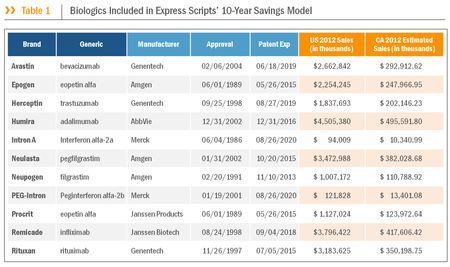
    next ten years.  The eleven biologics are listed in Table 1 of
    the report:

    Table 1
    Noting that "[t]he
    projected unrealized saving is significant," the report states that the
    potential savings "warrant[] regulatory and legislative consideration at
    both federal and state levels to improve the pathway for biosimilar evaluation
    and reject industry requests to enact legislative barriers to interchangeable
    biosimilar substitution."

    The GPhA indicated that the
    report "reinforces the importance of improving the pathway for biosimilar
    evaluation and rejecting requests to enact legislative barriers to
    interchangeable biosimilar substitution," and "bolsters the argument
    that adding hurdles to the biosimilar pathway only can do harm to patients,
    payers and the general public."

  • By Donald Zuhn

    USPTO Building FacadeWith day one of the latest
    federal government shutdown nearly at an end, and with Washington bracing for a
    prolonged government shutdown, the U.S. Patent and Trademark Office issued a notice
    to applicants and practitioners regarding the status of Office operations for the next few weeks.  The Office indicated it would remain open and
    would be "using prior year reserve fee collections to operate as usual for
    approximately four weeks."  The
    Office also indicated that it would continue to assess its fee collections as compared
    to its operating requirements in order to determine how long it will be able to
    operate in this capacity during the shutdown, adding that it would provide an
    update as more definitive information becomes available.

    If the shutdown continues
    past the time the Office exhausts its reserve funds, the Office noted that it
    "would shut down at that time, although a very small staff would continue
    to work to accept new applications and maintain IT infrastructure, among other
    functions."  The notice directs
    applicants and practitioners to the agency's plan
    for "an orderly shutdown," which indicates that after its reserve
    funds are exhausted:

    [E]xcepted employees [at the USPTO] will
    ensure the functionality of processes and systems minimally necessary for the
    preservation of patent rights, to allow compliance with statutory provisions
    that cannot be waived, and avoid disclosures of information that would be
    detrimental to the national security.  Additionally,
    the excepted employees will ensure the functionality of processes and systems
    minimally necessary to preserve trademark rights.  Preventing the public from accessing the
    USPTO's electronic filing and payments systems may result in the complete or
    partial loss of intellectual property.  Therefore,
    in order to prevent the loss of valuable intellectual property, these systems
    should remain open during any closure of the USPTO.

    The plan provides a list of
    106 of the Office's 11,789 employees who are excepted.

    USPTO SealIn addition to the above,
    the Office noted
    that the 18th Annual Independent Inventors conference, originally scheduled for
    October 11-12, has been cancelled.  The
    Office hopes to reschedule the conference after the government resumes full
    operation.  The Office also noted that requests
    for paper files have been temporarily suspended because those files are housed in
    a federal facility which is owned and operated by the General Services
    Administration (GSA), and which is closed during the shutdown.

    According to Wikipedia,
    the government shutdown that began earlier today is only the latest in a
    series of such shutdowns, which includes eight full government shutdowns lasting
    between one and three days apiece during the Reagan administration, a four day
    shutdown during the first Bush administration, and two full shutdowns lasting
    five and 21 days during the Clinton administration — the 21-day shutdown being the longest of any
    government shutdown.

  • A Little
    Reminder to the PTO about Due Process and the Importance of Objective Evidence
    of Non-Obviousness

    By Alison Baldwin

    In its decision on September 24th, the Federal Circuit reminded
    the Patent Office that the principles of due process are still alive and
    kicking and cannot be ignored by the Patent Office's judiciary.

    RambusThe case came to the Federal Circuit on appeal from a decision
    by the USPTO's Board of Patent Appeals and Interferences (BPAI) holding invalid
    various claims of U.S. Patent No. 6,260,097, which had been finally rejected as
    invalid by the examiner during an inter partes
    reexamination.  The '097 patent relates
    to dynamic random-access memory (DRAM).  Specifically,
    the claims are directed to what the assignee, Rambus, refers to as the "dual-edge/double-data-rate"
    functionality because the system transfers data at twice the rate by employing
    both the rising and falling edges of a clock signal that synchronizes the
    operations within the system.  While the
    technology at issue in this case is outside the normal parlance of the
    Patent Docs faithful, the issues raised by the Federal Circuit in its decision
    are applicable to any technology.

    Rambus appealed the Board's decisions on the issues of claim
    construction and obviousness.  The
    Federal Circuit agreed with the Board's claim construction and, for purposes of
    this post, we will not address the Court's claim construction analysis as it
    was fairly routine.  The real take-away
    for the reader of the Rambus v. Rea decision were the three errors the
    Federal Circuit found with the Board's obviousness decision.

    USPTO SealThe first error by the Board was a shifting the burden onto the
    Patentee to prove that the claims were not obvious.  In its opinion, the BPAI had concluded that "Rambus
    ha[d] not demonstrated that skilled artisans . . . would not have been able to
    arrive at the broadly claimed invention."  Rambus v. Rea, p. 11, citing Board decision.  As the Federal Circuit reminded the Patent
    Office, the burden is the Office's, not the Applicants, to present evidence of
    invalidity.  This is particularly true in
    a reexamination proceeding where "a preponderance of the evidence must
    show nonpatentability before the PTO may reject the claims."  Id. at 11.  As we enter the new age of reexamination
    under the inter partes review
    process, this opinion serves as an important reminder to the new ALJs
    empaneled as part of the Patent Trial and Appeal Board.

    The second error by the Board was created when the Board
    supplied its own reasons, that differed from those set forth previously by the
    examiner, to combine the prior art references to arrive at its obviousness
    determination.  The Board may not rely on
    new facts and rationales not previously raised to the applicant by the examiner
    because the applicant has to have a "fair opportunity to react to the
    thrust of the rejection."  Id. at 12.  If the applicant has not had an "fair
    opportunity" to respond to the rejection, then the Board must designate
    its decision a new ground of rejection and provide appellant with an
    opportunity to respond.  The Federal
    Circuit did not issue an opinion on the merits of the Board's obviousness
    determination — it just took issue with the procedure used.  However, it was a good reminder to the BPAI
    that these steps in the process cannot be skipped.

    The final error by the Board was in its mistreatment of
    objective evidence non-obviousness.  The
    Board took a very restrictive view of the nexus required between the evidence
    and the merits of the claimed invention.  First, Rambus presented uncontested evidence of long-felt need and industry
    praise due to the claimed dual-edge data transfer functionality through an
    industry article and a press release by a Rambus competitor.  However, the Board held that this evidence
    was not commensurate with the scope of the claims because the evidence
    discussed only one embodiment of the claims.  The Court reminded the BPAI that the objective evidence need only be "reasonably
    commensurate with the scope of the claims."  A patentee is not required to produce
    objective evidence of nonobviousness for every potential embodiment of the
    claim.

    Rambus also presented uncontested evidence of commercial
    success through its licensing activities relating to its dual-edge data
    transfer functionality.  The Board held
    that the evidence lacked nexus because "competitors have many reasons for
    taking licenses which are not necessarily related to obviousness."  Id. at 15.  The Federal Circuit took issue with the Board's position because there
    was no evidence in the record to support that assertion that the commercial
    value of the licenses stemmed from factors other than the claimed invention.

    Finally, the Board held that all of the objective evidence of
    non-obviousness presented by Rambus lacked a nexus because the "dual-edge
    functionality" was disclosed in the prior art and, therefore, was not
    novel.  The Federal Circuit reminded the
    BPAI that the obviousness inquiry must center around "the claimed
    invention as a whole."  Id.  The Court held that the evidence presented by
    Rambus was not limited to just the feature disclosed in the prior art.  However, the Court declined to make a final
    factual determination regarding the objective evidence and remanded back to the
    PTO.

    Viewing the Rambus v. Rea
    decision in light of other recent Federal Circuit decisions this year, such as Plantronics, Inc. v. Aliph, Inc. (July
    31, 2013), Apple Inc. v. ITC (August
    7, 2013), and Leo Pharmaceutical Products
    v. Rea
    (August 12, 2013), the Federal Circuit could not be sending a
    clearer message to all judiciary involved in invalidity determinations.  Objective evidence of non-obviousness is not
    an optional component of the obviousness inquiry — it is absolutely required
    and must be given its full consideration and weight.

    Rambus Inc. v. Rea (Fed. Cir. 2013)
    Panel: Circuit Judges Moore, Linn, and O'Malley
    Opinion by Circuit Judge Moore