• IPO #2The
    Intellectual Property Owners Association (IPO) will offer a one-hour webinar
    entitled "Post-Grant
    Review — Coming Soon" on October 16, 2013 beginning at 2:00 pm
    (ET).  A panel consisting of the Hon.
    Jennifer Bisk, Patent Trial and Appeal Board, U.S. Patent and Trademark Office;
    Mark Charles of Procter & Gamble Co.; and Marc Wefers of Fish &
    Richardson, PC will consider the ways in which post-grant review (PGR) is
    likely to develop, including whether certain industries are liable to be
    targeted; how to avoid pitfalls in pursuing parallel challenges in the U.S. and
    Europe; the deterrence of the estoppel provisions; and important implications
    for a company if it steps up the monitoring of competitors' patent
    applications.

    The
    registration fee for the webinar is $120 (government and academic rates are
    available upon request).  Those
    interested in registering for the webinar can do so here.

  • RIPLThe John Marshall
    Law School Review of Intellectual Property Law (RIPL) will be holding its 5th
    Annual RIPL Symposium from 9 am to 5 pm on November 8, 2013 at the John
    Marshall Law School in Chicago, IL.  The symposium,
    which will focus on "The Intersection of IP and Public Health," will examine
    the role that IP should play in affordable health care.  In particular, the Symposium will offer
    presentations on the following topics:

    • A Scientific
    Approach to IP: Innovation, Access, and a Forgotten Corner of the Universal
    Declaration of Human Rights
    • Regulatory
    Competitive Shelters in the Regulation of Biomedical Technologies
    • Patenting
    Identities: The Other Side of Myriad
    • Drugged Out: How
    Cognitive Bias Hurts Drug Innovation
    • Social Justice
    Meets Property Law: Realigning Patent Law's Asymmetric Contour in Novartis v. Union of India & Others
    • Pinwheel of
    Fortune
    • Adopting
    Pharmacogenomics and Parenting Repurposed Molecules under the Orphan Drug Act:
    A Cost Dilemma
    • Patenting Drugs
    in Canada: Differences and Dividing Lines North and South of the Border
    • Analyzing Trade
    Agreements' Effects on Access to Medicine in Jordan
    • Implementing and
    Enforcing Intellectual Property Rights In West Africa

    In addition, Patent Docs author
    Kevin Noonan will be presenting
    on reverse payment agreements.  A
    reception will follow the Symposium.  An
    agenda for the Symposium can be found here.

    Those interested in
    registering for the symposium online can do so here;
    the registration fee is $50 (general registration); there is no charge for
    current John Marshall students and faculty.

  • California Health InstituteThe California
    Healthcare Institute (CHI) and D Young & Co will be hosting two seminars on
    Patenting Biotech Inventions on November
    19, 2013 in San Diego, CA and on November 20, 2013 in San Francisco, CA.  The seminars will explore the key issues
    in patenting biotech and medical device inventions in Europe, including
    the following topics:

    • The major
    differences between patenting biotech and medical device inventions in the
    US and Europe.
    • Traps to avoid,
    including approaches to stem cells, antibodies, personalised medicine and
    more.
    • Requirements for
    experimental data in European patent applications.
    • Protecting
    diagnostic inventions in Europe.
    • The impact of one
    of the biggest changes to the patent landscape Europe has seen since 1978:
    the unitary patent and filing strategies.

    Speakers will
    include Fredrik Aslund, Examination Director, European Patent Office, and
    Aylsa Williams, Catherine Mallalieu, Robert Dempster, and
    Simon O'Brien of D Young & Co.

    D Young & CoEach day the
    seminar will close with a networking lunch.

    There is no charge
    to attend either seminar, but those interested in attending must register as
    places are limited.  Those interested in
    registering can should contact Rachel Daniels at registrations@dyoung.com.  Additional information regarding the seminars
    can be found here.

  • ABAThe American Bar
    Association (ABA) Section of Intellectual Property Law, Young Lawyers Division,
    and Center for Professional Development will be offering a live webinar on "Reverse-Payment License Agreements: A Review
    of the Hatch-Waxman Act Post-Actavis"
    on October 22, 2013 from 2:00 to 3:30 pm (Eastern).  Charles E. Miller of Sills Cummis & Gross
    PC will moderate a panel consisting of Donna M. Meuth, Associate General
    Counsel, Intellectual Property for Eisai Inc.; Kelly L. Morron of Schiff Hardin
    LLP; and Andrew D. Regan of Troutman Sanders LLP; Terri Stevens, Senior Vice
    President & Chief Corporate Development Officer for Aptalis Pharma.  The panel will address what the FTC v. Actavis decision means for Hatch-Waxman
    litigants engaged in settlement negotiations, and in particular discuss the
    options available to litigants for crafting reverse-payment settlements that
    will better withstand and deter antitrust challenges.  The panel will also examine the Supreme
    Court's decision and discuss the methods attorneys can use to assess reverse
    payment settlements in light of Actavis, including what may be on the
    horizon as more litigation plays out.

    The registration fee for
    the webcast is $95 for members of any of the sections sponsoring the webinar,
    $99 for government attorneys, $150 for ABA members, and $195 for the general
    public.  Those interested in registering
    for the webinar, can do so here
    or by calling 800-285-2221.

  • Strafford #1Strafford
    will be offering a webinar/teleconference entitled "Obviousness Standard After the AIA:
    Leveraging Latest PTO and Court Guidance — Overcoming Challenges of
    Obviousness and Attacks on Patent Validity" on November 14, 2013 from
    1:00 to 2:30 pm (EDT).  Barry J. Herman of Womble Carlyle Sandridge
    & Rice and Jon Schuchardt of Dilworth IP will provide patent counsel
    with guidance on the evolving obviousness standard in light of Federal Circuit
    treatment and analysis, the America Invents Act (AIA), and recent USPTO
    guidelines, and outline best practices to avoid obviousness rejections and
    defend patent validity.  The webinar will
    review the following questions:

    • How has patent reform and the AIA impacted the application
    of the obviousness standard?
    • Under what circumstances has the obvious-to-try
    standard supported a finding of obviousness — and when has it worked to
    nullify such a finding?
    • What are the steps that patent applicants can take
    to stand up to obviousness rejections?

    The
    registration fee for the webinar is $297 ($362 for registration and CLE processing).  Those registering by October 18, 2013 will
    receive a $50 discount.  Those interested
    in registering for the webinar, can do so here.

  • By
    Kevin E. Noonan

    CounsylWhether
    relying on Carl von Clausewitz or Jack Dempsey for the sentiment, Counsyl,
    Inc., a genetic diagnostic testing company has decided that the best defense
    against Myriad Genetics is a good offense and, accordingly, has filed a
    declaratory judgment action in the Northern District of California (the venue
    having the added advantage of not being in Myriad's backyard in Utah).  Represented by legal academic Mark Lemley,
    Counsyl asks the District Court to find that Myriad "has no rights" against
    Counsyl with respect to Myriad's patents, U.S. Patent Nos. 5,709,999; 5,747,282; 5,753,441; 6,951,721; 7,250,497; 5,837,492; 6,033,857; and 6,051,379
    (these are some, but not all of the patents asserted against Ambry Genetics and
    Gene-by-Gene).

    Specifically,
    the complaint alleges that it has "developed and is prepared to launch"
    genetic diagnostic tests to detect mutations in the human BRCA1 and BRCA2 genes
    to predict a likelihood for a woman to develop breast or ovarian cancer.  According to Counsyl, "[p]rior to the
    priority dates" of the patents recited in the complaint it was known that
    mutations in the BRCA1 and BRCA2 genes were linked to an increased risk of
    breast and ovarian cancer, echoing allegations made by Ambry Genetics and
    Gene-by-Gene in their opposition to Myriad's preliminary injunction motion in
    the Utah cases.  Counsyl also
    alleges that Myriad contends that "one or more claims" of the recited
    patents encompass fragments of the human BRCA1 and BRCA2 genes and methods for
    detecting disease-related mutations of these genes, and methods for using the
    detection of these mutations to predict risk breast and ovarian cancer.  The complaint mentions Myriad's development
    of its proprietary (and undisclosed) database of disease-related mutations in
    the BRCA1 and BRCA2 genes and the purported harm the failure to disclose has
    had on public health (specifically that it has "effectively hindered the
    medical community from being able to use patient data to further medical
    research and impeded the ability of clinicians to interpret genomic data").

    The
    complaint also reminds the District Court that "certain claims" in some of the
    recited patents were subject to prior litigation, and that some of those claims
    had been deemed by the Supreme Court to recite patent-ineligible subject
    matter.  Incredulously, Counsyl asserts
    that Myriad nonetheless has asserted other claims, not previously considered by
    any court against other defendants providing genetic diagnostic testing of
    human BRCA1 and BRCA2 genes.  "Numerous
    clinicians and entities performing research" on human BRCA1 and BRCA2
    genes are alleged to have received cease-and-desist letters from Myriad
    (neither copies of these letters nor the timeframe is disclosed) and, of
    course, Myriad has sued two other genetic diagnostic testing providers, Ambry
    Genetics and Gene-by-Gene, for offering BRCA1 and BRCA2 genetic tests.  This behavior, Counsyl alleges, puts it at
    risk for a patent infringement lawsuit from Myriad since it is in the same
    position as these other testing laboratories.  The complaint then sets forth with
    specificity the claims of the recited patents that Counsyl contends it is at
    risk for Myriad to assert against them.

    The
    complaint separates into Counts II through XV each of the recited patents,
    alleging invalidity for the '999 patent, the '282 patent, the '441 patent, the '721
    patent, the '497 patent, the '492 patent, the '857 patent, and the '397 patent,
    and non-infringement for the '282 patent, the '441 patent, the '721 patent,
    the '497 patent, the '492 patent, the '857 patent, and the '397 patent.  These counts are nothing more than the bare
    recitation of the patent numbers and the claims for each Count, and that Counsyl
    either does not infringe these claims or they are invalid for failing to meet
    at least one of the statutory requirements for patentability.

    Counsyl's
    prayer for relief includes a declaration of invalidity or non-infringement for
    the recited claims of each of the recited patents, and that (for no apparent
    reason) the case be declared exceptional and Counsyl be awarded attorneys fees
    under 35 U.S.C. § 285.

  • By
    Kevin E. Noonan

    MyriadNot
    to be outdone by defendants Ambry Genetics and Gene-by-Gene's 109-page brief in
    opposition to Myriad's Preliminary Injunction Motion, Myriad has now filed a Reply Brief weighing in at 140 pages (page limits in briefs seemingly unknown
    in the District of Utah).  The length is
    perhaps unsurprising, in view of the expansiveness of the arguments raised for
    and against a preliminary injunction in this case, as well as the still-settling
    state of the law regarding claims to genetic diagnostic methods.

    The
    brief is structured according to the requirements for grant of a preliminary
    injunction, Myriad contending that it is likely to prevail on the merits (this
    argument taking up the bulk of the brief), that it will suffer irreparable
    harm, and that the balance of the hardships and public interest favor entry of
    the injunction.  As in the earlier briefs
    from parties on both sides of the "v", this brief sets the stage with
    a section extoling the virtues of Myriad's BRCA tests, citing contemporaneous
    news broadcasts and newspaper stories concerning the discovery of the BRCA
    genes and Myriad's successful efforts (both scientific and financial) to turn
    that discovery into a useful test that has saved millions of women from breast
    and ovarian cancer.  That effort is
    described in the brief as "arduous, long and expensive" and the brief
    contrasts this history with defendants' allegations that Myriad's development
    of a genetic diagnostic test for the BRCA genes is merely a "law of nature"
    using known and obvious techniques. 
    Myriad asserts that these efforts entitle it to the twenty-year term
    provided for U.S. patents, a term Myriad believes it fully deserves.

    The
    argument that Myriad will prevail on the merits is set forth in two parts, one
    relating to the primer claims and the other to the method claims.  Myriad starts by reminding the court that it
    need only prevail on one of its asserted claims, Astrazeneca LP v. Apotex,
    Inc
    ., 633 F.3d 1042, 1050 (Fed. Cir. 2010), or as the brief states in the
    alternative, Myriad is not entitled to a preliminary injunction only if
    defendants can convince the court that "no single patent claim is
    patent-eligible, infringed and valid." 
    According to Myriad, the specificity and narrow scope of the asserted
    claims makes defendants' task "even more difficult," and ultimately
    defendants must fail.

    Regarding
    the composition claims, to probes and primers used in the diagnostic methods,
    Myriad reiterates its earlier argument that the Supreme Court in Association
    for Molecular Pathology v. Myriad Genetics, Inc.
    , 133 S.Ct. 2107 (2013) defined "a continuum" of patent
    eligibility wherein genomic DNA was not eligible but "synthetic" DNA
    is (the claimed probes and primers being such synthetic DNA):
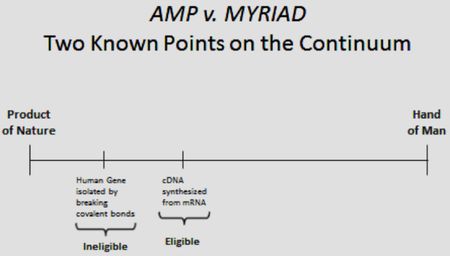
    FIG1
    According
    to Myriad, the Court's decision in the Myriad
    case was narrow: "We merely hold that genes and the
    information they encode are not patent eligible under §101 simply because
    they have been isolated form the surrounding genetic material." Id.
    at 2120 (emphasis added).  Myriad
    reiterates arguments it raised before the Court in the Myriad case, that the probes and primers are "distinct"
    from naturally occurring DNA and possess a novel utility resulting from human
    manipulation.  Myriad disputes defendants'
    argument that the Court categorically prohibited patenting oligonucleotides as
    an overbroad misreading of the Myriad
    decision.  According to Myriad, the Court
    set up a dichotomy between DNA that was "merely" isolated from the
    chromosome and DNA that was "synthetically created."  Myriad relies upon the Court's determination
    that claims 1 and 5 (encompassing genomic DNA encoding the BCRA 1 gene and
    oligonucleotide fragments thereof, respectively) of U.S. Patent No. 5,747,282
    were patent-ineligible, while claims 2 and 6 (encompassing cDNA encoding the
    BCRA 1 gene and oligonucleotide fragments thereof, respectively) were patent
    eligible.  Myriad contends that it was
    thus "not the nature of the nucleotide sequence that determines whether a
    particular DNA molecule is patentable, but rather the extent to which the
    molecule constitutes a 'naturally occurring' compound versus one created in a
    laboratory" because "in framing the issue, the Court expressly noted
    that cDNA shares the 'same protein-coding information' with a segment of
    natural DNA from the same gene. Id. at 2111."  The crux of this portion of Myriad's argument
    can be found in this quotation from the Supreme Court's Myriad decision:

    Scientists can . . . extract DNA from cells using well known
    laboratory methods. These methods allow scientists to isolate specific
    segments of DNA—for instance, a particular gene or part of a gene—which can
    then be further studied, manipulated, or used. It is also possible to create
    DNA synthetically through processes similarly well known
    in the field of genetics. One such method begins with an mRNA molecule and uses
    the natural bonding properties of nucleotides to create a new, synthetic
    DNA molecule
    . . . . This synthetic DNA created in the laboratory from
    mRNA is known as complementary DNA (cDNA).  Id. at 2112.

    Myriad
    expands on this interpretation of the Court's Myriad decision, stating that the Court "recognized that, in
    contrast to naturally occurring DNA that may be 'extracted from cells using
    well known laboratory methods,' '[i]t is also possible to create DNA
    synthetically through processes similarly well known in the field
    of genetics," going on to discuss only one such method, i.e., cDNA synthesis.  However, Myriad argues that "the Court
    expressly recognized that there are several ways of creating synthetic DNA of
    which the creation of cDNA was only " a particular one, concluding that "[t]he
    Court thus at least implicitly ruled that other forms of synthetic DNA are also
    patentable."  This interpretation is
    also consistent with dicta in the opinion relating to an "application of
    knowledge of the BRCA sequence[s]," recited with apparent approval in
    Section III of the Myriad
    opinion.  Myriad also argues that what
    are claimed here are pairs of oligonucleotide primers, which are "specially
    designed and made by the hand of man in a laboratory" as well as being "markedly
    distinct both in form and function from naturally occurring DNA."  Because "even a single primer molecule
    would qualify as patent eligible under AMP" "[a] fortiori, a
    functionally-coordinated pair of single-stranded DNA primers
    capable of synthesizing a new DNA molecule having a sequence in common with a
    specific portion of the sequence of BRCA1 or BRCA2 genes manifestly does not
    occur in nature
    and is patent eligible" (emphasis in the brief).   Myriad extends this distinction between
    naturally occurring DNA extracted from a cell and synthetic primers and probes
    with the following argument:

    Some of Myriad's claims in AMP were held invalid because some of the
    compositions encompassed by those claims originated in the human body,
    and the sole basis for claiming them was merely separating them from their
    natural origins by breaking of covalent bonds. cDNA and primers are
    fundamentally different because they originate not in the human body, but in a
    laboratory. In fact, primers originate in the head of the scientist designing
    them. To be sure, the scientist utilizes his knowledge of the genetic
    sequences, chemistry, and the complementarity of DNA bases in designing a
    particular pair of primers, just as any inventor makes use of natural laws and
    natural building blocks in creating any invention. For example, a researcher
    creating a new pharmaceutical molecule will design it to be complementary to
    bind to a receptor within the body based on natural laws and building blocks.
    But when a scientist designs a pair of primers and imbues them with the
    coordinated chemical properties needed to carry out a specific chemical
    reaction, the scientist performs the hallmark of "invention" in that
    he literally conceives of brand new molecules. Their genesis is not in
    extracting a pre-existing natural molecule from its surroundings, but instead
    in reducing this conceived idea to practice by building ("synthesizing")
    a completely new molecule where none existed before.

    Myriad
    disparages defendants' characterization of the Court's Myriad opinion as being contrary to the analytical framework set
    forth in the Myriad opinion as well
    as imposing a "broad and sweeping effect" that the Court expressly
    stated it "refrained from making such [a] far-reaching holding[]."  Myriad takes advantage of defendants'
    assertions that "the information (sequence) in DNA was the key" to
    the Court's decision by making the counter-argument that the actual distinction
    was between naturally occurring and synthetic 
    DNA, relying on the Court's recognition that while the relevant sequence
    information between genomic and cDNA was the same, nevertheless cDNA was
    patent-eligible because it was synthesized by a scientist in a laboratory.

    The
    Myriad decision did not mandate that genetic diagnostic testing was
    patent-ineligible according to Myriad, citing those portions of the opinion
    stating that "[a]s the first party with knowledge of the [BRCA1 and BRCA2]
    sequences, Myriad was in an excellent position to claim applications of that
    knowledge", and that "[m]any of its unchallenged claims are limited
    to such applications." Id.  And
    Myriad contends that its asserted method claims satisfy the patent eligibility
    rubrics set down in Mayo Collaborative Services v. Prometheus Laboratories,
    Inc.
    , 132 S.Ct 1289 (2012), specifically that the claims recite more than "abstract
    mental steps" or "routine or conventional steps," and that by
    reciting steps using patentable synthetic DNA primers the claims fall outside
    the scope of the Mayo decision.  It is the specific application of the
    knowledge of the BRCA gene sequences that provide the lynchpin for this portion
    of Myriad's argument, which is that their method claims are "directed to
    specific laboratory processes that utilize knowledge of the BRCA1 and BRCA2
    genes to develop previously unknown techniques."  It is this specific application of the
    specific knowledge of the BRCA genes that Myriad contends brings their claims
    outside the ambit of the patent ineligibility rationale set out in the Court's Mayo decision, as well as the use of a
    primer pair Myriad contends is itself patent-eligible for the reasons discussed
    above.  Its methods cannot be considered "routine
    and well understood," according to Myriad because, in contrast to
    Prometheus's claims here Myriad "discovered a brand new biomarker (the
    BRCA1 and BRCA2 genes) in a new indication (hereditary breast and ovarian
    cancer)" and "was also the first to apply its discovery to design
    specific applications of generalized techniques such as PCR and DNA sequencing [as
    well as BCRA gene-specific hybridization] to develop new assays for this new biomarker."  As a consequence, Myriad argues, "[t]his
    case presents opposite facts and compels the opposite conclusion," the
    critical distinction being the absence of the knowledge of the BRCA genes in
    the prior art making any assay
    involving these genes not "routine
    conventional and well-understood" regardless of how conventional the
    underlying processes may have been (and in a separate portion of the brief,
    Myriad includes the use of the probes and primers as further rendering the
    asserted method claims to be new and not routine).

    Myriad
    also argued that it was likely to be able to prove infringement.  According to its Reply brief, defendants'
    argument fail because they are based on erroneous claim construction, fail to
    address Myriad's infringement arguments, are not "well founded" or "lack
    merit."   Regarding the claim construction allegations,
    Myriad's arguments are based on defendants' position that including "adaptor,"
    "bar code" or "tag" sequences in their primers place these
    primers outside the scope of Myriad's claims because the primers are this not "wholly
    derived" from the native BRCA genes.  
    Myriad argues that this construction of the term "derived from"
    (to require "wholly" derived from) is contrary to the plain meaning
    of the term as well as how the phrase "derived from" is used in the
    specification (which, according to Myriad, include embodiments wherein the
    primers comprise adaptor, bar code and tag sequences).   And Myriad illustrates the deficiencies of
    defendants' arguments that its amplicons contain intro-derived (and this
    non-cDNA based) sequence, using an illustration from Ambry's own declarant
    showing that some of the amplicons are completely comprised of exonic (i.e.,
    cDNA) sequences:
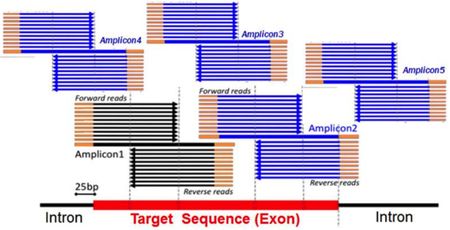
    FIG2
    Turning
    to defendants' invalidity arguments based on the prior art, Myriad argues that
    Ambry and Gene-by-Gene have not "raised a substantial question of
    invalidity" (the preliminary injunction-defeating standard) with regard to
    either anticipation (over the Schutte reference) or obviousness.  According to Myriad, the Schutte reference
    isn't prior art (being published after Myriad's priority date), nor does it
    disclose primers capable of amplifying BRCA genomic DNA.   Moreover, the other cited prior art does not
    disclose "a pair of single stranded DNA primers" specific for the
    human BRCA genes when disclosing double-stranded DNA fragments encompassing
    such primer sequences, and the experimental efforts disclosed in these
    references did not amount to prior invention under §102(g).   Myriad asserts that it had conceived of the invention(s)
    recited in their asserted claims prior to the earliest dates defendants assert
    and thus that the claims are not anticipated. 
    And regarding the BRCA2 primer claims, Myriad argues that defendants
    read out of the claims the limitation that these primers are used to amplify
    BRCA2-specific DNA, something not disclosed in the cited reference.

    Nor
    does the cited art render the asserted claims obvious according to Myriad's
    arguments.  The reason:  discovery of the BRCA genes was not obvious, inter alia, because there were not a "finite
    number of predictable solutions" leading to the elucidation of the BCRA
    genes, nor was there any reasonable expectation of success that the BCRA genes
    would be isolated and identified.  Myriad
    concedes that "[a]t the time of the invention, those of skill in the art
    had determined that the human BRCA1 gene was likely responsible for a large
    proportion of familial breast and ovarian cancer cases" and that "[i]t
    was also understood that the BRCA1 gene was linked to chromosome 17q21."  However Myriad contends that the absence of
    any knowledge of the "biochemical effects underlying inherited human
    breast cancer" precluded knowledge of the protein product of the cognate
    gene and necessitated "positional cloning" efforts for the BRCA1 gene's
    isolation.   This uncertainty was
    reinforced by contemporaneous reports that the BRCA1 gene could be found in
    genomic DNA regions from 4-18 million basepairs in length.  This confusion is illustrated by the
    following graphic in the brief showing where the BCRA1 gene might have been located in view of what
    was known in the art at the time Myriad successfully cloned the gene:
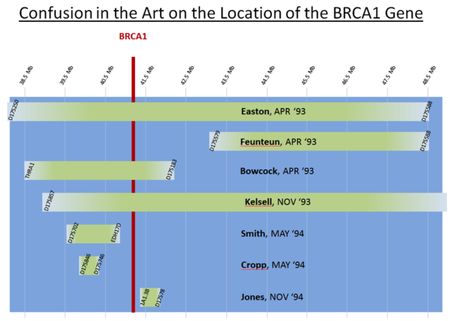
    FIG3Defendants
    error, according to Myriad, is that they:

    [I]ncorrectly assert that a person of ordinary skill in the art would immediately
    be drawn to the ranges identified by the Bowcock and Kelsell articles instead
    of the ranges identified by the other references, several of which post-date
    Bowcock and Kelsell. In selecting a region to search for the BRCA1 gene, the
    ordinarily skilled artisan could have selected any of the above regions, most
    of which we now know would have led (and for many did lead) to a dead end in
    that search.  In ignoring these
    references, Defendants focus on the region where the BRCA1 gene was ultimately
    discovered (even though many skilled artisans at the time did not) for no
    apparent reason other than they now know (because of Myriad's discovery) that
    the BRCA1 gene is located in that region. The Federal Circuit has routinely
    warned against such an approach. See Mintz v. Dietz & Watson, Inc.,
    679 F.3d 1372, 1379 (Fed. Cir. 2012) [and] Otsuka Pharm. Co. v. Sandoz, Inc.,
    678 F.3d 1280, 1296 (Fed. Cir. 2012) (citations to the record omitted)

    In
    other words, hindsight reconstruction according to Myriad. And there were other
    candidate genes that others in the field had already incorrectly identified as
    the responsible locus, thus further reinforcing the non-obviousness of Myriad's
    method claims.  The brief then sets out
    the difficulties actually experienced by the Myriad inventors, and others, to
    support its conclusion that "Defendants' claim that 'by the start of 1994,
    it was clear to the field what steps and techniques would be employed in order
    to discover the location and sequence of the BRCA1 gene' is meritless."

    In
    addition, and particularly with regard to the BRCA2 gene Myriad argues that the
    inventors followed "an unconventional path" to identify the gene, and
    in fact argued that one of the cited references, the Wooster (1995) reference, "shows
    exactly why the discovery of the BRCA 2 gene was not obvious," i.e. the
    purported BRCA2 gene contained a large sequence of unrelated DNA at the
    position encoding the purported carboxyl terminus of the gene.  Finally, Myriad asserts that the objective
    indicia support its argument that defendants have not shown obviousness by
    clear and convincing evidence, including evidence of "i) whether there was
    a long-felt need for the claimed invention, (ii) failure of others to achieve
    the invention, (iii) industry praise and respect for the claimed invention;
    (iv) unexpected results from the claimed invention, (v) skepticism of others;
    and (vi) the commercial success of the claimed invention."

    More
    briefly Myriad addresses defendants' arguments regarding written description
    and indefiniteness, particularly with regard to whether the terms "BRCA1
    gene" and "BRCA2 gene" include cDNA embodiments thereof.

    As
    for the other requirements for granting a preliminary injunction, Myriad
    asserts irreparable harm from price erosion that cannot be "readily
    compensated," as well as damage of reputational harm.  Comparing the damage to Myriad with the loss
    of the "headstart" advantage defendants argued they would suffer
    balances in favor of Myriad (according to Myriad) and the public interest is
    satisfied by Myriad's satisfaction of the market for hereditary predisposition
    testing for BRCA gene–related diagnostic testing.  Myriad contests the defendants' allegations
    that their testing is inadequate, that Myriad does not afford "superior
    access and affordability," facts Myriad states defendants "cannot
    dispute," and that the policy-based allegations regarding the public
    interest are irrelevant and "ignore Myriad's extensive contributions to
    the market."

    The
    brief also includes a recitation of facts Myriad disputes, including defendants'
    allegations that the primer and probe sequences are equivalent to the sequence
    information they encode (where Myriad reminds the court that DNA is not
    information like computer storage media), and that the claimed primers were
    indistinguishable from DNA as it exists in the chromosomes (Myriad asserting
    that "a segment of synthetically made DNA creates a different chemical
    compound than exists in the "natural" DNA in the human chromosomes
    because they both consist of a different overall collection of molecules.
    Different collections of molecules create different chemical compounds with
    different properties; all these factual assertions rely upon expert
    declarations).  Myriad also contests
    defendants' arguments contained in their factual allegations that PCR, DNA
    sequencing and DNA hybridization are "routine and conventional,"
    asserting in response that while these techniques had been applied to "certain"
    genes prior to August 14 1994 (Myriad's earliest priority date), their
    application to the human BRCA genes was neither well-known nor even
    possible.

    The
    Myriad case is not over, no matter how the district court rules, and it can be
    expected that the complete contours of the determination about
    patent-eligibility and patentability of genetic diagnostic testing will
    continue for the foreseeable future.

  • By Donald Zuhn

    23andMeA patent issued to 23andMe,
    Inc. last month has created some controversy, and in response, the biotech
    company, based in Mountain View, California, has posted its side of the story
    on the 23andMe blog.  The patent, U.S.
    Patent No. 8,543,339,
    which is entitled "Gamete donor selection based on genetic calculations,"
    is directed to a system for identifying a preferred gamete donor from among the
    plurality of donors based on a phenotype of interest, the genotype of a
    recipient, and the genotypes of the donors. 
    The patent contains three independent claims, which recite a system, method,
    and non-transitory computer program product for gamete donor selection:

    1.  A system for gamete donor selection
    comprising:
    one or more processors
    configured to:
        receive a specification
    including a phenotype of interest that can be present in a hypothetical
    offspring;
        receive a genotype of a
    recipient and a plurality of genotypes of a respective plurality of donors;
    determine statistical
    information including probabilities of observing the phenotype of interest
    resulting from different combinations of the genotype of the recipient and
    genotypes of the plurality of donors; and
        identify a preferred donor
    among the plurality of donors, based at least in part on an evaluation of the
    statistical information determined, including:
            to compare the
    probabilities of observing the phenotype of interest resulting from different
    combinations of the genotype of the recipient and the genotypes of the
    plurality of donors to identify the preferred donor; and
    a memory coupled to the
    processor, configured to provide the processor with instructions.

    11.  A method for gamete donor selection, comprising:
        receiving a specification
    including a phenotype of interest that can be present in a hypothetical
    offspring;
        receiving a genotype of a
    recipient and a plurality of genotypes of a respective plurality of donors;
        using one or more computer
    processors coupled to one or more memories configured to provide the one or
    more computer processors with instructions to determine statistical information
    including probabilities of observing the phenotype of interest resulting from
    different combinations of the genotype of the recipient and genotypes of the
    plurality of donors; and
    identifying a preferred
    donor among the plurality of donors, based at least in part on the statistical
    information determined, including:
            comparing the probabilities
    of observing the phenotype of interest resulting from different combinations of
    the genotype of the recipient and the genotypes of the plurality of donors to
    identify the preferred donor.

    21.  A non-transitory computer program product for
    gamete donor selection, the computer program product being embodied in a
    computer readable storage medium and comprising computer instructions for:
        receiving a specification
    including a phenotype of interest that can be present in a hypothetical
    offspring;
        receiving a genotype of a
    recipient and a plurality of genotypes of a respective plurality of donors;
        determining statistical
    information including probabilities of observing the phenotype of interest
    resulting from different combinations of the genotype of the recipient and
    genotypes of the plurality of donors; and
        identifying a preferred
    donor among the plurality of donors, based at least in part on an evaluation of
    the statistical information determined, including:
            comparing the probabilities
    of observing the phenotype of interest resulting from different combinations of
    the genotype of the recipient and the genotypes of the plurality of donors to
    identify the preferred donor.

    The detailed description of
    the '339 patent states that:

    The gamete donors
    and gamete recipient's genetic information such as genome sequences and/or
    marker information is obtained and stored. 
    In some embodiments, the recipient is allowed to make a specification of
    one or more phenotypes of interest in the hypothetical offspring.  Statistical information pertaining to the
    likelihood of observing phenotypes of interest are determined, based on the
    genotype of the recipient and the genotypes of different donors.  For example, probabilities of the phenotypes
    of interest in the hypothetical offspring resulting from different recipient-donor
    combinations are computed.  Based on the
    statistical information, one or more preferred donors are identified and
    optionally selected by the recipient.

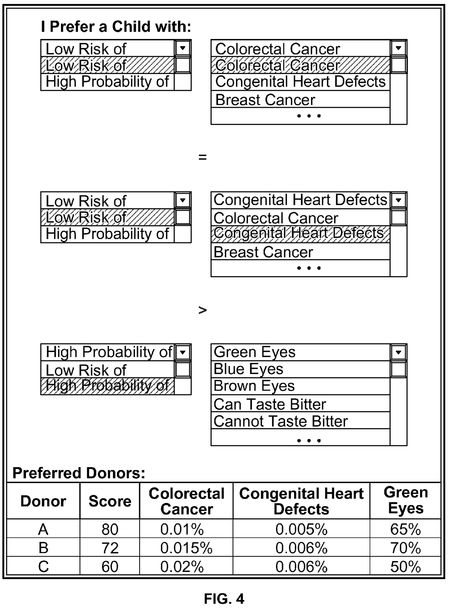
    According to the '339
    patent, one embodiment of the invention is disclosed in Figure 4 (below), which
    shows "a user interface for making [a] user specification and displaying
    the results," in which "the recipient has specified that she prefers
    low risk of colorectal cancer and congenital heart defects equally, and to a
    lesser degree she also prefers green eye color."  The '339 patent discloses that based on the
    user specification, a donor selection process is performed, and "the
    results page shows preferred donors A, B, and C, [wherein] the statistical
    distributions of the desired genotypes of the hypothetical child resulting from
    the combinations of the recipient and the donor, as well as an optional score calculated
    based on the statistical distribution are displayed."

    FIG4
    In the wake of the '339
    patent's issuance, 23andMe has been criticized for its efforts to secure patent
    protection on a method of creating "designer babies."  A commentary regarding the
    "controversial patent" appeared in the journal Genetics in Medicine last week (Sterckx et al., "I prefer a child with . . .": designer babies,
    another controversial patent in the arena of direct-to-consumer genomics
    ,"
    Genetics in Medicine (October 3,
    2013)).

    Possibly anticipating a
    backlash (the Genetics in Medicine
    commentary was submitted for publication two weeks before the '339 patent
    issued), 23andMe posted an article on its blog one week after the patent issued.  The article, entitled "A 23andMe Patent," notes that the company had
    "applied [for the patent] more than five years ago," and that the
    patent relates to one of the tools 23andMe offers to individuals "as part
    of their genetic exploration."  The
    article points out that:

    The tool — Family Traits Inheritance
    Calculator — offers an engaging way for you and your partner to see what kind
    of traits your child might inherit from you. 
    The Family Trait Inheritance Calculator has also been part of our
    service since 2009 and is used by our customers as a fun way to look at such
    things as what eye color their child might have or if their child will be able
    to perceive bitter taste or be lactose intolerant.

    The article indicates that
    "[w]hen 23andMe applied for the patent (#8543339) it was meant to cover
    the technology that supports our Family Traits Inheritance Calculator,"
    but acknowledges that "the language of the patent extends beyond the
    calculator and so we want to be very clear about our technology and our
    intentions."  In particular, the article explains
    that:

    At the time 23andMe filed the ['339] patent,
    there was consideration that the technology could have potential applications
    for fertility clinics so language specific to the fertility treatment process
    was included in the patent.  But much has
    evolved in that time, including 23andMe’s strategic focus.  The company never pursued the concepts
    discussed in the patent beyond our Family Traits Inheritance Calculator, nor do
    we have any plans to do so.

    The Genetics in Medicine commentary will be discussed in a subsequent
    post.

  • By Edward
    Reines —


    Reines, EdwardEdward
    Reines (at right), a partner at Weil, Gotshal & Manges, frequently argues before the
    Federal Circuit and is chair of the court's Advisory Council.  Prepared remarks
    for Judge Wood's Sept. 26 talk at the Illinois Institute of Technology
    Chicago-Kent College of Law can be downloaded here.

    The
    Chief Judge of the U.S. Court of Appeals for the Seventh Circuit, Diane
    Wood, recently
    delivered a speech provocatively titled "Is It Time to
    Abolish the Federal Circuit's Exclusive Jurisdiction in Patent Cases?"  While it is trendy to criticize the patent system, Judge Wood's prominence and
    her colorful critique have raised eyebrows.  Frequently mentioned as a potential
    Supreme Court nominee, Judge Wood's far-reaching proposal deserves close consideration — and honest rebuttal.

    The
    judge's focus on the Federal Circuit is understandable.  Although historically
    patent law was considered an esoteric backwater, it is now recognized as a
    dynamic legal field involving fascinating subjects and great financial stakes.  Our world is filled with amazing new inventions that improve the way we work,
    how we are entertained, and our healthcare.  Patent appeals now attract the
    finest advocates and garner national media attention.  In many ways, the Federal
    Circuit's patent docket has become the envy of the system.

    Judge
    Wood did not mince words in advancing her proposal to redistribute patent
    appeals back to the regional circuits.  In her live remarks, she critiqued the
    Federal Circuit for a lack of "intellectual ferment," highlighted the
    frequency of Supreme Court review, and described the court as too
    "specialist."  She proposed a dual jurisdiction system, allowing
    appellants to elect between the Federal Circuit and the regional circuits, with
    the Judicial Panel on Multidistrict Litigation resolving conflicts by lottery.

    The
    meteoric rise of technology, to be sure, has tested the patent system.  The
    Patent Office's inability to cope with the deluge of applications is well
    documented.  Patent assertion abuses, especially by so-called trolls, plague the
    system.  But are Judge Wood's criticisms of the Federal Circuit itself valid?

    Judge
    Wood suggests that having eleven regional circuits join the Federal Circuit in
    addressing patent law would add intellectual heft and avoid group think.  She
    theorizes that the Federal Circuit's culture of consistency stifles the freedom
    the regional circuits would have to make "big mistakes" that might
    advance patent law.

    The
    Federal Circuit was created in 1982, after studies showed that the regional
    circuits' handling of patent appeals was dysfunctional.  Renowned Second Circuit
    Judge Henry Friendly criticized the "mad and undignified" race to the
    courthouse stemming from regional circuit management of patent appeals.  A study
    cited by Judge Wood reported that patents in the Eight Circuit suffered an 88.8
    percent invalidity rate — meaning virtually all patents were ruled invalid.  It
    is doubtful that a return to such a free-for-all would raise the quality of
    discourse.

    In
    contrast to Judge Wood's concerns about Federal Circuit unanimity, the bar of
    the court often complains that each judge holds independent views, creating too
    much panel-to-panel variability.  If those from afar consider a court's
    jurisprudence too uniform, and those up-close consider it too diverse, the
    likelihood is that the court has struck about the right balance.

    Judge
    Wood's critique of the Federal Circuit based on the rate of Supreme Court
    review is in tension with her suggestion that it deserves a worthy counter-weight.  On the big issues, such as whether genetic tests may be patented, the Supreme
    Court has not been shy about its role.  And although the Supreme Court has
    historically heard as many as 20 Federal Circuit cases per term, more recently
    it has only decided a handful per term.  It is capable of addressing any perceived
    Federal Circuit bias.

    The
    portrayal of the Federal Circuit as too "specialist" overlooks the
    varied docket of the court, which includes veterans' appeals and trade
    disputes.  It also underrates the rich diversity and high caliber of the judges
    on the court.  This includes generalists with backgrounds as respected Supreme
    Court advocates and high-performing federal trial judges.  Of President Obama's
    six Federal Circuit appointees, only one is a patent expert, former Patent
    Office star Ray Chen, who would elevate the performance of any circuit.

    Judge
    Wood's proposal to reintroduce the regional circuits to patent appeals is,
    respectfully, impractical.  It would give litigants an incentive to race to
    appeal to obtain their preferred circuit law.  Trial courts would not know if
    they were governed by Federal Circuit or regional circuit patent law when they
    made decisions.  Simply put, adding the option of regional circuits to the
    Federal Circuit would worsen the unacceptable pre-1982 forum
    shopping.

    Finally,
    the idea of using the MDL panel to select the appeal court by lottery is
    dubious.  Judge Wood cites existing uses of this scheme.  But it has only been
    sparsely used in niche areas.  One real-world example provides a cautionary
    tale:  In an attempt at forum shopping, appeals were filed in 11 different
    regional circuits including the D.C. Circuit.  The MDL panel selected the Eighth
    Circuit by lottery.  The Eighth Circuit then transferred the appeal back to the
    D.C. Circuit.  Given the fast pace of patent litigation, such appellate roulette
    would be intolerable.

    In
    the end, calls to return patent appeals to the regional circuits cannot survive
    study of the pre-Federal Circuit mess.  A hybrid system with the Federal Circuit
    and the regional circuits competing for jurisdiction, while imaginative, would
    be a big mistake.  The Federal Circuit has presided over a technology boom like
    no other.  We know from hard-worn
    experience that the grass is not greener on the other side.

    The
    above article was originally published on October 7, 2013 in The Litigation Daily, and is being reprinted here with the author's permission.

  • IPO #2The
    Intellectual Property Owners Association (IPO) will offer a one-hour webinar on
    "Written
    Description of Biotech Inventions: Insight from the USPTO" on October
    10, 2013 beginning at 2:00 pm (ET).  Daniel
    Kolker, Supervisory Patent Examiner for Art Unit 1644 at the U.S. Patent and
    Trademark Office, will discuss how the agency's Written Description Training
    Materials, last revised in 2008, mesh with recent court decisions.  The panel, which also includes David Halstead
    of Ropes & Gray LLP and Deborah
    Martin of Pfizer, Inc., will consider
    how innovators can both protect their inventions and be sure of their freedom
    to operate, as well as discuss claims on an antibody which "binds to an
    antigen at residues X, Y, and Z of the antigen," and whether these claims are
    patentable even though they provide no structural information about the claimed
    antibodies.  The panel will also address
    the type of disclosure needed to support patentability and broad scope, and how
    recent case law should inform innovators' filing strategies throughout drug
    discovery and development.

    The
    registration fee for the webinar is $120 (government and academic rates are
    available upon request).  Those
    interested in registering for the webinar can do so here.