• CalendarNovember 4-5, 2013 – FDA Boot Camp Devices Edition*** (American Conference
    Institute) – Chicago, IL

    November 4-5, 2013 – Trade Secrets: Protecting Your Intellectual Capital and Confidential
    Business Information
    *** (American Conference
    Institute) – Chicago, IL

    November 6-8, 2013 – 2013 Fall Intellectual Property
    Counsels Committee (IPCC) Conference
    (Biotechnology
    Industry Organization) – Washington, DC

    November 7, 2013 – On Sale and Public Use Bars to Patentability
    After AIA — Minimizing the Risk of Patent Ineligibility or Invalidation
    (Strafford) – 1:00 to 2:30 pm (EST)

    November 8, 2013 – 5th
    Annual RIPL Symposium
    (John Marshall
    Law School Review of Intellectual Property Law (RIPL)) – Chicago, IL

    November 8, 2013 – IP Law
    Symposium
    (Intellectual
    Property Law Association of Chicago) – Chicago, IL

    November 13,
    2013 – "How University TTOs
    Can Slash Patent Expenses While Improving Patent Quality
    " (Technology
    Transfer Tactics) – 1:00 to 2:00 pm (Eastern)

    November 13, 2013 – Unitary Patent (UP)
    and Unified Patent Court (UPC)
    (D
    Young & Co) – 4:00 am, 7:00 am, 12:00 pm (EST)

    November 14, 2013 – Obviousness Standard After the AIA:
    Leveraging Latest PTO and Court Guidance — Overcoming Challenges of
    Obviousness and Attacks on Patent Validity
    (Strafford) – 1:00 to 2:30 pm (EST)

    November
    14, 2013 – "The
    Nuts & Bolts of Patents and the Drug Approval Process
    " (American Bar
    Association Section of Intellectual Property Law, Young Lawyers Action
    Division, Young Lawyers Division, and Center for Professional Development) – 1:00 to 2:30 pm (Eastern)

    November 17-20, 2013 – Creating and Leveraging Intellectual Property in Developing Countries: A Power Tool for Social and
    Economic Growth
    *** (Companies and IP Commission and National
    IP Management Office of South Africa) – Durban, South Africa

    November
    19, 2013 – PTAB or the District Court: Which
    Is the Better Option When Challenging Patent Validity?
    (McDonnell
    Boehnen Hulbert & Berghoff LLP) – 10:00 to 11:15 am (CT)

    November
    19, 2013 – Patenting Biotech Inventions (California
    Healthcare Institute (CHI) and D Young & Co) – San Diego, CA

    November 20, 2013 – Patenting Biotech Inventions (California
    Healthcare Institute (CHI) and D Young & Co) – San Francisco, CA

    December 3, 2013 – "Post-AIA Preissuance Prior Art Submissions at
    the USPTO — Best Practices for Third-Party Challenges to Patent Applications
    and for Monitoring Competition
    " (Strafford) – 1:00 to
    2:30 pm (EST)

    December 4, 2013 – Congress on Biotech & Pharma Patenting*** (C5 (UK)) – London, UK

    December 5, 2013 – Forum on Biosimilars*** (C5 (UK)) – London, UK

    December 9-10, 2013 – Patent Infringement Litigation Summit (Legal iQ (IQPC)) – San Francisco, CA

    December 10-11, 2013 – Advanced
    Forum on Patent Litigation
    *** (American Conference
    Institute) – New York, NY

    ***Patent Docs is a media partner of this conference or CLE

  • ABAThe American Bar
    Association (ABA) Section of Intellectual Property Law, Young Lawyers Action
    Division, Young Lawyers Division, and Center for Professional Development will
    be offering a live webinar on "The
    Nuts & Bolts of Patents and the Drug Approval Process" on November
    14, 2013 from 1:00 to 2:30 pm (Eastern). 
    Dr. Keisha Hylton-Rodic of the Nevrivy Patent Law Group will
    moderate a panel consisting of Ali. I.
    Ahmed, Chief Intellectual Property Counsel, Fresenius Kabi USA, LLC; James
    N. Czaban of Wiley Rein LLP;
    and Len Smith, Vice President,
    Intellectual Property Counsel, Medicis.  The panel will examine the basics of the
    Hatch-Waxman drug approval process, and discuss what IP attorneys need to know
    in order to work effectively with regulatory counsel and to navigate the
    approval process.  The panel will also
    examine what is involved in filing a new drug application (NDA), ANDA,
    505(b)(2) application, and BLA.

    The registration fee for
    the webcast is $95 for members of any of the sections sponsoring the webinar,
    $99 for government attorneys, $150 for ABA members, and $195 for the general
    public.  Those interested in registering
    for the webinar, can do so here
    or by calling 800-285-2221.

  • Strafford #1Strafford
    will be offering a webinar/teleconference entitled "Post-AIA Preissuance Prior Art Submissions at
    the USPTO — Best Practices for Third-Party Challenges to Patent Applications
    and for Monitoring Competition" on December 3, 2013 from 1:00 to
    2:30 pm (EST).  Clifton E. McCann and Steve Elleman of Thompson Hine will provide
    guidance to patent counsel on the preissuance submission rules, and offer best
    practices for monitoring competitors and making decisions regarding whether and
    how to file a preissuance submission on a competitor's or potential
    competitor's patent application.  The
    webinar will review the following questions:

    • How do the revised USPTO rules change the
    landscape for third-party intervenors?
    • What are the key considerations for patent counsel
    when deciding whether to make preissuance submissions?
    • What are the benefits and limitations of
    submitting prior art or other information on a pending patent application?

    The
    registration fee for the webinar is $297 ($362 for registration and CLE processing).  Those registering by November 8, 2013 will
    receive a $50 discount.  Those interested
    in registering for the webinar, can do so here.

  • D Young & CoD
    Young & Co will be offering a webinar on the proposed unitary patent (UP)
    and Unified Patent Court (UPC) on November 13, 2013.  The webinar will be offered at three times:
    4:00 am, 7:00 am, 12:00 pm (EST).  D
    Young & Co attorneys Richard Willoughby and Doug Ealey will discuss the
    latest UP and UPC developments and the steps attendees need to take in
    preparation for this new regime and what filing strategies attendees should
    have in place.

    While
    there is no charge to attend the webinar, attendees must register in
    advance.  Those wishing to register can
    do so here.

  • By
    Kevin E. Noonan

    Supreme Court Building #2Some
    of our commenters have asked (with greater or lesser degrees of stridency) that
    we "take a position" on claims like the Myriad method claims at issue
    in the lawsuits brought against Ambry Genetics, Gene-by-Gene, and Quest (and purportedly
    threatened against others).  We have
    declined the opportunity to do so in deference to a determination by the Utah District Court (or the California District Courts where Quest and Counsyl
    Genetics have filed declaratory judgment actions).  This decision is not because we don't have an
    opinion (to think otherwise would evince that the commenter has not been paying
    attention to our posts), but because it is ultimately a futile exercise.  And the reason for that conclusion rests
    solely on the Supreme Court's Mayo v.
    Prometheus
    decision.  As we've said
    before, this is the Potter Stewart/pornography view of patent eligibility, where
    the Court thinks it knows it when it sees it.  The very subjectivity of the standard condemns it.

    A
    discussion of whether a particular claim satisfies the Court's patent
    eligibility "test" quickly devolves into whether a party (or judge)
    believes that there is "enough" inventive in the claim to recite more
    than a law of nature and the instruction to "apply it," in the words
    of the Mayo opinion.  And this analysis is particularly difficult
    when the Court says elsewhere that "applications"
    of natural laws can recite patent-eligible subject matter.  The question becomes where to draw that
    metaphysical or semantic line distinguishing what is an application and what is
    an instruction to apply the natural law.  The Court's preemption "standard" is also unavailing, for the
    same reason:  all claims preempt (the
    ability of a third party to practice the claims) but when do we decide how much
    preemption is too much?  The Court doesn't
    say.

    Among
    the many doctrinal errors in the Mayo
    opinion, ignoring the rubric that claims must be assessed as a whole causes a
    particular kind of mischief.  Taken to
    its extreme, the principles espoused in Mayo
    would render a bicycle patent-ineligible, on the following analysis.  A bicycle is merely a collection of
    previously known "simple" machines (wheels, levers, gears, pulleys)
    that are put together in a routine and conventional way to preempt the use of
    human muscle motion to take advantage of natural laws of motion.  A similar analysis can be applied to almost
    anything.

    This
    analysis is not limited to mechanical devices, of course; what of a previously
    known compound that is formulated by routine and conventional methods to
    produce a pharmaceutical composition that treats a disease (where the use to
    treat the disease was unknown in the prior art)?  After all, the therapeutic effectiveness of
    the pharmaceutical composition is dependent merely on the natural law that this
    particular drug treats this specific disease, and claims to methods for
    treating the disease thus merely embody the recognition of the natural law and
    an instruction (and means) to apply it.  An example is U.S. Patent No. 4,724,232:

    1.  A method of treating a human having acquired immunodeficiency syndrome
    comprising the oral administration of an effective acquired immunodeficiency
    syndrome treatment amount of 3'-azido-3'-deoxythymidine to said human.

    Of
    course, if Justice Breyer's view of patent-eligibility was the law in the 1980's
    there would have been little chance for azidothyidine (AZT), for many years the
    only treatment for Acquired Immunodeficiency Syndrome, to have been
    commercially available.  After all, it is
    patently unlikely that Burroughs Wellcome would have incurred the costs of
    developing and obtaining regulatory approval of the drug without the very
    patent exclusivity the Court would deny Myriad.

    The
    objection may be made that even the Court recognizes therapeutic methods are different.  However anyone taking that position needs to recall that the claimed Prometheus
    test was not a diagnostic test but rather a test to determine the dosage of
    6-thioguanine that would have an optimal therapeutic
    effect.  So not only diagnostic methods like Myriad's, but
    methods like companion diagnostics methods having the potential to reduce the
    risk of adverse side effects from drug administration, can be readily categorized
    as "merely" reciting a law of nature and thus being patent ineligible.

    These
    are just two of the many illustrations of the mischief the Mayo decision can and has occasioned.  (It is the rare applicant that has not
    encountered a rejection under § 101 based on the Mayo
    opinion, and district courts in addition to those in the Myriad cases are grappling with these issues, often on summary
    judgment.)  One of the many consequences
    of the Mayo decision, trivial for the
    discussion of our "position" but important for continued innovation
    in America, is that the Court has dismantled one of the outstanding
    achievements of thirty years of Federal Circuit jurisprudence (although the Federal Circuit has been doing some dismantling of its own lately):  providing sufficient
    stability and clarity to U.S. patent law that a businessperson could sit down
    with her patent lawyer and assess the metes and bounds of her patent claims and
    those of her competitors, to make rationale, legally sound business
    decisions.  That task has become much
    more daunting in an era where the only honest answer to a client's question of
    whether a claim is valid or an invention eligible for patenting will be "that
    depends on what court reviews the claims."  This is, paradoxically,
    precisely the situation that existed prior to the institution of the Federal
    Circuit, where the judicial differences were geographic rather than
    philosophical (and thus easier to reliably identify).

    So
    the answer to the question of where do we stand on Myriad's (or any other)
    diagnostic method claims is simple:  there is no way to know whether such claims
    are valid or not until sanity (meaning legal analysis that depends on patent
    law rather than subjective prejudice) returns to U.S. patent law.

  • By Donald Zuhn

    AARPLast week, in a letter sent
    to the U.S. Trade Representative, Ambassador Michael Froman, the AARP asked
    that the U.S. not sign onto the Trans-Pacific
    Partnership Agreement
    (TPP) if the trade agreement includes a 12-year data
    exclusivity period for biologics.  The
    TPP is a multilateral free trade agreement currently being negotiated by
    Australia, Brunei, Chile, Malaysia, New Zealand, Peru, Singapore, the United
    States, and Vietnam (Canada, Japan, the Philippines, South Korea, and Taiwan
    have also expressed interest in participating in the agreement).

    Indicating that it was the
    AARP's "understanding that market exclusivity is one of the outstanding issues
    negotiators are working to resolve with the goal of completing the trade
    agreement before the end of the year," the letter declares that the AARP "strongly believes the final
    trade agreement should not bind the U.S. to a 12-year market exclusivity period
    for brand-name biologic drugs
    " (emphasis in original).  The group notes that its support for a
    shorter exclusivity period is based on the high cost of biologic therapeutics,
    which "can put these treatments out of reach for those who need
    them most, even for those with comprehensive health insurance."  The letter points out that "[t]he daily
    costs associated with biologics are approximately 22 times higher than the
    daily costs associated with small-molecule drugs."

    Although the AARP notes
    that the Patient Protection and Affordable Care Act (ACA) recognized that
    "there was a need for less expensive follow-on biologics, or biosimilars,
    both to help ensure access to biologic drugs and to reduce the economic burden
    they impose," the group also acknowledges that the PPACA created a 12-year
    data exclusivity period for biologics. 
    However, the letter indicates that the Federal Trade Commission "concluded
    that no additional exclusivity beyond the term of the patent was necessary to
    maintain innovation and competition in the industry" (see "No One Seems Happy with Follow-on Biologics According to
    the FTC
    "),
    and that the Obama Administration proposed reducing the exclusivity period from
    12 years to 7 years in its most recent budget (see "Senators Back 12-Year Data Exclusivity Period for
    Biosimilars and President Obama (Once Again) Does Not
    ").  The AARP concludes the letter by expressing its
    strong support for the President's proposal, as well as the group's belief that
    "increasing the availability of biosimilars will be a critical element of
    any comprehensive effort to contain health care costs."

    For additional information
    regarding this and other related topics, please see:

    • "White Paper Asserts
    That Existing Trade Agreements Provide No Data Exclusivity for Biologics
    ,"
    August 26, 2013
    • "BIO
    Reiterates Support for 12-Year Data Exclusivity Period for Biologics
    ,"
    August 20, 2013
    • "Senators
    Back 12-Year Data Exclusivity Period for Biosimilars and President Obama (Once
    Again) Does Not
    ," May 9, 2013
    • "U.S.
    Negotiators on TPP — Don't Trade Away the Biopharmaceutical Research Sector
    ,"
    September 30, 2012
    • "Senators
    Support Inclusion of 12-Year Exclusivity Period in Free Trade Agreement
    ,"
    September 12, 2011
    • "House
    Legislators Lobby to Exclude 12-Year Data Exclusivity Period from Free Trade
    Agreement
    ," August 11, 2011

  • By Andrew Williams

    TrollJust
    in time for Halloween, Senator Orrin Hatch (R-Utah) has introduced yet another
    piece of legislation to combat the perceived "patent troll" problem.  The Patent Litigation Integrity Act (S. 1612)
    is aimed at shifting the reasonable fees and other expenses from the prevailing
    party in patent litigations to the non-prevailing party, absent "substantially
    justified" conduct, or other circumstances that would make it unjust.  The proposed changes to 35 U.S.C. § 285 (Fees
    and other expenses) are nearly identical to the comparable section of the
    Goodlatte "Innovation Act," currently being discussed by the
    House.  The only significant difference
    between the two amendments to § 285 is that the Senate bill specifies that "reasonable
    fees and expenses" includes attorney fees.  As a result, both the House and Senate now currently have bills pending
    that would make the shifting of fees in patent litigation the default which can
    only be overcome by showing that conduct was substantially justified.  However, neither version provides guidance
    explaining when such "justifications" rises to the level of "substantial."

    Where
    the House and Senate bills diverge is in on how to hold the parties accountable
    for such fees, especially the plaintiff patent holders.  Rep. Goodlatte's bill proposes making the
    fees "recoverable against any interested party joined pursuant to section
    299(d)."  That section would allow
    joinder of an interested party if "the party alleging infringement has no
    substantial interest in the patent or patents at issue other than asserting
    such patent claim in litigation."  Therefore, not only must an "interested party" be identified,
    it must be shown that the patent-asserting plaintiff has no other interest in
    the patent (other than in asserting the patent).  Sen. Hatch's bill takes a different tact,
    providing for the potential discretionary bonding by "the party alleging
    infringement."  In this provision,
    the court is given the express authority to order such a party to "post a
    bond sufficient to ensure payment of the accused infringer's reasonable fees
    and other expenses, including attorney fees."  The provision goes on to highlight factors
    that the court "shall consider" in determining whether such "a
    bond requirement would be unreasonable or unnecessary."  These include: (1) whether the bond will
    burden the party alleging infringement to pursue unrelated activities; (2)
    whether the party is an institution of higher learning or non-profit technology
    transfer organization; (3) whether the party is a licensee of such an
    institution or organization and conducts further development on the subject
    matter; (4) whether the party is a named inventor or original assignee; (5)
    whether the party practices the invention; (6) whether the party can prove they
    have the ability to pay; and/or (7) whether the party will agree to pay the
    shifted fees (and has the ability to do so).

    Hatch, OrrinTwo
    immediate observations come to mind.  First, the bill introduced by Sen. Hatch (at left) treats the parties equally when it comes to fee
    shifting, but it only provides for the bonding by the party asserting patent
    infringement.  It is clear that the goal
    of this provision is to stop the "trolls," but it is also possible to
    imagine an alleged infringer dragging out litigation in the face of evident willful
    infringement in the hopes of deterring the patent holder with increased costs.  On the other hand, the patent holder would
    have the ability to request a preliminary injunction in such a case, especially
    if the alleged infringer's case is so obviously without merit.  The second observation is that this could set
    up for a patent enforcement system that has two classes of patent-asserting
    plaintiffs — those for whom there is no upfront cost to assert infringement,
    and those for whom there is an "entry fee," which could run in the
    millions of dollars.  The point has been
    made many times that there is an economic justification for non-practicing patent
    asserting entities — for example, they can help innovators that do not have
    sufficient resources of their own to capitalize on their inventions and they can
    help provide liquidity to the intellectual property market.  If such a "bond" provision is enacted,
    it could have a chilling effect on the legitimate patent asserting entities,
    which could have the unintended consequence of hindering innovation.  Perhaps in anticipation of such criticism,
    Sen. Hatch explained in a press release that "[f]ee shifting without the
    option to seek a bond is like writing a check on an empty account, and that's
    why it is important to include both in any legislation dealing with patent
    trolls."

    The
    introduction of this bill also brings up two important questions.  First, is there a problem with the current
    fee-shifting section of § 285?  According
    to most commentators, there does appear to be.  According to the June 4, 2013 New York Times Op-Ed piece, Chief Judge
    Rader, Colleen Chien, and David Hricik pointed out that of the nearly 3,000
    patent cases filed in 2011, only about 20 had fees shifted under § 285 (see "When NPR Podcasters Hit the Patent System").  That piece complained that federal judges
    were not using fee-shifting provision with sufficient regularity to discourage "troll"-like
    behavior.  However, part of the problem
    could lie in the standards established by the Federal Circuit to establish that
    a case in exceptional.  Along those
    lines, earlier this month, the Supreme Court granted certiorari in two
    cases dealing with the fee-shifting provision of § 285.  In the first, Octane Fitness v. Icon Health and Fitness, the Court framed the
    issue as:

    [W]hether the Federal Circuit's promulgation of a rigid and exclusive two-part
    test for determining whether a case is 'exceptional' under 35 U.S.C. § 285
    improperly appropriates a district court's discretionary authority to award
    attorney fees to prevailing accused infringers in contravention of statutory
    intent and this Court's precedent, thereby raising the standard for accused
    infringers (but not patentees) to recoup fees and encouraging patent plaintiffs
    to bring spurious patent cases to cause competitive harm or coerce unwarranted
    settlement from defendants.

    The
    framing of the question makes it appear that the Supreme Court is aware of the
    perceived patent-troll problem, and perhaps is even aware of Chief Judge Radar's
    opinion regarding the need to use § 285 more frequently.  In the second case, Highmark Inc. v. Allcare Management Sys., Inc., the Court framed
    the issue as:

    Whether a district court's exceptional-case finding under 35 U.S.C. § 285
    (which permits the court to award attorney's fees in exceptional cases), based
    on its judgment that a suit is objectively baseless, is entitled to deference.

    The
    Federal Circuit has been reviewing such cases de novo, and it is perceived that this creates yet another hurdle
    for the accused infringer to recoup their fees in such cases.  In addition to these upcoming Supreme Court
    cases and the proposed legislation, President Obama last June recommended a
    series of legislative measures to curb the perceived troll problem, including
    permitting "more discretion in awarding fees to prevailing parties in
    patent cases . . . (similar to the legal standard that applies in copyright
    infringement cases)."  Therefore,
    all three branches of government appear to believe that some change needs to be
    made to § 285, at least as it is currently applied.

    The
    second question is whether this is the right time to make such a change.  Rep. Conyers suggested yesterday in the
    hearing of the House Committee on the Judiciary that this might not be the best
    time to amend the fee-shifting statute, suggesting that it would be prudent to
    wait and see what the Supreme Court says on the issue (see "House Judiciary Committee Holds Hearing on Innovation Act").  Moreover, Rep. Goodlatte's bill includes
    provisions for heightened pleading standards.  It is unclear what sort of traction such a provision will have, but it
    appears that there is support for making a change beyond the notice pleading
    that exists currently.  However, if such
    a provision were enacted, then requiring a patent holder to both plead with
    very specific particularity and post a bond would seem
    overkill and would most certainly swing the pendulum far in the other
    direction.  It would therefore seem to
    make sense to postpone amending the fee-shifting statute, or at least hold off
    on proposing particular changes at least until the pleadings-standard changes are
    solidified.

    Patent
    Docs
    will continue to monitor and report on the activity of both the Goodlatte
    and Hatch bills, as well as any other bill introduced to curb abusive patent
    litigation.  In the meantime, be on the
    look-out tomorrow for any youngster in your neighborhood masquerading as patent
    trolls, because they might try to shake you down for licensing fees, or at the
    very least, some candy.

    Graphic of troll (above) by JNL was modified (cropped) from a graphic available at the Wikipedia Commons, pursuant to the Free Art License.  Any use of the modified graphic is subject to the same license.

  • By Andrew Williams

    House of Representatives SealEarlier
    today, the House Committee on the Judiciary held a hearing to
    discuss the Innovation Act (H.R. 3309), a bill that was introduced last week by
    the Chairman of the Committee, Rep. Bob Goodlatte (R-VA).  The Committee invited four witnesses to
    provide testimony on the issues addressed by the Bill:  Mr. Krish Gupta, Senior
    Vice President and Deputy General Counsel of EMC Corporation; Mr. Kevin Kramer,
    Vice President and Deputy General Counsel for Intellectual Property of Yahoo!
    Inc.; Mr. David J. Kappos, former Under Secretary of Commerce for Intellectual
    Property and Director of the U.S. Patent and Trademark Office; and Mr.
    Robert A. Armitage, former General Counsel of Eli Lilly & Co.  In addition, statements were provided by the
    chairs and ranking members of the House Committee on the Judiciary and the
    Subcommittee on Courts, Intellectual Property, and the Internet — Rep.
    Goodlatte, Rep. John Conyers, Jr. (D-MI), Rep. Howard Coble (R-NC), and Rep.
    Mel Watt (D-NC).

    Goodlatte, BobRep.
    Goodlatte (at left) opened the proceedings by suggesting that abusive litigation
    practices have already damaged our patent system.  The tenor of his statement was that patent
    trolls are destroying our patent system, and that abusive patent litigation is
    a drag on our economy.  His use of the
    pejorative term "patent troll" was telling, especially without
    providing a workable definition.  Rep.
    Goodlatte pointed out that the recently enacted America Invents Act was
    prospective in nature, but that the newly introduced legislation was currently needed
    to combat problems that are more immediate, and that go to the heart of abusive
    litigation practices.  The current bill
    was portrayed as being the product of years of work, which included collaborations with others and the release of two "discussion" drafts
    earlier this year.  The problem, as Rep.
    Goodlatte put it, is that these patent trolls are just looking for a quick
    payday, requesting settlements for amounts just under what it would cost to
    litigate.  He noted that "something
    is terribly wrong here" after listing a series of anecdotal examples of
    such abusive practices, without providing any details of these examples, much
    less what made them "abusive."  The only detail that he provided was for the company Lodsys (although
    not identified by name), explaining its campaign to obtain licenses for a
    patent which it alleges covers all in-app purchases.  However, Rep. Goodlatte noted that one of the
    recipients of such a letter, Martha Stewart, decided to fight back, filing a
    declaratory judgment action against Lodsys.  Interestingly, the new heightened pleading standard in the Innovation
    Act would not apply to Ms. Stewart in this case, and therefore, if this bill
    passes, any declaratory judgment plaintiff will still need only allege invalidity
    with no more specificity than the patent is invalid "under at least one of
    35 U.S.C. §§ 101, 102, 103, and 112."  Rep. Goodlatte did stress that any legislation needs to target behavior,
    and not specific entities.  In addition, he
    also stressed Congress' authority to pass laws that impact the judiciary, which
    was likely in response to criticism that has been leveled against Congress
    overstepping its bounds by attempting to dictate new requirements for court
    rules and procedures.  After all, Rep.
    Goodlatte stated, heightened pleading standards just make common sense.

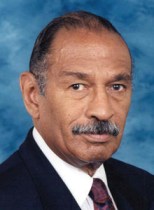
    Conyers, JohnBefore
    Rep. Conyers (at right) gave his statement, Rep. Goodlatte pointed out that in September,
    Rep. Conyers surpassed Sam Rayburn as the eighth-longest serving member of the
    House of Representatives in U.S. history.  Rep. Conyers then began by pointing out that our patent system is the
    envy of the world.  In order to maintain
    this position, he recently introduced the "Innovation Protection Act of
    2013" with Rep. Watt, Rep. Darrell Issa, and Rep. Doug Collins, to prevent
    the diversion of USPTO fees.  He
    noted that poor quality patents are a concern, and that we must give the Office
    the resources that it needs to improve the system.  With regard to the Innovation Act, Rep.
    Conyers noted the various concerns that some non-practicing entities were
    causing, but he also urged caution in addressing these concerns.  "Our first rule should be that we do no
    harm to our patent system," warning that we should not do anything to
    discourage innovation or increase the litigation that Congress is attempting to
    prevent.  He stated that Congress should
    not be considering amending the fee shifting statute at this time, because the
    Supreme Court is taking up the issue this term.  He also urged that Congress should not rush to expand the use of
    business method patents review as provided for in the recently enacted
    AIA.  Rep. Conyers continued by reminding
    that Congress has asked the Courts to develop their own rules for the past 80
    years, and that he saw no reason to abrogate that power at this time.  He also did not see a need to create a
    special carve-out for the pharmaceutical industry (although, to be fair, the
    exceptions for Hatch-Waxman litigation were likely necessitated by the time
    constraints associated with such cases–complaints that need to be filed within
    45 days of notice of infringement, and completion of litigation within 30
    months).  He concluded by urging the
    Chair to move cautiously, carefully, and deliberately.

    Coble, HowardRep.
    Coble (at left), the Chair of the Subcommittee on Courts, Intellectual Property and the
    Internet began his statement by pointing out that the actions of so-called
    patent trolls amount to nothing more than litigation extortion.  However, even though the bill is attempting
    to address some of the most abusive litigation practices, he pointed out that
    these reforms will apply to all patents.  Therefore, he cautioned that the House needs to work collaboratively
    with the Administration and the Senate in order to obtain meaningful
    reform.  American innovation cannot be
    held hostage to frivolous litigation, he concluded.

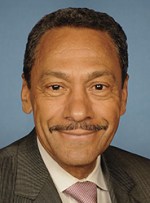
    Watt, MelvinFinally,
    Rep. Watt (at right), ranking member of the same subcommittee, gave his statement.  He started by observing that the problem with
    so-call patent trolls is not as enormous as portrayed, or as urgent.  As support, he cited the recent GAO report,
    which had the take-away message that it was the operating companies that were
    fighting amongst themselves (see "The GAO Issues a Report on Patent Litigation Trends — It Turns Out that the Sky Is Not Falling").  However,
    even though NPEs only brought a faction of the litigation, they engage in
    litigation tactics that pose unique challenges, which will require unique
    solutions.  Rep. Watt expressed concern
    that the proposed solutions might have adverse effects on all patent litigants,
    and therefore care must be taken to examine not only how the provisions will
    impact the bad actors, but how they will impact all participants.  He expressed dismay at the fact that even
    though the Chair had released two discussion drafts prior to introducing the
    bill, the process for developing and testing the proposed litigation proposals
    had been "insular and disappointing."  Rep. Watt supported some of the concepts, but worried about the interactions
    and execution of some provisions, and questioned the wisdom of others.  He continued:  "In the meantime, we risk
    jeopardizing comity with the federal judiciary with overly proscriptive
    mandates, losing the trust and confidence of the small and independent
    innovators with unbalanced remedies that leave them out of the equation, and
    even worse, we run the risk of enacting measures that could not only be
    ineffective, but could exacerbate the current problem or invite new unintended
    problems."  He concluded by noting
    that multiple, credible, and thoughtful stakeholders have expressed grave
    reservations about one provision or another in the Chair's bill, and that these
    concerns should not be dismissed as "opposition or obstructionism,"
    but instead open reflection and engagement is needed.

    As
    we have noted in the past, it is likely that some form of legislation will
    likely pass in the near future to address the perceived "abusive patent
    litigation" problem.  However, we
    have expressed our own "grave reservations" regarding some of the
    provisions of the Innovation act.  As
    such, we appreciated the statements of Reps. Conyers and Watt, and hope that
    the House fully scrutinizes each of these provisions to ensure that they are
    narrowly tailored to address the perceived problems.  We also hope that the House considers any and
    all consequences of each provision in order to hopefully avoid any that are
    unintended.

  • By Kevin E. Noonan

    Ambry GeneticsIn responding to Myriad Genetics'
    complaint for patent infringement, both Ambry Genetics and Gene-by-Gene asserted counterclaims under the Sherman Antitrust Act, predicated on
    Myriad's filing its patent infringement lawsuit.  Myriad filed motions with the District Court to dismiss these antitrust counterclaims under Fed. R. Civ Pro 12(b)(6)
    for failure to state a claim upon which relief can be granted, which Ambry and
    Gene-by-Gene have jointly opposed.  The basis for Myriad's motion is that filing lawsuits against these
    alleged infringers is immune from antitrust liability under the
    Noerr-Pennington doctrine, that neither Defendant has shown that Myriad's
    patent infringement allegations amount to sham litigation, and procedurally that
    neither Defendant has satisfied the pleadings requirements set forth by the
    Supreme Court under Bell Atlantic Corp. v. Twombly, 550 U.S. 544, 570
    (2007), and Ashcroft v. Iqbal, 556 U.S. 662 (2009).  Both Plaintiff's and Defendants' arguments
    ultimately depend on how the District Court will view the interpretation of the Supreme
    Court's decisions in its Mayo Collaborative Servs. v. Prometheus Labs., Inc.,
    132 S.Ct. 1289 (2012), and Association for Molecular Pathology v. Myriad
    Genetics, Inc.
    , 133 S.Ct. 2107 (2013), cases.

    Gene by GeneDefendants' brief opposing Myriad's motion
    to dismiss relies on two principles:  first, procedurally, that their complaint
    alleges sufficient facts to satisfy the Supreme Court's Twombly and Iqbal standards;
    and substantively, that Myriad's complaint is not entitled to Noerr-Pennington antitrust immunity
    because the litigation is a sham in view of the Court's recent Mayo and Myriad decisions.  The Noerr-Pennington
    doctrine of antitrust immunity, which arises from two Supreme Court cases:  Eastern R.R. Presidents Conference v. Noerr Motor Freight,
    Inc.,
    365 U.S. 127, 136, 81 S.Ct. 523
    (1961), and United Mine Workers v. Pennington, 381 U.S. 657, 85 S.Ct. 1585 (1965),
    stands for the proposition that a party has the right
    to petition its government for redress of grievances or to influence public
    officials is protected activity that cannot raise antitrust liability.  These activities include, inter alia, filing suit including patent
    infringement lawsuits.  However, there
    are exceptions to this immunity, including asserting claims obtained through
    inequitable conduct (Walker Process Equip., Inc. v. Food
    Mach. & Chem. Corp.,
    382 U.S. 172, 175-77
    (1965); accordingly "Walker Process fraud") or when the
    lawsuit is "objectively basis" or constitutes "sham litigation."  Neither Ambry nor Gene-by-Gene have
    alleged Walker Process fraud against
    any of Myriad's patents.

    Defendants argue in their
    opposition that, as a procedural matter they have raised "substantial and
    detailed factual allegations" that the District Court must take as true in
    deciding whether to deny Myriad's motion, citing Burnett v. Mortg. Elec.
    Registration Sys., Inc.
    , 706 F.3d 1231, 1235 (10th Cir. 2013).  Moreover, they argue that there is a "powerful
    presumption against rejecting pleadings for failure to state a claim," quoting Cayman
    Exploration Corp. v. United Gas Pipe Line Co.
    , 873 F.2d 1357, 1359 (10th
    Cir. 1989), and further citing as additional 10th Circuit precedent Duran
    v. Carris
    , 238 F.3d 1268, 1270 (10th Cir. 2001), and Lone Star Indus.,
    Inc. v. Horman Family Trust
    , 960 F.2d 917, 920 (10th Cir. 1992).  This is particularly true in antitrust cases,
    according to Defendants, because of the need (?) for "ample opportunity
    for discovery," citing Poller v. Columbia Broad. Sys., 368 U.S.
    464, 473 (1962); Hosp. Bldg. Co. v. Trs. of Rex Hosp., 425 U.S. 738, 746
    (1976).

    Substantively, Defendants argue
    that Myriad is not immunized under the Noerr-Pennington
    doctrine because Myriad's asserted claims are facially invalid under the
    Supreme Court's Mayo and Myriad decisions, and thus these
    lawsuits are brought in bad faith.  Defendants cite case law (albeit not from the 10th Circuit or
    Supreme Court) that make satisfaction of the objective prong of the sham
    litigation test apparently easier to satisfy than the precedent cited by Myriad
    in its motion to dismiss; indeed, Defendants even cite a DC District Court case
    (WAKA LLC v. DC Kickball, 517 F.Supp.2d 245, 251 (D.D.C. 2007)) that "the
    mere invocation of 'sham litigation' is enough to state a claim and survive
    dismissal (although this case was decided prior to either the Twombly or Iqbal decisions).  More
    convincingly, Defendants also cite 10th Circuit precedent that
    whether a suit is objectively baseless involves subjective factual
    determinations of whether a plaintiff had "probable cause" to file
    the lawsuit and that a motion to dismiss should be denied on those
    grounds.  Pers. Dept., Inc. v. Prof'l
    Staff Leasing Corp.,
    297 Fed.Appx.
    773, 780-81 (10th Cir. 2008).

    Defendants recite a litany of
    their factual allegations in this regard (supported by "over 30 pages of
    factual allegations regarding Myriad's bad
    faith conduct, spanning more than 100 paragraphs" in their counterclaim,
    including:

    • Myriad has in bad faith brought
    this lawsuit against Defendants on patent claims that it knows are invalid
    under two Supreme Court decisions and Federal Circuit authority.
    • Two decisions by the Supreme
    Court, issued before plaintiffs brought this suit, rebut the presumption by
    Myriad that it brought this suit in good faith:  [Myriad] and Mayo.
    • According to the Federal
    Circuit, with Mayo the Supreme Court "made clear that such
    diagnostic methods in that case essentially claim natural laws that are not
    eligible for patent."
    • The Supreme Court in AMP IV unanimously
    held that isolated DNA is not patent eligible subject matter, which had the
    effect of invalidating the claims Myriad currently asserts against Defendants.
    • The Supreme Court in [Myriad]
    unequivocally excluded from patentable subject matter synthetic DNA "that
    may be indistinguishable from natural DNA"; yet, Myriad is attempting to
    enforce claims in the present litigation that have common subject matter to the
    invalidated claims.
    • Myriad is asserting method
    claims in the present litigation that are facially invalid in view of the
    Supreme Court's decision in Mayo and the Federal Circuit's [two Myriad]
    decisions.

    Regarding the composition claims,
    Defendants contend that these are invalid under the Supreme Court's Myriad decision, illustrating the
    dispute (and the consequence of the Court's "less than pellucidly clear"
    opinions on matters of patent law) in how the Court's language in its Myriad decision should be
    interpreted.  Myriad contends that the
    synthetic nature of the probes and primers in its asserted composition claims
    brings those claims within the ambit of subject matter the Court deemed patent
    eligible, whereas Defendants argue that the patent eligibility question depends
    on whether the sequence of the primers is identical to sequences found in
    genomic DNA.  Although Defendants may
    have the better argument, Myriad relies on its assertion
    of claim 6 of U.S. Patent No. 5,747,282 which was among the claims not
    invalidated in the Court's opinion.

    It is with regard to the method
    claims that Defendants' arguments require the District Court to accept their
    (perhaps) logical extension of the Court's Mayo
    decision to extend to Myriad's asserted method claims and further to argue that
    assertion of such claims is objectively baseless and brought in bad faith.  This is certainly a question that needs
    answering, and may in fact be answered in the course of this patent
    infringement litigation.  But the fact
    that it needs to be answered undercuts Defendants' allegations that by bringing
    the lawsuit(s) Myriad has shed its Noerr-Pennington
    immunity and brought an objectively baseless lawsuit.  And Defendants are themselves capable of
    stretching the limits of the precedential value of the Myriad decisions, in their case regarding decisions by the Federal
    Circuit.  For example, their brief states
    that:

    The [second Federal
    Circuit Myriad opinion] declared
    invalid all method claims asserted in the AMP litigation except for
    Claim 20 of the '441 patent.  The method claims other than Claim 20 asserted in
    the AMP litigation (and here) compare and analyze patient BRCA1 and
    BRCA2 sequences.  That subject matter was expressly declared invalid in [the
    first and second Federal Circuit Myriad
    opinions].  Importantly, Myriad did not appeal that aspect of [second Federal
    Circuit Myriad opinion] to the
    Supreme Court.

    Missing from this analysis is that
    Plaintiffs in the Myriad case deigned
    not to challenge any of the method
    claims now asserted by Myriad, and that the method claims invalidated in the
    Myriad decisions were of a much broader and less specific scope than Myriad's
    now-asserted claims.  Thus, there is no direct precedential value of any of
    the Myriad decisions to the question of whether assertion of Myriad's claims is
    objectively baseless.

    Finally, the brief notes that
    several other competitors, including some (Counsyl, Quest, GeneDX) that Myriad
    has also sued, entered the marketplace as evidence that Myriad's patents are
    invalid; this at least raises a factual question as to the objective
    baselessness of Myriad's complaint that Defendants argue is not appropriate for
    summary dismissal under Fed. R. Civ. Pro. 12(b)(6).  Hedging their bets, Defendants also ask for
    leave to file an amended complaint should the District Court grant Myriad's
    motion.

  •         By Sherri Oslick

    Gavel About Court Report:  Each week we will report briefly on recently filed biotech and pharma cases.

    Astrazeneca
    AB et al. v. Dr. Reddy's Laboratories Inc. et al.

    3:13-cv-06157;
    filed October 23, 2013 in the District Court of New Jersey

    • Plaintiffs: 
    Astrazeneca AB; KBI-E Inc.; Pozen, Inc.; Astrazeneca LP
    • Defendants: 
    Dr. Reddy's Laboratories Inc.; Dr. Reddy's Laboratories Ltd.

    Astrazeneca
    AB et al. v. Lupin Ltd. et al.

    3:13-cv-06315;
    filed October 23, 2013 in the District Court of New Jersey

    • Plaintiffs: 
    Astrazeneca AB; Astrazeneca LP; KBI-E Inc.; Pozen, Inc.
    • Defendants: 
    Lupin Ltd.; Lupin Pharmaceuticals Inc.

    Astrazeneca
    AB et al. v. Mylan Pharmaceuticals et al.

    3:13-cv-06316;
    filed October 23, 2013 in the District Court of New Jersey

    • Plaintiffs: 
    Astrazeneca AB; Astrazeneca LP; KBI-E Inc.; Pozen, Inc.
    • Defendants: 
    Mylan Pharmaceuticals; Mylan Laboratories Ltd.; Mylan, Inc.

    Astrazeneca
    AB et al. v. Watson Laboratories, Inc. – Florida et al.

    3:13-cv-06318;
    filed October 23, 2013 in the District Court of New Jersey

    • Plaintiffs: 
    Astrazeneca AB; Astrazeneca LP; KBI-E Inc.; Pozen, Inc.
    • Defendants: 
    Watson Laboratories, Inc. – Florida; Actavis Pharma, Inc.

    The
    complaints in these cases are substantially identical.  Infringement of U.S. Patent No. 8,557,285 ("Pharmaceutical
    Compositions for the Coordinated Delivery of NSAIDs," issued October 15,
    2013) in conjunction with defendants' filing of an ANDA to manufacture a
    generic version of AstraZeneca's Vimovo® (naproxen and esomeprazole magnesium,
    used to relieve the signs and symptoms of osteoarthritis, rheumatoid arthritis,
    and ankylosing spondylitis, and to decrease the risk of stomach (gastric)
    ulcers in patients at risk of developing stomach ulcers from treatment with
    non-steroidal anti-inflammatory drugs (NSAIDs)).  View the Dr.
    Reddy's
    complaint here.


    Horizon Pharma
    AG et al. v. Par Pharmaceutical Companies, Inc. et al.

    1:13-cv-06298;
    filed October 22, 2013 in the District Court of New Jersey

    • Plaintiffs: 
    Horizon Pharma AG; Jagotec AG
    • Defendants: 
    Par Pharmaceutical Companies, Inc.; Par Pharmaceutical, Inc.

    Infringement
    of U.S. Patent Nos. 6,488,960 ("Corticosteroid Formulation" issued
    December 3, 2002), 6,677,326 ("Corticosteroid Formulation Comprising Less
    Than 2.5 mg Prednisolone for Once Daily Administration," issued January
    13, 2004), 8,309,124 ("Delayed Release Tablet with Defined Core Geometry,"
    issued November 13, 2012), 8,168,218 (same title, issued May 1, 2012), and
    8,394,407 (same title, issued March 12, 2013) following a Paragraph IV
    certification as part of Par's filing of an ANDA to manufacture a generic
    version of Horizon's Rayos® (prednisone delayed-release tablets, used as an
    anti-inflammatory or immunosuppressive agent for certain allergic,
    dermatologic, gastrointestinal, hematologic, ophthalmologic, nervous system,
    renal respiratory, rheumatologic, specific infectious diseases or conditions
    and organ transplantation; for the treatment of certain endocrine conditions;
    and for palliation of certain neoplastic conditions).  View the complaint here.


    University of
    Utah Research Foundation et al. v. Quest Diagnostics et al.

    2:13-cv-00967;
    filed October 22, 2013 in the District Court of Utah

    • Plaintiffs: 
    University of Utah Research Foundation; Trustees of the University of
    Pennsylvania; HSC Research and Development Limited Partnership; Endorecherche;
    Myriad Genetics
    • Defendants: 
    Quest Diagnostics; Quest Diagnostics Nichols Institute

    Infringement
    of U.S. Patent Nos. 5,709,999 ("Linked Breast and Ovarian Cancer
    Susceptibility Gene," issued January 20, 1998), 5,747,282 ("17Q-Linked
    Breast and Ovarian Cancer Susceptibility Gene," issued May 5, 1998), 5,753,441 (same title, issued May 19, 1998), 5,837,492 ("Chromosome
    13-Linked Breast Cancer Susceptibility Gene," issued November 17, 1998), 6,033,857 (same title, issued March 7, 2000), 6,051,379 ("Cancer Susceptibility
    Mutations of BRCA2," issued April 18, 2000), 6,951,721 ("Method for
    Determining the Haplotype of a Human BRCA1 Gene," issued October 4, 2005),
    and 7,250,497 ("Large Deletions in Human BRCA1 Gene and Use Thereof,"
    issued July 31, 2007) based on Quest'smanufacture, use, and sale of its BRCA
    Assay.  View the complaint here.


    Cephalon Inc.
    v. Eagle Pharmaceuticals Inc.

    1:13-cv-01738;
    filed October 21, 2013 in the District Court of Delaware

    Infringement
    of U.S. Patent No. 8,445,524 ("Solid Forms of Bendamustine Hydrochloride,"
    issued May 21, 2013) following a Paragraph IV certification as part of Eagle's
    filing of an NDA (under § 505(b)(2) of the Food, Drug and Cosmetic Act) to
    manufacture a generic version of Cephalon's Treanda® (bendamustine
    hydrochloride, used to treat chronic lymphocytic leukemia and non-Hodgkin's
    lymphoma).  View the complaint here.


    Takeda
    Pharmaceuticals USA Inc. v. Amneal Pharmaceuticals LLC

    1:13-cv-01729;
    filed October 21, 2013 in the District Court of Delaware

    Infringement
    of U.S Patent Nos. 7,906,519 ("Methods for Concomitant Administration of
    Colchicine and a Second Active Agent," issued March 15, 2011), 7,935,731 ("Methods
    for Concomitant Administration of Colchicine and Macrolide Antibiotics,"
    issued May 11, 2011), 8,093,298 (same title, issued January 10, 2012),
    7,964,648 ("Methods for Concomitant Administration of Colchicine and a
    Second Active Agent," issued June 21, 2011), and 8,093,297 (same title,
    issued January 10, 2012) following Amneal's filing of an ANDA to manufacture a
    generic version of Takeda's Colcrys® (single-ingredient colchicine product,
    used to treat Familial Mediterranean Fever). 
    View the complaint here.


    Forest
    Laboratories Inc. et al. v. Amneal Pharmaceuticals LLC et al.

    1:13-cv-01737;
    filed October 21, 2013 in the District Court of Delaware

    • Plaintiffs: 
    Forest Laboratories Inc.; Forest Laboratories Holdings Ltd.; Royalty Pharma
    Collection Trust
    • Defendants: 
    Amneal Pharmaceuticals LLC; Amneal Pharmaceuticals of New York LLC; Amneal
    Pharmaceuticals Co. India Pvt. Ltd.

    Infringement
    of U.S. Patent Nos. 6,602,911 ("Methods of Treating Fibromyalgia,"
    issued August 5, 2003), 7,888,342 ("Methods of Treating Fibromyalgia
    Syndrome, Chronic Fatigue Syndrome and Pain," issued February 15, 2011),
    and 7,994,220 ("Milnacipran for the Long-Term Treatment of Fibromyalgia
    Syndrome," issued August 9, 2011), all licensed to Forest, following a
    Paragraph IV certification as part of Amneal's filing of an ANDA to manufacture
    a generic version of Forest's Savella® (milnacipran hydrochloride, used in the
    management of fibromyalgia).  View the
    complaint here.


    Baxter
    Healthcare Corp. et al. v. HQ Specialty Pharma Corp.

    2:13-cv-06228;
    filed October 18, 2013 in the District Court of New Jersey

    • Plaintiffs: 
    Baxter Healthcare Corp.; Baxter International Inc.; Baxter Healthcare
    S.A.
    • Defendant: 
    HQ Specialty Pharma Corp.

    Infringement
    of U.S. Patent Nos. 6,310,094 ("Ready-to-Use Esmolol Solution,"
    issued October 30, 2001) and 6,528,540 ("Esmolol Formulation," issued
    March 4, 2003) following a Paragraph IV certification as part of HQ's filing of
    an NDA (under § 505(b)(2) of the Food, Drug and Cosmetic Act) to manufacture a
    generic version of Baxter's Brevibloc® (esmolol hydrochloride, used for the
    rapid control of the heart rate in patients with atrial fibrillation or atrial
    flutter in perioperative, postoperative, or other emergent circumstances where
    short term control of the heart rate with a short-acting agent is
    desirable).  View the complaint here.