• George Washington University Law SchoolThe George
    Washington Law Review will be holding a Symposium entitled "Cracking the
    Code: Ongoing § 101 Patentability Concerns in Biotechnology and Computer
    Software" on November 15, 2013 at the George Washington University Law School.  The agenda for the Symposium will include:

    • Biotechnology
    Panel — Charles Davis, former Editor-in-Chief, George Washington Law Review
    (moderator); Irene Calboli, Marquette University School of Law; Chris Holman,
    UMKC School of Law; John Golden, University
    of Texas at Austin School of Law; and Rebecca Eisenberg, University of Michigan
    Law School

    • Practitioner
    Panel — Jeff Kushan, Partner, Sidley Austin (moderator); Hans Sauer, Associate
    General Counsel, Biotechnology Industry Organization; Bernard Knight, Former
    General Counsel, U.S. Patent and Trademark Office; and Donald Dunner, Finnegan

    • Keynote Address
    — Hon. Paul R. Michel, former Chief Judge, U.S. Court of Appeals for the
    Federal Circuit (invitation only)

    Additional
    information about the Symposium, including a program and list of speakers, and
    registration information can be found here.

  • LSI - Law Seminars International - redLaw
    Seminars International (LSI) will be offering a one-hour telebriefing on "IPR Proceedings at the USPTO — Strategic Approaches to the New Patent
    Proceedings" on November 12, 2013 from 1:00 to 2:30 pm (Eastern).  Michael
    J. Twomey of Wilmer Cutler Pickering Hale and Dorr LLP will moderate a
    panel that includes Jennifer C. Bailey
    of Erise IP, P.A. and David L. Cavanaugh of Wilmer Cutler Pickering Hale and
    Dorr LLP.  The panel will provide
    strategic guidance for parties considering an IPR proceeding, and discuss how
    to decide whether to institute an IPR proceeding and best practices for when to
    file, how to successfully prepare for and appear before the USPTO.

    A
    Q&A will follow the presentation and last for up to 30 minutes.

    The
    registration fee is $195 per caller and $130 for each additional person on the
    same line who desires continuing education credit.  Those interested in registering for the
    telebriefing, can do so here.

  • Strafford #1Strafford
    will be offering a webinar/teleconference entitled "Leveraging the AIA's Expanded Prior Use
    Defense for Patent Infringement Claims" on November 21, 2013 from
    1:00 to 2:30 pm (EST).  Thomas L. Irving of Finnegan Henderson
    Farabow Garrett & Dunner; Colleen Kramer, Associate General Counsel –
    Intellectual Property for Mars Global Chocolate; and Amy J. Hoffman,
    Intellectual Property Counsel for Ecolab will examine the expanded prior
    commercial use defense, its requirements, and limitations, and discuss the
    strategic considerations for patents issued both before and after Sept. 16,
    2011, and offer best practices for using the defense.  The webinar will review the following
    questions:

    • How does the AIA expand the prior commercial use
    defense?
    • What are the limitations and exceptions to
    application of the prior user rights defense to patent infringement?
    • What are the strategic considerations for counsel
    in determining whether to use the commercial prior use defense?

    The
    registration fee for the webinar is $297 ($362 for registration and CLE processing).  Those interested in registering for the
    webinar, can do so here.

  • By Andrew Williams

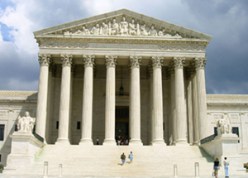
    Supreme Court Courtroom_cOn November 5, 2013, the Supreme Court heard oral arguments in the Medtronic Inc. v. Boston Scientific Corp. case (Supreme Court docket number 12-1128).  The sole issue on appeal was who has the burden of proof on the issue of infringement/non-infringement in a declaratory judgment action brought by a licensee under Medlmmune, the licensee (DJ Plaintiff) or the patent holder/licensor.  The Federal Circuit had decided that, in such cases, it is the licensee that seeks to disturb the status quo ante, and therefore it should bear the burden of proof.  However, if the tenor of the questioning is any indication, it would appear that the Justices did not necessarily agree.

    This problem presented by this case is a direct consequence of the Court's MedImmune decision several years ago.  In that case (as well as all similarly situated cases that have followed), the parties had entered into a patent licensing agreement, and while the license was maintained, the licensee was under no risk of facing a patent infringement suit.  However, the licensee wanted relief from royalty payments related to one of the licensed patents, but at the same time did not want to repudiate the entire contract.  Because the patent holder could not bring an infringement suit, there was a question about whether a case or controversy actually existed such that a declaratory judgment action could be brought.  The Supreme Court answered in the affirmative, reasoning that "[t]he rule that a plaintiff must destroy a large building, bet the farm, or (as here) risk treble damages and the loss of 80 percent of its business, before seeking a declaration of its actively contested legal rights finds no support in Article III."  Medlmmune, Inc. v. Genentech, Inc., 549 U.S. 118, 134 (2007).  In other words, the Court created what appeared to be a patent-license exception to the Article III case-or-controversy requirement, because the licensee was not under the threat of an infringement action.  Indeed, without repudiation, the patent holder could not even bring a counterclaim of patent infringement in such a case.  However, the logical underpinning of this apparently "artificial" satisfaction of the case-or-controversy requirement began to come unhinged when you consider the issue of who bears the burden of proof in such a case.  This was all too apparent during the oral argument as the Justices grappled with the issue.

    MedtronicInterestingly, the Court had minimal questions for Medtronic (the licensee).  In fact, most of the questioning during this part of the hearing was directed at ensuring the Justices had a correct understanding of the facts and procedural posture underlying this case.  For example, when counsel for Medtronic pointed out that this case was about the ordering of proofs in patent cases, Justice Alito stated that "if that's all that's involved, then the case doesn't seem to amount to quite as much as one might have thought otherwise, does it?"  The counsel representing the Solicitor General's office, which argued in favor of Medtronic, faced even less interrogation from the Court.  In fact, only three questions were asked by the Justices.

    Boston ScientificThings got more interesting during the presentation by counsel for Boston Scientific.  As opposed to the Federal Circuit, which focused the inquiry on which party was disturbing the status quo, it appeared as though the starting point for the Justices was that the courts should look to the appropriate mirror-image coercive action, as is done in other declaratory judgment actions.  Therefore, in this case, the court would focus on the infringement suit that the patent holder would bring if the licensee breached the contract.  For example, Chief Justice Roberts referred to this as the "elephant in the room":  "the relief they are seeking is protection against the relief that you would be seeking but for the declaratory judgment action."  However, this is not exactly correct, because with the license in place, the patent holder could not bring an infringement action.  For example, when Justice Kennedy pointed out that "if [the licensee] refused to pay the royalty . . . then there would have been infringement," counsel for Boston Scientific correctly pointed out:  "[b]ut then you're changing all the facts around.  That's not – – that's not what we're dealing with in this case."  The problem is that when you start by looking to what the mirror-image coercive action would be, the burden is pre-determined.  Thus, if the Court follows through with this reasoning, they almost certainly will shift the burden of proof back to the patent holder MedImmune-like cases.

    This is the heart of the problem with the MedImmune decision.  Assigning the burden of proof to either party results in a situation that is not necessarily fair to that party, and does not necessarily logically follow.  This problem was highlighted by the questions and comments from Justice Scalia, which is interesting considering he was the author of the MedImmune opinion.  First, Justice Scalia appeared to be so focused on MedImmune-type declaratory judgment actions that this exceptional-type case appeared to overshadow the typical declaratory-judgment actions.  For example, in responding to Boston Scientific's argument that no patent infringement counterclaim could be brought, Justice Scalia stated that it seemed to him "it is often the case in declaratory judgment actions that the defendant in the action cannot counterclaim."  This may be true if you are only considering MedImmune-type cases.  However, the Article III case-or-controversy requirement necessary for all declaratory-judgment actions almost requires that the DJ defendant be able to bring a counterclaim — otherwise the requirement would not be met.  For example, in patent infringement declaratory-judgment actions (where there is no license), the potential infringer brings suit to gain certainty that it can make, use, or sell its product without fear that a patent will be asserted against it.  In such cases, the patent holder is certainly able to bring an infringement counterclaim.  In fact, without the threat of such an infringement action, the Article III case-or-controversy requirement would be lacking.  Nevertheless, Justice Scalia stated that "[t]he whole purpose of the declaratory judgment statue is to enable you to sue before the other side has a cause of action against you."  However, this does not comport with the requirements of Article III.  In fact, Justice Scalia summarized the standard in the MedImmune case as:  "Basically, the question in each case is whether the facts alleged, under all the circumstances, show that there is a substantial controversy, between parties having adverse legal interests, of sufficient immediacy and reality to warrant the issuance of a declaratory judgment."  MedImmune, 549 U.S. at 127.  It is because these MedImmune-type actions have a somewhat "artificial" satisfaction of the case-or-controversy requirement (because there is no infringement) that causes the problems that arise in these sorts of cases.

    Justice Scalia also brought up the "res judicata problem," which also stems from the artificial nature of these MedImmune-type actions.  The hypothetical was explained as such by Justice Scalia:

    Let's assume that we put the burden of proof where you want it.  Okay?  So this declaratory judgment action is defeated.  All right?  Nonetheless, they say:  Still and all, we are going to go ahead and not pay any royalties.  And then you bring – – you bring an infringement action, right?

    In this hypothetical, the parties would need to relitigate the entire case.  This is because in MedImmune-type declaratory judgment action, as Justice Scalia put it, the best that the patent holder can establish "is that [the licensee] didn't prove non-infringement."  Or, as Boston Scientific's counsel put it, the issue in the declaratory judgment action is claim coverage, but the issue in the subsequent litigation is infringement.  Therefore, there would be no issue preclusion in the subsequent "breach" patent infringement litigation, and therefore the patent holder would need to prove infringement to be entitled to remedies.  This "res judicata problem" is an unfortunate consequence of the MedImmune decision.

    Finally, the counsel for Boston Scientific continued to stress that it is important to look at what remedy is being sought to determine who has the burden of proof.  Because the patent holder cannot seek any remedies, he argued, the burden should be with the licensee.  The Court did not seem convinced.  Interestingly, near the end of the hearing, Justice Scalia appeared to have recognized the sought-after remedy in this case:

    [T]hey don't want to continue to pay royalties.  That's the point.  That's why they bring the Declaratory Judgment Act [sic], so that the court can tell them:  You don't have to pay royalties because this stuff is not covered.

    To this, counsel for Boston Scientific responded:  "that's absolutely right."  If the Court focuses on this remedy, instead of analyzing what the mirror-image coercive action would be, it is possible that it could require the licensee to bear the burden of proof in these cases.  Nevertheless, it did not appear that the Justices were convinced that the burden should be any different in MedImmune-type cases than they are in standard "mirror-image coercive" declaratory-judgment actions.

    Of course, it is impossible to be certain what the outcome of any case will be based on the questioning from the bench.  We will, of course, provide an analysis when the Court issues its opinion, which should occur before the end of June, 2014.

  • Boehringer IngelheimThe UK Patents
    Court recently issued a judgement which referred four questions to the CJEU in
    the case Actavis Group v Boehringer
    Ingelheim
    that aim to clarify how the SPC Regulation ought to be
    interpreted in respect of products having combinations of active ingredients.

    This referral
    follows three earlier referrals to the CJEU concerning the interpretation of
    the SPC Regulation in the cases of Actavis
    v Sanofi, Lilly v Human Genome Sciences
    and Georgetown University.  These referrals were heard by the CJEU on 12 September 2013 and we are awaiting
    the CJEU's guidance to be issued.  It is suspected that the guidance on the
    three earlier referrals will provide a good indication as to how the CJEU will
    deal with the present referral.

    Background and facts

    Boehringer's European patent, EP (UK) 0502314, has a claim to
    a compound called telmisartan.  This
    compound is used in the treatment of hypertension and is marketed under the
    brand name Micardis.  The corresponding SPC is due to expire on 10
    December 2013.

    Boehringer also sells MicardisPlus,
    a product comprising telmisartan and hydrochlorothiazide.  In 2003 Boehringer
    applied to the UK IPO for an SPC to the combination of telmisartan and
    hydrocholothiazide.  EP (UK) 0502314 as
    granted did not have a claim specifically directed to this combination.  Boehringer
    therefore applied to amend the patent to insert a claim specifically directed
    to the combination.  Whilst the
    application to amend was pending the UKIPO agreed to suspend the SPC
    application for four months.  The
    amendment was granted and Claim 12, directed to the combination of telmisartan
    and hydrocholothiazide, was included in the amended patent.  The SPC for the combination was granted and
    is due to expire on 30 January 2017.


    ActavisActavis Group
    sought to invalidate the combination SPC in order
    to clear a path to launch its own product comprising telmisartan and
    hydrocholothiaziode.  In considering the
    invalidation action the UK Patents Court referred the four questions to the
    CJEU in order to seek clarification on the interpretation of the SPC Regulation
    in respect of combination products.

    Questions referred

    1.    (a) If a patent does not, upon grant, contain a claim that
    explicitly identifies two active ingredients in combination, but the patent
    could be amended so as to include such a claim could this patent, whether or
    not such an amendment is made, be relied upon as a "basic patent in force"
    for a product comprising those ingredients in combination pursuant to Article
    3(a) of Regulation No 469/2006/EC ("the Regulation")?

    (b)  Can a patent that has been
    amended after the grant of the patent and either (i) before and / or (ii) after
    grant of the SPC be relied upon as the "basic patent in force" for
    the purposes of fulfilling the condition set out in Article 3(a) of the
    Regulation?

    (c)  Where an applicant applies for
    an SPC for a product comprised of active ingredients A and B in circumstances
    where,

    (i)  after the date of application for the SPC but before the
    grant of the SPC, the basic patent in force, being a European Patent (UK) (the "Patent")
    is amended so as to include a claim which explicitly identifies A and B;

    and

    (ii)  the amendment is deemed, as a
    matter of national law, always to have had effect from the grant of the Patent;

    is the applicant for the SPC
    entitled to rely upon the Patent in its amended form for the purposes of
    fulfilling the Art 3(a) condition?

    The SPC regulation
    requires the basic patent which protects the active ingredient covered by the
    SPC to be in force.  In the present case,
    the patent as granted did not have a claim specifically to the combination of
    telmisartan and hydrocholothiazide when the SPC application for the combination
    was filed. Instead, a claim to the combination was added to the patent after
    the SPC application was filed.  The
    questions therefore arises as to whether the patent qualifies as "a basic
    patent in force" as per the requirement specified in the SPC regulation.

    The UK judge's
    preliminary view was that given that amendments to UK patents have
    retrospective effect to the date of patent grant, if the amendment is allowable
    then when the amendment occurred ought to not affect the validity of the SPC.

    2.    For the purposes of determining
    whether the conditions in Article 3 are made out at the date of the application
    for an SPC for a product comprised of the combination of active ingredients A
    and B, where (i) the basic patent in force includes a claim to a product
    comprising active ingredient A and a further claim to a product comprising the
    combination of active ingredients A and B and (ii) there is already an SPC for
    a product comprising active ingredient A ("Product X") is it
    necessary to consider whether the combination of active ingredients A and B is
    a distinct and separate invention from that of A alone ?

    This question
    essentially asks whether, in order for an SPC to be granted to a combination of
    active ingredients, is it necessary to consider whether the combination has to
    be an "inventive advance" over either one of the active ingredients
    alone.

    The issue of
    whether a combination of active ingredients amounts to an "inventive
    advance" over either one of the active ingredients is the subject of the
    referral by the UK Court to the CJEU in the case of Actavis v Sanofi.  The UK judge in the present case did not give his
    opinion as to what he thought the answer to this question ought to be, but
    preferred to wait for the CJEU's guidance in Actavis v Sanofi which is expected in the coming months.  However,
    the UK judge indicated that if the "inventive advance" question is of
    relevance in the case of telmisartan and hydrocholothiazide, then a further
    trial on this point will need to be held at a later date.

    3.    Where the basic patent in force "protects" pursuant
    to Article 3(a):

    (a) A product comprising active
    ingredient A ("Product X"); and

    (b) A product comprising a
    combination of active ingredient A and active ingredient B ("Product Y").

    And where:

    (c) An authorisation to place
    Product X on the market as a medicinal product has been granted;

    (d) An SPC has been granted in
    respect of Product X; and

    (e) A separate authorisation to
    place Product Y on the market as a medicinal product has subsequently been
    granted.

    Does the Regulation, in particular
    Articles 3(c), 3(d) and/or 13(1) of the Regulation preclude the proprietor of
    the patent being issued with an SPC in respect of Product Y? Alternatively, if
    an SPC can be granted in respect of Product Y, should its duration be assessed
    by reference to the grant of the authorisation for Product X or the
    authorisation for Product Y?

    This question
    essentially asks whether the prior existence of the telmisartan SPC precludes
    the possibility of obtaining an SPC for the combination of telmisartan and
    hydrocholothiazide.  If the answer to this question is "no," then the
    question goes on to ask whether the term of the combination SPC ought to be
    limited to the term of the telmisartan SPC.

    The UK judge
    indicated that he thought the telmisartan SPC should have no bearing on the
    grant of the combination SPC and that he would be surprised if the telmisartan
    SPC affected the term of the combination SPC.

    4.    If the answer to question 1(a) is in the negative and the
    answer to question 1(b)(i) is positive and the answer to question 1(b)(ii) is
    negative, then in circumstances where:

    i) in accordance with Art 7(1)
    Regulation, an application for an SPC for a product is lodged within six months
    of the date on which a valid authorisation to place that product on the market
    as a medicinal product has been granted in accordance with Directive 2001/83/EC
    or Directive 2001/82/EC;

    ii)  following the lodging of the
    application for the SPC, the competent industrial property office raises a
    potential objection to the grant of the SPC under Article 3(a) of the
    Regulation;

    iii)  following and in order to
    meet the aforesaid potential objection by the competent industrial property
    office, an application to amend the basic patent in force relied upon by the
    SPC applicant is made and granted;

    iv)  upon amendment of the basic
    patent in force, said amended patent complies with Article 3(a);

    does the SPC Regulation prevent the competent industrial
    property office from applying national procedural provisions to enable (a)
    suspension of the application for the SPC in order to allow the SPC applicant
    to apply to amend the basic patent, and (b) recommencement of said application
    at a later date once the amendment has been granted, the said date of
    recommencement being

    •    after six months
    from the date on which a valid authorisation to place that product on the
    market as a medicinal product was granted but

    •    within six months of the date on which the application to amend the
    basic patent in force was granted?

    Question 4 is
    related to question 1 and asks whether the procedure adopted by the UKIPO to
    suspend the application for the combination SPC, whilst the application to
    amend the patent was heard, was the correct approach.  In his preliminary view,
    the UK judge could see no good reason why this approach could be
    challenged.

    We await the CJEU's guidance on the referrals in the Actavis v Sanofi, Lilly v Human Genome
    Sciences and Georgetown University
    cases which is expected in the next few
    months.  This ought to give an indication
    of how it will deal with the four questions that have been referred in the
    present case.

    This
    report comes from European Patent Attorneys at WP Thompson & Co., 55 Drury Lane,
    London UK.  Further details and commentary can be obtained from Gill Smaggasgale,
    a partner at the firm.

  • By Kevin E. Noonan

    Ariosa DiagnosticsLast Wednesday, Judge
    Susan Illston of the Northern District of California granted summary judgment
    to declaratory judgment plaintiff Ariosa Diagnostics Inc. in Ariosa Diagnostics v. Sequenom.  The legal basis of the court's decision was
    an application of the Supreme Court's patent eligible subject matter
    jurisprudence under Section 101 of the Patent Act, and as one might expect it
    didn't go so well for the patentee.  But
    it is important to remember at times like this that "[o]ne swallow
    does not a summer make, nor one fine day . . . " and to take what lessons
    we can from the decision.

    SequenomThe technology at issue
    is non-invasive
    prenatal diagnosis of sex determination, blood typing, other genetic disorders
    and detection of pre-eclampsia, using a simple blood test that reduces or
    eliminates the need for amniocentesis and chorionic villus sampling (which
    incur risks to both mother and child).  Sequenom
    Inc. is the exclusive licensee of U.S. Patent No. 6,258,540 originally obtained
    by Isis Inc.; there are three independent claims attacked by Ariosa and
    asserted by Sequenom in its patent infringement counterclaims:

    1. A method for
    detecting a paternally inherited nucleic acid of fetal origin performed on a
    maternal serum or plasma sample from a pregnant female, which method comprises
        amplifying a paternally
    inherited nucleic acid from the serum or plasma sample and
        detecting the presence of a
    paternally inherited nucleic acid of fetal origin in the sample.

    24. A method
    for detecting a paternally inherited nucleic acid on a maternal blood sample, which method
    comprises:
        removing all or
    substantially all nucleated and anucleated cell populations from the blood
    sample,
        amplifying a
    paternally inherited nucleic acid from the remaining fluid and subjecting the
    amplified nucleic acid to a test for the Paternally [sic] inherited fetal
    nucleic acid.

    25. A method for performing
    a prenatal diagnosis on a maternal blood sample, which method comprises
        obtaining a non-cellular
    fraction of the blood sample
        amplifying a paternally
    inherited nucleic acid from the non-cellular fraction and
        performing
    nucleic acid analysis on the amplified nucleic acid to detect paternally
    inherited fetal nucleic acid.

    Ariosa's DJ action was filed
    December 19, 2011 and this summary judgment motion filed after Myriad decided.  The district court previously denied Sequenom's
    motion for preliminary injunction (on July, 2012), based on substantial
    question of invalidity under Section 101 (those with a refined temporal sense
    will recognize that this was before
    the Supreme Court's Myriad decision,
    and under prevailing Federal Circuit law where both genomic and cDNA was patent
    eligible).  The Federal Circuit vacated
    the court's denial of Sequenom's preliminary injunction motion for reconsideration
    under the Myriad decision.  In addition, the Federal Circuit also
    construed the claims, wherein the appellate panel (Chief Judge Rader joined by
    Judges Dyk and Reyna) reversed the district court's sub silentio construction of the claim term "paternally
    inherited nucleic acid" to mean "DNA sequence known [in advance] to
    be received only from the father which is not possessed by the mother."  (Chief Judge Rader's opinion recognizes that
    the bracketed phrase was not expressly recited by the district court but the
    court and parties acknowledged it as an essential component of the district
    court's claim construction.)  The court's
    opinion also reversed the district court's construction of the term "amplifying"
    to require preferential amplification of paternally inherited DNA, stating that:

    [T]he claim as written
    stands infringed without regard to whether, or not, other nucleic acid is
    amplified. A party that amplifies paternally inherited nucleic acid satisfies
    this claim limitation without regard to amplification beyond other nucleic
    acid. The claim does not state that paternally inherited nucleic acid is "selectively"
    or "only" amplified.

    On remand and in deciding to grant
    Ariosa's summary judgment (and deny cross-motion for summary judgment of
    infringement by Sequenom), the district court did not further construe the
    claims.

    In setting forth its patent eligibility analysis,
    the court recognized that exceptions to patent eligibility under the statute are
    to be narrowly construed according to both the Federal Circuit and Supreme
    Court:

    The Federal
    Circuit has explained that these exceptions should be applied narrowly. Ultramercial,
    Inc. v. Hulu, LLC
    , 722 F.3d 1335, 1342 (Fed. Cir. 2013); see also
    Prometheus
    , 132 S. Ct. at 1293 ("The Court has recognized . . . that
    too broad an interpretation of this exclusionary principle could eviscerate
    patent law. For all inventions at some level embody, use, reflect, rest upon,
    or apply laws of nature, natural phenomena, or abstract ideas.").

    The court then set forth its understanding of the "relevant"
    Supreme Court precedent (or at least that precedent from 1940 onward); this
    exercise loses to comprehensiveness any coherent application of relevant law
    (i.e., this is a dicta-fest) as
    follows:

    Funk Bros.
    Seed Co. v. Kalo Inoculant Co.
    , 333 U.S.
    127, 129 n.3 (1948):

    "If
    there is to be invention from such a discovery, it must come from the
    application of the law of nature to a new and useful end." Id. at
    130. The Court recognized that the aggregation of select strains of the species
    of bacteria into one product is an application of a newly-discovered natural
    principle, but explained that the application of that principle "is hardly
    more than an advance in the packaging of the inoculants."

    Gottschalk
    v. Benson
    , 409 U.S. 63, 64 (1972):

    The Supreme
    Court held that the claims were ineligible subject matter because the formula
    for converting BCD numerals to pure binary numerals was an abstract idea. See
    id.
    at 71. The Court explained: "The mathematical formula involved
    here has no substantial practical application except in connection with a
    digital computer, which means that if the judgment below is affirmed, the
    patent would wholly pre-empt the mathematical formula and in practical effect
    would be a patent on the algorithm itself." Id. at 71-72.

    Parker
    v. Flook
    , 437 U.S. 584, 585 (1978):

    The Court
    noted that "[t]he only difference between the conventional methods of
    changing alarm limits" and the claimed method "rests in the second
    step – the mathematical algorithm or formula." Id. at 585-86

    The Supreme
    Court explained that "[t]he only novel feature of the method is a
    mathematical formula," id. at 585, and the discovery of a
    phenomenon of nature or mathematical formula "cannot support a patent
    unless there is some other inventive concept in its application." Id. at
    594

    The Court
    recognized that the invention did not wholly preempt the formula, but explained
    that "'if a claim is directed essentially to a method of calculating,
    using a mathematical formula, even if the solution is for a specific purpose,
    the claimed method is nonstatutory.'" Id. at 595 (quoting In re
    Richman
    , 563 F.2d 1026, 1030 (CCPA 1977)); see also id. at 590 ("The
    notion that post-solution activity, no matter how conventional or obvious in
    itself, can transform an unpatentable principle into a patentable process
    exalts form over substance. A competent draftsman could attach some form of
    post-solution activity to almost any mathematical formula; the Pythagorean
    theorem would not have been patentable, or partially patentable, because a
    patent application contained a final step indicating that the formula, when
    solved, could be usefully applied to existing surveying techniques.").

    Diamond v.
    Diehr
    , 450 U.S. 175, 177 (1981):

    The Court
    held that "a physical and chemical process for molding precision synthetic
    rubber products falls within the § 101 categories of possibly patentable
    subject matter." Id. at 184. . . . The Court recognized that "the
    process admittedly employs a well-known mathematical equation, but [the
    patentees] do not seek to pre-empt the use of that equation. Rather, they seek
    only to foreclose from others the use of that equation in conjunction with all
    of the other steps in their claimed process." Id. at 187.

    Bilski v.
    Kappos
    , 130 S. Ct. 3218, 3223 (2010):

    The Supreme
    Court held that the claims were unpatentable under Benson, Flook,
    and Diehr because the claims "are attempts to patent abstract
    ideas." Id. at 3230.  . . . "Allowing
    petitioners to patent risk hedging would preempt use of this approach in all
    fields, and would effectively grant a monopoly over an abstract idea." Id.

    Mayo
    Collaborative Servs. v. Prometheus Labs., Inc.
    ,
    132 S. Ct. 1289 (2012):

    At the time
    of the invention, scientists already understood that the levels of certain
    metabolites in a patient's blood were correlated with the likelihood that a
    particular dosage of a thiopurine drug could cause harm or prove ineffective. Id.

    The Court
    explained that "Prometheus' patents set forth laws of nature – namely,
    relationships between concentrations of certain metabolites in the blood and
    the likelihood that a dosage of a thiopurine drug will prove ineffective or
    cause harm." Id. at 1296. "If a law of nature is not
    patentable, then neither is a process reciting a law of nature, unless that
    process has additional features that provide practical assurance that the
    process is more than a drafting effort designed to monopolize the law of nature
    itself. A patent, for example, could not simply recite a law of nature and then
    add the instruction 'apply the law.'" Id. at 1297.  Therefore, the Court concluded that although
    the patents recited additional steps in addition to the law of nature, the
    additional steps were insufficient to transform the character of the claims.
    See id. at 1297-98 ("[T]he claims inform a relevant audience about certain
    laws of nature; any additional steps consist of well understood, routine,
    conventional activity already engaged in by the scientific community; and those
    steps, when viewed as a whole, add nothing significant beyond the sum of their
    parts taken separately.").

    Association
    for Molecular Pathology v. Myriad Genetics, Inc.
    ,
    133 S. Ct. 2107 (2013):

    The Supreme
    Court held that "a naturally occurring DNA segment is a product of nature
    and not patent eligible merely because it has been isolated, but that cDNA is
    patent eligible because it is not naturally occurring." Id. at
    2111. . . . "To be sure, [Myriad] found an important and useful gene, but
    separating that gene from its surrounding genetic material is not an act of
    invention." Id. at 2117.

    The district court then explains how it synthesized
    this case law into a decision.  It first
    set forth Ariosa's (convincing) argument:

    "Ariosa
    argues that claims 1, 2, 4, 5, 8, 19-22, 24, and 25 of the '540 patent are not
    drawn to patent eligible subject matter because paternally inherited cffDNA is
    a natural phenomenon and the claims of the '540 patent merely add
    well-understood, routine, conventional activity in the field to that natural
    phenomenon."

    And then set forth some of the relevant "facts"
    (which the court says are what must be established by clear and convincing
    evidence):

    The parties
    agree that neither cffDNA nor the discovery of cffDNA in maternal plasma or
    serum is patentable, because the presence of cffDNA in maternal plasma or serum
    is a natural phenomenon.

    However, the
    '540 patent does not claim as an invention the discovery of cffDNA in maternal
    plasma or serum. The '540 patent claims methods of detecting paternally
    inherited cffDNA in maternal plasma or serum.

    The issue (according to the court):

    Therefore,
    the issue before the Court is whether the steps of the claimed methods in the '540
    patent, applied to that natural phenomenon, are sufficient to render the claims
    patentable.

    The court comes down in the side of
    patent-ineligibility, based on the following considerations:

    A process or
    method is not unpatentable simply because it contains a law of nature, a
    natural phenomenon, or an abstract idea. Prometheus, 132 S. Ct. at 1293;
    Flook, 437 U.S. at 590

    But, to be
    patentable, a process that focuses upon the use of a natural law, a natural
    phenomenon, or an abstract idea must contain other elements or a combination of
    elements, sometimes referred to as an "inventive concept," sufficient
    to ensure that the patent in practice amounts to significantly more than a
    patent upon the natural law, natural phenomenon, or abstract idea itself. Prometheus,
    132 S. Ct. at 1294 (this statement nicely illustrates the problem of judicial
    subjectivity that enters into the assessment of patent eligibility under the
    Supreme Court's case law).

    As in
    Prometheus, the court requires that "the claimed process – apart from the
    natural law, natural phenomenon, or abstract idea – must involve more than "well-understood,
    routine, conventional activity," previously engaged in by those in the
    field. Prometheus, 132 S. Ct. at 1294,
    1299.

    Ariosa's
    argument was simple:  the claims at issue
    did not "add enough" to the natural phenomenon to render the claims
    patent eligible.  Because the additional
    limitations "either apply well-understood, routine, and conventional
    activity to the natural phenomenon or limit the natural phenomenon to specific
    types of the natural phenomenon, which are also unpatentable."

    This
    is what the court agreed with.  The
    question is why, and the court sets forth its reasoning as follows.  According to the opinion, amplifying and
    detecting DNA from plasma or serum was well known at the time the invention was
    made, based on "evidence" in the specification.  However, this interpretation seems to be a
    misreading of the specification, which states that amplification was achieved using
    standard techniques, not that amplifying DNA from plasma or serum was itself a
    standard technique.  The prosecution
    history was cited for the same point with regard to detecting DNA, but the use
    of standard techniques to detect DNA does not make detecting DNA from plasma or
    serum standard.  This understanding was
    aided by Sequenom's expert, Dr. Evans, who "also acknowledged that others
    before the inventors had amplified and detected nucleic acid in plasma or
    serum."

    In a footnote, the court illustrates another
    problem stemming from a revitalization of Funk
    Bros
    ., to the effect that new discovery is not enough, something that could
    unnecessarily preclude a large amount of patentable subject matter:

    Dependent
    Claims 5, 8, 19, and 20 merely limit the natural phenomenon of paternally
    inherited cffDNA to specific types of that natural phenomenon, such as
    requiring that the cffDNA is from a Y chromosome or requiring that the cffDNA
    is at least a certain percentage of the total DNA. See '540 Patent at
    25:1-3, 25:8-10, 25:39-26:3. A specific type of a natural phenomenon is still a
    natural phenomenon and, thus, is not patentable. See Myriad, 133 S. Ct.
    at 2116; Prometheus, 132 S. Ct. at 1293.

    The court then illustrates the difficulties
    that arise when patent eligibility is assessed element–by-element rather than
    by looking at the claim as a whole:

    Because the
    claimed processes at issue — apart from the natural phenomenon of paternally
    inherited cffDNA — involve no more than well-understood, routine, conventional
    activity, previously engaged in by those in the field, they are not drawn to
    patent eligible subject matter and are invalid under § 101.

    And the decision illustrates how important where
    you start (eligible or not) determines where you end up:

    The Supreme
    Court has never stated that any use of a natural phenomenon is patentable. To
    the contrary, the Supreme Court has held that "simply appending
    conventional steps, specified at a high level of generality, to laws of nature,
    natural phenomena, and abstract ideas cannot make those laws, phenomena, and
    ideas patentable." Prometheus, 132 S. Ct. at 1300. It is only an
    innovative or inventive use of a natural phenomenon that is afforded patent
    protection.

    Thus the conclusion is reached:

    But, based
    on the undisputed facts before the Court, the only inventive part of the patent
    is that the conventional techniques of DNA detection known at the time of the
    invention are applied to paternally inherited cffDNA as opposed to other types
    of DNA. Thus, the only inventive concept contained in the patent is the
    discovery of cffDNA, which is not patentable.

    Amazingly, the court does not state the obvious,
    that this case can be fitted within the contours of the Supreme Court's Mayo decision (which would have been
    understandable).  Instead the court says:

    The Court's
    conclusion conforms with the relevant Supreme Court case law, in particular Flook
    and Myriad. The patent in Flook, like the present patent,
    claimed methods that utilized an abstract idea or a natural phenomenon — a
    mathematical algorithm in Flook, paternally inherited cffDNA in the
    present case.

    (In another footnote, the court justified
    this "Waring blender" approach to patent eligibility analysis by
    saying that "the Supreme Court has never drawn a
    distinction between natural phenomena, laws of nature, and abstract ideas in
    determining patent eligibility.")

    This has consequences:

    Sequenom
    argues that its use of cffDNA is inventive because prior to the invention, no
    one had started with the mother's plasma or serum to detect paternally
    inherited fetal DNA. Docket No. 223 at 7, 16. Even assuming this true, the same
    argument could be made for the claims in Flook. Prior to the invention
    in Flook, no one had used that particular mathematical formula to update
    alarm limits. Despite this, the Supreme Court held that the claims in Flook were
    not drawn to patent eligible subject matter. Thus, use of a newly discovered
    natural phenomenon, law of nature, or abstract idea will not render a claim
    patentable if the use of that natural phenomenon, law of nature or abstract
    idea is the only innovation contained in the patent.

    And:

    As explained
    in Flook, "the Pythagorean theorem would not have been patentable,
    or partially patentable, because a patent application contained a final step
    indicating that the formula, when solved, could be usefully applied to existing
    surveying techniques." 437 U.S. at 590. The Court similarly concludes that
    paternally inherited cffDNA is not patentable simply because the claims contain
    steps indicating that it may be detected using existing DNA detection methods.

    It is a statistical certainty that somewhere there
    is a universe where this logic makes sense, but it isn't this one.

    The court also finds that the Myriad decision supports its conclusion
    (seemingly ignoring Section III of the decision, which says, at least, that the
    holding in the case does not apply to
    method claims generally or to methods employing the knowledge of the
    chromosomal location or sequence of the human BRCA genes).  But in the application of the Myriad decision, the court asserts that,
    to be patent eligible, Sequenom needed to invent novel ways of detecting
    cffDNA. ("Similarly, had the inventors of the '540
    patent created an innovative method of performing DNA detection while searching
    for paternally inherited cffDNA, such as a new method of amplification or
    fractionation, those claims would be patentable."), based on dicta from the Myriad case.

    The court's answer to the charge that it is
    merely (and improperly) "engaging in a step-by-step dismantling of the
    claims (citing Diehr, that "[i]n
    determining the eligibility of respondents' claimed process for patent
    protection under § 101, their claims must be considered as a whole. It is
    inappropriate to dissect the claims into old and new elements and then to
    ignore the presence of the old elements in the analysis. This is
    particularly true in a process claim because a new combination of steps in a
    process may be patentable even though all the constituents of the combination
    were well known and in common use before the combination was made") and Ultramercial is that:

    [T]he Court
    has not dissected the claims into their individual limitations and then
    determined whether the individual elements are old or new. Rather, the Court
    has considered the claimed processes as a whole. The unrebutted evidence does
    not merely show that the individual steps of fractionation, amplification and
    detection were well-understood, routine, and conventional activity at the time
    of the invention. The evidence shows that it was well-understood, routine, and
    conventional activity to combine these steps to detect DNA in serum or plasma.

    The court does not even recognize that is doesn't
    know what it has done, much less know what it is doing; it has read the subject
    matter of the amplified DNA out of the claim, something that is not "routine,
    well-understood and conventional" but that the court does not consider.  Reading the claim as a whole, the question is
    whether what was "routine, well-understood and conventional" was
    amplifying cffDNA from blood plasma and serum, wherein then (and only then) the
    correlation between the detection of this DNA and fetal pathology might be
    merely the natural phenomenon that was claimed (and even then the argument that
    such a claim should not be patent eligible is doctrinally unsound).  But those are not the claims at issue here,
    and by ignoring this distinction the court comes to the wrong conclusion.

    As to preemption (which the court reads Flook as saying can condemn a claim but
    not save one if it doesn't completely preempt):

    In support
    of this argument, Sequenom has presented the Court with scientific articles describing
    methods for detecting cffDNA. Ariosa argues that even if these articles disclose
    alternative methods of detecting cffDNA, Sequenom has failed to present any
    evidence showing that any of these alternative methods are practical and
    commercially viable. In response, Sequenom argues that it is only relevant that
    the alternative methods can be practiced, not that they are commercially viable
    alternatives. The Court disagrees. If the alternative methods are not
    commercially viable, then the effect of the patent in practice would be to
    preempt all uses of the natural phenomenon. It is important to note that the '540
    patent does not merely claim uses or applications of cffDNA, it claims methods
    for detecting the natural phenomenon. Because generally one must be able to
    find a natural phenomenon to use it and apply it, claims covering the only
    commercially viable way of detecting that phenomenon do carry a substantial
    risk of preempting all practical uses of it. It is also important to note the
    age of the patent. The '540 patent was issued in July 2001. That twelve years
    have passed since the issuance of the patent but Sequenom does not present the
    Court with any evidence of a commercially viable alternative method of
    detecting cffDNA reflects the broad scope of the '540 patent's claims and the
    great risk that the patent could preempt the use of cffDNA. Indeed, Sequenom
    itself has acknowledged the preemptive effect of its patent. (albeit supported
    by some improvident statements by Sequenom in the record).

    (citations to the
    record omitted)

    The court cites no precedent, because there is
    none, that the preemption standard is commercially viable alternatives.  Indeed, Quest's allegations in its
    declaratory judgment action against Myriad illustrate the incentive broad
    patents provide (when they don't totally preempt), because Quest can now
    purportedly practice Myriad's methods without infringing their claims, due to
    Quest's efforts to design around using advances in technology in the 15 years
    since Myriad applied for its patents. 
    The court doesn't appreciate this, either:

    Further, the
    articles cited by Sequenom were published after the issuance of the patent and
    wellafter the date of the invention. Therefore, even assuming that the articles
    disclose alternative methods of detecting cffDNA, Sequenom has failed to show
    that any alternative methods existed at the time of the invention or at the
    time of issuance of the patent. Thus, it appears that the effect of issuing the
    '540 patent was to wholly preempt all known methods of detecting cffDNA at that
    time. Accordingly, the Court concludes that the claims at issue pose a
    substantial risk of preempting the natural phenomenon of paternally inherited
    cffDNA and that the preemption inquiry supports the Court's conclusion that the
    claims are not drawn to patent eligible subject matter.

    Under the district court's view, the only patent
    eligible method claim would be one that could be practiced without infringing
    at the time the invention was made.  It
    is hard to discern any advantage to patenting (as opposed to holding new methods
    as trade secrets) under this standard, because it would provide no benefit if
    the claims recited a specific method that one of ordinary skill in the art
    would understand could be circumvented using another known method.  Under this standard, there would be little
    incentive to disclose, an outcome directly contrary to the Constitutional
    mandate to "promote the progress . . . of the useful arts."

    This case illustrates the uncertainty that comes
    from enunciating a standard that raises a court's subjective opinion on patent
    eligibility to be dispositive, as illustrated by the Court's finding of a
    substantial question before the
    Supreme Court's Myriad decision came down.

    Most of this anti-patent animus stems from two
    sources:  first, an "inverted telescope" view of what the patentee
    gets from her "monopoly" versus what the public gets from disclosure,
    wherein an excessive focus on private benefits thwarts the benefits to the
    public; and second the Goldilocks idea that a court's role is to ensure the
    proper balance between too much and too little patenting.  Judge Illston has evinced her anti-patent
    animus in the past:  according to Price-Waterhouse Coopers report, 2013 Patent Litigation Study, patentees never
    prevail at summary judgment before her. 
    This case just demonstrates the consequences of deciding cases wherein judicial
    prejudices under the guise of law are used to decide what should and shouldn't
    be patent eligible.

  • By Andrew Williams

    Supreme Court Building #3The
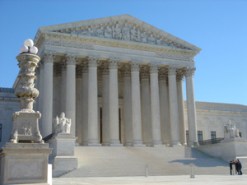
    Supreme Court will hear oral arguments in Medtronic Inc. v. Boston Scientific Corp. on Tuesday, November 5,
    2013.  The sole issue to be determined is
    whether the burden of proof shifts in a declaratory judgment action brought by
    a licensee under MedImmune, such that the licensee has the burden to
    prove that its products do not infringe the patent.  The Federal Circuit had decided this issue in
    the positive, thereby requiring Medtronic as the licensee to establish
    non-infringement of the licensed patents.  However, as we reported previously,
    this case was unique because it arose out of provision in the license that
    provided for a MedImmune-type
    resolution more than 15-years before the Supreme Court decided that case.  As a reminder, the parties (or their
    predecessors-in-interest) had entered into a license agreement in 1991 covering
    cardiac resynchronization therapy ("CRT") devices.  The products that were the subject of this
    case, however, were not marketed until 2004, and therefore (obviously) they
    were not specifically identified in the license.  The provision at issue in this case allowed
    the patent holder to identify any new Medtronic products that it believed were
    covered by its patents.  If Medtronic
    believed that theses identified products were not covered by the license, it
    had the option to initiate a declaratory judgment action to challenge the non-infringement
    and/or validity of the asserted patents.

    Two
    amicus curiae briefs focused on the
    particular language of the license agreement, although in different ways.  First, a collection of law professors
    submitted a brief on behalf of Medtronic, the licensee, noting in part that the
    burden on the patent holder was not "unfair" because the action was
    contemplated by the agreement.  Then,
    Tessera Technologies Inc. ("Tessera") argued that the case should be
    vacated and remanded because the license agreement did not, in fact, give rise
    to federal jurisdiction in this case.

    Legal
    Scholars Amicus Curiae Brief

    A
    collection of law professors filed a brief in support of Medtronic, arguing
    that the "purposes and policy concerns specific to the Declaratory
    Judgment Act and Patent Act favor finding that the Federal Circuit's special
    rule for licensee declaratory judgment actions is unnecessary and
    inappropriate."  The collection
    described itself as "scholars of administrative law, civil procedure, or
    intellectual property law who are interested in the efficient functioning of
    the United States patent system in the service of the public interest."

    To
    argue that the Federal Circuit decision was contrary to public interest, the
    collection of scholars began by explaining the importance of the DJ actions in
    obtaining timely "rights" clearance.  "A prime purpose of the federal Declaratory Judgment Act is to help
    eliminate uncertainty by enabling parties threatened with legal liability to
    obtain timely judicial determination of whether such liability applies."  Therefore, imposing the burden on the
    licensee in these litigations breaks the symmetry of the "mirror-image"
    declaratory judgment versus enforcement actions.  Importantly, this can lead to different
    outcomes.  The burden-of-proof
    differential could cause the patent holder to "win" the DJ action,
    even if it would have lost the mirror-image equivalent enforcement action.  Even though this probability might be very
    small, the scholarly collective pointed out that this relatively small
    discrepancy would sit uneasily with Supreme Court precedent.  In fact, the parties' persistence in this
    case suggests that stakes are larger than they would appear.  The ultimate impact could be that a licensee
    may instead choose to repudiate a license, because there would have a better
    chance (albeit slightly) of success without the shift of burdens.

    The
    consortium of scholars also argued that the burden should not shift to the
    licensees because of the difficulty with proving the negative, especially in
    patent cases.  However, is this
    necessarily true?  For a patent holder to
    successfully allege infringement, it must establish that all claim elements are
    met by the accused product or method.  However, an accused infringer can successfully defend such an allegation
    by demonstrating that a single element is missing.  Moreover, the scholars point out that
    hundreds of claims could be at issue, and "[i]n principle, infringement of
    each such claim might be separately asserted."  Whereas this is true, often many of these
    claims are dependent in nature, and therefore the number of independent claims
    at issue can be significantly less.  And,
    if a licensee can find one element missing from an independent claim, it need
    not concern itself with any of the claims that depend therefrom.  The scholars also highlighted that there can
    be multiple theories of infringement, which would somehow would prejudice
    licensees.  But, if a licensee was able
    to establish an absence of literal infringement, would not the burden of proof
    shift to the patent holder to allege the doctrine of equivalents, or some other
    theory?  While it is true that there may
    be "well-appreciated difficulty in proving a negative," this truism
    might not apply as readily to patent infringement cases.

    The
    scholarly collective also pointed out the practical consideration that such a
    shift in the burden of proof would prove difficult with efficient and
    predictable case management.  Patent
    litigations are apparently more time consuming than all federal cases except
    death penalty Habeas Corpus cases, environmental matters, and civil RICO
    cases.  In fact, many district courts
    have developed local patent rules or standing orders, which do not contemplate
    the shift of burden in these cases.  Until the lower courts can adjust, there will be "uncertainty,
    controversy, and waste" if the Federal Circuit opinion is not overturned.

    Finally,
    this confederation of scholars looked to the particular license at issue in
    this case.  This is not the "typical"
    MedImmune-type declaratory judgment
    action, where without that previous Supreme Court case, the licensee needed to "bet
    the farm" to bring the DJ action.  Instead, in this case, the parties' agreement explicitly provided for
    the bringing of such an action by the licensee.  Therefore, the "fairness" concerns for the patent holder
    expressed at the Federal Circuit are muted, because there was no surprise.  In fact, the patent holder can be argued to
    have disturbed the status quo, the argument goes, because they provided notice
    to the licensee, Medtronic.  Of course,
    this logic can be extended further, because it was not the patent holder in
    this case that introduced a new product that was covered by the license
    (allegedly).  In any event, the scholars
    point out that neither party was disturbing the status quo, because they were
    both merely acting "in accordance with their agreed regime for dispute
    resolution."

    Tessera
    Technologies Inc. Amicus Curiae Brief

    Tessera
    described itself as "a leading provider of miniaturization technologies
    for the electronics industry," and that as a frequent licensor, it has an
    obvious interest in the burden of persuasion question at issue.  In its amicus
    curiae
    brief
    , Tessera began by looking at the license itself, noting that
    the lower courts should not have had subject-matter jurisdiction over this case
    in the first place.  Because the license
    included a "comprehensive contractual royalty dispute resolution
    procedure," whereby the licensee was permitted to file a "nested"
    DJ action, there was no chance that the licensee was going to abandon the
    contract, and as such, a coercive patent infringement action by the licensor
    cannot have been reasonably anticipated.  Therefore, following the logic of the Gunn v. Minton Supreme Court case of last year, the Federal Circuit's
    judgment should be vacated.  Alternatively, Tessera argued that the case should be remanded to
    determine if the question at issue was better determined as a matter of state
    law.

    According
    to precedent, as articulated in Gunn v.
    Minton
    , there are two ways in which federal question jurisdiction can be
    invoked.  The first is where "'federal
    law creates the cause of action asserted.'"  The second is where jurisdiction still lies, even
    though the claim originated in state rather than federal law.  These are a "'special and small category
    of cases."  Importantly, it is the
    character of the threatened action, not the defense, the gives rise to
    jurisdiction.  In the present case, Tessera
    asserted that it was imperative to look to the license, which gives rise to an
    action that is unlike any other patent litigation — the licensee is allowed to
    escrow its contested royalties with the goal of obtaining a complete refund
    upon prevailing in the action; the licensee is not subject to any damages
    (other than the royalty obligations), treble damages, or injunctive relief; and
    the contract has claim preclusive effect, because if the patent holder does not
    follow the specified procedures, no royalty will be owed even if the patent is
    never litigated.  Therefore, according to
    Tessera, what is really being requested in this action is whether Medtronic's
    products fall within the scope of the license agreement.

    Tessera
    then pointed out why the first type of federal question jurisdiction was
    lacking.  In reviewing the cases on the
    issue, Tessera came to the conclusion "that identification of the
    anticipated or threatened coercive claims in declaratory judgment actions
    brought by patent licensees under an existing license turns on the 'totality of
    the circumstances.'"  Because the
    only "threatened" action was contractual (assertion that the accused
    device fell within the scope of the license), there was no chance that
    Medtronic was going to repudiate the license.  Instead, it was able to resolve the patent issue within the context of
    the contract procedure — by filing the present action.  As such, Medtronic's complaint was phrased in
    the past and present continuous sense, with no mention of any fear of future
    termination or patent infringement litigation.  Consequently, no anticipated, impending, or threatened actions could
    have given rise to the first type of federal question jurisdiction at the time.

    Gunn v. Minton
    provided the reasoning as to why the second type of jurisdiction was also
    lacking.  In that case, the Court
    explained that "'federal jurisdiction over a state law claim will lie if a
    federal issue is: (1) necessarily raised, (2) actually disputed, (3)
    substantial, and (4) capable of resolution in federal court without disrupting
    the federal-state balance approved by Congress.'"  And, as in Gunn, the third and fourth factors are missing here.  There would be no substantial impact on
    federal system as a whole.  Instead, the
    preclusive effect would be limited to parties and patents.  In fact, there is a similar "case-within-a-case"
    sub-issue here that is also backward looking, because the patents in this case
    have already expired.  The fourth factor
    is also not met, because state court have had the authority to hear patent
    license disputes, and undoing this prerogative would certainly disrupt the
    balance between the two.  Because the District Court lacked jurisdiction, so did the Federal Circuit, and therefore
    this case should be remanded with instructions to transfer to the Third Circuit
    to see if any other federal subject-matter jurisdiction can be found.

    Alternatively,
    Tessera argued that the case should be vacated because the burden of persuasion
    as to scope of a patent license is normally a state law matter.  As a result, the case should be remanded to
    determine if the parties contracted out this default rule.  If they did not, the lower court should
    determine on remand what burden state law provides in such a case.

    This
    is an interesting and compelling argument as to why the case should be vacated
    and remanded.  However, to reach this
    conclusion, Tessera had to make several assumptions about Supreme Court
    precedent, and how it would apply to the present facts.  It will be interesting to hear any questions
    to counsel directed at this jurisdictional issue.  Unfortunately, the Court denied Tessera's
    request to participate in the argument, but the tenor of the questions for the
    counsel present should be telling. 


  • ActavisActavis
    v Boehringer 
    [2013] EWHC 2927 related to a dispute over the
    combination of telmisartan and hydrochlorothiazide, which was marketed by
    Boehringer and protected by an SPC.  Actavis wanted to sell the combination
    product and believed the SPC to be invalid, but agreed to give an interim
    undertaking not to sell the combination product, pending the resolution of the
    dispute.  In return, Boehringer agreed to give a cross-undertaking.  However, there
    was a dispute over how far the cross-undertaking should extend.

    Boehringer IngelheimActavis
    sought a cross-undertaking that allowed (i) any company in the Actavis group
    and (ii) any customer or potential customer of any company in the Actavis group
    to obtain compensation for any loss it may have suffered as a result of the
    interim undertaking.  Actavis argued that this was appropriate as it covered a
    clearly defined class of persons and allowed for future corporate restructuring.

    Boehringer
    objected that the scope was too wide, as it did not identify the persons to
    whom the cross-undertaking would extend.  It was argued that Actavis must have known
    which companies in their group were involved and the reference to "customers
    or potential customers" was said to be unclear.

    Birss
    J held that any cross-undertaking can extend to any class of persons who may
    justly obtain compensation.  However, the relevant persons must be defined in
    some suitable way, as must the potential loss or harm that may arise.  A
    cross-undertaking was said to be the "price of an injunction" and so
    it is important that the party paying the price knows with reasonable certainty
    what it may be.

    Regarding
    the first group of persons, it was held that the relevant tasks (i.e., selling the
    product) carried out by the Actavis group were clear and that these tasks
    defined the persons affected by the undertaking, as well as the loss they would
    suffer.  It was therefore deemed unnecessary to define exactly which persons in
    the Actavis group would carry out these tasks.  Birss J also agreed with Actavis'
    argument that the proposed wording would save Actavis having to reapply to the
    court each time they are involved in a corporate restructuring.  The court was
    therefore happy that the cross-undertaking should cover the first group of
    persons.

    However,
    reference to the customers and potential customers in the second group was held
    to be unclear, not least because the combination product had not yet been put
    on the market by Actavis and so there were no customers.  Further, "potential
    customers" was said to be extremely vague with no real definition of who
    these could be or what loss they may suffer.  The cross-undertaking should
    therefore not cover the second group of persons.

    Birss
    J also highlighted that third parties, such as customers or potential customers,
    are able to apply to the court to be joined in proceedings such that they can
    benefit from the cross-undertaking.  Allowing the cross-undertaking to extend to
    the second group of persons would prejudge any such application and would
    unfairly extend the scope of the cross-undertaking for the benefit of a few,
    specific third parties.

    It
    is therefore clear that a cross-undertaking does not have to specifically
    define the exact persons to which it extends.  However, its scope must be defined
    in some way to allow the persons covered and the loss that they could suffer to
    be identified, as the party making the cross-undertaking must know the
    potential "price of the injunction."

    This
    report comes from European Patent Attorneys at WP Thompson & Co., 55 Drury Lane,
    London UK.  Further details and commentary can be obtained from Gill Smaggasgale,
    a partner at the firm.

  • By Andrew Williams

    Supreme Court Building #1"In
    the modern economy, licensing of intellectual property rights is a widespread
    and essential activity."  Those are
    the opening lines from the amicus curiae brief
    submitted by the Intellectual Property Owners Association ("IPO") for
    the Medtronic Inc. v. Boston Scientific
    Corp.
    case.  The Supreme Court is set
    to hear oral arguments in that case on Tuesday, November 5, 2013.  The IPO, which represents more than 200
    companies that own or have an interest in U.S. intellectual property rights,
    and one of its members, Koninklijke Philips N.V ("Philips"), both
    submitted briefs in support of Boston Scientific, et al.  Specifically, both
    organizations argued that the Federal Circuit decision should be upheld because
    to decide otherwise would disrupt the balance of power between
    patentee/licensors and licensees, such that it would create disincentives for
    patent holders to enter into license agreements in the first place.  Philips additionally argued that even if the
    Supreme Court were to side with Medtronic and require the patent holder to
    prove infringement in Medimmune-type
    declaratory judgment actions, it should still expressly allow the parties to
    retain the freedom to shift the burden of persuasion in the license agreement.

    As
    a reminder, the sole issue on appeal in that case is whether the burden of
    proof shifts in a declaratory judgment action brought by a licensee under Medlmmune,
    such that the licensee has the burden to prove that its products do not infringe
    the patent.  The Federal Circuit had
    decided this issue in the positive, thereby requiring Medtronic as the licensee
    to establish non-infringement of the licensed patents.  We have previously reported on the respective
    parties' positions (see "Supreme Court Grants Certiorari in Medtronic v. Boston Scientific"),
    as well as the United States' amicus
    curiae
    brief (see "United States Weighs-In on the Medtronic Case")
    in which it took the position that the burden of proving infringement should
    never shift from the patent holder.  Today,
    we report on the amicus curiae briefs
    that took the opposite position (supporting the respondent in this case) — that
    the burden of proof should be on the licensee that brought the suit.  Tomorrow, we will report on both the amicus curiae brief of a collection of
    legal scholars, in which they support the petitioner, Medtronic, as well as that
    of Tessera Technologies, which argued that the lower court lacked
    federal-question jurisdiction, and therefore that the case should be vacated and
    remanded.

    IPO Amicus Curiae Brief

    The
    IPO's position can be summarized with a single sentence from the introduction
    of its brief:  "To permit a licensee to maintain the status quo, force the
    licensor to prove infringement–even where the licensor cannot plead it, let alone
    seek infringement remedies and suffer no negative impact even if the licensee
    loses, would cause a significant imbalance between a patentee-licensor and a
    license."  The IPO approached the question with the recognition that
    license agreements have become essential in the modern economy, allowing
    parties to "settle litigation, to gain access to technology, to generate a
    revenue stream for inventors, and for myriad other reason."  In fact, the brief pointed out that the
    position taken by the Solicitor General "largely ignored the primacy of
    contract law in defining the relationship between the licensor and the
    licensee."  The IPO also pointed out
    that the Federal Circuit's decision does not conflict with the public interest
    in "weeding out" invalid patents, because patent validity is not
    implicated in this case.  No party has
    taken the position that the burden of persuasion should shift with regard to
    proving a patent is invalid, especially considering the heightened "clear
    and convincing" burden-of-proof standard.

    The
    IPO made four main points.  The first was
    to highlight that this case applies in only "the narrowly defined
    circumstances" in which the declaratory judgment defendant (patentee) is
    foreclosed from any infringement remedy, and instead the best to be hoped for
    is the maintenance of the status quo of the previously negotiated license.  In other words, the only party with something
    to gain is the licensee.  The IPO,
    therefore, supported the Federal Circuit's application of the "well-established
    equitable principle" that challengers should bear the burden of
    proof.  To do otherwise "would
    create an unintended loophole," at least from the point of view of the
    patentee-licensor, which could render patent licenses "of little worth."

    Contrary
    to the assertions made in other amicus
    curiae
    briefs, the IPO pointed out that the Federal Circuit's opinion was
    not at odds with MedImmune and it was
    not at odds with the public policy concerns expressed in the Supreme Court case
    of Lear v. Adkins, 395 U.S. 653
    (1969).  With regard to MedImmune, the Supreme Court was silent
    as to which party had the burden of proof, and that issue was not relevant to
    that decision.  Therefore, the Federal
    Circuit Medtronic opinion cannot be at
    conflict with it.  With regard to Lear, the Supreme Court had abolished
    licensee estoppel because the public had an interest in culling invalid and
    unenforceable patents.  In contrast, the MedImmune case only impacts the
    interests of the parties to the license.  Therefore, again, the Federal Circuit opinion cannot be at conflict with
    the Supreme Court.

    Finally,
    the IPO stressed the public policy in encouraging the formation of contracts,
    including settling legal disputes.  If
    the burden of persuasion fell to the patent holder in these types of case, it
    would create disincentives to license the patent in the first place.  The benefit of certainty in entering into a
    license would "obliterated" if the patent holder bared all of the risk
    in the subsequent litigation.  As a
    result, a potential licensor could initiate litigation prior to a license in
    order to "seek a higher, enforceable and more certain recovery."  Otherwise, "licenses would be free to
    challenge any patent claims resolved under an already negotiated, arms-length
    contract."  In other words, the
    licensee could "'have its cake and eat it too.'"  This disparity is even more pronounced in
    relation to settlement agreements.  As
    the IPO put it, "[a] patent owner would be foolish to agree to a
    patent-settlement license under this situation."

    Philips Amicus Curiae Brief

    Philips
    began its brief in support of Boston Scientific by pointing out that it
    (Philips) has been inventing and manufacturing electronics and electrical
    products for at least 120 years.  In
    fact, last year it filed U.S. patent application for over 1300 inventions.  It has been both a licensor and licensee of
    patents, and has an interest in having a clear and appropriate rule regarding
    the issue in the present case — the burden of persuasion in declaratory
    judgment non-infringement cases.  It also
    pointed out that in today's marketplace, consumer products are often covered by
    tens or hundreds of patents.  Licenses to
    such intellectual property are often bundled, and therefore can include weak
    patents along with the strong.  The
    parties to such an agreement are able to assess the relative strengths of those
    bundles, and negotiate appropriately.

    As
    a result, in addition to standing with the IPO brief detailed above, Philips
    separately urged the Supreme Court that, if it should hold that the patent
    holder bears the burden in such case, it should "expressly acknowledge
    that sophisticated parties' retain freedom, via contract, to shift the burden
    of persuasion relating to patent infringement to the licensee."  It pointed out that the Courts have otherwise
    allowed parties to contractually agree to modify litigation rights, such as
    waiving objections to personal jurisdiction and due process rights.  Because the parties are in the best position
    to understand the particular facts of their case, and are able to negotiate and
    bargain based on those fact, they should be able to allocate the burden(s)
    through contract.

    Philips
    concluded by noting that the amicus
    brief by Tessera Technologies is in agreement with the proposition that "sophisticated
    parties should be free to shift the burden of persuasion as they deem
    appropriate by contract."  We will
    detail that brief tomorrow, as well as the final amicus brief that was filed by a coalition of legal scholars.

  •         By Sherri Oslick

    Gavel About Court Report:  Each week we will report briefly on recently filed biotech and pharma cases.

    Teijin
    Ltd. et al. v. Dr. Reddy's Laboratories Ltd., et al.

    1:13-cv-01780;
    filed October 30, 2013 in the District Court of Delaware

    • Plaintiffs: 
    Teijin Ltd.; Teijin Pharma Ltd.; Takeda Pharmaceuticals USA, Inc.
    • Defendants: 
    Dr. Reddy's Laboratories Ltd.; Dr. Reddy's Laboratories Inc.

    Teijin
    Ltd. et al.. v. Mylan Pharmaceuticals Inc.

    1:13-cv-01781;
    filed October 30, 2013 in the District Court of Delaware

    • Plaintiffs: 
    Teijin Ltd.; Teijin Pharma Ltd.; Takeda Pharmaceuticals USA, Inc.
    • Defendant: 
    Mylan Pharmaceuticals Inc.

    The
    complaints in these cases are substantially identical.  Infringement of U.S. Patent No. 6,225,474 ("Polymorphs
    of 2-(3-cyano-4-isobutyloxyphenyl)-4-methyl-5-thiazolecarboxylic acid and
    Method of Producing the Same," issued May 1, 2001) following a Paragraph
    IV certification as part of defendants' filing of an ANDA to manufacture a
    generic version of Takeda's Uloric® (febuxostat, used for the chronic
    management of hyperuricemia in patients with gout).  View the Dr.
    Reddy's
    complaint here.


    Warner
    Chilcott Co., LLC v. Mylan Inc. et al.

    3:13-cv-06560;
    filed October 30, 2013 in the District Court of Delaware

    • Plaintiff:  Warner
    Chilcott Co., LLC
    • Defendants: 
    Mylan Inc.; Mylan Pharmaceuticals Inc.; Famy Care Ltd.

    Infringement
    of U.S. Patent No. 7,704,984 ("Extended Estrogen Dosing Contraceptive
    Regimen" issued April 27, 2010) following a Paragraph IV certification as
    part of Mylan's filing of an ANDA to manufacture a generic version of Warner
    Chilcott's Lo Loestrin® Fe (norethindrone acetate and ethinyl estradiol
    tablets, and ethinyl estradiol and ferrous fumarate tablets, used for oral
    contraception).  View the complaint here.


    Reckitt
    Benckiser Pharmaceuticals, Inc. et al. v. BioDelivery Sciences International,
    Inc.

    5:13-cv-00760;
    filed October 29, 2013 in the Eastern District of North Carolina

    • Plaintiffs: 
    Reckitt Benckiser Pharmaceuticals, Inc.; RB Pharmaceuticals Ltd.; MonoSol
    Rx, LLC
    • Defendant: 
    BioDelivery Sciences International, Inc.

    Infringement
    of U.S. Patent No. 8,475,832 ("Sublingual and Buccal Film Compositions,"
    issued July 2, 2013) in conjunction with BioDelivery's filing of an NDA (under
    § 505(b)(2) of the Food, Drug and Cosmetic Act) to manufacture its Bunavail
    product, comparable to Reckitt Benckiser's Suboxone® film (buprenorphine
    hydrochloride and naloxone hydrochloride sublingual film, used for the
    maintenance treatment of opioid dependence). 
    View the complaint here.


    Cipher
    Pharmaceuticals, Inc. et al. v. Watson Laboratories, Inc.-Florida et al.

    2:13-cv-06502;
    filed October 29, 2013 in the District Court of New Jersey

    • Plaintiffs: 
    Cipher Pharmaceuticals, Inc.; Galephar Pharmaceutical Research, Inc.; Ranbaxy,
    Inc.; Ranbaxy Pharmaceuticals, Inc.
    • Defendants: 
    Watson Laboratories, Inc.-Florida; Andrx Corp.; Actavis Pharma, Inc.; Actavis,
    Inc.

    Infringement
    of U.S. Patent No. 8,367,102 ("Pharmaceutical Semi-Solid Composition of
    Isotretinoin," issued February 5, 2013) following a Paragraph IV
    certification as part of Watson's filing of an ANDA to manufacture a generic
    version of Ranbaxy's Absorica® (isotretinoin, used for the treatment of severe
    recalcitrant nodular acne).  View the
    complaint here.


    Takeda
    Pharmaceutical Co. et al. v. Wockhardt Bio AG et al.

    3:13-cv-06427;
    filed October 25, 2013 in the District Court of New Jersey

    • Plaintiffs: 
    Takeda Pharmaceutical Co.; Takeda Pharmaceuticals U.S.A., Inc.;
    Takeda Pharmaceuticals America, Inc.
    • Defendants: 
    Wockhardt Bio AG; Wockhardt Ltd.; Wockhardt USA LLC.

    Infringement
    of U.S. Patent Nos. 6,328,994 ("Orally Disintegrable Tablets," issued
    December 11, 2001), 7,431,942 ("Orally Disintegrable Tablets," issued
    October 7, 2008), 7,399,485 ("Rapidly Disintegrable Solid Preparation,"
    issued July 15, 2008), and 7,875,292 ("Orally Disintegrable Tablets,"
    issued January 25, 2011) following a Paragraph IV certification as part of
    Wockhardt's filing of an ANDA to manufacture a generic version of Takeda's
    Prevacid® SoluTab (lansoprazole delayed release orally disintegrating tablets,
    used to treat ulcers, gastroesophageal reflux disease, erosive esophagitis, and
    pathological hypersecretory conditions, including Zollinger-Ellison
    syndrome).  View the complaint here.


    Ferring B.V.
    v. Apotex, Inc. et al.

    3:13-cv-00595;
    filed October 25, 2013 in the District Court of Nevada

    • Plaintiff: 
    Ferring B.V.
    • Defendants: 
    Apotex, Inc.; Apotex Corp.

    Infringement
    of U.S. Patent No. 8,487,005 ("Tranexamic Acid Formulations," issued
    July 16, 2013), 7,947,739 (same title, issued May 24, 2011) following a
    Paragraph IV certification as part of Aptoex's filing of an ANDA to manufacture
    a generic version of Ferring's Lysteda® (tranexamic acid, used to treat heavy
    menstrual bleeding).  View the complaint here.


    Dow
    Pharmaceutical Sciences, Inc. et al. v. Actavis, Inc. et al.

    2:13-cv-06401;
    filed October 24, 2013 in the District Court of New Jersey

    • Plaintiffs: 
    Dow Pharmaceutical Sciences, Inc.; Valeant Pharmaceuticals North America LLC
    • Defendants: 
    Actavis, Inc.; Watson Laboratories, Inc.; Andrx Corp.; Watson Pharma, Inc.

    Infringement
    of U.S. Patent No. 8,288,434 ("Topical Pharmaceutical Formulations
    Containing a Low Concentration of Benzoyl Peroxide in Suspension in Water and a
    Water-Miscible Organic Solvent," issued October 16, 2012) following a
    Paragraph IV certification as part of defendants' filing of an ANDA to
    manufacture a generic version of Dow's Acanya® (clindamycin phosphate and
    benzoyl peroxide gel, 1.2%/2.5%, used to treat acne).  View the complaint here.


    Warner
    Chilcott Co., LLC et al. v. Impax Laboratories, Inc.

    2:13-cv-06403;
    filed October 23, 2013;  in the District
    Court of New Jersey

    • Plaintiffs: 
    Warner Chilcott Co., LLC; Warner Chilcott (US), LLC
    • Defendant: 
    Impax Laboratories, Inc.

    Infringement
    of U.S. Patent Nos. 7,645,459 ("Dosage Forms of Bisphosphonates,"
    issued January 12, 2010), 7,645,460 ("Dosage Forms of Risedronate"
    issued January 12, 2010), and 8,246,989 ("Dosage Forms of Bisphosphonates"
    issued August 21, 2012) following a Paragraph IV certification as part of Impax's
    filing of an ANDA to manufacture a generic version of Warner Chilcott's Atelvia
    (risedronate sodium delayed-release, used to treat osteoporosis in women after
    menopause).  View the complaint here.


    Acella
    Pharmaceuticals, LLC v. Chemo S.A. France

    2:13-cv-00573;
    filed October 22, 2013 in the Eastern District of Virginia

    Declaratory
    judgment of invalidity of U.S. Patent No. 8,183,227 ("Compositions, Kits
    and Methods for Nutrition Supplementation," issued May 22, 2012), licensed
    to Everett Laboratories, Inc., relating to Everett's filing of a suit alleging
    infringement of the '227 patent based on Acella's manufacture and sale of its
    PNV-First product, an alleged copy of Everett's Vitafol®-One (prescription
    prenatal nutritional supplement).    View
    the complaint here.