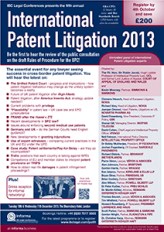
• LondonIBC Legal Conferences will be holding its 5th annual International Patent Litigation conference on December 10-11, 2013 in London.  IBC Legal faculty will offer presentations on the following topics:

    • The Unified Patent Court — progress and implications — How patent litigation behaviour may change as the unitary system becomes a reality;
    • Future of UK patent litigation after Virgin Atlantic;
    • Patent litigation, after America Invents Act: Strategy update needed?
    • Current problems with privilege;
    • "Plausibility" in patent law — UK case law and EPO jurisprudence;
    • FRAND after the Huawei v. ZTE;
    • Recent developments in SPC law?
    • Issues around enforcing second medical use patents;
    • Germany and UK — Do the German Courts need English guidance?
    • New developments in granting injunctions;
    • Use of expert witnesses — Comparing current practices in the UK and EU under the UPC;
    • Patent settlements/Pay-for-Delay — Are they so incompatible?
    • Trolls: Positions that each country is taking against NPEs;
    • Competence of EU and member states to interpret patent provisions on TRIPS; and
    • How to obtain real-life damages in patent infringement proceedings?

    Brochure CoverA complete brochure for this conference, including an agenda, detailed descriptions of conference sessions, list of speakers, and registration form can be obtained here.

    The registration fee for the conference is £1,499.  Those interested in registering for the conference can do so here, by e-mailing professionalcustserv@informa.com, by calling +44 (0)20 7017 5503, or by faxing a registration form to +44 (0)20 7017 4746.

  • Technology Transfer Tactics will be offering a webinar entitled "Using Competitive Technical Intelligence Techniques to Assess University Patents" on December 12, 2013 from 1:00 – 2:00 pm (Eastern).  Alan Porter, Professor Emeritus of Industrial & Systems Engineering, and of Public Policy, Georgia Institute of Technology; Barry Brager, Founder and Managing Partner of Perception Partners®; and Laura A. Schoppe, president of Fuentek, LLC will help attendees adopt the key methods and tools they use to improve their IP assessments and apply high-level market and competition analysis to their early-stage technologies, and also focus on how to systematically use Competitive Technical Intelligence (CTI) for detailed technology assessment and decision-making.  The webinar will cover the following topics:

    • Demystify CTI through a case study approach
    • Understand your IP's value proposition, market share and application potential
    • How to keep your budget in check while maintaining high quality data
    • Identify emerging trends in a technology space for:
        – Research and development
        – Licensing
        – Sales
    • Identify competitive threats and risks when developing IP
    • Visualize how the technology landscape is changing and where your IP fits in
    • Find and leverage information on market players, products, and positioning
    • Use CTI to help set achievable goals
    • Craft useful deliverables that deliver clear messages to the non-technical/rushed/executive mindset

    The registration fee for the webinar is $197.  Those interested in registering for the webinar, can do so here.

    Technology Transfer Tactics

  • By Donald Zuhn

    Sanofi-AventisLast week, in Sanofi-Aventis v. Pfizer Inc., the Federal Circuit affirmed an award of priority to Pfizer by the Board of Patent Appeals and Interferences in an interference involving the cDNA for the human interleukin-13 receptor binding chain (IL-13bc).  In particular, the appeal concerned the Board's decision with respect to the following count:

    Count 3.  The isolated protein of 6,268,480 claim 4;

    OR

    The isolated polynucleotide of 5,710,023 claim 1, selection (b) (an isolated polynucleotide comprising a nucleotide sequence of SEQ ID NO:3 from nucleotide 103 to nucleotide 1242).

    PfizerAs the Federal Circuit noted, the parties disagreed as to the dispositive question in the interference, with Pfizer arguing that the question was "who first had in hand the actual isolated DNA of the count and appreciated its IL-13bc function," and Sanofi arguing that the question was "the date each party first knew the complete sequence" of nucleotides 103 to 1242 (i.e., the protein encoding portion of IL-13bc).  In the interference, Sanofi was awarded the benefit of its December 6, 1995 priority date, and Pfizer presented evidence that by October 16, 1995, it had isolated a clone for human IL-13bc from a human cDNA library.  While the sequencing of that human IL-13bc clone was completed by November 15, 1995, eight possible errors were subsequently identified in the 1143-nucleotide sequence, yielding an amino acid sequence that was correct at 379 of 380 residues.  Although the Board concluded that Pfizer did not have a corrected sequence until February 7, 1996, it nevertheless determined that Pfizer had established conception of the subject matter of the count when it selected, isolated, and obtained the desired IL-13bc full-length polynucleotide and verified that it was the desired product, regardless of whether the fully correct sequencing of the polynucleotide was complete.

    On appeal, Sanofi argued that by awarding priority to Pfizer, the Board had erred as a matter of law.  In particular, Sanofi argued that Pfizer cannot be credited with conception before December 6, 1995 (Sanofi's date) because Pfizer's sequence analysis was in error as to eight nucleotides.  In other words, Sanofi contended that until Pfizer had correctly analyzed the polynucleotide, neither conception nor reduction to practice could occur, because Federal Circuit precedent requires the full and correct nucleotide sequence to establish conception and reduction to practice.  In support of its argument, Sanofi pointed to Amgen Inc. v Chugai Pharmaceutical Co., 927 F.2d 1200 (Fed. Cir. 1991), Fiers v. Revel, 984 F.2d 1164 (Fed. Cir. 1993), and Burroughs Wellcome Co. v. Barr Laboratories, Inc., 40 F.3d 1223 (Fed. Cir. 1994).

    In affirming the Board's award of priority to Pfizer, the Federal Circuit indicated that Amgen did not support Sanofi's argument that Pfizer did not, as a matter of law, have a complete conception until Pfizer had the full correct nucleotide sequence.  Instead, "[t]he court in Amgen held that when 'an inventor is unable to envision the detailed constitution of a gene' there may nonetheless be conception and reduction to practice of the gene when the inventor is in possession of the gene and a method for its preparation, i.e. 'after the gene has been isolated,' accompanied by knowledge of 'other characteristics sufficient to distinguish it from other genes.'"  In this case, "[t]he Pfizer activity meets these criteria."  With respect to Fiers, which Sanofi argued established a per se rule that conception of an isolated DNA requires the full and correct nucleotide sequence, the Federal Circuit noted that "[t]he Board distinguished Fiers and Amgen as holding that conception and reduction to practice did not occur until the gene was isolated, for in those cases neither structure nor definitive properties had been established for the isolated gene," and indicated that "Amgen and Fiers did not hold, as Sanofi asserts, that conception requires the complete and correct sequencing of the isolated DNA; the court instead referred to 'whatever characteristics sufficiently distinguish it.'"  With respect to Sanofi's citation of Burroughs Wellcome, the Court stated that this case "did not change these requirements, in holding that conception requires that the claimed DNA is possessed as a physical embodiment," adding that "[k]nowledge of the specific nucleotide sequence was not required in Burroughs Wellcome."

    The Federal Circuit explained that its "[p]recedent illustrates a variety of circumstances in which this requirement was met although the complete nucleotide sequence was not known," citing Enzo Biochem, Inc. v. Gen-Probe Inc., 323 F.3d 956 (Fed. Cir. 2002) (upholding claims for DNA probes that were made available by deposit in a public depository although the nucleotide sequence had not been determined); University of New Mexico v. Knight, 321 F.3d 1111 (Fed. Cir. 2003) (explaining that "a chemical structure is simply a means of describing a compound; it is not the invention itself"); and In re Wallach, 378 F.3d 1330 (Fed. Cir. 2004) (finding that the inventors were in possession of a protein that was described by a partial amino acid sequence in addition to other characteristics sufficient to identify it).  Stating that "[w]hen the subject matter is a DNA segment, conception requires possession and appreciation of the DNA segment that is claimed," the Federal Circuit concluded that "the Board correctly based conception and reduction to practice on the possession of the isolated DNA segment that was shown to have the desired properties."  The Court therefore concluded that the Board had applied the correct law, and affirmed the Board's award of priority to Pfizer.

    Sanofi-Aventis v. Pfizer Inc. (Fed. Cir. 2013)
    Panel: Circuit Judges Newman and Lourie and District Judge Davis, sitting by designation
    Opinion by Circuit Judge Newman

  • By Donald Zuhn

    AstraZeneca_smallIn an appeal decided last month, the Federal Circuit reversed and remanded a decision of noninfringement by the District Court for the District of New Jersey with respect to U.S. Patent No. 7,524,834, and affirmed the District Court's finding of obviousness with respect to U.S. Patent No. 6,598,603.  The panel also affirmed the District Court's dismissal of invalidity counterclaims brought by Defendants-Cross Appellants Apotex, Inc. and Apotex Corp., and the lower court's decisions regarding the bond amount.

    The '834 patent is directed to a sterile, pharmaceutically effective budesonide product, which is used to treat asthma in children.  Claims 1 and 50 of the '834 patent recite (emphasis in opinion):

    1.  A pharmaceutically acceptable micronized powder composition at least 98.5% by weight of which is pure budesonide or an ester, acetal or salt thereof, wherein the composition meets the criteria of sterility according to the US Pharmacopoeia [sic] 23/NF18, 1995, pages 1686-1690 and 1963-1975. ’834 Patent col. 11 ll. 48–52.

    50.  A pharmaceutically acceptable suspension consisting of a micronized powder composition at least 98.5% by weight of which is pure budesonide or an ester, acetal or salt thereof suspended in an aqueous solution, wherein the suspension meets the criteria of sterility according to the US Pharmacopoeia [sic] 23/NFl8, 1995, pages 1686-1690 and 1963-1975.

    The '603 patent is directed to a once-daily treatment of patients with budesonide administered by nebulizer.  Independent claim 1 of the '603 patent recites:

    1.  A method of treating a patient suffering from a respiratory disease, the method comprising administering to the patient a nebulized dose of a budesonide composition in a continuing regimen at a frequency of not more than once per day.

    AstraZeneca markets a "once-daily nebulized budesonide suspension used to treat asthma in children" under the name Pulmicort Respules®.

    Seeking approval to market generic versions of AstraZeneca's Pulmicort Respules® drug, Appellees Breath Ltd.; Apotex, Inc. and Apotex Corp.; Sandoz, Inc.; and Watson Laboratories, Inc. filed Abbreviated New Drug Applications (ANDAs) with the FDA.  In response to those ANDA filings, AstraZeneca brought suit against the Appellees for induced infringement of the patents at issue, and the Appellees counterclaimed for declaratory judgments of invalidity and noninfringement.

    Apotex #1With respect to Appellees Apotex, Inc. and Apotex Corp. (Apotex), the District Court granted AstraZeneca's request for a preliminary injunction, preventing Apotex from launching its generic product, subject to AstraZeneca's posting of a bond.  In response to a motion made by Apotex at trial, the District Court increased the bond amount to cover future damages, but refused to increase the bond amount to cover past damages.  Following a bench trial, the District Court found that claims 50 and 51 of the '834 patent were not infringed by Apotex and Sandoz, and that claims 1, 2, 50, and 51 of the '834 patent were not infringed by Breath and Watson.  Although the District Court determined that Appellees' labels induce infringement of claims 1-3, 7, 8, 12-17, and 24-28 of the '603 patent, the lower court also found these claims invalid as anticipated and obvious.  Finally, the District Court declined to exercise jurisdiction over Apotex's invalidity counterclaims directed to certain claims of the '603 patent (the lower court had first dismissed AstraZeneca's assertion of infringement with respect to these same claims).

    The District Court's finding of noninfringement with respect to the '834 patent was based on the lower court's construction of the phrase "micronized powder composition" as meaning "heat sterilized finely divided dry particles."  The District Court also determined that "heat sterilized" refers to "particles that have been sterilized through a process, consistent with heat sterilization, that allows them to essentially maintain the same pharmacological activity, physico-chemical properties, chemical purity, and physical form as the starting material."  AstraZeneca argued that the District Court erred by importing limitations into the claims because the plain meaning of the phrase "micronized powder composition" has nothing to do with heat sterilization.  In reversing and remanding the District Court's finding of noninfringement, the Federal Circuit noted that "[w]ith respect to the ordinary, plain meaning of the term 'micronized powder composition,' none of the three words imposes, or even implies, any form of sterilization."  While acknowledging that "[t]here is no dispute that the patent refers only to dry heat sterilization as the preferred method of achieving the claimed 'micronized powder composition' and criticizes, often sharply, other forms of sterilization," the panel determined that such criticism did not rise to the level of a disavowal of the phrase's otherwise plain meaning.  Noting that the '834 patent describes processes, products, and methods of use, the opinion states that "[a]t most, the specification is confusing with respect to whether it limits only the disclosed process to a specific form of sterilization or both the process and the disclosed product to a specific form of sterilization," adding that this "confusion leaves available an interpretation of the patent that the products, as opposed to the processes, are not limited to any particular form of sterilization."  Because the Court could not conclude that AstraZeneca disclaimed non-heat sterilized micronized powder compositions, the panel determined that the District Court erred by adding the "heat sterilized" limitation into the asserted claims, and that a more accurate construction of the phrase "micronized powder composition" would be "finely divided dry particles."

    As for the District Court's finding of invalidity with respect to the asserted claims of the '603 patent, the lower court determined that the '603 patent disclosed "once-daily dosing of nebulized budesonide" and that a skilled artisan would have been motivated to arrive at this "obvious conclusion."  In particular, the District Court found that the prior art included numerous studies that "taught the safety and efficacy of once-daily inhaled budesonide," including once-daily treatment of children and that practitioners would attempt to titrate a drug dose down to the lowest possible dose, i.e., a once-a-day dose.  The District Court also found that the prior art taught that nebulizers were the "most practical delivery device for certain patients like young children."  In affirming the District Court's finding of obviousness, the panel identified no clear error in the lower court's underlying factual determinations, and determined that those facts established by clear and convincing evidence that the asserted claims of the '603 Patent are obvious.

    With respect to the District Court's decision to decline jurisdiction over Apotex's invalidity claims, the panel declined to say that the lower court abused its discretion in dismissing those counterclaims, as "[t]he decision whether to accept jurisdiction of a Declaratory Judgment counterclaim is quintessentially left to the discretion of the district court."

    Finally, with respect to District Court's decisions regarding the bond amount, the Federal Circuit first noted that a bond amount is a procedural issue that is not unique to patent law, and therefore, that the law of the Third Circuit applied.  Looking to the Third Circuit's decision in Sprint Commc'n Co. v. Cat Commc'n Int'l, 335 F.3d 235 (3d Cir. 2003), the Federal Circuit concluded that "the Third Circuit would consider improper an increase to cover past damages even in the present circumstances."  In affirming the District Court's refusal to increase the bond amount to cover past damages, the opinion explains that:

    AstraZeneca expected that its liability would be limited to the bond amount before Apotex's motion.  AstraZeneca cannot be fairly informed after it obtained the benefit of the injunction that it must later pay more for the benefit it already obtained in order to obtain the benefit of a continued injunction.  The bond would no longer serve to cabin or fix liability, and that would result in an unexpected liability, which Sprint sought to prohibit.  It is immaterial whether the injunction has been dissolved, as in Sprint, or continues, as it does here.  Either way: the party securing the injunction decided to accept the preliminary relief by posting the bond required at the time.  Later requiring that party to post a higher bond for a period that already has passed results in a situation where that bond no longer fixes exposure or caps liability.  The party no longer simply could withdraw its request for an injunction over that period because that period already would have passed.


    AstraZeneca LP v. Breath Ltd.
    (Fed. Cir. 2013)

    Nonprecedential disposition
    Panel: Chief Judge Rader and Circuit Judges Bryson and Linn
    Opinion by Circuit Judge Linn

  • By Andrew Williams

    NPRIn May of this year, the NPR podcast "Planet Money" released an episode entitled "When Patents Hit the Podcast."  At that time, we reported on this podcast, and the misconceptions of the patent system that the show perpetuated (see "When NPR Podcasters Hit the Patent System").  NPR rebroadcast the episode last week, including an update related to the podcasting patent that was featured in that show, owned by Personal Audio LLC ("Personal Audio").  Even though that patent does not deal with the Biotech or Pharmaceutical industry, the criticisms that the show levied against the patent system affect all patents.  Therefore, an update of our story seemed appropriate.

    EFFAs suggested, the majority of the Podcast was a straight repeat of the earlier show.  One of the updates provided was a description of the recently introduced patent-reform legislation.  The only other update was a report that, as Planet Money host Zoe Chace put it, the Electronic Frontier Foundation ("EFF") recently filed "a complaint" with the Patent Office saying that the podcast patent "should not exist."  The EFF is an organization that describes itself as a "donor-funded nonprofit" that "has championed the public interest in every critical battle affecting digital rights."  The originally aired episode explained that the EFF was seeking to invalidate this patent at the United States Patent Office.  The EFF has now filed a petition for inter partes review of U.S. Patent No. 8,112,504 ("System for Dissmeinating Media Content Representing Episodes in a Serialized Sequence"), the so-called podcasting patent.  Interestingly, the EFF basically crowd-sourced both the cost of filing the petition, and the technological substance found within the petition.  A link can still be found on the EFF website for the "Save Podcasting" donation page, on which it is reported that the original goal of $30,000 was met in under 10 hours.  The website solicited donations at levels from its Silicon/Student Member ($25) to as high as its Super Major Donor ($2,500).  The site reports having received $76,890 to date, although it does not indicate what it will do with the excess money, other than its work to "stop trolls and stupid patents for good."

    With regard to the art cited in the petition, the EFF appears to have crowd-sourced this information also.  The EFF website contains a link labeled "Prior Art," which opens an "Ask Patents" webpage requesting help to "bust a patent being asserted against podcasting."  Claim 31, the claim that has been asserted against several podcasters, reads as follows:

    13. Apparatus for acquiring and reproducing media files representing episodes in a series of episodes as said episodes become available, said apparatus comprising: a digital memory, a communications port coupled to the Internet for transmitting data requests for data identified by specified URLs, for receiving downloaded data identified by said URLs in response to said requests, and for storing said downloaded data in said digital memory, and a processor coupled to said digital memory and to said communications port for executing one or more utility programs for: performing, from time to time, one of a sequence of update operations, each of said update operations comprising: downloading via the Internet the current version of a compilation file identified by a predetermined known URL, and storing attribute data contained in said current version of said compilation file in said digital memory, said attribute data describing one or more episodes in a series of episodes, said attribute data for each given one of said episodes including one or more episode URLs identifying one or more corresponding media files representing said given one of said episodes, accepting a selection of a particular episode described by attribute data stored in said digital memory by the operator of said apparatus, downloading and storing the particular media file identified by an episode URL included in the attribute data for said particular episode if said particular media file is not already stored in said digital memory, and reproducing said particular media file in a form perceptible to said operator.

    This patent claims priority back to October 2, 1996.  The Planet Money hosts noted that Personal Audio originally distributed magazine content via audio tapes.  They joked, therefore, that the patent could be invalidated by any teenager in the 1980s that created a mixed tape.  Clearly, such a tape would not invalidate the above claim (which speaks volumes regarding the patent sophistication of the Planet Money reporters).  The EFF, on the other hand, has an understanding of the patent system, even if they are skeptical of it.  They requested on the webpage "prior art that describes accessing a series of media files organized as episodes, tracks, installments, or the like, through the use of "compilation" data that (a) available to be downloaded by a client device, and (b) updated to describe the media files that are currently available."  To date, they received 107 answers.

    The inter partes review petition for the '504 patent references three different prior art "publications" that were alleged to anticipate or render obvious at least claims 31-35 of the patent.  The first piece of prior art included was the "Geek of the Week" Internet talk radio show.  The first two grounds referenced in the petition were (1) the website http://www.ncsa.uiuc.edu/radio/radio.html, appearing on April 22, 1993, and (2) the April 22, 1993 edition of the SurfPunk Technical Journal.  These "publications" were cited as 35 U.S.C. § 102(b) prior art.  The first of these publications was one of the webpages for the "Geek of the Week" Internet talk radio show.  The SurfPunk Technical Journal publication, on the other hand, republished the "Geek of the Week" webpage as it existed on April 22, 1993.  The petition also included a third ground for invalidity related to the Geek of the Week publications themselves.  In an abundance of caution, the EFF alleged that the Geek of the Week publications collectively contained all of the limitations, and therefore rendered the claims 31-35 obvious.  To help provide some context of these early "podcasts," the Planet Money updated episode contained some of the audio from these early "Geek of the Week" shows.

    The second prior art reference was a Canadian Broadcasting Corporation ("CBC") Radio Article, which appeared on January 1, 1996, and which described an Internet radio trial that was available on demand beginning in December 1993.  This article allegedly described the "availability of regularly-updated episodic radio programs on a web page at a predetermined location."  This was cited as 35 U.S.C. § 102(a) prior art.  Finally, the third prior art publication was the "Internet CNN Newsroom," which was a master's thesis submitted to MIT in May 1995, and made available on August 10, 1995.  Apparently the limitation of an "updated" compilation file was missing from the publication, but the EFF alleged that such a file would have been an obvious design choice.

    We take no position on the merits of this inter partes review petition, but we will continue to monitor its progress.  As we noted at the time, such a proceeding is a completely legitimate mechanism to address these so-call "bad" patents that people consider to be overbroad.  It would appear that if the EFF's characterization of these prior art publications is correct, even if they do not serve to invalidate the claims, it is a distinct possible that the claims will be narrowed such that Personal Audio will no longer be able to assert them against podcasters.  This is because the cited art appears to be similar to the same activity that gave rise to the demand letters and infringement lawsuits (such as the dissemination of podcasts like Marc Maron's WTF podcast and "The Adam Carolla Show").  Of course, we have not yet heard from Personal Audio, because they have filed no response yet with the Patent Office.  Nevertheless, it would not be surprising if Personal Audio was able to identify some distinction between their claims and these Internet radio shows from years earlier.

  • By
    Kevin E. Noonan

    NIHLast
    week, the National Institutes of Health denied a petition from a coalition of "public
    interest" groups who petitioned the agency to exercise so-called "march-in
    rights" under provisions of the Bayh-Dole Act against Abbott (now, AbbVie)
    over its antiretroviral drug ritonavir, exclusively sold by Abbott Laboratories
    under the name Norvir®.  These
    rights, and the conditions triggering their exercise, are set forth in 35
    U.S.C. § 203:

    35 USC § 203 – March-in rights

    (a)
    With respect to any subject invention in which a small business firm or
    nonprofit organization has acquired title under this chapter, the Federal
    agency under whose funding agreement the subject invention was made shall have
    the right, in accordance with such procedures as are provided in regulations
    promulgated hereunder to require the contractor, an assignee or exclusive
    licensee of a subject invention to grant a nonexclusive, partially exclusive,
    or exclusive license in any field of use to a responsible applicant or
    applicants, upon terms that are reasonable under the circumstances, and if the
    contractor, assignee, or exclusive licensee refuses such request, to grant such
    a license itself, if the Federal agency determines that such—

    (1) action is necessary because the contractor or assignee has not taken, or
    is not expected to take within a reasonable time, effective steps to achieve
    practical application of the subject invention in such field of use;
    (2) action is necessary to alleviate health or safety needs which are not
    reasonably satisfied by the contractor, assignee, or their licensees;
    (3) action is necessary to meet requirements for public use specified by
    Federal regulations and such requirements are not reasonably satisfied by the
    contractor, assignee, or licensees; or
    (4) action is necessary because the agreement required by section 204 has not
    been obtained or waived or because a licensee of the exclusive right to use or
    sell any subject invention in the United States is in breach of its agreement
    obtained pursuant to section 204.

    (b) A determination pursuant to this section or section 202 (b)(4) shall not be
    subject to chapter 71 of title 41. An administrative appeals procedure shall be
    established by regulations promulgated in accordance with section 206.
    Additionally, any contractor, inventor, assignee, or exclusive licensee
    adversely affected by a determination under this section may, at any time
    within sixty days after the determination is issued, file a petition in the
    United States Court of Federal Claims, which shall have jurisdiction to
    determine the appeal on the record and to affirm, reverse, remand or modify, as
    appropriate, the determination of the Federal agency. In cases described in
    paragraphs (1) and (3) of subsection (a), the agency's determination shall be
    held in abeyance pending the exhaustion of appeals or petitions filed under the
    preceding sentence.

    Regulations
    on how these rights can be petitioned for exercise by the relevant Federal
    agencies (such as the National Institutes of Health) have been promulgated:

    37 C.F.R. § 401.6 Exercise of march-in rights.

    (a)
    The following procedures shall govern the exercise of the march-in rights of
    the agencies set forth in 35 U.S.C. 203 and paragraph (j) of the clause at §
    401.14.

    (b)
    Whenever an agency receives information that it believes might warrant the
    exercise of march-in rights, before initiating any march-in proceeding, it
    shall notify the contractor in writing of the information and request informal
    written or oral comments from the contractor as well as information relevant to
    the matter. In the absence of any comments from the contractor within 30 days,
    the agency may, at its discretion, proceed with the procedures below. If a
    comment is received within 30 days, or later if the agency has not initiated
    the procedures below, then the agency shall, within 60 days after it receives
    the comment, either initiate the procedures below or notify the contractor, in
    writing, that it will not pursue march-in rights on the basis of the available
    information.

    (c)
    A march-in proceeding shall be initiated by the issuance of a written notice by
    the agency to the contractor and its assignee or exclusive licensee, as
    applicable and if known to the agency, stating that the agency is considering
    the exercise of march-in rights. The notice shall state the reasons for the
    proposed march-in in terms sufficient to put the contractor on notice of the
    facts upon which the action would be based and shall specify the field or
    fields of use in which the agency is considering requiring licensing. The
    notice shall advise the contractor (assignee or exclusive licensee) of its
    rights, as set forth in this section and in any supplemental agency
    regulations. The determination to exercise march-in rights shall be made by the
    head of the agency or his or her designee.

    (d)
    Within 30 days after the receipt of the written notice of march-in, the
    contractor (assignee or exclusive licensee) may submit in person, in writing,
    or through a representative, information or argument in opposition to the
    proposed march-in, including any additional specific information which raises a
    genuine dispute over the material facts upon which the march-in is based. If
    the information presented raises a genuine dispute over the material facts, the
    head of the agency or designee shall undertake or refer the matter to another
    official for fact-finding.

    (e)
    Fact-finding shall be conducted in accordance with the procedures established
    by the agency. Such procedures shall be as informal as practicable and be
    consistent with principles of fundamental fairness. The procedures should
    afford the contractor the opportunity to appear with counsel, submit documentary
    evidence, present witnesses and confront such persons as the agency may
    present. A transcribed record shall be made and shall be available at cost to
    the contractor upon request. The requirement for a transcribed record may be
    waived by mutual agreement of the contractor and the agency. Any portion of the
    march-in proceeding, including a fact-finding hearing that involves testimony
    or evidence relating to the utilization or efforts at obtaining utilization
    that are being made by the contractor, its assignee, or licensees shall be
    closed to the public, including potential licensees. In accordance with 35
    U.S.C. 202(c)(5), agencies shall not disclose any such information obtained
    during a march-in proceeding to persons outside the government except when such
    release is authorized by the contractor (assignee or licensee).

    (f)
    The official conducting the fact-finding shall prepare or adopt written
    findings of fact and transmit them to the head of the agency or designee
    promptly after the conclusion of the fact-finding proceeding along with a
    recommended determination. A copy of the findings of fact shall be sent to the
    contractor (assignee or exclusive licensee) by registered or certified mail.
    The contractor (assignee or exclusive licensee) and agency representatives will
    be given 30 days to submit written arguments to the head of the agency or
    designee; and, upon request by the con- tractor oral arguments will be held
    before the agency head or designee that will make the final determination.

    (g)
    In cases in which fact-finding has been conducted, the head of the agency or
    designee shall base his or her determination on the facts found, together with
    any other information and written or oral arguments submitted by the contractor
    (assignee or exclusive licensee) and agency representatives, and any other
    information in the administrative record. The consistency of the exercise of
    march-in rights with the policy and objectives of 35 U.S.C. 200 shall also be
    considered. In cases referred for fact-finding, the head of the agency or
    designee may reject only those facts that have been found to be clearly
    erroneous, but must explicitly state the rejection and indicate the basis for
    the contrary finding. Written notice of the determination whether march-in
    rights will be exercised shall be made by the head of the agency or designee
    and sent to the contractor (assignee of exclusive licensee) by certified or
    registered mail within 90 days after the completion of fact-finding or 90 days
    after oral arguments, whichever is later, or the proceedings will be deemed to
    have been terminated and thereafter no march-in based on the facts and reasons
    upon which the proceeding was initiated may be exercised.

    (h)
    An agency may, at any time, terminate a march-in proceeding if it is satisfied
    that it does not wish to exercise march-in rights.

    (i)
    The procedures of this part shall also apply to the exercise of march-in rights
    against inventors receiving title to subject inventions under 35 U.S.C. 202(d)
    and, for that purpose, the term ''contractor'' as used in this section shall be
    deemed to include the inventor.

    (j)
    An agency determination unfavorable to the contractor (assignee or exclusive
    licensee) shall be held in abeyance pending the exhaustion of appeals or
    petitions filed under 35 U.S.C. 203(2).

    (k)
    For purposes of this section the term exclusive licensee includes a
    partially exclusive licensee.

    (l)
    Agencies are authorized to issue supplemental procedures not inconsistent with
    this part for the conduct of march-in proceedings.

    A
    little over one year ago, four groups (the American Medical Students
    Association (AMSA), Knowledge Ecology International (KEI), U.S. Public Interest
    Research Group (PIRG), and the Universities Allied for Essential Medicines
    (UAEM)) filed a petition with the NIH requesting the agency to exercise these
    march-in rights over the anti-AIDS drug ritonavir, exclusively sold by Abbott
    Laboratories (see "Groups Petition for NIH Exercise of March-in Rights over Abbott Laboratories' Norvir®").  Significant to the NIH's latest decision, AbbVie's Norvir®
    product was the subject of a
    challenge by a group called Essential Inventions filed a petition, based
    not on private interests but on what it characterized as the "public
    interest" for lower prices on the HIV drugs.  In this case, there was no
    university party involved; Abbott/AbbVie had been funded by research monies from
    the Reagan administration in an effort to develop more effective anti-AIDS
    drugs.  The patents at issue (U.S. Patent Nos. 5,541,206; 5,635,523;
    5,648,497; 5,674,882; 5,846,987; 5,886,036; the agency notes that not all of
    these patents were developed under government contract and thus the Bayh-Dole
    march-in provisions do not apply to these patents) were the same patents that
    were the subject of the current petition, as was the basis in the
    statute:  that the requirement for licensing on "reasonable terms"
    ("upon terms that are reasonable under the circumstances") was
    violated by Abbott's pricing for Norvir®.  The NIH held public hearings
    and received written and oral testimony from a "variety of groups and
    individuals representing universities, the AIDS community, pharmaceutical
    interests, drafters of the Bayh-Dole Act, and other interested parties." 
    Despite these arguments (including arguments that Abbott's pricing was
    preventing state government agencies from providing Norvir® to patients), the
    NIH refused to exercise its march-in rights, saying:

    [T]he issue of the cost or pricing of drugs that include inventive technologies
    made using Federal funds is one which has attracted the attention of Congress
    in several contexts that are much broader than the one at hand.  In
    addition, because the market dynamics for all products developed pursuant to
    licensing rights under the Bayh-Dole Act could be altered if prices on such
    products were directed in any way by NIH, the NIH agrees with the public testimony
    that suggested that the extraordinary remedy of march-in is not an appropriate
    means of controlling prices.  The issue of drug pricing has global
    implications and, thus, is appropriately left for Congress to address
    legislatively.

    In
    the latest petition, the allegations again involved the cost of Abbott's
    Norvir® to U.S. patients.  In view of the agreement following the 2004
    petition that has Abbott selling the drug to state and Federal government
    agencies at reduced cost, the petition focused on the impact of these costs on
    private parties.  In this regard the petitioners argued that, in view of
    the financial crisis, these high[er] drug costs were "undermining the
    international competitiveness of [U.S.] employers" and harming the economy
    (leaving unsaid the hope for a different outcome from a different
    administration). 

    The
    petition asked for two specific remedies to be imposed "without prejudice
    to" further march-in rights in response to "anticompetitive, abusive
    or unfair practices" by a licensee.  These remedies are:

    • A ceiling on prices for U.S. residents, to be imposed when US prices for a
    drug are higher than 7 of 10 comparison countries, among "high income"
    countries as determined by the World Bank, or prices for U.S. residents,
    when are 10% higher than the median price in those countries (these
    circumstances would be "presumptively not reasonable" under the
    statute); and


    Licenses specific for use of a patented invention in the development of a "dependent"
    technology, such as a co-formulation of a patented drug with another drug.

    In
    addition, the petition requested imposition of "open" licensing for
    the drug under the agency's march-in rights provisions.  Petitioners
    suggested two additional "legal mechanisms" for achieving these
    ends:  royalty-free government licenses (involving participation by the
    government in drug distribution, etc.) and the grant of government licenses to
    third parties.

    In addition to the
    public health and unreasonable licensing grounds asserted in the petition, petitioners
    further argued that the Americans with Disabilities Act (as it has been
    interpreted by the Equal Employment Opportunities Commission) and the PPACA
    (the "healthcare law") imposes requirements on employers that
    implicate the provisions of § 203(a)(3) that allow the agency to exercise
    march-in rights to permit compliance with Federal regulations.  Finally,
    the petition asserted the policy rationale that "[t]he failure to grant a
    single march-in request in more than 30 years has sent a signal to the patent
    holder that the NIH will permit almost anything, no matter how abusive that
    action is to the public that paid for the research."

    After setting forth
    the facts as alleged by petitioners (and otherwise) and controlling law, the
    agency cited the following grounds for denying the petition.  First, the agency found that AbbVie had "achieved
    practical application of the Subject Patents" as required under §
    203(a)(1) because "Norvir® has now
    been on the market as an FDA approved drug since 1995," primarily as a
    coadministered drug used to "booster the effectiveness of protease
    inhibitors."  The agency further
    stated that "[t]he Requestors have provided no information, and no
    information was identified to suggest, that ritonavir is in short supply"
    either as a standalone drug or when co-formulated or co-administered.  In addition, the agency noted that Matrix
    Laboratories and Gilead had both received FDA approval for combinations of
    ritonavir and other antiretroviral drugs.  Accordingly, "AbbVie's record of manufacture and ritonavir's
    availability and use around the world demonstrate that" AbbVie has
    satisfied the requirements of § 203(a)(1).

    Second, the agency
    rejected Petitioner's argument that AbbVie had failed to satisfy the
    requirements of § 203(a)(2) to alleviate health or safety needs of the public
    due, according to Petitioners, to its high price.  The agency cited evidence that AbbVie had
    adopted a "Patient Assistance Program" for patients prescribed the
    drugs having no prescription drug insurance, and the company's testimony that
    it "provides access to Norvir® at no cost or at reduced prices for
    eligible patients."  The agency also
    relied upon the previous denial of exercise of march-in rights for Norvir®,
    wherein the agency had determined that "Norvir® has been approved by the
    FDA as safe and effective and is being widely prescribed by physicians for its
    approved indications."  And the
    changes that have occurred since this earlier agency determination involved "new
    formulations and combination therapies using ritonavir," developments that
    increased rather than decreased access.  Accordingly the agency found "[n]o new information [] to suggest
    [that] AbbVie failed to 'reasonably satisfy' the health and safety need
    standard of [§ 203(a)(2)] of the Bayh-Dole march-in statute."

    Finally, the agency
    found that recently enacted provisions of the Americans with Disabilities Act
    (ADA) and the Patient Protection and Affordable Care Act (PPACA) do not
    constitute "Federal regulations" under § 203(a)(3) unsatisfied by
    AbbVie.  That portion of the statute
    applies, according to the NIH, "when a statute or regulation, e.g., a
    safety or standards regulation, specifically requires the use of a patented
    technology, and the patent owner is not willing to grant licenses to third
    parties required to use it in their products.  Finding that these circumstances do not apply in this instance, the NIH
    denied the petition because "these statutes do not apply as a basis for consideration
    of march-in rights."  The NIH also
    rejected "additional government actions" including a request for use
    of the government's "use" license and a request that the NIH develop rules when there are price
    disparities between the U.S. and other developed countries.  As to the former, the agency stated that while
    the NIH has the authority to grant a non-exclusive license under § 202(c)(4)
    the agency "is a research institution not a drug manufacturer" and
    that "[e]ven if the NIH were to exercise its Government license [] it
    would not address the majority of the patients listed" in the Orange Book
    that were not government-owned.  Further, the NIH noted that "there is already a statutory
    mechanism, the Hatch-Waxman Act, to address barriers to generic [drug] entry"
    and that, in fact, "Hatch-Waxman proceedings have been instituted for at
    least three generic companies" for ritonavir.

    Regarding the request
    that the NIH issued rules for addressing price disparities, the agency rejected
    the scheme.  As set forth in the petition
    decision, Petitioners had asked the NIH to establish two rules:

    Rule 1:
    there will be a rebuttable presumption that the price of an NIH-supported drug
    is not "reasonable" when the price in the U.S. is higher than the
    price in "seven of the ten largest countries" (measured by Gross
    National Product) or when the U.S.
    price is 1at least 10% higher than in the reference countries.  Under this Rule, the NIH would "award
    contracts or grant license to competitors" if the presumption was not
    rebutted.  These countries include "high-income"
    countries such as Norway, Italy, France, Canada, Australia, the Netherlands,
    New Zealand, and the United Kingdom.

    Rule 2 is a
    compulsory licensing provision, that requires
    the NIH Director to grant such a license "subject to the payment of a
    reasonable royalty and [be limited to an] appropriate field of use, for "a
    drug, drug formulation, delivery mechanism, medical device, diagnostic or
    similar invention" that "is used or is potentially useful to prevent,
    treat, or diagnose [human] medical conditions or diseases," where "co-formulation,
    co-administration, or concomitant use with a secondary product is necessary to
    effect significant health benefits from the second product" under
    circumstances where the patentee has "refused a reasonable offer for a
    license."

    The agency rejected
    Rule 1 because "[i]t is not appropriate to assess the price of one drug
    out of the context of a country's entire health care delivery and drug
    pricing/reimbursement system" (particularly because "the United
    States does not have a delivery system like any of these other country
    comparators").  The NIH refused to
    consider Rule 2 because in its view the Bayh-Dole Act does not provide for the
    authority to grant such compulsory licenses when a Petitioner has not
    identified "any of the four Bayh-Dole march-in criteria."

    The agency noted in
    its conclusion that it is "sensitive to the impact of the pricing of drugs
    and their availability to patients."  However, the NIH also noted that its authority is limited to policing
    compliance with the Bayh-Dole Act, and that here as in 2004 "the
    extraordinary remedy of march-in is not an appropriate means of controlling
    prices of drugs broadly available to physicians and patients," suggesting
    petitioners pursue "legislative and other remedies.

    There is one
    additional aspect of this decision that bears mentioning.  Senator Patrick Leahy (D-VT) recently sent a
    letter to Francis Collins, NIH Director, asking that the agency exercise its
    march-in rights with respect to Myriad's BRCA gene testing patents (see "Senator Leahy Urges NIH to Use March-In Rights on Myriad BRCA Test").  While it is impossible to assess how the
    agency will react to a request from a Senator and politician rather than a
    groups such as Petitioners here, many of the factual considerations that
    mitigated against exercise of march-in rights here exist in the Myriad case.  (Of course, in Myriad what is at issue is the
    availability of a test for a relatively rare genetic mutation, rather than
    price availability for a drug for patients with a life-threatening and
    incurable infection.)  Thus, what might
    be truly extraordinary would be if the NIH came to a different decision in
    Myriad than it has here.

  • The Court of Justice of the European Union
    (CJEU) has recently ruled that an emergency Marketing Authorisation (MA) for a
    plant protection product does not provide a valid basis for an SPC for that plant
    protection product.

    Background

    Sumitomo ChemicalsClothiamidine is
    the active ingredient of the insecticide product, Poncho®.  Clothiamidine was protected by European
    patent EP0376279, filed 27 December 1989, which covered Germany amongst other
    countries.  In December 2003, Sumitomo
    Chemical Co. Ltd.
    was granted an emergency MA for Clothiamidine by the
    German authorities due to an imminent threat to various crops.  The emergency MA
    was valid for 120 days.

    In May 2004 Sumitomo
    filed an SPC at the German Patent and Trade Mark Office for Clothiamidine on
    the basis of the emergency MA and EP0376279.  The SPC application was refused.

    Sumitomo appealed the
    decision to refuse the SPC to the German Federal Patents Court.  The Court, in
    turn, sought guidance from the CJEU as to whether an emergency MA provides
    proper basis for the grant of an SPC.

    CJEU’s Decision

    The CJEU noted
    that the SPC Regulation specifies a 6 month period from the grant of a
    marketing authorisation in which to validly file an SPC application for a plant
    protection product.  While the 6 month period in respect of the emergency MA had
    not passed when the SPC application as filed, because the emergency MA was only
    in force for 120 days, it was not valid when the SPC application was
    filed.  In effect, the emergency MA
    expired the day before the SPC filing date.

    Notwithstanding
    the issue concerning the expiry of the emergency MA, the CJEU decided that the
    SPC Regulation ought to be interpreted as precluding the grant of an SPC for a
    plant protection product on the basis of an emergency MA for the product.  The
    CJEU noted that an emergency MA, by its very definition, is granted in special
    circumstances in which an emergency MA is needed in order to counteract an unforeseeable
    danger to a crop which cannot be contained by means other than the use of the
    active ingredient in question.  Plant
    protection products for which an emergency MA is granted do not undergo the
    same scientific testing and risk evaluation as plant protection products which are
    granted a provisional MA and which may serve as proper basis for an SPC
    application.

    As an additional
    point, around 4 months after filing the SPC application, the German authorities
    granted a provisional MA for Clothiamidine.  Sumitomo attempted to amend its SPC application to refer to the
    provisional MA.  However, the CJEU
    confirmed that the SPC Regulation precluded the grant of an SPC for a plant
    protection product on the basis on an MA which was granted after the SPC
    application was filed.

    This report comes from
    European Patent Attorneys at WP Thompson
    & Co.
    , 55 Drury Lane, London UK.  Further details and commentary
    can be obtained from Gill
    Smaggasgale
    , a partner at the firm.

  •         By Sherri Oslick

    Gavel About Court Report:  Each week we will report briefly on recently filed biotech and pharma cases.

    Advec Inc. v.
    Vector Biosystems Inc
    .
    1:13-cv-00217;
    filed November 1, 2013 in the Northern District of Florida

    Infringement
    of U.S. Patent No. 6,120,764 ("Adenovirus for Control of Gene Expression,"
    issued September 19, 2000) based on Vector Biosystem's manufacture and sale of
    its Ad-FLPe and Ad-CMV-Cr products.  View
    the complaint here.


    Purdue Pharma
    L.P. et al. v. Sandoz, Inc.

    1:13-cv-07776;
    filed November 1, 2013 in the Southern District of New York

    • Plaintiffs: 
    Purdue Pharma L.P.; P.F. Laboratories, Inc.; Purdue Pharmaceuticals L.P.;
    Grunenthal GmbH
    • Defendant: 
    Sandoz, Inc.

    Infringement
    of U.S. Patent Nos. 8,337,888 ("Pharmaceutical Formulation Containing
    Gelling Agent," issued December 25, 2012) and 8,309,060 ("Abuse-Proofed
    Dosage Form," issued November 13, 2012) following a Paragraph IV
    certification as part of Sandoz's filing of an ANDA to manufacture a generic
    version of Purdue Pharma's OxyContin® (controlled release oxycodone hydrochloride,
    used to treat pain).  View the complaint here.


    Otsuka
    Pharmaceutical Co., Ltd. v. Wockhardt Ltd. et al.

    3:13-cv-06604;
    filed October 31, 2013 in the District Court of New Jersey

    • Plaintiff:  Otsuka
    Pharmaceutical Co., Ltd.
    • Defendants: 
    Wockhardt Ltd.; Wockhardt USA LLC; Wockhardt Bio AG

    Infringement
    of U.S. Patent No. 6,977,257 ("Aripiprazole Oral Solution," issued
    December 20, 2005) following a Paragraph IV certification as part of Wockhardt's
    filing of an ANDA to manufacture a generic version of Otsuka's Abilify®
    (aripiprazole, used to treat bipolar disorder and schizophrenia).  View the complaint here.

  • Calendar

    November 12, 2013 – "IPR Proceedings at the USPTO — Strategic Approaches to the New Patent
    Proceedings
    " (Law
    Seminars International) – 1:00 to 2:30 pm (Eastern)

    November 13,
    2013 – "How University TTOs
    Can Slash Patent Expenses While Improving Patent Quality
    " (Technology
    Transfer Tactics) – 1:00 to 2:00 pm (Eastern)

    November 13, 2013 – Unitary Patent (UP)
    and Unified Patent Court (UPC)
    (D
    Young & Co) – 4:00 am, 7:00 am, 12:00 pm (EST)

    November 14, 2013 – Obviousness Standard After the AIA:
    Leveraging Latest PTO and Court Guidance — Overcoming Challenges of
    Obviousness and Attacks on Patent Validity
    (Strafford) – 1:00 to 2:30 pm (EST)

    November
    14, 2013 – "The
    Nuts & Bolts of Patents and the Drug Approval Process
    " (American Bar
    Association Section of Intellectual Property Law, Young Lawyers Action
    Division, Young Lawyers Division, and Center for Professional Development) – 1:00 to 2:30 pm (Eastern)

    November 15, 2013 – "Cracking the
    Code: Ongoing § 101 Patentability Concerns in Biotechnology and Computer
    Software
    " (George
    Washington Law Review) – George Washington University Law School

    November 17-20, 2013 – Creating and Leveraging Intellectual Property in Developing Countries: A Power Tool for Social and
    Economic Growth
    *** (Companies and IP Commission and National
    IP Management Office of South Africa) – Durban, South Africa

    November
    19, 2013 – PTAB or the District Court: Which
    Is the Better Option When Challenging Patent Validity?
    (McDonnell
    Boehnen Hulbert & Berghoff LLP) – 10:00 to 11:15 am (CT)

    November
    19, 2013 – Patenting Biotech Inventions (California
    Healthcare Institute (CHI) and D Young & Co) – San Diego, CA

    November 20, 2013 – Patenting Biotech Inventions (California
    Healthcare Institute (CHI) and D Young & Co) – San Francisco, CA

    November 21, 2013 – "Leveraging the AIA's Expanded Prior Use
    Defense for Patent Infringement Claims
    " (Strafford) – 1:00 to 2:30 pm (EST)

    November 22, 2013 – "Global
    Utility Requirements For Pharmaceutical and Biological Inventions
    " (American Bar
    Association (ABA) Section of Intellectual Property Law, Young Lawyers Action
    Group, Young Lawyers Division, and Center for Professional Development) – 1:00 to 2:30 pm (Eastern)

    December 3, 2013 – "Post-AIA Preissuance Prior Art Submissions at
    the USPTO — Best Practices for Third-Party Challenges to Patent Applications
    and for Monitoring Competition
    " (Strafford) – 1:00 to
    2:30 pm (EST)

    December 4, 2013 – Congress on Biotech & Pharma Patenting*** (C5 (UK)) – London, UK

    December 5, 2013 – Forum on Biosimilars*** (C5 (UK)) – London, UK

    December 9-10, 2013 – Patent Infringement Litigation Summit (Legal iQ (IQPC)) – San Francisco, CA

    December 10-11, 2013 – Advanced
    Forum on Patent Litigation
    *** (American Conference
    Institute) – New York, NY

    ***Patent Docs is a media partner of this conference or CLE

  • ABAThe American Bar
    Association (ABA) Section of Intellectual Property Law, Young Lawyers Action
    Group, Young Lawyers Division, and Center for Professional Development will be
    offering a live webinar on "Global
    Utility Requirements For Pharmaceutical and Biological Inventions"
    on November 22, 2013 from 1:00 to 2:30 pm (Eastern).  Jessica Marks of Finnegan, Henderson,
    Farabow, Garrett & Dunner, LLP will moderate a panel consisting of Dr.
    Bernd Aechter of Ter Meer Steinmeister & Partner, Munich, Germany; Eduardo
    da Gama Camara, Jr. of Dannemann Siemsen Advogados, Rio de Janeiro, Brazil; Dr.
    John Norman of Gowlings, Ottawa, Canada; and Whitney Remily of Kenyon &
    Kenyon LLP, Washington, DC.  The panel will discuss global utility
    requirements for pharmaceutical and biological inventions, and look at,
    compare, and contrast current utility requirements in various jurisdictions,
    such as the United States, Canada, Europe, and Brazil.  Attendees will gain practical knowledge on how
    to draft a global application for pharmaceutical and biological inventions that
    will meet the various requirements.

    The registration fee for
    the webcast is $95 for members of any of the sections sponsoring the webinar,
    $99 for government attorneys, $150 for ABA members, and $195 for the general
    public.  Those interested in registering
    for the webinar, can do so here
    or by calling 800-285-2221.