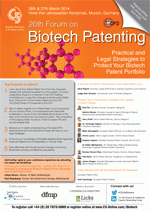
• Munich, GermanyC5 (UK) will be holding its 26th Forum on Biotech Patenting on March 26-27, 2014 in Munich, Germany.  C5 faculty will offer presentations on the following topics:

    • A View from the Bench: Evaluating the Implications of the New UPC System on Your Biotech Patent Strategies
    • Industry Roundtable: How to Manage and Exploit Your Patents in the UPC
    • How Can Biotech Companies Keep the Bolar Rolling: Key Developments in the European Biotech Landscape
    • Breadth of Claims: Practical Claim Tips to Avoid Subsequent Invalidity of Your Patents
    • Representation of Patent Attorneys Before the Unified Patent Court: Considerations, Dilemmas, Suggestions and the Best Routes Examined
    • Understanding the Importance of Personalised Medicine Patents in Biotechnology
    • How to Develop a Successful Strategy for Antibody Patents
    • Regulatory Insight and Industry Perspectives on your Biosimilars Strategies
    • Evaluating the Significance of Transparency and Confidentiality in Clinical Trials
    • A Pan European Perspective on SPCs: What You Need to Know to Successfully Obtain a SPC
    • Inside the European Patent Office: Understanding the Implications of EPO Developments on Your Patents
    • Strategy and Drafting Considerations for Human Genes Post Myriad
    • Lifting the Lid on Second Medical Use Patents: Understanding the Implications of Infringement of Second Medical Use Patents
    • Patent Protection and Enforcement in Brazil
    • Opportunities to Expand Your Patents Portfolio in Canada
    • Global Biotech Patent Strategies Afternoon: Up-and-Coming Markets
    • Manage the Practical Implications of the Lundbeck and Actavis Reverse Payments Cases
    • How to Formulate Your Stem Cell Strategies in light of the Brüstle v Greenpeace and International Stem Cells Corporation Cases

    BrochureIn addition, a pre-conference workshop entitled "Strategies in International Biotech Litigation from a Business and a Legal Point of View" will be held on March 25, 2014.

    A complete brochure for the Biotech & Pharmaceutical Patenting conference, including an agenda, detailed descriptions of conference sessions, list of speakers, and registration form can be obtained here.

    The registration fee is €1945 (conference alone), €2545 (conference plus workshop), or €845 (webcast).  Those registering on or before February 28, 2014 will receive a €200 discount.  Those interested in registering for the conference can do so here, by e-mailing registrations@C5-Online.com, by calling +44 20 7878 6888, or by faxing a registration form to +44 20 7878 6885.

    Patent Docs is a media partner of the C5 Biotech Patenting conference.

  • New York #3American Conference Institute (ACI) will be holding its 18th Advanced Forum on Life Sciences Collaborative Agreements and Acquisitions from March 31 to April 2, 2014 in New York, NY.  The conference will allow attendees to:

    • Incorporate the right takeaways from recent deals into optimal business development strategies;
    • Negotiate agreements that provide entry into key emerging markets;
    • Anticipate when a partnership might lead to a full M&A and incorporate appropriate terms into a hybrid or options agreement;
    • Avoid traps that can undermine collaborative efforts and lead to alliance failures;
    • Evaluate viable compensation structures;
    • Minimize risks through more effective partner selection and due diligence;
    • Structure option deals that meet both parties' potential objectives;
    • Resolve hotly contested issues with universities;
    • Develop appropriate strategies for new technologies;
    • Craft termination clauses that provide for a graceful exit when a partnership is not working; and
    • Optimize organizational goals for smaller companies when negotiating with a larger, more experienced entity.

    Brochure2In particular, ACI's faculty will offer presentations on the following topics:

    • Industry Case Study: "How Personalized Medicine Is Transforming Relationships Between Diagnostic and Drug Companies"
    • Getting to the Heart of Current Deal Terms and Drivers
    • IPOs and Beyond: Examining Traditional and Innovative Ways of Funding Research In Light of the Improved Capital Market Outlook
    • Universes Colliding: Understanding the Borders Between Options, Staged Acquisitions, and Hybrid Transactions
    • Mitigating Antitrust Risks Associated with Life Sciences Alliances and Agreements
    • Entering into Collaborative Research Agreements with Academic Institutions
    • Surviving the Unexpected: Learning from Missteps in Life Sciences Alliances
    • How the New Patent Rules and Recent Supreme Court Decisions Are Impacting Life Sciences Licensing
    • It's Not You, It's Me: Approaches for Ending A Negotiation or Collaboration That Minimize Exposure and Bridge Burning
    • Facilitating Entry into Emerging Markets via Strategic Partnering and Cross-Border Agreements

    In addition, a pre-conference workshop, entitled "David and Goliath: Guidance for Smaller Companies on Negotiating with Larger, More Experienced Organizations," will be offered from 9:00 am to 12:00 pm on March 31, 2014, and a psot-conference workshop, entitled "Conducting Effective & Strategic Due Diligence for Life Science Partnering and M&A," will be offered from 9:00 am to 12:00 pm on April 2, 2013.

    The agenda for the Life Sciences Collaborative Agreements and Acquisitions conference can be found here, and an agenda for the pre- and post-conference workshops can be found here.  A complete brochure for this conference, including an agenda, detailed descriptions of conference sessions, list of speakers, and registration form can be obtained here.

    ACI - American Conference InstituteThe registration fee for the conference is $2,295 (conference alone), $2,895 (conference and one workshop), or $3,295 (conference and both workshops).  Those registering by February 28, 2014 will receive a $200 discount.  Those interested in registering for the conference can do so here, by e-mailing CustomerService@AmericanConference.com, by calling 1-888-224-2480, or by faxing a registration form to 1-877-927-1563.

    Patent Docs is a media partner of ACI's Life Sciences Collaborative Agreements and Acquisitions conference.

  • By Kevin E. Noonan

    SequenomEarlier this week, Sequenom, Inc. filed its opening brief in Ariosa Diagnostics, Inc. v. Sequenom, Inc., appealing summary judgment that its licensed claims to a genetic diagnostic method for detecting fetal diseases and abnormalities in utero were invalid for reciting patent-ineligible subject matter.  In view of the exquisitely subjective nature of the standards for patent eligibility enunciated by the Supreme Court (most recently in Mayo v. Prometheus), Sequenom may face a task more daunting that it should be.  But in view of the fact that anything short of reversing the District Court's decision below can be expected to reduce the likelihood that personalized medicine will become commercially viable in our lifetimes, it is important that they prevail.

    To recap, the technology at issue was non-invasive prenatal diagnosis of sex determination, blood typing, other genetic disorders and detection of pre-eclampsia, using a simple blood test that reduces or eliminates the need for amniocentesis and chorionic villus sampling (which incur risks to both mother and child).  Sequenom Inc. is the exclusive licensee of U.S. Patent No. 6,258,540 originally obtained by Isis Inc.; there were three independent claims attacked by Ariosa and asserted by Sequenom in its patent infringement counterclaims:

    1. A method for detecting a paternally inherited nucleic acid of fetal origin performed on a maternal serum or plasma sample from a pregnant female, which method comprises
 amplifying a paternally inherited nucleic acid from the serum or plasma sample and
 detecting the presence of a paternally inherited nucleic acid of fetal origin in the sample.

    24. A method for detecting a paternally inherited nucleic acid on a maternal blood sample, which method comprises:
  removing all or substantially all nucleated and anucleated cell populations from the blood sample,
 amplifying a paternally inherited nucleic acid from the remaining fluid and subjecting the amplified nucleic acid to a test for the Paternally [sic] inherited fetal nucleic acid.

    25. A method for performing a prenatal diagnosis on a maternal blood sample, which method comprises
 obtaining a non-cellular fraction of the blood sample
 amplifying a paternally inherited nucleic acid from the non-cellular fraction and
 performing nucleic acid analysis on the amplified nucleic acid to detect paternally inherited fetal nucleic acid.

    The District Court based its decision on the Supreme Court's decision in AMP v. Myriad Genetics, that "naturally occurring" DNA is not patent eligible as a "product of nature," coupled that with the proscription from Mayo that "merely" adding "routine, conventional and well-understood" process steps to a "natural law" (or, in this case, "product of nature") was not "enough" to render method claims patent-eligible, determined that the amplification and sequencing steps recited in the claims were "routine, conventional and well-understood" process steps, and finally invoked Parker v. Flook for the proposition that the Supreme Court did not recognize any distinctions between an "abstract idea" and natural laws or phenomena to arrive at its decision that the claims at issue did not satisfy Section 101.  The District Court also discounted evidence that the art had developed alternative, non-infringing methods for performing the claims detection and diagnosis methods, on the grounds that these methods were not contemporaneous and were not "commercially viable."  The District Court entered summary judgment last November, and Sequenom timely appealed.

    Sequenom presents its arguments in thre parts:  first, that the Federal Circuit should review the District Court's determination de novo, and should apply the exceptions to subject matter eligibility narrowly while reading Section 101 expansively, consistent with Congressional intent.  Second, the Court should recognize that the District Court erred in how it applied controlling precedent to the claims at issue, first because the claims do not "merely" claims a "natural phenomenon" and second that the lower court applied a standard (i.e, the "commercially viable" standard for noninfringing alternatives that "lacks legal basics and contradicts public policy").  And finally, whether the District Court erred by deconstructing the claims and assessing their patent-eligibility separately, contrary to the Supreme Court's teachings in Diamond v. Diehr (but, honestly, consistent with Justice Breyer's treatment of the claims in Mayo, a case that pointedly did not overrule Diehr).

    The brief first begins with a section on the nature of the invention, which points our to the Court the benefits to the public of the invention disclosed and claimed in the patent-in-suit.  These include the ability to detect fetal abnormalities earlier in pregnancy and without the need for invasive procedures like amniocentesis and chorionic villus sampling that can put both mother and child's lives at risk.  The facts elucidated include those that support the novelty and non-obviousness of the claimed methods, factors necessitated by the Supreme Court's focus on whether a claim is "inventive" in Mayo (thus turning back the clock to the state of the law before Congress affirmatively created Section 103 in the Patent Act to inhibit if not prevent this type of subjective determination of what was patent-worthy by the Court).  (In homage to this pre-1952 Act Supreme Court precedent, Sequenom characterizes the inventors' recognition that cffDNA could be found in the acellular fraction of maternal blood as an "original stroke of genius" and note that the scientific journal article announcing this discovery had been cited "over a thousand times.")  And bowing to more recent trends from the Court, Sequenom accentuates in its factual allegations that the claimed methods were "limited" to detecting paternally inherited DNA in the cffDNA in maternal blood.  Finally, the fact statement notes that the claimed methods "transform" the cffDNA in application of the process steps, including fractionation, amplification and detection (including sequence determination) of the amplified cffDNA.  This section also sets forth the alternative methods for detecting cffDNA and using said detection for diagnostic applications.

    The brief also reminds the Court that, because this was a decision on summary judgment (under Ninth Circuit precedent) and because subject matter eligibility is a question of law, the Court is entitled and should decide the question before it de novo.  In so doing, Sequenom urges the Court to apply patent eligibility broadly and the exceptions to it narrowly, based on the statutory language and the Supreme Court's construction of the scope of the statute in Diehr and Bilski v. Kappos as well as recent Federal Circuit precedent, such as CLS Bank v. Alice and Ultramercial v. Hulu (perhaps in an effort to show that, no matter how the cases before these courts have come out, the principle of expansive reading on the scope of Section 101 is consistently broad).  The brief cites much of the same precedent for the corresponding principle that judicially created exceptions to broad subject matter eligibility should be applied parsimoniously.  In this context, of course, Ariosa had the burden of proving that the exception should be applied against Sequenom's claims by clear and convincing evidence, citing CLS Bank, and while not affirmatively drawing the conclusion suggests that Ariosa failed to meet this burden.

    In its first argument, Sequenom asserts that its claims do not claim a natural product or phenomenon, nor preempt all uses of fetal DNA or cffDNA, but rather claim narrow, specific, and limited applications of the biological act that cffDNA is present in maternal blood.  The brief identifies undue preemption (defined as "all other uses of the phenomenon"), which Sequenom argues is not the case here due to the existence of alterative, non-infringing methods for detecting cffDNA (once these inventors had disclosed that it was present in maternal blood).  Sequenom argues that the District Court erred by assessing subject matter eligibility of its claims as if they claimed the cffDNA itself, rather than an application of methods for detecting such DNA and providing a diagnosis of fetal disease or developmental disorder therefrom.  Sequenom also argues that the existence of the identified alternative methods for detecting cffDNA was dispositive on the question of preemption, and further that the claims taken as a whole satisfied the statutory requirements of novelty and non-obviousness as well as the Supreme Court's subjective "inventive concept" test and thus are patent eligible.

    Regarding preemption, the brief argues that the Supreme Court's concern with preemption was that a claim "preempts all practical uses" of a natural law, phenomenon of nature, or abstract idea, again citing Supreme Court (Mayo, O'Reilly v. Morse) as well as Federal Circuit case law.  This primacy for the preemption question was ignored by the District Court, according to Sequenom's brief, which deemed the preemption issue to be only "a consideration" when deciding whether a claim satisfies Section 101 or falls within an exception to it.  According to the brief:

    The Supreme Court has variously stated the distinction it drew in the Morse and Telephone cases, but the essence is that a patent recites ineligible subject matter only when it claims for itself, or preempts all other uses of, an abstract idea, law of nature, or natural phenomenon.

    The brief then contrasts this proscription of patent eligibility with instances where "a patent applies a natural phenomenon in a limited, non-preemptive manner so that other uses may be made of it," citing Bilski and Diehr (emphasis in original).  In this regard the brief argues that the District Court misread Flook, Bilski, and Mayo to be directed to "non-preemptive" patent claims, and thus failed to recognize the importance of the preemption question, and that the failure to unduly preempt prevented Sequenom's claims from invalidity under Section 101.  And the brief identifies Diehr as the case most closely related to the facts in this case (and cites how the Diehr Court distinguished the claims before it from the Flook case), asserting error by the District Court in "giving short shrift" to the Diehr decision.  Thus:

    In sum, the Supreme Court's and this Court's precedents follow a consistent theme:  where claims recite a natural phenomenon and no more, or when they recite a method in terms so general that it covers all ways to use the natural phenomenon, then the claims are not patent-eligible.  Where, as here, the patent claims a specific limited method and there are alternative methods available, then there is no preemption and no Section 101 eligibility concern.  The District Court failed to follow this controlling Section 101 law.

    With regard to the second argument, Sequenom asserts that the District Court "discounted" its evidence for alternative, noninfringing methods, and that "[t]he District Court adopted an unprecedented and improper standard to determine the relevance of alternative methods offered to prove the claimed method does not preempt all uses of a natural phenomenon.  It held that an alternative method would be relevant to show lack of preemption only if it both (i) was disclosed publicly before the '540 patent issued, and (ii) was shown by Sequenom to be commercially viable, a standard not enunciated by either the Supreme Court nor the Federal Circuit.  Further, the brief argues that there is no "rule or logic" in the District Court's "commercially viable" standard for alternative methods for practicing the claimed methods.  The brief notes that the concern has always been that claims "tie up future invention" and thus strongly suggest both that Sequenom's evidence for after-arising non-infringing alternatives was relevant and that this evidence supported Sequenom's arguments for subject matter eligibility.  Sequenom's claims do not do so and thus the District Court erred according to the brief.  Sequenom sets forth the consequences of the misapplied thinking of the District Court:

    As the Supreme Court observed in Myriad, it is expected that the original discoverers of a natural phenomenon or law of nature will invent the first (and perhaps best) method of applying their discovery.  . . .  However, the District Court's rule would require inventors, such as Lo and Wainscoat — who discovered cffDNA in 1996 and claimed a method applying it a few months later — to wait, perhaps indefinitely, to patent their method until other inventors have disclosed alternative methods using the discovery.

    Further, the District Court's "previously disclosed" requirement turns the presumption of validity on its head.  Under the District Court's rule, the first-to-invent is branded as a "preempter" whose method is doomed to be patent-ineligible.  Because Lo and Wainscoat came up with the first-filed method applying their ground-breaking discovery of cffDNA before any alternatives had been published, under the District Court's reasoning, their patent necessarily preempts all other methods that could apply their discovery.  Someone has to file first, and the first inventors should not be required to hold back disclosure of their method until others disclose alternative methods.  The net effect of the waiting game the District Court's rule creates would be to stymie the disclosure and exploitation of inventions — the reverse of the incentives the patent laws are intended to foster.

    (citations omitted).

    Specifically addressing the "commercially viable" standard enunciated by the District Court, the brief argues that "[t]he "commercially viable" requirement would impose a higher standard on alternative, non-preemptive methods than now exists for patented methods," and argues that this is a rule unsupported by legal precedent nor logic itself.  In making these arguments, the brief contrasts the District Court's standards for non-infringing alternatives with the requirements of patented methods, wherein there is no requirement that a claimed invention be commercially viable (citing Juicy Whip, Inc. v. Orange Bang, Inc., 185 F.3d 1364, 1366 (Fed. Cir. 1999), CFMT, Inc. v. YieldUp Int'l Corp., 349 F.3d 1333, 1338 (Fed. Cir. 2003), and Barmag Barmer Machinenfabrik AG v. Murata Machinery, Ltd., 731 F.2d 831, 839 (Fed. Circ. 1984) as examples).  This portion of the brief also notes that, under the District Court's rubric many earlier patents would need to have been invalidated due to lack of commercially viable, non-infringing alternatives.  (And the brief asserts that there is no definition or other factual basis or standard for what "commercially viable" requires or entails, while providing a propensity to invalidate the best method for a particular purpose.)

    Finally, Sequenom argues that the District Court misinterpreted and misapplied the law regarding the need for an "inventive concept" in the claims.  Here the error Sequenom asserts is that the District Court did not consider the claims "as a whole" but rather cherry-picked the different limitations and evaluated them separately and independently for patentability.  The brief argues that this analytical style is contrary to Supreme Court precedent, and then argues that the term is not a cipher for novelty and non-obviousness but rather a way of assessing "genuine human contribution" to an invention, citing (and trying to apply) Supreme Court precedent on this question.  And even using the District Court's failed analytical tools these claims should be deemed "inventive," according to the brief, based on the conventional practices in the art (including discarding acellular blood fraction containing cffDNA).  On the subject of inventiveness the brief has this to say:

    What is probative of patent-eligibility, and what the District Court erroneously denied, was the patent's combination of these steps for the first time in a groundbreaking method for the purpose of detecting paternally-inherited cffDNA in maternal plasma or serum and diagnosing fetal characteristics.  This new combination for this new purpose was neither conventional nor routine, and it satisfies the requirements of Section 101.

    It is the failure to look at the combination "as a whole" that was the source of the District Court's error.

    In the final section of the brief, Sequenom reminds the Court that this case was decided on remand from the Federal Circuit with instructions to consider the issues before the District Court in light of the Myriad decision, and that the District Court misapplied that law as it relates to patent-eligible method claims for screening anticancer drugs, analogizing the laboratory transformed variant with cffDNA in this case.  The brief reads the Court's Myriad decision as "[drawing] the patent-ineligibility line tightly around the genes' DNA sequences themselves" and that the Myriad decision "holds that even a small step away from the natural phenomenon as the result of human intervention is sufficient for patent-eligibility."  In the claims before the Court, Sequenom argues, the cffDNA is much more like cDNA deemed patent-eligible under Myriad than naturally occurring genomic DNA (which the Myriad Court deemed patent-ineligible).  And the brief argues that these claims fall squarely within the types of patent-eligible claims and methods cited with approval in Section III of the Myriad decision itself.

    Patent Docs will provide additional posts on Ariosa's responsive brief as well as any amicus briefs filed on behalf of either party.

  • By Andrew Williams

    2014 State of the UnionIt may come as no surprise, but on Tuesday, January 28, 2014, President Obama highlighted innovation and the patent system during his State of the Union address:

    We know that the nation that goes all-in on innovation today will own the global economy tomorrow.  This is an edge America cannot surrender.  Federally-funded research helped lead to the ideas and inventions behind Google and smartphones.  That's why Congress should undo the damage done by last year's cuts to basic research so we can unleash the next great American discovery — whether it's vaccines that stay ahead of drug-resistant bacteria, or paper-thin material that's stronger than steel.  And let's pass a patent reform bill that allows our businesses to stay focused on innovation, not costly, needless litigation.

    President Obama ("Full Text: President Obama's 2014 State of the Union Address").

    This is not surprising, considering it was the President's Patent Assertion and U.S. Innovation Report (with accompanying Legislative Priorities and Executive Actions) last June that seemed to kick-start Congress into high gear on patent reform legislation (see "'When the Patent System is Attacked!' — The White House Task Force on High-Tech Patent Issues").  It is unfortunate, however, that the President chose to speak of the patent system in these terms.  Despite his suggestion, it was the patent system that helped spur the innovation that has given America its edge.  It may be true that there is a vexatious litigation problem, but the entire patent system should not be thrown out with the proverbal bathwater.  The House has already passed a bill that could lead to unintended consequences.  We can only hope that the Senate will take a more reasoned approach to the problem.  Ideally, it will craft a more narrowly-tailored bill to serve as a counter-point to the Innovation Act.  Unfortunately, none of the Senate bills currently pending look like they will serve this function.  We don't need a patent reform bill that will have a chilling effect on legitimate patent claims.  If this happens, it could have the opposite effect desired by the President — it could result in a decrease in America's innovation.

  • By Michael Borella

    SmartGeneWhile non-precedential, this recent Federal Circuit decision further illustrates the Court's thinking with regard to the patent-eligibility of computer-implemented inventions under 35 U.S.C. § 101, and provides a reminder about the importance of procedural issues in § 101 cases.

    SmartGene filed a declaratory judgment action against the defendants ("ABL"), alleging non-infringement and invalidity of U.S. Patent Nos. 6,081,786 and 6,188,988, both owned by ABL.  On summary judgment, the District Court found both patents invalid under § 101.  A Federal Circuit panel consisting of Judges Lourie, Dyk, and Taranto affirmed.  Judge Lourie was the author of the contentious en banc CLS Bank v. Alice Corp. plurality concurrence that is currently under review by the Supreme Court, and Judge Dyk joined him in that opinion.  Judge Taranto, who wrote the present opinion, began his tenure at the Federal Circuit after the en banc Court heard oral arguments for CLS Bank.

    Each patent includes independent claims directed to a method, a system, and a computer readable medium, respectively, "for guiding the selection of a treatment regimen for a patient with a known disease or medical condition."  In December 2011, SmartGene moved for summary judgment under § 101, stating that that "for the purpose of the § 101 analysis, claim 1 of the '786 patent is representative of all of the claims of the patents-in-suit."  The District Court granted the motion based solely on its analysis of this claim, stating that "the differences between the various method and system claims within the patents-in-dispute are immaterial with respect to whether the patents constitute eligible subject matter under 35 U.S.C. § 101."

    ABL never contested this grouping of the claims in its responsive brief.  In oral argument against summary judgment, however, ABL attempted to rectify this omission by noting that "claiming an actual system . . . makes it even less abstract because it's not just a method . . . it is even more intimately connected to the computer."  But the District Court held firm, based on ABL's failure to contest the representativeness of claim 1 in its brief, as well as ABL's apparently non-persuasive oral arguments.

    ABL appealed both the District Court's grouping of the claims in its § 101 analysis, and the outcome of this analysis.

    Turning first to the grouping of the claims, the Federal Circuit quickly dismissed ABL's contentions.  Judge Taranto wrote that "[i]t is well established that arguments that are not appropriately developed in a party's briefing may be deemed waived."  Consequently, the District Court acted within its discretion to rule that "ABL forfeited any argument that any patent claims here are to be treated differently from claim 1 of the '786 patent."

    Moving to the substantive § 101 issue, the Federal Circuit once again upheld the District Court's position.  The claim at issue recites:

    1.    A method for guiding the selection of a therapeutic treatment regimen for a patient with a known disease or medical condition, said method comprising:
        (a)  providing patient information to a computing device comprising:
            a first knowledge base comprising a plurality of different therapeutic treatment regimens for said disease or medical condition;
            a second knowledge base comprising a plurality of expert rules for evaluating and  selecting a therapeutic treatment regimen for said disease or medical condition;
            a third knowledge base comprising advisory information useful for the treatment of a patient with different constituents of said different therapeutic treatment regimens;
    and
        (b)  generating in said computing device a ranked listing of available therapeutic treatment regimens for said patient; and
        (c)  generating in said computing device advisory information for one or more therapeutic treatment regimens in said ranked listing based on said patient information and said expert rules.

    Notably, all steps of the method either require the involvement of a computing device, or are performed by the computing device.  Nonetheless, the Federal Circuit still found that the claim was directed to a patent-ineligible mental process.

    Leaning heavily on the reasoning in CyberSource Corp. v. Retail Decisions, Inc., Judge Taranto wrote "section 101 [does] not embrace a process defined simply as using a computer to perform a series of mental steps that people, aware of each step, can and regularly do perform in their heads."  Also echoing Justice Breyer in Mayo v. Prometheus, Judge Taranto found that each step of claim 1 involved "well-understood, routine, conventional activity previously engaged in by researchers in the field."

    Particularly, in Judge Taranto's view, step (a) was directed to "routine input, memory, look-up, comparison, and output capabilities," step (b) was directed to generating "a ranked listing of available therapeutic treatment regimens, and step (c) was directed to generating "advisory information for one or more therapeutic treatment regimens in said ranked listing."  Consequently, he found that, without citing to any evidence or explaining why, these steps were routinely and consciously performed by doctors.  As a result, he found claim 1 to recite "a mental process excluded from section 101: the mental steps of comparing new and stored information and using rules to identify medical options."

    This decision, which I again emphasize is non-precedential, is another illustration of the Federal Circuit's § 101 reasoning post-Mayo and post-CLS Bank, and of the Court's current willingness to disregard the non-abstractness of general-purpose computer hardware when undertaking such reasoning.  However, a further issue is hidden within the subtext of this case.

    The alleged "mental process" of claim 1 is more than a series of purely mental steps.  For the claimed invention to be useful, a doctor would have to access a "knowledge base" of different therapeutic treatment regimens, and then produce a "ranked listing of available therapeutic treatment regimens."  Thus, it is implicit that the Federal Circuit considers "mental processes" to include steps that may require looking information up in a book or a database, and perhaps using pencil and paper to produce a result.

    But even if the breadth of claim 1 permits such a reading, the Court's § 101 "mental process" jurisprudence has essentially become a patent-eligibility bar on any computer-implemented algorithm that could conceivably be performed with pencil and paper, no matter how long it takes, how complicated, or how error-prone.  In today's "big data" systems, billions of data entries can be received, processed, analyzed, and used to draw conclusions.  It would take an army of humans thousands, or in some cases millions, of years to perform the same steps that could be performed in seconds, minutes, or hours by a modern cloud-computing system.

    As just one example, Amazon.com and Netflix are two entities that use recommendation engines to suggest to their users what media and products those users might want to purchase.  These suggestions are often based on the consumption habits of other users (e.g., using logic such as "people who buy product A also buy product B").  These systems often require a large amount of data (much more than one person could hold in his or her head or organize on paper) and a large amount of computing power to make useful recommendations.  Thus, without being computer-implemented, such recommendation engines would not exist.  And yet, method claims drawn to a recommendation engine operating on a general-purpose computer would likely be subject to § 101 challenges.

    Judge Lourie's CLS Bank concurrence sets forth this problematic reasoning:  "At its most basic, a computer is just a calculator capable of performing mental steps faster than a human could.  Unless the claims require a computer to perform operations that are not merely accelerated calculations, a computer does not itself confer patent eligibility."  Nonetheless, accelerating calculations has enabled new technologies that drive the information economy.

    One of aspect of innovation is to make products and services faster, cheaper, and better.  The patent system is intended to incentivize individuals and organizations to publically disclose such inventions, and as a result receive a limited property right thereover.  A broad exclusion of computer-implemented "mental processes" via § 101 is illogical and disregards the fundamental tradeoff on which the system is based.

    SmartGene, Inc. v. Advanced Biological Laboratories, SA (Fed. Cir. 2014)
    Nonprecedential disposition
    Panel: Circuit Judges Lourie, Dyk, and Taranto
    Opinion by Circuit Judge Taranto

  • By Donald Zuhn

    USPTO SealLast week, the U.S. Patent and Trademark Office published a notice of proposed rulemaking in the Federal Register (79 Fed. Reg. 4105), in which the Office proposed changes to the rules of practice that it claimed would "facilitate the examination of patent applications and . . . provide greater transparency concerning the ownership of patent applications and patents."  The notice, entitled "Changes To Require Identification of Attributable Owner," states that:

    This initiative is one of a number of executive actions issued by the Administration that are designed to ensure the highest-quality patents, enhance competition by providing the public with more complete information about the competitive environment in which innovators operate, enhance technology transfer and reduce the costs of transactions for patent rights by making patent ownership information more readily and easily available, reduce abusive patent litigation by helping the public defend itself against frivolous litigation, and level the playing field for innovators.

    The proposed changes to the rules would require that the "attributable owner" be identified at the time an application is filed (or shortly thereafter), during the pendency of an application when there is a change in the attributable owner (within three months of such change), at the time the issue fee is paid, when maintenance fee payments are made, and if a patent becomes involved in supplemental examination, ex parte reexamination, or a trial proceeding before the Patent Trial and Appeal Board.  The notice explains that the proposed rules use the term "attributable owner" rather than "real party in interest" to avoid confusion that might arise from use of the latter term elsewhere in Title 35.  The notice also indicates that applicants would not be required to identify the attributable owner for provisional applications or International applications prior to the commencement of the national stage in the United States.

    In addition, the notice seeks comments as to whether the Office should permit applicants and patentees to voluntarily report licensing offers and related information to the Office, which the Office would then make available to the public.  Licensing information that the Office envisions as possibly being reportable includes the willingness to license, licensing contacts, license offer terms, and commitments to license a patent on royalty-free or reasonable and non-discriminatory terms.

    According to the notice, the rules changes would facilitate patent examination by helping to:

    (1) Ensure that a "power of attorney" is current in each application or proceeding before the Office; (2) avoid potential conflicts of interest for Office personnel; (3) determine the scope of prior art under the common ownership exception under 35 U.S.C. 102(b)(2)(C) and uncover instances of double patenting; (4) verify that the party making a request for a post-issuance proceeding is a proper party for the proceeding; and (5) ensure that the information the Office provides to the public concerning published applications and issued patents is accurate and not misleading.

    The Office also expects the rules changes to:

    (1) Enhance competition and increase incentives to innovate by providing innovators with information that will allow them to better understand the competitive environment in which they operate; (2) enhance technology transfer and reduce the costs of transactions for patent rights since patent ownership information will be more readily and easily accessible; (3) reduce risk of abusive patent litigation by helping the public defend itself against such abusive assertions by providing more information about all the parties that have an interest in patents or patent applications; and (4) level the playing field for innovators.

    Under the rules changes, the Office would collect two types of owner information:  (1) titleholders (i.e., assignees), and (2) enforcement entities (i.e., real-parties-in-interest having the right to enforce an issued patent — defined by the notice as entities that have not already been identified as titleholders, but who are necessary to be joined in a lawsuit in order to have standing to enforce the patent or any patent resulting from the application).  For both of the above categories, the attributable owner would also have to identify the "ultimate parent entity" as defined in 16 C.F.R. § 801.1(a)(3).  The notice indicates that ultimate parent entities would be those entities that ultimately control titleholders or enforcement entities.  In discussing the above ownership interests, the notice explains that:

    In many cases, these types of ownership interests may be coextensive.  Specifically, the titleholder (or assignee) is often the same entity that has the right to enforce the patent, and is not controlled by any other entity (and so would not have to separately report an ultimate parent entity).  Most additional reporting will need to be done by companies that have complicated corporate structures and licenses, which often include the complex structures used by certain patent assertion entities ("PAEs") to hide their true identities from the public.  Some of this additional reporting may include exclusive licensees.  Although exclusive licensees are sometimes confidential now, they would only need to be disclosed where their rights are so substantial that they have enforcement rights in the patent.  In such circumstances, the public has a strong interest in knowing their identities in order to have an accurate picture of the competitive patent landscape, to allocate their research and development efforts appropriately, and to take licenses or purchase patents proactively and efficiently from the correct entities, as dictated by business needs.

    The rules changes would also provide applicants and patentees with the means to correct omissions and errors in the identification of attributable owner, as well as "excuse good faith failures" to notify the Office of the attributable owner or provide correct and complete information about the attributable owner.

    The notice indicates that the proposed rules changes are the result, in part, of the work of the White House Task Force on High-Tech Patent Issues, which published a paper detailing five executive actions and seven legislative recommendations "to protect innovators from frivolous litigation and ensure the highest-quality patents in our system" (see "'When the Patent System is Attacked!' — The White House Task Force on High-Tech Patent Issues").  The Office also notes that in 2011 it began soliciting comments regarding the process of collecting assignment and real-party-in-interest information (see "USPTO News Briefs," December 15, 2011, and "USPTO New Briefs," December 20, 2012).

    A discussion of the specific rules changes can be found on pages 4111-14 of the notice, and a list of the proposed changes to the rules can be found on pages 4119-21 of the notice.

    Comments on the notice of proposed rulemaking, which must be submitted by March 25, 2014, can be sent by e-mail to AC90.comments@uspto.gov, by regular mail addressed to:  Mail Stop Comments-Patents, Commissioner for Patents, P.O. Box 1450, Alexandria, VA 22313–1450, marked to the attention of James Engel, Senior Legal Advisor, Office of Patent Legal Administration, Office of the Deputy Commissioner for Patent Examination Policy, or via the Federal eRulemaking Portal (http://www.regulations.gov).  The notice also indicates that the Office will be holding two meetings with stakeholders (at locations and times to be announced) in order to obtain input on the proposed rules changes.

  • By Nicole Reifman

    MedtronicThe Federal Circuit's decision in Medtronic CoreValve, LLC v. Edwards Lifesciences Corp. provides a warning for patent practitioners seeking to claim priority to earlier filed patent applications:  failure to specifically reference each earlier filed patent application will result in a loss of a claim to priority to the omitted application(s).

    Medtronic sued Edwards for infringement of certain claims of its patent for a prosthetic valve, U.S. Patent No. 7,892,281 (the '281 patent).  The'281 patent was filed on January 5, 2009 and descends from a number of United States, international, and French patent applications.  Medtronic's position was that the asserted claims of the '281 patent had a priority date of October 31, 2000.

    Edwards LifesciencesDuring litigation in the U.S. District Court for the Central District of California, Edwards realized that the priority chain for the '281 patent did not comply with the requirements of 35 U.S.C. §§ 119 and 120 and moved for partial summary judgment that this limited the priority date of the asserted claims of the '281 patent to no earlier than April 10, 2003.  Medtronic filed a cross-motion for summary judgment, arguing that the asserted claims were entitled to the priority date of October 31, 2000.

    The District Court held that the '281 patent was not entitled to a priority date prior to April 10, 2003 because various applications in the chain of priority were not in compliance with the requirements of claiming priority under either 35 U.S.C. §§ 119 or 120.  The District Court thus granted Edwards' motion for summary judgment.  Medtronic appealed the priority issue to the Federal Circuit.

    The priority issue under 35 U.S.C. § 120 was whether the '281 patent "contains or is amended to contain a specific reference to the earlier filed application . . . submitted at such time during the pendency of the application."  35 U.S.C. § 120.  The Federal Circuit previously held in another case that the "specific reference" requirement means that each intermediate application in the chain of priority to refers to the prior applications.  Encyclopaedia Britannica, Inc. v. Alpine Electronics of America, Inc., 609 F.3d 1345, 1352 (Fed. Cir. 2010).

    Although the application for the '281 patent properly claimed the entire chain of priority, certain U.S.  applications in the chain of priority were held by the Federal Circuit to fail to specifically reference earlier filed applications.  At issue were two applications that simply stated "this application is also a continuation-in-part of [the international application]."  Medtronic argued that "this application" referred to an intervening application in the priority chain and thus did not leave out the intervening application, whereas Edwards argued that "this application" had a plain language meaning and referred to the present application, thus leaving out the intervening application.

    The Federal Circuit agreed with Edwards and held that the term "this application" is to have its plain language meaning, consistent with Section 201.11 of the M.P.E.P., to refer self-referentially to the present application.  Medtronic argued that the reasonable person test should instead be applied; however, the Federal Circuit held that "the patentee is the person best suited to understand the genealogy and relationship of her applications; a requirement for her to clearly disclose this information should present no hardship . . . .  Medtronic's 'reasonable person' test improperly places the burden of deciphering a priority claim upon the reader or the public."  The Federal Circuit agreed with the District Court and held that the two applications at issue thus lost any priority claim prior to April 10, 2003, and thereby also ruined a claim to priority before April 10, 2003 for the '281 application.

    The loss of claim of priority that limited the asserted claims of the '281 patent to the April 10, 2003 priority date resulted in the asserted claims of the '281 patent being held invalid as anticipated under 35 U.S.C. § 102 with two of the earlier filed applications listed in the '281 patent's chain of priority.

    Medtronic CoreValve, LLC v. Edwards Lifesciences Corp. (Fed. Cir. 2014)
    Panel: Circuit Judges Prost, Plager, and Taranto
    Opinion by Circuit Judge Prost

  • By Donald Zuhn

    NVCAEarlier this month, the National Venture Capital Association (NVCA), a trade association representing the U.S. venture capital industry, released the results of its MoneyTree Report on venture funding for 2013.  The report, which is prepared by NVCA and PriceWaterhouseCoopers LLP using data from Thomson Reuters, indicates that venture capitalists invested $29.4 billion in 3,995 deals in 2013, which constituted a 7% increase in dollars and a 4% increase in deals over the prior year (see chart below, which shows total venture funding from 2004 to 2013; data from MoneyTree Reports; click on chart to expand).

    Funding-Total-Year
    Last year, the software sector took the top spot in funding — with $11.0 billion invested in 1,523 deals — which was the highest level of funding for that sector since 2000.  The software sector also accounted for 37% of total venture investment in 2013, which constituted the highest percentage since the first MoneyTree Report was issued in 1995.  Biotechnology funding in 2013 increased to $4.5 billion, which was an 8.2% increase over biotechnology funding in 2012 (see chart below, which shows venture funding for the biotech (blue), medical devices (red), and software (green) sectors from 2004 to 2013; data from MoneyTree Reports; click on chart to expand).

    Funding-Industry-Year
    Overall, ten of the seventeen sectors tracked by the NVCA saw increases in dollars invested in 2013.

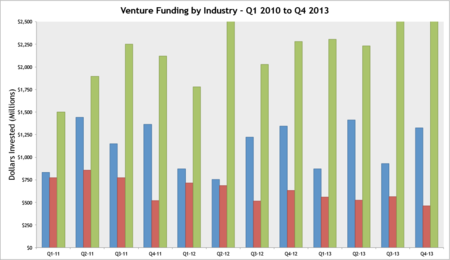
    The report also noted that in the fourth quarter of 2013, $8.4 billion was invested into 1,077 deals (see chart below, which shows venture funding by quarter from 2010 to 2013; data from MoneyTree Reports; click on chart to expand).

    Funding-Total-Quarter
    In the fourth quarter of 2013, biotechnology venture funding was up 42.6% over the third quarter with $1.3 billion being invested.  Biotechnology funding had dropped 34.4% in the third quarter, with only $927 million being invested (see chart below, which shows venture funding by quarter for the biotech (blue), medical devices (red), and software (green) sectors from 2010 to 2013; data from MoneyTree Reports; click on chart to expand).

    Funding-Industry-Quarter
    For additional information regarding this and other related topics, please see:

    • "Biotech Venture Funding Sees Second Quarter Rebound," July 22, 2013
    • "Biotech Venture Funding Down 33% in First Quarter," April 30, 2013
    • "Annual Venture Funding Drops for First Time in Three Years," February 4, 2013
    • "Biotech Venture Funding Up 64% in Third Quarter," October 29, 2012
    • "Venture Funding in Life Sciences Sector Drops 9% in Second Quarter," July 22, 2012
    • "Biotech Venture Funding Drops 43% in First Quarter," May 3, 2012
    • "Venture Funding Increased 22% in 2011," February 2, 2012
    • "Life Sciences Venture Funding Drops in Third Quarter," October 27, 2011
    • "Life Sciences Venture Funding up 37% in Second Quarter," August 1, 2011
    • "VentureSource Reports 35% Increase in 1Q Venture Funding," April 26, 2011
    • "NVCA Reports Modest Gains in First Quarter Venture Funding," April 19, 2011

    • "NVCA Reports 31% Drop in Venture Funding for Third Quarter," October 17, 2010

    • "NVCA Reports 34% Increase in Venture Funding for Second Quarter," July 22, 2010

    • "NVCA Report Shows First Quarter Drop in Venture Funding," April 20, 2010

    • "Biotech/Pharma Financing Improving, R&D Spending Up," August 31, 2009
    • "NVCA Study Shows Increase in Third Quarter Venture Funding," October 23, 2009

    • "First Quarter Venture Capital Funding at 12-Year Low," April 23, 2009

    • "NVCA Study Shows Decline in 2008 Investment; BIO Study Predicts Biotech Rebound in 2009," February 16, 2009

  • CalendarJanuary 30, 2014 -"Combating Patent Trolls: Third-Party Solutions and Defense Strategies in Litigation and Post-Grant Proceedings — Leveraging Counterclaim, Summary Judgment and Other Tactics; Utilizing Legislative, Insurance and Third-Party Tools" (Strafford) – 1:00 to 2:30 pm (EST)

    February 13, 2014 – "Proactive Patent Procurement and Prosecution Strategies: Minimizing the Threat of Post-Grant Challenges — Insulating Your Patent Portfolio From New Threats" (Strafford) – 1:00 to 2:30 pm (EST)

    February 18, 2014 – "Proposed Patent Reform Legislation: How It May Impact You (Especially if You Are Not Considered to be a 'Patent Troll'" (McDonnell Boehnen Hulbert & Berghoff LLP) – 10:00 to 11:15 am (CT)

    February 19-20, 2014 – AIA Post-Grant Patent Practice Conference (International Intellectual Property Institute and Bloomberg BNA) – Arlington, VA

    February 20, 2014 – "Protecting IP Rights in Joint Development Agreements and Strategic Alliances — Structuring JDAs to Apportion Contributed, Joint and Derivative IP; Planning for Involuntary Early Endings; and Avoiding Unintended Consequences" (Strafford) – 1:00 to 2:30 pm (EST)

    February 26-27, 2014 – Pharmaceutical and Biotechnology Patent Life Cycles and Portfolio Strategies*** (American Conference Institute) – New York, NY

    February 27, 2014 – "Patent Inventorship: Best Practices for Determination and Correction — Drawing the Line Between Inventor and Contributor, Leveraging Lessons From Year One of the AIA" (Strafford) – 1:00 to 2:30 pm (EST)

    March 5-7, 2014 – Advanced Patent Law Seminars (Chisum Patent Academy) – Cincinnati, OH

    March 12-13, 2014 – FDA Boot Camp*** (American Conference Institute) – New York, NY

    March 24-26, 2014 – Medical Device Patents*** (American Conference Institute) – Chicago, IL

    August 13-15, 2014 – Advanced Patent Law Seminars (Chisum Patent Academy) - Seattle, WA

    August 18-20, 2014 – Advanced Patent Law Seminars (Chisum Patent Academy) - Seattle, WA

    ***Patent Docs is a media partner of this conference or CLE

  • International Intellectual Property InstituteInternational Intellectual Property Institute and Bloomberg BNA will be holding and AIA Post-Grant Patent Practice Conference on February 19-20, 2014 in Arlington, VA.  The conference will include presentations on the following topics:

    • The Fundamentals of Post-AIA Post-Grant Patent Procedures
    • Luncheon Address by the Honorable Pauline Newman, Circuit Judge, U.S. Court of Appeals for the Federal Circuit
    Inter Partes and Post-Grant Reviews (including CBM Patent Reviews)
    • Derivation and Interference Procedures
    Fresenius USA v. Baxter Int’l and its Impact on Post-Grant Practice
    • Motions based on Estoppel/ Privity and Mock Conference
    • Motions for Joinder and Mock Conference
    • Discovery Motions and Mock Conference
    • Luncheon Address by the Honorable Randall Rader, Chief Judge, U.S. Court of Appeals for the Federal Circuit
    • Motions to Amend Claims and Mock Hearing on Amendment
    • Final Briefing and Mock Final Hearing

    More information regarding the conference, including an agenda, detailed descriptions of conference sessions, and list of speakers can be found here.

    Bloomberg BNAThe registration fee is $1,295 (for Bloomberg BNA subscribers) or $1,495 (for non-subscribers).  Those interested in registering for the conference can do so here or by calling 1-800-372-1033.