• BIO and Leaders in the IP Community

    By Andrew Williams

    BIO International ConventionThe 2014 BIO International Convention begins this week in San Diego.  If you are planning on attending, you probably already know that the amount of information and opportunities available at BIO can be daunting.  Therefore, Patent Docs has been highlighting a few sessions or other opportunities, in thematic fashion, to help you navigate your way through the convention.  For example, today, we focus on presentations by influential leaders in the Intellectual Property Community.  Of course, Patent Docs authors and contributors will be present at BIO as part of the MBHB contingent, and Patent Docs readers are encouraged to stop by the MBHB booth to discuss these sessions (or whatever other topic is of interest to you) (#1337).

    In the United States, two of the entities that have the most impact on U.S. patent practice are the United States Patent and Trademark Office and the United States Court of Appeals for the Federal Circuit.  And, on the global scale, it can be argued that no organization has more impact on international patent practice than the World Intellectual Property Organization ("WIPO").  Impressively, BIO will feature at least three current or recent leaders of these three organizations.  Therefore, attendees will be able to gain insight from the individuals that play (or have played) a major role in each of these three organizations.

    First on our list, Judge Randall R. Rader of the Federal Circuit will be providing his view from the bench on recent developments in biotech patent law in the courts and in Congress.  This session will be on Wednesday, June 25, from 8:30 AM to 9:00 AM for the Intellectual Property track.  Judge Rader recently stepped down from his position as Chief Judge, and was succeeded by now Chief Judge Sharon Prost.  Moreover, five days after his presentation at BIO, on June 30, Judge Rader will be retiring from the court.  The title of his presentation is aptly named "Welcome and Farewell — Judge Randall R. Rader."  Judge Rader has also been outspoken on the issue of using § 285 fee-shifting as a mechanism for federal courts to combat patent trolls.  It will be interesting to see what he has to say on the recent legislative efforts aimed at the same goal.  Along those lines, there will be a separate session later that day at 1:45 PM to 2:45 PM on these Congressional efforts.  The title of that session will be "As if AIA Hasn't Brought Enough Change — Patent Litigation Reform is Looming in the US."

    Next up, literally, Acting Director Michelle Lee will participate in a session immediately following Judge Rader, from 9:00 AM to 10:00 AM, June 25, entitled "View from the USPTO — Address by Acting Director Michelle Lee and Discussion of the Myriad-Mayo Guidelines."  Anyone following this blog knows how controversial those guidelines have been, so it will be interesting to hear the perspective of the acting director herself on the issue.  With her will be two additional representatives from the patent office, June Cohan, Legal Advisor, and Andrew Hirshfeld, Deputy Commissioner for Patent Examination Policy.  They promise to provide the latest thinking on the examination guidelines, and take questions and feedback from the audience.  The period for submitting comments to the Office on these guidelines is still open, and in fact has been extended to July 31, 2014.  Those attendees interested in this topic might also be interested in the session "Patent Eligibility from the Trenches: Practical Implications of the Supreme Court's Mayo and Myriad Decisions" on June 25, from 3:00 PM to 4:00 PM.  The panel for this session includes former Acting Director of the USPTO Teresa Stanek Rea.

    Finally (or should we say initially?), Director General Francis Gurry of WIPO will be kicking off the Intellectual Property track on Tuesday, June 24, from 2:15 PM to 2:45 PM.  The Director General will be discussing WIPO activities and their impact on the biotechnology sector.  Just last month, the member states of WIPO appointed Director General Gurry by consensus to a second six-year term of office.  Immediately preceding this presentation, there will be an Intellectual Property Meetup in the "IP Social Spot" from 1:30 PM to 2:15 PM.  This Meetup will provide intellectual property professionals to mingle and kick-off the track.

    Be on the look-out for the next installment of BIO 2014 previews in the next few days.

  • BIO International Convention copyThe Biotechnology Industry Organization (BIO) is holding its annual BIO International Convention this week in San Diego, CA.  Founded in 1993, BIO is a nonprofit association seeking supportive biotechnology policies on behalf of more than 1,100 biotechnology companies, academic institutions, state biotechnology centers, and related organizations across the United States and in more than 30 other nations.

    Patent-Docs-Logo_no_subtitleAs part of the Convention, more than 1,700 biotech companies, organizations, and institutions are expected to participate in the BIO Exhibition.  Patent Docs Donald Zuhn, Kevin Noonan, Andrew Williams, Sherri Oslick, Michael Greenfield, Josh Bosman, Josh Rich, James DeGiulio, and Nate Chongsiriwatana will also be attending BIO as part of the MBHB contingent, and will be participating in BIO's blogger network throughout the week.  Patent Docs readers who may be attending BIO this week are encouraged to stop by booth #1337 to meet the Docs, at the times indicated below, and talk a little biotech patent law.

    Tuesday, June 24

    9:30 am – 12:00 pm — Andrew Williams, Josh Rich, James DeGiulio, and Nate Chongsiriwatana
    12:00 – 2:30 pm — Donald Zuhn, Sherri Oslick, and Michael Greenfield
    2:30 – 5:30 pm — Sherri Oslick, James DeGiulio, and Nate Chongsiriwatana

    Wednesday, June 25

    9:30 am – 12:00 pm — Michael Greenfield, Josh Bosman, and Josh Rich
    12:00 – 2:30 pm — Sherri Oslick, James DeGiulio, and Nate Chongsiriwatana
    2:30 – 5:30 pm — Josh Bosman and James DeGiulio

    Thursday, June 26


    9:30 am – 12:00 pm — Donald Zuhn, Andrew Williams, Michael Greenfield, and Josh Bosman
    12:00 – 2:30 pm — James DeGiulio

    BIO - Good Times on Tap 2011In addition, most of the Docs will be attending the MBHB reception at Dublin Square Irish Pub & Grill in San Diego's downtown Gaslamp Quarter on Tuesday, June 24 from 8:00 pm to 1:00 am.  Additional information about the reception, including invitations for the event, can be picked up at the MBHB booth on Tuesday.

  • CalendarJune 23-26, 2014 – BIO International Convention (Biotechnology Industry Organization) – San Diego, CA

    June 25-26, 2014 – International Forum on Pharma Patent Extensions*** (C5) – London, England

    June 27, 2014 – "Navigating the Patent Trial and Appeal Board Post-Grant Minefield" (American Bar Association Section of Intellectual Property Law) – 1:00 to 2:30 pm (ET).

    June 30, 2014 – "Drafting Patent Claims After In re Packard: Navigating the New PTO Regime for Evaluating Indefiniteness" (Strafford) – 1:00 to 2:30 pm (EDT)

    July 9, 2014 – "Nautilus and Limelight: The Supreme Court Keeps Chipping Away at Patentees" (McDonnell Boehnen Hulbert & Berghoff LLP) – 10:00 to 11:15 am (CT)

    July 9-11, 2014 – Fundamentals of Patent Prosecution 2014: A Boot Camp for Claim Drafting & Amendment Writing (Practising Law Institute) – San Francisco, CA

    July 20-22, 2014 – 2014 Annual Meeting & Conference (National Association of Patent Practitioners) – Alexandria, Virginia.

    August 13-15, 2014 – Advanced Patent Law Seminars (Chisum Patent Academy) - Seattle, WA

    August 18-20, 2014 – Advanced Patent Law Seminars (Chisum Patent Academy) - Seattle, WA

    ***Patent Docs is a media partner of this conference or CLE

  • ABAThe American Bar Association (ABA) Section of Intellectual Property Law will be offering a live webinar entitled "Navigating the Patent Trial and Appeal Board Post-Grant Minefield" on June 27, 2014 from 1:00 to 2:30 pm (ET).  Cory C. Bell of Finnegan will moderate a panel consisting of Erika H. Arner of Finnegan; Samir N. Pandya, Senior IP Counsel for SAP AG; and Kirupa Pushparaj, IP Counsel for Square, Inc.  The panel will discuss the biggest mistakes petitioners and patent owners make, including:

    • Why so many petitions are being bounced?
    • What the PTAB looks for in a complete rejection?
    • Getting the PTAB to change their mind after institution.

    The registration fee for the webcast is $150 for members and $195 for the general public.  Those interested in registering for the webinar, can do so here.

  • By Michael Borella

    Supreme Court Building #1There's an old saying that "bad facts make bad law," acknowledging that a court's decision regarding an extreme case can result in law that poorly serves less extreme cases.  The Supreme Court's recent trio of 35 U.S.C. § 101 decisions, Bilski v. Kappos, Mayo Collaborative Services v. Prometheus Laboratories, Inc., and today's unanimous Alice Corp. v. CLS Bank Int'l each involved claims that were probably too broad for their own good.  But instead of directly challenging the novelty or non-obviousness of these claims, the patent-eligibility of the claims were the core of the respective disputes.  As a result, the lines between §§ 101, 102, and 103 have become blurred, and the Court still hasn't clarified what makes a claim too abstract to be patent-eligible despite using this doctrine to strike down claims in all three cases.  Thus, the impact of CLS Bank on less extreme cases — those with more focused claims for instance — remains to be seen.

    As noted in an earlier overview article by Kevin Noonan, the Court did not bar software or business method patents per se.  This case, however, continues the trend of two other patent cases decided this term, Limelight Networks, Inc. v. Akamai Technologies, Inc. and Nautilus, Inc. v. Biosig Instruments, Inc., in which the Court has placed further limits on the scope of patent protection.  Consequently, the Court has introduced new avenues for challenging the validity of patents.

    The following is a collection of initial thoughts regarding the CLS Bank decision and its impact on software and business method practice.

    • The Court declined to clearly define the term "abstract idea."  It stated that "we need not labor to delimit the precise contours of the 'abstract ideas' category in this case."  Instead, the Justices relied on the conceptual similarity between Alice's claims and those found patent-ineligible in Bilski.  Alice argued that abstract ideas must exist apart from any human interaction (e.g., an equation would be an abstract idea, but a process involving human activity would not).  The Court would hear nothing of this, couching the abstract claims of Bilski as "a method of organizing human activity."

    • In Bilski, the Court held that "while the machine-or-transformation test has always been a 'useful and important clue,' it has never been the 'sole test' for determining patentability."  In this case, Alice's computer-readable media and system claims were struck down under § 101, despite reciting general-purpose computer components.  Thus, it appears that to pass the machine-or-transformation test, claims must be tied to a particular machine and not just a generic computer.

    • To that point, the Court has taken a rather dim view of the ability of general purpose computing to lift an otherwise abstract idea above the § 101 bar.  For instance, the Court stated that "method claims, which merely require generic computer implementation, fail to transform [an] abstract idea into a patent-eligible invention," "[t]he fact that a computer necessarily exist[s] in the physical, rather than purely conceptual, realm is beside the point," "each step [of Alice's claims] does no more than require a generic computer to perform generic computer functions," and "nearly every computer will include a 'communications controller' and 'data storage unit' capable of performing the basic calculation, storage, and transmission functions required by the method claims."  It is now abundantly clear that recitation of generic computer structure will not save a claim that is drawn to an abstract idea.

    • 1980's Diamond v. Diehr noted that "[t]he question therefore of whether a particular invention is novel is wholly apart from whether the invention falls into a category of statutory subject matter."  After today, it appears as if novelty (or lack thereof) can play a major role in determining whether claims are statutory under § 101.  In finding Alice's claims drawn to the abstract idea of "intermediated settlement," the Court cited several references (some of which might not qualify as prior art under §§ 102 or 103) to establish that such undertakings were "fundamental economic practice long prevalent in our system of commerce."  Similarly, when considering the impact of the recited (or stipulated) computer implementation, the Court stated that "all of these computer functions are well-understood, routine, conventional activities previously known to the industry."

    • Justice Breyer's two step test for § 101 worthiness introduced in Mayo was thought by some to be an aberration or a temporary departure from the Court's previous holdings.  Others criticized it as being subjective and too difficult to apply in practice — the test certainly divided the Federal Circuit judges.  With the Justices relying on the test, it is now evident that the Mayo framework was no passing fad.

    • The first prong of the Mayo test is to "identify the abstract idea represented in the claim."  In doing so, the Court did not focus on the language of the claims, but instead focused on a summary of the claimed invention.  But almost any invention can be made to look abstract or conventional through summarization, or by downplaying certain aspects of the claim.

    • The second prong of the Mayo test is to determine whether a claim directed to an abstract idea recites "an element or combination of elements that is sufficient to ensure that the patent in practice amounts to significantly more than a patent upon the ineligible concept itself."  But we have little guidance as to what "significantly more" entails.  In the last 40 years, the only example of a claim meeting the § 101 bar in the Supreme Court is that of Diehr.

    • The Court seems to use the word "technological" as something of a synonym for "physical."  Thus, novel and non-obvious algorithmic improvements might not be patent-eligible unless they are integrated somehow with a physical process.  For instance, the Court wrote that "the claims in Diehr were patent eligible because they improved an existing technological process, not because they were implemented on a computer."  This fixation on physicality may demonstrate an underlying predisposition against software, which is technology that operates in a mostly unseen fashion.

    Alice's claims could have, and probably should have, been attacked as being anticipated or obvious.  After all, this decision relies on the existence of prior art that could have been used for such a purpose.  Instead, the Court has fully opened the § 101 Pandora's Box that it peeked into with Mayo.

  • Alice Corp. v. CLS Bank International (2014)

    By Kevin E. Noonan

    Supreme Court Building #2This morning, in Alice Corp. v. CLS Bank, the Supreme affirmed the Federal Circuit's per curiam opinion in CLS Bank v. Alice Corp. in a unanimous opinion by Justice Thomas with a concurring opinion by Justice Sotomayor joined by Justices Breyer and Ginsberg.  The decision appears to be an incremental one, insofar as it does not strike down all software patents and is crafted as an application of the Court's earlier precedent, particularly Bilski v. Kappos and Mayo Collaborative Serv. v. Prometheus Labs.

    The decision affirms patent ineligibility for the method claims (directed, according to the Court, to methods for implementing an intermediated settlement that are well-known in the art), system claims involving implementation of the method using a general purpose computer and computer code for directing a general purpose computer to implement the method.  From the opinion, it is clear that the Court is still striving for balance between tying up fundamental building blocks that would inhibit innovation while not swallowing patent law whole because everything ultimately is based on an abstract idea, law of nature or natural phenomenon:

    We have "repeatedly emphasized this . . . concern that patent law not inhibit further discovery by improperly tying up the future use of " these  building  blocks of human ingenuity" [quoting O'Reilly v. Morse as cited in Mayo].  "At the same time, we tread carefully in construing this exclusionary principle lest it swallow all of patent law" because "[a]t some level, "all inventions . . . embody, use, reflect, rest upon, or apply laws of  nature, natural phenomena, or  abstract ideas" [citing Mayo].

    Accordingly, in applying the §101 exception, we must distinguish between patents that claim the "'buildin[g] block[s]'" of human ingenuity and those that integrate the building blocks into something more, thereby "transform[ing]" them into a patent-eligible invention.  The former "would risk disproportionately tying up the use of the underlying" ideas and are therefore ineligible for patent protection.  The latter pose no comparable risk of pre-emption, and therefore remain eligible for the monopoly granted under our patent laws" [citing liberally from the Mayo opinion].

    The Court considers the Mayo opinion to have provided the framework for performing the patent-eligibility analysis:

    First, we determine whether the claims at issue are directed to one of those patent-ineligible concepts.  If so, we then ask, "[w]hat else is there in the claims before us?"  To answer that question, we consider the elements of each claim both individually and "as an ordered combination" to determine whether the additional elements "transform the nature of the claim" into a patent-eligible application.  We have described step two of this analysis as a search for an " 'inventive concept'" — i.e., an element or combination of elements that is "sufficient to ensure that the patent in practice amounts to significantly more than a patent upon the [ineligible concept] itself."

    The Court also considers its jurisprudence from Gottschalk v. Benson, through Parker v. Flook, Bilski and to Mayo to be consistent in both the underlying principles and how the analysis should be done.  The opinion distinguishes its seemingly contrary decision in Diamond v. Diehr in a way that may be useful in making decisions regarding what is patent-eligible subject matter (and how it should be claimed):  "In other words, the claims in Diehr were patent eligible because they improved an existing technological process, not be­cause they were implemented on a computer" (emphasis added).  And, in a footnote, the Court declares that its Mayo analysis is consistent with the patent law principle that the claims should be considered as a whole because the Mayo decision instructs a court to consider the elements of the claim at issue both individually and as a whole.

    The Court's opinion expressly ties its decision here to the decision in Bilski, based on the perceived similarity between attempts in each case to preempt a preexisting human activity (hedging in Bislki, intermediated settlement here) as being abstract ideas (and once again conflating Section 101 with Sections 102 and 103), the Court stating that "[i]t is enough to recognize that there is no meaningful distinc­tion between the concept of risk hedging in Bilski and the concept of intermediated settlement at issue here.  Both are squarely within the realm of 'abstract ideas' as we have used that term."  And after a brief discussion of the Court's understanding of how a conventional general purpose computer works, the Court opines that how the computer implements the claimed (and ineligible) method is not "enough" to render the system claims patent eligible because said implementation is entirely conventional.

    The Court's opinion also provides guidance on how it will determine what is "enough" that must be added to an abstract idea, law of nature or natural phenomenon to render a claim encompassing these categories to be patent-eligible, based on the rubric that there must be something in the claimed invention that improves existing technology:

    The method claims do not, for example, purport to improve the functioning of the computer itself.  ("There is no specific or limiting recitation of . . . improved computer technology . . . "); Brief for United States as Amicus Curiae 28–30.  Nor do they effect an improvement in any other technology or technical field.  Instead, the claims at issue amount to "nothing significantly more" than an instruction to apply the ab­stract idea of intermediated settlement using some un­specified, generic computer.  Under our precedents, that is not "enough" to transform an abstract idea into a patent-eligible invention [citations omitted].

    The system and computer-readable medium claims stand and fall with the method claims:

    Put another way, the system claims are no different from the method claims in substance.  The method claims recite the abstract idea implemented on a generic computer; the system claims recite a handful of generic computer components configured to implement the same idea.  This Court has long "warn[ed] . . . against" interpreting §101 in ways that make patent eligibility 'depend simply on the draftsman's art.'"

    The Court's decision is entirely consistent with its disinclination to enunciate broad proscriptions against patenting particular areas of technology, as evidenced by its decisions in Bilski (which did not rule all business method claims to be patent-ineligible), Association for Molecular Pathologists v. Myriad Genetics (which was limited to rendering genomic DNA patent-ineligible but did not disturb patent-eligibility for cDNA, and contained express proscriptions against reading the decision to encompass methods or other applications of the knowledge of the BRCA genes, despite the PTO's recent Guidelines that appear to ignore these proscriptions) and even Bowman v. Monsanto, which cautioned against interpreting the Court's decision in that case to apply to all "self-replicating technologies."

    Justice Sotomayor's concurring opinion is brief and to the effect that the Justice believes business method patents to be patent ineligible per se because they do not fall within the ambit of a "process" under the Patent Act.  Justices Breyer and Ginsberg join her here, as they did in Justice Stevens' concurring opinion in Bilski.  The other Justices apparently are not yet ready to make all business method claims ineligible for patenting, provided that they satisfy the rule reiterated here that there must be something that improves existing technology or otherwise does not merely adapt methods for controlling human activity for implementation by a computer.

  • Although the EPC does not specifically prohibit double patenting, that is the grant of two patents to the same applicant for the same invention, it is generally accepted that two patents cannot be granted to the same applicant for the same subject matter.  However, what is meant by "the same subject matter" has in the past caused some confusion as it too is not defined by the EPC.  A recent case before the Technical Board of Appeal (T 1780/12) has shed some light on its meaning.

    The Case

    University of TexasThe Board of Regents of the University of Texas (UTS) applied for two patents, EP1 and EP2.  EP2 was filed as a divisional of EP1 and was subsequently given the same filing date as EP1.

    Both EP1 and EP2 related to the use of antibodies to aminophospholipids for cancer treatment.

    The claims of EP1 were "Swiss-type claims" which are a form of purpose-limited process claim usually set out in the form "Use of X for the manufacture of a medicament for the treatment of Y"

    The divisional application was filed after EPC2000 came into effect.  EPC2000 allows for compounds which are useful in a method of treatment by therapy to be drafted as purpose limited product claims.  The claims of EP2 contained such claims in the form "X for use in the treatment of Y".

    EP1 was granted before EP2 and this forced the EPO to consider whether it could grant EP2 due to the restriction on double patenting.  The EPO refused EP2 on the grounds of double patenting which prompted an appeal from UTS.  The appeal focused on whether the EPO had neglected to focus on the scope of the claims and had focused too intensely on the language of the claims.

    The Appeal

    The Technical Board of Appeal (TBA) overturned the decision of the EPO.

    The TBA first considered what is meant by the term "subject matter" in the context of double patenting.  The TBA held that the subject matter of a claim was determined by two aspects, the category of the claim and its features.  Using this analysis, the TBA arrived at the conclusion that EP1 and EP2 related to the same invention.  However, for EP1 and EP2 to claim the same subject matter, and therefore fall foul of the objection, it was held that it was not enough for EP1 and EP2 to relate to the same invention.

    The TBA held that the questions of what is the "claimed subject matter" in the context of double patenting is to be determined by the scope of protection afforded by the claims.  In agreement with another Board of Appeal in T 1391/07, the TBA held that double patenting could only arise where EP1 and EP2 related to notionally the same scope of protection.  Double patenting does not arise if the scope of protection conferred by the claims of EP1 and EP2 overlap only partially.

    The claims of EP1 were purpose-limited process claims and the claims of EP2 were purpose-limited product claims.  It is well accepted that a claim to a process confers less protection than that of a product claim.  The scope of the claims of EP1 and EP2 were therefore different and so could not be seen to confer notionally the same scope of protection.

    Comment

    Whether double patenting is an issue is not merely an assessment of the category of conflicting claims but rather their features and claim scope.

    Practically, to avoid double patenting, it is not sufficient merely to consider the wording of the claims and to arrive at a conclusion about protection based upon that wording, but to interpret the wording to arrive at a sensible picture of the scope of protection that is being sought.  This assessment ought to be carried out at the time of filing a divisional application since it may be difficult to significantly change the scope of the claims of a divisional application later.

    This report comes from European Patent Attorneys at WP Thompson & Co., 55 Drury Lane, London UK.  Further details and commentary can be obtained from Gill Smaggasgale, a partner at the firm.

  • By Kevin E. Noonan

    MyriadWhile the rest of the patent world was focused on Supreme Court opinions (issued and pending) and Congressional action vel non on threats like patent trolls, the consolidated Multi District Litigation between Myriad Genetics and several defendants over BCRA 1 and 2 genetic testing has been proceeding apace in the U.S. District Court for the District of Utah.  There have been developments (although none too surprising) that have been to Myriad's benefit, as well as some bad news and the opening of another front in the gene testing wars that threaten to raise the political rhetoric over Myriad's business model to levels reminiscent of the ACLU's tactics.

    Ambry GeneticsThe good news for Myriad is that the District Court dismissed two sets of counterclaims:  the first, asserted by Ambry Genetics, that the bringing the lawsuit was itself a violation of the antitrust laws.  Ambry had argued specifically that Myriad filed its lawsuit "to enforce its invalid patents in bad faith in order to keep competitors from entering the market," citing Myriad's intention to maintain the "status quo" (which, according to Ambry is Myriad's "wrongful monopoly") as set forth in its brief in support of its preliminary injunction motion, in violation of Sections 1 and 2 of the Sherman Antitrust Act.  Ambry also asserted as an improper motive for the lawsuit its intention to contribute the results of its BRCA gene testing to public databases.  In Ambry's view, Myriad's failure to do the same constitutes an attempt to use "its invalid patents to maintain as secret patients' gene sequences (which do not belong to Myriad) in an attempt to limit competition."  And Ambry also asserted that Myriad is using the lawsuit to delay market entry by competitors other than Ambry, and to incorporate aspects of its own technology into Myriad's testing, resulting in an expropriation of "Ambry's superior screening services, which utilize more sensitive, efficient and cost-effective next-generation sequencing technologies."  Ambry's counterclaims also alleged that Myriad has "market power" and that its activities have harmed the market for diagnostic genetic testing for BCRA gene mutations in the United States, because Myriad has an "over 90% market share" for BRCA genetic testing and "possesses the power to control prices and exclude competitors."  Additionally, Ambry contended that Myriad falsely attested that Ambry's testing has "variant of unknown significance (VUS)" rates of 10-30%, and that Myriad knowing this falsity has had its employees conduct a campaign of informing genetic counselors of this false VUS rate for Ambry's BRCA testing.  Myriad opposed these allegations, and moved to dismiss under Fed. R. Civ. Pro. 12(b)(6) because it was immune from antitrust liability under the Noerr-Pennington doctrine first enunciated by the Supreme Court in Eastern R.R. Presidents Conference v. Noerr Motor Freight, Inc., 365 U.S. 127 (1961), and Mine Workers v. Pennington, 381 U.S. 657 (1965).  This immunity can only be abrogated by bringing a lawsuit that is objectively baseless, in bad faith or enforcing a patent obtained by fraud, i.e., inequitable conduct.

    On May 16th, the District Court granted Myriad's motion to dismiss in a terse Order stating that the Order was based on Myriad's argument in its briefing.

    Quest DiagnosticsThe Court, in an equally terse Order granted Myriad's motion to dismiss Quest Diagnostics' counterclaims for defamation and unfair competition.  These counterclaims were based on allegations by Quest that Myriad had, by asserting its patents broadly against any entity entering the BRCA testing market, violated unfair competition laws.  Quest's declaratory judgment complaint supported its allegations with factual assertions of specific actions by Myriad representatives.

    The bad news is both general and specific.  Generally, Chief Judge Rader's descent from the Federal Circuit bench removes from the Court a strong voice in favor of patent rights and enforcement of valid patents.  He consistently applied patent law using traditional concepts until overturned by the Supreme Court (inter alia, in Prometheus v. Mayo) and whatever influence he might have with the other members of the Court is now lost.  More bad news stems from the Supreme Court's decisions in Octane Fitness, LLC v. ICON Health & Fitness, Inc. and Highmark Inc. v. Allcare Health Mgmt. Sys., Inc., because (despite the protections of Noerr-Pennington) the District Court might find that bringing these several lawsuits even in good faith engendered liability for all the defendants' litigation expenses.

    Pathway GenomicsMore significant is the entry into the BRCA gene testing market of Pathway Genomics, who began offering testing for BRCA 1, BCRA 2 and MUTYH genes "on or about June 3, 2014."  Myriad filed suit ten days later.  In its complaint, which mirrors complaints against several other defendants, Myriad alleges infringement of the following claims of the following patents:

    Table
    Pathway Genomics has announced that its BRCATrue test is one that has taken more than a year to develop and has a sensitivity of 99.99%.  Uniquely, and important for the politics of the situation is Pathway Genomic's decision to donate up to $10 million in "free" genetic testing, in partnership with eight advocacy groups including the Susan G. Koman for the Cure, Bright Pink, Living Beyond Breast Cancer, National Ovarian Cancer Coalition, Young Survival Coalition, Foundation for Women's Cancer, Facing Our Risk of Cancer, and Sharsheret.  But this generosity is grounded on sound economics:  each "free" test will only be given one-for-one with paid testing.  Still, in view of the cost for each "paid-for" test of $1,799, the $10 million represents about 5,600 "free" tests.  And while Pathway Genomic's price is significantly less than Myriad's on its face (Myriad's tests cost $3,000-4,000 apiece), Myriad's business model is to charge relatives of a patient much less than the test for the initial patient.  Thus, it may be possible that for a given family Myriad's test costs could well be less than Pathway's.

    Despite these potentialites, Pathway Genomics has seized the rhetorical high ground (or low, depending on your understanding of the issues).  A press release issued by Pathway Genomics after Myriad filed suit proclaims "Pathway Genomics Responds to Myriad Genetics Lawsuit, Defends the Rights of All Women to Receive BRCA Testing Regardless of Socioeconomic Status" and is illustrated with a graphic that would have been at home in a World War II propaganda banner flying over the Red Army:
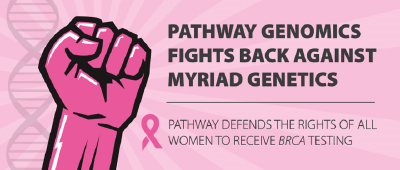
    Pathway Genomics Fights Back
    These graphics are accompanied by strong words from Jim Plante, Pathway Genomics' CEO, who the press release quotes as saying:

    We are a company trying to do good in the world.  Forty-eight hours after we raised hundreds of thousands of dollars for Susan G. Komen to fight breast cancer and announced our donation of $10 million of free genetic testing for women in need, Myriad Genetics slaps us with this unwarranted lawsuit.

    Given their pattern of filing lawsuits against other companies broadening access to this life-saving technology in clear disregard of the Supreme Court's decision last year, this lawsuit is not unexpected.  We do not infringe on any valid patent claims and are prepared to vigorously defend ourselves.

    And almost obligatorily:

    We are on a mission to make genetic testing more accessible and affordable, especially testing related to cancer screening, one of the leading causes of death in the world.  We believe that no corporation should have a monopoly over an individual's genes.  Every person should have access to vital information about their own body.

    In addition, Pathway Genomics has broached the issue of Myriad's sequestration of its genetic diagnostic mutation database, which Myriad has kept proprietary since about 2004.  Pathway Genomics also touts in its press release that it is part of the "Free the Data" movement, which opposes keeping genetic information as trade secrets (see "Consortium Launches Public Database of BRCA Data").  Their asserted hope is that "broadening access and sharing genetic information, we can collectively harness the power of the genome to improve our understanding of disease and improve healthcare for everyone" and vows to make its BRCA gene data available on the public database ClinVar.  While Myriad today has a large head start in its proprietary database, rapid adoption of Pathway Genomics' testing may provide a viable commercial alternative in much less time than it has taken Myriad to develop its own database (and may influence how long Myriad keeps its database as a trade secret).  These efforts may provide a market alternative to proposals for Congress to mandate disclosure, which would of course constitute a taking under the Fifth Amendment of the Constitution and require compensation sufficient to vitiate the public health cost advantage its proponents advocate.

  • BIO and World-Wide Intellectual Property Protection

    By Andrew Williams

    BIO International ConventionThe 2014 BIO International Convention begins next week in San Diego.  If you are planning on attending, you probably already know that the amount of information and opportunities available at BIO can be daunting.  Therefore, over the next week, Patent Docs will be highlighting a few sessions or other opportunities, in thematic fashion, to help you navigate your way through the convention.  For example, today, in honor of the World Cup, we focus on the "International" aspect of the convention by highlighting opportunities for those attendees that wish to compare intellectual property issues around the globe.  Of course, Patent Docs authors and contributors will be present at BIO as part of the MBHB contingent, and Patent Docs readers are encouraged to stop by the MBHB booth (#1337) to discuss these sessions (or whatever other topic is of interest to you).

    As any patent practitioner in the biotech and pharmaceutical space is aware, the various intellectual property protections available worldwide, with the varying requirements for patentability, can create a landmine for the unwary.  For example, some countries encourage early filing to avoid potential prior art issues, thereby providing for quicker public access to the technology disclosed.  Others, unfortunately, have heightened disclosure requirements, which counsels against filing until sufficient data is obtained.  Moreover, the various countries' policies towards follow-on biologics or personalized medicine with accompanying diagnostics create a tension between disclosure in order to obtain patent protection and non-disclosure in order to maintain trade secrets.  Several sessions across various tracks and forums will address some of these most difficult issues.

    First on our list, the Emerging Opportunities in Global Markets Forum will present "Predictions for the Future: Biopharmaceuticals and Exclusivity" on Thursday, June 26 at 11:00 AM to 12:00 noon.  The panel involved in this presentation will provide their perspective on the issue of follow-on biopharmaceuticals in various leading markets.  Pathways for the approval of such drugs are either very new or still forming.  Therefore, as the description of the session explains, decisions must be made in view of an uncertain legal and regulatory landscape, especially with regard to the intellectual property or regulatory exclusivity of these products.  The panel will explore the state of the global regulatory pathways, and how they present both opportunity and risk.  In addition, they will explain how organizations are dealing with new IP laws, and how these biopharmaceutical regulatory and IP systems will change strategies going forward.  This panel includes the Associate General Counsel of BIO, Hans Sauer; as well as Sherry Knowles, currently of Knowles Intellectual Property Strategies; Stephen Auten, Partner at Taft and renowned for his LinkedIn Hatch-Waxman ANDA Litigation Forum; and James Shehan, Counsel at Hyman, Phelps & McNamara, P.C.  The session will be moderated by Len Smith, currently General Counsel and Vice President of Heliae Development, LLC.

    Another area of significant interest for patent professionals practicing on a global scale is the concerns regarding disclosure requirements for patent application in different countries.  The problem becomes concrete when applicants need to decide whether to file an application with minimal data as soon as possible to minimize the changes of invalidating prior art, or to wait for additional data because of heightened disclosure requirements.  Famously, the Canadian courts have invalidated at least two of Eli Lilly's successful drugs, as well as many other companies' pharmaceuticals, because they did not meet the "promise doctrine" for utility.  In response, Eli Lilly has filed a Notice of Arbitration pursuant to the provision in the North American Free Trade Agreement (or NAFTA).  In contrast to the restrictions placed on the post-filing evidence to support utility in Canada and China, the U.S. and Europe allow such evidence for already-filed applications.  A session of the Intellectual Property track entitled "Show Me the Data!  Threshold Patent Application Disclosure Requirements & Post-Filing Evidence Admissibility in the U.S., Europe, Canada & China" will explore how the patent offices in these countries and regions treat post-filing evidence, and identify strategies of preparing applications in view of these disparate policies.  In addition, they will examine what impact the timing and availability of data acquisition has on filing applications in different jurisdictions worldwide.  The panelists will be Arvie Anderson, Assistant General Patent Counsel at Eli Lilly and Company; Patrick Kierans, Senior Partner at Norton Rose, LLP in Toronto, Canada; Wen Cao, Patent Attorney with NTD Intellectual Property Attorneys in Shanghai, China; and Ute Kilger, Partner at Boehmert & Boehmert in München, Germany.  The session will be moderated by Ed Haug, Managing Partner of Frommer Lawrence & Haug LLP, and will take place on Tuesday, June 24 at 4:15 PM to 5:15 PM.

    As a final example, the Personalized Medicine & Diagnostic Forum with be presenting "Navigating the Intellectual Property Minefield to Protect Personalized Medicine Innovations Worldwide" on Thursday, June 26 at 1:00 PM to 2:00 PM.  As pointed out in the description of this session, recent legal decisions and local policies have presented obstacles for obtaining IP protection involving personalized medicine.  However, numerous drugs are being developed with companion diagnostics.  Without sufficient IP protection to justify investments, many such therapies may never reach the market.  This panel of U.S. and European attorneys will identify the primary IP obstacles and offer strategies for generating adequate IP protection for personalized medicine innovations.  In addition, they will explore the impact that this IP will have for business and investment decisions in the major market countries.  The panel includes Hans-Rainer Jaenichen, Partner at Vossius & Partner; Shihong Nicolaou, Intellectual Property Manager of the Technology Transfer Office, U.C.S.D; and Scott Rittman, Associate Chief Intellectual Property Counsel, Becton, Dickinson and Company.  The panel will be moderated by Ned Israelsen, Managing Partner of Knobbe Martens Olson & Bear, LLP.

    Be on the look-out for the next installment of BIO 2014 previews in the next few days.

  • By Michael Borella

    NintendoA very experienced patent attorney once told me that you should never write means-plus-function claims unless there is a Luger at your temple.  This, the first opinion addressing indefiniteness to come from the Federal Circuit since the Supreme Court weighed in on the subject in Nautilis v. Biosig Instruments, does nothing to make one question the wisdom of that advice.

    Triton sued Nintendo in the Western District of Washington, alleging infringement of U.S. Patent No. 5,181,181.  Particularly, Triton contended that Nintendo's Wii Remote, in combination with other aspects of the Wii video game system, infringed several claims of the '181 patent.

    The '181 patent is directed to an input device that includes "components for determining its position, attitude, and motion."  These components may be, for instance, "three accelerometers and three rotational rate sensors for measuring linear acceleration along, and rotational velocity about, three orthogonal axes."  Each asserted claim recites "[an] integrator means associated with said input device for integrating said acceleration signals over time to produce velocity signals for linear translation along each of . . . first, second and third axes . . . ."

    The specification of the '181 patent discloses that a general-purpose microprocessor and an associated memory would facilitate this function.  With respect to details of the integration, however, the specification was silent.

    The District Court held the claims invalid for indefiniteness.  Triton appealed.

    Writing for a panel consisting of herself, Judge Reyna, and Judge Hughes, Federal Circuit Judge Moore began by noting that means-plus-function claiming under 35 U.S.C. § 112, paragraph 6 requires that the "specification . . . disclose with sufficient particularity the corresponding structure for performing the claimed function and clearly link that structure to the function."  Further, "[i]f the function is performed by a general purpose computer or microprocessor, then the specification must also disclose the algorithm that the computer performs to accomplish that function . . . failure to disclose the corresponding algorithm for a computer-implemented means-plus-function term renders the claim indefinite."

    The trade-off of means-plus-function claims in the computing arts is that the patentee can claim an outcome rather than the steps required to obtain that outcome.  But, to counteract the breadth of such claims, the patentee must disclose at least one algorithm for performing the steps.  The scope of the claims will be limited to the disclosed algorithm(s) and their equivalents.

    Without an algorithm for integration in the specification of the '181 patent, Triton found itself in a difficult situation.  First, Triton contended that the phrase "numerical integration" implicitly disclosed an algorithm, because such algorithms are well known to those of skill in the art.  This, of course, is true — integration is a basic calculus operation, and numerical integration algorithms are undergraduate textbook material.

    Judge Moore differed though, and asserted that "merely using the term 'numerical integration' does not disclose an algorithm — i.e., a step-by-step procedure — for performing the claimed function."  Instead, she agreed with the District Court that numerical integration "is not an algorithm but is instead an entire class of different possible algorithms used to perform integration."  Thus, the claim was not appropriately limited to the corresponding structure for performing the claimed function.  The fact that one of skill in the art could choose an appropriate well-known algorithm was immaterial because the '181 patent failed to disclose any such algorithm.

    Triton made a second argument that the specification did actually disclose an algorithm, though somewhat indirectly.  Judge Moore quickly disposed of this point because Triton had not properly raised it in the District Court proceedings.

    This outcome should not be surprising to anyone.  In Aristocrat v. IGT, the Federal Circuit warned against conflating the enablement requirement of 35 U.S.C. § 11, paragraph 1 with the disclosure requirement of 35 U.S.C. § 112, paragraph 6: "Enablement of a device requires only the disclosure of sufficient information so that a person of ordinary skill in the art could make and use the device.  A section 112 paragraph 6 disclosure, however, serves the very different purpose of limiting the scope of the claim to the particular structure disclosed, together with equivalents."

    In Nautilus, the Supreme Court held that "[a] patent is invalid for indefiniteness if its claims, read in light of the patent's specification and prosecution history, fail to inform, with reasonable certainty, those skilled in the art about the scope of the invention."  The claims at issue in Nautilus did include some means-plus-function language.  That holding however, apparently does not address the additional disclosure requirement of 35 U.S.C. § 112, paragraph 6.  Thus, a means-plus-function claim can be held invalid even if it passes the Court's "reasonable certainty" test.

    Triton Tech of Texas, LLC v. Nintendo of America, Inc. (Fed. Cir. 2014)
    Panel: Circuit Judges Moore, Reyna, and Hughes
    Opinion by Circuit Judge Moore