• By Kevin E. Noonan

    Washington - White House #2President Obama has reportedly decided against nominating Johnson & Johnson executive Philip Johnson in the face of political pressure from the hi-tech industry and Members of Congress, including Senator Charles Schumer (D-NY), as reported by The Wall Street Journal and GigaOm ("White House pulls plug on controversial Patent Office nominee after tech sector backlash").

    The proposed nomination, floated as a trial balloon last month, and its fate illustrate the rift between the biotech and pharma industry, who rely on patent exclusivity to provide the return on investment necessary to bring new drugs to market, and the IT industry, who are more concerned with the threat of so-called "patent trolls."  Mr. Johnson was known to oppose troll legislation that passed the House last fall and stalled in the Senate this spring (purportedly as the result of pressure from trial lawyers who feared the fee-shifting provisions in the bill would provide precedent for such provisions to spread from patent litigation to other lawsuits).

    There has been speculation about the fate of Michelle Lee, the current interim Deputy Director, but if the President was going to nominate her it would seem he would have done so by now.

    As the result of the President's decision not to nominate Mr. Johnson, the Office remains without a Director (for about 18 months and counting).  Because the time remaining on the President's term continues to diminish, the likelihood that a quality nominee would be willing to take on PTO leadership without sufficient time to make a difference is becoming less and less.  As the current subject matter eligibility Guidance shows, the Office needs a Director but the chances it will actually get one are becoming smaller and smaller.

  • Bloomberg BNA Hosts Panel on Subject Matter Eligibility

    By Kevin E. Noonan

    BIO International ConventionLast month at the BIO convention, Randy Kubetin, Managing Editor of Bloomberg BNA's Life Sciences Law & Industry Report moderated a panel entitled "Patent Eligibility from the Trenches: Practical Implications of the Supreme Court's Mayo and Myriad Decisions."  The panel provided a counterpoint to the USPTO's presentation earlier in the day (see "USPTO Provides Update on Myriad-Mayo Guidance"), which set forth the Office's position on subject matter eligibility.  This panel consisted of Theresa "Terry" Stanek Rea, former Deputy Director of the PTO under David Kappos and Acting Director upon his departure; Dr. Dianna DeVore, Senior Vice President, IP and Legal Affairs, Ariosa Diagnostics Inc. (familiar to readers for taking the position that nothing related to natural products or diagnostic methods is or should be patent eligible; Katherine Neville, a patent prosecutor from Marshall Gerstein and Borun in Chicago; and Matthew MacFarlaine, an author of Bloomberg BNA's Report, Stopped at the Threshold: The Practical Implications of the Supreme Court's Mayo and Myriad Decisions on Biotechnology Patent Practices (see "Bloomberg BNA Issues Report on PTO's Patent Eligibility Guidance").

    Mr. Kubetin introduced the panel and the topic by recapitulating some of his rhetoric he used in an earlier press conference introducing the Report:  speaking of the Mayo and Myriad cases and the USPTO Guidance, he asserted that the cases and the Guidance had "rewritten the playbook" and were (to use PTO Official June Cohan's phrase) "game changers."

    He then introduced the panel and Ex-Deputy Director Rea was the first to speak.  Asking that the session should be "highly entertaining" and "interactive, she presented what she called a "where we are" talk with regard to the Guidances and recent case law.  She argued that the Court's "judicial exceptions" were a "coarse filter" better assessed using substantive patent law.  She also asserted that in a close case, where patent eligibility is a tossup, the Office should choose to let an application pass through the Section 101 test.  She said that the Office was looking for "bright line" tests and for the public's help in properly applying the Court's rubrics, citing the Office's May 9th forum on the scope of the Guidances.  She also cautioned restraint by the Office, and asked the audience to advise clients to encourage them to pursue claims outside the scope of the Guidelines to help the Office "get it right."  She also mentioned that the deadline for written comments was extended by the Office until July 31, 2014 and said "[e]ach and every person in [the audience] has a moral duty" to provide comments on the Guidelines to help the Office "get it right."

    But she acknowledged that the "easy days" of having patent eligibility satisfied merely by reciting that a natural product was "isolated and purified" are gone, and what the Office needs are distinctions from the case law, particularly from the "scholars."  Ms. Rea also believes (from anecdotal evidence) that the Office and even certain examiners are looking for help in making the right determination; in this regard Ms. Rea cited the seven additional examples issued by the Office, including the one involving production of an antibiotic in yeast, which she believes should be patent eligible (unfortunately contrary to the Court's Cochrane v. Badische Anilin Soda Fabrik, 111 U.S. 293 (1884) precedent).

    Ms. Rea also argued (by example) for transparency by the Office, recalling her experience with the Written Description Guidelines from January 2001 and Director Kappos's supplemental guidelines in 2010, both of which were fully vetted through the formal agency rulemaking process.  She then directed her argument to why "getting it right" was important to her (as it should be to all of us, grey-haired or not): "I want as many drugs as possible and as many diagnostic tests as possible so I can look as good as possible for as long as possible."  She ended her portion of the panel by reminding the audience of the comments earlier in the morning by former Solicitor General Nancy Linck, agreeing that the Office should err on the side of patentability and said that she has optimism that the Office will do the right thing but needs our help in getting there.

    Next to speak was Dianna DeVore, Chief Patent Counsel of Ariosa Diagnostics; for those with short memories, Ariosa has taken the position (in its case against Sequenom) that genetic diagnostic tests utilizing "naturally occurring" fetal DNA were invalid under Section 101.  Dr. DeVore began her talk by stating that the "optimism is now over" and that the issue isn't how to get patents to grant from the Office but on how they can be enforceable.  Dr. DeVore acknowledged that the issues have not been completely resolved and that the current state of the law has had a "chilling effect" on diagnostics.  A result of this chilling effect is a "change IP regime," from "content based" (presumably genetic information) to "technology based," for example technology applicable to many diagnostics areas (she cited prenatal diagnostics and oncology as examples).  While admitting that not everyone believes these changes are good for diagnostics (a brave understatement particularly in front of this audience), she then predicted that as a result of the changes in the law, genetic diagnostic technology would rely more on trade secrets than patent protection, saying that the worst case scenario for a genetic diagnostics company would be to disclose its "secret sauce" in a patent application without being able to protect its methods.  (Without impugning Dr. DeVore's motivation it is clear that such a regime favors companies like Ariosa because it not only does not require disclosure but actively discourages it, so that the "term" of a proprietary diagnostic method can last far longer than the statutory patent term.)  Former Deputy Director Rea then piped up, saying that this scenario "really scares her" because the point of the patent system was disclosure; if Dr. DeVore's predictions became true the future would create specialized "institutes" where patients would need to visit to get a diagnosis.  Under these circumstances these institutes would "control" such testing because it would be difficult if not impossible to reverse engineer the test.  Dr. DeVore deflected this criticism by reminding the audience of the competition between the Scolnick lab and Mary Claire King's lab over the BRCA genes, implying that this sort of competition could avoid the consequences Ms. Rea had envisioned.  Unfortunately, while in the BRCA case there could have been such competition, the type of diagnostics Ms. Rea was talking about is unlikely to have the same sort of competition if only because such diagnostic tests are unlikely to involve inheritance of a single gene having the cancer-predisposing effects of BRCA (if only for the reason that it is one of the very few having such effects).

    Dr. DeVore also conflates the Mayo and Myriad holdings (as Ariosa has in its arguments to the District Court and the Federal Circuit), illustrated as saying the holdings were "not internally consistent" because producing cDNA from mRNA was "routine" (and implying that cDNA thus should not be patent eligible subject matter).

    Dr. DeVore ended her talk by mentioning the Court's decision in Alice Corp. v CLS Bank, saying that she has been "surprised" that the Court had been so interested in this area of the law.  She also stated that she believes the Federal Circuit will ultimately determine where the lines on patent eligibility will be drawn.

    Ms. Katherine Neville was the next speaker, and her talk was directed to the expanded scope of patent ineligibility in the Guidance that she said included antibodies, antibiotics, and other natural products.  She said that in her experience as a patent prosecutor for Biomarin and other pharmaceutical clients she had seen "viable 101 rejections and ridiculous ones, and cited the NIH study on the source of approved drugs over the past thirty years that has been discussed at the BIO IPCC meeting in April (see "Sherry Knowles 'Speaks Truth to Power' on the PTO's § 101 Guidelines").

    Ms. Rea again spoke up, reminding the audience that such drugs would not be brought to market unless a company can have an exclusivity position, citing bacitracin and taxol as examples.  Finally, Ms. Neville spoke about alternative claiming methods (such as methods of treatment) and the limitations of using these claim forms rather than claiming such natural products as compositions.

    The final speaker was Matt MacFarlaine, one of the authors of the Bloomberg BNA Report, and his presentation was largely a recap of the information disclosed in Bloomberg BNA's earlier press conference.  His message:  that the Office was broadly applying the Guidance on a case-by-case basis, to invalidate many claims encompassing widely varying subject matter (including in a particular example methods for identifying products of selective breeding of cod using genetic testing; these claims were deemed patent ineligible).  The pattern the authors detected was to "reject first" and then review an applicant's response to determine whether it overcame the assertion of patent ineligibility.

    Mr. Kubetin then started the truly interactive part of the program, presenting three claims and having the audience vote on whether the claims were patent eligible under the Guidances.  These claims were related to the following technologies:

    • A method for optimizing treatment of breast cancer with Tamoxifen, patterned very closely to the claim invalidated in Mayo;

    • A method for amplifying DNA patterned very closely on claims to the polymerase chain reaction (PCR); and

    • A vector comprising a nucleic acid operatively linked to a heterologous promoter.

    Perhaps not surprisingly, the vast majority of audience participants believed the first claim not to be patent eligible, based on its similarity to the Mayo claim.  This sentiment seemingly ignored the question of whether it was known (at the time the method was invented) that Tamoxifen was a treatment for breast cancer; the similarity to the Mayo claim was enough for most of the audience to arrive at its conclusion of patent ineligibility.  At least one questioner pointed out that this sentiment was based on the assumption that Tamoxifen was not a new compound and posed the question of whether the result would be different if it was novel (Dr. DeVore remained steadfast in her position that this claim would just be a natural correlation whether Tamoxifen was a new compound or not.)

    The other two claims were deemed by the majority of the audience to be patent eligible.  However, one audience member reacted to the PCR claim by stating that "this was exactly what the Supreme Court was trying to get rid of in Myriad, . . . control of genetic information."  Unless this was an ACLU plant, this outburst provided a measure of how far the ACLU's position has taken hold even among BIO attendees.  However, it is important to realize that this position conflates claims to a method for obtaining (genetic) information with the information itself, and also forgetting that genetic information per se is not patent eligible and has never been patented.  The recombinant DNA claim was less controversial if only because it was polled at the very end of the session (which had of course gone overtime); from earlier discussions it was clear that even this claim had some audience members believing that patent eligibility would depend on whether making recombinant DNA was "routine and conventional," something the Supreme Court has not held but criteria clearly implicated in the Office's Guidance.

    Taken together, this session, Bloomberg BNA's press conference regarding its Report, and the PTO's session earlier in the day firmly established that the law of subject matter eligibility is in flux throughout the patenting space, a situation created by the Supreme Court, abetted by the USPTO and the excessive Guidances, and one that decidedly does not "Promote the Progress of . . . the Useful Arts."

  • Life Sciences Top 49

    By Donald Zuhn

    IPO #2Last month, the Intellectual Property Owners Association (IPO) announced the release of its 31st annual list of the top 300 organizations receiving U.S. patents.  Patent Docs Readers may recall that the U.S. Patent and Trademark Office stopped releasing its annual list of top patent recipients in 2006 in order to "discourag[e] any perception that we believe more is better."

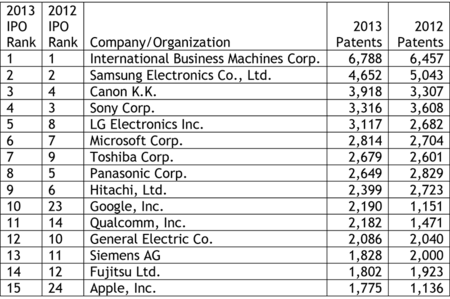
    The IPO compiled its list by counting the number of utility patents granted during 2013 that listed an organization or a subsidiary as the owner on the printed patent.  The IPO notes that if an assignment to an organization or its subsidiary was recorded after the patent was printed, the patent was not counted, and further, that patents that were granted to two or more organizations jointly were attributed to the organization listed first on the patent.  The IPO also noted that 277,835 patents were issued in 2013, which was an increase from the 253,155 patents that issued in 2012.  The top fifteen companies on the IPO Top 300 are listed below (click on table to expand):

    2013 Top 15
    Falling out of the Top 15 in 2013 were Seiko Epson Corp. and Toyota Jidosha K.K., which dropped to 19th and 22nd, respectively.  Replacing those companies in the Top 15 were Google, Inc. and Apple, Inc.

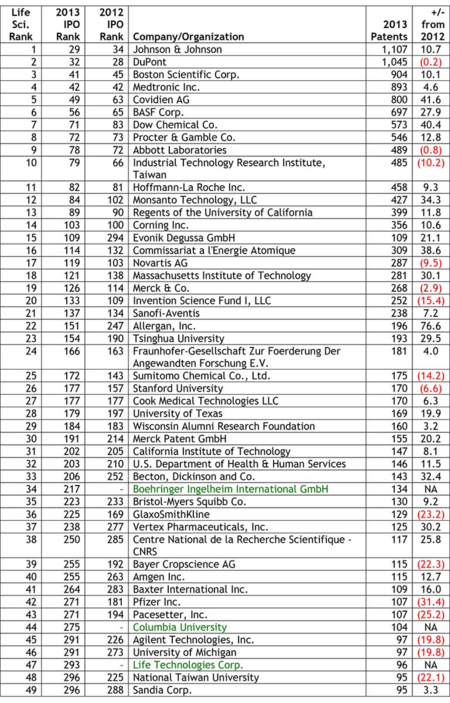
    As in past years, Patent Docs used the IPO's list of top patent holders to compile a list of the top "life sciences" companies and organizations receiving U.S. patents in 2013.  In the past seven years, the number of life sciences companies and organizations making the list has gone from 51 in 2006 to 47 in 2007, 43 in 2008, 47 in 2009, 56 in 2010, 53 in 2011, 50 in 2012, and 49 last year.  Each organization's IPO top 300 ranking for 2013 is indicated in the "2013 IPO Rank" column; the IPO top 300 ranking for 2012 (if available) is indicated in the "2012 IPO Rank" column; and the change in number of patents from 2012 is indicated in "+/- from 2012."  The Life Sciences Top 49 is listed below (click on table to expand):

    2013 Top 49Life sciences companies and organizations that failed to make the IPO top 300 in 2013 after making it in 2012 included Dongbu Hitek Co., Ltd. (#224 on the IPO top 300 for 2012), DSM IP Assets B.V. (273), AstraZeneca AB (288), and Toray Industries Inc. (296).  Life sciences companies new to this year's list are indicated in green text.

    Please note that some of the companies and organizations listed above may be involved in work outside the life sciences sector, and therefore, a portion of the patents granted to these companies and organizations may be directed to other than life sciences-related inventions.  In addition, our list is a little inclusive in that we included medical device companies.

    For additional information regarding this topic, please see:

    • "IPO Releases List of Top 300 Patent Holders for 2012," June 24, 2013
    • "Another Look at IPO Top 300 and Life Sciences Top 53," June 11, 2012
    • "IPO Releases List of Top 300 Patent Holders for 2011," June 7, 2012
    • "IPO Releases List of Top 300 Patent Holders for 2010," June 30, 2011
    • "IPO Releases List of Top 300 Patent Holders for 2009," May 26, 2010
    • "IPO Releases List of Top 300 Patent Holders for 2008," May 14, 2009
    • "IPO Releases List of Top 300 Patent Holders," May 22, 2008
    • "IPO Posts List of Top 300 Patent Holders," April 20, 2007

  •         By Sherri Oslick

    Gavel About Court Report:  Each week we will report briefly on recently filed biotech and pharma cases.

    Eli Lilly and Company et al. v. Panacea Biotec, Ltd.
    1:14-cv-01064; filed June 26, 2014 in the Southern District of Indiana

    • Plaintiffs:  Eli Lilly and Company; Daiichi Sankyo Co., Ltd.; Daiichi Sankyo, Inc.; Ube Industries, Ltd.
    • Defendant:  Panacea Biotec, Ltd.

    Infringement of certain of U.S. Patent Nos. 8,404,703 ("Medicinal Compositions Containing Aspirin," issued March 26, 2013) and 8,569,325 ("Method of Treatment with Coadministration of Aspirin and Prasugrel," issued October 29, 2013) following a Paragraph IV certification as part of Panacea's filing of an ANDA to manufacture a generic version of Lilly's Effient® (prasugrel hydrochloride, to be used in combination with aspirin for the reduction of thrombotic cardiovascular events in certain patients with acute coronary syndrome (ACS) who are to be managed with percutaneous coronary intervention).  View the complaint here.

    Novartis Pharmaceuticals Corp. et al. v. Mylan Inc. et al.
    1:14-cv-00111; filed June 26, 2014 in the Northern District of West Virginia

    • Plaintiffs:  Novartis Pharmaceuticals Corp.; Novartis Corp.; Novartis AG; Novartis Pharma AG
    • Defendants:  Mylan Inc.; Mylan Pharmaceuticals, Inc.

    Novartis Pharmaceuticals Corp. et al. v. Mylan Inc. et al.
    1:14-cv-00820; filed June 25, 2014 in the District Court of Delaware

    • Plaintiffs:  Novartis Pharmaceuticals Corp.; Novartis Corp.; Novartis AG; Novartis Pharma AG
    • Defendants:  Mylan Inc.; Mylan Pharmaceuticals Inc.

    The complaints in these cases are substantially identical.  Infringement of U.S. Patent Nos. 6,465,504 ("Substituted 3,5-Diphenyl-1,2,4-Triazoles and Their Use as Pharmaceutical Metal Chelators," issued October 15, 2002) and 6,596,750 (same title, issued July 22, 2003) following a Paragraph IV certification as part of Mylan's filing of an ANDA to manufacture a generic version of Novartis' Exjade® (deferasirox, used for the treatment of chronic iron overload due to blood transfusions).  View the Delaware complaint here.

    Shire LLC et al. v. Ranbaxy Inc. et al.
    1:14-cv-00827; filed June 25, 2014 in the District Court of Delaware

    • Plaintiffs:  Shire LLC; Shire Development LLC; Supernus Pharmaceuticals Inc.
    • Defendants:  Ranbaxy Inc.; Ohm Laboratories Inc.; Ranbaxy Laboratories Ltd.

    Infringement of U.S. Patent Nos. 6,287,599 ("Sustained Release Pharmaceutical Dosage Forms with Minimized pH Dependent Dissolution Profiles," issued September 11, 2001) and 6,811,794 (same title, issued November 2, 2004) based on Ranbaxy's filing of an ANDA to manufacture a generic version of Shire's Intuniv® (guanfacine, used to treat attention-deficit hyperactivity disorder).  View the complaint here.

    Pfizer Inc. et al. v. CFT Pharmaceuticals LLC
    2:14-cv-00714; filed June 20, 2014 in the Eastern District of Wisconsin

    • Plaintiffs:  Pfizer Inc.; Wyeth LLC; Pfizer Pharmaceuticals LLC; Pfizer Manufacturing Holdings LLC; PF Prism CV
    • Defendant:  CFT Pharmaceuticals LLC

    Infringement of U.S. Patent Nos. 7,879,828 ("Tigecycline Compositions and Methods of Preparation," issued February 1, 2011) and 8,372,995 ("Crystalline Solid Forms of Trigecycline and Methods of Preparing Same," issued February 12, 2013), licensed to Pfizer, following a Paragraph IV certification as part of CFT's filing of an ANDA to manufacture a generic version of Pfizer's Tygacil® (tigecycline injectible, used for the treatment of complicated skin and skin structure infections, complicated intra-abdominal infections, and community-acquired bacterial pneumonia).  View the complaint here.

    Novartis Pharmaceuticals Corp. et al. v. Mylan Inc. et al.
    1:14-cv-00106; filed June 20, 2014 in the Northern District of West Virginia

    • Plaintiffs:  Novartis Pharmaceuticals Corp.; Novartis AG; Novartis Pharma AG; LTS Lohmann Therapie-Systeme AG
    • Defendants:  Mylan Inc.; Mylan Pharmaceuticals Inc.

    Infringement of U.S. Patent Nos. 6,316,023 ("TTS Containing an Antioxidant," issued November 13, 2001) and 6,335,031 (same title, issued January 1, 2002) following a Paragraph IV certification as part of Mylan's filing of an ANDA to manufacture a generic version of Novartis' Exelon® Patch (rivastigmine tartrate, used to treat mild to moderate dementia of the Alzheimer's type, and mild to moderate dementia associated with Parkinson's disease).  View the complaint here.

  • CalendarJuly 9, 2014 – "Nautilus and Limelight: The Supreme Court Keeps Chipping Away at Patentees" (McDonnell Boehnen Hulbert & Berghoff LLP) – 10:00 to 11:15 am (CT)

    July 9-11, 2014 – Fundamentals of Patent Prosecution 2014: A Boot Camp for Claim Drafting & Amendment Writing (Practising Law Institute) – San Francisco, CA

    July 20-22, 2014 – 2014 Annual Meeting & Conference (National Association of Patent Practitioners) – Alexandria, Virginia

    July 22, 2014 – "America Invents Act: Patent Strategies and Reforms Counsel Needs to Know" (Commercial Law WebAdvisor) – 1:00 to 2:30 pm (Eastern)

    July 24, 2014 – "Protecting IP Rights After Limelight Networks v. Akamai: Implications for Divided Patent Infringement and Inducement — Prosecuting and Litigating Patent Claims Following the New Supreme Court Decision" (Strafford) – 1:00 to 2:30 pm (EDT)

    July 30, 2014 – "Ask the Office: New Guidance on Functional Claiming" (American Bar Association Section of Intellectual Property Law) – 1:00 to 2:30 pm (ET)

    July 30, 2014 – "Alice Corp. v. CLS Bank: Patent Eligibility of Software-Related Inventions" (Strafford) – 1:00 to 2:30 pm (EDT)

    August 13-15, 2014 – Advanced Patent Law Seminars (Chisum Patent Academy) - Seattle, WA

    August 18-20, 2014 – Advanced Patent Law Seminars (Chisum Patent Academy) - Seattle, WA

    ***Patent Docs is a media partner of this conference or CLE

  • Strafford #1Strafford will be offering a webinar/teleconference entitled "Protecting IP Rights After Limelight Networks v. Akamai: Implications for Divided Patent Infringement and Inducement — Prosecuting and Litigating Patent Claims Following the New Supreme Court Decision" on July 24, 2014 from 1:00 to 2:30 pm (EDT).  Sona De and Gene W. Lee of Ropes & Gray will provide guidance to patent counsel on the impact of the new Limelight Networks Inc. v. Akamai Techs. Inc. decision on patent litigation and prosecution, and discuss the divided infringement loophole and outline steps to protect IP rights.  The webinar will review the following questions:

    • What are the implications of the Limelight Networks Inc. v. Akamai Techs. Inc. decision for infringement claims?
    • What best practices in patent claim drafting can counsel employ to minimize the risk of infringement?
    • What is the impact of the decision for method claims?

    The registration fee for the webinar is $297 ($362 for registration and CLE processing).  Those interested in registering for the webinar, can do so here.

  • Commercial Law WebAdvisor
    Commercial Law WebAdvisorwill be offering a webinar entitled "America Invents Act: Patent Strategies and Reforms Counsel Needs to Know" on July 22, 2014 from 1:00 to 2:30 pm (Eastern).  Aaron D. Charfoos of Dykema Gossett PLLC will examine the changes to the patent system introduced by the AIA, as well as strategies in-house counsel and other attorneys advising businesses can employ to put themselves at an advantage when applying for and challenging patents.  The webinar will address the following topics:

    • How the America Invents Act altered the landscape of obtaining and challenging patents,
    • How the change from a “first-to-invent” to a “first-to-file” system affects how patents are awarded,
    • Steps counsel and businesses need to take to secure the earliest possible filing date,
    • New ways to challenge patents after they issue, specifically Inter Partes Review (IPR) and Covered Business Method Review (CBMR),
    • Procedural benefits to IPR and CBMR compared to civil proceedings, and
    • Other litigation assessment strategies.

    The registration fee for the webinar is $299.  Those interested in registering for the webinar, can do so here.

  • ABAThe American Bar Association (ABA) Section of Intellectual Property Law will be offering a live webinar entitled "Ask the Office: New Guidance on Functional Claiming" on July 30, 2014 from 1:00 to 2:30 pm (ET).  Christopher Alan Bullard of Oblon, Spivak, McClelland, Maier & Neustadt, L.L.P. will moderate a panel consisting of Nathan James Prepelka of The Webb Law Firm, Alysa N. Youngson of MH2 Technology Law Group, and Andrew Hirshfeld of the U.S. Patent and Trademark Office.  The panel will discuss the following topics:

    • The impact of the new training materials on patent examination,
    • The quality of issued patent claims, and
    • How to avoid potential pitfalls associated with functional claiming.

    This webinar will provide attendees with an opportunity to pose questions about the new examiner training on functional claim language.  Attendees who have questions about this topic, should send their questions to the panel moderator, Chris Bullard (cbullard@oblon.com), by July 8, 2014.

    The registration fee for the webcast is $150 for members and $195 for the general public.  Those interested in registering for the webinar, can do so here.

  • Strafford #1Strafford will be offering a webinar/teleconference entitled "Alice Corp. v. CLS Bank: Patent Eligibility of Software-Related Inventions" on July 30, 2014 from 1:00 to 2:30 pm (EDT).  Michael L. Kiklis and Stephen G. Kunin of Oblon Spivak McClelland Maier & Neustadt will examine the Supreme Court's Alice Corp. v. CLS Bank Int'l decision and its impact on patent eligibility for software-related inventions, and discuss what counsel to companies need to do to get patent protection for inventions implemented in computer software.  The webinar will review the following questions:

    • What does the Supreme Court's decision mean for patent eligibility for software-related inventions?
    • How can patent litigation defendants take advantage of the guidance for Section 101 challenges?
    • What best practices should counsel employ to protect software-related inventions?

    The registration fee for the webinar is $297 ($362 for registration and CLE processing).  Those registering by July 18, 2014 will receive a $50 discount.  Those interested in registering for the webinar, can do so here.

  •         By Sherri Oslick

    Gavel About Court Report:  Each week we will report briefly on recently filed biotech and pharma cases.

    Otsuka Pharmaceutical Co. Ltd. v. Par Pharmaceutical Inc.
    1:14-cv-00789; filed June 20, 2014 in the District Court of Delaware

    Infringement of U.S. Patent Nos. 5,753,677 ("Benzoheterocyclic Compounds," issued May 19, 1998) and 8,501,730 ("Process for Preparing Bezazepine Compounds or Salts Thereof," issued August 6, 2013) following a Paragraph IV certification as part of Par's filing of an ANDA to manufacture a generic version of Otsuka's Samsca® (tolvaptan, used to treat hyponatremia).  View the complaint here.

    Amarin Pharmaceuticals Ireland Ltd. v. Omthera Pharmaceuticals Inc. et al.
    1:14-cv-00791; filed June 20, 2014 in the District Court of Delaware

    • Plaintiff:  Amarin Pharmaceuticals Ireland Ltd.
    • Defendants:  Omthera Pharmaceuticals Inc.; AstraZeneca Pharmaceuticals LP

    Infringement of U.S. Patent No. 8,663,662 ("Stable Pharmaceutical Compositions and Methods of Using Same" issued March 4, 2014) based on AstraZeneca's anticipated marketing and sale of their recently FDA-approved Epanova™ (mixture of polyunsaturated free fatty acids derived from fish oils for use as an adjunct to diet to reduce triglyceride levels in adult patients with severe (≥ 500 mg/dL) hypertriglyceridemia).  View the complaint here.

    Avanir Pharmaceuticals Inc. v. Ranbaxy Laboratories Ltd. et al.
    1:14-cv-00792; filed June 20, 2014 in the District Court of Delaware

    • Plaintiff:  Avanir Pharmaceuticals Inc.
    • Defendants:  Ranbaxy Laboratories Ltd.; Ranbaxy Inc.

    Infringement of U.S. Patent Nos. 7,659,282 ("Pharmaceutical Compositions Comprising Dextromethorphan and Quinidine for the Treatment of Neurological Disorder," issued February 9, 2010) and 8,227,484 ("Pharmaceutical Compositions Comprising Dextromethorphan and Quinidine for the Treatment of Neurological Disorder," issued July 24, 2012) following a Paragraph IV certification as part of Ranbaxy's filing of an ANDA to manufacture a generic version of Avanir's Nuedexta® (dextromethorphan hydrobromide/quinidine sulfate, used to treat pseudobulbar affect).  View the complaint here.  [NB: The complaint was voluntarily dismissed 10 days after it was filed.]

    Senju Pharmaceutical Co. et al. v. Metrics, Inc. et al.
    1:14-cv-03962; filed June 20, 2014 in the District Court of New Jersey

    • Plaintiffs:  Senju Pharmaceutical Co.; Bausch & Lomb, Inc.; Bausch & Lomb Pharma Holdings Corp.
    • Defendants:  Metrics, Inc.; Pharmaceuticals, Inc.; Mayne Pharma Group Ltd.; Mayne Pharma (USA), Inc.; Coastal Pharmaceuticals, Inc.

    Infringement of U.S. Patent Nos. 8,129,431 ("Aqueous Liquid Preparation Containing 2-amino-3-(4-bromobenzoyl)phenylacetic acid," issued March 6, 2012), 8,669,290 (same title, issued March 1, 2014), and 8,754,131 (same title, issued June 17, 2014) following a Paragraph IV certification as part of Metrics' filing of an ANDA to manufacture a generic version of B&L's Prolensa® (bromfenac ophthalmic solution, used to treat postoperative inflammation and reduction of ocular pain in patients who have undergone cataract surgery).  View the complaint here.


    Otsuka Pharmaceutical Co. v. Intas Pharmaceuticals Ltd. et al.
    1:14-cv-03996; filed June 20, 2014 in the District Court of New Jersey

    • Plaintiff:  Otsuka Pharmaceutical Co.
    • Defendants:  Intas Pharmaceuticals Ltd.; Accord Healthcare, Inc.; Accord Healthcare Ltd.; Astron Research Ltd.; Hetero Labs Ltd.

    Infringement of U.S. Patent Nos. 8,017,615 ("Low Hygroscopic Aripiprazole Drug Substance and Process for the Preparation Thereof," issued September 13, 2011), 8,580,796 (same title, issued November 12, 2013), and 8,642,760 (same title, issued February 4, 2014) following a Paragraph IV certification as part of Accord's filing of an ANDA to manufacture a generic version of Otsuka's Abilify® (aripiprazole, used to treat bipolar disorder and schizophrenia).  View the complaint here.

    Medicine Store Pharmacy Inc v. AfGin Pharma LLC
    3:14-cv-02255; filed June 20, 2014 in the Northern District of Texas

    • Plaintiff:  Medicine Store Pharmacy Inc d/b/a RXpress Pharmacy
    • Defendant:  AfGin Pharma LLC

    Declaratory judgment of non-infringement and invalidity of U.S. Patent No. 8,329,734 ("Topical Therapy for Migraine," issued December 11, 2012) based on RXpress' manufacture and sale of its "Migraine Cream" product(s).  View the complaint here.