• Strafford #1Strafford will be offering a webinar/teleconference entitled "Evolving PTAB Trial Practice: Navigating Complex Procedural Rules — Strategically Using Routine and Additional Discovery, Requests for Joinder, and Motions to Amend" on December 15, 2014 from 1:00 to 2:30 pm (EST).  Greg H. Gardella and Scott A. McKeown of Oblon Spivak McClelland Maier & Neustadt will provide guidance to counsel on Patent Trial and Appeal Board (PTAB) trial practice, focusing on discovery, joinder and motions to amend, and examine guidance issued by the PTAB, as well as lessons from recent PTAB decisions.  The webinar will review the following questions:

    • What is the PTAB’s current approach to joinder?
    • How can counsel use the PTAB’s recent guidance on routine and additional discovery most effectively?
    • What are best practices for using joinder in a case before the PTAB?

    The registration fee for the webinar is $297 ($362 for registration and CLE processing).  Those interested in registering for the webinar, can do so here.

  • ABAThe American Bar Association (ABA) Center for Professional Development and Section of Intellectual Property Law will be offering a live webinar entitled "Strategic Considerations Before Kick-Starting an IPR" on December 16, 2014 from 1:00 to 2:30 pm (ET).  Jennifer Lee Bailey, Kim E. Choate, Margaret McInerney Welsh, and Thomas Victor Miller discuss factors that a potential Petitioner should consider before filing an inter partes review (IPR), including:

    • Statutory and regulatory requirements
    • Claim construction
    • Asserted grounds
    • Expert declarations

    The registration fee for the webcast is $150 for members and $195 for the general public.  Those interested in registering for the webinar, can do so here.

  • The Federal Circuit Bar Association (FCBA) will be holding a panel discussion webinar entitled " Appealing to the Federal Circuit From PTAB Decisions in AIA Review Proceedings" on December 11, 2014 from noon to 1:00 pm (EST).  Scott Weidenfeller of the USPTO Office of the Solicitor, John Dragseth of Fish & Richardson P.C., and Timothy Salmon of Cuozzo Speed Technologies LLC and Empire IP LLC will discuss appeals of final decisions of the USPTO's Patent Trial and Appeal Board (PTAB) in AIA review proceedings (i.e., inter partes review, post-grant review, and covered business method patent review) to the United States Court of Appeals for the Federal Circuit and the unique aspects of and interesting issues in these types of appeals.  The panel discussion will be held at the USPTO, Knox Building, 10th Floor.  Those wishing to participate online can do so by visiting the FBCA's registration website.  Information about registering for this event can be found here.

    The registration fee for the webcast is $120 (non-member private practitioners), $35 (non-member government/academic/retired), or complimentary for FCBA members.  Those interested in registering for the webcast, can do so here.

  • By Andrew Williams

    USPTO SealJust what does it take to amend your claims during an IPR proceeding before the PTAB?  Of course, the America Invents Act ("AIA") specifically provides that Patent Owners may file one motion to amend the claims.  AIA, § 316(d)(1).  However, most people in the patent community are well aware that the PTAB has only granted one such motion, in a case in which the motion to amend was unopposed, and in which the patent owner was the United State of America!  Therefore, it is understandable that most practitioners view the prospect of amending claims as futile.  To appease these concerns, the PTAB has been issuing instructions and guidance for well over a year.  In an early example, the Idle Free Systems, Inc. v. Bergstrom, Inc. case (IPR2012-00027) provided one of the first sets of guidance on motions to amend on June 11, 2013 (Paper 26), which is still cited regularly today.  In fact, it can be found on the Patent Office PTAB Representative Decisions page under the heading "Motions to Amend."  The Patent Office also released a message on its AIA Blog on May 5, 2014, entitled "How to Make Successful Claim Amendments in an AIA Trial Proceeding."  Nevertheless, either no one was paying attention, or more likely, amending claims is not as easy as the PTAB has suggested it would be.  In its latest attempt, a three-APJ panel released an order "On Motion to Amend Claims" on October 30, 2014 in the Corning Optical Communications RF, LLC v. PPC Broadband, Inc. case, IPR2014-00441 (Paper 19).

    The Corning Optical guidance was issued after a telephone conference between the parties and Judges Jameson Lee, Josian C. Cocks, and Jacqueline Wright Bonilla.  Specifically, the Patent Owner was satisfying its requirement "to confer" as found in 37 C.F.R. § 42.121(a).  Nevertheless, the Board provided verbal guidance, followed by the issued order.  Importantly, the Board authorized the Patent Owner to include its proposed substitute claim set as an appendix so as to not count toward the restrictive 15-page limit.

    The Substitute Claim Set

    The PTAB regulations require that the substitute claim set appear as a claim listing and be responsive to the ground of unpatentability.  See C.F.R. § 42.221(a)(2)(i) and (b).  Moreover, there is a presumption that for every claim at issue, only one substitute claim is reasonable.  The Board warned, however, that this does not mean that the Patent Owner can simply maintain the same number of claims.  Instead, each substitute claim must be traceable back to an original patent claim at issue.  In addition, the Patent Owner should not eliminate any feature or element from the claims.  If the Patent Owner believes that more than one substitute claim is required for one or more particular claims, they should "articulate a special circumstance to justify the request."  Finally, the substitute claim set must identify what the changes are to the original claims, ideally with the use of brackets for deletions and underlining for additions.

    Burden of Proof

    The regulations provide that the Patent Owner bears the burden of proof in establishing it is entitled to amended claims.  37 C.F.R. § 42.20(c).  The reason that is commonly given by the Office is that if the motion is granted, the claim set will be added to an issued patent without examination.  Of course, this is contrary to the justification provided for the use of the Broadest Reasonable Interpretation standard for claim construction (which is used, in part, because the claims are allegedly being examined and can therefore be amended).  Nevertheless, in general, the Patent Owner must show patentability.

    An IPR can only be instituted based on citation to certain types of prior art (patents and printed publications) on 35 U.S.C. § 102 (anticipation) or § 103 (obviousness) grounds.  However, with respect to showing that a substitute claim set is patentable, there is no such limitation.  As we reported at the time, the Board in the Ariosa Diagnostics v. Isis Innovation Ltd. Final Written Decision, IPR2012-00022 (Paper 166) denied a motion to amend claims because the Patent Owner failed to show patentability under 35 U.S.C. § 101.  As the Board stated, "when considering a motion to amend, we do not examine and allow or reject the substitute claims, but determine whether the patent owner has met its burden of establishing that it is entitled to the substitute claims that it seeks in its motion to amend" (emphasis in original).  Important to this decision, however, was that the original claims had been found by a District Court to have failed the patent eligibility requirement of § 101.  Nevertheless, if there is any question, it might be advisable for any Patent Owner to explain why the substitute claims are patent eligible (in addition to the other requirements related to patentability).

    Writing Description Support

    The regulations also provide that the Patent Owner must show where written description support can be found in the specification for the proposed substitute claims.  37 C.F.R. § 42.221(a)(2)(ii).  This citation should be to the original disclosure, not the issued patent.  Also, support must be shown for the entire claim, not just the newly added feature.

    Claim Construction

    If the meaning of any newly added term can reasonably be thought to be in dispute, the Patent Owner should provide a proposed claim construction.  If this is a means-plus-function, the corresponding structure, material, or act should be identified.  Moreover, it is unsufficient to state that the term should be given its plain and ordinary meaning.  Instead, such meaning should be provided with any supporting evidence.

    Patentability

    Notwithstanding the outcome in the Ariosa Final Written Decision, the Board in this guidance noted that the Patent Owner must show patentability over the prior art if the trial was instituted over prior art.  Of course, this demonstration is not limited to references cited by the Petitioner, but instead must account for all prior art.  For example, for any new feature found in the substitute claims, "it should be revealed whether the feature was previously known anywhere, in whatever setting, and whether or not the feature was known in combination with any of the other elements in the claim."  Luckily, the Patent Owner is not expected to be aware of everything that the hypothetical person ordinary skill in the art is, but it should reveal what it does know, and how it might be relevant.  Of course, the Patent Owner should explain the level of skill in the art, ideally as it relates to the newly added claim limitation.  It would also be useful to include any textbooks or conventional practices related to the added feature.  And, as we have seen, conclusory statements of patentability are not useful.

    Based on a review of the outcome of these motions, this requirement appears to be the reason most are not granted.  Therefore, it might be instructive to look at the only case that granted (in part) a motion to amend — International Flavors & Fragrances Inc. v. The United States of America (IPR2013-00124).  That case related to a patent with methods for repelling arthropods (such as ticks and mosquitoes) using particular isolongifolenone analogs.  The claim amendment sought to limit the broadest independent claim drawn to the genus by specifying a markush group of five analogs from which the isolongifolenone analog could be selected.  The Patent Owner did reference the publication cited during institution as the "'apparent' closest prior art."  The Board believed that the Patent Owner's statement was conclusory.  However, the Patent Owner's explanation of what would have been understood by one of ordinary skill in the art carried the day (with the possible help of an expert declaration and citation to several publications).

    Specifically, the Board noted the Takeda standard for determining the obviousness of small molecules:  "it remains necessary to identify some reason that would have led a chemist to modify a known compound in a particular manner to establish prima facie obviousness of a new claimed compound."  Takeda Chem. Indus., Ltd. v. Alphapharm Pty., Ltd., 392 1350, 1357 (Fed. Cir. 2007).  In this case, the Patent Owner cited to several references demonstrating that minor structural changes to the relevant compounds can result in very different properties, especially with regard to repelling insects.  Because there was not a "small or easily traversed" number of molecules disclosed in the prior art references, and the Patent Owner was able to demonstrate why one of ordinary skill in the art would not have modified the lead compound, the Board found that the Patent Owner established patentability of the substitute claim set.

    Not every case is going to have such a straight forward proof of the negative — that the prior art does not render the claims unpatentable.  Nevertheless, if possible, a Patent Owner would be well advised to cite to prior art references that establish that the substituted claims are both not present in the prior art, nor rendered obviousness in the view of the art.  This will help to turn a negative proof (it's not unpatentable) into a positive one (the prior art establishes that one skilled in the art would not have arrived at the claimed invention).

    It can only be hoped with this newly issued guidance for seeking to amend claims in IPR proceedings will result in making it easier to amend claims.  We will continue to monitor such motions, to see if Patent Owners are heeding the advice of the PTAB, or to see if it is truly futile to seek to amend claims, regardless what the PTAB has been recently saying.

  • By Kevin E. Noonan

    That it is more difficult today to be a patentee able to defend her patent rights than any time since the 1940's is nicely illustrated by the Federal Circuit's decision in Par Pharmaceutical, Inc. v. TWI Pharmaceuticals, Inc., where the patentee prevailed only to face almost certain defeat on remand.

    Par PharmaceuticalThis is an ANDA case involving certain formulations of megestrol acetate, a compound known in the art as an appetite stimulant for use with cancer patients and AIDS patients to treat cachexia and for treating anorexia and other conditions where there is a significant loss of body mass.  The invention provided modified megestrol formulations where the drug was administered as "nanosized" particles; the prior art administered megestrol acetate in micronized form, sold by Bristol-Myers Squibb as Megace OS, which formulation had been the target of ANDA litigation.  Par had obtained FDA approval for marketing its own form of Megace OS, but rather than enter the marketplace with this formulation contracted with Alkermes Pharma Ireland (formerly Elan Pharmaceuticals) to adapt that company's nanoparticle technology (termed "NanoCrystals") to make nanosized megestrol acetate formulations (which it termed Megace ES and for which Par also received FDA approval).

    During prosecution, the PTO rejected method claims for using these formulations as being obvious over the combination of prior art disclosing micronized megestrol acetate formulations with prior art NanoCrystal formulation methods.  The Office initially found these formulation claims obvious, but Par obtained U.S. Patent No. 7,101,576 by including "wherein" clauses, based on its discovery that the nanosized formulations had a reduced "food effect" when compared to micronized formulations; specifically, the nanosized version did not increase nutrient absorption (rate or extent) which the panel noted was important for treating AIDS patients.  Claim 1 of the '576 patent is illustrative:

    A method of increasing the body mass in a human patient suffering from anorexia, cachexia, or loss of body mass, comprising administering to the human patient a megestrol formulation, wherein:
        (a)  the megestrol acetate formulation is a dose of about 40 mg to about 800 mg in about a 5 mL dose of an oral suspension;
        (b)  the megestrol acetate formulation comprises megestrol particles having an effective average particle size of less than about 2000 nm, and at least one surface stabilizer associated with the surface of the megestrol particles; and
        (c)  the administration is once daily;
        wherein after a single administration in a human subject of the formulation there is no substantial difference in the Cmax of megestrol when the formulation is administered to the subject in a fed versus a fasted state,
        wherein fasted state is defined as the subject having no food within at least the previous 10 hours, and wherein fed state is defined as the subject having a high-calorie meal within approximately 30 minutes of dosing.

    TWi PharmaceuticalsTWi Pharmaceuticals filed an ANDA for Par's nanosized formulation, and in its Paragraph IV letter asserted invalidity on four grounds: "(1) the claims are invalid as obvious under 35 U.S.C. § 103 []; (2) the claims do not cover patentable subject matter under § 101; (3) the claims are not enabled under § 112; and (4) Par does not have standing to assert its claims."

    The District Court did not reach any of TWi's invalidity contentions other than obviousness, for which it based its opinion on several prior art references that fell into two broad categories:  first, art related to "the pharmacokinetic properties of megestrol, and [second] the use of nanoparticle technology in drug formulation."  In addition to the prior art use of Megase OS, the Court considered scientific references relating to how the drug was absorbed using micronized formulations.  With regard to nanoparticle technology used for drug formulations the District Court considered prior U.S. and EP patents showing that particles having sizes in the range of 400-1000 nm were useful particularly for drugs having low aqueous solubility.  Included in these references was U.S. Patent No. 5,145,684 ("'684 patent"), which disclosed improved bioavailability of Class II drugs related to megestrol using nanosized technology. Another reference particularly noted by the District Court was a reference suggesting that nanosized drug formulations could be used to improve bioavailability and decrease the food effect, in R.H. Müller et al, Nanosuspensions as Particulate Drug Formulations in Therapy: Rationale for Development and What We Can Expect for the Future, 47 Advanced Drug Delivery Rev. 3–19 (2001); Par relied upon these advantages to overcome an obviousness rejection during patent prosecution.

    While the District Court was unwilling to grant summary judgment of invalidity to TWi, it did enter judgment against Par after a bench trial, finding that the use of megestrol and the advantages of nanosized drug formulations were known in the prior art.  To counter Par's argument that the prior art did not teach the advantageous properties of nanosized megestrol acetate formulations on the "food effect" as recited in the "wherein" clauses of Par's claims, the District Court held that these were the consequence of the "pharmacokinetic parameters of these formulations" and thus were "inherent" properties of these formulations.  The Court also found that known patient-to-patient variabilities in prior art micronized megestrol formulations like Megace OS provided sufficient motivation to use nanosized formulations of megestrol even in the absence of any teachings in the art regarding the beneficial reduced food effect.  Thus, the District Court found for TWi that Par's claims were obvious.

    The Federal Circuit disagreed, vacating the judgment and remanding for further fact-finding, in an opinion by Judge O'Malley, joined by Judges Wallach and Hughes.  After setting forth the standard of review and the law of obviousness generally, the panel set forth the dispositive issue in the case:  whether all the claimed limitations were disclosed in the prior art (which the opinion sets out as a threshold issue that must be satisfied before questions regarding motivation to combine or reasonable expectation of success can be considered), citing Medichem, S.A. v. Rolabo, S.L., 437 F.3d 1157, 1164 (Fed. Cir. 2006).  The parties generally agreed about the content of the prior art.  In particular, it was also undisputed that the prior art did not expressly disclose any food effect associated with megestrol administration.  The question was whether the food effect limitation was disclosed in the prior art under the principles of inherency.  The District Court found that the food effect limitation was inherently disclosed in the art; the Federal Circuit held this was error.

    The panel's analysis began with the definition of inherency and the established principle that "inherency may supply a missing claim limitation in an obviousness analysis," citing Santarus, Inc. v. Par Pharm., Inc., 694 F.3d 1344, 1354 (Fed. Cir. 2012); Alcon Research, Ltd. v. Apotex Inc., 687 F.3d 1362, 1369 (Fed. Cir. 2012); In re Kao, 639 F.3d 1057, 1070 (Fed. Cir. 2011); In re Kubin, 561 F.3d 1351, 1357 (Fed. Cir. 2009), and Ansonia Brass & Copper Co. v. Elec. Supply Co., 144 U.S. 11 (1892) (later in the opinion the panel notes that none of these cases have changed the fundamental approach to the question cited below).  But the opinion reiterates the Court's caution that inherency cannot be based on what may happen but what must happen by a combination of prior art that purportedly will inherently have a property recited as an affirmative limitation in a claim being examined for obviousness, citing In re Rijckaert, 9 F.3d 1531, 1533–34 (Fed. Cir. 1993); In re Oelrich, 666 F.2d 578, 581 (C.C.P.A. 1981); and Application of Shetty, 566 F.2d 81, 86 (C.C.P.A. 1977).  The principle at play in the Court's assessment of the District Court's decision is found in Hansgirg v. Kemmer, 102 F.2d 212, 214 (C.C.P.A. 1939):

    Inherency, however, may not be established by probabilities or possibilities.  The mere fact that a certain thing may result from a given set of circumstances is not sufficient.  If, however, the disclosure is sufficient to show that the natural result flowing from the operation as taught would result in the performance of the questioned function, it seems to be well settled that the disclosure should be regarded as sufficient.

    Here, the Federal Circuit found that the District Court did not require TWi to produce clear and convincing evidence of such inevitability.  Indeed, the panel noted that the claims themselves contain limitations that contradict what the opinion calls the "district court's broad diktats regarding the effect of particle size on bioavailability and food effect."  The panel acknowledged that it may be the case that reducing particle size is accompanied by a decrease in the food effect, but vacated the judgment because the lower court did not require TWi to provide clear and convincing evidence that such a correlation between decreasing particle size and decreased food effect must occur as required for an inherently disclosed element of a claim when evaluating it for obviousness.  Thus the panel remanded, after further finding that the District Court had not erred in finding both a motivation to combine the cited art and a reasonable expectation of success in producing the claimed formulations.  In coming to these conclusions the panel rejected Par's contention that the skilled worker would not have combined the art to achieve the claimed effect, reminding the parties (and us) that the motivation identified by a court need not be the same motivation that compelled the inventors, citing Allergan, Inc. v. Sandoz, Inc., 726 F.3d 1286, 1292 (Fed. Cir. 2013).  This principle addressed Par's challenge that motivation to combine could not have been present because the art did not recognize the benefits of the combination with regard to the food effect discovered by the patentees.  The Federal Circuit found several other motivations related to, inter alia, interpatient variability in the prior art that served it quite nicely in satisfying the requirement for a motivation to combine.  And while Par argued that these motivations were better served by other modifications in prior art micronized megestrol formulations, the panel noted that "the motivation [need not] be the best option, only [] a suitable option from which the prior art did not teach away," citing Galderma Labs., L.P. v. Tolmar, Inc., 737 F.3d 731, 738 (Fed. Cir. 2013), and Bayer Healthcare Pharm., Inc. v. Watson Pharm., Inc., 713 F.3d 1369, 1376 (Fed. Cir. 2013).

    Regarding the reasonable expectation of success, the opinion found that the NanoCrystal technology was sufficiently well established that the skilled worker would have expected to be able to adapt the prior art micronized formulations of megestrol acetate to the claimed nanosized formulations and that these would have a reasonable likelihood (albeit not a certainty, which is not required under the In re O'Farrell standard, 853 F.2d 894, 903–04 (Fed. Cir. 1988)) to be operable.  The panel also rejected Par's contentions that the prior art taught away from micronized megestrol acetate formulations, particularly because that art did not discuss important features of the claimed invention (such as nanosized megestrol formulations).  Finally, the opinion also rejected Par's evidence of secondary considerations.

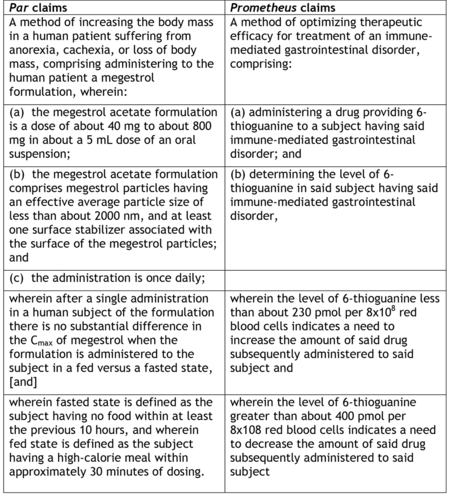
    Despite this victory on appeal, Par's problems are only beginning in view of TWi's assertion of an invalidity defense based on subject matter eligibility.  In addition to being several district courts' basis du jour for invalidating claims, the similarities between the claims at issue in this case and the Prometheus claims struck down by the Supreme Court in Mayo v. Prometheus is uncanny:

    Table
    Not to belabor the point, but megestrol acetate formulations and methods for administering them were well established in the art, like the administration step in the Prometheus claims, and formulating megestrol into nanosized particles can easily be encompassed within the Mayo court's "well-established, routine and conventional" rubric.  Most telling, the novelty of the Par claims, like the novelty of Prometheus's claims, reside in the "wherein" clauses, which were in Mayo and are likely to be here insufficient to provide that ineluctable "something more" required by the Mayo opinion to provide subject matter eligibility.

    Rendering Par's prevailing in its appeal a likely Pyrrhic victory at best and suggesting that the exercise before the Federal Circuit was merely a way station to a negotiated settlement.  No doubt such a settlement will then be subject to FTC scrutiny under FTC v. Actavis to determine whether settling raises antitrust liability.

    Par Pharmaceutical, Inc. v. TWi Pharmaceuticals, Inc. (Fed. Cir. 2014)
    Panel: Circuit Judges O'Malley, Wallach, and Hughes
    Opinion by Circuit Judge O'Malley

  • By Donald Zuhn

    Coalition for 21st Century MedicineOn March 4, the U.S. Patent and Trademark Office issued a guidance memorandum, entitled "Guidance For Determining Subject Matter Eligibility Of Claims Reciting Or Involving Laws of Nature, Natural Phenomena, & Natural Products" (or "Myriad-Mayo Guidance"), to implement a new procedure for determining the subject matter eligibility of claims under 35 U.S.C. § 101 in view of the Supreme Court's decisions in Association for Molecular Pathology v. Myriad Genetics, Inc. (2013), and Mayo Collaborative Services v. Prometheus Laboratories, Inc. (2012).  At a public forum hosted at the USPTO in May, the Office encouraged shareholders to submit written comments on the Guidance.  Since the forum, the Office has encouraged the patent community to provide further feedback regarding the Guidance (despite the Office's announced deadline of July 31 for submitting comments).

    Comments regarding the Guidance, including five received after the July 31 deadline, have been posted on the USPTO website.  The comments have been divided into seven groups (with the number of submissions in each group also provided):  Intellectual property organizations and other associations (21), government agencies (0), academic and research institutions (4), law firms (7), companies (8), individuals (43), and comments received after August 1, 2014 (5).  Yesterday, we presented Part I of an examination of comments submitted on August 6, 2014 by The Coalition for 21st Century Medicine (note: the Coalition also was a signatory on joint comments submitted on October 14, 2014 by the Biotechnology Industry Organization, five companies, and six individuals (see "Examination of Myriad-Mayo Guidance Comments — BIO Joint Comment")).  Today, we present Part II of our examination of the Coalition's comments.

    The Coalition's 45-page letter provides proposed examination processes for analyzing composition claims and method claims (pages 3-12) and more than 30 pages of examples providing 41 exemplary claims and an analysis of each claim under the Coalition's proposed "practical framework".  In Part I of our examination of the Coalition's comments, we discussed the group's proposed process for analyzing composition claims.  Today, we discuss the Coalition's proposed process for analyzing method claims.  In a subsequent post, we will examine some of the examples and exemplary claims set forth in the Coalition's letter.

    With respect to method claims, the Coalition contends that:

    The case law urges a fairly simple threshold question:  "Has the applicant claimed a law of nature per se?"  While claims to laws of nature per se are ineligible, claims to applications of laws of nature are eligible.

    The letter notes that this two-step analysis was set forth in Mayo, as discussed by the Court in Alice Corp. v. CLS Bank Int’l. (2014):

    In Mayo Collaborative Services v. Prometheus Laboratories, Inc. we set forth a framework for distinguishing patents that claim laws of nature, natural phenomena, and abstract ideas from those that claim patent-eligible applications of those concepts.  First, we determine whether the claims at issue are directed to one of those patent-ineligible concepts.  If so, we then ask, "[w]hat else is there in the claims before us?"(internal citations omitted).

    The Coalition explains that "[b]ecause applicants are unlikely to explicitly claim a bare law of nature, precedent urges patent reviewers to look a little closer at method claims to make sure the applicant hasn't in effect claimed the law of nature by, e.g., merely including a token reference to 'applying' the law of nature."  However, the Coalition argues that "[t]his caution from the courts should not be over read, however, to mean that broad applications are categorically ineligible or that method claims must recite specifics of the process at arbitrarily high levels of detail."

    In examining method claims for subject matter eligibility, the Coalition suggests that the following questions be addressed:

    1.  Does the claim appear, on its face, to recite a natural principle?

    2.  What is the natural principle potentially claimed and how is it recited in the claim?

    3.  Does the claim recite a process that is different in any way from that which is well understood, routine and conventional in the art?

    With respect to the first question, the letter notes that:

    The primary cases in this area are Benson, Flook, Diehr, Mayo, and Alice.  These cases tend to give not an actual analytical framework but instead examples from which general principles of analysis can be gleaned.  For example, Benson, Flook and Diehr together teach that a claim reciting a mathematical algorithm facially raises the question of whether an abstract idea is being claimed.  This is not to say that all claims involving such an algorithm are improperly directed to an abstract idea, as made clear by Diehr.  Instead, these cases teach that the presence of the algorithm facially raises the issue and warrants further analysis . . . ."

    Mayo similarly teaches that "wherein" clauses in a method claim will often facially raise the question of whether an abstract idea or natural principle is being claimed.  Again, this is not because "wherein" clauses are always problematic.  Such clauses can often recite important structure or steps in a process that meaningfully limit a claim to an application of a natural principle.

    Moving on to the second question, the Coalition declares that "[t]his may be the most important part of the analysis," adding that in answering the question, "[i]t is critical to understand the difference between a law of nature and a statistical correlation."  The Coalition then points to gravity as an example of a law of nature, and the relationship between a numerical gene expression score and the presence of brain cancer as an example of a statistical correlation.  The letter then explains that:

    There cannot be any single, direct mechanistic connection between a human-created numerical score (i.e., a number) and the presence of the disease.  . . .  [T]he critical question is whether humans truly made the process or not.  No human made gravity; we simply discovered it and the natural laws by which it operates.  A human created the numerical expression score and likewise "created" the correlation through statistics (a human-created mathematical endeavor).

    Nevertheless, the letter acknowledges that "a claim to a statistical correlation may not be patent-eligible as it is arguably an abstract idea."  As an example, the letter suggests that if one determines that obese patients tend to have higher blood lipid levels, one "cannot claim 'the correlation between obesity and blood lipid levels' or even 'a method comprising determining whether a patient is obese, wherein obesity indicates (or correlates to) increased blood lipid levels,'" but rather "must claim an application of the statistical correlation such as a method of using obesity as a prescreen for determining which patients should have their blood lipid levels tested."

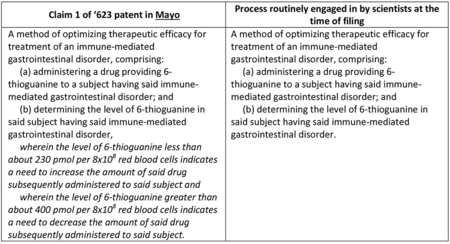
    The Coalition then discusses the final prong of its proposed process of analyzing method claims.  In answering the third question, the Coalition suggests that "one helpful way to assess whether a natural principle is being claimed is to find the closest prior art process and compare it side-by-side to the claimed process."  The letter uses the Mayo case as an example of such a comparison, providing the following chart:

    Table
    The letter states that:

    The [Mayo] Court found that the only difference between the prior art method and the claimed method was the "wherein" clauses.  But these merely describe (or inform an audience about) a pre-existing but newly "discovered" fact about the process; they do not specify any new or even modified step, structure or element of the process.  In this way they are not truly a part of the process and do not "meaningfully limit" the claim (or even limit it at all).  This simple fact is the central reason the claims in Mayo were patent ineligible[.]

    Despite asking whether a claim recites a process that differs from that which is well understood, routine and conventional in the art, the Coalition argues that "[i]t is critical to recognize that, despite the use of terms like 'well-understood,' 'routine,' or 'conventional,' this is not an obviousness analysis."  In particular, the Coalition contends that "[a] claimed process is not ineligible simply because it differs from what was routine and conventional in a way that, in view of the newly discovered natural principle, would have been obvious."

    In a subsequent post, we will examine some of the examples and exemplary claims set forth in the Coalition's letter and how the group applies its proposed examination processes for analyzing composition claims and method claims to those exemplary claims.

    For additional information regarding this topic, please see:

    • "Examination of Myriad-Mayo Guidance Comments — The Coalition for 21st Century Medicine," Ecember 1, 2014
    • "BIO IPCC Panel Discusses Impact of Myriad-Mayo Guidance," November 13, 2014
    • "USPTO Provides Update on Status of Revised Myriad-Mayo Guidance," November 12, 2014
    • "Examination of Myriad-Mayo Guidance Comments — University Community Joint Comment," October 28, 2014
    • "Examination of Myriad-Mayo Guidance Comments — BIO Joint Comment," October 23, 2014
    • "Sherry Knowles Addresses Real World Impact of Myriad-Mayo Guidance at BIO Symposium," October 15, 2014
    • "Guest Post: Myriad — A Direct and Unexceptional Approach," October 12, 2014
    • "USPTO Outlines Changes to Myriad-Mayo Guidance at BIO Symposium," September 30, 2014
    • "USPTO Expected to Issue Revised Myriad-Mayo Guidance in October," September 17, 2014
    • "Guest Post: Myriad-Mayo Guidance — Consistency With International Harmonization and TRIPS," August 26, 2014
    • "Examination of Myriad-Mayo Guidance Comments — AUTM, COGR, AAU, and APLU," August 21, 2014
    • "Examination of Myriad-Mayo Guidance Comments — International Bioindustry Associations," August 11, 2014
    • "Examination of Myriad-Mayo Guidance Comments — ACLU," August 5, 2014
    • "Guest Post: Overview of First Published Comments on Myriad-Mayo Patent Eligibility Guidance," July 13, 2014
    • "Guest Post: USPTO Public Forum on Patent Guidance: My Thoughts as a Speaker and Attendee," June 11, 2014
    • "USPTO Holds Forum on Subject Matter Eligibility — Part IV," May 22, 2014
    • "USPTO Holds Forum on Subject Matter Eligibility — Part III," May 15, 2014
    • "USPTO Holds Forum on Subject Matter Eligibility — Part II," May 14, 2014
    • "Guest Post: How to Patent Grapefruit Juice — The New USPTO Guidance for Patent Eligible Subject Matter Is Both Sticky and Sour," May 13, 2014
    • "USPTO Holds Forum on Subject Matter Eligibility — Part I," May 12, 2014
    • "USPTO Tries to Address Public Misunderstandings Regarding Myriad-Mayo Guidance," April 16, 2014
    • "USPTO Issues Guidance for Analyzing Subject Matter Eligibility of Claims Reciting Laws of Nature/Natural Principles, Natural Phenomena or Natural Products," March 4, 2014


  • By Donald Zuhn

    Coalition for 21st Century MedicineOn March 4, the U.S. Patent and Trademark Office issued a guidance memorandum, entitled "Guidance For Determining Subject Matter Eligibility Of Claims Reciting Or Involving Laws of Nature, Natural Phenomena, & Natural Products" (or "Myriad-Mayo Guidance"), to implement a new procedure for determining the subject matter eligibility of claims under 35 U.S.C. § 101 in view of the Supreme Court's decisions in Association for Molecular Pathology v. Myriad Genetics, Inc. (2013), and Mayo Collaborative Services v. Prometheus Laboratories, Inc. (2012).  At a public forum hosted at the USPTO in May, the Office encouraged shareholders to submit written comments on the Guidance.  Since the forum, the Office has encouraged the patent community to provide further feedback regarding the Guidance (despite the Office's announced deadline of July 31 for submitting comments).

    Comments regarding the Guidance, including five received after the July 31 deadline, have been posted on the USPTO website.  The comments have been divided into seven groups (with the number of submissions in each group also provided):  Intellectual property organizations and other associations (21), government agencies (0), academic and research institutions (4), law firms (7), companies (8), individuals (43), and comments received after August 1, 2014 (5).  Today, while applicants and practitioners await promised revisions to the Guidance (now more than a month overdue based on initial estimates from Office representatives), we present the first part of an examination of the comments submitted on August 6, 2014 by The Coalition for 21st Century Medicine (note: the Coalition also was a signatory on joint comments submitted on October 14, 2014 by the Biotechnology Industry Organization, five companies, and six individuals (see "Examination of Myriad-Mayo Guidance Comments — BIO Joint Comment")).

    According to the Coalition's letter, the group represents more than two dozen diagnostic technology companies, clinical laboratories, researchers, physicians, venture capitalists, and patient advocacy groups (a list of Coalition members can be found on the group's website).  The Coalition's 45-page letter provides proposed examination processes for analyzing composition claims and method claims (pages 3-12) and more than 30 pages of examples providing 41 exemplary claims and an analysis of each claim under the Coalition's proposed "practical framework."  The Coalition divides its examples into four categories (with the number of claims in each category also provided):

    A. Composition/Manufacture Claim Reciting A Natural Product (4 claims)

    B. Composition vs. Method Claims, Each Reciting A Small Organic Molecule (11 claims)

    C. Composition vs. Method Claims, Each Reciting Two Natural Products (12 claims)

    D. Process Claim Involving A Natural Principle (14 claims)

    By comparison, the Office's Myriad-Mayo Guidance ran 19 pages and provided eight examples with only fourteen exemplary claims (see "USPTO Issues Guidance for Analyzing Subject Matter Eligibility of Claims Reciting Laws of Nature/Natural Principles, Natural Phenomena or Natural Products").

    The Coalition's letter begins by asserting that its "proposed practical framework" and analysis in each of the four examples "are supported by binding case law precedent from the Supreme Court and the Federal Circuit," while acknowledging "the Office's challenge in creating a practical framework for everyday examination that harmonizes decades of court decisions under changing statutory provisions, especially when such court decisions appear to have intentionally avoided any clear-cut analytical rules."  That being said, the Coalition contends that:

    The Courts have made clear that the default under § 101 is eligibility.  Only if subject matter clearly fits within a category of excluded matter is it ineligible for patenting.  And those categories should be interpreted faithfully but narrowly to exclude only that which is clearly a product, law or phenomenon of nature or an abstract idea.

    The Coalition stresses that "[t]he importance of the Office correctly instructing its examiners on how to analyze subject matter eligibility cannot be overstated," stating that:

    The United States is currently a global leader in biotechnology, emerging technologies, and medicine.  Restricting the scope of patent-eligibility in the U.S. beyond that required by binding case law may cause a slowing of the growth of human capital, investment, and even academic advancement in those areas, especially as compared to other markets such as China, Europe, Australia, Japan, Russia, and South Korea that continue to offer a superior degree of protection for inventions in these industries.

    The Coalition next outlines proposed processes for analyzing composition claims and method claims.  With respect to composition claims, the letter suggests that the following questions be addressed in examining composition claims for subject matter eligibility:

    1.  Does the claim appear, on its face, to potentially encompass a product of nature?

    2.  What is the product of nature potentially encompassed by the claim?

    3.  Is the claimed composition structurally identical to a natural product, including any discrete natural unit?

    4.  Does the claimed composition possess a new or enhanced function or utility as compared to the natural product?

    According to the Coalition, "[t]he overarching question that should guide examination for subject matter eligibility under 35 U.S.C. § 101 is 'Who/what produced the composition as claimed?'"  Citing Diamond v. Chakrabarty, the letter states that:

    "Congress thus recognized that the relevant distinction was […] between products of nature […] and human-made inventions."  Chakrabarty, 447 U.S. at 313.  That which is made by nature unaided by the hand of man is "part of the storehouse of knowledge of all men" and ineligible for patenting.  "Anything under the sun that is made by man" is eligible for patenting.

    In addressing the first question of its proposed process for analyzing composition claims, the Coalition, sounding somewhat prescient, argues that "[e]xamination must recognize the critical distinction between 'encompassing' and 'comprising,'" adding that "[a] claim 'comprising' a product of nature could well be eligible since everything at its core 'comprises' a product of nature."  The Office has recently indicated that the revised Guidance would focus on claims that are directed to a judicial exception rather than those that merely recite or involve a judicial exception (see "USPTO Provides Update on Status of Revised Myriad-Mayo Guidance").

    According to the Coalition, the next step in addressing the first question of its proposed analysis involves looking for a potential natural counterpart in the specification or common knowledge in the art.  The letter contends, however, that "[a] claim to anything whose chemical structure as a whole is facially not found or not reasonably suspected of being in nature does not raise the question of subject matter eligibility."

    Moving on to the second question, the letter declares that "[t]his is arguably the most important part of the analysis," adding that "[a] careful and correct identification and definition of what the product of nature is (and is not) will generally determine the outcome."  Following a discussion of the difference between a molecule's chemical and physical properties and its specific biological functions, the letter states that:

    A claim does not encompass a natural product simply because the claimed composition shares some or many properties with a natural product.  If those properties are put to new, different, or enhanced function or use in the particular composition of the claim, then the claim is to a patent eligible human invention.

    The letter next addresses the third question in the analysis of composition claims, noting that "[i]f care has been taken in correctly identifying a natural product against which to compare the claim[ed] composition, then structural identity should be fairly straightforward to assess."  While suggesting that relatively few or minor structural differences may confer subject matter eligibility, the letter acknowledges that:

    Not just any change will be sufficient to make a composition patent eligible.  For example, the Court in AMP recognized that the claimed isolated DNA was structurally different from native DNA ("broken covalent bonds") but nevertheless determined the claimed compositions were ineligible for patenting.  This was because the claims were not defined in terms of any structural change that yielded an identified functional change and were, instead, defined expressly according to the natural properties and functions of the genes.

    However, the Coalition's letter explains that:

    [A]ny structural change may potentially confer eligibility, no matter how relatively minor, if it imparts some functional change.  In Chakrabarty, the structural differences between the claimed bacterium and the natural bacteria were comparatively minor.  These changes represented a relatively small insertion of genetic material that produced a relatively miniscule additional complement of proteins.  But the important thing for the Court was the impact these small changes had on the function of the bacterium.  "Here, by contrast, the patentee has produced a new bacterium with markedly different characteristics from any found in nature and one having the potential for significant utility."  Chakrabarty, 447 U.S. at 310 (emphasis added).  The real question under this point is:  Has the patentee created something (rather than merely finding something in nature) and has the patentee's activity (the "hand of man") given that something new utilities?

    The letter lays out three possible scenarios following analysis of composition claims under the third prong of the Coalition's proposed process:

    1.  The claimed composition as a whole is structurally identical to a natural product as a whole — at which point the claim should be rejected under 35 U.S.C. § 101 for being directed to a natural product.

    2.  The claimed composition as a whole is not structurally identical to and does not share substantial structural similarity with a natural product as a whole – at which point the composition should be found to be patent eligible.

    3.  The claimed composition as a whole is not structurally identical to, but shares substantial structural similarity with, a natural product as a whole — at which point examination should proceed to the fourth prong of analysis.

    With respect to the fourth question in the Coalition's proposed process of analyzing composition claims, the letter argues that "[e]xamination should focus on determining whether the claimed composition possesses at least one new or enhanced function or utility, either recited in the specification or in the claim language itself, which is not found in the natural product."  The letter explains that "[t]he new or enhanced function or utility must be sufficient under traditional § 101 utility analysis (i.e., specific, substantial, credible)," adding that:

    If the composition is structurally differentiated from a natural product in only a general, negative way (e.g., merely "isolated") and is claimed according to its natural function, then the composition is patent ineligible.  If on the other hand the composition is distinguished from the natural product in a positive, specific way (e.g., a specific structural feature) and is claimed according to that function, then the composition is eligible.

    With respect to the "special problem" of a combination of two or more natural products, the letter suggests that "[t]he composition can be patent eligible if (a) the combination is recited at some level of specificity to exclude reasonably foreseeable natural combinations and (b) the combination as claimed possesses at least one function not found in any of the natural components alone or any natural combination of the natural components."

    In subsequent posts, we will examine the Coalition's proposed process for analyzing method claims and some of the examples and exemplary claims set forth in the Coalition's letter.

    For additional information regarding this topic, please see:

    • "BIO IPCC Panel Discusses Impact of Myriad-Mayo Guidance," November 13, 2014
    • "USPTO Provides Update on Status of Revised Myriad-Mayo Guidance," November 12, 2014
    • "Examination of Myriad-Mayo Guidance Comments — University Community Joint Comment," October 28, 2014
    • "Examination of Myriad-Mayo Guidance Comments — BIO Joint Comment," October 23, 2014
    • "Sherry Knowles Addresses Real World Impact of Myriad-Mayo Guidance at BIO Symposium," October 15, 2014
    • "Guest Post: Myriad — A Direct and Unexceptional Approach," October 12, 2014
    • "USPTO Outlines Changes to Myriad-Mayo Guidance at BIO Symposium," September 30, 2014
    • "USPTO Expected to Issue Revised Myriad-Mayo Guidance in October," September 17, 2014
    • "Guest Post: Myriad-Mayo Guidance — Consistency With International Harmonization and TRIPS," August 26, 2014
    • "Examination of Myriad-Mayo Guidance Comments — AUTM, COGR, AAU, and APLU," August 21, 2014
    • "Examination of Myriad-Mayo Guidance Comments — International Bioindustry Associations," August 11, 2014
    • "Examination of Myriad-Mayo Guidance Comments — ACLU," August 5, 2014
    • "Guest Post: Overview of First Published Comments on Myriad-Mayo Patent Eligibility Guidance," July 13, 2014
    • "Guest Post: USPTO Public Forum on Patent Guidance: My Thoughts as a Speaker and Attendee," June 11, 2014
    • "USPTO Holds Forum on Subject Matter Eligibility — Part IV," May 22, 2014
    • "USPTO Holds Forum on Subject Matter Eligibility — Part III," May 15, 2014
    • "USPTO Holds Forum on Subject Matter Eligibility — Part II," May 14, 2014
    • "Guest Post: How to Patent Grapefruit Juice — The New USPTO Guidance for Patent Eligible Subject Matter Is Both Sticky and Sour," May 13, 2014
    • "USPTO Holds Forum on Subject Matter Eligibility — Part I," May 12, 2014
    • "USPTO Tries to Address Public Misunderstandings Regarding Myriad-Mayo Guidance," April 16, 2014
    • "USPTO Issues Guidance for Analyzing Subject Matter Eligibility of Claims Reciting Laws of Nature/Natural Principles, Natural Phenomena or Natural Products," March 4, 2014

  •         By Sherri Oslick

    Gavel About Court Report:  Each week we will report briefly on recently filed biotech and pharma cases.

    Fresenius Kabi USA LLC v. Agila Specialties Private Ltd. et al.
    1:14-cv-01438; filed November 26, 2014 in the District Court of Delaware

    • Plaintiff:  Fresenius Kabi USA LLC
    • Defendants: Agila Specialties Private Ltd.; Mylan Inc.

    Fresenius Kabi USA, LLC v. Agila Specialties Private Ltd. et al.
    1:14-cv-00205; filed November 26, 2014 in the Northern District of West Virginia

    • Plaintiff:  Fresenius Kabi USA, LLC
    • Defendants:  Agila Specialties Private Ltd.; Mylan Inc.

    The complaints in these cases are substantially identical.  Infringement of U.S. Patent No. 8,476,010 ("Propofol Formulations with Non-Reactive Container Closures," issued July 2, 2013) following a Paragraph IV certification as part of Agila's filing of an ANDA to manufacture a generic version of Fresenius' Diprivan® (propofol injectable emulsion, used for the induction and maintenance of general anesthesia and sedation in certain patient populations).  View the Delaware complaint here.

    Sanofi et al. v. Sandoz Inc.
    1:14-cv-01434; filed November 24, 2014 in the District Court of Delaware

    • Plaintiffs:  Sanofi; Sanofi-Aventis U.S. LLC
    • Defendant:  Sanofi-Aventis U.S. LLC

    Infringement of U.S. Patent Nos. 8,318,800 ("Solid Pharmaceutical Compositions Containing Benzofuran Derivatives," issued November 27, 2012), 8,410,167 ("Use of Dronedarone for the Preparation of a Medicament for Use in the Prevention of Cardiovascular Hospitalization or of Mortality," issued April 2, 2013), and 8,602,215 ("Methods for Reducing the Risk of an Adverse Dronedarone/Beta-Blockers Interaction in a Patient Suffering from Atrial Fibrillation," issued December 10, 2013) following a Paragraph IV certification as part of Sandoz's filing of an ANDA to manufacture a generic version of Sanofi's Multaq® (dronedarone, used to reduce the risk of hospitalization for atrial fibrillation in patients in sinus rhythm with a history of paroxysmal or persistent atrial fibrillation).  View the complaint here.

    Endo Pharmaceuticals Solutions Inc. et al. v. Paddock Laboratories LLC et al.
    1:14-cv-01422; filed November 21, 2014 in the District Court of Delaware

    • Plaintiffs:  Endo Pharmaceuticals Solutions Inc.; Bayer Intellectual Property GmbH; Bayer Pharma AG
    • Defendants:  Paddock Laboratories LLC; Perrigo Co.

    Infringement of U.S. Patent Nos. 7,718,640 ("Methods and Pharmaceutical Compositions for Reliable Achievement of Acceptable Serum Testosterone Levels," issued May 18, 2010) and 8,338,395 (same title, issued December 25, 2012), licensed to Endo, following a Paragraph IV certification as part of Paddock's filing of an ANDA to manufacture a generic version of Endo's Aveed® (testosterone undecanoate, used to restore andmaintain physiologically acceptable testosterone concentrations in patients suffering from hypogonadism).  View the complaint here.

    Otsuka Pharmaceutical Co., Ltd. v. Zydus Pharmaceuticals USA Inc. et al.
    1:14-cv-07252; filed November 20, 2014 in the District Court of New Jersey

    • Plaintiff:  Otsuka Pharmaceutical Co., Ltd.
    • Defendants:  Zydus Pharmaceuticals USA Inc.; Cadila Healthcare Ltd.

    Infringement of U.S. Patent Nos. 8,017,615 ("Low Hygroscopic Aripiprazole Drug Substance and Process for the Preparation Thereof," issued September 13, 2011), 8,580,796 (same title, issued November 12, 2013), and 8,642,760 (same title, issued February 4, 2014) following a Paragraph IV certification as part of Zydus' filing of an ANDA to manufacture a generic version of Otsuka's Abilify® (aripiprazole, used to treat bipolar disorder and schizophrenia).  View the complaint here.

    Astrazeneca AB et al. v. Actavis Laboratories FL, Inc. et al.
    3:14-cv-07263; filed November 20, 2014 in the District Court of New Jersey

    • Plaintiffs:  Astrazeneca AB; Aktiebolaget Hassle; Astrazeneca LP; Zeneca Inc.
    • Defendants:  Actavis Laboratories FL, Inc.; Actavis Pharma, Inc.

    Infringement of U.S. Patent Nos. 6,369,085 ("Form of S-omeprazole," issued April 9, 2002) and 7,411,070 (same title, issued August 12, 2008) following a Paragraph IV certification as part of Actavis' filing of an ANDA to manufacture a generic version of AstraZeneca's Nexium 24HR® (esomeprazole magnesium, used for the treatment of gastroesophageal reflux disease).  View the complaint here.

  • CalendarDecember 2, 2014 – "China's New IP Courts: What U.S. Companies Need to Know" (Intellectual Property Owners Association) – 12:00 to 1:00 pm (ET)

    December 3, 2014 – "Europe's Unified Patent Court: A Lot to Like?" (Intellectual Property Owners Association) – 12:00 to 1:00 pm (ET)

    December 3, 2014 – "Alice, Where Are You Going?" (American Intellectual Property Law Association) – 12:30 – 2:00 pm (Eastern

    December 4, 2014 – "Section 112(a) Enablement and Written Description: Leveraging CCPA and Early Federal Circuit Decisions — Capitalizing on Past Precedent to Withstand 112(a) Rejections and Attacks on Patent Validity and Patentability" (Strafford) – 1:00 to 2:30 pm (EST)

    December 8, 2014 – "Demonstrating Patent Eligibility Post-Alice Corp. Decision — Navigating the Nuances and Leveraging Guidance From Federal Circuit and PTAB Opinions" (Strafford) – 1:00 to 2:30 pm (EST)

    December 10, 2014 – European Patent Reform Forum (Managing Intellectual Property) – San Jose, CA

    December 11, 2014 – "Is Inequitable Conduct Making Its Comeback?" (American Intellectual Property Law Association) – 12:30 – 2:00 pm (Eastern)

    December 11, 2014 – "IP Due Diligence in M&A Transactions — Conducting IP Investigations and Leveraging Results During Deal Negotiations" (Strafford) – 1:00 to 2:30 pm (EST)

    December 12, 2014 – European Patent Reform Forum (Managing Intellectual Property) – New York, NY

    December 16, 2014 – "Inter-Partes and Post-Grant Reviews: How to Protect Your University IP" (Technology Transfer Tactics) – 1:00 to 2:00 pm (ET)

    December 18, 2014 – "Protecting Your Intellectual Property: Best Practices for China" (American Bar Association (ABA) Center for Professional Development, Law Practice Division, Section of Intellectual Property Law, Section of International Law, Section of Science & Technology Law, and Solo, Small Firm and General Practice Division) – 11:00 am to 12:30 pm (ET)

    ***Patent Docs is a media partner of this conference or CLE

  • AIPLA #1The American Intellectual Property Law Association (AIPLA) will be offering a webinar entitled "Is Inequitable Conduct Making Its Comeback?" on December 11, 2014 from 12:30 – 2:00 pm (Eastern).  Matthew Blackburn of Locke Lord, and Keith McWha of McCarter & English will address recent post-Therasense Federal Circuit decisions relating to inequitable conduct, including the Federal Circuit's decisions in American Calcar v. American Honda, Apotex Inc. v. UCB, and Intellect Wireless, Inc. v. HTC affirming findings of inequitable conduct, and discuss the impact of these decisions as a tool in patent litigation and as cautionary tales in patent prosecution.  The panelists will also offer best practice tips in patent prosecution to minimize exposure to these allegations.

    The registration fee for the program is $145 (AIPLA member rate) or $175 (non-member rate).  Those interested in registering for the program, can do so here.