• Strafford #1Strafford will be offering a webinar/teleconference entitled "Proving and Avoiding Inequitable Conduct in Patent Prosecution and Litigation — Leveraging Court Treatment Post-Therasense and the AIA's Answer to Inequitable Conduct Issues" on January 8, 2015 from 1:00 to 2:30 pm (EST).  Thomas L. Irving of Finnegan Henderson Farabow Garrett & Dunner, Jennifer M.K. Rogers of Shumaker & Sieffert, and Margaret J. Sampson of Vinson & Elkins will provide guidance to patent counsel on understanding the types of activity that may lead to a finding of inequitable conduct and practical tactics to avoid inequitable content in patent prosecution, and examine arguments that have worked to avoid a finding of inequitable conduct.  The webinar will review the following questions:

    • What are the most common assertions defendants make when raising the inequitable conduct defense?
    • What are best practices prosecutors and litigators should employ when pursuing and defending inequitable conduct allegations?
    • What guidance do post-Therasense decisions provide on how inequitable conduct will be treated?

    The registration fee for the webinar is $297 ($362 for registration and CLE processing).  Those interested in registering for the webinar, can do so here.

  • Strafford #1Strafford will be offering a webinar/teleconference entitled "Preparing for and Navigating PTAB Appeals Before the Federal Circuit — Conducting PTAB Trials With Eye to Appeal, Determining Errors for Appeal, Understanding PTO Practice and Federal Circuit Law" on January 22, 2015 from 1:00 to 2:30 pm (EST).  Erika H. Arner and Michael J. Flibbert of Finnegan Henderson Farabow Garrett & Dunner will provide guidance to patent counsel on preparing a PTAB case for appeal to the Federal Circuit, and offer strategic tips for conducting a PTAB trial with an eye to appeal and best practices for prevailing on appeal.  The webinar will review the following issues:

    • How the Federal Circuit will address potential review issues
    • The Federal Circuit's early guidance on standing to appeal
    • Strategies in PTAB proceedings to build a record and preserve issues for appeal

    The registration fee for the webinar is $297 ($362 for registration and CLE processing).  Those registering by January 9, 2015 will receive a $50 discount.  Those interested in registering for the webinar, can do so here.

  • Strafford #1Strafford will be offering a webinar/teleconference entitled "Combating Patent Trolls: Third-Party Solutions and Defense Strategies in Post-Grant and Litigation — Leveraging Counterclaim, Summary Judgment and Other Tactics; Utilizing Legislative, Insurance and Third-Party Tools" on January 29, 2015 from 1:00 to 2:30 pm (EST).  Kevin Jakel od Unified Patents and Michael L. Kiklis of Oblon Spivak McClelland Maier & Neustadt will provide patent counsel with a broad-based view of defending against patent trolls, and discuss third-party solutions and provide a deep dive into specific troll strategies.  The webinar will review the following questions:

    • What third-party solutions are available?
    • What factors should be considered when determining if and when to use a third-party solution?
    • What defenses are available to companies facing patent troll claims?
    • What strategies can companies implement to minimize the impact of patent assertions?

    The registration fee for the webinar is $297 ($362 for registration and CLE processing).  Those registering by January 9, 2015 will receive a $50 discount.  Those interested in registering for the webinar, can do so here.

  • By Michael Borella and Andrew Williams

    TrollThe press has been all too eager to decry the so-called "broken" U.S. patent system and the alleged "scourge" of non-practicing entities (NPEs).  However, few if any articles attempt to provide an even-handed analysis of these issues.  Recently, Jon Potter and Julie Samuels published a piece in Roll Call, urging Congress to pass comprehensive patent reform legislation to clamp down on NPEs, while James Bessen, in The Atlantic, lauded the Supreme Court's recent Alice Corp. v. CLS Bank Int'l decision for already having a deleterious impact on business method patents.  Samuels was formerly of the Electronic Frontier Foundation (EFF), a group with an anti-patent agenda.

    The need for patent reform has arguably diminished.  Three decisions handed down by the Supreme Court last year, Alice, Octane Fitness, LLC v. Icon Health & Fitness, Inc., and Nautilus, Inc. v. Biosig Instruments, Inc., each addressed one of the alleged weakness in the patent system that so-called trolls are thought to exploit.  These cases have been credited for the drop in patent litigation seen since the end of the Court's last term.  Moreover, the Patent Trial and Appeals Board ("PTAB") has been accused of becoming a patent "death squad" because of the large number of inventions that it has recently found to be unpatentable.

    These articles, therefore, appear to be desperate attempts to flame the anti-patent fervor that existed last year.  As we have come to expect, both articles present only one side of the story, and do not consider the negative consequences that further anti-NPE legislation could bring about, and that the Alice decision has already produced.  Further, the authors make unsupported assertions, draw questionable conclusions, and exhibit a profoundly flawed understanding of patent law.

    For example, as with similar articles, the Potter and Samuels's article starts from the presupposition that "our patent system is out of balance," citing the Alice decision for support.  The unsuspecting reader will assume that this is a forgone conclusion.  Nevertheless, it is through their explanation of how this decision and proposed legislation are meant to "solve" the supposed crisis, the authors reveal a lack of understanding of the historical and philosophical basis of the patent system.

    To that point, the authors equate "trolls" with NPEs (non-practicing entities).  The term NPE, however, encompasses all entities that do not manufacture products, including most universities, research institutions, and individual inventors.  Interestingly, Ms. Samuels's previous organization, the EFF, accused universities of fueling the patent troll problem.  Patent asserting organizations have been acknowledged by most, including the White House, to serve an important role as mediator between such NPEs and operating companies often necessary to commercialize inventions.  In fact, the United States' patent system purposefully encourages such actions by making patent property rights freely assignable and eschewing a "working" requirement.  This philosophy goes back to the framers of the Constitution, and allows the patent system to be accessible to everyone, not just those with abundant resources.

    Potter and Samuels go on to assert, without citing any support, that NPEs "grievously injure innovators, bankrupt small companies, and waste judicial resources."  Yet, the current functioning patent system is essential to the business models of these same innovators and small companies.  Without patents, the innovations of a small software company can be easily reverse engineered and copied by larger players with more market clout, or foreign companies with lower overheads.  Trademarks, copyrights, and trade secrets do little to help in these situations.

    In addition, the authors fail to consider the fact that these "innovators" and "small companies" (or any defendant in a patent litigation case for that matter), might actually infringe a valid patent.  If so, should they be allowed to freeload off the labor of others without penalty just because the patent at issue encompasses a business method or software, or happens to be owned by an NPE?

    Bessen states that a recent the Government Accountability Office ("GAO") report "attributed 89 percent of the increase in patent litigation [in the 2007-2011 time frame] to software patents."  This report, however, conflated actual software patents and business method patents, collectively referring to both as "software patents."  In fact, the GAO found that "operating companies brought most of the patent infringement lawsuits from 2007 to 2011."  Additionally, the report indicated that the number of defendants in software and business method patent litigation increased 89 percent, but the number of lawsuits increased more modestly.  According to the report, the increase in the number of patent lawsuits in 2011 "was most likely influenced by the anticipation of changes in the 2011 Leahy-Smith America Invents Act (AIA), which made several significant changes to the U.S. patent system, including limiting the number of defendants in a lawsuit, causing some plaintiffs that would have previously filed a single lawsuit with multiple defendants to break the lawsuit into multiple lawsuits."

    Of course, even if there was an increase in software patent litigation, it would have likely been a reflection of the increased importance of software in our everyday lives.  The 2007-2011 time frame tracks the rise of the smartphone and always-on computing, dramatic growth in social media, and a multimedia streaming revolution led by Netflix and YouTube, among other factors.  Like it or not, software is now an integral part of our personal and professional lives, as we carry our laptops, tablets, phones, e-readers, and digital fitness trackers with us whether we are going to work or on vacation.  An increase in the number of software patents granted, as well as an increase in software patent litigation, is a natural consequence of the ubiquity of software.

    Certainly, no one is denying that there are bad actors that abuse the litigation system both with regard to intellectual property rights and otherwise.  However, elevating this minority of cases to be representative of the norm is not a reason to dispense with the entire system.  In fact, Bessen's methodologies for assessing the cost of so-called patent trolls have been called into question.  See, e.g., Schwartz & Kesan, Analyzing the Role of Non-Practicing Entities in the Patent System, Cornell Law Review, Vol. 99:2, pp. 425-56 (2014).  As a result, the implications that can be drawn from the data with regard to the impact of NPEs on the system are dubious at best.

    With respect to the Alice decision, both sets of authors ignore the damage that this case has already caused to the patent system.  Under Alice, when determining whether a patent claim meets the statutory requirements for patent-eligibility, one must determine whether the claim is directed to a patent-ineligible law of nature, natural phenomenon, or abstract idea.  If so, then one determines whether any additional claim elements transform the claim into a patent-eligible application that amounts to significantly more than the ineligible concept itself.

    This two-prong test has been widely criticized for its vagueness and subjectivity.  The Supreme Court refused to define what it meant by the term "abstract idea," leading to consternation among patentees, patent attorneys, and even federal judges.  For instance, Judge Wu of the United States District Court for the Central District of California criticized Alice for setting forth an "I know it when I see it" test.  Judge Pfaelzer, a colleague of Judge Wu, wrote that the Supreme Court's patent-eligibility cases "often confuse more than they clarify [and] appear to contradict each other on important issues."

    The Supreme Court also blurred the lines between the assessment of patent-eligibility and other patentability requirements.  The patent law requires that, among other things, claims must be novel and non-obvious, as well as encompassing patent-eligible subject matter.  In 1981, the Supreme Court clarified that each of these inquiries were separate and distinct, and that it was "inappropriate to dissect the claims into old and new elements and then to ignore the presence of the old elements in the analysis."  Alice, as well as its 2012 predecessor case Mayo Collaborative Servs. v. Prometheus Labs., Inc., turned this notion around.  Now, when conducting a patentable subject matter review, claims can be analyzed element by element and compared to prior art.

    As many commentators have articulated since the Mayo opinion was handed down, determining whether the breadth of a claim is appropriate is better served by conducting the well-understood and more objective and established analyses of novelty and obviousness.  Despite the lack of any suggestion from Congress that patent-eligibility is to be used for these purposes, the Supreme Court, now followed by the Federal Circuit, has made patentable subject matter a perverse weapon for the unsupported rejection and invalidation of claims.

    The well-understood obviousness analysis asks whether the differences between the claimed invention and the prior art would have been obvious to one of ordinary skill in the art.  The Alice test, for a claim that incorporates a preexisting algorithm or a longstanding practice, inquires if the claim adds "significantly more" to that algorithm or practice.  The substantive difference between the two is that the obviousness test is grounded using prior art as a reference point for what is known, while the Alice test is not.  This eliminates much of the objectivity from the Alice analysis, putting thousands of patents in a state of legal uncertainty.  The "validity" of such patents may depend on which judge or panel conducts the test.

    Bessen goes as far as to suggest that while the Alice decision is limiting the number of granted business method patents, it hasn't gone far enough to similarly limit software patents.  But why should we view patents in such sweeping terms, with the connotation that business method and software patents are inherently bad?  Patents are either valid or invalid, regardless of the technology claimed therein.

    Furthermore, the implication that software should not warrant patent protection unfairly singles out one of the greatest drivers of the U.S. economy over the last forty years.  A major aspect of innovation is to make products and services faster, cheaper, and better.  The patent system is intended to incentivize individuals and organizations to publicly disclose such inventions, and as a result receive a limited exclusive-use property right thereover.  Despite contentions of the deleterious impact of a "broken" patent system on the software industry, the computer and information industry as a whole continues to grow, as evidenced by recent record-breaking stock values, billion-dollar acquisitions, and successful initial public offerings. A broad exclusion of computer-implemented inventions is illogical and disregards the fundamental tradeoff on which the system is based.

    Graphic of troll (above) by JNL was modified (cropped) from a graphic available at the Wikipedia Commons, pursuant to the Free Art License.  Any use of the modified graphic is subject to the same license.

  •         By Sherri Oslick

    Gavel About Court Report:  Each week we will report briefly on recently filed biotech and pharma cases.

    Eli Lilly and Company v. Sandoz Inc.
    1:14-cv-02008; filed December 5, 2014 in the Southern District of Indiana

    Infringement of U.S. Patent No. 7,772,209 ("Novel Antifolate Combination Therapies," issued August 10, 2010) following a Paragraph IV certification as part of Sandoz's filing of an ANDA to manufacture a generic version of Lilly's Alimta® (pemetrexed for injection, used to treat malignant pleural mesothelioma and locally advanced or metastatic non-small cell lung cancer).  View the complaint here.

    Fresenius Medical Care Holdings, Inc. v. Lotus Pharmaceutical Co., Ltd. et al.
    1:14-cv-14345; filed December 5, 2014 in the District Court of Massachusetts

    • Plaintiff:  Fresenius Medical Care Holdings, Inc.
    • Defendants:  Lotus Pharmaceutical Co., Ltd.; Alvogen Pine Brook, Inc.

    Fresenius Medical Care Holdings, Inc. v. Lotus Pharmaceutical Co., Ltd et al.
    2:14-cv-07612; filed December 5, 2014 in the District Court of New Jersey

    • Plaintiff:  Fresenius Medical Care Holdings, Inc.
    • Defendants:  Lotus Pharmaceutical Co., Ltd; Alvogen Pine Brook, Inc.

    The complaints in these cases are substantially identical.  Infringement of U.S. Patent No. 6,576,665 ("Encapsulated Calcium Acetate Caplet and a Method for Inhibiting Gastrointestinal Phosphorous Absorption," issued June 10, 2003) following a Paragraph IV certification as part of defendants' filing of an ANDA to manufacture a generic version of Fresenius' PhosLo® GelCaps (calcium acetate, used to treat renal failure).  View the D. Mass. complaint here.

    Allergan Inc. et al. v. Wilshire Pharmaceuticals Inc.
    1:14-cv-01461; filed December 4, 2014 in the District Court of Delaware

    • Plaintiffs:  Allergan Inc.; Vistakon Pharmaceuticals LLC
    • Defendant:  Wilshire Pharmaceuticals Inc.

    Infringement of U.S. Patent No. 8,664,215 ("Ocular Allergy Treatments with Alcaftadine," issued March 4, 2014), licensed to Allergan, following a Paragraph IV certification as part of Wilshire's filing of an ANDA to manufacture a generic version of Allergan's Lastacaft® (alcaftadine ophthalmic solution 0.25%, used for the prevention of itching associated with allergic conjunctivitis).  View the complaint here.

    Novartis Pharmaceuticals Corp. v. Amneal Pharmaceuticals, LLC et al.
    2:14-cv-07557; filed December 3, 2014 in the District Court of New Jersey

    • Plaintiff:  Novartis Pharmaceuticals Corp.
    • Defendants:  Amneal Pharmaceuticals, LLC; Amneal-Agila, LLC; Mylan Inc.; Mylan Institutional Inc.

    Novartis Pharmaceuticals Corp. v. Sagent Pharmaceuticals, Inc.
    2:14-cv-07556; filed December 3, 2014 in the District Court of New Jersey

    Novartis Pharmaceuticals Corp. v. Par Sterile Products, LLC et al.
    2:14-cv-07558; filed December 3, 2014 in the District Court of New Jersey

    • Plaintiff:  Novartis Pharmaceuticals Corp.
    • Defendants:  Par Sterile Products, LLC; Par Pharmaceutical Companies, Inc.

    The complaints in these cases are substantially identical.  Infringement of U.S. Patent No. 8,324,189 ("Use of Zolendronate for the Manufacture of a Medicament for the Treatment of Bone Metabolism Diseases," issued December 4, 2012) following a Paragraph IV certification as part of defendants' filing of an ANDA to manufacture a generic version of Novartis' Zometa® (zoledronic acid, used for the prevention of skeletal-related complications associated with cancer).  View the Amneal complaint here.

  • By Kevin E. Noonan

    MyriadIn a decision that will surprise no one (written by Judge Dyk, which made the conclusions foregone from the first page of the opinion), the Federal Circuit today affirmed the Utah District Court's decision denying Myriad Genetics' motion for a preliminary injunction in the consolidated Multidistrict Litigation styled In re BRCA1- and BRCA2-based Hereditary Cancer Test Patent Litigation.  What might have been anticipated but is still surprising is the opinion's apparent willingness to ignore established patent law principles (and the statute) in favor of obsequious obedience to what the panel perceives to be Supreme Court precedent while at the same time ignoring Myriad's arguments that relied upon express language from the Court's recent § 101 cases.

    To recap, the appeal was over the following claims from Myriad's asserted patents (in a footnote the opinion noted that Myriad was no longer pursuing an appeal with regard to claims 2 and 4 of U.S. Patent No. 5,654,155, claim 5 of U.S. Patent No. 6,951,721, and claim 4 of U.S. Patent No. 6,033,857).

    From U.S. Patent No. 5,753,441 ("the '441 patent"):

    7. A method for screening germline of a human subject for an alteration of a BRCA1 gene which comprises comparing germline sequence of a BRCA1 gene or BRCA1 RNA from a tissue sample from said subject or a sequence of BRCA1 cDNA made from mRNA from said sample with germline sequences of wild-type BRCA1 gene, wild-type BRCA1 RNA or wild-type BRCA1 cDNA, wherein a difference in the sequence of the BRCA1 gene, BRCA1 RNA or BRCA1 cDNA of the subject from wild-type indicates an alteration in the BRCA1 gene in said subject [The method of claim 1] wherein a germline nucleic acid sequence is compared by hybridizing a BRCA1 gene probe which specifically hybridizes to a BRCA1 allele to genomic DNA isolated from said sample and detecting the presence of a hybridization product wherein a presence of said product indicates the presence of said allele in the subject.

    8. A method for screening germline of a human subject for an alteration of a BRCA1 gene which comprises comparing germline sequence of a BRCA1 gene or BRCA1 RNA from a tissue sample from said subject or a sequence of BRCA1 cDNA made from mRNA from said sample with germline sequences of wild-type BRCA1 gene, wild-type BRCA1 RNA or wild-type BRCA1 cDNA, wherein a difference in the sequence of the BRCA1 gene, BRCA1 RNA or BRCA1 cDNA of the subject from wild-type indicates an alteration in the BRCA1 gene in said subject [The method of claim 1] wherein a germline nucleic acid sequence is compared by amplifying all or part of a BRCA1 gene from said sample using a set of primers to produce amplified nucleic acids and sequencing the amplified nucleic acids.

    (where claim language in italics recites limitations from the independent claim, and language in bold and italics is relevant to the Court's opinion).

    From U.S. Patent No. 5,747,282 ("the '282 patent"):

    16. A pair of single-stranded DNA primers for determination of a nucleotide sequence of a BRCA1 gene by a polymerase chain reaction, the sequence of said primers being derived from human chromosomne 17q, wherein the use of said primers in a polymerase chain reaction results in the synthesis of DNA having all or part of the sequence of the BRCA1 gene.

    17. The pair of primers of claim 16 wherein said BRCA1 gene has the nucleotide sequence set forth in SEQ ID NO:1.

    From U.S. Patent No. 5,837,492 ("the '492 patent"):

    29. A pair of single-stranded DNA primers of at least 15 nucleotides in length for determination of the nucleotide sequence of a BRCA2 gene by a polymerase chain reaction, the sequence of said primers being isolated from human chromosome 13, wherein the use of said primers in a polymerase chain reaction results in the synthesis of DNA comprising all or at least 15 contiguous nucleotides of the BRCA2 gene.

    30. The pair of primers of claim 29 wherein said BRCA2 gene has the nucleotide sequence set forth in SEQ ID NO:1.

    Myriad moved in the District Court for a preliminary injunction, which the Court denied; while it found that Myriad had established the required risk of irreparable harm, the public interest was "in equipoise" and the balance of the hardships tipped slightly in Ambry's favor.  The Court denied the injunction because it found Myriad had not demonstrated a likelihood of success on the merits, based on its application of the Supreme Court's Myriad decision in determining that the asserted claims were invalid for failure to recite patent-eligible subject matter.

    The Federal Circuit's opinion was written by Judge Dyk, joined by Chief Judge Prost and Judge Clevenger.  The Court performed its invalidity assessment on the composition of matter claims from the '282 and '492 patents separately from its analysis of the '441 patent's method claims, with the Supreme Court's prior opinion on the validity of other claims from these patents casting a determinative shadow on the opinion.  The panel's characterization of the Myriad opinion set the stage:

    The Supreme Court, in its Myriad decision, held that claims of the '282 patent directed to isolated DNA were drawn to patent-ineligible subject matter because the isolated DNA strands, which are naturally occurring and separated from the rest of the human genome, were natural phenomena.

    For these composition of matter claims, and using claim 16 of the '282 patent as being representative and further being "guided by [the Supreme Court's] Myriad [decision]" the Court analogized the claimed primers to genomic DNA (based on no asserted change in sequence) and rejected Myriad's attempts to distinguish based on their synthetic nature.  With little explanation of what the panel thought its statements meant as a factual matter, the opinion stated that its earlier Myriad opinion had established that DNA fragments are "synthesized" in nature as well as by man, neglecting the distinction between the claimed single-stranded oligonucleotides (ssDNA) and "naturally occurring" double stranded DNA fragments.  In a pattern that returns with even more force in the method claims, the opinion notes the breadth of the claimed primers, which can be any short DNA molecules that hybridize to any portion of the BRCA1 or BRCA2 genomic DNA.  It will be appreciated that Myriad's own claim language was helpful in reaching this conclusion, insofar as claim 16 recites "said primers being derived from human chromosomne 17q" and that "the primers support[] PCR amplification of all or part of the sequence of the BRCA1 gene."  Again not surprisingly, the panel cites to In re Roslin Institute (another Judge Dyk opinion) for the principle that there must be a structural change to distinguish a product of nature from a patent-eligible derivative thereof.

    The opinion also asserts that ssDNA binds to DNA in vitro as it does in vivo to reject Myriad's argument regarding differences in function, ignoring the fact that there is little evidence that hybridization of oligonucleotides exist in vivo.  In this regard, of course, the breadth of the claims regarding any pair of primers worked against the patentee, because there was no limitation to a particular pair of primers having a particular structure that could have been argued provided the "hand of man" as required by the Supreme Court's Diamond v. Chakrabarty decision (a decision the Myriad Court followed).  The opinion ends this section with its harshest statement, that there "must" be a difference in structure, relying on dicta in the Supreme Court's Myriad decision that extend the Court's rationale beyond what the case actually says.

    With regard to the method claims of the '441 patent, the panel eschewed analysis under the Supreme Court's Mayo v. Prometheus decision (which was the basis argued by the appellees and inevitable amicus, the American Civil Liberties Union).  Rather, the opinion held these claims to be patent-ineligible for reciting an "abstract idea" under Alice v. CLS Bank and applied that Supreme Court decision's "two-step test" to make its determination.  In doing so, the panel dissected the claims to a first set of paragraphs, "which describe the comparison of wildtype genetic sequences with the subject's genetic sequence and correspond to the first step of Alice" and the second set of paragraphs, "which describe the techniques to be used in making the comparisons and correspond to the second step of Alice."

    The panel opined that these first steps are bound by the Court's earlier decision in AMP v. Myriad, wherein the "comparing" step was held to be patent-ineligible because it encompassed "an abstract mental process of 'comparing' and 'analyzing' two gene sequences."  From that Myriad opinion the Court cites:

    [The] claim thus recites nothing more than the abstract mental steps necessary to compare two different nucleotide sequences: one looks at the first position in a first sequence; determines the nucleotide sequence at that first position; looks at the first position in a second sequence; determines the nucleotide sequence at that first position; determines if the nucleotide at the first position in the first sequence and the first position in the second sequence are the same or different, wherein the latter indicates an alteration; and repeats the process for the next position.

    Applied to the claims from the '441 patent, the panel stated that:

    The methods, directed to identification of alterations of the gene, require merely comparing the patient's gene with the wild-type and identifying any differences that arise.  [Citing the '441 patent specification for support.]  The number of covered comparisons is unlimited.  The covered comparisons are not restricted by the purpose of the comparison or the alteration being detected.  Because of its breadth, the comparison step covers detection of yet undiscovered alterations, as well as comparisons for purposes other than detection of cancer.  Even with respect to cancer, the comparisons are not limited to the detection of risk of breast or ovarian cancer.

    This, of course, is an argument about preemption, but rather than cite Mayo, the opinion cited for support is Gottschalk v. Benson, 409 U.S. 63, 64 (1972) — reminiscent of the District Court in Ariosa v. Sequenom citing Parker v. Flook rather than Mayo in support of its invalidity determination under § 101 — and avoided any discussion regarding the applicability of § 112 to this analysis.

    As for the second paragraphs of these claims, the panel stated that the District Court had found that the recited steps ("hybridizing a BRCA1 gene probe which specifically hybridizes to a BRCA1 allele to genomic DNA isolated from said sample and detecting the presence of a hybridization product" from claim 7, and "amplifying all or part of a BRCA1 gene from said sample using a set of primers to produce amplified nucleic acids and sequencing the amplified nucleic acids" in claim 8) "set forth well-understood, routine and conventional activity engaged in by scientists at the time of Myriad's patent applications," a characterization the Court said Myriad did not dispute.  In addition, the panel stated that "the claims contain no otherwise new process for designing or using probes, primers, or arrays beyond the use of BRCA1 and BRCA2 sequences in those processes," which Myriad also did not dispute.  Thus, the opinion concluded that "[n]othing is added by identifying the techniques to be used in making the comparison because those comparison techniques were the well-understood, routine, and conventional techniques that a scientist would have thought of when instructed to compare two gene sequences."

    Except, of course, that it was not "routine, conventional and well-understood" to use these methods to identify cancer propensity-associated mutations in human DNA, because neither the genes nor the mutations were known.  The Court expressly chose not to credit that portion of the Supreme Court's opinion that seems the most related to the question before this panel:

    Similarly, this case does not involve patents on new applications of knowledge about the BRCA1 and BRCA2 genes.  Judge Bryson aptly noted that, "[a]s the first party with knowledge of the [BRCA1 and BRCA2] sequences, Myriad was in an excellent position to claim applications of that knowledge.  Many of its unchallenged claims are limited to such applications," citing Judge Bryson's opinion concurring-in-part and dissenting-in-part with the Federal Circuit's Myriad decision (689 F. 3d, at 1349).

    The opinion makes this rhetorical pirouette by focusing on the argument that the method claims at issue are similar to claim 21 of the '441 patent, which recites:

    A method for detecting a germline alteration in a BRCA1 gene, said alteration selected from the group consisting of the alterations set forth in Tables 11 and 12 which comprises analyzing a sequence of the BRCA1 gene or BRCA1 RNA from a human sample or analyzing the sequence of BRCA1 cDNA made from mRNA from said sample[,] wherein a germline alteration is detected by hybridizing a BRCA1 gene probe which specifically hybridizes to an allele of one of said alterations to RNA isolated from said human sample and detecting the presence of a hybridization product, wherein the presence of said product indicates the presence of said allele in the sample.

    This claim was, according to the opinion, "cited with approval" by Judge Bryson and "seemingly" also by the Supreme Court.  Regardless, the opinion correctly noted that this claim was not before the Court in Myriad (Federal Circuit or Supreme Court) and thus there is no precedent regarding its validity.  However, how the opinion distinguishes the patent eligibility vel non of claim 21 suggests that, once again, there is an overbreadth issue here better addressed under § 112 rather than § 101, and that if the claims at issue were so limited (i.e., to specific mutations) at least the preemption concerns would be diminished, perhaps to the point that the panel could have seen its way clear to a more favorable patent-eligibility decision.

    Unfortunately, the opinion doesn't even give lip service to the direction in the Alice opinion that the claims must also be considered as a whole, using its fragmented analysis as the only justification for coming to the conclusion that the claims are not patent eligible.  In doing so, the Court was able to avoid the issue of whether the claims are eligible because of the application of an old method to a new composition, which has always been patent eligible regardless of the patentability of the composition per se (and consistent with the distinctions drawn by the Supreme Court in its Myriad decision).

    Finally, nowhere in the opinion does the court address the presumption of validity; this opinion suggests that, at least for patent eligibility there is no presumption (a position consistent with Judge Mayer's concurrence in I/P Engine, Inc. v. AOL Inc. (Fed. Cir. 2014)).

    And to add insult to injury, the Court awarded costs to appellee.

    The most grave risk arising from this opinion is that the Patent Office, which only on Monday issued revised guidelines that acknowledged that functional differences between a patented invention and a natural product can be sufficient for patent eligibility, could once again be swayed by the winds of perceived judicial fiat to renege on this more reasoned approach and return to the much-lamented structural requirement approach set out in the Guidance promulgated on March 4th.  This risk is more than just a possibility, in view of the express note in the Guidance that it was a "work-in-progress" subject to further revision in view of pending Federal Circuit cases including Myriad v. Ambry.  With luck, cooler heads will prevail and this decision will be limited to its facts.  But in the continuing saga of the Myriad patents nothing can be considered certain, and the Office's present to the patent community of the revised Guidance could just as quickly turn to a lump of coal in our stockings.

    In re BRCA1- and BRCA2-based Hereditary Cancer Test Patent Litigation (Fed. Cir. 2014)
    Panel: Chief Judge Prost and Circuit Judges Clevenger and Dyk
    Opinion by Circuit Judge Dyk

  • By Michael Borella

    USPTO SealOn December 15, the United States Patent and Trademark Office (USPTO) published its 2014 Interim Guidance on Patent Subject Matter Eligibility.  This Interim Guidance was the long-anticipated update to the Procedure for Subject Matter Eligibility Analysis of Claims Reciting or Involving Laws of Nature / Natural Principles, Natural Phenomena, and/or Natural Products from March, and Preliminary Examination Instructions in view of the Supreme Court decision in Alice Corp. from June.  The Interim Guidance supersedes the former and supplements the latter.

    The Interim Guidance was recently discussed in general on this site.  This article focuses on the impact of the Interim Guidance on claims that potentially incorporate an abstract idea — i.e., those focused on business methods and software.

    The discussion of abstract ideas begins with a non-exhaustive list thereof, including:  mitigating settlement risk, creating a contractual relationship, using advertising as an exchange or currency, processing information through a clearinghouse, comparing new  and  stored information and  using rules to identify options, using categories to organize, store and transmit information, organizing information through mathematical correlations, managing a game of bingo, the Arrhenius equation for calculating the cure time of rubber, a formula for updating alarm limits, a mathematical formula relating to standing wave phenomena, and a mathematical procedure for converting one form of numerical representation to another.  All of these types of abstract ideas were gleaned from respective pre-Alice and post-Alice Supreme Court and Federal Circuit cases.  This list is far more extensive than that of the Preliminary Examination Instructions of June.

    As we know, if a claim appears to be directed to such an abstract idea, an examiner is then to determine "whether the elements of the claim, considered both individually and as an ordered combination, are sufficient to ensure that the claim as a whole amounts to significantly more than the exception itself."  The Preliminary Examination Instructions set forth a few categories of elements that meet or do not meet this requirement.  In the Interim Guidance, these lists have been fleshed out.

    Limitations that may be enough to qualify as ''significantly more'' when recited in a claim with a judicial exception include:

    • Improvements to another technology or technical field;*
    • Improvements to the functioning of the computer itself;*
    • Applying the judicial exception with, or by use of, a particular machine;
    • Effecting a transformation or reduction of a particular article to a different state or thing;
    • Adding a specific limitation other than what is well-understood, routine and conventional in the field, or adding unconventional steps that confine the claim to a particular useful application; or
    • Other meaningful limitations beyond generally linking the use of the judicial exception to a particular technological environment.*

    Limitations that were found not to be enough to qualify as ''significantly more'' when recited in a claim with a judicial exception include:

    • Adding the words ''apply it'' (or an equivalent) with the judicial exception, or mere  instructions to implement an abstract idea  on a computer;*
    • Simply appending well-understood, routine and  conventional activities previously known to the industry, specified at a high  level  of generality, to the judicial exception, e.g., a claim to an abstract idea  requiring no more  than a generic computer to perform generic computer functions that  are well- understood, routine and  conventional activities previously known to the industry;*
    • Adding insignificant extrasolution activity to the judicial exception, e.g., mere data gathering in conjunction with a law of nature or abstract idea; or
    • Generally linking the use of the judicial exception to a particular technological environment or field of use.

    * Appeared verbatim or in a similar form in the Preliminary Examination Instructions.

    The Interim Guidance goes on to discuss the cases that resulted in the above list of abstract ideas and the "significantly more" factors.  For the most part, the USPTO's interpretation of these cases sticks with the respective court's actual language.  Indeed, when viewed as a whole, the Interim Guidance sets forth a reasonable reading of the law.  In the USPTO, claims directed to disembodied methods that could potentially be performed manually are not patent-eligible, and any recited generic computer hardware or insignificant pre-solution or post-solution activity will essentially be ignored for these purposes.  However, claims that require a machine for their substantive performance, improve the performance of such a machine, and/or produce a tangible result are likely to be considered patent-eligible.

    In this light, it is surprising that one of the examples in the Interim Guidance is SiRF Technology v. ITC.  Therein, a disembodied method claim directed to "calculating an absolute position of a GPS receiver and an absolute time of reception of satellite signals" was found to patent-eligible, despite the claim being theoretical capable of being carried out manually.  This claim was evaluated prior to the Alice decision, and it is questionable whether the claim would survive judicial scrutiny under that case's two-prong test.

    Regardless, the Interim Guidance contains a couple of additional nuggets of good news for applicants.  First, examiners are instructed to "[i]n the rejection, identify the exception by referring to where it is recited (i.e., set forth or described) in the claim and explain why it is considered an exception.  Then, if the claim includes additional elements, identify the elements in the rejection and explain why they do not add significantly more to the exception."  In the 35 U.S.C. § 101 rejections that we have seen so far, it is not uncommon for an examiner to provide a terse, conclusory statement that the claims at issue are patent-ineligible.  The Interim Guidance provides rebuttal material from the applicant, who can now argue that a rejection lacking specificity with respect to the analysis of either prong is facially insufficient.

    Further, the Interim Guidance states that "[f]or claims that may recite a judicial exception, but are directed to inventions that clearly do not seek to tie up the judicial exception" a streamlined eligibility analysis may apply.  This streamlined analysis should be used "for a claim that may or may not recite a judicial exception but, when viewed as a whole, clearly does not seek to tie up any judicial exception such that others cannot practice it."  For such a claim, patent-eligibility "will be self-evident."  As an example of a self-evident patent-eligible claim, the USPTO provides the hypothetical example of "a robotic arm assembly having a control system that operates using certain mathematical relationships."  Under the Interim Guidance, this is "clearly not an attempt to tie up use of the mathematical relationships and would not require a full analysis to determine eligibility."  Again, such language provides applicants with ammunition for rebutting overzealous examiners who have rejected analogous claims.

    Despite the Interim Guidance offering a reasonably fair and thorough overview of the current law of patent-eligibility, applicants must remain cautious.  The Interim Guidance is for examination of patents only.  Courts may give little or no weight to its reasoning.  As a result, claims that are allowable by the USPTO under a particular rationale may be invalidated by a reviewing court, even in the presence of this rationale.

  • By Donald Zuhn

    USPTO SealEarlier today, the U.S. Patent and Trademark Office published its interim guidance regarding the examination of claims for subject matter eligibility under 35 U.S.C. § 101 (which the Office announced yesterday) in the Federal Register (79 Fed. Reg. 74618).  The Federal Register notice, entitled "2014 Interim Guidance on Patent Subject Matter Eligibility," outlines an examination process that supplements the Office's "Preliminary Examination Instructions in view of the Supreme Court Decision in Alice Corporation Pty. Ltd. v. CLS Bank International," which was issued in June (see "USPTO Issues Preliminary Examination Instructions Regarding Alice Corp. v. CLS Bank International"), and supersedes the Office's "Procedure for Subject Matter Eligibility Analysis of Claims Reciting or Involving Laws of Nature/Natural Principles, Natural Phenomena, and/or Natural Products, which was issued in March (see "USPTO Issues Guidance for Analyzing Subject Matter Eligibility of Claims Reciting Laws of Nature/Natural Principles, Natural Phenomena or Natural Products") ("Myriad/Mayo guidance").  The notice indicates that the interim guidance takes effect today, and includes a request for public comment.

    With respect to the Office's Myriad/Mayo guidance, the Office's notice states (in a footnote) that the analysis outlined in the interim guidance:

    [D]iffers from the [analysis outlined in the Myriad/Mayo guidance] in certain respects.  Note, for example, the test for determining whether a claim is directed to a "product of nature" exception is separated from the analysis of whether the claim includes significantly more than the exception.  Also, the application of the overall analysis is based on claims directed to judicial exceptions (defined as claims reciting the exception, i.e., set forth or described), rather than claims merely "involving" an exception.  For instance, process claims that merely use a nature-based product are not necessarily subject to an analysis for markedly different characteristics.  Additionally, the markedly different analysis focuses on characteristics that can include a product's structure, function, and/or other properties as compared to its naturally occurring counterpart in its natural state. [Emphasis in original.]

    The differences between the interim guidance and Myriad/Mayo guidance correspond to statements made by Office representatives over the past few months (see "Docs @ BIO: USPTO Provides Update on Myriad-Mayo Guidance"; "USPTO Expected to Issue Revised Myriad-Mayo Guidance in October"; "USPTO Outlines Changes to Myriad-Mayo Guidance at BIO Symposium"; and "USPTO Provides Update on Status of Revised Myriad-Mayo Guidance").

    As for the Office's preliminary Alice Corp. guidance, the notice points out that the preliminary Alice Corp. guidance superseded some subject matter eligibility guidance in the MPEP (§§ 2106(II)(A) and 2106(II)(B)) and that the interim guidance supersedes some subject matter eligibility guidance in the MPEP (§ 2105, in part, and § 2106.01), but that "[e]xaminers should continue to follow the MPEP for all other examination instructions."

    The notice indicates that the interim guidance "offers a comprehensive view of subject matter eligibility in line with Alice Corp, Myriad, Mayo, and the related body of case law," and is responsive to the public feedback the Office has received concerning the Myriad/Mayo guidance and preliminary Alice Corp. guidance.  While the Office acknowledges that "there may be variations in the precise contours of the analysis for subject matter eligibility that will still achieve the same end result," the Office asserts that the analysis outlined in the interim guidance will "promote[] examination efficiency and consistency across all technologies."

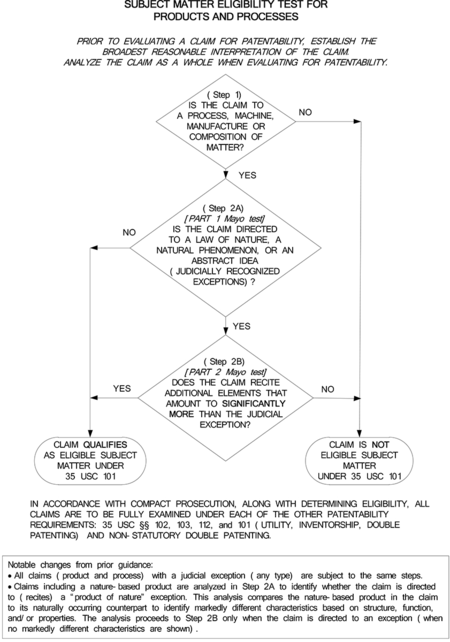
    Following the presentation of a flowchart, which sets forth the eligibility test for both products and processes, the interim guidance is divided into five parts:  (1) a two-part analysis for determining whether a claim is directed to a judicial exceptions, (2) a brief reminder about complete examination, (3) examples of claims, based on Supreme Court decisions, analzyed using the interim guidance analysis, and (4) summaries of Supreme Court and Federal Circuit decisions relating to laws of nature, natural phenomena, and abstract ideas.  Today, we will provide an overview of the interim guidance and a discussion of the first two parts of the guidance.  More detailed analyses of Parts III and IV of the interim guidance, as well as additional perspectives of how the interim guidance will impact applicants and practitioners in both the Myriad/Mayo space and Alice space, will be provided in subsequent posts.

    The analysis to be used in determining "whether a claim is drawn to patent-eligible subject matter" is illustrated in the interim guidance by the following flowchart (click on flowchart to expand):
    Flowchart
    According to the interim guidance, the current two-step analysis for determining subject matter eligibility under 35 U.S.C. § 101, as set forth in MPEP § 2106, consists of:  (1) determining whether the claimed invention is "directed to one of the four statutory categories" (i.e., process, machine, manufacture, or composition of matter), and (2) determining whether the claimed invention is "wholly directed to subject matter encompassing a judicially recognized exception."  In the flowchart included in the interim guidance, the first step of the above analysis is shown in the first diamond (labeled "Step 1"), and the second step of the analysis is shown in the second and third diamonds (labeled "Step 2A" and "Step 2B").  The interim guidance notes that the second step has been divided into two steps (or diamonds) in the flowchart to correspond with the two-step (or two-part) analysis from Alice Corp. (which was set forth earlier in Mayo).  These last two steps/diamonds are the subject of the interim guidance.

    The interim guidance indicates that in Step 2A (the second diamond on the flowchart), which corresponds to part 1 of the Alice Corp./Mayo test, the examiner shall "[d]etermine whether the claim is directed to a law of nature, a natural phenomenon, or an abstract idea (judicial exceptions)."  As for Step 2B (the third diamond on the flowchart), which corresponds to part 2 of the Alice Corp./Mayo test, the interim guidance indicates that the examiner shall "[d]etermine whether any element, or combination of elements, in the claim is sufficient to ensure that the claim amounts to significantly more than the judicial exception."

    With regard to Step 2A, the interim guidance states that if the examiner determines that the claimed invention is not directed to any judicial exceptions, the claim is eligible and needs no further eligibility analysis.  In discussing this step, the interim guidance states that "[a] claim is directed to a judicial exception when a law of nature, a natural phenomenon, or an abstract idea is recited (i.e., set forth or described) in the claim."

    As for the judicial exceptions, the interim guidance indicates that "[l]aws of nature and natural phenomena, as identified by the courts, include naturally occurring principles/substances and substances that do not have markedly different characteristics compared to what occurs in nature."  The notice then lists several types of concepts that courts have found to be laws of nature and natural phenomena:  an isolated DNA (Association for Molecular Pathology v. Myriad Genetics, Inc.), a correlation that is the consequence of how a certain compound is metabolized by the body (Mayo Collaborative Services v. Prometheus Laboratories, Inc.), electromagnetism to transmit signals (O'Reilly v. Morse), and the chemical principle underlying the union between fatty elements and water (Tilghman v. Proctor).

    With respect to abstract ideas, the interim guidance indicates that "[a]bstract ideas have been identified by the courts by way of example, including fundamental economic practices, certain methods of organizing human activities, an idea 'of itself,' and mathematical relationships/formulas."  The notice then lists several types of concepts that courts have found to be abstract ideas:  mitigating settlement risk (Alice Corp. v. CLS Bank); hedging (Bilski v. Kappos); creating a contractual relationship (buySAFE, Inc. v. Google, Inc.); using advertising as an exchange or currency (Ultramercial, LLC v. Hulu, LLC and WildTangent); processing information through a clearinghouse (Dealertrack Inc. v. Huber); comparing new and stored information and using rules to identify options (SmartGene, Inc. v. Advanced Biological Laboratories, SA); using categories to organize, store and transmit information (Cyberfone Systems v. CNN Interactive Group); organizing information through mathematical correlations (Digitech Image Tech., LLC v. Electronics for Imaging, Inc.); managing a game of bingo (Planet Bingo, LLC v. VKGS LLC); the Arrhenius equation for calculating the cure time of rubber (Diamond v. Diehr); a formula for updating alarm limits (Parker v. Flook); a mathematical formula relating to standing wave phenomena (Mackay Radio & Telegraph Co. v. Radio Corp. of America); and a mathematical procedure for converting one form of numerical representation to another (Gottschalk v. Benson).

    In applying the Step 2A analysis to nature-based products, the interim guidance notes that an examiner should determine whether a nature-based product limitation in a claim needs to be evaluated using a markedly different characteristic analysis, and if so, to carry out that analysis.  (In a footnote, the notice recognizes that "[t]his revised analysis represents a change from prior guidance, because now changes in functional characteristics and other non-structural properties can evidence markedly different characteristics, whereas in the [Myriad/Mayo guidance] only structural changes were sufficient to show a marked difference.")

    The notice explains that "[a] nature-based product can be claimed by itself (e.g., 'a Lactobacillus bacterium') or as one or more limitations of a claim (e.g., 'a probiotic composition comprising a mixture of Lactobacillus and milk in a container')," and indicates that in the latter case, "the markedly different characteristics analysis should be applied to the resultant nature-based combination, rather than its component parts."  According to the notice, the markedly different characteristics analysis compares the nature-based product limitation to its naturally occurring counterpart in its natural state, or to the closest naturally occurring counterpart when there is no naturally occurring counterpart to the nature-based product.  The interim guidance states that "[m]arkedly different characteristics can be expressed as the product's structure, function, and/or other properties," noting that "even a small change can result in markedly different characteristics from the product's naturally occurring counterpart."  The interim guidance also states that:

    In accordance with this analysis, a product that is purified or isolated, for example, will be eligible when there is a resultant change in characteristics sufficient to show a marked difference from the product's naturally occurring counterpart.  If the claim recites a nature-based product limitation that does not exhibit markedly different characteristics, the claim is directed to a "product of nature" exception (a law of nature or naturally occurring phenomenon), and the claim will require further analysis to determine eligibility based on whether additional elements add significantly more to the exception.

    The notice provides several examples of the types of characteristics considered by the courts when determining whether there is a marked difference, including:  biological or pharmacological functions or activities (citing Funk Bros. Seed Co. v. Kalo Inoculant Co., Diamond v. Chakrabarty, In re King, and Myriad); chemical and physical properties (citing Parke-Davis & Co. v. H.K. Mulford Co. and Funk Bros.; phenotype, including functional and structural characteristics (citing In re Roslin Inst.); and structure and form, whether chemical, genetic or physical (citing Chakrabarty, Parke-Davis, and Myriad).

    The interim guidance notes that "[i]f the claim includes a nature-based product that has markedly different characteristics, the claim does not recite a 'product of nature' exception and is eligible . . . unless the claim recites another exception (such as a law of nature or abstract idea, or a different natural phenomenon)."  Otherwise, the examiner must then proceed to Step 2B of the analysis.

    In Step 2B, the examiner must "determine whether the elements of the claim, considered both individually and as an ordered combination, are sufficient to ensure that the claim as a whole amounts to significantly more than the exception itself," which the interim guidance characterizes as "a search for an 'inventive concept.'"  The notice cautions that "[i]t is important to consider the claim as whole," as "[i]ndividual elements viewed on their own may not appear to add significantly more to the claim, but when combined may amount to significantly more than the exception."  The notice lists examples of considerations identified by the Supreme Court for determining whether a claim with additional elements amounts to significantly more than the judicial exception itself, including limitations that may be enough to qualify as "significantly more" when recited in a claim with a judicial exception and limitations that were found not to be enough to qualify as "significantly more" (see page 74624 of notice).

    If after the Step 2B analysis, the claim is found to be directed to patent-ineligible subject matter, the interim guidance indicates that the examiner should "identify the exception by referring to where it is recited (i.e., set forth or described) in the claim and explain why it is considered an exception," and "[t]hen, if the claim includes additional elements, identify the elements in the rejection and explain why they do not add significantly more to the exception."

    Part I of the interim guidance concludes with a brief discussion of claims reciting a plurality of exceptions and a streamlined eligibility analysis.  With respect to the former concept, the notice states that for claims directed to a plurality of exceptions, examiners should conduct the eligibility analysis for one of the exceptions.  The interim guidance suggests that "if the claim fails under Step 2B for one exception, the claim is ineligible, and no further eligibility analysis is needed."  As for streamlined analysis, the interim guidance explains that this analysis "can be used for a claim that may or may not recite a judicial exception but, when viewed as a whole, clearly does not seek to tie up any judicial exception such that others cannot practice it."  The notice includes four examples of subject matter for which the streamlined analysis could be used:  (1) a robotic arm assembly having a control system that operates using certain mathematical relationships (which the notice states is clearly not an attempt to tie up use of the mathematical relationships), (2) an artificial hip prosthesis coated with a naturally occurring mineral (which the notice states is not an attempt to tie up the mineral), (3) a cellphone with an electrical contact made of gold, (4) a plastic chair with wood trim.

    Part II of the interim guidance reminds examiners that "[r]egardless of whether a rejection under 35 U.S.C. 101 is made, a complete examination should be made for every claim under each of the other patentability requirements:  35 U.S.C. 102, 103, 112, and 101 (utility, inventorship and double patenting) and nonstatutory double patenting."

    Part III of the interim guidance provides examples, based on Supreme Court decisions, where the examination procedure set forth in the interim guidance is used to analyze claims for subject matter eligibility.  The six examples include:

    Example 1. Diamond v. Chakrabarty (U.S. Patent No. 4,259,444)
    Example 2. Association for Molecular Pathology v. Myriad Genetics, Inc. (U.S. Patent No. 5,747,282)
    Example 3. Diamond v. Diehr (U.S. Patent No. 4,344,142)
    Example 4. Parker v. Flook
    Example 5. Mayo v. Prometheus (U.S. Patent No. 6,355,623)
    Example 6. Alice Corp. v. CLS Bank (U.S. Patent Nos. 5,970,479 and 7,725,375)

    As noted above, Patent Docs will provide more detailed analyses of Part III in subsequent posts (readers may note that detailed analyses of several of the cases used in Part III have been previously provided in this space, including Myriad (here and here), Mayo, and Alice Corp. (here and here)).

    Part IV of the interim guidance provides brief summaries of Supreme Court and Federal Circuit decisions in which the claims at issue were analyzed with respect to judicial exceptions for subject matter eligibility.  This section of the interim guidance provides summaries of the following Supreme Court decisions:

    O'Reilly v. Morse (U.S. Reissue Patent No. RE 117)
    Tilghman v. Proctor (U.S. Patent No. 11,766)
    Mackay Radio & Telegraph Co. v. Radio Corp. of America (U.S. Patent No. 1,974,387)
    Gottschalk v. Benson
    Bilski v. Kappos

    This section also provides summaries of the following Federal Circuit decisions (divided into two groups: abstract idea decisions issued prior to the Supreme Court's Alice Corp. decision and abstract idea decisions issued since the Alice Corp. decision):

    SiRF Technology v. ITC (U.S. Patent No. 6,417,801)
    Research Corp. Tech. v. Microsoft Corp. (U.S. Patent No. 5,111,310)
    Dealertrack Inc. v. Huber (U.S. Patent No. 7,181,427)
    SmartGene, Inc. v. Advanced Biological Laboratories, SA (U.S. Patent No. 6,081,786)
    Cyberfone Systems v. CNN Interactive Group (U.S. Patent No. 8,019,060)
    • Digitech Image Tech., LLC v. Electronics for Imaging, Inc. (U.S. Patent No. 6,128,415)
    Planet Bingo, LLC v. VKGS LLC (U.S. Patent No. 6,398,646)
    buySAFE, Inc. v. Google, Inc. (U.S. Patent No. 7,644,019)
    Ultramercial, LLC v. Hulu, LLC and WildTangent (U.S. Patent No. 7,346,545)
    DDR Holdings, LLC v. Hotels.com, L.P. (U.S. Patent No. 7,818,399)

    As noted above, Patent Docs will provide more detailed analyses of Part IV in subsequent posts (readers may note that detailed analyses of many of the cases discussed in Part IV have been previously provided in this space, including the following cases: Bilksi, SmartGene, Cyberfone Systems, Digitech Image Tech., Planet Bingo, Ultramercial, and DDR Holdings).

    The notice also indicates that explanatory training examples relating to nature-based products, replacing the examples in the Myriad/Mayo guidance, will be released (those examples were posted on the Office's interim guidance website on Monday; Patent Docs will provide a more detailed analysis of the nature-based products examples in a subsequent post).  The notice further indicates that explanatory example sets relating to claims that do and do not amount to significantly more than a judicial exception are being developed and will be issued at a future date (Drew Hirshfeld, U.S. Patent and Trademark Office Deputy Commissioner for Patent Examination Policy, indicated during a conference call on Monday that those examples were expected to be released in one to two weeks).

    In addition to outlining the Office's interim guidance on subject matter eligibility, the notice includes a request for public comment regarding the interim guidance as well as suggestions for examples to be used in examiner training and in the explanatory example sets that have been (and will be) posted on the Office's interim guidance website.  Echoing comments made by Mr. Hirshfeld during Monday's conference call, the notice states that "[i]mplementation of examination guidance on eligibility will be an iterative process continuing with periodic supplements based on developments in patent subject matter eligibility jurisprudence and public feedback."  Written comments regarding the interim guidance and suggesting additional examples can be sent by e-mail to:  2014_interim_guidance@uspto.gov.  The deadline for submitting written comments is March 16, 2015.

    The notice also indicates that the Office will be holding a public forum in mid-January 2015 to discuss the interim guidance and receive additional oral input on the interim guidance.  Mr. Hirshfeld indicated during Monday's conference call that the forum would take place on January 21, 2015.  The Office's interim guidance website further indicates that the eligibility forum will take place from 1:00 to 5:00 pm (EST) on that date in the USPTO's Madison Auditorium North (Concourse Level) in Alexandria, VA.  Information regarding the forum, which will be accessible via WebEx, can be found on the interim guidance website.


  • By Donald Zuhn

    USPTO SealIn a conference call this morning, Drew Hirshfeld, U.S. Patent and Trademark Office Deputy Commissioner for Patent Examination Policy, announced that the USPTO would be releasing revised guidance on subject matter eligibility later today and that the guidance would be published in the Federal Register on Tuesday.  In fact, the revised guidance was made available for public inspection in the Federal Register reading room during the conference call (and can be found here).

    The revised guidance will provide an integrated approach, applying to all types of subject matter, and take the Association for Molecular Pathology v. Myriad Genetics, Inc., Mayo Collaborative Services v. Prometheus Laboratories, Inc., Alice Corp. v. CLS Bank International, and other decisions into account.  In particular, the revised guidance will use the two-step analysis described by Justice Breyer in Mayo and discussed further in Alice (see "Thoughts on Alice Corp. v. CLS Int'l").

    Mr. Hirshfeld noted that the Office's delay in releasing the guidance was due, at least in part, to incorporating more recent decisions such as Ultramercial Inc. v. Hulu LLC and even DDR Holdings, LLC v. Hotels.com, L.P. into the guidance.  In fact, he pointed out that the revised guidance was "pulled back" to incorporate DDR Holdings, which was issued by the Federal Circuit on December 5.

    Noting that the Office has "taken to heart the feedback the public has given us," Mr. Hirshfeld indicated that the publication of the revised guidance would open a 90-day comment period, and he encouraged the public to submit comments on the guidance, adding that "we are still very interested in receiving people's feedback."  In addition, he announced that the Office would be holding a public forum on the revised guidance on January 21.  Mr. Hirshfeld added that the Office viewed the process of revising the guidance as an "iterative" one, and that the Office would "not hesitate" to make further changes as dictated by future court decisions and public feedback.  He said that Office was "trying to be as open and transparent" as possible with respect to the guidance.

    With regard to the revised guidance itself, Mr. Hirshfeld declared that "most people will see that we made significant changes" as compared with the Office's prior subject matter guidance.  Most of these changes will come on the life sciences side, where Mr. Hirshfeld noted the "feedback was more critical."  In response to a question regarding changes to the guidance, Mr. Hirshfeld indicated that the revised guidance would incorporate all of the changes that the Office has been discussing publicly for the past several months (and which have been described in this space in a number of posts).  In particular, he noted that by applying to claims that recite or involve a judicial exception, the Office was using "too broad of a funnel."  In view of the Alice decision, the process outlined in the guidance would apply to claims that recite or are directed to a judicial exception rather than those that merely "involve" a judicial exception.  The revised guidance will also differ with respect to application of the "markedly different" standard.  Mr. Hirshfeld acknowledged that while the previous guidance was "heavily weighted on structure," the revised guidance has been broadened to include other markedly different characteristics such as functionality.  Examiners will also be asked to apply a markedly different analysis in the first step of the test, which Mr. Hirshfeld expected would "help examiners make an early determination" as to subject matter eligibility, and thereby "simplify" the process.  In an effort to further simplify the process, the Office has removed the 12-factor test that was set forth in the Myriad/Mayo guidance from the revised guidance, which Mr. Hirshfeld said was "too confusing."  As the Office has been suggesting for months, however, the revised guidance, like the Myriad/Mayo guidance released in March, will not be confined to DNA.

    Among the changes will be several new examples in the Myriad/Mayo space.  These examples will be made available on the Office's subject matter eligibility website, which will be going live later today.  Mr. Hirshfeld noted that some of the new examples will be similar to those presented by June Cohan, a Legal Advisor with the USPTO's Office of Patent Legal Administration, at the BIO International Convention in San Diego in June (see "Docs @ BIO: USPTO Provides Update on Myriad-Mayo Guidance").  Mr. Hirshfeld noted that examples in the Alice space are expected to be added to the website in one or two weeks, with the delay on the hi-tech side being due to the recent Ultramercial and DDR Holdings decisions.  He also stated that "carefully crafted hypotheticals" were required in the Alice space because "we feel we need to give more guidance than examiners are getting from the cases."

    Patent Docs will provide a more detailed analysis of the revised guidance in a subsequent post.