• By Cambria Alpha-Cobb* and Anthony D. Sabatelli** —

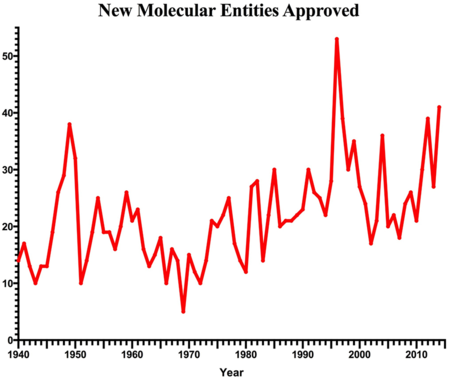
    FDAIf innovation drives progress, then 2014 was the year of progress!  During the past year the U.S. Food and Drug Administration approved 41 new drugs.  That is 14 more than 2013 and the highest number in 18 years!  What spurred this increase?  And what challenges do these new drugs face in the 2015 market?

    The FDA publishes the drug approval data based on New Molecular Entities (NMEs) [1].  These drugs can be both the traditional small molecule drugs in addition to newer high-molecular weight biologics.  For information on NMEs and how they are classified, see "The Scorecard- Fewer New Drug Approvals in 2013: What's in store for 2014?" [2] a previous blog post by Dr. Anthony Sabatelli.  Using data published annually from the FDA, we plotted the number of approved NMEs since the 1940s [1][3], below.  After a dramatic peak in 1996, our plot shows a steady decline in approvals, followed by very little turnaround throughout the first decade of the 21st century and then a slow recovery in the past few years.  Not only does this 2014 spike continue a slow upward trend, but also the new generation of drugs it embodies is believed to represent key advances in new drug development, suggesting a more broad-based recovery [4].

    One of the main changes to the drug pipeline has been the expansion of treatment options. Many of the breakthrough discoveries from the past year are diverging from the traditional small molecules into whole new technologies and therapies. Nearly 4 out of 10 of the approved NMEs in 2014 were for biologics, a dramatic increase from 1 in 10 biologic NMEs approved in 2005 [5]. The 2014 NMEs spanned 10 therapeutic areas, up from 8 last year, with infectious diseases dominating with 12 approvals [4]. Next in line were approvals for cancer treatments (8) and rare disease drugs (5), emphasizing the industry's focus on specialized products [6].

    ChartChart of New Molecular Entities approved: Annual approved NMEs based on data from [1] and [3].

    While this innovation is helping restore our faith in the drug industry, these drugs are arriving into a market where high prices are coming under attack, and more competition will only increase these attacks.  Fierce Pharma identified six therapeutic areas, including some rare diseases and cancer treatment, where increased competition could lead to heavy price competition [7].  This competition raises questions about future commercial prospects and could suggest reduced future development efforts due to these new pricing pressures [8].

    As John Carroll, editor of Fierce Biotech, states, "Approvals aren't enough to determine whether a pipeline strategy is successful or not." [8]  However 2014 was the best year since 1996, and the innovative technologies provide encouragement that this spike might be part of a long-lived trend.  Competition in pricing may hinder the sales of some of these new drugs, however the future is promising as firms venture from their comfort zones and embrace these breakthrough discoveries [8].

    * Dr. Cambria Alpha-Cobb is a Technology Specialist at Dilworth IP
    ** Dr. Sabatelli is a Partner with Dilworth IP


    [1]http://www.fda.gov/Drugs/DevelopmentApprovalProcess/DrugInnovation/ucm20025676.htm
    [2]http://www.dilworthip.com/scorecard-fewer-new-drug-approvals-2013-whats-store-2014/
    [3]http://www.fda.gov/AboutFDA/WhatWeDo/History/ProductRegulation/SummaryofNDAApprovalsReceipts1938tothepresent/default.htm
    [4]http://www.forbes.com/sites/bernardmunos/2015/01/02/the-fda-approvals-of-2014/
    [5]http://www.fda.gov/Drugs/DevelopmentApprovalProcess/HowDrugsareDevelopedandApproved/DrugandBiologicApprovalReports/NDAandBLAApprovalReports/ucm373420.htm
    [6]http://in.reuters.com/article/2015/01/01/pharmaceuticals-approvals-idINL6N0UE2C120150101
    [7]http://www.fiercepharma.com/story/limited-attention-span-focus-these-market-shake-ups-2015/2014-12-24
    [8]http://www.fiercebiotech.com/special-reports/biopharma-posts-chart-topping-41-new-drug-approvals-2014/2015-01-02?utm_medium=nl&utm_source=internal

  •         By Sherri Oslick

    Gavel About Court Report:  Each week we will report briefly on recently filed biotech and pharma cases.

    Pfizer Inc. et al. v. Mylan Inc. et al.
    1:15-cv-00026; filed January 8, 2015 in the District Court of Delaware

    • Plaintiffs:  Pfizer Inc.; Wyeth LLC; Pfizer Pharmaceuticals LLC; PF Prism C.V.; Pfizer Manufacturing Holdings LLC
    • Defendants:  Mylan Inc.; Agila Specialties Private Ltd.; Mylan Pharmaceuticals Inc.

    Infringement of U.S. Patent Nos. 7,879,828 ("Tigecycline Compositions and Methods of Preparation," issued February 1, 2011) and 8,372,995 ("Crystalline Solid Forms of Trigecycline and Methods of Preparing Same," issued February 12, 2013), licensed to Pfizer, following a Paragraph IV certification as part of Mylan's filing of an ANDA to manufacture a generic version of Pfizer's Tygacil® (tigecycline injectible, used for the treatment of complicated skin and skin structure infections, complicated intra-abdominal infections, and community-acquired bacterial pneumonia).  View the complaint here.

    Sanofi-Aventis U.S. LLC et al. v. Accord Healthcare, Inc.
    1:15-cv-00018; filed January 7, 2015 in the Middle District of North Carolina

    • Plaintiffs:  Sanofi-Aventis U.S. LLC; Aventis Pharma S.A.; Sanofi
    • Defendant:  Accord Healthcare, Inc.

    Sanofi-Aventis U.S. LLC et al. v. Accord Healthcare, Inc.
    3:14-cv-08079; filed December 29, 2014 in the District Court of New Jersey

    • Plaintiffs:  Sanofi-Aventis U.S. LLC; Aventis Pharma S.A.; Sanofi
    • Defendant:  Accord Healthcare, Inc.

    The complaints in these cases are substantially identical.  Infringement of U.S. Patent No. 5,847,170 ("Taxoids, Their Preparation and Pharmaceutical Compositions Containing Them" issued December 8, 1998) following a Paragraph IV certification as part of Accord's filing of an ANDA (for one dosage form) and an NDA (under § 505(b)(2) of the Food, Drug and Cosmetic Act) (for another dosage form) to manufacture a generic version of Sanofi's Jevtana® (cabazitaxel injection, used in combination with prednisone for the treatment of patients with hormonerefractory metastatic prostate cancer previously treated with a docetaxel-containing treatment regimen).  View the New Jersey complaint here.


    Forest Laboratories LLC et al. v. Apotex Corp. et al.
    1:15-cv-00018; filed January 5, 2015 in the District Court of Delaware

    • Plaintiffs:  Forest Laboratories LLC; Forest Laboratories Holdings Ltd.; Cerexa Inc.; Takeda Pharmaceutical Company Ltd.
    • Defendants:  Apotex Corp.; Apotex Inc.; Sandoz Inc.

    Infringement of U.S. Patent Nos. 6,417,175 ("Phosphonocephem Derivatives," issued July 9, 2002), 6,906,055 ("Phosphonocephem Compound," issued June 14, 2005), 7,419,973 (same title, issued September 2, 2008), and 8,247,400 ("Cephem Compounds Useful for the Treatment of Bacterial Infections," issued August 21, 2012) following a Paragraph IV certification as part of Apotex's filing of an ANDA to manufacture a generic version of Forest's Teflaro® (ceftaroline fosamil injection, used for the treatment of community-acquired bacterial pneumonia and for the treatment of acute bacterial skin and skin structure infections).  View the complaint here.

    Reckitt Benckiser Pharmaceuticals Inc. et al. v. Par Pharmaceutical Inc. et al.
    1:14-cv-01573; filed December 31, 2014 in the District Court of Delaware

    • Plaintiffs:  Reckitt Benckiser Pharmaceuticals Inc.; MonoSol Rx LLC
    • Defendants:  Par Pharmaceutical Inc.; IntelGenX Technologies Corp.

    Reckitt Benckiser Pharmaceuticals Inc. et al. v. Watson Laboratories Inc.
    1:14-cv-01574; filed December 31, 2014 in the District Court of Delaware

    • Plaintiffs:  Reckitt Benckiser Pharmaceuticals Inc.; MonoSol Rx LLC
    • Defendant:  Watson Laboratories Inc.

    The complaints in these cases are substantially identical.  Infringement of U.S. Patent Nos. 8,900,497 ("Process for Making a Film Having a Substantially Uniform Distribution of Components," issued December 2, 2014) and 8,906,277 ("Process for Manufacturing a Resulting Pharmaceutical Film," issued December 9, 2014) in conjunction with defendants' filing of an ANDA to manufacture a generic version of Reckitt Benckiser's Suboxone® (buprenorphine hydrochloride and naloxone hydrochloride sublingual film, used for the maintenance treatment of opioid dependence).  View the Par complaint here.

    Sanofi-Aventis U.S. LLC et al. v. Fresenius Kabi USA LLC
    1:14-cv-01533; filed December 30, 2014 in the District Court of Delaware

    • Plaintiffs:  Sanofi-Aventis U.S. LLC; Aventis Pharma S.A.; Sanofi
    • Defendant:  Fresenius Kabi USA, LLC

    Sanofi-Aventis U.S. LLC et al. v. Fresenius Kabi USA, LLC
    3:14-cv-08082; filed December 29, 2014 in the District Court of New Jersey

    • Plaintiffs:  Sanofi-Aventis U.S. LLC; Aventis Pharma S.A.; Sanofi
    • Defendant:  Fresenius Kabi USA, LLC

    The complaints in these cases are substantially identical.  Infringement of U.S. Patent Nos. 5,847,170 ("Taxoids, Their Preparation and Pharmaceutical Compositions Containing Them" issued December 8, 1998) and 7,241,907 ("Acetone Solvate of Dimethoxy Docetaxel and its Process of Preparation" issued July 10, 2007) following a Paragraph IV certification as part of Fesenius' filing of an ANDA to manufacture a generic version of Sanofi's Jevtana® (cabazitaxel injection, used in combination with prednisone for the treatment of patients with hormonerefractory metastatic prostate cancer previously treated with a docetaxel-containing treatment regimen).  View the New Jersey complaint here.


    Sanofi-Aventis U.S. LLC et al. v. BPI Labs, LLC et al.
    8:14-cv-03233; filed December 30, 2014 in the Middle District of Florida

    • Plaintiffs:  Sanofi-Aventis U.S. LLC; Aventis Pharma S.A.; Sanofi
    • Defendants:  BPI Labs, LLC; Belcher Pharmaceuticals, LLC

    Sanofi-Aventis U.S. LLC et al. v. BPI Labs, LLC et al.
    3:14-cv-08081; filed December 29, 2014 in the District Court of New Jersey

    • Plaintiffs:  Sanofi-Aventis U.S. LLC; Aventis Pharma S.A.; Sanofi
    • Defendants:  BPI Labs, LLC; Belcher Pharmaceuticals, LLC

    The complaints in these cases are substantially identical.  Infringement of U.S. Patent No. 5,847,170 ("Taxoids, Their Preparation and Pharmaceutical Compositions Containing Them" issued December 8, 1998) following a Paragraph IV certification as part of BPI's filing of an ANDA to manufacture a generic version of Sanofi's Jevtana® (cabazitaxel injection, used in combination with prednisone for the treatment of patients with hormonerefractory metastatic prostate cancer previously treated with a docetaxel-containing treatment regimen).  View the New Jersey complaint here.

    Novartis Pharmaceuticals Corp. et al. v. Ranbaxy Inc. et al.
    1:14-cv-01526; filed December 29, 2014 in the District Court of Delaware

    • Plaintiffs:  Novartis Pharmaceuticals Corp.; Novartis AG
    • Defendants:  Ranbaxy Inc.; Ranbaxy Laboratories Ltd.

    Infringement of U.S. Patent Nos. 6,894,051 ("Crystal Modification of a N-phenyl-2-pyrimidineamine Derivative, Processes for Its Manufacture and Its Use," issued May 17, 2005) and RE43,932 ("Crystal Modification of a N-phenyl-2-pyrimidineamine Derivative, Processes for Its Manufacture and Its Use," issued January 15, 2013) following a Paragraph IV certification as part of Ranbaxy's filing of an ANDA to manufacture a generic version of Novartis' Gleevec® (imatinib mesylate, used for various indications, including treatment of myeloid leukemia).  View the complaint here.

    AstraZeneca AB et al. v. Andrx Labs, LLC et al.
    3:14-cv-08030; filed December 24, 2014 in the District Court of New Jersey

    • Plaintiffs:  AstraZeneca AB; Aktiebolaget Hassle; AstraZeneca LP; Zeneca Inc.
    • Defendants:  Andrx Labs, LLC; Andrx Corp.; Actavis, Inc.

    Infringement of U.S. Patent Nos. 6,369,085 ("Form of S-omeprazole," issued April 9, 2002) and 7,411,070 (same title, issued August 12, 2008) following a Paragraph IV certification as part of Andrx's filing of an ANDA to manufacture a generic version of AstraZeneca's Nexium 24HR® (esomeprazole magnesium, used for the treatment of gastroesophageal reflux disease).  View the complaint here.

    Otsuka Pharmaceutical Co., Ltd. v. Apotex Corp. et al.
    1:14-cv-08074; filed December 24, 2014 in the District Court of New Jersey

    • Plaintiff:  Otsuka Pharmaceutical Co., Ltd.
    • Defendants:  Apotex Corp.; Apotex Inc.; Apotex Pharmachem Inc.

    Infringement of U.S. Patent Nos. 8,017,615 ("Low Hygroscopic Aripiprazole Drug Substance and Process for the Preparation Thereof," issued September 13, 2011), 8,580,796 (same title, issued November 12, 2013), 8,642,760 (same title, issued February 4, 2014), and 8,759,350 ("Carbostyril Derivatives and Serotonin Reuptake Inhibitors for Treatment of Mood Disorders," issued June 24, 2014) following a Paragraph IV certification as part of Apotex's filing of an ANDA to manufacture a generic version of Otsuka's Abilify® (aripiprazole, used to treat bipolar disorder and schizophrenia).  View the complaint here.

    Otsuka Pharmaceutical Co., Ltd. v. Sciegen Pharmaceuticals Inc. et al.
    1:14-cv-08077; filed December 22, 2014 in the District Court of Delaware

    • Plaintiff: Otsuka Pharmaceutical Co., Ltd.
    • Defendants: Sciegen Pharmaceuticals Inc.; Bactolac Pharmaceutical, Inc.

    Infringement of U.S. Patent Nos. 8,017,615 ("Low Hygroscopic Aripiprazole Drug Substance and Process for the Preparation Thereof," issued September 13, 2011), 8,580,796 (same title, issued November 12, 2013), and 8,642,760 (same title, issued February 4, 2014) following a Paragraph IV certification as part of Sciegen's filing of an ANDA to manufacture a generic version of Otsuka's Abilify® (aripiprazole, used to treat bipolar disorder and schizophrenia).  View the complaint here.
  • CalendarJanuary 13-14, 2015 – Advanced Summit on Life Sciences Patents (American Conference Institute) – New York, NY

    January 14-15, 2015 – "The USPTO Revised Patent Eligibility Guidance" (Intellectual Property Owners Association) – 2:00 to 3:15 pm (ET)

    January 15, 2015 – "Obviousness Standard After the AIA: Leveraging Latest PTO and Court Guidance — Overcoming Challenges of Obviousness and Attacks on Patent Validity" (Strafford) – 1:00 to 2:30 pm (EST)

    January 15, 2015 – "Have The Supreme Court's Octane and Highmark Decisions Obviated The Need For Legislative Changes to Section 285?" (Patent Litigation Committee of the Federal Circuit Bar Association) – noon to 1:00 pm (ET)

    January 16, 2015 – 5th Annual Patent Law Conference (University of San Diego School of Law) – University of San Diego

    January 20, 2014 – "Top Patent Law Stories of 2014" (McDonnell Boehnen Hulbert & Berghoff LLP) – 10:00 am to 11:15 am (CT)

    January 22, 2015 – "Preparing for and Navigating PTAB Appeals Before the Federal Circuit — Conducting PTAB Trials With Eye to Appeal, Determining Errors for Appeal, Understanding PTO Practice and Federal Circuit Law" (Strafford) – 1:00 to 2:30 pm (EST)

    January 29, 2015 – "IPR Defense: An Overview of Strategic Considerations and Potential Pitfalls From the Patent Owner's Perspective" (American Bar Association Center for Professional Development and Section of Intellectual Property Law) – 1:00 to 2:30 pm (ET)

    January 29, 2015 – "Combating Patent Trolls: Third-Party Solutions and Defense Strategies in Post-Grant and Litigation — Leveraging Counterclaim, Summary Judgment and Other Tactics; Utilizing Legislative, Insurance and Third-Party Tools" (Strafford) – 1:00 to 2:30 pm (EST)

    February 5, 2015 – "On Sale and Public Use Bars to Patentability After AIA — Minimizing the Risk of Patent Ineligibility or Invalidation" (Strafford) – 1:00 to 2:30 pm (EST)

    February 24-25, 2015 – Professional Responsibility and Legal Ethics for Life Sciences Attorneys (American Conference Institute) – Philadelphia, PA

    March 5-6, 2015 – Advanced Patent Law Seminar (Chisum Patent Academy) – Cincinnati, OH

    ***Patent Docs is a media partner of this conference or CLE

  • IPO #2The Intellectual Property Owners Association (IPO) will offer two webinars on "The USPTO Revised Patent Eligibility Guidance" on January 14 and 15, 2015 from 2:00 to 3:15 pm (ET) each day.  The webinars will clarify the meaning of the new guidance, discuss which inventions are now more likely to be found patent eligible and how to write patent applications that clear current hurdles.  The first webinar, which will cover life sciences, will be presented by Raul Tamayo of the U.S. Patent and Trademark Office, Deborah Martin of Pfizer, Inc., and Kevin Noonan of McDonnell Boehnen Hulbert & Berghoff LLP, and the second webinar, which will cover software and information technology, will be presented by Michael Cygan of the U.S. Patent and Trademark Office, Bart Eppenauer of Shook, Hardy & Bacon LLP, and Manny Schecter of IBM Corp.

    The registration fee for each webinar is $130 (government and academic rates are available upon request).  Those interested in registering for the webinar can do so here.

  • The Patent Litigation Committee of the Federal Circuit Bar Association (FCBA) will be holding a panel discussion webinar entitled "Have The Supreme Court's Octane and Highmark Decisions Obviated The Need For Legislative Changes to Section 285?" on January 15, 2015 from noon to 1:00 pm (ET).  Eric C. Cohen of Katten Muchin Rosenman LLP will moderate a panel consisting of Patrick J. Coyne and Erik R. Pukny of Finnegan, Henderson, Farabow, Garrett & Dunner, LLP and John R. Kenny of Kenyon & Kenyon.  The panel will explore whether Octane obviates the need for fee-shifting patent reform legislation.  Those wishing to participate online can do so by visiting the FBCA's registration website.  Information about registering for this event can be found here.  The registration fee for the webcast is $120 (non-member private practitioners), $35 (non-member government/academic/retired), or complimentary for FCBA members and students.

  • By Andrew Williams

    USPTO SealFor only the second time, the Patent Trial and Appeals Board ("PTAB" or "Board") granted a motion to amend claims.  However, even though these two current motions were only granted-in-part, the fact that some claim amendments were accepted while others were denied can shed even more light on the Board's requirement for such motions.  Indeed, this was the first time that the Board provided a real-world example of a claim-amendment hypothetical described in the June 11, 2013 decision from the Idle Free Systems, Inc. v. Bergstrom, Inc. case (IPR2012-00027) (Paper 26) – that of obtaining a claim set with a hierarchy of different scope.  The Idle Free opinion posited that if a patent owner moved to substitute three claims (one independent and two dependent), the two dependent claims should (at least facially) not be able to contain any additional new features beyond the independent claim.  The reason provided was that these new features would not be responsive to an alleged ground of unpatentability, which would be in violation of 37 C.F.R. § 42.121(a)(2)(i)).  Moreover, according to Idle Free, unless the patent owner can show a patentable distinction between the dependent claims and the independent claims, there would be no "meaningful reason" to add the new feature, which is inconsistent with the statutory requirement that "[f]or each challenged claim" a "reasonable number of substitute claims" may be proposed.  35 U.S.C. § 316(d)(1)(B).  It is these present two cases that first showed how this theory works in practice.

    In actuality, this case involved two separate IPRs to two patents that are continuations of each other.  One IPR, Riverbed Technology, Inc. v. Silver Peak Systems, Inc., IPR2013-00402, involved U.S. Patent 8,312, 226, which was a continuation of U.S. Patent 8,370,583 (the subject of the second proceeding, IPR2013-00403).  Because the reasoning for both granting and denying the various claim amendments was very similar for both of the cases, we will focus on IPR2013-00402.  These cases were unique in that the patent owner did not file either a Patent Owner Preliminary Response or a Patent Owner Response.  Instead, the patent owner only filed a motion to amend, seeking to cancel claims 1-12 (3 sets of 4 claims) and substitute claims 13-18 (2 claims for each set).  And, unlike the case for the granted motion to amend in International Flavors & Fragrances Inc. v. The United States of America (IPR2013-00124), the petitioner in these cases opposed the motion.  But, despite this opposition, the Board found that the patent owner had met its burden with respect to substitute claims 13 and 15, and granted-in-part the motion.  The patent owner, on the other hand, did not meet its burden with respect to the other claims.

    The technology at issue in these cases related to network memory systems.  And, whereas that portion of our readership that tends to be more life-sciences orientated might not have sufficient interest in the specifics, it is important to have at least a basic understanding of the technology at issue.  The issue addressed by the patents involved the use of distributed servers instead of centralized servers.  The advantage of keeping the information on a centralized server was that it is easier to synchronize the data (think jointly editing a document with several other people on different computers versus a network), but "bandwidth bottleneck" can occur when multiple computers attempt to access data.  On the other hand, several distributed servers can be used by remote computers to cut down on this bottleneck, but the procedures to ensure synchronization of data are more complex.  Moreover, even though caching can be used by the remote computers in the centralized system, caching is binary, and therefore even a small change to a document will prevent caching from being utilized.

    The patentees developed a system that reduced network traffic by using "appliances" linked to the servers and remote computers to determine whether even a portion of the requested data was accessible locally.  If a portion of the data was not locally accessible, that portion could be accessed from the central server, with instructions to subsequently store the data with the updated portion on the locally accessible machine.  This was accomplished, in part, by the calculation of a hash and the use of both a fine and a course filter, and comparing it to a corresponding signature hash table.  For those not familiar with the term, a hash is calculated using a hash function, which converts any piece of data into a digital signature, and can be used to determine if two pieces of data are identical.  The patentees developed a way to identify "sync points" by determining the hash values for locations down to the byte level, and performing forward and backward memory comparison to identify the optimum length of matching data.  This was advantageous over the prior art, according to the patentees, because the prior art used "pre-segmented data," which was inflexible and did not allow for the identification of very small changes.  As a rough analogy to molecular biology, this would be akin to the difference between screening DNA with a hybridization probe that could only identify whether the DNA stretches were identical, and alternatively being able to pinpoint ever base substitution present in the DNA.

    To provide a sense of the scope of the amendments made to the "independent" parent claim, claim 13 follows as exemplary:

    13. (proposed substitute for claim 4) The source-site appliance of claim 1, wherein the processor is configured to determine whether the transmitted data corresponds to locally accessible data via a process comprising:
        identifying sync points in the transmitted data having matches in the locally accessible data by (i) determining hash values corresponding to different byte locations of the transmitted data, (ii) finely filtering the hash values using a fine filter to determine a finely filtered set of the hash values corresponding to fine sync points, and coarsely filtering the hash values using a coarse filter to determine a coarsely filtered set of the hash values corresponding to coarse sync points, and  (iii) determining from the finely filtered set of the hash values and the coarsely filtered set of the hash values, a plurality of hash values matching hash values of the locally accessible data; and
        performing for byte locations with matching hash values, a forward and backward memory comparison between the transmitted data and data representing the locally accessible data, the forward and backward comparison to identify a size of a matching region of the transmitted data with the data representing the locally accessible data, and performing based on results of the forward and backward memory comparison, a determination of a locally accessible portion of the transmitted data corresponding to the matching region that is locally accessible at the destination-site appliance and a non-locally accessible portion of the transmitted data that is not locally accessible at the destination-site appliance; and
        wherein the instruction comprises a retrieve instruction and a store instruction, the retrieve instruction indicating to the destination-site appliance to retrieve the locally accessible portion of the transmitted data corresponding to the matching region from storage locally accessible to the destination-site appliance, and the store instruction indicating to the destination-site appliance to store the non-locally accessible portion of the transmitted data; and
        wherein the processor is further configured to send [a] the non-locally accessible portion of the transmitted data over the wide area network to the destination-site appliance.

    Of course, this claim is written in dependent form, but is essentially independent because claim 1 will be canceled.  The proposed substitute dependent claims contained additional features beyond changing which claim from which it depends.  Claim 14 is exemplary:

    14. (proposed substitute for claim 3) The source-site appliance of claim [1] 13 wherein the store instruction further indicates to the destination-site appliance to store another copy of the locally accessible portion of the transmitted data together with the non-locally accessible portion of the data at an index in a database in the storage locally accessible to the destination-site appliance.

    The analysis began, as always, by determining whether there was any broadening of claim scope.  The PTAB found that each proposed substitute claim contained all of the limitations of the corresponding claim in the original patent, and that no limitations were removed.  The petitioner did not challenge the patent owner's assertion regarding claim scope.  Next, the Board looked to determine if there was written description support in the original disclosure.  Again, petitioner did not challenge this, and the Board concluded that the patent owner made a significant showing that there was written description support.  With regard to the interpretations of the new claim terms, the patent owner provided constructions and support for "sync point," "fine sync point," and "course sync point," which the petitioner did not challenge.  The Board agreed that these constructions provided the broadest reasonable interpretation of the claims.

    Having made these determinations, the Board looked to whether the patent owner met its burden of proof to demonstrate patentability over the prior art.  A problem faced by other patent owners in previous IPRs was that they did not demonstrate that the prior art included more than the cited art, but rather included prior art not of record but known to the patent owner.  Silver Peak met its burden by providing a "story" of what the prior taught, citing to both art of record and otherwise, and explaining why its proposed substitute claims described "a very different approach."  For example, the Silver Peak explained that "pre-existing data de-duplication systems reduced network traffic by dividing data into 'segments' (or 'chunks') and transmitting a 'reference' (or 'token'), rather than the data segment itself, when the destination device already had a copy of the data segment."  In contrast, instead of this inflexible approach of searching through all data segments, the patentees developed the method described by the claims.  This method of describing the prior art "problem" and the patentees "solution" was deemed to be persuasive by the Board.

    The petitioner, in additional to challenging (unsuccessfully) the patent owners characterization of the prior art, alleged that the patent holder did not distinguish the invention over all of the prior art of which it was aware.  The Board disagreed with petitioner based on the facts of the case.  Moreover, the petitioner argued that the substitution motions were defective because they did not include the testimony of a technical expert.  The Board, however, pointed out that even though experts can be helpful, they are not a prerequisite.  Each case depends on its facts.  As a result, the Board grated the motions to the extent they requested substitution of two of these "independent" claims per patent.

    Even though it is certainly instructive to learn what the Board considered to be a sufficient explanation of the prior art such that the burden of proof to amend the claims was met, it is the distinction between the claims that were granted and those that were denied that has additional value.  As mentioned above, it was the failure of the patent owner to propose a reasonable number of substituted claims that caused the rejection of these claims.  However, the "reasonable number" did not correspond to a one-for-one substitution.  Indeed, Silver Peak was proposing one-third less claims than in the original patent.  Instead, the patent owner ran afoul of this requirement because it added additional new features to the dependent claims.  And, according to Idle Free, when seeking such claims, the patent holder must "establish a special circumstance for adding those features."  This amounts to demonstrating why the dependent claims would be patentable over the prior art and the parent (independent) claims.  And, as the Board concluded, in part, the "Patent Owner does not explain sufficiently why storing an additional copy would have been non-obvious," when the parent claims included its own storing of a copy of the data.

    The Board has explained that it does not want to address such claims of differing scope because the PTAB is more of an adjudicatory than examinational body.  In fact, if the patent owner truly wanted such claims, the PTAB explained in Idle Free that the patent owner could utilize some other type of proceeding at the office, such as ex parte reexamination.  Interestingly, according to Idle Free,if the patent owner had not sought to add the additional limitations to the dependent claims, but rather only amended the claim on which it depended, those claims would have survived.  This is true, even though such claims would be broader in scope than those being sought by the patent holder.  It is possible that Silver Peak had a strategic reason for adding such limitations, such as concern that invalidating prior art to the broader claims may have been identified in the future.  In such a scenario, adding these limitations may have allowed these narrower claims to survive.

  • By Donald Zuhn

    FireworksAfter reflecting upon the events of the past twelve months, Patent Docs presents its eighth annual list oftop patent stories.  For 2014, we identified eighteen stories that were covered on Patent Docs last year that we believe had (or are likely to have) the greatest impact on patent practitioners and applicants.  Previously, we counted down stories #18 to #15, #14 to #11, #10 to #7, and #6 to #4.  Today, we count down the top three stories of 2014.  As with our other lists (2013, 2012, 2011, 2010, 2009, 2008, and 2007), links to our coverage of these stories (as well as a few links to articles on related topics) have been provided in case you missed the articles the first time around or wish to go back and have another look.  As always, we love to hear from Patent Docs readers, so if you think we left something off the list or disagree with anything we included, please let us know.  In addition, we will be offering a live webinar on the "Top Patent Law Stories of 2014" on January 20, 2015 from 10:00 am to 11:15 am (CT).  Details regarding the webinar can be found here.

    3.  AIA Post-Grant Review Proceedings Rise in Popularity

    Although they were established in September 2012 when the Leahy-Smith America Invents Act was enacted, the patent community had to wait until 2014 for post-grant review proceedings to really take hold.  And when we refer to post-grant review proceedings, we are talking about inter partes reviews (IPRs) and post-grant reviews (PGRs), both of which were set forth in § 6 ("post-grant review proceedings") of the AIA, as well as the transitional program for covered business method patents, a "post-grant review proceeding" set forth in § 18 of the AIA.  The lag between enactment and the use of post-grant review proceedings stems from the effective dates and applicability of the provisions of the AIA that established these proceedings.  In particular, the provisions for IPRs did not take effect until September 2013, and the provisions for PGRs apply only to patents issued from applications filed after March 15, 2013.  In June, we reported that IPR filings had exceeded 1,500.  By comparison, in the almost 14-year run of inter partes reexaminations, just over 1900 requests for inter partes reexaminations had been filed (see USPTO statistics).  So, the numbers indicate that the AIA's IPRs have been much more popular.  In addition, in September we reported on what appears to have been the second filed PGR.  We expect that the popularity of post-grant review proceedings will continue into 2015.

    For information regarding this and other related topics, please see:

    • "PTAB Update — Hatch-Waxman-Watch Edition," December 11, 2014
    • "PTAB Update — Amending Claims in an IPR Proceedings ," December 4, 2014
    • "Versata Software, Inc. v. Callidus Software, Inc. (Fed. Cir. 2014)," November 20, 2014
    • "In re Cuozzo Speed Technologies LLC Federal Circuit Argument — The Patent Office Asks to Have Its Cake and Eat It Too," November 10, 2014
    • "PTAB Update — Is "Broadest Reasonable Interpretation" the Appropriate Standard?" October 27, 2014
    • "Federal Circuit Schedules Argument for First IPR Final Written Decision – In re Cuozzo Speed Technologies LLC," October 2, 2014
    • "PTAB Update — A Review of the First Round of Comments — Part 2," October 1, 2014
    • "PTAB Update — A Review of the First Round of Comments (Part 1)," September 18, 2014
    • "USPTO Extends Deadline for Comments to Help Improve PTAB Proceedings " September 15, 2014
    • "PGR Report — The Attack of 35 U.S.C. § 112," September 11, 2014
    • "IPR Update – Prosecution Bars ," September 3, 2014
    • "IPR Update — The First Pharma IPR Decisions, July 22, 2014
    • "Deputy Directory Lee Announces the Request for Written Comments to Help Improve PTAB Proceedings," July 15, 2014
    • "Docs @ BIO — Federal District Court vs. the PTAB," June 26, 2014
    • "PTAB Grants First Motion for Leave to Amend in Inter Partes Review," May 27, 2014
    • "AIA Trial Roundtables — PTAB Takes Its Show on the Road," April 17, 2014
    • "IPR Update — The First Biotech IPR Decisions," March 24, 2014
    • "Inter Partes Review — A Look Back," March 16, 2014


    2.  Supreme Court Decides Alice Corp. v. CLS Bank

    In June, the Supreme Court affirmed the Federal Circuit's per curiam opinion in CLS Bank v. Alice Corp.  While the decision did not strike down all software patents, and was crafted as an application of the Court's earlier precedent, particularly Bilski v. Kappos and Mayo Collaborative Serv. v. Prometheus Labs., the Court affirmed the patent ineligibility of method claims (directed, according to the Court, to methods for implementing an intermediated settlement that are well-known in the art), system claims involving implementation of the method using a general purpose computer, and computer code for directing a general purpose computer to implement the method.  In its Alice decision, the Court applied Justice Breyer's two-step test for § 101 worthiness introduced in Mayo (which would become the focus of the USPTO's revised subject matter eligibility guidance).  The story coming in at #8 on this year's list concerned the impact of the Supreme Court's Alice Corp. opinion on subsequent Federal Circuit and Patent Trial and Appeal Board decisions.  As we noted in an earlier post in our top stories series, of the nine Federal Circuit and PTAB decisions we covered during the second half of 2014, in only one case did the Federal Circuit conclude that computer-implemented claims had survived a § 101 challenge.  Readers can look for more discussion of this top story during our live webinar on the "Top Patent Law Stories of 2014" on January 20, 2015, as well as here and here.

    For information regarding this and other related topics, please see:

    • "USPTO Issues Preliminary Examination Instructions Regarding Alice Corp. v. CLS Bank International," June 25, 2014
    • "Thoughts on Alice Corp. v. CLS Bank Int'l," June 19, 2014
    • "Supreme Court Issues Decision in Alice Corp. v. CLS Bank," June 19, 2014
    • "Supreme Court Hears Oral Argument in Alice Corp. v. CLS Bank Int'l," April 6, 2014
    • "Alice Corp. v. CLS Bank Int'l: CLS Bank's Supreme Court Brief," March 10, 2014
    • "Alice Corp. v. CLS Bank Int'l: Alice's Supreme Court Brief," March 9, 2014

    1.  PTO Issues "Comprehensive" Subject Matter Eligibility Guidance Superseding Myriad/Mayo Guidance

    In March, the U.S. Patent and Trademark Office issued a memorandum to the Patent Examining Corps, implementing a new procedure for determining the subject matter eligibility of claims under 35 U.S.C. § 101 in view of the Supreme Court's decisions in Association for Molecular Pathology v. Myriad Genetics, Inc. (2013), and Mayo Collaborative Services v. Prometheus Laboratories, Inc. (2012).  The Myriad-Mayo guidance was not well received by applicants and practitioners, many of whom were critical of the Office's interpretation of Myriad, Mayo, and a number of other relevant opinions.  Over the course of the next nine months, Office representatives addressed issues with the Myriad-Mayo guidance in several public forums.  In mid-December, the Office issued revised guidance that supplemented the Office's Alice guidance and superseded the controversial Myriad-Mayo guidance.  The differences between the interim guidance and Myriad/Mayo guidance correspond to statements made by Office representatives over the latter half of 2014 (see "Docs @ BIO: USPTO Provides Update on Myriad-Mayo Guidance"; "USPTO Expected to Issue Revised Myriad-Mayo Guidance in October"; "USPTO Outlines Changes to Myriad-Mayo Guidance at BIO Symposium"; and "USPTO Provides Update on Status of Revised Myriad-Mayo Guidance").  The Office indicated that the interim guidance "offers a comprehensive view of subject matter eligibility in line with Alice Corp, Myriad, Mayo, and the related body of case law," and was responsive to public feedback the Office received concerning the Myriad/Mayo guidance and preliminary Alice Corp. guidance.  Readers can look for more discussion of this top story during our live webinar on the "Top Patent Law Stories of 2014" on January 20, 2015, as well as here and here.

    For information regarding this and other related topics, please see:

    • "Impact of Interim Guidance on Business Method and Software Claims," December 17, 2014
    • "USPTO Issues Interim Guidance on Subject Matter Eligibility," December 16, 2014
    • "USPTO to Release Revised Subject Matter Eligibility Guidance," December 15, 2014
    • "Examination of Myriad-Mayo Guidance Comments — The Coalition for 21st Century Medicine — Part II," December 2, 2014
    • "Examination of Myriad-Mayo Guidance Comments — The Coalition for 21st Century Medicine," December 1, 2014
    • "BIO IPCC Panel Discusses Impact of Myriad-Mayo Guidance," November 13, 2014
    • "USPTO Provides Update on Status of Revised Myriad-Mayo Guidance," November 12, 2014
    • "Examination of Myriad-Mayo Guidance Comments — University Community Joint Comment," October 28, 2014
    • "Examination of Myriad-Mayo Guidance Comments — BIO Joint Comment," October 23, 2014
    • "The Indefiniteness of What is "Routine, Well-understood and Conventional" in Assessing Patent Eligibility of Diagnostic Method Claims," October 20, 2014
    • "Sherry Knowles Addresses Real World Impact of Myriad-Mayo Guidance at BIO Symposium," October 15, 2014
    • " USPTO Outlines Changes to Myriad-Mayo Guidance at BIO Symposium," September 30, 2014
    • "USPTO Expected to Issue Revised Myriad-Mayo Guidance in October," September 17, 2014
    • "Guest Post: Myriad-Mayo Guidance — Consistency With International Harmonization and TRIPS," August 26, 2014
    • "Examination of Myriad-Mayo Guidance Comments — AUTM, COGR, AAU, and APLU," August 21, 2014
    • "Examination of Myriad-Mayo Guidance Comments — International Bioindustry Associations," August 11, 2014
    • "Examination of Myriad-Mayo Guidance Comments — ACLU," August 5, 2014
    • "How to Protect a Product of Nature," August 3, 2014
    • "Guest Post: Overview of First Published Comments on Myriad-Mayo Patent Eligibility Guidance," July 13, 2014
    • "Docs @ BIO: The Rest of the Story," July 8, 2014
    • "Docs @ BIO: USPTO Provides Update on Myriad-Mayo Guidance," July 1, 2014
    • "Docs @ BIO: Bloomberg BNA Issues Report on PTO's Patent Eligibility Guidance," June 30, 2014
    • "USPTO Extends Deadline for Providing Feedback on Myriad-Mayo Guidance," June 27, 2014
    • "Guest Post: USPTO Public Forum on Patent Guidance: My Thoughts as a Speaker and Attendee," June 11, 2014
    • "Guest Post: Myriad — An Obvious and Patent-Friendly Interpretation," June 4, 2014
    • "USPTO Holds Forum on Subject Matter Eligibility — Part IV," May 22, 2014
    • "USPTO Holds Forum on Subject Matter Eligibility — Part III," May 15, 2015
    • "USPTO Holds Forum on Subject Matter Eligibility — Part II," May 14, 2014
    • "Guest Post: How to Patent Grapefruit Juice — The New USPTO Guidance for Patent Eligible Subject Matter Is Both Sticky and Sour," May 13, 2014
    • "USPTO Holds Forum on Subject Matter Eligibility — Part I," May 12, 2014
    • "In re Roslin Institute (Fed. Cir. 2014)," May 8, 2014
    • "Sherry Knowles "Speaks Truth to Power" on the PTO's § 101 Guidelines," May 1, 2014
    • "USPTO Tries to Address Public Misunderstandings Regarding Myriad-Mayo Guidance," April 16, 2014
    • "Thoughts on the USPTO's Patent Eligibility Guidelines (and What to Do About Them)," March 18, 2014
    • "USPTO Issues Guidance for Analyzing Subject Matter Eligibility of Claims Reciting Laws of Nature/Natural Principles, Natural Phenomena or Natural Products," March 4, 2014

  • By Donald Zuhn

    FireworksAfter reflecting upon the events of the past twelve months, Patent Docs presents its eighth annual list of top patent stories.  For 2014, we identified eighteen stories that were covered on Patent Docs last year that we believe had (or are likely to have) the greatest impact on patent practitioners and applicants.  Previously, we counted down stories #18 to #15, #14 to #11, and #10 to #7.  Today, we count down stories #6 to #4 as we work our way towards the top three stories of 2014.  As with our other lists (2013, 2012, 2011, 2010, 2009, 2008, and 2007), links to our coverage of these stories (as well as a few links to articles on related topics) have been provided in case you missed the articles the first time around or wish to go back and have another look.  As always, we love to hear from Patent Docs readers, so if you think we left something off the list or disagree with anything we included, please let us know.  In addition, we will be offering a live webinar on the "Top Patent Law Stories of 2014" on January 20, 2015 from 10:00 am to 11:15 am (CT).  Details regarding the webinar can be found here.

    6.  Federal Circuit Denies Myriad Motion for Preliminary Injunction

    In March, the District Court for the District of Utah denied Myriad Genetics' motion for preliminary injunction in Myriad Genetics v. Ambry Genetics.  Myriad had filed suit against Ambry for infringement of ten patents relating to genetic diagnostic testing less than a month after the U.S. Supreme Court announced its decision in AMP v. Myriad Genetics in June 2013.  Ambry was one of the first companies to announce that it would provide genetic diagnostic testing for the BRCA 1 and BRCA 2 genes after the Supreme Court's Myriad decision.  The litigation with Ambry was consolidated with five other infringement suits against Gene-by-Gene, Quest, GeneDx, Invitae, and LabCorp, and three declaratory judgment actions by Quest, Invitae, and Counsyl.  Myriad then appealed the District Court's denial of the company's preliminary injunction motion.  Last month, the Federal Circuit affirmed the District Court's decision denying Myriad Genetics' motion for a preliminary injunction in In re BRCA1- and BRCA2-based Hereditary Cancer Test Patent Litigation.  The impact of the Federal Circuit's decision in the case (on the U.S. Patent and Trademark's recent interim subject matter guidance, for example) may well land this story on next year's list.

    For information regarding this and other related topics, please see:

    • "In re BRCA1- and BRCA2-based Hereditary Cancer Test Patent Litigation (Fed. Cir. 2014)," December 17, 2014
    • "Guest Post: Myriad — A Direct and Unexceptional Approach," October 12, 2014
    • "Federal Circuit Argument in Myriad Appeal Scheduled," September 25, 2014
    • "News from Abroad: Myriad Patent Upheld by Full Federal Court of Australia," September 5, 2014
    • "Good News, Bad News and More Inflammatory Rhetoric in Myriad Genetics Case," June 17, 2014
    • "Dr. Cook-Deegan Brings the Medical Community Up to Date on the Myriad Case," March 31, 2014
    • "Myriad Appeals Adverse Preliminary Injunction Decision," March 20, 2014
    • "Panel on Multidistrict Litigation Consolidates Myriad Cases in Utah District Court," March 19, 2014
    • "Utah Judge Denies Myriad's Preliminary Injunction Motion," March 11, 2014
    • "Gene-by-Gene Cries Uncle, Settles with Myriad Genetics," February 7, 2014


    5.  Supreme Court Decides Nautilus v. Biosig Instruments –– Overrules Federal Circuit "Insolubly Ambiguous" Standard for Indefiniteness

    On June 2, the Supreme Court issued two decisions impacting patent law.  In the first, Nautilus, Inc. v. Biosig Instruments, Inc., the Supreme Court reversed the Federal Circuit, overruling the "insolubly ambiguous" standard for patent claim indefiniteness.  The Court discerned that § 112 "entails a 'delicate balance,'" wherein "[o]n the one hand, the definiteness requirement must take into account the inherent limitations of language," while on the other hand "a patent must be precise enough to afford clear notice of what is claimed, thereby " 'appris[ing] the public of what is still open to them.'"  According to the Court, this inherent ambiguity cannot become so great that it creates a "zone of uncertainty" around the patent claims, which would discourage innovation without any benefit to the public.  And the Court was apparently persuaded that "patent applicants face powerful incentives to inject ambiguity into their claims" unless countervailing disincentives (in the form of being put at risk of being invalidated) are in place.  Being "[c]ognizant of the competing concerns," the Court announced its test for indefiniteness, stating that "we read §112, ¶2 to require that a patent's claims, viewed in light of the specification and prosecution history, inform those skilled in the art about the scope of the invention with reasonable certainty," noting that "[t]he definiteness requirement, so understood, mandates clarity, while recognizing that absolute precision is unattainable."

    For information regarding this and other related topics, please see:

    • "Triton Tech of Texas, LLC v. Nintendo of America, Inc. (Fed. Cir. 2014)," June 16, 2014
    • "Nautilus, Inc. v. Biosig Instruments, Inc. (2014)," June 3, 2014
    • "In re Packard (Fed. Cir. 2014)," May 18, 2014


    4.  Supreme Court Decides Limelight v. Akamai — Reverses Federal Circuit in Divided Infringement Case

    In the Supreme Court's other June 2 patent-related decision, Limelight Networks, Inc. v. Akamai Technologies, Inc., the Court again reversed the Federal Circuit, determining that a defendant is not liable for inducing infringement of a patent under 35 U. S. C. § 271(b) when no one has directly infringed the patent under § 271(a) or any other statutory provision.  The Court declared that "our case law leaves no doubt that inducement liability may arise 'if, but only if, [there is] . . . direct infringement.'"  The Court noted that "the Federal Circuit reasoned that a defendant can be liable for inducing infringement under §271(b) even if no one has committed direct in­fringement within the terms of §271(a) (or any other pro­vision of the patent laws), because direct infringement can exist independently of a violation of these statutory provi­sions."  However, as the Court explained, "there has simply been no infringement of the method [of Akamai's U.S. Patent No. 6,108,703], because the performance of all the patent's steps is not attributable to any one person," and "where there has been no direct infringement, there can be no inducement of infringement under §271(b)."  In addition, the Court refused Akamai's request to review the merits of the Federal Circuit's rule from Muniauction, Inc. v. Thomson Corp. for direct infringement under § 271(a), noting that the question presented clearly focused on § 271(b), and not § 271(a).

    For information regarding this and other related topics, please see:

    • "Limelight Networks, Inc. v. Akamai Technologies, Inc. (2014)," June 2, 2014

  • By Michael Borella

    Federal Circuit SealPatentee Content Extraction and Transmission (CET) owns U.S. Patent Nos. 5,258,855 (the '855 patent), 5,369,508 (the '508 patent), 5,625,465 (the '465 patent), and 5,768,416 (the '416 patent).  The '508, '465, and '416 patents are continuations of the '855 patent, and in the words of the Federal Circuit, "share substantially the same specification."

    CET filed infringement suits against Wells Fargo Bank, PNC Financial Services Group, Inc. (PNC) and various third parties in the United States District Court for the District of New Jersey.  Diebold, Inc., supplier of the allegedly infringing equipment used by the defendants, joined the action as a cross-appellant.  Diebold contended that CET engaged in tortious interference and violations of the RICO act due CET's infringement claims being baseless.

    In the District Court, PNC filed a Rule 12(b)(6) motion to dismiss the case on the grounds that all asserted claims were invalid as patent-ineligible under 35 U.S.C. § 101.  The District Court agreed, dismissing CET's complaint, and also dismissing Diebold's counter-claims against CET, because CET's actions were protected under the Noerr-Pennington doctrine (the act of petitioning the government — including the filing of a lawsuit — is immune from liability unless the litigation is a "sham").

    CET appealed to the Federal Circuit and Diebold cross-appealed.  Judges Dyk, Taranto, and Chen heard the case, with Judge Chen authoring the unanimous opinion.

    Claim 1 of the '855 patent recites:

    A method of processing information from a diversity of types of hard copy documents, said method comprising the steps of:
        (a) receiving output representing a diversity of types of hard copy documents from an automated digitizing unit and storing information from said diversity of types of hard copy documents into a memory, said information not fixed from one document to the next, said receiving step not preceded by scanning, via said automated digitizing unit, of a separate document containing format requirements;
        (b) recognizing portions of said hard copy documents corresponding to a first data field; and
        (c) storing information from said portions of said hard copy documents corresponding to said first data field into memory locations for said first data field.

    The Court described the claimed invention (of the '855 patent as well as the other three patents) as "a method of 1) extracting data from hard copy documents using an automated digitizing unit such as a scanner, 2) recognizing specific information from the extracted data, and 3) storing that information in a memory."  Further, "[t]his method can be performed by software on an automated teller machine (ATM) that recognizes information written on a scanned check, such as the check's amount, and populates certain data fields with that information in a computer's memory."

    In Alice Corp. v. CLS Bank Int'l, the Supreme Court set forth a two-prong test for the patent-eligibility of claims under 35 U.S.C. § 101.  First, one determines whether a claim is directed to a patent-ineligible law of nature, natural phenomenon, or abstract idea.  Then, if the claim appears to be directed to such an exception, one is to determine whether the elements of the claim, considered both individually and as an ordered combination, are sufficient to ensure that the claim as a whole amounts to significantly more than the exception itself.

    In applying the Alice test, the Court found that the claims were directed to the abstract idea of "1) collecting data, 2) recognizing certain data within the collected data set, and 3) storing that recognized data in a memory."  The Court noted that such activities were "well-known" and have been performed by human beings, and banks, for some time.  CET argued that the claims were not abstract because they involve a scanner, and "human minds are unable to process and recognize the stream of bits output by a scanner."  Nonetheless, the Court did not find that this point distinguished the claims over those of Alice.

    Moving on to the second prong of the test, the Court stated that "the asserted patents contain no limitations — either individually or as an ordered combination — that transform the claims into a patent-eligible application."  The Court used CET's concession at oral argument "that the use of a scanner or other digitizing device to extract data from a document was well-known at the time of filing, as was the ability of computers to translate the shapes on a physical page into typeface characters" to conclude that "CET's claims merely recite the use of this existing scanning and processing technology to recognize and store data from specific data fields such as amounts, addresses, and dates."  As a result, the Court found that there was no inventive concept to CET's use of a generic scanner, and that the claims failed to pass muster under § 101.

    CET argued that the District Court erred when it held the claims to be patent-ineligible in the pleading stage of the suit.  Invoking Ultramercial, Inc. v. Hulu, LLC, a recent case in which claims were invalidated as patent-ineligible on the pleadings, the Federal Circuit disagreed.  In a conclusory fashion, the Court stated that "even when construed in a manner most favorable to CET, none of CET's claims amount to significantly more than the abstract idea of extracting and storing data from hard copy documents using generic scanning and processing technology."  Accordingly, the Court found the dismissal of the case proper.

    The Court next considered the counts of tortious interference and violations of the RICO act that Diebold brought against CET.  Under the Noerr-Pennington doctrine, to overcome a plaintiff's presumptive immunity from liability when bringing a suit, the opposing party must establish that "not only that the litigation was objectively baseless, but also that the defendant subjectively intended to harm the plaintiff through the abuse of a governmental process itself, as opposed to harms flowing from the outcome of that process."

    The Court found that CET's acts of filing for patent infringement were not objectively baseless because "the state of the law of § 101 was deeply uncertain at the time CET filed its complaints against Wells Fargo and PNC in 2012."  Thus, the suits, though ultimately unsuccessful, were protected by the First Amendment, and Diebold's claims were dismissed.

    As the post-Alice jurisprudence of the Federal Circuit continues to grow, some trends are emerging.  First, while the Supreme Court found that use of a generic computing device to be insufficient to lift otherwise ineligible claims over the § 101 bar, the Federal Circuit has expanded that reasoning to similar uses of the Internet (Ultramercial) and now generic scanning devices.

    Second, this decision illustrates a divide between the Federal Circuit and the USPTO's Patent Trial and Appeal Board (PTAB) regarding application of the Alice test.  In U.S. Bancorp v. Solutran, Inc., the PTAB denied Covered Business Method Review (on the basis of alleged patent-ineligibility) of U.S. Patent No. 8,311,945, directed to scanning and processing paper checks.

    Claim 1 of that patent recites:

    A method for processing paper checks, comprising:
        a) electronically receiving a data file containing data captured at a merchant's point of purchase, said data including an amount of a transaction associated with MICR information for each paper check, and said data file not including images of said checks;
        b) after step a), crediting an account for the merchant;
        c) after step b), receiving said paper checks and scanning said checks with a digital image scanner thereby creating digital images of said checks and, for each said check, associating said digital image with said check's MICR information; and
        d) comparing by a computer said digital images, with said data in the data file to find matches.

    The PTAB found that this claim was not directed to an abstract idea because the claim was directed to "a method of processing paper checks, which is more akin to a physical process than an abstract idea."  Thus, despite claim 1 reciting "some fundamental economic practices . . . such as crediting an account for a merchant,"  the additional features of "receiving said paper checks and scanning said checks with a digital scanner and comparing by a computer said digital images . . . are not fundamental economic practices, mathematical algorithms, or basic tools of scientific and technological work."

    Consequently, applicants need to be cautious — claims that are found patent-eligible by the USPTO's interpretation of Alice could very well be found the opposite by a reviewing court's interpretation of that case.

    Content Extraction and Transmission, LLC vs. Wells Fargo Bank (Fed. Cir. 2014)
    Panel: Circuit Judges Dyk, Taranto, and Chen
    Opinion by Circuit Judge Chen

  • By Donald Zuhn

    FireworksAfter reflecting upon the events of the past twelve months, Patent Docs presents its eighth annual list of top patent stories.  For 2014, we identified eighteen stories that were covered on Patent Docs last year that we believe had (or are likely to have) the greatest impact on patent practitioners and applicants.  On New Year's Eve, we counted down stories #18 to #15, and on New Year's Day, we covered stories #14 to #11.  Today, we count down stories #10 to #7 as we work our way towards the top three stories of 2014.  As with our other lists (2013, 2012, 2011, 2010, 2009, 2008, and 2007), links to our coverage of these stories (as well as a few links to articles on related topics) have been provided in case you missed the articles the first time around or wish to go back and have another look.  As always, we love to hear from Patent Docs readers, so if you think we left something off the list or disagree with anything we included, please let us know.  In addition, we will be offering a live webinar on the "Top Patent Law Stories of 2014" on January 20, 2015 from 10:00 am to 11:15 am (CT).  Details regarding the webinar can be found here.

    10.  While FDA Accepts First Biosimilar Application, Some Biosimilar Applicants Try to Bypass BPCIA

    In July, Sandoz announced that the U.S. Food and Drug Administration had accepted its application to market a version of the protein filgrastim.  The reference product is Amgen's NEUPOGEN®.  Sandoz markets a biosimilar filgrastim outside the U.S. under the brand name ZARZIO®.  Interestingly, in October, Amgen announced the results of a Phase III clinical trial of its own biosimilar drug (designated ABP 501) for moderate-to-sever plaque psoriasis conducted in comparison with adalimumab (sold by AbbVie as Humira®).  Amgen and Sandoz were both involved in a BPCIA dispute that was resolved by the Federal Circuit in December.  In what some perceived as an attempt to sidestep the requirements of the BPCIA, Sandoz filed a declaratory judgment action against Amgen and Roche related to its etanercept biosimilar drug product, which it developed to compete with Amgen's Enbrel® TNF inhibitor.  In Sandoz v. Amgen, the Federal Circuit affirmed the District Court's dismissal of Sandoz's suit because "Sandoz did not allege an injury of sufficient immediacy and reality to create subject matter jurisdiction."  In other biosimilar developments, the FDA issued a "Guidance for Industry" in August entitled "Reference Product Exclusivity for Biological Products file under Section 351(a) of the PHS Act."  The Guidance provides some grounds for determining the term of market exclusivity under the BPCIA (12 years; Sec. 351(k)(7), codified at 42 U.S.C. 55 262(k)).

    For information regarding this and other related topics, please see:

    • "Celltrion Healthcare Co. v. Kennedy Trust for Rhematology Research (S.D.N.Y. 2014); Hospira Inc. v. Janssen Biotech Inc. (S.D.N.Y. 2014)," December 11, 2014
    • "Sandoz Inc. v. Amgen Inc. (Fed. Cir. 2014)," December 9, 2014
    • "Amgen Poised to Enter Biosimilars Market," October 8, 2014
    • "FDA Releases Another Prospective Guidance," August 13, 2014
    • "Finally, A Biosimilar Application Has Been Accepted By The FDA ," July 28, 2014
    • "FDA Releases Draft Guidance on Biosimilars," May 14, 2014
    • "Indiana Governor Signs Biosimilar Substitution Bill," April 10, 2014


    9.  Congress and Tech Sector Wage Battle Against Patent Trolls

    Despite having passed patent reform legislation — the Leahy-Smith America Invents Act — in September 2011, many in the patent community expected Congress to pass another piece of patent reform legislation in 2014 — this time addressing patent litigation and the problem of so-called patent trolls.  However, after taking up and tabling legislation in March and April, Senator Patrick Leahy (D-VT), Chairman of the Senate Committee on the Judiciary, announced that he was taking the Patent Transparency and Improvements Act of 2013 (S. 1720) off the Committee's agenda because of a lack of "sufficient support behind any comprehensive deal."  Meanwhile, the tech sector continued to lobby for patent litigation reform.  Congress may take up patent reform again this year.

    For information regarding this and other related topics, please see:

    • "More Misinformation Regarding the Patent System and Non-Practicing Entities," December 18, 2014
    • "Patent Litigation Reform — Will the Outcome of the Mid-Term Elections Matter, and Is Reform Still Necessary?" October 30, 2014
    • "Teva v. Sandoz — Is Deferential Review a Boon for Patent Trolls?" October 14, 2014
    • "House Tries One More Time: Targeting Rogue and Opaque Letters Act of 2014 ("TROL Act")," July 17, 2014
    • "Patent Reform Legislation Off The Table — For Now," May 21, 2014
    • "Senate Judiciary Committee Tables Patent Reform, Again," April 3, 2014
    • "Stopping Bad Legislation — The Innovation Alliance Speaks Out," April 2, 2014
    • "Stopping Bad Patents — Senator Schumer Takes on the "Patent Trolls"," April 1, 2014
    • "New York Times Op-Ed Argues Law Takes Misguided Approach to Software Patents," March 30, 2014
    • "Senate Judiciary Committee Takes Up, Then Tables, Patent Reform," March 27, 2014
    • "A Rebuttal to The Economist's "Stalking Trolls"," March 13, 2014
    • "Senate Legislation Update — The Commerce Committee Gets in the Act," March 5, 2014


    8.  Courts and PTAB Deal with Fallout of Alice Corp. v. CLS Bank

    In June, the Supreme Court issued its opinion Alice Corp. v. CLS Bank International, affirming the Federal Circuit's per curiam opinion in CLS Bank International v. Alice Corp. (stay tuned for more on that decision as we move closer to the top three stories of 2014).  However, the impact of the Supreme Court's Alice Corp. opinion on Federal Circuit and Patent Trial and Appeal Board decisions made it to #8 on the list.  Patent Docs covered nine such decisions during the second half of 2014, and in only one case (DDR Holdings, LLC) did the Federal Circuit conclude that computer-implemented claims survive a § 101 challenge.  Readers can look for more discussion of this top story, as well as the Supreme Court's Alice Corp. decision, during our live webinar on the "Top Patent Law Stories of 2014" on January 20, 2015.

    For information regarding this and other related topics, please see:

    • "DDR Holdings, LLC v. Hotels.com, L.P. (Fed. Cir. 2014)," December 8, 2014
    • "Ultramercial Inc. v. Hulu LLC (Fed. Cir. 2014)," November 16, 2014
    • "Ultramercial Inc. v. Hulu LLC — Party Briefs," November 6, 2014
    • "Cambridge Assoc., LLC v. Capital Dynamics (PTAB 2014); PNC Bank v. Secure Axcess, LLC (PTAB 2014)," October 16, 2014
    • "U.S. Bancorp v. Solutran, Inc. (PTAB 2014)," September 10, 2014
    • "Planet Bingo, LLC v. VKGS LLC (Fed. Cir. 2014)," August 27, 2014
    • "I/P Engine, Inc. v. AOL Inc. (Fed. Cir. 2014)," August 18, 2014
    • "Stewart Title Guaranty Co. v. Segin Software, LLC (PTAB 2014)," July 23, 2014
    • "Digitech Image Technologies, LLC v. Electronics For Imaging, Inc. (Fed. Cir. 2014)," July 14, 2014
    • "Cyberfone Systems, LLC v. CNN Interactive Group, Inc. (Fed. Cir. 2014)," March 3, 2014
    • "SmartGene, Inc. v. Advanced Biological Laboratories, SA (Fed. Cir. 2014)," January 29, 2014


    7.  Supreme Court Addresses Fee Shifting Determinations in Exceptional Cases

    In April, the Supreme Court issued opinions in Octane Fitness, LLC v. ICON Health & Fitness, Inc. and Highmark Inc. v. Allcare Health Mgmt. Sys., Inc.  The issue in both cases centered on the attorney fee-shifting provision of 35 U.S.C. § 285.  In Octane Fitness, a mostly unanimous court held that "an 'exceptional' case is simply one that stands out from others with respect to the substantive strength of a party's litigating position (considering both the governing law and the facts of the case) or the unreasonable manner in which the case was litigated," the Court leaving the determination of whether a case is "exceptional" to the discretion of the District Court judge.  In Highmark, the Supreme Court determined that "an appellate court should apply an abuse-of-discretion standard in reviewing all aspects of a district court's §285 determination," even though "questions of law may in some cases be relevant to the §285 inquiry."  The Supreme Court's decisions make it easier for a trial court to shift fees to the non-prevailing party if it believes that the litigation was brought or conducted in an abusive manner, and also make it more difficult for an appellate court to overturn such a determination.

    For information regarding this and other related topics, please see:

    • ""Standing Out" — A Closer Look at the "Exceptional Case" Standard Articulated in Octane Fitness," April 29, 2014
    • "Patent Trolls Beware — Supreme Court Issues Decisions in Octane Fitness and Highmark," April 29, 2014
    • "Oral Arguments in the Supreme Court Octane Fitness, LLC v. ICON Health & Fitness, Inc. Case," February 27, 2014
    • "Supreme Court to Hear Oral Arguments in Attorney Fee Shifting Cases," February 25, 2014
    • "Supreme Court Preview — Highmark Inc. v. Allcare Health Mgmt. Sys., Inc.," February 19, 2014
    • "Supreme Court Preview — Octane Fitness, LLC v. ICON Health & Fitness, Inc.," February 13, 2014