• IPO #2The Intellectual Property Owners Association (IPO) and U.S. Patent and Trademark Office will be co-sponsoring the 25th Annual Conference on USPTO Law and Practice (PTO Day) on March 10, 2015 in Washington, D.C.

    The PTO Day program includes patent general sessions on the following topics:

    • Recent Patent Case Law Developments — How Does It Affect You?
    • Section 101 — What's Left of Life Sciences and Software Patentability, and How to Maximize Success in the New Normal

    And breakout sessions on the following topics:

    • Tips and Pitfalls for Foreign Applicants
    • The PTAB — Understanding the Odds and How to maximize Them
    • Oral Advocacy
    • IPR

    USPTO SealIn addition, USPTO Deputy Director Michelle Lee will provide a luncheon address.  A copy of the program, including an agenda, can be found here.

    The registration fee for the conference ranges from $225 (government/academic registration) to $700 (general registration).  Those interested in registering can do so here.

  • IPO #1The Intellectual Property Owners Association (IPO) will offer a one-hour webinar entitled "Hatch-Waxman and Biologic Strategies at the PTAB" on March 3, 2015 beginning at 2:00 pm (ET).  Cynthia Hardman of Goodwin Procter, LLP; Gerald Flattmann Jr. of Paul Hastings; and Teresa Stanek Rea of Crowell & Moring, LLP will analyze how inter partes review and other post-grant proceedings should influence Hatch-Waxman/small molecule and biologic litigation strategies.

    The registration fee for the webinar is $130 (government and academic rates are available upon request).  Those interested in registering for the webinar can do so here.

  • AIPLA #1The American Intellectual Property Law Association (AIPLA) will be offering a webinar entitled "Best Practices to Secure Allowance of Patent Application Claims Using Evidence" on March 3, 2015 from 12:30 – 2:00 pm (ET).  Courtenay Brinckerhoff of Foley & Lardner; Matthew Dowd of Wiley Rein, LLP; and Mary Till, USPTO Office of Patent Legal Administration will cover evidentiary declarations under the First Inventor to File (FITF) system, including declarations relating to the 1-year grace period under the new section 102(b), explain Rule 132 declarations and other evidence to overcome obviousness rejections, and demonstrate how to avoid common pitfalls that can sink a patent during litigation.

    The registration fee for the program is $95 (AIPLA member rate) or $135 (non-member rate).  Those interested in registering for the program, can do so here.

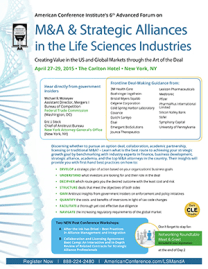
  • New York #2American Conference Institute (ACI) will be holding its 6th Advanced Forum on M&A and Strategic Alliances in the Life Sciences Industries from April 27-29, 2015 in New York, NY.  The conference will allow attendees to:

    • Develop a strategic plan of action based on your organizations' business goals;
    • Understand what investors are looking for and their role in the deal;
    • Decipher which route gets you the desired outcome with the least cost and risk;
    • Structure deals that meet the objectives of both sides;
    • Gain Antitrust insights from government insiders on enforcement and policy initiatives;
    • Quantify the costs and benefits of inversions in light of tax code changes;
    • Facilitate a thorough yet cost effective due diligence; and
    • Navigate the increasing regulatory requirements of the global market.

    Brochure_M&AIn particular, ACI's faculty will offer presentations on the following topics:

    • Developing a Strategic Plan of Action Based on What Fits with Your Organization's Business Growth Goals
    • Insights from the Investors Table: An Overview of the Current Climate of the Life Sciences Industries from Those Backing the Deals
    • Traditional M&A v. an Option Deal: Weighing Control and Risk, and Playing the Price Game
    • Collaborations and Partnerships in the Commercial Sector
    • Licensing: Whether for a Product or a Market, New Structures and Opportunities for Revitalizing Licensing Deals
    • Academic Institutions — A Roadmap for Partnering with Higher Education Institutions
    • Antitrust Pitfalls and the Priorities of Antitrust Enforcers
    • An Analysis of Recent M&A Trends and Lessons Learned from this Year's Biggest Deals
    • Expanding Your Horizons — Specific Concerns for Global Pursuits
    • Giving Diligence Its Due: Conducting a Thorough Yet Cost Effective Analysis
    • Inversions: Shifting Strategies in Global M&A in Response to Recent Tax Code Changes

    In addition, two post-conference workshops will be held on April 29, 2015.  The first, entitled "After the Ink has Dried ~ Best Practices in Alliance Management and Integration," will be offered from 9:00 am to 12:00 pm, and the second, entitled "Collaboration and Licensing Agreement Boot Camp: An Interactive and In-Depth Review of Related Contracts for Strategic Alliance Professionals," will be offered from 1:00 to 4:00 pm.

    An agenda for this conference can be found here (Day 1) and here (Day 2), and an agenda for the post-conference workshops can be found here.  A complete brochure for this conference, including an agenda, detailed descriptions of conference sessions, list of speakers, and registration form can be obtained here.

    ACI - American Conference InstituteThe registration fee for the conference is $2,195 (conference alone), $2,795 (conference and one workshop), or $3,295 (conference and both workshops).  Patent Docs readers who reference the discount code "PDMA1" will receive $100 off the current price tier when registering.  Those interested in registering for the conference can do so here, by e-mailing CustomerService@AmericanConference.com, by calling 1-888-224-2480, or by faxing a registration form to 1-877-927-1563.

    Patent Docs is a media partner of ACI's M&A and Strategic Alliances in the Life Sciences Industries conference.

  • By Andrew Williams

    GenzymeEarlier this week, the Patent Trial and Appeal Board ("PTAB" or "Board") handed down what is thought to be the first set of inter partes review ("IPR") Final Written Decisions ("FWDs") in the biopharmaceutical industry.  And unlike the case of the first set of Orange-Book related FWDs (see "PTAB Update — Hatch-Waxman-Watch Edition"), the Board determined that all challenged claims were unpatentable.  The drug that these patents covered is Myozyme, or alglucosidase alfa, which is an enzyme replacement therapy for treating Pompe disease (or glycogen storage disease type II).  This disease is caused by a deficiency of the lysosomal enzyme acid α-glucosidase ("GAA"), resulting in an accumulation of glycogen in tissues such as the heart and skeletal muscle.  Pompe disease is treated by administering to the patient a therapeutically effective amount of the protein.  Myozyme is a recombinant human version of this protein (rhGAA), and is produced in precursor form in Chinese hamster ovary (CHO) cell cultures.  The drug is marketed by Genzyme, the patent owner of two related patents involved in these IPR proceedings.  The third related to an unrelated patent, which is owned by Duke University.  BioMarin Pharmaceutical Inc. filed the three petitions in 2013.  The PTAB determined that the claims of the two Genzyme patents were obvious in view of various combinations of references, including a Duke Press Release announcing the FDA's approval of an application for Orphan Drug Designation, a PCT application disclosing the production of phosphorylated lysosomal proteins using transgenic mammals, and three other references reporting research related to GAA.  In addition, the PTAB determined that the claims of the Duke patent were either obvious in view of similar cited art, or were anticipated by the oldest Genzyme patent involved in these proceedings.  It is unclear if there are other patents that cover this product, but Genzyme has at least one continuing application pending at the Office.  In today's post, we will take a closer look at these first two IPR proceedings related to the Genzyme patents.

    IPR2013-00534 and IPR2013-00537

    The patents related to the first two IPR petitions related to methods of treating human patients afflicted with Pompe disease by intravenously administering a therapeutically effective amount of Human GAA in order to reduce and/or arrest further accumulation of glycogen.  The patents at issue were U.S. Patent Nos. 7,351,410 and 7,655,226.  The '410 patent only has one claim:

    1.  A method of treating a human patient with Pompe's disease, comprising intravenously administering biweekly to the patient a therapeutically effective amount of human acid alpha glucosidase, whereby the concentration of accumulated glycogen in the patient is reduced and/or further accumulation of glycogen is arrested.

    Claim 1 of the '226 patent is similar, except it does not contain the limitation for biweekly administration.

    The '410 patent was invalidated on two separate obviousness grounds.  The first was in view of the combination of Reuser (WO 97/05771), Barton (a New England Journal of Medicine article from 1991), and Van der Ploeg (a Pediatric Research journal article from 1988).  Reuser was described as teaching "the production of phosphorylated lysosomal proteins using transgenic nonhuman mammals for use in enzyme replacement therapy as treatment for lysosomal enzyme deficiencies."  This reference mentioned that a Pompe disease treatment in mice had been tested with a purified GAA, and that pharmaceutical compositions for intravenous administration were contemplated by the reference.  Barton was cited as teaching a clinical trial with Gaucher Disease (another lysosomal enzyme deficiency disease), wherein patients received enzyme replacement therapy on a biweekly intravenous administration schedule.  Finally, van der Ploeg allegedly described "an in vitro study using cultured skeletal muscle cells from a patient with Pompe disease."  The Patent Owner argued that "a person of ordinary skill in the art would not have had a reasonable expectation of success for a method of treating a human patient with Pompe disease using GAA administered biweekly . . . ."  Moreover, it argued that there would have been no motivation to combine because of the differences between Gaucher disease and Pompe disease.  Finally, the Patent Owner alleged that the objective indicia of non-obviousness supported the patentability of the claim.

    The Board did agree that as of the priority date, it could not have been predicted with "absolute certainty" that Pompe disease could be treated safely and effectively using GAA.  However, they also concluded that there was sufficient motivation to pursue the clinical development of treatment as disclosed in Reuser.  The only missing element was the biweekly dosing schedule.  But, because the experimentation needed to achieve this treatment regime was "nothing more than" routine, it required skills more akin to an artisan rather than an inventor.  Important in the Board's analysis was that the prior art did not merely teach a promising field of experimentation with numerous parameters to try, but instead provided sufficient motivation to select a suitable dose and dosing schedule.  And, because the enzyme replacement therapy would have needed to be administered for life, a repeated spaced administration of GAA would have been understood.

    With regard to the secondary considerations, the Board found a nexus lacking between the evidence related to long-felt but unmet need, skepticism, praise, and commercial success.  This was because the Board characterized the invention as limited to the biweekly administration feature.  Therefore, because the secondary considerations related to the merits of the therapeutic compositions of GAA, they were inapplicable to the present invention.  This seems to be an unfair characterization of the invention, however, because even if such compositions were known, they were not being used as a safe and effective treatment of Pompe disease (including the biweekly administration schedule).

    The other obviousness argument combined Barton and Van der Ploeg with a Duke Press Release announcing the approval of an Orphan Drug application for the GAA drug.  This release is described as providing "details [of] a proposed FDA clinical trial study in which infants with Pompe disease would be injected with recombinant GAA to evaluate the safety and efficacy of the recombinant enzyme treatment."  Genzyme had argued that the Press Release was silent as to the dosing regimen, and therefore the cited art did not contain all of the limitations of the claim.  However, the Board found the use of the term "injected" to teach "intravenous administration."  Also, the Press Release did not disclose the source of the enzyme, but the Board found this was cured by Van der Ploeg.  In other words, "the concept of using human GAA to treat Pompe disease was known in the art."  And, even if clinical trials were unpredictable, their design was essentially routine to those skilled in the art.

    The IPR related to the '226 patent was similar in nature.  In fact, it was essentially easier to establish the obviousness of the claims because they did not contain the limitation related to the dosing regimen.  Therefore, because this important impediment was removed, institution was only sought and granted on obviousness challenges incorporating the Duke Press Release.  And, not surprising in view of the other IPR FWD, all challenged claims were found to be unpatentable.

    In a future post, we will analyze the FWD related to the Duke patent.

  • By Donald Zuhn

    NVCALast month, the National Venture Capital Association (NVCA), a trade association representing the U.S. venture capital industry, released the results of its MoneyTree Report on venture funding for 2014.  The report, which is prepared by NVCA and PriceWaterhouseCoopers LLP using data from Thomson Reuters, indicates that venture capitalists invested $48.3 billion in 4,356 deals in 2014, which constituted a 61% increase in dollars and a 4% increase in deals over the prior year (see chart below, which shows total venture funding from 2005 to 2014; data from NVCA; click on chart to expand).

    Annual Funding
    Last year, the software sector reached its highest level of funding since 2000, with the sector capturing $19.6 billion in funding (a 77% increase in funding over 2013).  The software sector also accounted for 41% of total venture investment in 2014, which constituted the highest percentage since the first MoneyTree Report was issued in 1995.  Biotechnology funding in 2014 increased to $6.0 billion, which was a 4% increase over biotechnology funding in 2013, and which was good enough to place the biotechnology second among all sectors.  Life Sciences funding (which combines the biotechnology and medical device sectors) reached $8.6 billion in 204, which was the highest level of Life Sciences funding since 2008.  Life Sciences funding accounted for 18% of total venture capital investments in 2014.  Overall, fourteen of the seventeen sectors tracked by the NVCA saw increases in dollars invested in 2014.

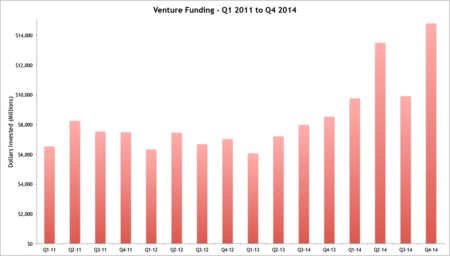
    The report also noted that in the fourth quarter of 2014, $14.8 billion was invested into 1,109 deals (see chart below, which shows venture funding by quarter from 2011 to 2014; data from NVCA; click on chart to expand).

    Funding By Quarter
    In the fourth quarter of 2014, the software sector remained the top sector, capturing nearly four times as much venture funding as the second sector (media and entertainment), with $5.8 billion going into 461 deals.  The software sector has now held the top spot in venture funding for 21 straight quarters.  Life Sciences funding in the fourth quarter of 2014 was up 62% over the third quarter to $2.8 billion.

    For additional information regarding this and other related topics, please see:

    • "Third Quarter Venture Funding Declines 27% from Second Quarter," October 22, 2014
    • "Software Sector Leads Pack in 2Q Venture Funding and Biotech Sector Finishes Second," July 20, 2014
    • "Software Sector Leads First Quarter Venture Funding to Thirteen Year High; Biotech Sector Finishes Second (Again)," April 30, 2014
    • "Biotech Venture Funding Rebounded in 2013 After Strong Fourth Quarter," January 26, 2014
    • "Biotech Venture Funding Sees Second Quarter Rebound," July 22, 2013
    • "Biotech Venture Funding Down 33% in First Quarter," April 30, 2013
    • "Annual Venture Funding Drops for First Time in Three Years," February 4, 2013
    • "Biotech Venture Funding Up 64% in Third Quarter," October 29, 2012
    • "Venture Funding in Life Sciences Sector Drops 9% in Second Quarter," July 22, 2012
    • "Biotech Venture Funding Drops 43% in First Quarter," May 3, 2012
    • "Venture Funding Increased 22% in 2011," February 2, 2012
    • "Life Sciences Venture Funding Drops in Third Quarter," October 27, 2011
    • "Life Sciences Venture Funding up 37% in Second Quarter," August 1, 2011
    • "VentureSource Reports 35% Increase in 1Q Venture Funding," April 26, 2011
    • "NVCA Reports Modest Gains in First Quarter Venture Funding," April 19, 2011

    • "NVCA Reports 31% Drop in Venture Funding for Third Quarter," October 17, 2010

    • "NVCA Reports 34% Increase in Venture Funding for Second Quarter," July 22, 2010

    • "NVCA Report Shows First Quarter Drop in Venture Funding," April 20, 2010

    • "Biotech/Pharma Financing Improving, R&D Spending Up," August 31, 2009
    • "NVCA Study Shows Increase in Third Quarter Venture Funding," October 23, 2009

    • "First Quarter Venture Capital Funding at 12-Year Low," April 23, 2009

    • "NVCA Study Shows Decline in 2008 Investment; BIO Study Predicts Biotech Rebound in 2009," February 16, 2009

  • By Kevin E. Noonan

    23andMeLast Thursday the genetic diagnostic and DNA analysis company 23andMe announced that the FDA had granted the company approval to market a genetic diagnostic test for Bloom's Syndrome, the first such approval for this rare genetic disease.  The news is tempered by the company's further announcement that it will not offer the test to consumers "until it completes the regulatory process for additional test reports and can offer a more comprehensive product offering."

    FDAReaders may recall that the FDA effectively stopped 23andMe from selling its genetic analysis kit, which the company marketed as Personal Genomic Services (PGS) in November 2013 by issuing a Warning Letter to the Company (see "FDA Threatens Agency Action Against 23andMe Over Personal Genetic Testing").  According to the FDA, genetic diagnostics assays fall under the agency's purview and authority because they are medical devices (21 U.S.C. § 321(h)).  According to the letter, the testing service offered "is intended for use in the diagnosis of disease or other conditions or in the cure, mitigation, treatment, or prevention of disease, or is intended to affect the structure or function of the body."  At that time, the agency professed a desire to work with the company to assist in developing the type and quantity of evidence required for approval, but warned that it had spent "significant time" evaluating the PGS test and providing feedback to 23andMe.  It appears that the company complied with the agency by submitting the evidence for approval of a much more limited test (i.e., limited to Bloom's Syndrome), compare to the tests offered previously (which included more that 250 "diseases and conditions" such as BRCA gene mutations, diabetes, coronary artery disease, an sensitivities to drugs such as warfarin, clopidigrel and 5-fluorouracil).

    The test is described as a "spit test kit and a chip array platform," and approval is limited at this time to detecting genetic markers for Bloom's syndrome.  Bloom's syndrome is a genetic disease inherited in an autosomal recessive manner, that predisposes individuals to certain cancers and is also associated with short stature, sensitivity to sunlight exposure and shortened lifespan.  The locus of the mutation is in the BLM gene on chromosome 15 (at 15q26.1) and encodes a DNA helicase.  Defects in this gene cause a dramatic (~ten-fold) increase in homologous recombination in cells from affected individuals, resulting in genomic instability.  Genetic testing is the only way to predict risk for passing the disease to offspring, as parents having only one copy of the gene show no symptoms.

    The FDA's decision to permit 23andMe to offer the test, while important to the company and to those individuals who may be at risk for passing on the Bloom's syndrome trait to their children, is also significant for the type of testing the FDA required and the evidence it mandated for approval.  For example, 23andMe in an announcement stated that it "conducted extensive comprehension studies with consumers from different backgrounds, education levels and incomes," as well as test accuracy and validity.

    The company's future in the genetic diagnostics space remains uncertain, however, in view of the following disclaimer on its website:

    Updated February 19, 2015b: 23andMe provides ancestry-related genetic reports and uninterpreted raw genetic data only.  We intend to add some health-related genetic reports in the future once we have a comprehensive product offering.  At this time, we do not know which health reports might be available or when they might be available.

    A disturbing note was struck by Alberto Guitierrez, Director of the Office of In Vitro Diagnostics and Radiologic Health in the agency's Center for Devices and Radiologic Health, who stated that "[t]he FDA believes that in many circumstances it is not necessary for consumers to go through a licensed practitioner to have direct access to their personal genetic information," and that the FDA intended to "exempt these devices from FDA premarket review."  How disturbing this sentiment may be will depend on how widespread access to genetic testing becomes and the extent to which providers such as 23andMe provide information to consumers receiving this information; indeed, the company's disclaimer suggests that FDA action has encouraged it not to provide any interpretation for the "raw genetic data" it supplies to consumers.  For all the criticism that has been leveled against Myriad (some of which may have been justified) the company acted responsibly by ensuring that its customers had access to genetic counselors who explained the significance of their test results and provided options for accommodating the consequences of any propensities their genetics disclosed.  Among all the negative press Myriad received there were two types of stories that did not appear: one, that the company had provided a misdiagnosis (of either type); and two, that someone had decided to end their life because they misinterpreted the results of their test or its implications on their health.  Minimizing the risk of the latter outcome will depend even more heavily on adequate counseling as more individuals have more tests for more genetic diseases, particularly as those diseases expand to include those that are less determinative than tests like the BRCA test or 23andMe's Bloom's Syndrome test and as there are more opportunities for behavioral modifications that could modulate patient outcomes.  Mr. Gutierrez is also reported to have said that authorization of 23andMe's test "supports innovation and will ultimately benefit consumers."  But that innovation will be costly if it is not accompanied by the appropriate amount of interpretation so individuals can make the best-informed choices for themselves.

  •         By Sherri Oslick

    Gavel About Court Report:  Each week we will report briefly on recently filed biotech and pharma cases.

    Novartis Vaccines and Diagnostics, Inc. et al. v. Pfizer, Inc.
    2:15-cv-01283; filed February 18, 2015 in the District Court of New Jersey

    • Plaintiffs:  Novartis Vaccines and Diagnostics, Inc.; Novartis Pharma AG
    • Defendant:  Pfizer, Inc.

    Infringement of U.S. Patent Nos. 7,576,176 ("Neisseria Meningitidis Antigens and Compositions," issued August 18, 2009), 8,524,251 (same title, issued September 3, 2013), 8,394,390 ("Neisserial Antigenic Peptides," issued March 12, 2013), 8,398,988 ("Adjuvanting Meningococcal Factor H Binding Protein," issued March 19, 2013), 8,840,907 ("Isolated Protein and Compositions Comprising the Protein," issued September 23, 2014), and 8,834,888 ("Adjuvanting Meningococcal Factor H Binding Protein," issued September 16, 2014) based on Pfizer's anticipated manufacture and sale of its recently approved Trumenba® product (a meningococcus B vaccine, bivalent rLP2086, used to vaccinate against meningitis).  View the complaint here.


    Novartis AG et al. v. Ezra Ventures LLC
    4:15-cv-00095; filed February 13, 2015 in the Eastern District of Arkansas

    • Plaintiffs:  Novartis AG; Novartis Pharmaceuticals Corp.; Mitsubishi Tanabe Pharma Corp.; Mitsui Sugar Co. LTD
    • Defendant:  Ezra Ventures LLC

    Infringement of U.S. Patent No. 5,604,229 ("2-Amino-1,3-Propanediol Compound and Immunosuppressant," issued February 18, 1997) following a Paragraph IV certification as part of Ezra's filing of an ANDA to manufacture a generic version of Novartis' Gilenya® (fingolimod hydrochloride, used to reduce the frequency of clinical exacerbations and to delay the accumulation of physical disability in patients with relapsing forms of multiple sclerosis).  View the complaint here.

    Forest Laboratories LLC et al. v. Alembic Pharmaceuticals Ltd. et al.
    1:15-cv-00158; filed February 13, 2015 in the District Court of Delaware

    • Plaintiffs:  Forest Laboratories LLC; Forest Laboratories Holdings Ltd.
    • Defendants:  Alembic Pharmaceuticals Ltd.; Alembic Global Holding SA; Alembic Pharmaceuticals Inc.

    Infringement of U.S. Patent No. 5,763,476 ("Sublingual or Buccal Pharmaceutical Composition," issued June 9, 1998) following a Paragraph IV certification as part of Alembic's filing of an ANDA to manufacture a generic version of Forest's Saphris® (asenapine maleate, sublingual, used to treat schizophrenia and manic or mixed episodes associated with bipolar I disorder).  View the complaint here.


    AbbVie Inc. et al. v. Mylan Pharmaceuticals Inc. et al.
    1:15-cv-01402; filed February 13, 2015 in the Northern District of Illinois

    • Plaintiffs:  AbbVie Inc.; AbbVie Deutschland GmbH & Co. KG
    • Defendants:  Mylan Pharmaceuticals Inc.; Mylan Laboratories Ltd.; Mylan Laboratories Inc.; Mylan Inc.

    Infringement of U.S. Patent Nos. 8,025,899 ("Solid Pharmaceutical Dosage Form," issued September 27, 2011), 8,268,349 (same title, issued September 18, 2012), 8,309,613 (same title, issued November 13, 2012), 8,377,952 ("Solid Pharmaceutical Dosage Formulation," issued February 19, 2013), 8,399,015 ("Solid Pharmaceutical Dosage Form," issued March 19, 2013), 8,470,347 ("Self-emulsifying Active Substance Formulation and Use of this Formulation," issued June 25, 2013), and 8,691,878 ("Solid Pharmaceutical Dosage Form," issued April 8, 2014) following a Paragraph IV certification as part of Mylan's filing of an ANDA to manufacture a generic version of AbbVie's Kaletra® (lopinavir and ritonavir, used to treat HIV infections).  View the complaint here.

    Helsinn Healthcare S.A. et al. v. Gavis Pharma LLC
    3:15-cv-01228; filed February 13, 2015 in the District Court of New Jersey

    • Plaintiffs:  Helsinn Healthcare S.A.; Roche Palo Alto LLC
    • Defendant:  Gavis Pharma LLC

    Infringement of U.S. Patent Nos. 7,947,724 ("Liquid Pharmaceutical Formulations of Palonosetron," issued May 24, 2011), 7,947,725 (same title, issued May 24, 2011), 7,960,424 (same title, issued June 14, 2011), 8,598,219 (same title, issued December 3, 2013), and 8,729,094 (same title, issued May 20, 2014) following a Paragraph IV certification as part of Gavis' filing of an ANDA to manufacture a generic version of Helsinn's Aloxi® (palonosetron hydrochloride intravenous solution, used to prevent chemotherapy induced nausea and vomiting).  View the complaint here.


    Novo Nordisk Inc. et al. v. Sun Pharmaceutical Industries Ltd. et al.
    3:15-cv-01287; filed February 12, 2015 in the District Court of New Jersey

    • Plaintiffs:  Novo Nordisk Inc.; Novo Nordisk Femcare AG
    • Defendants:  Sun Pharmaceutical Industries Ltd.; Sun Pharmaceutical Industries, Inc.

    Infringement of U.S. Patent No. 7,018,992 ("Hormone Composition," issued March 28, 2006) following a Paragraph IV certification as part of Sun's filing of an ANDA to manufacture a generic version of Novo Nordisk's Vagifem® (estradiol vaginal tablets, used to treat atrophic vaginitis due to menopause).  View the complaint here.

  • CalendarFebruary 25, 2015 – European biotech patent law update (D Young & Co) – 3:00 am, 6:00 am, and 11:00 am (ET)

    February 25, 2015 – "Prevailing Before the PTAB 'Death Squad': Practical Considerations for Petitioners and Patent Holders" (McDonnell Boehnen Hulbert & Berghoff LLP) – 10:00 am to 11:15 am (CT)

    February 26, 2015 – "Coordinating Post-Grant Patent Opposition in Europe and the U.S. — Navigating Timing, Grounds for Opposition, Discovery, and Amendments to Maximize Protection in Both Jurisdictions" (Strafford) – 1:00 to 2:30 pm (EST)

    February 27, 2015 – 59th Annual Intellectual Property Law Conference (The John Marshall Law School Center for Intellectual Property Law) – Chicago, IL

    March 3, 2015 – "Patent Eligibility Requirements in Life Sciences" (Maschio & Soames) – 2:00 pm CST (Chicago)

    March 4, 2015 – "Patent Eligibility Requirements in Life Sciences" (Maschio & Soames) – 12:00 noon AEDT (Melbourne) and 12:00 noon GMT (London)

    March 4-5, 2015 – Medical Device Patents*** (American Conference Institute) – Chicago, IL

    March 5, 2015 – "Drafting and Prosecuting Patent Applications to Withstand PTAB Scrutiny — Building Reasonable Claim Construction to Avoid Unpatentability and Using Declarations to Survive Post Grant Proceedings" (Strafford) – 1:00 to 2:30 pm (EST)

    March 5-6, 2015 – Advanced Patent Law Seminar (Chisum Patent Academy) – Cincinnati, OH

    March 10-11, 2015 – FDA Boot Camp*** (American Conference Institute) – New York, NY

    March 19, 2015 – "Abstract Ideas after Alice Corp. v. CLS Bank Int'l: The USPTO Issues Interim Guidance and Examples" (McDonnell Boehnen Hulbert & Berghoff LLP) – 10:00 am to 11:15 am (CT)

    March 25-26, 2015 – Post-Grant PTO Proceedings*** (American Conference Institute) – New York, NY

    March 30-31, 2015 – Post-Grant Patent Challenges at the PTAB*** (Momentum) – San Jose, CA

    ***Patent Docs is a media partner of this conference or CLE

  • MomentumMomentum will be holding its 2nd IP Counsel Exchange on Post-Grant Patent Challenges at the PTAB on March 30-31, 2015 in San Jose, CA.  The conference will offer presentations on the following topics:

    • Perspectives from the Chief Administrative Patent Judge — Hon. James D. Smith, Chief Administrative Judge Patent Trial and Appeal Board, U.S. Patent & Trademark Office
    • Interpreting What the Past 12 Months of CBM Challenges and IPR and PGR Proceedings Reveal About Party Successes and Failures Across Industries
    • Proven Strategies for Asserting or Defending A Patent Challenge at the PTAB — Tips for Avoiding Common Procedural Pitfalls and Effective Litigation Techniques for Obtaining Successful Results
    • Discovery, Evidence, Claim Construction and Addressing Key Evidentiary Issues That Arise During the Co-Pendency of Counterpart Patent Proceedings
    • Stays, Estoppel and the Management of Joint Proceedings — Perspectives from the Federal Bench on the Procedural Impact of PTAB Decisions on Pending and Parallel Federal District Court Litigation
    • Perspectives from the Director of the Silicon Valley Office of the USPTO
    • Behind the Scenes with the PTAB Bench
    • Exploring Circumstances for When Pursuing an IPR, PGR or CBM May Not Be the Right Litigation Option for Achieving Your Unique IP Litigation Goals and Business Objectives
    • What Other Industries Can Learn from How the Pharmaceutical Industry Is Strategically Utilizing and Responding to the Heightened Use of PTAB Proceedings
    • A Perspective on the Treatment of PTAB Proceedings By Way of Appeal
    • Legal Analytics for PTAB: Using Data-Driven Insights Into PTAB Trials and District Court Cases to Set IP Litigation Strategy

    In addition, two additional sessions will be offered during the conference.  The first session is entitled "A Guide to Successfully Navigating PGRs, IPRs and CBMs for Petitioners and Interested Parties: Insights for Selecting the Best Challenge for Your Unique IP Litigation Goals and Business Objectives," and the second is entitled "Master Class: A Practitioner's Guide to Most Effectively Utilizing Experts and Witnesses in PTAB Proceedings: Dissecting the Nuances of Witness Presentation and Posturing at the PTAB."

    The agenda for the Post-Grant Patent Challenges at the PTAB conference can be found here.  Those interested in registering for the conference can do so here.

    Patent Docs is a media partner of Post-Grant Patent Challenges at the PTAB conference.