• Munich, GermanyAmerican Conference Institute (ACI) will be holding a conference on U.S. Biosimilars on April 21, 2015 in Munich, Germany.  ACI faculty will offer presentations on the following topics:

    • Minimizing the Uncertainty Surrounding the Pathway: Insights Into USFDA’s Current Initiatives Regarding the First Wave of Biosimilars Applications
    • Evaluating the Risk and Commercial Opportunity in the Emerging U.S. Biosimilars Landscape
    • In-House Keynote Address
    • Timing is Everything: A Cheat Sheet for Managing the Logistics of the BPCIA Exchange Process
    • Biosimilars Litigation Spotlight: Immediate Action Plans for Innovators and Biosimilars to Prepare For the Battles to Come
    • Incorporating Inter-Partes Review and New USPTO Procedures Into Branded and Biosimilar Litigation Strategies
    • Open Floor Session: Lessons Learned so Far: Comparing and Contrasting the US and EU Biosimilars Experience

    A pre-conference boot camp, entitled "Biosimilars 101: Essential Training for EU Pharmaceutical Lawyers on the Relevant US Regulatory and Legal Landscape," will be held on April 20, 2015.  The boot camp will offer presentations on the following topics:

    • Diving Into the Science of Biologics and Biosimilars: What Counsel Needs to Know to Formulate a Regulatory and Patent Strategy
    • Understanding the Structure of the USFDA and Its Role in Approving and Regulating Biosimilars
    • Delving into the Mechanics of the USFDA Biosimilars Approval Process and Section 351(k) Applications Under the Pathway
    • Mastering the Essentials of New USPTO Post-Grant Proceedings For Effective Use in the Biosimilars Space — to be presented in part by Patent Docs author Kevin Noonan
    • Obtaining Adequate Patent Protection in the US: Factoring Key Cases into Your Biosimilars Patent Strategy
    • US Federal Trade Commission and State Law Updates: Understanding the Controversy Surrounding Competition, Substitution, and Naming in the Biosimilars Arena

    ACI - American Conference InstituteThe agenda for the U.S. Biosimilars conference can be found here, and additional information about the pre-conference boot camp can be found here.  A complete brochure for this conference, including an agenda, detailed descriptions of conference sessions, list of speakers, and registration form can be obtained here.

    The registration fee for the conference is €1195.  Those interested in registering for the conference can do so here.

  • IPO #2The Intellectual Property Owners Association (IPO) will offer a one-hour webinar entitled "IP5 Global Dossier: A New Era in Global Patent Prosecution?" on April 2, 2015 beginning at 2:00 pm (ET).  Don Levin of the U.S. Patent and Trademark Office, Samson Helfgott of Katten Muchin Rosenman LLP, and John Treangen of Dow Chemical will discuss the implications of the IP5 Dossier for corporations and law firms.  The IP Dossier is an international cooperative effort of the patent offices of the U.S., Europe, China, Japan, and Korea that allows the patent offices to share work. The panel will also discuss the Common Citation Document (CCD), which consolidates the prior art cited by all participating offices for the family members of a patent application.

    The registration fee for the webinar is $130 (government and academic rates are available upon request).  Those interested in registering for the webinar can do so here.

  • By Kevin E. Noonan

    The Federal Circuit has availed itself of another opportunity to demonstrate that the Supreme Court's recent decision in Teva v. Sandoz may be relevant in cases that are the exception rather than the rule.  The Federal Circuit's decision in Cadence Pharmaceuticals Inc. v. Exela Pharmsci Inc. affirmed the District Court's findings of literal infringement, infringement under the doctrine of equivalents, and failure of the defendant Exela Pharmsci to show the claims were invalid by clear and convincing evidence.

    Cadence PharmaceuticalsAt issue were two Cadence Pharmaceuticals patents: U.S. Patent No. 6,028,222 ("the '222 patent) and U.S. Patent No. 6,992,218 (the "'218 patent") which are directed to formulations of acetaminophen (also called paracetamol and exemplified by brands like Tylenol®).  As it turns out, formulated in aqueous solution acetaminophen can break down to produce toxic decomposition products.  The '222 patent claims formulations that inhibit this decomposition using a buffer and a free-radical capture agent:

    1.  A stable, liquid formulation consisting essentially of acetaminophen dispersed in an aqueous medium containing a buffering agent and at least one member of the group consisting of a free radical scavenger and a radical antagonist.  (emphasis added)

    The '218 patent claims a method for producing such formulations:

    1.  A method for preparing an aqueous solution with an active [principle of phenolic] nature susceptible to oxidation, which is paracetamol, while preserving for a prolonged period, comprising de-oxygenation of the solution by bubbling with at least one inert gas and/or placing under vacuum, until the oxygen content is below 2 ppm, and optionally the aforementioned aqueous solution with an active principle is topped with an inert gas atmosphere heavier than air and placed in a closed container in which the prevailing pressure is 65,000 Pa maximum, and the oxygen content of the aqueous solution is below 2 ppm, and optionally the deoxygenation of the solution is completed by addition of an antioxidant.

    Exela PharmSciCadence's product is provided as an injectable sold under the name Ofirmev® and Cadence has listed both the '222 and '218 patents in the Orange Book (also known as the FDA's Approved Drug Products with Therapeutic Equivalence Evaluations).  Litigation ensued under the Hatch-Waxman statutory scheme when Exela sent a Paragraph IV motion to Cadence asserting that the '222 and '218 patents are invalid and not infringed.  The District Court found neither patents invalid but found both were infringed by Exela's generic formulations.  These decisions were appealed to the Federal Circuit with regard to the infringement judgments (both literal and under the Doctrine of Equivalents) and the Court's invalidity determinations (except that Exela did not appeal the District Court's finding that the asserted claims of the '222 patent were not infringed.

    The Federal Circuit affirmed in an opinion by Judge Linn, joined by Judges Reyna and Wallach.  With regard to claim construction, the opinion noted that "the district court's claim constructions were based solely on the intrinsic record" and hence "the Supreme Court's recent decision in Teva does not require us to review the district court's claim construction any differently than under the de novo standard we have long applied," citing Fenner Invs., Ltd. v. Cellco P'ship, 2015 WL 570730 (Fed. Cir. Feb. 12, 2015).  Accordingly, the Court then turned to the issues on appeal regarding the '222 patent, which "turned" on claim construction according to the opinion.  The disputed term, "buffering agent," was construed by the District Court to mean "[a]n agent that helps the formulation resist change in pH."  The Court did not adopt Exela's proposed construction that the term should mean "in an effective concentration to resist material changes in pH" based on an absence in the specification of any basis for this construction.  Exela argued that the specification and prosecution history did in fact contain support for this construction, but the Federal Circuit was content to rely on the "plain and ordinary meaning" of the term because there was nothing (in its view) "in the intrinsic record [that] warrant[ed] adding requirements of effective concentration or resistance to material change."  With this construction the opinion found substantial evidence that "the sodium ascorbate present in Exela's formulation as an antioxidant met the buffering agent limitation, as correctly construed" and affirmed the judgment of literal infringement of the '222 patent claims.

    Regarding the '218 patent, the issue was whether reducing the oxygenation level of the acetaminophen formulation to below 2 ppm before admixture of the drug product was equivalent to reducing the dissolved oxygen levels to below 2 ppm after admixture.  Exela also argued that the "vacuum stoppering step" in the claimed method was not optional (and thus the absence of this step in Exela's process avoided application of the doctrine of equivalents).  The distinction between deoxygenating before (per Exela's method) or after (per the claimed method) precluded a finding of literal infringement.  However, the District Court found no difference in when the formulation was deoxygenated and thus applied the doctrine of equivalents to find infringement.  The Federal Circuit found no clear error in this determination, based on expert testimony from Cadence that the timing of the deoxygenation step "would have no impact on the stability of the final product."  This conclusion was supported by unchallenged testimony that the final formulation is stable regardless of when the deoxygenation step takes place.  The Federal Circuit opinion also agreed with the District Court that finding equivalence in deoxygenating before and after admixture of acetaminophen did not "vitiate" a claim limitation, distinguishing over Exela's citation of the Court's decision in Planet Bingo, LLC v. GameTech International, Inc., 472 F.3d 1338, 1345 (Fed. Cir. 2006).  In that case, according to the opinion, the outcome was "substantially different" and that vitiation is equivalent to a determination that "the evidence is such that no reasonable jury could conclude that an element of an accused device is equivalent to an element called for in the claim, or that the theory of equivalence to support the conclusion of infringement otherwise lacks legal sufficiency."  More generally, the Federal Circuit set forth its understanding (supported by copious citation) that "vitiation" "is not an exception or threshold determination that forecloses resort to the doctrine of equivalents, but is instead a legal conclusion of a lack of equivalence based on the evidence presented and the theory of equivalence asserted."  The Federal Circuit again agreed with the District Court that the phrase on its own terms indicated that the step was optional ("optionally topped with an inert gas . . . and placed in a closed container in which the prevailing pressure is 65,000 Pa maximum").  In addition to the plain meaning, the opinion found support in the specification for the optional nature of this step and rejected Exela's argument that Cadence had disclaimed the optionality of this step during prosecution, saying that the evidence of disavowal was not "clear and unmistakable."

    With regard to the '222 patent (and keeping in mind that the District Court decision and briefing before the Federal Circuit occurred before the Supreme Court's Teva decision), it seems likely that Exela would have benefited from independent testing and expert testimony regarding the function of the buffering agent in the formulations disclosed in the '222 patent.  In view of the Teva decision it seems equally apparent that accused infringers will avail themselves of this opportunity in future infringement actions.  Similarly, with regard to the '218 patent there is no mention in the opinion that the appellate record contained affirmative evidence of a difference in the formulation when deoxygenation was performed before rather than after admixture of acetaminophen in the formulation and thus no basis for either the District Court or the Federal Circuit to rule in Exela's favor.

    Finally, the Federal Circuit affirmed the District Court's determination that Exela had not established by clear and convincing evidence that the '218 patent was invalid for obviousness over the '222 patent.  This part of the opinion also highlights the importance of the underlying facts supporting an obviousness determination in view of the standards of review (clear error for factual matters and de novo review for the ultimate legal conclusion of obviousness).  Exela was also under a heightened burden, according to the Federal Circuit, because the arguments and the art put forward by Exela had been considered by the Examiner during prosecution.  Thus, the combination of the statutory presumption of validity, and the additional presumption that "the Patent Office is 'presumed to have properly done its job' when it ultimately allowed the '218 patent" (citing PowerOasis, Inc. v. T-Mobile USA, Inc., 522 F.3d 1299, 1304 (Fed. Cir. 2008), quoting Am. Hoist & Derrick Co. v. Sowa & Sons, Inc., 725 F.2d 1350, 1360 (Fed. Cir. 1984) made finding of clear error the only avenue by which Exela could prevail.  The evidence was that the teachings of the cited prior art related to degradation by oxidation rather than hydrolysis, as with acetaminophen and Exela did not proffer sufficient evidence to the contrary to amount to clear error in the district court's conclusion.

    While not particularly unconventional, this decision highlights a tendency for legal questions (obviousness, claim construction, enablement) to be much more a matter to the underlying facts than had been the case heretofore.  As a consequence, Federal Circuit review of these questions may be less frequently de novo and district courts may be entitled to greater deference based on their factual determinations.  Which, of course, merely enhances the value of patent practitioners who can adduce the necessary evidence at trial now that it has become evident that they will need to do so.

    Cadence Pharmaceuticals Inc. v. Exela Pharmsci Inc. (Fed. Cir. 2015)
    Panel:  Circuit Judges Reyna, Linn, and Wallach
    Opinion by Circuit Judge Linn

  • By Donald Zuhn

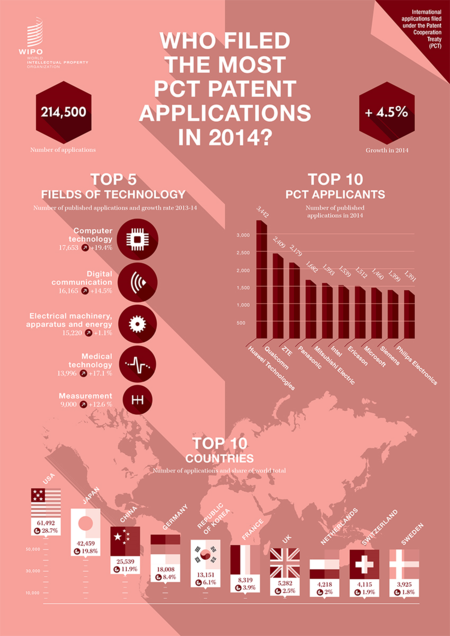
    WIPOLast week, the World Intellectual Property Organization (WIPO) released data on 2014 international application filings under the Patent Cooperation Treaty (PCT).  WIPO noted that U.S. and Japanese filings accounted for almost half (48.5%) of all PCT filings last year, with total filings coming in at just under 215,000, a 4.5% increase over the previous year.  The rest of the top 10 consisted of China, Germany, South Korea, France, the United Kingdom, the Netherlands, Switzerland, and Sweden.  Among the top three countries, filings in which the U.S. was primary country of origin were up 7.1% over the prior year, Japanese filings were down 3%, and Chinese filings were up 18.7%.  A complete list of filings by country of origin can be found here.

    WIPO also released a list of top PCT applicants, which not surprisingly was dominated by hi-tech companies.  While few life sciences companies cracked the WIPO top 50, five companies or institutions that made our most recent list of top "Life Sciences" U.S. patentees (see "IPO Releases List of Top 300 Patent Holders for 2013 — Life Sciences Top 49") — BASF, Procter & Gamble, Dow, Commissariat a L'Energie Atomique et Aux Energies Alternatives, and the University of California — made it onto the WIPO list.  The list of the top 50 PCT applicants can be found here.

    The University of California led all educational institutions with regard to PCT filings.  WIPO noted that nine of the top ten educational institutions were U.S. universities.  WIPO's list of top 50 educational institutions can be found here.

    WIPO also provided a list of PCT filings by field of technology, with the list divided into five categories:  electrical engineering, instruments, chemistry, mechanical engineering, and other fields.  Computer technology accounted for the largest share of PCT applications in 2014, with 8.4% (17,653 applications, up 19.4% since 2013).  Digital communications (7.7%) and electronic machinery (7.3%) rounded out the rest of the top three technology fields.  In the chemistry category, PCT filings were up 2.8% to 5,874 for biotechnology and up 4.1% to 8,568 for pharmaceuticals in 2014.  However, WIPO noted that relative to the total number of PCT filings, the share of pharmaceutical filings has steadily declined since 2007.  Among the top pharmaceutical filers in 2014 Merck Sharp & Dohme Corp. (171 applications), Novartis AG (141), F. Hoffmann-La Roche AG (135), and the University of California (111).  WIPO also noted that while universities and public research organizations are responsible for 26% of pharmaceutical PCT filings, these entities are only responsible for 4.6% of computer technology filings and 2.8% of digital communication filings.  A complete list of PCT filings by technology field can be found here.

    WIPO also released the following infographic, while summarizes some of the data for PCT application filings in 2014.

    Infographics_pct_2014

  • By Kevin E. Noonan

    ACLUThe ACLU championed its efforts in the AMP v. Myriad case as being another instance of the group fighting for the rights of the many and the powerless against corporate America and the oligarchical few.  In a paradox, it now seems that the fruits of their efforts are to have empowered just those whom it has traditionally opposed, and that the question of whether personalized medicine will become widely available is in the hands of insurance companies and large diagnostic testing providers (who traditionally have not needed to rely on patent protection in view of their economic clout).

    To better appreciate the irony it is useful to compare the history of the most successful personalized medicine effort to date, Myriad's BRCA gene tests for breast and ovarian cancer, with an alternative history premised on the Supreme Court's Myriad decision being rendered 10-15 years earlier that it was.  Absent the prohibitions produced by the Myriad decision, Myriad had its patent exclusivity to rely upon in building its BRCA gene testing business.  This began in 1997, three years before the announcement of the results of the Human Genome Project.  At that time, genetic testing was in its infancy, and at best BRCA gene testing was considered "experimental":  Myriad did not have anything other than genealogical data showing an association of genetic variants in the descendants of women who had dies of breast cancer, and had identified a few dozen specific variants.  The reliability of the testing could also be reasonably brought into question because Myriad detected several "variants of unknown significance" (VUS), where the genetic sequence identified in a particular patient was different from the "typical" genetic sequence, but there was insufficient genealogical information.  In addition, women having the BRCA gene mutation who suffer from breast or ovarian cancer are a small subset of the totality of breast or ovarian cancer sufferers, with frequencies in line with other diseases having a heritable genetic propensity.

    MyriadInto this situation came Myriad, who armed with its patent exclusivity was able to obtain investors who permitted it to grow the business of testing women for the genetic mutations that indicated a high likelihood of developing cancer.  (It should also be appreciated that the increased risk of breast or ovarian cancer for women bearing a BRCA gene mutation is much higher than is the case for other cancers, making this an anomaly for genetic diagnostic tests.)  The investment was not only in laboratories, lab technicians and supplies; Myriad had to enlist a nationwide network of genetic counselors to provide women with the information they would need should their test indicate a propensity (~90%) for developing breast or ovarian cancer, as well as educating ob/gyn doctors about the test.  While the latter can be discounted as marketing, Myriad also had to take on public and private insurers to have them pay for the test, and this needed to be done on a state-by-state basis.  Indeed, acceptance of Myriad's BRCA test as being significantly reliable as to deserve coverage varied from state to state over the past 18 years since Myriad's BRCA gene patents were obtained.

    None of this was (solely) altruism, of course; Myriad was running a business.  But whether society benefited from Myriad's efforts can best be considered by comparison to that alternative history, where Myriad did not have exclusivity over BRCA gene tests.

    This history can be predicated on an earlier enunciation of the Supreme Court's decision, or more easily by presuming that Mary Claire King or other researchers cloned the BRCA genes before Myriad and, as they have stated did not protect the genes or diagnostic methods by patenting.  Under this scenario the gene sequences would have been freely available to anyone, particularly university and academic medical centers, such as New York University (where Dr. Harry Ostrer, one of the named plaintiffs in the Myriad case, was practicing) or the University of Pennsylvania (where other plaintiffs, Drs. Kazakian and Ganguly were working), as well as commercial entities.  However, without patent exclusivity, the only commercial concerns capable of providing the service would have been unlikely to entertain the possibility, due in part to the high hurdles and costs associated with garnering acceptance from payors at that time.  (Myriad didn't have a choice because BRCA testing for breast and ovarian cancer was a core business.)

    Under these circumstances the role of providing genetic testing would likely have fallen to academic sources.  This raises a few problems regarding the goal of making such testing broadly available and affordable.  The first is geographic:  while residents of cities and other locations that are the sites of major medical centers would likely have had access to BRCA gene testing it is less likely that less geographically accessible areas would have had such access.  Women residing in and around Boston, or New Haven, or New York, or Philadelphia, or Washington, or Atlanta, or Dallas, or Houston, or San Diego, or Los Angeles, or San Francisco, or Portland, or Seattle, or Denver, or Rochester (MN), or Madison (WI), or Chicago, or Detroit, or Cleveland, or Buffalo, or Cincinnati, or Pittsburgh or St. Louis would have access.  But women in Appalachia, or the Four Corners region of the Southwest, or rural Idaho, or Montana, or Arkansas or the Dakotas, would need the kind of outreach Myriad provided — is it reasonable to expect any of the hospitals in metropolitan areas far from these more remote (and typically impoverished) regions of the country?

    Perhaps more fundamentally, is genetic diagnostic testing as performed by Myriad the best use of academic medical facilities?  Academic medicine, like most academic pursuits is involved in discovering causes of disease and developing new treatments.  It is also not well adapted to the type of rote performance of thousands or millions of tests under circumstances where no errors are tolerated.  It is hard to contemplate university or medical center counsel being comfortable with academic or even clinical labs performing such tests; inevitably, any such testing would come in conflict (for resources, personnel, lab space) with the traditional purpose of such labs and testing, being ancillary to providing optimal patient care.  And this is as it should be:  patients look to these hospitals and the physicians populating them as being primarily concerned with helping them get well (while acknowledging the reality that finances and in some cases profit enter into the equation).

    But if the goal is the widest proliferation of diagnostic genetic testing then the question is, what is the best way to accomplish it.  The idea that academic research and medicine will be able to do so is a fantasy for at least the reasons set forth above; more importantly, such researchers are best utilized in identifying the genetic causes of disease.  Thus, the question comes down to whether small, academic-based start-up biotech and diagnostic companies or larger, more corporate diagnostic testing labs will monopolize the space.  As the Myriad example illustrates, start-ups must have reliable patent protection in order to establish the protocols, networks, and reimbursement infrastructure needed to sustain such a business, while the larger diagnostic companies do not.  The economic advantages these larger companies have will typically be enough for them to out-compete a startup, even one with better understanding of the science and technology.  This is true upon inspection:  for the startup one or a few genetic tests may be the only product they have to sell, while larger, more established diagnostic testing labs have a much larger product list (and much longer history with diagnostic customers) to sustain them while they adapt to a disruptive new technology like genomic testing.

    Even with this economic clout success is not certain, because part of the impetus for startup companies such as Myriad to aggressively advocate for payors to reimburse patients for the testing stem from the reality that this is usually the only way such companies will survive.  Larger companies have far less motivation for new technology (think Xerox/IBM vs. Microsoft/Apple) even if there is perceived profit in it.  One example of this situation is reflected in a paper in Genetics in Medicine from the American College of Medical Genetics and Genomics published February 25, 2015.  In this paper, the College provides a policy statement, arguing that payors should be willing to reimburse genetic testing costs even when the effects of these tests on clinical outcome in unclear:

    Clinical utility for genetic tests was discussed in 1998 by the US Task Force on Genetic Testing.  The Task Force specifically stated that "the development of tests to predict future disease often precedes the development of interventions to prevent, ameliorate, or cure that disease in those born with genotypes that increase the risk of disease.  Even during this therapeutic gap, benefits might accrue from testing.  "http://www.genome.gov/10001733.  In the broadest sense, "clinical utility" refers to the likelihood that a given intervention (in this case, genetic information) will lead to an improved health outcome (http://www.phgfoundation.org/tutorials/clinicalUtility/) or to whether a test can provide information about diagnosis, treatment, management, or prevention of a disease that will be helpful to a consumer.  http://ghr.nlm.nih.gov/handbook/testing/validtest.  Establishing an etiological diagnosis is generally asserted to no longer be sufficient to claim clinical utility.  Further, evidence that physicians change their management of a patient based on an etiological diagnosis is said to lack clinical utility unless clinical outcomes research has demonstrated that such changes in an individual's treatment will result in benefit.  http://www.palmettogba.com/palmetto/moldx.nsf/MolDX_Manual.pdf.  Moreover, coverage decision-making policy is now driven by a narrowed perspective that clinical benefit accrues only to the individual receiving the services.  [emphasis added]

    The College disagrees with this "narrow view" that only tests directly related to improved clinical outcomes should be recompensed.  The article expresses the view that such testing should be considered for its "effects on diagnostic or therapeutic management, implications for prognosis, health and psychological benefits to patients and their relatives, and economic impact on health-care systems."  Examples include those familiar to anyone who has taken Myriad's BRCA test:  not only the benefit of an individual knowing her genetic status, but how that knowledge impacts the likelihood that her relatives will also have the test and know their risk (something for which Myriad charged much less than the widely reported $3,000-4,000 for the BRCA gene test).  "Current models" of these benefits "define utility as either (i) clinical benefit specific to the individual receiving the service or (ii) "personal" benefit because it applies to other family members or because the result may suggest interventions that are less well definedGrosse & Khoury, 2006, "What is the clinical utility of genetic testing?," Genet Med 8:448–450; Robson et al., 2010, American Society of Clinical Oncology policy statement update: genetic and genomic testing for cancer susceptibility. J Clin Oncol 28:893–901.  This paradigm "frames the utility of genetic and genomic information too narrowly and fails to acknowledge that information regarding significant genetic risks can enable highly actionable — indeed, life-saving — interventions for individuals and their family members," according to the College.  Further:

    As genetic and genomic information increasingly enables disease prevention and reproductive planning, a narrow focus on medical benefit only to the individual originally tested and diagnosed is apparent as a construct of an obsolete system in which care is provided only to those with overt disease and that clinical benefit can be achieved only when a therapeutic option (i.e., a drug) is available.

    Contrary to the predictions of the ACLU and many on its side of the debate, the Myriad decision has not led to an idyllic world of genetic diagnostics (an outcome aided by the Court's other decision negatively affecting the competitive position of startup companies, Mayo v. Prometheus).  It will be instructive to see how BRCA gene testing progresses in the aftermath of Myriad "giving up the ghost" on its efforts to maintain a modicum of exclusivity with the Federal Circuit's invalidation of many of Myriad's remaining genetic testing claims.  Many companies, including some large diagnostic testing labs, have entered these waters, but it is too soon to know how reimbursement, costs and accessibility are affected.

    There is one way that a small company can maintain its exclusivity which forms Myriad's only remaining competitive advantage.  Taking advantage of being the "first mover" in this space, Myriad has accumulated a large database of undisclosed "variants of unknown significance" (VUS) in the BRCA genes, the significance of which is not unknown to Myriad.  Thus, even now an ob/gyn is faced with the quandary of advising a patient to have the "Brand X" test (which may be cheaper although how much cheaper is an unanswered question) or the Myriad test.  If the patient has a widely known BRCA gene mutation all is well (for the physician), because she now knows how to advise her patient.  If, on the other hand, the patient's genetic report contains one or several VUS's then the only responsible course would be to have the patient's sample retested (or at least reevaluated).  Any benefits accruing from having the test available from parties other than Myriad thus evaporates.

    Of course the larger companies have the same capacity and perhaps even moreso, which leads to the possibility that such companies will simply avail themselves of this model and keep all diagnostic testing information to themselves.  In either case, the final result of the ACLU's overheated efforts will be that large corporate entities will "own" your DNA, and there will be nothing anyone can do about it.  Which is something of a paradox, if not amounting to an irony.

  • By Kevin E. Noonan

    Supreme Court Building #2There has always been a tension between the need for a final arbiter of the law and the inherent power associated with such a role placed in the judicial branch.  Jefferson himself was wary of this tendency, writing in a letter to Edward Livingston in 1825:

    One single object . . . will entitle you to the endless gratitude of society; that of restraining judges from usurping legislation.

    And Abraham Lincoln also perceived the dangers, in his first inaugural address:

    The candid citizen must confess that if the policy of the government, upon vital questions, affecting the whole people, is to be irrevocably fixed by decisions of the Supreme Court, the instant they are made, in ordinary litigation between parties, in personal actions, the people will have ceased to be their own rulers, having, to that extent, practically resigned their government into the hands of that eminent tribunal.

    Patrick Henry, noted for his fiery rhetoric was more direct:

    Power is the great evil with which we are contending.  We have divided power between three branches of government and erected checks and balances to prevent abuse of power.  However, where is the check on the power of the judiciary?  If we fail to check the power of the judiciary, I predict that we will eventually live under judicial tyranny.

    While these sentiments have been raised generally regarding great social questions (racial integration, same-sex marriage, universal healthcare), the turning of the judicial worm in recent years regarding patent law has occasioned similar considerations in this sphere.  From KSR, eBay, Medimmune, Bilski, Mayo, Myriad, Alice, and even Actavis, the Supreme Court has signaled the judiciary that in some ways it has endorsed "open season" on the patent system.  That the judiciary has gotten this message can be ascertained by district court decisions such as Ariosa v. Sequenom, where the court crafted entirely new theories of patent ineligibility based on combinations of seemingly unrelated Supreme Court law (and in many ways, dicta).

    Such outcomes are perhaps not unexpected in view of the failure of clarity that many of the Court's subject matter eligibility decisions have had, and both the U.S. Patent and Trademark Office and the courts are recognized as being in the middle of interpreting and incorporating the less than pellucid directives of the High Court on these questions.  That this tendency has spread beyond patent eligibility, and indeed beyond the strict bounds of patent law itself, can be appreciated by considering the legal grounds enunciated by the California District Court in Amgen v. Sandoz in its opinion last Thursday denying Amgen a preliminary injunction to keep a biosimilar version of Neupogen® off the market while patent litigation is proceeding (see "Gotta Dance? Apparently Not — A Biosimilar Update")

    The basis for this decision was grounded in the District Court's interpretation of the following provisions of the BPCIA, the portion of the omnibus healthcare law enacted in 2010 and commonly referred to as "Obamacare" that provided a biosimilar approval pathway in the U.S.:

    (2) SUBSECTION (k) APPLICATION INFORMATION.—Not later than 20 days after the Secretary notifies the subsection (k) [biosimilar] applicant that the application has been accepted for review, the subsection (k) applicant—
        (A) shall provide to the reference product sponsor a copy of the application submitted to the Secretary under subsection (k), and such other information that describes the process or processes used to manufacture the biological product that is the subject of such application; and
        (B) may provide to the reference product sponsor additional information requested by or on behalf of the reference product sponsor. [emphasis added]

    This section of the law is governed by the following definitions:

    (1) CONFIDENTIAL ACCESS TO SUBSECTION (k) APPLICA­TION.—
        (A) APPLICATION OF PARAGRAPH.—Unless otherwise agreed to by a person that submits an application under subsection (k) (referred to in this subsection as the 'sub­ section (k) applicant') and the sponsor of the application for the reference product (referred to in this subsection as the 'reference product sponsor'), the provisions of this paragraph shall apply to the exchange of information described in this subsection.
        (B) IN GENERAL.—
            (i) PROVISION OF CONFIDENTIAL INFORMATION.—
            When a subsection (k) applicant submits an application under subsection (k), such applicant shall provide to the persons described in clause (ii), subject to the terms of this paragraph, confidential access to the informa­tion required to be produced pursuant to paragraph (2) and any other information that the subsection (k) applicant determines, in its sole discretion, to be appro­priate (referred to in this subsection as the 'confidential information'). [emphasis added]

    where the remainder of this section provides limits on how the information can be used and the requirements for confidentiality imposed on the recipients of the information.

    The law also contains provisions in the event that the biosimilar (section 351(k) applicant) does not comply with these rules:

    (9) LIMITATION ON DECLARATORY JUDGMENT ACTION.—
        (A) SUBSECTION (k) APPLICATION PROVIDED.—If a subsection (k) applicant provides the application and informa­tion required under paragraph (2)(A), neither the reference product sponsor nor the subsection (k) applicant may, prior to the date notice is received under paragraph (8)(A), bring any action under section 2201 of title 28, United States Code, for a declaration of infringement, validity, or enforce­ ability of any patent that is described in clauses (i) and (ii) of paragraph (8)(B).
        (B) SUBSEQUENT FAILURE TO ACT BY SUBSECTION (k) APPLICANT.—If a subsection (k) applicant fails to complete an action required of the subsection (k) applicant under paragraph (3)(B)(ii), paragraph (5), paragraph (6)(C)(i), paragraph (7), or paragraph (8)(A), the reference product sponsor, but not the subsection (k) applicant, may bring an action under section 2201 of title 28, United States Code, for a declaration of infringement, validity, or enforce­ ability of any patent included in the list described in para­ graph (3)(A), including as provided under paragraph (7).
        (C) SUBSECTION (k) APPLICATION NOT PROVIDED.—If a subsection (k) applicant fails to provide the application and information required under paragraph (2)(A), the ref­erence product sponsor, but not the subsection (k) applicant, may bring an action under section 2201 of title 28, United States Code, for a declaration of infringement, validity, or enforceability of any patent that claims the biological product or a use of the biological product.

    (Notably, these provisions are reciprocal and affect the rights of both the reference product sponsor and the biosimilar applicant.)  Also, the BPCIA provides the opportunity for the reference product sponsor to seek a preliminary injunction upon notice of commercial marketing:

    (8) NOTICE OF COMMERCIAL MARKETING AND PRELIMINARY INJUNCTION.—
        (A) NOTICE OF COMMERCIAL MARKETING.—The sub­section (k) applicant shall provide notice to the reference product sponsor not later than 180 days before the date of the first commercial marketing of the biological product licensed under subsection (k).
        (B) PRELIMINARY INJUNCTION.—After receiving the notice under subparagraph (A) and before such date of the first commercial marketing of such biological product, the reference product sponsor may seek a preliminary injunction prohibiting the subsection (k) applicant from engaging in the commercial manufacture or sale of such biological product until the court decides the issue of patent validity, enforcement, and infringement with respect to any patent that is—
            (i) included in the list provided by the reference product sponsor under paragraph (3)(A) or in the list provided by the subsection (k) applicant under para­ graph (3)(B); and
            (ii) not included, as applicable, on—
                (I) the list of patents described in paragraph (4); or
                (II) the lists of patents described in paragraph(5)(B). [emphasis added]

    It is clear from these provisions that Congress intended this protocol, colloquially termed the "patent dance," to be mandatory and not optional, evidenced inter alia by the fact that where options were intended to exist the statute recites them.  The rationale for these steps in the dance are evident:  without knowledge of the nature of the biosimilar and the methods for manufacturing it contained in the biosimilar application, the reference product sponsor has no way of knowing which patent to assert, and (as evidenced by the outcome here) is put in the position of facing generic competition without any avenue to prevent it.

    Nevertheless, the District Court held that Congress had not intended "shall" to have its ordinary meaning, either in the English language ("must; is or are obliged to") or as used in statutes:

    Use of "shall" and "may" in statutes also mirrors common usage; ordinarily "shall" is mandatory and "may" is permissive.38  These words39 must be read in their broader statutory context, however, the issue often being whether the statutory directive itself is mandatory or permissive.40  Use of both words in the same provision can underscore their different meanings,41 and often the context will confirm that the ordinary meaning of one or the other was intended.42  Occasionally, however, context will trump ordinary meaning.43

    _______________________________________________________

    38 "The mandatory 'shall' . . . normally creates an obligation impervious to judicial discretion." Lexecon, Inc. v. Milberg Weiss Bershad Hynes & Lerach, 523 U.S. 26, 35 (1998). "The use of a permissive verb — 'may review' instead of 'shall review' — suggests a discretionary rather than mandatory review process." Rastelli v. Warden, Metro. Correctional Center, 782 F.2d 17, 23 (2d Cir. 1986).

    39 "Should" sometimes is substituted for "may" as a permissive word. Union Elec. Co. v. Consolidation Coal Co., 188 F.3d 998, 1001 (8th Cir. 1999). "Will" and "must" can be additional mandatory words. Bankers Ins. Co. v. Florida Res. Prop. & Cas. Jt. Underwriting Ass'n, 137 F.3d 1293, 1298 (11th Cir. 1998).

    40 See IA SUTHERLAND, STATUTES AND STATUTORY CONSTRUCTION § 25:4 (Norman J. Singer ed., 6th ed. 2002 rev.).

    41 See, e.g., Lopez v. Davis, 531 U.S. 230, 241 (2001) ("Congress' use of the permissive 'may' . . . contrasts with the legislators' use of a mandatory 'shall' in the very same section"); and United States ex rel. Siegel v. Thoman, 156 U.S. 353, 359-60 (1895) ("in the law to be construed here it is evident that the word 'may' is used in special contradistinction to the word 'shall'").

    42 See, e.g., Escoe v. Zerbst, 295 U.S. 490, 493 (1935) ("doubt . . . is dispelled when we pass from the words alone to a view of [the statute's] ends and aims").

    43 See, e.g., Moore v. Illinois Cent R.R., 312 U.S. 630, 635 (1941) (substitution of "may" for "shall" "was not, we think, an indication of a change in policy, but was instead a clarification of the [Railway Labor Act's] original purpose [of establishing] a system for peaceful adjustment and mediation voluntary in its nature"). See also discussion in Gutierrez de Martinez v. Lamagno, 515 U.S. 417, 432 n.9 (1995) ("shall" sometimes means "may").

    44 The Dictionary Act provides that "unless the context indicates otherwise," "words importing the singular include and apply to several persons, parties, or things; words importing the plural include the singular." 1 U.S.C. § 1.

    45 Public Citizen, Inc. v. Mineta, 340 F.3d 39, 54 (2d Cir. 2003).

    Statutory Interpretation: General Principles and Recent Trends, Congressional Research Service Report for Congress, August 31, 2008.  The District Court decision flies directly in the face of this precedent, wherein Congress not only used the mandatory "shall" but in the same section used the permissive "may," evincing precisely the type of distinction cited in the Report.

    That the District Court was looking to find this outcome can be gleaned by its concerns of the times provided in the statute for the patent dance (~230 days) and the marketing notice (180 days).  No one cognizant of the realities of patent litigation (as we can assume a Federal District Court judge must be) can believe that either of these time frames are excessive; indeed, the overwhelming commentary on the patent dance is how rapidly these exchanges and notifications must occur.  Even the Hatch-Waxman Act provides a 30-month (~900 day) stay in FDA approval to permit the patentee and the generic challenger to engage in litigation, and modern patent litigation has not become less complex or proceeds more quickly in the 30 intervening years from enactment of the Hatch-Waxman Act in 1984.  It should also be appreciated that the quickness with which Sandoz obtained approval (less than 10 months from filing in August, 2014 to approval in March, 2015) is a function of the extensive experience Sandoz has in Europe with a biosimilar form of Neupogen®, which has been approved by the EMEA and on the market in Europe for several years, and with the FDA's decision to permit Sandoz to rely in the U.S. on some of the pharmacological and clinical evidence adduced by Sandoz in obtaining European approval.  But this situation (while likely to arise in other biosimilar applications having similar histories) will not be the norm in future, when the reference product sponsor will have the benefit of the 12 year market exclusivity period to litigate patent protection upon biosimilar application filings 4 years after the reference product has been approved.

    Moreover, current patent reform legislation (while generally exempting ANDA litigation under the Hatch-Waxman Act) will require more specific factual assertions and allegations to comply with pleadings requirements in patent cases, and ignorance of the contents of the biosimilar application and manufacturing methods will make it harder for the reference product sponsor to comply.  And judicial economy and expeditious resolution of these disputes will not be fostered by forcing the reference product sponsor, as Amgen has been forced to do, to guess which patent to assert and then seek leave to amend its complaint upon getting the information in discovery that the statute mandates in the first place.

    This baroque interpretation of these provisions of the BPCIA stands in stark contrast to the District Court's denial of Amgen's motion that 42 U.S.C. § 262(l)(9)(C) precludes Sandoz of asserting counterclaims of invalidity, non-infringement or unenforceabilty.  Here, the Court correctly noted that this portion of the law would preclude a biosimilar applicant, like Sandoz, who did not comply with the disclosure provisions from bringing a declaratory judgment action, but does not preclude assertion of these counterclaims.  Should it do so, the consequences of non-disclosure would strip the biosimilar applicant of any procedural avenue to challenge the reference product sponsor's asserted patents, a consequence not supported by the plain language of the statute.

    The Supreme Court has changed its view of its role in deciding patent cases in the almost thirty-five years since deciding Diamond v. Chakrabarty, where the Chief Justice Burger wrote:

    Our task, rather, is the narrow one of determining what Congress meant by the words it used in the statute; once that is done our powers are exhausted. Congress is free to amend §101 so as to exclude from patent protection organisms produced by genetic engineering.  Compare 42 U.S.C. §2181, exempting from patent protection inventions "useful solely in the utilization of special nuclear material or atomic energy in an atomic weapon."  Or it may choose to craft a statute specifically designed for such living things.  But, until Congress takes such action, this Court must construe the language of §101 as it is.

    To the sentiments voiced by Justice Breyer in Mayo v. Prometheus:

    [W]e must recognize the role of Congress in crafting more finely tailored rules where necessary.  Cf. 35 U.S.C. §§161–164 (special rules for plant patents).  We need not determine here whether, from a policy perspective, increased protection for discoveries of diagnostic laws of nature is desirable.

    Following these views, the District Court clearly felt empowered to require plaintiffs to petition Congress to "clarify" what it meant by "shall" in the statutory language.  Perhaps this situation is caused by the apparent disdain the Supreme Court has for patent law, or the Federal Circuit's recent lack of advocacy for the patent system, or the chaos created in Congress due to IT industry advocating that patents inhibit innovation (when what they actually do is protect patentees from predation by large corporations).  The BPCIA was enacted to contain a carefully crafted "patent dance" whose very complexity may have encouraged the creative arguments by Sandoz that prevailed in the district court.  The California District Court has permitted Sandoz to avoid the dance (for now; Sandoz faces a "launch at risk" situation should the Federal Circuit reverse).  But it is apparent that district courts have been empowered to use their own judgment on the relative societal benefits (e.g., cheaper biologic drugs) to craft creative interpretations of legislation, particularly when the question is framed as a preliminary injunction where the effect on the public is a legitimate consideration.  But as a consequence the "will of the People" (insofar as it is embodied in the actions of the legislature) is subjugated to the whims of the judiciary, as the Founding Fathers feared.  It is hard to see how this is a positive development.

  •         By Sherri Oslick

    Gavel About Court Report:  Each week we will report briefly on recently filed biotech and pharma cases.

    Bristol-Myers Squibb Co. v. Mylan Pharmaceuticals, Inc.
    1:15-cv-00049; filed March 19, 2015 in the Northern District of West Virginia

    Bristol-Myers Squibb Co. v. Mylan Pharmaceuticals, Inc.
    3:15-cv-01949; filed March 17, 2015 in the District Court of New Jersey

    The complaints in these cases are substantially identical.  Infringement of U.S. Patent No. 6,087,383 ("Bisulfate Salt of HIV Protease Inhibitor," issued July 11, 2000), licensed to BMS, following a Paragraph IV certification as part of Mylan's filing of an ANDA to manufacture a generic version of BMS' Reyataz® (atazanavir bisulfate, used to treat HIV infection).  View the New Jersey complaint here.


    Otsuka Pharmaceutical Co., Ltd. v. Indoco Remedies Ltd. et al.
    1:15-cv-01967; filed March 17, 2015 in the District Court of New Jersey

    • Plaintiff:  Otsuka Pharmaceutical Co., Ltd.
    • Defendants:  Indoco Remedies Ltd.; Hetero Labs Ltd.

    Infringement of U.S. Patent Nos. 8,017,615 ("Low Hygroscopic Aripiprazole Drug Substance and Process for the Preparation Thereof," issued September 13, 2011), 8,580,796 (same title, issued November 12, 2013), 8,642,760 (same title, issued February 4, 2014), and 8,759,350 ("Carbostyril Derivatives and Serotonin Reuptake Inhibitors for Treatment of Mood Disorders," issued June 24, 2014) following a Paragraph IV certification as part of Indoco's filing of an ANDA to manufacture a generic version of Otsuka's Abilify® (aripiprazole, used to treat bipolar disorder and schizophrenia).  View the complaint here.


    Galderma Laboratories LP v. Actavis Laboratories UT Inc.
    1:15-cv-00232; filed March 12, 2015 in the District Court of Delaware

    Infringement of U.S. Patent Nos. 7,439,241 ("Compounds, Formulations, and Methods for Treating or Preventing Rosacea," issued October 21, 2008), 8,410,102 ("Methods and Compositions for Treating or Preventing Erythema," issued April 2, 2013), 8,426,410 ("Compounds, Formulations, and Methods for Treating or Preventing Inflammatory Skin Disorders," issued April 23, 2013), 8,859,551 (same title, issued October 14, 2014), 8,513,247 ("Methods and Compositions for Safe and Effective Treatment of Erythema," issued August 20, 2013), and 8,513,249 (same title, issued August 20, 2013) following a Paragraph IV certification as part of Actavis' filing of an ANDA to manufacture a generic version of Galderma's Mirvaso® (brimonidine topical gel, used for the topical treatment of persistent facial erythema of rosacea in adults).  View the complaint here.

    Sanofi-Aventis U.S. LLC et al. v. Apotex Corp. et al.
    3:15-cv-01835; filed March 11, 2015 in the District Court of New Jersey

    • Plaintiffs:  Sanofi-Aventis U.S. LLC; Aventis Pharma S.A.; Sanofi
    • Defendants:  Apotex Corp.; Apotex Inc.

    Sanofi-Aventis U.S. LLC et al. v. Breckenridge Pharmaceutical, Inc.
    3:15-cv-01836; filed March 11, 2015 in the District Court of New Jersey

    • Plaintiffs:  Sanofi-Aventis U.S. LLC; Aventis Pharma S.A.; Sanofi
    • Defendant:  Breckenridge Pharmaceutical, Inc.

    The complaints in these cases are substantially identical.  Infringement of U.S. Patent No. 8,927,592 ("Antitumoral Use Of Cabazitaxel," issued January 6, 2015) following a Paragraph IV certification as part of defendants' filing of an ANDA to manufacture a generic version of Sanofi's Jevtana® (cabazitaxel injection, used in combination with prednisone for the treatment of patients with hormonerefractory metastatic prostate cancer previously treated with a docetaxel-containing treatment regimen).  View the Apotex complaint here.

  • CalendarMarch 24, 2015 – "Leveraging Inter Partes Review Petition Denials — Lessons From PTAB Full or Partial Denials to Avoid Institution of an IPR or Avoid a Denial" (Strafford) – 1:00 to 2:30 pm (EDT)

    March 25-26, 2015 – Post-Grant PTO Proceedings*** (American Conference Institute) – New York, NY

    March 25, 2015 – "Commercial Success at the PTAB" (Intellectual Property Owners Association) – 2:00 to 3:00 pm (ET)

    March 30-31, 2015 – Post-Grant Patent Challenges at the PTAB*** (Momentum) – San Jose, CA

    March 31, 2015 – "Overcoming Sect. 101 Rejections Post-Alice Corp. — Leveraging USPTO Guidance and Recent Decisions to Meet Sect. 101 Patent Eligibility Requirements" (Strafford) – 1:00 to 2:30 pm (EDT)

    March 31, 2015 – "Trade Secret or Patent Protection? Making the Right Choice for Your University’s Innovations" (Technology Transfer Tactics) – 1:00 to 2:00 pm (Eastern)

    April 1, 2015 – "PCT Filing and International Patent Prosecution" (American Intellectual Property Law Association)

    April 7, 2015 – Biotechnology/chemical/pharmaceutical (BCP) customer partnership meeting (U.S. Patent and Trademark Office) – 11:00 am to 5:00 pm (EDT)

    April 9, 2015 – "Conducting and Analyzing Patent Searches — Strategies for Validity, Patentability, Infringement, FTO and State-of-the-Art Searches" (Strafford) – 1:00 to 2:30 pm (EDT)

    April 15-17, 2015 – 2015 Spring Intellectual Property Counsels Committee (IPCC) Conference (Biotechnology Industry Organization) – St. Louis, MO

    April 16, 2015 – "Patent Subject Matter Eligibility: Navigating the New USPTO Guidance — Analyzing Subject Matter and Avoiding Rejection Under the USPTO's Detailed Framework" (Strafford) – 1:00 to 2:30 pm (EDT)

    April 27-29, 2015 – M&A and Strategic Alliances in the Life Sciences Industries*** (American Conference Institute) – New York, NY

    ***Patent Docs is a media partner of this conference or CLE

  • USPTO Building FacadeThe U.S. Patent and Trademark Office will be holding its next biotechnology/chemical/pharmaceutical (BCP) customer partnership meeting on Tuesday, April 7, 2015.  The meeting will be simultaneously available at the USPTO Headquarters (Alexandria, VA) and the Rocky Mountain Regional Office (Denver Satellite Office).  During the BCP meeting, participants will be able to interact with Office personnel in person at both locations, or alternatively, via webcast.

    The agenda for the meeting is as follows:

    • Welcoming and Opening Remarks (11:00 – 11:20 am EDT) — Jerry Lorengo, Director, TC1600, USPTO (Alexandria); Daniel Sullivan, Director, TC1600, USPTO (Denver); Wanda Walker, Director, TC1600, USPTO (Alexandria); Michael Carone, Regional Manager, USPTO (Denver)

    • Patent Quality Initiatives (11:20 am – 12:30 pm EDT) — Valencia Martin Wallace, Deputy Commissioner for Patent Quality, USPTO (Alexandria); Esther Kepplinger, Chief Patent Counselor, Wilson Sonsini Goodrich & Rosati (Alexandria); Robert Stoll, Partner, Drinker Biddle
    (Alexandria)

    • Break (12:30 – 1:00 pm EDT)

    • Recent Updates in Patent Term Adjustment and Patent Term Extension (1:00 – 1:50 pm EDT) — Mary Till Senior Advisor, OPLA, USPTO (Alexandria), Kery Fries Senior Advisor, OPLA, USPTO (Alexandria)

    • Filing Sequence Listings in International and National Stage Applications (1:50 – 2:50 pm EDT) — Susan Wolski International Patent Legal Administration, USPTO (Alexandria)

    • Break (2:50 – 3:20 pm EDT)

    • Interim Guidance on Patent Subject Matter Eligibility (3:20 – 4:50 pm EDT) — Raul Tamayo, Senior Legal Advisor, OPLA, USPTO (Denver); June Cohan, Legal Advisor, OPLA, USPTO (Alexandria)

    • Closing Remarks/Discussion (4:50 – 5:00 pm EDT) — Michael Carone, Regional Manager, USPTO (Denver); Jerry Lorengo, Director, TC1600, USPTO (Alexandria); Daniel Sullivan, Director, TC1600, USPTO (Denver); Wanda Walker, Director, TC1600, USPTO (Alexandria)

    Additional information regarding the BCP customer partnership meeting can be found here.

  • IPO #2The Intellectual Property Owners Association (IPO) will offer a one-hour webinar entitled "Commercial Success at the PTAB" on March 25, 2015 beginning at 2:00 pm (ET).  Pradeep Chintagunta, The University of Chicago Booth School of Business; Michael Flibbert of Finnegan, Henderson, Farabow, Garrett & Dunner, LLP; and John Jarosz, Analysis Group will focus on how patent owners can make the best case for commercial success at the PTAB, taking into account evidentiary and time restraints. The PTAB has been strict about requiring a nexus between commercial success and the patented technology. The panel will discuss how to make a case for that nexus, and consider how a petitioner can poke holes in the arguments of the patent owner that its commercial success shows non-obviousness.

    The registration fee for the webinar is $130 (government and academic rates are available upon request).  Those interested in registering for the webinar can do so here.