• CincyBioCincyIP will be holding its annual CincyBIO conference on April 21, 2015 at the Horseshoe Casino in Cincinnati, OH.  The conference will consist of the following sessions:

    • Draft and Prosecute Biotech Patent Applications That Can Withstand IPR and PGR Challenges
    • The Patentability of Natural Products: A European Perspective
    • Protecting Natural Products in the Wake of Evolving Eligibility Standards
    • Strategies for Patenting at the Intersection of Biotech, Informatics & Healthcare IT
    • The Future of Biotechnology Innovation, and How it can be Protected and Monetized

    Additional information about the conference, including an agenda and list of speakers can be found here.

    There registration fee for the conference is $125 (CincyIP member), $150 (non-member with CLE), $100 (non-member without CLE), or $25 (students).  Those interested in registering can do so here.

  • New York #2American Conference Institute (ACI) will be holding its 9th Annual Paragraph IV Disputes conference on April 27-28, 2015 in New York, NY.  ACI faculty will provide insights into:

    Teva v. Sandoz and the Impact of a New Claim Construction Standard of Review
    • Personal and General Jurisdiction Challenges Under Daimler and Mylan
    Myriad 101 Rejections and Nautilus 112 Indefiniteness Findings
    Barraclude and New Obviousness Considerations
    • IPR, CBM, and PGR Utilization in ANDA Litigation
    • Reissue Applications as a Cure for Invalidity Findings
    Akamai's Effect on Method of Treatment Claims and Carve-Outs
    • Settlement Strategies Post-Actavis
    • At-Risk Launches and Damages

    CoverThe conference will offer presentations on the following topics:

    • The Role of Legal Analytics in the Paragraph IV Disputes Landscape: Playing Moneyball for Successful ANDA Litigation Strategy
    • Questions of Personal and General Jurisdiction in A Paragraph IV Case: Exploring Daimler's Applicability in a Hatch Waxman Scenario
    • Exploring Possible New Grounds Paragraph IV Invalidity Challenges: How 101 Rejections Under Myriad and Findings of 112 Indefiniteness Under Nautilus May Alter Paragraph IV Litigation
    • Defeating the Undefeatable: New Obvious Considerations for Paragraph IV Compound Patent Challenges in Light of Baraclude
    • PTO Proceedings Retrospect: Exploring the Growing Use of IPR, PGR and CBM Review in Hatch-Waxman Litigation
    • Exploring the Utilization of Reissue Applications to Cure Invalidity Findings at the PTAB and District Courts
    • The Patent Trial and Appeals Board Live: A Conversation with Administrative Patent Judges on PTAB Practices and Protocols for Hatch-Waxman Practitioners
    • A View From the Bench: The Federal Judges Speak
    Teva v. Sandoz — Claim Construction Redoux: De Novo vs. Deferentia
    Limelight v. Akamai: Assessing Its Impact on Method of Treatment Patents and Section viii Label Carve Outs
    • FTC Keynote: Reverse Payment Settlements and Other Antitrust Concerns Impacting Paragraph IV Litigation in the Wake of Actavis
    • Developing Practical Strategies for Settling A Paragraph IV Case Post-Actavis: A Litigator's Perspective
    • FDA Update: Survey of Agency Activity Impacting Paragraph IV Litigation
    • Assessing the True Measure of Damages in At Risk Launch Scenario
    • The Ethics of Paragraph IV Practice: New Developments Impacting Professional Responsibility in the Hatch-Waxman Arena

    In addition, a pre-conference workshop, entitled "Anatomy of a PTO PTAB Patent Trial in the Hatch-Waxman Arena" will be offered from 8:30 am to 12:30 pm on April 29, 2015.

    The agenda for the Paragraph IV Disputes conference can be found here.  A complete brochure for this conference, including an agenda, detailed descriptions of conference sessions, list of speakers, and registration form can be obtained here.

    ACI - American Conference InstituteThe registration fee for the conference is $2,295 (conference alone) or $2,895 (conference and workshop).  Those interested in registering for the conference can do so here, by e-mailing CustomerService@AmericanConference.com, by calling 1-888-224-2480, or by faxing a registration form to 1-877-927-1563.

    Patent Docs is a media partner of the Paragraph IV Disputes conference.

  • ABAThe American Bar Association (ABA) Section of Intellectual Property Law and Young Lawyers Division will be offering a live webinar entitled "Interim Guidance on Patent Subject Matter Eligibility" on April 30, 2015 from 1:00 to 2:30 pm (ET).  Leslie McDonell (moderator) of Finnegan, Henderson, Farabow, Garrett & Dunner, Dr. Amelia Feulner Baur of McNeill Baur PLLC; Ali Salimi, Legal Advisor, Office of Patent Legal Administration, U.S. Patent and Trademark Office will:

    • Explore the impact of the new guidance on patent examination;
    • Examine the quality of issued patent claims; and
    • Provide practitioners with "best practices" insights on how to avoid potential pitfalls associated with subject matter eligibility.

    The registration fee for the webcast is $150 for members and $195 for the general public.  Those interested in registering for the webinar, can do so here.

  • Strafford #1Strafford will be offering a webinar/teleconference entitled "Patent Prosecution: Leveraging Declarations to Strengthen Patents Against Post-Grant Proceedings" on May 12, 2015 from 1:00 to 2:30 pm (EDT).  Thomas L. Irving, Deborah M. Herzfeld, and Jonathan R.K. Stroud of Finnegan Henderson Farabow Garrett & Dunner will provide guidance to patent counsel for preparing and submitting declarations during prosecution of U.S. patent applications to support the desired claim interpretation, non-obviousness and § 112 positions.  The webinar will review the following questions:

    • How can practitioners prepare and submit declarations during prosecution to strengthen the application against the threat and/or efficacy of a third-party’s post-grant challenges?
    • What can patent owners do to try and obtain the desired claim construction in both litigation and post-grant proceedings?
    • How can practitioners introduce strong grounds for patentability under §§ 102, 103 and 112 in the specification and prosecution history so that IPRs and PGRs are either denied or otherwise ineffective against the challenged instituted claims?

    The registration fee for the webinar is $297 ($362 for registration and CLE processing).  Those registering by April 17, 2015 will receive a $50 discount.  Those interested in registering for the webinar, can do so here.

  • JPPCLE_31The Connecticut, New Jersey, New York, and Philadelphia Intellectual Property Law Associations will be holding their 31st Annual Joint Patent Practice Seminar on May 12, 2015 in New York, NY.  The seminar will consist of five panels:  USPTO Practice, Pharmaceuticals/Life Sciences, High Tech, Litigation, and Supreme Court with each panel addressing a series of cases and topics.  An agenda for each of the panels can be found here.

    A featured morning address will be given between 8:54 and 9:25 am by Drew Hirshfeld, Deputy Commissioner for Patent Examination Policy, U.S. Patent and Trademark Office.  In addition, the Hon. Jimmie V. Reyna, Circuit Judge, U.S. Court of Appeals for the Federal Circuit will provide a keynote address entitled "Looking Ahead: New Developments and Challenges for the CAFC."

    The registration fee for the conference is $450 (for those registering by April 30, 2015).  Those interested in registering for the conference can do so here.

  • By Donald Zuhn

    CoverLast month, the Biotechnology Industry Organization (BIO) announced the release of a BIO commissioned study that estimates the economic impact of academic licensing between 1996 and 2013.  The study, entitled "The Economic Contribution of University/Nonprofit Inventions in the United States: 1996-2013," was prepared by Lori Pressman, David Roessner, Jennifer Bond, Sumiye Okubo, and Mark Planting.  The group used an "I-O" approach to estimate the economic impact of academic licensing, wherein "input" and "output," rather than "cost" and "revenue," were examined (the study notes that the use of input and output is apt because the same economic transaction is "output" to one party, the seller, and "input" to the other, the buyer).  A detailed discussion of the I/O approach and the group's assumptions begins on page 6 of the study.

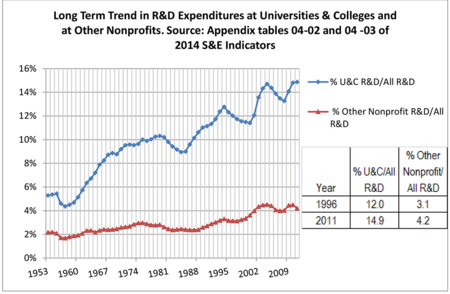
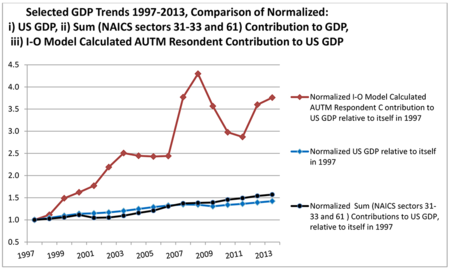
    The study indicates that over the 18-year period examined, the total contribution of academic licensors (i.e., academic U.S. AUTM survey respondents) to gross industry output ranges from $282 billion to $1.18 trillion, in 2009 $U.S. Dollars, and the contributions to GDP range from $130 billion to $518 billion, in 2009 $U.S. Dollars.  The study also indicates that over this same period, licensed product sales from U.S. universities, hospitals, and research institutes supported between 1,130,000 million and 3,824,000 million "person years" of employment supported.  The study notes that a long-term trend (see Figure 1 of the study below) is that universities and other nonprofits are performing a larger share of total U.S. R&D.  The study also notes that U.S. R&D performed by universities and colleges from 1953 through 2011 grew from 5.3% to 14.9% of total U.S. R&D, while the fraction of R&D performed by other nonprofits grew from 2.2% to 4.2% (the contribution of academic licensing to U.S. GDP between 1996 and 2013 is shown in Figure 3 of the study; see below).

    Long Term Trend

    GDP Trends
    Among the survey respondents were between 26 and 30 U.S. hospitals and research institutes (HRI's) and between 131 and 164 universities (depending on the year that data was collected).  The survey notes that HRI's were included in the survey because hospitals and research institutes often have close ties to universities and share personnel and evidence suggests that the character of the work performed in research institutes may be similar to that done at universities and colleges.  The study concludes by noting that "[i]t will be interesting to watch these trends as academic licensing continues to mature, patent life is effectively shortened in a now almost 20 year post GATT world, patent laws continue to evolve, and data and databases, both public and private, play an increasing role in society and the economy."

    In its announcement of the study, BIO pointed out that the study illustrates that "academic-industry partnerships are a critically important part of our economy," adding that "[a]cademic inventions play a critical role in the creation of spin-off companies that drive state, regional, and national economic growth."

  • By Kevin E. Noonan

    Exela PharmSciLate last month, the Federal Circuit handed Exela Pharma Sciences its latest defeat in litigation relating to its ANDA filing on Cadence Pharmaceuticals' injectable acetaminophen-based drug Ofirmev®, in Exela Pharma Sciences LLC v. Lee.  This litigation was collateral to Exela's ANDA case against Cadence, and involved an attack on one of the underlying Orange Book listed patent, on the grounds that the Patent and Trademark Office had exceeded its statutory authority in granting the patent because it was not timely filed.

    The patent at issue in this litigation was U.S. Patent No. 6,992,218 (the "'218 patent"), which claimed a method for producing acetaminophen (paracetamol) formulations that inhibit its decomposition to toxic by-products in aqueous solutions using a buffer and a free-radical capture agent:

    1.  A method for preparing an aqueous solution with an active [principle of phenolic] nature susceptible to oxidation, which is paracetamol, while preserving for a prolonged period, comprising de-oxygenation of the solution by bubbling with at least one inert gas and/or placing under vacuum, until the oxygen content is below 2 ppm, and optionally the aforementioned aqueous solution with an active principle is topped with an inert gas atmosphere heavier than air and placed in a closed container in which the prevailing pressure is 65,000 Pa maximum, and the oxygen content of the aqueous solution is below 2 ppm, and optionally the deoxygenation of the solution is completed by addition of an antioxidant.

    Earlier, the Federal Circuit had affirmed a district court's findings against Exela of literal infringement, infringement under the doctrine of equivalents, and failure to show the claims were invalid by clear and convincing evidence, in Cadence Pharmaceuticals Inc. v. Exela Pharmsci Inc.  Here, the question was whether the PTO had acted illegally by permitting patentee SCR Pharmatop (Cadence Pharmaceutical's licensor) to "revive" a U.S. national phase application that granted as the '218 patent that had gone abandoned for failure to be filed within 30 months of its earliest filing date.  Pursuant to the provisions of 35 U.S.C. § 351 et seq., applications filed under the provisions of the Patent Cooperation Treaty (PCT) are required to enter the U.S. national phase no later than 30 months after the earliest claimed priority date, by payment of a fee and filing a paper indicating the intention to file a U.S. national phase application.  It was undisputed that SCR filed its U.S. national phase application one day late, and that it had petitioned the PTO to revive the abandoned application because the delay was "unintentional."  It was also undisputed that the statutory language at the relevant time read as follows:

    The requirements with respect to the national fee . . ., the translation . . ., and the oath or declaration . . . shall be complied with by the date of the later time as may be fixed by the Director. . . Failure to comply with these requirements shall be regarded as abandonment of the application by the parties thereof, unless it be shown to the satisfaction of the Director that such failure to comply was unavoidable. . . . [emphasis added]

    35 U.S.C. § 371(d).  The Office in its implementing regulations distinguishes unintentional from unavoidable delay:

    Revival of abandoned application, terminated reexamination proceeding, or lapsed patent.
        
    (a) Unavoidable.  If the delay in reply by applicant or patent owner was unavoidable, a petition may be filed pursuant to this paragraph to revive an abandoned application, a reexamination proceeding . . . , or a lapsed patent.  A grantable petition pursuant to this paragraph must be accompanied by: . . .
        (b) Unintentional.  If the delay in reply by applicant or patent owner was unintentional, a petition may be filed pursuant to this paragraph to revive an abandoned application, a reexamination proceeding . . . , or a lapsed patent.  A grantable petition pursuant to this paragraph must be accompanied by: . . .

    37 C.F.R. § 1.137 (2000).  Exela's argument on its face was simple:  the statute required a showing (to the Director's satisfaction) that abandonment (through failure to comply by the deadline) was unavoidable, not just unintentional.  Because SCR did not make such a showing (and the PTO did not require it), reviving the U.S. national phase application that resulted in the '218 patent was contrary to statute and outside the PTO's authority.  Thus, Elexa argued, the patent was void ab initio (and they could not be precluded from having their ANDA granted and entering the marketplace based on this patent).

    The PTO denied Exela's petition, and the company then sued in district court under the provisions of the Administrative Procedures Act.  The District Court at first denied the Office's motion to dismiss under Fed. R. Civ. Pro. 12(b)(1) (lack of standing) and 12(b)(6) (failure to state a cause of action) but later granted the Office's motion based on an intervening decision by the 4th Circuit.  This decision, Hire Order, Ltd. v. Marianos, 698 F.3d 136, 170 (4th Cir. 2012), held that "facial" challenges to agency action (i.e., inter alia that they are on their face outside the scope of the agency's statutory authority) must be brought within a six-year statute of limitations period under 28 U.S.C. § 2401(a), which period starts on the adoption date of the regulation.  Because the Office had adopted its version of the regulation, 37 C.F.R. § 1.137 in 1982 the Court held that Elexa was barred from bringing its challenge now.

    The Federal Circuit affirmed in a per curiam decision by Judges Newman and Dyk; former Chief Judge Rader had been on the panel at oral argument but has since left the bench.  The per curiam opinion focused its discussion of the issues on the availability to a third party of judicial review on a granted patent.  Exela stressed the provisions of the APA codified at 5 U.S.C. § 702 for the proposition that any "person suffering legal wrong because of agency action, or adversely affected or aggrieved by agency action" should have recourse to the courts for review.  In addition to the statute, Exela cited Supreme Court case law to the effect that there is a "strong presumption that Congress intends judicial review of administrative action," citing Bowen v. Michigan Academy of Family Physicians, 476 U.S. 667, 670 (1986), and later, Block v. Community Nutrition Institute" 467 U.S. 340, 350–51 (1984) ("'where substantial doubt about the congressional intent exists, the general presumption favoring judicial review of administrative action is controlling.'").  Exela's best argument was that the plain language of the statute, combined with the distinctions between unavoidable and unintentional abandonment in the PTO's own regulations, was sufficient evidence that the Office had acted outside its proper scope (ultra vires) and that without judicial review SCR (and Cadence) would be able to enforce the invalid '218 patent.

    The Office's argument was less substantive but more procedurally straightforward:  simply, "that there is no authority for third parties to collaterally challenge the correctness of PTO revival rulings" and thus Exela's challenge must fail even if the District Court was wrong in holding that its petition was time barred.

    The panel agreed, saying that they saw no evidence that Congress intended to permit third parties to challenge agency action like the one Elexa brought in this case.  The opinion applied Federal Circuit law, citing Helfgott & Karas, P.C. v. Dickinson, 209 F.3d 1328, 1334 (Fed. Cir. 2000), and distinguished the precedent cited by Elexa, Morganroth v. Quigg, 885 F.2d 843 (Fed. Cir. 1989).  In that case the issue was whether a patent applicant could invoke judicial review of agency action regarding revival of an abandoned application (that answer is yes), which was clearly contemplated by the APA, and was thus not controlling with regard to the question before the Court of whether a third party could invoke the APA to seek judicial review on such a question.  This conclusion was amply supported, according to the opinion, by "[t]he Patent Act's 'intricate scheme for administrative and judicial review of PTO patentability determinations,' and 'the Patent Act's careful framework for judicial review at the behest of particular persons through particular procedures.'"  Pregis Corp. v. Kappos, 700 F.3d 1348, 1357 (Fed. Cir. 2012).

    This portion of the opinion was unsurprising.  Both remaining judges penned concurring opinions and in these the tale becomes more interesting.  Judge Dyk's opinion is, perhaps predictably, the less traditional one and in fact calls into question the Federal Circuit's opinion in Aristocrat Technologies Australia Pty Ltd. v. International Game Technology, 543 F.3d 657 (Fed. Cir. 2008) (curiously, a case not cited or relied upon in the per curiam opinion).  In that case, the Federal Circuit ruled that "a defendant in an infringement action could not assert improper revival of an abandoned patent application as a defense in that action."  While stating that "[w]e need not decide here whether Aristocrat was correctly decided," and that "the Patent Act is inconsistent with third party APA review" (thus affirming the per curiam opinion regarding the question at hand), Judge Dyk took the time to "write separately to explain why [he thinks the Court's] decision in Aristocrat was problematic."

    Most of his reasoning is set forth in counterpoint to the grounds upon which the Aristocrat panel relied, which included that attacking revival of an abandoned patent application is not "literally" among the grounds for finding a patent invalid under 35 U.S.C. § 282. Judge Dyk set forth four "aspects" of the decision that in his view "warrant reconsideration":

    • The Aristocrat panel did not consider whether there is a presumption of judicial review of agency action, citing Sackett v. Envtl. Prot. Agency, 132 S. Ct. 1367, 1373 (2012); Bowen, 476 U.S. at 670; Block v. Cmty. Nutrition Inst., 467 U.S. 340, 348–49 (1984); see also 5 U.S.C. § 702 (conferring a general cause of action upon persons "adversely affected or aggrieved by agency action within the meaning of a relevant statute") to support his (not expressly stated) view that there is such a presumption.  Judge Dyk apparently considers this presumption to have become stronger in light of the per curiam decision in this case, because without APA or any alternative mechanism the only remaining way for a third party to base a challenge on improper revival would be as an invalidity defense in an infringement action.

    • Judge Dyk also does not see this question as being "a minor procedural error in the PTO process."  He cites the language of the statute for the suggestion that Congress intended there to be the consequence of abandonment for noncompliance with the statutory timeframe, and that Congress permitted the Office by statute to excuse noncompliance only under the specific circumstance when failure to timely file was unavoidable.  35 U.S.C. § 371(d)

    • The Judge also sees unfairness in the current state of the law, where a patent applicant can seek judicial review of an abandonment determination under Morganroth v. Quigg while an accused infringer cannot.

    • Finally, Judge Dyk believes that the Aristocrat panel erred in limiting its consideration of "nonstatutory" invalidity defenses have been used with approval by courts, citing obviousness-type double patenting, patent misuse, and the "shop rights" doctrine as "well-established defense[s] not specified in the statute."

    After reciting this litany Judge Dyk noted for the record that "[i]n the future, en banc action to reconsider Aristocrat may be appropriate."

    Again not surprisingly, Judge Newman disagreed in her concurrence, expressly addressing the "concerns" raised in Judge Dyk's concurring opinion.  In her view, Aristocrat was properly decided, inter alia, because:

    If any prosecution irregularity or procedural lapse, however minor, became grist for a later assertion of invalidity, accused infringers would inundate the courts with arguments relating to every minor transgression they could comb from the file wrapper.  This deluge would only detract from the important legal issues to be resolved — primarily, infringement and validity.

    She also noted that not only is revival not a ground for invalidity but is also cannot be the basis for requests for reexamination, inter partes review or post-grant review, and that irregularities in prosecution (which is how Judge Newman characterizes the question of reviving an abandoned application) "becomes irrelevant after the patent has issued," citing Magnivision, Inc. v. Bonneau Co., 115 F.3d 956, 960 (Fed. Cir. 1997) and Norian Corp. v. Stryker Corp., 363 F.3d 1321, 1324 (Fed. Cir. 2004).  Supreme Court precedent is not to the contrary in her view; she cites Block v. Community Nutrition Institute, 467 U.S. 340 (1984) for the proposition that:

    Whether and to what extent a particular statute precludes judicial review is determined not only from its express language, but also from the structure of the statutory scheme, its objectives, its legislative history, and the nature of the administrative action involved.

    In a complex scheme of this type, the omission of such a provision is sufficient reason to believe that Congress intended to foreclose [the action].

    Also relevant to Judge Newman's assessment is that Congress has since amended § 371(d) to remove the requirement for unavoidability.

    Judge Newman ends her concurrence with uncharacteristic pique:

    With all respect, my colleague errs in stating that such major substantive issues [antitrust violation, patent misuse, and shop right], each of which is a traditional defense, "cannot be so easily distinguished" from an excuse for a missed filing date.  If judges cannot easily distinguish the significance of antitrust violation from a missed date, we must try harder.

    These concurrences point out a developing problem with patent jurisprudence in this era.  The Federal Circuit era was one characterized by increased stability in U.S. patent law.  In recent times, over seemingly the entire scope of the law that stability has been eroded, primarily by the courts; e.g., see the district court's treatment of the Office's interpretation of 35 U.S.C. § 120 in Immersion Corp. v. HTC CorpThe issues Judge Dyk raises suggest that Patent Office practices of long standing will continue to come under attack; it may seem funny when Justice Kagan calls the Office "patent-happy" in open court, but it is another thing when challenges to how the Office has consistently interpreted the patent statute threaten the validity of thousands of patents.  Patentees are entitled to some measure of stare decisis and settled expectations, and the Patent Office is entitled to deference (Chevron or otherwise) in support of patentees' quiet repose.

    Exela Pharma Sciences LLC v. Lee (Fed. Cir. 2015)
    Panel: Circuit Judges Newman and Dyk (Circuit Judge Rader did not participate in decision)
    Opinion per curiam

  • By Donald Zuhn

    CoverThe U.S. Patent and Trademark Office recently released its Performance and Accountability Report for Fiscal Year (FY) 2014.  In contrast with last year's report, the 2014 report notes that the Office issued a new strategic plan last year:  the 2014-2018 Strategic Plan.  The report indicates that the 2014-2018 Strategic Plan "demonstrates the progress made to date by building on the tangible successes of recent years with a focus on achieving the USPTO's vision as a global IP leader by:

    • Establishing the optimal pendency and quality levels for both patents and trademarks that will enable the USPTO to operate efficiently and effectively within the expectations of the IP community;
    • Effectively administering the provisions of the AIA;
    • Continuing to transform the USPTO with next-generation technology and services;
    • Maintaining a strong and diverse leadership team, agile management structure, and a diverse and engaged cadre of employees in achieving the agency’s mission and vision;
    • Continuing to work with other government agencies, Congress, and USPTO's global partners to establish IP systems that benefit innovation, create jobs, and lead to strong economies around the world; and
    • Recruiting and retaining the highest quality employees to accomplish the agency’s important work."

    As in the previous 2010-2015 Strategic Plan, the Office's 2014-2018 Strategic Plan sets forth three strategic goals and one management goal in support of the Office's mission to foster innovation, competitiveness and economic growth, domestically and abroad by delivering high quality and timely examination of patent and trademark applications, guiding domestic and international intellectual property policy, and delivering intellectual property information and education worldwide, with a highly-skilled, diverse workforce.

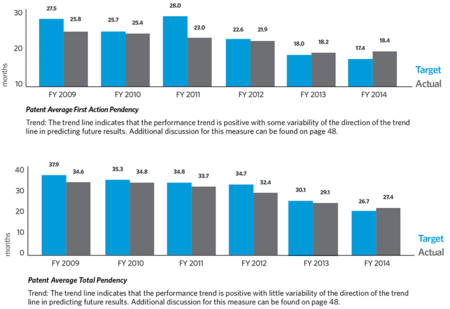
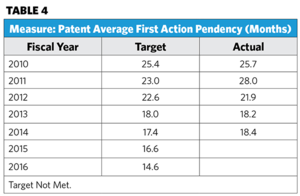
    The 2014-2018 Strategic Plan specifies eleven performance outcome measures for which the Office has developed annual performance targets.  According to the report, the Office met its annual performance targets for eight of the eleven performance targets.  Unfortunately, all three of the targets that were missed fell within the first strategic goal, which concerns the optimization of patent quality and timeliness.  In particular, average first action pendency was 18.4 months (higher than the 17.4 month target), average total pendency was 27.4 months (higher than the 26.7 month target), and patent quality composite score was 75.0 (lower than the 83 to 91 target).

    The last performance target is new to the report, replacing the percent of patent applications that were filed electronically (in the 2013 report, the Office noted that 98.1% of patent applications were filed electronically, which left little room for improvement).  The 2014 report notes that the Patent Quality Composite Score is a quality metric composed of seven total factors that take into account stakeholder comments.  In particular, the seven factors measure:

    (a) the quality of the action setting forth the final disposition of the application; (b) the quality of the actions taken during the course of the examination; (c) the perceived quality of the patent process as measured through external quality surveys of applicants and practitioners; (d) the quality of the examiner’s initial search; (e) the degree to which the first action on the merits follows best examination practices; (f) the degree to which global USPTO data are indicative of compact, robust prosecution; and (g) the degree to which patent prosecution quality is reflected in the perceptions of the examination corps as measured by internal quality surveys.

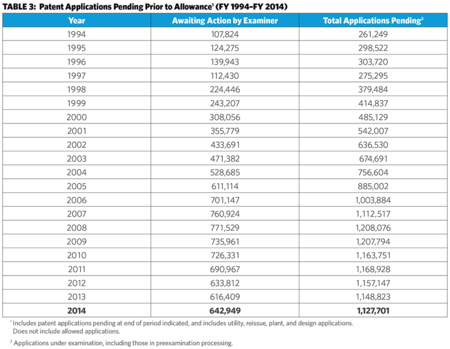
    Table 3 of the report provides data for the patent-related performance targets for FY 2010 to FY 2014 (click on any table to expand):

    Table 3
    The report also presents data for the following patent-related performance targets:  patent average first action pendency for FY 2009 to FY 2014 (upper panel) and patent average total pendency for FY 2009 to FY 2014 (lower panel) (as for the third patent performance target, the report notes that because the Patent Quality Composite Score has only three years of recorded results, "the measure is presently unsuitable for trend analysis"):

    2 Charts
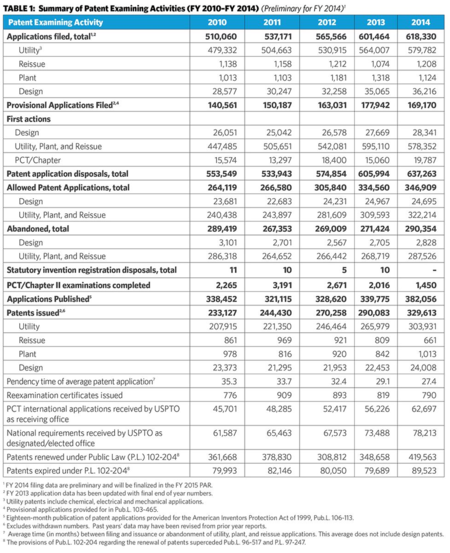
    The report notes that the number of applications filed increased from 601,464 in FY 2013 to 618,330 in FY 2014, which constituted a 2.7% increase in filings.  This followed a 6.0% increase in application filings in FY 2013.

    Table 1
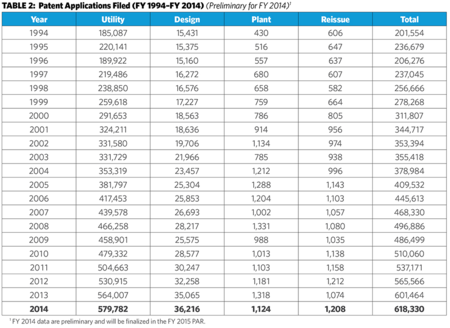
    Although the Office accepted more than 600,000 patent applications for the second straight year and topped 500,000 applications for the fifth consecutive year (see Table 2 below), the number of applications awaiting action also increased from 616,409 in FY 2013 to 642,949 in FY 2014 (see Table 3 below).  Prior to FY 2014, the number of applications awaiting action had dropped in five consecutive years.  The total number of pending applications, however, decreased from 1,148,823 in FY 2013 to 1,127,7013 in FY 2014.

    Table 2

    Table 3_Action
    Utility patent issuances were up significantly in FY 2014, rising from 265,979 in FY 2013 to 303,931 in FY 2014.  It was the fifth straight year that the Office issued more than 200,000 utility patents (having issued 207,915 patents in FY 2010, 221,350 patents in FY 2011, and 246,464 patents in FY 2012), and the fifth straight increase.

    As noted above, with respect to first action and total pendency, the results in FY 2014 were below the Office's targets and the goals for FY 2015 and FY 2016 present even tougher challenges.  For first action pendency, the annual performance target drops from 17.4 months for FY 2014 (which the Office failed to meet) to 16.6 months for FY 2015 and 14.6 months for FY 2016, and for total pendency, the annual performance target drops from 26.7 months in FY 2014 (which the Office also failed to meet) to 27.8 months in FY 2015 and 24.6 months in FY 2016.

    Table 4 Table 5
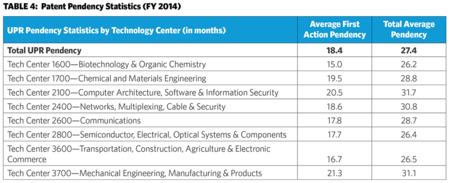
    For biotechnology and organic chemistry applications, average first action pendency reversed last year's gains, rising from 13.4 months in FY 2013 to 15.0 months in FY 2014 (average first action pendency for these applications was 23.8 months in FY 2011 and 17.8 months in FY 2012).  Total average pendency for biotechnology and organic chemistry applications, however, once again improved, falling from 27.5 months in FY 2013 to 26.2 months in FY 2014 (total average pendency for these applications was 33.6 months in FY 2011 and 30.0 months in FY 2012).  Both pendency measures for biotechnology and organic chemistry applications for FY 2014 were below the Office's overall averages of 18.4 months and 27.4 months, respectively.  No other Technology Center posted a better first action pendency or total average pendency than TC 1600.

    Table 4_by TC

    For additional information regarding this and other related topics, please see:

    • "USPTO Releases Performance and Accountability Report for FY 2013," January 9, 2014
    • "USPTO Releases Performance and Accountability Report for FY 2012," November 28, 2012
    • "USPTO Releases Performance and Accountability Report for FY 2011," November 30, 2011
    • "USPTO Releases 2010 Performance and Accountability Report," November 17, 2010
    • "USPTO Announces 'Highest Performance Levels in Agency's History' in 2008," November 18, 2008
    • "USPTO Announces 'Record Breaking' 2007 Performance," November 15, 2007
    • "Patent Office Announces Record-Breaking Year," December 27, 2006

  • By Paul Cole[1]

    Both U.S. practitioners and their European colleagues will be concerned about a dictum in In re Roslin Institute (Edinburgh), 750 F.3d 1333, 1338-39 (Fed. Cir. 2014) that any existing [micro]organism found in the wild is not patent-eligible.  That dictum is said to follow from Diamond v Chakrabarty, 447 U.S. 303 and Funk Brothers v Kalo Inoculant, 333 U.S. 127.  However, there are strong arguments that firstly that such a far-reaching categorical exclusion is supported neither by Funk Brothers nor by Chakrabarty if their actual holdings are correctly understood and secondly that it brings US domestic law into conflict with an express provision for microorganism patentability contained in Article 27 of the TRIPS Agreement.

    The decision in Funk Brothers concerns U.S. Patent No. 2,200,532 (Bond).  Farmers had previously used inoculants of cultured Rhizobia bacteria packaged in a powder or liquid base for inoculating seeds of leguminous plants.  Mixed cultures of Rhizobia for field legumes were known, but they had proved unsatisfactory because the different species of the Rhizobia inhibited each other when mixed in a common base.  Bond had provided a mixed culture of Rhizobia capable of inoculating the seeds of plants belonging to several cross-inoculation groups.  In his concurring opinion, Justice Frankfurter identified two different claims of originality, (1) the idea that there were compatible strains and (2) the experimental demonstration that such strains in fact existed and had been found.  Bond's written description both disclosed the idea and provided evidence of its truth in the form of chemical analysis of plants grown from inoculated seeds and of photographs of the grown plants.  However, although compatibility testing procedures had been disclosed, the written description contained no details of experiments leading to the identification and isolation of compatible strains, and no individual strains were identified, had been deposited in a culture collection or had been claimed.  The skilled reader was left to his or her own devices to find compatible strains and was not told in advance whether the necessary tests would involve a few tens of samples and a few weeks or many thousands of samples and some years, although the dissenting opinion of Justices Burton and Jackson suggest that the necessary tests were in fact not difficult.  If the information contained in the specification had been presented for publication in a peer-reviewed journal, it should have been rejected by the referees for lack of supporting experimental detail, and it is unclear why anything less should satisfy the requirements for patentability.

    A representative product claim read:

    "An inoculant for leguminous plants comprising a plurality of selected mutually non-inhibitive strains of different species of bacteria of the genus Rhizobium, said strains being unaffected by each other in respect to their ability to fix nitrogen in the leguminous plant for which they are specific."

    The principle of nature underlying the claim is the existence of a genus of mutually non-inhibitive bacterial strains.  A further requirement of the claim is that strains of different bacteria falling within the genus should be selected and incorporated into an inoculant, implicitly by placement in a powder or liquid base.  The only novelty is in the existence of non-inhibitive strains and the ability to achieve the specified result, which is entirely generic and functional.

    Justice Douglas began his opinion with the commonplace that patents could not issue for the discovery of the phenomena of nature, citing Le Roy v. Tatham, 14 How. 156, 175.  He rightly described the qualities of the individual bacteria, like the heat of the sun, electricity, or the qualities of metals, as manifestations of laws of nature, free to all men and reserved exclusively to none.  That the inventor did not create the qualities of inhibition or non-inhibition of the individual bacteria which were the work of nature is also factually true, but would become manifestly untrue if extended to cover non-inhibitory bacterial mixtures for which selective isolation of the non-inhibitory strains and their mixing them together was the work of man, not nature.  Furthermore, his observation provides no authority for the proposition that isolated naturally-occurring microoganisms in biologically pure culture and with valuable properties are not patent-eligible.  As explained in Chakrabarty, the practice of the USPTO had been to grant such patents from Louis Pasteur's 1873 U.S. Patent No. 141,072 for germ-free yeast (see footnote 9) up to the 1970 Plant Variety Protection Act and no reason was given in Chakrabarty for that practice not to continue.

    Justice Douglas continued with the further commonplace that was that if there was to be invention in such a discovery it had to come from the application of the newly discovered law of nature to a new and useful end.  It is submitted that there were two logical applications of the discovery:
        (a) selection, isolation and culturing of particular combinations of bacterial strains that were non-inhibitive.  It will be recalled that the information in the patent in issue was only at the highest level of generality and that specific strains were neither identified nor claimed.  Applications of this type were therefore not considered by the Court.
        (b) aggregation of the select strains of the several species into a single product.  The Justices were unanimous that this was an application of the newly-discovered natural principle and hence implicitly patent-eligible.

    What then justified his holding that the product claims did not disclose an invention or discovery satisfying the test he had earlier set out in Cuno Engineering Corp. v. Automatic Devices Corp., 314 U. S. 84, 314 U. S. 90-91 (1941)?  It should be mentioned that although eligibility and obviousness arose under the same section of the pre-1952 statute, there is little doubt that the test explained in Cuno concerned obviousness now §103, not eligibility now §101 and its judicial exclusions, an automobile cigarette lighter not being a product of nature.

    The Cuno opinion focused on whether the claimed subject matter was the result of invention, going beyond the skill of the calling and exhibiting "a flash of genius"[2].  In holding that the inventor's skill in making the relevant contribution did not reach the level of inventive genius required by the Constitution, Justice Douglas emphasized that the test was necessary "lest in the constant demand for new appliances the heavy hand of tribute be laid on each slight technological advance in an art."  He further explained his views about invention or discovery (which apparently remained unchanged between 1941 and 1950) at greater length in his concurring opinion in A. & P Tea Co v Supermarket Equipment Corp., 340 U.S. 147 (1950) where he again emphasized the standard written into the Constitution and observed that:

    "Every patent is the grant of a privilege of exacting tolls from the public.  The Framers plainly did not want those monopolies freely granted.  The invention, to justify a patent, had to serve the ends of science — to push back the frontiers of chemistry, physics, and the like; to make a distinctive contribution to scientific knowledge.  That is why through the years the opinions of the Court commonly have taken "inventive genius" as the test.  It is not enough that an article is new and useful.  The Constitution never sanctioned the patenting of gadgets.  Patents serve a higher end — the advancement of science.  An invention need not be as startling as an atomic bomb to be patentable.  But it has to be of such quality and distinction that masters of the scientific field in which it falls will recognize it as an advance."

    Justice Jackson dismissed the invention in A. & P. on the ground that merely speeding a supermarket customer on his or her way and reducing checkout costs did not make the claimed subject-matter patentable.  The opinion of Justice Douglas in Funk Brothers is an earlier instance of the same line of thought given his finding that what flowed from the application of the newly discovered natural principle was an important commercial advance in the packaging of inoculants, but nothing more.  Application of the discovery that non-inhibitory strains existed therefore did not in his opinion produce an advance of sufficient quality and distinction for patentability.

    The following passage has been quoted in Chakrabarty and subsequently in in Roslin for the proposition that the mixture of bacteria was unpatentable because its qualities were the work of nature unaltered by the hand of man.  However, when read in context it was clearly intended to explain that the application was of insufficient distinction to meet the test in Cuno firstly because the benefit was for manufacturers and dealers but not for the wider benefit of agriculture, and secondly because when applied to plants the bacteria then acted as an aggregation of individuals rather than a combination:

    "Each of the species of root-nodule bacteria contained in the package infects the same group of leguminous plants which it always infected.  No species acquires a different use.  The combination of species produces no new bacteria, no change in the six species of bacteria, and no enlargement of the range of their utility.  Each species has the same effect it always had.  The bacteria perform in their natural way.  Their use in combination does not improve in any way their natural functioning.  They serve the ends nature originally provided, and act quite independently of any effort of the patentee."

    It will be apparent that Justice Douglas might well have taken a different view if the application of the discovery resulted in a bacterial mixture that provided a performance benefit for the farmer when applied to crops, e.g., increasing nitrogen fixation and crop yields and which would have been likely to be recognised as an agricultural and scientific and not merely a commercial advance.

    A subsidiary reason why Justice Douglas refused to take the advantages of the claimed inoculant at the packaging stage into account may be the purely generic nature of the claimed subject matter.  His position is explained in the following language which is not free from difficulty:

    "But once nature's secret of the non-inhibitive quality of certain strains of the species of Rhizobium was discovered, the state of the art made the production of a mixed inoculant a simple step.  Even though it may have been the product of skill, it certainly was not the product of invention.  There is no way in which we could call it such unless we borrowed invention from the discovery of the natural principle itself.  That is to say, there is no invention here unless the discovery that certain strains of the several species of these bacteria are non-inhibitive and may thus be safely mixed is invention.  But we cannot so hold without allowing a patent to issue on one of the ancient secrets of nature now disclosed."

    If the underlying objection is not undue claim scope, then the opinion descends into self-contradiction since the existence of the non-inhibitory genus was not part of the state of the art at the time that the invention was made but was a secret known only to the inventor Bond, and there was no reason for a skilled person to have made the mixed inoculant without that knowledge.  In his recent paper Inventive Application: A History[3], Jeffrey A. Lefstin argues that in Neilson v. Harford, the famous "hot blast" case decided by the Court of Exchequer in 1841 Neilson's patent on the hot blast was sustained not because his application was inventive, but because it was entirely conventional and obvious.  In both England and the U.S., inventors could patent any practical application of a new discovery, regardless of the application's novelty or inventiveness.  To hold otherwise places a double burden on an inventor:  first discovering a new principle or rule of nature and secondly devising an inventive application of that discovery.  In the nature of scientific and technical advance there can be few occasions where both happen at the same time.

    In summary, the reasons why the patent was held ineligible in Funk Brothers was lack of invention not lack of eligibility, the underlying discovery not giving rise to an application that represented a sufficient scientific advance, and the feature at the point of novelty being claimed in such generic functional terms that its benefits should not count towards satisfying the Cuno test.

    Justice William O. Douglas has been accused by his critics, including his former law clerks, of hasty writing and his majority opinion in Funk Brothers as explained above is not free from difficulty.  It is surprising that this pre-1952 decision should have been applied with such enthusiasm given that it and the A. & P. case were the triggers for inclusion of §103 in the 1952 legislation and given the fractured nature of the decision with marked differences in the opinion of Justice Frankfurter and dissents by Justices Burton and Jackson.

    A succession of later opinions has given Funk Brothers wide and doubtful interpretation.  In Chakrabarty Chief Justice Burger alleged that the Bond claim was merely to a hitherto unknown natural phenomenon.  However that opinion runs into the difficulty that Bond's claimed inoculant was a newly created composition of matter selected and mixed by the hand of man and meeting all the requirements of Hartranft v. Wiegmann, 121 U. S. 609, 121 U. S. 615 (1887) insofar as it had a new name (mixed inoculant), new characteristics (non-inhibition) and new utility (in the concise words of Justice Frankfurter, multi-service applicability).  In Myriad Justice Thomas attributed the Funk Brothers holding to the fact that the patent holder had not altered the bacteria in any way.  That opinion runs up against the difficulty that although the bacteria were naturally occurring, the claimed composition of matter had been produced by the hand of man and as understood by Justice Thomas was claimed in association with a solid or liquid carrier.  In Roslin the Federal Circuit takes doubtful interpretation a step further, arguing that "the natural organism itself — the mixture of bacteria — was unpatentable because its 'qualities are the work of nature' unaltered by the hand of man."  That interpretation encounters the difficulties that a mixture of bacteria is not a natural organism, that mixtures created by the hand of man fall into the eligible composition of matter classification as explained in Shell Development Co. v. Watson, 149 F.Supp. 279, 280 (DC 1957) (citing 1 A. Deller, Walker on Patents § 14, p. 55 (1st ed.1937)), both cited in Chakrabarty, and that all the Justices in Funk Brothers including Justice Frankfurter in his concurring opinion and Justices Burton and Jackson in their dissenting opinions held that what was claimed was a patent-eligible application of Bond's newly discovered natural principle.

    In Roslin the Federal Circuit treats Myriad as providing a categorical exclusion that "isolated," naturally occurring DNA strands should not be eligible for patent protection.  It is inexplicable why such a broad holding should be given to the careful opinion of Justice Thomas, in which he summarised his holding both at the beginning and at the end of his opinion, including the limiting words "merely because", "merely hold" and "simply because".  As explained in an earlier posting Myriad — An Obvious and Patent-Friendly Interpretation[4] the ruling is to be understood in terms of reasons, not technical differences.  Naturally occurring DNA does not become patent eligible just because it has been isolated, but if when isolated it has new and valuable utility then it does not fall within the rule.  Any patent attorney should by virtue of his or her lifetime training be aware of the fact that the expression "one only" or words to the same effect does not cover two or three.

    There are therefore compelling reasons for questioning whether the Roslin categorical exclusion is indeed supported by US domestic law.

    In addition to the issues under US domestic law, the Roslin opinion arguably puts the US in contravention of TRIPS by categorically excluding naturally occurring microorganisms from patentability.  The US acceded to the WTO on 1 January 1995.  There must therefore be a strong presumption against any amendment to US intellectual property law, including patent law, that provides a categorical exclusion not existing in US law as of 1 January 1995.  That proposition is supported by the well-known substantive canon of interpretation in Murray v. The Charming Betsy, 6 U.S. (2 Cranch) 64 (1804) against interpreting US domestic law contrary to the law of nations, which arguably has much increased persuasive power where the US Government itself was the moving spirit behind the relevant treaty.  Article 27(3)(c) of TRIPS expressly permits the exclusion from patentability of plants whether cultivated or found in the wild but correspondingly forbids the exclusion of microorganisms.  They are widely and internationally treated as patentable and fall under heading C12N 1/00 of the Cooperative Patent Classification.  There is no reason to put a gloss on the term "microorganism" to exclude those that exist in nature.  The EPO has granted patents for naturally occurring microorganisms from its inception and continues to do so.  One example is provided by EP-B-1436380 (Wynne, Reading University) which is concerned with a probiotic strain of Lactobacillus isolated from the human gut and in addition to exhibiting characteristics typical of Lactobacilli in general having the further surprising properties that it can suppress the growth of Candida species to a degree never previously achieved through use of a probiotic and that it is unaffected by tetracycline and related antibiotics.  Since Candida in any region of the body is considered to be a causative factor in irritable bowel syndrome (IBS), the novel strain is useful in treating or preventing that disorder.  The granted main claim is directed to:  "A lactobacillus strain as deposited under accession number NCIMB 41114"; claim 1 of the corresponding granted U.S. Patent No. 7,125,708 is directed to "a biologically pure culture" of the same strain.  See also, e.g., granted EP-B-0029976 (Nakajima, Unitika) and granted EP-B-2785826 (Zielinska).

    The newly expressed categorical exclusion set out in Roslin therefore amounts to a fundamental change in US domestic law from what was understood at the time when TRIPS was entered into, and if followed would put US grant practice and substantive law fundamentally at variance with practice and substantive law  before the EPO and in other major industrialised countries.

    For all the above reasons, any future reliance on the Roslin microorganism dictum would therefore be a matter for concern.


    [1] Visting professor of IP Law, Bournemouth University; European Patent Attorney; Partner, Lucas & Co, 135 Westhall Road, Warlingham, Surrey CR6 9HJ, United Kingdom; e-mail pcole@lucas-uk.com. In addition to his prosecution practice, Paul Cole founded and edited the newsletter Intellectual Property Decisions in the 1970’s-1980’s, is the author of the textbook Fundamentals of Patent Drafting published by the Chartered Institute of Patent Attorneys, London, UK, and is an editor of The CIPA Guide to the Patents Acts. He has over 35 years of experience in abstracting and analysing opinions of the UK courts, the US courts and the EPO Appeal Board.

    [2] For completeness it should be mentioned that in Graham v John Deere  383 U.S. 1 (1966) Justice Clark explained that Congress intended by the last sentence of §103 to abolish the test it believed this Court announced in the controversial phrase "flash of creative genius." However he went on to observe that rather than establishing a more exacting standard, Cuno merely rhetorically restated the requirement that the subject matter sought to be patented must be beyond the skill of the calling.

  •         By Sherri Oslick

    Gavel About Court Report:  Each week we will report briefly on recently filed biotech and pharma cases.

    Gilead Sciences Inc. et al. v. Watson Laboratories Inc. et al.
    1:15-cv-00289; filed April 1, 2015 in the District Court of Delaware

    • Plaintiffs:  Gilead Sciences Inc.; Royalty Pharma Collection Trust
    • Defendants:  Watson Laboratories Inc.; Actavis Inc.; Actavis plc

    Infringement of U.S. Patent No. RE42,462 ("Carboxylic Acid Derivatives, Their Preparation and Use," issued June 14, 2011) following a Paragraph IV certification as part of Watson's filing of an ANDA to manufacture a generic version of Gilead's Letairis® (ambrisentan, used to treat pulmonary arterial hypertension).  View the complaint here.


    Forest Laboratories LLC et al. v. InvaGen Pharmaceuticals Inc.
    1:15-cv-00277; filed March 27, 2015 in the District Court of Delaware

    • Plaintiffs:  Forest Laboratories LLC; Forest Laboratories Holdings Ltd.; Merck KGaA; Merck Patent Gesellschaft mit beschrankter Haftung
    • Defendant:  InvaGen Pharmaceuticals Inc.

    Forest Laboratories LLC et al. v. Accord Healthcare Inc.

    1:15-cv-00272; filed March 27, 2015 in the District Court of Delaware

    • Plaintiffs:  Forest Laboratories LLC; Forest Laboratories Holdings Ltd.; Merck KGaA; Merck Patent Gesellschaft mit beschrankter Haftung
    • Defendant:  Accord Healthcare Inc.

    Forest Laboratories LLC et al. v. Alembic Pharmaceuticals Ltd. et al.
    1:15-cv-00273; filed March 27, 2015 in the District Court of Delaware

    • Plaintiffs:  Forest Laboratories LLC; Forest Laboratories Holdings Ltd.; Merck KGaA; Merck Patent Gesellschaft mit beschrankter Haftung
    • Defendants:  Alembic Pharmaceuticals Ltd.; Alembic Global Holding SA; Alembic Pharmaceuticals Inc.

    Forest Laboratories LLC et al. v. Apotex Inc. et al.
    1:15-cv-00274; filed March 27, 2015 in the District Court of Delaware

    • Plaintiffs:  Forest Laboratories LLC; Forest Laboratories Holdings Ltd.; Merck KGaA; Merck Patent Gesellschaft mit beschrankter Haftung
    • Defendants:  Apotex Inc.; Apotex Corp.

    Forest Laboratories LLC et al. v. Teva Pharmaceuticals USA Inc.
    1:15-cv-00275; filed March 27, 2015 in the District Court of Delaware

    • Plaintiffs:  Forest Laboratories LLC; Forest Laboratories Holdings Ltd.; Merck KGaA; Merck Patent Gesellschaft mit beschrankter Haftung
    • Defendant:  Teva Pharmaceuticals USA Inc.

    The complaints in these cases are substantially identical.  Infringement of U.S. Patent Nos. 7,834,020 ("Polymorphic forms of 1-'4-(5-Cyanoindol-3-YL)Butyl-4-(2-Carbamoylbenzofuran-5-YL) Piperazine Hydrochloride," issued November 16, 2010), 8,193,195 (same title, issued June 5, 2012), 8,236,804 (same title, issued August 7, 2012), and 8,673,921 (same title, issued March 18, 2014) following a Paragraph IV certification as part of defendants' filing of an ANDA to manufacture a generic version of Forest's Viibryd® (vilazodone hydrochloride, used for the treatment of major depressive disorder in adults).  View the Accord complaint here.


    Enzo Life Sciences Inc. v. Hologic Inc.
    1:15-cv-00271; filed March 27, 2015 in the District Court of Delaware

    Infringement of U.S. Patent Nos. 6,992,180 ("Oligo- Or Polynucleotides Comprising Phosphate-Moiety Labeled Nucleotides," issued January 31, 2006) and 7,064,197 ("System, Array and Non-Porous Solid Support Comprising Fixed or Immobilized Nucleic Acids," issued June 20, 2006) based on Hologic's manufacture, use, and sale of nucleic acid assay products.  View the complaint here.


    IPXpharma LLC v. Millennium Pharmaceuticals Inc.
    1:15-cv-00276; filed March 27, 2015 in the District Court of Delaware

    Infringement of U.S. Patent No. 6,171,786 ("Methods for Preventing Multidrug Resistance in Cancer Cells," issued January 9, 2001) based on Millennium's manufacture and sale of its Velcade® product (bortezomib, used to treat multiple myeloma).  View the complaint here.


    McNeil-PPC, Inc. et al. v. Watson Laboratories, Inc.
    2:15-cv-02197; filed March 27, 2015 in the District Court of New Jersey

    • Plaintiffs:  McNeil-PPC, Inc.; Stiefel Research Australia Pty. Ltd.
    • Defendant:  Watson Laboratories, Inc.

    Infringement of U.S. Patent No. 6,946,120 ("Pharmaceutical Composition," issued September 20, 2005) following a Paragraph IV certification as part of Watons' filing of an ANDA to manufacture a generic version of McNeil's Rogaine® (minoxidil topical aerosol foam, used to treat androgenic alopecia of the vertex of the scalp).  View the complaint here.


    Novo Nordisk Inc. v. Baxter Healthcare Corp. et al.
    3:15-cv-02157; filed March 26, 2015 in the District Court of New Jersey

    • Plaintiff:  Novo Nordisk Inc.
    • Defendants:  Baxter Healthcare Corp.; Baxter Innovations GmbH; Baxter Aktiengesellschaft

    Declaratory judgment of non-infringement and invalidity of U.S. Patent No. 6,100,061 ("Recombinant Cell Clone Having Increased Stability in Serum and Protein-Free Medium and a Method of Recovering the Stable Cell Clone and the Production of Recombinant Proteins by Using a Stable Cell Clone," issued August 8, 2000), 6,475,725 ("Recombinant Cell Clones Having Increased Stability and Methods of Making and Using the Same," issued November 5, 2002), 6,936,441 (same title, issued August 30, 2005), 7,094,574 (same title, issued August 22, 2006), 8,080,414 (same title, issued December 20, 2011), 8,084,251 (same title, issued December 27, 2011), 8,084,252 (same title, issued December 27, 2011), and 8,329,465 (same title, issued December 11, 2012) based on Novo Nordisk's imminent manufacture and sale of its Novoeight® product (turoctocog alfa, used to treat adults and patients with hemophilia), a competitive product to Baxter's Advate® product (Antihemophilic Factor [Recombinant], used to treat adults and patients with hemophilia).  View the complaint here.


    Reckitt Benckiser LLC v. Amneal Pharmaceuticals LLC
    2:15-cv-02155; filed March 26, 2015 in the District Court of New Jersey

    Infringement of U.S. Patent Nos. 6,372,252 ("Guaifenesin Sustained Release Formulation and Tablets," issued April 16, 2002), 6,955,821 ("Sustained Release Formulations of Guaifenesin and Additional Drug Ingredients," issued October 18, 2005), and 7,838,032 ("Sustained Release of Guaifenesin," issued November 23, 2010 following a Paragraph IV certification as part of Amneal's filing of an ANDA to manufacture a generic version of plaintiff's Mucinex® (guaifenesin, used to treat chest congestion).  View the complaint here.


    Reckitt Benckiser LLC v. Perrigo Co. et al.
    2:15-cv-02155; filed March 26, 2015 in the District Court of New Jersey

    • Plaintiff:  Reckitt Benckiser LLC
    • Defendants:  Perrigo Co.; Perrigo Research and Development Co.

    Infringement of U.S. Patent Nos. 6,372,252 ("Guaifenesin Sustained Release Formulation and Tablets," issued April 16, 2002), 6,955,821 ("Sustained Release Formulations of Guaifenesin and Additional Drug Ingredients," issued October 18, 2005), and 7,838,032 ("Sustained Release of Guaifenesin," issued November 23, 2010 following a Paragraph IV certification as part of Perrigo's filing of an ANDA to manufacture a generic version of plaintiff's Mucinex® DM (guaifenesin/dextromethorphan, used to treat chest congestion).  View the complaint here.