• Strafford #1Strafford will be offering a webinar/teleconference entitled "Section 103 and Non-Obviousness Post-AIA — Navigating Timing Changes, Federal Court Treatment, and Secondary Considerations to Meet Patent Validity Requirements" on July 23, 2015 from 1:00 to 2:30 pm (EDT).  Thomas L. Irving and Erika H. Arner of Finnegan Henderson Farabow Garrett & Dunner will provide guidance to patent counsel regarding the impact of the Leahy-Smith America Invents Act (AIA) on Section 103 and non-obviousness, and offer best practices for meeting the non-obviousness requirement for patent validity.  The webinar will review the following questions:

    • How has the AIA impacted the determination of obviousness?
    • How has the Federal Circuit treated the issue of non-obviousness?
    • How has PTAB treated obviousness issues?
    • What practices should counsel employ in order to meet the non-obviousness requirement?

    The registration fee for the webinar is $297 ($362 for registration and CLE processing).  Those interested in registering for the webinar, can do so here.

  •     By Paul Cole* —

    Ariosa DiagnosticsThe June 12, 2015 decision of the Federal Circuit in the above case has been discussed by Kevin Noonan in his posting of 22 June, but it is believed that the factual and legal background could benefit from further discussion.

    It is convenient to consider claims 1 and 2 of US Patent No. 6,258,540 together since PCR is the technique exemplified and both claims 1 and 2 were held not to be patent eligible.

    The kernel of the opinion of Judge Reyna is contained in the two passages set out below:

    It is undisputed that the existence of cffDNA in maternal blood is a natural phenomenon.  Sequenom does not contend that Drs. Lo and Wainscoat created or altered any of the genetic information encoded in the cffDNA, and it is undisputed that the location of the nucleic acids existed in nature before Drs. Lo and Wainscoat found them.  The method ends with paternally inherited cffDNA, which is also a natural phenomenon.  The method therefore begins and ends with a natural phenomenon.  Thus, the claims are directed to matter that is naturally occurring.

    Like the patentee in Mayo, Sequenom contends that the claimed methods are patent eligible applications of a natural phenomenon, specifically a method for detecting paternally inherited cffDNA. Using methods like PCR to amplify and detect cffDNA was well-understood, routine, and conventional activity in 1997.  The method at issue here amounts to a general instruction to doctors to apply routine, conventional techniques when seeking to detect cffDNA.  Because the method steps were well-understood, conventional and routine, the method of detecting paternally inherited cffDNA is not new and useful.

    It is useful to consider the steps of the claimed method against these statements to determine the extent to which they can legitimately be held to fall within the natural phenomenon exclusion.  Detail in addition to the express wording of the claim is believed to indicate what would be implicit to a skilled reader.

    The first step requires the use of a maternal serum or plasma sample from a pregnant female.  In Example 1, 10μl of centrifuged and heated plasma or serum are placed into a 0.5 ml Eppendorf tube.  While the presence of cffDNA in the maternal serum or plasma is a natural phenomenon, the decision to make use of the serum or plasma sample for amplification and detection is arguably a step towards an application of that phenomenon.

    The second step involves addition of pair of primers to the blood or serum sample.  In Example 1 of the patent in issue these are Y1.7 andY1.8 which are specific for the Y-chromosome which is passed only from father to son and determines the sex of the fetus.  Those primers enable amplification of a sequence of the Y-chromosome of length 198 base pairs.  The experimental details in Example 1 are less than complete, but comparison with Example 2 shows that ~300 nM of each amplification probe would have been added and 200μM each of dATP, dCTP, dGTP and dUTP to provide the monomeric nucleotides needed for polymerisation, together with polymerization enzyme and incidental materials.  The serum or plasma samples were then subjected to 60 cycles of polymerase chain reaction in a PCR machine, 30-40 cycles being generally regarded as sufficient for the reaction to go to completion.  As explained at page 3 of the slip opinion, amplifying cffDNA results in a single copy, or a few copies, of a piece of cffDNA being exponentially multiplied across several orders of magnitude, generating thousands to millions of copies of that particular DNA sequence to reach detectable levels.  If a sample originally contains one or more parentally-derived Y-chromosomes, then after amplification thousands or millions of copies of the selected 198 bp short sequence are present in it.

    The product of the second step could therefore most appropriately be described as a composition of matter which is for that reason inherently within the realm of patent-eligibility, said composition comprising the blood or serum of the sample, the naturally occurring cffDNA, thousands to millions of copies of the the Y-chromosome short sequence and residual primer, nucleotides, enzyme and other starting materials.  Even if concentration is focused on the short sequences to the exclusion of other relevant process and composition of matter features, the short sequence copies are a wholly artificial creation, being the result of the synthetic chain reaction and to describe them as a natural product gives rise to an error, on the figures of the slip opinion, of 103-106 which is on any view an exuberant margin.  They have new utility compared to the original blood or serum sample insofar as they are present at levels that are detectable in subsequent test procedures whereas the original cffDNA is not.

    Furthermore in equating the selected and amplified short sequences with a natural product, the Court is implicitly disregarding long-established precedents such as Parke-Davis & Co. v. H. K. Mulford Co (adrenalin), Kuehmsted v. Farbenfabriken of Elberfeld Co. (aspirin) and Merck & Co. v. Olin Mathieson Chemical Corp (Vitamin B12) which show that an isolated or purified natural product having new utility is patent-eligible.  By the same logic, the amplified short sequences are a new and different product having new utility in that they have been brought to detectable levels and cannot be equated simply with the corresponding region of the Y-chromosome as a natural product.

    The third step involves detecting the presence of the paternally inherited nucleic acid, and although specified at a high degree of generality is not unduly broad having regard to the range of tests that can be performed.  In Example 1, the mere presence of a Y-positive signal distinguishes a male fetus from a female fetus.  In Example 2, quantitative PCR is used as a screening marker for aneupoloid pregnancies e.g. Downs syndrome, Example 3 describes tests for RhD, Example 4 describes tests for pre-eclampsia and Example 5 provides data showing the very high concentration of fetal DNA in serum or plasma compared to the cellular fraction of maternal blood.

    Prometheus requires the claim to be considered not merely as an isolated aggregation of features but as an ordered combination.  If that is done, the new result emerges of a test of high sensitivity for a range of medical conditions that can be applied early in pregnancy and avoiding the risks to the fetus inherent in amniocentesis and that starts from a new and hitherto overlooked starting material and that, in the words of Judge Reyna "revolutionised medical care."  The question in Prometheus was whether the described processes added enough, and it is submitted that the benefits achieved should not have been dismissed as adding nothing of significance.

    The proposition that because the method steps were well-understood, conventional and routine, the method of detecting paternally inherited cffDNA is not new and useful verges on the incomprehensible.  Essentially the same claim was examined by the EPO Appeal Board T 0146/07 ISIS/Prenatal diagnosis.  The closest prior art was a paper from one of the inventors, Dr Lo.  That paper describes a method for the detection of foetal RhD sequences in peripheral blood of sensitized RhD-negative pregnant women.  In the earlier method described, antecubital venous blood was collected from pregnant women and DNA was extracted from the buffy coat fraction, i.e., peripheral blood mononuclear cells (PBMC) isolated from maternal peripheral blood.  Foetal RhD sequences were detected by PCR using specific primers.  The method therefore differed from that now claimed in that the presence of nucleic acid of foetal origin was detected in buffy coat cells rather than in maternal serum or plasma.  As explained in the patent in issue, it was surprisingly found that foetal DNA is enriched in maternal plasma or serum compared to the amount present in the cellular fraction.  The Opposition Division found that a skilled person starting from the cited document and confronted with the problem of providing a more sensitive method for detecting foetal blood cells would not have derived the solution claimed.  In affirming this finding, the Appeal Board held that even of the technical problem were reformulated to the lesser task of finding an alternative source of foetal nucleic acid a skilled person starting from Dr Lo's paper would not have been motivated to consider serum or plasma samples.  Lack of industrial applicability was not a ground of opposition, but nevertheless it is disturbing that subject matter held inventive by the EPO should be summarily dismissed as ineligible in the U.S. under §101.

    The steps quoted from the Prometheus opinion recur in Alice and to that extent may reflect a settled view within the Supreme Court.  However, it is submitted that it is inappropriate to select specific passages from these opinions without taking into account the caution with which they were originally expressed, and the warning at the end of the Prometheus opinion that a new protective rule that seems to suit the needs of one field might produce unforeseen results in another.  It is difficult to avoid the conclusion that in Ariosa the Court is extending the second part of the two-part Prometheus test beyond the original intention of the Supreme Court and has fallen into the trap of making its findings of fact to fit the earlier opinions on which it wished to rely, rather than straightforwardly finding the objective facts and then applying the appropriate jurisprudence to them.

    * Mr. Cole is a European Patent Attorney and Partner with Lucas & Co. in Warlingham, Surrey, UK and Professor of IP Law at Bournemouth University.

  • Life Sciences Top 55

    By Donald Zuhn —

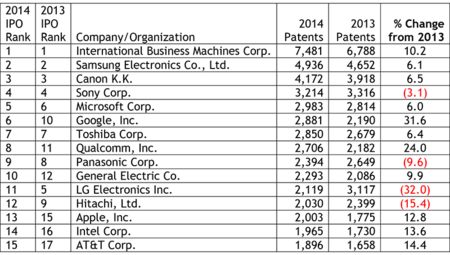
    IPO #2Last week, the Intellectual Property Owners Association (IPO) announced the release of its 32nd annual list of the top 300 organizations receiving U.S. patents (see "Top 300 Organizations Granted U.S. Patents in 2014").  Patent Docs Readers may recall that the U.S. Patent and Trademark Office stopped releasing its annual list of top patent recipients in 2006 in order to "discourag[e] any perception that we believe more is better."

    The IPO compiled its list by counting the number of utility patents granted during 2014 that listed an organization or a subsidiary as the owner on the printed patent.  The IPO notes that if an assignment to an organization or its subsidiary was recorded after the patent was printed, the patent was not counted, and further, that patents that were granted to two or more organizations jointly were attributed to the organization listed first on the patent.  The IPO also noted that 300,678 patents were issued in 2014, which was an increase from the 277,835 patents that issued in 2013.  The top fifteen companies on the IPO Top 300 are listed below (click on table to expand):

    2014 Top 15
    Falling out of the Top 15 in 2013 were Fujitsu Ltd. and Siemens AG, which dropped to 16th and 21st, respectively.  Replacing those companies in the Top 15 were Intel Corp. and AT&T Corp.

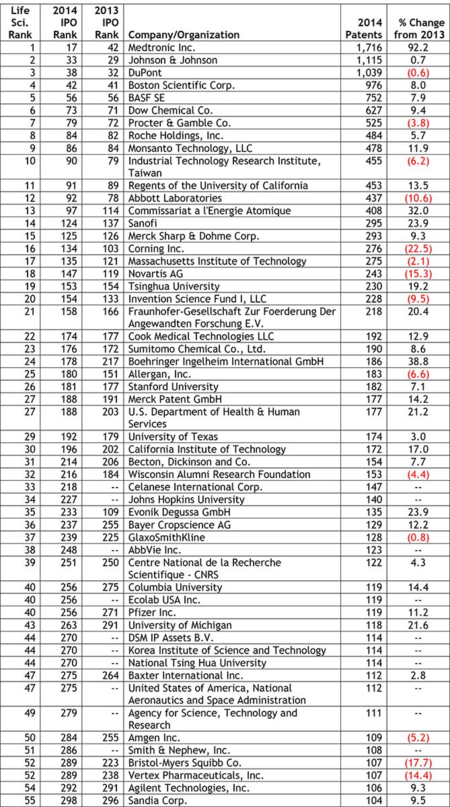
    As in past years, Patent Docs used the IPO's list of top patent holders to compile a list of the top "life sciences" companies and organizations receiving U.S. patents in 2014.  In the past seven years, the number of life sciences companies and organizations making the list has gone from 51 in 2006 to 47 in 2007, 43 in 2008, 47 in 2009, 56 in 2010, 53 in 2011, 50 in 2012, 49 in 2013, and 55 last year.  Each organization's IPO top 300 ranking for 2014 is indicated in the "2014 IPO Rank" column; the IPO top 300 ranking for 2013 (if available) is indicated in the "2013 IPO Rank" column; and the change in number of patents from 2013 is indicated in "% Change from 2013."  The Life Sciences Top 55 is listed below (click on table to expand):

    2014 LS Top 55
    Life sciences companies and organizations that failed to make the IPO top 300 in 2014 after making it in 2013 included Covidien AG (#49 on the IPO top 300 for 2013), Pacesetter, Inc. (271), Life Technologies Corp. (293), and National Taiwan University (296).  UPDATE: A Patent Docs reader reminded that in January 2015, Medtronic, Inc. announced that it had completed the acquisition of Covidien plc.  Medtronic moved from #42 on the IPO Top 300 for 2013 to #17 in 2014.

    Please note that some of the companies and organizations listed above may be involved in work outside the life sciences sector, and therefore, a portion of the patents granted to these companies and organizations may be directed to other than life sciences-related inventions.  In addition, our list includes medical device companies.

    For additional information regarding this topic, please see:

    • "IPO Releases List of Top 300 Patent Holders for 2013," July 7, 2014
    • "IPO Releases List of Top 300 Patent Holders for 2012," June 24, 2013
    • "Another Look at IPO Top 300 and Life Sciences Top 53," June 11, 2012
    • "IPO Releases List of Top 300 Patent Holders for 2011," June 7, 2012
    • "IPO Releases List of Top 300 Patent Holders for 2010," June 30, 2011
    • "IPO Releases List of Top 300 Patent Holders for 2009," May 26, 2010
    • "IPO Releases List of Top 300 Patent Holders for 2008," May 14, 2009
    • "IPO Releases List of Top 300 Patent Holders," May 22, 2008
    • "IPO Posts List of Top 300 Patent Holders," April 20, 2007

  • By Kevin E. Noonan

    Court of Appeals - 3d CircuitEver since the Supreme Court's decision in FTC v. Actavis in 2013, courts (predominantly district courts) have grappled with the scope of the decision.  It was evident that the presence of a large cash payment from the innovator (branded) drug company to the generic challenger as part of a "reverse payment" settlement agreement in ANDA litigation was enough to provoke a "rule of reason" antitrust analysis according to the rubrics set forth in Justice Breyer's opinion.  The more difficult question was whether other forms of consideration could lead to the same result.  A specific type of such "other" compensation from branded plaintiff to generic defendant was a promise by the branded drug maker not to market a so-called "authorized generic" form of the branded drug (i.e., a generic form of the drug marketed by the branded company), especially during the 180-day exclusivity period that a successful generic challenger received for being the "first filer" of an ANDA.  District courts have split on the issue, as shown in this non-exhaustive list:

    In re Nexium (Esomeprazole) Antitrust Litig., 968 F. Supp. 2d 367 (D. Mass. 2013) (no authorized generic; mixed decision on state law)

    In re Wellbutrin XL Antitrust Litig., No. 08cv-2431, DKT No. 534 (E.D. Pa. Jan. 17, 2014) (no authorized generic triggered rule of reason analysis)

    In re Lipitor Antitrust Litigation, 2014 WL 282755 (D.N.J. Jan. 24, 2014) (not limited to cash payments but rather the total value of whatever is transferred from the brand to the generic) (see "Judge Sheridan Dismisses More Plaintiffs in Lipitor Antitrust Case")

    In re Loestrin 24 FE Antitrust Litig., MDL No. 13-2472-S, DKT No. 116 (D.R.I. Sept. 4, 2014) (money means money)

    In re Niapsan Antitrust Litigation, 2014 U.S. Dist. LEXIS 124818 (E.D. Pa. Sept. 5, 2014) (monetary terms not required)

    In re Lipitor Antitrust Litigation, 3:12-cv-02389 (PGS) (Sept 12, 2014) (antitrust allegations dismissed on the pleadings)

    In re Effexor Antitrust Litigation, 11:5479 (PGS) (Oct. 6, 2014) (accord with Lipitor decision)

    And in the District Court decision here (In re Lamictal Direct Purchaser Antitrust Litig. 18 F. Supp. 3d 560, 561 (D.N.J. 2014), the Court held that the Actavis decision was limited to instances where there was a cash payment from the brand company to the generic challenger.

    A more definitive answer (for now) comes from the Third Circuit's decision issued last Friday in the appeal from the Lamictal case.  And the answer is that Actavis is not limited to reverse payment settlement agreements having a cash transfer to the generic, but can also include other types of consideration, in particular a promise from the brand not to market an authorized generic during the 180-day exclusivity period (see opinion).

    Teva #1The Court's rationale (from a panel having no members in common with the panel that decided the K-Dur appeal that prompted Supreme Court review of reverse payment settlement agreements) illustrates the consequences of Justice Breyer's opinion.  The case involved Teva's generic versions of Glaxo-SmithKline's (GSK) Lamictal® (lamotrigine) drug for epilepsy and bipolar disorder; the patent on the drug expired in 2008.  The court considered the antitrust question in view of an earlier (January 2005) decision that claim 1 of the patent was invalid as anticipated by prior art.  The settlement agreement contained three provisions where, in exchange for settling ANDA litigation asserting challenges to GSK's patents, Teva would be allowed to market generic lamotrigine chewables (an annual $50 million market), 37 months before patent expiry and tablets (an annual $2 billion market), at the end of the patent's term.  (The difference in the times of entry and the sizes of the markets played a role in the Court rejecting the argument that the agreement was precompetitive due to early market entry of the generic drug.)  In particular, the agreement contained a provision that Teva's generic tablets and chewables would not face competition from GSK's own "authorized generic."  Plaintiffs here are a class of "direct purchasers" (i.e., wholesale drug sellers).

    GlaxoSmithKline - GSKThe Third Circuit panel vacated the District Court's grant of a motion to dismiss for failure to state a claim under Fed. R. Civ. Pro. 12(b)(6) and remanded.  The Court rejected the argument that the Actavis decision should be limited to cash payments.  Rather, the Court considered the benefit to generic challenger Teva arising from branded drug maker Glaxo SmithKline's agreement not to market an "authorized generic" version of lamotrigine during Teva's 180-day exclusivity period as part of a settlement agreement ending ANDA litigation between the companies.  In making this determination the Court recognized that although there was no frank money payment from GSK to Teva, the complaint recited sufficient allegations that the Court should apply the "rule of reason" to plaintiffs' challenge to the agreement for violating Sections 1 and 2 of the Sherman Act.  Important in its analysis was that GSK would be permitting Teva to be the sole generic entering a $2 billion market for Lamictal® capsules and that the value to Teva was "an unexplained large transfer of value from the patent holder to the alleged infringer" that implicated the rationale provided by the Supreme Court in its Actavis decision for subjecting the agreement to antitrust scrutiny under the rule of reason.

    The Court specifically held that the "no-authorized generic" portion of the agreement "may represent an unusual, unexplained reverse transfer of considerable value from the patentee to the alleged infringer and may therefore give rise to the inference that it is a payment to eliminate the risk of competition" which were the types of agreements (albeit in the context of cash payments) that Actavis held were subject to antitrust scrutiny.

    The Court's prejudices (consistent with the general anti-patent consensus that has arisen in this century) are reflected in how the Court begins it analysis, stating that patents are "the exception to the general rule against monopolies" and that "Patent Clause itself reflects a balance between the need to encourage innovation and the avoidance of monopolies which stifle competition without any concomitant advance in the 'Progress of Science and useful Arts,'" citing Bonito Boats, Inc. v. Thunder Craft Boats, Inc., 489 U.S. 141, 146 (1989) (perhaps the first instance of the Court enunciating Justice Breyer's "Goldilocks" view of this need for balance in patenting).  (It is illustrative that the Court cites in support of this balancing idea a passage from Areeda and Hovencamp's treatise, Antitrust Law, that states "Patent law . . . serves the interests of consumers by protecting invention against prompt imitation in order to encourage more innovation than would otherwise occur.")  And the panel cited Justice Breyer's Actavis decision, specifically the cases cited therein (and rebutted by the Chief Justice in his dissent) to support these prejudices.

    The panel also recognizes that the Court identified reverse payment settlement agreements to be outside the norm because the included large cash settlements from the patentee to the accused infringer (hence the term "reverse payment") and that such settlement terms were extremely unusual and uncommon outside ANDA litigation.  Nevertheless, the panel held that "no authorized generic" agreements could fall within the province of the "five sets of considerations" set forth in Justice Breyer's opinion depending on the value to the generic challenger in having the branded drug maker forswear from marketing its own generic version of a branded drug.  Here, the Court reasoned:

    It seems to us that no-AG agreements are likely to present the same types of problems as reverse payments of cash.  The no-AG agreement here may be of great monetary value to Teva as the first-filing generic.  In Actavis, the Supreme Court recognized generally that the 180-day exclusivity period is "possibly 'worth several hundred million dollars,'" and may be where the bulk of the first-filer's profits lie.

    Citing "evidence" from amicus briefs, the Court then states that:

    There are also plausible indicia that this pattern held true here: the Amici States point out that "[p]ublic records show that generic sales of Lamictal in 2008 were some 671 million dollars," so the no-AG agreement "was clearly worth millions of dollars, if not hundreds of millions of dollars[,] to the generic."

    The FTC also weighed in (to the extent that whatever expertise the Commission has provided support for the Court's opinion), wherein:

    The FTC suggests, using sales of the drug Paxil as a yardstick, that GSK's no-AG agreement would have been worth hundreds of millions of dollars to Teva. [emphasis added]

    (The opinion "explains" in a footnote how "sales of Paxil" can be used as a yardstick for Lamictal sales; the only relevant statistic is the similar market value of Paxil compared with Lamictal immediately prior to generic competition.)

    The panel also considered abstaining from marketing an authorized generic to be equivalent to "transfer[ring] the profits the patentee would have made from its authorized generic to the settling generic — plus potentially more, in the form of higher prices, because there will now be a generic monopoly instead of a generic duopoly."  And this is how the Court makes the equation from frank cash payments to the no authorized generic provisions of this settlement agreement:

    Absent a no-AG promise, launching an authorized generic would seem to be economically rational for the brand.  For this reason, the fact that the brand promises not to launch an authorized generic (thereby giving up considerable value to the settling generic) makes the settlement something more than just an agreed-upon early entry: it "may instead provide strong evidence that the patentee seeks to induce the generic challenger to abandon its claim with a share of its monopoly profits that would otherwise be lost in the competitive market." [citing Actavis]

    The Court also rejected defendants' argument that the "no authorized generic" portion of the agreement was an exclusive license, inter alia because (in a footnote) the panel stated that the agreement was not an exclusive license and in the body of the opinion opined that licensing could not be used solely for anticompetitive effect.

    The result of this decision is that, at least in the Third Circuit, the scope of agreements subject to the rule of reason (or at least not subject to being dismissed for failure to state a claim) includes those having "no authorized generics" provisions in addition to agreements involving cash payments to generic challengers from branded drug makers.  This upsets several earlier decisions in this circuit, and it remains to be seen whether other circuits accept the panel's reasoning in considering this question.

  • By Eddie Obissi and Michael Borella

    Note: This coverage of a district court case from last year provides an overview of the patented invention, as well as the decision currently being appealed to the Federal Circuit.  In a subsequent article, we will review the parties' briefs.

    District Court for the District of DelawareOn November 21, 2012, McRo, Inc., doing business as Planet Blue, initially commenced action in the District Court of the District of Delaware against a number of defendants.  Planet Blue alleged infringement of U.S. Patent Nos. 6,307,576 and 6,611,278, the latter a continuation of the former.  More defendants were added in subsequent suits, and the cases were consolidated and transferred to the Central District of California.  The defendants — now numbering 23 — jointly filed a motion for judgment on the pleadings based on 35 U.S.C. § 101.  On September 22, 2014, District Court Judge Wu ruled for the defendants on the motion.  Planet Blue's appeal to the Federal Circuit is currently pending.

    Ever since the Supreme Court's decision in Alice Corp. v. CLS. Bank Int'l, the federal courts and the U.S. Patent and Trademark Office have struggled to apply the two-step subject matter eligibility test therein.  Last year, Federal Circuit case law refined the boundaries of § 101 to some extent.  In Ultramercial v. Hulu, the Court reiterated that a disembodied method merely using general-purpose technology (i.e., the Internet) fails to meet the requirements of § 101, while in DDR Holdings  v. Hotels.com, the Court stated that a claimed invention that is necessarily rooted in computer technology (e.g., one that changes the technology itself rather than just using it) is patent-eligible.

    While distinguishable, the line between Ultramercial and DDR Holdings is fine.  Patentee and defendant arguments often boil down to whether the claims under dispute are more or less like those of one case or the other.  The present case is being viewed as an opportunity for the Federal Circuit to clarify its interpretation of § 101.  Thus, it is helpful to consider the proceedings in the District Court.

    Judge Wu's patent-eligibility analysis focused on claim 1 of the '576 patent, which recites:

    A method for automatically animating lip synchronization and facial expression of three-dimensional characters comprising:
        obtaining a first set of rules that define output morph weight set stream as a function of phoneme sequence and time of said phoneme sequence;
        obtaining a timed data file of phonemes having a plurality of sub-sequences;
        generating an intermediate stream of output morph weight sets and a plurality of transition parameters between two adjacent morph weight sets by evaluating said plurality of sub-sequences against said first set of rules;
        generating a final stream of output morph weight sets at a desired frame rate from said intermediate stream of output morph weight sets and said plurality of transition parameters; and
        applying said final stream of output morph weight sets to a sequence of animated characters to produce lip synchronization and facial expression control of said animated characters.

    The claimed invention relates to generating automated lip-synchronization and associated facial expression for 3D animated characters.  The prior art generally encompassed a "morph target" approach, where the 3D character's facial orientation would be represented by a vector of values ("morph weights") associated with various vertices disposed across the character's face.  The facial orientation would change based on differences in vertex values from those assigned to the face at rest.  To animate the character's speech, for example, one would manually insert the appropriate morph weights at critical times (in "keyframes") in the associated recording, and a computer program would interpolate between the facial expressions to provide a visual impression of different sounds being uttered.  This process, however, was inefficient and tedious, since many morph targets would need to be manually set in order to make the animated facial expression accurately match the recording.  Planet Blue's contribution was intended to automate this process by feeding time-aligned phonetic transcripts into a computer, and setting rules for how to apply various morph targets to manipulate the 3D character's facial expressions based on this input.

    The defendants argued that, under the post-Alice § 101 framework, the claims of the patents were ineligible because they simply "set forth the previously-known animation method as a series of mathematical steps, and instruct the user to perform those steps on a computer."  To evaluate this argument, Judge Wu focused on interpreting the Alice ruling.

    The first step in the Alice test is whether the claims incorporate a patent-ineligible concept (e.g., an abstract idea, law of nature, or natural phenomenon).  The second step is whether the claims also supply an 'inventive concept' that renders the claims patentable, despite the inclusion of the patent-ineligible concept.  According to this test, an 'inventive concept' is "an element or combination of elements that is sufficient to ensure that the patent in practice amounts to significantly more than a patent upon the ineligible concept itself."  In considering Alice, Judge Wu observed that, "so far, the two-part test for identifying an abstract idea appears to be of limited utility, while comparisons to previously adjudicated patents — or more precisely, to past cases' characterizations of those patents — have done the heavy lifting."  Despite criticizing the Alice opinion as setting forth an "I know it when I see it" test, he shrugged off the implications thereof and noted "[i]n any event, the Supreme Court has spoken, and § 101 now plays an important limiting role."

    Beginning his substantive analysis, Judge Wu wrote a section entitled "The Claims, In Isolation, Appear Tangible and Specific."  He observed that the claims did not appear to preempt all uses of rules for 3-D lip synchronization.  He further noted that the claims did not preempt the prior art methods of computer-assisted lip synchronization.  Thus, Judge Wu admitted that "[a]t first blush, it is therefore difficult to see how the claims might implicate the basic underlying concern that these patents tie up too much future use of any abstract idea they apply."

    After making these remarks that seemed encouraging for the patentee, Judge Wu determined that "it is not enough to view the claims in isolation."  Rather, he carried out an analysis that is reminiscent of the abstraction-filtration-comparison test for substantial similarity of computer programs described in the copyright case of Computer Associates International, Inc. v. Altai, Inc.  First, he decided that in § 101 analyses, it is appropriate to remove "conventional activity."  Thus, if the elements of the claims not covered by the prior art are directed to an abstract idea, the invention can be patent-ineligible under § 101.  Such a method of claim evaluation has been called a "point of novelty" analysis.

    Applying Alice to the claims, Judge Wu found the point of novelty of Planet Blue's claims to be "the idea of using rules, including timing rules, to automate the process of generating keyframes."  Working against Planet Blue throughout this analysis was its own admitted prior art.  Judge Wu was able to form a claim chart mapping most of the claim elements to features described as prior art in the '576 patent.  After making this comparison, Judge Wu characterized the point of novelty as simply using rules, rather than people, to set the morph targets in achieving the same result of 3D lip synchronization.

    He noted that, in claiming the novel portion of the invention, the patentees described these concepts "at the highest level of generality."  The invention did not specify the exact rules to be applied in generating the morph targets, and stipulated that the user should set them to her preference.  Judge Wu found that, because the patent purported to claim all such rules but described just one set of example rules, the claims merely state an abstract idea and tell one to apply it.  Consequently, the claims do not supply an inventive concept under Alice.  Though his reasoning is couched in terms used by the Supreme Court in Alice, it simply masks Judge Wu's true argument — that Planet Blue claimed its invention too broadly (Judge Wu's focus on the specification's level of descriptive detail for the determination of an 'inventive concept' is similar to the approach that we have recently seen in Internet Patents Corp. v. Active Network, Inc.).

    Thus, despite his initial observation that the claims did not seem unduly preemptive, Judge Wu found that the claimed invention preempted "the field of automatic lip synchronization for computer-generated 3D animation . . . using a rules-based morph target approach."  And also despite stating that "the [§ 112] written description requirement guards against claims that merely recite a description of the problem to be solved while claiming all solutions to it" he made this finding under the auspices of § 101.  In short, Judge Wu used patent-eligibility to make a written description and enablement argument, and justified it by saying that the claims preempted what is indisputably a very narrow field.

    Nor did inventiveness make the claims patentable.  Not unlike the Federal Circuit in Ultramercial, Judge Wu found that novelty does not necessarily preclude a finding of invalidity under § 101.  Evidence that one of the defendants called the invention "revolutionary" similarly failed to sway the decision.  Judge Wu declared that "for purposes of the § 101 inquiry, which is different from the § 103 inquiry, the revolutionary nature of an abstract idea does not weigh in favor of patentability."  To make this point, he cited Mayo Collaborative Services v. Prometheus Laboratories, Inc., where the Supreme Court gave Einstein's mass-energy equivalence in his Theory of Special Relativity as an example of something that would not be patentable under § 101.

    Judge Wu's application of the Alice framework to the patents in dispute has been subject to criticism.  Perhaps the most comprehensive overview of this case is District Court Judge Pfaelzer's analysis in California Institute of Technology v. Hughes Communications.  Judge Pfaelzer offered three substantive critiques of Judge Wu's application of the Alice framework.

    First, she asserted that Diamond v. Diehr represented an affirmative step by the Supreme Court to reject the point of novelty approach engendered in its previous decision in Parker v. Flook.  She noted that neither Bilski, nor, Mayo, nor Alice, nor any relevant precedent had revived the analysis in § 101 decisions.  Therefore it was inappropriate for Judge Wu to "dissect . . . a claim into old and new elements" when evaluating an abstract idea under the Alice framework.

    Second, Judge Pfaelzer found that Judge Wu had conflated step one and step two of the framework.  By filtering the claim elements before determining that an abstract idea existed, he had ignored that Mayo and Alice dictate that an abstract idea be determined before evaluating whether the claims add "something more."  This point also makes clear that Judge Wu's prior assertion that using step two to find a patent valid means that "there was a categorization error . . . in step one," is not the case.  Rather, Judge Pfaelzer's point elucidates the notion accepted by the Supreme Court in Alice and Mayo that all inventions, to some degree, encompass abstract ideas.

    Indeed, Alice, Mayo, and Diehr all require that claims should be considered "as a whole" or as "an ordered combination."  Step two of the Alice test allows conventional aspects of a claim to be ignored during the 'something more' determination.  But there is no authority for such piecemeal analysis during step one.

    Third, Judge Pfaelzer attacked the functional implications of Judge Wu's approach.  Judge Pfaelzer went to some lengths to establish that software is still patentable after Alice, not only because of congressional recognition of such patents in the America Invents Act, but also because of express language in the Supreme Court's analysis in Alice.  However, she found that "it is difficult to imagine any software patent that survives under [Planet Blue's] approach."  Thus, she declared that Judge Wu's § 101 analysis of the invention "appears to reach the wrong conclusion."

    Nearly all judges applying the Alice framework have noted that § 101 is a murky area of law, especially in the context of software inventions.  That being said, Judge Wu used a rationale based on a partial prior art and written description analysis to invalidate the patent under § 101.  This point of novelty approach to patentability is subjective and has led to a counter-intuitive result — an innovative, "revolutionary" patent being struck down as "too broad," even when there is no prior art of record that discloses or suggests the claimed invention as a whole.

    But even if the Federal Circuit disagrees with Judge Wu's analysis, it may come to the same ultimate conclusion.  Based on Alice, Mayo, Ultramercial, and DDR, one can craft reasonable arguments that could find Planet Blue's patent valid or invalid under § 101.  Unfortunately, this case boils down to whether the Federal Circuit truly knows a patent-eligible claim when they see it.


  •         By Sherri Oslick

    Gavel About Court Report:  Each week we will report briefly on recently filed biotech and pharma cases.

    Teijin Ltd. et al. v. Macleods Pharmaceuticals Ltd. et al.
    1:15-cv-00454; filed June 4, 2015 in the District Court of Delaware

    • Plaintiffs:  Teijin Ltd.; Teijin Pharma Ltd.; Takeda Pharmaceuticals U.S.A., Inc.
    • Defendants:  Macleods Pharmaceuticals Ltd.; Macleods Pharma USA, Inc.

    Infringement of U.S. Patent No. 7,361,676 ("Solid Preparation Containing Single Crystal Form," issued April 22, 2008) following a Paragraph IV certification as part of Macleods' filing of an ANDA to manufacture a generic version of Takeda's Uloric® (febuxostat, used for the chronic management of hyperuricemia in patients with gout).  View the complaint here.

    Takeda Pharmaceutical Co. Ltd. et al. v. Actavis Laboratories FL, Inc. et al.
    1:15-cv-00451; filed June 3, 2015 in the District Court of Delaware

    • Plaintiffs:  Takeda Pharmaceutical Co. Ltd.; Takeda Pharmaceuticals International GmbH; Takeda Pharmaceuticals USA, Inc.; Takeda Pharmaceuticals America, Inc.; Orexigen Therapeutics, Inc.
    • Defendants:  Actavis Laboratories FL, Inc.; Actavis Pharma, Inc.; Andrx Corp.; Actavis, Inc.

    Infringement of U.S. Patent Nos. 7,375,111 ("Compositions for Affecting Weight Loss," issued May 20, 2008), 7,462,626 (same title, issued December 9, 2008), 8,088,786 ("Layered Pharmaceutical Formulations," issued January 3, 2012), 8,318,788 (same title, issued November 27, 2012), 8,722,085 ("Methods for Administering Weight Loss Medications," issued May 13, 2014), 8,815,889 ("Composition and Methods for Increasing Insulin Sensitivity," issued August 26, 2014), and 8,916,195 ("Sustained Release Formulation of Naltrexone," issued December 23, 2014) following a Paragraph IV certification as part of Actavis' filing of an ANDA to manufacture a generic version of Takeda's Contrave® (naltrexone hydrochloride and bupropion hydrochloride, used as an adjunct to a reduced-calorie diet and increased physical activity for chronic weight management in adults with an initial body mass index (BMI) of (1) 30 kg/m2 or greater (obese), or (2) 27 kg/m2 or greater (overweight) in the presence of at least one weight-related comorbidity).  View the complaint here.


    Jazz Pharmaceuticals, Inc. v. Roxane Laboratories, Inc.
    2:15-cv-03684; filed June 1, 2015 in the District Court of New Jersey

    Infringement of U.S. Patent No. 8,952,062 ("Microbiologically Sound and Stable Solutions of Gamma-Hydroxybutyrate Salt for the Treatment of Narcolepsy," issued February 10, 2015) following a Paragraph IV certification as part of Roxane's filing of an ANDA to manufacture a generic version of Jazz's Xyrem® (sodium oxybate, used to treat narcolepsy).  View the complaint here.

  • CalendarJuly 8-10, 2015 – Fundamentals of Patent Prosecution 2015: A Boot Camp for Claim Drafting & Amendment Writing (Practising Law Institute) – San Francisco, CA

    July 9, 2015 – "Leveraging Post-Grant Patent Proceedings Before the PTAB — Best Practices for Patentees and Third Parties in Inter Partes Review, Post-Grant Review and Covered Business Method Patent Challenges" (Strafford) – 1:00 to 2:30 pm (EDT)

    July 14, 2015 – Patent Quality Chat webinar series – Face-to-face Examiner Interviews: A Demonstration of USPTO Tools – noon to 1:00 pm (EDT)

    July 20-21, 2015 – Patent Cooperation Treaty Seminar (American Intellectual Property Law Association) – San Francisco, CA

    July 23-24, 2015 – Patent Cooperation Treaty Seminar (American Intellectual Property Law Association) – Alexandria, VA

    August 11, 2015 – Patent Quality Chat webinar series – Measuring Patent Quality – noon to 1:00 pm (EDT)

    August 12-14, 2015 – Advanced Patent Law Seminar (Chisum Patent Academy) – Seattle, WA

    ***Patent Docs is a media partner of this conference or CLE

  • AIPLA #1The American Intellectual Property Law Association (AIPLA) will be its 19th annual Patent Cooperation Treaty Seminar on July 20-21, 2015 in San Francisco, CA and on July 23-24, 2015 in Alexandria, VA.  The Seminar is designed for practicing attorneys, patent agents, paralegals and administrators who want to learn more about PCT rules, procedures, practices, and strategies.

    For newcomers to the PCT, there will be a one-hour "PCT Primer" webinar from 12:30 to 1:30 pm (EDT) on July 14, 2015.  The webinar, which is free to all PCT Seminar registrants, will provide an overview of the PCT system and the basics of filing a PCT application.

    An online agenda for the seminar can be viewed here.

    The registration fee for the conference is $295 (AIPLA member – Student/Government/Corporate in-house counsel Member), $445 (Non-Member – Government/Corporate in-house counsel), $645 (AIPLA Member), or $945 (Non-Member).  Those interested in registering for the conference can do so here.

  • The More Things Change (Lighting Ballast Control LLC v. Philips Electronics North America), the More They Stay the Same (Teva Pharmaceuticals USA, Inc. v. Sandoz Inc.)

    By Andrew Williams

    On June 18, 2015, the Federal Circuit handed down its second opinion in the Teva Pharmaceuticals USA v. Sandoz Inc. case.  And, much like with the first opinion in 2013, the Court reversed the District Court's holding with regard to claim 1 of U.S. Patent No. 5,800,808 ("the '808 patent") — the only patent still pending.  A split panel decided that, even though the District Court made factual determinations about how one skilled in the art would understand this claim, specifically the claim term "molecular weight," the claim was nevertheless indefinite.  Of course, in the interim, for the same case, the Supreme Court reversed long standing Federal Circuit precedent regarding the level of deference to be afforded a District Court's factual determinations during claim construction.  Or at least it thought it did.  Judge Moore, writing the opinion for the Court, stated that it did not matter if they gave deference to the lower court in this case.  In contrast, on June 23, 2015, the Federal Circuit determined in the Lighting Ballast Control LLC v. Philips Electronics North America remand that the deference to which the District Court's factual determinations were entitled dictated affirmance.

    Teva #2The background of the Teva case has been addressed in previous posts (see "Teva Pharmaceuticals USA, Inc. v. Sandoz, Inc. (Fed. Cir. 2013)")  Basically, this case involves the drug Copaxone®, which was approved for the treatment of multiple sclerosis.  The active ingredient is copolymer-1, or glatiramer acetate, which is a polypeptide product that consists of four different amino acids (alanine, glutamic acid, lysine, and tyrosine).  Copolymer-1, however, is a mixture of individual polymer molecules with different constituent ratios, and different molecular weights.  Therefore, it is often expressed as "average molecular weight."  Statistically speaking, though, there are at least three ways to calculate average molecular weight:  peak average molecular weight (Mp), number average molecular weight (Mn), and weight average molecular weight (Mw).  Mp is the molecular weight of the most abundant molecule in the sample; Mn is the combined total mass of all of the molecules in the sample divided by the total number of molecules; and Mw is similar to number average molecular weight, except instead of dividing the sample by total number of molecules, you take into account the weight fraction of each molecule.

    Teva's specification was silent as to which molecular weight measurement was used, or the appropriate way to measure it.  The only mention was to the use of size exclusion chromatography (SEC), which can be used to obtain all three values.  Moreover, the applicants made statements in related cases that compounded the problem.  First, in the prosecution history of one of the patents, the applicants said that "[o]ne of ordinary skill in the art, upon reviewing the specification, would understand that 'average molecular weight' refers to the molecular weight at the peak of the molecular weight distribution curve," or Mp.  However, in response to an identical rejection in an earlier related application, the patentees said that ""[o]ne of ordinary skill in the art could understand that kilodalton units implies [sic] a weight average molecular weight," or Mw.  Teva's expert explained that one skilled in the art would have understood that average molecular weight could only be Mp because the use of SEC without more would suggest it (because determining Mn and Mw would require additional calculations).  The District Court found this testimony credible.  Moreover, the District Court found that one skilled in the art would have recognized that the statement in the one application file history was false.  In the first Teva v. Sandoz opinion, the Federal Circuit did not credit these findings and held the claims with this claim term to be indefinite.

    On remand from the Supreme Court, the Federal Circuit clarified that the only relevant evidence was intrinsic.  As such, even under the Supreme Court's analysis, whether the claims were indefinite was purely a legal question.  In fact, this is not inconsistent with the original Federal Circuit holding:  "On de novo review of the district court's indefiniteness holding, we conclude that Dr. Grant's testimony does not save Group I claims from indefiniteness."  Just to be clear, the Court acknowledged that it found no error with the District Court's determination of how a skilled artisan would have understood the teaching of the specification ("And we see no clear error in that fact finding — that one of skill in the art could read Mp from a chromatogram without further calculation and that Mw or Mn would both require further calculations.").  This factual finding, however, did not change the fact that there are at least three different types of "average molecular weight" that are calculated three different ways and could give three different values.  In fact, neither party disputed that there was "no express definition" for the claim term, and that the terms Mp, Mw, and Mn were not used in the specification.

    The case, therefore, turned on the "internal coherence and context assessment" test articulated by the Federal Circuit.  In fact, the Court stated that this test was itself a question of law that could not be converted to a factual question by the introduction of expert testimony.  As such, the testimony of Teva's expert did nothing to resolve the ambiguity of which molecular weight measurement to use.

    In addition, when the Federal Circuit first decided the case, it found that the contradictory statements in the prosecution history of related applications rendered the ambiguity of the claim term insoluble.  Of course, in the interim, the Supreme Court rejected the "insolubly ambiguous" standard, and articulated the "reasonable certainty" standard in the Nautilus, Inc. v. Biosig Instruments, Inc. case.  As the Federal Circuit noted, somewhat snarkily, when it decided that case on remand "[t]he Court has accordingly modified the standard by which lower courts examine allegedly ambiguous claims; we may now steer by the bright star of 'reasonable certainty,' rather than the unreliable compass of 'insoluble ambiguity.'"  Therefore, even assuming that a skilled artisan would recognize the scientifically erroneous claim made by the patentees, the specification would still not have informed a person of ordinary skill in the art of the scope of the invention with reasonable certainty.

    Interestingly, the only Judge on the current panel that was on the panel in 2013 was Judge Moore, who wrote the opinion for the Court in both instances.  In the 2013 Teva v. Sandoz case, then-Chief Judge Rader and District Judge Benson of the District of Utah sitting by designation completed the panel.  On remand, these two judges were replaced by Judges Mayer and Wallach.  You probably could not find a member of the Federal Circuit that has been more outspoken against the de novo standard of claim construction review as Judge Mayer.  It seemed almost fitting that he had an opportunity to dissent from this case.

    In dissent, Judge Mayer cited the Supreme Court in Teva: "'[I]n some instances, a factual finding may be close to dispositive of the ultimate legal question of the proper meaning of [a claim] term in the context of [a] patent."  It stood to reason, therefore, that this was "such a case."  Not surprisingly, Judge Mayer criticized the majority for not giving the District Court's "extensive fact-finding" any deference.  In cases with complex technology, he pointed out, it is often necessary to look outside the patent and its prosecution history.  Perhaps in an attempt to trigger another bite at the Supreme Court apple, a disproportionate number of Judge Mayer's citations were to Supreme Court precedent — some dating back to the 1800s.  Judge Mayer was also critical of the citation to the prosecution history — because even though statements made in the prosecution of related applications may be used to interpret claims, the same is not true to find a claim indefinite.  This is even truer when the erroneous or conflicting statements came years after the patent at issue issued.  However, the majority would likely agree with this sentiment — the issue for them was not that the erroneous statements damned the claims, but that a skilled artisan's recognition of this erroneous statement would not have saved the claims.

    The Federal Circuit came to almost the opposite outcome in the remand from Lighting Ballast Control LLC v. Philips Electonics North America.  That case had an even more complicated history.  The District Court had first determined (in part) that the claim term "voltage source means" was governed by 35 U.S.C. § 112, ¶ 6, and was therefore indefinite because the specification did not disclose sufficient structure.  Then it reversed itself when deciding a motion for reconsideration because it did not give sufficient weight to the expert testimony about how those skilled in the art would understand the specification.  The Federal Circuit disagreed and reversed.  This set the stage for the Lighting Ballast en banc decision, in which the Court reaffirmed the de novo standard of review for all claim construction issues.  Of course, this decision was short lived in view of the Supreme Court's Teva decision.

    Lighting Ballast returned to the Federal Circuit after its prior en banc decision was vacated and remanded.  This time, because it could not say that the District Court's factual determinations were clearly erroneous, it affirmed the lower court's determination that the specification provided the requisite structure and that the claims were therefore not indefinite.  Even though the outcome was different than the Teva remand, these cases were distinct enough to support such outcomes.  In this case, the expert testimony was used to explain what the specification meant.  In contrast, the expert testimony in the Teva case was cast as supplementing missing information from the specification — mainly which molecular weight measurement to use.  It therefore didn't matter how a skilled artisan would have interpreted a particular figure or a statement in the prosecution history — the claim term could have been one of three different possibilities and nothing in the intrinsic record resolved that issue.  It will nevertheless be interesting to see how subsequent cases are decided, and whether this decision will stave off the feared use of expert testimony in every claim construction proceeding (see "Teva Pharmaceuticals USA, Inc. v. Sandoz Inc. (2015)").  Somehow, this scenario seems unlikely.

  • By Kevin E. Noonan

    PfizerOver seven years ago, the Federal Circuit delivered a mixed ruling against Pfizer in litigation against Teva) relating to the pain medication Celebrex® (celocoxib) (where "celocoxib" is 4-[5-(4-methylphenyl)-3-(trifluoromethyl)-1H-pyrazol-1-yl]benzenesulfonamide).  In that case, Pfizer, Inc. v. Teva Pharmaceuticals USA, Inc. (Fed. Cir. 2008), the Court upheld a District Court determination that Teva was liable for infringing a trio of Pfizer patents (U.S. Patent Nos. 5,466,823; 5,563,165; and 5,760,068) but reversed the District Court's determination that the claims of the '068 patent were not invalid for obviousness-type double patenting.  Pfizer took steps to remedy the deficiency of the claims of the '068 patent by reissue, but those efforts were deemed insufficient in a decision handed down today in G.D. Searle LLC v. Lupin Pharmaceuticals Inc. et al.

    This case involved ANDA litigation against five generic defendants (Lupin, Teva Pharmaceuticals USA Inc., Mylan Pharmaceuticals Inc., Watson Laboratories, Inc., Apotex Inc. and Apotex Corp.), again related to generic Celebrex.  The basis for the Court's earlier determination that the '068 patent was invalid for obviousness-type double patenting was that the designation of this patent as a "continuation-in-part" was not merely semantic but had substantive repercussions regarding whether the '068 claims were entitled to the "safe harbor" provisions of 35 U.S.C. § 121.  These provisions entitle a divisional application filed as the result of a restriction requirement (a Patent Office determination that an applicant has filed claims directed to more than one invention) to be exempt from obviousness-type double patenting, and illustrate Congressional intent (from the legislative history of the 1952 Patent Act) to prevent the unfairness of forcing an applicant to be required to file a divisional application based on claiming "independent inventions" through restriction while permitting the original application to be used as "prior art" in a obviousness-type double patenting rejection.  The Federal Circuit considered it also Congress's intent to restrict the safe harbor to divisional applications (which have an identical specification to the originally-filed application) and keep any claims in such a divisional application strictly within the bounds of what had been determined to be a separate invention.  This meant, for example, that an applicant would not be able to include claims in a divisional that were within the scope of any claims previously elected for examination.  In this way applicants would be precluded from inequitably increasing patent term while not being penalized for electing one invention and pursuing additional inventions in divisional applications.

    The lineage of the '068 patent began with U.S. patent application No. 08/160,594 in which the U.S. Patent and Trademark Office imposed a three-way restriction requirement:  to the claimed compounds per se, compositions of said compounds and methods of use for treating inflammation and resulting pain without the side effects of conventional non-steroidal anti-inflammatory compounds.  The compound claims were elected and granted as U.S. Patent No. 5,466,823 and the composition claims pursued in a divisional application (Serial No. 08/457,059) that issued as U.S. Patent No. 5,563,165.  Both the '823 and '165 patents have expired.

    Pfizer did not pursue the method of treatment claims in a divisional application but instead filed a continuation-in-part application that contained additional disclosure (including previously undisclosed compounds) as well as claims to the three classes of inventions that were subject to restriction in the '594 application.  The U.S. application issued as U.S. Patent No. 5,521,207 and is also expired.  However, this application was the priority document for a PCT (International) Application that entered the national phase in the U.S. as Serial No. 08/648,113.  In that application the PTO imposed a unity of invention/restriction requirement along exactly the same lines as in the '594 application, requiring the applicant to choose between claims to the compounds, compositions, and method of treatment claims.  Pfizer chose to pursue the method of treatment claims and these claims ultimately granted in the '068 patent.

    In the earlier litigation, the Federal Circuit found that the claims of the '068 patent did not fall within the safe harbor because it was a continuation-in-part application, not a divisional.  Such a "CIP" application by definition contains some of the disclosure of an earlier-filed application in addition to new disclosure.  Because of this distinction, the Federal Circuit found that CIP applications could not fall within the safe harbor because they could encompass additional information (and patentable inventions) that were not a part of the original, restricted claims.

    After receiving this decision, Pfizer filed reissue application No. 12/205,319 under 35 U.S.C. § 251 seeking to amend the '068 patent to conform to the requirements for a divisional application.  According to the panel decision today, in its reissue declaration "Pfizer asserted that it had erred in prosecuting the application leading up to the '068 patent as a continuation-in-part, rather than as a divisional application, and that the error had resulted in invalidating the relevant claims of the '068 patent for obviousness-type double patenting."  Pfizer filed a preliminary amendment wherein:

    (1) it deleted portions of the '068 patent specification that were not present in the '594 application; (2) it designated the '113 application as a divisional of the '594 application and removed the priority claim to the '629 application; (3) it amended claim 1 to be a method claim using only the compounds originally disclosed in the '594 application; (4) it canceled claims 2-12, which were method claims using compounds that were not present in the '594 application; (5) it canceled claim 18 (reciting a method of preventing colorectal cancer), which was not found in the '594 application; and (6) it added new method claims 19-23, which recited the use of the method disclosed in claim 1 to treat five specific types of inflammation-associated disorders.

    Initially the PTO rejected the reissue application on the grounds that these changes were not the types of error intended to be remedied by reissue; in response Pfizer amended its amendment to assert "various technical errors" that Pfizer contended rendered the claims indefinite, and on that basis the reissue application was permitted to continue.  Pfizer then made the changes in the original version of the application and the application granted as RE44,048.

    The District Court held that these corrections were not correctable under the reissue statute, and that the claims in the '048 reissue patent were not entitled to the safe harbor under 35 U.S.C. § 121 and thus were invalid for obviousness-type double patenting.

    The Federal Circuit affirmed, in an opinion by Judge Bryson joined by Chief Judge Prost and Judge Hughes.  The opinion recognized the question of the propriety of the reissue application under § 251 but was content to limit the decision to the absence of the safe harbor under § 121 for the reissue claims.  The panel expressly rejected Pfizer's argument that the restriction requirement from the '594 application extended to the national phase of the PCT application, despite the similarities in the nature of three classes of claims in each.  The panel reasoned that this cannot be the case because the national phase '113 application contained new matter not contained in the '594 application and thus was properly treated as a continuation-in-part (the earlier case had expressly held that CIPs were not entitled to the safe harbor provisions of § 121).  In this regard the panel rejected the changes in the reissue application, stating that "[s]imply deleting that new matter from the reissue patent does not retroactively alter the nature of the '113 application."

    The opinion also raises the equities (between Pfizer and the public) involved:

    Moreover, when the '113 application issued as the '068 patent in June 1998, Pfizer obtained patent protection for the new matter that was not present in the '594 application.  For years thereafter, the public was not free to practice that new matter (e.g., the now cancelled claims 2-12 and 18 of the '068 patent) because of that patent protection.  Pfizer cannot now identify the '113 application as a divisional of the '594 application (for purposes of section 121) and retroactively relinquish the new matter in the '113 application, after having enjoyed years of patent protection for it.  See In re Harita, 847 F.2d 801, 809 (Fed. Cir. 1988) ("In any given case, the [reissue] statute should be so applied to the facts that justice will be done both to the patentee and the public."); see also In re Serenkin, 479 F.3d 1359, 1362 (Fed. Cir. 2007) ("[Section] 251 is based on fundamental principles of equity and fairness[.]").  Fairness to the public does not permit Pfizer to convert the '113 application into a division of the original '594 application, and thereby take advantage of the safe harbor provision, simply by designating it as a divisional application years after the fact.

    (This rationale also applies to the foreign patents arising from the PCT application, whose status has not changed.)

    The opinion also sets forth as a basis for its decision its determination that the restriction requirement in the '113 application is not the same as the restriction requirement in the '594 application (despite their similarities).  The panel states that the claims in divisional applications must be "derived from the same restriction requirement," citing its earlier opinion regarding this patent family and also Boehringer Ingelheim Int'l GmbH v. Barr Labs., Inc., 592 F.3d 1340, 1354 (Fed. Cir. 2010), stating:

    When separate restriction requirements are imposed on separate applications and the record does not show that any of the various restriction requirements carried forward from one application to the next, the earlier restriction requirement cannot be viewed as having continued in effect with respect to the later-filed application [citing Bristol-Myers Squibb Co. v. Pharmachemie B.V., 361 F.3d 1343, 1349-50 (Fed. Cir. 2004)].

    The record here was that there were two separate restriction requirements asserted in two related but distinct (regarding the disclosure in the specification and the subject matter of the claims) applications, and that these differences precluded the restriction requirement imposed in the '594 application from having "carried over" to the '113 application (and the panel noted there was no evidence that the '113 application examiner referenced or was even aware of the restriction in the '594 application).  And the Court expressly rejected Pfizer's "but for" argument with regard to the requirement imposed in the '594 application (that "but for" that restriction the method of treatment claims would have been prosecuted in the '594 application).

    While this decision is entirely consistent with the Court's earlier Pfizer decision, it does illustrate how stringently the Court has and intends to apply the law of obviousness-type double patenting for pharmaceutical patents.

    G.D. Searle LLC v. Lupin Pharmaceuticals, Inc. (Fed. Cir. 2015)
    Panel:  Chef Judge Prost and Circuit Judges Bryson and Hughes
    Opinion by Circuit Judge Bryson