• Strafford #1Strafford will be offering a webinar/teleconference entitled "Defending Patents in IPR Proceedings — Leveraging Motions to Amend and Preliminary Responses, Weighing Secondary Considerations" on August 13, 2015 from 1:00 to 2:30 pm (EDT).  Michael J. Flibbert of Finnegan Henderson Farabow Garrett & Dunner, John C. Jarosz of Analysis Group, and Maureen D. Queler of Finnegan Henderson Farabow Garrett & Dunner will provide guidance to counsel representing patent owners in defending their patents in inter partes review (IPR) challenges, and discuss IPR strategy, tools the patent owner has in his toolbox, and best practices for minimizing risk of cancellation.  The webinar will review the following questions:

    • What strategies have patent owners used to achieve a successful result in IPR proceedings?
    • What advantage does a patent owner have when an expert is involved in planning IPR strategy?
    • How can patent counsel leverage motions to amend or preliminary responses in IPR defense?

    The registration fee for the webinar is $297 ($362 for registration and CLE processing).  Those registering by July 24, 2015 will receive a $100 discount ($165 discount for registration and CLE processing).  Those interested in registering for the webinar, can do so here.

  • By Andrew Williams

    Federal Circuit SealAs we reported earlier, the Federal Circuit recently affirmed the PTAB's Final Written Decision in the Versata Development Group v. SAP America, Inc. case — the first appeal under the covered business method ("CBM") patent review procedure.  In so doing, the Court made several ancillary determinations, such as whether the PTAB properly concluded that the patent-at-issue was a "CBM" patent, and if so, whether it was a technological invention (which would have excluded it from review).  Judge Hughes agreed with the majority that the '350 patent claims in that case were invalid under 35 U.S.C. § 101, so he agreed that the Court should have affirmed the Board's ultimate decision.  However, Judge Hughes believed that the AIA took away the Court's jurisdiction to review any aspect of the decision to institute, including the determination whether the patent falls within the scope of CBM patent review.  Moreover, he found the majority's attempts to distinguish the case from In re Cuozzo to be unpersuasive.  Nevertheless, Judge Hughes' dissent highlights a division that now exists at the Federal Circuit regarding PTAB post-grant-review-proceeding appeals that do not directly address the merits of the Final Written Decision.  Patent Owners would be well-advised to frame such appeals as a question of the Board's "ultimate authority to invalidate," rather than a question of the Board's authority to institute.

    In explaining his position, Judge Hughes logically started with the wording of the statute.  35 U.S.C. § 324(e) states: "The determination by the Director whether to institute a post-grant review under this section shall be final and nonappealable."  As such, he explained, there is an unambiguous bar to judicial review at any time.  This is supported by 35 U.S.C. § 329, which provides that:  "A party dissatisfied with the final written decision of the [Board] under section 328(a) may appeal the decision [to the Federal Circuit.]" (emphasis added).  This position is also supported by the structure for the PTAB patent trials established by the AIA, by which the decision to institute is considered to be final, and therefore is not revisited during the merits phase of review (the trial).  Finally, Judge Hughes noted that his interpretation is also supported by the purpose behind these post-grant review proceedings.  Congress intended them to be a quick and cost-effective alternative to district court litigation, but if the Federal Circuit was able to second guess every decision to institute, especially after the parties and the Board had expended significant resources to reach the Final Written Decision, this goal would be frustrated.

    The majority, however, would not have necessarily disagreed with this analysis by Judge Hughes.  Instead, the majority made a distinction between the decision to institute and the Board's "invalidation authority under § 18" (which would fall outside the scope of § 324(e)).  In other words, the majority essentially said (at least according to Judge Hughes) that if a patent is not properly subject to CBM review, that patent should not have been ultimately invalidated, and because of that we can review that issue.  Of course, the dissent points out that this would eviscerate § 324(e), because properly viewed, every institution decision would look this way.

    The crux of the distinction would appear to be found in the Cuozzo decision itself.  Even though Judge Hughes believes that this prior case controls here, the majority pointed to an important distinction found in that decision.  In Cuozzo, the Board instituted a ground of obviousness that was not present in the filed petition.  All of the invalidating art was present in the petition, but the Board crafted its own obviousness rejection based on its selection of this art.  The Federal Circuit noted that they could not review this institution, in part, because the alleged defect was cured.  In other words, the petitioner could have drafted a proper obviousness ground.  In the present case, if the patent was not subject to CBM review, the defect could not be cured — or put another way, it would not have been possible for the petitioner to have crafted a valid ground of rejection.  Even though Judge Hughes did not agree with this reading of the Cuozzo decision, he did highlight the fact that this is now a valid mechanism to challenge an issue that might otherwise be framed as one related to institution.  Instead, a patent owner wishing to appeal such an issue related to the decision to institute would be wise to frame that question as one of the Board's ultimate authority to invalidate if they wish to have any success at the Federal Circuit.  Of course, unfortunately, that advice does not run both ways.  If a petitioner wishes to appeal a Final Written Decision upholding the validity of a patent, or some of its claims, the petitioner will most likely not want to argue that the trial should not have been instituted in the first place.

  • By Michael Borella

    Federal Circuit SealSection 18 of the Leahy-Smith America Invents Act (AIA) established a transitional program through which the USPTO conducts post-grant reviews of covered business method (CBM) patents.  For the most part, § 18 incorporates the procedural aspects of 35 U.S.C. §§ 321–329, which codifies post grant reviews.  The CBM review process is an attempt by Congress to address perceived litigation abuses involving business method patents.

    In April 2007, Versata sued SAP for infringement of U.S. Patent No. 6,553,350 in the District Court for the Eastern District of Texas.  Versata prevailed at trial.  SAP appealed to the Federal Circuit, which affirmed the verdict.  In September 2012, during these proceedings, SAP petitioned the USPTO's Patent Trial and Appeal Board (PTAB) for a CBM review of the '350 patent.  SAP challenged the patent's validity under 35 U.S.C. §§ 101, 102, and 112.  In June 2013, the PTAB ruled, finding claims 17 and 26-29 invalid under § 101.

    Versata appealed this decision to the Federal Circuit, raising both procedural and substantive issues with respect to the PTAB's handling of the case.  In a lengthy opinion by Judge Plager, the Court affirmed the PTAB's decision.  Judge Newman joined the opinion, while Judge Hughes concurred in part and dissented in part.  The majority opinion will be discussed herein.

    Claim 17 of the '350 patent recites (formatted for readability):

    A method for determining a price of a product offered to a purchasing organization comprising:
        arranging a hierarchy of organizational groups comprising a plurality of branches such that an organizational group below a higher organizational group in each of the branches is a subset of the higher organizational group;
        arranging a hierarchy of product groups comprising a plurality of branches such that a product group below a higher product group in each of the branches in a subset of the higher product group;
        storing pricing information in a data source, wherein the pricing information is associated with (i) a pricing type, (ii) the organizational groups, and (iii) the product groups;
        retrieving applicable pricing information corresponding to the product, the purchasing organization, each product group above the product group in each branch of the hierarchy of product groups in which the product is a member, and each organizational group above the purchasing organization in each branch of the hierarchy of organizational groups in which the purchasing organization is a member;
        sorting the pricing information according to the pricing types, the product, the purchasing organization, the hierarchy of product groups, and the hierarchy of organizational groups;
        eliminating any of the pricing information that is less restrictive; and
        determining the product price using the sorted pricing information.

    Put in simpler terms, the '350 patent is directed to creating hierarchies of customer groups and product groups, then assigning prices to products based on these hierarchies.  For instance, "[s]pecial pricing adjustments may be defined as applying to all members of a specific customer group or a specific product group."  According to the patent, the prior art required a very large table to provide this function.  By consolidating the information in the table into the claimed hierarchy, the invention overcomes "the prior art's difficulty in storing, maintaining, and retrieving the large amounts of data required to apply pricing adjustments to determine prices for various products."

    On appeal, Versata raised the following issues:

    • if the PTAB makes an initial determination under §18 of the AIA that the patented invention qualifies for "covered business method" treatment under §18, may a court review that issue when reviewing as part of a final written decision the invalidation of claims under the authority of §18?
    • if the answer is yes, for purposes of post-grant review by the USPTO how is the term "covered business method patent" to be understood, and does the patent at issue here qualify as a CBM patent?
    • if the PTAB correctly determines that under §18 of the AIA a patent comes within the definition of a CBM patent, what are the criteria for determining whether the patent is excluded from review under §18 because the patent falls within the statutorily-excepted category of "technological invention," and how do those criteria apply to the '350 patent?
    • if, in deciding the merits of the case—the validity of the challenged claims in the patent—the PTAB is called upon to engage in claim construction, does the PTAB apply the USPTO's general rule of the 'broadest reasonable interpretation,' or does it apply the judicial standard of the 'one correct construction'?
    • finally, on appeal at the final written decision stage to this court, during which [the Federal Circuit] must decide whether the PTAB applied the substantive tests for validity correctly, may a court determine whether as an initial matter the PTAB chose the correct substantive tests to apply, and did the PTAB apply them correctly here?

    After the Court addressed these issues, it then turned to the merits of the PTAB analysis regarding the subject-matter-eligibility of the '350 patent.

    Issue 1: Judicial Review of CBM Review Institution

    In order for CBM review of a patent to be instituted in the PTAB, the patent in question must be a "covered business method patent," not a "technological invention," and it must be "more likely than not that at least 1 of the claims challenged in the petition is unpatentable."  If review is instituted, a trial is held before the PTAB, and eventually the proceeding ends with a final written decision of the PTAB.  Such a decision can be appealed to the Federal Circuit.

    35 U.S.C. §324(e), which applies to both post-grant review and CBM proceedings, states that "[t]he determination by the Director [of the USPTO] whether to institute a post-grant review under this section shall be final and nonappealable."  Before the Federal Circuit, Versata challenged the institution of the CBM proceeding for the '350 patent, contending that "[t]he PTAB does not have authority to review CBM patents for subject-matter eligibility under 35 U.S.C. §101."  SAP countered by asserting that the Federal Circuit does not have "authority to review any questions decided by the PTAB in the course of making its initial decision to institute review, including whether ineligibility under §101 is a permissible ground for invalidation under the CBM authority invoked by the PTAB."

    The Court addressed this point by analyzing the language of the statute, noting that this language "does not by its terms apply to limits on the authority to enter a 'final written decision' invalidating a patent . . . [i]nstitution and invalidation are two distinct actions by the PTAB."  The Court further stated that barring judicial review of whether a patent can be invalidated under § 101 "would also run counter to our long tradition of judicial review of government actions that alter the legal rights of an affected person, a hallmark of the distinction between (generally reviewable) final agency action and (generally unreviewable) agency action that merely initiates a process."  Additionally, the Court invoked a line of Supreme Court cases which held that "judicial review of a final agency action by an aggrieved person will not be cut off unless there is persuasive reason to believe that such was the purpose of Congress."

    Thus, the Court concluded that nothing "argues against this court, in an appeal of a final written decision, deciding contested questions regarding premises necessary to the agency's ultimate relied-on authority to take the action on appeal . . . just because the agency first addressed those premises at the initiation stage of the proceeding."

    Issue 2: Is the '350 Patent a CBM Patent, and if so, is it a Technological Invention?

    Section 18 defines a CBM patent as "a patent that claims a method or corresponding apparatus for performing data processing or other operations used in the practice, administration, or management of a financial product or service."  But CBM patents do not include "patents for technological inventions."  Versata and SAP disagreed on how these provisions should be interpreted.

    Particularly, Versata disagreed with the PTAB's conclusion that the '350 patent was a CBM patent.  According to the PTAB, "the definition [of CBM patent should] be broadly interpreted to encompass patents claiming activities that are financial in nature, incidental to a financial activity or complementary to a financial activity" (emphasis added).  Thus, "[t]he PTAB . . . declined to interpret the statute as requiring that the patent's invention literally comprehend a financial product or service."  Instead, the PTAB found that Versata's claims, which relate to monetary matters, were directed to financial products and services under § 18.

    The Court determined that, as a matter of statutory interpretation, the definition of CBM patent "covers a wide range of finance-related activities," including those claimed by the '350 patent.  The Court further noted that Congress broadly delegated rule-making authority to the USPTO with respect to CBM review, and that "the expertise of the USPTO entitles the agency to substantial deference in how it defines its mission."  Consequently, the '350 patent falls within the definition of a CBM patent.

    Section 18 also states that CBM patents do not include patents for "technological inventions."  The statute does not define this term.  In 37 C.F.R. § 42.301(b), the USPTO provided a definition stating that, in a technological invention, "the claimed subject matter as a whole recites a technological feature that is novel and unobvious over the prior art; and solves a technical  problem using a technical solution."

    The Court expressed displeasure with the USPTO's definition.  It first noted that the requirement of novelty and non-obviousness seemed to be tautological, since the USPTO would have already found that the claimed invention met these requirements when the patent under review was issued.  The Court further criticized the rest of the definition as being circular, and not offering "anything very useful in understanding the meaning of the term."

    Nonetheless, the USPTO has published its Patent Trial Practice Guide, which stated that the following characteristics, when present in a claimed invention, did not support the position that the invention is technological:  "recitation of known technologies"; "reciting the use of known prior art technology"; and "combining prior art structures to achieve the normal, expected, or predictable result of that combination."  In light of this definition, as well as the Supreme Court's holding in Alice Corp. v. CLS Bank Int'l that recitation of a general purpose computer to perform otherwise abstract steps "does not change the fundamental character of an invention," the Court agreed with the PTAB.  In particular, the Court found that the '350 patent claimed a non-technical procedure "akin to creating organizational management charts."

    As a result, the Court affirmed the PTAB's conclusion that the '350 patent is a CBM patent, and that it is not a technological invention.

    Issue 3 – Claim Construction Standards

    The USPTO adopted the "broadest reasonable interpretation" (BRI) standard for claim construction for AIA post-grant proceedings, including CBM reviews.  This is the same standard used by examiners when analyzing claims in office actions for patent applications, but different from the narrower construction used by courts when reviewing the claims of issued patents.  Naturally, Versata disagreed with the use of BRI.

    The Court cut to the chase, invoking its recently-decided In re Cuozzo Speed Technologies, in which the majority approved the USPTO using BRI for PTAB inter partes review (IPR) claim construction proceedings.  The Court noted that it was bound by its own precedent, and even though Cuozzo did not directly apply to CBM proceedings, it saw "no basis for distinguishing between the two proceedings for purposes of the PTAB's use of BRI in claim construction here."

    Additionally, the Court found that even if a narrower claim construction standard had been used, "it is less than clear that the outcome in this case would be different."  According to the Court, use of the "one correct construction" standard would result in the same interpretation of the claims.

    Therefore, the Court affirmed the PTAB's claim construction.

    Issue 4 – The Merits

    Turning to the patent-eligiblity issues, the Court reviewed Versata's challenge to the PTAB's use of § 101 to invalidate the claims.  First, the Court addressed whether the PTAB is permitted to use this section when determining the validity of claims in a CBM review, as well as whether the Federal Circuit can review such use.

    With regard to appellate review, the Court noted that, for the same reasons discussed with respect to Issue 1 above, it has jurisdiction to review the PTAB's use of § 101 even though this use occurred when the PTAB made its decision to institute CBM review.

    Turning to whether the PTAB was within its authority to apply § 101 as it did, the Court referred to § 328(a) of the statute, which states that the PTAB "shall issue a final written decision with respect to the patentability of any patent claim challenged."  Meanwhile, § 321(b) states that a petitioner in a PGR proceeding "may request to cancel as unpatentable 1 or more claims of a patent on any ground that could be raised under paragraph (2) or (3) of section 282(b)."  These paragraphs of § 282(b) specify that the validity of a patent can be challenged under "any ground specified in part II as a condition for patentability," § 112, or § 251.  Part II of 35 U.S.C. lists only § 102 and § 103, but not § 101, as a "condition for patentability."

    Versata latched on to this apparent discrepancy as a rationale for concluding that the PTAB was not authorized to use § 101 to invalidate patents in CBM proceedings.  SAP countered that § 101 is generally understood to be an invalidity defense.  The Court conceded that Versata's reading of the statute was arguably correct, but asserted that "both our opinions and the Supreme Court's opinions over the years have established that §101 challenges constitute validity and patentability challenges."  The Court went on to state that Versata's reasoning was a "hyper-technical adherence" to form over substance, and that "[e]xcluding §101 considerations from the ameliorative processes in the AIA would be a substantial change in the law as it is understood, and requires something more than some inconsistent section headings in a statute's codification."

    Moving on to the substantive issues, the Court applied the two-step Alice test.  The first step is whether the claims incorporate a patent-ineligible concept (e.g., an abstract idea, law of nature, or natural phenomenon).  The second step is whether the claims also supply an inventive concept that renders the claims patentable, despite the inclusion of the patent-ineligible concept.  According to this test, an inventive concept is "an element or combination of elements that is sufficient to ensure that the patent in practice amounts to significantly more than a patent upon the ineligible concept itself."

    In discussing the contours of § 101, the Court contrasted the claims found to be unpatentable in cases such as Alice, Bilski v. Kappos, Ultramercial v. Hulu, and others with the only two cases involving claims that are still clearly patent-eligible post-AliceDiamond v. Diehr and DDR Holdings v. Hotels.com.  Regarding the latter case, the Court wrote "[w]e drew a distinction between the patent-eligible claims at issue and patent-ineligible claims in the past that had merely recited commonplace business methods aimed at processing business information, applying known business processes to particular technological environments."

    Applying the first step of Alice, the Court held that the '350 patent involved "the abstract idea of determining a price, using organizational and product group hierarchies."  The Court's reasoning here is a bit thin, as it merely concluded that the claims of the '350 patent were similar to those in Alice and Bilski, and that the claimed invention "is an abstract idea that has no particular concrete or tangible form or application."

    Applying the second step, the Court found that each individual limitation was purely conventional, inherent in the abstract idea itself, or a well-known computer function (such as storing information).  Considering the claim as an ordered combination led the Court to the same result, as "the components of each claim add nothing that is not already present when the steps are considered separately."  Continuing to apply its walks-like-a-duck analysis, the Court justified its position by comparing the claimed invention to the patent-ineligible claims in Content Extraction & Transmission v. Wells Fargo Bank and OIP Techs. v. Amazon.com, while distinguishing the invention from Diehr and DDR Holdings.

    Versata argued that its invention provides a "desired benefit for the computing environment: fewer software tables and searches, leading to improvements in computer performance and ease of maintenance."  The Court, however, quickly shot down this line of reasoning by pointing out that the claims do not recite such an improvement, and that Verasta had admitted as such.  Versata also challenged the PTAB's failure to consider the purported commercial success of the invention.  But the Court stated that "[c]ommercial success is not necessarily a proxy for an improvement in a technology nor does it necessarily indicate that claims were drawn to patent eligible subject matter."

    With a final caveat that "any given analysis in a §101 abstract idea case is hardly a clear guidepost for future cases arising under § 101," the Court affirmed the PTAB holding that Versata's claims are invalid.

    Versata Development Group, Inc. v. SAP America, Inc. (Fed. Cir. 2015)
    Panel:  Circuit Judges Newman, Plager, and Hughes
    Opinion by Circuit Judge Plager; opinion concurring in part and dissenting in part by Circuit Judge Hughes

  • By Kevin E. Noonan

    Medicines CompanyThere have been many voices raised in recent years against the patent system for a variety of political, policy, or personal reasons.  Indeed, there is even a book entitled Don't File a Patent that sets out the authors' reasons against patenting.  But if ever there was a company who would have a right to be disgruntled by the patent system it has to be The Medicines Company.  TMC resembled the Job of patent law even before seeing two of its formulation patents struck down by a Federal Circuit panel earlier this month.

    It is a tale well told (here and elsewhere) about TMC's travails during one of the longest patent law sagas that reached an end last year.  That case involved TMC's efforts to obtain a patent term extension (PTE) pursuant to 35 U.S.C. § 154 for U.S. Patent No. 5,196,404 which claimed TMC's anticoagulant drug bivalirudin (sold under the brand name Angiomax®).  After several years petitioning the U.S. Patent and Trademark Office and then pursuing its remedies in the courts, TMC received a PTE of 1,728 days for the '404 patent, which expired on December 15, 2014 at the end of the extension period.

    The most recent case involved two other TMC patents, U.S. Patent Nos. 7,582,727 and 7,598,343; the following claim from each patent is representative:

    Claim 1 of the '727 patent:

    Pharmaceutical batches of a drug product comprising bivalirudin (SEQ ID NO: 1: [Phe Pro Arg Pro Gly Gly Gly Gly Asn Gly Asp Phe Glu Glu Ile Pro Glu Glu Tyr Leu]) and a pharmaceutically acceptable carrier for use as an anticoagulant in a subject in need thereof, wherein the batches have a pH adjusted by a base, said pH is about 5-6 when reconstituted in an aqueous solution for injection, and wherein the batches have a maximum impurity level of Asp9-bivalirudin that does not exceed about 0.6% as measured by HPLC.

    Claim 1 of the '343 patent:

    Pharmaceutical batches of a drug product comprising bivalirudin (SEQ ID NO: 1: [Phe Pro Arg Pro Gly Gly Gly Gly Asn Gly Asp Phe Glu Glu Ile Pro Glu Glu Tyr Leu]) and a pharmaceutically acceptable carrier, for use as an anticoagulant in a subject in need thereof, said batches prepared by a compounding process comprising: (i) dissolving bivalirudin in a solvent to form a first solution; (ii) efficiently mixing a pH-adjusting solution with the first solution to form a second solution, wherein the pH-adjusting solution comprises a pH-adjusting solution solvent; and (iii) removing the solvent and pH-adjusting solution solvent from the second solution; wherein the batches have a pH adjusted by a base, said pH is about 5-6 when reconstituted in an aqueous solution for injection, and wherein the batches have a maximum impurity level of Asp9-bivalirudin that does not exceed about 0.6% as measured by HPLC.

    The patents claimed bivalirudin formulations for intravenous injections, wherein the pH is adjusted to make the formulation less acidic than a simple water or saline solution would be.

    TMC had a long-standing (1997-2006) relationship with Ben Venue Laboratories to make bivalirudin for commercial sale.  Its own attempts to produce formulations of the drug for commercial sale were less fruitful, the company being unable to produce batches of the drug that satisfied FDA criteria.  These failures led the company to hire a consultant to "investigate" why there were problems making the drug, and in these efforts determined that there were certain ways of adjusting the pH that reduced the impurity levels to less than 0.6%; these discoveries resulted in the '343 and '727 patents.

    However, prior to the critical date (i.e., more than one year prior to the filing date of the applications that resulted in the '343 and '727 patents), "The Medicines Company hired Ben Venue to prepare three batches of bivalirudin using an embodiment of the patented method."  Importantly for the outcome, these were invoiced for services in preparing bivalirudin lots, "marked with a commercial product code and a customer lot number, and [] released to The Medicines Company for commercial and clinical packaging."

    HospiraThereafter TMC and Hospira became embroiled in ANDA litigation and in a bench trial the District Court found that Hospira's proposed product would not infringe and that TMC's patents were not invalid.

    The Federal Circuit, addressing only the question of whether the on-sale bar invalidated TMC's patents, reversed in an opinion by Judge Hughes, joined by Judges Dyk and Wallach.  The panel considered this question de novo (Robotic Vision Sys., Inc. v. View Eng'g, Inc., 249 F.3d 1307, 1310 (Fed. Cir. 2001)) and applied the Supreme Court's standard for applying the on-sale bar enunciated in Pfaff v. Wells Elecs., Inc., 525 U.S. 55, 67–68 (1998).  Specifically, the on-sale bar applies if the activities in question occur before the critical date and the claimed invention "(1) was the subject of a commercial offer for sale; and (2) was ready for patenting."  The District Court found that, while the invention was ready for patenting the circumstances surrounding the transfer of the drug from Ben Venue labs to TMC did not amount to a commercial offer for sale.  The District Court's basis for its determination that there was no commercial sale was that "(1) Ben Venue only sold manufacturing services, not pharmaceutical batches; and (2) the batches fall under the experimental use exception."  In the Federal Circuit's opinion, the panel agreed that Ben Venue "invoiced the sale as manufacturing services and title to the pharmaceutical batches did not change hands," but this was not dispositive.  According to the opinion, the purpose of the on-sale bar must be considered, which is "to preclude attempts by the inventor or his assignee to profit from commercial use of an invention for more than a year before an application for patent is filed," citing D.L. Auld Co. v. Chroma Graphics Corp., 714 F.2d 1144, 1147 (Fed. Cir.1983).  What determines whether the on-sale bar has been breached is when an inventor has commercially exploited the invention before the critical date.  Applying this and other precedent (including W.L. Gore & Assocs., Inc. v. Garlock, Inc., 721 F.2d 1540 (Fed. Cir. 1983)), the panel found "no principled distinction between the commercial sale of products prepared by the patented method []and the commercial sale of services that result in the patented product-by-process" that occurred in this case.  Interestingly, the panel identified what was sold as the services themselves, whereas the claims are directed to pharmaceutical batches.  The lynchpin of the argument equating the activities the panel considered were sufficient to trigger the on-sale bar appears to be the Court's interpretation of these claims as being "product-by-process" claims.  The opinion also states that "the sale of the manufacturing services here provided a commercial benefit to the inventor more than one year before a patent application was filed," thus implicating the policy considerations the panel identified as motivating the on-sale bar.  It did not help (but it is unclear why it was considered relevant) that Ben Venue labeled the batches it provided with "commercial product codes and customer lot numbers" or that each batch was worth $10 million.

    According to the Court, "[t]o find otherwise [i.e., that this was not a commercial sale] would allow The Medicines Company to circumvent the on-sale bar simply because its contracts happened to only cover the processes that produced the patented product-by-process."

    The panel also distinguished the facts at bar with cases where "the inventors have requested another entity's services in developing products embodying the invention without triggering the on-sale bar," citing Trading Techs. Int'l, Inc. v. eSpeed, Inc., 595 F.3d 1340, 1361–62 (Fed. Cir. 2010).  The Court contrasted the "secret, personal use[s]" at issue in the Trading Technologies case (where no on-sale bar violation was found) with the "commercial exploitation" (emphasis in the opinion) in the case at bar.

    The opinion also notes that whether or not TMC knew that the product "inherently" contained the claimed properties ("maximum impurity level[s] of Asp9-bivalirudin that does not exceed about 0.6% as measured by HPLC") was "irrelevant" to the on-sale bar question, citing Abbott Labs. v. Geneva Pharm., 182 F.3d 1315, 1319 (Fed. Cir. 1999).

    With regard to the District Court's application of the experimental use exception, the panel cited In re Cygnus Telecomm. Tech., LLC Patent Litig. for the proposition that "experimental use cannot occur after a reduction to practice."  536 F.3d 1343, 1356 (Fed. Cir. 2008).  In rejecting TMC's argument that it "did not appreciate the maximum impurity level limitation of the claimed invention until after twenty-five batches of bivalirudin were manufactured according to [the] new process," the Court avoided the argument that an invention cannot be "ready for patenting" if it has not yet been conceived.  The Court also avoided the fact that there cannot be nunc pro tunc conception by seemingly begging the question, stating "where an invention is on sale, conception is not required to establish reduction to practice," citing Scaltech, Inc. v. Retec/Tetra, LLC, 269 F.3d 1321, 1331 (Fed. Cir. 2001), and that "[t]he sale of the [invention] in question obviates any need for inquiry into conception" citing Abbott Labs.  (The opinion further limits the applicability of these citations to the question before it, by admitting that these cases did not involve experimental use, and conceding that the experimental use exception may be raised "even if the invention had been reduced to practice if the inventor was unaware that the invention had been reduced to practice (i.e., worked for its intended purpose) and continued to experiment," citing New Railhead Mfg., L.L.C. v. Vermeer Mfg. Co., 298 F.3d 1290, 1297 (Fed. Cir. 2002).)  Because "[t]his is not a situation in which the inventor was unaware that the invention had been reduced to practice, and was experimenting to determine whether that was the case" and "[t]he batches sold satisfied the claim limitations, and the inventor was well aware that the batches had levels of Asp9-bivalirudin well below the claimed levels of 0.6%" the Court held that the experimental use exception did not apply.

    Finally, the panel rejected TMC's argument that the invention was not ready for patenting, stating that "because the invention was sold, for the reasons described [elsewhere in the opinion], we find that the Ben Venue batches reduced the invention to practice" and "[t]hus, the district court did not clearly err in finding the invention was ready for patenting."  While consistent with the rest of the opinion, this reasoning seems to collapse the Pfaff two-prong test into the sole question of whether there was a commercial sale, because according to the opinion the existence of such a commercial sale means that the invention was reduced to practice and thus ready for patenting (and as stated above, without regard to whether the inventor conceived the invention or not).

    As a practical matter TMC is faced with the situation (with regard to Hospira) that it faced before:  because Hospira's product was adjudged not to infringe that company should be able to obtain FDA approval and enter the marketplace with a generic bivalirudin to compete with Angiomax®.  All of the patents related to the '404 patent have expired (according to PTO records) and neither the '727 nor the '343 patents appear to have any related patents or patent applications in a priority chain.  TMC's valiant pursuit of the PTE to which it was entitled gained them an additional 1,726 days of exclusivity but it appears that whatever protection the patent system afforded them is now over.

    The Medicines Company v. Hospira (Fed. Cir. 2015)
    Panel: Circuit Judges Dyk, Wallach, and Hughes
    Opinion by Circuit Judge Hughes

  • By Donald Zuhn

    AllerganLast month, Allergan, Inc. and Allergan Sales, LLC filed suit against Ferrum Ferro Capital, LLC and Kevin Barnes ("FFC") in the U.S. District Court for the Central District of California, alleging that FFC attempted to extort Allergan by misusing the Inter Partes Review ("IPR") process established under the Leahy-Smith America Invents Act, and that FFC's misuse of the patent system constituted attempted civil extortion and malicious prosecution under California law and also violated California's Unfair Competition Law.  The dispute concerns an IPR petition that FFC filed on March 9, 2015 challenging the validity of Allergan's U.S. Patent No. 7,030,149.  In particular, FFC's IPR petition asserts that the '149 patent is obvious in view of four references.  The '149 patent is one of at least six patents protecting Allergan's COMBIGAN®, a combination of brimonidine and timolol for topical ophthalmic use in treating patients suffering from glaucoma and/or ocular hypertension.

    In its complaint, Allergan notes that "[t]he development of COMBIGAN® required the investment of tens of millions of dollars by Allergan and thousands of hours in research and development."  Allergan also notes that it is the holder of an approved New Drug Application for brimonidine tartrate/timolol maleate ophthalmic solution 0.2%/0.5%, sold under the COMBIGAN® trademark, and that numerous generic companies had filed Abbreviated New Drug Applications seeking approval to market generic versions of COMBIGAN®.  In response, Allergan filed suit against the ANDA filers, eventually prevailing in the U.S. District Court for the Eastern District of Texas, which rejected the generic companies' validity challenge to the '149 patent (the generic companies had asserted that the '149 patent was obvious in view of the same four references FFC asserted in its IPR petition).  The Federal Circuit subsequently affirmed (see "Allergan, Inc. v. Sandoz Inc. (Fed. Cir. 2013)") and then denied a petition for rehearing and rehearing en banc.  The Supreme Court later denied certiorari.

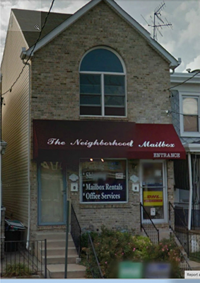
    FFC Mail Drop BoxAllergan's complaint alleges that FFC is a privately held venture fund having no principal place of business and maintaining a mail drop box in Wilmington, DE (the complaint includes a photo of the mail drop box location; at right).  The complaint also alleges that named Defendant Kevin Barnes is one of FFC's founders.

    According to Allergan's complaint, FFC's website is "a shell, with no information available on it about any of FFC's supposed activities," and is almost identical to the website of another venture fund owned by Mr. Barnes, Hyacinth Sloop Capital, LLC.  The complaint alleges that FFC:

    • "has no facilities in which to conduct research and development to create a generic formulation of Allergan's COMBIGAN®, or any other pharmaceutical drug";
    • "has not financed any research and development activities to create a generic formulation of Allergan's COMBIGAN®, or any other pharmaceutical drug";
    • "has hired no scientists or other personnel capable of performing any research and development activities to create a generic formulation of Allergan’s COMBIGAN®, or any other pharmaceutical drug"; and
    • "has hired no regulatory or other personnel necessary to prepare, submit and prosecute an ANDA application for any generic drug with the FDA."

    Allergan's complaint states that FFC sent a letter to Allergan on March 9, 2015 "falsely represent[ing] to Allergan that FFC was prepared to 'seek [Federal Food and Drug Administration ('FDA')] approval via a Paragraph III ANDA filing to produce and market a generic brimonidine tartrate/timolol maleate ophthalmic solution with [an unnamed] Contract Manufacturing Partner ('CMP'),'" which Allergan alleges was "clearly a sham."  FFC also included its IPR petition with its March 9 letter.  According to Allergan:

    FFC attempt[ed] to extract compensation from Allergan by stating [in the March 9 letter] that it "firmly believes that a company such as Allergan should be given a single opportunity to support FFC's core social and investment interests before other time-barred producers are able to file for joinder in the '149 Patent IPR, and before FFC files additional IPR petitions against the COMBIGAN® patents and proceeds with a Paragraph III filing.  As such, FFC is amenable to discussing an immediate and confidential settlement with Allergan."

    Alleging that FFC "did not have and still do[es] not have a reasonable basis for filing the IPR petition against the '149 patent based on the same prior art and the same grounds that were already rejected by the U.S. District Court and the Federal Circuit," Allergan asserts that FFC's conduct constitutes attempted civil extortion under the California Penal Code.  Allergan also alleges that FFC's conduct in "[p]reparing a false 'proposed FDA filing,'" falsely representing that it was "prepared to 'seek FDA approval via a Paragraph III ANDA filing,'" "[f]iling an objectively baseless IPR petition of the unlawful purpose of extorting Allergan," and "[a]ttempting to intimidate Allergan into settling quickly" constitutes unfair, unlawful and/or fraudulent business acts or practices under the California Business and Professions Code.  Finally, Allergan alleges that FFC's conduct in filing the IPR petition constitutes malicious prosecution under California law.

    Defendants have until August 10 to Answer Allergan's complaint.  Patent Docs will report on further developments in the case.

  •         By Sherri Oslick

    Gavel About Court Report:  Each week we will report briefly on recently filed biotech and pharma cases.

    Fresenius Kabi USA, LLC. v. Par Sterile Products, LLC et al.
    2:15-cv-03852; filed June 9, 2015 in the District Court of New Jersey

    • Plaintiff:  Fresenius Kabi USA, LLC
    • Defendants:  Par Sterile Products, LLC; Par Pharmaceutical, Inc.; Par Pharmaceutical Companies, Inc.

    Infringement of U.S. Patent No. 9,006,289 ("Levothyroxine Formulations," issued April 14, 2015) following a Paragraph IV certification as part of Par's filing of an ANDA to manufacture a generic version of Fresenius' levothyroxine sodium powder for injection product (levothyroxine sodium, used as replacement or supplemental therapy in congenital or acquired hypothyroidism of any etiology, except transient hypothyroidism during the recovery phase of subacute thyroiditis).  View the complaint here.


    Actavis Laboratories UT, Inc. v. UCB, Inc.
    2:15-cv-01001; filed June 8, 2015 in the Eastern District of Texas

    Infringement of U.S. Patent No. 7,921,999 ("Peelable Pouch for Transdermal Patch and Method for Packaging," issued April 12, 2011) based on UCB's manufacture and sale of its Neupro® (rotigotine transdermal systm, used to treat the signs and symptoms of idiopathic Parkinson's disease and moderate-to-severe Restless Legs Syndrome).  View the complaint here.


    Bayer Pharma AG et al. v. Macleods Pharmaceuticals Ltd. et al.
    1:15-cv-00464; filed June 5, 2012 in the District Court of Delaware

    • Plaintiffs:  Bayer Pharma AG; Bayer Intellectual Property GmbH; Bayer HealthCare Pharmaceuticals Inc.
    • Defendants:  Macleods Pharmaceuticals Ltd.; Macleods Pharma USA, Inc.

    Infringement of U.S. Patent No. 8,613,950 ("Pharmaceutical Forms With Improved Pharmacokinetic Properties," issued December 4, 2013) following a Paragraph IV certification as part of Macleods filing of an ANDA to manufacture a generic version of Bayer's Staxyn® (vardenafil hydrochloride, used to treat erectile dysfunction).  View the complaint here.


    Mallinckrodt LLC et al. v. Watson Laboratories, Inc.- Florida et al.
    2:15-cv-03800; filed June 5, 2015 in the District Court of New Jersey

    • Plaintiffs:  Mallinckrodt LLC; Mallinckrodt Inc.; Depomed, Inc.
    • Defendants:  Watson Laboratories, Inc.- Florida; Actavis Laboratories FL, Inc.

    Infringement of U.S. Patent Nos. 8,597,681 ("Methods of Producing Stabilized Solid Dosage Pharmaceutical Compositions Containing Morphinans," issued December 3, 2013), 8,658,631 ("Combination Composition Comprising Oxycodone and Acetaminophen for Rapid Onset and Extended Duration of Analgesia," issued February 25, 2014), 8,741,885 ("Gastric Retentive Extended Release Pharmaceutical Compositions," issued June 3, 2014), 8,980,319 ("Methods of Production Stabilized Solid Dosage Pharmaceutical Composition Containing Morphinans," issued March 17, 2015), 8,992,975 ("Methods of Producing Stabilized Solid Dosage Pharmaceutical Compositions Containing Morphinans," issued December 3, 2013), 7,976,870 ("Gastric Retentive Oral Dosage Form with Restricted Drug Release in the Lower Gastrointestinal Tract," issued July 12, 2011), and 8,668,929 ("Gastric Retentive Extended-Release Dosage Forms Comprising Combinations of a Non-Opioid Analgesic and an Opioid Analgesic," issued March 11, 2014) following a Paragraph IV certification as part of Watson's filing of an ANDA to manufacture a generic version of Mallinckrodt's Xartemis XR (acetaminophen and oxycodone, used for the management of acute pain severe enough to require opioid treatment and for which alternative treatment options are inadequate).  View the complaint here.


    Bausch & Lomb Inc. et al. v. Apotex Inc. et al.
    1:15-cv-03879; filed June 5, 2015 in the District Court of New Jersey

    • Plaintiffs:  Bausch & Lomb Inc.; Bausch & Lomb Pharma Holdings Corp.; Senju Pharmaceutical Co., Ltd.
    • Defendants:  Apotex Inc.; Apotex Corp.

    Infringement of U.S. Patent Nos. 8,784,789 ("Aqueous Liquid Preparations and Light-Stabilized Aqueous Liquid Preparations," issued July 22, 2014) and 8,877,168 (same title, issued November 4, 2014) following a Paragraph IV certification as part of Apotex's filing of an ANDA to manufacture a generic version of Bausch & Lomb's Bepreve® (bepotastine besilate ophthalmic solution, used for the treatment of itching associated with allergic conjunctivitis).  View the complaint here.

  • CalendarJuly 14, 2015 – Patent Quality Chat webinar series – Face-to-face Examiner Interviews: A Demonstration of USPTO Tools – noon to 1:00 pm (EDT)

    July 16-17, 2015 - "Advanced Patent Prosecution Seminar 2015: Claim Drafting & Amendment Writing" (Practising Law Institute) – New York, NY

    July 20-21, 2015 – Patent Cooperation Treaty Seminar (American Intellectual Property Law Association) – San Francisco, CA

    July 22, 2015 – "Navigating Ex Parte Reexamination and Reissue Applications — The Mechanics of Preparation and Interplay with AIA Post-Grant Proceedings and Litigation" (American Intellectual Property Law Association) – 12:30 – 2:00 pm (Eastern)

    July 23, 2015 – "Section 103 and Non-Obviousness Post-AIA — Navigating Timing Changes, Federal Court Treatment, and Secondary Considerations to Meet Patent Validity Requirements" (Strafford) – 1:00 to 2:30 pm (EDT)

    July 23-24, 2015 – Patent Cooperation Treaty Seminar (American Intellectual Property Law Association) – Alexandria, VA

    July 29, 2015 – "Teva: The Real Impact on Claim Construction Tactics in the PTAB, Federal Courts, and ITC" (American Intellectual Property Law Association) – 12:30 – 2:00 pm (Eastern)

    July 29, 2015 – "Protecting Your Trade Secrets: Strategies and Tools to Avoid Costly Litigation" (Commercial Law WebAdvisor) – 1:00 to 2:30 pm (Eastern)

    July 29, 2015 – "Sweeping Developments in Patent Reform Agenda: The Innovation Act and the PATENT Act — A 2015 Perspective" (The Knowledge Group) – 3:00 to 5:00 pm (ET)

    August 6, 2015 – "Maximizing Patent Prosecution Opportunities in Europe: Tactics for Counsel When Drafting U.S.-Origin Applications — Navigating Differing USPTO and EPO Legal Standards While Maintaining U.S. Patent Strategy" (Strafford) – 1:00 to 2:30 pm (EDT)

    August 10-11, 2015 – "Advanced Patent Prosecution Seminar 2015: Claim Drafting & Amendment Writing" (Practising Law Institute) – San Francisco, CA

    August 11, 2015 – Patent Quality Chat webinar series – Measuring Patent Quality – noon to 1:00 pm (EDT)

    August 12-14, 2015 – Advanced Patent Law Seminar (Chisum Patent Academy) – Seattle, WA

    September 10-11, 2015 - "Advanced Patent Prosecution Seminar 2015: Claim Drafting & Amendment Writing" (Practising Law Institute) – Chicago, IL

    September 24-25, 2015 - Advanced Patent Law Seminar (Chisum Patent Academy) – Washington, DC

    ***Patent Docs is a media partner of this conference or CLE

  • AIPLA #1The American Intellectual Property Law Association (AIPLA) will be offering a webinar on "Navigating Ex Parte Reexamination and Reissue Applications — The Mechanics of Preparation and Interplay with AIA Post-Grant Proceedings and Litigation" on July 22, 2015 from 12:30 – 2:00 pm (Eastern).  Paromita Chatterjee of Paul Hastings, Daniel Chung of Finnegan, and Thomas Ho of Bookoff McAndrews will explore strategies surrounding ex parte reexamination and reissue proceedings, and the mechanics of preparing the associated requests and applications, and will also take participants through the most common filing errors that get these applications denied or that detrimentally affect co-pending litigations.

    The registration fee for the program is $145 (AIPLA member rate) or $195 (non-member rate).  Those interested in registering for the program, can do so here.

  • Strafford #1Strafford will be offering a webinar/teleconference entitled "Maximizing Patent Prosecution Opportunities in Europe: Tactics for Counsel When Drafting U.S.-Origin Applications — Navigating Differing USPTO and EPO Legal Standards While Maintaining U.S. Patent Strategy" on August 6, 2015 from 1:00 to 2:30 pm (EDT).  Rebecca M. McNeill of McNeill Baur and Jens Viktor Nørgaard of HØIBERG (Denmark) will provide guidance for patent counsel in drafting U.S.-origin patent applications to maximize prosecution opportunities in both the U.S. and Europe, and offer best practices for U.S. patent application drafters to protect inventions in Europe without sacrificing U.S. strategy.  The webinar will review the following questions:

    • What are the key considerations for patent counsel drafting U.S. applications when global patent protection is anticipated or desired?
    • What are the significant differences between the U.S. and European approaches to patent applications?
    • What steps should counsel take when drafting U.S. patent applications to maximize protection in Europe?

    The registration fee for the webinar is $297 ($362 for registration and CLE processing).  Those interested in registering for the webinar, can do so here.

  • AIPLA #1The American Intellectual Property Law Association (AIPLA) will be offering a webinar on "Teva: The Real Impact on Claim Construction Tactics in the PTAB, Federal Courts, and ITC" on July 29, 2015 from 12:30 – 2:00 pm (Eastern).  Cory Bell of Finnegan, Robert Counihan of White and Case, and Jonathan Stroud of Unified Patents will explore the implications of the Teva Supreme Court decision on claim construction in both district courts and at the PTAB, whether the adoption of clear error review will have a significant impact on claim construction practices, and other best practices and strategies for developing a winning claim construction.

    The registration fee for the program is $145 (AIPLA member rate) or $195 (non-member rate).  Those interested in registering for the program, can do so here.