• Chicago #5The Intellectual Property Owners Association (IPO) will be holding its 43rd Annual Meeting on September 27-29, 2015 in Chicago, IL.  Among the presentations being offered at the annual meeting are:

    • U.S. Supreme Court Cases That Every IP Attorney Should Know About
    • Corporate IP Management Best Practices
    • Invalid IP: I Know It When I See It
    • The Nagoya Protocol: Conserving Biodiversity or Withering the Fruits of Innovation?
    • Patent Issues in Latin America — Special Focus in Brazil, Mexico, and Colombia
    • Best Practices in Patent Litigation: What Practitioners Need to Know Given Recent Procedural Changes
    • Double the Opportunity: Patent and Copyright Protection for Software after Alice and Oracle
    • Drafting an International Application
    • Utility & Patent Eligibility Standards
    • Post Grant Proceedings at the USPTO
    • How to Recover Your Attorney Fees from Your (by Definition) Bad Faith Litigation Adversary?

    IPO #2In addition, Hon. Sharon Prost, Chief Judge, U.S. Court of Appeals for the Federal Circuit, will present the luncheon keynote on September 28, and Herbert Wamsley, Executive Director, Intellectual Property Owners Association, will present the luncheon keynote on September 29.

    A program for the meeting, including an agenda, descriptions of the scheduled sessions, and list of speakers, can be obtained here.

    The registration fee for the meeting is $500 (government/academic), $975 (IPO members), or $1,475 (non-members).  Those interested in registering for the meeting can do so here.

  • AIPLA #1The American Intellectual Property Law Association (AIPLA) will be holding a Biotech Patent Law Road Show in Boston, MA on September 10, 2015.  The roadshow will focus on hot-button issues in biotech, providing in-depth discussions on:

    • Claim Drafting in a Post-Myriad/Mayo/Akamai/Ariosa World
    • Section 112 Challenges: The Balance Between Broad Claims and Enforcement
    • Thinking Forward: Life Sciences Patents in IPRs
    • Conflict Issues in a 21st Century Life Sciences Practice (Ethics Session)

    The registration fee for the program is $395 (AIPLA member rate), $545 (non-member rate), $150 (AIPLE government/student rate), or $225 (non-member government rate).  Those interested in registering for the program, can do so here.

  • AIPLA #1The American Intellectual Property Law Association (AIPLA) will be offering a webinar on "Professional Negligence: Real-Life Case Studies in IP Malpractice & How to Avoid Them" on September 17, 2015 from 12:30 – 2:00 pm (Eastern).  David Kramer and Theodore Nittis of Oswald Companies will address IP specific risk management strategies and will use actual malpractice claim scenarios experienced by their clients to demonstrate how employment of those strategies would have prevented such claims.

    The registration fee for the program is $145 (AIPLA member rate) or $195 (non-member rate).  Those interested in registering for the program, can do so here.

  • By Donald Zuhn

    Washington - Capitol #6Last month, in a letter to Congressional leadership, 79 Members of Congress expressed their support for the Innovation Act (H.R. 9) but sought inclusion of language in the bill "to preserve the integrity of the Drug Price Competition and Patent Term Restoration Act (commonly known as Hatch-Waxman), and the Biologics Price Competition and Innovation Act (BPCIA)."  Stating that "any patent litigation legislation must represent the views of the full spectrum of different industries and sectors reliant on a well-functioning U.S. patent system," the letter asserted that at least one additional change to the legislation was needed to address concerns of the life sciences community.

    According to the letter's signatories, "the patent challenge system created under the America Invents Act, specifically the IPR system, threatens to undermine the[] specialized patent resolution frameworks [i.e., Hatch-Waxman and the BPCIA] in a way that was not intended when Congress created it."  Explaining that "[p]atents are critically important for developing FDA-approved biopharmaceutical products," the Representatives note that "[u]nlike companies in other sectors, biopharmaceutical companies are not able to immediately capitalize on the value of their patents," and instead "must spend almost a decade and, on average, $2.6 billion, before they can receive approval from the FDA to bring new medicines to market."  In support for the Hatch-Waxman regime, the letter points out that generics currently make up 88% of all prescriptions in the U.S., up from 19% prior to enactment of Hatch-Waxman, and that generics saved the U.S. health care system almost $1.5 trillion between 2004 and 2013.  The letter also notes that meanwhile "investment in research and development (R&D) is at an all-time high and there were a record number of new medicines approved by the FDA in 2014, allowing patients to live longer healthier lives."

    The Representatives state that "[t]he IPR process, as implemented by the Patent and Trademark Office (PTO), must not be allowed to upset this delicate balance," and contend that Congress can address concerns of the life sciences sector "by including language in H.R. 9 to make clear that the IPR process does not apply to biopharmaceutical patents that are subject to challenge under Hatch-Waxman and BPCIA."  According to the signatories, such an approach "would protect the delicate balance Congress struck in Hatch-Waxman and BPCIA while in no way harming the intent behind the IPR process."

  • By Andrew Williams

    MicrosoftEarlier this week, we noted that parties wishing to challenge IPR Final Written Decisions from the PTAB on appeal to the Federal Circuit would face an uphill challenge.  However, even if that challenge is extremely difficult, it is not necessarily futile.  This was demonstrated by the Federal Circuit on June 16, 2015 when it remanded part of a PTAB decision in the Microsoft Corporation v. Proxyconn, Inc. case.  The Court held that even though it does not constitute error to use the "Broadest Reasonable Interpretation" (or BRI) standard for claim construction, it is error to adopt a construction that is "unreasonable," which the Board did for two of the construed claim terms.  Otherwise, the Court did not find error with the Board's validity determination with respect to the claims not impacted by the improperly construed claims.  The Federal Circuit also addressed, for the first time, the standards implemented by the Board for amending claims during IPR proceedings.  Specifically, the Court found that the Board's Idle Free decision included a permissible interpretation of the PTO regulations at least with respect to the burden placed on the patentee to demonstrate patentability of any claim amended in view of the prior art of record.  The Court did, however, stop short of indicating that it is proper to require the patentee to address patentability over the entirety of the prior art.

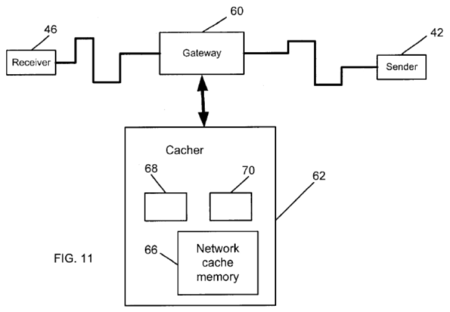
    At the risk of oversimplifying the technology at issue, the patent in this case, U.S. Patent No. 6,757,717, related to decreasing traffic over the internet.  Specifically, it sought to address the problem of sending files between computers multiple times when either the original computer, or an intermediary computer, already contained a copy of the file.  Basically, the computer wishing to access a particular file (the receiver/computer) sends a request to a sender/computer that has a copy of the file.  Instead of immediately sending the file, the sender/computer calculates a "digital digest," or code (our term), that can be used to uniquely identify the file.  This code is used by the receiver/computer to determine if it already has a copy of the file on its memory.  Only if the answer is negative does the sender/computer transmit the whole file over the internet.  The patent also envisioned an intermediary "gateway" computer which would use the code to determine whether a "caching" computer had a copy of the file that could be sent to the receiver/computer.  This is demonstrated in Figure 11 from the '717 patent, which was reproduced in the opinion:

    Figure 11
    Microsoft filed two IPR petitions related to the '717 patent, each challenging different claims.  The Board joined the two proceedings, and determined that claims 1, 3, 6, 7, 9-12, 14, 22, and 23 were unpatentable as anticipated, and claims 1, 3, and 10 were additionally unpatentable as obvious.  However, claim 24 survived.  Microsoft appealed the determination that claim 24 was found to be patentable, and Proxyconn cross-appealed almost everything else.  Chief Judge Prost wrote the decision for a unanimous panel that included Judge Lourie and District Judge Gilstrap from the Eastern District of Texas sitting by designation.

    Was the Use of the BRI Standard Revesable Error?

    Proxyconn first challenged the Board's use of the BRI standard.  While the appeal was pending, the In re Cuozzo case was decided.  The Federal Circuit in this case said it was bound by the Cuozzo decision to approve of the use of the BRI standard.

    However, the Court pointed out that even though the Board may construe the claims broadly, they may not do so unreasonably.  Therefore, for example, if the PTAB adopts a construction that is contrary to arguments made or positions taken during the original prosecution, it could be reversible error.  Moreover, "[a] construction that is 'unreasonably broad' and which does not 'reasonably reflect the plain language and disclosure' will not pass muster."  In other words, the construction cannot be divorced from the specification or the record.

    Was the Construction of the Claim Terms Really "Reasonable"?               

    Proxyconn next challenged the claim constructions as unreasonable.  The first related to the phrase "gateway . . . connected to said packet-switched network in such a way that network packets send between at least two other computers."  The Board adopted the construction proffered by Microsoft that the "two other computers" were not limited to just the sender/computer and the receiver/computer, but could encompass the gateway and caching computers.  As a result, it found claims 6, 7, and 9 anticipated by the "DRP" reference.

    The Federal Circuit did not find this construction to be reasonable.  A plain reading of the impacted claims indicated that the "two other computers" were meant to be alternatives to the gateway and caching computers.  Indeed, the term "other" denoted distinction between the "two other computers" and the gateway and caching computers separately identified in the claims.  Therefore, a construction that included them would be nonsensical.  Furthermore, the specification consistently used this term to distinguish the two computers from the gateway and caching computers.  Therefore, the Board's construction was determined to be unreasonably broad.

    Similarly, Proxyconn challenged the construction of the terms "sender/computer" and "receiver/computer."  Specifically, the Board construed these claim terms in such a way as to encompass the intermediary gateway and caching computers.  But, with similar logic as used above, the Federal Circuit found that such constructions did not reasonably reflect the language and disclosure of the '717 patent.

    Because the Board's determination of patentability was necessarily flawed with regard to the claims that contained any of these claim terms, the Federal Circuit vacated the findings of unpatentability of these claims and remanded for proceedings consistent with the opinion.  Because Microsoft filed a petition for panel rehearing at the end of July, the case has not yet made its way back to the PTAB.  It will be interesting to see how they handle the remand, and how fast they handle it, once it returns.  Without the "one-year-to-final-decision" time constraints, the PTAB may not feel compelled to deal with the remand in an expedited fashion.  We will, of course, monitor the case and report any interesting developments.

    Did the Board Properly Deny Proxyconn's Motion to Amend

    As another interesting aspect of this case, the Federal Circuit for the first time addressed one the largest criticisms levied against the PTAB for these new post-grant proceeding challenges to issued patents — the ability (or lack thereof) to amend the claims.  Proxyconn had moved to replace claims 1 and 3 with claims 35 and 36, respectively.  Microsoft alleged that the substitute claims were not patentable because they were anticipated by the prior art reference DRP, which was of record, but was not a reference cited when trial was instituted for these two claims.  The Board denied the motion for two reasons.  First, it found that Proxyconn had not met its burden of establishing a prima facie case of patentability.  Essentially, among other defects, it had failed to provide constructions of the newly added claim terms, failed to address the manner in which the claims were patentable over the art, and failed to identify the closest prior art.  Second, it rejected Proxyconn's argument that the Board was precluded from relying on the DRP reference.

    At center stage in this appeal was the "informative" decision Idle Free, which was decided by a six-member panel.  As such, even though it is not necessarily binding on other panels, it has been cited on numerous occasions in the denial of motions to amend.  Basically, the Idle Free decision clarifies that the burden is on the patent owner to show "a patentable distinction over the prior art of record and also prior art known to the patent owner."  Interestingly, because the DRP reference was of record in the case, the Federal Circuit made clear that it was not deciding whether every requirement in Idle Free constitutes permissible interpretations of the PTO's regulations.  As indicated in footnote 4, "[t]he Idle Free decision is not itself before us . . . ."  Therefore, it remains a question whether a patentee is properly required to provide a distinction over the all of the prior art (at least of which it is aware).

    But, with regard to the prior art of record, the Court found the Idle Free requirement to be reasonable.  First, it found that establishing "rules" within adjudicated cases was permissible.  While it might be advantageous to establish such rules with traditional notice and comment rule-making, the decision ultimately rests with the agency's discretion.  As such, the use of adjudication over rulemaking was not an abuse of discretion.  Second, the Court found that the Board acted reasonably when it interpreted its rules to require a patentee to show patentability over the art of record, because nothing in the statute or regulations prohibits it.  Moreover, it is consistent with the very nature of these IPR proceedings.  If the motion is granted, the claims will be added to an issued patent without further examination.  Therefore, to limit any challenge to only the art cited at institution could prevent the Board from denying the motion despite being in possession of art that undermines patentability.  Finally, the Court rejected Proxyconn's argument that such an interpretation was "fundamentally unfair."  Proxyconn was clearly aware of the DRP reference because it was a part of the entire proceedings.  It also had an opportunity to respond to Microsoft's opposition which cited the DRP reference, although it chose not to.  As such, the Court determined that this was not a case in which Proxyconn was taken by surprise and was not given the opportunity to respond.

    Microsoft Corporation v. Proxyconn, Inc. (Fed. Cir. 2015)
    Panel: Chief Judge Prost, Circuit Judge Lourie, and District Judge Gilstrap (sitting by designation)
    Opinion by Chief Judge Prost

  • By Kevin E. Noonan

    House of Representatives SealLast week, Rep. Bob Goodlatte, Chairman of the House Judiciary Committee, released a 200-page Report on H.R. 9, "The innovation Act," introduced by Chairman Goodlatte with several co-sponsors earlier this year.  The bill sets forth several "reforms" of U.S. patent law, primarily directed to addressing the "problem" of so-called "patent trolls."

    The Report sets forth the language of the bill and a provision-by-provision explication of the bill in its entirety.  Much of the majority's Report sets out the purported "new consensus" constituting "broad agreement" among "industry leaders from different sectors . . . on a common set of reforms that will address the most serious abuses currently afflicting the patent-enforcement system."  The majority Report expresses the sentiment that "[e]very member of this Committee wishes to see the patent system fulfill its constitutional mandate to ''promote the progress of science and the useful arts.'''  The Report also states that:

    It is the goal of this Committee to ensure that American manufacturing, small businesses, and start-up companies are protected against patent-enforcement abuse, while also ensuring that the patent system continues to protect and encourage American ingenuity.  The Innovation Act, which has earned the support of a broad coalition of America's most innovative companies, recalibrates the Nation's patent-enforcement mechanisms in a manner that strikes a balance between these overlapping and sometimes conflicting goals, and that ensures that the Nation's patent system continues to drive technological innovation and economic growth.

    Most of the remainder of the majority section of the Report sets forth testimony, from this and the last Congress that illustrate this "new consensus."  (Included in these sections of the majority Report are the views of USPTO Director Lee, who agrees with the expressed need for litigation reform but is much less supportive of the changes in PTO, especially PTAB, procedures.)  For most provisions in the law (particularly the litigation-related provisions), the Report contains quotations from such hearing testimony supporting the changes encompassed by the bill.  These include the provisions related to attorney's fees, heightened pleading standards, mandatory joinder, venue, patent ownership transparency, the customer-suit exception, and "recommendations to the Judicial Conference," including changes in discovery rules.

    This pattern changes when the Report moves onto the provisions changing how intellectual property rights are discharged in bankruptcy and "corrections and improvements to the America Invents Act."  Here, the Report discusses the historical and policy reasons for the changes that would be effected by enactment of the bill.  An example of the former change is elimination of the "could-have-raised" estoppel provisions of the post-grant review provisions of the AIA.  The Report cites statements from the AIA's legislative history that inclusion of this estoppel was a simple mistake that needed correction inter alia because of its negative effects on the effectiveness of the post-grant review provisions of the law.  The Report set forth reasons for and against changing the claim construction standard before the PTAB in post-grant review and inter partes review proceedings, with the weight of these considerations favoring changing the broadest-reasonable-interpretation standard to the standard used by courts as set forth in Phillips v. AWH Corp.  These changes do not extend to covered business method reviews, however, the Report noting that recent Supreme Court cases (including Bilski v. Kappos and Alice Corp. v. CLS Bank Corp.) make the validity of these claims sufficiently questionable that "the Committee finds it unnecessary to burden the Board with applying the district courts' claim-construction approach to define the precise metes and bounds of the unpatentable subject matter claimed in such patents."

    The Report also castigates the Federal Circuit from departing from settled law (traced to Thomson-Houston Elec. Co. v. Ohio Brass Co.) in support of its codification of obviousness-type double patenting.  The bill proposes changes in 35 U.S.C. § 121 (to eliminate the provisions related to OTDP) in favor of election provisions as part of revised § 102(e)(2).  These new § 102 provisions would prevent the abuses (litigation by different patentees over claims that are not patentably distinct) that are the only justification for the continued vitality of the OTDP doctrine in view of the changes in patent term effected by the GATT/TRIPS agreement.

    The Report also addresses the policy concerns behind the provisions of the bill that abrogate the Supreme Court's Gunn v. Minton decision and once again bring patent malpractice cases under the Federal Circuit's "arising under" jurisdiction.

    The Report sets forth the history of the hearings and witnesses before the committee, and the roll call votes on the bill itself (which passed by a vote of 24-8) and three proposed but defeated amendments.  Director Lee's statement on the bill is also included.

    The minority portion of the Report was signed by nine Democratic members of the committee, including Ranking Member Rep. John Conyers, Jr. and Reps. JACKSON LEE, JOHNSON, JR., DEUTCH, BASS, CICILLINE, and PETERS.  The minority Report sets forth several reasons against the bill.  Under the heading "The Innovation Act Limits The Rights Of All Patent Holders, Not Just So–Called ''Patent Trolls,'' And Presents Other Policy Concerns," the minority Report sets out the following negative consequences of certain provisions of the bill:

    • Impose burdensome pleading requirements for plaintiffs that exceed what is required in other civil cases and which demand details plaintiffs may not know before conducting discovery (Section 3(a));
    • Discourage, through a presumptive fee shifting standard, small businesses and individual inventors from bringing meritorious lawsuits because the risk of having to pay the other sides court costs may outweigh the benefits of winning (Section 3(b));
    • Deter investments by venture capitalists in entrepreneurs, start-ups, and individual inventors through harsh joinder rules that may make the investors liable for paying attorneys' fees (Section 3(c));
    • Limit discovery for plaintiffs that will lead to costly litigation and case delays (Section 3(d)); and
    • Improperly shield some of the most culpable infringers through an over-broad stay of litigation for end users of infringing products (Section 5).

    The minority Report then discusses in depth the grounds these Representatives have for concluding that the heightened pleadings requirements will prevent meritorious lawsuits by "legitimate inventors"; that the fee-shifting provisions favor parties with "deep pockets" and can similarly prevent meritorious claims from inventors to be brought; that the joinder provisions can be expected to chill investment in individual inventors and entrepreneurs; that the discovery provisions are better left to the courts to develop and as written invite abuse; and that the customer stay provisions could "deprive legitimate patent owners of meaningful relief."  This section also characterizes the change in the post-grant review estoppel provisions as being "controversial" and not just a "scrivenor's error" that needs more robust consideration and debate before being enacted.

    The minority Report also contends that the bill will be ineffective in  achieving its purported goals, in a section having the heading "The Innovation Act Does Not Effectively Address The Deceptive Use Of Demand Letters, Stop Abuse Of Post-Grant Proceedings At The USPTO, or Improve Patent Examination Quality At The USPTO."  This section addresses the particular problem of "extortionate use of demand letters," the "abuse" of post-grant proceedings (including use of inter partes review by certain hedge funds) and the problems in patent quality caused by fee diversion of USPTO user fees.

    The final section of the minority Report, entitled "Recent Developments Make Many Of The Provisions In The Innovation Act Unnecessary," sets out the changing landscape of patent law since the bill was first proposed  These include that:

    • Courts are Already Awarding Fees at a Much Higher Rate
    • Patent Case Filings Have Decreased Significantly Over the Last Year
    • Pleading Standards are Already Set to Increase Due to the Elimination of Form 18
    • District Courts Have Developed Local Case Management Rules
    • The USPTO Has Begun an Enhanced Patent Quality Initiative

    (This section also contends, perhaps somewhat gratuitously, that "H.R. 9 Is More Objectionable than the Senate's PATENT Act.")

    The minority Report concludes (urging their colleagues to "reject this flawed measure"):

    Congress must respond to the problems of abusive patent litigation in the courts and the gaming of the patent process at the USPTO, and we are willing to work with any and all stakeholders and interested parties to develop a fair process to find common sense solutions.  That is why we supported amendments at the Committee markup to make reasonable improvements that would protect patent rights, while still curtailing abusive patent litigation and exploitation of the patent process.  We must take a targeted approach that includes deterring further abuses of IPR proceedings and ending fee diversion from the USPTO to ensure adequate hiring, proper training of examiners, and sustained patent quality.  And, serious patent reform legislation must stop the extortionate use of deceptive demand letters.  Unfortunately, we cannot support H.R. 9 because it includes changes that go well beyond the problems of so-called ''patent trolls;'' it creates an imbalance in the patent system tilted against individual inventors and small businesses; and it will have a chilling effect on innovation.

    While many have considered eventual passage of H.R. 9 to be a near certainty, the bill did not come to the House floor for a vote before the August recess.  As mentioned in the minority Report there is a competing (and different) bill in the Senate and that bill has not been passed out of committee.  Thus, the fate of H.R. 9, and patent "reform" generally, is much less certain in this Congress that it appeared in January when Rep. Goodlatte introduced the bill.

  • By Andrew Williams

    IlluminaOne of the first IPR petitions ever filed, IPR2012-0006, was related to biotechnology — specifically DNA sequencing.  Illumina, Inc. filed that petition, and two others, IPR2012-00007 and IPR2013-00011, against patents owned by The Trustees of Columbia University in the City of New York ("Columbia").  The PTAB issued its Final Written Decisions in early 2014, canceling all of the challenged claims, which we reported at the time (see "IPR Update — The First Biotech IPR Decisions").  The Federal Circuit just recently concluded its review of these cases, affirming the decision of the Board.  The clear take away message from this decision is that anyone wanting to challenge a PTAB decision is likely going to face an uphill battle.  Even though the Court did write an opinion in this case, albeit non-precedential, the expectation is that the majority of IPR reviews appealed to the Federal Circuit will end in Rule 36 affirmances.  It is possible that the extreme deference that the Court appears to be showing the Patent Office could be a direct result of the deluge of cases that are anticipated for the next couple of years (if not longer).  Perhaps by signaling the uphill nature of these appeals, the Court may be attempting to discourage a perfunctory appeal in every case. Or, they may be setting the stage to make the Rule 36 judgements easier to issue.  Of course, there is another possible explanation.  It is conceivable that the first few petitions filed were really strong and/or were filed against low-hanging fruit.  As stronger patents get challenged, the PTAB may find themselves faced with closer cases, which may result in an increase in reversals or remands issued by the Federal Circuit.  Only time will tell.

    In our previous review of the PTAB decisions, we provided a detailed explanation of the technology in this case.  Briefly, nucleotide analogues for use in sequencing by synthesis were at issue, which is a technique of sequencing by which every added nucleotide is determined using a label, such as a fluorescently detectable label.  Basically, this technology involves incorporating a labeled nucleotide analogue into a primer strand using DNA polymerase, in a manner comparable to that used when a DNA strand is synthesized.  Normally, when a DNA strand is synthesized, the 5' position of the sugar in a new incoming nucleotide is linked to the 3'-OH group of the sugar of a preexisting nucleotide in the strand under synthesis.  The difference in this sequencing technique, though, is that the newly incorporated nucleotide analogues have cleavable chemical groups capping the 3'-OH to prevent the incorporation of any successive nucleotides before the identity of the nucleotide analogue is determined. This nucleotide is identified with a detectable label attached to the nucleotide, with a unique label used for each base (A, C, G, or T).  In order to sequence an entire region of DNA, the 3'-OH cap is cleaved and the process repeated step-wise until the entire sequence is deduced.

    Columbia scientists purported to invent particular nucleotide analogues utilized by this technique.  Specifically, the analogues have the detectable label attached to the base instead of the 3'-OH group, they have a cleavable chemical group capping the 3'-OH group, and at least some of the claims require the use of a deaza-substituted base, such as 7-deazapurine (a deazabase is one in which a natural nitrogen atom in the base ring is substituted with a carbon atom).  The opinion included an example of such a nucleotide analogue from Colombia's briefing:

    Image
    Representative claims of the patents-at-issue, with the emphasis as added by the Federal Circuit noted, include:  Patent No. 7,713,698, claims 1 and 11:

    1.  A method of determining the identity of a nucleotide analogue incorporated into a nucleic acid primer extension strand, comprising:
        a) contacting a nucleic acid template attached to a solid surface with a nucleic acid primer which hybridizes to the template;
        b) simultaneously contacting the product of step a) with a polymerase and four nucleotide analogues which are either (i) aA, aC, aG, and aT, or (ii) aA, aC, aG, and aU, so as to incorporate one of the nucleotide analogues onto the nucleic acid primer and form a nucleic acid primer extension strand, wherein each nucleotide analogue within (i) or (ii) comprises a base labeled with a unique label and contains a removable chemical moiety capping the 3'-OH group of the sugar of the nucleotide analogue, and wherein at least one of the four nucleotide analogues within (i) or (ii) is deaza-substituted; and
        c) detecting the unique label of the incorporated nucleotide analogue, so as to thereby determine the identity of the nucleotide analogue incorporated into the nucleic acid primer extension strand.

    11.  A plurality of nucleic acid templates immobilized on a solid surface, wherein a nucleic acid primer is hybridized to such nucleic acid templates each such nucleic acid primer comprising a labeled incorporated nucleotide analogue, at least one of which is deaza-substituted, wherein each labeled nucleotide analogue comprises a base labeled with a unique label and contains a removable chemical moiety capping the 3'-OH group of the sugar of the nucleotide analogue.

    Patent No. 7,790,869, claims 12 and 15:

    12.  A nucleotide having a base that is attached to a detectable label through a cleavable linker, wherein the nucleotide has a deoxyribose comprising a cleavable chemical group capping the 3' OH group, wherein the cleavable linker is cleaved by a means selected from the group consisting of one or more of a physical means, a chemical means, a physical chemical means, heat, and light, and wherein the cleavable chemical group capping the 3' OH group is cleaved by a means selected from the group consisting of one or more of a physical means, a chemical means, a physical chemical means, heat, and light.

    15.  The nucleotide of claim 12, wherein the base is a deazapurine.

    And Patent No. 8,088,575, claims 1 and 6:

    1.  A method of determining the identity of a nucleotide analogue incorporated into a nucleic acid primer extension strand, comprising: a) contacting a nucleic acid template attached to a solid surface with a nucleic acid primer which hybridizes to the template; b) simultaneously contacting the product of step a) with a polymerase and four nucleotide analogues which are either (i) aA, aC, aG, and aT, or (ii) aA, aC, aG, and aU, so as to incorporate one of the nucleotide analogues onto the nucleic acid primer and form a nucleic acid primer extension strand, wherein each nucleotide analogue within (i) or (ii) comprises a base labeled with a unique label and contains a small removable chemical moiety capping the 3'-OH group of the sugar of the nucleotide analogue, wherein said small cleavable chemical group does not interfere with the recognition of the nucleotide analogue by polymerase as a substrate; and c) detecting the unique label of the incorporated nucleotide analogue, so as to thereby determine the identity of the nucleotide analogue incorporated into the nucleic acid primer extension strand.

    6.  The method of claim 1, wherein said base of at least one of said nucleotide analogues is a deazapurine.

    The PTAB's Failure to Resolve PHOSITA's Qualifications

    The first allegation by Columbia addressed by the Federal Circuit was whether the PTAB erred because it did not resolve what the qualifications would be of a person having ordinary skill in the art.  Columbia's expert asserted that a PHOSITA would have been skilled in "both biology and synthetic nucleotide chemistry," while Illumina's expert's definition did not include any mention of chemistry.  The challenge was that Illumina's expert did not possess the qualifications of a PHOSITA, and therefore was unqualified to opine.

    The Court explained that failure to make explicit finding regarding the level of skill in the art is not necessarily reversible error.  Moreover, it is normally easier to establish obviousness with a higher level of skill.  Thus, because the PTAB found the claim obvious regardless of whether a PHOSITA was skilled in chemistry, it follows that someone with that additional skill would have found the claims at least as obvious (if not more so).  And, because the PTAB found Illumina's expert's qualifications sufficient, its credibility determination was not reversible error.

    Prior Art Disclosures

    The Court next considered whether the prior art contained all of the limitations of challenged claims: (1) a labeled base, (2) a removable 3'-OH cap, and (3) a deaza-substituted base.  The cited art was detailed in our previous post, as mentioned above.  The primary reference, WO 91/06678 ("Tsien"), purportedly described the DNS sequencing by synthesis method, and therefore was a starting point for many of the rejections of the relevant claims.  Tsien disclosed unique labels attached to a base, and a removable 3'-OH chemical moiety (capping group).  Columbia argued that even though a cleavable label attached to a base might have been disclosed, it did not teach such a label with a cleavable tether.  The Board, however, found that because Tsien disclosed these two concepts in adjacent paragraphs, one skilled in the art would have recognized the utility of such a tether.  The Board also cited two additional references, Dower and Stemple, as disclosing base-labeled nucleotides that contain 3'-OH moieties.  The Federal Circuit found there was substantial evidence for the finding that the prior art disclosed "nucleotides with a label on the nucleotide base with a removable 3'-OH group," and "a cleavable tether to release the label" from the base.

    Motivation to Combine

    Columbia also argued that the PTAB erred in concluding that a person of skill in the art would have combined the above-referenced teachings with a 7-deazapurine nucleotide.  Tsien did reference another article, Prober.  And, Prober did disclose the labeling of purines.  However, Columbia asserted that Tsien only cited Prober for the proposition that purines could be labeled.  As such, the argument went, there was no motivation to combine.

    The PTAB had found an express teaching of incorporating a 3'-blocked dNTP having a fluorescent label in the Prober reference.  Moreover, the Federal Circuit pointed out, the motivation to combine can be found even in the absence of an explicit mention of the one reference in the other.  This case was even stronger because Tsien pointed directly to Prober, even if not the specific section of Prober.  The Court found that the PTAB's finding was supported by substantial evidence.

    Reasonable Expectation of Success

    Columbia also argued that the chemistry for creating the claimed nucleotide analogues was complex, and that therefore there would not be a reasonable expectation of success.  However, even Columbia's expert admitted that the synthetic process would have been easily understood by one skilled in the art.  Therefore, the Federal Circuit found substantial evidence supporting the PTAB's finding regarding the expectation.

    Secondary Considerations

    The Court next considered the Board's analysis of the secondary considerations of non-obviousness.

    • Simultaneous Invention weighs modestly in favor of obviousness

    Not quite a consideration of non-obviousness, the near simultaneous invention by two other companies, Solexa (a predecessor of Illumina) and Amersham counseled that the invention was obvious.  Columbia argued that these "inventions" were not prior art, but the Court pointed out that they do not need to be for this consideration.  In fact, if they were, they would have been considered under §§ 102 and 103.

    • Copying does not favor nonobviousness

    Columbia asserted that Manteia, a company whose intellectual property was acquired by Solexa, copied the invention.  However, the Board did not make a specific factual finding regarding whether the invention was copied.  Nevertheless, the Court did find that simultaneous invention can weigh in favor of obviousness, but only does so modestly in this case.

    • Attempted Licensing weights modestly in favor of nonobviousness.

    Columbia also points to Illumina's attempts to license the technology.  However, the Court found that none of the correspondence specifically mentioned the patents at issue.  Therefore, at best, this was only modest evidence of nonobviousness.

    • Commercial Success does not favor nonobviousness

    Columbia alleged that Illumina had significant sales of technology covered by the patents at issue.  However, Illumina pointed out, and the Court agreed, that all of the features proclaimed by Columbia to be responsible for the success of the products could be found in the prior art Tsien reference.  Moreover, the fact that Columbia was relying on Illumina's sales complicated the matter, because the Court could not separate out potential simultaneous invention or copying.

    • Unexpected Results do not favor nonobviousness

    Finally, Columbia asserted that the claimed nucleotides were "unexpectedly" better than pyrosequencing.  The PTAB dismissed this argument because pyrosequencing was not the closet prior art, and therefore was not probative to the determination of nonobviousness.  The Federal Circuit agreed.

    Anticipation

    The Board has also found that certain claims were anticipated by Tsien, and other references independently.  Columbia argued that these references were non-enabling, and did not disclose all of the elements.  Tsien was described as teaching a genus, but not the specific claimed species.  However, the Court pointed out that when a genus is small enough, such that all members can be envisaged, a genus anticipates every species within the genus.  Also, the Court noted that the patents at issue also do not disclose the chemistry required to practice the invention, which suggests that the chemistry required was not novel or nonobvious.  Finally, the Court held that the PTAB did not abuse its discretion in denying Columbia's motion to amend.

    Trustees of Columbia University v. Illumina, Inc. (Fed Cir. 2015)
    Panel: Chief Judge Prost and Circuit Judges Schall and Wallach
    Opinion by Circuit Judge Wallach

  • ABA JournalThe ABA Journal has begun work on its 9th annual list of the 100 best legal blogs (or blawgs) and has announced that it is seeking the advice of its readers, via the ABAJournal.com website, on which blogs to include on this year's Blawg 100.  For the past three years, Patent Docs has been honored to be included among the five blogs selected in the IP Law category of the Blawg 100 (see "ABA Journal Announces 2012 Blawg 100"; "ABA Journal Announces 2013 Blawg 100"; and "ABA Journal Announces 2014 Blawg 100").

    Readers interested in nominating a particular blog for the 9th annual Blawg 100 should use the ABA Journal's blawg 100 amici form.  Additional information about the Blawg 100 can also be found on the blawg 100 amici form.  The form requires that anyone making a nomination provide a name, employer or law school, city, and e-mail address.  The ABA Journal requires this information in order to discourage:

    • Bloggers who nominate their own blogs or nominate blogs to which they have previously contributed posts.
    • Employees of law firms who nominate blogs written by their co-workers.
    • Public relations professionals in the employ of lawyers or law firms who nominate their clients' blogs.
    • Pairs of bloggers who have clearly entered into a quid pro quo agreement to nominate each other.

    The ABA Journal, however, welcomes comments (up to 500 words in length) from readers who do not fall into the above categories.

    2013_Blawg100_HorizBadgeFavIn addition, the ABA Journal is encouraging readers to keep the following criteria in mind when nominating blogs:

    • The ABA Journal is primarily interested in blogs in which the author is recognizable as someone working in a legal field or studying law in the vast majority of his or her posts.
    • The blog should be written with an audience of legal professionals or law students in mind.
    • The majority of the blog's content should be unique to the blog and not cross-posted or cut and pasted from other publications.
    • The ABA Journal is not interested in blogs that more or less exist to promote the author's products and services.

    Nominations must be submitted no later than 11:59 pm (CT) on Sunday, August 16, 2014.

  •         By Sherri Oslick

    Gavel About Court Report:  Each week we will report briefly on recently filed biotech and pharma cases.

    Millennium Pharmaceuticals Inc. v. Dr. Reddys Laboratories, Ltd. et al.
    1:15-cv-00539; filed June 25, 2015 in the District Court of Delaware

    • Plaintiff:  Millennium Pharmaceuticals Inc.
    • Defendants:  Dr. Reddys Laboratories, Ltd.; Dr. Reddys Laboratories, Inc.

    Millennium Pharmaceuticals Inc. v. Sun Pharmaceutical Industries Ltd. et al.
    1:15-cv-0053940; filed June 25, 2015 in the District Court of Delaware

    • Plaintiff:  Millennium Pharmaceuticals Inc.
    • Defendants:  Sun Pharmaceutical Industries Ltd.; Sun Pharma Global FZE; Sun Pharmaceutical Industries Inc.

    The complaints in these cases are substantially identical.  Infringement of U.S. Patent Nos. 6,713,446 ("Formulation of Boronic Acid Compounds," issued March 30, 2004) and 6,958,319 (same title, issued October 25, 2005), licensed exclusively to Millennium, following a Paragraph IV certification as part of defendants' filing of an ANDA to manufacture a generic version of Millenium's Velcade® (bortezomib, used to treat multiple myeloma).  View the Dr. Reddy's complaint here.


    Novartis Pharmaceuticals Corp. v. Aurobindo Pharma Ltd. et al.
    2:15-cv-04427; filed June 25, 2015 in the District Court of New Jersey

    • Plaintiff:  Novartis Pharmaceuticals Corp.
    • Defendants:  Aurobindo Pharma Ltd.; Aurobindo Pharma USA, Inc.

    Infringement of U.S. Patent No. 8,324,189 ("Use of Zolendronate for the Manufacture of a Medicament for the Treatment of Bone Metabolism Diseases," issued December 4, 2012) following a Paragraph IV certification as part of Aurobindo's filing of an ANDA to manufacture a generic version of Novartis' Zometa® (zoledronic acid, used for the prevention of skeletal-related complications associated with cancer).  View the complaint here.


    Cephalon, Inc. v. Fresenius Kabi USA, LLC
    1:15-cv-00536; filed June 24, 2015 in the District Court of Delaware

    Infringement of U.S. Patent No. 8,344,006 ("Liquid Formulations of Bendamustine," issued on January 1, 2013) following a Paragraph IV certification as part of Fresenius' filing of an ANDA to manufacture a generic version of Cephalon's Treanda® (bendamustine hydrochloride, used to treat chronic lymphocytic leukemia and non-Hodgkin's lymphoma).  View the complaint here.


    Ferring B.V. et al. v. Actavis, Inc. et al.
    Filed June 23, 2015 in the District Court of New Jersey

    • Plaintiffs:  Ferring B.V.; Ferring International Center S.A.; Ferring Pharmaceuticals Inc.
    • Defendants:  Actavis, Inc.; Watson Laboratories, Inc.; Andrx Corp.; Watson Laboratories, Inc. – Florida; Watson Pharama, Inc.

    Infringement of U.S. Patent No. 9,060,939 ("Tranexamic Acid Formulations," issued June 23, 2015) following in conjunction with Watson's filing of an ANDA to manufacture a generic version of Ferring's Lysteda® (tranexamic acid, used to treat heavy menstrual bleeding).  View the complaint here.

  • CalendarAugust 6, 2015 – "Maximizing Patent Prosecution Opportunities in Europe: Tactics for Counsel When Drafting U.S.-Origin Applications — Navigating Differing USPTO and EPO Legal Standards While Maintaining U.S. Patent Strategy" (Strafford) – 1:00 to 2:30 pm (EDT)

    August 10-11, 2015 – "Advanced Patent Prosecution Seminar 2015: Claim Drafting & Amendment Writing" (Practising Law Institute) – San Francisco, CA

    August 11, 2015 – Patent Quality Chat webinar series – Measuring Patent Quality – noon to 1:00 pm (EDT)

    August 13, 2015 – "Defending Patents in IPR Proceedings — Leveraging Motions to Amend and Preliminary Responses, Weighing Secondary Considerations" (Strafford) – 1:00 to 2:30 pm (EDT)

    August 12-14, 2015 – Advanced Patent Law Seminar (Chisum Patent Academy) – Seattle, WA

    August 20, 2015 – "Inducement to Infringe in Patent Litigation: Protecting IP Rights — Lessons from Commil USA v. Cisco Sys. Inc. and Leveraging Opinions of Counsel" (Strafford) – 1:00 to 2:30 pm (EDT)

    August 24, 2015 – Roadshow on Patent Quality and AIA Trials (American Intellectual Property Law Association and U.S. Patent and Trademark Office) – Santa Clara, CA

    August 26, 2015 – Roadshow on Patent Quality and AIA Trials (American Intellectual Property Law Association and U.S. Patent and Trademark Office) – Dallas, TX

    August 27, 2015 – "Meet the New Boss. Same as the Old Boss? Not Even Close under New Mayo/Alice Regime for § 101" (McDonnell Boehnen Hulbert & Berghoff LLP) – 10:00 am to 11:15 am (CT)

    August 27, 2015 – "Biosimilars: Regulation, Litigation and New Developments Patent Practitioners and Regulatory Attorneys Should Know" (American Intellectual Property Law Association) – 12:30 – 2:00 pm (Eastern)

    August 28, 2015 – Roadshow on Patent Quality and AIA Trials (American Intellectual Property Law Association and U.S. Patent and Trademark Office) – Alexandria, VA

    September 10-11, 2015 - "Advanced Patent Prosecution Seminar 2015: Claim Drafting & Amendment Writing" (Practising Law Institute) – Chicago, IL

    September 18, 2015 – Developments in Pharmaceutical and Biotech Patent Law 2015 (Practising Law Institute) – San Francisco, CA

    September 24-25, 2015 - Advanced Patent Law Seminar (Chisum Patent Academy) – Washington, DC

    October 2, 2015 – Developments in Pharmaceutical and Biotech Patent Law 2015 (Practising Law Institute) – New York, NY

    ***Patent Docs is a media partner of this conference or CLE