• Strafford #1Strafford will be offering a webinar/teleconference entitled "Trade Secrets and Cybersecurity: Protecting Intellectual Property, Mitigating Loss and Navigating Legal Responses" on September 24, 2015 from 1:00 to 2:30 pm (EDT).  Matthew F. Prewitt of Schiff Hardin will provide guidance to IP counsel on protecting trade secrets from cyberattack, discuss what action to take if trade secrets are stolen in a cyberattack and to mitigate the loss, and examine the legal responses available to respond to a cyberattack.  The webinar will review the following questions:

    • What are the key vulnerabilities that make cyberattack and trade secret theft a real risk?
    • What practical legal remedies are available if a company's trade secrets are stolen by cyberattack?
    • What strategies can counsel employ to identify and manage the cyber risks to trade secrets?

    The registration fee for the webinar is $297 ($362 for registration and CLE processing).  Those registering by August 28, 2015 will receive a $100 discount ($165 discount for registration and CLE processing).  Those interested in registering for the webinar, can do so here.

  • World IP ForumIntellectual Professionals LLP will be holding the next World IP Forum on September 15-17, 2015 in Bangkok, Thailand.  The Forum will offer presentations on the following topics:

    • Trade Secrets and IP Litigation Insurance
    • IP and Taxation — Tax Benefits From IP Assets and IP Transactions
    • The Next Round of Patent Reform — What Should It Incorporate
    • Empowering the Society Through Intellectual Property
    • After Myriad: Reconsidering the Incentives for Innovation in the Biotech Industry
    Alice vs CLS Bank: Ramifications on Computer Implemented Inventions and Business Method Patents
    • Building and Protecting an International Drug Portfolio
    • Before and After the America Invents Act
    • The War Between Biologics and Biosimilars — The Dance for Patent
    • Europe on the Edge
    • In Search of Lower Cost Resolution: Using Arbitration to Resolve Patent Disputes
    • IP in the Biotech and Pharma Industry: A Year in Review
    • Assessing Patent Strength and Value: Applying the Patent Valuation Gauntlet
    • Improving Global Patent Prosecution
    • Future of Intellectual Property and IP Transactions
    • Role of Technology Transfer for Promoting Innovation Based Research Through Academy Industry Nexus
    • Insights from Brazil
    • The Keys of Running a Globally Successful Patent Licensing Program
    • Patent Valuation, Parameters, Tools and Best Practices — Learning & Evolution
    • National IPR Policy of India
    • IP Commercialization & Portfolio Management — Opportunities, Challenges and Practical Tips
    • Fight Against NPEs: Can There Be a Uniform Strategy?
    • IP Monetization: Maximize the Value of Your IP Assets
    • IP Monetization: NPEs and Operating Companies — The Buy-Sell Negotiation Strategies

    The complete agenda for the World IP Forum, including detailed descriptions of conference sessions and a list of speakers, can be found here.

    The registration fee for the Forum is US $699.  Those interested in registering for the Forum can do so here.

  • GruneckerGrünecker will be offering a two-day seminar on European Patent Law on September 24-25, 2015 in Munich, Germany.  The seminar will offer presentations on the following topics:

    • The UPC and the Unitary Patent (All You Need to Know — And Not More)
    • The Doctrine of Equivalence: Dead in the UK, Dying in Germany, Very Alive in France
    • The EPO — Most Important Recent Decisions
    • Patent Filing Strategies
    • Plenary Discussion on Selected Issues

    Those wishing to register can do so here.

  • By Kevin E. Noonan & Michael Borella

    AkamaiThe Federal Circuit handed down a unanimous en banc decision today regarding the interplay between literal infringement and induced infringement in Akamai Technologies Inc. v. Limelight Networks, Inc.  On remand from a disapproving reversal by the Supreme Court, the en banc court took notice of the "opportunity" provided in this case to "revisit the § 271(a) question" in view of the High Court's opinion that there was "the possibility that [the Federal Circuit] erred by too narrowly circumscribing the scope of § 271(a)" in its earlier opinion.  Limelight Networks, Inc. v. Akamai Techs., Inc., 134 S. Ct. 2111, 2119, 2120 (2014).  The per curiam opinion announces that the Court now "unanimously set forth the law of divided infringement under 35 U.S.C. § 271(a)" and that, in this case there was substantial evidence to support the jury finding that Limelight directly infringed U.S. Patent No. 6,108,703.  Accordingly, the Federal Circuit reversed the District Court's grant of Limelight's motion for judgment of non-infringement as a matter of law.

    To recap, the case arose in 2006, when Akamai sued Limelight in district court alleging infringement of U.S. Patent No. 6,108,703.  The '703 patent is assigned to the Massachusetts Institute of Technology ("MIT") and is exclusively licensed to Akamai.

    Claim 34 of the '703 patent recites:

    A content delivery method, comprising:
        distributing a set of page objects across a network of content servers managed by a domain other than a content provider domain, wherein the network of content servers are organized into a set of regions;
        for a given page normally served from the content provider domain, tagging at least some of the embedded objects of the page so that requests for the objects resolve to the domain instead of the content provider domain;
        in response to a client request for an embedded object of the page:
        resolving the client request as a function of a location of the client machine making the request and current Internet traffic conditions to identify a given region; and
        returning to the client an IP address of a given one of the content servers within the given region that is likely to host the embedded object and that is not overloaded. [Emphasis added]

    The claimed invention is directed to delivering electronic data using a content delivery network (CDN).  It purports to facilitate faster delivery of the data by separating the content of a website onto multiple servers.  The content that requires greater network capacity (such as photos and videos) can be assigned to servers ("tagged") that provide this content at faster speeds.  The remaining content can be provided by non-specialized servers.  Other independent claims further recited a step of serving the embedded object from one of the content servers.

    Limelight NetworksLimelight operates a CDN, and content providers are its customers.  Limelight carries out three of the four claimed steps (the distributing, resolving, and returning steps), but did not tag components of its customers' websites — instead, Limelight contractually required its customers to do their own tagging, if those customers wanted to exploit the faster servers.  The relevant language of the contract stated "Customer [i.e., content provider] shall be responsible for identifying via the then current [Limelight] process all [URLs] of the Customer Content to enable such Customer Content to be delivered by [Limelight]," and "Customer shall provide [Limelight] with all cooperation and information necessary for [Limelight] to implement the [Content Delivery Service]."

    At trial, the jury found that Limelight and its customers jointly and directly infringed '703 patent under 35 U.S.C. § 271(a), and awarded $40 million in damages.  Following this verdict, the Federal Circuit decided Muniauction, Inc. v. Thomson Corp.  In Muniauction, the Court held that direct infringement of a claimed method requires that a single entity perform every step of the claim (the "single entity rule").  But, this requirement is satisfied if steps are performed by multiple parties provided that a single defendant exercises "control or direction" over entire process.  Thus, neither party is liable for infringement if they perform all of the steps, but merely engage in an arms-length relationship to do so.

    Limelight moved for judgment of non-infringement as a matter of law (JMOL) in view of Muniauction, and the District Court granted the motion, holding that because (i) no single entity performed all of the claimed steps, and (ii) the contractual relationship between Limelight and its customers did not rise to the level of "control or direction" there was no liability.  On appeal, a Federal Circuit panel affirmed, but the Court reheard the case en banc, reversed, and remanded the case for further proceedings.  Particularly, the en banc majority reasoned that Limelight and its customers did not directly infringe, but "the evidence could support a judgment in its favor on a theory of induced infringement [under 35 U.S.C. § 271(b)]" because "inducement does not require that the induced party be an agent of the inducer or be acting under the inducer's direction or control."  The Court, however, also stated that "here can be no indirect infringement without direct infringement."

    In a June 2014 appeal, the Supreme Court took issue with this apparent contradiction, and held that a defendant is not liable for inducing infringement under 35 U.S.C. § 271(b) when no one party has directly infringed the patent under § 271(a).  The High Court reversed the Federal Circuit finding that Limelight had infringed the '703 patent and sent the case back to the Federal Circuit for reconsideration.

    On remand, a Federal Circuit panel considered whether Limelight has infringed under § 271(a).  Judge Linn authored the opinion of the court, joined by Chief Judge Prost with Judge Moore dissenting.  According to the majority, Limelight was not liable for direct infringement "because Limelight . . . did not perform all of the steps of the asserted method claims . . . and because the record contains no basis on which to impose liability on Limelight for the actions of its customers who carried out the other steps, Limelight has not directly infringed the '703 patent under § 271(a)."  The majority confirmed that "direct infringement liability of a method claim under 35 U.S.C. § 271(a) exists when all of the steps of the claim are performed by or attributed to a single entity — as would be the case, for example, in a principal-agent relationship, in a contractual arrangement, or in a joint enterprise."  Here, there was no liability "[b]ecause this case involves neither agency nor contract nor joint enterprise" and "[e]ncouraging or instructing others to perform an act is not the same as performing the act oneself."

    In dissent, Judge Moore disagreed.  She believed that "§ 271(a) includes joint tortfeasor liability." Characterizing the majority's rule as creating "a gaping hole in what for centuries has been recognized as an actionable form of infringement," she opined that the single entity rule "is a recent judicial creation inconsistent with statute, common law, and common sense."

    The Court reheard the appeal en banc and arrived at the decision handed down today.  In its opinion, the per curiam court set out the basics, that only if a single tortfeasor performed all the steps in a claimed method would direct infringement lie and liability be found.  However, the Court recognized that situations (like the one at bar) could arise where no one tortfeasor can be fairly said to directly infringe by practicing all the steps of a claimed method.  However, according to the opinion, "an entity [is] responsible for others' performance of method steps in two sets of circumstances: (1) where that entity directs or controls others' performance, and (2) where the actors form a joint enterprise."  This holding leads to an assessment of whether a single entity "directs or controls the acts of another."

    Turning to vicarious liability law for enlightenment (while recognizing that the circumstances under which vicarious liability arises are not entirely analogous to the question before the court), the opinion states that infringement liability can arise when the infringing acts are those of an agent or the subject of a contract for their performance.  Applying these principles to the Limelight situation, the Court held that joint infringement may apply "when an alleged infringer conditions participation in an activity or receipt of a benefit upon performance of a step or steps of a patented method and establishes the manner and timing of that performance," relying on Metro-Goldwyn-Mayer Studios Inc. v. Grokster, Ltd., 545 U.S. 913, 930 (2005).  And this question, according to the opinion, is one of fact (i.e., for a jury) that is to be reviewed under the "substantial evidence" standard.

    The opinion also considers the other situation where direct infringement can be found through the actions of two or more actors who have formed a "joint enterprise."  Under these circumstances, each joint tortfeasor can be held responsible for the actions of the other "as if each is a single actor."  Such a joint enterprise is found only on proof of four elements:

    (1) an agreement, express or implied, among the members of the group;
    (2) a common purpose to be carried out by the group;
    (3) a community of pecuniary interest in that purpose, among the members; and
    (4) an equal right to a voice in the direction of the enterprise, which gives an equal right of control.

    (citing the Restatement (Second) of Torts, § 491).  This is also a question of fact for the jury and subject to review using the substantial evidence standard.

    The Court's synthesis of these legal principles is directed to the question of "whether all method steps can be attributed to a single entity" and is "not limited solely to principal-agent relationships, contractual arrangements, and joint enterprise, as the vacated panel decision held."  This approach is also consistent with the Supreme Court's admonishments in its opinion regarding the extent to which the Federal Circuit did and did not understand what constituted literal infringement under § 271(a).  But the en banc court also acknowledged "other factual scenarios [that] may arise warranting attributing others' performance of method steps to a single actor," consistent with the fact-based nature of the inquiry.

    Applying these principles to the case before the Court, the en banc opinion held that "[t]he jury heard substantial evidence from which it could find that Limelight directs or controls its customers' performance of each remaining method step, such that all steps of the method are attributable to Limelight."  This control was found by the panel in Limelight's conditions imposed on its customers to perform certain steps (the "tagging" and "serving" steps) of the claimed method under conditions where Limelight determined the "manner or timing" of such performance.  These conditions include Limelight's requirement that its customers sign a "standard contract" containing the requirement for tagging and serving content.  After discussing the content of these contractual provisions, the Court concluded "if Limelight's customers wish to use Limelight's product, they must tag and serve content.  Accordingly, substantial evidence indicates that Limelight conditions customers' use of its content delivery network upon its customers' performance of the tagging and serving method steps."

    With regard to the "manner and timing" question, the Court held that there was substantial evidence that Limelight was in control of that, too.  This evidence was found in Limelight's "welcome letter" that instructed each customer how to use Limelight's services.  These instructions included "step-by-step" instructions on how to tag content, under circumstances where failure to follow "these precise steps" will make Limelight's services unavailable.  Further, "Limelight's engineers assist with installation and perform quality assurance testing [and] remain available if the customer experiences any problems."

    Taking these (and other facts) into consideration, the en banc court held that "Limelight's customers do not merely take Limelight's guidance and act independently on their own.  Rather, Limelight establishes the manner and timing of its customers' performance so that customers can only avail themselves of the service upon their performance of the method steps."

    This opinion signals a move away from the restrictive Muniauction joint infringement framework to something that resembles a "totality of the circumstances" test.  Arguably, after today, joint infringement will be able to be established in more scenarios.  But the burden of doing so may be higher, as a multitude of factors may need to be considered.

    This is not the end of the line for the parties, however.  As the opinion notes, because there are remaining issues in both the appeal and cross-appeal, the matter will be once more before the panel.  Perhaps more troubling for Akamai, however, is the following language from the Supreme Court's 2014 opinion:

    [T]here has simply been no infringement of the method [of the '703 patent], because the performance of all the patent's steps is not attributable to any one person.

    [W]here there has been no direct infringement, there can be no inducement of infringement under §271(b).

    [T]he reason Limelight could not have induced infringement under §271(b) is not that no third party is liable for direct infringement; the problem, instead, is that no direct infringement was committed [emphasis in opinion].

    These statements suggest that, insofar as the Court considered the issue of direct infringement, the Justices had decided it did not arise from the behavior relied upon by the en banc court in arriving at its decision today.  Which suggests that another trip back to the Supreme Court may be in the offing.

    Akamai Technologies, Inc. v. Limelight Networks, Inc. (Fed. Cir. 2015)
    Before Chief Judge Prost and Circuit Judges Newman, Lourie, Linn, Dyk, Moore, O'Malley, Reyna, Wallach, and Hughes
    Per curiam opinion

  • By Donald Zuhn

    AllerganIn June, Allergan, Inc. and Allergan Sales, LLC filed suit against Ferrum Ferro Capital, LLC and Kevin Barnes ("FFC") in the U.S. District Court for the Central District of California, alleging that FFC attempted to extort Allergan by misusing the Inter Partes Review ("IPR") process established under the Leahy-Smith America Invents Act, and that FFC's misuse of the patent system constituted attempted civil extortion and malicious prosecution under California law and also violated California's Unfair Competition Law.  On Monday, FFC moved to strike Allergan's complaint under California's "anti-SLAPP" (strategic litigation against public participation) statute (California Code of Civil Procedure § 425.16), which FFC indicates is a creation of state law that "protect[s] defendants from interference with the exercise of their constitutional rights, particularly the right to petition the government" (emphasis in original).

    In the memorandum accompanying its motion to strike, FFC contends that the only reason Allergan filed suit was to retaliate against FFC for filing an IPR petition with the U.S. Patent and Trademark Office's Patent Trial and Appeal Board to invalidate an Allergan patent (U.S. Patent No. 7,030,149).  FFC argues that because Allergan filed suit against FFC as retaliation for "FFC engaging in the fundamental First Amendment right to petition the government," the first requirement of the anti-SLAPP statute is satisfied.  FFC also argues that "[s]ince there are sound legal arguments to support FFC's position that Claim 4 of the '149 Patent is non-patentable as obvious, Allergan cannot demonstrate a probability of prevailing," and therefore the second requirement of the anti-SLAPP statute is satisfied.

    With regard to the first requirement, FFC argues that its IPR petition is "clearly protected conduct."  FFC indicates that:

    [It] is a venture fund focused on the strategic deployment of capital towards socially beneficial ends.  One of the company's core social interests is expanding the availability of lower-cost pharmaceutical products for senior citizens suffering from debilitating medical conditions such as glaucoma.  While FFC is currently not directly in the business of distributing pharmaceuticals, it looks for opportunities where it can apply its capital to create opportunities to promote its core principles while still obtaining a return on its capital.

    FFC continues by stating that "Allergan presently holds the exclusive rights over its tellingly named drug, Combigan, which merely combines two other drugs (brimonidine and timolol) to treat glaucoma," and asserting that "[u]nder a belief that Allergan's Combigan patents are obvious and therefore invalid," FFC filed an IPR petition for the '149 patent.  FFC indicates that:

    If the IPR proceeding is successful, Allergan's artificial monopoly on this market would be lifted, allowing other generic producers, including producer(s) financed by FFC, to make and distribute affordable solutions to patients seeking a cost efficient solution to their ailment, thereby satisfying Ferrum Ferro's core missions of reducing the cost of pharmaceutical products for senior citizens suffering from debilitating medical conditions.

    As for Allergan's motivation in filing its complaint, FFC argues that:

    Plaintiffs filed this action with the specific intent of censoring Ferrum Ferro's petition, or to pressure Ferrum Ferro into dropping its case.  Their motive?  To protect Allergan's artificial monopoly that has allowed it to extract a premium price for the mere act of combining two known medications into a single solution.  Using threats of civil litigation as a means of intimidating people from petitioning their government as Plaintiffs has done here is the precise conduct from which California's Anti-SLAPP statute seeks to shield speakers.

    With regard to the second requirement of the anti-SLAPP statute, and in support of its assertion that "[a] reasonable person reviewing all the facts could conclude that claim 4 of the '149 patent is obvious and therefore nonpatentable," FFC states that "after carefully reviewing evidence as presented in district court, an esteemed judge of the Federal Circuit, in a strongly worded opinion, stated that claim 4 of the '149 patent is indeed obvious and therefore nonpatentable and invalid."  FFC's reference is to Judge Dyk's concurring-in-part and dissenting-in-part opinion in Allergan, Inc. v. Sandoz Inc., 726 F.3d 1286 (Fed Cir. 2013).  FFC also notes that the standard before the Federal Circuit (clear and convincing evidence) is higher than the standard before the Board (preponderance of the evidence), and therefore asserts that "the defendants were unsuccessful [in the Allergan, Inc. v. Sandoz Inc. case] because they were required to prove by clear and convincing evidence that claim 4 of the '149 patent was obvious" (emphasis in original).  FFC declares that:

    Understandably, Allergan would prefer to avoid defending its patent in the face of this lower standard of proof.  Allergan understands there is a statistically significant probability that FFC will prevail on its claims.  Accordingly, to retaliate for FFC's [IPR] petition, and to bring collateral pressure on FFC to drop its case, Allergan seeks to distort the law and allege claims that have no basis in order to prevent the Inter Partes Review from proceeding.

    FFC adds that:

    Rather than defend the IPR, Allergan followed its usual modus operandi by resorting to aggressive litigation in district court to keep treatments out of the eyes of under-insured patients, while maximizing their own profits.  In doing so, Plaintiffs make the extraordinary assertion that petitioning the government for an Inter Partes Review constitutes "extortion," "unfair competition," and "malicious prosecution."

    In a footnote, FFC continues:

    It is ironic that Allergan calls [FFC's] actions "extortion," when Allergan itself makes its profits by trying to artificially inflate the costs of glaucoma treatments.  Allergan combined two drugs that already existed, and despite the obviousness of this "invention," if a suffering patient can’t afford Allergan's "patent premium" then as far as Allergan is concerned, that patient should simply go blind.  Despite this being the true narrative here, Allergan has the audacity to use the word "extortion" to describe Defendants' quest to bring these treatments to under-insured patients for a lower cost.  Perhaps the senior citizens currently unable to see because Allergan blocks their ability to afford sight-saving treatments would have another word for it.

    On the specific claim of extortion, FFC argues that Allergan cannot show that FFC wrongfully obtained Allergan's property by threatening to do an unlawful injury to Allergan or Allergan's property, and therefore cannot succeed on its attempted civil extortion claim.  As for Allergan's unfair competition claims, FFC argues that "[i]f the underlying act is legal, then one cannot impose a duty to refrain from it through California’s Unfair Competition Law (UCL)."  Addressing Allergan's allegations in support of its UCL claim, FFC argues that:

    Allergan's assertion that [use of a mail drop box in connection with running its business] is an unfair business practice . . . seems nonsensical, and their inclusion of what they think is a scurrilous photograph of the facility makes their intent questionable.  The use of a private mail drop box is certainly not an unfair business practice, and such an allegation is absurd.

    As for Allergan's assertion that FFC prepared a false proposed FDA filing for a hypothetical generic brimonidine tartrate/timolol maleate ophthalmic solution, FFC noted that its counsel wrote in a letter that "FFC is prepared to seek FDA approval via a Paragraph III ANDA filing to produce and market a generic brimonidine tartrate/timolol maleate ophthalmic solution with a Manufacturing Parter ("CMP") upon the invalidation of the Combigan Orange Book-listed patents" (emphasis in FFC's memo).  FFC contends that its counsel "made it clear, via the proposed Paragraph III as opposed to Paragraph IV FDA ANDA submission, that FFC would not infringe on the '149 patent as long as it was valid."

    Finally, with respect to Allergan's malicious prosecution claim, FFC argues that "[t]his is the most obviously sanctionably weak claim," stating that although "Allergan admits in its Complaint that an essential element of a malicious prosecution claim under California law is that the proceedings brought against the party claiming malicious prosecution must have been concluded in its favor," "[t]he face of the complaint establishes that . . . the civil proceedings at question [i.e., the IPR proceeding] have not been concluded at all, much less in Allergan’s favor."

    FFC's motion will be heard on November 9, 2015.  Patent Docs will continue to report on further developments in the case.

  • This is the second article in a series on advancements in microbiome research and development. This installment reviews US patents issued in 2015 in "Microbiomics."  Upcoming articles will continue to review important topics in this technology area, and patents of interest.

    By Jessica Miles* and Anthony D. Sabatelli** —

    Microbiome-related therapies typically involve compositions containing bacteria — often called probiotics — that treat disease or promote health.  Some therapies change the composition of the gut microbiome by providing desirable bacterial species, nutrients that promote the growth of desirable microbiome members, or bacterial species that displace bacterial pathogens.  Other therapies comprise bacteria or bacterial components that interact with the patient's own organs, tissues, and systems.  Many of these therapies stimulate the immune system, and therapies are being developed to treat various metabolic, inflammatory, and infectious diseases.

    There has been continuous patent activity in this field in 2015.  Each issued U.S. patent is listed in Table 1 (click on table to enlarge) and summarized in more detail below.  Notably, these patents relate to a variety of research areas within microbiomics.  Patent No. 8,927,242 relates to the "gut-brain axis," an emerging area of research that will be discussed more fully in a next installment.  The term describes the connection between the gastrointestinal tract and the brain, and research in this area seeks to identify how microbiota influence brain function.  Patent No. 8,951,512 relates to the relationship between the composition of the microbiome and diseases such as obesity and related metabolic syndromes.  The patent covers therapies for osteoporosis and other disorders of bone formation and mineralization.  Patent No. 9,005,603 describes treatments for autoimmune disease.

    Other patents focus on therapies for gastrointestinal disorders.  Patent 9,011,834 describes the use of bacterial spores for modulating the composition of the gut microbiota.  Patent 9,017,662 relates to a therapeutic, engineered strain for the treatment inflammatory bowel disease.  Patent 9,028,841 describes a method for treating Clostridium difficle infection.  Patent 9,040,036 relates to a probiotic combination of bacterial spores and non-pathogenic bacteria.  Patent 9,040,101 describes a method for treating metformin-induced diarrhea while improving insulin sensitivity in diabetic patients.  Patent 9,040,302 relates to the use of an engineered bacterial strain for targeted delivery of therapies to the gastrointestinal tract.  Patent 9,050,358 describes a probiotic combination of bacterial species for the treatment of irritable bowel syndrome and gastrointestinal distress.  Patent 9,057,070 relates to the use of an engineered strain for treatment of inflammatory bowel disease.

    There are both public and private assignees represented among these newly-granted patents.  New York University, North Carolina State University, the University of Virginia Patent Foundation, and CalTech are universities and university affiliates.  A non-profit medical practice and research center, the Mayo Clinic, and the Brigham and Women's Hospital, Inc., a teaching and research hospital, were also awarded patents.  Several of the companies profiled in the first installment of this series as leaders in microbiome R&D continue to develop their portfolios with these recent patents:  NuBiome, Inc., Actogenix, Seres Therapeutics, and MicroBiome Therapeutics LLC were all granted patents this year.  There are also two patents with the same sole inventor, Thomas Borody.  Dr. Borody is the founder and director of the Sydney-based Centre for Digestive Diseases, which researches, diagnoses, and treats gastrointestinal disorders.

    As this review of patent activity indicates, microbiome research and development is thriving.  The patents discussed here cover a wide range of applications of the microbiome, targeting gastrointestinal, autoimmune, bone, and psychiatric disorders.  Moreover, the patents come from a variety of institutions, including academia, industry, and non-profit research centers.  The diversity of subject matter and origin of these inventions speaks to the strength and importance of microbiome R&D, and it is likely that the remainder of 2015 will see more innovation in this field.

    Table 1: 2015 Patents in Microbiomics
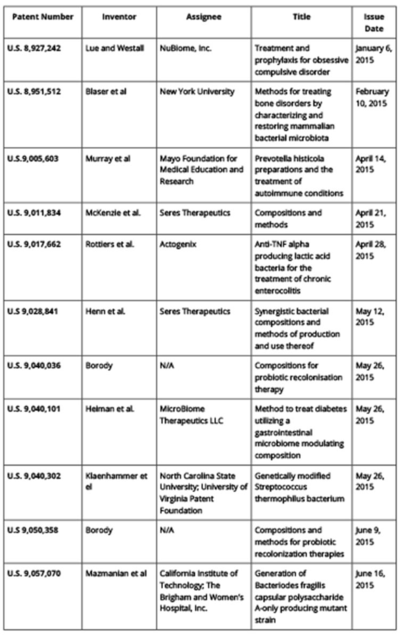
    Table 1
    U.S. Patent No. 8,927,242
    generally relates to a bacterial therapy for treatment of a subset of psychiatric disorders in children. The patent covers administration of the bacteria Streptococcus oralis 89a to treat mental illness. Pediatric Autoimmune Neuropsychiatric Disorders Associated with Streptococcal Infections (PANDAS) include Obsessive Compulsive Disorder (OCD) and/or Tourette Syndrome, whose symptoms can worsen following infection. Autoimmunity from inappropriate immune responses to bacterial antigens is thought to impair function of the basal ganglia, which controls the brain structure involved in emotion and movement. Embodiments of this invention use a combination of therapeutic bacteria, which reduces populations of the antigen-inducing species, with supplemented enzymes (such as PepO, PepO2 and subtilisin), which break down the antigens that cause disease.

    U.S. Patent No. 8,951,512 generallyrelates to a bacterial therapy for treatment of osteoporosis or related bone disorders. The gut microbiota modulates metabolism and immunity. Changes to the composition of the gut microbiota can disrupt these critical functions and lead to changes in bone mass. The patent claims bacterial strains, including Helicobacter pylori, which restore gut microbiome composition; prebiotics that stimulate the growth of therapeutic bacterial strains or improve gut microbiome composition; and methods for administering these compositions to patients.

    U.S. Patent No. 9,005,603 generally relates to a bacterial therapy containing Prevotella histicola for treatment of autoimmune diseases such as arthritis and multiple sclerosis. This species reduces inflammation, a hallmark of autoimmune disease.

    U.S. Patent 9,011,834 generally relates to a bacterial therapy for treatment or prevention changes to the composition of the gut microbiota, such as those that accompany Clostridium difficile infection, irritable bowel syndrome, and Crohn's. The patent claims the production, isolation, and administration of germination-competent bacterial spores. These spores are intended to modulate the gut microbiota.

    U.S. Patent 9,017,662 generally relates to a bacterial therapy for treatment of inflammatory bowel disease (IBD). The patent claims oral administration of a strain of Lactococcus lactis engineered to produce antibodies that neutralize tumor necrosis factor-α (TNF).

    U.S. Patent 9,028,841 generally relates to a bacterial therapy for treatment or prevention of changes to the composition of the gut microbiota, such as those that accompany C. difficile infection. The patent claims a composition containing a combination of Collinsella aerofaciens and Clostridiaceae family members. These bacteria are intended to inhibit the growth of pathogenic species and populate the gut.

    U.S. Patent 9,040,036 generally relates to a bacterial therapy for treatment or prevention of changes to the composition of the gut microbiota. The patent claims a composition containing a combination of bacterial spores from anaerobic cocci, non-pathogenic Clostridiaceae family members, members of the genus Bacteroides, Collinsella, Fusobacteria, Propionibacteria, Lactobacillus, Gemmiger, Desulfomonas, Peptostreptococcus; and a non-pathogenic Escherichia coli species.

    U.S. Patent 9,040,101 generally relates to the treatment of diarrhea in diabetic patients taking metformin, a treatment for type II diabetes. Metformin treatment causes diarrhea in some patients and has been shown to change the composition of the gut microbiome in mice. The patent claims a treatment containing inulin, beta-glucan, and polyphenolic compounds from blueberries. Inulin is an undigestible carbohydrate that can be utilized by Bacteriodetes species, promoting their growth and function. Beta-glucan is intended not only to protect members of the gut microbiome from the antimicrobial action of bile, but also to provide polysaccharide-derived nutrients for the members of the gut microbiota.Polyphenolic compounds have been shown to improve insulin sensitivity in diabetic patients.

    U.S. Patent 9,040,302 generally relates to the use of an engineered strain of Streptococcus thermophiles as a drug delivery vehicle. The patent claims a composition containing the engineered strain that expresses an alanine-glutamine or alanine-glutamine-arginine rich bioagent after being exposed to bile in the intestine. Glutamine helps promote intestinal integrity. The addition of alanine is intended to improve stability of the peptide, while arginine may increase glutamine's effects.

    U.S. Patent 9,050,358 generally relates toa bacterial therapy for treatment of gastrointestinal disorders associated with changes to the composition of the gut microbiome. The patent claims a composition containing bacterial spores from Clostridium bifermentans, Clostridium butyricum, Clostridium difficile, Clostridium ramosum, Clostridium innocuum and a Collinsella species. This composition can also be combined with a number of other Clostridia and Bacteroides, members of the genus, Bifidobacterium Pseudoflavonifractor capillosus, Odoribacter splanchnicus, anaerobic cocci, Fusobacteria, Propionibacteria, Lactobacillus, Gemmiger, Desulfomonas, Peptostreptococcus, Escherichia coli, Peptostreptococcus productus II, Parabacteroides distasonis Fusobacterium prausnitzii, Coprococcus eutactus, , Peptostreptococcus productus I, Ruminococcus bromii, Eubacterium siraeum, Ruminococcus torques, Eubacterium rectale, Eubacterium eligens, Eubacterium biforme, Eubacterium rectale III-F, Coprococcus comes, Ruminococcus albus, Dorea formicigenerans, Eubacterium haffii, Eubacterium ventriosum I, Ruminococcus obeum, Eubacterium rectale, , Ruminococcus callidus, Butyrivibrio crossotus, Acidaminococcus fermentans, Eubacterium ventriosum, Coprococcus catus, Aerostipes hadrus, Eubacterium cylindroides, Eubacterium ruminantium, Eubacterium CH-1, Staphylococcus epidermidis, Peptostreptococcus BL, Eubacterium limosum, Tissirella praeacuta, Fusobacterium mortiferum I, Fusobacterium naviforme, Ruminococcus flavefaciens, Ruminococcus AT, Peptococcus AU-1, Fusobacterium nucleatum, Fusobacterium mortiferum, Gemella morbillorum, Finegoldia magnus, Peptococcus G, -AU-2; Streptococcus intermedius, Ruminococcus lactaris, Ruminococcus CO Gemmiger X, Coprococcus BH, –CC; Eubacterium tenue, Eubacterium ramulus, , Prevotella oralis, Prevotella ruminicola, Odoribacter splanchnicus, Desuifomonas pigra, Succinivibrio A, and a non-pathogenic fungi.

    U.S. Patent 9,057,070 generally relates to a bacterial therapy for treatment of inflammatory bowel disease. The patent claims administration of a strain of Bacillus fragilis engineered to lack all but one of its native capsular polysaccharides (capsular polysaccharide A, or PSA). The inventors have shown that PSA reduces intestinal inflammation in mouse models of multiple sclerosis and inflammatory bowel disease. This invention is intended to facilitate the purification of PSA, but not other polysaccharides, from B. fragilis.

    * Jessica Miles is a Technology Specialist at Dilworth IP
    ** Dr. Sabatelli is a Partner with Dilworth IP

  • Editor's note: This is the first part in a series that will explore the current and potential developments of microbiome research, and how those developments interface with intellectual property protection.

    By Jessica Miles* and Anthony D. Sabatelli** —

    This is the first installment in a series on advancements in microbiome research and development.  Our goal with this series is to inform readers about developments in this important and growing field and to highlight, where possible, Connecticut's role in fostering this research.  This first article will provide a brief overview of this technology area, featuring both prominent pharmaceutical companies and research labs.  Future articles will discuss progress in commercializing this research, review new and relevant patents, and explore issues of law and policy in microbiome R&D.

    Research into the microbiome seeks to characterize the microorganisms that live in and on different environments.  Although these environments can be broadly terrestrial, extraterrestrial aquatic, and biological, we often use the term specifically to describe the bacteria living in and on different sites of the human body.  The word "microbiome" refers either to the organisms themselves (also called "microbiota") or their collective genomes.  Within the human gut, the most bacteria-rich organ, these genes outnumber those in the human genome 100: 1, providing attractive candidates for pharmaceutical intervention.  Inflammatory bowel disease (IBD), childhood-onset asthma, diabetes, obesity, cardiovascular disease, colorectal cancer, and antibiotic-associated diarrhea are some of the diseases that involve changes in the composition or loss of the function of the microbiome.

    Microbiomics Companies

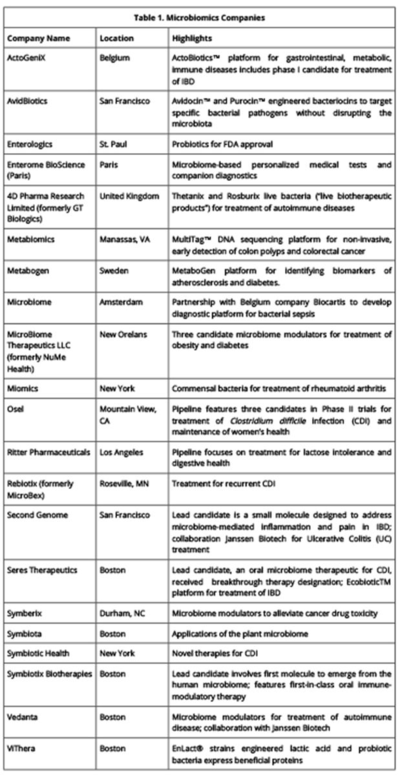
    2015 is shaping up to be a banner year for microbiome-based drug development, or "microbiomics."  This year, Google Ventures President Bill Maris named microbiomics one of eight technologies with the potential to revolutionize life sciences, comparing its potential for impact to that of stem cells research, artificial intelligence, and gene editing.  In late June, Seres Therapeutics became the first microbiomics company to go public, with a $134 million IPO.  Table 1 provides more information about Seres and other leading companies in the microbiomics space (click on table to enlarge).

    Table I
    Several local startups seek to enter this market.  Mark Driscoll and Thomas Jarvie, formerly of 454 Life Sciences in Branford, have founded Shoreline Biome to develop diagnostics and therapeutics targeting the human microbiome.  Azitra, the brainchild of Yale students in medicine and public health, is building a platform that combines microbiomics and synthetic biology for the treatment of skin disease.

    Microbiome Research: Connecticut and Beyond

    Connecticut boasts several outstanding leaders in microbiome research.  George Weinstock, a Professor and Director for Microbial Genomics at The Jackson Laboratory for Genomic Medicine (JGM) in Farmington led the Human Microbiome Project, a five-year, $115 million initiative to characterize the microbiome and its contribution to disease.  Recent hire Julia Oh is bringing her innovative work on the skin microbiome to the JGM as an Assistant Professor.  Her arrival adds to a growing community of microbiome scientists in the state, including Andrew Goodman, an Associate Professor of microbial pathogenesis at Yale University whose work was recently honored by the Burroughs Wellcome Trust.  Yale is also home to metagenomics pioneer Jo Handelsman (currently on leave as Associate Director for Science at the White House Office of Science and Technology Policy), immunobiologists Richard Flavell and Ruslan Medzhitov, and physician-scientist Martin Kriegel.  At University of Connecticut (UConn), Joerg Graf and Xiaomei Cong are collaborating to investigate whether early life stress exposure, microbiome disruption, and psychological dysfunction are linked in preterm infants.

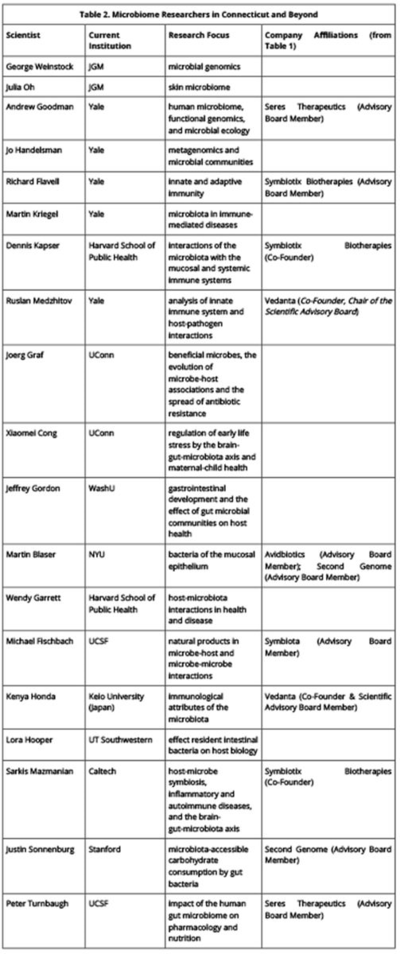
    The studies of CT-based scientists complement the work of other outstanding researchers in this field.  These include Jeffrey Gordon at Washington University in St. Louis (WashU), Martin Blaser at New York University (NYU), Wendy Garrett at Harvard University, Michael Fischbach at University of California San Francisco (UCSF), Lora Hooper at University of Texas Southwestern Medical Center (UT Southwestern), Sarkis Mazmanian at California Institute of Technology (Caltech), Justin Sonnenburg at Stanford University, Peter Turnbaugh at UCSF, and many others.  Several of these scientists also hold key patents in microbiomics and some have also started or advise microbiome-based pharmaceutical companies.  Table 2 reviews these key researchers and their contributions (click on table to enlarge).

    Table 2
    Closing

    The microbiome represents a new frontier in health and disease.  A number of microbiome-based therapies are now in the early stages of development.  This recent flurry of commercialization would not be possible without basic research from labs both in CT and around the world.  These trends will surely continue as R&D in this field progresses.  Stay tuned for the next installment of this series, which will review the patent landscape in microbiome research, with a focus on applications and grants issued this year.

    * Jessica Miles is a Technology Specialist at Dilworth IP
    ** Dr. Sabatelli is a Partner with Dilworth IP

    Note: Shoreline Biome and Azitra, both mentioned in this article, are clients of Dilworth IP.

  • By Donald Zuhn

    USPTO to Replace EFS-Web and PAIR

    EFS-WebIn an article posted on the Director's Forum blog, U.S. Patent and Trademark Office Deputy Director Russ Slifer announced that the Office would begin implementing a new system that will eventually replace the EFS-Web, Public PAIR, and Private PAIR.  The new initiative, eCommerce Modernization (eMod), which is intended to improve the electronic patent application process by modernizing the filing and viewing systems, will be implemented in phases over the next few years, with an initial pilot program expected to start in the summer of 2016.  According to the announcement, eMod will help provide a simpler authentication process, improved functionality, and a more user friendly interface and documents for applicants, and will streamline patent submission, review, and management processes, and increase accuracy of application processing and publication for examiners.

    The Office is seeking feedback regarding the new system.  Those in the patent community can review ideas that have already been submitted and vote or comment on those ideas here.  Comments can also be submitted at the Office's eMod webpage or by e-maling comments to eMod@USPTO.gov.


    U.S. and Brazil Announce Work Sharing Program

    INPILast month, the U.S. Patent and Trademark Office and Brazilian National Institute of Industrial Property (INPI) announced that U.S. Secretary of Commerce Penny Pritzker and Brazilian Minister of Development, Industry & Foreign Trade (MDIC) Armando Monteiro had signed a Joint Statement on Patent Work Sharing.  Pursuant to the Joint Statement, the USPTO and INPI "intend to commence cooperative activities, on or after the date of signature of this Joint Statement, including the implementation of a mutually beneficial work-sharing pilot program that facilitates the examination of patent applications that are commonly filed in the United States and Brazil."  The agreement between the two offices is part of broader government-wide efforts to expand trade and investment with Brazil.  According to the announcement regarding the Joint Statement, the USPTO's Office of Policy and International Affairs (OPIA) is now working closely with counterpart officials in the INPI to establish a technical framework for a future patent work-sharing program between the two offices, which is expected to be finalized by the end of summer.


    Google Chrome Browser to End Support for Java Plug-Ins — Impact on Use of EFS-Web and Private PAIR

    ChromeThe U.S. Patent and Trademark Office issued an e-mail Patents Alert notice last month noting that Google removed the default ability to use the Java plug-in from Chrome version 42.  The Office indicated that the modification will impact the ability of Chrome users to access EFS-Web and Private PAIR because Java is required for authentication into these systems.  However, the Office pointed out that there is a temporary workaround that will allow Chrome users to use the Java plug-in through September 2015 when Google plans to end support for Java plug-ins in its newest browser, Chrome version 45.  Information about that workaround can be found here.  The Office notes that Chrome users using version 45 and above will no longer be able to use the workaround after September 2015 and will therefore not be able to log into EFS-Web or Private PAIR.  According to the Office's announcement, "Oracle is recommending the use of alternative browsers such as Firefox, Internet Explorer, and Safari."  The Office also indicated that it is investigating any possible strategies to mitigate the impact of changes in the Chrome browser.  Additional information can be found on the Office's EFS-Web Announcements webpage.


    EFS-Web and Private PAIR Inaccessible with Microsoft Edge Browser

    Windows EdgeIn an advisory on the U.S. Patent and Trademark Office's EFS-Web Announcements webpage, the Office noted that EFS-Web and Private PAIR users updating to Windows 10 should be aware that the browser included with the new operating system, Microsoft Edge, does not support plug-ins and will not run Java.  As a result, the EFS-Web and Private PAIR cannot be accessed via Microsoft Edge.  The Office noted that to access the EFS-Web and Private PAIR using Windows 10, Oracle is recommending the use of alternative browsers such as Firefox and Internet Explorer.

  • CalendarAugust 10-11, 2015 – "Advanced Patent Prosecution Seminar 2015: Claim Drafting & Amendment Writing" (Practising Law Institute) – San Francisco, CA

    August 11, 2015 – Patent Quality Chat webinar series – Measuring Patent Quality – noon to 1:00 pm (EDT)

    August 12-14, 2015 – Advanced Patent Law Seminar (Chisum Patent Academy) – Seattle, WA

    August 13, 2015 – "Defending Patents in IPR Proceedings — Leveraging Motions to Amend and Preliminary Responses, Weighing Secondary Considerations" (Strafford) – 1:00 to 2:30 pm (EDT)

    August 20, 2015 – "Inducement to Infringe in Patent Litigation: Protecting IP Rights — Lessons from Commil USA v. Cisco Sys. Inc. and Leveraging Opinions of Counsel" (Strafford) – 1:00 to 2:30 pm (EDT)

    August 24, 2015 – Roadshow on Patent Quality and AIA Trials (American Intellectual Property Law Association and U.S. Patent and Trademark Office) – Santa Clara, CA

    August 26, 2015 – Roadshow on Patent Quality and AIA Trials (American Intellectual Property Law Association and U.S. Patent and Trademark Office) – Dallas, TX

    August 27, 2015 – "Meet the New Boss. Same as the Old Boss? Not Even Close under New Mayo/Alice Regime for § 101" (McDonnell Boehnen Hulbert & Berghoff LLP) – 10:00 am to 11:15 am (CT)

    August 27, 2015 – "Biosimilars: Regulation, Litigation and New Developments Patent Practitioners and Regulatory Attorneys Should Know" (American Intellectual Property Law Association) – 12:30 – 2:00 pm (Eastern)

    August 28, 2015 – Roadshow on Patent Quality and AIA Trials (American Intellectual Property Law Association and U.S. Patent and Trademark Office) – Alexandria, VA

    September 10, 2015 – Biotech Patent Law Road Show (American Intellectual Property Law Association) – Boston, MA

    September 10-11, 2015 - "Advanced Patent Prosecution Seminar 2015: Claim Drafting & Amendment Writing" (Practising Law Institute) – Chicago, IL

    September 17, 2015 – "Professional Negligence: Real-Life Case Studies in IP Malpractice & How to Avoid Them" (American Intellectual Property Law Association) – 12:30 – 2:00 pm (Eastern)

    September 18, 2015 – Developments in Pharmaceutical and Biotech Patent Law 2015 (Practising Law Institute) – San Francisco, CA

    September 22, 2015 – "The Evolving World of Biosimilars Litigation" (McDonnell Boehnen Hulbert & Berghoff LLP) – 10:00 am to 11:15 am (CT)

    September 24-25, 2015 - Advanced Patent Law Seminar (Chisum Patent Academy) – Washington, DC

    September 27-29, 2015 – 43rd Annual Meeting (Intellectual Property Owners Association) – Chicago, IL

    October 2, 2015 – Developments in Pharmaceutical and Biotech Patent Law 2015 (Practising Law Institute) – New York, NY

    ***Patent Docs is a media partner of this conference or CLE

  • MBHB Logo 2McDonnell Boehnen Hulbert & Berghoff LLP will be offering a live webinar on "The Evolving World of Biosimilars Litigation" on September 22, 2015 from 10:00 am to 11:15 am (CT).  In this presentation, MBHB attorneys and Patent Docs authors Dr. Kevin E. Noonan and Dr. Andrew W. Williams will review the history of the BPCIA and the Amgen v. Sandoz case, including the potential implications of the Federal Circuit’s recent decision.  Topics to be addressed the webinar include:

    • The statutory framework of the BPCIA
    • The Sandoz application and subsequent litigation
    • Statutory construction at the district court and Federal Circuit
    • Prospects for Supreme Court review
    • Consequences of the Federal Circuit decision

    While there is no fee to participate, attendees must register in advance.  Those wishing to register can do so here.  CLE credit is pending for the states of California, Illinois, New Jersey, New York, North Carolina, and Virginia.