• Lex MachinaLex Machina will be offering a live webinar on the release of its 2023 Patent Litigation Report on February 15, 2023 at 9:00 am (PDT).  Aria Nejad of Lex Machina will moderate a panel consisting of Robin Davis of Woodsford, Michael Connelly of WIT Legal, and Elaine Chow of Lex Machina that will discuss patent litigation trends over the last three years; offer insights on judges, venues, parties, law firms, case filings, timing, case resolutions, findings, and damages; and look at emerging trends in connection with PTAB litigation and federal appellate patent litigation.

    Those wishing to register for the webinar can do so here.

  • IPO #2The Intellectual Property Owners Association (IPO) Black IP Professionals Resource Group will be hosting a virtual discussion entitled "IPO Black History Month Event: Successes and Challenges Faced by Leaders in the Black IP Community" on February 16, 2023 from 2:00 pm to 3:00 pm (ET).  Gaby L. Longsworth of Sterne, Kessler, Goldstein & Fox PLLC and Tony Sabeta of Aird & McBurney LP will moderate a panel consisting of Govinda Davis of Dinsmore & Shohl LLP, Eldora L. Ellison of Sterne, Kessler, Goldstein & Fox PLLC, Dara M. Kendall of Procter & Gamble Company, and Theodore (Ted) A. Wood of Wood IP will provide insights, perspectives, and strategies for thriving in the IP profession.

    There is no registration fee for the webinar.  However, those interested in attending the webinar should register here.

  • ACIAmerican Conference Institute (ACI) will be presenting a National Forum on IP, Funding and Tech Strategies for Novel Therapeutic Modalities and Gene Therapies from March 21-22, 2023, in Boston, MA.  The Forum will highlight leveraging technology, safeguarding IP, and securing funding to accelerate development in mRNA, CRISPR, and CAR-T.

    The Forum promises to be a holistic, end-to-end summit for therapeutic pioneers, innovators, investors, executives and their counsel to meet, assess, and shape the future development and commercialization of these novel modalities and therapies.  Confirmed speakers include Julia Tierney (Chief of Staff, Food and Drug Administration), Anne Gussow (Supervisory Patent Examiner, Quality Assurance Specialist, USPTO), Karlheinz Skowronek (Supervisory Patent Examiner, Bioinformatics, USPTO), and Julie Wu (Supervisory Patent Examiner, Immunotherapy and Recombinant Antibodies, USPTO).

    A brochure, agenda, and registration information including lodgings can be found here.  ACI can be contacted by e-mail at customerservice@americanconference.com and by telephone at 1-888-224-2480.

    Patent Docs readers can save 10% by using promo code: D10-999-PATENTDOCS.

  • Life Sciences "Top 56"

    By Donald Zuhn

    IPO #2Last month, the Intellectual Property Owners Association (IPO) and Harrity Analytics announced the release of the 40th annual list of the top 300 organizations receiving U.S. utility patents (see "Top 300 Organizations Granted U.S. Patents in 2022").  Patent Docs readers may recall that the U.S. Patent and Trademark Office stopped releasing its annual list of top patent recipients in 2006 in order to "discourag[e] any perception that we believe more is better."

    HarrityAs with the 2021 report, the 2022 report was compiled in collaboration with Harrity Analytics, based on data obtained from the U.S. Patent and Trademark Office.  The IPO and Harrity Analytics noted that patents reported on the 2022 list are utility patents granted during the 2022 calendar year that listed the organization or a subsidiary as the owner on the printed patent document.  Harrity Analytics then used organization and subsidiary data provided to two independent third-party data providers and reviewed over 200,000 assignments to attribute ownership to the correct organizations, where applicable.  The report notes that patents that were granted to two or more organizations jointly are attributed to each organization separately, and that companies for which patents were granted to subsidiaries are combined with patents granted to the parent.

    The IPO and Harrity Analytics also noted that 323,018 patents were issued in 2022, down 1% from the 327,798 patents that issued in 2021.  The top twenty companies on the Top 300 are listed below (click on table to expand):

    Top 20
    As in past years, Patent Docs used the IPO's list of top patent holders to compile a list of the top "life sciences" companies and organizations receiving U.S. utility patents in 2022.  Each organization's top 300 ranking for 2022 is indicated in the "2022 IPO Rank" column; the top 300 ranking for 2021 (if available) is indicated in the "2021 IPO Rank" column; and the change in number of patents from 2021 is indicated in "% Change from 2021."  The Life Sciences Top 56 is listed below (click on table to expand):

    Top 56 LS
    Please note that some of the companies and organizations listed above may be involved in work outside the life sciences sector, and therefore, a portion of the patents granted to these companies and organizations may be directed to other than life sciences-related inventions.  Our list also includes medical device companies.

    For additional information regarding this topic, please see:

    • "IPO & Harrity Analytics Release List of Top 300 Patent Holders for 2021," January 23, 2022
    • "IPO & Harrity Analytics Release List of Top 300 Patent Holders for 2020," February 18, 2021
    • "IPO & Harrity Analytics Release List of Top 300 Patent Holders for 2019," May 20, 2020
    • "IPO Releases List of Top 300 Patent Holders for 2018," August 7, 2019
    • "IPO Releases List of Top 300 Patent Holders for 2017," July 4, 2018
    • "IPO Releases List of Top 300 Patent Holders for 2016," June 14, 2017
    • "IPO Releases List of Top 300 Patent Holders for 2014," July 1, 2015
    • "IPO Releases List of Top 300 Patent Holders for 2013," July 7, 2014
    • "IPO Releases List of Top 300 Patent Holders for 2012," June 24, 2013
    • "Another Look at IPO Top 300 and Life Sciences Top 53," June 11, 2012
    • "IPO Releases List of Top 300 Patent Holders for 2011," June 7, 2012
    • "IPO Releases List of Top 300 Patent Holders for 2010," June 30, 2011
    • "IPO Releases List of Top 300 Patent Holders for 2009," May 26, 2010
    • "IPO Releases List of Top 300 Patent Holders for 2008," May 14, 2009
    • "IPO Releases List of Top 300 Patent Holders," May 22, 2008
    • "IPO Posts List of Top 300 Patent Holders," April 20, 2007

  • By Donald Zuhn –-

    World Health OrganizationOn February 1, the World Health Organization (WHO) released a "zero draft" of a WHO convention, agreement, or other international instrument on pandemic prevention, preparedness, and response (or "WHO CA+") for the consideration of the Intergovernmental Negotiating Body (INB) at its fourth meeting, which will take place on February 27, 2023.  The INB, comprised of the 194 Member States of the WHO, was established in December 2021 at a special session of the World Health Assembly, the decision-making body of the WHO, to draft and negotiate a convention, agreement, or other international instrument under the Constitution of the WHO to strengthen pandemic prevention, preparedness, and response.  In December 2022, the INB agreed at its third meeting that the INB's Bureau (comprised of six delegates, one from each of the six WHO regions) would develop the zero draft of the pandemic accord (the Bureau of the INB is comprised of members from South Africa, Brazil, Egypt, the Netherlands, Thailand, and Japan).

    The zero draft begins by stating the following:

    1.   In recognition of the catastrophic failure of the international community in showing solidarity and equity in response to the coronavirus disease (COVID-19) pandemic, the World Health Assembly convened a second special session in December 2021, where it established an Intergovernmental Negotiating Body (INB) open to all Member States and Associate Members (and regional economic integration organizations as appropriate) to draft and negotiate a WHO convention, agreement or other international instrument on pandemic prevention, preparedness and response, with a view to its adoption under Article 19, or under other provisions of the WHO Constitution as may be deemed appropriate by the INB.

    2.  In furtherance of the above mandate, the INB established a process and systematic approach for its work and agreed, at its second meeting, that the instrument should be legally binding and contain both legally binding as well as non-legally binding elements. In that regard, the INB identified Article 19 of the WHO Constitution as the comprehensive provision under which the instrument should be adopted, without prejudice to also considering, as work progressed, the suitability of Article 21, and requested the Bureau to develop and present to the INB a conceptual zero draft of the instrument (referred to herein as the "WHO CA+") for discussion.

    3.   At its third meeting, the INB agreed that the Bureau, with support from the WHO Secretariat, would prepare the zero draft of the WHO CA+, based on the conceptual zero draft and input received during the third meeting of the INB, with legal provisions. The INB further agreed that the zero draft would be considered at its fourth meeting as a basis for commencing negotiations at that meeting, it being understood that the zero draft will be without prejudice to the position of any delegation and following the principle that "nothing is agreed until everything is agreed".

    4.   Accordingly, the Bureau has prepared this zero draft of the WHO CA+ for consideration by the INB at its fourth meeting.

    The 32-page long zero draft provides a 49-clause preamble, with at least ten of those clauses concerning intellectual property:

    37.   Recalling the Doha Declaration on the TRIPS Agreement and Public Health of 2001 and reiterating that the Agreement on Trade-Related Aspects of Intellectual Property Rights (TRIPS Agreement) does not and should not prevent Members of the World Trade Organization from taking measures to protect public health,

    38.   Reaffirming that the TRIPS Agreement can and should be interpreted and implemented in a manner supportive of the right of Members of the World Trade Organization to protect public health and, in particular, to promote access to medicines for all,

    39.   Reaffirming that Members of the World Trade Organization have the right to use, to the full, the TRIPS Agreement and the Doha Declaration on the TRIPS Agreement and Public Health of 2001, which provide flexibility to protect public health including in future pandemics,

    40.   Recognizing that protection of intellectual property rights is important for the development of new medical products, but also recognizing concerns about its effects on prices, as well as noting discussions/deliberations in relevant international organizations on, for instance, innovative options to enhance the global effort towards the production of, timely and equitable access to, and distribution of health technologies and know-how, by means that include local production,

    41.   Recognizing that protection of intellectual property rights is important for the development of new medicines, and also recognizing concerns about the negative effect on prices and on the production of, timely and equitable access to, and distribution of vaccines, treatments, diagnostics and health technologies and know-how,

    42.   Recognizing that intellectual property protection is important for the development of new medicines, and also recognizing concerns about its effect on prices, as well as noting discussions on enhancing global efforts towards the production of, timely and equitable access to, and distribution of health technologies and products,

    43.   Recognizing the concerns that intellectual property on life-saving medical technologies continues to pose threats and barriers to the full realization of the right to health and to scientific progress for all, particularly the effect on prices, which limits access options and impedes independent local production and supplies, as well as noting structural flaws in the institutional and operational arrangements in the global response to the COVID-19 pandemic, and the need to establish a future pandemic prevention, preparedness and response mechanism that is not based on a charity model,

    44.   Reaffirming the flexibilities and safeguards contained in the TRIPS Agreement and their importance for removing barriers to production of, and access to, pandemic-related products, as well as sustainable supply chains for their equitable distribution, while also recognizing the need for sustainable mechanisms to support transfer of technology and know-how to support the same,

    45.   Reaffirming the flexibilities and safeguards contained in the TRIPS Agreement and their importance for ensuring access to technologies, knowledge and full transfer of technology and know-how for production and supply of pandemic-related products, as well as their equitable distribution,

    46.   Recalling resolution WHA61.21 (2008) on the global strategy and plan of action on public health, innovation and intellectual property, which lays out a road map for a global research and development system supportive of access to appropriate and affordable medical countermeasures, including those needed in a pandemic, . . . .

    Among the provisions set forth in the zero draft, Article 7 on "Access to technology: promoting sustainable and equitably distributed production and transfer of technology and know-how" provides several provisions that will be of interest to those in the patent community:

    3.   During inter-pandemic times, all Parties commit to establish these mechanisms and shall:

    (a)   coordinate, collaborate, facilitate and incentivize manufacturers of pandemic-related products to transfer relevant technology and know-how to capable manufacturer(s) (as defined below) on mutually agreed terms, including through technology transfer hubs and product development partnerships, and to address the needs to develop new pandemic-related products in a short time frame;

    (b)   strengthen coordination, with relevant international organizations, including United Nations agencies, on issues related to public health, intellectual property and trade, including timely matching of supply to demand and mapping manufacturing capacities and demand;

    (c)   encourage entities, including manufacturers within their respective jurisdictions, that conduct research and development of pre-pandemic and pandemic-related products, in particular those that receive significant public financing for that purpose, to grant, on mutually agreed terms, licences to capable manufacturers, notably from developing countries, to use their intellectual property and other protected substances, products, technology, know-how, information and knowledge used in the process of pandemic response product research, development and production, in particular for pre-pandemic and pandemic-related products . . . .

    4.   In the event of a pandemic, the Parties:

    (a)   will take appropriate measures to support time-bound waivers of intellectual property rights that can accelerate or scale up manufacturing of pandemic-related products during a pandemic, to the extent necessary to increase the availability and adequacy of affordable pandemic-related products;

    (b)   will apply the full use of the flexibilities provided in the TRIPS Agreement, including those recognized in the Doha Declaration on the TRIPS Agreement and Public Health of 2001 and in Articles 27, 30 (including the research exception and "Bolar" provision), 31 and 31bis of the TRIPS Agreement;

    (c)   shall encourage all holders of patents related to the production of pandemic-related products to waive, or manage as appropriate, payment of royalties by     developing country manufacturers on the use, during the pandemic, of their technology for production of pandemic-related products, and shall require, as appropriate, those that have received public financing for the development of   pandemic-related products to do so; and

    (d)   shall encourage all research and development institutes, including manufacturers, in particular those receiving significant public financing, to waive, or manage as appropriate, royalties on the continued use of their technology for production of pandemic-related products.

    5.   For purposes of this Article, "capable manufacturer" refers to an entity that operates in a manner that is consistent with national and international guidelines and regulations, including biosafety and biosecurity standards.

    According to a Health Policy Watch report on the zero draft, "the draft will be negotiated in [the INB] — and it is unlikely to survive in its current form given the strong pharmaceutical lobby, particularly in the European Union" (see Cullinan, "Pandemic Treaty 'Zero-Draft' is Out – Proposes WHO Gets 20% of All Pandemic Products to Ensure Equity," Health Policy Watch, February 1, 2023).

    The zero draft will now be discussed at the INB's fourth meeting on February 27, 2023.

  • By Aaron Gin and Yuri Levin-Schwartz* —

    OpenAI's prototype of ChatGPT, released at the end of November 2022, drew rapid, widespread public attention for its ability to provide articulate, human-like responses across a wide variety of knowledge domains.  Numerous articles have already explored large language models like ChatGPT and what they can and cannot do — as well as the broad impact of such models on the legal profession[i][ii][iii][iv].  In this article, we explore how large language models like ChatGPT may impact patent prosecution in the near future.

    For inspiration, we prompted ChatGPT:  "As a patent attorney, how can I utilize ChatGPT?"  Here's the first use case output by the AI model:

    (1)   Drafting patent applications: ChatGPT can help you generate patent claims and descriptions of inventions, which are key components of a patent application.

    Indeed, ChatGPT can write patent claims by analyzing input information such as the technical field of the invention, the problem the invention solves, and a description of the invention.  However, the quality of the claims that ChatGPT provides depends directly on the relevance and completeness of the input information.  For example, if you ask ChatGPT to write claims relating to simply "a bicycle," it will provide 20 total claims and three independent claims (consistent with the no-fee limits for claims in U.S. patent applications) that relate to a generic bicycle.  Claim 1 is:

    A bicycle comprising a frame, two wheels, and a handlebar, the frame being configured to support a rider, the two wheels being rotatably attached to the frame, and the handlebar being operatively connected to the frame and configured to enable steering of the bicycle.

    The dependent claims describe a chain, derailleur, different gear configurations, brakes, and so on.

    The problem with the scope of this claim set, of course, is that it doesn't include anything novel or non-obvious.  To move closer to a useful claim set, we need to include more information about the potentially novel elements.

    As a narrower example, we could change our focus to a bicycle having "a shifter cable formed from carbon fiber filaments".  In that case, the ChatGPT output changes to:

    A bicycle comprising a frame, a fork, at least one wheel, a shifter cable formed from carbon fiber filaments, a shifter mechanism for controlling the shifting of the gears of the bicycle, wherein the shifter cable is operatively connected to the shifter mechanism and extends from the shifter mechanism to the gears of the bicycle.

    This scope is an improvement over the generic bicycle claim, but it also introduces new problems, including 1) an antecedent basis problem for "the gears"; 2) potentially extraneous elements such as "a fork" and "at least one wheel;" 3) potential "means plus functions" interpretations with "a shifter mechanism for . . ."; and 4) in our example output, several multiple-dependent claims that would draw huge fees from the USPTO.  Problems aside though, from a patent practitioner's high-level point of view, ChatGPT could speed up the process of drafting a patent application by rapidly generating numerous candidate claim iterations.

    In some cases, this might mean that, instead of spending time wordsmithing a set of claims, a patent attorney could focus more closely on an invention's specific point of novelty and work with the inventor(s) to develop a plain English summary of the specific differences between a generic device/system/method and the innovation.

    Such a focused summary could provide ChatGPT with better inputs from which to form more relevant candidate patent claims and be used as a seed to ask ChatGPT to provide an initial patent specification.  For example, if we input "write a patent specification for a bicycle with a shifter cable formed from carbon fiber filaments," ChatGPT provides a relevant title, field of the invention, background, summary, and a brief, but reasonably complete, detailed description.  Such outputs could potentially be used as a base template or an outline to draft a more complete patent specification.

    In the near term, patent practitioners may also consider using ChatGPT alongside other claim drafting tools, such as ClaimMaster or Juristat, among others.  These tools can help patent attorneys avoid potential issues, including antecedent basis, means-plus-function, indefiniteness, Section 101, among other possibilities.

    Remember, your conversations aren't private

    One important issue involving large language models is how they use the information from user prompts.  For example, a patent attorney must make sure to not disclose a client's confidential information through interactions with ChatGPT.  Prompts provided to ChatGPT, and likely most other large language models, are not private at this time.  Specifically, OpenAI's FAQ provides the following:

    Can you delete specific prompts?

    No, we are not able to delete specific prompts from your history.  Please don't share any sensitive information in your conversations.

    OpenAI's Privacy Policy also provides:

    Communication Information: If you communicate with us, we may collect your name, contact information, and the contents of any messages you send ("Communication Information").

    As such, patent attorneys must take care not disclose confidential information to publicly-accessible large language models like ChatGPT.  A court could consider the content of the messages as public disclosure of the invention because OpenAI has no obligation to secrecy.  Inadvertent disclosures could result in a loss of patent rights and/or a time bar if a utility application is not filed within one year of the disclosure.

    Even with these cautions and potential issues, ChatGPT and other large language models have the potential to reduce drafting work for patent attorneys by rapidly providing candidate patent claims and corresponding detailed description.  This may give patent attorneys more time to focus on the creative and interactive aspects of patent law.

    * Yuri Levin-Schwartz, Ph.D., is a law clerk at MBHB.

    [i] https://www.patentdocs.org/2023/01/the-existence-of-chatgpt-does-not-justify-attempts-to-equate-human-and-machine-cognition.html

    [ii] https://www.mondaq.com/uk/patent/1261506/chatgpt-are-patent-attorneys-out-of-a-job

    [iii] https://www.mbhb.com/intelligence/snippets/chatgpt-what-it-is-and-what-it-can-and-cannot-do/

    [iv] https://www.mbhb.com/intelligence/snippets/who-owns-your-chatgpt-output/

  • By Kevin E. Noonan –

    Supreme Court Building #1Facing what is likely to be something of an uphill battle in seeking to have the Federal Circuit's decision against it in Amgen v Sanofi overturned before a not always patent-friendly Supreme Court, Amgen in late December filed its opening brief addressing the Question Presented in the granted certiorari petition:

    Whether enablement is governed by the statutory requirement that the specification teach those skilled in the art to "make and use" the invention, 35 U.S.C. § 112, or whether it must instead enable those skilled in the art "to reach the full scope of claimed embodiments" without undue experimentation ― i.e., to cumulatively identify and make all or nearly all embodiments of the invention without substantial "time and effort," Pet. App. 14a [emphasis in Question].

    The brief begins by disparaging the decision based on the Federal Circuit "once again" "imposing limitations on the Patent Act that are inconsistent with the Act's text" as the Supreme Court asserted in Bilski v. Kappos, 561 U.S. 593, 612 (2010).  Amgen argues that the focus of the Court's consideration of the question before it should be on the statute and its text, which has not changed appreciably since the 1790 Patent Act enacted by the Founders.  An important consideration regarding this question is the "patent bargain," recognized by the Court in Universal Oil Prods. Co. v. Globe Oil & Refin. Co., 322 U.S. 471, 484 (1944), and Pfaff v. Wells Elecs., Inc., 525 U.S. 55, 63 (1998), and Amgen's assertion that the Federal Circuit's decision violates all three prongs — statutory text, precedent, and history — of enablement law in establishing its full scope" test (illustrating the incorrectness of the test in its view by asserting that patents protecting inventions like Watt's steam engine and the Wright Brothers' airplane would not pass muster under this test).  "[T]he law has never required that, for those inventions to be patentable, skilled artisans must be able to cumulatively identify and make every variation without substantial time and effort" (emphasis in brief), Amgen argues and characterizes the standard as "folly" based on treatises from Robinson (1890) to the late Dmitriy Karshtedt's paper entitled The Death of Genus Claims (Dmitry Karshtedt, Mark A. Lemley & Sean B. Seymore, The Death of the Genus Claim, 35 HARV. J. L. & TECH. 1, 23-35 (2021).  The basis for the full scope test — the need to describe a patented invention through its full scope to satisfy enablement — is contrary to Supreme Court precedent, Amgen argues, citing (amongst many other cases as its argument is developed) Smith v. Snow, 294 U.S. 1, 11 (1935), for the principle that it is "not necessary to . . . describe in the specification[] all possible forms in which the claimed principle may be reduced to practice."  Amgen asserts that the proper alternative to the Federal Circuit's test can be found in Consolidated Electric Light Co. v. McKeesport Light Co., 159 U.S. 465 (1895), "which applied the statutory standard to invalidate claims where there was proof that the patent's instructions were not enabling for large classes of claimed subject matter."

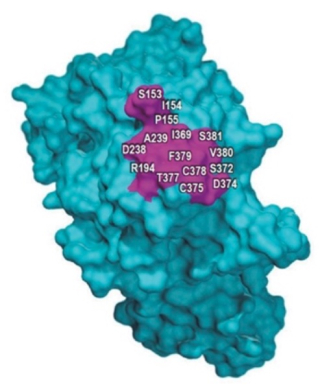
    And such an analysis is not needed in this case, according to the brief, because there is no evidence that the disclosure is actually deficient in any way regarding Amgen's "breakthrough" invention of monoclonal antibodies with real world benefits (reducing cholesterol).  While setting forth an explication of the technology is unnecessary here, the brief emphasizes the limited area of the PCSK9 protein involved in the antibody interaction that provides the therapeutic benefit and constrains the antibodies that can interact with it, shown in this drawing as the purple-colored section of the molecule:

    Image
    The brief emphasizes the extent of disclosure in the patent specifications instructing the skilled worker on how to make antibodies that recognize these limited portions of the protein, and the "roadmap" that teaches the skilled artisan how to make antibodies having the relevant therapeutic properties (many steps of which are "high throughput"), as well as the capacity to make "conservative" substitutions to provide alternative embodiments of antibodies having the requisite therapeutic function.  The disclosure satisfies the Wands test, the brief asserts, and that should be enough.

    In the face of this evidence from the specification (and the two juries' fact-finding supporting their verdict that the claims were not shown to be non-enabled), Amgen argues that the Federal Circuit's basis for invalidating for non-enablement was mere speculation, citing portions of the decision in support of these assertions stating that "there might be 'millions of candidates' that fall within the claims, each of which would have to be 'generate[d] and then screen[ed]' to determine whether it met the claims' requirements"; "'you could be immunizing mice for a hundred years,'" but "'[t]here might be kind of an antibody that you didn't come up with in that time period'"; and that those same conservative substitutions could produce (unpredictably) a non-functional antibody.  Amgen emphasizes the contrariness of the Federal Circuit's imposition of its invalidation on enablement grounds to the two juries' decisions that the claims were enabled as well as the clear and convincing evidence standard of proof Amgen contends the juries' decisions establish Respondent did not satisfy juxtaposed to what Amgen deems speculation by the Federal Circuit panel rendering the decision.

    With regard to the statute, Amgen argues that its purpose is "to require the patentee to describe his invention so that others may construct and use it after the expiration of the patent," citing Schriber-Schroth Co. v. Cleveland Tr. Co., 305 U.S. 47, 57 (1938), and that the full scope test has no basis in the statutory language.  The statutory standard is straightforward, Amgen maintains, and evidence of this straightforwardness is that the Court has applied it without necessary interpretation ("directly"), citing Wood v. Underhill, 46 U.S. (5 How.) 1, 5 (1846) (permitting unspecified variations in types of clay used to make bricks and tiles); Mowry v. Whitney, 81 U.S. (14 Wall.) 620, 644 (1872) (method for manufacturing railway wheels that avoided "strain" due to different wheel parts cooling at different rates without requiring all types of wheels and all temperatures to be expressly exemplified); Loom Co. v. Higgins, 105 U.S. 580, 586 (1882); The Telephone Cases, 126 U.S. 1, 536 (1888); Minerals Separation, Ltd. v. Hyde, 242 U.S. 261, 271 (1916) (wherein a method for concentrating mineral ores using mixture and hearing with oil was permitted a scope that encompasses unexemplified ores and variations on the method to adapt it to different ores); and Universal Oil Prods. Co. v. Globe Oil & Refin. Co., 322 U.S. 471, 484 (1944).  Amgen argues that the application of the standard in these cases is consistent with the plain meaning of the statute.  On the contrary, the Federal Circuit's "full scope" requirement deviates from the statutory text by requiring more than the statute does, by "focus[ing] on the "number of possible candidates within the scope of the claims"—the number of theoretical embodiments that might meet the claims' requirements" (emphasis in brief).  And this heightened requirement has not been applied to other genus claims Amgen argues, citing McRo inc. v. Bandai Namco Games Am. Inc., 959 F.3d 1091, 1100, as an example.  What the Federal Circuit has done with its heightened "full scope" requirement is to have turned enablement into a "numbers game" with regard to the 26 exemplified disclosed antibodies and the theoretical "millions of candidat[e]" antibodies which would then need to be generate[d] and screen[ed]" to satisfy the full scope test.  And this is an impossibility, Amgen states, as the Supreme Court has recognized in holding this was not the proper test, citing Mowry.

    Amgen's arguments harken back to the Framer's adoption of English patent law (citing several English cases in which Amgen argues the full scope standard would have "flunked"), codified in the 1790 Patent Act that has remained essentially unchanged to the present 1952 statute.  The consistency in the statute and its interpretation "tends to negate the existence of" the Federal Circuit's new "full scope" standard Amgen argues, citing Printz v. United States, 521 U.S. 898, 918 (1997).  19th and early 20th Century U.S. case law is consistent with Amgen's interpretation, the brief citing Carver v. Braintree Manufacturing Co., 5 F. Cas. 235 (C.C.D. Mass. 1843) (Justice Story) (cotton gins), as well as treatises (W. Phillips, The Law of Patents for Inventions 237 (1837); G. Curtis, A Treatise on the Law of Patents for Useful Inventions §124 (1849)) and regional Circuit Courts of Appeal decisions (Toledo Rex Spray Co. v. Cal. Spray Chem. Co., 268 F. 201, 204 (6th Cir. 1920); Donner v. Am. Sheet & Tin Plate Co., 165 F. 199, 206 (3d Cir. 1908); Philip A. Hunt Co. v. Mallinckrodt Chem. Works, 177 F.2d 583, 585 (2d Cir. 1949); Ill. Tool Works, Inc. v. Foster Grant Co., 547 F.2d 1300, 1309 (7th Cir. 1976)).  Amgen also cites several pre-Federal Circuit cases that would have invalidated the patents at issue under the full scope test, including Franc-Strohmenger & Cowan, Inc. v. Arthur Siegman, Inc., 27 F.2d 785, 785-786 (2d Cir. 1928) (neckties made with "resilient" linings); and Ansul Co. v. Uniroyal, Inc., 448 F.2d 872, 877878 (2d Cir. 1971) (methods to grow plants encompassing "the entire plant kingdom").  Finally, the brief cites decisions from the Federal Circuit's predecessor Court, the Court of Custom and Patent Appeals that (Amgen argues) support its "plain meaning" interpretation of the enablement requirements of Section 112, including In re Gay, 309 F.2d 769, 772 (C.C.P.A. 1962); In re Halleck, 422 F.2d 911, 912, 914 (C.C.P.A. 1970); and In re Angstadt, 537 F.2d 498 (C.C.P.A. 1976) (citing Minerals Separation).

    Amgen further argues that the statute provides a "reasonableness" standard dependent on the patented subject matter that can balance the scope of the claims and whether the "specific instructions" are "sufficiently robust to permit skilled artisans to reasonably make and use individual embodiments as needed" rather than requiring a skilled artisan to be able to make "all embodiments, seriatim with minimal time and effort."  Amgen asserts that the Federal Circuit's "full scope" standard "serves no valid patent-law policy and harms innovation[,] fundamentally alters the basic patent bargain[, and] discourages breakthrough innovations by cutting off patent protection for the most significant inventions simply because they have too many useful applications," which "threatens devastating consequences."  The brief argues that the Federal Circuit's full scope test is contrary to the constitutional mandate that the patent laws "promote progress" because "[o]nce an invention has been described sufficiently for skilled artisans to make and use it, disclosing thousands more examples of variations that achieve the same result contributes little to the store of human knowledge."  And worse, the brief argues, application of the test "destroys incentives for breakthrough inventions" like the case at bar, positing a correlation between "the more pioneering the innovation, the more likely it is to have a broad range of applications."  Perversely in Amgen's view, the Federal Circuit test creates a situation where "[i]t makes no sense to deny groundbreaking innovations patent protection because they somehow have too many useful implementations" (emphasis in brief).

    The brief also juxtaposes the practical application of the enablement test under well-established precedent under the statute with the "theoretical inquiry into hypothetical applications" engendered by the Federal Circuit's full scope test.  Defendants are not without means to challenge enablement under the conventional standard, Amgen asserts, as exemplified by instances where the skilled worker cannot practice a claimed invention at all, citing Beidler v. United States, 253 U.S. 447, 453 (1920), or that practicing the invention requires the public to achieve invention "in their own right" to obtain an operative embodiment, citing Consol. Elec. Light Co. v. McKeesport Light Co., 159 U.S. 465, 472-474 (1895), or reciting alternative embodiments in the claims where there is no teaching regarding one of them, citing Auto. Techs. Int'l, Inc. v. BMW of N. Am., Inc., 501 F.3d 1274, 1285 (Fed. Cir. 2007).  There are also the "needle in a haystack" forms of non-enablement according to Amgen, such as in Idenix Pharms. LLC v. Gilead Scis. Inc., 941 F.3d 1149, 1162 (Fed. Cir. 2019), cert. denied, 141 S. Ct. 1234 (2021); and Wyeth & Cordis Corp. v. Abbott Labs., 720 F.3d 1380, 1384-1385 (Fed. Cir. 2013), or circumstances where the number of inoperative embodiments is so large that the effort required to produce an operative embodiment "becomes significant" as in Atlas Powder Co. v. E.I. du Pont De Nemours & Co., 750 F.2d 1569, 1576 (Fed. Cir. 1984); in all these instances the claims are not enabled under the conventional enablement test without need for recourse to the Federal Circuit's full scope test.  These cases also illustrate that there is no overbroad claiming "problem" in need of the full scope test to remedy, Amgen states, because "[i]f the claim truly exceeds what the patent enables, challengers will always be able to show, through evidence, that skilled artisans cannot reasonably 'make and use' large areas of the claimed invention by following the patent's teaching" (emphasis in brief), as illustrated by the Court's decision in Consolidated Electric, and several other cases, including Béné v. Jeantet, 129 U.S. 683 (1889); and Holland Furniture Co. v. Perkins Glue Co., 277 U.S. 245 (1928).  Thus Amgen asserts the Federal Circuit's full scope test is unnecessary in attempting to solve a problem that does not exist, and in doing so in this case "allow[ed] clearly enabled claims to be invalidated based on speculation rather than proof" as evidenced by Respondents' failure "to identify even one actual antibody that could not be made following the patent's disclosures" (emphasis in brief).

    The brief takes the time (as it almost must) to set forth the deleterious consequences that are likely to arise if the full scope enablement test is affirmed.  These include harm to genus claims not limited to chemical, biotechnological, and pharmaceutical arts, exemplified by a recent Patent Trial and Appeals Board decision holding unpatentable genus claims to glass-making method based on this Federal Circuit precedent.  But the bulk of this portion of the argument is focused on the expected effects on claims in the biotechnology and pharmaceutical fields, based on the nature of these inventions, the complexities of the claimed subject matter, and the triviality of changes that can be made.  These vulnerabilities are exacerbated by the costs of bringing a patented product to market, the brief citing as an average almost $3 billion, where the possibilities of "free-rider" issues that are enhanced under the full scope enablement test undermine incentives to invest.  In addition to these negative effects on progress, Amgen argues the situation under the full scope test also delays effective disclosure if undue efforts must be undertaken for "rote identification of permutations within an invention"; the time and effort to do so will delay disclosure in patent applications until "sufficient" species within a genus have been identified to satisfy the full scope test.

    Finally, the brief applies the rubrics to the case at bar, which the brief argues establishes that the specification enabled preparation of the 26 exemplified antibodies as well as providing a roadmap to making other embodiments using routine methods known in the art, and that Respondents could not show any failure to make any antibody falling within the scope of the invalidated claims.  Amgen directly addresses Respondents' argument that their claims "preempt the future" (likely one of the more compelling arguments for Respondents' position) by ignoring the availability of further, later-arising improvements on the invention by others, citing Seymour v. Osborne, 78 U.S. (11 Wall.) 516, 548 (1871).  The two juries' verdicts that Amgen's claims had not been shown not to be enabled was supported by "[m]ountains of evidence" they argue, and this evidence was not countered by any evidence that the disclosed methods ever failed.  The brief enumerates the disclosures in the patents' specifications regarding the 26 exemplified antibodies, the "roadmap" teaching how to produce additional antibodies and reliance on well-established prior art methods for making monoclonal antibodies generally, and the ability to identify conservative amino acid substitutions to produce antibodies having variations in structure but retaining the functional properties of the claimed antibodies that gave them their therapeutic effectiveness.  While emphasizing the lack of factual evidence contrary to the juries' verdicts, the brief concludes by emphasizing the error of law Amgen asserts against the Federal Circuit's decision in its use of the full scope test in the face of a jury verdict supported by substantial evidence, in urging the Supreme Court to reverse the adverse decision below.

  • CalendarFebruary 8, 2023 – Artificial Intelligence (AI) and Emerging Technologies (ET) Partnership Series (U.S. Patent and Trademark Office, Dallas Bar Association Intellectual Property section, and State Bar of Texas IP section) – 11:00 am to 3:00 pm (CT), Dallas, TX

    February 8, 2023 – "Patent Strategies for Protecting Aftermarket Parts: Strengthening the Portfolio, Implementing Enforcement Program" (Strafford) – 1:00 to 2:30 pm (EST)

    February 8, 2023 – "Unified Patent Court (UPC): A New Forum for Patent Litigation in Europe" (Intellectual Property Owners Association) – 2:00 pm to 3:00 pm (ET)

    February 9, 2023 – "China IP: Quarterly Legislation and Case Law Update" (U.S. Patent and Trademark Office) – 10:00 am to 11:00 am (ET)

    February 10, 2023 – "Protecting Your IP" (U.S. Patent and Trademark Office) – 2:00 pm to 4:30 pm (ET), Baltimore, MD

  • USPTO SealThe U.S. Patent and Trademark Office, in collaboration with Dallas Bar Association (DBA) Intellectual Property (IP) section and State Bar of Texas IP section, will be holding its next meeting of the Artificial Intelligence (AI) and Emerging Technologies (ET) Partnership Series from 11:00 am to 3:00 pm (CT) on February 8, 2023 at the Arts District Mansion in Dallas, TX.  During the meeting, panelists from the USPTO and diverse stakeholders from academia, industry, and law firms will explore various IP policy issues with respect to AI-driven innovation.  The meeting will include discussions of the following topics:

    • Panel 1: AI-Driven Innovation – The Current State of Play
    • Panel 2: AI Inventorship
    • Panel 3:  Unanticipated IP Challenges from AI-Driven Innovation
    • Public listening session

    Additional information regarding the customer partnership meeting, including how to participate online, can be found here.

  • Strafford #1Strafford will be offering a webinar entitled "Patent Strategies for Protecting Aftermarket Parts: Strengthening the Portfolio, Implementing Enforcement Program" on February 8, 2023 from 1:00 to 2:30 pm (EST).  Jonathan H. Urbanek and Jacqueline L. Thompson of Fitch Even Tabin & Flannery will guide patent counsel on patent strategies for protecting aftermarket parts, discuss leveraging IP to protect aftermarket parts and create obstacles for will-fitters, and discuss claiming tactics to block will-fitters and offer guidance on detecting and stopping will-fitters once a portfolio is in place.  The webinar will review the following issues:

    • Preparing, filing, and prosecuting patent applications to develop a strong portfolio focused on aftermarket parts
    • Integrating business input into the patent life cycle
    • Identifying and stopping will-fitters
    • Creating non-patent challenges for will-fitters

    The registration fee for the webcast is $347.  Those interested in registering for the webinar, can do so here.