• By Joseph Herndon

    Two recent District Court decisions show examples of "weak" claims, which in the past would likely be found invalid as lacking novelty or being obvious, but today are struck down as being unpatentable under § 101.  The cases illustrate the need for software or computer-implemented claims to explicitly recite novel structural components or specific details for how functions are performed.

    Listingbook, LLC v. Market Leader, Inc.

    MD North CarolinaOn November 13, 2015, the U.S. District Court for the Middle District of North Carolina issued an opinion in the case Listingbook, LLC v. Market Leader, Inc. that held claims ineligible for patent protection under § 101.  Listingbook's U.S. Patent No. 7,454,355 describes a method and system where real estate agents use computers to log onto a website and create individual client accounts containing information about each client.  After logging into their accounts, clients can view properties found by the agent, tag properties for future reference, and if authorized, conduct their own searches of the real estate information database.  The clients' online activity is monitored and recorded in the system.

    Claim 1 reads as follows:

        A computer-implemented method of providing client-accessed real estate information to a real estate professional associated with a first client and a second client, and for providing professional-accessed real estate information to the first client and the second client, the method comprising:
        connecting to a database of real estate information;
        providing the professional with access to the real estate information;
        storing a first account for the first client and a second account for the second client, the first account and the second account being authorized by the professional;
        providing the first client with access to the first account and providing the second client with access to the second account;
        providing the first client, when accessing the first account, with access to the real estate information;
        providing the second client, when accessing the second account, with access to the real estate information;
        monitoring actions of the professional while the professional is accessing the real estate information;
        monitoring actions of the first client while the first client is accessing the first account;
        monitoring actions of the second client while the second client is accessing the second account;
        generating and storing professional-accessed real estate information for the first client and the second client in response to the actions of the professional as the professional reviews the real estate information;
        generating and storing first client-accessed real estate information in response to the actions of the first client;
        generating and storing second client-accessed real estate information in response to the actions of the second client;
        providing at least some of the first client-accessed real estate information and at least some of the second client-accessed real estate information to the professional, thereby providing the professional with knowledge of the actions of the first client and the actions of the second client; and
        providing at least some of the professional-accessed real estate information for the first client to the first client and at least some of the professional-accessed real estate information for the second client to the second client, thereby providing the first client and the second client with knowledge of the actions of the real estate professional.

    The patent also includes a CRM independent claim and a system independent claim with a server and communications circuit, and each of these independent claims recite the steps of method claim 1.

    The District Court first discussed recent uncertainty about whether a presumption of validity and standard of proof apply in cases challenging patent-eligibility under § 101.  If so, Market Leader must show, by clear and convincing evidence, that none of the asserted claims meet the statutory requirements of 35 U.S.C. § 101.  If not, Market Leader has a lower standard.  The uncertainty arises because there is a question whether burdens of proof apply only to questions of fact, and whether a claim is directed to patentable subject matter is a question of law.  There does not seem to be a controlling Supreme Court or Federal Circuit decision on this matter, and the District Court here applied both the presumption and the standard of proof in this case.  As seen, however, even using the higher standard did not help the patent claims.

    Using the two-step framework set forth by the U.S. Supreme Court's decision in Alice v. CLS Bank, the District Court first found the claims to be directed to an abstract idea.  The District Court found that Claim 1 describes a computerized version of a "conventional interaction".

    The District Court noted that Listingbook's patent specification confirms that real estate agents "conventionally" connect to a database of real estate information "to locate properties of interest for their clients," and contact each client to determine whether the client is interested in any of the resulting properties and whether the client has found any properties of interest from other sources, such as print advertisements or the Internet.  Through this interaction, the agent and clients have exchanged information and collaborated in the real estate search process.  The District Court found that Listingbook's invention simply places the interaction online, and the fact that Listingbook's method is performed online — rather than in an office, over the phone, or through email — does not change the Court's conclusion that Claim 1 is directed to an abstract idea.

    Turning to the second step of the Alice framework, the question becomes whether the claims at issue contain an "inventive concept" that transforms the abstract idea into a patent-eligible application of that idea.  Here, a generic computer is the only machine needed to perform the method of Claim 1, and "adding a computer to otherwise conventional steps does not make an invention patent-eligible."

    The District Court thus found that the claims at issue in Listingbook's patent are directed to an abstract idea and lack an inventive concept to render the claims patent-eligible under § 101 of the Patent Act.

    The claims here recite no novel features and really do just implement basic Real Estate agent functions over the internet.  The patent has a priority date of April 27, 2000, but that is still not quite early enough to pre-date the computerized multiple listing services (MLS) of the 1970's.  The claims here simply recite features that are too vague and lack details to provide an inventive concept, which now-a-days leads to being found invalid under § 101.  When the claims are too vague, they are more easily considered to be directed to an abstract idea.

    Stanacard v. Rubard

    District Court for the Southern District of New YorkOn November 18, 2015, the U.S. District Court for the Southern District of New York issued an opinion in the case Stanacard v. Rubard, LLC that also held claims ineligible for patent protection under § 101.

    Stanacard's patent in this case (U.S. Patent No. 7,346,156) is for an invention on a method for routing a long distance call.  Claim 1 of the Patent is a method claim, requiring as follows:

        A method comprising:
        detecting an identity of a caller;
        receiving an assigned incoming telephone number;
        identifying a recipient associated with the assigned incoming telephone number and the identity;
        connecting the caller and the recipient;
        wherein said caller has a plurality of assigned incoming telephone numbers to choose from, at least one of said plurality of assigned incoming telephone numbers being associated with said recipient,
        wherein each assigned incoming telephone number is associated with multiple recipient telephone numbers, a particular telephone number of a recipient being determined solely by a particular assigned incoming telephone number used by a particular identified caller and without input of further data by said caller, whereby said caller is not required to be within a particular network for making calls.

    The District Court characterized the system as follows:  a telephone service provider or prepaid calling service assigns to its customer (the "end user") a unique ten digit telephone number, which the caller can dial from his personal telephone (whether a land line or a cellular device) in order to reach a designated recipient.  The caller associates that number ("the assigned incoming telephone number") with a particular, specified recipient (the "recipient telephone number").  When the customer dials those ten digits – no more – from his personal telephone, he is connected to the person whose number he has previously designated as the "recipient telephone number," without the need to enter a PIN or any additional information, including a country or city code.

    The District Court also provided an illustrative example:  suppose I am the end user.  My service provider assigns me the number 555-222-1234; I tell the service provider that, when I dial those digits, I want to be connected to my best friend (the recipient), who lives in Ohio, and whose telephone number is 614-555-1213.  When I dial the assigned incoming telephone number (555-222-1234) from my personal telephone number (987-654-3210) — which number is recognized via some unclaimed but well known device like Caller ID — the call is forwarded directly to my best friend's home telephone number (614-555-1213).  I need not input any additional information in order to get the call routed to its intended recipient.  The invention only works when the end user dials the assigned incoming telephone number from his own telephone.

    But because a particular incoming number must correlate with a particular recipient, a service provider can assign the same incoming telephone number (555-222-1234) to thousands of different customers — each of whom can specify a different person who should receive a call if he dials those ten digits from his phone.

    The District Court commented that the claim is directed to a well-known activity that is almost as old as telephony itself — making a long distance telephone call.  The District Court noted that what plaintiff did was figure out a way to make such a call more cheaply, by dialing a ten digit local number and nothing more.  He combined two activities that have long been performed, by humans and by machines — caller ID and call forwarding — such that the recipient of a local call (area code plus seven digit number) uses some type of caller ID to recognize who the incoming caller is, and then forwards the incoming call to its intended recipient by associating the assigned incoming telephone number with a particular recipient's telephone number.  Importantly, the District Court commented that "Neither caller ID nor the method by which the call actually gets forwarded to its intended recipient (over what telephone network, using what switching facilities) is claimed."  No physical aspect of this process is claimed.  What is claimed is the idea of dialing only ten digits, at which point some unspecified intermediary will identify both the caller and the intended recipient of the call and connect them.

    The District Court reiterated a number of times that the claims do not recite any sort of physical structure and lack details for how the functions are performed.  Using the two-part test, the District Court first found that the claims are directed to an abstract idea of connecting two people via long distance telephony through the medium of using caller ID and call forwarding when a local number is dialed, rather than to a "process," "machine," "manufacture", or "composition of matter."  Applying the second part of the test, the District Court found that the patent does not "specify" how "claim elements" interact to achieve a "desired result which overrides conventional practice," and thus, include no inventive concept that would save the claim.

    Interestingly, here, the District Court hinted several times that had the claims recited some physical components and details for how the components function in a way different from conventional practice, then the claims would likely satisfy § 101.  The concept described in the patent appears to be novel, but the claims were drafted in a way that left them too vague and lacking detail.

    Also, an interesting side-note to consider for § 101 analysis is whether courts should consider some type or form of "secondary considerations" during the second step of the two-prong test (i.e., when determining whether the patent claims recite any inventive concept).  In this case, the plaintiffs' expert testified that the system disclosed by the patent completely changed the calling paradigm of prepaid telecommunications by, among other things, eliminating the PIN entry as a prerequisite to placing an international telephone call and thereby solving – creatively – the major handicap of every calling card.  Further, observing that persons (including plaintiff's expert) had been trying to design a less expensive and more convenient method of placing international telephone calls for "many years," the expert further testified that, "[t]he idea behind the '156 patent — combining the customer's telephone number and the dialed local access number into a unique 20-digit combination is elegant, simple, beautiful but by no means obvious; none of us working in this field came up with the method set forth in the '156 patent, and not for the lack of trying."  Lastly, the expert also testified that, "[t]he method disclosed by the '156 patent made an immediate and loud splash in the market place of prepaid telecommunications and garnered a market share away from others."  The District Court noted that such evidence of secondary considerations creates a genuine issue of fact about whether the patent is or is not "obvious" within the meaning of the patent laws, 35 U.S.C. § 103.  But, as to § 101, the District Court gave such evidence no weight.

    It is curious from a patentee's perspective that claims are found to be unpatentable under § 101 if they are directed to abstract ideas AND ALSO lack inventive concept, but evidence to support inventive concept including secondary considerations has no weight for the § 101 analysis.  Because the § 101 analysis is so intertwined with novelty and obviousness components, it would seem that the secondary considerations should come into play as well.


  •         By Sherri Oslick

    Gavel About Court Report:  Each week we will report briefly on recently filed biotech and pharma cases.

    Merck Sharp & Dohme Corp. v. Savior Lifetec Corp.
    5:15-cv-00415; filed August 21, 2015 in the Eastern District of North Carolina

    Infringement of U.S. Patent No. 5,952,323 ("Carbapenem Antibiotic," issued September 14, 1999) following a Paragraph IV certification as part of Savior's filing of an ANDA to manufacture a generic version of Merck's Invanz® (ertapenem, used for the treatment of complicated intra-abdominal infections, complicated skin and skin structure infections, community acquired pneumonia, complicated urinary tract infections, and acute pelvic infections, and for the prophylaxis ofvsurgical site infection following elective colorectal surgery).  View the complaint here.


    Otsuka Pharmaceutical Co., Ltd. v. Standard Chem. & Pharm. Co., Ltd et al.
    1:15-cv-06353; filed August 21, 2015 in the District Court of New Jersey

    • Plaintiff:  Otsuka Pharmaceutical Co., Ltd.
    • Defendants:  Standard Chem. & Pharm. Co., Ltd; Stason Pharmaceuticals Inc.; Breckenridge Pharmaceutical, Inc.; Zhejiang Jinhua Conba Bio-Pharm Co. Ltd.; Tai Heng Industry Co., Ltd.

    Infringement of U.S. Patent Nos. 8,017,615 ("Low Hygroscopic Aripiprazole Drug Substance and Process for the Preparation Thereof," issued September 13, 2011), 8,580,796 (same title, issued November 12, 2013), 8,642,760 (same title, issued February 4, 2014), and 8,759,350 ("Carbostyril Derivatives and Serotonin Reuptake Inhibitors for Treatment of Mood Disorders," issued June 24, 2014) following a Paragraph IV certification as part of defendants' filing of an ANDA to manufacture a generic version of Otsuka's Abilify® (aripiprazole, used to treat bipolar disorder and schizophrenia).  View the complaint here.


    Par Pharmaceutical, Inc. et al. v. TWi Pharmaceuticals, Inc. et al.
    1:15-cv-00710; filed August 18, 2015 in the District Court of Delaware

    • Plaintiffs:  Par Pharmaceutical, Inc.; Alkermes Pharma Ireland Ltd.
    • Defendants:  TWi Pharmaceuticals, Inc.; TWi Pharmaceuticals USA, Inc.

    Infringement of U.S. Patent No. 9,107,827 ("Nonoparticulate Megestrol Formulations," issued August 18, 2015) in conjunction with Twi's filing of an ANDA to manufacture a generic version of Par's Megace ES® (megestrol acetate, used for the treatment of appetite loss, severe malnutrition, or unexplained, significant weight loss in AIDS patients).  View the complaint here.


    Dr. Reddy's Laboratories, Inc. et al. v. Fresenius Kabi USA, LLC
    1:15-cv-00714; filed August 18, 2015 in the District Court of Delaware

    • Plaintiffs:  Dr. Reddy's Laboratories, Inc.; Dr. Reddy's Laboratories, Ltd.
    • Defendant:  Fresenius Kabi USA, LLC

    Declaratory judgment of non-infringement of U.S. Patent No. 8,476,010 ("Propofol Formulations with Non-Reactive Container Closures," issued July 2, 2013) in conjunction with Dr. Reddy's filing of an ANDA to manufacture a generic version of Fresenius' Diprivan® (propofol injectable emulsion, used for the induction and maintenance of general anesthesia and sedation in certain patient populations).  View the complaint here.

  • CalendarNovember 20, 2015 - 2015 Friedman Memorial Lecture on Excellence in Appellate Advocacy (Federal Circuit Bar Association) – Washington, DC

    November 23, 2015 – "Double Patenting: Defeating Double Patenting Rejections and Avoiding Terminal Disclaimers" (Strafford) – 1:00 to 2:30 pm (EST).

    December 1, 2015 - Efficient patent prosecution (U.S. Patent and Trademark Office's Dallas Office) – 2:30 to 5:30 pm (CT) – Dallas, TX

    December 2, 2015 – "USPTO's Subject Matter Eligibility: An Update" (Knowledge Group) – 3:00 to 5:00 pm (ET)

    December 2, 2015 – "Searching, Inventorship, & the Inventor Interview: Practical Legal & Business Considerations" (American Intellectual Property Law Association) – 12:30 – 2:00 pm (Eastern)

    December 3, 2015 – "Duty of Candor, Fixing Mistakes, Ex Parte Communications, Sanctions & Professionalism Before the PTAB in Contested Proceedings" (Strafford) – 1:00 to 2:30 pm (EST)

    ***Patent Docs is a media partner of this conference or CLE

  • Strafford #1Strafford will be offering a webinar/teleconference entitled "Duty of Candor, Fixing Mistakes, Ex Parte Communications, Sanctions & Professionalism Before the PTAB in Contested Proceedings" on December 3, 2015 from 1:00 to 2:30 pm (EST).  Thomas L. Giannetti, Lead Judge, U.S. Patent and Trademark Office, and Mercedes K. Meyer of Drinker Biddle & Reath will provide guidance to patent counsel involved in patent prosecution and contested proceedings before the USPTO on the duties of candor and disclosure; examine related issues of privilege, ex parte communications and conflicts of interest; and offer best practices for meeting duties of candor, disclosure, and privilege before the USPTO.  The webinar will review the following questions:

    • How does the duty of candor apply in IPRs, PRGs and CBMs?
    • What enhanced duty of candor do patent counsel have under MPEP 2001.06(c)?
    • What potential repercussions do patent owners and challengers face if they fail to meet their obligations of duty of candor and disclosure?

    The registration fee for the webinar is $297 ($362 for registration and CLE processing).  Those interested in registering for the webinar, can do so here.

  • AIPLA #1The American Intellectual Property Law Association (AIPLA) will be offering a webinar entitled "Searching, Inventorship, & the Inventor Interview: Practical Legal & Business Considerations" on December 2, 2015 from 12:30 – 2:00 pm (Eastern).  Kimberly Prior of Johnson & Johnson and H. Sanders Gwin of Shumaker & Sieffert will cover practical legal and business considerations for the initial inventor interview and patent searching; walk attendees through the basics of assessing client goals and preparing for an initial inventor interview, and deciding whether, what, and how to search; and equip attendees with tools for making a considered inventorship determination.

    The registration fee for the program is $145 (AIPLA member rate) or $195 (non-member rate).  Those interested in registering for the program, can do so here.

  • USPTO SealThe U.S. Patent and Trademark Office's Dallas Office will be hosting a program on efficient patent prosecution on December 1, 2015 from 2:30 to 5:30 pm (CT) at the Dallas USPTO, Terminal Federal Building Annex, 207 South Houston Street, Dallas, TX.  The program will will showcase: (1) virtual interviewing capabilities and tips for conducting a successful examiner interview from Dallas; (2) searching for prior art using the search tools available in the Dallas Regional Office; and (3) utilizing the Patent Ombudsman to resolve procedural prosecution issues.

    The event is free and open to the public.  However, because space is limited, those wishing to attend must RSVP by contacting the Dallas USPTO at TXRegionOutreach@uspto.gov.

  • Strafford #1Strafford will be offering a webinar/teleconference entitled "Double Patenting: Defeating Double Patenting Rejections and Avoiding Terminal Disclaimers" on November 23, 2015 from 1:00 to 2:30 pm (EST).  Thomas L. Irving of Finnegan Henderson Farabow Garrett & Dunner; Donna M. Meuth, Associate General Counsel, Eisai; and Margaret J. Sampson of Baker Botts will provide guidance to IP counsel for understanding Patent Term Adjustment B-delay possibilities and double patenting, particularly in view of a desire not to lose PTA in an earlier issued patent, and analyze recent court treatment and offer best practices to defeat double patenting rejections, and avoid terminal disclaimers, and if a terminal disclaimer must be filed, some specific language to consider.  The webinar will review the following questions:

    • What is the scope of double patenting?
    • What is the examiner's duty for presenting double patenting rejections?
    • What steps can be taken to defeat double patenting rejections?
    • What best practices can be employed to avoid terminal disclaimers?
    • How can practitioners craft terminal disclaimers with an eye towards patent litigation?

    The registration fee for the webinar is $297 ($362 for registration and CLE processing).  Those interested in registering for the webinar, can do so here.

  • Will The "No Supplier Exception" to the On-Sale Bar Fall?

    By Andrew Williams

    Federal Circuit SealOn November 13, 2015, the Federal Circuit granted a petition for rehearing en banc filed in The Medicines Company v. Hospira, Inc.  As we previously reported, the Federal Circuit held in that case that an order placed with a pharmaceutical contract manufacturer can be an offer for sale that will have an invalidating effect on a later-issued patent with claims that cover the subject of that sale.  This follows from established Federal Circuit precedent that there is no "supplier exception" to the on-sale bar of pre-AIA 35 U.S.C. § 102(b), provided the sale was not for experimental use.  See Special Devices, Inc. v. OEA, Inc., 270 F.3d 1353 (Fed. Cir. 2001).  And in case you were wondering whether it is relevant that the commercial "offer for sale" was essentially made by the contract manufacturer (Ben Venue in this case), it is not.  See, e.g., Zacharin v. U.S., 213 F.3d 1366, 1371 (Fed. Cir. 2000) ("Finally, under this court's precedents, it is of no consequence that the sale was made by a third party, not by the inventor, or that the product was constructed and the sale made pursuant to the buyer's directions." [citations omitted]).

    The order granting the petition requested the briefing of the parties to address the following issues:

    (a) Do the circumstances presented here constitute a commercial sale under the on-sale bar of 35 U.S.C. § 102(b)?
        (i) Was there a sale for the purposes of § 102(b) despite the absence of a transfer of title?
        (ii) Was the sale commercial in nature for the purposes of § 102(b) or an experimental use?
    (b) Should this court overrule or revise the principle in Special Devices, Inc. v. OEA, Inc., 270 F.3d 1353 (Fed. Cir. 2001), that there is no "supplier exception" to the on-sale bar of 35 U.S.C. § 102(b)?

    It is clear from this list that the Court is not only interested in reviewing the facts of the present case, but is also interested in reconsidering the wisdom of the rule against an exception for suppliers.  This rule, of course, impacts small companies or individuals that might not have the resources to manufacture their inventions themselves.  This is true even if the purchase order is not (or was not) publicly known or available.  For companies with the size and capabilities to keep the manufacturing in-house, there is no such similar concern — even when the inventors are not located in the department responsible for production.  It is also clear from the questions presented that this case has the potential to impact industries outside of pharma and the life sciences.  Indeed, the "no supplier exception" rule has been applied in cases as disparate as surgical saw blades (Brasseler, U.S.A. I, L.P. v. Stryker Sales Corp., 182 F.3d 888 (Fed. Cir. 1999)); slow cookers (Hamilton Beach Brands, Inc. v. Sunbeam Prods., Inc., 726 F.3d 1370 (Fed. Cir. 2013)); and automobile airbags (Special Devices).

    What is not clear is whether any holding in the en banc decision will apply to on-sale bar considerations in post-AIA applications and patents.  Of course, the fact pattern of this case applies to pre-AIA activities, and therefore any such pronouncement will likely be limited to the statute as it read at the time.  However, even though the new section 102 also includes an "on-sale" bar, there is more of a focus on public availability ("A person shall be entitled to a patent unless — (1) the claimed invention was . . . on sale, or otherwise available to the public before the effective filing date of the claimed invention.").  Therefore, it is possible that any holding in the en banc decision will not apply to current or future contract manufacturing orders.

    Patent Docs will continue to monitor this case and provide any updates as warranted.

  • By Andrew Williams

    Federal Circuit SealDo you want the good news or the bad news first?  Well, the good news is that the Federal Circuit has begun reversing PTAB decisions on the merits for IPR proceedings.  To be fair, in the Microsoft case, the Federal Circuit remanded because the claim construction was not reasonable — and therefore could not be the broadest reasonable interpretation.  But on November 5, 2015, in Belden Inc. v. Berk-Tek LLC, the appeals court reversed the trend of affirming every Board decision related to the prior art and reversed a PTAB's obviousness determination.

    That brings us to the bad news, at least for Patent Owners.  The Federal Circuit held as obvious two claims that had been affirmed by the PTAB as patentable.  In other words, despite having the reputation of being a patent "death squad," the Board was told by the Federal Circuit that it was not invalidating enough claims (at least in this case).  Moreover, the Federal Circuit sanctioned the introduction of new affidavit testimony by the Petitioner after the Patent Owner had submitted its last response and expert testimony.  The Court did explain that the Board did not err in determining that the new evidence was limited to responding to assertions of the Patent Owner's expert.  Nevertheless, in view of the fact that no expert testimony accompanied the original petition, this case amounts to an all-around unwelcome decision for Patent Owners.

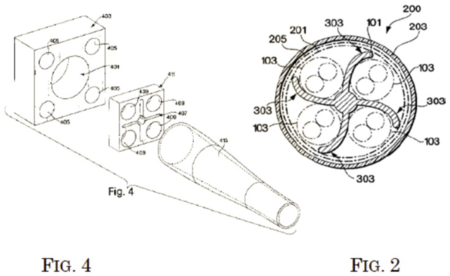
    As this case turns on obviousness, at least a cursory understanding of the technology is important.  The patent at issue, Belden's U.S. Patent No. 6,074,503, discloses and claims "a method of making a cable by passing a core and conducting wires through one or more dies, bunching the wires into grooves on the core, twisting the bunch to close the cable, and jacketing the entire assembly."  The problems solved by this invention included how to align the conducting wires to the core, and how to prevent the core from twisting independently during the process.  Claim 1 reads:

    1.  A method of producing a cable, comprising steps of:
        passing a plurality of transmission media and a core through a first die which aligns the plurality of transmission media with surface features of the core and prevents twisting motion of the core;
        bunching the aligned plurality of transmission media and core using a second die which forces each of the plurality of transmission media into contact with the surface features of the core which maintain a spatial relationship between each of the plurality of transmission media;
        twisting the bunched plurality of transmission media and core to close the cable; and
        jacketing the closed cable.

    Fig. 4 from the patent shows an assembly containing three dies (the two squares and the cone-like structure), and Figure 2 represents a cross-section of the resulting cable.

    Figures
    Claim 4 was grouped with claim 1 because it only contained the additional limitation that the core be "extruded," such that the surface features of the core align with the plurality of transmission media.  Claims 2 and 3 were grouped together because they both required the third die (represented as the biggest square in Fig. 4 above).  Finally, claims 5 and 6 were grouped because they both required that the transmission media be "twisted pairs of insulated conductors."

    Obviousness

    The Board instituted trial after Berk-Tek's predecessor in interest (Nexans, Inc.) filed a petition asserting anticipation and obviousness based on seven prior art references.  For the four original claims (claims 1-4), the Patent Office sided with the Petitioner and invalidated the claims as obvious.  For the remaining 2 claims, however, the Board concluded that, even though all of the elements were known in the art, the petitioner had not established that there was a reason to combine them.

    On appeal, the Federal Circuit found that there was substantial evidence for the Board's conclusion that claims 1-4 were obvious.  One of the primary references was a Japanese patent (Japanese Patent No. 19910, or JP '910).  Belden argued that this reference was only related to making transmission lines, but the Board noted that, among other things, the title of the JP '910 was "A method of manufacturing plastic insulated communication cables."  The PTAB also concluded that a particular board in the Japanese reference could have been used to prevent the twisting of the core.  Moreover, the Board cited to the expert report of Mr. Baxter, which included reasons why a skilled artisan would have so modified the board.  The Federal Circuit agreed that there was substantial evidence to make this conclusion.

    With regard to claims 2 and 3, Belden did not dispute that two additional prior art references disclosed a third die.  Instead, it asserted that there was no reason to combine this third die with JP '910.  However, the Board had cited to the reference in the KSR decision to predictable variations.  In other words, the Supreme Court had required consideration of factors such as "design incentives and other market forces" in determining whether a skilled artisan would have recognized the potential benefits and pursued the particular variations.  Because the PTAB made the appropriate inquiry, including considering the expert report of Mr. Baxter, the Federal Circuit was satisfied that there was substantial evidence for the Board's conclusion.

    As mentioned, the Federal Circuit disagreed with the Board with regard to claims 5 and 6, even giving it the deference that it deserved.  The PTAB had found that two pieces of prior art could be combined to teach or suggest these claims.  However, it did not think that there was any motivation to so combine these teachings.  The Federal Circuit disagreed, stating that the conclusion in the Final Written Decision did not "withstand[] scrutiny through the lens of governing law."  First, the Board had concluded that JP '910 only taught conductors that were not insulated.  However, the Federal Circuit noted that the Board had already determined that JP '910 disclosed aligning the wires with the core, and how to do so.  This alignment problem, the Court explained, did not depend on whether the wires were insulated.  A prior art reference must be considered for everything it teaches, and is not limited to the particular invention described.  In addition, the Board had found compelling the patent owner's argument that if the conductors were insulted, the final jacketing step would have been redundant.  However, the Federal Circuit pointed out that the final step did not require that the jacketing be insulted.  Finally, the patent owner had made an argument that modifying JP '910 to included twisted pairs would destroy the circular shape of the wire.  Again, the Federal Circuit pointed out that the claims did not require a circular shape.

    The most significant aspect of the Federal Circuit's decision with regard to claims 5 and 6 is that it did not vacate and remand for the Board to make the appropriate finding.  Instead, it found that the record was already sufficient to reverse the Board because the petitioner had apparently proven by a preponderance of the evidence that the claims were obvious.  For good reason, the opinion is silent about whether the same would have been true under the clear and convincing standard used by district courts.  A patent owner found in a similar situation would be wise to consider this case and convince the Federal Circuit why the Board had substantial evidence to reach the conclusion that it did.

    Motion to Exclude

    Belden also lost its challenge of the Board's denial to exclude the Baxter declaration submitted after the Patent Owner's response.  Belden had argued that the information presented in the declaration could have been, and should have been, included with the petition.  Instead, as the argument goes, Berk-Tek essentially "sandbagged" the patent owner with its reply.  Correspondingly, the patent owner complained that it lacked a fair opportunity to respond.  Nevertheless, the Federal Circuit rejected all of these arguments.

    For the first argument, the Court noted that Mr. Baxter responded to the Patent Owner response, and to the declaration submitted by Berk-Tek's expert, Mr. Clark.  Of course, little mention was made of the fact that the same arguments could have been presented before the patent owner was required to file a response, and why therefore did Mr. Clark's declaration essentially white-wash the omission.

    With regard to the second argument, the Federal Circuit pointed out that the Patent Owner had plenty of opportunity to respond.  These opportunities included, for example:

    • It had the ability to cross-examine the expert and filed observations;
    • It could have moved to exclude the declaration;
    • It could have disputed the substance of the declaration at the oral hearing;
    • It could have moved to submit a surreply;
    • It could have requested that the Board waive or suspend the regulations preventing the Patent Owner an opportunity to respond.

    For its part, the Board did hold the petitioner to a "response-only" standard for the new evidence, and ensured that the prima facie obviousness case did not rely on any new evidence.  It also provided for cross-examination and submission of observations.  Moreover, Belden moved to exclude the declaration (which the Board considered but obviously rejected).  Because the Patent Owner took advantage of several of the opportunities, it was irrelevant that the other potential opportunities did not occur.

    The take away lesson for a patent owner is to argue for as many of these alternatives as possible should a petitioner in the future undertake a similar strategy.  Of course, this does set up a potential gamesmanship opportunity for petitioners.  And, unfortunately for Belden, the guidance provided by the Federal Circuit was of little use for the patent owner in this case.

    Belden Inc. v. Berk-Tek LLC (Fed. Cir. 2015)
    Panel: Circuit Judges Newman, Dyk, and Taranto
    Opinion by Circuit Judge Taranto

  • By Michael Borella

    Many patent attorneys have a visceral, disapproving reaction to negative claim limitations — elements that specify what a claim does not cover.  While a line of Federal Circuit cases has established that negative limitations are acceptable in some situations, there still is a wide gap between claiming "a binary value that is not zero" versus "a kitchen utensil that is not a fork."  In a recent decision, a Federal Circuit panel has shed more light on when such limitations can be employed without violating the written description requirement.

    NetlistInphi filed a request for inter partes reexamination in the U.S. Patent and Trademark Office (USPTO) of Netlist's U.S. Patent No. 7,532,537.  During these proceedings, Netlist amended the claims to overcome cited art, and in doing so introduced a negative limitation to an independent claim.  The examiner allowed the claims.

    Inphi then appealed to the USPTO's Patent Trial and Appeal Board (PTAB), alleging that the negative limitation resulted in the claim being invalid for lack of written description in the specification under 35 U.S.C. § 112, paragraph 1.  The PTAB affirmed the examiner's allowance, and Inphi appealed to the Federal Circuit.

    Claim 1 of the '537 patent recites:

    A memory module comprising:
        a plurality of memory devices, each memory device having a corresponding load; and
        a circuit electrically coupled to the plurality of memory devices and configured to be electrically coupled to a memory controller of a computer system, the circuit selectively isolating one or more of the loads of the memory devices from the computer system, the circuit comprising logic which translates between a system memory domain of the computer system and a physical memory domain of the memory module, wherein the system memory domain is compatible with a first number of chip selects, and the physical memory domain is compatible with a second number of chip selects equal to twice the first number of chip selects, wherein the plurality of memory devices comprises double-data rate (DDR) dynamic random-access memory (DRAM) devices and the chip selects of the first and second number of chip selects are DDR chip selects that are not CAS, RAS, or bank address signals.

    The italicized portion of claim 1 contains the negative limitation at issue, which excludes three specific types of signals.  Chip selects are typically control lines that select one or more chips out of several attached to a bus, and may be used to refer generically to the signals carried thereon.

    DRAM stores data in banks of rows and columns, analogous to a spreadsheet.  Thus, each unit where data is stored can be addressed by a row and a column.  CAS stands for column address strobe, a signal that specifies a column address.  Similarly, RAS stands for row address strobe, a signal that specifies a row address.  The combination of CAS and RAS signals allows each unit in a bank of the DRAM matrix to be addressed.  Bank address signals, on the other hand, specify which of the banks is being addressed.

    InphiInphi contended that the negative limitation was not supported by the specification of the '537 patent, and thus constitutes new matter.  In support of this notion, Inphi cited a 2012 Federal Circuit case, Santarus, Inc. v. Par Pharm., Inc., which held that "[n]egative claim limitations are adequately supported when the specification describes a reason to exclude the relevant limitation."

    The PTAB identified "three parts of the specification of the '537 patent upon which it relied in finding that the negative claim limitation was reasonably supported."  In a nutshell, these parts, according to the PTAB, distinguish between chip select lines in general and CAS, RAS and bank address signals.  As a result, the '537 patent implicitly supports embodiments in which a chip select is not carrying CAS, RAS, or bank address signals.

    In its review, the Federal Circuit stated that "[w]hether a patent claim satisfies the written description requirement of 35 U.S.C. § 112, paragraph 1 depends on whether the description clearly allows persons of ordinary skill in the art to recognize that the inventor invented what is claimed."  Inphi argued that a "reason to exclude" in Santarus "requires something more than properly describing alternative features of the patented invention."  Netlist took the position that "the written description requirement is satisfied when alternative features are properly described."  The Court framed the issue as "whether properly describing alternative features — without articulating advantages or disadvantages of each feature — can constitute a reason to exclude under the standard articulated in Santarus."

    The Court held that "reason to exclude" is satisfied by an express description of the disadvantages of the excluded features, or an express description of the advantages of the claimed invention without these features.  However, such descriptions are not necessary to meet the requirements of § 112 paragraph 1 for negative claim limitations.  Doing so, in the Court's view, would improperly "articulate a new and heightened standard for negative claim limitations."  As such, a "reason to exclude" can be provided by "properly describing alternative features of the patented invention."  The "reason to exclude" of Santarus is sufficient, but not necessary.

    The Court warned, however, "[t]hat is not to say that in all cases, a patentee may arbitrarily dissect its invention by amending the claims in order to avoid the prior art."  For instance, if the specification prohibits a particular negative claim limitation, addition of that limitation will render the claim invalid.

    Once again, the Federal Circuit has explained how careful specification drafting can allow the patentee more claiming flexibility down the road.  For instance, if three features of a claim, A, B, and C, are optional, one can state in the specification that zero or more of A, B, and C may be present, in any combination or permutation.  As a result, a negative claim limitation with any of A, B, and/or C can be added during prosecution or post-grant proceedings.

    Inphi Corp. v. Netlist, Inc. (Fed. Cir. 2015)
    Panel:  Circuit Judges O'Malley, Reyna, and Chen
    Opinion by Circuit Judge O'Malley