• Patent Eligibility Requires Consideration of the Claim as a Whole

    By Joseph Herndon

    Ohio-northernThe U.S. District Court for the Northern District of Ohio (Eastern Division) issued an opinion on December 21, 2015 in the case captioned 01 Communique Laboratory, Inc. vs. Citrix Systems, Inc., et al. (case no. 1:06-cv-253) regarding patent eligibility under 35 U.S.C. § 101 of software claims.

    The Court found the patent claims to be eligible under § 101.  The claims at issue are claims independent claim 24 and dependent claim 45 in U.S. Patent No. 6,928,479 (the '479 patent").

    Independent claim 24 is provided below.

    24.  A computer program product for use on a server computer linked to the Internet and having a static IP address, for providing access to a personal computer from a remote computer, the personal computer being linked to the Internet, its location on the Internet being defined by either (i) a dynamic public IP address (publicly addressable), or (ii) a dynamic LAN IP address (publicly un-addressable), the computer program product comprising:
        (a) a computer usable medium;
        (b) computer readable program code recorded or storable in the computer useable medium, the computer readable program code defining a server computer program on the server computer wherein:
            (i) the server computer program is operable to enable a connection between the remote computer and the server computer; and
            (ii) the server computer program includes a location facility and is responsive to a request from the remote computer to communicate with the personal computer to act as an intermediary between the personal computer and the remote computer by creating one or more communication sessions there between, said one or more communication sessions being created by the location facility, in response to receipt of the request for communication with the personal computer from the remote computer, by determining a then current location of the personal computer and creating a communication channel between the remote computer and the personal computer,10 the location facility being operable to create such communication channel whether the personal computer is linked to the Internet directly (with a publicly addressable) dynamic IP address or indirectly via an Internet gateway/proxy (with a publicly unaddressable dynamic LAN IP address).

    The '479 patent is owned by Communique, and the claimed invention is a "system, computer product and method for providing a private communication portal" through which individuals may remotely access a personal computer from a remote computer using a locator server acting as an intermediary between the personal and remote computers.

    The Court utilized the two-part framework set forth in Mayo for distinguishing patent claims that cover laws of nature, natural phenomena, or abstract ideas from patent eligible claims.  The first step is to "determine whether the claims at issue are directed to one of those patent-ineligible concepts."  If the claim is not directed to one of the three patent ineligible concepts, no further analysis is required — the claim is patent eligible under § 101.  But if the claim is directed to an abstract idea, the Court must undertake the second step of Mayo to determine whether the elements of a claim, "both individually and 'as an ordered combination,'" contain "additional elements" that "transform the nature of the claim into a patent-eligible application" of an abstract idea.

    Abstract Idea?

    The Court cited several cases in which the claims were found to be directed to abstract ideas, and noted those as examples including claims directed to algorithms, mathematical formulas, and conventional economic and business principles and practices, such as hedging risk and use of an intermediary; methods equivalent to human mental work; "[a]ge-old ideas [and] basic tools of research and development, like natural laws and fundamental mathematical relationships"; methods of budgeting; use of advertising as currency; guaranteeing a party's performance; automated call distribution; computerized telephone call routing system; and customizing content based on information known about customer.

    The Defendant asserted that claim 24 usurps the abstract idea of an intermediary connecting two endpoints, and adds nothing of a technical nature.  The Defendant further argued that claim 24 covers an abstract idea of an intermediary that, in response to a request for communication, finds a current location of the requested endpoint and creates a connection between the two devices, and argued that the invention could be, and was, performed by humans when telephone operators connected one caller to a second caller at the first caller's request.

    However, the Court found that the Defendant's analogy breaks down when claim 24 is considered as a whole, as the Supreme Court in Alice requires.  The Court noted that while an operator can connect callers, the operator could not do so if the recipient of the call has a dynamic (changing) phone number that is unknown to the operator (publicly unaddressable IP address).  In addition, the "then current location" of the personal computer in claim 24 is not simply the personal computer's current IP address — or a telephone number in the analogy — but includes determining the then current "communication session for communicating with the personal computer."

    The Court also noted that to further determine if a claim is directed to an abstract idea, "the court must identify the purpose of the claim — in other words, determine what the claimed invention is trying to achieve — and ask whether that purpose is abstract."  Here, the purpose of claim 24, as reflected in the '479 patent specification, in creating the private communication channel for remote access is not simply to allow people to talk with each other, but to allow direct access of data on the personal computer from the remote computer.  A telephone operator cannot and does not provide the caller with direct access to data on the callee's desk.  The Court found that the Defendant oversimplified the subject matter of the '479 patent and claim 24 in an attempt to characterize the invention as an abstract idea.

    Thus, the Court found that the '479 patent and claim 24 are not merely directed to a broad concept of remote access or automatic call routing, and that the '479 patent and claim 24 do not involve a basic or fundamental business or economic practice or principle, algorithm, a conventional idea that existed in a pre-Internet world simply implemented by a computer, or an idea that could be performed by humans.

    Rather, the Court noted that claim 24 describes a "particular approach" to solving problems with prior art remote access patents that could only exist in a post-Internet world, utilizing a "location facility" that creates the private communication portal between the personal and remote computers in a specific way, even if the IP address of the personal computer is dynamic and not publicly addressable, to achieve the solution taught by the '479 patent.

    Thus, the Court concluded that the '479 patent and claim 24 are not directed to an abstract idea.  The Court further noted that even if claim 24 were determined to be an abstract idea, the claim would still be patent eligible under the second step of the Mayo analysis.

    Inventive Concept?

    For purposes of completion of the analysis, the Court examined the claim under the second step of the Mayo test that requires the Court to "search for an 'inventive concept' . . . that is 'sufficient to ensure that the patent in practice amounts to significantly more than a patent upon the [ineligible concept] itself.'"

    The Court stated that a "software patent can be eligible under § 101 when it claims a solution to a problem necessarily rooted in computer technology, and does not merely recite a conventional business or economic practice known from a pre-Internet world that is simply implemented on a generic computer performing generic computer functions."

    Again, here, the Court found that the Defendant failed to consider claim 24 as a whole, as required by Alice, by arguing that specific individual elements of claim 24 were previously known, and that "under certain circumstances," remote access between two server computers was possible before the '479 patent.  But the '479 patent does not claim to invent each individual element of the claim or remote access, but to solve the problems with existing remote access technology.

    The '479 patent and claim 24 disclose a specific solution, rooted in computer technology, to remote access problems that can only arise in the realm of computer networks, and accomplishes that solution even in the face of specific Internet-centric challenges.

    In summary, the Court followed the two-step framework as required and found that the claims satisfy section 101.  Notably, the Court ignored arguments against elements of the claim individually, and required the theoretical consideration of the claim "as a whole".

    Most helpful to the patent owner is also probably that the claim is easily found to be necessarily rooted in computer technology for solving a specific problem that existed.

    In reviewing this opinion, I find parallels to prosecution of pending U.S. patent applications at the USPTO.  Many Examiners issue Office Actions alleging that claims are ineligible under 35 U.S.C. § 101, but they do not consider the claim as a whole.  Moreover, often times, Examiners oversimplify the subject matter of the claims in an attempt to characterize the invention as an abstract idea by simply ignoring aspects of the claims during the section 101 analysis, or by characterizing novel aspects recited in the claims are routine, or generic computer implementation.  This opinion offers some guidance on strategies for responding to such rejections in instances in which the Examiner may not have fully appreciated the breadth of the claim.

    Further, it is helpful to see additional examples of software claims found to be patent eligible, which today does not happen too often.  When drafting and prosecuting patent applications, it is often helpful to show Examiners that Courts have found claims similar to those pending in the application to be patent eligible, and so looking to such cases as examples is a great way to strategize a scope of claims to file.

    01 Communique Laboratory, Inc. vs. Citrix Systems, Inc. (N.D. Ohio 2015)
    Opinion by Judge Lioi

  • Patent Claims (and Specification) Lacking in Detail Fail under 35 U.S.C. § 101

    By Joseph Herndon

    Federal Circuit SealThe Federal Circuit issued an opinion on December 28, 2015 in the case captioned Vehicle Intelligence and Safety LLC v. Mercedes-Benz USA, LLC regarding patent eligibility under 35 U.S.C. § 101 of method and system claims.  Ultimately, the Federal Circuit found that the patent claims are ineligible under § 101 as being directed to abstract ideas coupled with routine data-gathering steps and conventional computer activity.

    Vehicle Intelligence brought suit against Mercedes-Benz USA, LLC and Daimler AG alleging infringement of U.S. Patent No. 7,394,392.  Following claim construction, the Northern District of Illinois granted Mercedes-Benz's Rule 12(c) motion, declaring the disputed claims invalid as drawn to patent-ineligible subject matter under 35 U.S.C. § 101 and dismissing the case with prejudice.  Vehicle Intelligence appealed from the Northern District of Illinois's judgment declaring claims 8, 9, and 11-18 invalid under 35 U.S.C. § 101.

    The '392 patent claims methods and systems that screen equipment operators for impairment, selectively test those operators, and control the equipment if an impairment is detected.  The '392 specification lists examples of equipment within the scope of its claims, including "automobiles, trucks, industrial vehicles, public transportation vehicles, such as buses, subways, trains, planes, and ships, and dangerous machinery in general."  It also provides examples of the types of impairments its claimed methods and systems may screen for and test:  intoxication (from alcohol or chemicals); physical impairments (injuries from accidents or "violence against" the operator, blindness, lack of air, or poisonous or disabling gases or dust); medical impairments (stroke, heart attack, diabetic coma, exhaustion, or infectious disease); or emotional impairment (grief, anger, psychosis, anxiety, or euphoria).

    Independent claims 8 and 16 are provided below.

    8.  A method to screen an equipment operator for impairment, comprising:
        screening an equipment operator by one or more expert systems to detect potential impairment of said equipment operator;
        selectively testing said equipment operator when said screening of said equipment operator detects potential impairment of said equipment operator; and
        controlling operation of said equipment if said selective testing of said equipment operator indicates said impairment of said equipment operator, wherein said screening of said equipment operator includes a time-sharing allocation of at least one processor executing at least one expert system.

    16.  A system to screen an equipment operator, comprising:
        a screening module to screen and selectively test an equipment operator when said screening indicates potential impairment of said equipment operator, wherein said screening module utilizes one or more expert system modules in screening said equipment operator; and
        a control module to control operation of said equipment if said selective testing of said equipment operator indicates said impairment of said equipment operator, wherein said screening module includes one or more expert system modules that utilize at least a portion of one or more equipment modules selected from the group of equipment modules consisting of: an operations module, an audio module, a navigation module, an anti-theft module, and a climate control module.

    The Federal Circuit analyzed the claims using the familiar two-step test introduced in Mayo Collaborative Services v. Prometheus Laboratories, Inc., 132 S. Ct. 1289, 1296–98 (2012), and further explained in Alice Corp. Party v. CLS Bank International, 134 S. Ct. 2347, 2355 (2014).  The first step includes determining whether the claims at issue are directed to a patent-ineligible concept.  The second step includes examining the elements of the claim to determine whether it contains an "inventive concept" sufficient to transform the claimed abstract idea into a patent-eligible application.

    First Step—Are Claims Directed to a Patent-Ineligible Concept?

    The Federal Circuit agreed with the District Court that the claims at issue are drawn to a patent-ineligible concept, specifically the abstract idea of testing operators of any kind of moving equipment for any kind of physical or mental impairment.

    The Federal Circuit noted deficiencies in the claims in that "[n]one of the claims at issue are limited to a particular kind of impairment, explain how to perform either screening or testing for any impairment, specify how to program the 'expert system' to perform any screening or testing, or explain the nature of control to be exercised on the vehicle in response to the test results."  Vehicle Intelligence attempted to show that the use of an "expert system" improves over the prior art by providing faster, more accurate and reliable impairment testing.  But, the Federal Circuit stated that neither the claims at issue nor the specification provide any details as to how this "expert system" works or how it produces faster, more accurate and reliable results.

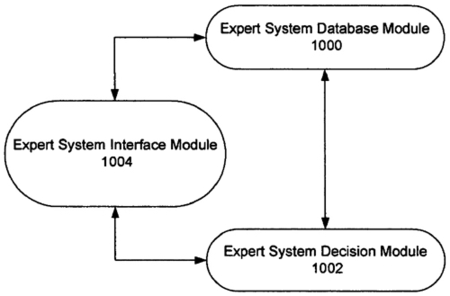
    All of Figures 1-16 of the '392 patent are generic block diagrams.  The most detailed description of the "expert system" is in Figure 8 of the '392 patent, reproduced below.

    Flowchart
    As can be seen, Figure 8 is very general and lacking in detail as to components of the "expert system".  The description for Figure 8 states that the "decision module 1002 makes the actual determination of whether or not the equipment operator is impaired and decides which control response to make if there is an impairment."  It then lists equipment operator characteristics that may be measured and states that this information is used to determine if the equipment operator has a "true impairment."

    The Federal Circuit stated that "critically absent from the entire patent is how the existing vehicle equipment can be used to measure these characteristics; assuming these measurements can be made, how the decision module determines if an operator is impaired based on these measurements; assuming this determination can be made, how the decision module decides which control response to make; and assuming the control response decision can be made, how the 'expert system' effectuates the chosen control response."

    Thus, in the absence of any details about how the "expert system" works, the claims at issue are drawn to a patent-ineligible abstract idea, satisfying Mayo/Alice step one.

    Vehicle Intelligence challenged the District Court's application of Mayo/Alice step one, arguing that the claims at issue do not preempt all equipment operator testing.  It argues that the existence of prior art methods of equipment operator testing, evidenced by the eleven prior art references identified in the '392 specification, prove that the claims at issue do not preempt the abstract idea of performing equipment operator testing because these references describe non-infringing methods for doing so.  Notably, the Federal Circuit stated that "This argument is meritless."  The Federal Circuit explained that while assessing the preemptive effect of a claim helps to inform the Mayo/Alice two-step analysis, the mere existence of a non-preempted use of an abstract idea does not prove that a claim is drawn to patent-eligible subject matter.  The Federal Circuit noted that if Vehicle Intelligence's argument was adopted, all a patentee would need do to insulate itself from a § 101 challenge would be to identify a single prior art reference in the specification and state that its invention improves upon that reference.

    Second Step—Do Claims Contain an "Inventive Concept" to Transform into Patent-Eligible Status?

    The Federal Circuit also agreed with the District Court that the claims at issue fail Mayo/Alice step two.

    Vehicle Intelligence argued that its methods are embedded in "specialized existing equipment modules," as opposed to generic computers, which renders them patent-eligible.  The '392 specification explains that the "specialized existing equipment modules" are things such as the gas and brake pedals and the steering wheel of a car, as well as stereo, navigation, anti-theft, and climate-control systems.

    Again, though, absent from the '392 patent is any explanation of how the methods at issue can be embedded into these existing modules.  The only details related to this point provided in the claims at issue is that the methods involve using "at least a portion of" these existing equipment modules (claims 9, 12, and 16–18) and "a time-sharing allocation of at least one processor executing at least one expert system" (claims 8, 9, and 11–15).  The specification does not provide any more detail and, in fact, explains that the processors used in the methods may be "based on any commercially available microprocessor of any word bit width and clock speed, a control Read-Only-Memory, or a data processing equivalent."  The Federal Circuit noted that arguing that the claimed methods are tied to particular machines alone is insufficient to confer eligibility.

    Vehicle Intelligence argued that there are at least four inventive concepts in the claims at issue:  1) screening by one or more expert systems; 2) selectively testing; 3) a time-sharing allocation of at least one processor; and 4) a screening module that includes one or more expert systems that use at least a portion of one or more equipment modules.  But, again, the claims do not specify what screening should be done or how the expert system would perform such screening.  They do not explain how to select the tests to run or even what tests to select from.  They do not explain how the "time-sharing allocation" on a processor should be done.  And they do not explain how the expert system works to screen for impairments or how such systems can be portioned out over one or more equipment modules.  The claims fail in each of the four alleged inventive concepts to provide any details of how things work.

    As a last resort, Vehicle Intelligence argued that the claims are necessarily rooted in computer technology.  The Federal Circuit found two problems with this argument.  First, the claims do not address a problem arising in the realm of computer networks because they are broadly drafted to cover testing a vehicle operator for impairments, similar to a police officer field testing a driver for sobriety.  Second, the claims at issue do not recite faster, more accurate and reliable impairment testing than what was known in the prior art.

    In this case, the '392 patent seemed to be doomed from the beginning due to lack of any detail provided in the specification for who, what, when, and how the invention works.  The fact that the vague language in the claim lacked any support from the specification made the patent ineligibility determination by the Federal Circuit very easy to conclude.

    One additional aspect not mentioned is that the claims arguably recite only human action, nothing of which is an inventive concept.  While the first step recites "screening . . . by one or more expect systems . . . ," the step does not recite who or what performs the screening using the expert system.  Again, with these claims, it is a theme that they are lacking in any detail and use of 35 U.S.C. § 101 to invalidate the claims appears proper.

    As seen within much literature published on the subject of software claims and 35 U.S.C. § 101, one of the most fundamental steps that a patent drafter can do to help the patent survive § 101 challenges is to describe the invention in complete detail by not only describing an algorithm, but also, describing each function of the algorithm in detail as well as describing structural components of devices that perform each function of the algorithm.  Vague and imprecise descriptions that may be thought to be crafty patent drafting resulting in broad claims that can cover many infringers, such as with the '392 patent "expert system decision module", are no longer sufficient.

    An interesting note with this case is that the inventor, Kevin Roe, of the '392 patent is an attorney who also filed and prosecuted the application leading to the '392 patent, and further appears to have argued the appeal on behalf of Vehicle Intelligence.

    Vehicle Intelligence and Safety LLC v. Mercedes-Benz USA, LLC (Fed. Cir. 2015)
    Nonprecedential disposition
    Panel: Circuit Judges Moore, Clvenger, and Reyna
    Per curiam opinion

  • By Kevin E. Noonan

    Mistakes happen; there is even a book, entitled Human Error, that discusses how and why they happen.  The Federal Circuit addressed the consequences of human error (or perhaps more accurately, instances where there was a less-than-perfect understanding of the chemical structure of a claimed invention) in a surprisingly lenient fashion in Cubist Pharmaceuticals, Inc. v. Hospira Inc.  And the reasoning behind that answer harkens back to the time when the technology for determining structure was not as robust as it is now, and when biological molecules comprising chains of amino acids were not routinely defined (and disclosed) by their sequence but rather by how they were isolated or otherwise produced.

    Cubist PharmaceuticalsThe decision arose from ANDA litigation involving daptomycin (sold by Cubist as Cubicin), an antibacterial agent originally developed by Eli Lilly & Co. where the patent on the molecule per se had expired long ago (2002).  There were five patents in suit:  one patent relating to formulations, compositions, and methods of treating bacterial infections (U.S. Patent No. 5,912,226, now U.S. Reissue Patent No. RE39,071); two patents directed to dosage regimens (U.S. Patent Nos. 6,852,689 and 6,468,967); and two patents directed to purification methods for daptomycin compositions (U.S. Patent Nos. 8,058,238 and 8,129,342).

    The District Court held all of the claims in four of the patents to be invalid for obviousness (and a smaller subset invalid for anticipation), but found Hospira's proposed generic daptomycin product to infringe claims 18 (directed to a combination of certain forms of the molecule) and 26 (directed to pharmaceutical compositions of the combinations claimed in claim 18) of the '071 reissue patent and that these claims were not invalid.  The claimed combination comprises two daptomycin-related compounds (anhydrodaptomycin and the beta isomer of daptomycin) and a third being daptomycin itself.

    The Federal Circuit affirmed in an opinion by Judge Bryson, joined by Judges Wallach and Hughes.  Hospira advanced three arguments on appeal related to its invalidity contentions.  The first was that the U.S. Patent and Trademark Office erred when it issued a certificate of correction concerning the chemical structure of the daptomycin molecule:

    Figure
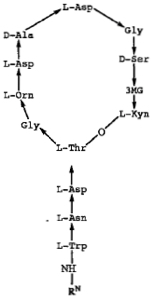
    The asserted error was in the structure of the L-Asn (L-asparagine) residue on the amino terminal stem as shown in the diagram.  The original specification contained three descriptions of daptomycin as recited in these combinations.  The first was "an A-21978C cyclic peptide," identifying the compound as being prepared from "a group of closely related, acidic peptide antibiotics" that are described in U.S. Patent No. 4,208,403"; these peptides are disclosed as being produced by fermentation of Streptomyces roseosporus.  The second mode of describing daptomycin in the specification was by a code name assigned by Lilly that was known in the art as being specific for daptomycin.  The third way was by the structure shown above, wherein the RN group at the amino terminus was n-decanoyl.

    "As it turns out," as stated in the opinion, this structure is incorrect:  daptomycin comprises D-Asn, not L-Asn.  However, "[a]t the time the application for the '226 patent was filed, and until well after that patent was issued, it was universally believed that the asparagine amino acid in daptomycin was the L-isomer of asparagine, as set forth in the structural diagram," and it was only years afterwards (after the '226 patent was granted and after the '071 reissue patent was filed) that the true stereochemistry of the molecule was discovered.  With regard to the patent, Cubist filed and was granted a Certificate of Correction under 35 U.S.C. § 255.  That provision of the patent statute permits changes "of minor character" that do not broaden the scope of the claims, and Hospira challenged this characterization of the correction.  Hospira supported this argument with expert testimony, to the effect that the molecule comprised of D-Asn was "an entirely different compound" than daptomycin comprising L-Asn (albeit without any reference to the teachings in the '071 patent specification).  Accordingly Hospira argued that the District Court should have construed claims 18 and 26 of the '071 patent as being limited to the L-Asn-containing forms of daptomycin (which their proposed generic formulations would not infringe).  The District Court disagreed, saying that the change was merely to the formula (i.e., the depiction of the compound's structure) and not any change in the compound itself.  The Federal Circuit agreed, citing Regents of Univ. of N.M. v. Knight, 321 F.3d 1111, 1122 (Fed. Cir. 2003), for the proposition that "a chemical structure is 'simply a means of describing a compound; it is not the invention itself'" and further that "the specification as a whole must be considered" not the chemical structure alone.  The crux of this reasoning is set forth in this portion of the opinion:

    By reference to a co-pending application (later issued as U.S. Patent No. 4,885,243), the specification teaches that daptomycin is obtained through fermentation of Streptomyces roseosporus.  That fermentation process necessarily results in daptomycin, not the variant with the L-isomer of asparagine.  The evidence at trial established that the L-isomer variant cannot be produced by fermentation and can only be produced synthetically.

    The panel also considered the consistent disclosure in the specification identifying daptomycin by its Lilly identification number, and recognized that "it was universally believed that the asparagine amino acid in daptomycin was the L-isomer of asparagine, not the D-isomer" at the time the application was originally filed.  In reaching this conclusion the panel distinguished earlier precedent, including Bayer v. Dow Agrosciences LLC, 728 F.3d 1324 (Fed. Cir. 2013).  The distinction is that here the description in the specification was consistent with the understanding in the art, whereas in Bayer the proposed claim construction was "inconsistent with the 'strong accepted scientific meaning' of the claim language."

    HospiraHospira's second argument was that the specification of the '071 patent did not satisfy the written description requirement due to the error in misidentifying the daptomycin structure.  The District Court found that the specification "reasonably conveyed to those skilled in the art that the inventors had possession of the claimed subject matter as of the filing date" as required by the statute under Ariad Pharm., Inc. v. Eli Lilly & Co., 598 F.3d 1336, 1351 (Fed. Cir. 2010) (en banc) and the Federal Circuit agreed.  Despite the error in the disclosed structure, "one skilled in the art would have understood that the inventors possessed and were working with the naturally occurring fermentation product, i.e., the daptomycin molecule containing D-asparagine."  The correspondence between the other ways daptomycin was identified in the specification (the Lilly identification code and as being a ""A21978C cyclic peptide") with the product of S. roseosporus fermentation established for the Federal Circuit panel that the skilled worker would have understood the inventors to have been in possession of daptomycin despite the error in chemical structure, citing Invitrogen Corp. v. Clontech Labs., Inc., 429 F.3d 1052, 1072 (Fed. Cir. 2005).  And the Court rejected Hospira's assertion that their position was supported by the Court's earlier decision in In re Wallach, 378 F.3d 1330 (Fed. Cir. 2004)In that case, the inventors were in possession of only 5% of the amino acid sequence of a particular protein (although they were in possession of an isolate of the protein itself) and attempted to use that disclosure to support claims to all nucleic acids encoding the entire protein.  The panel quotes the distinction made in Wallach (and relevant to the broader issues discussed here) that "whether the applicants 'were in possession of the protein says nothing about whether they were in possession of the protein's amino acid sequence'" because there was no evidence that "the full amino acid sequence of a protein can be deduced from a partial sequence and the limited additional physical characteristics" identified and disclosed in the Wallach specification.

    Hospira's last argument was that Cubist had violated the "recapture rule" of reissue patents, that a patentee cannot reclaim through reissue what had been relinquished during prosecution in order to obtain an allowance.  Application of the recapture rule requires that the reissued claims were broader than the claims as originally granted (a position the District Court and Federal Circuit rejected with regard to the certificate of correction issue) and that the broadened subject matter had been surrendered during prosecution of the original application.  While this doctrine applies if the reissue claims have been broadened in any way, it does not apply if the claims are narrowed.  Here, the Federal Circuit agreed with the District Court that claims 18 and 26 were narrower than those claims as originally granted and thus that the recapture rule was not violated by these claims.  (In addition, the decision discussed the course of prosecution to the effect that the subject matter in the reissue claims had not been surrendered during prosecution, because any surrender was related to overcoming an indefiniteness rejection and not due to any asserted prior art.)

    The Federal Circuit also affirmed the District Court's determination that all of the asserted claims of the other four patents in suit were invalid for obviousness, based in large part on its factual determinations regarding the state of the prior art and on Cubist's failure to provide sufficient evidence of secondary considerations to overcome Hospira's prima facie case.

    The Federal Circuit's decision in this case is reminiscent of the days before the biotechnology revolution provided purified proteins as the result of recombinant genetic methods wherein the amino acid sequence of the produced proteins were predicted from the cloned nucleic acids encoding them.  Prior to that, purified proteins were isolated from natural sources (for example, insulin from animal pancreata obtained inter alia from slaughterhouses).  Patent law recognized it to be sufficient for an applicant to disclose a reliable source of the desired protein and methods for isolating it in useful quantities.  (The reader will be spared any discussion here of whether such claims would be patent eligible.)  But a consequence of this regime, mandated by the technology available, was that any "purified" preparation of a protein from a natural source was likely not to be homogeneous.  It is well known that animals in an outbred population will have a plurality of alleles of a gene for almost any protein that have small variances in amino acid sequence.  This population heterogeneity was recognized but not considered relevant to providing a disclosure that supported claims to the isolated protein preparation.  In contrast, producing proteins by recombinant genetic technology imposed a homogeneity on the produced protein product that may by itself be sufficient to distinguish such preparations from preparations made from natural sources.  But it also changed (some would contend, raised) the quanta of disclosure needed to satisfy the written description requirement so that undisclosed sequence differences became relevant to claim validity.

    In this decision the Federal Circuit eschewed such sequence-dependent reasoning and relied instead on the totality of what the specification disclosed.  The decision was based in large part on the identity of what S. roseosporus fermentation produced, and the irrelevance (for the panel) of the erroneous structure contained in the specification (and claims).  This isn't a right-or-wrong approach; rather, it relies (as many patents granted in the decades prior to biotechnology did) on identifying a reliable source of a natural product and an assessment of what the specification provided.  Which, even in the biotechnology era, seems a refreshing application of sound patent law.

    Cubist Pharmaceuticals, Inc. v. Hospira Inc. (Fed. Cir. 2015)
    Panel: Circuit Judges Wallach, Bryson, and Hughes
    Opinion by Circuit Judge Bryson

  • By Donald Zuhn

    USPTO SealAlthough the U.S. Patent and Trademark Office has not yet made a formal announcement on the USPTO Systems Status and Availability webpage or the Office's Facebook and Twitter accounts, it appears that the Office has now restored access to the EFS-Web and Private Patent Application Information Retrieval (PAIR) system.  Patent Docs was able to access the EFS-Web as a registered eFiler — although we were able to access a specific application via the EFS-Web, we did not test whether the system would actually accept an uploaded submission.  Patent Docs was also able to access a specific application using Private PAIR.  As of the time of this post, the Office did not appear to have restored Public PAIR.

    UPDATED:  The USPTO Systems Status and Availability webpage was updated today to include the following information:

    Systems are slowly being returned to service today with a goal of bringing all systems online and operational Monday morning, December 28.

    Due to the extent of the damage to the systems that provide power to the USPTO's data center, we know that work will continue for the next several days.  Therefore, in order to keep systems protected and prevent damage, it is possible that some or all systems may need to be taken offline again.

    We understand how critical these systems are for our customers, and our teams will continue to work around the clock to fully restore them as quickly as possible.  Based upon the results and the stability of our operations, we will keep deadline flexibility in mind and will closely monitor operations and evaluate whether any additional "holiday notices" similar to the one issued last week covering December 22 to 24 are needed.

  • Holiday StarsThe authors and contributors of Patent Docs wish their readers and families a Happy Holidays.

  • USPTO SealBy Donald Zuhn

    The U.S. Patent and Trademark Office announced this morning that it has now restored its fax line and is once again able to receive faxed documents.  The announcement was made on the Office's Facebook and Twitter accounts.

    Despite the restoration of its fax line, the Office will still consider each day from Tuesday, December 22, 2015, through Thursday, December 24, 2015, to be a "Federal holiday within the District of Columbia" under 35 U.S.C. § 21 and 37 C.F.R. §§ 1.6, 1.7, 1.9, 2.2(d), 2.195, and 2.196.  As a result, the Office will consider any action or fee due between December 22 and December 24 as timely if the action is taken, or the fee is paid, on the next succeeding business day on which the USPTO is open (see 37 C.F.R. §§ 1.7(a) and 2.196).  According to the Office, actions that are taken or fees that are paid on the next succeeding business day on which the USPTO is open will be considered timely for the purposes of, for example, 15 U.S.C. §§ 1051(b), 1058, 1059, 1062(b), 1063, 1064, and 1126(d), or 35 U.S.C. §§ 119, 120, 133, and 151.  Because Friday, December 25 is a Federal holiday, the next succeeding business day would currently be Monday, December 28, 2015 (provided, of course, that the Office can restore its remaining systems by that date).  The Office also noted that it would issue a subsequent notice as needed if its systems are not fully operational by Monday, December 28, 2015.

    Patent Docs will continue to monitor and report on the USPTO systems shutdown through the holiday weekend.

    UPDATED:  Some commentators have questioned the Office's authority to consider December 22-24, 2015 to be Federal holidays (see, e.g., Comment 6 in response to Patently-O's coverage of the USPTO power outage and systems shutdown, as well as the comment here).

    UPDATED:  The comment posted in response to Patently-O's coverage of the USPTO power outage and systems shutdown has now been posted here.

  • By Donald Zuhn

    USPTO SealOn Tuesday, December 22, a major power outage at the U.S. Patent and Trademark Office headquarters in Alexandria, VA significantly damaged the Office's electronic systems and required the shutdown of the Office's online and IT systems.  As a result, the Office's filing, searching, and payment systems, systems used by examiners across the country, and fax machines have been unavailable to applicants and practitioners since Tuesday evening.

    In an update posted earlier today on the USPTO Systems Status and Availability webpage, the Office indicated that it was working diligently to assess the operational impact on its systems and to determine how soon they could be safely brought back into service in the coming days.  The Office noted that "teams will continue to work around the clock to restore [the Office's systems] as quickly as possible," but estimated that its systems would be impacted at least through the Christmas holiday on Friday.

    Although the Office was advising stakeholders this morning to utilize regular and Express mail (requiring many applicants and practitioners to dust off procedures that had become far less common since the implementation of the Office's EFS-Web), the Office's most recent notice indicates that the shutdown constituted an emergency situation and that the Office would consider each day from Tuesday, December 22, 2015, through Thursday, December 24, 2015, to be a "Federal holiday within the District of Columbia" under 35 U.S.C. § 21 and 37 C.F.R. §§ 1.6, 1.7, 1.9, 2.2(d), 2.195, and 2.196.  As a result, the Office will consider any action or fee due between December 22 and December 24 as timely if the action is taken, or the fee is paid, on the next succeeding business day on which the USPTO is open (see 37 C.F.R. §§ 1.7(a) and 2.196).  According to the Office, actions that are taken or fees that are paid on the next succeeding business day on which the USPTO is open will be considered timely for the purposes of, for example, 15 U.S.C. §§ 1051(b), 1058, 1059, 1062(b), 1063, 1064, and 1126(d), or 35 U.S.C. §§ 119, 120, 133, and 151.  Because Friday, December 25 is a Federal holiday, the next succeeding business day would currently be Monday, December 28, 2015 (provided, of course, that the Office can restore its systems by that date).  The Office also noted that it would issue a subsequent notice as needed if its systems are not fully operational by Monday, December 28, 2015.

    Updates regarding the status and availability of the Office's systems can be found here, as well as on the Office's Facebook and Twitter accounts.  In addition, Patent Docs will continue to monitor and report on the USPTO systems shutdown through the holiday weekend.

    UPDATED:  Some commentators have questioned the Office's authority to consider December 22-24, 2015 to be Federal holidays (see, e.g., Comment 6 in response to Patently-O's coverage of the USPTO power outage and systems shutdown, as well as the comment here).

    UPDATED:  The comment posted in response to Patently-O's coverage of the USPTO power outage and systems shutdown has now been posted here.

  • By Bill Reid* —

    Christmas is the biggest holiday in my family.  We spend a lot of time putting up decorations, but the most time of all is devoted to decorating the Christmas tree.  For me personally, it's a uniquely special time because I find myself reflecting on Christmases past with absent family I very much miss, and Christmases when my own children (13 and 17) were very young.  It wakes me up to the magic of this year's Christmas, and how wonderful it is to have loved ones close.  It makes me grateful.

    I have noticed in recent Christmases that words escape my mouth that were last uttered by my father many years ago.  Things like, "make sure you turn off the tree lights before you go to bed, do you think I'm made of money?" . . . and . . . "if you expect to open any presents, then you better keep water in the tree stand.  We don't want any fire hazards around here!"

    To be truthful, I'm not sure now how much of a fire hazard Christmas trees can actually be, and it has not previously been something that concerned me, unless reminded.  For example, my first year out of college I spent in Louisiana.  Having just started a new job, I couldn't return home.  It was the first time I had spent Christmas away from home, and I was alone.  Anxious to get into the Christmas spirit, I got a tree, ornaments, lights, and set it up in my apartment.  I was apparently much less anxious to get out of the Christmas spirit, however, because it was not until the following August that I took it down, following a threatening note from my landlord regarding "fire hazards."

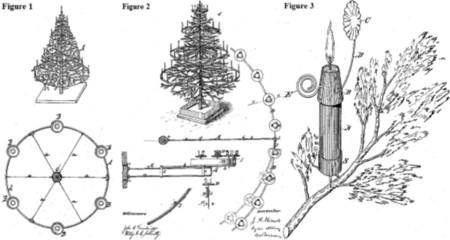
    But if you think about it, Christmas trees aren't nearly the fire hazards they once were.  If you review the early patents (you knew this was coming, it's an IP blog), you see they actually hung lighted candles from the tree!  Take a look at the candle holding rigs in U.S. Patent Numbers 227,088 and 227,693 from 1880 (Figures 1 and 2 respectively), or the reflector support for a candle in U.S. Patent No. 298,478 from 1884 (Figure 3).  In my house, the worst thing that can happen to the tree is the cat goes for an ornament or the tinsel, and knocks something on the floor.  In 1880, that same cat could have necessitated a visit by the local fire brigade!  Standing around waiting for something like that to happen would have freaked my father out completely.  But to be fair, I don't suppose I'd be any better.

    Figure
    So, relax this Christmas.  There's no lighted candles on the tree to worry about.  Whether Christmas is a big day for you and the family, or just another in the holiday season, we wish you the best one ever.  Enjoy!

    Happy, happy Christmas, that can win us back to the delusions of our childish days; that can recall to the old man the pleasures of his youth; that can transport the sailor and the traveler, thousands of miles away, back to his own fire-side and his quiet home!

    ~Charles Dickens, The Pickwick Papers

    * Bill Reid is a Partner at Dilworth IP

  • By Donald Zuhn

    USPTO SealIn a notice published in the Federal Register earlier today (80 Fed. Reg. 79277), the U.S. Patent and Trademark Office invites stakeholders to submit patent quality-related topics that they believe should be the subject of a case study as part of a new Enhanced Patent Quality Initiative pilot program.  In the notice, the Office explains that it regularly performs case studies to investigate specific quality-related issues as well as review individual examiner work products.  Such case studies allow the USPTO to investigate how a particular issue is being treated or addressed across hundreds or thousands of applications, and where appropriate, to take action to remediate quality issues or to formulate best practices to further enhance quality.

    According to the Office's Federal Register notice, case study topics submitted under the new pilot program should be more than mere statements of an issue or problem encountered by the submitter, but should propose a specific correlation or trend for study, and where possible, suggest a methodology for its investigation.  The Office notes that a helpful submission should also explain how the results of a given case study could be used to improve patent quality.

    The notice lists five restrictions on topic submissions: (1) topics must be presented in separate submissions to ensure consideration, (2) submissions should be titled to reflect the topic being submitted, (3) submissions cannot contain information associated with any particular patent application or patent, any particular examiner, or any particular art unit, (4) topics should focus on patent quality issues, and (5) submissions should concisely explain the nature and purpose of the proposed case study.  Results of case studies conducted as a result of the pilot program will be used by the Office to improve its understanding of the quality of its work products and, where appropriate, to take action to remediate quality issues or to formulate best practices to further enhance quality.  The notice concludes with an example of a topic submission regarding the impact of pre-first action interviews on the quality of resulting patent prosecution.

    Written topic submissions must be received by the Office on or before February 12, 2016 to be considered.  Submissions can be sent by e-mail to TopicSubmissionForCaseStudies@ uspto.gov; by regular mail addressed to:  Mail Stop Comments Patents, Commissioner for Patents, P.O. Box 1450, Alexandria, Virginia 22313–1450, marked to the attention of Michael Cygan, Senior Legal Advisor, Office of Patent Legal Administration, Office of the Deputy Commissioner for Patent Examination Policy; or via the Federal eRulemaking Portal.  The Office requests that submissions also include the following information: (1) the name and affiliation of the individual responding; and (2) an indication of whether the submission being offered represents the views of the respondent's organization or are the respondent's personal views.

  •         By Sherri Oslick

    Gavel About Court Report:  Each week we will report briefly on recently filed biotech and pharma cases.

    Merck Sharp & Dohme Corp. et al. v. Med-Pharmex, Inc.
    3:15-cv-01905; filed August 28, 2015 in the Southern District of California

    • Plaintiffs:  Merck Sharp & Dohme Corp.; Intervet Inc.
    • Defendant:  Med-Pharmex, Inc.

    Infringement of U.S. Patent No. 6,127,353 ("Mometasone Furoate Monohydrate, Process for Making Same and Pharmaceutical Compositions," issued October 3, 2000) following Med-Pharmex's filing of an Abbreviated New Animal Drug Application seeking approval to sell a generic version of Merck's Mometamax® (mometasone furoate monohydrateotic otic suspension, used to treat ear infections in dogs).  View the complaint here.


    Merck Sharp & Dohme Corp. v. Royalty Pharma Collection Trust
    1:15-cv-00757; filed August 28, 2015 in the District Court of Delaware

    Declaratory judgement of non-infringement and invalidity of U.S. Patent Nos. 6,303,661 ("Use of Dipeptidyl Peptidase IV Effectors For Lowering the Blood Glucose Levels in Mammals," issued October 16, 2001), 6,803,357 ("Method Of Regulating Glucose Metabolism And Reagents Related Thereto," issued October 12, 2004), 7,157,429 (same title, issued January 2, 2007), 6,890,898 (same title, issued May 10, 2005), 7,078,381 (same title, issued July 18, 2006), 7,459,428 (same title, issued December 2, 2008), 7,829,530 (same title, issued November 9, 2010), 8,318,669 (same title, issued November 27, 2012.), 8,513,190 (same title, issued August 20, 2013), and 9,044,424 (same title, issued June 2, 2015) based on Merck's manufacture and sale of its Sitagliptin Products, including Januvia®, Janumet® and Janumet® XR (sitagliptin phosphate or sitagliptin phosphate and metformin, used to treat Type II diabetes).  View the complaint here.


    Warner Chilcott (US), LLC et al. v. Teva Pharmaceuticals USA, Inc. et al.
    2:15-cv-01471; filed August 28, 2015 in the Eastern District of Texas

    • Plaintiffs:  Warner Chilcott (US), LLC; Warner Chilcott Company, LLC; Qualicaps Co., Ltd.
    • Defendants:  Teva Pharmaceuticals USA, Inc.; Teva Pharmaceutical Industries Ltd.

    Infringement of U.S. Patent No. 6,649,180 ("Hard Capsule Formed of Cellulose Ether Film with a Specific Content of Methoxyl and Hydroxypropoxyl Groups," issued November 18, 2003) following a Paragraph IV certification as part of Tea's filing of an ANDA to manufacture a generic version of Warner Chilcott's Delzicol® (mesalamine delayed release capsules, used for the treatment of mildly to moderately active ulcerative colitis in patients 12 years of age older and for the maintenance of remission of ulcerative colitis in adults).  View the complaint here.


    Galderma Laboratories LP et al. v. Taro Pharmaceuticals USA Inc
    3:15-cv-02814; filed August 28, 2015 in the Northern District of Texas

    • Plaintiffs:  Galderma Laboratories LP; Galderma SA; Galderma Research & Development SNC
    • Defendant:  Taro Pharmaceuticals USA Inc.

    Infringement of U.S. Patent Nos. 8,071,644 ("Combinations of Adapalene and Benzoyl Peroxide for Treating Acne Lesions," issued December 6, 2011), 8,080,537 (same title, issued December 26, 2011), 8,129,362 ("Combination/Association of Adapalene and Benzoyl Peroxide for Treating Acne Lesions," issued March 6, 2012), 8,445,543 ("Combinations of Adapalene and Benzoyl Peroxide for Treating Acne Lesions," issued May 21, 2013), and 8,809,305 ("Administration of Adapalene and Benzoyl Peroxide for the Long-Term Treatment of Acne Vulgaris," issued August 19, 2014) following a Paragraph IV certification as part of Taro's filing of an ANDA to manufacture a generic version of Galderma's Epiduo® Gel (adapalene and benzoyl peroxide, used to treat acne vulgaris).  View the complaint here.