• Strafford #1Strafford will be offering a webinar/teleconference entitled "NPE Patent Litigation: Latest Developments — Leveraging Alice, Federal Rules Amendments, and Patent Office Proceedings in Defending Infringement Disputes" on January 27, 2016 from 1:00 to 2:30 pm (EST).  R. David Donoghue of Holland & Knight and Dana M. Herberholz of Parsons Behle & Latimer will provide guidance to IP counsel on recent developments that impact how companies deal with non-practicing entities (NPEs, and also discuss settlement and defense strategies in patent suits with NPEs.  The webinar will review the following issues:

    • What impact have the AIA and the Supreme Court decision in Alice had on NPEs?
    • How have practitioners leveraged strategic motions practice in NPE litigation?
    • What strategies can be employed to minimize the threat of NPE patent litigation?

    The registration fee for the webinar is $297.  Those interested in registering for the webinar, can do so here.

  • By Donald Zuhn

    FireworksAfter reflecting upon the events of the past twelve months, Patent Docs presents its ninth annual list of top patent stories.  For 2015, we identified twenty stories that were covered on Patent Docs last year that we believe had (or are likely to have) the greatest impact on patent practitioners and applicants.  In two prior posts, we counted down stories #20 to #16 and stories #15 to #11, and today we count down stories #6 to #10 as we work our way towards the top five stories of 2015.  As with our other lists (2014, 2013, 2012, 2011, 2010, 2009, 2008, and 2007), links to our coverage of these stories (as well as a few links to articles on related topics) have been provided in case you missed the articles the first time around or wish to go back and have another look.  As always, we love to hear from Patent Docs readers, so if you think we left something off the list or disagree with anything we included, please let us know.  In addition, we will be offering a live webinar on the "Top Patent Law Stories of 2015" on January 21, 2016 from 10:00 am to 11:15 am (CT).  Details regarding the webinar, which will focus on a handful of the most important stories, can be found here.


    10.  USPTO Electronic Systems Go Dark

    On December 22, a major power outage at the U.S. Patent and Trademark Office headquarters in Alexandria, VA significantly damaged the Office's electronic systems and required the shutdown of the Office's online and IT systems.  At the end of the day on December 23, the Office declared the three days from December 22 through December 24 to be "Federal holiday[s] within the District of Columbia" under 35 U.S.C. § 21 and 37 C.F.R. §§ 1.6, 1.7, 1.9, 2.2(d), 2.195, and 2.196, and as a result, any action or fee due on those days would be considered as timely if the action was taken, or the fee was paid, on the next succeeding business day on which the USPTO is open.  By Christmas Eve, the Office had restored its fax line, and by December 27, the Office had restored access to the EFS-Web and Private Patent Application Information Retrieval (PAIR) system.  Six days after the power outage, the Office's electronic systems were once again functional enough that the Office did not have to declare December 28 a Federal holiday.  Some issues, however, have persisted even into this week, e.g., filed documents may not appear on PAIR for some time, and a colleague was unable to access the payment system when filing applications on January 5.  Interestingly enough, the Office noted in August that it would begin implementing a new system in the summer of 2016 that would eventually replace the EFS-Web, Public PAIR, and Private PAIR.

    For information regarding this and other related topics, please see:

    • "Breaking News: USPTO Restores EFS-Web and Private PAIR," December 26, 2015
    • "USPTO Restores Fax Line," December 24, 2015
    • "Major Power Outage Causes Shutdown of USPTO Online and IT Systems — USPTO to Consider December 22-24 to be 'Federal Holidays'," December 23, 2015
    • "USPTO News Briefs," November 30, 2015
    • "USPTO News Briefs," August 9, 2015


    9.  Federal Circuit and USPTO Clarify PTA Rule
    s

    The Federal Circuit issued several decisions during the year that will have an impact on future Patent Term Adjustment determinations.  In Gilead Sciences, Inc. v. Lee, the Court affirmed a decision by the District Court for the Eastern District of Virginia that the Office had properly calculated the PTA for one of Gilead's patents.  In that case, the Office determined that the applicant's submission of an Information Disclosure Statement 57 days after a response to a restriction requirement had been filed, and 27 days before a non-final rejection had been issued, constituted a failure to engage in reasonable efforts to conclude prosecution of the application.  In Mohsenzadeh v. Lee, the Court affirmed a decision by the District Court for the Eastern District of Virginia that the Office had properly calculated the PTA for two patents.  In that case, the Court determined that two divisional applications were not entitled to the Office's 1,476-day delay in issuing a restriction requirement in the application from which both divisional applications were filed.  Finally, in Daiichi Sankyo Co. v. Lee, the Court affirmed a decision by the District Court for the District of Columbia that two of Daiichi's patents, which had issued prior to August 5, 2009, were not entitled to a corrected PTA determination under the Optional Interim Procedure, which the Office adopted following the Federal Circuit's decision in Wyeth v. Kappos (the Office made the Optional Interim Procedure available only for patents that issued between August 5, 2009 and March 1, 2010).  The Office also revised the rules of practice last year to implement the Federal Circuit's decision in Novartis AG v. Lee.  In Novartis, the Federal Circuit agreed with the USPTO that the filing of an RCE tolls the B Delay clock even if the RCE was filed more than three years after the application was filed.

    For information regarding this and other related topics, please see:

    • "Daiichi Sankyo Co. v. Lee (Fed. Cir. 2015)," July 20, 2015
    • "Mohsenzadeh v. Lee (Fed. Cir. 2015)," July 8, 2015
    • "USPTO Issues Final Rule in View of Novartis v. Lee," March 16, 2015
    • "Gilead Sciences, Inc. v. Lee (Fed. Cir. 2015)," March 2, 2015


    8.  Federal Circuit Decides First PTAB Appeal

    In February, in In re Cuozzo Speed Technologies, LLC, the Federal Circuit decided the first appeal of the first inter partes review Final Written Decision for the first IPR ever filed.  The decision was significant not only because it was the Court's first PTAB appeal, but also because the Court affirmed the Board's use of the Broadest Reasonable Interpretation (BRI) standard for claim construction and agreed with the Office that any aspect of the decision to institute the IPR is not reviewable.  In July, the Court denied a petition for rehearing en banc in the case, and in September, in Achates Reference Publishing, Inc. v. Apple Inc., the Court reaffirmed its In re Cuozzo holding that the Court could not review any decision by the PTAB related to the institution of an IPR, including a determination whether the decision was time-barred according to the AIA.

    For information regarding this and other related topics, please see:

    • "Achates Reference Publishing, Inc. v. Apple Inc. (Fed. Cir. 2015)," October 1, 2015
    • "No Rehearing En Banc for In re Cuozzo Speed Technologies — PTAB Update," July 9, 2015
    • "In re Cuozzo Speed Technologies, LLC (Fed. Cir. 2015)," February 4, 2015


    7.  Supreme Court Decides Teva v. Sandoz

    In January, the Supreme Court held in Teva Pharmaceuticals USA, Inc. v. Sandoz Inc. that an "appellate court must apply a 'clear error,' not de novo, standard of review" to the evidentiary underpinnings of a district court's claim construction determination.  Unlike some of the Court's recent patent decisions, Teva was not decided by a 9-0 vote, with the majority constituting only seven Justices.  The Teva majority had determined that claim construction was ultimately a question of law but one that could depend on "subsidiary" fact-finding by the district court.  According to Justice Breyer's majority opinion, Federal Rule of Civil Procedure 52(a)(6) mandates that an appellate court give substantial deference to district court fact finding and to contravene the lower court's factual determinations only if there was "clear error."  In addition, the Court majority asserted jurisprudential policy grounds for its decision, including that the district court was in the best position to assess (expert) witness credibility and to become familiar with the technology involved in the invention.  Justices Thomas and Alito disagreed, taking the position that while Justice Breyer and his brethren would have applied the law correctly if there were underlying facts to be determined, in the context of claim construction there are no "subsidiary facts" to be determined and that Teva and the Court misapplied the law in arriving at this conclusion.  Simply stated, in Justice Thomas's opinion, Rule 52(a)(6) simply did not apply in Teva.  In June, the Federal Circuit decided Teva on remand, once again reversing the District Court's holding with regard to claim 1 of U.S. Patent No. 5,800,808, with a split panel deciding that the claim was indefinite notwithstanding the District Court's factual determinations about how one skilled in the art would understand the claim.

    For information regarding this and other related topics, please see:

    • "Federal Circuit Tackles Claim Construction Review under New Standard," June 25, 2015
    • "What's Next? Some Consequences of the Teva v. Sandoz Decision," January 22, 2015
    • "Teva v. Sandoz: The Dissent," January 21, 2015
    • "Teva Pharmaceuticals USA, Inc. v. Sandoz Inc. (2015)," January 20, 2015
    • "Teva Pharmaceuticals USA, Inc. v. Sandoz Inc. – 'Evidentiary Underpinnings' of Claim Construction: Supreme Court Holds Findings of Fact Require Deference," January 20, 2015


    6.  Supreme Court Decides Commil v. Cisco Systems

    In May, the Supreme Court handed down its decision in Commil USA, LLC v. Cisco Systems, Inc., vacating the Federal Circuit's reversal of the District Court's ruling that Cisco's evidence that it had a "good faith belief" that Commil's claims were invalid was inadmissible for rebutting liability for inducing infringement.  The Supreme Court held that "[a] defendant's belief regarding patent validity is not a defense to an induced infringement claim."  In the process of deciding Commil, the Court chastised the Federal Circuit for misinterpreting both patent law and the Court's decision in Global-Tech Appliances, Inc. v. SEB S.A. (2014).

    For information regarding this and other related topics, please see:

    • "Commil USA, LLC v. Cisco Systems, Inc. (2015)," May 26, 2015

  • By Michael Borella

    District Court for the Eastern District of TexasAs 2015 drew to a close, the toll of the Alice Corp. v. CLS Bank Int'l decision on software and business method patents became apparent.  Post Alice, approximately 70% of all patents challenged under 35 U.S.C. § 101 have been invalidated in district courts, while the rate of § 101 rejections has exceeded 80% in some of the USPTO's art units where it was previously below 40%.  As a consequence, patentees have become increasingly concerned about whether key patents in their portfolios might be subject to an Alice challenge in litigation, as well as whether their new technologies are protectable.

    In addition to limiting the scope of patentable subject matter in Alice, the Supreme Court, in Octane Fitness v. Icon Health and Fitness and Highmark Inc. v. Allcare Health Management Systems, has increased the number of situations in which 35 U.S.C. § 285 allows bad faith assertion of patent rights to expose a litigant to attorneys' fees.  Recently, these rulings came in play together in the Eastern District of Texas.

    eDekka sued approximately 220 defendants, including 3balls, as allegedly infringing its U.S. Patent No. 6,266,674.  Claim 1 of the '674 patent recites:

    1.  Method for storing information provided by a user which comprises:
        in response to user input, receiving and storing information;
        in response to user input, designating the information as data while the information is being received;
        in response to user input, designating at least a portion of the information as a label while the information is being received;
        in response to user input, traversing a data structure and providing an indication of a location in the data structure;
        in response to user input, storing the label at the location in the data structure; and
        associating the label with the data.

    The Court described the patent as related to "storing and labeling information" and disclosing "a preferred embodiment that includes a cassette tape recorder with multiple buttons, a microphone, and a speaker."  eDekka targeted "online retailers that offer a shopping cart feature on their e-commerce websites" as alleged infringers.

    A number of the defendants filed motions to dismiss under 35 U.S.C. § 101 on the grounds that the '674 patent did not meet the patent-eligibility requirements set forth by Alice.  The Court granted this motion, and the defendants followed up with another motion to make the case exceptional under 35 U.S.C. § 285.

    Section 285, as interpreted in Octane Fitness, requires that an exceptional case "is simply one that stands out from others with respect to the substantive strength of a party's litigating position (considering both the governing law and the facts of the case) or the unreasonable manner in which the case was litigated."  Further, "[d]istrict courts may determine whether a case is 'exceptional' in the case-by-case exercise of their discretion, considering the totality of the circumstances."  If the district court determines a case to be exceptional, then shifting of attorney's fees is appropriate if the moving party can establish so based on a preponderance of evidence.

    The defendants took the position that "(1) eDekka's case was objectively unreasonable; and (2) eDekka litigated in an unreasonable manner."

    With respect to the defendants' first point, the Court noted that "the '674 [p]atent is demonstrably weak on its face, despite the initial presumptions created when this patent was issued by the PTO."  Particularly, claim 1 refers to a data structure but does not limit this structure to one stored in or operated on a computer.  Given the claim's high-level definition of the invention, and its lack of any physical structure, the Court concluded that the "claims were clearly directed toward unpatentable subject matter, and no reasonable litigant could have reasonably expected success on the merits when defending against the numerous § 101 motions filed in this case."

    But, eDekka argued that the claimed invention improves the functioning of technology by reducing "the time to retrieve information and the amount of information that must be retrieved" despite there being no basis in the claims for this notion.  eDekka also argued that the claims required a special purpose computer, even though there is no recitation of any sort of computer hardware in the claims, and only limited support for such in the specification.

    The Court concluded that "eDekka repeatedly offered insupportable arguments on behalf of an obviously weak patent" and questioned whether eDekka thoroughly evaluated its claims against relevant law before initiating a large number of lawsuits.  Accordingly, the Court determined that these facts supported the case being held exceptional under § 285.

    With respect to the defendants' second point, the Court found that eDekka's litigation history "reflects an aggressive strategy that avoids testing its case on the merits and instead aims for early settlements falling at or below the cost of defense."  For instance, just two days before the § 101 hearing, "counsel for eDekka contacted numerous defendants with offers to settle their cases for three-thousand dollars each."  Thus, the Court found "that it is reasonable to conclude that eDekka acted with the goal of exploiting the high cost to defend complex litigation to extract nuisance value settlement[s] from defendants."  This also weighed significantly toward the Court finding the case to be exceptional.

    After considering the totality of circumstances, the Court held the case to be exceptional and awarded attorneys' fees to the defendants.  The Court did so reluctantly, stating that it did not wish to "unintentionally narrow the public's access to the courts by chilling future decisions to seek redress for a case in which success is not guaranteed," but that "the threshold of exceptionality has been crossed by eDekka."

    As noted above, Alice has dramatically increased the likelihood that certain types of claims will be invalidated under § 101.  At first blush, this case might suggest that asserting such claims raises the specter of exceptionality challenges.  Perhaps, but eDekka also attempted to defend its claims with unfounded arguments while engaging in an aggressive litigation strategy.

  • Generic Software Claims Found Ineligible under § 101

    By Joseph Herndon

    Washington-westernA common theme found in recent patent litigation is that software claims lacking detail are more likely to be found invalid under 35 U.S.C. § 101.

    The U.S. District Court for the Western District of Washington at Seattle issued an opinion on December 15, 2015 in a case captioned Recognicorp, LLC v. Nintendo Co. Ltd., et al. (case no. C12-1873RAJ) regarding patent eligibility under 35 U.S.C. § 101 of software claims.  Ultimately, the District Court found that the patent claims are ineligible under § 101.

    Through a number of assignments, Recognicorp is the current assignee of U.S. Patent No. 8,005,303 (the '303 Patent), entitled "Method And Apparatus For Encoding/Decoding Image Data".  Recognicorp alleged that Nintendo infringed the '303 Patent by selling composite image customization products, including "software included on the Nintendo Wii to create and customize a facial (or other) feature of a Mii."

    In the Nintendo gaming architecture, a Mii is a free-form digital avatar used in Nintendo's Wii gaming consoles, and allows users to develop a likeness of themselves, other people, or invented characters.  After creating a Mii using the Mii Channel on a Wii or the Mii Maker application on a Nintendo 3DS or Wii U, Mii's can be used as playable characters in various titles for each of the named consoles.

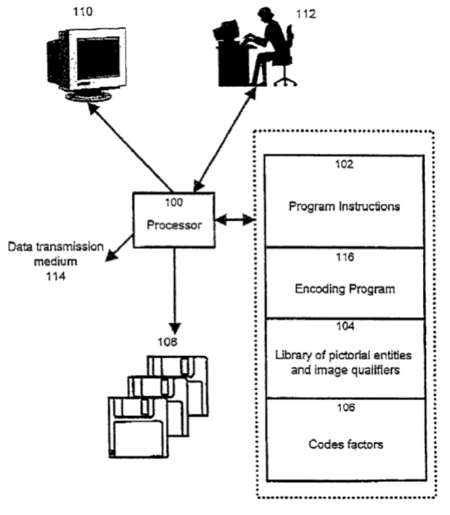
    The '303 Patent discloses a "method and an apparatus for encoding images" and explains that "[i]t is known in the art to create images on the basis of components that are assembled to form a complete image," such as by using "[p]aper strips containing exemplary features" or by using "a program element running on a computing platform which allows a user to select individual components and combining them on a pre-selected face."  In so "constructing an image, pictorial entities are selected from a library of entities as assembled into images," storage of which may require "significant amounts of memory."  As a result, the '303 Patent explains that "there exists a need in the industry to refine the process of encoding images such as to reduce the memory requirements for storage and the bandwidth required for the transmission of the image."

    Figure 1 of the patent is reproduced below that illustrates a process flow diagram of the method of claim 1.

    FigureClaim 1 is provided below:

    1.    A method for creating a composite image, comprising:
        displaying facial feature images on a first area of a first display via a first device associated with the first display, wherein the facial feature images are associated with facial feature element codes;
        selecting a facial feature image from the first area of the first display via a user interface associated with the first device, wherein the first device incorporates the selected facial feature image into a composite image on a second area of the first display, wherein the composite image is associated with a composite facial image code having at least a facial feature element code and wherein the composite facial image code is derived by performing at least one multiplication operation on a facial code using one or more code factors as input parameters to the multiplication operation; and
        reproducing the composite image on a second display based on the composite facial image code.

    The District Court noted the Supreme Court's two-part test to analyze claims for patent-eligibility.  First, courts must determine whether the claims at issue are directed to one of those patent-ineligible concepts, and if so, then secondly courts must examine what else is there in the claims before them by considering "the elements of each claim both individually and as an ordered combination to determine whether the additional elements 'transform the nature of the claim into a patent-eligible application'".

    The second part has been characterized as searching for an "inventive concept" — i.e., an element or combination of elements that is sufficient to ensure that the patent in practice amounts to significantly more than a patent upon the ineligible concept itself.

    Is the '303 Patent Directed to A Patent Ineligible Concept?

    The District Court noted that in essence, the steps claimed in the '303 Patent boil down to: (1) displaying potential input variables (the facial features and their modifications), (2) selecting and manipulating the inputs, (3) deriving an output code by performing a "multiplication operation" on the inputs, and (4) outputting the original inputs on another device by performing the sequence in reverse on another device.

    The District Court further summarized the '303 Patent by stating that, in other words, the '303 Patent utilizes a "paint by numbers" approach to creating, encoding, and decoding composite facial images.  This reasoning was used to conclude that the steps of the patent are directed to the abstract idea of encoding and decoding composite facial images using a mathematical formula.

    The District Court cited to other decisions and noted that such other courts have found that encoding and decoding data is a "fundamental concept" — or put another way, an abstract idea.

    The District Court separately noted that processes that can be performed entirely in the human mind or with pen and paper are not patentable, and even without construing the claims to determine the precise parameters of the encoding scheme, the District Court noted that the specific image encoding process likely can be performed entirely within the human mind or with pen and paper.  So long as the individual is provided the specific input variables — here, the facial feature element codes and code factors — she can apply the "multiplication operation" on the facial code until she can derive a composite image code.  When another individual is provided this same composite facial image code, he could perform the multiplication operation backward to derive the same composite image.

    This allegation by the District Court, that the claim can be performed entirely in the human mind, is troublesome since it ignores the first clause "displaying facial feature images on a first area of a first display via a first device associated with the first display," which cannot be performed in the human mind and necessarily requires computer technology.  Nonetheless, seeing as this first step is likely considered insignificant extra-solution activity, the outcome of patent ineligibility is unlikely to be changed despite this possible flawed "separate" reasoning.

    The District Court rounded out the analysis by rejecting the argument that the claims are necessarily rooted in computer technology, an attempt to save them from invalidity under section 101, by stating that the claims merely require reproducing the image on a different device or generically "transmitting" the image code.  Transmission may be completed "either verbally or through electronic communication means" (also providing that the "data transmission medium" can be through "any other communication medium suitable for the transfer of data").

    In other words, the '303 Patent does not solve a problem created by or specifically arising in a particular technological environment as it can be applied to many technological environments.

    Does the '303 Patent Describe an Inventive Concept?

    Here, the District Court noted that there is little doubt that the claimed steps for generating a composite facial image — namely selecting, manipulating, and incorporating facial features into a composite image — are purely conventional.  The '303 Patent's specification itself discloses that these very methods for creating composite facial images were well established in the prior art.

    The other claimed steps were considered obvious in the field.  Generating a composite facial image necessarily requires a degree of customization based on manipulating the essential elements of a face.  But, again, the '303 Patent itself acknowledges common techniques for creating composite facial images involved dividing the image of a face into constituent features and then selecting and combining features to create the image from a given library of features.

    The District Court did away with the final step of reproducing a previously generated facial image as being obvious as well by assuming that there was no other use for it — "why create a customized face if not to recreate it?"  Here, lack of description of alternative use cases in the specification probably did not help.

    The Defendant argued that the encoding scheme and algorithm provide the "inventive concept" needed to render the claims patent-eligible.  But, the '303 Patent itself acknowledged that constructing composite images based on selected individual features was well known in the art.

    Since the '303 Patent's claimed methods and systems do not improve the function of a computer nor do they improve upon methods of creating composite images, the innovation claimed by the '303 Patent is merely a more efficient manner of encoding composite facial image data by using a generic computer.

    The District Court concluded that the '303 Patent failed both prongs of the Alice test.

    The "Machine or Transformation" Test

    As an alternative, the District Court additionally analyzed the claims under the "Machine or Transformation" test, in which a method claim may be patentable if (1) it is tied to a particular machine or apparatus or (2) it transforms a particular article into a different state or thing.  The discussion was short, however, with the District Court simply noting that the mere manipulation or reorganization of data does not satisfy the transformation prong and the machine prong was not considered.

    Looking over the '303 Patent, it appears that the patent is well-written with sufficient detail, however, the claims failed to incorporate necessary detail to survive § 101.  Because the claims are broad, the description of prior art or known concepts in the patent itself worked against any arguments alleging that the claims describe an inventive concept.

    Novel aspects of claim 1 are within wherein clauses of the "selecting" limitation, and using wherein clauses to recite such aspects can be a problem itself since such clauses can be considered to recite optional material (MPEP § 2111.04).  Further, those novel aspects are recited generically, such as "incorporates the selected facial feature image into a composite image on a second area of the first display," "associated with a composite facial image code having at least a facial feature element code," and "derived by performing at least one multiplication operation on a facial code".  Details for how any of these functions are performed likely would improve the prospects of the claim surviving § 101.

    If a broad independent claim is desired, perhaps usage of dependent claims as fallback positions to recite the details can be helpful if the patent is ever intended to be asserted in court.

  • By Donald Zuhn

    FireworksAfter reflecting upon the events of the past twelve months, Patent Docs presents its ninth annual list of top patent stories.  For 2015, we identified twenty stories that were covered on Patent Docs last year that we believe had (or are likely to have) the greatest impact on patent practitioners and applicants.  Last week, we counted down stories #20 to #16, and today we count down stories #15 to #11 as we work our way towards the top five stories of 2015.  As with our other lists (2014, 2013, 2012, 2011, 2010, 2009, 2008, and 2007), links to our coverage of these stories (as well as a few links to articles on related topics) have been provided in case you missed the articles the first time around or wish to go back and have another look.  As always, we love to hear from Patent Docs readers, so if you think we left something off the list or disagree with anything we included, please let us know.  In addition, we will be offering a live webinar on the "Top Patent Law Stories of 2015" on January 21, 2016 from 10:00 am to 11:15 am (CT).  Details regarding the webinar, which will focus on a handful of the most important stories, can be found here.


    15. Federal Circuit Decides Biosig v. Nautilus on Remand

    In April, the Federal Circuit considered the question of indefiniteness on remand from the Supreme Court's reversal in Nautilus v. Biosig and found again that the Biosig's claims were not indefinite.  In the earlier proceedings in the case, the District Court found the term "in spaced relationship" indefinite as a matter of law, and the Federal Circuit reversed, using its "insolubly ambiguous" test to hold that the claim was amenable to construction and thus not indefinite.  The Supreme Court rejected the Federal Circuit's standard, holding that "a patent is invalid for indefiniteness if its claims, read in light of the specification delineating the patent, and the prosecution history, fail to inform, with reasonable certainty those skilled in the art about the scope of the invention," and reversed and remanded for reconsideration by the Federal Circuit under this standard.  On remand, the Federal Circuit again reversed the District Court's indefiniteness determination, noting that that "an ordinarily skilled artisan would be able to determine this language requires the spaced relationship to be neither infinitesimally small nor greater than the width of a user's hands," and concluding that "[t]he term 'spaced relationship' does not run afoul of 'the innovation-discouraging 'zone of uncertainty' against which [the Supreme Court] has warned,' and to the contrary, informs a skilled artisan with reasonable certainty of the scope of the claim."

    For information regarding this and other related topics, please see:

    • "Biosig Instruments, Inc. v. Nautilus, Inc. (Fed. Cir. 2015)," April 27, 2015


    14.  Supreme Court Decides Kimble v. Marvel

    In August, the Supreme Court let stand its fifty-year ban on royalties post patent expiry (Brulotte v. Thys Co., 1964).  The case involved U.S. Patent No. 5,072,856 to Kimble, directed to a toy that simulated the web-shooting devices used by the fictional Spiderman, which Kimble attempted to license to Marvel (which owns the rights to the Spiderman character, comic books, movies, and ancillary merchandise).  Marvel instead chose to copy the invention, bringing their own version of the toy to market, and the parties subsequently settled the resulting patent infringement lawsuit on terms wherein Marvel purchased the patent for a lump sum (~$500,000) plus a 3% royalty; the settlement containing no limit on this royalty obligation with regard to patent expiry.  Marvel brought a declaratory judgment action against paying post-expiry royalties in which it prevailed, and the Supreme Court majority refused to overrule the Brulotte rule.  Although the majority recognized that royalty plans like the one at issue here can have advantages including "draw[ing] out payments over time and t[ying] those payments, in each month or year covered, to a product's commercial success," the majority believed that the principle of limiting the exclusive right to the statutory term is sufficiently important to require patentees and their licensees to "find ways around Brulotte" using other means.

    For information regarding this and other related topics, please see:

    • "Kimble v. Marvel Entertainment, LLC (2015)," August 20, 2015


    13.  FDA Approves First Biosimilar

    In January, the FDA's Oncologic Drugs Advisory Committee ("ODAC") recommended the approval of Sandoz's biosimilar filgrastim application to market a version of Amgen's NEUPOGEN® biologic drug, making Sandoz's application the first to be accepted under the new biosimilar pathway created by the Biologics Price Competition and Innovation Act (BPCIA), which was part of the healthcare reform package passed in 2010 and commonly referred to as "Obamacare."  Two months later, the FDA approved the biosimilar version of Neupogen® for sale in the U.S. — thus becoming the first biosimilar to be approved under the BPCIA (a mere ten months after Sandoz filed its biosimilar application).  Sandoz (a division of Novartis) began selling its biosimilar product in September under the brand name Zarxio™.  Sandoz also avoided the disclosure provisions of the BPCIA in 2015, successfully arguing that those provisions were optional before the District Court and the Federal Circuit (but that's a "top story" for another day).

    For information regarding this and other related topics, please see:

    • "Sandoz' NEUPOGEN® Biosimilar Now on the Market," September 7, 2015
    • "The First Biosimilar Application Has Been Approved — But What About the Patent Issues?" March 12, 2015
    • "FDA Approves Sandoz Filgrastim Biosimilar," March 8, 2015
    • ""No Clinically Meaningful Differences": The First Accepted Biosimilar Application Has Been Recommend for FDA Approval," January 14, 2015


    12.  Patent Reform Stalls in Congress

    The year began with Rep. Bob Goodlatte (R-VA), the Chairman of the House Judiciary Committee, introducing his "Innovation Act" bill (H.R. 9), which sets forth several "reforms" of U.S. patent law, in substantially the same form as in the last Congress.  In July, Rep. Goodlatte released a 200-page Report on H.R. 9.  While many considered eventual passage of H.R. 9 to be a near certainty, the bill did not come to the House floor for a vote before the August recess and the year concluded with the bill sitting on the House calendar.  Although the Innovation Act is primarily directed to addressing the "problem" of so-called "patent trolls," over the course of 2015 a different patent reform issue (especially in the biopharm sector) started to gain traction.  In an article published last fall on Medium, Biotechnology Industry Organization (BIO) President and CEO Jim Greenwood highlighted this issue, urging Congress to modify the inter partes review (IPR) system, which he argued had "turn[ed] the serious business of medical innovation and entrepreneurial risk-taking into a casino."  In a letter sent to the Senate and House Committees on the Judiciary, 101 patient organizations also expressed "concern[] that, as currently written, H.R. 9 falls short of preserving important patent protections for the biopharmaceutical innovation our communities rely on to achieve a better quality of life."  The group of patient organizations contended that "IPR[s] opened the door to abuses that threaten the unique and specialized mechanisms under the Drug Price Competition and Patent Term Restoration Act (commonly referred to as the Hatch-Waxman Act) and the Biologics Price Competition and Innovation Act (BPCIA)."  Whether the Innovation Act moves to a House vote, and whether that bill (or an alternative) proposes any reforms to the IPR system, will begin to play out as Congress reconvenes this week.

    For information regarding this and other related topics, please see:

    • "BIO CEO: IPR System Threatens Medical Innovation," December 6, 2015
    • "Pigs Fly, Hell Has Frozen Over, and the New York Times Supports Small Inventor and University Patenting," October 28, 2015
    • "101 Patient Organizations Ask Congress to Curb IPR Abuse," October 11, 2015
    • "PTAB Denies Inter Partes Review Petitions Against Two Acorda Patents," August 24, 2015
    • "Ferrum Ferro Capital Files Motion to Strike Allergan's Complaint Alleging Misuse of IPR Process," August 12, 2015
    • "Representatives Seek Protections for Hatch-Waxman and BPCIA in Innovation Act," August 6, 2015
    • "Rep. Goodlatte Releases Report on H.R. 9," August 4, 2015
    • "CBO Provides Cost Estimate to Government to Implement Innovation Act," July 27, 2015
    • "Allergan Fights Back, Files Complaint Against Venture Fund That Filed IPR Petition," July 13, 2015
    • "A Sea Change for IPRs? — Part II," June 10, 2015
    • "A Sea Change for IPRs?" June 9, 2015
    • "Senate Judiciary Committee Passes PATENT Act," June 4, 2015
    • "Group of National and State Organizations Asks Congress to Enact Legislative Reforms to Maintain Strong Patent System," June 1, 2015
    • "A Modest Proposal (or Two)," April 22, 2015
    • "Legislation Introduced in House to Eliminate Uncertainty Regarding AIA Grace Period," April 20, 2015
    • "STRONG Patents Act of 2015 — An Alternative Patent Reform Bill," March 4, 2015
    • "Rep. Goodlatte Introduces His Patent Reform Bill (Again) — Part II," February 9, 2015
    • "Rep. Goodlatte Introduces His Patent Reform Bill (Again)," February 5, 2015
    • "Pro-Patent Coalition Writes Letter to the House and Senate Judiciary Committees," January 29, 2015
    • "Big Ten Lobbies Congress to Tread Lightly on "Patent Reform"," January 29, 2015


    11.  Australia Follows U.S. Lead on DNA Claims

    In June, the High Court of Australia heard the long anticipated appeal from the unanimous decision of a 5-judge bench of the Full Federal Court to allow Myriad's claims to isolated nucleic acids.  In October, the High Court of Australia handed down its decision in D'Arcy v Myriad Genetics Inc [2015] HCA 35, unanimously striking down the validity of the first three claims of Myriad's patent, which related to isolated nucleic acid sequences of the BRAC1 gene.  In reaching that decision, the majority judgment characterized the claimed invention as "information" rather than a chemical product, because it was defined as a code for the BRAC1 gene, which can be stored in various products, such as the isolated DNA of a person or cDNA where the introns in the sequence have been excised.  The product was merely the medium in which that information resides.  The High Court's decision marked a dramatic departure from the Australian Parliament's position on "gene patents" in recent years.  Australia Patent Law only expressly excluded from patentability "human beings and biological processes for their generation", and in 2010 the Patent Amendment (Human Genes and Biological Materials) Bill 2010, which sought to exclude not only DNA and RNA, but all biological entities from patentability, failed to pass after the Senate Legal and Constitutional Affairs Legislation Committee (SLCALC) recommended against the Bill.  As one of Patent Docs correspondents noted, the High Court's decision in D'Arcy v Myriad Genetics Inc brought Australia's position on isolated DNA and RNA in line with that of the United States, while representing a marked deviation from major trading partners such as Europe and the U.S. on the issue of patentability of cDNA.

    For information regarding this and other related topics, please see:

    • "Australian High Court Has Ruled in Myriad Gene Patent Case," October 8, 2015
    • "High Court Rules Myriad's BRCA Genes Not Patentable Subject Matter in Australia," October 8, 2015
    • "Isolated Nucleic Acids Not Patentable in Australia," October 7, 2015
    • "Isolated Gene Sequences Suffer A Cruel Fate in the Hands of the High Court of Australia," October 7, 2015
    • "High Court of Australia Hears Myriad Appeal," June 16, 2015

  •         By Sherri Oslick

    Gavel About Court Report:  Each week we will report briefly on recently filed biotech and pharma cases.

    Spectrum Pharmaceuticals, Inc. et al. v. Amneal Pharmaceuticals LLC
    2:15-cv-01697; filed September 3, 2015 in the District Court of Nevada

    • Plaintiffs:  Spectrum Pharmaceuticals, Inc.; University of Strathclyde
    • Defendant:  Amneal Pharmaceuticals LLC

    Infringement of U.S. Patent No. 6,500,829 ("Substantially Pure Diastereoisomers of Tetrahydrofolate Derivatives," issued December 31, 2002) following a Paragraph IV certification as part of Amneal’s filing of an ANDA to manufacture a generic version of Spectrum's Fusilev® (levoleucovorin, used to treat advanced metastatic colorectal cancer).  View the complaint here.


    OSI Pharmaceuticals, LLC et al. v. Apotex Inc. et al.
    1:15-cv-00772; filed September 2, 2015 in the District Court of Delaware

    • Plaintiffs:  OSI Pharmaceuticals, LLC; Genentech, Inc.
    • Defendants:  Apotex Inc.; Apotex Corp.

    Infringement of U.S. Patent No. 6,900,221 ("Stable Polymorph on N-(3-Ethynylpheny1)-6, 7-Bis(2MethoxyEthoxy)-4-Quinazolinamine Hydrochloride, Methods of Production, and Pharmaceutical Uses Thereof," issued May 31, 2005) following a Paragraph IV certification as part of Apotex’s filing of an ANDA to manufacture a generic version of OSI's Tarceva® (erlotinib, used to treat non-small cell lung cancer and advanced pancreatic cancer).  View the complaint here.


    Merck Sharp & Dohme Corp. et al. v. Actavis Laboratories FL, Inc. et al.
    0:15-cv-61858; filed September 2, 2015 in the Southern District of Florida

    • Plaintiffs:  Merck Sharp & Dohme Corp.; Cubist Pharmaceuticals LLC; Optimer Pharmaceuticals LLC; MSD Investment Holdings (Ireland); MSD International GmbH
    • Defendants:  Actavis Laboratories FL, Inc.; Actavis Pharma, Inc.; Actavis, Inc.

    Infringement of U.S. Patent Nos. 7,906,489 ("18-Membered Macrocycles and Analogs Thereof," issued March 15, 2011), 8,586,551 (same title, issued November 19, 2013), 7,378,508 ("Polymorphic Crystalline Forms of Tiacumicin B," issued May 27, 2008), 7,863,249 ("Macrolide Polymorphs, Compositions Comprising Such Polymorphs, and Methods of Use and Manufacture Thereof," issued January 4, 2011), and 8,859,510 (same title, issued October 14, 2014) following a Paragraph IV certification as part of Actavis' filing of an ANDA to manufacture a generic version of Merck's Dificid® (fidaxomicin, used for the treatment of Clostridium difficileassociated diarrhea in adults 18 years of age or older).  View the complaint here.


    Jazz Pharmaceuticals, Inc. et al. v. Amneal Pharmaceuticals, LLC
    2:15-cv-06562; filed September 2, 2015 in the District Court of New Jersey

    • Plaintiffs:  Jazz Pharmaceuticals, Inc.; Jazz Pharmaceuticals Ireland Ltd.
    • Defendant:  Amneal Pharmaceuticals, LLC

    Infringement of U.S. Patent No. 9,050,302 (“Method of Administration of Gamma Hydroxybutyrate with Monocarboxylate Transporters,” issued June 9, 2015) following a Paragraph IV certification as part of Amneal’s filing of an ANDA to manufacture a generic version of Jazz's Xyrem® (sodium oxybate, used to treat narcolepsy).  View the complaint here.


    AstraZeneca AB et al. v. Alkem Laboratories Ltd. et al.
    3:15-cv-06609; filed September 2, 2015 in the District Court of New Jersey

    • Plaintiffs:  AstraZeneca AB; Aktiebolaget Hassle; AstraZeneca LP; Zeneca Inc.
    • Defendants:  Alkem Laboratories Ltd.; Ascend Laboratories, LLC

    Infringement of U.S. Patent Nos. 6,369,085 ("Form of S-omeprazole," issued April 9, 2002), 7,411,070 (same title, issued August 12, 2008), 7,411,070 (same title, issued August 12, 2008) and 8,466,175 (same title, issued June 18, 2013) following a Paragraph IV certification as part of Alkem’s filing of an ANDA to manufacture a generic version of AstraZeneca's Nexium® (esomeprazole magnesium, used for the treatment of gastroesophageal reflux disease).  View the complaint here.


    AstraZeneca AB et al. v. Actavis Elizabeth LLC et al.
    3:15-cv-06610; filed September 2, 2015 in the District Court of New Jersey

    • Plaintiffs:  AstraZeneca AB; Aktiebolaget Hassle; AstraZeneca LP; Zeneca Inc.
    • Defendants:  Actavis Elizabeth LLC; Actavis, Inc.

    Infringement of U.S. Patent Nos. 6,369,085 ("Form of S-omeprazole," issued April 9, 2002) and 7,411,070 (same title, issued August 12, 2008) following a Paragraph IV certification as part of Actavis’ filing of an ANDA to manufacture a generic version of AstraZeneca's Nexium 24HR®  (esomeprazole magnesium, used for the treatment of gastroesophageal reflux disease).  View the complaint here.


    Janssen Pharmaceutica, N.V. et al. v. Mylan Pharmaceuticals, Inc. et al.
    1:15-cv-00152; filed September 2, 2015 in the Northern District of West Virginia

    • Plaintiffs:  Janssen Pharmaceutica, N.V.; Janssen Sciences Ireland UC; Gilead Sciences, Inc.; Gilead Sciences Ireland UC
    • Defendants:  Mylan Pharmaceuticals, Inc.; Mylan, Inc.

    Infringement of U.S. Patent Nos. 8,841,310 ("Combinations of a Pyrimidine Containing NNRTI with RT Inhibitors," issued September 23, 2014), 7,125,879 ("HIV Inhibiting Pyrimidines Derivatives" issued October 24, 2006), and 8,101,629 (""Salt of 4-[[4-[[4-(2-Cyanoethenyl)-2,6-Dimethylphenyl]amino]-2-Pyrimidinyl]Amino]Benzonitrile" issued January 24, 2012), all licensed to Gilead, following a Paragraph IV certification as part of Mylan's filing of an ANDA to manufacture a generic version of Gilead's Complera® (emtricitabine, rilpivirine, and tenofovir disoproxil fumarate, used to treat HIV-1 in adults who have never taken HIV-1 medicines before and who have no more than 100,000 copies/mL of virus in their blood).  View the complaint here.


    Jazz Pharmaceuticals, Inc. et al. v. Lupin Ltd. et al.
    2:15-cv-06548; filed September 1, 2015 in the District Court of New Jersey

    • Plaintiffs:  Jazz Pharmaceuticals, Inc.; Jazz Pharmaceuticals Ireland Ltd.
    • Defendants:  Lupin Ltd.; Lupin Pharmaceuticals Inc.; Lupin Inc.

    Infringement of U.S. Patent Nos. 6,472,431 ("Microbiologically Sound and Stable Solutions of Gamma-Hydroxybutyrate Salt for the Treatment of Narcolepsy," issued October 29, 2002), 6,780,889 (same title, issued August 24, 2004), 7,262,219 (same title, issued August 28, 2007), 7,851,506 (same title, issued December 14, 2010 ("Sensitive Drug Distribution System and Method" issued February 22, 2011), 8,263,650 ("Microbiologically Sound and Stable Solutions of Gamma-Hydroxybutyrate Salt for the Treatment of Narcolepsy,"  issued September 11, 2012), 8,324,275 (same title, issued December 4, 2012), 8,461,203 ("Microbiologically Sound and Stable Solutions of Gamma-Hydroxybutyrate Salt for the Treatment of Narcolepsy," issued June 11, 2013), 7,668,730 ("Sensitive Drug Distribution System and Method," issued February 23, 2010), 7,765,106 (same title, issued July 27, 2010), 7,765,107 (same title, issued July 27, 2010), 7,895,059 (same title, issued February 22, 2011), 8,457,988 (same title, issued June 4, 0213), 8,589,182 (same title, issued November 19, 2013),  8,731,963 (same title, issued May 20, 2014), 8,772,306 ("Method of Administration of Gamma Hydroxybutyrate with Monocarboxylate Transporters," issued July 8, 2014), 8,859,619 ("Microbiologically Sound and Stable Solutions of Gamma-Hydroxybutyrate Salt for the Treatment of Narcolepsy," issued October 14, 2014), 8,952,062 (same title, issued February 10, 2015), and 9,050,302 (“Method of Administration of Gamma Hydroxybutyrate with Monocarboxylate Transporters,” issued June 9, 2015) following a Paragraph IV certification as part of Lupin’s filing of an ANDA to manufacture a generic version of Jazz's Xyrem® (sodium oxybate, used to treat narcolepsy).  View the complaint here.

  • CalendarJanuary 6, 2016 – "Preparing for and Navigating PTAB Appeals Before the Federal Circuit — Conducting PTAB Trials With Eye to Appeal, Determining Errors for Appeal, Understanding PTO Practice and Federal Circuit Law" (Strafford) – 1:00 to 2:30 pm (EST)

    January 7, 2016 – "STRANGLEHOLD! Written Description and Functional Claiming in the Chemical and Biotech Arts" (American Intellectual Property Law Association) – 12:30 – 2:00 pm (Eastern)

    January 7, 2016 – Ex parte appeals and AIA trials (U.S. Patent and Trademark Office's Dallas Office) – 9:00 to 11:30 am am (CT), Dallas, TX

    January 7, 2016 – "Double-Patenting: Impact of Gilead on Bio and Pharma" (Intellectual Property Owners Association) – 2:00 to 3:00 pm (ET)

    January 8, 2016 – "Double-Patenting: Tech Patents, Double Patenting, and Ex Parte Reexam" (Intellectual Property Owners Association) – 2:00 to 3:00 pm (ET)

    January 14, 2016 – "Strategic Use of Patent Reissue: Determining Whether and When to Pursue a Reissue Application — Correcting Errors, Responding to an IPR Challenge and Mastering the Recapture Rule" (Strafford) – 1:00 to 2:30 pm (EST)

    January 20, 2016 – "Patent Eligibility Post-Alice: Practical Advice for Navigating the Current 35 USC § 101 Regime" (American Intellectual Property Law Association) – 12:30 – 2:00 pm (Eastern)

    January 21, 2016 – "Top Patent Law Stories of 2015" (McDonnell Boehnen Hulbert & Berghoff LLP) – 10:00 am to 11:15 am (CT)

    January 21, 2016 – "Obviousness Standard After the AIA: Leveraging Latest PTO and Court Guidance — Overcoming Challenges of Obviousness and Attacks on Patent Validity" (Strafford) – 1:00 to 2:30 pm (EST)

    ***Patent Docs is a media partner of this conference or CLE

  • USPTO SealThe U.S. Patent and Trademark Office's Dallas Office will be hosting a program focusing on tips and strategies for filing and managing ex parte appeals and AIA trials on January 7, 2016 from 9:00 to 11:30 am am (CT) at the Dallas USPTO, Terminal Federal Building Annex, 207 South Houston Street, Dallas, TX.  The program will begin with a tour of the new office followed by an overview of PTAB operations, and then attendees may participate in small break-out sessions lead by local administrative patent judges to discuss (1) AIA trials; (2) ex parte appeals; (3) successful briefing; and (4) oral advocacy skills.  Attendees also will have the opportunity to meet the new Regional Director Hope Shimabuku, on her first day at the Dallas USPTO.

    The event is free and open to the public.  However, because space is limited, those wishing to attend must RSVP by contacting the Dallas USPTO at dallas@uspto.gov.

  • IPO #2The Intellectual Property Owners Association (IPO) will offer two one-hour webinars on double patenting.  The first webinar, entitled "Double-Patenting: Impact of Gilead on Bio and Pharma," is being offered on January 7, 2016 from 2:00 to 3:00 pm (ET).  Tim Babcock of Akros Pharma Inc., Jack Brennan of Fish & Richardson, and Jeremy Lowe of Axinn Veltrop will focus on tips for patent prosecution after Gilead v. Natco, as well as the litigation outlook with a particular focus on biosimilars.  The second webinar, entitled "Double-Patenting: Tech Patents, Double Patenting, and Ex Parte Reexam," is being offered on January 8, 2016 from 2:00 to 3:00 pm (ET).  Barry Bretschneider of BakerHostetler, Jeffrey Hohenshell of Medtronic, and Lissi Mojica of Dentons US LLP will examine how double patenting arises in tech company patent portfolios, how ex parte reexamination differs from other post-grant proceedings vis-a-vis double patenting, and how it can be used to invalidate vulnerable patents.

    The registration fee for each webinar is $135 (government and academic rates are available upon request).  Those interested in registering for the webinar can do so here.

  • By Donald Zuhn

    FireworksAfter reflecting upon the events of the past twelve months, Patent Docs presents its ninth annual list of top patent stories.  For 2015, we identified twenty stories that were covered on Patent Docs last year that we believe had (or are likely to have) a significant impact on patent practitioners and applicants.  Today, we count down stories #20 to #16, and then in the coming week, we will work our way towards the top stories of 2015.  As with our other lists (2014, 2013, 2012, 2011, 2010, 2009, 2008, and 2007), links to our coverage of these stories (as well as a few links to articles on related topics) have been provided in case you missed the articles the first time around or wish to go back and have another look.  As always, we love to hear from Patent Docs readers, so if you think we left something off the list or disagree with anything we included, please let us know.  In addition, we will be offering a live webinar on the "Top Patent Law Stories of 2015" on January 21, 2016 from 10:00 am to 11:15 am (CT).  Details regarding the webinar, which will focus on a handful of the most important stories on this year's list, can be found here.


    20.  USPTO Launches Patent Quality Initiative

    In February, the U.S. Patent and Trademark Office announced the launch of a comprehensive and enhanced patent quality initiative, and kicked off the initiative by requesting comments from the public on how the Office could enhance patent quality.  The Office indicated that its quality efforts would be aimed at improving patent operations and procedures, enhancing the customer experience, and improving existing quality metrics, and would target three "patent quality pillars": (1) excellence in work products (i.e., issued patents and Office actions), (2) excellence in measuring patent quality, and (3) excellence in customer service.  The Office followed the announcement of the quality initiative with a two-day "Quality Summit" in March.  Earlier this month, the Office invited stakeholders to submit patent quality-related topics that should be the subject of a case study as part of an enhanced patent quality initiative pilot program.  The Office regularly performs case studies to investigate specific quality-related issues as well as review individual examiner work products, and such case studies allow the Office to investigate how a particular issue is being treated or addressed across hundreds or thousands of applications, and where appropriate, to take action to remediate quality issues or to formulate best practices to further enhance quality.

    For information regarding this and other related topics, please see:

    • "USPTO Seeks Topics for Quality Case Study Pilot Program," December 21, 2015
    • "USPTO Launches Enhanced Patent Quality Initiative," March 5, 2015


    19. TPP Moves Forward

    For the past six years, a dozen countries have negotiated the Trans Pacific Partnership (TPP) treaty, a multilateral free trade agreement, with the negotiations shrouded in secrecy.  This secrecy was not absolute, with the Wikileaks website periodically publishing purported drafts of the agreement.  With the announcement in October that the parties had come to substantial agreement on the treaty, Wikileaks once again released portions of the agreement, and in November, the Obama Administration released the approved text of the agreement.  One of the more controversial provisions of the agreement would reduce the term of market exclusivity of biologic drugs from 12 years as provided by the Biologic Price and Competition and Innovation Act (BPCIA) to 8 years.  However, there has been vociferous opposition to the agreement, despite Congress having granted the President so-called "fast-track authority" for the TPP.  As a consequence, Congress can ratify the agreement but cannot amend the agreement or filibuster Senate consideration.  Given the level of political opposition, in addition to the antipathy of the Republican Party to anything the President proposes, it is likely that the agreement will not be ratified, if it ever is, until a new Administration takes power in January 2017.

    For information regarding this and other related topics, please see:

    • "What Are the IP Provisions of the TPP?" November 9, 2015
    • "What May Be the IP Provisions of the Trans Pacific Partnership Agreement," October 15, 2015
    • "Transparency and the Trans-Pacific Partnership Treaty," March 11, 2015


    18.  Myriad Settles with Diagnostic Companies

    In the aftermath of the Supreme Court's decision in AMP v. Myriad Genetics in 2013, Myriad filed suit against six genetic diagnostic test providers (Ambry Genetics, Gene-by-Gene, Quest, GeneDx, Invitae, and LabCorp) and was itself sued in declaratory judgment actions by three others (Quest, Invitae, and Counsyl).  Five of these actions were consolidated in the District of Utah, where Myriad's preliminary injunction motion was denied on the grounds that Myriad was unlikely to prevail on the merits regarding the asserted claims in view of the Supreme Court's Myriad opinion, and late last year, the Federal Circuit affirmed that determination.  Following those setbacks for Myriad, several companies opposing Myriad (Ambry Genetics, LabCorp, Invitae, and Pathway Genomics) issued press releases in January announcing that the action against them had settled.  The press releases from those companies stated that Myriad's infringement allegations had been dismissed "with prejudice" and that each of the parties had received a "covenant not to sue" by Myriad.  The only financial considerations announced were that each party would bear its own costs of the litigation.  In February, Myriad settled with the remaining defendants.  In diagnostic patent news unrelated to the above litigation, but nevertheless of interest to applicants and practitioners, the U.S. Patent and Trademark Office issued its report on so-called "second opinion" genetic diagnostic testing, more than three years after the June 2012 deadline mandated by Section 27 of the Leahy-Smith America Invents Act.

    For information regarding this and other related topics, please see:

    • "PTO Releases Report on Confirmatory Genetic Diagnostic Testing," October 6, 2015
    • "Koepsell and Noonan on Gene Patenting," May 28, 2015
    • "Quest Diagnostics and Inserm Launch BRCA Data-Sharing Initiative," April 30, 2015
    • "The ACLU, Working for the Man," March 24, 2015
    • "Game Over for Myriad — Update," February 16, 2015
    • "Game Over for Myriad," February 10, 2015
    • "Myriad Throws in the Towel," January 27, 2015


    17.  USPTO Announces PTAB Rules Changes

    In March, U.S. Patent and Trademark Office Director Michelle Lee issued a statement on the PTO Blog indicating several "quick-fix" and proposed rule changes.  Among the "quick fix" changes, the Office nearly doubled the number of pages for a motion to amend, with opposition briefing and reply briefing receiving a commensurate amount of additional pages.  These changes were followed by a first "Final Rules" package of amendments to the Rules of Practice before the Patent Trial and Appeal Board (PTAB), which was issued in May, and a second rules package introduced in the form of a Notice of Proposed Rulemaking in August.  No sweeping changes were proposed in the second rules package, and with respect to the change many stakeholders were hoping for (i.e., to the Broadest Reasonable Interpretation (BRI) standard for construing claims), the Board affirmed the use of the BRI standard in all but the most limited circumstances, relying heavily on the Federal Circuit's decision in In re Cuozzo.

    For information regarding this and other related topics, please see:

    • "Single-APJ Institution Pilot Program — USPTO Requests Written Comments for IPR Proceedings," August 27, 2015
    • "Views from the Director's Office on Post-Grant Reviews by the PTAB," August 26, 2015
    • "PTAB Finally Proposes Rule Amendments: The More Things Change . . . ," August 19, 2015
    • "Final 'Ministerial' Rule Amendments for Practice Before the PTAB," May 20, 2015
    • "USPTO Director Announces 'Quick-Fix' and Anticipated Changes to PTAB Practice," March 30, 2015


    16.  District Court Patent Decisions Are Cause for (Initial) Concern

    A pair of district court decisions in the District of Delaware bear watching to see how (or if) the Federal Circuit weighs in.  In Immersion Corp. v. HTC Corp., the trial court construed 35 U.S.C. § 120 to prohibit filing a continuation application on the day its immediate parent granted, contrary to established U.S. Patent and Trademark Office practice (the lower court refusing to grant the Office any deference in the matter).  The decision, if affirmed, may well put more patents at risk than Myriad, Mayo, and Alice combined.  Speaking of Mayo, the trial court in Endo Pharmaceuticals Inc. v. Actavis Inc. found claims directed to methods of using oxymorphone to treat pain in patients with renal impairment to be facially invalid under 35 U.S.C. § 101 as being directed to patent-ineligible subject matter, relying heavily on the Supreme Court's decision in Mayo.

    For information regarding this and other related topics, please see:

    • "Endo Pharmaceuticals Inc. v. Actavis Inc. (D. Del. 2015)," December 9, 2015
    • "IPO Files Amicus Brief in Immersion Corp. v. HTC Corp.," August 17, 2015
    • "Immersion Corp. v. HTC Corp. (D. Del. 2015)," March 18, 2015