• By Joseph Herndon

    The test for what is patentable subject matter under 35 U.S.C. § 101 in the United States has become quite difficult to understand.  In Alice Corp. v. CLS Bank, the Supreme Court provided a two-step test for distinguishing patents that claim patent ineligible laws of nature, natural phenomena, and abstract ideas from those that claim patent-eligible applications of those concepts.  The first step requires a court to determine if the claims are directed to a law of nature, natural phenomenon, or abstract idea.  If not, the claims pass muster under § 101.  A court applies the second step only if it finds in the first step that the claims are directed to a law of nature, natural phenomenon, or abstract idea.  The second step requires the court to determine if the elements of the claim individually, or as an ordered combination, "transform the nature of the claim" into a patent-eligible application.  Step two has been described as a search for an "inventive concept".

    Many courts have complained that identifying whether a claim is "directed to an abstract idea" under step one of the Alice test is not always a simple undertaking.  Without a bright-line test, whether claims will be considered to satisfy 35 U.S.C. § 101 has become unpredictable at best.  With many court decisions, it would seem that the court could just as easily have come to the opposite decision.  Some bright-line rule of course would be welcomed, but I recognize that developing a single rule that applies to all technologies is difficult.

    Martin Snyder, of Main Sequence Technology Inc., has developed a possible solution, and a link to his paper, entitled "Subject Matter Eligibility in the Information Age," can be found here.

  • By Kevin E. Noonan

    Aedes aegyptiThe rise and spread of the Zika virus, although limited for now to South America, has raised concerns globally, particularly with the prospect of the Summer Olympics in Rio de Janeiro later this year.  And with those concerns comes renewed interest in the insect vector associated with zika virus transmission, the Aedes aegypti mosquito.  This mosquito is also the transmission vector for other arboviruses, including those responsible for yellow fever, dengue fever, and Chikungunya, and has been extensively studied for over fifty years.  These studies have been facilitated by the existence of a form of the mosquito that is readily adapted to the laboratory environment (perhaps related to the feral and domestic forms of the mosquito that exist in Africa).

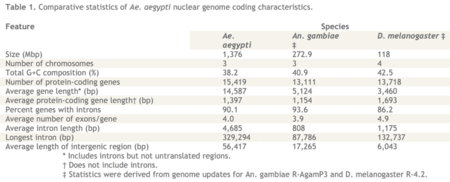
    So it seems appropriate to revisit the explication of the Ae. aegypti genome, as published in Science in 2007.1  This species is known to have radiated from the malaria vector Anopheles gambiae about 150 million years ago and the genome of that mosquito, along with the Drosophila melanogaster genome, was used for comparison purposes to understand the structure of the Aedes genome.  The Aedes aegypti genome has a sequence size of 1.38 Gbp, 5-fold larger than Anopheles gambiae mosquito (278 Mbp); both mosquitos have three chromosomes but Ae. aegypti lacks the heteromorphic sex chromosomes found in D. melanogaster.  The average gene length and size of intergenic regions was found to be 4-6 fold longer than in An. gambiae and D. melanogaster, which the authors believed was due to almost 50% of the Ae. aegypti genome comprising transposable elements.  Despite these differences, chromosomal synteny was reported to have been maintained between these mosquito species, but orthologous gene order was found to be twice as high between the mosquito species than in comparison between either mosquito and the fruit fly.

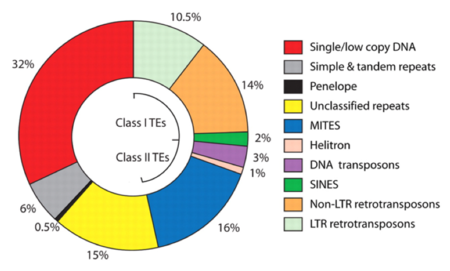
    Genetic analysis for the presence of open reading frames found 15,419 predicted proteins (and alternative splicing can increase this to 16,789 transcripts), with 80% of these confirmed as being transcriptionally active.  There is an increased gene number for odorant binding proteins, cytochrome P450 and cuticle domains relative to An. gambiae.  The relative distribution of genomic content was found as illustrated:

    Figure_1(where Penelope and Helitron are eukaryotic transposable elements and MITEs are miniature inverted repeat transposable elements that in Ae. aegypti have "terminal inverted repeat sequences and target-site duplications, features characteristic of transposition of DNA transposons" according to this report.  These researchers identified over 1,000 types of transposable elements in the mosquitoe's genome, which included most of the families identified in eukaryotes, wherein non-protein coding transposable elements comprise 16% of the genome and are more numerous than protein-coding transposable elements (present at about 3% of the genome).  Three percent of the Ae. aegypti genome comprise about 13,000 copies of long terminal repeat retrotransposons, and there are 50,000 copies of tRNA related SINE elements.  The pattern of transposable element distribution in Ae. aegypti was found to be consistent with "an overall lack of apparent horizontal transfer events."

    A consequence of the predominance of transposable elements in the Ae. aegypti genome created "an asymmetric distribution of intron lengths within genes" and frequent occurrence of transposable element-associated open reading frames "either in close proximity to genes or in introns" and an overall increase in gene length due to "infiltration" of transposable elements into introns.  Compared to related species, "67% of the Ae. aegypti proteins having an ortholog in An. gambiae and 58% having an ortholog in D. melanogaster," with an "average amino acid identity of 74% between the mosquito proteins, in contrast with ~58% identity between mosquito and fruit fly proteins."  Further:

    Approximately 2,000 orthologs are shared only between the mosquitoes and may represent functions central to mosquito biology.  Although most of these proteins are of unknown function, ~250 can be assigned a predicted function, of which 28% are involved in gustatory/olfactory systems, 12% are members of the cuticular gene family and 8% are members of the cytochrome P450 family.

    These authors also report "an expansion of Zn-fingers, insect cuticle, cytochrome P450, odorant binding protein (OBP) A10/OS-D, insect allergen related and HMG-I and MHG-Y domains in Ae. aegypti" compared to other insects (specifically, An. gambiae, D. melanogaster and Apis mellifera (the honey bee)).  Members of the superfamily of G-protein coupled receptors were also found, including "111 non-sensory class A, B and C GPCRs, 14 atypical class D GPCRs, and 10 opsin photoreceptors."  Again in comparison with An. gambiae and D. melanogaster, these authors report orthologs for more than 85% of non-sensory GPCRs (which suggest to these researchers that there has been "significant conservation of GPCR-mediated neurological processes across [the] Diptera [family]."  With regard to the ion transport-homologous genes found in the Aedes aegypti genome the paper states:

    Similar to other multi-cellular eukaryotes, ~ 32% of all three insect transporters code for ion channels and probably function to maintain haemolymph homeostasis under different environmental conditions by modulating the concentrations of Na+, K+ and Cl− ions.  Aedes aegypti encodes more paralogs of voltage-gated potassium ion channels, epithelial sodium channels and ligand-gated ion channels (LIC) such as the glutamate-gated ion channel than An. gambiae and D. melanogaster.  These channels play important roles in the signal transduction pathway and cell communication in the central nervous system and at neuromuscular junctions.  . . .  A collection of 64 putative ATP-binding cassette transporters was identified, including subgroups that encode multi-drug efflux proteins.  Aedes aegypti encodes more members of 4 different types of amino acid transporters than An. gambiae and D. melanogaster.  Mosquito larvae cannot synthesize de novo all the basic, neutral or aromatic L-amino acids, and must rely on uptake of these essential amino acids.  Aromatic amino acids phenylalanine and tryptophan are particularly important because they are precursors for the synthesis of neurotransmitters.  The richer repertoire of membrane transport systems in Ae. aegypti is likely to intersect with the apparent increase in odorant reception and detoxification capacity.

    Instead of bearing heteromorphic sex chromosomes, an Aedes aegypti gender is determined by an autosomal locus where the dominant allele determines maleness.  The researchers detected gender differences in gene expression:

    669 and 635 transcripts were enriched in females and males, respectively, and 6,713 transcripts were expressed at similar levels in both sexes.

    An additional 373 and 534 transcripts generated exclusive hybridization signals (with signal intensity below cutoff threshold level in one channel) in females and males, respectively, and may therefore represent sex specific transcripts.  Functional categorization of female and male enriched transcripts were remarkably similar, with male mosquitoes expressing a slightly larger number of immune and redox/stress related transcripts while females expressed a larger number of putative blood digestive enzyme transcripts.  This particular pattern of immune gene expression is surprising considering a predicted lower need for immune defense in the males, due to the lack of pathogen exposure that results from blood feeding.

    144 orthologous genes displaying the same sex specific transcription pattern in An. gambiae, while 74 orthologs showed an opposite profile, suggesting differences in certain sex specific functions between the two mosquito species.

    Finally, the overall chromosomal organization showed significant synteny ("a distinct one-to-one correlation") between the Aedes aegypti genome and that of both An. gambiae and D. melanogaster (with an exception on the 2p and 3q chromosomal arms.

    A summary of the genetic comparisons provided in the report was provided in tabular form as set forth below (click on table to enlarge).

    Table_1

    1 This work was the result of an international effort involving scientists from The Institute for Genomic Research, Broad Institute of MIT and Harvard, Virginia Polytechnic Institute and State University, Bloomberg School of Public Health, Johns Hopkins University, University of Notre Dame, Harvard University, College of Agricultural Sciences, Colorado State University, Northwestern University, University of California, Riverside, University of California, Santa Cruz, Purdue University, Texas A&M, the Joint Technology Center, and the University of Massachusetts in the U.S.; European Bioinformatics Institute (EMBL-EBI), University of Geneva Medical School, Swiss Institute of Bioinformatics, Imperial College London, University of Oxford, Centro Nacional de Genotipado, Fundación Pública Galega de Medicina Xenómica, Hospital Clínico Universitario de Santiago, Institut Pasteur, Universidade da Coruña, Institut Jacques Monod, Universität Göttingen, and Complexo Hospitalario Universitario de Santiago in Europe; and Universidade de Sao Paulo, Instituto de Quimica, Universidade de Sao Paulo, Institute of Biomedical Sciences, and the Instituto Butantan in Brazil.

  • Laches Bars Claim to Change Inventorship on Issued U.S. Patent

    By Joseph Herndon

    Federal Circuit SealOn February 16, 2016, the Federal Circuit issued an opinion in a case captioned Hedwig Lismont v. Alexander Binzel Corp.  This appeal arises from an inventorship dispute between Hedwig Lismont (Mr. Lismont) and Alexander Binzel Corp. (Binzel-USA), Alexander Binzel Schweisstechnik GmbH & Co. KG (Binzel-Germany), Abicor Unternehmensverwaltungs GmbH (Abicor), IBG Industrie-Beteiligungs-GmbH & Co. KG (IBG), and Richard Sattler (Mr. Sattler) (Appellees).  The U.S. District Court for the Eastern District of Virginia granted summary judgment in favor of Appellees, concluding that Mr. Lismont's inventorship claim, which he filed ten years after the patent issued, was barred by laches.  The Federal Circuit agreed with the District Court's conclusion that the presumption of laches applies against Mr. Lismont's claim and that he failed to rebut that presumption.

    This case serves as a reminder of the power of laches as a defense.  For purposes of this case, laches as a defense does not consider any of the underlying facts surrounding whether Mr. Lismont was a proper inventor of the patent.  Rather, laches simply bars Mr. Lismont from bringing his claim of inventorship any further due to delay in asserting his rights.

    The case has somewhat complicated facts that are simplified here.  Binzel-Germany is the owner of a German Patent (filed in 1997), which serves as the priority document for a PCT application filed in 1998.  Binzel-Germany also owns the U.S. patent at the heart of this dispute, which issued in 2002 to Mr. Sattler and claims priority to the 1998 PCT application.

    Mr. Lismont asserted that, in 1995, he developed the inventive method disclosed in both the German and U.S. patent in response to Binzel-Germany's request for assistance in developing a lower-cost manufacturing process.  Mr. Lismont further alleged that, despite numerous representations from Binzel-Germany that he was the first to conceive of this method, Binzel-Germany filed the German patent application naming Mr. Sattler, a Binzel-Germany employee, as the inventor, rather than Mr. Lismont.  As with the German patent application, Binzel-Germany did not identify Mr. Lismont as an inventor on its PCT Application, and thus, Mr. Lismont also was not named as an inventor on the corresponding U.S. patent.

    Two years after the German patent issued, Mr. Lismont initiated litigation against Binzel-Germany in the German Regional Federal Court in Frankfurt, Germany (First German Litigation).  In that litigation, Lismont maintained that he was the sole inventor of the subject matter disclosed in the German patent and therefore sought to change inventorship on the German patent.  Mr. Lismont subsequently filed a second action in Germany (Second German Litigation) against Binzel-Germany, Abicor, and Mr. Sattler, seeking damages related to his inventorship claim.  Ultimately, the German courts ruled against Mr. Lismont in both cases for essentially the same reasons:  that he failed to prove that he had an inventorship interest in the German patent.

    On October 31, 2012, twelve years after Mr. Lismont initiated the First German Litigation, he initiated the underlying litigation seeking, among other things, to correct inventorship of the U.S. patent under 35 U.S.C. § 256(a).  The District Court granted the Appellees motion for summary judgment on the basis that Mr. Lismont's inventorship claim was barred by laches.

    Laches is an equitable defense that may bar an inventorship claim, and to prevail on a defense of laches, a defendant must establish that (1) the plaintiff's delay in filing a suit was "unreasonable and inexcusable"; and (2) the defendant suffered "material prejudice attributable to the delay."  Further, a rebuttable presumption of laches attaches whenever more than six years passes from the time a purportedly omitted inventor knew or should have known of the issuance of the relevant patent.  This presumption of laches may be rebutted if the plaintiff offers evidence to show an excuse for the delay or that the delay was reasonable or by offering evidence sufficient to place the matters of defense prejudice and economic prejudice genuinely in issue.

    Presumption of Laches

    Because Mr. Lismont undisputedly knew of the application that eventually issued as the U.S. patent before the U.S. patent issued, the District Court concluded that the laches clock started to run when the U.S. patent issued on August 6, 2002.  Then, more than ten years later, on October 31, 2012, Mr. Lismont initiated the present action.  Given that this delay exceeded six years, the District Court found that the rebuttable presumption of laches attached.

    Mr. Lismont argued that he did not delay in initiating the underlying action because he had been diligently seeking to vindicate his inventorship rights in German and European courts.  The Federal Circuit disagreed, and noted that the relevant inquiry for the laches presumption is whether more than six years passed between the time when the inventor knew or should have known of the subject patent and the time the inventor initiated litigation.  Accordingly, to avoid the imposition of the rebuttable laches presumption, Mr. Lismont should have filed his United States inventorship litigation within six years of August 6, 2002, the date on which the patent issued.

    Rebutting the Presumption

    Although Mr. Lismont's litigation abroad may not be used to avoid a presumption of laches, it may help to rebut that presumption.  The Federal Circuit has recognized that a patent owner may avoid the consequences of what would otherwise be an unreasonable delay in filing suit by establishing that he or she was engaged in "other litigation".

    For other litigation to excuse a plaintiff's delay, however, the defendant must have adequate notice of the other proceedings as well as plaintiff's intention to pursue its patent rights upon completion of the other proceedings.  What is important is whether the defendant had reason to believe it was likely to be sued.  Although the "other litigation" excuse is typically invoked when a plaintiff is serially asserting its patents against different defendants, in circumstances like those presented in this case, the defendant in the foreign litigation must likewise receive adequate notice that the plaintiff intends to later pursue its rights under United States patents after termination of the proceedings in the foreign jurisdiction.

    The Federal Circuit found, however, that the mere initiation of patent litigation in a foreign jurisdiction and the existence of United States patents are not sufficient to notify a defendant that the plaintiff will eventually seek to assert its patent rights in the United States.

    Mr. Lismont pointed to three possible sources of the requisite notice, each of which was rejected by the Federal Circuit.

    1.  A document filed in the First German Litigation in which he stated that "the witness Sattler has applied for the patent that is in dispute here in the Unite[d] States in his own name as inventor" and then stated that an "extension of claim according to § 263 ZPO is therefore expressly reserved." (i.e., notifying Binzel-Germany that he was reserving his right to assert correction of inventorship on the '406 patent).  But, here, the Federal found that "ZPO" refers to the German Code of Civil Procedure and section 263 of the German Code of Civil Procedure permits amendments to pleadings pending in a German civil action.  Thus, Mr. Lismont's reference to "§ 263 ZPO" reserved only his right to "extend" his German claim in front of the German court.

    2.  A letter to Mr. Sattler that (i) noted the filing of a U.S. patent application naming Mr. Sattler as the inventor; (ii) advised that Mr. Lismont would "carefully examine and prosecute your conduct and actions in all legal respects"; and (iii) notified Mr. Sattler that failure to pay damages would result in the initiation of "appropriate legal action with no further notification."  Again, the Federal Circuit found that this communication lacked any indication that Mr. Lismont intended to commence legal proceedings to correct inventorship in the United States.

    3.  Lismont's request in Germany for "worldwide damages" also does not satisfy requisite notice.  There are no assertions in the complaint filed in the Second German Litigation indicating that Mr. Lismont was pursuing the issue of inventorship as to the '406 patent.  More importantly, there are no assertions in the complaint that could serve to notify Binzel-Germany that this issue would eventually be litigated in the United States if left unresolved upon conclusion of the litigation abroad.

    Thus, because the plaintiff did not provide any explicit notice to the defendants in a foreign patent dispute that it would pursue litigation in the courts of the United States against the same defendants upon termination of the foreign litigation, it was not an abuse of discretion to find that laches bars the later claim.  Thus, the Federal Circuit found that the presumption of laches applies and that Mr. Lismont had not presented any genuine issues sufficient to rebut the presumption.  Therefore, Mr. Lismont's claims were barred by laches.

    Thus, in instances in which a party believes a patent has issued with improper inventorship, and the interested party is looking to be correctly added as a named inventor, 35 U.S.C. § 256 allows for a court to order correction of the patent on notice and hearing of all parties concerned and the USPTO Director shall issue a certificate of correction with the proper inventorship.  But, with all claims, the doctrine of laches is a possible defense, and plaintiffs must act diligently to avoid unreasonable delay to bring forth possible claims.  For correction of inventorship, within 6 years of learning of the error, the interested party must come forward to challenge/correct the inventorship to avoid the presumption of laches.

    Lismont v. Alexander Binzel Corp. (Fed. Cir. 2016)
    Panel: Circuit Judges Lourie, Reyna, and Chen
    Opinion by Circuit Judge Chen

  • By Andrew Williams

    Supreme Court Building #1Earlier today, the Supreme Court heard oral arguments in two related cases:  Halo Electronics, Inc. v. Pulse Electronics, Inc. (Supreme Court docket number 14-1513) and Stryker Corp. v. Zimmer, Inc. (Supreme Court docket number 14-1520).  The issue on appeal in the Halo case was limited to Question 1 presented in the petition:

    QUESTION PRESENTED:

    1.  Whether the Federal Circuit erred by applying a rigid, two-part test for enhancing patent infringement damages under 35 U.S.C. § 284, that is the same as the rigid, two-part test this Court rejected last term in Octane Fitness, LLC v. ICON Health & Fitness, Inc., 134 S. Ct. 1749 (2014) for imposing attorney fees under the similarly-worded 35 U.S.C. § 285.

    In the Stryker case, the questions that will be considered are:

    1.  Has the Federal Circuit improperly abrogated the plain meaning of 35 U.S.C. § 284 by forbidding any award of enhanced damages unless there is a finding of willfulness under a rigid, two-part test, when this Court recently rejected an analogous framework imposed on 35 U.S.C. § 285, the statute providing for attorneys' fee awards in exceptional cases?

    2.  Does a district court have discretion under 35 U.S.C. § 284 to award enhanced damages where an infringer intentionally copied a direct competitor's patented invention, knew the invention was covered by multiple patents, and made no attempt to avoid infringing the patents on that invention?

    As suggested by the question in the Halo case, issues in these two cases are similar to those decided by the Court in the Octane Fitness and Highmark cases from the 2013-2014 term.  The relevant text of this section of the statute reads:  "In either event the court may increase the damages up to three times the amount found or assessed."  An important distinction between these cases and the prior ones is that any change in the way that this statute is applied will only benefit patent owners.  As a result, not surprisingly, a theme that permeated throughout the argument today was whether pirates, or willful infringers, are as dangerous as the so-called trolls.  How the various Justices view this dichotomy will likely be determinative of the outcome of these cases.

    The Petitioner

    Jeffrey Wall, counsel for Stryker Corp., argued on behalf of both petitioners.  The position of both patent owners in this case was that the Federal Circuit had developed a test for enhanced damages that is too rigid.  According to In re Seagate Technologies, the currently controlling en banc Federal Circuit decision, a patent owner needs to show both (1) an alleged infringer acted despite an objectively high likelihood it was infringing the patent, and (2) the infringer knew or should have known of the risk.  As Mr. Wall put it, instead of focusing exclusively on "the nature of the infringement," the district courts also look to defenses developed by litigation counsel to get the accused infringer "off the hook."  Mr. Wall even quoted Justice Breyer from the Octane case in saying that "a patent lawyer can virtually always come up with some non-frivolous defense in litigation."

    This was an opening for Justice Breyer to begin his questioning.  In what will not be a surprise to anyone, Justice Breyer began his comments with the following observation:  "Today's patent world is not a steam-engine world."  Unfortunately, this was followed up with:

    We have decided to patent tens of thousands of software products and similar things where hardly anyone knows what the patent's really about.  A company that's a start-up, a small company, once it gets a letter, cannot afford to pay 10,000 to $100,000 for a letter from counsel, and may be willing to run its chances.

    Mr. Wall responded a little later:

    Because on the other side of the parade of horribles you're worried about are the people who can infringe, knowing that they can discount by the probability that they'll be found to have infringed in litigation with virtually no back-end penalty, even if they were a very bad infringer . . . .

    When pressed for how to articulate a test by Justice Sotomayor, Mr. Wall again pointed to the nature of the infringement, and added "[t]hat needs to be intentional or reckless based on the facts as they were known to the infringer."  Moreover, Mr. Wall suggested taking into account the strength of the notice, such as "what kind of notice were they on the patent, and what would have been commercially reasonable in the industry as it exists."

    The United States

    Roman Martinez argued on behalf of the United States as amicus curiae.  He took the position that the Federal Circuit moved in the right direction with the Seagate case, but that they made two mistakes: (1) when "they said that in a case where you have subjective intent, that, in and of itself, is not enough to establish a case for enhanced damages," and (2) "with respect to how the recklessness inquiry is supposed to happen."  The problem with the latter is because the analysis is from the reasonable man with "the benefit of omniscience, giving him the benefit of hindsight and saying, what facts do we know at the time of trial?"

    In what seemed uncharacteristic, Justice Breyer basically said that we should trust the Federal Circuit, because "we're not leaving it up to the 475 trial judges [] because those 475 trial judges don't see patent cases very much."  Justice Breyer again made his concern clear, this time speaking in the shoes of the Federal Circuit:  "And we are afraid that if we do not use this objective standard, what we will see is a major effect discouraging invention because of fear that if we try to invent, we'll get one of these letters and we can't afford $100,000 for an opinion."            

    Respondant

    Carter Phillips, counsel for Pulse Electronics, argued on behalf of the Respondents in this case.  For their part, Mr. Phillips argued to maintain the status quo.  In fact, Mr. Phillips highlighted two areas that he did not think should change:  (1) the de novo standard of review, and (2) the clear and convincing evidence standard.  Specifically, Mr. Phillips did not want to see discretion afforded to the lower court's decisions.  His reason was that whether there is an objectively reasonable basis for what has been done is basically a question of law.  With regard to maintaining the clear and convincing evidence standard, he provided two reasons.  First, the standard was in existence in 1985, and Congress didn't modify it with the America Invents Act.  Second, Mr. Phillips pointed out that they are talking about punitive damages, which should have a higher standard.

    Justice Sotomayor took the counterpoint to Justice Breyer during Mr. Phillips argument.  After noting that "there's a whole lot of worry articulated by Justice Breyer," she went on to note that "there's not a whole lot of worry about protecting the patent owner."  She continued:

    I can't forgot that historically enhanced damages were automatic, and they were automatic because of a policy judgment that owning a patent entitled you to not have people infringe willfully or not willfully.  And I accept that at some point there was a different judgment made that — that good-faith infringers should be treated differently than other infringers, willful infringers.

    But I don't know that that swung so far the other way that it can only be that, if you come up with something, any defense whatsoever in the litigation that's not frivolous, that that gets you out of enhanced damages.

    It will clearly be the difference in this policy consideration will be determinative of how the Court will decide — will the Court favor the pirates or the trolls.

    Alexander Hamilton

    On a final note, Justice Breyer attempted to provide a historical example:

    [T]here was a company.  And the company made, I think, cotton goods.  And an individual thought that he could make a lot of money by taking those cotton goods and the machinery that they were used and selling it all over the United States.  And so he did it.  I think it was Alexander Hamilton.

    Even though it is not clear that Justice Breyer had the correct historical figure in mind, it was a nice shout-out to Lin-Manual Miranda and his blockbuster hit on Broadway.  In fact, Justice Breyer is on record as being a fan of the show.  It was only too bad that Mr. Miranda didn't include a song about Thomas Jefferson helping to create the original patent system in his musical score.

  • Producing "digital labels" is Patent Eligible under § 101

    By Joseph Herndon

    District Court for the Eastern District of TexasOn February 6, 2016, the U.S. District Court for the Eastern District of Texas (Marshall Division) issued a decision in a case captioned Gonzalez v. Infostream Group, Inc. (Case No. 2:14-cv-906-JRG-RSP).

    The patent friendly Eastern District Court in Texas denied a Motion for Summary Judgment of Invalidity and found that the asserted patents are patent eligible under 35 U.S.C. § 101.  The decision is lacking somewhat with factual support for how these patents are subject matter eligible, and the outcome shows some of the randomness in application of the test for determining patent eligibility.

    The Asserted Patents

    The asserted patents include U.S. Patent No. 7,873,665 (the '665 patent) entitled "Method for Digitally Labeling Websites" and U.S. Patent No. 7,558,807 (the '807 patent) entitled "Host Website for Digitally Labeled Websites and Method".

    Claim 1 of the '665 patent recites:

    1.  A method for multi-parameter digital labelling of Internet Websites, comprising:
        gathering of unambiguous, multi-parameter qualitative data concerning a single or a plurality of at least one of an Internet website, an Internet posting, their substantive contents, and their owner or creator;
        sourcing, from the owner or creator of said website or Internet posting, each said item of qualitative data referring to said website, said internet posting, or its substantive contents or its owner or creator;
        producing a plurality of digital labels for each said website or internet posting, wherein each digital label uniquely refers to and represents a particular item of qualitative information;
        wherein producing of digital labels further comprises encoding of the qualitative data in any digital form;
        domiciling of these multi-parameter digital labels on at least one of the same computer, the same computer network, and on several computers linked to each other;
        manipulation of the said multi-parameter digital labels comprising generation of a list of at least one of websites and Internet postings that match parameters stipulated  by an entity conducting a search and represented in the digital labels according to at least one of the presence of, the absence of, the numerical or other value contained in, the numerical or other value not contained in, any one, all, and any configuration of the labels that have reference to one or more websites or Internet postings; and
        making available the effective use of these multi-parameter digital labels and the means for their manipulation, to the general public through the Internet.

    The District Court summarized the '665 patent as describing a method for making digital labels including two primary steps of (1) gathering "unambiguous, multi-parameter qualitative data" on websites or Internet postings and their owners from the owners; and (2) producing "digital labels" for the websites and postings where each "digital label" represents "a particular item of qualitative information" about the website, posting, or owner.  The claim then states that the "plurality of digital labels" are "produc[ed]" by "encoding" and are "domicil[ed]" on a computer or network.  The "domiciled" "labels" can be "manipulated," by generating a list of websites or postings that have labels that represent the "parameters stipulated by an entity conducting a search" or that do not have labels that are excluded by the parameters ('665 patent, col. 23 ll. 27–12).

    The '665 patent helps identify websites.  For publishers, the issue is how to get one's website noticed in an increasingly crowded field; for web surfers, the issue is how to find what's out there.  As discussed above, subscribers label their websites and the labels are digitized.  A "label" is something which identifies contents, or provides information about the subscriber or his website.

    Claim 1 of the '807 patent recites:

    1.  A host website apparatus for listing subscribers comprising:
        a computer system,
        said computer system includes a digital label database for providing to a listing subscriber digital labels representing different specific qualities and a subscriber database for storing a listing of subscribers' digital labels;
        said computer system being configured to respond to a subscriber's request for listing and guiding the subscriber via the Host Website display to enter information pertaining to the subscriber and converting the information to digital labels by accessing said digital label database and storing the subscriber's digital labels in said subscriber database; and
        said computer system further configured to enable users to search said subscriber database for subscriber digital labels identifying subscriber qualities.

    Here, the District Court summarized claim 1 of the '807 patent as describing a website, and referred to parameters of the claim.

    The Defendant contended that the '665 patent and the '807 patent are invalid under 35 U.S.C. § 101 because they claim the abstract idea of using labels to facilitate searches, and this constitutes an abstract idea because Gonzalez told the Patent Office that his invention was to label websites using a digital form of the labels that were already well-known on physical items.  The Defendant pointed to the summary of the invention in the applications and contended that it shows that the invention described is the abstract idea of using labels as a way to organize websites by category to make them easier to find, because it shows that it is the same idea that is used in library-card catalogs:  using labels to organize books by category so they are easier to find.

    Section 101 Analysis

    The District Court followed the Supreme Court's two-step test for distinguishing patents that claim patent ineligible laws of nature, natural phenomena, and abstract ideas from those that claim patent-eligible applications of those concepts.  The first step requires a court to determine if the claims are directed to a law of nature, natural phenomenon, or abstract idea.  If not, the claims pass muster under § 101.  A court applies the second step only if it finds in the first step that the claims are directed to a law of nature, natural phenomenon, or abstract idea.  The second step requires the court to determine if the elements of the claim individually, or as an ordered combination, "transform the nature of the claim" into a patent-eligible application.  Step two has been described as a search for an "inventive concept".

    Step One

    The District Court found that claim 1 of the '665 patent is not directed to an "abstract idea".  The District Court reasoned that claim 1 recites steps for "gathering" one type of data and "producing" a "label," and while "gathering" data may describe an abstract idea, "producing" a "label" based on that gathered data does not describe an abstract idea.  The District Court construed "label" to mean "something symbolic of unambiguous qualitative data about an item, its maker, or its owner."  Thus, processing gathered data to "produce" "something symbolic" does not describe an abstract idea because that process is a specific and concrete implementation of data storage.  Similarly, using "labels" serves a concrete and specific way of conducting data storage and search.

    The District Court also found that claim 1 of the '807 patent is not directed to an "abstract idea."  Here, the District Court reasoned that claim 1 recites a computer system configured to use "digital labels."  The system obtains "digital labels" by "responding" to a subscriber request and "guiding" the subscriber to provide the information that is used to create the "digital labels."  While the "responding" limitation may describe somewhat of an abstract idea of reacting to information from a source, the "guiding" limitation describes a more specific and concrete way of processing information.  The District Court noted that "[m]any ways of gathering information exist besides obtaining it by 'guiding' a subscriber," presumably using a preemption argument in favor of a patentee, which may be the first time ever in a § 101 analysis.

    Step Two

    Because the District Court found that the claims are not directed to abstract ideas, the claims are patent-eligible under § 101, and the District Court did not need to reach step two.

    But, to round out the analysis, the District Court noted that the claims, when read as whole, disclose an "inventive concept."  The District Court reasoned that claim 1 of the '807 patent describes a computer system that allows for data to be more easily searched and the specification implies that the invention "improve[s] the functioning of the computer [system] itself".  The District Court went further to state that even though the claims recite generic physical limitations such as "computer system," "database," and "Website," in combination with "labels" these components improve the computer system so that it can address the Internet-centric problem of "surfers" being unable find information through word-match searches.

    In this case, the District Court's reasoning is not well-founded based on the facts of the case.  It seems that the best support to find these claims patent eligible under 35 U.S.C. § 101 is that the claims use any potentially abstract idea in a manner designed to solve a technological problem and such that the use is necessarily rooted in computer technology.  The District Court placed large emphasis on "digital labels" being encoded in a digital form as saving the claims from patent ineligibility.  Although the District Court did not explicitly mention preemption, or lack thereof for the patent claims, as a reason for finding the claims patent eligible, the language given by the Court that many ways for doing this exist besides what is claimed sounds a lot like a preemption argument.  And preemption arguments have been routinely shot down by courts, at least as a stand-alone test for eligibility.

    The cataloging of websites described by these patents would appear to be an abstract idea, however, the patent friendly Eastern District of Texas declined to rule them out.

    Report and Recommendation by U.S. Magistrate Judge Roy S. Payne

  •         By Sherri Oslick

    Gavel About Court Report:  Each week we will report briefly on recently filed biotech and pharma cases.

    Actavis Laboratories UT, Inc. v. Par Pharmaceutical, Inc.
    1:15-cv-00886; filed October 2, 2015 in the District Court of Delaware

    Infringement of U.S. Patent Nos. 7,029,694 ("Compositions and Methods for Transdermal Oxybutynin Therapy," April 18, 2006), 7,179,483 (same title, issued February 20, 2007), 8,241,662 ("Unoccluded Topical Oxybutynin Gel Composition and Methods for Transdermal Oxybutynin Therapy," issued August 14, 2012), and 8,920,392 ("Method for Treating Overactive Bladders and a Device for Storage and Administration of Topical Oxybutynin Compositions," issued December 30, 2014) following a Paragraph IV certification as part of Par's filing of an ANDA to manufacture a generic version of Actavis' Gelnique® (oxybutynin chloride 10% gel, used in the treatment of overactive bladder with symptoms of urge urinary incontinence, urgency, and frequency).  View the complaint here.


    AbbVie Inc. et al. v. Hetero USA Inc. et al.
    1:15-cv-00889; filed October 2, 2015 in the District Court of Delaware

    • Plaintiffs:  AbbVie Inc.; Abbvie Deutschland GmbH & Co. KG
    • Defendants:  Hetero USA Inc.; Hetero Labs Ltd.; Hetero Labs Limited Unit-III

    Infringement of U.S. Patent Nos. 6,037,157 ("Method for Improving Pharmacokinetics," issued March 14, 2000), 6,703,403 (same title, issued March 9, 2004), 7,148,359 ("Polymorph of a Pharmaceutical," issued December 12, 2006), 7,364,752 ("Solid Dispersion Pharmaceutical Formulations," issued April 29, 2008), 8,025,899 ("Solid Pharmaceutical Dosage Form," issued September 27, 2011), 8,268,349 (same title, issued September 18, 2012), 8,399,015 (same title, issued March 19, 2013), 8,309,613 (same title, issued November 13, 2012), 8,377,952 ("Solid Pharmaceutical Dosage Formulation," issued February 19, 2013), 8,470,347 ("Self-emulsifying Active Substance Formulation and Use of this Formulation," issued June 25, 2013), and 8,691,878 ("Solid Pharmaceutical Dosage Form," issued April 8, 2014) following a Paragraph IV certification as part of Hetero's filing of an ANDA to manufacture a generic version of AbbVie's Kaletra® (lopinavir and ritonavir, used to treat HIV infections).  View the complaint here.


    Amgen Inc. et al. v. Apotex Inc. et al.
    0:15-cv-62081; filed October 2, 2015 in the Southern District of Florida

    • Plaintiffs:  Amgen Inc.; Amgen Manufacturing Ltd.
    • Defendants:  Apotex Inc.; Apotex Corp.

    Infringement of U.S. Patent Nos. 8,952,138 ("Refolding Proteins Using a Chemically Controlled Redox State," issued February 10, 2015) and 6,162,427 ("Combination of G-CSF With a Chemotherapeutic Agent for Stem Cell Mobilization," issued December 19, 2000) based on Apotex's filing of a BLA to market a biosimilar version of Amgen's Neupogen® (filgrastim, used to treat side effects of certain forms of chemotherapy).  View the complaint here.


    Altergon SA et al. v. Actavis Laboratories UT, Inc.
    1:15-cv-00883; filed October 1, 2015 in the District Court of Delaware

    • Plaintiffs:  Altergon SA; IBSA Institut Biochimique SA; Teikoku Seiyaku Co., Ltd.
    • Defendant:  Actavis Laboratories UT, Inc.

    Infringement of U.S. Patent No. 5,607,690 ("External Anti-Inflammatory and Analgesic Plaster Preparation," issued March 4, 1997) following a Paragraph IV certification as part of Actavis' filing of an ANDA to manufacture a generic version of Altergon's Flector® (diclofenac epolamine patch, used for the topical treatment of acute pain due to minor strains, sprains, and contusions).  View the complaint here.


    Alcon Pharmaceuticals Ltd. et al. v. Par Pharmaceutical, Inc.
    3:15-cv-07240; filed October 1, 2015 in the District Court of New Jersey

    • Plaintiffs:  Alcon Pharmaceuticals Ltd.; Alcon Laboratories, Inc.; Alcon Research, Ltd.
    • Defendant:  Par Pharmaceutical, Inc.

    Infringement of U.S. Patent Nos. 6,284,804 ("Topical Suspension Formulations Containing Ciprofloxacin and Dexamethasone," issued September 4, 2001) and 6,359,016 (same title, issued March 19, 2002) following a Paragraph IV certification as part of Par's filing of an ANDA to manufacture a generic version of Alcon's Ciprodex® (0.3% ciprofloxacin and 0.1% dexamethasone sterile otic suspension).  View the complaint here.


    Actelion Pharmaceuticals Ltd. v. Lee
    1:15-cv-01266; filed October 1, 2015 in the Eastern District of Virginia

    Review and correction of the patent term adjustment calculation made by the U.S. Patent and Trademark Office for U.S. Patent No. 8,518,912 ("Phosphonic Acid Derivates and Their Use as P2Y12 Receptor Antagonists," issued August 27,2013).  View the complaint here.

  • CalendarFebruary 24, 2016 – "Patentable Subject Matter after Alice: Best Practices for Addressing 35 U.S.C. § 101" (McDonnell Boehnen Hulbert & Berghoff LLP) – 10:00 am to 11:15 am (CT)

    February 24, 2016 – "Patent Law Year in Review — 2015 and a Look Ahead to 2016" (Clear Law Institute) – 3:00 – 4:15 pm (ET)

    February 25, 2016 – "Negotiating Technology Transfer Agreements — Structuring Key Provisions, Anticipating and Avoiding Drafting Pitfalls, Addressing Cross-Border Challenges" (Strafford – 1:00 to 2:30 pm (EST)

    February 26, 2016 - 60th Annual Intellectual Property Law Conference (John Marshall Law School Center for Intellectual Property Law) – Chicago, IL

    March 1, 2016 – "PTAB Best Practices for Petitioners" (American Intellectual Property Law Association) – 12:30 – 2:00 pm (Eastern)

    March 8, 2016 – Patent Quality Chat webinar series: "Latest on the Cooperative Patent Classification (CPC) System" (U.S. Patent and Trademark Office) – 12:00 to 1:00 pm (ET)

    March 10, 2016 – "Biotech Patents and §101 Rejections: Meeting Patent Eligibility Requirements — Leveraging Recent Decisions and USPTO Guidance to Overcome Rejections" (Strafford) – 1:00 to 2:30 pm (EST)

    March 10-11, 2016 - Advanced Patent Law Seminar (Chisum Patent Academy) – Cincinnati, OH

    March 16, 2016 – "Preparing for the European Unified Patent Court (UPC)" (McDonnell Boehnen Hulbert & Berghoff LLP) – 10:00 am to 11:15 am (CT)

    ***Patent Docs is a media partner of this conference or CLE

  • Strafford #1Strafford will be offering a webinar/teleconference entitled "Biotech Patents and §101 Rejections: Meeting Patent Eligibility Requirements — Leveraging Recent Decisions and USPTO Guidance to Overcome Rejections" on March 10, 2016 from 1:00 to 2:30 pm (EST).  Denise M. Kettelberger, Ph.D. of Sunstein Kann Murphy & Timbers, and Katherine M. Kowalchyk, Ph.D. of Merchant & Gould will provide guidance for patent counsel for overcoming §101 rejections for biotech patents, and review recent case law and USPTO guidance on §101 patent eligibility and offer strategies to address §101 rejections.

    The registration fee for the webinar is $297.  Those interested in registering for the webinar, can do so here.

  • AIPLA #1The American Intellectual Property Law Association (AIPLA) will be offering a webinar entitled "PTAB Best Practices for Petitioners" on March 1, 2016 from 12:30 – 2:00 pm (Eastern).  David Cavanaugh of Wilmer Hale; Scott Chambers of Porzio, Brombert & Newman; Jonathan Stroud, Chief Patent Counsel, Unified Patents; and ​Christa Brown-Sanford of Baker Botts will walk through some of the basic and more advanced aspects of Patent Trial and Appeal Board (PTAB) practice, suggesting best practices for those both new and seasoned before the PTAB.

    The registration fee for the program is $145 (AIPLA member rate) or $195 (non-member rate).  Those interested in registering for the program, can do so here.

  • Strafford #1Strafford will be offering a webinar/teleconference entitled "Negotiating Technology Transfer Agreements — Structuring Key Provisions, Anticipating and Avoiding Drafting Pitfalls, Addressing Cross-Border Challenges" on February 25, 2016 from 1:00 to 2:30 pm (EST).  Luke K. Pedersen and Stephen C. Mann of Baker Botts will provide guidance to counsel for drafting technology transfer and licensing agreements, and discuss key clauses in the contracts and offer best practices for negotiating the agreements and avoiding common pitfalls.

    The registration fee for the webinar is $297.  Those interested in registering for the webinar, can do so here.