• Federal Circuit Bar AssociationThe Federal Circuit Bar Association (FCBA), in conjunction with the John Marshall Law School, the Notre Dame Law School, and DePaul University College of Law will be offering a program on "Patent Litigation 2016: The Courts and the Patent Trial and Appeal Board" on April 28, 2016 from 8:45 am to 5:00 pm (CT) at the John Marshall Law School in Chicago, Illinois.  The program will include presentations on the following topics:

    • Case Management of Patent Cases in the Northern District of Illinois under the Amended Federal Rules
    • Patent Case Management and Next Generation: The Corporate Counsel Perspectives
    • Claim Construction in the PTAB and District Courts — The Impact of Amendments to PTAB and Federal Rules, and Case Law Developments
    • Hot Topics in Patent Law
    • Damages
    • Ethical Considerations in View of Amendments to PTAB and Federal Rules

    The lunch keynote speaker will be Chief Judge Sharon Prost of the U.S. Court of Appeals for the Federal Circuit.

    The registration fee for the webinar is $250 (FCBA members) or $295 (non-members).  Additional information regarding the program, including an agenda and registration details, can be found here.

  • AIPLA #1The American Intellectual Property Law Association (AIPLA) will be offering a webinar entitled "Patent Prosecution Conflicts of Interest for Clients Having Competing Technologies" on April 27, 2016 from 12:30 – 2:00 pm (Eastern).  Frederick W. Gibb of Gibb & Riley; ​William R. Griffin, U.S. Patent & Trademark Office, Deputy Director Office of Enrollment & Discipline; and Mercedes K. Meyer of DrinkerBiddle will examine caselaw and disciplinary decision examples that explain conflicts of interest, whether an attorney-client relationship actually exists, and representation of competing clients using screening walls.

    The registration fee for the program is $145 (AIPLA member rate) or $195 (non-member rate).  Those interested in registering for the program, can do so here.

  • USPTO SealThe U.S. Patent and Trademark Office will be hosting a Symposium on Enhanced Patent Quality on April 27, 2016 from 9:00 am to 5:00 pm ET in the Madison Auditorium at the USPTO headquarters in Alexandria, VA.  The purpose of the Symposium is to provide an update about the USPTO's programs to enhance patent quality.  There also will be a hands on workshop to showcase new ways that the USPTO will measure patent quality and a panel discussion with experienced practitioners about how applicants can strengthen their application filings.  The Symposium will provide presentations on the following topics:

    • Opening Remarks — Before and After: How Is Enhanced Patent Quality Making a Difference — Michelle Lee, Director of the USPTO

    • Search & Training Enhancements — Highlights include: Global Dossier and Clarity of the Record Training — Maria Holtmann, Director of International Programs; and Don Hajec, Assistant Deputy Commissioner for Patent Operations

    • Prosecution Enhancements — Highlights include: Clarity of the Record Pilot — Robin Evans, Director, Technology Center 2800

    • Post-examination Enhancements — Highlights include: Post Grant Outcomes — Jack Harvey, Acting Assistant Deputy Commissioner for Patent Operations

    • Improving Evaluation of Examination — Highlights include: Topic Submission for Case Studies and Big Data — Brian Hanlon, Director of the Office of Patent Legal Administration

    • Quality Metrics — Improving Patent Quality Measurement — Marty Rater, Chief Statistician, Office of Patent Quality Assurance

    • Master Review Form (MRF) Hands-On Workshop — Reviewing for Correctness, Clarity, and Consistency — Sandie Spyrou, Supervisory Review Quality Assurance Specialist; and Kathleen Bragdon, Senior Advisor to the Deputy Commissioner for Patent Quality

    • MRF Report Out — From the workshop

    • Panel Discussion — How Applicants Can File and Prosecute a Quality Application — Russ Slifer, Deputy Director of the USPTO; Bill Bunker, Knobbe Marten; Rick Nydegger, Workman Nydegger; Kevin Noonan, MBHB; Laura Sheridan, Google; and Tim Wilson, SAS

    • Q&A with Panel

    The program will be free and open to the public.  The event will also be webcast.  Additional information about the Symposium, including registration information and details for accessing the webcast can be found here.

  • D Young & CoD Young & Co will be offering a webinar on April 27, 2016 to provide an update on the Unified Patent Court (UPC) and unitary patent (UP) as well as address some common misunderstandings of the UPC and UP.  The webinar will be offered at three times: 9:00 am, noon, and 5:00 pm BST — 4:00 am, 7:00 am, and 12:00 pm (EDT).  D Young & Co attorneys Richard Willoughby and Rachel Bateman will also give guidance on the preparation that is needed, assuming that the UP/UPC comes into force in Q1 2017.

    While there is no charge to attend the webinar, attendees must register in advance.  Those wishing to register can do so here.

  • By Josh Rich

    Washington - Capitol #3After a brief markup session in which no amendments to the bill were proposed, the House Judiciary Committee reported the Defend Trade Secrets Act of 2016 to the House floor by unanimous voice vote today.  The bill passed the Senate earlier this month by a vote of 87-0 and should receive quick approval by the full House.  President Obama has voiced support for the measure and should sign the bill into law in short order.  The bill is remarkable not only for its bipartisan support, but also because it would create a new Federal cause of action for intellectual property owners.

    During the markup session, seven representatives spoke in favor of the bill including the Chairman (Rep. Goodlatte of Virginia), the ranking minority member (Rep. Conyers of Michigan), sponsors of the House's original version of the Defend Trade Secrets Act (Rep. Collins of Georgia and Reps. Nadler and Jeffries of New York), Rep. Lofgren of California, and Rep. Johnson of Georgia.  Other than Rep. Lofgren, all spoke only of the importance of the bill to American business and their appreciation for the efforts of all who helped draft and promote the bill.  Rep. Lofgren, whose district covers much of San Jose and Santa Clara, expressed concern over the venue for hearings after ex parte seizures.  Specifically, she was troubled that a start-up or small business might be forced to try to find counsel and prepare for a hearing across the country within a week of having had a seizure executed against it.  But, remarkably, rather than proposing an amendment to address the issue, Rep. Lofgren recognized that the bill is on a fast track to the President's desk and only expressed the hope that the concern could be dealt with later (either through a later law or some other mechanism).  Thus, no amendments were proposed and the bill was reported in the same form in which it passed the Senate.

    The bill now goes to the House floor for debate.  Since it had over 150 cosponsors in its original House form and support from the White House, however, it is unlikely that there will be much dissent or controversy.  Indeed, the House Judiciary Committee took only one week to report the bill after it was passed by the Senate.  Thus, it is likely we will see the President signing the Defend Trade Secrets Act of 2016 into law this spring, creating a new Federal civil cause of action for trade secret misappropriation.

  • PTAB Not Bound by Prior District Court Ruling on § 101

    By Joseph Herndon

    USPTO SealOn March 30, 2016, the U.S. Patent and Trademark Office (USPTO) Patent Trial and Appeal Board (PTAB) issued a Final Written Decision in a case captioned Samsung Electronics America, Inc., Samsung Electronics Co., LTD., and Apple, Inc. v. Smartflash LLC (Patent Owner), in which the challenged claim was found to be directed to patent ineligible subject matter under 35 U.S.C. § 101.  Despite the Petitioner having already lost a Motion for Summary Judgment of Invalidity under § 101 in its related district court litigation with Patent Owner, the PTAB sided with the Petitioner.

    Samsung initially filed a Petition to institute covered business method (CBM) patent review of claim 11 of U.S. Patent No. 8,033,458 based upon the assertion that claim 11 is directed to patent ineligible subject matter under 35 U.S.C. § 101.  Later, Apple filed a Petition to institute CBM review of claim 11 based on the same ground, and Apple simultaneously filed a "Motion for Joinder" of their newly filed case with Samsung's previously instituted case.  The PTAB granted Apple's Petition and consolidated the two proceedings.

    The '458 Patent

    Owners of proprietary data, especially audio recordings, have a need to address the prevalence of "data pirates" who make proprietary data available over the internet without authorization.  The '458 patent describes providing portable data storage together with a means for conditioning access to that data upon validated payment.  This combination allows data owners to make their data available over the internet without fear of data pirates.  The portable data storage device is connected to a terminal for internet access that reads payment information, validates that information, and downloads data into the portable storage device from a data supplier.  The data on the portable storage device can be retrieved and output from a mobile device.

    The '458 patent discusses addressing recording industry concerns of data pirates offering unauthorized access to widely available compressed audio recordings.  The '458 patent proposes to solve this problem by restricting access to data on a device based upon satisfaction of use rules linked to payment data.  The challenged claim (claim 11) depends from independent claim 6.  Claims 6 and 11 are reproduced below:

    6.  A data access device for retrieving stored data from a data carrier, the device comprising:
        a user interface;
        a data carrier interface;
        a program store storing code implementable by a processor; and
        a processor coupled to the user interface, to the data carrier interface and to the program store for implementing the stored code, the code comprising:
            code to retrieve use status data indicating a use status of data stored on the carrier, and use rules data indicating permissible use of data stored on the carrier;
            code to evaluate the use status data using the use rules data to determine whether access is permitted to the stored data; and
            code to access the stored data when access is permitted.

    11.  A data access device according to claim 6 wherein said use rules permit partial use of a data item stored on the carrier and further comprising code to write partial use status data to the data carrier when only part of a stored data item has been accessed.

    1.  Abstract Idea

    The PTAB followed the Supreme Court's framework for distinguishing patents that claim laws of nature, natural phenomena, and abstract ideas from those that claim patent-eligible applications of these concepts.  The first step in the analysis is to determine whether the claims at issue are directed to one of those patent-ineligible concepts.

    The Petitioner argued that the challenged claim is directed to the abstract idea of "regulating authorized use of information."  The PTAB noted that the Patent Owner did not explain in its briefs how the claimed subject matter escapes this classification.  The PTAB thus made short work on step one, and found claim 11 to be drawn to a patent-ineligible abstract idea as proposed by Petitioner.

    2.  Inventive Concept

    A claim that recites an abstract idea must include additional features so as to survive a challenge under section 101.  This second part of the test has been referred to as a search for an inventive concept.

    The Petitioner argued that the claims of the '458 patent cover nothing more than the basic financial idea of enabling limited use of paid for and/or licensed content using conventional computer systems and components.  The PTAB agreed with and adopted the Petitioner's rationale that the additional elements of the challenged claims are generic features of a computer that do not bring the challenged claim within § 101 patent eligibility.

    The specification of the '458 patent treats as well-known all potentially technical aspects of the claims, which simply require generic computer components (e.g., interfaces, program store, and processor).  Further, the claimed computer code simply performs generic computer functions, such as retrieving, accessing, evaluating, and writing.  The PTAB noted that the recitation of these generic computer functions is insufficient to confer specificity.

    Because the Patent Owner did not provide any argument as to how the claimed "program store" recited in claim 6 is constructed or implemented in an unconventional manner, the PTAB did not find any inventive concept in the '458 patent related to the way these data types are constructed or used.  The '458 patent claim simply recites data types with no description of the underlying implementation or programming that results in these data types.

    In addition, because the recited elements can be implemented on a general purpose computer, the challenged claim does not cover a "particular machine."  Thus, the PTAB determined that the potentially technical elements of the claim are nothing more than "generic computer implementations" and perform functions that are "purely conventional."

    Relying on the Federal Circuit's decision in DDR Holdings, the Patent Owner asserted that the challenged claim is directed to statutory subject matter because "the claims are rooted in computer technology in order to overcome a problem specifically arising in the realm of computer networks."  Specifically, the Patent Owner contended that the challenged claim is "directed to particular devices that can download and store digital content into a data carrier."

    The PTAB did not agree that the challenged claims "are rooted in computer technology in order to overcome a problem specifically arising in the realm of computer networks — that of digital data piracy" and "address . . . a challenge particular to the Internet."  The PTAB noted that data piracy exists in contexts other than the Internet, such as data piracy of CDs being addressed by copyright protection.  Whatever the problem, the PTAB found that the solution provided by the challenged claim is not rooted in specific computer technology.

    Although the specification discusses data piracy on the Internet, the challenged claims are not limited to the Internet.  The underlying concept of the challenged claims, particularly when viewed in light of the '458 patent specification, is controlling access to content, which the PTAB found to be a fundamental economic practice long in existence in commerce.

    After applying this two-part test, the PTAB found that Petitioner had shown by a preponderance of the evidence that the challenged claims are drawn to an abstract idea that does not add an inventive concept sufficient to ensure that the patent in practice amounts to significantly more than a patent on the abstract idea itself, and thus, claim 11 of the '458 patent is unpatentable under § 101.

    Lastly, the Patent Owner asserted that (1) Petitioner has already lost a Motion for Summary Judgment of Invalidity under § 101 in its related district court litigation with Patent Owner; and that (2) the Office is estopped from revisiting the issue of § 101, which was inherently reviewed during examination.

    But the PTAB noted that the Patent Owner did not provide any authority that precluded the PTAB from deciding the issue of patent eligibility under § 101 in the context of the present AIA proceeding, even where a non-final district court ruling on § 101 exists.  Similarly, the Patent Owner did not provide any authority for its assertion that the question of whether the claims are directed to statutory subject matter has already been adjudicated by the USPTO, and the USPTO is estopped from allowing the issues to be raised in the present proceeding.

    Samsung Electronics America, Inc. v. Smartflash LLC (Case CBM2014-00192) (PTAB 2016)
    Before Jennifer S. Bisk, Rama G. Elluru, Jeremy M. Plenzler, and Matthew R. Clements, Administrative Patent Judges
    Final Written Decision by Jeremy M. Plenzler

  • By Donald Zuhn

    Washington - Capitol #6In a letter sent to members of Congress earlier this month, 58 public health organizations urged Congress to reject the Trans-Pacific Partnership (TPP) in its current form, stating that the coalition was "alarmed by the implications for access to medicines" of the TPP.  According to the signatories, the TPP, which was signed by the U.S. and eleven other countries in February, includes intellectual property, investment, and reimbursement listing provisions that "would do more to undermine access to affordable medicines than any previous U.S. trade agreement."

    Arguing that "[g]eneric competition has consistently proven the most effective means of reducing prices and ensuring prices continue to fall over time," the group declares that:

    By expanding the monopoly power of pharmaceutical companies, TPP provisions would restrict generic competition and thereby enable medicine prices to keep spiraling out of reach — locking in a broken system here at home and exporting that system to the eleven other TPP countries and those that may join later, including lower-income developing countries where public resources are limited and most people pay for medicines out-of-pocket.

    Among the TPP provisions causing the greatest concern for the coalition are the following patent-related provisions:

    – Measures that enable patent "evergreening" by requiring countries to grant additional 20-year patents for new uses, new methods or new processes of using existing medicines.  These provisions facilitate abuse of the patent system and extend the monopoly protection that enables patent holders to keep prices high over many more years for products that are already on the market.

    – Extension of patent terms beyond 20 years when the patent office review exceeds a certain period, and when patent holders allege delays in drug regulatory review of a medicine's safety and efficacy in order to grant marketing approval.  Patent term adjustments significantly delay market entry of generic medicines.

    The signatories also found the following regulatory provisions to be of concern:

    – Rules requiring data/marketing exclusivity of at least 5 years for small molecule medicines plus at least 3 years of additional exclusivity for modifications of existing medicines or 5 years for combinations.  These exclusivity periods create additional monopoly power separate from and independent of patents by blocking the registration and marketing approval of generic products.  This delays generic competition even if there is no patent on the medicine.

    – For the first time in a U.S. trade agreement, there is a separate provision for monopoly protection for biologic medicines — such as monoclonal anti[]bodies that are rapidly becoming the treatments of choice for many cancers and other illnesses.  Provisions include at least 8 years of exclusivity, or 5 years of exclusivity plus "other measures", either of which could undermine the Administration's budget proposals to provide no more than 7 years of exclusivity to allow less expensive follow-on biologics to come to the U.S. market sooner.  The Federal Trade Commission has concluded no exclusivity period for biologics is necessary for companies to recoup costs and incentivize innovation.  There is also concern that these provisions could keep prices higher for even longer if TPP parties enter into side agreements guaranteeing lengthier monopoly protection for these already high-cost medicines.

    According to the coalition, "[i]ntellectual property protection is a public policy instrument intended to stimulate innovation in exchange for technological advancement that benefits the public," and governments are responsible for maintaining "an appropriate balance between promoting access to, and fostering innovation in, medicines."  The group of public health organizations argues that the TPP provisions described above "significantly skew that balance away from consumer access to medicines by unduly expanding pharmaceutical industry monopoly power."  In the U.S., the signatories contend that:

    [T]he TPP is a danger to public health and fiscal responsibility because it would lock in policies that keep prices of too many medicines unaffordably high.  It would tie Congress's hands, potentially for decades to come, preventing policymakers from having flexibility as they formulate sensible policies to promote access and keep medicines affordable.

    The following organizations signed the letter:

    ACRIA Center on HIV & Aging
    Act Up Boston
    Adrian Dominican Sisters, Portfolio Advisory Board
    African Services Committee
    AIDS Alabama
    AIDS Healthcare Foundation
    Alliance for a Just Society
    Alliance for Retired Americans
    American Medical Student Association
    Article 25
    AVAC- Global Advocacy for HIV Prevention
    Breast Cancer Action
    Cancer Families for Affordable Medicine
    Center for Policy Analysis on Trade and Health (CPATH)
    Communications Workers of America (CWA)
    Community Organizations in Action
    Connecticut Citizen Action Group
    CREDO Action
    DC Fights Back
    Dominican Sisters of Hope
    Global Justice Institute of Metropolitan Community Churches
    Health Alliance International
    Health Global Access Project (GAP)
    Hepatitis Education Project
    Hesperian Health Guides
    HIV Prevention Justice Alliance
    Icahn School of Medicine at Mount Sinai
    Indian People's Action
    Initiative for Medicines, Access & Knowledge (I-MAK)
    Interfaith Center on Corporate Responsibility, Domestic and Global Health Leadership Teams
    Main Street Alliance
    Maryknoll Office for Global Concerns
    Médecins Sans Frontières/Doctors Without Borders USA
    National Nurses United
    National Physicians Alliance
    NETWORK, A National Catholic Social Justice Lobby
    Northwest Coalition for Responsible Investment
    Other98
    Oxfam America
    People's Health Movement USA
    Physicians for a National Health Program
    Physicians for Social Responsibility
    Project Inform
    Public Citizen
    RESULTS
    Social Security Works
    Student Global AIDS Campaign
    Sum Of Us
    Treatment Action Group
    United Church of Christ, Justice and Witness Ministries
    Universities Allied for Essential Medicines
    Ursuline Sisters of Tildonk, U.S. Province
    US Action
    Virginia Organizing
    Voices of Community Activists & Leaders (VOCAL-NY)
    Washington Community Action Network
    Yale Global Health Justice Partnership
    Young Professionals Chronic Disease Network

  •         By Sherri Oslick

    Gavel About Court Report:  Each week we will report briefly on recently filed biotech and pharma cases.

    Forest Laboratories, LLC et al. v. Amerigen Pharmaceuticals, Inc. et al.
    1:15-cv-00966; filed October 23, 2015 in the District Court of Delaware

    • Plaintiffs:  Forest Laboratories, LLC; Forest Laboratories Holdings, Ltd.; Adamas Pharmaceuticals, Inc.
    • Defendants:  Amerigen Pharmaceuticals, Inc.; Amerigen Pharmaceuticals Ltd.

    Infringement of U.S. Patent Nos. 8,039,009 ("Modified Release Formulations of Memantine Oral dosage Forms," issued October 18, 2011), 8,058,291 ("Methods and Compositions For the Treatment of CNS-Related Conditions," issued November 15, 2011), 8,168,209 ("Method and Composition for Administering an NMDA Receptor Antagonist to a Subject," issued May 1, 2012), 8,173,708 (same title, issued May 8, 2012), 8,283,379 ("Method and Compositions for the Treatment of CNS-Related Conditions," issued October 9, 2012), 8,293,794 (same title, issued October 23, 2012), 8,329,752 ("Composition for Administering an NMDA Receptor Antagonist to a Subject," issued December 11, 2012), 8,338,485 ("Compositions for the Treatment of CNS-Related Conditions," issued December 25, 2012), 8,338,486 ("Methods for the Treatment of CNS-Related Conditions," issued December 25, 2012), 8,362,085 ("Method for Administering an NMDA Receptor Antagonist to a Subject," issued January 29, 2013), 8,580,858 ("Compositions For the Treatment of CNS-Related Conditions," issued November 12, 2013), and 8,598,233 ("Method for Administering an NMDA Receptor Antagonist To A Subject," issued December 3, 2013) following a Paragraph IV certification as part of Amerigen's filing of an ANDA to manufacture a generic version of Forest's Namzaric ® (memantine hydrochloride extended-release and donepezil hydrochloride, used for the treatment of moderate to severe dementia of the Alzheimer's type).  View the complaint here.


    Tris Pharma, Inc. v. Actavis Laboratories FL, Inc. et al.
    1:15-cv-00969; filed October 23, 2015 in the District Court of Delaware

    • Plaintiff:  Tris Pharma, Inc.
    • Defendants:  Actavis Laboratories FL, Inc.; Andrx Corp.; Actavis, Inc.; Actavis Pharma, Inc.

    Tris Pharma, Inc. v. Actavis Laboratories FL, Inc. et al.
    2:15-cv-07684; filed October 23, 2015 in the District Court of New Jersey

    • Plaintiff:  Tris Pharma, Inc.
    • Defendants:  Actavis Laboratories FL, Inc.; Andrx Corp.; Actavis, Inc.; Actavis Pharma, Inc.

    The complaints in these cases are substantially identical.  Infringement of U.S. Patent No. 9,040,083 ("Orally Effective Methylphenidate Extended Release Powder And Aqueous Suspension Product," issued May 26, 2015) following a Paragraph IV certification as part of Actavis' filing of an ANDA to manufacture a generic version of Tris' Quillivant XR® (methylphenidate hydrochloride oral suspension, used to treat attention deficit hyperactivity disorder, distributed by Pfizer).  View the Delaware complaint here.


    Takeda Pharmaceutical Co. Ltd. et al. v. Aurobindo Pharma Ltd. et al.
    1:15-cv-09398; filed October 23, 2015 in the Northern District of Illinois

    • Plaintiffs:  Takeda Pharmaceutical Co. Ltd.; Takeda Pharmaceuticals USA Inc.; Takeda Pharmacticals America, Inc.
    • Defendants:  Aurobindo Pharma Ltd.; Aurobindo Pharma U.S.A., Inc.; Aurolife Pharma LLC

    Infringement of U.S. Patent Nos. 6,328,994 ("Orally Disintegrable Tablets," issued December 11, 2001), 7,431,942 ("Orally Disintegrable Tablets," issued October 7, 2008), 7,875,292 ("Orally Disintegrable Tablets," issued January 25, 2011), and 7,399,485 ("Rapidly Disintegrable Solid Preparation," issued July 15, 2008) following a Paragraph IV certification as part of Aurobindo's filing of an ANDA to manufacture a generic version of plaintiffs' Prevacid® SoluTab (lansoprazole delayed release orally disintegrating tablets, used to treat ulcers, gastroesophageal reflux disease, erosive esophagitis, and pathological hypersecretory conditions, including Zollinger-Ellison syndrome).  View the complaint here.  [NB: The complaint was later voluntarily dismissed.]


    Mallinckrodt LLC et al. v. Par Pharmaceutical Inc.
    2:15-cv-07694; filed October 23, 2015 in the District Court of New Jersey

    • Plaintiffs:  Mallinckrodt LLC; Mallinckrodt Inc.; Depomed, Inc.
    • Defendant:  Par Pharmaceutical Inc.

    Infringement of U.S. Patent Nos. 6,488,962 ("Tablet Shapes to Enhance Gastric Retention of Swellable Controlled-Release Oral Dosage Forms," issued December 3, 2002), 8,597,681 ("Methods of Producing Stabilized Solid Dosage Pharmaceutical Compositions Containing Morphinans," issued December 3, 2013), 8,658,631 ("Combination Composition Comprising Oxycodone and Acetaminophen for Rapid Onset and Extended Duration of Analgesia," issued February 25, 2014), 8,741,885 ("Gastric Retentive Extended Release Pharmaceutical Compositions," issued June 3, 2014), 8,980,319 ("Methods of Production Stabilized Solid Dosage Pharmaceutical Composition Containing Morphinans," issued March 17, 2015), 8,992,975 ("Methods of Producing Stabilized Solid Dosage Pharmaceutical Compositions Containing Morphinans," issued December 3, 2013), 7,976,870 ("Gastric Retentive Oral Dosage Form with Restricted Drug Release in the Lower Gastrointestinal Tract," issued July 12, 2011), 8,668,929 ("Gastric Retentive Extended-Release Dosage Forms Comprising Combinations of a Non-Opioid Analgesic and an Opioid Analgesic," issued March 11, 2014), 8,372,432 (""Gastric Retentive Extended-Release Dosage Forms Comprising Combinations of a Non-Opioid Analgesic and an Opioid Analgesic," issued February 12, 2013), 8,377,453 (same title, issued February 19, 2013), 8,394,408 (same title, issued March 12, 2013), and 9,050,335 ("Pharmaceutical Compositions for Extended Release of Oxycodone and Acetaminophen Resulting in a Quick Onset and Prolonged Period of Analgesia," issued June 9, 2015) following a Paragraph IV certification as part of Par's filing of an ANDA to manufacture a generic version of Mallinckrodt's Xartemis XR (acetaminophen and oxycodone, used for the management of acute pain severe enough to require opioid treatment and for which alternative treatment options are inadequate).  View the complaint here.


    Pfizer Inc. et al. v. Mylan Inc. et al.
    1:15-cv-00188; filed October 23, 2015 in the Northern District of West Virginia

    • Plaintiffs:  Pfizer Inc.; Wyeth LLC; Pfizer Pharmaceuticals LLC; PF Prism C.V.; Pfizer Manufacturing Holdings LLC
    • Defendants:  Mylan Inc.; Mylan N.V.; Mylan Laboratories Ltd.; Mylan Pharmaceuticals Inc.

    Infringement of U.S. Patent Nos. 7,879,828 ("Tigecycline Compositions and Methods of Preparation," issued February 1, 2011), 8,372,995 ("Crystalline Solid Forms of Trigecycline and Methods of Preparing Same," issued February 12, 2013), and 8,975,242 ("Tigecycline Compositions and Methods of Preparation," issued March 10, 2015), licensed to Pfizer, following a Paragraph IV certification as part of Mylan's filing of an ANDA to manufacture a generic version of Pfizer's Tygacil® (tigecycline injectible, used for the treatment of complicated skin and skin structure infections, complicated intra-abdominal infections, and community-acquired bacterial pneumonia).  View the complaint here.

  • By Kevin E. Noonan

    Sherkow, JacobAt the end of March, the Intellectual Property Counsels' Committee (IPCC) of the Biotechnology Innovation Organization (BIO) held its Spring meeting, convening in-house counsel and outside counsel involved in patenting the member companies' intellectual property.  Presenting on one of the panels was Professor Jacob S. Sherkow (at right) from the New York Law School's Innovation Center for Law and Technology; his presentation provided the most recent statistics on the activities of the Patent Trial and Appeal Board related to inter partes reviews (IPR).

    According to Professor Sherkow, there have been 4,253 IPR petitions filed; only 228 (5.36%) of these have been on Orange Book-listed patents.  Looking more closely at these 228 petitions:

    • 152 (66.67%) were filed by generic manufacturers;
    • 37 (16.22%) were filed by brand manufacturers;
    • 37 (16.22%) were filed by investment firms, and
    • 2 (0.88%) were filed by public interest organizations.

    The most prodigious generic filer has been Mylan (filing 22), followed by Lupin (16), Apotex (16), Amneal (16), Par (11), and Praxair (10).  These statistics illustrate how the IPR strategy has been inculcated into the Hatch-Waxman regime for challenging patents and can provide an alternative route to litigation for challenging Orange-Book-listed patents.

    Looking at outcomes, 98 (42.9%) of these IPRs were instituted and 68 (29.8%) not instituted, with 52 (22.8%) having institution decisions pending and 10 (4.3%) being settled before institution.  Of the 98 that have been instituted, most (66) are awaiting trial, while 12 settled, 12 were found in final written decision to have patentable claims and 5 had the Board determine that all claims were unpatentable.  These statistics suggest that while providing a low(er)-cost alternative to Hatch-Waxman litigation there has not been wholesale invalidation of these Orange Book-listed patents such as was seen for the initial cadre of IPRs (which were invalidated with such numbing consistency that the Board was termed a "death panel" for patents).

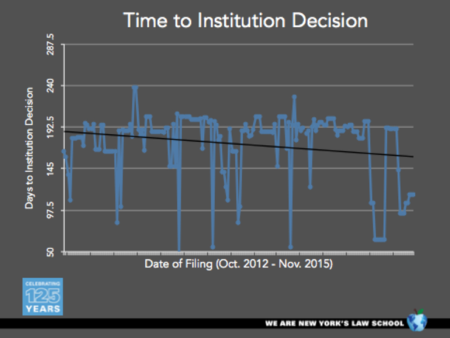
    Professor Sherkow also showed graphs plotting the time the Board took to make its institution decision between October 2012 and November 2015:

    Plot 1
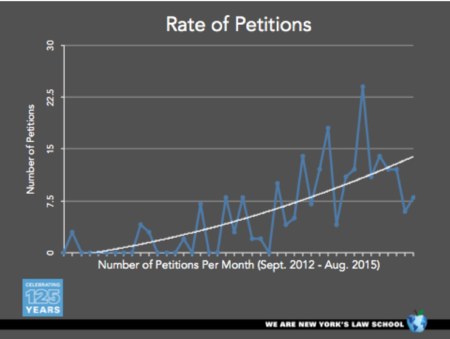
    and the rate of petition filings during that timeframe:

    Plot 2
    These graphs show that the institution times have been variable but decreasing generally, from almost six months for the first-filed IPRs to a little less that 5 months currently, and that the rate of petition filing has increased from around five per month to about fifteen per month by August 2015.

    The IPR option has received a fair amount of attention since the Office implemented the process as part of its rollout of the America Invents Act in 2012.  It should be remembered that the predecessor to these petitions, petitions for inter partes reexamination established in 1999 by the American Inventor Protection Act, took some time to be used (but not to the extent that IPRs have been used almost from their institution).  The "threat" of estoppel in IPR use apparently has been countered by petitioners' early successes (and success rate) before the Board, and by the procedural advantages that have been given to the petitioner (including using the broadest reasonable interpretation, or BRI, of the claims coupled with impediments raised against the patentee regarding entering claim amendments).  But insofar as the USPTO can view the level of petitions filed against granted U.S. patents to be a success, these statistics support that interpretation.  Whether IPRs will ultimately help innovation or hinder it is another, as yet unanswered question.

  • CalendarApril 20, 2016 – "Patents After the AIA: Evolving Law and Practice – Part 2" (American Intellectual Property Law Association) – 12:30 to 2:00 pm (Eastern)

    April 21, 2016 – 32nd Annual Joint Patent Practice Seminar (Connecticut, New Jersey, New York, and Philadelphia Intellectual Property Law Associations) – New York, NY

    April 21, 2016 - 26th Annual Trade Secrets Seminar (Intellectual Property Law Association of Chicago) – Chicago, IL

    April 21, 2016 – "Navigating the New EU Unitary Patent System and Unified Patent Court — Strategic Considerations for U.S. Applicants and Patentees" (Strafford) – 1:00 to 2:30 pm (EDT)

    April 21, 2016 – "Preparing for Patent Litigation: Practical Strategies for University Tech Transfer Offices" (Technology Transfer Tactics) – 1:00 to 2:00 pm (Eastern)

    May 11, 2016 – "Patents After the AIA: Evolving Law and Practice – Part 3" (American Intellectual Property Law Association) – 12:30 to 2:00 pm (Eastern)

    May 18, 2016 – "The PTAB Front and Center at the Federal Circuit and the Supreme Court: The First Year of Appellate Review" (McDonnell Boehnen Hulbert & Berghoff LLP) – 10:00 am to 11:15 am (CDT).

    ***Patent Docs is a media partner of this conference or CLE