• Strafford #1Strafford will be offering a webinar/teleconference entitled "POPRs and the New PTAB Final Rules: Maximizing the Impact of POPRs in IPR Petitions" on May 4, 2016 from 1:00 to 2:30 pm (EDT).  Cory C. Bell, Joshua L. Goldberg, Thomas L. Irving, and Jill K. MacAlpine, Ph.D., of Finnegan Henderson Farabow Garrett & Dunner will provide guidance to patent counsel on how to maximize the impact of a Patent Owner Preliminary Response (POPR), in light of the PTAB final rules, and discuss insufficient evidence in the petition, favorable claim constructions, and attacking threshold issues.  The webinar will review the following issues:

    • To which PTAB post-grant proceeding do the new rules apply?
    • What are the pros and cons of generating and presenting new evidence in the patent owner preliminary response?

    The registration fee for the webinar is $297.  Those interested in registering for the webinar, can do so here.

  • IPO #2The Intellectual Property Owners Association (IPO) will offer a one-hour webinar entitled "Federal Trade Secret Law: Getting It Right Early" on May 5, 2016 from 2:00 to 3:00 pm (ET).  Ken Corsello of IBM, Bradford Newman of Paul Hastings, and Randy Kay of Jones Day will focus on how attorneys can get off to a good start and avoid mistakes under the new law when representing both aggrieved secret holders and clients who are accused of stealing secrets.  Among the issues to be discussed are:

    • When might a claim under state law still be the best option?
    • What jurisdictional questions will arise if there are state and federal cases over the same issues?
    • What will be best practices after the DTSA's rejection of the "inevitable disclosure" doctrine?
    • How will damages under the law be proved?
    • What changes are employers now required to make to written employment policies and nondisclosure agreements?

    The registration fee for the webinar is $135 (government and academic rates are available upon request).  Those interested in registering for the webinar can do so here.

  • AIPLA #1The American Intellectual Property Law Association (AIPLA) will be offering a webinar entitled "Protection 360: The interplay between patent protection, licensing, and trade secret protection in light of the current regulatory and legal environment" on May 4, 2016 from 12:30 – 2:00 pm (Eastern).  Timur Slonim of Mintz Levin Cohn Ferris Glovsky and Popeo, PC will moderate a panel consisting of Robert Greenfeld of Steptoe & Johnson, LLP; Kristoffer Leftwich of Sidley Austin, LLP; Douglas Wilson of Heim Payne & Chorush, LLP.  The panel will analyze the decision-making processes involved in establishing and reviewing an IP portfolio, including the balance between patent and trade secret protection, as well as a discussion of software license agreements for software protection and system access and an update on strategies for litigation matters involving trade secrets.

    The registration fee for the program is $145 (AIPLA member rate) or $195 (non-member rate).  Those interested in registering for the program, can do so here.

  • By Kevin E. Noonan

    Breyer, JusticeIn a recent book entitled Imbeciles: The Supreme Court, American Eugenics, and the Sterilization of Carrie Buck, author Adam Cohen examines the case of Buck v. Bell, where Justice Oliver Wendell Holmes wrote that "[t]hree generations of imbeciles are enough" to justify the forced sterilization of a woman the State of Virginia had labeled "feebleminded."  This term was used to identify immigrants, epileptics, and women of "loose morals," among others, deemed to be a blight on America's genetic heritage, and cast as a societal threat by the American eugenics movement.

    The tragedy, first explored by Stephen Jay Gould in "Carrie Buck's Daughter," The Flamingo's Smile (1985), was that not only was Carrie not an imbecile but neither were her mother nor her daughter (who was less than one year old at the time).  Justice Holmes rendered his opinion based on this factual inaccuracy and, according to Mr. Cohen, his own prejudices about race and class as a Boston Brahmin of the turn of the 20th Century.  While the Justice had more than adequate help in coming to the wrong conclusion, ultimately Mr. Cohen shows that the combination of predilection and factual error informed one of the cruelest aphorisms in American jurisprudence (which remains good law today).

    It is easy for this example to come to mind when reading the questions and assertions from current Associate Justice Stephen Breyer, author of the Court's unanimous decision in Mayo v. Prometheus, regarding his understanding and concerns with the patent system and its discontents.  A sampling of these quotations illustrate the point:

    But there is another way to look at it.  And the other way to look at it ­­– and that's what I would like your comment about — ­is that there are these things, for better words, let's call them patent trolls, and that the Patent Office has been issuing billions of patents that shouldn't have been issued.  I overstate ­­ but only some.  And what happens is some person in business gets this piece of paper and ­­looks at it and says, oh, my God, I can't go ahead with my invention.

    And so what we're trying to do with this process is to tell the Office, you've been doing too much, too fast.  Go back and let people who are hurt by this come in and get rid of those patents that shouldn't have been issued.  Now, we will give you, again, once the same chance we gave you before, and that is you can amend it once if you convince the judge you should have done it before.  But if, on the broadest possible interpretation, you know, reasonable interpretation, it shouldn't have been issued, we're canceling it.  And that is for the benefit of those people who were suffering from too many patents that shouldn't have been issued in the first place.  I don't know.

    (Oral Argument, Cuozzo Speed Technologies v. Lee, April 25, 2016)

    Today's patent world is not a steam ­engine world.  We have decided to patent tens of thousands of software products and similar things where hardly anyone knows what the patents really about.  A company that's a start­up, a small company, once it gets a letter, cannot afford to pay $10,000 to $100,000 for a letter from Counsel, and may be willing to run its chances.

    You start saying, little company, you must pay $10,000 to $100,000 to get a letter, lest you get willful damages against you should your bet be wrong.

    We have one more path leading us to national monopoly by Google and Yahoo or their equivalence, and the patent statute is not designed to create monopolies throughout the United States.  It's designed to help the small businessman, not to hurt him.  So leave those words for interpretation to the expert court, and in this area it may well be the Federal Circuit.

    We have all kind of amicus briefs that say that's the truth.  And indeed, thousands and thousands and thousands of small businessmen are trying to break into businesses that they just can't do without software.  And when you have tens or hundreds of thousands of patents on software by other companies, that means we can't break in.

    (Oral Argument, Halo Electronics v. Pulse Electronics and Stryker Corp. v. Zimmer, Inc., February 26, 2016)

    Can you in fact ­­ now, this is ­­ — look, there are 42 briefs in this case.  I actually read them and I found them very, very helpful up to the point where I have to make a decision, because they're serious.  I mean, you know ­­ now, the problem that I came away with is the one that you're beginning to discuss, that if you simply say, take an idea that's abstract and implement it on a computer, there are ­­ — you're going to get it much faster, you're going to be able to do many, many things, and if that's good enough, there is a risk that you will take business in the United States or large segments and instead of having competition on price, service and better production methods, we'll have competition on who has the best patent lawyer.  You see where I'm going on that one?

    And if you go the other way and say never, then what you do is you rule out real inventions with computers.

    And so in those 42 briefs, there are a number of suggestions as to how to go between Scylla and Charybdis.  Now, I would like to know ­­ — I don't know if you can step back from your representational model.  That's a problem.  But you're all we have now.  And ­­from my point of view, I need to know what in your opinion is the best way of sailing between these two serious harms.

    (Oral Argument, Alice Corp. v. CLS Bank Int'l., March 31, 2014)

    It's highly abstract language.  I gather you, like I, have read some of these claims.  They are very hard to understand and when you get to the bottom of it, the abstract nature of the language, plus the fact that it has something to do with computer input, plus the fact that, you know, you suspect very strongly it's baseless, but you really don't like to say something that isn't true and you can say, well, I could see how somebody might think there was something to this claim, just in that tone of voice, which you can't write down that tone of voice.

    (Oral Argument, Octane Fitness LLC v. Icon Health and Fitness, Inc., February 26, 2014)

    Well, how ­­ what do you do with the government's argument here, which I take it as being on page 17, they make an argument which, as I understood it, which is a big qualification, ­­ that ­­ some of these things are awfully complicated.

    You might have a ­­ a claim or, really, it's a set of claims that cover 48 pages with all kinds of symbols and 42 different sort of division possibilities.

    And ­­then the ­­so ­called infringer, or the person who falls outside the coverage, is looking at his product, and it's one of the most complex things you've ever seen.  And he has to think to himself, well, how ­am I supposed ­­ — how does the claim cover this?  And ­­it's — ­­ there are many, many, many possibilities.  I take it that's what they mean when they say it makes sense to put the burden of demonstrating how the claim limitations map onto the accused product because infringement may be found only when the product falls within the scope ­­of the asserted claim or claims in every respect.

    Your client, who's the patentee, knows how.  Otherwise, he wouldn't be bringing this infringement suit or the inside ­the­ coverage suit or responding to someone who says it's outside the coverage.  But ­­the person who is the alleged infringer might not know it, and therefore, it makes sense to put everything in the same place; notice of infringement, burden of production, burden of proof.  And that way, it will be easier to focus on what's at stake.

    (Oral Argument, Medtronic Inc. v. Boston Scientific Corp., November 5, 2013)

    Now it is certainly the case that Justice Breyer is fond of outrageous hypotheticals to probe the parties' positions and there is nothing wrong with that.  (At least we should hope that his reference to billions of patents being improvidently granted by the USPTO was an exaggeration; after all, the Office has issued only about 9,000,000 patents in its 220 year history, and the Justice should know this.)  But behind the quoted statements is a clear concern about the possibly pernicious effects of patents, and it is fair to ask whether these concerns are grounded in reality.  While there certainly are those who agree with the Justice, there are also clear disconnects between these sentiments and how patents play out in the real world.

    For example, it isn't generally the case that large companies use patents to intimidate or inhibit innovation by small companies.  They don't need to:  large companies have the wherewithal to ignore small companies and on some occasions simply expropriate whatever innovation those smaller companies have disclosed in their patents.  No, the rise in patent litigation has been by "trolls," as that term has been applied to small companies, universities, and patent aggregators to whom these entities have turned when they have lost their technologies to larger companies, in an attempt to recoup through litigation what could not be obtained by the traditional route, licensing.  There is not (although some large companies will portray things this way) a drag on innovation; indeed, the term "patent troll" was invented by a Cisco employee on an anonymous blog several years ago.  This situation is illustrated by the long history of patent litigation involving Data Treasury, a small Long Island firm that invented methods for electronic check cashing.  The banking industry not only didn't license Data Treasury's patents but, after adopting these method with a license attempted to absolve themselves of infringement liability in the court of public opinion, labeling the company as a patent troll, and getting their elected representatives to do the same.  When that didn't work, a provision that would have exempted the banks from their liability was introduced at the eleventh hour as part of S.1145, a predecessor to the America Invents Act debated by the Senate in 2008.  This provision was scuttled only when the Bush Administration realized that, as an Act of Congress any such exemption would cost the American people upwards of $1 billion as a taking (see "The (Un)intended Consequence of the Law").

    In actuality, the need for and reaction to "trolls" is related to the short obsolescence horizon for most non-pharma innovation, and also its interrelatedness; an advantageous, patented feature of a product can become widespread, and there does not seem to be a universal standard setting body to referee these situations (unlike patents for prior like inventions, such as connectivity protocols for modems a generation ago).  But, particularly in view of the history of Data Treasury and other small firms trying to protect their technology, the concerns voiced by Justice Breyer seem at best misplaced and yet clearly inform his thinking.

    Similarly, the idea that patent claims are a complicated tangle is inconsistent with the patent statute and how it is applied by the PTO and (at least the inferior) courts.  Certainly the subject matter can be complex to a layman, no matter what the technology.  But there is no mystery (and, insofar as the Court's Nautilus decision remedies any laxity in how 35 U.S.C. §112(b) is applied, no uncertainty) about what a claim means.  Satisfying § 112 has, over the past twenty years, become a major question in patent litigation and a resource for challenging patents, and a patentee who does not "particularly point out and distinctly claim" what is her invention is at a serious disadvantage in enforcing her claims.  It can even be said that in some instances the strictures of § 112 have ensured a heightened level of clarity and disclosure:  in the genomic era at the turn of this century it was certainly possible to publish a scientific paper identifying a newly discovered gene (found in a database of human gene sequences elucidated inter alia by the Human Genome Project) distinguished merely by homology to other genes and speculation about what such a gene might do.  Not so at the Patent Office:  the Office required disclosure of the function of the protein product of such a gene, relying on the Court's decision in Brenner v. Manson that "a patent is not a hunting license."  This points to the different functions of a patent and a scientific paper, but also illustrates that the patent system requires a practically effective level of disclosure.  This is consistent with the understanding that Congress has delegated its Article I power to grant patents only to promote progress, and that progress is promoted not only by invention but disclosure thereof "in such full, clear, concise, and exact terms as to enable any person skilled in the art to which it pertains . . . to make and use the same."  Which is not how Justice Breyer apparently sees the situation, but that doesn't mean that there has been a wholesale abandonment of these requirements, by the Office, the courts, or the inventing community.

    Finally, perhaps it is appropriate to close with another quote from Justice Breyer, during oral argument in Bowman v. Monsanto:

    MR. WALTERS:  Mr. Bowman went to a grain elevator and he bought from the grain elevator without restriction seeds to — and it was his purpose to plant them.  Now, the only way that he can make use –- if you assume in the first instance that there is exhaustion to the seeds that Mr. Bowman purchased from the grain elevator, you are taking away any ability for him to use that seed or use the invention . . . .

    Now, if you say that there is exhaustion in the seeds that Mr. Bowman purchased from the grain elevator, but you say it doesn't apply to the progeny, you are not allowing him to actually practice the invention to grow more seeds.

    JUSTICE BREYER:  No, but you are allowing him to use those seeds for anything else he wants to do.  It has nothing to do with those seeds.

    There are three generations of seeds.  Maybe three generations of seeds is enough.

    (Laughter.)

    JUSTICE BREYER:  It is for this example.  First of — you have the Monsanto, the first generation they sold.  They have children, which is the second generation.  And those children have children, which is the third generation, okay?  So bad joke.

  • By Josh Rich

    Washington - Capitol #6One week after the House Judiciary Committee unanimously reported the Defend Trade Secrets Act of 2016 to the House floor, the full House approved the bill, 410-2.  The two no votes were from tea party Republicans, Rep. Justin Amash (R-MI) and Rep. Thomas Massey (R-KY).  Oddly, Rep. Massey is himself an inventor and former technology business owner who holds numerous patents and has two engineering degrees.  Regardless, the bill now moves to the President for his signature, which the White House has already indicated the President will provide.  As a result, there will soon be — for the first time — a Federal private right of action for trade secret misappropriation.

    The provisions of the Defend Trade Secrets Act were written against the backdrop of the Uniform Trade Secrets Act, which governs trade secret law in most of the states.  Despite its name, the Uniform Trade Secrets Act has been enacted in various forms in the states, with different definitions of trade secrets and burdens of proof on showing whether information has been misappropriated.  In addition, state law has been found onerous to enforce when the misappropriating party is out of the state or out of the country, especially when the misappropriating party is likely to flee or destroy evidence.

    The Defend Trade Secrets Act adds three critical new elements.  First, a private right of action for trade secret misappropriation that can be brought in the Federal courts.  Second, an ex parte seizure provision that allows a trade secret owner to ensure trade secrets are not further disseminated and evidence is not destroyed.  Third, whistleblower protection provisions that prevent retribution against whistleblowers who reveal trade secrets to the government or in litigation claims, as long as the revelation is done under seal.  All three elements are intended to address concerns with the Uniform Trade Secrets Act.

    First, the new Federal claim for trade secret misappropriation brings with it a single definition of trade secrets, a definition of "improper means" of obtaining trade secrets, and the certainty and ease of the Federal Rules of Civil Procedure.  The definition of trade secrets amends what has previously been used in Federal criminal cases, applying to information (1) for which an owner has taken reasonable measures to maintain secrecy and (2) which derives independent economic value from not being known and not being readily ascertainable through proper means by another person who can obtain economic value from the disclosure or use of the information.  The definition of "improper means" expressly excludes reverse engineering and independent derivation, which are not expressly excluded from the definition in all states.  And the Federal Rules of Civil Procedure provide a clear, simple path for obtaining evidence from other states.

    Second, an unprecedented provision allows for the ex parte seizure of trade secrets from an accused misappropriator in extraordinary circumstances.  "Extraordinary circumstances" is not intended to be an independent hurdle, but establish that there must be some exigency (such as a fleeing person or threat of destruction of evidence) to invoke the ex parte seizure provision rather than traditional equitable procedures.  The bill has extensive rules, both procedural and substantive, for when the ex parte seizure provision can be invoked and how it should be applied.

    Third, the bill frees a whistleblower from any potential criminal or civil liability under any trade secret law, Federal or state, for disclosing a trade secret confidentially.  The protections extend to both disclosure to government officials for the purpose of investigating a potential violation of the law and filing of a complaint under seal.  Furthermore, the bill requires employers to inform all new employees and contractors of the whistleblower protections.

    In summary, we will soon see access to the Federal courts for claims of trade secret misappropriation on a par with other forms of intellectual property.  Thanks to Congress's bipartisan support of the Defend Trade Secrets Act, companies will have an additional weapon at their disposal to protect their trade secrets, and a much stronger way to prevent dissemination after they are first misappropriated.

  • Focusing on the Claims, the PTAB Denies CBM Review of a Market Research Patent

    By Joseph Herndon

    USPTO SealOn April 13, 2016, the U.S. Patent and Trademark Office (USPTO) Patent Trial and Appeal Board (PTAB) issued a decision denying institution of a covered business method (CBM) patent review of U.S. Patent No. 8,041,805.  This decision favors patent owners in that the PTAB focused on what the claims recited when determining if the claims were directed to some financial product or service.  While this is the standard to follow as recited by the AIA statute, the PTAB has in the past repeatedly instituted CBM review of patents that include claims with no financial aspects whatsoever (see Motorola Mobility, LLC, v. Intellectual Ventures I, LLC (PTAB 2016), and Square, Inc. v. Protegrity Corp. (PTAB 2016).

    OpinionLab, Inc. is the owner of the '805 patent, and Qualtrics, LLC filed a Petition for CBM review of all 33 claims of the '805 patent.  In a previous inter partes review (IPR) proceeding, Qualtrics challenged many of the same claims of the '805 patent as it did in the CBM review, only on different grounds.  In the IPR, the PTAB determined that Qualtrics had failed to prove, by a preponderance of the evidence, that the claims of the '805 patent were unpatentable under 35 U.S.C. § 103.  In seeking CBM review, Qualtrics challenged the claims of the '805 patent under 35 U.S.C. § 101 as being directed to a patent-ineligible abstract idea.

    The '805 patent is the subject of two district court actions:  OpinionLab, Inc. v. Qualtrics Labs, Inc., 1:13-cv-01574 (N.D. Ill.), and OpinionLab, Inc. v. iPerceptions Inc., 1:12-cv-05662 (N.D. Ill.), and thus, the CBM petition may be considered.

    The '805 Patent

    The '805 patent is directed to a system and method for soliciting "page-specific" feedback from website users.  User feedback is solicited on a page-specific basis by incorporating a "user-selectable element," or "viewable icon," into each web page of the website.  The icon incorporated in each web page solicits the user's subjective reaction to various aspects of the particular web page being viewed by the user.  When the user rolls over or clicks on the icon, a rating scale and/or question box appears within the user's browser window.  The rating scale and/or question box appears within the same browser window on which the user is viewing the particular web page itself.  Software associated with the icon operates to collect and store the user's reactions in a database for subsequent reporting to an interested party.  Claim 1 is illustrative of the claimed invention:

    1.  One or more computer-readable non-transitory storage media embodying software operable when executed to:
        provide a user-selectable element viewable on each of a plurality of particular web pages of a website upon initial display of a particular web page and soliciting page-specific user feedback concerning the particular web page upon initial display of the particular web page, the user-selectable element appearing identically and behaving consistently on each of the plurality of particular web pages; and
        receive the page-specific user feedback concerning the particular web page for reporting to an interested party, the page-specific user feedback concerning the particular webpages having been provided by a user while the user remained at the particular web page, and the page-specific user feedback comprising one or more page-specific subjective ratings of the particular web page and one or more associated page-specific open-ended comments concerning the particular web page, the page specific user feedback allowing the interested party to access page-specific subjective ratings and associated page-specific open-ended comments across the plurality of particular web pages to identify one or more particular web pages for which the page-specific user feedback is notable relative to page-specific user feedback for other particular web pages;
        wherein the user-selectable element is viewable within a browser window upon initial display of the particular web page and remains viewable within the browser window, at least prior to the user selection, regardless of user scrolling.

    CBM Petition

    As the petitioner, Qualtrics bears the burden of demonstrating that the '805 patent is a CBM patent.  The AIA defines a CBM patent as "a patent that claims a method or corresponding apparatus for performing data processing or other operations used in the practice, administration, or management of a financial product or service, except that the term does not include patents for technological inventions."  AIA § 18(d)(1).

    The determination of whether a patent is eligible for CBM review focuses on "what the patent claims."  Office Patent Trial Practice Guide, 77 Fed. Reg. 48,734, 48,736 (Aug. 14, 2012) (response to comment 8).  A patent need have only one claim directed to a CBM to be eligible for review.

    First, Qualtrics argued that the claimed invention is directed to a financial product or service because the specification states that the claimed invention may be used in connection with websites that conduct "commercial transactions."  But, the PTAB was strict on the relevant inquiry being on the claims and whether they are directed to a financial product or service.  Here, the claims are devoid of any terms that could be reasonably argued as rooted in the financial sector or limited to a monetary transaction.  Instead, the claims recite a software capability of general utility that crosses many sectors, commercial and non-commercial alike.

    The PTAB simplified the claims as reciting a "user-selectable element," i.e., an icon, that solicits and receives feedback from users without requiring them to navigate between webpages, i.e., "while the user remain[s] at the particular webpage" and "regardless of user scrolling."  The PTAB concluded that the claimed invention is nothing more than a website tool for gathering information — a quick and easy way to solicit contemporaneous reactions from website users, and soliciting feedback from website users is hardly the exclusive domain of the financial sector.

    The PTAB noted that the specification contemplates both commercial and non-commercial applications for the claimed website tool, and as such, the PTAB did not characterize the claimed invention as limited to "commercial" applications when both the claims and the specification indicate a more general utility.

    Qualtrics also argued that the claimed invention is limited to a financial product or service because "collecting user feedback is primarily used to improve the effectiveness of websites, including their marketing, interface usability, and customer communications functions."  But the PTAB stated that the use of consumer feedback to improve the capabilities of a website does not necessarily make that use financial in nature, and that the statute authorizing review of CBM patents was not meant for "technologies common in business environments across sectors and that have no particular relation to the financial services sector, such as computers, communications networks, and business software."

    Qualtrics further argued that the specification's mention of using the claimed invention as a measure of the website's value suggests it is financial in nature.  The PTAB shut down this argument, and stated that this potential use is purely exemplary, and that, both the specification and the claims actually speak in broader terms that include not only valuing the website in terms of "clicks," but also collecting information for purposes of "polling, surveying, product development research, market research, [and] usability testing."

    Over and over again, the PTAB maintained focus on the claims, which simply recite that user feedback is collected "for reporting to an interested party," without any further restriction.  In that regard, the PTAB did not find any claim language that gives rise to a fee or other movement of money.

    The PTAB noted that the fact that the specification may describe the website tool as capable of being used for commercial purposes does not mean that the claims are limited to such applications.

    The PTAB summarized Qualtrics' position as being that any patent claiming something that might have potential application to a financial product or service would be eligible for CBM patent review, regardless of its general utility and application outside of finance.  The PTAB then noted that this position is not consistent with the statutory language, which requires a focus on what is recited by the claims.

    The PTAB thus concluded that Qualtrics failed to demonstrate that the '805 patent is a covered business method patent as defined by § 18(d)(1) of the AIA, and thus, the Petition for CBM review was denied and no trial will be instituted.  Because the PTAB found that that '805 patent did not claim a financial product or service, the PTAB did not consider the exception of whether the patent covered a technological invention.

    This decision follows proper application of the AIA statute and evaluation of the patent claims.  But this decision is far from the norm, as other PTAB judges easily may have found the patent to be eligible for CBM review.  Hopefully, this decision starts a trend of enforcing the statutory language for CBM institutions so that there is less randomness as to which patents are subject to CBM review.

    Qualtrics, LLC v. Opinionlab, Inc. (Case CBM2016-00003) (PTAB 2016)
    Before Rama G. Elluru, Jeremy M. Plenzler, and Carl M. DeFranco, Administrative Patent Judges
    Decision by Carl M. DeFranco

  • By Andrew Williams

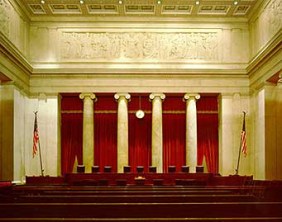
    Supreme Court CourtroomEarlier today, the Supreme Court heard oral arguments in the Cuozzo Speed Technologies, LLC v. Lee appeal (Supreme Court docket number 15-466).  The Court was considering two issues related to the recently implemented IPR proceedings from the Patent Trial and Appeal Board ("PTAB" or "Board").  The two questions presented were:

    1.  Whether the court of appeals erred in holding that, in IPR proceedings, the Board may construe claims in an issued patent according to their broadest reasonable interpretation rather than their plain and ordinary meaning.

    2.  Whether the court of appeals erred in holding that, even if the Board exceeds its statutory authority in instituting an IPR proceeding, the Board's decision whether to institute an IPR proceeding is judicially unreviewable.

    This is, or course, the first opportunity the Supreme Court has had to consider these new proceedings, as well the Board's implementation of them.  And, as Justice Breyer pointed out near the outset, it is how you view these proceedings that will likely influence your answer to these questions:

    [Y]ou could look at this new law as you [Cuozzo] were looking at it, as trying to build a little court proceeding.  If I thought it was just doing that, I would say you were right.  But there is another way to look at it.  And the other way to look at it . . . is that there are these things, for better words, let's call them patent trolls, and that the — the Patent Office has been issuing billions of patents that shouldn't have been issued — I overstate — but only some. . . .  And so what we're trying to do with this process is to tell the office, you've been doing too much too fast.  Go back and let people who are hurt by this come in and get rid of those patents that shouldn't have issued. . . .  If it's that second purpose, then I would think, well, maybe this is right, what they [the PTAB] are doing.

    And, not surprisingly, during the oral argument, the Justices appeared to be struggling with just what these proceedings are, and what the intent of Congress was in creating them.

    The overwhelming majority of the time spent during oral argument was dedicated to the question of whether the Broadest Reasonable Interpretation ("BRI") standard for claim construction was the proper one for the Board to be applying in IPR proceedings.  And, even though the questions asked by the Justices during oral argument do not necessarily broadcast which direction they are leaning, it would appear that Chief Justice Roberts and Justice Breyer have diametrically opposed views on this question.  Justice Breyer gave away his bias when he suggested that the Patent Office has been issuing "billions" of bad patents.  This was further exemplified in a series of questions related to appeals from the Patent Office — whether from initial prosecution or from a Final Written Decision in an IPR proceeding.  The example that Justice Breyer used superficially mirrored the Cuozzo patent.  Simply put, the Cuozzo patent claims technology directed to indicating speed limits at particular locations on a GPS unit.  A GPS receiver is used to track the location of a vehicle, and the speed limit indicator correlates the vehicle's position with a database containing the speed limit for that location.  As the database is accessed, the colored filter adjusts so that speeds above the legal speed are displayed in red, while legal speeds are displayed in white.  Justice Breyer got a laugh when he created his own hypothetical patent:

    I apply for a patent because I have this thing that instead of putting red cellophane on the speedometer, I put purple cellophane on the speedometer.  It signals the presence of a hot dog stand.  All right. [Laughter] I — I then try to patent it.  And they look at this patent and, no, absolutely not.

    Of course, Justice Breyer was not accurately portraying Cuozzo's patent with this example, because it was not as simplistic as simply selecting a particular color for the indicator.  Instead, this example more betrays Justice Breyer's distrust of the Patent Office and the patents they have issued.  This, unfortunately, may also be a signal how he would decide the issue.

    On the other end of the spectrum, Chief Justice Roberts seemed persuaded that IPR proceedings are an alternative to district court litigation, and as such, the rules should be as similar as possible in both forums.  For example, he questioned the Assistant to the Solicitor General regarding the Patent Office's position that the BRI standard is proper because it is the standard used in its other proceedings.  Picking up on a comment made earlier by Justice Ginsburg, Chief Justice Roberts noted that IPR proceedings are "a hybrid entity with characteristics of the PTO and the district court."  He continued: "So why — why should we be so wedded to the way they do business in the PTO with respect to the broadest possible construction when the — the point is not to replicate PTO procedures.  It's supposed to take the place of district court procedures."  More importantly, he observed that "it's a very extraordinary animal in legal culture to have two different proceedings addressing the same question that lead to different results." And, finally, after discovering that the district court's interpretation of a claim is not binding on the Patent Office, and vice versa, Chief Justice Roberts complained: "It just seems to me that that's a bizarre way to conduct legal — decide a legal question."

    The remaining Justices that asked questions appeared to be struggling with how these IPR proceedings operated, and how they fit into the context of the Patent Office overall (not surprising, Justice Thomas did not ask any questions).  Again, the resolution of this struggle will likely impact the outcome of the case.  But at least Justice Sotomayor seemed to pick up on the fact that regardless of which particular standard is used, it will not be outcome determinative in the large majority of cases.  For example, after Cuozzo's counsel explained how a district court determines the plain and ordinary meaning of a claim term, Justice Sotomayor asked:

    Aren't those tools used in determining the broadest — the broadest reasonable reading, meaning how can the PTO decide what a broad reasonable reading is unless it looks at all those factors and decides that the specifications and all the other things don't cure, continue to provide ambiguity in the patent?

    Justice Sotomayor appeared to point to the prosecution history as the potential source of this confusion.  Cuozzo's counsel noted that the Patent Office does not look to the prosecution history during initial examination — because it obviously does not exist yet.  The implication appeared to be that the PTAB also does not look to the initial prosecution history.  However, the Assistant to the Solicitor General disabused the Justices of this impression.  He stated: "It's true in the initial examination context that the PTO does not use prosecution history, but it has expressly noted that it will use prosecution history in a proceeding like this the IPR — because it's already in existence."  It will be interesting to see how the resolution of this question will influence Justice Sotomayor's thinking (and possibly the thinking of the Justices) on the outcome of the case.

    A decision in this case is expected by the end of June.  At that time, we will report on the conclusion of the Court and any potential implications the decision will have on IPR and other post-grant proceedings before the PTAB.

  •         By Sherri Oslick

    Gavel About Court Report:  Each week we will report briefly on recently filed biotech and pharma cases.

    Teva Pharmaceuticals USA Inc. et al. v. Biocon Ltd. et al.
    1:16-cv-00278; filed April 19, 2015 in the District Court of Delaware

    • Plaintiffs:  Teva Pharmaceuticals USA Inc.; Teva Pharmaceutical Industries Ltd.; Teva Neuroscience Inc; Yeda Research and Development Co Ltd.
    • Defendants:  Biocon Ltd.; Apotex Corp.

    Infringement of U.S. Patent Nos. 8,232,250 ("Low Frequency Glatiramer AcetateTherapy," issued July 31, 2012), 8,399,413 (same title, issued March 19, 2013), 8,969,302 (same title, issued on March 3, 2015), and 9,155,776 (same title, issued October 13, 2015) following a Paragraph IV certification as part of defedants' filing of an ANDA to manufacture a generic version of Teva's Copaxone® (glatiramer acetate injection, used for the reduction or frequency of relapses in patients with relapsing-remitting multiple sclerosis).  View the complaint here.


    Forest Laboratories, LLC et al. v. Apotex Inc. et al.
    1:16-cv-00269; filed April 15, 2015 in the District Court of Delaware

    • Plaintiffs:  Forest Laboratories, LLC; Forest Laboratories Holdings, Ltd.; Cerexa, Inc.; Takeda Pharmaceutical Co. Ltd.; Allergan USA, Inc.
    • Defendants:  Apotex Inc.; Apotex Corp.

    Infringement of U.S. Patent No. 6,417,175 ("Phosphonocephem Derivatives, Derivatives, Process for the Preparation of the Same, and Use Thereof" issued July 9, 2002) following a Paragraph IV certification as part of Apotex's filing of an ANDA to manufacture a generic version of Forest's Teflaro® (ceftaroline fosamil injection, used for the treatment of community-acquired bacterial pneumonia and for the treatment of acute bacterial skin and skin structure infections).  View the complaint here.


    Merck Sharp & Dohme Corp. v. Bristol-Myers Squibb Co. et al.
    2:16-cv-02122; filed April 15, 2015 in the District Court of New Jersey

    • Plaintiff:  Merck Sharp & Dohme Corp.
    • Defendants:  Bristol-Myers Squibb Co.; E.R. Squibb & Sons, L.L.C.; Ono Pharmaceutical Co., Ltd.

    Declaratory judgment of invalidity and non-infringement of U.S. Patent Nos. 8,779,105 ("Monoclonal Antibodies to Programmed Death 1 (PD-1)," issued July 15, 2014) and 9,084,776 ("Methods for Treating Cancer Using Anti-PD-1 Antibodies," issued July 21, 2015) based on Merck's manufacture and sale of its Keytruda® product (pembrolizumab, an anti-PD-1 antibody, used to treat metastatic melanoma).  View the complaint here.

  • CalendarApril 26, 2016 - Biotechnology/Chemical/Pharmaceutical (BCP) Customer Partnership Meeting (U.S. Patent and Trademark Office) – Alexandria, VA

    April 27, 2016 – "Patent Prosecution Conflicts of Interest for Clients Having Competing Technologies" (American Intellectual Property Law Association) – 12:30 – 2:00 pm (Eastern)

    April 27, 2016 - Symposium on Enhanced Patent Quality (U.S. Patent and Trademark Office) – Alexandria, VA

    April 27, 2016 - Update on Unified Patent Court (UPC) and Unitary Patent (UP) (D Young & Co) – 4:00 am, 7:00 am, and 12:00 pm (EDT)

    April 28, 2016 – "Patent Litigation 2016: The Courts and the Patent Trial and Appeal Board" (Federal Circuit Bar Association, John Marshall Law School, Notre Dame Law School, and DePaul University College of Law) – Chicago, Illinois

    May 11, 2016 – "Patents After the AIA: Evolving Law and Practice – Part 3" (American Intellectual Property Law Association) – 12:30 to 2:00 pm (Eastern)

    May 18, 2016 – "The PTAB Front and Center at the Federal Circuit and the Supreme Court: The First Year of Appellate Review" (McDonnell Boehnen Hulbert & Berghoff LLP) – 10:00 am to 11:15 am (CDT).

    ***Patent Docs is a media partner of this conference or CLE

  • USPTO Building FacadeThe U.S. Patent and Trademark Office will be holding its next biotechnology/chemical/pharmaceutical (BCP) customer partnership meeting on Tuesday, April 26, 2016 at the USPTO Headquarters (Alexandria, VA).  The agenda for the meeting is as follows:

    • Welcoming and Opening Remarks (10:00 – 10:10 am EST) — Mark Powell, Deputy Commissioner, International Patent Cooperation, USPTO; Jerry Lorengo Director, TC1600, USPTO; Daniel Sullivan Director, TC1600, USPTO; and Wanda Walker Director, TC1600, USPTO

    • International Patent Cooperation Featuring Global Dossier (10:10 – 11:00 am) — Jessica Patterson, Program Manager, International Patent Cooperation

    • Outside Perspectives on International Patent Cooperation (11:00 – 11:25 am) — Anthony P. Venturino, Vorys, Sater, Seymour and Pease LLP

    • Break (11:25 – 11:30 am)

    • Supplemental Examination (11:30 am – 12:30 pm) — Jean Witz, SPE, Central Reexamine Art Unit, USPTO

    • Lunch (12:30 – 1:30 pm)

    • Third Party Submission (1:00 – 2:00 pm EDT) — Bennett Celsa, Quality Assurance Specialist, TC1600, USPTO (Alexandria)

    • Antibody Written Description (1:30 – 2:30 pm) — Joanne Hama, SPE, TC1600, USPTO

    • Break (2:30 – 2:40 pm)

    • Enhancing the Quality of Biologics Patents: Computational Simulations as Evidence (2:40 – 3:40 pm) — Brian Lathrop, Law Office of Brian K. Lathrop

    • Closing Remarks (3:40 – 3:50 pm) – Directors, TC1600, USPTO

    The meeting can be viewed online here.  Additional information regarding the BCP customer partnership meeting, including registration information for those wishing to attend the meeting, can be found here.