• Daniel Law and Bardehle Pagenberg will be offering a two-part webinar on "How to Litigate Patents before the UPC Compared to German and Brazilian Courts" on March 8, 2023 at 10:00 am (BRT) / 2:00 pm (CET).  Stefan Lieck, Anna Giedke, and Ricardo Nunes will provide insights into key aspects of patent litigation in the UPC, German, and Brazilian court system, and discuss effective relief, duration of proceedings, costs and their reimbursement, interplay of infringement and validity, courts and judges as well as provisional measures.

    While there is no cost to participate in the program, those interested in attending the webinar can register here.

  • Strafford #1Strafford will be offering a webinar entitled "Patent Assignments and Priority in an International Context: U.S., Europe, and Asia" on March 9, 2023 from 1:00 to 2:30 pm (EST).  Jonathan Bench of Harris Bricken Sliwoski and Austen Zuege of Westman Champlin & Koehler will guide patent counsel on patent assignments and priority in the international context, together with key transactional concerns that may arise in the scope of negotiations; address key considerations for patent counsel, including scope of the assignment, signing issues, corrections, due diligence, representations and warranties, jurisdiction, and choice of law; and discuss dealing with non-assignment transfers by operation of local/foreign law and assignment issues in the U.S., Europe, and Asia that may arise during negotiations or dealt with post-closing.  The webinar will review the following issues:

    • How do patent assignments in multiple countries impact patent priority?
    • What are the significant differences between the U.S. and other jurisdictions' approaches to patent assignments?
    • What steps should counsel take when dealing with patent assignments to maximize protection around the world?
    • How will patents be dealt with in a standard M&A transaction vs. venture capital investment vs. private equity sale?
    • What types of negotiation points will be addressed in the representations and warranties section of a governing transaction agreement and its related disclosure schedule?
    • What type of dispute resolution forums should be considered when dealing with an international patent portfolio or an international transaction with patents across multiple jurisdictions?

    The registration fee for the webcast is $347.  Those interested in registering for the webinar, can do so here.

  • By Michael Borella

    Hat tip to Prof. Lefstin who wrote a detailed analysis of this case on Patently-O.  We will keep our review short and to the point (pun intended, see below).

    International Trade Commission (ITC)We are all familiar with the rhetorical device of a parade of horribles — a series of very bad things that could happen if some action is (or isn't) taken.  Often, these parades involve a degree of hyperbole.  In other cases, they underestimate just how horrible the horribles actually are.

    The Supreme Court's Alice Corp. v. CLS Bank Int'l decision set off such a parade.  It started with certain computerized financial transactions being ruled ineligible, to more general forms of software inventions being held similarly invalid.  The exceptions to the broad statutory categories of patent subject matter now include audio/video streaming, wirelessly-controlled garage door openers, electric vehicle charging stations, cameras, methods of tuning drive shafts, and cardiac monitoring devices.

    In a decision that came down last October but somehow managed to avoid attention until recently, the International Trade Commission (ITC) affirmed an administrative law judge's decision that patent claims directed to an article of manufacture are abstract ideas under Alice.  An example of one of these claims recites:

    A polycrystalline diamond compact, comprising:
        a polycrystalline diamond table, at least an unleached portion of the polycrystalline diamond table including:
            a plurality of diamond grains directly bonded together via diamond-to-diamond bonding to define interstitial regions, the plurality of diamond grains exhibiting an average grain size of about 50 μm or less;
            a catalyst occupying at least a portion of the interstitial regions;
            wherein the unleached portion of the polycrystalline diamond table exhibits a coercivity of about 115 Oe or more;
            wherein the unleached portion of the polycrystalline diamond table exhibits an average electrical conductivity of less than about 1200 S/m; and
            wherein the unleached portion of the polycrystalline diamond table exhibits a Gratio of at least about 4.0×10⁶; and
        a substrate bonded to the polycrystalline diamond table.

    In plain English, a polycrystalline diamond compact (PDC) "can be used in drilling tools (e.g., cutting elements, gage trimmers, etc.), machining equipment, bearing apparatuses, wire-drawing machinery, and in other mechanical apparatuses" and "have found particular utility in cutters in rotary drill bits."  So the invention here is the business end of a drill.

    The ITC's main problem with the above claim resides in the wherein clauses.  Indeed, the ITC wrote:

    It is clear from the language of the claims that the claims involve an abstract idea—namely, the abstract idea of a PDC that achieves the claimed performance measures (G-Ratio and thermal stability) and has certain measurable side effects (specific magnetic saturation, coercivity, and specific permeability), which, as discussed below, the specifications posit are derived from enhanced diamond-to-diamond bonding in the PCDs.

    Here, the ITC seems to find that the claimed characteristics of the unleached portion are "performance measures" and appear to discount or ignore, for purposes of eligibility, the physical PDC properties that these characteristics represent.  Instead, the ITC stated that "[t]he Federal Circuit has explained that the patent eligibility inquiry requires that the claim identify how a functional result is achieved by limiting the claim scope to structures specified at some level of concreteness."

    This is a misstatement of the law.  Functional claiming is explicitly permitted by the patent statute, and using it is subject to well-known caveats, none of which are ineligibility.

    Finding the claims abstract, the ITC went on to conclude that "[t]he elements of the asserted claims—individually and as an ordered combination—do not transform the nature of the claims into something patent-eligible" because they "recite results-oriented language and the recited physical elements are conventional."  What the ITC munges in its analysis is that the claims are alleged to provide a performance improvement over prior techniques — they even take that as given, stating that the stronger PDCs of the claim "that achieve certain performance measures and desired magnetic and electrical properties" are still abstract.

    The Supreme Court and Federal Circuit have stated that providing improvements to a technology can render an otherwise abstract invention eligible.  But the ITC appears to want the claim to recite the exact PDC structure that causes it to have the claimed characteristics, regardless of any improvement provided.

    It is very hard to square this outcome with a number of Federal Circuit decisions.  For example, in Thales Visionix Inc. v. U.S., that Court found the following claim eligible because it encompassed a technological improvement:

    A system for tracking the motion of an object relative to a moving reference frame, comprising:
        a first inertial sensor mounted on the tracked object;
        a second inertial sensor mounted on the moving reference frame; and
        an element adapted to receive signals from said first and second inertial sensors and configured to determine an orientation of the object relative to the moving reference frame based on the signals received from the first and second inertial sensors.

    This claim is arguably even broader and more functional than the PDC claim above.  The ITC, however, relied on the reasoning in American Axle & Mfg. v. Neapco Holdings LLC that used a bastardized version of the Alice test made up out of thin air to find a functionally-drafted claim ineligible.  So add this case to the parade.

    A silver lining to this thundercloud is that Commissioner Schmidtlein dissented from her colleagues' reasoning and would have found the claim eligible.  Commissioner Schmidtlein focused on the improvements over the prior art that were not persuasive to her colleagues, noting that the claimed PDC "exhibits improved mechanical and/or thermal properties and performs better in high-abrasion applications, such as earth-boring drill bits."

    She also looked to the specification's teaching that the claimed characteristics relating to coercivity, conductivity, magnetic saturation, and specific permeability "reflect the extent to which the diamond grains have bonded and formed large diamond grains thereby displacing the metal catalyst in the diamond matrix."  As a result, the invention is claimed "in terms reflecting its structure, including its microstructure quantified by various measurements."

    Commissioner Schmidtlein explicitly considered the claims as a whole rather than dividing the elements into structure and measurements.  In a detailed review of the specification, she asserted that the characteristics that the majority found to be measurements were in fact tied to the improved performance of the structure.  In finding the claims directed to an eligible composition of matter, she wrote:

    Labeling certain claim elements merely as "performance standards," "results," "side effects," or "not a design choice," in my view, fails to appreciate that the claimed parameters are concrete, objective measurements for defining the invention and which reflect the diamond microstructure.  Many properties of patented materials could be described the same way.  As is often the case in materials science and chemistry, intrinsic properties like density, pH, conductivity, and melting point result from other design choices, such as the choice of chemical inputs, processing parameters, and finishing steps.  The claimed PDC involves a composition of matter that the inventors characterized based on what it is.  That a particular material property of this composition of matter "results" from other design choices does not render it abstract.

    She also found a distinction between the tangibility of the claimed invention and the precedent used by the majority, which was largely drawn to ineligible software claims involving intangible information.[1]  She further distinguished the invention over that of American Axle, in that the advance of the claimed PDC is a physical structure rather than a law of physics with unbounded parameters.

    Finally, Commissioner Schmidtlein wrote "finding claims reciting a specific, definable composition of matter as ineligible . . . suggests that the ID [final initial determination] and Majority have strayed from the preemption concerns that motivate the judicial exception to patent eligibility."

    In other words, a drill bit is not an abstract idea.

    Commission Opinion

    [1] Screaming into the void once again, I remind the world that all software has a tangible representation and that, when executed by hardware, has a tangible effect. 

  •     By Michael Borella

    When boiled down to a fundamental level, all technologies are double-edged swords.  A spear can be used to hunt game or to wage war.  A hammer can be used to build a shelter or to murder fellow humans.  Social media can be used to connect lonely and geographically-distanced affinity groups in an emotionally meaningful way or to foster misinformation and possibly even genocide.

    Artificial intelligence (AI) is no different.

    We are largely unaware of the prevalence of AI.  From content recommendation, to detection of financial fraud, to drug discovery, to spam filters, these computational models exist in the background of everyday life.  AI mostly hangs out behind the scenes impacting our lives in invisible ways.  But the slow rollout of autonomous vehicles and the significantly faster adoption of personal digital assistants are more overt examples.

    In science fiction, there is no shortage of utopian stories in which menial tasks carried out by humans are performed by various types of robots, ostensibly leaving humans with more time to think, create, relax, and enjoy life.  In reality, replacement of human labor with non-intelligent automations has so far proven to be disruptive to many societies.  For the most, part knowledge workers such as lawyers have escaped this disruption.  We believe, perhaps arrogantly, that the value we provide to our clients requires a generalized intelligence and a sense of empathy that is missing from modern AI.  Thus, we may look down our noses at the thought of incorporating AI into our workflows.

    It is time to reassess that viewpoint.

    All lawyers, especially those of us in patent law, employ various types of technological assists.  We draft, edit, and review on computers.  We look things up in search engines and Wikipedia.  We use docketing software and reminders to stay on top of our schedules and deadlines.  The technology-assisted lawyer is already here, and those who eschew these technologies are hard-pressed to keep up.

    But let's not forget the aforementioned dual nature of these technologies.  The same tools that help us do our jobs can also distract us with non-stop notifications.  Moreover, search engine results can be misleading, and Wikipedia can contain mistakes.  But we've adapted to use these tools by applying the same skeptical and inquisitive frame of mind that makes us suited for the profession.  We take non-verified information for what it is — information.  When in doubt, we double and triple source it.  Indeed, being a patent attorney who needs to understand new and complex science and engineering inventions would be frustrating and hard if not for our technological assists even accepting that they are not 100% reliable.

    Generative AI is yet another assistive tool, though with bigger caveats.

    The latest large language models, such as ChatGPT, are remarkably good at producing human-like text focused on a particular topic.  While ChatGPT output generally falls far short of a well-trained and experienced human author, it can often exceed the quality of writing of an average human.  Thus, it is premature to state that patent lawyers (or other types of lawyers) are going to be replaced anytime soon.  However, ignoring the trends in large language models may cause some of us to be gradually obsoleted.

    Currently, these models are useful yet unreliable.  They frequently produce insightful results, but also can "hallucinate" pure nonsense, falsehoods, and fabrications.  This is because they are little more than sophisticated sentence autocompleters, with arguably no understanding of what they write.  Still their output can be cogent and detailed, in the form of a paragraph or essay.

    Thus, one might be tempted to cut and paste these results into a legal document.  Of course, that would be a mistake at least due to said hallucinations.  Instead, large language model output, when relevant, should be edited and/or recrafted.  In a sense, this is not that different from what one might do when paraphrasing or otherwise incorporating information found in a web search, in case law, or from Wikipedia.  But large language models put you closer to the finish line by writing a first draft for you.

    For example, when writing a patent application, one might describe how an invention can be used.  It could make a handful of existing technologies more efficient — faster, better, etc.  We can spend an hour or two writing descriptions of each of these technologies from scratch, or we can farm that task out to ChatGPT.  Within minutes it will provide workmanlike descriptions that can be edited for stylistic consistency and accuracy,[1] and then we can explain how the invention improves each.

    Not unlike junior associates or talented paralegals, today's large language models can help us shave off a couple of hours of time per application by helping us write the background section and describe the prior art.  Beyond that, current technology is hit or miss.  For example, ChatGPT can draft patent claims but there are numerous reasons not to use it for this purpose.

    Like their predecessors, these tools can be used for various purposes, some constructive and other destructive.[2]  The key is to use them for what they are good at doing, and not for tasks at which they are likely to fail.  Over time, ChatGPT may evolve to a point where it can automate even more of the drafting process, perhaps even taking a first pass at office action responses, as well as validity or invalidity arguments.  This may be as little as five to ten years out, though no one knows for sure whether these models will continue to improve at their current pace or hit some unforeseen plateau.

    Regardless, the AI-assisted patent attorney is just the latest iteration of the technology-assisted patent attorney.  As the world changes, we need to be flexible and adapt to new professional and business realities.  ChatGPT and its many rival models that are in the process of development and launch represent just one of these realities.

    [1] In this scenario, ChatGPT is likely to provide a reasonably on-point result because it is describing something well-known. 

    [2] One of the more troubling abilities of ChatGPT is that it can reduce the marginal cost of generating massive amounts of disinformation to nearly zero.  In the wrong hands and without safeguards built into the model, it may not be long before our social media and news channels are overflowing with nonsense at a level well beyond what we already see.  This is not quite what Orwell predicted, but likely just as bad. 

  • MBHB Logo 2McDonnell Boehnen Hulbert & Berghoff LLP will be offering a live webinar entitled "The Weird and Evolving Landscape of Software and Business Method Patent Eligibility: MBHB Webinar" on March 8, 2023 from 10:00 am to 11:15 am (CT).  In this presentation, MBHB attorney and Patent Docs author Michael Borella will discuss how patent eligibility is currently viewed by the USPTO and courts, appeals statistics from the PTAB, and what a patentee can do to navigate this treacherous landscape.

    While there is no fee to participate, attendees must register in advance.  Those wishing to register can do so here.  CLE credit is pending for the states of California, Illinois, New Jersey, New York, North Carolina, and Virginia.

  • OxFirstOxFirst Limited will be offering a webinar entitled "Are Injunctions at the ITC and District Court within Reach for SEPs?" on February 27, 2023 at 15:30 (GMT).  Noah Brumfield and James Gagen of Allen & Overy will provide insight into the current enforcement climate in the U.S. for those seeking to obtain injunctions based on infringement of standard essential patents, discuss how the relevant considerations for asserting standard essential patents at the U.S. International Trade Commission (USITC) have developed over the years, especially in light of the interplay between the USITC and U.S. competition authorities, and provide an update on the U.S. competition law implications of seeking and obtaining injunctive relief in the standard essential patent context, drawing on recent changes in competition authority policies and approaches.

    While there is no cost to participate in the program, those interested in attending the webinar should register here.

  • J A KempJ A Kemp will be offering a webinar entitled "EPO Oppositions" on February 28, 2023 at 16:00 pm (GMT).  Marc Wilkinson and Jimmy Nicholls of J A Kemp will review opposition practice, including strategies for attacking and defending cases, consider how best to position a case in prosecution, and to formulate an amendment strategy, and also consider oral proceedings, and how videoconferencing has recently impacted on the conduct of hearings.  The webinar will address the following topics:

    • Grounds of opposition
    • Drafting an opposition statement
    • Good defence starts in prosecution
    • Claim amendments – auxiliary requests in opposition
    • Strategies to maintain flexibility on appeal
    • Supporting data – what can usefully be filed and when
    • Oral proceedings, including hearings via videoconference

    There is no registration fee for this webinar.  However, those interested in registering for the webinar, should do so here.

  • Strafford #1Strafford will be offering a webinar entitled "Subject Matter Eligibility and AI: USPTO Guidance, Court and PTAB Treatment, Meeting Eligibility Requirements" on February 28, 2023 from 1:00 to 2:30 pm (EST).  Michael L. Kiklis of Kiklis and Clark, and Stephen G. Kunin and Christopher J. Maier of Maier & Maier will guide patent counsel on subject matter eligibility issues in AI patents, examine the most recent USPTO eligibility standard and how to address it, discuss how the courts and the PTAB have addressed subject matter eligibility in AI cases, and offer best practices for navigating subject matter eligibility and drafting to satisfy patent eligibility requirements.  The webinar will review the following issues:

    • What are the unique eligibility challenges for AI patent applications?
    • How have the courts treated the issue of subject matter eligibility in AI patents?
    • What steps should patent counsel take to satisfy patent eligibility requirements?

    The registration fee for the webcast is $347.  Those interested in registering for the webinar, can do so here.

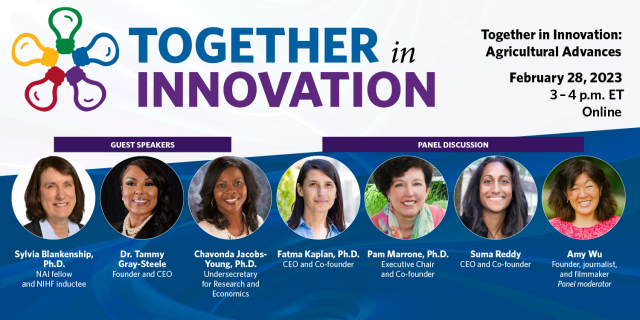
  • The U.S. Patent and Trademark Office will be hosting a virtual program entitled "Together in Innovation: Agricultural Advances" on February 28, 2023 from 3:00 pm to 4:00 pm (ET).  The program will cover the following topics:

    • How diverse teams are an essential part of a successful business strategy
    • The challenges that women innovators often face and overcome in agricultural innovation
    • Valuable resources that innovators can use to protect their intellectual property (IP) and secure funding for their enterprises

    Those interested in registering for the event, can do so here.

    Together-in-innovation-social-graphic-1500px

  • HarrityHarrity & Harrity will be offering a webinar entitled "Diversity Dialogue ThinkTank: An Update on Programs to Increase the Representation of Women in IP" on March 1, 2023 at 3:00 pm (ET).  Elaine Spector of Harrity & Harrity, LLP; Meredith Struby of Meunier Carlin & Curfman LLC; Lisa Mueller of Casimir Jones, S.C.; and Carlyn Burton of Osha Bergman Watanabe & Burton LLP will provide an update on the progress each firm has made in the implementation of their new programs for increasing the representation of women in patent law and the anticipated impact on the field of patent law.

    Those interested in attending the webinar can register here.