• IPO #2The Intellectual Property Owners Association (IPO) will offer a one-hour webinar entitled "USPTO and Section 101: New Examiner Guidelines" on May 18, 2016 from 2:00 to 3:00 pm (ET).  Robert Bahr, Deputy Commissioner of Patent Examination Policy, U.S. Patent and Trademark Office; Bart Eppenauer of Shook, Hardy & Bacon L.L.P.; and Michelle Holoubek of Sterne Kessler Goldstein and Fox will explain the agency's new policies on subject matter eligibility determinations and how the agency will encourage examiners to follow them. The panel will also review the recent Federal Circuit decision in Enfish v. Microsoft and other pending decisions that may cause the USPTO to further adjust its policies.

    The registration fee for the webinar is $135 (government and academic rates are available upon request).  Those interested in registering for the webinar can do so here.

  • Strafford #1Strafford will be offering a webinar/teleconference entitled "Overcoming §103 Rejections for Biotech and Chemical Patents: Leveraging Recent Decisions and USPTO Guidance" on June 9, 2016 from 1:00 to 2:30 pm (EDT).  Dr. Shing-Yi (Cindy) Cheng, Thomas L. Irving, and Dr. Amanda K. Murphy of Finnegan Henderson Farabow Garrett & Dunner will provide guidance for patent counsel for overcoming §103 rejections for biotech and chemical patents, review recent case law and USPTO guidance on §103 patent eligibility, and offer strategies to address §103 rejections.  The webinar will review the following issues:

    • What evidentiary support should counsel provide to bolster its assertion of validity?
    • What strategies should patent counsel implement to overcome §103 rejections for biotech patents?
    • How can patent counsel guide applicants in reducing the likelihood of rejection?

    The registration fee for the webinar is $297.  Those interested in registering for the webinar, can do so here.

  • Informa Life SciencesInforma Life Sciences will be holding its 25th Annual EU Pharmaceutical Law Forum on May 24-26, 2016 in Brussels, Belgium.  The conference will offer presentations on the following topics:

    • Feedback from the EU Commission on competition law (keynote presentation);
    • Reverse payment patent settlements;
    • Discounts, rebates and excessive pricing in the pharmaceutical industry;
    • Key issues and pitfalls in the merger control review of pharmaceuticals transactions;
    • Understanding the latest developments in SPCs;
    • Enforcing second medical use patents;
    • Lifecycle management with respect to competition law, patents and regulatory frameworks;
    • Current state of the art and work in progress at the European Medicines Agency;
    • Form follows function? Implementation of EU regulatory frameworks in pharmaceutical law at the EU Commission (keynote presentation);
    • Marketing, advertising, social media, mobile aps and e-health;
    • Orphan Regulation: 15 years later — Ready for the future?
    • Transparency of clinical trial data, other regulatory data and prices;
    • Biosimilars and the regulatory frameworks;
    • Adaptive licensing and early access to medicines;
    • Quiz time! Competition law, patents, regulatory frameworks and pot luck;
    • Revisions to the medical devices regulation and the IVD regulation;
    • Impact of the new data privacy regulation;
    • Examining the new safe harbour ruling/agreement;
    • Data privacy and clinical trial data;
    • Transparency with regards to payments to healthcare professionals;
    • Essential guidance on the use of mobile apps and e-health with respect to privacy;
    • Accountability and record keeping in a pharma context — An imperative requirement of the GDPR;
    • Anti-bribery and enforcement trends across the EU and Deferred Prosecution Agreements (DPAs): Private practice perspective;
    • Anti-bribery from a practical in-house counsel perspective;
    • Ensuring efficient internal investigations;
    • How to mitigate risk;
    • Examining commercial intellectual property issues in collaboration and licensing agreements;
    • The importance of due diligence;
    • Obligations to exploit;
    • Assessing the financial aspects of licensing and collaboration agreements;
    • Legal and BD&L perspective: The importance of alliance management in licensing deals;
    • Planning, negotiating and drafting termination provisions;
    • Co-marketing/co-promotion agreements in the pharma industry);
    • Outlining a recent asset deal in the pharmaceutical industry; and
    • Industry case study.

    An agenda for this conference, including detailed descriptions of conference sessions and list of speakers, can be found here.  Registration fee packages for the forum can be found here.  Those interested in registering for the conference can do so here.

    Patent Docs is a media partner of the EU Pharmaceutical Law Forum.

  • By Donald Zuhn –-

    USPTO SealLast week, the U.S. Patent and Trademark Office issued further guidance for determining subject matter eligibility under 35 U.S.C. § 101.  In addition to a memorandum on subject matter eligibility determinations that was issued to the patent examining corps, an updated list of court decisions (Supreme Court and Federal Circuit) addressing subject matter eligibility, and an updated index of eligibility examples, that guidance provided six additional life sciences examples numbered 28-33 (33 being the total number of examples that the Office has issued to date).

    One of the more interesting of the six new life sciences examples is Example 29, which includes seven claims directed to the detection of a hypothetical protein, JUL-1, and the diagnosis and/or treatment of a hypothetical autoimmune disease, julitis.  According to the example, julitis develops when the immune system of a person having the disease mistakes normal skin cells for pathogens, which causes chronic inflammation of the skin that results in an itchy and extremely painful rash on the face, hands, and feet.  The example also indicates that while julitis is conventionally diagnosed by a physical examination of the characteristic rash, patients are often misdiagnosed as having rosacea since the rash caused by julitis looks similar to rashes caused by rosacea.

    In the example, applicant has discovered that julitis patients have JUL-1 in their plasma, skin, hair and nails, while individuals who do not have julitis (or who have rosacea instead) do not.  Applicant also discloses detecting JUL-1 using anti-JUL-1 antibodies that may be naturally occurring (e.g., a human anti-JUL-1 antibody isolated from a patient known to have julitis), or non-naturally occurring (e.g., a porcine anti-JUL-1 antibody created by injecting pigs with JUL-1, or a specific monoclonal antibody named "mAb-D33" that was created by applicant).  The example notes that at the time applicant's application was filed, porcine antibodies were not routinely or conventionally used to detect human proteins such as JUL-1.  The example also notes that at the time applicant's application was filed, julitis was conventionally treated with anti-tumor necrosis factor (TNF) antibodies, but for unknown reasons, some patients did not respond well to this conventional treatment.  The example further notes that applicant has successfully treated julitis patients (even those who are non-responsive to anti-TNF antibodies) with topical vitamin D, which at the time applicant's application was filed, was not commonly or routinely administered to patients with julitis.

    The seven claims presented in example 29 are as follows:

    1.  A method of detecting JUL-1 in a patient, said method comprising:
        a.  obtaining a plasma sample from a human patient; and
        b.  detecting whether JUL-1 is present in the plasma sample by contacting the plasma sample with an anti-JUL-1 antibody and detecting binding between JUL-1 and the antibody.

    2.  A method of diagnosing julitis in a patient, said method comprising:
        a.  obtaining a plasma sample from a human patient;
        b.  detecting whether JUL-1 is present in the plasma sample by contacting the plasma sample with an anti-JUL-1 antibody and detecting binding between JUL-1 and the antibody; and
        c.  diagnosing the patient with julitis when the presence of JUL-1 in the plasma sample is detected.

    3.  A method of diagnosing julitis in a patient, said method comprising:
        a.  obtaining a plasma sample from a human patient;
        b.  detecting whether JUL-1 is present in the plasma sample by contacting the plasma sample with a porcine anti-JUL-1 antibody and detecting binding between JUL-1 and the porcine antibody; and
        c.  diagnosing the patient with julitis when the presence of JUL-1 in the plasma sample is detected.

    4.  A method of diagnosing julitis in a patient, said method comprising:
        a.  obtaining a plasma sample from a human patient;
        b.  detecting whether JUL-1 is present in the plasma sample by contacting the plasma sample with antibody mAb-D33 and detecting binding between JUL-1 and antibody mAb-D33; and
        c.  diagnosing the patient with julitis when the presence of JUL-1 in the plasma sample is detected.

    5.  A method of diagnosing and treating julitis in a patient, said method comprising:
        a.  obtaining a plasma sample from a human patient;
        b.  detecting whether JUL-1 is present in the plasma sample;
        c.  diagnosing the patient with julitis when the presence of JUL-1 in the plasma sample is detected; and
        d.  administering an effective amount of topical vitamin D to the diagnosed patient.

    6.  A method of diagnosing and treating julitis in a patient, said method comprising:
        a.  obtaining a plasma sample from a human patient;
        b.  detecting whether JUL-1 is present in the plasma sample;
        c.  diagnosing the patient with julitis when the presence of JUL-1 in the plasma sample is detected; and
        d.  administering an effective amount of anti-tumor necrosis factor (TNF) antibodies to the diagnosed patient.

    7.  A method of treating a patient with julitis, the method comprising administering an effective amount of anti-TNF antibodies to a patient suffering from julitis.

    According to the example, all but claim 2 are considered to be patent eligible.

    In analyzing the claims presented in example 29, the Office explains that claim 1 is eligible because steps (a) and (b) of the claim "do not recite or describe any recognized exception" (the example cites Mayo Collaborative Services v. Prometheus Laboratories, Inc. in support of this determination, which the example indicates stands for the proposition that the recited steps of administering a drug to a patient and determining the resultant level of 6-thioguanine in the patient "are not themselves natural laws").  As a result, the analysis of this claim ends with Step 2A of analytic framework set forth in the Interim Guidance (i.e., determining whether the claim is directed to a judicial exception), and the example notes that there is no need to proceed with Step 2B of the analytic framework (i.e., determining whether any element, or combination of elements, in the claim is sufficient to ensure that the claim amounts to significantly more than the judicial exception).

    With respect to claim 2, the example explains that:

    [T]he claim recites diagnosing the patient with julitis when the presence of JUL-1 in the plasma sample is detected, which describes a correlation or relationship between the presence of JUL-1 in a patient's plasma and the presence of julitis in the patient.  This limitation sets forth a judicial exception, because this type of correlation is a consequence of natural processes, similar to the naturally occurring correlation found to be a law of nature by the Supreme Court in Mayo).  Additionally, step c could be performed by a human using mental steps or basic critical thinking, which are types of activities that have been found by the courts to represent abstract ideas (e.g., the mental comparison in Ambry Genetics, or the diagnosing an abnormal condition by performing clinical tests and thinking about the results in Grams).

    As a result, claim 2 is found to be directed to "at least one exception."  As for Step 2B of the analytic framework, the example explains that the claim's step of "[o]btaining a sample in order to perform tests is well-understood, routine and conventional activity for those in the field of diagnostics," and that the claim's step of "[d]etecting whether JUL-1 is present in the plasma sample merely instructs a scientist to use any detection technique with any generic anti-JUL-1 antibody," and further, that:

    When recited at this high level of generality, there is no meaningful limitation, such as a particular or unconventional machine or a transformation of a particular article, in this step that distinguishes it from well-understood, routine, and conventional data gathering activity engaged in by scientists prior to applicant's invention, and at the time the application was filed, e.g., the routine and conventional techniques of detecting a protein using an antibody to that protein.

    According to the example, consideration of the additional elements as a combination does not save claim 2 because "[u]nlike the eligible claim in Diehr in which the elements limiting the exception are individually conventional, but taken together act in concert to improve a technical field, the claim here does not invoke any of the considerations that courts have identified as providing significantly more than an exception."  Finding that claim 2 claim as a whole does not amount to significantly more than the exception itself, the Office determines that this claim is not eligible.

    The example next explains that claim 3, which differs from claim 2 in that the detecting step utilizes a porcine anti-JUL-1 antibody, is eligible because:

    [A]t the time the application was filed, the use of porcine antibodies in veterinary therapeutics was known to most scientists in the field.  But significantly, there is no evidence that porcine antibodies were routinely or conventionally used to detect human proteins such as JUL-1.  Thus, the claim's recitation of detecting JUL-1 using a porcine antibody is an unconventional step that is more than a mere instruction to "apply" the correlation and critical thinking step (the exception) using well-understood, routine or conventional techniques in the field.

    Similarly, claim 4, which differs from claims 2 and 3 in that the antibody mAb-D33 is utilized in the detecting step, is found to be eligible because:

    [A]t the time the application was filed, antibody mAb-D33 was not routinely or conventionally used to detect human proteins such as JUL-1.  Thus, the claim's recitation of detecting JUL-1 using mAb-D33 is an unconventional step that is more than a mere instruction to "apply" the correlation and critical thinking step (the exception) using well-understood, routine or conventional techniques in the field.

    Claim 5 differs from claim 2 in that claim 5 is directed to a method of diagnosing and treating julitis, the detecting step of claim 5 encompasses any technique for detecting whether JUL-1 is present in the plasma sample, and claim 5 adds an additional step of administering an effective amount of topical vitamin D to the diagnosed patient.  Unlike claim 2, however, the example finds claim 5 to be eligible.  The example explains that claim 5 is eligible because:

    [T]his claim further recites an additional element of administering an effective amount of topical vitamin D to the diagnosed patient (step d).  Vitamin D was known to doctors, and was routinely and conventionally used as an oral supplement to maintain bone health prior to applicant's invention, and at the time the application was filed.  However, mere knowledge of vitamin D or its use in other ways to treat other medical conditions does not make the administration of topical vitamin D to treat julitis a conventional step that those in this field would routinely practice.  The evaluation turns on whether the use of topical vitamin D was widely prevalent in the field at the time the invention was made and the application was filed.  Because it was not, the recitation of administering topical vitamin D is an unconventional step that is more than a mere instruction to "apply" the correlation and critical thinking step (the exception) using well-understood, routine or conventional techniques in the field.

    Claim 6, which differs from claim 5 in that an effective amount of anti-tumor necrosis factor (TNF) antibodies –- rather than an effective amount of topical vitamin D –- is administered to the diagnosed patient, is also found to be eligible in example 29.  Although the example explains in analyzing claim 6 that "[p]rior to applicant's invention, and at the time the application was filed, julitis was conventionally treated with anti-tumor necrosis factor (TNF) antibodies, but for unknown reasons, some patients do not respond well to this conventional treatment," the example states that:

    When the additional elements are viewed as a combination, however, the additional elements (steps a, b and d) amount to a claim as a whole that adds meaningful limits on the use of the exception (the correlation and critical thinking step).  The totality of these steps including the recitation of a particular treatment (administration of an effective amount of anti-TNF antibodies) in step d integrate the exception into the diagnostic and treatment process, and amount to more than merely diagnosing a patient with julitis and instructing a doctor to generically "treat it."  Further, the combination of steps, which is not routine and conventional, ensures that patients who have julitis will be accurately diagnosed (due to the detection of JUL-1 in their plasma) and properly treated with anti-TNF antibodies, as opposed to being misdiagnosed as having rosacea as was previously commonplace.  See Diamond v. Diehr, 450 U.S. 175, 188 (1981) ("a new combination of steps in a process may be patentable even though all the constituents of the combination were well known and in common use before the combination was made").

    Finally, in determining that claim 7, which is directed to treating a patient with julitis by administering an effective amount of anti-TNF antibodies to the patient, is eligible, the example explains that "[t]he recited step of administering antibodies to a patient suffering from julitis does not recite or describe any recognized exception" (the example again cites Mayo Collaborative Services v. Prometheus Laboratories, Inc. in support of this determination, which the example indicates stands for the proposition that the recited steps of administering a drug to a patient and determining the resultant level of 6-thioguanine in the patient "are not themselves natural laws").  As with claim 1, the analysis of claim 7 ends with Step 2A of analytic framework, and the example notes that there is no need to proceed with Step 2B.

    Patent Docs will provide summaries of other life sciences examples in subsequent posts.

  • By Michael Borella

    Federal Circuit SealSome things are rare.  A visit from Halley's comet . . . the Chicago Cubs winning the World Series . . . a season of Game of Thrones without a major character's death . . . and a Federal Circuit panel finding that claims pass muster under 35 U.S.C. § 101.  With respect to the latter category, there is now a second post-Alice decision concluding that a patent's claims meet the statutory and judicial requirements of patent-eligibility.

    In 2012, Enfish sued Microsoft and several other parties in the Central District of California for infringement of U.S. Patent Nos. 6,151,604 and 6,163,775.  The District Court, with the late Judge Mariana R. Pfaelzer presiding, found all claims invalid under § 101 because they were directed to the abstract idea of "storing, organizing, and retrieving memory in a logical table" or "the concept of organizing information using tabular formats."

    Both patents claim ways of manipulating a new type of database table.  As a representative example, claim 17 of the '604 patent recites:

    A data storage and retrieval system for a computer memory, comprising:
        means for configuring said memory according to a logical table, said logical table including:
        a plurality of logical rows, each said logical row including an object identification number (OID) to identify each said logical row, each said logical row corresponding to a record of information;
        a plurality of logical columns intersecting said plurality of logical rows to define a plurality of logical cells, each said logical column including an OID to identify each said logical column; and
        means for indexing data stored in said table.

    In order to appreciate the claimed invention, let's take a step back.  Traditional databases are relational, in that "each entity (i.e., each type of thing) that is modeled is provided in a separate table" of rows and columns.  Classic examples include an employee database that contains a table with entries for each employee, as well as respective tables for employee job titles and departments.

    In contrast, the patents describe a "self-referential" table structure that allows the information that would normally appear in multiple relational tables to be stored in a single table.  Some of the information that might otherwise appear in columns is formatted as rows instead.  In the specification of the '604 patent, Enfish asserted that this self-referential arrangement had several advantages.  These include faster lookups, more efficient storage of data other than structured text, and no requirement that one model each thing to be represented in the database as a separate table.  For instance, "the self-referential database can be launched without [modeling and configuration of tables] and instead configured on-the-fly."

    With that in mind, the District Court construed the "means for configuring" step of claim 17 under 35 U.S.C. § 112, paragraph 6, as requiring a four-step algorithm:

    1.  Create, in a computer memory, a logical table that need not be stored contiguously in the computer memory, the logical table being comprised of rows and columns, the rows corresponding to records, the columns corresponding to fields or attributes, the logical table being capable of storing different kinds of records.

    2.  Assign each row and column an object identification number (OID) that, when stored as data, can act as a pointer to the associated row or column and that can be of variable length between databases.

    3.  For each column, store information about that column in one or more rows, rendering the table self-referential, the appending, to the logical table, of new columns that are available for immediate use being possible through the creation of new column definition records.

    4.  In one or more cells defined by the intersection of the rows and columns, store and access data, which can include structured data, unstructured data, or a pointer to another row.

    In its substantive analysis, the Court proceeded to review the two-prong test for patent-eligibility set forth in Alice Corp. v. CLS Bank Int'l.  First, one must determine whether the claim at hand is directed to a judicially-excluded law of nature, a natural phenomenon, or an abstract idea.  If so, then one must further determine whether any element, or combination of elements, in the claim is sufficient to ensure that the claim amounts to something more than the judicial exception.  Notably, generic computer implementation of an otherwise abstract process does not qualify as "something more."

    With respect to the "directed to" language of the first prong, the Court wrote that this inquiry "applies a stage-one filter to claims, considered in light of the specification, based on whether their character as a whole is directed to excluded subject matter."  The Supreme Court "suggested that claims purporting to improve the functioning of the computer itself, or improving an existing technological process might not succumb to the abstract idea exception."  Since Alice, this analysis has almost exclusively been the domain of the second prong.  However, the Federal Circuit reasoned that performing such an analysis as an entry point to the Alice test was appropriate.

    Here, it is helpful to quote the Court at length:

    We do not read Alice to broadly hold that all improvements in computer-related technology are inherently abstract and, therefore, must be considered at step two.  Indeed, some improvements in computer-related technology when appropriately claimed are undoubtedly not abstract, such as a chip architecture, an LED display, and the like.  Nor do we think that claims directed to software, as opposed to hardware, are inherently abstract and therefore only properly analyzed at the second step of the Alice analysis.  Software can make non-abstract improvements to computer technology just as hardware improvements can, and sometimes the improvements can be accomplished through either route.  We thus see no reason to conclude that all claims directed to improvements in computer-related technology, including those directed to software, are abstract and necessarily analyzed at the second step of Alice, nor do we believe that Alice so directs.  Therefore, we find it relevant to ask whether the claims are directed to an improvement to computer functionality versus being directed to an abstract idea, even at the first step of the Alice analysis.

    As a result, the Court interpreted the first prong of Alice as making a determination of "whether the focus of the claims is on the specific asserted improvement in computer capabilities (i.e., the self-referential table for a computer database) or, instead, on a process that qualifies as an abstract idea for which computers are invoked merely as a tool."  The Court noted that the Alice and Bilski v. Kappos cases, as well as essentially all but one other § 101 case that it has reviewed since Alice, fell due to being of the latter type.  In contrast, claim 17 is focused on "an improvement to computer functionality itself, not on economic or other tasks for which a computer is used in its ordinary capacity."

    The Court dismissed the conclusion of Judge Pfaelzer that the claims were abstract, and also rejected Microsoft's argument that the claims are directed to "the concepts of organizing data into a logical table with identified columns and rows where one or more rows are used to store an index or information defining columns."  Instead, the Court found that "describing the claims at such a high level of abstraction and untethered from the language of the claims all but ensures that the exceptions to § 101 swallow the rule."  The Court further observed that, based on the District Court's construction, claim 17 recited a specific implementation of a self-referential table rather than the storing of tabular data in general.  Thus, "the district court oversimplified the self-referential component of the claims and downplayed the invention's benefits."

    In an interesting twist, perhaps due to the means-plus-function structure of the claims, the Court relied heavily on the specification's purported advantages of the claimed implementation.  Again quoting the Court at length:

    The specification also teaches that the self-referential table functions differently than conventional database structures.  According to the specification, traditional databases, such as those that follow the relational model and those that follow the object oriented model, are inferior to the claimed invention.  While the structural requirements of current databases require a programmer to predefine a structure and subsequent data entry must conform to that structure, the database of the present invention does not require a programmer to preconfigure a structure to which a user must adapt data entry.  Moreover, our conclusion that the claims are directed to an improvement of an existing technology is bolstered by the specification's teachings that the claimed invention achieves other benefits over conventional databases, such as increased flexibility, faster search times, and smaller memory requirements.

    Further, the ability of the invention to operate on a general-purpose computer was not dispositive.  The Court observed that "[u]nlike the claims at issue in Alice or, more recently in Versata Development Group v. SAP America, Inc., . . . the claims here are directed to an improvement in the functioning  of a computer [while] the claims at issue in Alice and Versata can readily be understood as simply adding conventional computer components to well-known business practices."  Requiring an improvement to a computer to be in hardware would resurrect the bright-line machine-or-transformation test of Bilski or improperly "creat[e] a categorical ban on software patents."

    The Court went on to recognize the importance of software and the potential for innovation therewith:  "Much of the advancement made in computer technology consists of improvements to software that, by their very nature, may not be defined by particular physical features but rather by logical structures and processes . . . [w]e do not see in Bilski or Alice, or our cases, an exclusion to patenting this large field of technological progress."

    Accordingly, the Court concluded that the claims were not abstract under prong one of Alice, and therefore prong two of that test need not be carried out.

    The outcome of this case may seem surprising when viewing the claims on their face.  Claim 17 seems broad, but due to the § 112 ¶ 6 analysis, the Court applied the Alice test to the claims as construed in view of the specification.  This narrower interpretation of the claims (the four-step algorithm above) likely made the invention look less abstract.  Further, perhaps because the specification was in play from this construction, the Court took into account the patentee's contentions therein regarding the improvements and advantages of the invention.

    Clearly, a practice point to take away is that describing how an invention improves over the prior art, especially if it improves the operation of a computer, can be advantageous.  Of course, for purposes of avoiding estoppel, one should be careful when pointing out the deficiencies of what came before.  Additionally, it appears as if the claims do not need to explicitly recite such improvements.

    Another interesting aspect of this decision is that the Federal Circuit subtly changed the nature of the Alice test.  Now, one can short-circuit the full analysis if the claimed invention is clearly not abstract, and doing so may involve determining whether the invention improves the operation of a computer or technological process.  In a sense, the two-prong test is being compressed into a one-prong test.  The impact of this approach may be significant, especially if it is adopted by district courts and the USPTO.

    Additionally, the Court made it clear that whether such an improvement resides in hardware or software is not material.  Since Bilski, there has been a knee-jerk reaction to add a hardware component to at least one element of each independent claim.  Perhaps that is no longer necessary when the innovation is in software.

    Finally, this outcome is in line with the reasoning behind the USPTO's abstract ideas examples, published last year in January and July.  Based on these examples, as well as the Diamond v. Diehr and DDR Holdings v. Hotels.com cases, there are two main ways to claim software inventions to avoid § 101 issues.  First, one can claim the software controlling other machines or components.  Not unlike Diehr, when claimed with an appropriate level of specificity, such inventions may be viewed as an improvement to an industrial process.  Second, one can claim that the software improves the operation of a computer itself.  Usually this will take the form of lower-layer functions that support applications developed thereon.  For instance, well-drafted claims directed to operating system function, networking, message parsing, speech recognition, image processing, compression, encryption, and graphical user interfaces, have all been found patent-eligible either in the courts or by the USPTO.  Now we can add databases to that list.

    Enfish, LLC v. Microsoft Corp. (Fed. Cir. 2016)
    Panel: Circuit Judges Moore, Taranto, and Hughes
    Opinion by Circuit Judge Hughes

  • By Josh Rich

    Washington - White House #2This afternoon, President Obama signed the Defend Trade Secrets Act of 2016 ("DTSA") into law, creating a new Federal cause of action for misappropriation of trade secrets.  The new law is the most significant expansion of Federal intellectual property law in a generation, and brings with it significant benefits — but also new responsibilities — for intellectual property owners and employers.  And in this era of narrowed subject matter eligibility for patenting, the DTSA may provide enough of an incentive for intellectual property owners to keep more information as trade secrets.

    Prior to the enactment of the DTSA, trade secret owners could protect their rights under state law or a patchwork of Federal laws that provided criminal and civil sanctions for interstate trade secret misappropriation or misuse of computerized data, such as the Economic Espionage Act ("EEA") and the Computer Fraud and Abuse Act ("CFAA").  However, although most states — all except Massachusetts and New York — have adopted a version of the Uniform Trade Secrets Act ("UTSA"), those enactments have actually not been uniform, and the variations have proved to be important to trade secret owners seeking relief.  Furthermore, the state law nature of UTSA claims has made it difficult to chase misappropriators across state law and collect evidence from third parties located out-of-state or overseas.  Prior Federal laws did not provide much more help, relegating aggrieved parties to seeking criminal sanctions under the EEA or twisting their civil claims into the ill-fitting paradigm of the CFAA.  Against this backdrop, Congress worked for several years to build a strong bipartisan consensus for a Federal civil cause of action for misappropriation of trade secrets, resulting in the DTSA.

    The DTSA includes three key provisions that intellectual property owners should know about.  First, the Federal civil cause of action for misappropriation of trade secrets.  Second, an ex parte seizure provision that can be invoked in extraordinary circumstances.  Third, whistleblower protections that preempt criminal and civil liability under either Federal or state law, and place certain new obligations upon employers.

    First, the DTSA allows a trade secret owner (whether the assignee or a licensee) to bring a civil action against a misappropriator if the trade secret is related to a product or service used in, or intended for use in, interstate or foreign commerce.  The definition of a trade secret is intentionally broad and based on the definition in the UTSA, which requires (i) the owner to have taken reasonable measures to keep the information secret and (ii) the information to derive independent economic value from not being generally known or readily ascertainable through proper means to another person who can obtain economic value from the information.  The acts that constitute misappropriation are also taken from the UTSA, and essentially require the misappropriator to have used improper means to have obtained the trade secrets, or been the beneficiary of someone else who used improper means and know that the information was improperly obtained.  Notably, the DTSA specifically states that reverse engineering, independent derivation, or any other lawful means of acquisition do not constitute improper means.

    Second, unlike the UTSA, the DTSA provides a means for a trade secret owner to have a court seize stolen trade secrets, without notice to the misappropriator, if the misapropriator is seeking to flee the country, planning to disclose the trade secret to a third party immediately, planning to destroy evidence of the misappropriation, or is otherwise not amenable to enforcement of the court's orders.  There are strict requirements for the initial ex parte seizure petition, the scope of the court's seizure order, and the post-seizure treatment of the evidence.  Further, the DTSA requires a hearing within one week to allow a defendant to argue that the ex parte seizure was improper.  And if the seizure proves to be wrongful or excessive, the aggrieved subject of the seizure can bring a cause of action against the trade secret owner (and the damages are not limited by any seizure bond set by the court).

    Third, the DTSA insulates whistleblowers against liability under any Federal or state trade secret law (either criminal or civil), so long as the whistleblower discloses any trade secrets in confidence either in a lawsuit filed under seal or to government officials, if the purpose is reporting a suspected violation of the law.  Furthermore, employers must provide notice of the whistleblower protections in all future contracts with employees (which can include disclosure in the form of an employee handbook).  In that context, the DTSA indicates that the term "employees" includes contractors as well.  If an employer fails to make the disclosure, it is barred from obtaining exemplary damages or attorney's fees in an action against an employee under the DTSA.

    All in all, the DTSA is a powerful new tool that intellectual property owners now have at their disposal.  It strengthens trade secret rights, and makes them easier to enforce.  Given that patent rights have been chipped away in certain contexts (especially through lack of subject matter eligibility for certain types of inventions), it may be enough incentive for intellectual property owners to keep their inventions secret.  It certainly merits greater consideration of secrecy, given its strengthening of owners' rights; on the other hand, it also requires employers to start taking steps to ensure notice of whistleblower rights.  So, in the end, it is likely to be a boon to both innovators and employees.

  • By Joseph Herndon

    USPTO SealOn Monday, May 9, 2016, the U.S. Patent and Trademark Office published information on Patent Trial and Appeal Board (PTAB) trials regarding motions to amend claims.  The Acting Chief Administrative Patent Judge, Nathan Kelley, wrote that while the America Invents Act (AIA) gives patent owners the right to file a motion to amend its claims during a trial, few such motions have been granted as compared to the number of total petitions filed.

    A motion to amend may involve a request to cancel patent claims, to substitute claims in the patent, or a combination of the two.  Requests solely to cancel claims typically are granted without substantive review.  Requests that seek to substitute claims are generally decided only when the panel of judges determines that the claims as originally issued are unpatentable, because nearly all such motions are contingent on a decision unfavorable to patentability of the original claims.

    Judge Kelley noted that a Motion to Amend Study was conducted, and some highlights from the study (based on data current through April 30, 2016) include:

    • There have been more than 4,850 inter partes review, covered business method review, and post-grant review petitions filed since the inception of the America Invents Act ("AIA").  Of these, 1539 trials have gone to completion or settled (where joined or consolidated trials were counted as a single trial), and motions to amend were sought in 192.  (34 more motions to amend are pending in currently open cases.)

    • Of those 192, not all ultimately required the PTAB to pass on the merits of the motion.  This is because, often, motions to amend are filed as "contingent" motions — if the PTAB upholds the patentability of the original claims, such motions never get decided.  Several other cases settle before motions to amend are decided.  Additionally, some motions to "amend" only request the cancellation of claims, and those are routinely granted.

    Judge Kelley summarized that this leaves 118 motions to amend (out of the 192) that a PTAB panel has had a chance to review.  Of these, the PTAB only granted or granted-in-part 6.

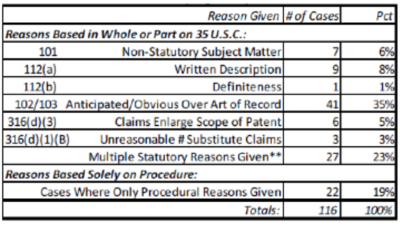
    Of those denied, including the denial portion of those granted-in-part, 22 were denied solely on procedural grounds (only one of which was that the patent owner failed to state that the substitute claims were patentable over the prior art "in general"), and 94 were denied after identifying specific grounds of patentability that the proposed amended claims did not satisfy.

    For the 94 denied, this refers to the proposed amended claims still being found unpatentable.  This is akin to an examiner rejecting an amended claim because it is anticipated, obvious, not described, etc.  But, the PTAB proceedings must be completed within a year, and there is no time for the back-and-forth between the applicant and the USPTO that happens during prosecution.  Instead, the PTAB acts as the final arbiter of these newly proposed claims based solely on the briefing presented to it by the parties — if the PTAB grants such a motion, the new claims will issue (and be enforceable against the public) without any examination to ensure compliance with the statutory requirements for patentability.  A disappointed patent owner who believes the PTAB erred in refusing to allow a claim amendment can, of course, seek review from the Federal Circuit.

    Below is a table from the study that summarizes reasons provided for denying entry of substitute claims.

    Table
    As seen from the table, it appears that patent owners have not been able to satisfy the Board that any such proposed amendments would in fact distinguish over the art used to challenge the patent.  Patent owners, of course, have to consider an infringer when proposing amendments to the claims, and it would seem that most proposed amendments likely do not vary enough in scope over issued claims so as to overcome the challenging art.

    Judge Kelley discounted the notion that motions to amend are no longer being filed because parties think they're futile, and noted that the PTAB is currently on track to have about 50 motions filed this year, which is consistent with the level they were filed in 2013 (e.g., 49 filed) and 2015 (e.g., 59 filed).  Although there were 92 motions to amend filed in 2014, and so these motions are on the decline based on a few years of data.

  • By Donald Zuhn –-

    USPTO SealIn a notice published in the Federal Register (88 Fed. Reg. 27381) on Friday, the U.S. Patent and Trademark Office issued further guidance for determining subject matter eligibility under 35 U.S.C. § 101.  The notice, entitled "May 2016 Subject Matter Eligibility Update," discusses a memorandum on subject matter eligibility determinations that was issued to the patent examining corps, additional life sciences examples that are intended to assist examiners in making eligibility determinations, an updated index of eligibility examples, and an updated list of court decisions (Supreme Court and Federal Circuit) addressing subject matter eligibility, each of which has been made available on the Office's subject matter eligibility webpage.

    The notice begins by reminding stakeholders about the July 2015 Update on Subject Matter Eligibility, which provided further guidance to examiners on making subject matter eligibility determinations and sought public comment regarding the Office's prior guidance on subject matter eligibility.  In response to public feedback regarding the July 2015 Update — a total of 37 submissions were submitted — the Office issued a memorandum on eligibility determinations to the examining corps on May 4, 2016.  In particular, the memorandum, entitled "Formulating a Subject Matter Eligibility Rejection and Evaluating the Applicant's Response to a Subject Matter Eligibility Rejection," provides guidance to examiners on formulating subject matter eligibility rejections and evaluating responses to subject matter eligibility rejections.

    The memorandum to the patent examining corps, which runs just over six pages in length and is signed by Robert Bahr, Deputy Commissioner for Patent Examination Policy, provides examiners with additional guidance for applying the analytic framework set forth in the 2014 Interim Guidance on Patent Subject Matter Eligibility (see "USPTO Issues Interim Guidance on Subject Matter Eligibility").  As noted in the 2014 Interim Guidance, the two-step analysis for determining subject matter eligibility under 35 U.S.C. § 101 that is set forth in MPEP § 2106, consists of: (1) determining whether the claimed invention is "directed to one of the four statutory categories" (i.e., process, machine, manufacture, or composition of matter), and (2) determining whether the claimed invention is "wholly directed to subject matter encompassing a judicially recognized exception."  In the 2014 Interim Guidance, the first step of the above analysis was labeled "Step 1," and the second step of the analysis was divided into a "Step 2A" and a "Step 2B," to correspond with the two-step (or two-part) analysis from Alice Corp. v. CLS Bank Int'l (which was set forth earlier in Mayo Collaborative Services v. Prometheus Laboratories, Inc.).

    In discussing Step 2A of the above analysis, the memorandum states that when an examiner makes a subject matter eligibility rejection and determines that a claim is directed to an abstract idea, "the rejection should identify the abstract idea as it is recited (i.e., set forth or described) in the claim and explain why it corresponds to a concept that the courts have identified as an abstract idea," and similarly, when an examiner makes a subject matter eligibility rejection and determines that a claim is directed to a law of nature or a natural phenomenon, "the rejection should identify the law of nature or natural phenomenon as it is recited (i.e., set forth or described) in the claim and explain using a reasoned rationale why it is considered a law of nature or natural phenomenon."  As for Step 2B of the analysis, the memorandum states that an examiner's rejection "should identify the additional elements in the claim and explain why the elements taken individually and in combination do not amount to a claim as a whole that is significantly more than the exception identified" in carrying out Step 2A of the analysis (emphasis in original).

    More specifically, the memorandum states that a subject matter rejection under Step 2 of the analysis outlined in the 2014 Interim Guidance should:

    • identify the judicial exception by referring to what is recited (i.e., set forth or described) in the claim and explain why it is considered an exception;

    • identify any additional elements (specifically point to claim features/limitations/steps) recited in the claim beyond the identified judicial exception; and

    • explain the reason(s) that the additional elements taken individually, and also taken as a combination, do not result in the claim as a whole amounting to significantly more than the judicial exception [emphasis in original].

    For judicial exceptions constituting an abstract idea, law of nature, natural phenomena, or product of nature, the memorandum provides sample explanations for satisfying the first point above:

    Sample explanation: The claim recites the steps of sorting information by X, which is an abstract idea similar to the concepts that have been identified as abstract by the courts, such as organizing information through mathematical correlations in Digitech or data recognition and storage in Content Extraction.

    Sample explanation: The claim recites the correlation of X, and X is a law of nature because it describes a consequence of natural processes in the human body, e.g., the naturally-occurring relationship between the presence of Y and the manifestation of Z.

    Sample explanation: The claim recites X, which is a natural phenomenon because it occurs in nature and exists in principle apart from any human action.

    Sample explanation: The claim recites X, which as explained in the specification was isolated from naturally occurring Y. X is a nature-based product, so it is compared to its closest naturally occurring counterpart (X in its natural state) to determine if it has markedly different characteristics. Because there is no indication in the record that isolation of X has resulted in a marked difference in structure, function, or other properties as compared to its counterpart, X is a product of nature exception.

    With respect to abstract ideas, the memorandum also indicates that "[e]xaminers should not go beyond those concepts that are similar to what the courts have identified as abstract ideas."

    With regard to examining the claim as a whole, the memorandum states that:

    It is important to remember that a new combination of steps in a process may be patent eligible even though all the steps of the combination were individually well known and in common use before the combination was made (Diehr).  Thus, it is particularly critical to address the combination of additional elements, because while individually-viewed elements may not appear to add significantly more, those additional elements when viewed in combination may amount to significantly more than the exception by meaningfully limiting the judicial exception [emphasis in original].

    As for an examiner's determination that particular claim limitations are well-understood, routine, or conventional, the memorandum points out that a rejection "should explain why the courts have recognized, or those in the relevant field of art would recognize, those claim limitations as being well-understood, routine, conventional activities," but notes that "even if a particular laboratory technique was discussed in several widely-read scientific journals or used by a few scientists, mere knowledge of the particular laboratory technique or use of the particular laboratory technique by a few scientists is not sufficient to make the use of the particular laboratory technique routine or conventional in the relevant field."

    As for the evaluation of an applicant's response to a subject matter eligibility rejection, the memorandum indicates that claim amendments adding an additional element "may be enough to qualify as 'significantly more' if [the additional element] meaningfully limits the judicial exception, improves another technology or technical field, improves the functioning of a computer itself, or adds a specific limitation other than what is well-understood, routine, conventional activity in the field or unconventional steps that confine the claim to a particular useful application."  Moreover, the memorandum states that "even if an element does not amount to significantly more on its own . . . , it can still amount to significantly more when considered in combination with the other elements of the claim."

    Finally, for responses in which an applicant argues that a claim does not preempt all applications of the judicial exception, the memorandum states that "an appropriate response would be to explain that preemption is not a standalone test for eligibility."  The memorandum indicates that "[q]uestions of preemption are inherent in and resolved by the two-part framework from Alice Corp. and Mayo, as explained by the Federal Circuit in OIP and Sequenom," adding that "while a preemptive claim may be ineligible, the absence of complete preemption does not demonstrate that a claim is eligible."

    In addition to providing additional life sciences examples (some of which should prove to be of significant interest to life sciences practitioners and applicants), the May 2016 Update also provides an updated index of eligibility examples. An index of examples was previously provided with the July 2015 Update as Appendix 2.  The index provided with the latest update divides the examples into the following five categories:

    • Nature-Based Products (NBP) — ten examples released on December 16, 2014
    • Abstract Ideas (AI) — eight examples released on January 27, 2015
    • Computer Based Training & CBT Slides (CBT) — two examples released on March 6, 2015
    • July 2015 Update Appendix 1 — seven examples released on July 30, 2015
    • Life Sciences (LS) — six examples released with the May 2016 Update

    With respect to the new life sciences examples, the Office notes that they provide exemplary subject matter eligibility analyses of hypothetical claims and claims drawn from case law, and that the examples are intended as a teaching tool to assist examiners and the public in understanding how the Office would apply the eligibility guidance in certain fact-specific situations.  (The May 4 memorandum reminds examiners that the examples "are intended to show exemplary analyses only and should not be used as a basis for a subject matter eligibility rejection or relied upon in the same manner as a decision from a court," and adds that "while it would be acceptable for applicants to cite an example in support of an argument for finding eligibility in an appropriate factual situation, applicants should not be required to model their claims or responses after the examples to attain eligibility.")  The new life sciences examples, which are numbered 28-33 (33 being the total number of examples that the Office has issued to date), cover vaccines (ex. 28), diagnosing and treating julitis (ex. 29), dietary sweeteners (ex. 30), screening for gene alterations (ex. 31), a Fourdrinier (paper-making) machine (ex. 32), and a process of hydrolyzing fat (ex. 33).  Patent Docs will provide summaries of the additional life sciences examples in subsequent posts.

    The final document released with the May 2016 Update is an updated version of the Appendix of Supreme Court and Federal Circuit decisions that was previously provided with the July 2015 Update (i.e., Appendix 3).  The list of subject matter eligibility court decisions (formerly Appendix 3) can be found here.  The Office notes that the list of court decisions will continue to be updated to include Federal Circuit decisions without opinion (Fed. Cir. R. 36) on appeals originating from the Patent Trial and Appeal Board (PTAB), but will not be updated to include Federal Circuit decisions without opinion affirming a district court decision as the latter "provide little benefit to examiners or the public."

    The Office also notes that the documents released with the May 2016 Update "were developed as a matter of internal Office management and are not intended to create any right or benefit, substantive or procedural, enforceable by any party against the Office."  As such, the notice indicates that the failure of Office personnel to follow any of the guidance materials does not form a proper basis for either an appeal or a petition.

    Finally, in the May 2016 Update, the Office indicates that it continues to seek public comment on subject matter eligibility and that the "[t]he comment period is open-ended, and comments will be accepted on an ongoing basis."  In view of the Office's commitment to enhancing the quality of examination, the notice also indicates that the Office is particularly interested in obtaining comments addressing any progress the Office is making with respect to the quality of correspondence regarding subject matter eligibility rejections. Comments can be sent by e-mail to:  2014_interim_guidance@uspto.gov.  Because comments will be made available for public inspection, those submitting comments should not include information (e.g., addresses or phone numbers) that submitters do not wish to make public.

    In future posts, Patent Docs intends to discuss selected life sciences examples that were released with the May 2016 Update.

  •         By Sherri Oslick

    Gavel About Court Report:  Each week we will report briefly on recently filed biotech and pharma cases.

    Boehringer Ingelheim Pharma GmbH & Co. KG et al. v. Hetero USA, Inc. et al.
    3:16-cv-02356; filed April 26, 2016 in the District Court of New Jersey

    • Plaintiffs:  Boehringer Ingelheim Pharma GmbH & Co. KG; Boehringer Ingelheim International GmbH; Boehringer Ingelheim Pharmaceuticals, Inc.
    • Defendants:  Hetero USA, Inc.; Hetero Labs Ltd. Unit-III; Hetero Labs Ltd.

    Infringement of U.S. Patent No. 6,087,380 ("Disubstituted Bicyclic Heterocycles, the Preparations and the Use Thereof as Pharmaceutical Compositions," issued July 11, 2000) following a Paragraph IV certification as part of Hetero's filing of an ANDA to manufacture a generic version of Boehringer's Pradaxa® (dabigatran etexilate mesylate, used to reduce the risk of stroke and systemic embolism in patients with non-valvular atrial fibrillation).  View the complaint here.


    Amneal Pharmaceuticals LLC v. GlaxoSmithKline LLC et al.
    1:16-cv-00300; filed April 25, 2016 in the District Court of Delaware

    • Plaintiff:  Amneal Pharmaceuticals LLC
    • Defendants:  GlaxoSmithKline LLC; Glaxo Group Ltd.

    Declaratory judgment of non-infringement of U.S. Patent Nos. 8,637,512 ("Formulations and Method of Treatment," issued January 28, 2014) and 9,144,547 ("Oral Dosage Form for Controlled Drug Release," issued September 29, 2015) based on Amneal's filing of an ANDA (and Paragraph IV certification) to manufacture a generic version of GSK's Lamictal XR® (lamotrigine, used as adjunctive therapy for primary generalized tonic-clonic seizures and partial-onset seizures with or without secondary generalization in patients aged 13 years and older and as conversion to monotherapy in patients aged 13 years and older with partial-onset seizures who are receiving treatment with a single AED).  View the complaint here.


    Novartis AG et al. v. Mylan Pharmaceuticals Inc. et al.
    1:16-cv-00289; filed April 22, 2016 in the District Court of Delaware

    • Plaintiffs:  Novartis AG; Novartis Pharmaceuticals Corp.; Mitsubishi Tanabe Pharma Corp.; Mitsui Sugars Co., Ltd.
    • Defendants:  Mylan Pharmaceuticals Inc.; Mylan, Inc.

    Infringement of U.S. Patent No. 5,604,229 ("2-Amino-1,3-Propanediol Compound and Immunosuppressant," issued February 18, 1997) following a Paragraph IV certification as part of Mylan's filing of an ANDA to manufacture a generic version of Novartis' Gilenya® (fingolimod hydrochloride, used to reduce the frequency of clinical exacerbations and to delay the accumulation of physical disability in patients with relapsing forms of multiple sclerosis).  View the complaint here.


    Senju Pharmaceutical Co., Ltd. et al. v. Hi-Tech Pharmacal Co. Inc. et al.
    1:16-cv-02270; filed April 22, 2016 in the District Court of New Jersey

    • Plaintiffs:  Senju Pharmaceutical Co., Ltd.; Bausch & Lomb Inc.; Bausch & Lomb Pharma Holdings Corp.
    • Defendants:  Hi-Tech Pharmacal Co. Inc.; Akorn, Inc.; Akorn Ophthalmics, Inc.

    Infringement of U.S. Patent Nos. 8,129,431 ("Aqueous Liquid Preparation Containing 2-amino-3-(4-bromobenzoyl)phenylacetic acid," issued March 6, 2012), 8,669,290 (same title, issued March 1, 2014), 8,754,131 (same title, issued June 17, 2014), 8,871,813 (same title, issued October 28, 2014), 8,927,606 (same title, issued January 6, 2015), and 9,144,609 (same title, issued September 29, 2015) following a Paragraph IV certification as part of Hi-Tech's filing of an ANDA to manufacture a generic version of B&L's Prolensa® (bromfenac ophthalmic solution, used to treat postoperative inflammation and reduction of ocular pain in patients who have undergone cataract surgery).  View the complaint here.


    Par Pharmaceutical, Inc. et al. v. Luitpold Pharmaceuticals, Inc. et al.
    2:16-cv-02290; filed April 22, 2016 in the District Court of New Jersey

    • Plaintiffs:  Par Pharmaceutical, Inc.; Par Sterile Products, LLC
    • Defendants:  Luitpold Pharmaceuticals, Inc.; Daiichi Sankyo, Inc.; Daiichi Sankyo Company, Ltd.

    Par Pharmaceutical, Inc. et al. v. Luitpold Pharmaceuticals, Inc. et al.
    2:16-cv-01999; filed April 22, 2016 in the Eastern District of New York

    • Plaintiffs:  Par Pharmaceutical, Inc.; Par Sterile Products, LLC
    • Defendants:  Luitpold Pharmaceuticals, Inc.; Daiichi Sankyo, Inc.; Daiichi Sankyo Company, Ltd.

    The complaints in these cases are substantially identical.  Infringement of U.S. Patent Nos. 9,119,876 ("Epinephrine Formulations," issued September 1, 2015) and 9,295,657 (same title, issued March 29, 2016) following a Paragraph IV certification as part of Luitpold's filing of an ANDA to manufacture a generic version of Par Sterile's Adrenalin® (epinephrine injection, used to treat anaphylaxis and for induction and maintenance of mydriasis during intraocular surgery).  View the New Jersey complaint here.


    Galderma Laboratories LP et al. v. Tolmar Inc
    3:16-cv-01099; filed April 22, 2016 in the Northern District of Texas

    • Plaintiffs:  Galderma Laboratories LP; Galderma SA; Galderma Research & Development SNC
    • Defendant:  Tolmar Inc.

    Infringement of U.S. Patent Nos. 8,071,644 ("Combinations of Adapalene and Benzoyl Peroxide for Treating Acne Lesions," issued December 6, 2011), 8,080,537 (same title, issued December 26, 2011), 8,129,362 ("Combination/Association of Adapalene and Benzoyl Peroxide for Treating Acne Lesions," issued March 6, 2012), 8,445,543 ("Combinations of Adapalene and Benzoyl Peroxide for Treating Acne Lesions," issued May 21, 2013), and 8,809,305 ("Administration of Adapalene and Benzoyl Peroxide for the Long-Term Treatment of Acne Vulgaris," issued August 19, 2014) following a Paragraph IV certification as part of Tolmar's filing of an ANDA to manufacture a generic version of Galderma's Epiduo® Gel (adapalene and benzoyl peroxide, used to treat acne vulgaris).  View the complaint here.


    Sanofi-Aventis U.S. LLC et al. v. Dr. Reddy's Laboratories, Inc. et al.
    3:16-cv-02259; filed April 21, 2016 in the District Court of New Jersey

    • Plaintiffs:  Sanofi-Aventis U.S. LLC; Aventis Pharma S.A.; Sanofi
    • Defendants:  Dr. Reddy's Laboratories, Inc.; Dr. Reddy's Laboratories, Ltd.

    Infringement of U.S. Patent No. 5,847,170 ("Taxoids, Their Preparation and Pharmaceutical Compositions Containing Them" issued December 8, 1998) following a Paragraph IV certification as part of DRL's filing of an ANDA to manufacture a generic version of Sanofi's Jevtana® (cabazitaxel injection, used in combination with prednisone for the treatment of patients with hormonerefractory metastatic prostate cancer previously treated with a docetaxel-containing treatment regimen).  View the complaint here.


    AbbVie Inc. et al. v. MedImmune, LLC
    8:16-cv-01129; filed April 15, 2016 in the District Court of Maryland

    • Plaintiffs:  AbbVie Inc.; AbbVie Biotechnology Ltd.
    • Defendant:  MedImmune, LLC

    Declaratory judgment of invalidity of U.S. Patent No. 6,248,516 ("Single Domain Ligands, Receptors Comprising Said Ligands Methods for Their Production, and Use of Said Ligands and Receptors," issued June 19, 2001) relating to AbbVie's marketing and sale of its Humira® product (adalimumab, used to treat rheumatoid arthritis, juvenile idiopathic arthritis, psoriatic arthritis, ankylosing spondylitis, Crohn's disease and plaque psoriasis).  View the complaint here.

  • CalendarMay 10, 2016 – "Patent Eligibility, Prior Art and Obviousness 2016: Current Trends in Sections 101, 102 and 103" (Practising Law Institute) – New York, NY

    May 10-12, 2016 - Fundamentals of Patent Prosecution 2016: A Boot Camp for Claim Drafting & Amendment Writing (Practising Law Institute) – Chicago IL

    May 11, 2016 – "Patents After the AIA: Evolving Law and Practice – Part 3" (American Intellectual Property Law Association) – 12:30 to 2:00 pm (Eastern)

    May 18, 2016 – "The PTAB Front and Center at the Federal Circuit and the Supreme Court: The First Year of Appellate Review" (McDonnell Boehnen Hulbert & Berghoff LLP) – 10:00 am to 11:15 am (CDT)

    May 18-19, 2016 - Due Diligence Summit for Life Sciences*** (ExL Events) – Boston, MA

    May 26, 2016 – "Challenging Pending Patent Applications: When, Where and What Type — Navigating Third-Party Submissions, Protests and Derivation Proceedings for Pre-Grant Applications" (Strafford) – 1:00 to 2:30 pm (EDT)

    June 15-17, 2016 - Fundamentals of Patent Prosecution 2016: A Boot Camp for Claim Drafting & Amendment Writing (Practising Law Institute) – New York, NY

    July 6-8, 2016 - Fundamentals of Patent Prosecution 2016: A Boot Camp for Claim Drafting & Amendment Writing (Practising Law Institute) – San Francisco, CA

    June 14, 2016 – "Patent Eligibility, Prior Art and Obviousness 2016: Current Trends in Sections 101, 102 and 103" (Practising Law Institute) – San Francisco, CA (also webcast)

    ***Patent Docs is a media partner of this conference or CLE