• By Andrew Williams

    Sandoz #1In other Supreme Court news from Monday, June 20, 2016, the Court invited the Solicitor General to file briefs in the Sandoz v. Amgen (No. 15-1039) and Amgen v. Sandoz (No. 15-1195) appeals to express the views of the United States.  As we previously reported, Sandoz petitioned the Court on February 16 for a writ of certiorari to review one of the issues decided by the Federal Circuit on July 21, 2015, specifically:

    Whether notice of commercial marketing given before FDA approval can be effective and whether, in any event, treating Section 262(l)(8)(A) as a stand-alone requirement and creating an injunctive remedy that delays all biosimilars by 180 days after approval is improper.

    AmgenSince that time, Amgen filed a brief in opposition on March 21 asking the Court to deny Sandoz's petition.  At the same time, Amgen filed a conditional cross-petition asking the Court for a writ of certiorari to review a second question in the event it granted the Sandoz Petition, because both questions relate to the "patent-resolution scheme of the BPCIA."  Specifically, the question posed in the conditional cross-petition was:

    Is an Applicant required by 42 U.S.C. § 262(l)(2)(A) to provide the Sponsor with a copy of its biologics license application and related manufacturing information, which the statute says the Applicant "shall provide," and, where an Applicant fails to provide that required information, is the Sponsor's sole recourse to commence a declaratory-judgment action under 42 U.S.C. § 262(l)(9)(C) and/or a patent-infringement action under 35 U.S.C. § 271(e)(2)(C)(ii)?

    Nevertheless, Amgen stressed that this petition was expressly conditional on the grant of Sandoz's petition, and that it ultimately urged the Court to deny both petitions.

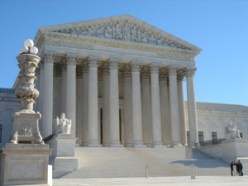
    Supreme Court Building #2The Supreme Court's action on Monday can be seen as a delay tactic on the part of the Court.  Obviously, no decision on whether the Court will hear this case will be made before the Court's next term.  Moreover, the Solicitor General does not have a deadline for expressing the views of the United States.  Nevertheless, this still can be seen as a positive for Sandoz.  It would not have been surprising for the Court to deny the petition outright; especially considering the Federal Circuit opinion was the first significant interpretation of the BPCIA by a Court of Appeals.  In fact, Amgen argued in its opposition brief that this case was a poor vehicle for review because the issues are still be developed by the lower courts.  However, the Supreme Court did not wait for the case law to develop at the PTAB and the Federal Circuit regarding the new IPR proceedings, but instead took up the first appeal it could, which culminated in the Court's opinion in Cuozzo v. Lee on Monday.  As a result, a lot could hinge on the views of the United States, which we will likely see later this year.  Patent Docs will continue to monitor this case and provide updates as necessary.

  • By Andrew Williams

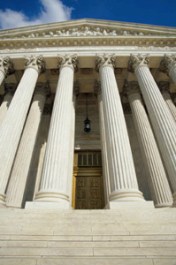
    Supreme Court Building #3The saga of the first-filed IPR petition (IPR2012-00001) came to a close today when the Supreme Court decided the Cuozzo Speed Technologies, LLC v. Lee case.  We have been following this case ever since the PTAB issued its Final Written Decision — the first that the PTAB ever issued.  On the first question, the Court unanimously approved of the USPTO's decision to use the "broadest reasonable interpretation" standard for claim construction in IPR proceedings.  This question will be addressed in a separate post.  On the second question, six members of the Court agreed that the statute mandated that the decision to institute an IPR was not subject to judicial review.  Justice Breyer authored the decision of the Court, with Justice Alito penning a dissent on the second question, which was joined by Justice Sotomayor.

    The second question centered on the correct interpretation of 35 U.S.C. § 314(d) ("No appeal. — The determination by the Director whether to institute an inter partes review under this section shall be final and nonappealable.").  Cuozzo took the position that the Board's institution of the IPR proceeding in this case was contrary to the statute.  Specifically, the PTAB had instituted trial for at least some of the claims on grounds that were not explicitly identified in the petition.  According to Cuozzo, this violated § 312(a)(3), which requires that the petition set forth the grounds for challenge "with particularity."  The Patent Office instead took the position that any issue related to institution cannot be reviewed.  Following oral argument, it was difficult to predict how the Court would resolve this question, particularly because very little of the time was dedicated to this issue.  Justice Breyer resolved the question by looking to the congressional objective in passing the AIA — to give "the Patent Office significant power to revisit and revise earlier patent grants."  As a result, he concluded that Congress intended to bar review of the Board's decisions about whether the "reasonable likelihood" standard of ultimately prevailing in the case had been met.  Justice Breyer also believed that cases "where a patent holder grounds its claim in a statute closely related to that decision to institute" the IPR proceedings cannot be reviewed.

    This did not mean that Justice Breyer believed that all questions related to institution should be unreviewable.  For example, the decision states that the Justices "need not, and do not, decide the precise effect of §314(d) on appeals that implicate constitutional questions, that depend on other less closely related statutes, or that present other questions of interpretation that reach, in terms of scope and impact, well beyond 'this section.'"  Therefore, according to the Court, constitutional questions related to due process could still be appealed.  In addition, if the Patent Office were to partake in "shenanigans," the Federal Circuit could set aside the decision as "'contrary to constitutional right,' 'in excess of statutory jurisdiction,' or 'arbitrary [and] capricious.'"  Justice Breyer used as an example the invalidation of a claim as indefinite under § 112, which would be a clear violation of statutory authority for IPR proceedings.  Justice Alito's dissent-in-part disagreed with the majority.  Under his understanding, many more institution decisions would be reviewable because of the strong presumption favoring judicial review.  This dictated his conclusion that this statutory provision did not prevent any review, but merely channeled any appeal though the Board's final written decision.

    While the majority appears to have drawn a bright line between what is and is not reviewable, the line gets fairly blurry when considering some of the questions that the Federal Circuit has determined are unreviewable.  At first glance, the new standard looks similar to the "authority to invalidate" test articulated by the Federal Circuit appeared in Versata Dev. Grp., Inc. v. SAP America, Inc.  In that case, the Federal Circuit reviewed whether the patent at issue was a proper CBM patent — whether it was a patent covering a financial product or service, and whether the patent was for a technological invention.  The Federal Circuit distinguished this case from its Cuozzo case (In re Cuozzo) by pointing to the distinction between institution and invalidation.  Because the determination whether the patent at issue was a covered business method patent related to the Board's "authority to invalidate," review of the decision was found to be appropriate.  In other words, if the patent at issue was not a proper CBM patent, it would be outside the statutory jurisdiction of the Board.  Therefore, without necessarily using the same terminology, the Cuozzo v. Lee decision is consistent with allowing review of CBM patent determinations.

    The difficulties arise because the "authority to invalidate" standard did not take hold at the Federal Circuit outside the context of CBMs.  Many hypotheticals have been posited about the horrors that could result from the Federal Circuit's refusal to review any institution decision.  Probably the most concrete example was when the Court refused to review whether a third-party was a real party in interest.  This case, Achates Reference Publ'g, Inc. v. Apple Inc., did not rest on that singular question, however, but rather the Federal Circuit concluded it could not review any decision related to the statutory time-bar — whether a petitioner was barred from filing an IPR petition because it had been sued in district court more than one year beforehand.  Justice Breyer's decision suggests that this situation would fall within the "shenanigans" standard and thus allow review of such cases.  However, because of the broad language used by the Supreme Court, this decision means that only time will tell if the Federal Circuit agrees.  Therefore, even though we won't have any more Cuozzo decisions, the fallout from Cuozzo v. Lee is likely to be felt for years to come.

    Cuozzo Speed Technologies LLC v. Lee (2016)

  • By Kevin E. Noonan

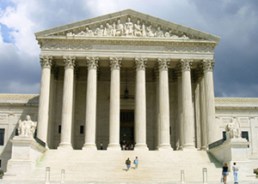
    Supreme Court Building #1In its first pronouncement regarding the post-grant reviewing proceedings established by the America Invents Act ("AIA"), the Supreme Court ruled that the Patent and Trademark Office's positions on two of the law's provisions regarding inter partes review ("IPR") were correct.  First, the Court held unanimously that the USPTO properly applied the "broadest reasonable interpretation" standard for claim construction for IPRs.  Second, six members of the Court also agreed that the statute mandated that the decision to institute an IPR was not subject to judicial review.  Justice Breyer authored the decision of the Court, with Justice Thomas authoring a concurring opinion to voice his continued displeasure with judicial deference to administrative agencies under Chevron USA Inc. v. Nat'l Defense Council, Inc.  On the second question Justice Alito penned a dissent, which was joined by Justice Sotomayor.  This post will discuss the Court's first holding regarding the standard of review for claim construction; a related post will discuss the unreviewability of the Office's decision to institute an IPR in the first place (found in Section II of the opinion).

    Section I of Justice Breyer's opinion provides a detailed review of patent examination and reexamination procedures, up to an including IPRs under the AIA.  This synopsis contains a highly simplified description of the invention (bordering on trivializing it) but then references an Appendix, which "offer[s] a less simplified (and more technical) description" of the invention.

    Section III is directed to the claim construction standard used by the PTAB in deciding IPRs.  Cuozzo argued that the Office did not have the legal authority to issue its regulations using the "broadest reasonable interpretation" (BRI) claim construction standard.  But the Court found otherwise, that Congress gave the Office this authority is 35 U. S. C. §316(a)(4):  "a provision that grants the Patent Office authority to issue 'regulations . . . establishing and governing inter partes review under this chapter'" — just like the Federal Circuit.  This conclusion was expressly based on the following rubrics from Chevron:  where a statute is clear, the agency must follow the statute, but where a statute leaves a "gap" or is "ambigu[ous]," the Court will "typically interpret it as granting the agency leeway to enact rules that are reasonable in light of the text, nature, and purpose of the statute."  Such a "gap" is found here, because "[n]o statutory provision unambiguously directs the agency to use one standard or the other."  In addition, "the statute 'express[ly] . . . authoriz[es] [the Patent Office] to engage in the process of rulemaking' to address that gap" in the Court's opinion, citing United States v. Mead Corp., 533 U. S. 218, 229 (2001).

    The opinion addresses the dissent at the Federal Circuit:  that the Office has authority only to issue procedural rules under §2(b)(2)(A), citing Cooper Technologies Co. v. Dudas, 536 F. 3d 1330, 1335 (Fed. Cir. 2008).  But the Court believes § 316 expressly gives the Office rulemaking authority that authorizes using the BRI standard.  In interpreting these two parts of the Patent Act, the opinion distinguishes the language of § 2(b)(2)(A), which gives "the Patent Office authority to issue 'regulations' 'which . . . shall govern . . . proceedings in the Office'" (emphasis in opinion) with the statutory language of §316(a)(4), which gives the Office the authority to promulgate regulations "establishing and governing inter partes review."  According to the Court, "[t]he Circuit's prior interpretation of §2(b)(2)(A) cannot magically render unambiguous the different language in the different statute before us."

    The opinion also addresses, and rejects, Cuozzo's argument (supported by certain amici) that Congress intended the IPR procedure to be adjudicatory in nature.  Instead, the Court states that "inter partes review is less like a judicial proceeding and more like a specialized agency proceeding," on the basis that petitioners need not have standing, citing Consumer Watchdog v. Wisconsin Alumni Research Foundation, 753 F. 3d 1258, 1261–1262 (Fed. Cir. 2014); the parties may settle yet the PTAB may continue to a decision; and the Office's capacity to intervene, as it did in this case, in later judicial review of the PTAB's decisions.  The opinion also notes the difference in the burden of proof in IPR (preponderance) versus at trial (clear and convincing evidence) as an indication that Congress did not intend an IPR to be a substitute for district court litigation.

    The Court also was not persuaded that Congress changed the fundamental nature of the proceedings when it changed the name from "reexamination" to "review"; in the Court's view the essence of all these proceedings is to provide "a second look at an earlier administrative grant of a patent."  "Thus, in addition to helping resolve concrete patent-related disputes among parties, inter partes review helps protect the public's 'paramount interest in seeing that patent monopolies . . . are kept within their legitimate scope," said the Court, citing Precision Instrument Mfg. Co. v. Automotive Maintenance Machinery Co., 324 U. S. 806, 816 (1945).

    Finally, the Court found nothing in "the statutory language, its purpose, or its history" that suggested Congress had contemplated the claim construction standard the PTAB should apply.  In reaching this conclusion, the Court rejected Cuozzo's contention that intent could be found in § 301(d), in mandating that the Office should "determine the proper meaning of a patent claim," in view of "a background of language and practices indicating that Congress designed a hybrid proceeding the Court found ambiguous statutory language regarding the "proper standard" of claim construction.  Accordingly:

    The upshot is, whether we look at statutory language alone, or that language in context of the statute's purpose, we find an express delegation of rulemaking authority, a "gap" that rules might fill, and "ambiguity" in respect to the boundaries of that gap.  Mead Corp., 533 U. S., at 229; see Chevron U. S. A. Inc., 467 U. S., at 843.

    This conclusion led the Court to consider whether, and conclude that, the regulation the Office has adopted is reasonable.  Given primacy of place is the effect that using the BRI standard protects the public from "[a] reasonable, yet unlawfully broad claim [that] might discourage the use of the invention by a member of the public."  The Court recognizes that "an examiner's (or reexaminer's) use of the broadest reasonable construction standard increases the possibility that the examiner will find the claim too broad (and deny it)" but that "use of that standard encourages the applicant to draft narrowly" (an outcome the Court, or at least Justice Breyer, clearly believes is desirable).  The opinion is equally clear regarding its basis for believing this outcome is desirable:  "[t]his helps ensure precision while avoiding overly broad claims, and thereby helps prevent a patent from tying up too much knowledge, while helping members of the public draw useful information from the disclosed invention and better understand the lawful limits of the claim."  Moreover, the Court finds ample evidence of "past practice" before the Office applying the BRI standard, including in earlier reexamination proceedings and interferences (a position advocated by the Generic Pharmaceutical Association and friends as amici).  And the Court rejected Cuozzo's arguments that Congress intended IPRs to be different in kind from inter partes reexaminations (for many of the same reasons enunciated by the Court earlier in the opinion).  Importantly the Court also rejects the principal complaint by many commentators regarding the lack of the ability to amend claims that during ex parte examination provides the justification for using the BRI standard.  According to the Court, "[t]he process [] is not as unfair as Cuozzo suggests" because "[t]he patent holder may, at least once in the process, make a motion to do just what he would do in the examination process, namely, amend or narrow the claim" (and the opinion "counts" in favor of this "fairness" the opportunity to amend present during ex parte examination, seemingly content to ignore the basis for instituting IPRs, that the art presented was not considered during initial examination of the application that granted, improvidently or not, into the patent challenged in the IPR).  The opinion also elides the statistical evidence regarding the chimera that is the ability to amend claims in an IPR proceeding, saying "that question is not before us" (but "if not you, who?  And if not now, when?" is a fair question in response).  And finally, the Court is not disturbed by the issue of inconsistent outcomes between the PTAB and district court, saying "[t]his possibility [] has long been present in our patent system."

    Lead PTAB Judge Michael Tierney remarked, at this year's BIO International Convention, that he believed cases where the standard of review would make a difference in the outcome of an IPR would be exceedingly rare.*  It has certainly been the experience of most patent practitioners that in certain cases before certain examiners the reach of the "broadest" reasonable interpretation can seem strained.  See, for example, In re Suitco Surface, Inc.  Perhaps the PTAB will be more inclined to grant motions to amend as it (and practitioners) become more experienced in IPR proceedings, and as the likelihood increases that such amendments may in fact recite patentable claims.  But what is clear is that the Court believes that the Office has properly exercised the authority it was given by Congress.  Left untested is the question of whether this particular exercise of authority contravenes the separation of powers between Article I courts (such as the PTAB) and Article III courts that has been raised in other cases, but this is a question most decidedly not before the Court in this case.

    *"Will the PTAB be a Road Block for Biotech? Lessons Learned from the First Three Years of Inter-Partes Review and Future Prospects."

    Cuozzo Speed Technologies LLC v. Lee (2016)
    Opinion by Justice Breyer, joined as to Part II by Chief Justice Roberts and Justices Kennedy, Thomas, Ginsburg, and Kagan; concurring opinion by Justice Thomas; opinion concurring in part and dissenting in part by Justice Alito, joined by Justice Sotomayor

  • By Donald Zuhn

    Supreme Court Building #2In March, following the Federal Circuit's denial of Sequenom's petition for rehearing en banc, Sequenom filed a petition for certiorari for Supreme Court review of the Federal Circuit's decision in Ariosa Diagnostics, Inc. v. Sequenom, Inc.  In response to that petition, twenty-two amicus briefs were filed encouraging the Supreme Court to grant certiorari.  With the Court scheduled to consider Sequenom's petition in conference on Thursday, Patent Docs will examine selected amicus briefs in the coming week.  Today, we review the amicus curiae brief submitted by Dr. Ananda Mohan Chakrabarty.  Dr. Chakrabarty is most recognizable to those in the patent community for developing a genetically engineered organism using plasmid transfer, for which he obtained U.S. Patent No. 4,259,444, which in turn was the subject of the landmark Supreme Court case, Diamond v. Chakrabarty, 447 U.S. 303 (1980).

    Chakrabarty, AnandaDr. Chakrabarty (at left) begins his brief by arguing that "the current direction for addressing the issue [of what constitutes patentable subject matter under U.S. patent law], represented by the Mayo/Myriad/Alice framework of analysis, has failed and will continue to fail all stakeholders in the United States patent system," and therefore, "this Court should reconsider the basic issue of how to handle the judicial exceptions to § 101, particularly as [it] relates to the judicial exception categories of 'natural phenomena' and 'law of nature,'" adding that the Ariosa v. Sequenom case "offers an excellent opportunity to do so."  According to Dr. Chakrabarty, the Mayo/Myriad/Alice analytic framework "has turned § 101 into a needle's eye that must be traversed, rather than the broad open archway it was intended to be."  Dr. Chakrabarty acknowledges that "dealing with the judicial exception categories of 'natural phenomena' and 'laws of nature' requires different thinking than dealing with the more ambiguous category of 'abstract concept,'" and contends that for the first two exceptions "the proper analysis should focus on determining whether the thing covered by the patent claims involves an alteration or manipulation by the hand of man and, if so, whether that alteration or manipulation has created useful qualities or characteristics that did not exist in the thing's natural state."

    In a section of the brief entitled "A Scientist's View," Dr. Chakrabarty states that "[i]n this case, the Federal Circuit's adherence to Mayo, rather than following its own conviction that Sequenom's significant invention is worthy of patent protection, was exceptionally disappointing to scientists."  Contrasting the Federal Circuit's decision in Ariosa with the Supreme Court's decision in Mayo, Dr. Chakrabarty explains that "[s]peaking as a scientist, it was not surprising that the Mayo patent was held invalid," but suggests that "the Sequenom technology is altogether different, involving innovative and novel ideas for a technology that no longer requires the isolation of rare whole fetal cells."

    Quoting from Diamond v. Chakrabarty, Dr. Chakrabarty reminds that "[i]t is beyond dispute that 35 U.S.C. § 101 includes 'anything under the sun that is made by man,'" arguing that "[t]his principle is fully consistent with the judicially created exceptions of natural phenomena and laws of nature because those items — properly interpreted — are not new and not made by man."  Turning to his '444 patent, Dr. Chakrabarty posits that while the '444 patent "is unequivocally proper and valid[,] . . . it is easy to realize that the outcome might have been different under the Mayo/Myriad/Alice framework of analysis."  He suggests that "in that altered world of analysis, my patent would have been attacked as merely applying the basics of the genetic code, extracting a known natural DNA sequence from point A and inserting it into another known natural DNA sequence at point B using previously established (read 'conventional') techniques."

    Dr. Chakrabarty also asserts that:

    [T]he most far-reaching role of patentability in the modern life of a technical economy is to incentivize the formation of capital which leads to invention.  The sophistication of current science requires large amounts of capital to fuel the fire of invention.  The process takes years.  And unless the Mayo/Myriad/Alice framework is revised significantly and soon, its disastrous effect will harm the U.S. (and world) economies for a long time [emphasis in brief].

    For Dr. Chakrabarty, Step 1 of the Mayo/Myriad/Alice framework "is distinctly unhelpful," "provid[ing] no guidance on what that statement means or how to do it," and Step 2 of the Mayo/Myriad/Alice framework "is no better."  The whole framework "inherently conflates § 101 with §§ 102-103, if for no other reason than that terms such as 'inventive concept' and 'conventional steps' have a 200 year history of use in the context of distinguishing claimed inventions from the prior art."  Dr. Chakrabarty argues that "[t]he proper application of § 101 should be formulated in a manner that is separate and independent from §§ 101-103 and 112, just as those sections should be left free to do their jobs separate and independent from § 101."  He suggests that Sequenom's petition for certiorari presents "a perfect vehicle to re-define the proper framework of analysis of § 101, at least for the area of life sciences," arguing that:

    [T]he proper § 101 analysis should provide that, if the inventor claims a material — or a process using a material — that has been altered or manipulated by the hand of man and, if as a result of that alteration or manipulation, the claimed subject matter is shown to have qualities, characteristics, or properties that did not exist in the natural material, then that claimed subject matter passes muster under § 101 and is worthy of being considered under §§ 102-103 and 112.

    Applying his proposed analytic framework to Sequenom's invention, Dr. Chakrabarty explains that "the starting point is a sample of maternal blood (claim 21), serum (claim 1), or plasma (claim 1)," that "[t]he sample is altered and manipulated, as disclosed in the patent, with the result of yielding information about sex and genetic deformities of a fetus," and that "[t]here is no dispute in this record that this manipulation by the hand of man is novel, nonobvious, and properly disclosed in the specification."  He then asks "[h]ow can that not be patentable?"

  • CalendarJune 15-17, 2016 - Fundamentals of Patent Prosecution 2016: A Boot Camp for Claim Drafting & Amendment Writing (Practising Law Institute) – New York, NY

    July 6-8, 2016 - Fundamentals of Patent Prosecution 2016: A Boot Camp for Claim Drafting & Amendment Writing (Practising Law Institute) – San Francisco, CA

    June 9, 2016 – "Overcoming §103 Rejections for Biotech and Chemical Patents: Leveraging Recent Decisions and USPTO Guidance" (Strafford) – 1:00 to 2:30 pm (EDT)

    June 14, 2016 – "Patent Eligibility, Prior Art and Obviousness 2016: Current Trends in Sections 101, 102 and 103" (Practising Law Institute) – San Francisco, CA (also webcast)

    June 23, 2016 - Trade Secrets Seminar (Intellectual Property Law Association of Chicago) – Chicago, IL

    June 30, 2016 – Biotechnology/chemical/pharmaceutical (BCP) customer partnership (U.S. Patent and Trademark Office) – Alexandria, VA

    June 30, 2016 – "Ethics in Intellectual Property" (Intellectual Property Law Association of Chicago New Programming Committee) – Chicago, IL

    July 26, 2016 – "Pharma and Chemical Patent Applications: Meeting Written Description Requirement — Demonstrating Evidence of Possession of the Invention, Navigating the Guidelines, Maintaining Chain of Priority" (Strafford) – 1:00 to 2:30 pm (EDT)

    August 4-5, 2016 - Advanced Patent Law Seminar (Chisum Patent Academy) – Seattle, WA

    August 8-9, 2016 - Advanced Patent Law Seminar (Chisum Patent Academy) – Seattle, WA

    ***Patent Docs is a media partner of this conference or CLE

  • USPTO Building FacadeThe U.S. Patent and Trademark Office will be holding its next biotechnology/chemical/pharmaceutical (BCP) customer partnership meeting on Thursday, June 30, 2016 at the USPTO Headquarters (Alexandria, VA).  The agenda for the meeting is as follows:

    • Welcoming and Opening Remarks (10:00 – 10:10 am EDT) — Hope Shimabuku, Director, Dallas Regional Office, USPTO; Jerry Lorengo, Director, TC1600, USPTO; Daniel Sullivan, Director, TC1600, USPTO; and Wanda Walker, Director, TC1600, USPTO

    • Stakeholders’ Perspective On Patent Quality Initiative (10:10 – 11:00 am) — Frank P. Grassler, VP for Technology Development, Office of Technology Development, University of Texas Southwestern Medical Center

    Inter Partes Review/Post Grant Review: Status Report and Overview of the New Rules (11:00 – 11:50 am) — Lora Green, Administrative Patent Judge, PTAB, USPTO

    • Break (11:50 – 12:00 pm)

    • Biological Deposit (12:00 – 12:40 pm) — Gary Benzion, SPE, TC1600

    • TC Pendency (12:40 – 1:00 pm) — Brandon Fetterolf, SME/SPE, TC1600

    • Lunch (1:00 – 1:45 pm)

    • 101 New Examples; Workshop (1:45 – 3:15 pm) — Marjorie Moran, SME/SPE, TC1600; Zachariah Lucas, QAS, TC1600

    • Subject Matter Eligibility, A Stakeholder’s Perspective (3:15 – 3:35 pm) — Leslie Fischer, Senior Patent Attorney, Novartis Pharmaceuticals Corp.

    • Closing Remarks (4:50 – 5:00 pm) – TC1600 and Dallas Regional Office Directors

    Additional information regarding the BCP customer partnership meeting, including registration information for those wishing to attend the meeting or register for online participation, can be found here.

  • IPLACThe Intellectual Property Law Association of Chicago (IPLAC) New Programming Committee will be offering a seminar on "Ethics in Intellectual Property" from 8:00 to 9:30 am (Central) on June 30, 2016 at the offices of Kirkland & Ellis in Chicago, IL.  During the seminar, Mark Peterson of Aon Risk Solutions will share his experiences in ethics and risk management related to the prosecution and enforcement of intellectual property.  The registration fee for the Seminar is $30 (IPLAC members) or $40 (non-members).  Those interested in registering can do so here.

  • Strafford #1Strafford will be offering a webinar/teleconference entitled "Pharma and Chemical Patent Applications: Meeting Written Description Requirement — Demonstrating Evidence of Possession of the Invention, Navigating the Guidelines, Maintaining Chain of Priority" on July 26, 2016 from 1:00 to 2:30 pm (EDT).  Thomas L. Irving of Finnegan Henderson Farabow Garrett & Dunner will provide guidance to patent counsel to ensure chemical and pharmaceutical patent applications meet the written description requirement, outline lessons for counsel from Federal Circuit and PTAB decisions, and offer perspectives and strategies to avoid challenges.  The webinar will review the following issues:

    • Guidelines for pharmaceutical application's written description support, e.g., a novel drug substance, product, and method(s) of treatments and manufacture;
    • Preparing non-pharmaceutical, chemical application's written description in support of a novel compound, composition, and methods of use and compound manufacture;
    • How a lack of written description support can be used in an AIA inter partes review before PTAB; and
    • How a lack of written description support can be used before PTAB to attack claims by breaking the chain of priority to pre-AIA date benefit in an AIA post-grant review.

    The registration fee for the webinar is $297.  Those registering by July 1, 2016 will receive a $50 discount.  Those interested in registering for the webinar, can do so here.

  • By Donald Zuhn

    Supreme Court Building #2In March, following the Federal Circuit's denial of Sequenom's petition for rehearing en banc, Sequenom filed a petition for certiorari for Supreme Court review of the Federal Circuit's decision in Ariosa Diagnostics, Inc. v. Sequenom, Inc.  In response to that petition, twenty-two amicus briefs were filed encouraging the Supreme Court to grant certiorari.  With the Court scheduled to consider Sequenom's petition in conference next Thursday, Patent Docs will examine selected amicus briefs in the coming week.  Today, we review the amici curiae brief submitted by Eli Lilly and Company, Eisai Inc., Upsher-Smith Labroatories, Inc., Pfizer Inc., and Etiometry, Inc.

    LillyThe amici begin by noting that the Supreme Court has applied a nonstatutory "implicit exception" to patentability to ensure that patents cannot be granted for "concepts" (which, according to the amici, refer to laws of nature, natural phenomena, and abstract ideas), and that "[t]he Court has applied the implicit exception as part of a 'threshold test' for patentability that operates before other patentability requirements may be considered."  The amici contend, however, that the implicit exception "does no more than duplicate the [Patent Act's] effects when statutory provisions would also invalidate the same patent," and ask:

    Given the current explicit statutory limitations on patenting in the Patent Act—and the proper interpretation of those limitations—should the Court's judicially imposed implicit exception to subject matter considered to be eligible for patenting be abrogated, such that patentability and patent validity are to be determined solely under such explicit statutory provisions?

    Citing the amicus brief of Paul Gilbert Cole, the amici point out that "[t]he most pointed criticism of the Court's implicit exception is that the Court's recent jurisprudence has expanded the reach of the exception such that today it applies to invalidate U.S. patents that would be clearly eligible for patenting under international norms."  The amici note that the analytical framework devised by the Court for applying the threshold test for patentability is "intended to operate as a surrogate for the broader policy question of whether a patent claim is so conceptual that rights under the patent might dominate or otherwise preempt access to a law or product of nature, a natural phenomenon, or an abstract idea."  The amici suggest, however, that "[l]ike many surrogate tests, it risks overreaching its policy objectives."  Stating that "the Court has never considered whether the proper interpretation of the current statutory requirements, considered together rather than piecemeal, would fully address the policy considerations that caused the Court to mandate the non-statutory implicit exception," the amici argue that "it is now essential as an exercise of judicial restraint for the Court to consider whether to abrogate the implicit exception in deference to the present explicit statutory scheme" (emphasis in brief).

    The amici spend the remaining pages of their brief explaining how the statutory patentability requirements prevent valid claims from protecting or dominating a law of nature, natural phenomenon, or abstract idea, or covering or otherwise precluding access to naturally-occurring subject matter.  Noting that 35 U.S.C. § 101 requires that a valid claim must be drafted in terms of a "process, machine, manufacture, or composition of matter" or an improvement thereto, the amici contend that "[t]hese four statutory categories, by forcing valid patent claims to be expressed in terms of the applications that physically embody an invention, represent subject matter that is mutually exclusive with respect to mere concepts—such as laws, phenomena, and ideas."  According to the amici, "the patent statute explicitly limits patenting to physical embodiments, things and act-based processes that can only ever be applications of any related concept and can never be the concept itself" (emphasis in brief).  The amici argue that when 35 U.S.C. §§ 101, 103 and 112(a) are considered together, these statutory requirements, which limit valid patent claims to inventive and useful applications of any related concept, "operate to limit valid patent claims to inventive and practically useful applications of any law, phenomenon, or idea to which a claimed invention relates" (emphasis in brief).

    The amici acknowledge, however, that "[w]hile these various statutory provisions address whether valid patent claims can literally cover a law, phenomenon or idea, they do not necessarily foreclose resort to patent drafting techniques that might be used to craft valid patent claims preempting access to such concepts."  Nevertheless, the amici argue that "[t]he Patent Act of 1952 contains two provisions that, if properly interpreted and applied, fully negate the potential effectiveness of such drafting techniques: § 112(a) and § 112(f)."  According to the amici, "the combination of § 112(a) and § 112(f) forecloses the possibility that patent drafting techniques might secure protection over a concept to which an invention relates beyond the physical embodiments of the invention as set out in terms of the specific structures, materials, or acts disclosed in the patent."

    With respect to the statutory requirement for novelty, the amici argue that this requirement — and more specifically the "inherent anticipation" aspect of this requirement — "bars the patenting of any subject matter that exists or operates in nature," and "assures that patent rights cannot impair access to the basic tools of science or technology or in any other way impede the ability of the patent system to promote progress in the useful arts."

    The amici conclude their brief by declaring that:

    Interpreting the current statutory provisions in a manner consistent with the Court's precedents makes it impossible to identify any scenario under which a valid patent could provide protection for a law of nature, a natural phenomenon, or an abstract idea—either directly or through drafting techniques aimed at yielding a valid patent claim that might dominate or otherwise preempt access to such a law, product, phenomenon, or idea.  The same applies with respect to patents relating to entirely mental processes and products of nature.

    Given the manifest difficulties that the implicit exception presents to the proper functioning of the patent laws, the Court should address whether judicial restraint now dictates deference to the statutory framework.

  • Patent Having Claims That Apply Law of Nature Is Patent-Eligible

    By Joseph Herndon

    C.D. CalOn June 8, 2016, the U.S. District Court for the Central District of California issued an order denying a motion to dismiss, and found that U.S. Patent No. 5,720,894 is directed to patent-eligible subject matter in a case captioned Femto-Sec Tech, Inc. v. Lensar, Inc.

    Lensar argued that the '894 Patent is directed to a "natural phenomena and laws of nature," but the Court made it clear that a patent with claims that apply laws of nature should not be considered patent-ineligible as being directed at that law of nature.

    The '894 Patent is directed to the field of ultrashort pulse duration laser systems suitable for material and biological tissue processing.  The patent purportedly improved upon the prior art of the use of lasers as a therapeutic and preventive tool in various fields, such as surgery, by increasing ablation efficiency while minimizing collateral damage to adjacent material.

    The '894 Patent recites two independent claims, and claim 1 is representative and reproduced below.

    1.  A method for selective material removal processing comprising:
        providing a pulsed laser;
        operating said laser so as to produce a pulsed output beam, the beam comprising individual pulses each having a pulse duration in the range of from about 1 femtosecond to about 100 picoseconds;
        directing said pulsed output beam onto a target material from which removal is desired, wherein each pulse interacts with a thin layer portion of said material so as to form a plasma;
        allowing said formed plasma to decay, such that said material portion is removed; and
        repeating said plasma formation step at a pulse repetition rate greater than 10 pulses per second until a sufficient depth of material has been removed with substantially no transfer of thermal or mechanical energy into the remaining material and substantially no collateral damage thereto.

    Nuijten Standard

    An invention is patent-eligible if it claims a new and useful process, machine, manufacture, or composition of matter, according to 35 U.S.C. § 101.  Claims that encompass transitory forms of signal transmission (e.g., transitory electrical and electromagnetic signals propagated through some medium) are invalid because those transitory embodiments are not directed to statutory subject matter.  In re Nuijten, 500 F.3d 1346, 1353 (Fed. Cir. 2007).  A transitory signal per se is not one of the four categories of patentable subject matter.

    Lensar initially provided arguments questioning whether or not a laser beam is among one of the statutory categories, and submitted that the laser beam is more analogous to a signal per se.  The Court, however, found that neither of the independent claims of the '894 Patent purports to claim a laser beam per se.  Instead, independent claim one clearly claims only a "method" which includes, as a required step in the process, the use of a "pulsed laser."  The method claim is a "process" under 35 U.S.C. § 101 and is, thus, directed to statutory subject matter.

    The Court noted that contrary to Lensar's assertion, the Federal Circuit in Nuijten did not find the electromagnetic signal to be a patent-ineligible natural phenomenon.  Courts applying Nuijten do not strike patents that improperly claim natural phenomenon, but rather, patents that improperly claim transitory signals.  Here, because no signal is claimed, the Nuijten arguments were not relevant.

    Alice Standard

    Laws of nature, natural phenomena, and abstract ideas are not patentable.  The two-step Alice test is used for patent eligibility purposes.  First, the Court must determine whether the claims at issue are directed to one of those patent-ineligible concepts, and if so, then the second step requires the Court to search for an inventive concept.

    Lensar argued that the claims are directed toward natural phenomena and the laws of nature.  The Court found that Lensar failed to indicate what portion of the patent claims appear to claim for itself a particular law of nature, and rather, found that the '894 patent does not, in fact, recite a law of nature.

    In Alice, the Supreme Court reiterated that a "patent is not rendered ineligible for patent simply because it involves" a patent-ineligible concept.  Instead, a patent is ineligible if it is directed to the patent ineligible concept, for example, by claiming an essential building block of human ingenuity or a scientific principle.

    Here, the Court found that the claims of the '894 Patent are not directed towards the broad, generalized use of electromagnetic spectrum.  Instead, the '894 Patent has claimed a particularized, specific use of a specific range of the electromagnetic spectrum; a use that the '894 Patent claims has particular and useful effects.  The Court further iterated that the plain focus of the claim is not directed, broadly, to laser beams, but instead the focus of the claim is the operation of a pulse laser of an ultrashort duration (between a femtosecond (quadrillionth of a second) and 100 picoseconds (trillionth of a second)) repeatedly to achieve the desired results of material removal with substantially no collateral damage.

    The Court made clear that although this invention, like all patent-eligible inventions, may at some level "apply laws of nature," that does not mean that the present invention is directed at that law of nature.

    The Court also noted that Lensar failed to show how ultrashort pulse laser beams are naturally occurring phenomena.  In fact, the '894 Patent indicates that the ultrashort pulse laser beams have to be generated from a specialized piece of equipment.  The Court found that the discovery that the material-removing properties of ultrashort pulsed lasers have beneficial effects is "not nature's handiwork" but rather the work of the inventor of the subject matter here.

    Although the Court concluded that the claims of the '894 Patent survive scrutiny under step one of the Alice analysis, the Court also determined that the claims of the '894 Patent would also survive under step two of the Alice framework.  The Court highlighted the fact that use of ultrashort pulsed beams at least improves the functionality of a laser for a specific, particularized purpose:  material removal.

    The Court thus concluded that the claims of the '894 Patent are patent eligible.  The Court here provides a nice example to push-back on the unfounded allegations of § 101 attacks, and made it clear that a patent with claims that apply laws of nature should not be considered patent-ineligible as being directed at that law of nature.

    Order Denying Defendant's Motion to Dismiss by Honorable James V. Selna