• Strafford #1Strafford will be offering a webinar/teleconference entitled "Structuring Freedom-to-Operate Opinions: Reducing Risk of Patent Infringement — Combating Troubling FTO Results, Overcoming Potential Roadblocks, Addressing Impact of Post-Grant Process on FTO Opinions" on September 21, 2016 from 1:00 to 2:30 pm (EDT).  Doris Johnson Hines and Thomas L. Irving of Finnegan Henderson Farabow Garrett & Dunner, and Laura A. Labeots, Ph.D., of Husch Blackwell will provide guidance to patent counsel preparing and providing freedom-to-operate (FTO) opinions for companies developing new products, and outline best practices for drafting FTO opinions to reduce infringement risks.  The webinar will review the following issues:

    • What are best practices for patent counsel when analyzing FTO issues and structuring FTO opinions?
    • What is the impact of the post-grant process on FTO opinions?
    • When should counsel seek FTO opinions to protect new research and products from infringement claims?

    The registration fee for the webinar is $297.  Those interested in registering for the webinar, can do so here.

  •         By Sherri Oslick

    Gavel About Court Report:  Each week we will report briefly on recently filed biotech and pharma cases.

    Tris Pharma Inc. v. Actavis Elizabeth LLC et al.
    1:16-cv-00603l; filed July 12, 2016 in the District Court of Delaware

    • Plaintiff:  Tris Pharma Inc.
    • Defendants:  Actavis Elizabeth LLC; Actavis Inc.

    Infringement of U.S. Patent Nos. 8,202,537 ("Modified Release Formulations Containing Drug-Ion Exchange Resin Complexes," issued June 19, 2012), 8,287,903 ("Orally Effective Methylphenidate Extended Release Powder and Aqueous Suspension Product," issued October 16, 2012), 8,999,386 ("Methylphenidate Extended Release Chewable Tablet," issued April 7, 2015), and 9,295,642 (same title, issued March 29, 2016) following a Paragraph IV certification as part of Actavis' filing of an ANDA to manufacture a generic version of Tris' QuilliChew ER® (methylphenidate hydrochloride extended-release chewable tablets, used to treat ADHD in children 6 years and above).  View the complaint here.


    Imprimis Pharmaceuticals, Inc. v. Alcon Pharmaceuticals Ltd. et al.
    3:16-cv-01794; filed July 11, 2016 in the Southern District of California

    • Plaintiff:  Imprimis Pharmaceuticals, Inc.
    • Defendants:  Alcon Pharmaceuticals Ltd.; Alcon Research, Ltd.

    Declaratory judgment of noninfringment of U.S. Patent Nos. 6,716,830 ("Ophthalmic Antibiotic Compositions Containing Moxifloxacin," issued April 6, 2004) and 7,671,070 ("Method of Treating Ophthalmic Infections with Moxifloxacin Compositions," issued March 2, 2010) based on Imprimis' manufacture and sale of certain ophthalmic products.  View the complaint here.


    Gilead Sciences, Inc. et al. v. Aurobindo Pharma Ltd. et al.
    1:16-cv-04178; filed July 8, 2016 in the District Court of New Jersey

    • Plaintiffs:  Gilead Sciences, Inc.; Emory University
    • Defendants:  Aurobindo Pharma Ltd.; Aurobindo Pharma USA Inc.

    Infringement of U.S. Patent Nos. 6,642,245 ("Antiviral Activity and Resolution of 2-Hydroxymethyl-5-(5-fluorocytosin-1-yl)-l,3-oxathiolane," issued November 4, 2003), 6,703,396 ("Method of Resolution and Antiviral Activity of 1,3-Oxathiolane Nucleoside Enantiomers," issued March 9, 2004), 8,592,397 ("Compositions and Methods for Combination Antiviral Therapy," issued November 26, 2013), and 8,716,264 (same title, issued May 6, 2014) following a Paragraph IV certification as part of Aurobindo's filing of an ANDA to manufacture a generic version of Gilead's Truvada® (emtricitabine and tenofovir disoproxil fumarate, used for the treatment of HIV-1 infection in adults).  View the complaint here.


    Merck Sharp & Dohme Corp. v. Genentech, Inc. et al.
    2:16-cv-04992; filed July 7, 2016 in the Central District of California

    • Plaintiff:  Merck Sharp & Dohme Corp.
    • Defendants:  Genentech, Inc.; City of Hope

    Declaratory judgment of invalidity and noninfringement of U.S. Patent No. 7,923,221 ("Methods of Making Antibody Heavy and Light Chains Having Specificity for a Desired Antigen," issued April 12, 2011) based on Merck's manufacture and sale of its Keytruda® product (pembrolizumab, used to treat patients with unresectable or metastatic melanoma, and for the treatment of patients with metastatic or PD-L1 positive, non-small cell lung cancer, as determined by an FDA-approved test, with disease progression on or after platinum-containing chemotherapy) and/or Merck's anticipated manufacture and sale of its bezlotoxumab products (to be used for the prevention of Clostridium difficile infection recurrence).  View the complaint here.


    AstraZeneca AB v. Apotex Corp. et al.
    1:16-cv-00583; filed July 7, 2016 in the District Court of Delaware

    • Plaintiff:  AstraZeneca AB
    • Defendants:  Apotex Corp.; Apotex Inc.

    Infringement of U.S. Patent No. RE44,186 ("Cyclopropyl-Fused Pyrrolidine-Based Inhibitors of Dipeptidyl Peptidase IV and Method," issued April 30, 2013) following a Paragraph IV certification as part of Apotex's filing of an ANDA to manufacture a generic version of AstraZeneca's Onglyza® (saxagliptin hydrochloride, used as an adjunct to diet and exercise to improve glycemic control in adults with type 2 diabetes mellitus).  View the complaint here.

  • By Joseph Herndon

    USPTO SealSally Beauty (Petitioner) filed a Petition requesting a review under the transitional program for covered business method (CBM) patents of U.S. Patent No. 5,969,324, owned by Intellectual Ventures I LLC (IV).

    Sally Beauty challenged the patentability of claims 1–14 of the '324 Patent under 35 U.S.C. §§ 101, 102, and 103.  IV disclaimed claim 14 (e.g., reciting point of sale), such that claims 1–13 remain to be challenged in the proceeding.

    The PTAB determined that the Petition demonstrated that it is more likely than not that at least one of the challenged claims is unpatentable, and a CBM patent review of all of the challenged claims of the '324 Patent was instituted.

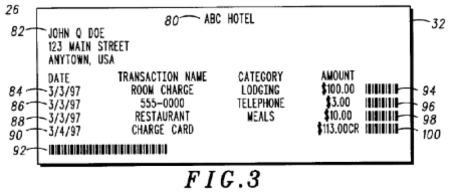
    The '324 Patent relates to electronic recordkeeping of accounting data.  The Specification discusses the disadvantages of prior bookkeeping systems, and discloses the use of nonpredictable bar codes to identify transactions that are downloaded to an end user.  From a point of sale terminal, transaction information, including a list of items purchased, the amounts charged or credited for each item, and the date and time of the transaction, are received and associated with a nonpredictable code.  That nonpredictable code may be embedded in a bar code printed on a receipt by the point of sale terminal, as illustrated in Fig. 3, reproduced below.  Subsequently, the end user can scan the transaction receipt with the bar code and the resultant information can be transmitted to the end user's computer.

    FIG3
    Claims 1 and 9 are independent, and claim 1 is considered representative of the claims challenged.  Claim 1 is reproduced below:

    1.  A database management method comprising the steps of:
        receiving and storing transaction information associated with a nonpredictable bar code, the transaction information generated by a transaction terminal;
        receiving a request for the transaction information including data associated with the nonpredictable bar code;
        retrieving the transaction information based upon the nonpredictable bar code; and
        communicating the transaction information.

    Standing to Seek Covered Business Method Patent Review

    A covered business method patent "claims a method or corresponding apparatus for performing data processing or other operations used in the practice, administration, or management of a financial product or service, except that the term does not include patents for technological inventions."  AIA § 18(d)(1).

    Sally Beauty argued that the '324 Patent claims relate to a financial product or service, citing claims 1 and 9 and its recitation of "transaction information," as well as discussion in the Specification and Figures which detail the communication of information in a transaction receipt generated at a point of sale terminal.

    But IV argued that a recent Federal Circuit case (Blue Calypso LLC v. Groupon, Inc., 815 F.3d 1331 (Fed. Cir. 2016)) requires that the proper standard to apply when assessing the financial product or service prong of CBM eligibility is whether the claims of the patent, as construed, expressly or inherently recite a financial component.  IV argued that neither claim 1 nor claim 9 expressly or inherently recite a financial component, because "transaction information" is not exclusive to the financial sector, involving technology common in business environments across different sectors.

    IV noted also argued that the Specification of the '324 Patent does not limit the scope of the claims to a financial product or service.

    But the PTAB was persuaded by Sally Beauty in that at least one claim recites a method for performing data processing or other operations used in the practice, administration, or management of a financial product or service, namely claim 1.  Claim 1 explicitly recites that the information that the method is performed on is "transaction information."  Although claim 1 could be used with any number of transactions in a non-financial environment, the clear thrust of the '324 Patent was found to be toward financial transactions.

    The PTAB also noted that an exclusivity to the financial sector test is not a proper inquiry to make, given the legislative history indicating that "financial product or service" should be interpreted broadly.  Where a broad claim could be interpreted as being applicable to both a financial product or service, and to a non-financial product or service, such an exclusivity test would excise all claims from consideration that do not implicitly recite such a product or service.  Because here the clear implication from the Specification of the '324 Patent is that the claimed "transaction information" is directed to use with a financial product or service, at least one claim was found to recite a method directed to a financial product or service sufficient to meet a criterion for instituting a covered business method patent review.

    Technological Invention Exception

    The definition of "covered business method patent" in Section 18(d)(1) of the AIA does not include patents for "technological inventions."  To determine whether a patent is for a technological invention, we consider "whether the claimed subject matter as a whole recites a technological feature that is novel and unobvious over the prior art; and solves a technical problem using a technical solution."  37 C.F.R. § 42.301(b).  Both prongs must be satisfied in order for the patent to be excluded as a technological invention.

    Sally Beauty argued that the '324 Patent is not for a technological invention because none of the claims recite a technological feature that is novel and nonobvious over the prior art.  According to Sally Beauty, the terms recited in the claims are directed to generic, well-known components when the '324 Patent application was filed, and use of the claimed "nonpredictable bar code" includes bar codes that were known at that time as the '324 Patent concedes.

    IV did not argue that the claims of the '324 Patent recite a novel and unobvious technological feature.

    Thus, the PTAB easily found that the '324 Patent is not for a technological invention because at least claim 1 does not satisfy the first prong of the test.  Claim 1 does not recite a technological feature that is novel or unobvious over the prior art.  Claim 1 recites, in part, "receiving and storing transaction information associated with a nonpredictable bar code," such that no bar code need be scanned to meet the claim limitations, so that the claim only requires the manipulation of information.  The steps of receiving a request for information, retrieving that information, and communicating that information were all known processes that are generally performed by computers during the relevant time period, i.e., at the time of filing the '324 Patent.

    Thus, the PTAB found that the '324 Patent is eligible for covered business method patent review.

    Section 101 Subject Matter Eligibility

    Once the CBM review was instituted, the claims were challenged under section 101.  Sally Beauty argued that the claims of the '324 Patent are directed merely to an abstract idea of "storing and retrieving transaction information through the use of a well-known security feature."  The argument presented was that the '324 Patent itself concedes that it was intended to automate a manual process and the claims describe the automation of the fundamental economic concept of recording and retrieving transaction information through the use of generic computer functions.

    IV responded by indicating that the claim term "bar code" was read out of its analysis.  But the PTAB found that the claims recite receiving transaction information associated with a nonpredictable bar code, rather than use of a bar code.  No scanning or querying of any type of bar code is specifically recited, such that the independent claims need only handle the associated information, post-derivation, to satisfy the steps of claim 1 or the system of claim 9.  As such, from a standpoint of determining if the claims are directed to an abstract idea, any consideration of the use of a nonpredictable bar code is not necessary.

    With respect to step 2 of the Mayo analysis, i.e., whether additional elements of the claims transform the nature of the claims into a patent-eligible application of the abstract idea, Sally Beauty argued that the claims are merely directed to performing the recited processes "using basic and indisputably well-known computing components."

    IV simply argued that Sally Beauty did not show that the claim elements recite no inventive concept, but provided no specific analysis of Sally Beauty's assertions.

    The PTAB found that the challenged claims of the '324 Patent are directed to the abstract idea of "storing and retrieving transaction information through the use of a well-known security feature," and that additional elements of the claims do not transform the nature of the claims into a patent-eligible application of the abstract idea.

    The PTAB found that these additional computer-related limitations are not meaningful limitations that can salvage these claims and make them patent eligible, and that these computer-related limitations require nothing more than the routine and conventional use of a computer to receive, retrieve, and communicate information, and the handling of information requests.

    The PTAB noted that, to be limited meaningfully, the claim must contain more than mere field-of-use limitations, tangential references to technology, insignificant pre- or post-solution activity, ancillary data-gathering steps, or the like.

    As such, the PTAB was persuaded that it is more likely than not that claims 1–13 of the '324 Patent are directed to ineligible subject matter under 35 U.S.C. § 101, and thus, a CBM patent review of all of the challenged claims of the '324 Patent was instituted.

    Before Administrative Patent Judges Karl D. Easthom, Kevin F. Turner, and Kevin W. Cherry
    Decision by Administrative Patent Judge Turner

  • By Kevin E. Noonan

    American Economic ReviewOne of the great benefits of scientific inquiry is the capacity for presumptions and prejudices from experience to be challenged and explained in ways that are counter-intuitive.  This is true even for disciplines like economics, where the complexity of the variables involved (and the inability for most studies to be experimentally manipulated for pragmatic or ethical reasons) increase the necessity to avoid "just so" explanations for the observed data.  Recently a paper by Cockburn, Lanjouw, and Schankerman, "Patent and the Global Diffusion of New Drugs," American Economic Review 106: 136-64 (2016), challenges the conventional wisdom that patents impede and price regulations promote access to new drugs around the world and particularly in developing countries.

    The study evaluated the time to launch of 642 new drugs in 76 countries between 1983-2002.  The data in broad strokes showed that both patent protection and price regulations "strongly affect" how quickly new drugs become commercially available.  But contrary to expectations, the data showed that launch is delayed by price regulation, whereas "[l]onger and more extensive patent rights" accelerate new drug launch.  In addition to these results, the authors noted that other factors (health policies, demographics, economic factors) that make drug markets more profitable also speed up introduction of new drugs, using data controlled for policy regimes country-by-country and otherwise.

    The authors recognize the competing interests and factors:  on the one hand, providing adequate incentives for new drug development in the first place, and on the other hand having those drugs priced to be "affordable" for a sufficient percentage of the citizens who need or could benefit from the drug to avoid political consequences.  The authors also recognize that governments encourage the first with patents and the second with price controls.

    Much of the literature on these competing interests has been focused on the GATT/TRIPS agreement and its semi-compulsory harmonization of patent protection globally, particularly in developing countries.  There, the "tradeoff" seems particularly inequitable, because in addition to the "deadweight loss" of higher prices due to patents (these are economists, after all) there is the prospect of significant portions of such populations being unable to afford access to the drugs.  Some have also argued that the benefits of patenting in these countries is far less, and thus the risks to innovation of price regulation are sufficiently low as to minimize the need for patenting.

    These authors looked at another metric:  the effects of patents and price controls on the rate of diffusion (i.e., new drug introduction) in countries outside the U.S.  This is because, according to the authors, "[t]he public health benefits of new drugs depend, first, on how quickly (if at all) drugs are launched in different countries and, second, on how widely they are adopted within a country, once launched."  The calculus they used ignores the R&D costs of the drugs, which by definition are "sunk costs" by the time the drug begins to "diffuse" into countries other than where it was developed.  Even so, drug makers are sensitive to the balance between anticipated profits and costs of launching in each country.  Such costs include those incurred to obtain regulatory approval (such as clinical trials) as well as setting up distribution networks, "detailing," and reimbursement mechanisms.  These are country-by-country costs, and thus the authors could meaningfully investigate how different patent and price control regimes affected drug launch in each country.

    Traditional economic theory assumes these costs are negligible and thus introduction in each country depends on idiosyncratic variables in the demand for each drug in each country.  These authors posit that the costs are not negligible, and that the policies in each country and their effect on expected profits matter in determining whether and how quickly new drugs are introduced into each country.

    The countries chosen for study "span all levels of economic development and exhibit a wide variety of patent regimes."  The study also differentiates between process patents (protecting methods for manufacturing drugs, which the authors characterize as "weak" and use India as an example of a country that permitted only process patents as a way to promote domestic competitive entry, i.e., generics) and product patents, which they say "confer stronger rights . . . and allow[] for more effective appropriation of rents."

    They discuss four principal empirical findings:

    • There is limited scope and slow pace of global diffusion of new drugs (with there being long (> 10 years) lags in many countries and many drugs never being launched outside a small number of developed countries).

    • Patent policies adopted by different governments "strongly affect" the rate of diffusion, with "[l]onger, and stronger, patent protection" increasing the rate of adoption (reducing the lag by 55% when comparing countries with no product patents with those with "long" product patent terms).  Interestingly, which process patents also have an effect they report to have a much lower impact, and product patents having "short" terms have no effect at decreasing the lag in drug introduction rates.

    • Price controls have the opposite effect, with countries having "strong" controls having "significantly longer launch lags" (i.e., increasing by about 25% on average and, in some circumstances, by as much as 80%).

    • New drugs are launched more quickly in countries having institutions that promote drug availability and distribution (citing adoption of the WHO's Essential Drug List as one factor).

    There was also an effect of market size, consistent with earlier studies showing, inter alia, that "market size is associated with greater pharmaceutical innovation and nongeneric entry."

    The econometric analysis presented in the paper is beyond the scope of this discussion here; to illustrate, the authors assert that:

    The probability that the drug is launched in country j at time t, given it has not been launched before (the hazard rate of launch), is

    h(t|Zijt)        = Pr(ωijt > ω*ijt| ωij1 < ωij1, . . . , ωijt-1 < ω*ijt-1)

                       = Pr(ωijt > ω*ijt| ωij, t-1 < ω*ijt-1)

    where Zijt ≡ (xij,Tj,tijij) is assumed known to the firm, and the second equality follows from the AR(1) assumption on ω. This implies that the hazard rate is a decreasing function of factors that raise the threshold ω*.

    'Nuff said.

    The dataset used was based on the entry date of the drugs in each country, branded or generic, as compiled by IMS Health Inc., to avoid the vagaries in public health and regulatory records in each country.  For India (which was not monitored by IMS during the relevant time period), data from an Indian market research company (ORG/MARG) was used.  The 642 drugs chosen were based, in part, on the authors' ability to (relatively) unambiguously identify the drugs in each country based on generic/non-proprietary naming conventions that they recognize could vary.  Also, all forms of the drugs (salts, ester, etc. of a given "active moiety") were treated as equivalents.

    The patent regime in each country was characterized by four qualities:  "duration of patent term, coverage of pharmaceutical products, coverage of chemical manufacturing processes, and an index of the strength of patent protection that reflects the degree to which patent law provisions favor patent holders versus potential infringers," forming a "propatent index" that ranged from zero to 1.  Term was further split into "short" = 0-12 years, "medium" = 13-17 years, and "long" =  > 18 years; assuming delay between patent protect and market approval is on average 10 years, the "short" category was equivalent to no patent protection in a country.  For product patents, the distribution of these different terms in he countries studied were 6.4, 16.5, and 58.2 percent, and for process patents they were 10.8, 22,3, and 60 percent.  Similarly, although the authors acknowledge the variety and complexity of different price control schemes in the countries studied, they separated the countries into ones with "no," "some," and "extensive" price controls, where an extensive price control schema was one where "most or all drugs are regulated."  Arranged this way, 22% of the countries had no price controls, 31% had some, and 47% had extensive price controls.

    Finally, the "other" variables considered include 1) "whether a country had adopted a national formulary" (65% of all countries studied); 2) "whether a country had adopted the Essential Drug List (EDL) promulgated by the World Health Organization" (41%); and 3) "whether a country has a formal 'national drug policy,' i.e., an effort to coordinate industrial policy and domestic regulation to promote access to safe and effective pharmaceuticals" (63%).

    Overall, these researchers found drug distribution to be slow:

    In the entire sample of new drugs, 39 percent were launched in ten or fewer countries during the sample period, and only 41 percent were launched in more than 25 countries.  The mean number of countries experiencing launch is 22.4 (median of 18) out of a possible 76.  Even among the wealthier countries with the most developed health care systems, not all drugs became available during the sample period: e.g., only about 60 percent were launched in the United States, Germany, or the United Kingdom.

    And they acknowledged that there were a variety of factors other than patent and drug price policies that can affect these results.  But they found that "higher quality" drugs (ones subject to FDA approval) showed the widest extent of diffusion, with more than half being launched in more than 25 countries.

    These authors report three "main" findings from their data:

    • "First, pooling over all drugs and countries, even after ten years only 41 percent of drug-country opportunities for a launch were taken up.  Even after 20 years or more, less than 50 percent of possible launches had taken place, and as a practical matter, many of these drugs may never be launched in large numbers of countries."

    • "Second, the pace and extent of diffusion is strongly associated with a country's patent and price regulation regimes."

    • Third, "launch delays are strongly related to market size."

    The remainder of the paper provides and explanation of how the data were analyzed and validated, which is also outside the scope of this discussion.

    The authors conclude by noting that, while their data show that strong patent protection and no to little price controls increase the rate of new drug diffusion:

    [T]he same policies that promote faster launch—stronger patent rights and the absence of price regulation—are also those that raise prices.  This highlights the basic trade-off countries face between making new drug therapies available and making them affordable.  Finding ways to mitigate the adverse effects of this trade-off remains a major challenge.  One possible approach would be to introduce multi-lateral recognition of drug trials and regulatory approval, lowering launch costs and speeding up global drug diffusion.  Finally, our findings highlight the broader point, not limited to pharmaceuticals, that patent rights can have an important impact on the diffusion of new innovations as well as on the rate at which new innovations are created.

    These conclusions underscore the significance of the message that can be drawn from the data:  things aren't always as they seem.  Such findings are important if policymakers are to address disparities in access to medicines for the poor in countries developed and developing, while not causing the contrary effect of having those policies impede rather than promote these lofty policy goals by being based on assumptions that are contrary to the reality that these results illuminate.


  • By John Cravero and Richard Martin

    USPTO SealAbout the PTAB Life Sciences Report:  Each week we will report on recent developments at the PTAB involving life sciences patents.

    Koios Pharmaceuticals LLC v. Medac Geselleschaft Fuer Klinische Spezial Praparate MBH

    PTAB Petition:  IPR2016-01370; filed July 20, 2016

    Patent at Issue:  U.S. Patent No. 8,664,231 ("Concentrated methotrexate solutions," issued March 4, 2014) claims a method for the treatment of inflammatory autoimmune diseases comprising subcutaneously administering a methotrexate in a pharmaceutically acceptable solvent at a concentration of more than 30 mg/ml.

    Petitioner Koios Pharmaceuticals LLC is challenging the '231 patent on six grounds as being anticipated under 35 U.S.C. § 102(b) (grounds 1 and 4) or obviousness under 35 U.S.C. § 103(a) (grounds 2, 3, 5, and 6).  View the petition here.

    Related Matters:  According to the petition, the '231 patent was involved in litigation in the District of New Jersey, captioned Medac Pharma Inc. v. Antares Pharma, Inc., 1:14-cv-1498; and in IPR2014-01091 (Antares Pharma, Inc. v. Medac Pharma Inc.; Petitioners Antares Pharm, Inc., Leo Pharma A/S, and Leo Pharma Inc.; filed on 07/01/2014; instituted on 01/06/2015; and terminated 04/30/2015 through settlement). The petition also indicates that the '231 patent is involved in IPR2016-00649 (Petitioner Frontier Therapeutics, LLC; filed on 02/22/2016; pending).


    Par Pharmaceutical, Inc. v. Novartis AG

    PTAB Petition:  IPR2016-01479; filed July 22, 2016

    Patent at Issue:  U.S. Patent No. 9,006,224 ("Neuroendocrine tumor treatment," issued April 14, 2015) claims a device for collecting and assaying a sample of biological fluid.

    Petitioner Par Pharmaceutical, Inc. is challenging the '224 patent on four grounds as being obviousness under 35 U.S.C. § 103(a) (grounds 1-4).  View the petition here.

    Related Matters:  According to the petition, related matters include litigations in the District of Delaware, captioned Novartis Pharm. Corp. et al. v. Par Pharm., Inc., 1:14-cv-1289-RGA; Novartis Pharm. Corp. et al. v. Par Pharm., Inc., 1:14-cv-1494-RGA; Novartis Pharm. Corp. et al. v. Par Pharm., Inc., 1:15-cv-78-RGA; Novartis Pharm. Corp. et al. v. Par Pharm., Inc., 1:15-cv-475-RGA; and Novartis Pharm. Corp. et al. v. Par Pharm., Inc., 1:15-cv-1050-RGA; and in IPR2016-1461 (Roxane Labs., Inc. v. Novartis AG).  The petition also indicates that related matters include IPR2016-00084, -01023, -01059, -01102, and -01103 (inter partes review of U.S. Patent No. 5,665,772).


    Alere Inc. v. Rembrandt Diagnostics, LP

    PTAB Petition:  IPR2016-01498; filed July 27, 2016

    Patent at Issue:  U.S. Patent No. 8,623,291 ("Multiple analyte assay device," issued January 7, 2014) claims a device for assaying a fluid for the presence or absence of different analytes and a method for detecting a multiplicity of analytes using such a device.

    Petitioner Alere Inc. is challenging the '291 patent on nine grounds as being obviousness under 35 U.S.C. § 103(a) (grounds 1-9).  View the petition here.

    Related Matters:  According to the petition, the '291 patent is involved in litigation in the Southern District of California, captioned Rembrandt Diagnostics, LP v. Alere Inc., et al., No. 3:16-cv-698-CAB-NLS.


    Alere Inc. v. Rembrandt Diagnostics, LP

    PTAB Petition:  IPR2016-01502; filed July 27, 2016

    Patent at Issue:  U.S. Patent No. 6,548,019 ("Device and methods for single step collection and assaying of biological fluids," issued April 15, 2003) claims a device for collecting and assaying a sample of biological fluid.

    Petitioner Alere Inc. is challenging the '019 patent on thirteen grounds as being anticipated under 35 U.S.C. § 102(b) (grounds 1 and 5) or obviousness under 35 U.S.C. § 103(a) (grounds 2-4 and 6-13).  View the petition here.

    Related Matters:  According to the petition, the '019 patent is involved in litigation in the Southern District of California, captioned Rembrandt Diagnostics, LP v. Alere, Inc., et al., No. 3:16-cv-698-CAB-NLS.

  • By Michael Borella

    Introduction

    Supreme Court Building #2It is abundantly clear that the Supreme Court's 2014 Alice Corp. v. CLS Bank decision has significantly changed the patent-eligibility landscape for business methods and some types of software inventions.  For instance, in 2015, approximately 70% of all patents challenged under Alice in district courts were invalidated, while the monthly 35 U.S.C. § 101 rejection rates for USPTO Technical Centers 3620, 3680, and 3690 were over 85% for most of the year.[1]

    These sobering statistics are due to the new subject matter eligibility test set forth in Alice.  Particularly, one must first determine whether the claim at hand is directed to a judicially-excluded law of nature, a natural phenomenon, or an abstract idea.  If so, then one must further determine whether any element, or combination of elements, in the claim is sufficient to ensure that the claim amounts to significantly more than the judicial exception.  But, generic computer implementation of an otherwise abstract process does not qualify as "significantly more."  Notably, the abstract idea exclusion has been heavily employed against the aforementioned business method and software inventions.

    Since Alice was handed down, organizations, their attorneys, the USPTO, and lower courts have struggled to apply this test.  After all, the Supreme Court refrained from explicitly defining the scope of abstract ideas, and provided only limited examples of what might be "significantly more" than a judicial exclusion.  This has led to much hand-wringing, because ultimately one must be able to determine whether a claim falls into the bucket of patent-eligible inventions.  This calculus takes place during claim drafting, when evaluating the eligibility of a pending claim, and when evaluating the validity of an issued claim.

    But what if we are approaching post-Alice eligibility the wrong way?

    Herein, I propose that our emphasis on deciphering the two-prong test might not be the best way of evaluating claims.  Instead, we should be focusing on two alternate tests that have emerged from lines of cases in the Federal Circuit.  There is evidence that these tests are being used, in at least some circumstances, by the district courts and USPTO.  Further, I submit that thinking about patent-eligibility in terms of these two tests may be more helpful than just focusing on the language of Alice.

    The first is the "technological tool test."  The question to ask is whether the claimed invention is directed to a new technological tool, or is it merely making use of one or more existing technological tools.  The second is the "technical problem test."  Here, the question is whether the claimed invention is a technical solution to a technical problem (yes this is very similar to the approach used by other jurisdictions, Europe, and the European Patent Office in particular).

    The Technological Tool Test

    Use of the technological tool test first appeared explicitly in Enfish, LLC v. Microsoft Corp.  Therein, the Federal Circuit characterized the first prong of Alice as an inquiry into "whether the focus of the claims is on the specific asserted improvement in computer capabilities . . . or, instead, on a process that qualifies as an abstract idea for which computers are invoked merely as a tool."  The court further noted that "in Bilski and Alice and virtually all of the computer-related § 101 cases we have issued in light of those Supreme Court decisions, it was clear that the claims were of the latter type."

    Thus, the Federal Circuit is taking the position that the technological tool test can be used to distinguish between eligible and non-eligible inventions.  Notably, the court stated that the claims in Enfish were "directed to a specific improvement to the way computers operate" and therefore "not directed to an abstract idea within the meaning of Alice."  In some cases, if claims clearly pass this test, then there is no need to fully evaluate the claims under the two-prong test of Alice — essentially, short-circuiting that determination.  But the technological tool test can also be applied at prong two, as we will see below.

    This test was picked up by the USPTO in its May 19th memo entitled Recent Subject Matter Eligibility Decisions (Enfish, LLC v. Microsoft Corp. and TLI Communications LLC v. AV Automotive, LLC).  In it, the USPTO asserted that "the Enfish claims were not ones in which general-purpose computer components are added after the fact to a fundamental economic practice or mathematical equation, but were directed to a specific implementation of a solution to a problem in the software arts."

    In contrast to Enfish, the Federal Circuit rendered a decision in TLI Communications LLC v. AV Automotive, L.L.C. shortly thereafter.  In TLI, the court wrote that while the claims involve "concrete, tangible components such as 'a telephone unit' and a 'server,' the specification makes clear that the recited physical components merely provide a generic environment in which to carry out the abstract idea of classifying and storing digital images in an organized manner."  The court also found that the process recited by the method claims was abstract (though arguably the ordered combination of method steps was new).  Since the claims involved merely using the recited components for their intended purpose, no new technological tool was invented.  Thus, the claims were found invalid under § 101.

    Not long after Enfish and TLI were decided, the Federal Circuit found another set of claims to meet the requirements of § 101.  In Bascom Global Internet Servs. v. AT&T Mobility LLC, the challenged claims involve an Internet content filtering system in which "individuals are able to customize how requests for Internet content from their own computers are filtered instead of having a universal set of filtering rules applied to everyone's requests."  Throughout the opinion, the court referred to the claimed filtering mechanisms as a "tool."  But the observation that swung the analysis in favor of the patentee was that the claim involved "the installation of a filtering tool at a specific location, remote from the end-users, with customizable filtering features specific to each end user."  Thus, "the inventive concept harnesses this technical feature of network technology in a filtering system by associating individual accounts with their own filtering scheme and elements while locating the filtering system on an ISP server."  As a consequence, the court found that the claims were "a technology-based solution (not an abstract-idea-based solution implemented with generic technical components in a conventional way) to filter content on the Internet that overcomes existing problems with other Internet filtering systems."  In other words, a new technological tool.

    Recently, language related to Enfish's take on technological tools has found its way into district court decisions (see, e.g., Open Parking, LLC v. Parkme, Inc., as well as about a dozen others) and the USPTO's Patent Trial and Appeal Board as well (see, e.g., Netsirv v. Boxbee, and several other Board decisions).  Even though it is less than six months old, Enfish's tool paradigm already has a long reach.

    The Technical Problem Test

    Use of the technical problem test can differentiate between technical solutions to technical problems and technical solutions to non-technical (e.g., business) problems.  The former usually are patent-eligible, while the latter usually are not.  In order to apply this test one must consider whether the problem being solved is technical in nature.  Of course, one must also consider whether the solution is technical, but in almost all claims that is the case.

    While use of a similar test has been employed in Europe for years, it has only recently reached U.S. shores.  Language supporting this test was introduced by the USPTO in its rules regarding the Covered Business Method (CBM) review program.  Particularly, 37 C.F.R. § 42.301 states "[i]n determining whether a patent is for a technological invention solely for purposes of the Transitional Program for Covered Business . . . the following will be considered on a case-by-case basis: whether the claimed subject matter as a whole recites a technological feature that is novel and unobvious over the prior art; and solves a technical problem using a technical solution."

    While this position is not binding on courts, and even the USPTO couches it by limiting the definition to the CBM program, the Federal Circuit has adopted its use in at least some cases.  Notably, in that court's final take on Ultramercial Inc. v. Hulu LLC, Judge Mayer wrote in concurrence that Alice "for all intents and purposes, set out a technological arts test for patent eligibility."  In support of this premise, Judge Mayer suggested that the Supreme Court's dim view of claims that do not "improve the functioning of the computer itself or effect an improvement in any other technology or technical field" effectively leads to a technological requirement.  Judge Mayer contrasted claims that encompassed such an improvement with those directed to business or entrepreneurial goals.  It is worth noting, however, that nothing in the patent statute or the Alice decision dictates such an approach.

    While this test has not been widely applied outside of CBM proceedings (though it is gaining popularity in the Federal Circuit and district courts), it is a helpful instrument for evaluating the patent-eligibility of claims.  For instance, the ineligible, financially-focused claims of Alice and Bilski v. Kappos were technical solutions to business problems.  Similarly, in Ultramercial, claims directed to carrying out an abstract business transaction over the Internet were deemed ineligible.  On the other hand, the claims directed to new features of a web server in DDR Holdings, LLC v. Hotels.com L.P. were found to be eligible.  Those claims were a technical solution to a technical problem despite their being motivated by commercial goals.

    Indeed, the recent spate of Federal Circuit § 101 decisions can be viewed through this lens.  Enfish was directed to a new form of database that has certain advantages over other types — thus it was a technical solution to a technical problem.  Similarly, Bascom's per-user Internet filtering technically solved a technical problem that was present in the state-of-the-art filtering mechanisms.

    In contrast, TLI's claims to the transmission and storage of digital images were directed to "use of conventional or generic technology in a nascent but well-known environment, without any claim that the invention reflects an inventive solution to any problem presented by combining the two."  Particularly, the specification of TLI's patent indicated that the problem being solved was one of administration of digital images, rather than an improvement to a specific technology.  As a consequence, the court concluded that "the claims are not directed to a solution to a technological problem."

    Surely, the line between what is a technical versus a non-technical problem can be thin.  After all, most inventions are ultimately aimed at addressing business issues (e.g., by making something work faster, better, cheaper, with new features, and so on).  But those that merely make use of generic technology to solve what is presented as a business goal are unlikely to survive a § 101 challenge.

    Conclusion

    While there may be counterexamples (although I am not aware of any), it appears that the outcomes of most Supreme Court and Federal Circuit § 101 cases can be determined by applying either the technological tool test or the technical problem test.  Thus, these tests may be helpful for patentees, alleged infringers, and their respective representatives to keep in mind.

    For instance, when evaluating the eligibility of a new invention, a patentee or its attorney should consider whether the invention can be reasonably said to pass these two tests.  If not, then further consideration should be taken as to how the invention can be positioned and claimed to be more technical.

    Of course, the claims themselves remain critically important — claims that are too broad or vague are likely to fail under the current § 101 jurisprudence.  But when drafted to a technological tool or technical solution to a technical problem, these claims are in a better position to issue and survive challenges.  Further, the specification has become similarly important, as it provides the applicant with an opportunity to state the (technical) motivation of the invention.

    I am not advocating that we ignore the two-prong test of Alice.  Clearly, we still need to be able to apply those prongs in court and during prosecution.  Attorneys, however, must have a deep bench of arguments and ways of thinking about § 101.  The two tests presented herein may be helpful in that regard — at the very least they are more concrete than making decisions about poorly-defined notions of what is "abstract" and "significantly more."


    [1]
    Statistics derived in part from http://www.bilskiblog.com/.

  • CalendarAugust 25, 2016 – "The Next Wave of Data Privacy: What the GDPR, Privacy Shield and Brexit Mean for U.S. Intellectual Property Litigation" (McDonnell Boehnen Hulbert & Berghoff LLP) – 10:00 am to 11:15 am (CT)

    September 1, 2016 – "Drafting and Prosecuting Patent Applications to Withstand PTAB Scrutiny — Building Reasonable Claim Construction to Avoid Unpatentability and Using Declarations to Survive Post-Grant Proceedings" (Strafford) – 1:00 to 2:30 pm (EDT)

    September 7, 2016 – "USPTO's Subject Matter Eligibility: A 2016 Update" (The Knowledge Group) – 12:00 to 2:00 pm (EST)

    September 7, 2016 – "What is Patent Eligible: The Ever-evolving Section 101 Standard" (Dilworth IP) – 1:00 to 2:00 pm (EDT)

    September 8, 2016 – "After-Final Practice: Navigating Expanding PTO Options to Compact Patent Prosecution — Utilizing Post-Prosecution Pilot Program (P3), After-Final Consideration Pilot 2.0, Pre-Appeal Conference and More" (Strafford) – 1:00 to 2:30 pm (EDT)

    September 8, 2016 – "Europe's Unified Patent Court and Patents with Unitary Effect: Status, Perspectives and Impact of Brexit" (Practising Law Institute) – 1:00 to 2:00 pm (Eastern)

    September 11-13, 2016 - 44th Annual Meeting (Intellectual Property Owners Association) – New York, NY

    September 14-15, 2016 - Advanced Patent Prosecution Workshop 2016: Claim Drafting & Amendment Writing (Practising Law Institute) – Chicago, IL

    September 15, 2016 – "On Sale and Public Use Bars to Patentability: Leveraging Recent Developments — Minimizing Risk of Patent Ineligibility or Invalidation" (Strafford) – 1:00 to 2:30 pm (EDT)

    September 20, 2016 – "The Shifting Landscape of Bio/Pharma Litigation: The Influence of PTAB Proceedings" (McDonnell Boehnen Hulbert & Berghoff LLP) – 10:00 am to 11:15 am (CT)

    September 29, 2016 - IP & Diagnostics Symposium (Biotechnology Innovation Organization) – Alexandria, VA

    September 29-30, 2016 – Advanced Patent Law Seminar (Chisum Patent Academy) – Washington, DC

    October 3-4, 2016 – Advanced Patent Law Seminar (Chisum Patent Academy) – Washington, DC

    ***Patent Docs is a media partner of this conference or CLE

  • Biotechnology Innovation OrganizationThe Biotechnology Innovation Organization (BIO) will be holding its fourth annual IP & Diagnostics Symposium from 8:15 am to 2:30 pm on September 29, 2016 at the Hilton Alexandria Old Town Hotel in Alexandria, VA.  The Symposium will review and evaluate the state of patent law for advanced molecular diagnostics and personalized medicine as well as explore the implications of developments in these fields for patenting in the broader biopharma sector.  The Symposium will offer the following presentations and sessions:

    • Session 1 — Diagnostic Tests – Is There Anything Left to Patent? — Warren Woessner of Schwegman, Lundberg & Woessner, P.A. will moderate a panel consisting of Leslie Fischer, Novartis; and Hans Sauer, Biotechnology Innovation Organization.

    • Session 2 — Patenting Diagnostics and Personalized Medicine in Europe and Beyond — Berthold Rutz of the European Patent Office will moderate a panel consisting of Jennifer Enmon of Vossius & Partner; and Arti Rai, Elvin R. Latty Professor of Law and co-Director, Duke Law Center for Innovation Policy, Duke University.

    • Session 3 — How Diagnostics can be Developed in a Post-Mayo World — Patent Docs author Donald Zuhn of McDonnell Boehnen Hulbert & Berghoff LLP will moderate a panel consisting of Michael Flavin of Flavin Ventures; and Patent Docs author Kevin Noonan of McDonnell Boehnen Hulbert & Berghoff LLP (session sponsored by McDonnell Boehnen Hulbert & Berghoff LLP).

    • Session 4 (Working Luncheon) — Regulation of Diagnostics: Trends and Developments — Scott Danzis of Covington & Burling LLP will moderate a panel consisting of Wade Ackerman of Covington & Burling LLP.

    An agenda for the Symposium, including a list of speakers, moderators, and panelists can be obtained here.

    The registration fee for the Symposium is $70-90 (service provider rates), $40-50 (in-house counsel at R&D company rates), or $0 (academic, government & non-profit association rates). Those interested in registering for the Symposium, can do so here.

  • The Chisum Patent Academy will be offering two sessions of its Advanced Patent Law Seminar on September 29-30 and October 3-4, 2016 in Washington, DC.  The seminar is co-taught by Donald Chisum, author of the treatise Chisum on Patents (LexisNexis), and Janice Mueller, who was a tenured full Professor at the University of Pittsburgh School of Law from 2004-2011.  The registration fee for each seminar is $1,500; a maximum of ten registrations will be accepted for each seminar.  Those interested in registering for either seminar can do so here.  Additional information regarding the seminar can be obtained here or by e-mailing info@chisum.com.

    Chisum Patent Academy

  • Dilworth IPDilworth IP will be offering a live webinar entitled "What is Patent Eligible: The Ever-evolving Section 101 Standard" on September 7, 2016 from 1:00 to 2:00 pm (EDT).  In this presentation, Dr. Anthony Sabatelli will discuss:

    • Current interpretations of Section 101;
    • Best practice tips for avoiding or overcoming a Section 101 rejection;
    • The Supreme Court's denial of certiorari in the Ariosa v. Sequenom case;
    • The important guidance provided by the Federal Circuit in two recent cases: Rapid Litigation v. CellzDirect and Enfish v. Microsoft.

    Those wishing to register for the webinar can do so here.