• USPTO SealThe U.S. Patent and Trademark Office will be offering the next webinar in its Patent Quality Chat webinar series from 12:00 to 1:00 pm (ET) on September 13, 2016.  In the latest webinar, which will provide a discussion on "Future Information Disclosure Practice in a Global Dossier Environment," the Office will explore whether to leverage electronic resources (e.g., Global Dossier and USPTO internal databases) to automatically import relevant information into pending U.S. applications from sources such as domestic parent and counterpart foreign applications.  The webinar will also consider the potential benefits from the perspectives of examiners and applicants.

    Instructions for viewing the webinar can be found here.  Additional information regarding the Patent Quality Chat webinar series can be found on the USPTO's Patent Quality Chat webpage.

  • By John Cravero and Richard Martin

    USPTO SealAbout the PTAB Life Sciences Report:  Each week we will report on recent developments at the PTAB involving life sciences patents.

    Illumina, Inc. v. Scripps Research Institute

    PTAB Petition:  IPR2016-01619; filed August 15, 2016

    Patent at Issue:  U.S. Patent No. 6,060,596 ("Encoded combinatorial chemical libraries," issued May 9, 2000) claims bifunctional molecules of formula A—B—C, where A is a polymer comprising a linear series of chemical units, B is a linker, and C is an identifier oligonucleotide comprising a linear series of unit identifier nucleotide sequences, each of which identifies a corresponding chemical unit in polymer A.  The patent also claims libraries of these bifunctional molecules.

    Petitioner Illumina, Inc. is challenging the '596 patent on three grounds as being anticipated under 35 U.S.C. § 102(b) (ground 3) or obviousness under 35 U.S.C. § 103(a) (grounds 1 and 2).  View the petition here.

    Related Matters:  According to the petition, the '596 patent is involved in litigation in the Southern District of California, captioned Scripps Research Institute v. Illumina, Inc., 3:16-cv-661-JLS-BGS.


    Celltrion, Inc. v. Biogen, Inc

    PTAB Petition:  IPR2016-01614; filed August 15, 2016

    Patent at Issue:  U.S. Patent No. 7,820,161 ("Treatment of autoimmune diseases," issued October 26, 2010) claims methods of treating rheumatoid arthritis, an autoimmune disease, by administering more than one intravenous dose of rituximab (RITUXAN®) along with methotrexate.

    Petitioner Celltrion, Inc is challenging the '161 patent on three grounds as being obviousness under 35 U.S.C. § 103(a).  View the petition here.

    Related Matters:  According to the petition, the '161 patent was involved in IPR2015-00415 (Boehringer Ingelheim Pharmaceuticals, Inc. v. Biogen, Inc.; Boehringer Ingelheim Pharmaceuticals, Inc., Boehringer Ingelheim International, GmbH; filed on 12/15/2014; instituted on 07/17/2015; and terminated 10/1/2015 through Petitioner Request for Adverse Judgment for Abandonment of the Contest under 37 C.F.R. § 42.73(b)(4)). The '161 patent was also involved in IPR2015-01744 (Celltrion, Inc. v. Biogen, Inc.; Petitioner Celltrion, Inc.; filed 08/17/2015; dismissed without prejudice 10/6/2015).


    Bioeq IP AG v. Genentech, Inc.

    PTAB Petition:  IPR2016-01608; filed August 16, 2016

    Patent at Issue:  U.S. Patent No. 6,716,602 ("Metabolic rate shifts in fermentations expressing recombinant proteins," issued April 6, 2004) claims methods for increasing product yield of a properly-folded polypeptide of interest produced by recombinant host cells, where expression of the polypeptide by the host cells is regulated by an inducible system.

    Petitioners bioeq IP AG, bioeq GmbH, Swiss Pharma International AG, and Santo Holding AG are challenging the '602 patent on four grounds as being anticipated under 35 U.S.C. § 102(b) (ground 1) or obviousness under 35 U.S.C. § 103(a) (grounds 2, 3, and 4).  View the petition here.

    Related Matters:  There are no related matters identified.


    Torrent Pharmaceuticals, Ltd. v. UCB Pharma GmbH

    PTAB Petition:  IPR2016-01636; filed August 18, 2016

    Patent at Issue:  U.S. Patent No. 6858650 ("Stable salts of novel derivatives of 3,3-diphenylpropylamines," issued February 22, 2005) claims describes derivatives of 3,3-diphenylpropylamines and salt forms.

    Petitioner Torrent Pharmaceuticals, Ltd. is challenging the '650 patent on three grounds as being or obviousness under 35 U.S.C. § 103(a).  Petitioner Torrent Pharmaceuticals, Ltd. seeks joinder with IPR2016-00510 through its Motion for Joinder under 35 U.S.C. § 315(c), 37 C.F.R. §§ 42.22 and 42.122(b).  View the petition here.

    Related Matters:  According to the petition, the '650 patent is involved in litigation in the District of Delaware, captioned Pfizer, Inc. and UCB Pharma GmbH v. Mylan Pharmaceuticals, Inc., No. 1:15-cv-00079-GMS; the Northern District of West Virginia, captioned Pfizer Inc. and UCB Pharma GmbH v. Mylan Pharmaceuticals Inc., No. 1:15-cv-00013-IMK; and in the District of Delaware, captioned Pfizer, Inc. and UCB Pharma GmbH v. Sandoz, Inc., et al., No. 1:13-cv-01110-GMS.  Petitioner Torrent Pharmaceuticals, Ltd. seeks joinder with IPR2016-00510 through a Motion for Joinder under 35 U.S.C. § 315(c), 37 C.F.R. §§ 42.22 and 42.122(b).  IPR2016-00510 (Mylan Pharmaceuticals Inc. v. UCB Pharma GmbH; Petitioners Mylan Pharmaceuticals Inc. and Mylan Laboratories Ltd.; filed 2/2/2016; instituted 7/20/2016).


    Apotex, Inc. v. Alcon Research, Ltd.

    PTAB Petition:  IPR2016-01640; filed August 18, 2016

    Patent at Issue:  U.S. Patent No. 8,791,154 ("High concentration olopatadine ophthalmic composition," issued July 29, 2014) (listed in the Orange Book as covering Alcon's PAZEO® product, containing 0.7 w/v% olopatadine) claims ophthalmic compositions for treatment of allergic conjunctivitis that includes a relatively high concentration of olopatadine solubilized in aqueous solution.

    Petitioners Apotex, Inc. and Apotex, Corp. are challenging the '154 patent on two grounds as being obviousness under 35 U.S.C. § 103(a).  View the petition here.

    Related Matters:  According to the petition, the '154 patent is involved in litigation in the District of Delaware, captioned Alcon Research, Ltd. v. Watson Labs., 1-15-cv-01159; and in the District of Delaware, captioned Alcon Research, Ltd. v. Lupin Ltd. et al, 1-16-cv-00195.  Petitioners Apotex, Inc. and Apotex, Corp. seek joinder with IPR2016-00544 through a Motion for Joinder under 35 U.S.C. § 315(c), 37 C.F.R. §§ 42.22 and 42.122(b).  IPR2016-00544 (Argentum Pharmaceuticals LLC v. Alcon Research, Ltd.; Petitioners Argentum Pharmaceuticals LLC.; filed 2/2/2016; instituted 7/18/2016).

  • By Kevin E. Noonan

    Despite an understandable amount of gloom and doom in patenting circles regarding the effects of the recent Supreme Court and Federal Circuit jurisprudence on life sciences patents (Mayo v. Prometheus; AMP v. Myriad GeneticsAriosa v. Sequenom as leading examples), investors appear to remain optimistic regarding the potential for successful commercialization in the sector.  According to a June report in Nature Biotechnology there are several reasons to be positive, as shown in the graphs accompanying the article (see Huggett, "Biotech's wellspring—a survey of the health of the private sector in 2015," Nature Biotechnology 34: 608–15 (2016)).

    Over the past ten years (with the evident decline during the Great Recession of 2008) the amount raised and number of VC fund financing of biotech companies has improved, particularly with regard to the amount invested in this sector (up 60% since 2005 and 155% from the lowest amount invested in 2010):

    Global amount and number of financings raised by VC funds, 2006-2015

    Nbt.3600-F1See Huggett (2016), Figure 1.

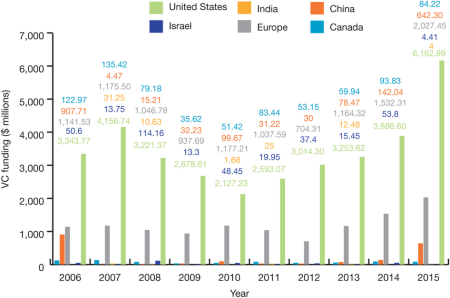
    The U.S. showed the most robust investment in biotech drugs since 2006, followed by Europe and China, although Chinese investment has been more uneven than investment in the West:

    VC investment for drug development biotechs by region

    Nbt.3600-F2See Huggett (2016), Figure 2.

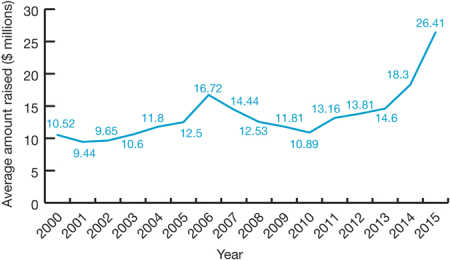
    Average global investment has more than doubled since 2000, and has increased by almost 150% since 2010:

    Global average amount invested per VC round

    Nbt.3600-F3See Huggett (2016), Figure 3.

    And this trend is even more dramatic in the number of "A" rounds of investment during this timeframe:

    Number of A rounds, 2000–2015

    Nbt.3600-F4See Huggett (2016), Figure 4.

    Whether this trend continues may depend on whether the deleterious effects of these court decisions begin to become apparent.  For example, Sequenom began the year by laying off about a quarter of its staff, mostly in its Carolina facility that had been processing its fetal diagnostic maternal blood tests, and by midyear had been acquired by LabCorp.  If investors react to these occurrences, and should small biotech diagnostics companies continue to meet either resistance to further patenting from the USPTO or invalidation of existing patents in the courts, the improvements reported by Nature Biotechnology may reverse.  Perhaps such an eventuality, as painful as it may be and harmful to the global economic and physical health, it might promote new thinking regarding the wisdom of the Supreme Court's foray into subject matter eligibility.

  • By Michael Borella

    District Court for the Eastern District of TexasCore Wireless Licensing brought an action against LG Electronics in the Eastern District of Texas.  Core contended that LG infringed claim 21 of its U.S. Patent No. 7,804,850.  LG moved for summary judgment on the grounds that the claim was invalid under 35 U.S.C. §§ 101 and 112.

    The claim recites:

    21.  An apparatus comprising:
        a memory adapted to store computer program instructions and a virtual transmission time interval;
        a wireless transceiver;
        a processor adapted to:
        check to determine whether the apparatus is transmitting data packets in a current air interface transmission time interval; and
        for the case where it is determined that the apparatus is not transmitting in the current air interface transmission time interval, to cause the transmitter to transmit a next data packet after a predetermined period associated with the virtual transmission time interval has elapsed, wherein the next data packet comprises at least one protocol data unit and the virtual transmission time interval is an integer multiple of the current air interface transmission time interval.

    The claim is directed to reducing interference in a cellular wireless network (e.g., a 4G LTE network) by spacing out the transmissions from individual mobile devices.  Particularly, a base station communicates with these devices to "schedule regular Transmission Time Intervals ('TTIs') between subsequent data transmissions."  With respect to transmissions by mobile devices, the rate thereof "can be 'slowed down' or 'decelerated' by sending the data to the physical layer every n*TTI, instead of once every [TTI]."  The '850 patent discloses that doing so can reduce overall interference between the devices and base station.

    Multiple issues were brought by LG:  subject matter eligibility under § 101, as well as enablement and written description under § 112.  This discussion will focus on the eligibility contentions.

    As set forth by the Supreme Court in Alice Corp. v. CLS Bank, compliance with § 101 requires use of a two-prong test.  First, one must first determine whether the claim at hand is directed to a judicially-excluded law of nature, a natural phenomenon, or an abstract idea.  If so, then one must further determine whether any element, or combination of elements, in the claim is sufficient to ensure that the claim amounts to significantly more than the judicial exception.  But generic computer implementation of an otherwise abstract process does not qualify as "significantly more."

    LG took the position that claim 21 was merely directed to the abstract idea of traffic metering.  Particularly, LG argued that:

    Traffic metering is a basic, abstract concept.  For example, freeway onramps are familiar bottlenecks for many drivers.  Some freeways have adopted the use of traffic lights on these onramps to meter the flow of traffic onto the freeway.  Instead of allowing cars to proceed from the onramp onto the freeway as they arrive, stoplights can inject an additional delay between cars to alleviate congestion.  Claim 21 is directed to this same basic concept for packet transmissions – in particular, to modifying the time in between subsequent transmissions by an integer multiple.

    In reviewing this contention, the Court focused on whether the claim was preempting any fundamental "building blocks of human ingenuity," such as methods of organizing human activity, fundamental truths, an idea of itself, an algorithm, and so on.  Looking to the recent Federal Circuit opinion in BASCOM Global Internet Servs. v. AT&T Mobility LLC, the Court indicated that any claim that effectively preempts all uses of an abstract idea is ineligible.  This demonstrates that the federal courts are putting more weight on the notion of preemption that the USPTO, which believes that a preemption analysis is baked into the two-prong test.

    The preemption inquiry drove the Court's reasoning:

    Although LG alleges that claim 21 is directed to the abstract idea of 'traffic metering,' LG does not argue that claim 21 would cover all traffic metering generally or even that claim 21 would preempt all forms of traffic metering in the context of mobile device networks.  While there are some parallels between LG's freeway onramp analogy and claim 21, the claim is manifestly narrower than 'traffic metering' and does not cover what happens at a freeway onramp.  Claim 21 restricts its applicability to a 'wireless' device with 'a processor' and 'a memory.'  Moreover, claim 21 does not cover delaying any data transmission by any amount of time; claim 21 is limited to delaying the transmission of a 'protocol data unit' (a specific type of data packet) by exactly 'an integer multiple of the current air interface transmission time interval.'

    Further, the Court invoked Enfish, LLC v. Microsoft Corp. in concluding that claim 21 involves a purported improvement on a type of traffic metering that exists in wireless networks.  Particularly, "[c]laim 21 assumes by its terms that the network imposes a fixed 'transmission time interval' during which data packets can be sent," and "teaches further delaying or metering the transmission by an integer multiple of the transmission time interval."  According to the Court, claim 21 is therefore an "archetypal example of an invention directed to 'improving the functioning of the computer itself' or 'improving an existing technological process' that Courts have repeatedly held to be patent-eligible."

    As a result, the Court found that the claim is directed to a specific technology that solves problems in mobile device networks, and is not abstract under the first prong of Alice.

    When carrying out the § 101 inquiry, it is tempting to view a claim at a 10,000 foot level, and then make an analogy between this view of the claim and a known, conventional activity.  But such an approach, though approved by the Supreme Court and Federal Circuit, attenuates the actual language of the claim, leading to a less objective scrutiny.  This Court, on the other hand, focused on the precise claim language during its prong one analysis, and was not persuaded by LG's high-level comparison to freeway on-ramp metering.

  • Eastern District of Texas and PTAB Issue Conflicting Decisions on Same Patent

    By Joseph Herndon

    District Court for the Eastern District of TexasIV sued J. Crew for patent infringement of three patents:  U.S. Patent Nos. RE43,715, 6,782,370, and 5,969,324.  J. Crew filed a Motion to Dismiss, contending that the asserted patents are drawn to patent-ineligible subject matter under 35 U.S.C. § 101.  Ultimately, the District Court concluded that the claims of the '715 and '370 patents are directed to patent-ineligible subject matter, and the claims of the '324 patent are not directed to patent-ineligible subject matter.

    USPTO SealBelow is a summary of the reasoning for these decisions for each patent.  However, interestingly, on August 2, 2016, the PTAB at the U.S. Patent Office came to a contrary decision with respect to the '324 patent, and determined that it is more likely than not that claims of the '324 patent are unpatentable under 35 U.S.C. § 101, within a decision to institute a trial in a covered business method (CBM) patent review of the '324 patent between Sally Beauty Holdings, Inc. and IV.  We recently discussed that decision here.  It appears that IV has asserted the '324 patent against numerous defendants, and at least one has been able to raise the question of § 101 successfully so as to institute a CBM review.

    A.  The '715 patent

    The '715 patent is directed to a method for allowing an internet user to create a web page that may simultaneously display public and private data as integrated data on one digital screen or other network device.  Claim 20 is representative and is reproduced below.

    20.  A method of integrating and delivering data available over a network, said method including the steps of:
        acquiring public data from at least one publicly available data store coupled to said network, wherein said public data is determined by private data;
        acquiring said private data from at least one private data store coupled to said network;
        integrating said public data and said private data to form integrated data; and
        delivering said integrated data to a user system.

    The District Court found that the '715 Patent is directed toward the abstract idea of combining data from two sources for delivery to a user.  The District Court found no meaningful limitations on any of the generic steps in claim 20 that render the claim any less abstract.

    Figure 6 of the '715 patent teaches the invention through the use of an exemplary website, americanexpress.com, which displays one embodiment of the invention:  a single webpage simultaneously displaying private data (account balance) and public data (promotional information).  The District Court found that this makes clear that the '715 patent merely discloses the use of generic computer network technology to achieve an online variation of a well-established, real-world practice.  Long before the advent of online credit card billing, printed account statements resembling Figure 6's webpage were regularly mailed to credit card members that combined private account information along with public promotional information.

    Since the asserted claims of the '715 patent were found to be directed toward an abstract idea, the District Court next determined that there was no inventive concept sufficient to transform the claims into patent-eligible subject matter.  The claims' references to computer components are generic and tangential.  Combining generic data, from generic data stores, across generic networks does not reflect the necessary innovation to salvage this underlying abstract idea.

    The District Court noted that the only arguably inventive concepts disclosed by the '715 patent are (1) the distinction between "public data" and "private data", and (2) the method by which public data is "determined by" private data.  But a review of the claims exposes these concepts as vague and uninventive, and subjective.

    B.  The '370 patent

    The '370 patent discloses a method for using a network for the recommendation of goods and services based on a potential customer's selection of goods and services and a database of previous customer purchase history.  Claim 1 is representative and is reproduced below.

    1.  A computer-implemented method for the recommendation of goods and/or services to potential customers over a distributed network based on customer buying history utilizing an information processing system containing processing means having transmission means for receiving and transmitting data, and database storage means for receiving and transmitting data, and database storage means for storing information in database files, the method comprising the steps of:
        receiving customer commands specifying a particular good or service to be used as filter data;
        storing information pertaining to goods and/or services purchase history of previous customers;
        comparing said filter data with said stored information and determining whether, for said filter data, corresponding entries exist within the stored information; and
        if corresponding entries exist, displaying the identity of other goods and/or services purchased by said previous customers who have purchased the good and/or services used as said filter data.

    The District Court found that the '370 Patent is directed toward the abstract idea of recommending products to customers based on purchase history.  The District Court contended that the typical sales clerk at a hardware store often performs these same steps.

    In search of an inventive concept, the District Court looked to the preamble to claim 1, which (even if assumed to be limiting) merely provides computer implementation of this abstract marketing idea.

    C.  The '324 patent

    The '324 patent discloses a method for storing and retrieving transaction information via a nonpredictable barcode.  A point-of-sale transaction system utilizes a nonpredictable barcode in connection with generating information related to the transaction, storing that data, and retrieving it from a remote computer system.  The transaction data is tied to a nonpredictable barcode, which can help prevent unauthorized access to the transaction data.  Claim 1 is representative and is reproduced below.

    1.  A database management method comprising the steps of:
        receiving and storing transaction information associated with a nonpredictable bar code, the transaction information generated by a transaction terminal;
        receiving a request for the transaction information including data associated with the nonpredictable bar code;
        retrieving the transaction information based upon the nonpredictable bar code; and
        communicating the transaction information.

    Crew contended that the '324 patent is directed toward the abstract idea of retrieving transaction records.  The District Court concluded that J. Crew had not met its burden under the Alice framework because J. Crew took an overly generalized view of the claim language that vitiated meaningful limitations.

    The District Court found that J. Crew's recitation of the claims ignored (or at least evaded) the elements of "nonpredictable bar code" and "transaction information associated with a nonpredictable bar code."  The District Court found that the invention lies in the combined use of nonpredictable bar codes with transaction information, and this was far from conventional, resulting in an improvement over the mid-1990s accounting software, which relied on manual entry of transaction information.  Considering all of the above, the District Court found the asserted claims of the '324 patent to be directed to patent-eligible subject matter.

    It's interesting to contrast the District Court's reasoning with the PTAB's findings for the '324 patent in which the PTAB accepted that the '324 patent is directed merely to an abstract idea of "storing and retrieving transaction information through the use of a well-known security feature."  The '324 patent itself concedes that it was intended to automate a manual process and the claims describe the automation of the fundamental economic concept of recording and retrieving transaction information through the use of generic computer functions.

    With respect to the "bar code", the PTAB found that the claims recite receiving transaction information associated with a nonpredictable bar code, rather than use of a bar code.  No scanning or querying of any type of bar code is specifically recited, such that the independent claims need only handle the associated information, post-derivation, to satisfy the steps of claim 1.  As such, from a standpoint of determining if the claims are directed to an abstract idea, any consideration of the use of a nonpredictable bar code is not necessary.

    Conflicting opinions issued by the PTAB and the District Court illustrate the difficulties and problems with the Alice framework for determining patent eligible subject matter under § 101.

    Intellectual Ventures I LLC v. J. Crew Group, Inc. (E.D. Tex. 2016)
    Memorandum Opinion and Order by District Judge Rodney Gilstrap

  • By Kevin E. Noonan

    GenzymeMany of the complaints from patent holders over the PTO's inter partes review process under the Leahy-Smith America Invents Act (codified in pertinent part at 35 U.S.C. §§ 311-319) stem from how the Office has implemented these proceedings (at §§ 42.1-42.80 and 42.100-42.123).  Genzyme has addressed their complaints about the process, in the context of a challenge under the Administrative Procedures Act (5 U.S.C. § 500 et seq.) in a petition for panel rehearing or en banc review of the Federal Circuit's decision affirming invalidation of the claims of Genzyme's U.S Patent Nos. 7,351,410 and 7,655,226, in Genzyme Therapeutic Products, Inc. v. Biomarin Pharmaceutical, Inc.

    BiomarinThe case arose over Biomarin's IPR of claims directed to methods for treating Pompe's disease, a deficiency in the lysosomal enzyme acid α-glucosidase (GAA), which is expressed as an inability to break down glycogen, particularly in muscle, causing glycogen buildup in muscle tissue.  Claim 1 of the '410 patent is representative of the claims involved in the IPR:

    A method of treating a human patient with Pompe's disease, comprising intravenously administering biweekly to the patient a therapeutically effective amount of human acid alpha glucosidase, whereby the concentration of accumulated glycogen in the patient is reduced and/or further accumulation of glycogen is arrested.

    Biomarin requested an IPR in 2013 based on four grounds for the '410 patent, with the PTAB instituting on two of them:  under § 103 based on the combination of the Duke press release and two prior art references (the Barton reference and van der Ploeg '88 references); and also under § 103 for the combination of the another reference, the Reuser reference, with the Barton and van der Ploeg '88 references.  For the '266 patent, the PTAB instituted under § 103 for claims 1 and 3 based on the combination of the Duke press release, the van der Ploeg '88 reference, and the van Hove reference, and for claims 4-6 based on the combination of the Duke press release, the van der Ploeg '88 reference, the Barton reference, and the Reuser reference.

    Genzyme responded to Biomarin's request by arguing that none of the cited references disclosed the results of in vivo tests in humans or animals.  In response, Biomarin asserted two additional references that disclosed in vivo administration of M6P-modified GAA in mouse (van der Ploeg '91) and Japanese quail (Kikuchi).

    The Board found the challenged claims to be obvious, based on disclosure in the Reuser reference of all elements of the claimed invention except the dosing interval which, according to the PTAB, was the result of "routine optimization."  With regard to whether there was a reasonable expectation of success, the Board stated that "all that remained to be achieved over the prior art was the determination that a specific dose within a previously suggested dose range, and its corresponding dosing schedule, would have been safe and effective for the treatment of human patients," basing this portion of its determination on the cited art, including the Kikuchi and van der Ploeg art submitted by Biomarin during the trial phase of the IPR proceeding (i.e., after the Board had rendered its decision to initiate the IPR).

    Federal Circuit SealThe Federal Circuit affirmed, in an opinion by Judge Bryson, joined by Judges Moore and Reyna.  Relevant to the rehearing petition, the panel rejected Genzyme's procedural challenge under the Administrative Procedures Act (APA), that the Board had erred in relying on "facts and legal arguments" not asserted in the request, as a violation of the Act's notice and opportunity to respond requirements.  While acknowledging that "formal adjudication" such as an IPR imposes "certain procedural requirements" on the PTO under the APA, including "timely notice" and an opportunity to "submit facts and argument" under 5 U.S.C. §§ 554(b)-(c), 557(c), the Court stated that these provisions were intended to prevent an agency from "chang[ing] theories in midstream" without giving a respondent the opportunity to address the changed theory, citing Belden v. Berk-Tek LLC, 805 F.3d 1064, 1080 (Fed. Cir. 2015) (quoting Rodale Press, Inc. v. FTC, 407 F.2d 1252, 1256-57 (D.C. Cir. 1968).  This was not the case here, according to the opinion, because Genzyme had ample notice and opportunity to rebut Biomarin's obviousness case against its claims.  Support for this conclusion was had by noting that the Board based its final determination of obviousness on the same references it used for deciding to institute the IPR.  The fact that the Board cited references (the in vivo references, van der Ploeg '91, and Kikuchi) in its final determination that were not included in the combination used to institute the IPR was not to the contrary, because "the introduction of new evidence in the course of the trial is to be expected in inter partes review trial proceedings and, as long as the opposing party is given notice of the evidence and an opportunity to respond to it, the introduction of such evidence is perfectly permissible under the APA."

    Genzyme's argument to the contrary, according to the Court, was based on "misunderstanding of the role of the institution decision in inter partes review proceedings before the Board":

    There is no requirement, either in the Board's regulations, in the APA, or as a matter of due process, for the institution decision to anticipate and set forth every legal or factual issue that might arise in the course of the trial.  See Boston Carrier, Inc. v. ICC, 746 F.2d 1555, 1560 (D.C. Cir. 1984) (even when adjudicating charges of misconduct, an agency "is not burdened with the obligation to give every applicant a complete bill of particulars as to every allegation that carrier will confront").  Because the institution decision comes at the outset of the proceedings and the patentee is not obligated to respond before the Board makes its institution decision, it is hardly surprising that the Board cannot predict all the legal or factual questions that the parties may raise during the litigation.

    Indeed, the opinion goes on to say that "development of evidence in the course of the trial is in keeping with the oppositional nature of an inter partes review proceeding," with the requestor asserting its invalidity case to the PTAB and the patent owner presenting amendments (sic), and with the Board then deciding whether the challenger has borne the burden of proving invalidity (citing the Senate legislative history of the IPR provisions, despite the differences in how Congress may have thought it was providing for IPRs and the PTAB's decisions on how to implement the statute).

    The "critical question" under the APA is "whether Genzyme received 'adequate notice of the issues that would be considered, and ultimately resolved, at that hearing'" the Court opined, citing Pub. Serv. Comm'n of Ky. v. FERC, 397 F.3d 1004, 1012 (D.C. Cir. 2005).  The panel concluded that Genzyme had not shown that there were any issues of fact or law used by the PTAB as the basis of its obviousness determinations for which Genzyme had not had adequate notice or opportunity to be heard.  Finally, the opinion also noted that PTO procedures provide means for moving to exclude evidence (such as 37 C.F.R. § 42.64(c)) or to file a surreply when Biomarin introduced this evidence during the institution proceedings, neither of which procedural avenues Genzyme used.

    In its petition for rehearing, Genzyme poses what it characterizes as a "precedent-setting" question:

    Whether, to comply with the Administrative Procedure Act in an inter partes review proceeding, the Patent Trial and Appeal Board must provide a patent owner notice of the components of the legal and factual analysis that are necessary to a finding of unpatentability.

    In support of its answer to this question (i.e., that the Board is compelled to provide express notice under circumstances arising in this IPR), petitioner asserts that the panel decision was contrary to Belden Inc. v. Berk-Tek LLC, 805 F.3d 1064 (Fed. Cir. 2015); In re Biedermann, 733 F.3d 329 (Fed. Cir. 2013); and Rambus Inc. v. Rea, 731 F.3d 1248 (Fed. Cir. 2013) (the latter two cases in the context of ex parte examination).

    The petition asserts that the panel contravened this precedent because it held that the notice provision could be satisfied when the initiation decision included "(1) the prior art references that establish the claim limitations and (2) the statutory basis of invalidity asserted" but could omit the legal argument relied upon in the Final Written Decision provided that it was "in some way brought to the patent owner's attention" during the course of the trial.  Here, according to Genzyme, there were two omissions:  any discussion of the "reasonable expectation of success" prong of the obviousness test, and art disclosing in vivo data of effectiveness of the claimed method, at the time the IPR was initiated.  Genzyme argues that this failure to provide notice under 5 U.S.C. § 554(b)(3) was outcome-determinative since Genzyme could have sworn behind the references if given timely notice but could not because they didn't have notice at a time when such an act would have been effective.

    In addition, the petition characterizes the Board's reliance on the "reasonable expectation of success" argument as the Board "changing course" — somewhat paradoxically, Genzyme argues that the Board and the parties acknowledged that a § 103 challenge must establish that there would have been a reasonable expectation of success, but then criticizes the decision for not including the argument in the institution decision.  Petitioner's rationale in support of this argument is that it matters not that the parties knew generically that the expectation of success question would be germane to obviousness generally.  The notice Genzyme believes was required (and that it did not get) was that this issue would be considered by the Board in rendering its decision.  In its view:

    The panel's cramped reading of the APA's notice provision departs from this Court's precedent establishing, in the examination context, that "reliance on the same statutory basis and the same prior art references, alone, is insufficient to avoid making a new ground of rejection"—and thus violating the APA—"when the Board relies on new facts and rationales."  In re Biedermann, 733 F.3d at 337 (quoting In re Leithem, 661 F.3d 1316, 1319 (Fed. Cir. 2011)).  "The ultimate criterion," this Court has explained, "is whether the appellant has had before the PTO a 'fair opportunity to react to the thrust of the rejection.'"  Rambus, 731 F.3d at 1255 (quoting In re Jung, 637 F.3d 1356, 1365 (Fed. Cir. 2011)).  And the "thrust of the rejection change[s] when," for example, the Board finds "a new factual basis for the reason to combine," In re Biedermann, 733 F.3d at 338; see Rambus, 731 F.3d at 1256—even if the references being combined do not change.

    The petition characterizes the panel decision as being contrary to this precedent, which the petition asserts stands (according to petition) for the proposition that the Board must only provide the statutory basis for invalidity — obviousness — and the prior art that supports the conclusion to satisfy the notice provisions.  Not only is this not a proper interpretation of the law, in Genzyme's view, but the precedent relied upon seemingly has a higher notice standard for ex parte examination than the panel used in this case; the standard for IPR should be even more stringent than this precedent, according to the petition, in view of the fact that an IPR extinguishes an existing rather than a nascent property right.

    The panel's position was that there were no "new grounds" of rejection and thus that the precedent was not contravened.  The petition rebuts that assertion, stating that "the substance of the panel's analysis is incompatible with that precedent.  There is no plausible dispute that the Board's final written decisions here relied on "new facts" (i.e., new in vivo references) "and rationales" (i.e., reasonable expectation of success) compared to the institution decisions," citing In re Biedermann, 733 F.3d at 337.

    The petition also states that the APA itself does not provide any basis for "applying different notice standards in IPRs" or for making a distinction between those references "used to establish claim limitations" (for which there is no dispute that they must be noticed) and those that are used to set forth the state of the art (which the panel decision asserts need not be noticed).  For petitioners, there is no distinction in effect between the "matters of fact and law" needed to establish that the elements recited by the claims are in the prior art and those needed to show that the skilled worker had a reasonable expectation of success.  And in view of the importance of these issues, the petition asserts that if notice does not apply under the APA then the notice provision is "meaningless in the IPR context."

    Petitioners also distinguish the panel's reliance on Ariosa Diagnostics v. Verinata Health, which stands for the proposition that the Board may rely on a reference to show the state of the art even if that reference was not part of the institution decision.  Petitioners don't dispute that — here their argument is that the Board did not indicate that the in vivo references were relevant to the obviousness question and then had its legal determination of obviousness rest on those references.  It is this legal analysis that petitioners say is new and for which they had no notice.  The crux:

    The panel's decision thus allows petitioners not only to "build a record by introducing evidence" (Slip Op. 10) but to cure fundamental defects in the institution decision after the patent owner points them out—and after the patent owner has any right to respond [emphasis added].

    The real argument appears to be that if the institution decision is flawed, the Board should not get to cure during the trial; however, neither the Board nor the Federal Circuit may look favorably on such a procedural avenue to permit the patentee to prevail without addressing the substance.

    The petition raises a secondary point:  the need for "notice" to come from the Board and not from the record, i.e., the trial or the other party.  This argument is based on a due process argument supported by precedent in other contexts that the agency must provide notice under the APA, citing Pub. Serv. Comm'n of Ky. v. F.E.R.C., 397 F.3d 1004, 1012 (D.C. Cir. 2005).  It does not seem to be in dispute that the Board relied on Biomarin's introduction of the in vivo evidence and argument during the trial phase to provide notice, which petitioner says is improper.

    Again, relating to the right to respond:

    The petitioner is "expected" to introduce new evidence at the reply stage, Slip Op. 9—when the patent owner has no right to respond, Belden, 805 F.3d at 1081 ("no rule provides patent owners the right to file surreplies to a petitioner's Reply")—and once the petitioner has done so, the APA's notice requirement is satisfied, see Slip Op. 10-11.  But at that point, it is too late.

    In this regard the petition notes that the panel apparently believes that petitioner could have objected to introduction of this evidence during the IPR trial, but states that this is a question of admissibility not notice, and there is little to no basis to object on admissibility grounds.  Also deficient was the panel's suggestion that this evidence could have been subject to a motion to exclude, because inter alia this would shift the burden to the patentee (plus running afoul of the PTO's overarching public interest concerns).

    The petition raises the crux of many of the procedural objections patentees have raised against how the PTO has implemented IPRs:  the Board's focus on speedy resolution within the 12 month period deforms many parts of the process, here by shortening the time for a patentee to respond to new evidence to its detriment and prejudice.  The same argument could be made (and has) with regard to other procedural decisions (such as patentee's motions to amend) with some force; perhaps the Office should reconsider whether expeditiousness (or the perception of the overriding importance it has placed in compliance with the timing requirements of the Act) is worth the perception that the Office is not treating patentees and their patent property rights fairly.  And it should escape no one's notice that in casting the issue in an administrative law context, the issues are ripe for Supreme Court review.

  • CalendarAugust 30, 2016 – "Inducement and Indirect Infringement: A Muddle After NuVasive?" (Intellectual Property Owners Association) – 2:00 to 3:00 pm (ET).

    September 1, 2016 – "Drafting and Prosecuting Patent Applications to Withstand PTAB Scrutiny — Building Reasonable Claim Construction to Avoid Unpatentability and Using Declarations to Survive Post-Grant Proceedings" (Strafford) – 1:00 to 2:30 pm (EDT)

    September 7, 2016 – "USPTO's Subject Matter Eligibility: A 2016 Update" (The Knowledge Group) – 12:00 to 2:00 pm (EST)

    September 7, 2016 – "What is Patent Eligible: The Ever-evolving Section 101 Standard" (Dilworth IP) – 1:00 to 2:00 pm (EDT)

    September 8, 2016 – "After-Final Practice: Navigating Expanding PTO Options to Compact Patent Prosecution — Utilizing Post-Prosecution Pilot Program (P3), After-Final Consideration Pilot 2.0, Pre-Appeal Conference and More" (Strafford) – 1:00 to 2:30 pm (EDT)

    September 8, 2016 – "Europe's Unified Patent Court and Patents with Unitary Effect: Status, Perspectives and Impact of Brexit" (Practising Law Institute) – 1:00 to 2:00 pm (Eastern)

    September 11-13, 2016 - 44th Annual Meeting (Intellectual Property Owners Association) – New York, NY

    September 14-15, 2016 - Advanced Patent Prosecution Workshop 2016: Claim Drafting & Amendment Writing (Practising Law Institute) – Chicago, IL

    September 15, 2016 – "On Sale and Public Use Bars to Patentability: Leveraging Recent Developments — Minimizing Risk of Patent Ineligibility or Invalidation" (Strafford) – 1:00 to 2:30 pm (EDT)

    September 20, 2016 – "The Shifting Landscape of Bio/Pharma Litigation: The Influence of PTAB Proceedings" (McDonnell Boehnen Hulbert & Berghoff LLP) – 10:00 am to 11:15 am (CT)

    September 20, 2016 – "Defending Patents in IPR Proceedings: Best Practices to Mitigate Risks of Claim Cancellation — Leveraging Preliminary Responses, Using Experts, Filing Motions to Amend and Substitute Claims, Evaluating Secondary Considerations" (Strafford) – 1:00 to 2:30 pm (EDT)

    September 21, 2016 – "Structuring Freedom-to-Operate Opinions: Reducing Risk of Patent Infringement — Combating Troubling FTO Results, Overcoming Potential Roadblocks, Addressing Impact of Post-Grant Process on FTO Opinions" (Strafford) – 1:00 to 2:30 pm (EDT)

    September 22-23, 2016 - Seminar on European Patent Law (Grünecker) – Munich, Germany

    September 29, 2016 - IP & Diagnostics Symposium (Biotechnology Innovation Organization) – Alexandria, VA

    September 29-30, 2016 – Advanced Patent Law Seminar (Chisum Patent Academy) – Washington, DC

    October 3-4, 2016 – Advanced Patent Law Seminar (Chisum Patent Academy) – Washington, DC

    ***Patent Docs is a media partner of this conference or CLE

  • IPO #2The Intellectual Property Owners Association (IPO) will offer a one-hour webinar entitled "Inducement and Indirect Infringement: A Muddle After NuVasive?" on August 30, 2016 from 2:00 to 3:00 pm (ET).  John Campbell of McKool Smith, Prof. Tim Holbrook of Emory University School of Law, and Blair Jacobs of Paul Hastings LLP will review the state of the law and give specific current guidance for both plaintiffs and defendants at each stage of litigation involving inducement: pre-complaint, motion to dismiss, discovery, summary judgment, trial, and remedy. The panel will also discuss the future direction of the law.

    The registration fee for the webinar is $135 (government and academic rates are available upon request).  Those interested in registering for the webinar can do so here.

  • Strafford #1Strafford will be offering a webinar/teleconference entitled "Defending Patents in IPR Proceedings: Best Practices to Mitigate Risks of Claim Cancellation — Leveraging Preliminary Responses, Using Experts, Filing Motions to Amend and Substitute Claims, Evaluating Secondary Considerations" on September 20, 2016 from 1:00 to 2:30 pm (EDT).  Michael J. Flibbert of Finnegan Henderson Farabow Garrett & Dunner, John C. Jarosz of Analysis Group, and Maureen D. Queler of Finnegan Henderson Farabow Garrett & Dunner will provide guidance to counsel representing patent owners in defending their patents in inter partes review (IPR) challenges, and discuss IPR strategy, lessons from recent PTAB rulings, and best practices to mitigate risk of cancellation of patent claims.  The webinar will review the following issues:

    • What strategies have patent owners used to achieve a successful result in IPR proceedings?
    • How can patent owners best use expert testimony to effectuate an IPR defense strategy?
    • How can patent owners persuasively present motions to amend or preliminary responses in IPR defense?

    The registration fee for the webinar is $297.  Those registering by September 2, 2016 will receive a $50 discount.  Those interested in registering for the webinar, can do so here.

  • GruneckerGrünecker will be offering a two-day seminar on European Patent Law on September 22-23, 2016 in Munich, Germany.  The seminar will provide practical and strategic information on European Patent Law, including a "Brexit update" on the UPC and the Unitary Patent.  Those wishing to register can do so here.