• By Nicholas Vincent* and Anthony D. Sabatelli** —

    Many research efforts into the microbiome have focused primarily on the human microbiome, i.e., microorganisms within and on the body, and how changes in these microbial communities correlate with changes in health and disease.  Less attention, however, has been paid to the microbial communities external to humans and how changes in these communities can affect health.  These communities have a broad range, from the microbiome of indoor spaces, also called the microbiology of the built environment (MoBE), to microbial communities found outdoors.  Microbial communities that give certain foods, such as San Francisco sour dough bread, various wines, beers, and even cheeses, characteristic qualities like taste and texture are also examples of external microbiomes.  As with the human microbiome, scientists do not yet fully understand how changes in external or indoor microbiomes could alter human health, but we see plentiful possibilities for further research and intellectual property protection of subsequent innovation, especially with regards to the MoBE.  This article concludes with a sampling of some of the patenting activity in this area.

    Efforts to Understand the Environmental and Built Microbiomes

    Initial research efforts into external microbiomes centered mostly around environmental microbial communities.  The Earth Microbiome Project (EMP) is a large-scale research endeavor that has attempted to categorize and classify microbial communities in different biomes across the globe in an effort to elucidate the "Earth's microbiome" using a variety of metagenomic and metatranscriptomic approaches.  These approaches focus on large-scale and often high-throughput data collection and analyses.  Projects such as the EMP emphasize that the composition of complex environmental microbial communities that surround us are largely unknown to researchers.

    Although projects such as the EMP look at environmental microbial communities, they leave out an important aspect of human life—the indoor microbiome, or the microbiology of the built environment (MoBE).  Various research efforts are currently being undertaken to foster growth in this area.  The National Academies of Science and Engineering have begun a consensus study to understand issues related to the MoBE including its formation and effects on human health.  The end goal of the study is to gather enough information to apply the findings to novel building materials and architectural approaches.  Although a report is expected in 2017, efforts to understand the indoor microbiome are still in their infancy.  As this field expands, so will, we believe, opportunities for patentable innovation related to it.

    Implications of an Altered Microbiome

    It is largely unclear how an altered external or built microbiome will affect human health.  Several initial investigations have sought to understand the role potential pathogens play as part of the indoor microbiome.  Handorean, et al. determined that aerosolized particles from soiled linens in healthcare settings could contribute to pathogen exposure.  Additionally Rhoads, et al. noted that temperature setting is critical in control of pathogens such as Legionella pneumophila in water heaters and water taps.  Both of these findings suggest that environmental changes and the introduction of pathogens into external or indoor microbiomes can easily lead to potential exposure, suggesting the need for novel filtration and sterilization techniques and approaches.

    Many researchers are also beginning to explore whether exposure to an altered indoor microbiome in infancy or childhood could lead to the development of adverse health outcomes like asthma and allergies.  Several studies have further investigated the connection between an altered indoor environment and immunological development in children.  Avershina, et al. found that high vacuum cleaning frequency is associated with an altered gut microbiome during pregnancy and for 2-year old children.  In even younger subjects, Shin et al. found that operating room microbes may seed C-section-born children with microbes, and therefore the indoor microbiome of the birth room can play an especially important role in immune development and health in a subset of newborn children.  Furthermore, King, et al. determined that shotgun sequencing could reveal normal hospital microbiomes and detect any fluctuations in microbial community composition, including the emergence of opportunistic pathogens.  Research into MoBEs has not been restricted to hospitals: Hewitt, et al. found that bacterial diversity in offices varies from city to city.

    Although research efforts have begun to elucidate the external and indoor microbiomes, many questions remain.  In September 2016, Adams, et al. proposed ten questions regarding indoor microbiomes and data collection related to them, not only in an effort to advance the field, but also in an effort to standardize its methods, approaches, and interpretations.  In short, much research is needed, but as we learn more, we see the opportunity emerging for novel patents.

    Intellectual Property and Patent Considerations of External and Built Microbiomes

    Although initial patent applications have been filed that are relevant to monitoring, sampling, and detecting external microbial communities, we expect the space to expand rapidly as more basic research is completed.  In 2012, patent application WO2012116289A2 (for this and all other mentioned patent applications, see Appendix A) was filed describing microbial population changes in response to radiation, and using those changes as identifiers of the type of radiation that has occurred.

    In 2015, patent application WO2015103165A1 was filed by Biota Technology, Inc. describing novel and unique methods, systems, and processes for monitoring, analyzing, and controlling the microbial presence in industrial activities.  The company also filed patent application WO2015103332A2 describing novel and unique methods for characterizing the microbiome associated with hydrocarbon processes, including production and exploration.

    Recently, Trans-Vac Systems LLC filed patent application US20160041074A1, which recognizes how humans alter the built microbiome both in living areas and medical settings, and proposes novel air monitoring and filtration system inventions to remove potential pathogens from MoBEs.

    Closing

    As research efforts rapidly expand, we expect growth in the need for patents to protect novel advancements related to the built environment.  As we understand more with regards to how the indoor environment affects human health, we expect an increased need to patent novel inventions related to sterilization and filtration techniques and apparatuses.  Further, as we learn how building materials and approaches can affect the indoor microbiome, we expect an increased need for patents ranging from actual building material products to architectural approaches.  Additionally, previous patent applications (WO2015103165A1 and WO2015103332A2, for example) have highlighted the potential of microbiome-related intellectual property advances in the fields of fuel and energy exploration.
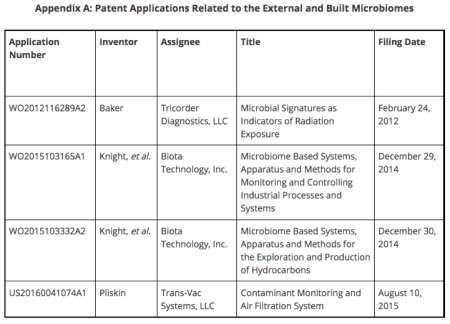
    Table

    * Nicholas Vincent is a Technology Specialist at Dilworth IP
    ** Dr. Sabatelli is a Partner with Dilworth IP

    For additional information regarding this topic, please see:

    • "The Emergent Microbiome: A Revolution for the Life Sciences – Part V, Patents Relating to Obesity and Metabolic Disorders," February 28, 2016
    • "The Emergent Microbiome: A Revolution for the Life Sciences – Part IV, Obesity and other Metabolic Disorders," February 18, 2016
    • "Jackson Laboratory Hosts Microbiome Symposium Related to Cancer and Immunology," January 19, 2016
    • "The Emergent Microbiome: A Revolution for the Life Sciences – Part III, Psychobiotics," October 13, 2015
    • "The Emergent Microbiome: A Revolution for the Life Sciences – Part II, 2015 Patent Trends," August 11, 2015
    • "The Emergent Microbiome: A Revolution for the Life Sciences – Part I, R&D Leaders," August 10, 2015

  • Just When You Thought the Federal Circuit Was Softening Restrictions on Software Patents, the Tide Turns Again

    By Joseph Herndon

    Federal Circuit SealIntellectual Ventures I LLC ("IV") sued Symantec Corp. and Trend Micro (defendants) for infringement of various claims of three U.S. Patents (Nos. 6,460,050; 6,073,142; and 5,987,610).  The District Court held the asserted claims of the '050 patent and the '142 patent to be ineligible under § 101, and the asserted claim of the '610 patent to be eligible.  The Federal Circuit affirmed as to the ineligibility of the asserted claims of the '050 patent and '142 patent, but reversed as to the asserted claim of the '610 patent, resulting in finding all asserted claims ineligible under § 101.

    Some reasoning applied during the two-step analysis, and in particular when finding that the patents are "directed to abstract ideas," is not clearly provided by the Federal Circuit.  The analysis for each of the three patents is summarized below.  This decision just muddies the waters following other recent patent-owner friendly decisions in which the Federal Circuit seemed to be creating more ways for software patents to survive.

    The decision further includes quite an interesting concurrence in which First Amendment rights were discussed as being implicated with Software patents??  Further comments will be provided on the concurrence alone.

    The '050 Patent

    The '050 patent is entitled "Distributed Content Identification System."  The patent application was filed on December 22, 1999, and the '050 patent issued on October 1, 2002.  The patent is directed to methods of screening emails and other data files for unwanted content.  Independent claim 9 is representative and recites:

    9.  A method for identifying characteristics of data files, comprising:
        receiving, on a processing system, file content identifiers for data files from a plurality of file content identifier generator agents, each agent provided on a source system and creating file content IDs using a mathematical algorithm, via a network;
        determining, on the processing system, whether each received content identifier matches a characteristic of other identifiers; and
        outputting, to at least one of the source systems responsive to a request from said source system, an indication of the characteristic of the data file based on said step of determining.

    According to IV, this method of filtering emails is used to address the problems of spam e-mail and the use of e-mail to deliver computer viruses.  The Federal Circuit, however, agreed with the District Court that receiving e-mail (and other data file) identifiers, characterizing e-mail based on the identifiers, and communicating the characterization — in other words, filtering files/e-mail — is an abstract idea.

    The Federal Circuit equated the claimed features to a practice for people receiving paper mail to look at an envelope and discard certain letters, without opening them, from sources from which they did not wish to receive mail based on characteristics of the mail.  Supposedly, the list of relevant characteristics could be kept in a person's head.

    The Federal Circuit also found that claim 9 of the '050 patent resembled claims that have been held directed to an abstract idea.  Recently, in BASCOM Global Internet Services, Inc. v. AT&T Mobility LLC, a claim to a "content filtering system for filtering content retrieved from an Internet computer network" was found to be directed to an abstract idea (although later saved in step two from ineligibility).

    The Federal Circuit proceeded to Mayo/Alice step two to determine whether the claims contain an "inventive concept" that renders them patent-eligible.  IV argued that the proffered prior art did not anticipate or render obvious the asserted claims of the '050 patent.  The Federal Circuit noted that while the claims may not have been anticipated or obvious because the prior art did not disclose all features, that does not suggest that the idea of "determining" and "outputting" is not abstract, much less that its implementation is not routine and conventional.

    To be clear, the Federal Circuit stated that the novelty of any element or steps in a process, or even of the process itself, is of no relevance in determining whether the subject matter of a claim falls within the § 101 categories of possibly patentable subject matter, despite the fact that the second step is considered a search for an "inventive concept".  A bit confusing indeed.

    The Federal Circuit found that the steps of the asserted claims of the '050 patent do not "improve the functioning of the computer itself," and are also distinguishable from those in BASCOM, which allegedly improved an existing technological process by describing "how [a] particular arrangement of elements is a technical improvement over prior art ways of filtering [Internet] content."  The Federal Circuit found that there is not, in the '050 patent, any "specific or limiting recitation of . . . improved computer technology," as the asserted claims describe only generic computer elements.

    Finally, the Federal Circuit found that the asserted claims do not contain any limitations that address IV's purported technological improvements of requiring automatic updates to the antivirus or antispam software or the ability to deal with a large volume of such software.  The Federal Circuit summarized that when a claim directed to an abstract idea contains no restriction on how the result is accomplished and the mechanism is not described, then the claim is not patent-eligible.  Thus, the asserted claims of the '050 patent were found to be not patent-eligible under § 101.

    The '142 Patent

    The '142 patent is entitled "Automated Post Office Based Rule Analysis of E-Mail Messages and Other Data Objects for Controlled Distribution in Network Environments."  The patent application was filed on June 23, 1997, and the '142 patent issued on June 6, 2000.  The patent is directed to methods of routing e-mail messages based on specified criteria (i.e., rules).  Claim 1 is representative and recites:

    1.  A post office for receiving and redistributing email messages on a computer network, the post office comprising:
        a receipt mechanism that receives an e-mail message from a sender, the e-mail message having at least one specified recipient;
        a database of business rules, each business rule specifying an action for controlling the delivery of an e-mail message as a function of an attribute of the e-mail message;
        a rule engine coupled to receive an e-mail message from the receipt mechanism and coupled to the database to selectively apply the business rules to the e-mail message to determine from selected ones of the business rules a set of actions to be applied to the e-mail message; and
        a distribution mechanism coupled to receive the set of actions from the rule engine and apply at least one action thereof to the e-mail message to control delivery of the e-mail message and which in response to the rule engine applying an action of deferring delivery of the e-mail message, the distribution engine automatically combines the email message with a new distribution list specifying at least one destination post office for receiving the e-mail message for review by an administrator associated with the destination post office, and a rule history specifying the business rules that were determined to be applicable to the e-mail message by at least one rule engine, and automatically delivers the e-mail message to a first destination post office on the distribution list instead of a specified recipient of the e-mail message.

    The '142 patent's abstract describes the invention as "[a] system, method and various software products . . . for automatic deferral and review of e-mail messages and other data objects in a networked computer system, by applying business rules to the messages as they are processed by post offices."  Claim 1 also describes the patented system as a "post office" — albeit an electronic one.

    The District Court held that "the asserted claims of the '142 patent are directed to human-practicable concepts, which could be implemented in, for example, a brick-and-mortar post office."  The Federal Circuit agreed, and this allegedly demonstrated that the concept is well-known and abstract.

    Turning to step two, the specification states that the claims can "operate[] on a conventional communications network" and the patent discloses only generic computers performing generic functions.  The Federal Circuit found that this confirms that the implementation of the abstract idea is routine and conventional, and does not "improve the functioning of the computer itself."  Thus, the asserted claims of the '142 patent were found to be not patent-eligible under § 101.

    The '610 Patent

    The '610 patent is entitled "Computer Virus Screening Methods and Systems."  The patent application was filed on February 12, 1998, and the patent issued on November 16, 1999.  The patent is directed to using computer virus screening in the telephone network.  Claim 7 is the only asserted claim of the '610 patent, and claim 7 depends from claim 1, which provides:

    1.  A virus screening method comprising the steps of:
        routing a call between a calling party and a called party of a telephone network;
        receiving, within the telephone network, computer data from a first party selected from the group consisting of the calling party and the called party;
        detecting, within the telephone network, a virus in the computer data; and
        in response to detecting the virus, inhibiting communication of at least a portion of the computer data from the telephone network to a second party selected from the group consisting of the calling party and the called party.

    7.  The virus screening method of claim 1 further comprising the step of determining that virus screening is to be applied to the call based upon at least one of an identification code of the calling party and an identification code of the called party.

    The District Court held claim 7 of the '610 patent to be patent-eligible, but the Federal Circuit reversed this decision.

    The Federal Circuit found that the idea of virus screening was well known when the '610 patent was filed, and thus, was a long prevalent practice in the field of computers, and, as the patent admits, performed by many computer users.  The specification recites conventional "virus screening software," and the Federal Circuit noted that by itself, virus screening is well-known and constitutes an abstract idea.

    At step two of Mayo/Alice, the Federal Circuit found that there is no other aspect of the claim that is anything but conventional.  Just as performance of an abstract idea on the Internet is abstract, so too the performance of an abstract concept in the environment of the telephone network is abstract.

    The Federal Circuit further found that the asserted claim does not improve or change the way a computer functions.  IV argued that the claims of the '610 Patent include meaningful limitations that narrow the claimed invention to a specific way of screening for computer viruses within the telephone network . . . and does not preempt all virus detection.  The Federal Circuit basically ignored this argument and stated that while preemption may signal patent ineligible subject matter, the absence of complete preemption does not demonstrate patent eligibility.

    In summary, the Federal Circuit compared the claims to Enfish and DDR Holdings, and stated that unlike the claims at issue in Enfish (which involved a "specific type of data structure designed to improve the way a computer stores and retrieves data in memory") claim 7 of the '610 patent does not improve or change the way a computer functions.  Nor does claim 7 overcome a problem unique to the Internet as was the case in DDR Holdings.

    Judge Stoll provided a dissent with respect to the '610 patent.  Judge Stoll noted that the '610 patent confirms that the claimed invention "advantageously screen[s] computer data for viruses within a telephone network before communicating the computer data to an end user," and this was a fundamental architectural shift from prior-art virus screening, which occurred locally on an end user's computer rather than centrally as in the invention.  Such a shift improved the overall security of telecommunication networks by thwarting the ability of viruses to reach and exploit end users.

    Although Judge Stoll agrees that the patent is directed to the abstract idea of "virus screening," Judge Stoll found that claim 7 is eligible as an ordered combination under step two.  While the network components and virus screening software recited by the claim may themselves be conventional, claim 7's inventive concept is moving virus screening software from its typical location on end users' computers and deploying it instead "within the telephone network" itself.  Thus, the invention harnesses network architecture and exploits it by utilizing a non-conventional and non-generic arrangement of virus screening components, which improves overall network security and usability.  As to this arrangement being non-conventional and non-generic, the District Court had before it IV's expert testimony that the invention provided a novel solution to the protection gap problem and greatly reduced the likelihood of an end user receiving a virus when it held claim 7 eligible.

    Judge Stoll analogized the claims in the BASCOM case to the present claims.  In BASCOM, the claims were directed to filtering content on the Internet, i.e., not on a user's local computer, and the present invention advantageously screens computer data for viruses within a telephone network before communicating the computer data to an end user.  Judge Stoll found no meaningful difference between BASCOM and this case in terms of eligibility because claim 7 also purports to improve the functioning of the computer itself, or, at the very least, the functioning of the network.

    Judge Stoll further noted that the claims at issue do not simply invoke the Internet as a means to an end, but they improve the security and functioning of the Internet itself.

    In response, Judge Dyk disagreed and found this case to be unlike BASCOM, where the technology overcame existing problems with other Internet filtering systems, and because the record does not indicate that claim 7 recites any improvement to conventional virus screening software, it is conventional.

    This decision, overall, provides more confusion than guidance as to how to determine eligibility of software patent claims.  With respect to the '610 patent, the two judges each have differing views for whether the claims are like or unlike those in BASCOM, and basically, depending on how the claims are "characterized", the outcome of the case is controlled.  This is troubling because the claims should not be characterized at all, and should stand on their own.  In terms of determining what is conventional, it seems that the Court can characterize the claims in a way to achieve a desired outcome.  More standard rules need to be applied and followed.

    Intellectual Ventures I LLC v. Symantec Corp. (Fed. Cir. 2016)
    Panel: Circuit Judges Dyk, Mayer, and Stoll
    Opinion by Circuit Judge Dyk; concurring opinion by Circuit Judge Mayer; opinion dissenting-in-part by Circuit Judge Stoll

  • By Kevin E. Noonan

    Supreme Court Building #1The Supreme Court denied certiorari today in Amphastar Pharmaceuticals, Inc. v. Momenta Pharmaceuticals, Inc., thereby leaving intact the Federal Circuit's fractured precedent on the question of whether post-approval activities are properly within the scope of the Hatch-Waxman "safe harbor" (as set forth in 35 U.S.C. § 271(e)(1)).  This was the question presented to the Court:

    Whether the safe harbor protects a generic drug manufacturer's bioequivalence testing that is performed only as a condition of maintaining FDA approval and is documented in records that must be submitted to the FDA upon request.

    The case below, styled Momenta Pharmaceuticals, Inc. v. Teva Pharmaceuticals USA Inc. involved a District Court's determination that U.S. Patent No. 7,575,886 was not infringed by Teva nor by Amphastar and additional defendants in companion cases decided together.  The claims at issue were directed to enoxaparin, an anticoagulant drug marketed since 1993 under the brand name Lovenox®.  Momenta marketed the first generic version of the drug and sought to block additional generic entrants by asserting the '866 patent, which claimed methods for ensuring that each batch of the drug met quality standards.  The District Court held that co-defendant Amphastar's activities alleged by Momenta to infringe the '886 patent fell within the scope of the § 271(e)(1) safe harbor as being "reasonably related to the development and submission of information under a Federal law which regulates the manufacture, use, or sale of drugs . . ." under the statute.

    The Federal Circuit vacated the District Court's grant of summary judgment in Amphastar's favor, in an opinion by Judge Wallach joined by Judge Moore and by Judge Dyk, who also dissented in part on other aspects of the decision.  The majority relied on its interpretation of the "purpose" of the statute from the legislative history:

    [Section 271(e)(1)] provides that it is not an act of patent infringement for a generic drug maker to import or to test a patented drug in preparation for seeking FDA approval if marketing of the drug would occur after expiration of the patent . . . .  This section does not permit the commercial sale of a patented drug by the party using the drug to develop such information . . . .  The information which can be developed under this provision is the type which is required to obtain approval of the drug. . . .  The purpose of sections 271(e)(1) and (2) is to establish that experimentation with a patented drug product, when the purpose is to prepare for commercial activity which will begin after a valid patent expires, is not a patent infringement [emphasis in opinion].

    The opinion noted that while the contours of the safe harbor have been deemed broad (citing, inter alia, Merck KGaA v. Integra Lifesciences I, Ltd., 545 U.S. 193, 202 (2005), Classen Immunotherapies, Inc. v. Biogen IDEC, 659 F.3d 1057, 1072 (Fed. Cir. 2011), and AbTox, Inc. v. Exitron Corp., 122 F.3d 1019, 1027 (Fed. Cir. 1997)), the safe harbor is not without boundaries.  These exceptions include research tools not subject to FDA approval (Proveris Sci. Corp. v. Innovasystems, Inc., 536 F.3d 1256, 1265–66 (Fed. Cir. 2008)) and information "routinely reported" to the FDA post-approval (citing Classen).  Earlier, the Federal Circuit had affirmed denial of Momenta's motion for preliminary injunction on the grounds that the movant was unlikely to prevail, but in light of a fuller record than had been available at the preliminary injunction stage, the Court was convinced that the FDA submissions relied upon by Amphastar were sufficiently "routine" that they fell outside the scope of the § 271(e)(1) safe harbor.  The opinion contrasted the routine nature of the submissions made based on the use of Momenta's method with "non-routine submissions that may occur both pre- and post-approval, such as the submission of investigational new drug applications ('INDs'), new drug applications ('NDAs'), supplemental NDAs, or other post-approval research results."  Because Amphastar's submissions using Momenta's patented technology were routine, they were not "reasonably related to the development and submission of information" as required by the statute to qualify for the safe harbor, and the District Court's decision to the contrary was clearly erroneous in the Federal Circuit's opinion.  This decision was based in part on the panel's apprehension that deciding in Amphastar's favor would "result in manifest injustice" because it would be the first case to have § 271(e)(1) encompass "activities related to ongoing commercial manufacture and sale."  The majority's conclusion was supported by the Federal government as amicus, wherein "the government argued that the routine use of a patented testing process in the commercial manufacture of a drug is not 'reasonably related to the development and submission of information to [the] FDA' and thus not shielded from liability by § 271(e)(1).'"

    Denial of certiorari does not connote agreement by the Court, of course, but until the Court decides to address this issue the question of what activities are not within the safe harbor remains unclear, particularly with regard to ones such as safety testing that are performed post-approval (see "Supreme Court Denies Certiorari in Momenta Case").

  • By Donald Zuhn

    Patents for HumanityOn Thursday, the U.S. Patent and Trademark Office announced the latest winners of the Patents for Humanity program.  The Patents for Humanity program, which was launched by the Office in February 2012 as part of an Obama Administration initiative to promote game-changing innovations to solve long-standing development challenges, is a competition recognizing patent owners and licensees who address global challenges in health and standards of living.  Entrants are divided into five categories:  medicine, nutrition, sanitation, energy, and living standards.  The Office noted that in this latest round, for which the application process concluded on December 4, 2015, four of the five categories did not produce honorees.  Winners receive accelerated processing of select matters at the USPTO (i.e., a patent application, ex parte reexamination, or an ex parte appeal to the Patent Trial and Appeal Board) in addition to recognition for their work.  The latest winners are as follows:

    • The U.S. Food & Drug Administration for developing an improved meningitis vaccine production process, which has been used to immunize 235 million people in high-risk African countries.  FDA scientists set out to create a better meningitis vaccine production method for the Meningitis Vaccine Program (MVP), which was formed by the health non-profit PATH, the Gates Foundation, and the World Health Organization to combat Meningitis A.  The new technology developed by the FDA raised vaccine production yield from 20% to 60% and enabled the vaccine to last up to four days without refrigeration, unlike previous vaccines.  The FDA has licensed the technology to the MVP.

    • Case Western Reserve University (CWRU) for creating a low-cost, accurate malaria detection device, which allows for better diagnosis and treatment of malaria.  CWRU Engineers and doctors designed the Magneto-Optical Detection (MOD) device, which uses lasers and magnets to diagnose malaria by detecting iron-laden byproducts of the parasite in the blood.  The device can be ten times cheaper per test than the current standard.  CWRU received an honorable mention in the 2014 Patents for Humanity program.

    • GestVision for developing a quick, simple diagnostic test for preeclampsia, a pregnancy complication that is the leading cause of prenatal death for mothers and babies worldwide, mostly in low and middle income countries.  GestVision's test detects misfolded proteins in urine associated with PE, which may be shown by a colored dot similar to a pregnancy test.  Following initial research at Yale University, GestVision was created to further develop the technology.

    • The Global Good Fund at Intellectual Ventures for creating a passive cooler that can keep vaccines cold over thirty days, and for donating dozens of units to the fight against Ebola and other relief efforts.  Researchers at Global Good designed the Arktek cooler to keep vaccines cold for over a month with no power required — the device uses high-efficiency insulation materials to prevent heat transfer.  The technology has been licensed to a leading refrigeration manufacturer in order to scale production of the device at an affordable price.

    This year, the Office also awarded two honorable mentions:

    • Sanofi for researching new malaria drug candidates with shorter, simpler treatment regimens that can potentially counter the growing trend of drug resistance.

    • Alere Inc. for developing diagnostic assays for rapid and early HIV diagnosis at the point of care in low-resource settings.

    Additional information regarding the latest winners of the Patents for Humanity program can be found here, and information regarding the Patents for Humanity program can be found here.

  • CalendarOctober 3-4, 2016 – Advanced Patent Law Seminar (Chisum Patent Academy) – Washington, DC

    October 13, 2016 – "Leveraging USPTO Examiner Count System: Efficiently Prosecuting Patents, Lowering Prosecution Costs" (Strafford) – 1:00 to 2:30 pm (EDT)

    October 18, 2016 – "Brexit: The Impact on Your International Patent Filing Strategy" (RWS inovia and Managing IP) – 9:00 am (CT)

    October 19, 2016 - Biotechnology/Chemical/Pharmaceutical (BCP) Customer Partnership Meeting (U.S. Patent and Trademark Office) – Alexandria, VA

    October 19, 2016 – "To Patent or Not to Patent: When to Keep Your IP a Trade Secret" (McDonnell Boehnen Hulbert & Berghoff LLP) – 10:00 am to 11:15 am (CT)

    ***Patent Docs is a media partner of this conference or CLE

  • RWS GroupRWS inovia and Managing IP will be offering a free webinar on "Brexit: The Impact on Your International Patent Filing Strategy," on October 18, 2016 at 9:00 am (CT).  Reinhard Ottway of RWS Group; Gary Smith, former director of the PCT at WIPO; Justin Simpson of Inovia; and James Nurton, managing editor, Managing IP will discuss Brexit and implications for the Unitary Patent (UP), the Unitary Patent Court (UPC), and other important patent related issues.

    Managing Intellectual PropertyThose interested in registering for the webinar can do so here.

  • USPTO SealThe U.S. Patent and Trademark Office will be holding its next biotechnology/chemical/pharmaceutical (BCP) customer partnership meeting on October 19, 2016 at the USPTO Headquarters (Alexandria, VA).  The agenda for the meeting is as follows:

    • Welcoming and Opening Remarks (10:00 – 10:10 am EDT) — Jerry Lorengo, Director, TC1600, USPTO; Daniel Sullivan, Director, TC1600, USPTO; and Wanda Walker, Director, TC1600, USPTO

    • Writing a 35 USC 112(a)-Enablement Rejection for Methods of Treatment with Organic Compounds (10:10 – 11:00 am) — Bennett Celsa, QAS, TC1600, USPTO; Sreeni Padmanabhan, SPE, TC1600, USPTO

    • Claim Interpretation (11:00 – 11:45 am) — Jeffrey Lundgren, SPE, TC1600, USPTO

    • Lunch (11:45 am – 12:55 pm)

    • Functional Claiming in the Life Sciences (12:55 – 1:45 pm) — Joe Mallon, Partner, Knobbe, Martens, Olson & Bear, LLP

    • Enhanced Patent Quality Initiative (EPQI) (1:45 – 2:30 pm) — Andrea Wellington, Senior Advisor, Office of the Deputy Commissioner for Patent Quality, USPTO

    • Break (2:30 – 2:40 pm)

    • Rule 130 Declarations for First-Inventor-to-File Applications (2:40 – 3:25 pm) — Kathleen Fonda, Senior Legal Advisor, Office of Patent Legal Administration (OPLA), USPTO

    • Special Programs for Patent Prosecution (3:25 – 4:00 pm) — Fereydoun Sajjadi, SPE, TC1600, USPTO

    • Closing Remarks (4:00 – 4:10 pm) – Directors, TC1600, USPTO

    Additional information regarding the BCP customer partnership meeting, including registration information for those wishing to attend the meeting or register for online participation, can be found here.

  • CBM Petition Denied for Patent Lacking Financial Product or Financial Activity in the Claims

    By Joseph Herndon

    USPTO SealIn a recent decision, the Patent Trial and Appeal Board (PTAB) denied the institution of a covered business method (CBM) patent review on an Internet Portal System patent because the claims lacked any recitation of a financial product or financial activity.  The decision serves well to inform petitioners that the focus for CBM decisions is becoming more on the claim language itself, in contrast to some earlier decisions by the Board where a liberal reading and interpretation of the patent in general was allowed to institute a CBM trial.

    Plaid Technologies Inc. filed a Petition requesting a review under the transitional program for CBM patents of claims 1–12 of U.S. Patent No. 6,199,077 owned by Yodlee, Inc.  Ultimately, the PTAB determined that the information presented in the Petition did not establish that the '077 patent qualifies as a "covered business method patent" that is eligible for review.

    The '077 patent

    The '077 patent generally relates to the field of Internet navigation and, in particular, to a method and apparatus for gathering summary information from users or websites and presenting that information as HyperText Markup Language to the users or websites via either push or pull technology.  According to the '077 patent, one problem encountered by an individual who has several subscriptions to Internet-brokered services is that there are numerous passwords and usernames to remember.  Another problem encountered by an individual with numerous subscriptions services is that he/she must bookmark all the corresponding web pages in a computer cache so he/she can find and access these services quickly.  The '077 patent purportedly addresses these problems by providing an Internet portal that includes a server connected to the Internet, along with portal software executing on the server that includes a summary software agent.  The Internet Portal maintains a list of Internet websites specific to a particular user, and the summary software agent accesses these websites, retrieves information according to pre-programmed criteria, and then summarizes the retrieved information for delivery to the user.

    Of the challenged claims, claims 1 and 7 are independent.  Claim 1 is directed to an Internet portal, whereas claim 7 is directed to a method executed in an Internet portal system for gathering data specific to a person from a plurality of Internet sites storing data specific to that person.  Claims 1 and 7 are reproduced below:

    1.  An Internet Portal, comprising:
        an Internet-connected server;
        a list of addresses of Internet sites associated with a specific person, which sites store information specific to the person; and
        a software suite executing on the server, the software suite including a set of gathering spitware agents, with at least one gatherer agent dedicated to each of the Internet sites;
        wherein the Portal accomplishes a gathering cycle by accessing individual ones of the Internet sites, authenticating too each site accessed as the person, and the gathering agent dedicated to each site accessed extracts data from that site.

    7.  In an Internet Portal system, a method for gathering data specific to a person from a plurality of Internet sites storing data specific to that person, the method comprising the steps of:
        (a) initiating a gathering cycle accessing individual ones of the plurality of sites;
        (b) authenticating to the sites as the person; and
        (c) executing a software gathering agent at each site accessed to gather data from the site, the gathering agent dedicated to each site accessed.

    Does the '077 patent qualify for CBM review?

    A "covered business method patent" is a patent that "claims a method or corresponding apparatus for performing data processing or other operations used in the practice, administration, or management of a financial product or service, except that the term does not include patents for technological inventions."  AIA § 18(d)(1).  For purposes of determining whether a patent is eligible for a covered business method patent review, the focus is on the claims.

    Although not binding authority, several Board decisions have determined that the following considerations weigh in favor of concluding that the patent at issue is not a CBM patent eligible for review:  (1) claims of general utility with (2) no explicit or inherent finance-related terminology or limitations.  (Qualtrics, LLC v. OpinionLab, Inc., Case CBM2015-00164 (PTAB Feb. 3, 2016)).

    Plaid contended that the challenged claims of the '077 patent cover financial-related activities because these claims gather data for "subscription services," such as activities like "banking, stock trading, shopping, and so forth."  For instance, Plaid argued that the claimed "Internet Portal system" is intended to be used to gather data, particularly financial data, because the corresponding "Internet sites" may include a number of financially-related websites, such as "My Bank.com," "My Stocks.com," "My shopping.com," "Mortgage.com," and "Airline.com."

    Yodlee, however, argued that the arguments presented by Plaid narrowly focus on examples in the specification of the '077 patent, and that there is not a single claim term that is tied sufficiently to a financial-related activity that would justify concluding that the '077 patent is a CBM patent eligible for review.

    The PTAB agreed with Yodlee and found that Plaid had not demonstrated that the challenged claims of the '077 patent are directed to a method or apparatus for performing data processing or other operations used in the practice, administration, or management of a financial product or service.

    The language of the independent claims generally applies to executing a software program to gather or extract data from a plurality of websites on the Internet.  Given this general utility, the PTAB agreed with Yodlee that the independent claims are devoid of any claim terms that reasonably could be argued as being tied sufficiently to a financial-related activity that would justify concluding that the '077 patent is a CBM patent eligible for review.

    Although certain examples in the specification of the '077 patent cover financial embodiments, the PTAB found no language in the specification that somehow limits the scope of claims 1 and 7 in this way.  Indeed, the specification discloses that the list of websites on a user's personalized web page, which may include "My Bank.com," "My Stocks.com," "My shopping.com," "Mortgage.com" and "Airline.com," are "but a few of many exemplary destinations that may be present and listed on [the user's personalized web page]."

    Lastly, the PTAB noted the Board panel's reasoning in Qualtrics applies equally to the circumstances presented in this case.  That is, if the PTAB were to adopt the position advocated by Plaid in its Petition, it would mean that any patent claiming something that might potentially apply to a financial product or service would be a CBM patent eligible for review, regardless of its general utility and application outside of finance.

    Thus, the PTAB was clear that because the challenged claims of the '077 patent are of general utility with no explicit or inherent finance-related terminology or limitations, this patent was not considered a CBM patent eligible for review.  The CBM review was thus not instituted.

    Before Administrative Patent Judges Kevin F. Turner, Michael R. Zecher, and John A. Hudalla
    Decision by Michael R. Zecher

  • CBM Patent Review Denied for Claims Lacking Financial Subject Matter

    By Joseph Herndon

    USPTO SealThe PTAB denied institution of a covered business method (CBM) patent review in a case between BMC Software Inc. (Petitioner) v. zIT Consulting GmbH (Patent Owner).  Petitioner, BMC Software, Inc., filed a Petition to institute a CBM patent review of claims 1–29 of U.S. Patent No. 8,904,405, owned by zIT Consulting GmbH.  While the '405 patent specification mentioned some example usages in the financial sector, because the claims lacked any mention of financial subject matter, the PTAB denied the CBM patent review.

    The '405 Patent

    The '405 patent, titled "System and Method for Managing Mainframe Computer System Usage," issued on December 2, 2014.  The patent relates to managing mainframe computer system usage for large mainframe computers.  More particularly, it relates to managing processing limits of logical partitions executed by such computers.  The Background of the Invention refers specifically to IBM's System z computing platform.  According to the patent, IBM allows System z users to manually set a usage limit, referred to as a Defined Capacity (DC), for each logical partition (LPAR).  IBM also allows users to manually set a usage limit for a group of LPARs, referred to as a Group Capacity Limit (GCL).

    One objective of the patent is to manage computer system workload performance for System z, and to control costs by managing usage of the system using DCs and GCLs.

    The invention thus uses a logically partitioned data processing system, and each running workload task can be classified based on time criticality with groups of logical partitions being freely defined as having processing capacity limits and upon a determination of how much capacity is needed for a time critical workload task, the workload can be balanced between logical partitions to prevent surplus processing capacity being used to run not time critical workloads.

    Of the challenged claims, claim 1 is representative and reproduced below:

    1.  A method for managing mainframe computer system usage comprising:
        establishing a first group definition, the first group definition including first and second logical partitions executed by the mainframe computer system;
        establishing a first group policy, the first group policy including first and second partition processing capacity limits, and a time criticality level for each of a plurality of workload tasks assigned to the first and second logical partitions, each time criticality level indicating whether the workload task associated therewith is time critical or not time critical;
        monitoring performance of the first and second logical partitions in executing the plurality of workload tasks;
        determining, based on the performance monitoring and the first group policy, if either of the first and second logical partitions has a capacity deficit or a capacity surplus; and
        if one of the first and second logical partitions is determined to have a capacity deficit while the other is determined to have a capacity surplus, automatically balancing the first and second partition processing capacity limits.

    Whether the '405 Patent Is a Covered Business Method Patent

    The standard for instituting a covered business method patent review is set forth in 35 U.S.C. § 324(a), which states that the petition must demonstrate that it is more likely than not that at least 1 of the claims challenged in the petition is unpatentable.

    But a threshold question is whether the '405 patent is a "covered business method patent," as defined by the AIA.  The PTAB found that it was not.

    A covered business method patent is "a patent that claims a method or corresponding apparatus for performing data processing or other operations used in the practice, administration, or management of a financial product or service." AIA § 18(d)(1).

    Petitioner argued that the '405 patent meets the requirement of the statute because it claims a method used in the management of a financial product, namely, a method described as being for managing IBM's software licensing contract which is argued to be a "financial product."

    The PTAB disagreed.  The PTAB noted that the '405 patent describes the Field of Invention as "managing mainframe computer system usage, and more particularly, . . . managing processing capacity limits of logical partitions executed thereby."  Consistent with this description, the independent claim preambles each recite, "A method for managing mainframe computer system usage."  The PTAB concluded that the patent is not directed to managing a software license contract, but rather to managing the physical usage of a computer system.  The mere fact that by managing usage, certain costs may be reduced, does not meet the criteria of the statute.  The PTAB stated that saving money is not necessarily a financial activity under the covered business method patent review statute, and if it were, then every patent that led to a cost reduction would qualify for CBM review.  In fact, virtually every patented invention is intended to confer a financial benefit on its user, and so, the statute cannot be read to be this broad.

    Petitioner secondly argued that the '405 patent targets a tool specifically designed for the financial sector, i.e., System z.  Here, the '405 patent states "a trend toward more commercial computer users owning and operating their own computer systems," and lists as examples, very large corporations, and especially financial sector corporations such as banks, exchanges, brokerages and the like.  The '405 patent goes on to identify IBM as the preeminent example of a third party provider of computing services, and specifically identifies IBM's System z.  From this, Petitioner concluded that in at least these two senses, the claims target a method to manage a financial product.

    The PTAB again was unpersuaded by this second argument because the claims are "directed to" managing usage of a computer system.  There is nothing in the Specification or claims that requires a particular computer system or industry.  By referring to banks, exchanges, brokerages, and the like, the '405 patent does not limit the invention to a particular industry or application.

    The Petitioner conceded that the '405 patent claims on their face, do not recite a financial limitation, but attempted to analogize this case to others in which the PTAB found claims to be CBM qualified.  While the PTAB in this instance recognized that other panels have considered evidence of the problem addressed in the specification in determining eligibility for CBM review, the PTAB declined to be bound by the particular factors considered in those cases or by the outcomes.

    The PTAB then cited to other panels of the Board having similar facts that reached an opposite conclusion from that urged by Petitioner.  See, e.g., AT&T Mobility LLC v. Intellectual Ventures II LLC, Case CBM2015-00185 (PTAB May 4, 2016).  In AT&T, for example, the Board indicated that statements in the specification that a claimed invention has particular utility in financial applications may weigh in favor of determining that a patent is eligible for a covered business patent review; however, CBM patent review is not necessarily available for patents that claim generally useful technologies that also happen to be useful to financial applications.  Thus, focus was on the claims, and what the claims were "directed to", in contrast to possible uses of the claimed invention.

    In short, the PTAB was not persuaded by Petitioner's argument that the '405 patent claims are directed to methods for performing data processing or other operations used in the practice, administration, or management of a financial product or service.  Thus, the Petition for CBM review was denied.

    This is a nice decision by the PTAB here to follow the requirements of the statute that the claims need to be directed to a financial product or service, rather than following prior Board panels that liberally allow CBM review basically in any instance in which the patent mentions something financial.

    Before Administrative Patent Judges Justin T. Arbes, Thomas L. Giannetti, and Kerry Begley
    Decision by Thomas L. Giannetti

  • By John Cravero and Richard Martin

    USPTO SealAbout the PTAB Life Sciences Report:  Each week we will report on recent developments at the PTAB involving life sciences patents.

    Medtronic Xomed, Inc. v. Neurovision Medical Products, Inc.

    PTAB Petition:  IPR2016-01847; filed September 19, 2016

    Patent at Issue:  U.S. Patent No. 8,467,844 ("Electrode for prolonged monitoring of laryngeal electromyography," issued June 18, 2013) claims a device for use in monitoring electrical signals during laryngeal electromyography.

    Petitioner Medtronic Xomed, Inc. is challenging the '844 patent on two grounds as being obvious under 35 U.S.C. § 103(a).  View the petition here.

    Related Matters:  According to the petition, the '844 patent is involved in litigation in the Eastern District of Texas, captioned Neurovision Medical Products, Inc v. Medtronic Public Limited Company et al., 2:16-cv-00127.


    HyperBranch Medical Technology, Inc. v. Incept LLC

    PTAB Petition:  IPR2016-01836; filed September 16, 2016

    Patent at Issue:  U.S. Patent No. 7,009,034 ("Biocompatible crosslinked polymers," issued March 7, 2006) claims a method of preparing a composition suitable to coat a tissue of a patient where nucleophilic functional groups and electrophilic functional groups crosslink to form a hydrogel.

    Petitioner HyperBranch Medical Technology is challenging the '034 patent on six grounds as being anticipated under 35 U.S.C. § 102(b) (grounds 1 and 4) or obviousness under 35 U.S.C. § 103(a) (grounds 2, 3, 5, and 6).  View the petition here.

    Related Matters:  According to the petition, the '034 patent is involved in litigation in the District of Delaware, captioned Integra LifeSciences Corp., et al., v. HyperBranch Med. Tech., Inc., 15-819-LPS- CJB.


    Natus Medical Incorporated v. Nox Medical EHF

    PTAB Petition:  IPR2016-01822; filed September 15, 2016

    Patent at Issue:  U.S. Patent No. 9,059,532 ("Biometric belt connector," issued June 16, 2015) claims an electrode belt and belt connector for electrically connecting a conductor of the electrode belt to a male portion of a snap connector electrode connected to a biometric device.

    Petitioners Natus Medical Inc., Natus Neurology Inc., Embla Systems LLC, and Embla Systems LTD. are challenging the '532 patent on eight grounds as being anticipated under 35 U.S.C. § 102(b) (ground 1) or obviousness under 35 U.S.C. § 103(a) (grounds 2-8).  View the petition here.

    Related Matters:  According to the petition, the '532 patent is involved in litigation in the District of Delaware, captioned Nox Medical Ehf. v. Natus Neurology Inc., Civil Action No. 15-709-RGA.


    Minerva Surgical, Inc. v. Hologic, Inc.

    PTAB Petition:  IPR2016-00680; filed March 4, 2016; institution denied September 12, 2016

    Patent at Issue:  U.S. Patent No. 9,095,348 ("Moisture transport system for contact electrocoagulation," issued August 4, 2015) claims a device for ablating the interior linings of body organs such as the uterus.

    Petitioner Minerva Surgical Inc. challenged the '348 patent on two grounds as being obviousness under 35 U.S.C. § 103(a).  View the petition here.  The PTAB denied institution of Inter Partes Review stating that Petitioner did not show a reasonable likelihood that it would prevail with respect to at least one of the challenged claims.  View the PTAB Decision here.

    Related Matters:  According to the petition, the '348 patent is involved in litigation in the District of Delaware, captioned Hologic, Inc. et al v. Minerva Surgical, Inc., 1:15-cv-01031-SLR.  The petition also indicates that the '348 patent is involved in IPR2016-00685 (Petitioner Minerva; filed on 03/04/2016; Institution denied 09/12/2016).


    Minerva Surgical, Inc. v. Hologic, Inc.

    PTAB Petition:  IPR2016-00685; filed March 4, 2016; institution denied September 12, 2016

    Patent at Issue:  U.S. Patent No. 9,095,348 ("Moisture transport system for contact electrocoagulation," issued August 4, 2015) claims a device for ablating the interior linings of body organs such as the uterus.

    Petitioner Minerva Surgical Inc. challenged the '348 patent on one ground as being obviousness under 35 U.S.C. § 103(a).  View the petition here.  The PTAB denied institution of Inter Partes Review stating that Petitioner did not show a reasonable likelihood that it would prevail with respect to at least one of the challenged claims.  View the PTAB Decision here.

    Related Matters:  According to the petition, the '348 patent is involved in litigation in the District of Delaware, captioned Hologic, Inc. et al v. Minerva Surgical, Inc., 1:15-cv-01031-SLR.  The petition also indicates that the '348 patent is involved in IPR2016-00680 (Petitioner Minerva; filed on 03/04/2016; Institution denied 09/12/2016).