• Federal Circuit Bar AssociationThe Federal Circuit Bar Association (FCBA) will be offering a program entitled "Factors Affecting Success of Motions to Stay District Court Litigation" on October 21, 2016 from 1:00 to 2:00 pm (EDT) at the FCBA office in Washington, DC.  Kevin Hardy of Williams & Connolly LLP will moderate a panel consisting of Christopher Geyer of Williams & Connolly LLP; Andrew Riley of Finnegan, Henderson, Farrabow, Garrett & Dunner, LLP; and Jonathan Stroud, Chief Patent Counsel, Unified Patents.  The panel will discuss recent data on stay orders, and provide some considerations related to overall litigation strategy when it is likely that a patent challenger will seek to stay the district court case pending review by the PTAB.

    The registration fee for the program is $125 (non-member private practitioner), $50 (government/academic/retired non-member), or free (FCBA members).  Additional information regarding the program can be found here.

  • The Knowledge GroupThe Knowledge Group will offer a live webcast entitled "PTAB Patent Proceedings: Best Practices and Strategies" on October 18, 2016 from 3:00 to 5:00 pm (EST).  John Bird of Sughrue Mion PLLC; Christopher Scharff of McAndrews, Held & Malloy; and Neil Smith of Schwegman Lundberg and Woessner LLP will offer a discussion for patent prosecuting and litigating attorneys and patent agents on the best practices and strategies for patent application preparation and prosecution, as well as a review of recent developments in PTAB proceedings.  The panel will also discuss issues involving patent owner preliminary response, amendments, depositions, objections to evidence, and will provide a roadmap in handling multiple proceedings at the PTAB and district court and when to take certain actions.  The webinar will cover the following topics:

    • Inter Partes Review
    • Post-Grant Review
    • Best practices for patentees
    • Best practices for third parties
    • Post-Grant Practice Since PTAB
    • Best Practices in Adapting to PTAB Challenges
    • Up-to-the-Minute Regulatory Updates

    The registration fee for the webcast is $299 (regular rate) or $199 (government/nonprofit rate).  Those interested in registering for the webinar can do so here.

  • JMLSThe John Marshall Law School Center for Intellectual Property, Information & Privacy Law, World Intellectual Property Organization, and Bloomberg Law will be offering a "Patent Cooperation Treaty (PCT) Seminar for Patent Professionals" on October 20-21, 2016 in Chicago, IL.  The seminar offers an examination of current practice with regard to the PCT system, with a half-day session providing an overview of the PCT system, the most recent and future developments in the PCT system as well as covering some of the most important strategic decisions that need to be taken when using the PCT system, followed by a day and a half session that will provide a detailed analysis of the PCT system, covering best practices and sophisticated tips about the procedural aspects of the PCT.  The seminar will cover the PCT process from start to finish including the filing of the applications, preparing the international search, the preliminary examination, and eventually entering national phase before designated Offices.  The seminar will also offer a platform for the participants to discuss more complex and unusual scenarios and to discuss particularly interesting real-live cases put forth by the instructors or by the attendees' own experience.

    An online agenda for the seminar can be viewed here.

    The registration fee for the seminar is $100 (half-day session), $400 (day and a half session), $450 (entire seminar), or free (JMLS faculty, adjuncts, and students).  Those interested in registering for the conference can do so here.

  • Rule-Based Data Processing Patent Held to Be Directed to Patent-Ineligible Subject Matter

    By Joseph Herndon

    On October 11, 2016, the Federal Circuit issued a precedential opinion in FairWarning IP, LLC v. Iatric Systems, Inc. affirming dismissal of a patent infringement suit brought by FairWarning holding that the asserted patent, U.S. Patent No. 8,578,500, claims patent-ineligible subject matter under 35 U.S.C. § 101.  The Federal Circuit essentially found that the claims were directed to a combination of previously identified abstract-idea categories, and thus, they were found invalid.

    The '500 patent is titled "System and Method of Fraud and Misuse Detection" and discloses ways to detect fraud and misuse by identifying unusual patterns in users' access of sensitive data.  The specification describes systems and methods to detect fraud by an otherwise-authorized user of a patient's protected health information ("PHI").  According to the specification, pre-existing systems were able to record audit log data concerning user access of digitally stored PHI.  The claimed systems and methods record this data, analyze it against a rule, and provide a notification if the analysis detects misuse.  Claim 1 recites:

    1.  A method of detecting improper access of a patient's protected health information (PHI) in a computer environment, the method comprising:
        generating a rule for monitoring audit log data representing at least one of transactions or activities that are executed in the computer environment, which are associated with the patient's PHI, the rule comprising at least one criterion related to accesses in excess of a specific volume, accesses during a pre-determined time interval, accesses by a specific user, that is indicative of improper access of the patient's PHI by an authorized user wherein the improper access is an indication of potential snooping or identity theft of the patient's PHI, the authorized user having a pre-defined role comprising authorized computer access to the patient's PHI;
        applying the rule to the audit log data to determine if an event has occurred, the event occurring if the at least one criterion has been met;
        storing, in a memory, a hit if the event has occurred; and
        providing notification if the event has occurred.

    Step One

    A § 101 challenge has a first step requiring a court to "determine whether the claims at issue are directed to a patent-ineligible concept."  The District Court found that "the '500 patent is directed to or drawn to the concept of analyzing records of human activity to detect suspicious behavior."  The Federal Circuit agreed with the District Court.

    The patented method, as illustrated by claim 1 quoted above, collects information regarding accesses of a patient's personal health information, analyzes the information according to one of several rules (i.e., related to accesses in excess of a specific volume, accesses during a pre-determined time interval, or accesses by a specific user) to determine if the activity indicates improper access, and provides notification if it determines that improper access has occurred.

    The Federal Circuit found that the claims are directed to a combination of previously identified abstract-idea categories.  Specifically, the claims here are directed to collecting and analyzing information to detect misuse and notifying a user when misuse is detected.

    Comparing the claims to the recent decision in McRO, Inc. v. Bandai Namco Games America Inc. (Fed. Cir. 2016), which also involved claims reciting rules, the Federal Circuit found distinctions.  In McRO, the Federal Circuit held that, in analyzing step one, the claims were not directed to an abstract idea, but instead were directed to "a specific asserted improvement in computer animation, i.e., the automatic use of rules of a particular type."  The Federal Circuit explained in McRO that the claimed improvement was allowing computers to produce accurate and realistic lip synchronization and facial expressions in animated characters that previously could only be produced by human animators, and the claimed rules in McRO transformed a traditionally subjective process performed by human artists into a mathematically automated process executed on computers.

    The Federal Circuit found that the present claims merely implement an old practice in a new environment.  The claimed rules ask whether accesses of PHI, as reflected in audit log data, are 1) "by a specific user," 2) "during a pre-determined time interval," or 3) "in excess of a specific volume."  These are the same questions (though perhaps phrased with different words) that humans in analogous situations detecting fraud have asked for decades, if not centuries.

    The Federal Circuit also found that the claims here are not directed to an improvement in the way computers operate, nor does FairWarning contend as much.  While the claimed system and method certainly purport to accelerate the process of analyzing audit log data, the speed increase comes from the capabilities of a general-purpose computer, rather than the patented method itself.

    Thus, because these claims were found to be directed to an abstract idea at step one of the patent-eligibility inquiry, we turn to step two.

    Step Two

    At step two, the court must then examine the elements of the claim to determine whether it contains an inventive concept sufficient to transform the claimed abstract idea into a patent-eligible application.

    The Federal Circuit again agreed with the District Court, which explained that the claims generally require (1) generating a rule related to the number of accesses, the timing of accesses, and the specific users in order to review transactions or activities that are executed in a computer environment; (2) applying the rule; (3) storing the result; and (4) announcing the result.

    The claim limitations, analyzed alone and in combination, were considered to fail to add something more to transform the claimed abstract idea of collecting and analyzing information to detect misuse into a patent-eligible application.

    FairWarning argued some system claims separately, but they were found to fail as well because they simply add the requirement that the system include a "user interface" for selection of a rule, as well as a microprocessor that analyzes audit log data under various rules.

    In sum, the Federal Circuit found that the claimed invention is directed to the broad concept of monitoring audit log data, and the claims here do not propose a solution or overcome a problem specifically arising in the realm of computer technology.

    Thus, the claims were found to be patent-ineligible under § 101.

    Procedure

    The District Court granted Iatric's motion and dismissed the case under Rule 12(b)(6) of the Federal Rules of Civil Procedure.  On appeal, FairWarning also argued that "there is an identified claim construction issue" that precludes dismissal under Rule 12(b)(6).  FairWarning argued that, under a correct construction, the District Court would have understood the term audit log data to exist in the computer environment after at least one of the transactions or activities are executed in the computer environment by an authorized user, and the implication of this construction, FairWarning argued, would be that the '500 patent is necessarily rooted in computer technology.

    The Federal Circuit found that simply requiring computer implementation of an otherwise abstract-idea process, as FairWarning would require of the claim, does not make the claims patent eligible, and regardless of the resolution of this construction issue, the '500 patent claims patent-ineligible subject matter.  Thus, any claim construction issue was rendered moot.

    FairWarning IP, LLC v. Iatric Systems, Inc. (Fed. Cir. 2016)
    Panel: Circuit Judges Lourie, Plager, and Stoll
    Opinion by Circuit Judge Stoll

  • By Donald Zuhn

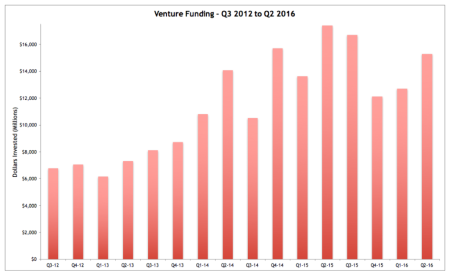
    NVCAEarlier this year, the National Venture Capital Association (NVCA), a trade association representing the U.S. venture capital industry, released the results of its MoneyTree Report on venture funding for the second quarter of 2016.  The report, which is prepared by the NVCA and PricewaterhouseCoopers LLP using data from Thomson Reuters, indicates that venture capitalists invested $15.3 billion in 961 deals in the second quarter, which constituted a 20% increase in dollars and a 5% decrease in deals as compared with the first quarter of 2016, when nearly $12.7 billion was invested in 1,011 deals (see chart below, which shows total venture funding from the third quarter of 2013 through the second quarter of 2016; data from MoneyTree Reports; click on chart to expand).  The second quarter of 2016 was the tenth consecutive quarter in which more than $10 billion in venture capital was invested.  However, as compared with the second quarter of 2015, invested dollars and deals were down 12% and 22%, respectively, in the second quarter of 2016.

    Venture Funding - Total
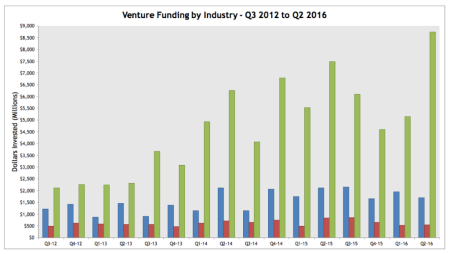
    In contrast with the increase in total funding, venture funding in the biotechnology sector decreased from $1.96 billion in the first quarter of 2016 to $1.69 billion in the second quarter of 2016 (see chart below, which shows venture funding for the biotech (blue), medical devices (red), and software (green) sectors since the third quarter of 2013; data from MoneyTree Reports; click on chart to expand).  In addition to experiencing a 14% decrease in dollars, the biotech sector also saw a 19% decrease in deals, with 100 deals in the second quarter of 2016.  Despite the decrease in dollars and deals, the biotechnology sector still received the second largest amount of venture capital for the quarter.

    Venture Funding - Industry
    The software sector once again captured the top spot among the seventeen sectors tracked by the NVCA, collecting $8.74 billion in the second quarter of 2016 (up 70% from the $5.15 billion the industry picked up in the first quarter).  The software sector has now captured the top spot for 27 straight quarters, with the biotech sector finishing second in all but five of those quarters.  The software sector has also received more than $4 billion in funding for the tenth consecutive quarter.

    Medical device and equipment investment increased by 3% with respect to dollars in the second quarter, with $539 million being invested.  Ten of the seventeen sectors tracked by the NVCA remained flat or saw increases in dollars invested in the second quarter of 2016.

    For additional information regarding this and other related topics, please see:

    • "Venture Funding Reaches Highest Level in More Than a Decade," February 25, 2016
    • "Third Quarter Venture Funding Declines 27% from Second Quarter," October 22, 2014
    • "Software Sector Leads Pack in 2Q Venture Funding and Biotech Sector Finishes Second," July 20, 2014
    • "Software Sector Leads First Quarter Venture Funding to Thirteen Year High; Biotech Sector Finishes Second (Again)," April 30, 2014
    • "Biotech Venture Funding Rebounded in 2013 After Strong Fourth Quarter," January 26, 2014
    • "Biotech Venture Funding Sees Second Quarter Rebound," July 22, 2013
    • "Biotech Venture Funding Down 33% in First Quarter," April 30, 2013
    • "Annual Venture Funding Drops for First Time in Three Years," February 4, 2013
    • "Biotech Venture Funding Up 64% in Third Quarter," October 29, 2012
    • "Venture Funding in Life Sciences Sector Drops 9% in Second Quarter," July 22, 2012
    • "Biotech Venture Funding Drops 43% in First Quarter," May 3, 2012
    • "Venture Funding Increased 22% in 2011," February 2, 2012
    • "Life Sciences Venture Funding Drops in Third Quarter," October 27, 2011
    • "Life Sciences Venture Funding up 37% in Second Quarter," August 1, 2011
    • "VentureSource Reports 35% Increase in 1Q Venture Funding," April 26, 2011
    • "NVCA Reports Modest Gains in First Quarter Venture Funding," April 19, 2011

    • "NVCA Reports 31% Drop in Venture Funding for Third Quarter," October 17, 2010

    • "NVCA Reports 34% Increase in Venture Funding for Second Quarter," July 22, 2010

    • "NVCA Report Shows First Quarter Drop in Venture Funding," April 20, 2010

    • "Biotech/Pharma Financing Improving, R&D Spending Up," August 31, 2009
    • "NVCA Study Shows Increase in Third Quarter Venture Funding," October 23, 2009

    • "First Quarter Venture Capital Funding at 12-Year Low," April 23, 2009

    • "NVCA Study Shows Decline in 2008 Investment; BIO Study Predicts Biotech Rebound in 2009," February 16, 2009

  • By Donald Zuhn

    CoverPatent services provider RWS inovia recently released its seventh annual report on global patent and IP trends.  In compiling "The 2016 U.S. Global Patent & IP Trends Indicator," RWS inovia, which produces products for PCT national phase entry and European patent validation, and provides IP translations and search services, surveyed more than 100 companies and universities in May 2016 to identify the trends having the greatest impact on the foreign filing strategies of patentees around the world.

    The 2016 report notes that 68% of survey respondents are from the U.S. and 32% are from Europe.  In addition, the report provides the following industry breakdown for survey respondents:  mechanical/engineering (16.8%), university/association/non-profit (15.9%), pharmaceuticals or biotech industries (14.0%), electrical/electronics (10.3%), IT/software/media (8.4%), and chemicals/materials (6.5%) (the remaining 28% of respondents were classified as "other," which encompasses manufacturing, telecommunications, teaching/research, consulting, pest control, and mining).  With regard to the size of respondents, the report notes that 37.4% of respondents had one to 100 employees, 19.6% had 101 to 1,000 employees, 32.7% had 1,001 to 10,000 employees, and 10.3% had more than 10,000 employees.  The report also indicates that 37.4% of survey respondents had no in-house patent attorneys or agents, 48.6% had one to four attorneys or agents, 6.5% had five to nine attorneys or agents, 5.6% had ten to 24 attorneys or agents, and 1.9% had 25 or more attorneys or agents.

    The 2016 report indicates that for U.S. applicants, fallout from the Alice Corp. v. CLS Bank ruling was the dominating issue in 2015, and for European applicants, the unitary patent was the main topic of concern.  With respect to filing expectations, 79.2% of respondents said they filed as many patent applications as they expected to file in 2015, 8.3% filed more than they expected, and 12.5% filed less than they expected.  The 2016 report indicates that 36.5% of survey respondents filed between four and nineteen patent families in 2015, 24% filed 1-3 patent families, 12.5% filed 20-49 patent families, 10.4% filed either no patent families or more than 100 patent families, and 6.3% filed 50-99 patent families.  The report noted that respondents have been filing fewer patent families as compared to three years ago.

    In addition, respondents filed 34.3% of their patent families internationally in 2015, down from 49% in 2014 and 52% in 2013.  The report notes that 66.7% of those international filings were made using the PCT, 2.6% were made using the Paris Convention, and 30.6% were made using a combination of the PCT and Paris Convention.  For respondents using the PCT to file internationally, 64% respondents had used the USPTO as the International Searching Authority, 56% had used the EPO, 31% had used the Korean IP Office (KIPO), and 8% had used the Australian Patent Office.  With regard to the countries in which respondents regularly filed, the top twelve jurisdictions were:

    1. United States
    2. Europe
    3. China
    4. Japan
    5. Canada
    6. India
    7. Australia
    8. South Korea
    9. Brazil
    10. Russia
    11. Singapore
    12. South Africa

    With respect to IP budgets, 41.4% of survey respondents experienced IP budget cuts in 2015 (of which 12.1% of respondents were experiencing budget cuts for the first time in recent years).  For respondents who had reduced foreign patenting costs in 2015, cost savings were achieved by filing in fewer countries (41.0%), bringing steps in-house (23.7%), negotiating with U.S. or European counsel (19.8%), consolidating foreign counsel (18.4%), negotiating with foreign counsel (17.1%), using non-law firm providers (14.5%), reducing costs on patent translations (11.8%), and consolidating local counsel (9.2%).  For survey respondents who brought steps in-house, those steps included annuities (29.0%), drafting specifications (17.1%), foreign patent filing (17.1%), patent translations (11.8%), U.S. or European prosecution (9.2%), filing U.S. or European patent applications (7.9%), and foreign patent prosecution (6.6%).

  • By Donald Zuhn –-

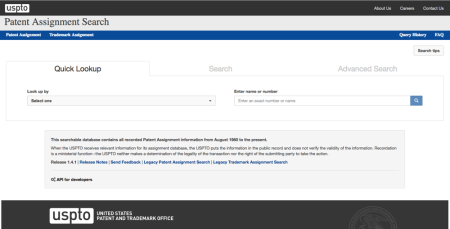
    USPTO SealIn a Patent Alert e-mail distributed last month, the U.S. Patent and Trademark Office announced the release of an enhanced version of its Patent Assignment Search System.  The Office noted that the new system provides an improved layout, labeling, and tooltips, allowing users to perform a "Quick Look-Up" search to display desired assignment data directly.  The new layout (see screenshot below) also includes "Search" and "Advanced Search" tabs.  Users will be able to export data to CSV, PDF, and XML files, and view attached patent assignment documents for all electronically available documents from mid-1998 to the present.  In addition, users will be able to access the legacy Assignments on the Web (AOTW) system.  Finally, an API (application programming interface) will be available for external applications to retrieve and read assignments data.  A full list of new features and enhancements can be found here.

    Assignment Search Screenshot

  • CalendarOctober 11, 2016 - Patents Ombudsman Program and Pro Se Assistance Program (U.S. Patent and Trademark Office) – 12:00 to 1:00 pm (ET)

    October 12, 2016 – "Addressing §101 Patent Eligibility Rejections: Getting Off the Hook" (The Knowledge Group) – 10:00 am to 12:00 pm (EST)

    October 13, 2016 – "Leveraging USPTO Examiner Count System: Efficiently Prosecuting Patents, Lowering Prosecution Costs" (Strafford) – 1:00 to 2:30 pm (EDT)

    October 19, 2016 – "To Patent or Not to Patent: When to Keep Your IP a Trade Secret" (McDonnell Boehnen Hulbert & Berghoff LLP) – 10:00 am to 11:15 am (CT)

    ***Patent Docs is a media partner of this conference or CLE

  • USPTO SealThe U.S. Patent and Trademark Office will be offering the next webinar in its Patent Quality Chat webinar series from 12:00 to 1:00 pm (ET) on October 11, 2016.  Anthony Knight, Director of Stakeholder outreach and Patents Ombudsman Program, and Mindy Bickel, Associate Commissioner for Innovation Development, will detail the Patents Ombudsman Program and Pro Se Assistance Program, and the services they provide.  Through a discussion of frequent issues facing patent prosecutors today, the speakers will help circumvent some more common problems and get feedback on other assistance they might be able to provide.

    Instructions for viewing the webinar can be found here.

    Additional information regarding the Patent Quality Chat webinar series can be found on the USPTO's Patent Quality Chat webpage.

  • The Knowledge GroupThe Knowledge Group will offer a live webcast entitled "Addressing §101 Patent Eligibility Rejections: Getting Off the Hook" on October 12, 2016 from 10:00 am to 12:00 pm (EST).  Seth M. Cannon of Carter, DeLuca, Farrell & Schmidt, LLP and Viresh R. Patel of Jones Robb PLLC will help attendees understand many of the important issues and insights with regard to recent court decisions on patent eligibility, as well as the impact of the Alice decision, and also present key findings and best practices in addressing §101 patent eligibility rejections issued by the USPTO.  The webinar will cover the following topics:

    • Subject Matter Eligibility Under §101: An Overview
    • Identifying Patent-Eligible Inventions
    • Best Practices for Drafting Patent Applications in View of Alice
    A Review of Subject Matter Eligibility Rejections Issued by the USPTO
    • Best Practices for Addressing Subject Matter Eligibility Rejections
    • Identifying and Traversing Common Rationale Relied Upon in Rejections
    • Analogizing and Distinguishing Relevant Court Decisions and Examples Provided in the § 101 Guidelines
    • Claim Amendment Strategies for Addressing Subject Matter Eligibility Rejections
    • Procedural Tips for Traversing Subject Matter Eligibility Rejections
    • Utilizing Examiner Interviews to Address § 101 Rejections

    The registration fee for the webcast is $299 (regular rate) or $199 (government/nonprofit rate).  Those interested in registering for the webinar can do so here.