• Strafford #1Strafford will be offering a webinar/teleconference entitled "Drug Substance Patents: Leveraging New FDA Guidance, Protecting Composition of Matter Patents, Drafting Solid Form Claims" on November 1, 2016 from 1:00 to 2:30 pm (EDT).  Eyal H. Barash of Barash Law and Dr. Steef Boerrigter, Senior Research Investigator, Materials Science SSCI will provide guidance on what solid forms are with respect to "traditional" drug substance patents, how to patent them and what the challenges are in the process, and discuss the effect of the new cocrystal guidance at the FDA and provide a survey of cases relating to solid form patents and what can be learned from them.  The webinar will review the following issues:

    • A brief scientific introduction as to what a solid form is;
    • What are the key patentability issues when preparing solid form patents?
    • How are pharmaceutical companies using solid form patents?
    • What is different about claiming solid form patents with respect to "organic chemistry" claims in other composition of matter patents?
    • What impact does the new FDA guidance on cocrystals have on patenting composition of matter?

    The registration fee for the webinar is $297.  Those interested in registering for the webinar, can do so here.

  • Strafford #1Strafford will be offering a webinar/teleconference entitled "Markman Hearing Strategies, Claim Construction in a Post-AIA PTAB Environment and the Impact of Recent SCOTUS Decisions" on October 27, 2016 from 1:00 to 2:30 pm (EDT).  Robert Rando of Rando Law Firm and Kevin P. Wagner of Faegre Baker Daniels will provide guidance on the preparation for and the conducting of Markman hearings, examine key considerations from claim selection to timing to the use of experts, and offer effective strategies to navigate the claim interpretation process.  The webinar will review the following issues:

    • What steps should patent counsel take in preparation for a Markman hearing?
    • What are the pros and cons of conducting the Markman hearing early in litigation? Or late in litigation?
    • What guidance can be drawn from recent court decisions for claim construction in district court?
    • What impact could AIA procedures have on the patents in question in Markman hearings?

    The registration fee for the webinar is $297.  Those interested in registering for the webinar, can do so here.

  • The Knowledge GroupThe Knowledge Group will offer a live webcast entitled "Decoding the Framework of Double Patenting: Legal Issues and Insights Uncovered!" on October 24, 2016 from 3:00 to 5:00 pm (EST).  Gurpreet Singh Walia of Cohen & Gresser LLP, Thomas Hedemann of Axinn, Veltrop & Harkrider LLP, and Alan Macek of Dimock Stratton LLP will cover the following topics:

    • Double Patenting Concept in US and Canada
    • Recent Court Treatments
        – Gilead Sciences Inc. v. Natco Pharma Ltd.
        – AbbVie Inc. v. Mathilda & Terence Kennedy Inst. of Rheumatology Trust
        – Significant Cases in Canadian Court
    • Overcoming Double Patenting Rejections

    The registration fee for the webcast is $299 (regular rate) or $199 (government/nonprofit rate).  Those interested in registering for the webinar can do so here.

  • JMLSThe John Marshall Law School Center for Intellectual Property, Information & Privacy Law and Kuhnen & Wacker will be offering a seminar on "European Patent Practice" on November 1-2, 2016 in Chicago, IL.  A brochure for the seminar can be found here.

    The registration fee for the seminar is $100 (single day), $195 (two days), or $95 (government, judicial or academic rate).  Those interested in registering for the conference can do so here.

  • By Joseph Herndon

    District Court for the Eastern District of TexasIn the U.S. District Court for the Eastern District of Texas, in a case captioned Perdiemco, LLC. v. Industrack LLC, the Court found some patents having method claims directed to "conveying user location" to be patent-eligible under 35 U.S.C. § 101.  Much of the reasoning was based on the recent Federal Circuit decision McRO, Inc. v. Bandai Namco Games America Inc., and even though the claims are generally broad and only include basic/generic computer components, the claims survived a § 101 challenge.  This is good for patentees and patent owners, as some Courts are now more willing to allow software patent claims to survive.

    The defendants filed motions for judgment on the pleadings that the asserted patents claim ineligible subject matter under 35 U.S.C. § 101, and that the claims of the asserted patents are invalid under 35 U.S.C. § 112 ¶¶ 1 and 2.  The asserted patents include U.S. Patent Nos. 8,223,012; 8,493,207; 8,717,166; 9,003,499; and 9,071,931.  These patents share a common specification, and are generally directed to conveying location information by defining object location events relating object location information to user-defined zones and managing conveyance of object location event information based on user identification codes.  By using access codes, multiple users can collaboratively define and manage events and manage the conveyance of corresponding object location information, user-defined zone information, and/or object location event information among computing devices.  An example use case includes tracking pets, in which a pet has associated with it a location information source and the pet owner defines zones that the pet is supposed to stay in (e.g., a yard) and may define zones in which the pet is not allowed (e.g., a garden).  An object location event for leaving the yard sends an email and dials a phone of the pet owner.  An object location event for entering the garden might cause a siren to go off to scare the pet.  Thus, location information is used to trigger certain events.

    Subject Matter Eligibility

    Defendants contended that all asserted claims of all asserted patents embody an abstract idea of managing the dissemination of location and/or event information within a community, or at most, they recite different ways of organizing people into groups and managing the dissemination of location/event information through use of conventional computer and GPS technology.

    Claim 6 of the '012 patent is representative and is reproduced below.

    1.  A method for conveying user location information, comprising:
        interfacing with an administrator that authorizes a first user associated with a first user identification code to access an object location information from a location information source associated with a second user identification code that is different from the first identification code; and
        conveying the object location information to a third user based on an information access code specified by said first user, said information access code being associated with a third user identification code that is different from the first and second user identification codes.

    5.  The method of claim 1, wherein the second user identification code is associated with a zone information comprising a coordinate on a map; and wherein at least one of the object location information or zone information is conveyed to the third user based on the information access code.

    6.  The method of claim 5, wherein the second user identification code is associated with an object location event information that relates the object location information to the zone information; and wherein at least one of the object location information or the zone information or the object location event information is conveyed to the third user based on the information access code.

    Defendants argued that representative claim 6 merely requires (1) interfacing with an administrator who (2) authorizes a first user to (3) access the location/zone/event information of a second user and (4) conveying that information to a third user.

    Defendants constructed an analogy between claim 6 and a scenario in which steps of claim 6 could easily be performed by humans without the need for any computer or location tracking technology.  The scenario:  a mother desiring to track the location of her daughter who is traveling on a class field trip from Florida to Washington D.C., and the mother (administrator) may authorize a chaperone (first user) that has traveled with the daughter's (second user) class to supervise and track her daughter as well as have access to and convey the daughter's location (access object location information associated with the second user).  When the class arrives at their hotel in Washington (associating the second user with a zone and/or event), the chaperone is authorized to notify the mother and father (third user) that they have safely arrived at their destination (conveying location, zone and/or event information to a third user).

    This example apparently confirms that claim 6 is directed to no more than the abstract idea of "managing the dissemination of location and/or event information within a community" and is therefore patent ineligible.

    The Court, however, found a number of fatal problems with Defendants' analysis of claim 6.  First, it is improper to "simply ask whether the claims involve a patent-ineligible concept."  Instead, the analysis turns on "whether the claims in these patents focus on a specific means or method that improves the relevant technology or are instead directed to a result or effect that itself is the abstract idea and merely invoke generic processes and machinery."

    Here, claim 6 requires a variety of computer-related components, including: "user identification code[s]," "a location information source," and "an information access code."  The claim then recites a specific structure of rules for providing information about the locations of objects to users and for managing user access to this information.  The Court found that it is therefore not apparent that claim 6 recites nothing significantly more than an instruction to apply an abstract idea using some unspecified, generic computer.

    Instead, the Court found that claim 6 defines a set of rules for organizing and improving the behavior of a computerized location information system.  Here, as in McRO, the specific structure of the claimed rules would prevent broad preemption of all rules-based means for achieving the desired result.

    The second problem with Defendants' argument, as noted by the Court, is the premise that analogizing the method of claim 6 to a class field trip confirms that claim 6 is directed to an abstract idea.  This fact is not necessarily dispositive — "processes that automate tasks that humans are capable of performing are patent eligible if properly claimed," as noted in McRO.

    More importantly, the Court found that the field trip analogy omits or glosses over many limitations of the claim, including the aforementioned "location information source" and access codes.  Managing the information provided by the location information source using a set of relationships defined in part by access codes is what the claim is all about.  The Court noted that the analogy also fails to capture another key feature of the claim:  centralization.  In the field trip analogy, a variety of independent actors (mother, father, chaperone) must coordinate with one another and no single actor performs all the claimed steps.  It is also not clear that any actor in the analogy performs the "interfacing" and "conveying" steps.  These deficiencies in the analogy help to illustrate why claim 6 is not merely a computerized version of conventional human activity, it is an improvement to a computer system that administers, manages, and conveys location information in a centralized way.

    Accordingly, like the claims in Enfish and McRO, the Court found that claim 6 of the '012 Patent is not directed to an abstract idea and therefore survives step one of the Mayo eligibility analysis, and thus, satisfies section 101.

    Written Description

    Defendants also moved for judgment on the pleadings that the asserted patents are invalid under § 112(1) for failure to provide adequate written description.  Defendants contended that the common specification and prosecution history of the asserted patents unequivocally establishes that the inventor required user defined zones and user defined events to be essential to his purported invention, and because each of the asserted claims does not include both a user defined zone and user defined event, and are thus broader than the specification disclosure, the asserted claims are invalid for failing to comply with the written description requirement.

    The test for the sufficiency of the written description is whether the disclosure of the application relied upon reasonably conveys to those skilled in the art that the inventor had possession of the claimed subject matter as of the filing date.

    In the context of a 12(c) motion, the Court may not consider expert testimony or any other evidence outside the pleadings.  Instead, the Court must draw all reasonable factual inferences in favor of the non-movant.  For this reason, the Court could not conclude that Defendants established their written description defense by clear and convincing evidence.  Even if the claims do not recite every "essential" technological feature discussed in the specification, this does not render them invalid as a matter of law.  Judgment on the pleadings is, therefore, not the proper way to resolve this fact-intensive defense.

    Defendants further contended that the asserted patents are invalid under § 112(2) for failing to claim "what the patentee regarded as his invention."  This argument is based on the same premise as Defendants' § 112(1) defense, that "the inventor of the Asserted Patents unequivocally regarded user defined zones and user defined events as required features of his purported invention."

    Unlike written description, validity under § 112(2) is a question of law.  However, the party asserting this defense must make a showing of a logical inconsistency or contradiction between the claims and the specification.  The fact that the asserted claims do not encompass every feature, or even every important feature, disclosed in the specification does not imply a logical contradiction.  Defendants cited no authority for the proposition that every feature disclosed in the specification must be claimed, and indeed the converse appears to be true.  The Court found no logical contradiction between the asserted claims and the common specification.

    Report and Recommendation by Magistrate Judge Roy S. Payne

  • By Andrew Williams

    PfizerOn April 5, 2016, the FDA approved Celltrion's application to market a biosimilar to Janssen Biotech Inc.'s REMICADE® (infliximab) anti-TNF-α antibody (see "FDA Approves Inflectra – Celltrion's REMICADE® Biosimilar").  Presumably because of the Notice-of-Commercial-Marketing provision, Celltrion notified Janssen at the time that it would not begin selling its biosimilar drug product until at least October 2, 2016, subject to certain reservations (see "An Inflectra Update: Janssen Requests an Expedited Trial").  Fast forward to this Monday, October 17, 2016, and Pfizer announced that it would begin shipping the Celltrion biosimilar, named INFLECTRA® (infliximab-dyyb), in late November 2016.  Pfizer pointed out in its press release that it holds the exclusive commercialization rights to INFLECTRA in the U.S., and that it has already introduced the biosimilar in other markets around the world.  This will be only the second biosimilar to be made available in the U.S., and the first biosimilar that is a therapeutic antibody.  Pfizer indicated that it intends to introduce INFLECTRA at a 15% discount to the current wholesaler acquisition cost (WAC) of REMICADE.

    If Pfizer does indeed launch by the end of the year, it will most likely do so under a cloud of patent uncertainty.  On March 6, 2015, Janssen filed suit in the U.S. District Court for the District of Massachusetts against Celltrion Healthcare Co., Ltd., Celltrion, Inc., and Hospira, Inc, alleging infringement of six patents that purportedly covered the antibody at issue, methods of using the antibody, and methods and reagents for the manufacture of the antibody.  By the end of 2015, all counts related to three of the patents had been voluntarily dismissed.  Then, on March 22, 2016, Defendants stipulated that they would not begin selling their biosimilar drug product prior to June 30, 2016, the date on which a fourth patent expired.  As a result, when the FDA approved INFLECTRA, there were only two patents remaining in the lawsuit.

    The first patent, U.S Patent No. 6,284,471, entitled "Anti-TNFa Antibodies and Assays Employing Anti-TNFa Antibodies," was invalidated by the Court on August 19, 2016 as a result of a Motion for Summary Judgement of Invalidity for Obviousness-Type Double Patenting filed by Celltrion.  The '471 patent issued on September 4, 2001, and because it was filed before the change in patent term that resulted from the Uruguay Round Agreements Act, it was set to expire 17 years after issuance, on September 4, 2018.  However, Janssen also held U.S. Patent 6,790,444, which issued on September 14, 2004 and expired on July 11, 2011 (because its expiration was based on priority date, not the issue date of the patent).  In reaching its decision, the Court noted that the Federal Circuit held in Gilead Sciences, Inc. v. Natco Pharma Ltd. "that a later-issuing, earlier-expiring patent can act as double-patenting reference for an earlier-issuing, later-expiring patent."  (We reported on the Gilead case at the time).  The District Court did acknowledge that the present case was distinct from Gilead because that case did not address the differences in patent term resulting from the Uruguay Round Agreements Act.  Nevertheless, it concluded that the Federal Circuit's reasoning in Gilead was equally applicable here, because "the statute was not intended to alter the judicial doctrine of obviousness double patenting."  Subsequently, on September 27, 2016, the District Court entered partial final judgement that the '471 patent is invalid so the issue could be appealed, because it reasoned that the decision was severable from the remaining issues and the Federal Circuit would not be required to decide the same issues more than once.  We will continue to cover this aspect of the case should it be appealed to the Federal Circuit.

    The last remaining patent, U.S. Patent 7,598,083, is set to be tried to a jury in February, 2017.  Specifically, the Court has set the trial for the two weeks between February 13 and February 24.  The '083 patent is entitled "Chemically Defined Media Compositions," and is set to expire February 7, 2027.  Even though there is more than a decade of patent term remaining, Janssen informed the Court during a February 9, 2016 conference that it would not seek a preliminary injunction.  Correspondingly, Pfizer will not be prevented from launching at risk when it ships the biosimilar drug product at the end of the year.

  • By Kevin E. Noonan

    The intersection of patent law, drug regulations, creative lawyering, and commerce (if not outright greed) has once again arisen in a qui tam suit brought under 31 U.S.C. §§ 3729–3733 (alleging fraud against the U.S. Government) by Lower Drug Prices for Consumers (LDPFC), reportedly an arm of Foxhill Capital, in USA ex rel. Lower Drug Prices for Consumers (LDPFC) v. Allergan and Forest Labs, Case No. 16-cv-09 (E.D. Texas 2016).  And if this plaintiff is successful it raises even greater risks to drug development than the continuing onslaught of inter partes review petitions by hedge fund managers, non-governmental organizations, gadflies, and others who would not have standing to challenge drug patents in court.

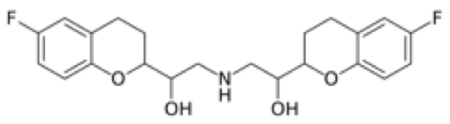
    The case involves Orange Book-listed U.S. Patent No. 6,545,040 that covers the drug nebivolol, sold by Allergan and Forrest Labs as Bystolic® for the treatment of high blood pressure (it is a beta blocker) having the structure:

    Structure
    The basis of the suit are "overpayment and overcharges" made to defendants by the U.S. government,  "directly or indirectly" through such programs as Medicare, Medicaid, the Children's Health Insurance Program, the Veterans' Administration, the military, prisons, and programs for Native Americans, according to the complaint.  The alleged injury and fraudulent pricing is based on the defendants' exclusivity under the '040 patent, which "is an invalid patent that should never have been issued by the United States Patent and Trademark Office."  Perhaps fortunately for these drug companies the term of this wrongful overpricing alleged by the complaint only commenced on June 2, 2015 when another patent on the drug, U.S. Patent No. 5,759,580, expired.  The complaint alleges that defendants knew ("and would have been well-known to any company engaged in new drug research") that the patent was invalid.  And it is on the basis for this allegation that the lawsuit, and plaintiff's potential liability for bringing it, will hang.

    The '040 patent granted with six claims, claim 1 being representative and reciting the drug itself ([2R,αS,2′S,α′S]-α,α′-[iminobismethylene]bis[6-fluoro-3,4-dihydro-2H-1-benzopyran-2-methanol]).  According to the complaint, these claims have been invalidated abroad (including in the UK) and challenged in ANDA litigation against seven generic companies (including Amerigen Pharmaceuticals, Glenmark Pharmaceuticals, Hetero Labs, Torrent Pharmaceuticals, Watson Laboratories, Alkem Laboratories, and Indchemie Health Specialties), each of which settled their litigations with Allergan/Forrest.  The complaint alleges that these settlements are under scrutiny by the Federal Trade Commission but whether this extends further than the review of ANDA settlements by the FTC prescribed by the Medicare Modernization Act of 2003 is not described in the complaint.  Plaintiffs allege that they have performed independent investigations, supported by expert declarations by Dr. Daniel W. Armstrong and Dr. Ronald W. Millard as well as 53 documents "found or created" by LDPFC in its investigation prior to filing the complaint.  Specifically, the complaint alleges that the claimed stereoisomers encompassed by claim 1 of the '040 patent were disclosed four years earlier than the patent's filing date, in U.S. Patent No. 4,654,362 (albeit as a mixture of other stereoisomers).  The complaint acknowledges that the question then becomes whether it would have been obvious to separate the isomers, and asserts the Federal Circuit's decision in Aventis Pharma Deutschland GmbH v. Lupin Ltd. (Fed. Cir. 2007), in support of its allegation that the claims are invalid for obviousness.  This portion of the complaint (¶¶ 32-45) overstates the holding of the Aventis case, applying it for the proposition that any separation of any mixture of stereoisomers is per se obvious, provided there was motivation to do so.  And while the complaint (and expert declarations) focus on the routine nature of attempting to separate enantiomers, the only reference to whether the skilled worker would have had a reasonable expectation of success in doing so is recited in the negative (the result "would not have been [] unexpected").

    These paragraphs (and the supporting documents and declarations) constitute all the support for the obviousness argument raise in the complaint.  The remainder of the allegations arise from the assumption that they are sufficient, and thus that defending their patents and maintaining the branded price constitutes "false claims" against the U.S. government (¶¶ 46-50) for "an inflated and false overprice" for the drug (¶ 47).  And while the complaint also alleges that the patentees "fail[ed] to supply all relevant information to the [USPTO]" there is no specific allegation that the patentee(s) are guilty of inequitable conduct.  The complaint also casts the confidential nature of the invalidity contentions by each of the ANDA defendants in a negative light (¶¶ 51-56), asserting that this (court-ordered) confidentiality "kep[t] the otherwise public invalidity contentions hidden from the public and the federal government" (¶ 54).

    The motivation for the suit becomes abundantly clear in the Prayer for Relief, which includes "actual damages, treble damages, and/or civil penalties between $5,000 and $10,000 for each violation [i.e., each pill sold] of 31 U.S.C. §§ 3729(a)(1)(B)," plus attorneys' fees, costs and expenses, and interest, and asks that, should the U.S. government intervene that plaintiffs get "at least 15% and not more than 25% of the proceeds of any judgment or settlement," and if the government does not intervene, at least 25% but not more than 30% of such proceeds.

    It remains to be seen whether the lawsuit "has legs" or will be subject to a motion to dismiss on any number of grounds, particularly because the PTAB ruled against the petitioner and refused to institute an IPR; after all, if a petitioner cannot prevail under the relatively lax standards before the Office, including no presumption of validity and the "broadest reasonable interpretation" standard for claim construction, it is unlikely that a district court will find otherwise.  It is important to note that the asserted basis for the action is that allegations of invalidity in Hatch-Waxman ANDA litigation provide the mens rea behind the qui tam action.  If mere allegations of invalidity are enough then no patent involved in any regulated industry will be safe from someone somewhere deciding that the "bounty" provided by the statute is sufficient incentive to bring suit.  A similar pattern emerged a decade ago for "false marking" claims, based on marketing patented goods in commerce where the patent had expired (yet the marking continued).  There, the inducement was the risk that even a small penalty could amount to a large fine in aggregate (for example, for the sale of millions of consumer items annually).  The current foray is more pernicious, because in the former case the tort (insofar as there was one) was patent:  the items continued to be marked and sold after the patents had expired.  Here there is no such certainty, and the circumstances are certainly ripe for the type of trolling activities that the high tech industry has spent a decade bemoaning (with varying levels of justification).  Congress solved the last qui tam problem by changing the statute to require injury and standing; perhaps Congress should consider a similar change in the law here, not just for qui tam actions but for IPRs in general.  At least that would restrict challengers to those with a real interest in reducing drug costs the old fashioned way, by providing generic drugs and not by clever (ab)uses of the legal system to fashion themselves a financial jackpot.

    Hat tip to Dennis Crouch for making us aware of this complaint (see "Bad Patents and the False Claims Act")

  • By Nicholas Vincent* and Anthony D. Sabatelli** —

    On September 13, the Federal Circuit held that a series of ordered combination of steps related to lip-synch software did not constitute an abstract idea, and was subsequently patent eligible under §101 (McRO, Inc. v. Bandai Namco Games America).  This decision reversed and remanded an earlier decision issued by the United States District Court for the Central District of California in McRO, Inc. v. Sony Computer Entertainment America, LLC.  This case, which was followed closely by the IT community, also has important, positive implications for the patent eligibility of biotech inventions.

    The earlier decision asserted in 2014 that U.S. Patent Nos. 6,307,576 ('576) and 6,611,278 ('278) were invalid, as they were not based on patentable claims under § 101.  In particular, the decision held that, although there were novel portions of the invention, they were claimed too broadly, thereby invalidating the patents.  Patents '576 and '278 share the same title ("Method for Automatically Animating Lip Synchronization and Facial Expression of Animated Characters").

    In the current ruling, the Court sought to apply the two-step Alice test, a test that first addresses whether the claims are directed toward an abstract idea, and if they are, then considers whether the claims recite something "significantly more" that makes the claims patent-eligible.  In applying the first step of the Alice test, the Court found that representative Claim 1 of '576, which focuses on particular improvements in computer animation, is not directed towards an abstract idea.  In addition, the Court went on to state that the advancement represents a significant improvement on the prior art.  As a result, step one of the Alice test is not met, and the software-encoded combination of steps for the lip-synch software is therefore patent eligible under § 101.  Interestingly, the Court did not reach step two of the test, showing that it is possible to pass the Alice test on step one alone, giving hope to future claims that may face Alice-related challenges.

    Interestingly, McRO maintained in its position that the claims are patent eligible because they constitute an improvement in animation, regardless of whether they are claiming an abstract idea.  In fact, McRO claimed that Diamond v. Diehr was the relevant precedent since the final product is a 3-D video and not an abstract idea.  This was challenged by the defendants who claimed that a past case, Parker v. Flook, was most pertinent to the patentability of the lip-synch software mainly because McRO was patenting what the defendants claimed was an unpatentable algorithm.  The Court, as previously stated, held otherwise.

    Image
    The image represents a 'viseme' (a representation of a character from the lip-synch software making a sound).  In this image from McRO, Inc. v. Bandai Namco Games America, the character is making the 'aah' sound, which corresponds to one component of a more complex and programmable speech pattern.

    The highly anticipated McRO decision comes on the tails of three recent decisions also by the Federal Circuit:  the Rapid Litigation Management, Enfish, and BASCOM decisions, the latter two of which are also from the computer/ software realm, and not the biotech world.  Together, these decisions are expected to play an important role in guiding the formation of patent-eligible claims that, historically, would have likely been considered patent-ineligible under the Alice test.  Specifically, and in relation to the McRO decision, claiming improvements on prior art seems to be both a promising and successful way of overcoming potential Alice-related challenges.

    Together, McRO, Rapid Litigation Management, Enfish, and BASCOM give the biotech field important guidance in developing patent-eligible biotech claims.  Not only does this new developing precedent grant the potential for expanded patentability, but it also provides a clearer means to overcoming Alice-related challenges in the future.  The message for biotech is to craft claims and set up the background in the specification to clearly point out the importance and improvements of the technology.  Clearly, if there is an improvement over the state of the art, this bodes well for patent eligibility.

    For biotechnology, the implication of expanded patentability is particularly promising; as biotechnology research engages more frequently with larger data sets and uses more complex, quantitative, and software-based approaches to answer questions, computing and software will play a larger role in these research endeavors.  Computers and software are becoming increasingly more enmeshed with many areas of biotech research and developments.  Moving forward, the ability to successfully defend algorithm-based patents against Alice challenges on the tails of McRO will likely focus primarily on the improvements over prior art, a shift from an earlier focus on the abstract nature of the innovation in question.

    * Nicholas Vincent is a Technology Specialist at Dilworth IP
    ** Dr. Sabatelli is a Partner with Dilworth IP

  • By Michael Borella and Eddie Obissi

    Anecdotally, there seems to be a loosening up regarding the application of § 101 by the District Courts.  The 2014 Supreme Court decision in Alice Corp. v. CLS Bank Int'l has been referred to as sounding a death knell for software and business method patents, and (less hyperbolically) as a sea-change in the law of patent-eligibility.  Indeed, for the first two years after Alice came down, decisions rendering challenged patents ineligible under § 101 held around 65-70% in the District Courts.  Hundreds of patents and thousands of claims were invalidated.

    But 2016 has brought a trio of § 101 holdings from the Federal Circuit that shored up the eligibility jurisprudence.  Enfish v. Microsoft and McRo v. Bandai, as well as Bascom v. AT&T Mobility to a lesser extent, have made it abundantly clear that software can be patent-eligible if the invention is an improvement to computer technology or another technology, specifically claimed, and does not preempt any abstract ideas encompassed therein.

    But have these cases had an impact on the District Courts, and if so, to what extent?  While the data is still preliminary, it seems that these decisions may be making it easier for courts to find that claims are not ineligible at both the pleadings and post-discovery stages.  In fact, September was the best month for patentees in all of 2016.

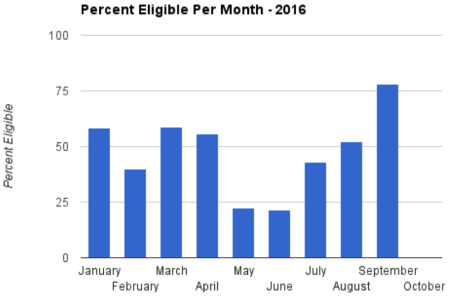
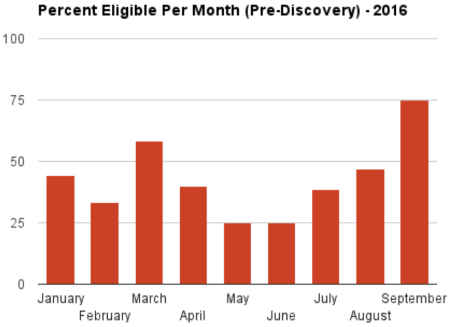
    We collected data on every § 101 decision made in the District Courts from the beginning of the year until the end of September.[1]  In total, we examined 141 distinct cases, of which claims were found eligible 73 times and ineligible 68 times, for an eligibility rate of 51.7%.  Thus, it appears as if, in 2016, patents are being found eligible in a higher percentage of cases than previously.

    Histogram 1
    But, as shown in the chart above, the most striking month was September, in which 78.2% (18 out of 23) of the cases came down in favor of the patentee.  Not only is this the highest monthly success rate in all of 2016 (prior to September, only 46.6% of cases favored the patentee), but it dwarfs the 30-35% rate that followed Alice.

    Drilling deeper, of these 23 decisions in September, 20 were decided on the pleadings, and 3 were decided after discovery.  The patentee success rate for § 101 decisions made in the pleadings stage was 75% and after discovery was 100%.  While patentees had a perfect record for decisions made after discovery, the significance of this observation is questionable.  The after-discovery data is sparse, consisting of only 27 cases for all of 2016 so far, and in two other months patentees enjoyed 100% success as well.

    Histogram 2
    The majority of the § 101 decisions in September, and throughout the year, were made on the pleadings.  As shown in the chart above, the month of September was unusually good for patentees.  Prior to September, the patentee success rate on the pleadings was hovering around 44%.  As noted above, this increased to 75% last month.  Thus, the main driver of the high rates of eligibility in September was decisions made on the pleadings.

    While we cannot say with certainty why this is the case, there are likely explanations.  First, the Enfish and McRo cases have made it harder for a challenger to invalidate a patent prior to discovery.  Enfish made it clear that improvements to technology are patent-eligible.  When reviewing a 12(b)(6) or 12(c) motion on the pleadings, the court is obliged to draw all inferences in the patentee's favor.  Therefore, if the patent's specification contends that the claimed invention is a technological improvement over the prior art, this will be taken as fact for purposes of deciding the motion (of course, an unsuccessful challenger can attempt to rebut such a contention by introducing contrary evidence during discovery).  In the five months since Enfish came down, it has been heavily cited by the district courts, which suggests that it is having an outsized impact on outcomes in these proceedings.

    McRo, on the other hand, was decided in mid-September.  Thus, it is unlikely to have had an impact on many § 101 decisions in that month.  Still, in McRo the Federal Circuit clarified that that automating a process that is not known to have been performed manually can be patent-eligible.  Previously, any process that could be performed manually was almost certainly ineligible.  Thus, the impact of McRo is unclear but may turn out to be significant.

    Second, patents being asserted post-Alice may be undergoing a higher level of vetting by their owners.  As Alice wiped out swathes of patents over the last two years, patentees may be becoming more selective in which patents they assert, the result being that the patents litigated now are better equipped to withstand § 101 challenges.

    Third, Post Grant Review proceedings in the USPTO may be weeding out some of the weaker patents before district court review has a chance to complete.  This may include patents with claims that could be challenged under § 101 in court but are invalidated under § 102 or § 103 in an Inter Partes Review, as well as those invalidated under § 101 or other grounds in a Covered Business Method Review.

    Regardless of the underlying reasons, the month of September 2016 was an outlier.  Whether it is a sign of things to come remains to be seen.

    [1] In this data we considered eligibility under § 101 separately from other challenges to the claims.  Thus, if a claim was found eligible under § 101 but unpatentable under §§ 102 or 103, the outcome for our purposes was "eligible."  Several (5) decisions were "split" in that some claims were found eligible and others were not.  We omitted these cases from this analysis.

  • CalendarOctober 18, 2016 – "PTAB Patent Proceedings: Best Practices and Strategies" (The Knowledge Group) – 3:00 to 5:00 pm (EST)

    October 19, 2016 – "To Patent or Not to Patent: When to Keep Your IP a Trade Secret" (McDonnell Boehnen Hulbert & Berghoff LLP) – 10:00 am to 11:15 am (CT)

    October 20-21, 2016 – "Patent Cooperation Treaty (PCT) Seminar for Patent Professionals" (John Marshall Law School Center for Intellectual Property, Information & Privacy Law, World Intellectual Property Organization, and Bloomberg Law) – Chicago, IL

    October 21, 2016 – "Factors Affecting Success of Motions to Stay District Court Litigation" (Federal Circuit Bar Association) – Washington, DC

    ***Patent Docs is a media partner of this conference or CLE