• Federal Circuit Bar AssociationThe Federal Circuit Bar Association (FCBA) will be offering a program entitled "From Chevron to Cuozzo: Practical Impacts of Administrative Law on PTO Proceedings" on December 6, 2016 from 1:00 to 2:00 pm (ET) at the Northeastern University School of Law in Boston, MA.  Andrew M. Mason of Klarquist Sparkman LLP will moderate a panel consisting of Lucas C. Townsend of Gibson, Dunn & Crutcher and Philip Warrick, Office of the Solicitor, U.S. Patent and Trademark Office.  The panel will focus on the practical consequences of the requirements of the Administrative Procedure Act ("APA") and administrative law, generally, in PTO proceedings, including examination, reexamination, appeals, and PTAB trials such as inter partes review.  The panel will also provide an overview of the APA-PTO intersection, discuss how leading administrative law decisions affect PTO proceedings, and cover strategic considerations relating to APA challenges.

    Additional information regarding the program can be found here.

  • Strafford #1Strafford will be offering a webinar/teleconference entitled "After-Final Practice: Navigating Expanding PTO Options to Compact Patent Prosecution — Utilizing Post-Prosecution Pilot Program (P3), After-Final Consideration Pilot 2.0, Pre-Appeal Conference and More" on November 22, 2016 from 1:00 to 3:00 pm (EST).  Andrew T. Harry and Scott A. McKeown of Oblon McClelland Maier & Neustadt will provide guidance to patent counsel on the various USPTO options for responding after final rejection of a patent application; touch on the basics of each option and focus on strategic considerations and use of the different options; and also provide an update on the ongoing pilot program, review statistics, and discuss their experiences.  The webinar will review the following issues:

    • What options are available to patent counsel upon receiving a final rejection to a patent application?
    • What factors should patent counsel consider when determining if and which PTO option to use in response to a final rejection?
    • How can patent counsel and applicants leverage the PTO options for compact patent prosecution?

    The registration fee for the webinar is $297.  Those interested in registering for the webinar, can do so here.

  • By Andrew Williams

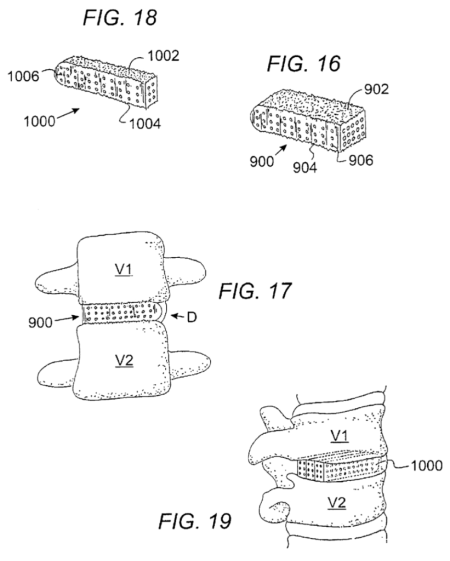
    Federal Circuit SealThe Federal Circuit remanded a final written decision of the Patent Trial and Appeal Board ("PTAB" or "Board") because the Board invalidated certain claims in a patent without providing adequate notice or opportunity to the patentee to respond to an assertion about a prior art reference.  Interestingly, in the In re NuVasive, Inc. opinion decided on November 9, 2016, the Federal Circuit reviewed the outcome of two IPR proceedings related to the same patent, U.S. Patent No. 8,187,334, directed to implants for spinal fusion surgery.  In the first proceeding, IPR2013-00507, the original petition had specifically cited to a section of U.S. Patent No. 5,860,973 ("Michelson"), and that section included a description of a prior art structure.  In the other proceeding, IPR2013-00508, there was no such specific citation to the structure, although the Michelson reference was cited.  In both cases, the Board relied on that prior art structure as represented in Figure 18 to invalidate all but one of the challenged claims as obvious.  In reaching its decision for the IPR2013-00508 proceeding, the Federal Circuit concluded that because Figure 18 was not referenced until the petitioner's reply, and because the Board's citation to Figure 18 was material to its invalidation of the claims, NuVasive was entitled to an opportunity to respond to the assertion about this figure.  The same was not true for IPR2013-00507.  The Federal Circuit concluded in that case that because Figure 18 was referenced in the petition, although not with specificity, NuVasive had sufficient notice (although "barely") that it should address the prior art structure found in that figure.  Claims 16 and 17 were the only two claims invalidated in the IPR2013-00508 proceedings that were not also invalidated in the IPR2013-00507 case, so the IPR2013-00508 case was remanded "for further proceedings regarding claims 16 and 17 in accordance with" the opinion.

    The technology in the case involved spinal fusion implants designed to be inserted between two vertebrae to replace damaged or diseased discs.  One claimed feature of the patented implants related to its dimensions, specifically a length that is both greater than 40 mm and at least 2.5 times the maximum width. This can be seen in this representative claim (with relevant language highlighted):

    1.  A spinal fusion implant of non-bone construction positionable within an interbody space between a first vertebra and a second vertebra, said implant comprising:
        an upper surface including anti-migration elements to contact said first vertebra when said implant is positioned within the interbody space, a lower surface including anti-migration elements to contact said second vertebra when said implant is positioned within the interbody space, a distal wall, a proximal wall, a first sidewall and a second sidewall, said distal wall, proximal wall, first sidewall, and second sidewall comprising a radiolucent material;
        wherein said implant has a longitudinal length greater than 40 mm extending from a proximal end of said proximal wall to a distal end of said distal wall;
        wherein a central region of said implant includes portions of the first and second sidewalls positioned generally centrally between the proximal wall and the distal wall, at least a portion of the central region defining a maximum lateral width of said implant extending from said first sidewall to said second sidewall, wherein said longitudinal length is at least two and half times greater than said maximum lateral width;
        at least a first fusion aperture extending through said upper surface and lower surface and configured to permit bone growth between the first vertebra and the second vertebra when said implant is positioned within the interbody space, said first fusion aperture having: a longitudinal aperture length extending generally parallel to the longitudinal length of said implant, and a lateral aperture width extending between said first sidewall to said second sidewall, wherein the longitudinal aperture length is greater than the lateral aperture width; and at least three radiopaque markers;
        wherein a first of the at least three radiopaque markers is at least partially positioned in said distal wall, a second of said at least three radiopaque markers is at least partially positioned in said proximal wall, and a third of said at least three radiopaque markers is at least partially positioned in said central region.

    The prior art Michelson reference described several spinal fusion implants, some of which were long and wide, but one of which was long and narrow.  The following four picture from that patent show two different implants and their respective insertion into the vertebrae:

    FiguresBoth petitions cited to other references as the primary reference for an obviousness assertion, but also cited to Michelson as teaching implants with elongated shapes with "dimensions that are longer than wide."  However, only in the IPR2013-00507 petition did Medtronic (the petitioner) cite to column 10, line 6 through column 11, line 15 for this proposition.  Nevertheless, this section described five different figures (16-20), and Figure 18 itself was never specifically identified.

    Medtronic only specifically identified Figure 18 in both proceedings after NuVasive filed its Patent Owner Response, in which it argued that "no single reference taught an implant that was both longer than 40 mm and had a length at least 2.5 times its width."  Medtronic pointed out in its Reply that Figure 18 disclosed exactly such an implant.  NuVasive requested leave to file a motion to strike or in the alternative, the opportunity to file a surreply, but the Board denied all such attempts.  Instead, the Board assured NuVasive it understood its position and would take it into account when making the final determination.  Nevertheless, the PTAB ultimately held all but one challenged claim obvious, relying heavily on Figure 18.  NuVasive appealed, and Medtronic cross-appealed on claim 18 but ultimately withdrew from the case.

    The Federal Circuit pointed out that the APA imposes particular requirements on the Patent Office, including timely informing patent owners of the matters of fact and law asserted against the patent and providing all parties the opportunity to respond after notice is provided.  In this case, the Court found the assertions regarding Figure 18 to be material, differentiating this case from Genzyme Therapeutic Prods. Ltd. v. Biomarin Pharm. Inc., in which the Court found that newly cited references were provided to establish the state of the art.  The Federal Circuit concluded that NuVasive was entitled to an opportunity to respond to the facts about Figure 18, even though Michelson was cited in both petitions ("And under the APA's fact-specific standard, common sense, and this court's precedent, that entitlement was not lessened in this case by virtue of the opportunity NuVasive had to respond to other factual assertions about Michelson.").  In other words, even though NuVasive had to respond to other assertions regarding Michelson, the new assertions regarding Figure 18 were sufficiently distinct to assure NuVasive an opportunity to respond to them.

    However, for the IPR2013-00507, the Court found that NuVasive had had that opportunity from the outset of the case, because Medtronic had cited to the section of the specification that happened to include a description of Figure 18.  This was sufficient, according to the Court, to put NuVasive on notice that it should address the dimensions of the implant in its Patent Owner Response.  What is unclear, however, is what is the maximum amount of text that needs to be referenced to still create such an obligation for a Patent Owner?  The clear takeaway for petitioners, however, is that to the extent possible with word-count constraints, make as many ancillary citations to as much cited art as possible in the hopes of creating such an obligation.

    One final observation that was not adequately explained by the Court is that NuVasive cited to Michelson Figures 16, 19, and 20 in its Patent Owner Response to demonstrate that the art used long-and-wide implants.  The patent owner explained that these configurations were desirable because they maximized the surface area of contact with the vertebrae.  Nevertheless, it is difficult to explain why NuVasive wasn't already on notice that it should explain why Figure 18 had similar dimensions as the claim invention, especially considering this figure was found in the midst of the other cited figures.  In fact, the Board had concluded that this citation to the other figures by NuVasive was sufficient to allow Medtronic to raise Figure 18 in its reply.  ("[A] reply may only respond to arguments raised in the corresponding opposition, patent owner preliminary response, or patent owner response.")  It is unclear, therefore, why NuVasive was not under an obligation at that point to differentiate the dimensions of Figure 18 from the claimed invention.  Going forward, it would probably behoove a Patent Owner to do so.  But, until the law changes, this In re NuVasive case should sufficiently support any requirement that the Patent Owner be provided with the opportunity to respond in such situations.

    In re NuVasive, Inc. (Fed. Cir. 2016)
    Panel: Circuit Judges Moore, Wallach, and Taranto
    Opinion by Circuit Judge Taranto

  • By Donald Zuhn –-

    Trump PenceEarlier today, in a result that stunned at least 47.7% of the American electorate and many observers abroad, a contentious Presidential election finally came to a conclusion, with Republican candidate Donald J. Trump defeating the Democratic challenger, Hillary Clinton.  As of late Wednesday evening, The New York Times reports that Mr. Trump has secured 279 electoral votes to Secretary Clinton's 228 votes — even though Secretary Clinton currently holds a 230,053 edge in the popular vote, with Secretary Clinton securing 59,923,027 votes (47.7%) to Mr. Trump's 59,692,974 votes (47.5%).

    With Mr. Trump now set to be sworn in as the 45th President of the United States in January, supporters of both candidates have begun to wonder how a Trump Presidency might impact their lives.  And readers of this space have likely focused on the possible impact of a Trump Administration on patents and innovation, as well as on the hi-tech and life sciences sectors.

    With respect to patents, the Intellectual Property Owners Association reported that while Mr. Trump had been mostly silent on intellectual property law and policy on the campaign trail, the 2016 Republican Party Platform includes a section on "Intellectual Property Rights" that states:

    Private property includes not only physical property such as lands and homes, but also intellectual property like books and patents.  Article 1, section 8 of the Constitution gives Congress the power to safeguard intellectual property rights for "Authors and Inventors."  By protecting the proprietary rights of creators and innovators, the Constitution promotes the general welfare by providing incentives for investment in all sorts of technology and artistic works.  Intellectual property is a driving force in today's global economy of constant innovation.  It is the wellspring of American economic growth and job creation.  With the rise of the digital economy, it has become even more critical that we protect intellectual property rights and preserve freedom of contract rather than create regulatory barriers to creativity, growth, and innovation.

    Protecting intellectual property is also a national security issue.  We must guard against counterfeit parts that can compromise the reliability of our weapons systems and the safety of military personnel.  Today, the worst offenses against intellectual property rights come from abroad, especially in China.  We call for strong action by Congress and a new Republican president to enforce intellectual property laws against all infringers, whether foreign or domestic.

    Earlier today, FierceBiotech reported on the immediate impact of the election on the biopharma industry, noting that the Nasdaq Biotechnology Index and S&P Biotech were up 6% and 9%, respectively, this morning.  FierceBiotech also reported that European biopharma stocks had also surged by the morning after the election.  According to the industry publication, many investors may be betting that Mr. Trump, and the Republican party, will not push as hard on the issue of drug pricing as Secretary Clinton would have had she won.  The publication suggested that "Clinton has remained a concern for biopharma, given that she openly 'declared war' on pharma pricing last year and has, along with Democrat (and failed presidential hopeful) Sen. Bernie Sanders, shaken stocks with their tweets denouncing 'price gouging' from the industry."

    Nature News reported that Mr. Trump's election win had stunned U.S. researchers.  In a separate report, Nature News collected social media reaction to Mr. Trump's victory, noting that the election results had generated "shock, disbelief and fear of funding cuts" among U.S. researchers.  The publication is also tracking the impact of Mr. Trump's election on science in the U.S. and beyond, asking researchers to complete a short online poll.

    Scientific American received responses from the Trump campaign regarding Mr. Trump's position on several science issues, and published those responses in a report earlier today.  On innovation, the Trump campaign stated that:

    [T]he federal government should encourage innovation in the areas of space exploration and investment in research and development across the broad landscape of academia.  Though there are increasing demands to curtail spending and to balance the federal budget, we must make the commitment to invest in science, engineering, healthcare and other areas that will make the lives of Americans better, safer and more prosperous.

    And on the importance of long-term investment in research, the campaign indicated that:

    [W]e must have programs such as a viable space program and institutional research that serve as incubators to innovation and the advancement of science and engineering in a number of fields.  We should also bring together stakeholders and examine what the priorities ought to be for the nation.  Conservation of resources and finding ways to feed the world beg our strong commitment as do dedicated investment in making the world a healthier place.

  • By Joseph Herndon

    District Court for the District of NevadaPlaintiff CG Technology Development, LLC sued Defendants Bwin.Party Digital Entertainment, PLC in the U.S. District Court for the District of Nevada for infringement of various patents via operation of various online casino games.  Bwin filed a motion to dismiss infringement as to U.S. Patents 8,771,058; 8,814,664; 9,355,518; and 9,306,952 based on unpatentability under 35 U.S.C. § 101.

    The District Court followed the two-step test set forth by the Supreme Court in which first, a court determines whether the claim is "directed to one of those patent-ineligible concepts."  If not, the analysis ends.  If so, however, a court must consider the elements of each claim "both individually and 'as an ordered combination' to determine whether the additional elements 'transform the nature of the claim' into a patent-eligible application."

    All patents relate to various aspects of online gambling, and various details of the four patents at issue are discussed below.

    The '058 Patent

    The '058 patent is directed to a zone dependent payout percentage gambling system.  Higher payout percentages are offered in certain locations than in other locations.  For example, in certain areas of a casino, such as in mall and shop areas, payout percentages of between 98% and 99% are offered.  In other areas, payout percentages below 96% may be offered.  Figure 6 is reproduced below and illustrates separate zones for the mobile device.

    Image
    Claim 19 is representative of the '058 patent and is the only claim Plaintiffs have accused Defendants of infringing.  Claim 19 reads in full:

    19.  A computer system comprising:
        a processor operable to execute a set of instructions; and
        a memory having stored thereon the set of instructions, in which the set of instructions, when executed by the processor, cause the computer system to perform a method comprising:
            determining a first location of a mobile gaming device,
            determining a first game configuration associated with the first location,
            generating a first game outcome using the first game configuration,
            determining a first payout associated with the first game outcome,
            crediting a player account with a first amount based on the first payout,
            determining a second location of the mobile gaming device, wherein the second location is different from the first location,
            determining a second game configuration associated with the second location, wherein the second game configuration is different from the first game configuration,
            generating a second game outcome using the second game configuration,
            determining a second payout associated with the second game outcome, and
            crediting the player account with a second amount based on the second payout.

    The District Court noted that determining game configurations (based on some set of rules, e.g., an algorithm, list, etc.), generating game outcomes based on the configurations (based on some set of rules, e.g., an algorithm, list, etc.), determining payouts based on game outcomes (based on some set of rules, e.g., an algorithm, list, etc.), and crediting players based on payouts (accounting) are abstract ideas that can be conducted in one's mind.

    But at least one aspect of the process requires activity outside of one's mind:  determining the physical location of the mobile gaming device.  Claim 19 is limited to using a computer system to locate a mobile gaming device.  The specification notes that location verification technology may be network- or satellite-based and may use methods such as geo-fencing or triangulation.

    The District Court found that determining an actual, physical location is not an abstract concept because one cannot perform the function in one's head.  Claim 19 does not simply instruct a practitioner to use a computer to perform calculations using pre-existing location data; it requires as an essential step that the computer actually determine the location of the mobile gaming device.

    The District Court found that because claim 19 requires the location of a mobile gaming device via a computer system, that is concrete enough to take the claim outside the scope of Alice Corp.'s "abstract idea" exception to patentability under § 101.  The location of the mobile gaming device via computer is a limited, concrete, physical task.

    The District Court found that the argument of whether similar methods of location-based gaming options are well known and long-practiced goes to anticipation or obviousness under §§ 102 or 103, respectively, not patentability under § 101.

    The District Court therefore denied the motion to dismiss Claim 19 of the '058 Patent under § 101.

    The '664 Patent, '518 Patent, and '952 Patent

    Each of the challenged claims in the '664 Patent, '518 Patent, and '952 Patent recites a requirement of physically locating wireless gaming terminals via a computer to perform a function, and the District Court found that these claims are not invalid under § 101 for the same reasons as with Claim 19 of the '058 Patent above.  The District Court summarily determined that such action makes the process sufficiently concrete to survive Alice Corp.

    Thus, the motion to dismiss was denied for all patents.

    This case easily could have been decided differently, as we have seen many times in the past, by the Court simply identifying the function of location-determination as a well-known feature and then dismissing the feature in the abstract idea analysis.  However, this Court correctly noted that whether the location-determination feature is well known goes to anticipation or obviousness, rather than patentability under § 101.  As a result, all claims reciting the requirement of physically locating the wireless gaming terminal were found to be directed to patentable subject matter.

    Order by District Judge Robert C. Jones

  • By Donald Zuhn –-

    USPTO SealIn a notice published in the Federal Register (81 Fed. Reg. 71485) last month, the U.S. Patent and Trademark Office announced that it will be holding two roundtables in order to obtain public input on patent subject matter eligibility in view of recent decisions by the Supreme Court and Federal Circuit.  The first roundtable will be held from 1:00 to 5:00 pm EST on November 14, 2016 in the Madison Auditorium at the U.S. Patent and Trademark Office in Alexandria, VA, and the second roundtable will be held from 8:00 am to 5:00 pm PST on December 5, 2016 in Paul Brest Hall at Stanford University.  The Office's notice also included a request for written comments regarding the specific topics to be addressed in each roundtable.

    In the notice, the Office states that "[o]ver the past six years, the Supreme Court has issued a series of decisions—Bilski, Mayo, Myriad, and Alice—that have significantly impacted patent eligibility law and continue to generate substantial public debate."  The notice briefly summarizes each of these cases, pointing out that:

    These cases continue to have a substantial effect on patent eligibility in the United States.  On the one hand, they have overturned decades-old USPTO practice regarding patent eligibility of isolated genes, placing the United States at odds with the practices of major trading partners, including Europe.  On the other hand, the Mayo two-step test has generally raised the bar for patent eligibility in all fields of technology.

    The notice indicates that at the first roundtable, the Office will be seeking public feedback regarding improvements to the Office's existing subject matter eligibility guidance and training examples.  In particular, the Office is seeking feedback on the following topics:

    1.  Suggestions to how to improve the Office's subject matter eligibility guidance, particularly the three recent memoranda discussed above;

    2.  Comments on the May 2016 Life Sciences examples and their effect on prosecution of patent applications in the life sciences, and suggestions of additional examples, or technology areas in which examples would be helpful;

    3.  Suggestions on how best to make examiners aware of newly issued judicial decisions, and how best to incorporate recent decisions holding claims eligible, such as Enfish, Bascom, Rapid Litigation Management, and McRO, into the Office's subject matter eligibility guidance; and

    4.  Concerns on how the Office's subject matter eligibility guidance and training examples, or how court decisions, are being applied by examiners.

    Although the deadline to submit a request to speak at the first roundtable has passed, the Office's notice indicates that the public is invited to speak at the first roundtable by appearing in person at the USPTO headquarters in Alexandria, VA or at one of the four USPTO Regional Offices.  An agenda for the first roundtable can be found here.  Written comments regarding the topics to be addressed at the first roundtable can be submitted by e-mail to 2014_interim_guidance@uspto.gov.

    At the second roundtable, the Office is interested in facilitating a public discussion and receiving public feedback regarding larger questions concerning the legal contours of eligible subject matter under the U.S. patent system.  In particular, at the second roundtable the Office desires (1) "to promote conversation on how the current section 101 jurisprudence is evolving; what the optimum legal contours for patent eligibility should be; and how best to achieve these goals"; (2) "to facilitate discussion and create a public record with relevant information on the actual or perceived impact of existing law on particular technology areas, and the effects on investment in research and development, and innovation generally"; (3) obtain "comments on whether developments in patent-eligibility law should be left primarily to the courts or whether other administrative initiatives are desirable"; and (4) secure input on "whether legislative changes are desirable and, if so, views on the elements of such changes."

    The notice provides a list of eighteen questions on which it is interested in receiving views and comments from the public.  The eighteen questions include the following:

    1.  How has the Supreme Court's interpretation of 35 U.S.C. 101 in the past several years affected the enforcement of patents and the development of subject-matter-eligibility law?

    2.  Should the patent statute be amended to further define the statutory categories of invention, i.e., process, machine, manufacture, and composition of matter?

    3.  Do you think there should be exceptions to patentable subject matter?

    4.  Should the patent statute be amended to define the judicial exceptions?

    6a.  Do you think that title 35 should be amended to revise the definition for the term "invention" and/or provide a definition for the term "discovery" along with specific examples of subject matter that should not be treated as an invention and/or discovery?

    7.  Does the concept of preemption, either separately or in the context of the Mayo two-step framework, capture useful insight in guarding against the issuance of overly broad patents?

    8.  What does the term "discovery" in sections 100 and 101 mean, and to what extent should a "discovery" be eligible for a patent?

    9.  What does the term "invention" in sections 100 and 101 mean, and to what extent should a non-naturally occurring product of human ingenuity qualify as an "invention" to be eligible for a patent?

    10.  To what extent should products that have been isolated from their natural surroundings as a result of human ingenuity be eligible for a patent?

    11.  To what extent should a "diagnostic method" be eligible for a patent?

    12.  Are there lines that can or should be drawn scientifically or legislatively between different types of compositions of matter for purposes of obtaining patent protection (e.g., between human genes and genes of other species)?

    13.  What particular inventions or specific types of technologies that should be patent eligible are not patent eligible, or are likely to be challenged as patent ineligible, under Mayo/Myriad?

    14.  Should patents be available for methods that do not involve a machine or a transformation?

    15.  If you support some form of "machine or transformation test," please identify the best expression of such a test.

    16.  To what extent should an invention that involves a business method be eligible for a patent?

    17.  To what extent should an invention that involves computer software be eligible for a patent?

    18.  What mechanisms, other than the judicial exceptions, can be used to prevent issuance of overly broad software or computer-related patents that cover wide swaths of economic activity?

    Additional questions and information being sought by the Office with respect to the above questions can be found in the Office's notice.  Those wishing to submit public feedback regarding any of the above questions are encouraged to review the notice in order to provide as complete and full response as possible.

    Those wishing to speak at the second roundtable must submit a request to the Office by November 14, 2016.  The Office's notice also indicates that the public is invited to speak at the second roundtable by appearing in person at the USPTO headquarters in Alexandria, VA or at one of the four USPTO Regional Offices.  Written comments regarding the topics and questions to be addressed at the second roundtable can be submitted by e-mail to 101Roundtable2@uspto.gov.

    Written comments related to either of the roundtables must be submitted by January 18, 2017.  Both roundtables will be available for viewing via webcast.  Additional information regarding the roundtables and submission of written comments can be found in the Office's notice.  An agenda and webcast information for the roundtables can be obtained at the webpage for Roundtable 1 or the webpage for Roundtable 2.


  • CalendarNovember 8, 2016 – "Clarity of the Record Pilot: A Discussion of Findings" (U.S. Patent and Trademark Office) – 12:00 to 1:00 pm (ET) on 

    November 9, 2016 – "Evolution of Patent Litigation: Interface of Judicial and Administrative Patent Proceedings" (Federal Circuit Bar Association) – Northeastern University School of Law, Boston, MA

    November 10, 2016 – "Ethics in AIA Post-Grant Proceedings at the PTAB" (Intellectual Property Owners Association) – 2:00 to 3:00 pm (ET)

    November 10, 2016 – "Patent Prosecution and Defeating Abstractness: Minimizing the Risk of Sect. 101 Rejection — Lessons From Recent Federal Circuit Court Decisions" (Strafford) – 1:00 to 2:30 pm (EDT)

    November 15, 2016 – "Covered Business Method (CBM) Patent Review: Another Way to Kill Software Patents?" (McDonnell Boehnen Hulbert & Berghoff LLP) – 10:00 am to 11:15 am (CT)

    November 15, 2016 – "That's a Fact! The Role of Factual Disputes in PTAB Institution Decisions in the Life Sciences" (Federal Circuit Bar Association) – 1:00 to 2:00 pm (ET)

    ***Patent Docs is a media partner of this conference or CLE

  • IPO #2The Intellectual Property Owners Association (IPO) will offer a one-hour webinar entitled "Ethics in AIA Post-Grant Proceedings at the PTAB" on November 10, 2016 from 2:00 to 3:00 pm (ET).  Hon. Thomas Giannetti, Lead Administrative Patent Judge, Patent Trial and Appeal Board, U.S. Patent and Trademark Office will review the ethical obligations of participants in AIA post-grant proceedings.  Richard Giunta of Wolf Greenfield and Kevin Laurence of Renaissance IP will discuss several topics with the judge, including:

    • The rules regarding motions for sanctions by parties in an inter partes (IPR) or covered business method (CBM) review;
    • Lessons from successful motions for sanctions versus unsuccessful motions; and
    • Ethical problems that arise due to parallel proceedings at the PTAB and U.S. district courts, including issues regarding protective orders and inconsistent claim construction.

    The registration fee for the webinar is $135 (government and academic rates are available upon request).  Those interested in registering for the webinar can do so here.

  • Federal Circuit Bar AssociationThe Federal Circuit Bar Association (FCBA) will be offering a webcast entitled "That's a Fact! The Role of Factual Disputes in PTAB Institution Decisions in the Life Sciences" on November 15, 2016 from 1:00 to 2:00 pm (ET).  David Frazier of Latham & Watkins will moderate a panel consisting of Adam Perlman of Williams & Connolly LLP, David Frazier of Latham & Watkins, and Seth Heller of Axinn, Veltrop & Harkrider LLP.  The panel will examine how the PTAB addresses factual questions such as interpreting the prior art, unpredictability, and unexpected results and when and how might new testimonial evidence may be helpful in deciding whether to institute trial, and will consider practical strategies for petitioners and patent owners.

    The registration fee for the webinar is $125 (non-member private practitioner), $50 (non-member government/academic/retired), or free (FCBA member).  Those interested in registering for the webinar, can do so here.

  • Strafford #1Strafford will be offering a webinar/teleconference entitled "Patent Prosecution and Defeating Abstractness: Minimizing the Risk of Sect. 101 Rejection — Lessons From Recent Federal Circuit Court Decisions" on November 10, 2016 from 1:00 to 2:30 pm (EDT).  Joseph M. Casino of Wiggin and Dana, Stephen A. Marshall of Fish & Richardson, and James L. Reed of Squire Patton Boggs will examine recent Federal Circuit decisions on patent eligibility for software, and discuss the Court's different approaches and offer best practices for demonstrating patent eligibility.  The webinar will review the following issues:

    • How are the courts applying the framework for patent eligibility created in Alice?
    • What guidance can be gleaned from the Federal Circuit’s decisions in Enfish, BASCOM, DDR Holdings, Rapid Litigation and McRO?
    • What are best practices for patent counsel to avoid patent-eligibility issues?

    The registration fee for the webinar is $297.  Those interested in registering for the webinar, can do so here.