• By Kevin E. Noonan

    Federal Circuit SealIn this recent precedential decision, the Federal Circuit vacated and remanded a Patent Trial and Appeal Board decision invalidating claims from Nuvasive's U.S. Patent No. 8,361,156 in an inter partes review instituted on a petition by Medtronic, Inc.  In rendering its opinion the Court reiterated the need for the Board to enunciate a reasoned basis for finding obviousness.

    The '156 patent is directed to spinal fusion implants; claim 1 is representative:

    A spinal fusion implant of non-bone construction positionable within an interbody space between a first vertebra and a second vertebra, said implant comprising:
    . . .
        at least first and second radiopaque markers oriented generally parallel to a height of the implant, wherein said first     radiopaque marker extends into said first sidewall at a position proximate to said medial plane, and said second radiopaque     marker extends into said second sidewall at a position proximate to said medial plane.

    The prior art cited against these claims included two prior art industry brochures, a user guide, and a U.S. Patent Application publication (the Federal Circuit's opinion contained no further explication of the facts at issue).  The PTAB issued a Final Written Decision that concluded that the patent was invalid for obviousness over "various combinations" of this cited art.

    The Federal Circuit vacated and remanded.  Judge Wallach wrote for a unanimous court, joined by Judges Moore and Taranto.  The Court considered two issues:  first, whether Patentee Nuvasive had waived its argument that two of the asserted prior art references were not "printed publications."  The panel affirmed, illustrating the severity of practice before the PTAB.  The importance of the question for appellate review is patent:  to properly consider the correctness of the PTAB's actions, the Federal Circuit needs "a comprehensive record that contains the arguments and evidence presented by the parties" because the court's review "is confined to the four corners of that record" says the opinion, citing In re Watts, 354 F.3d 1362, 1367 (Fed. Cir. 2004).  With regard to waiver, Nuvasive had challenged the references' status as prior art in its opposition to the inter partes review petition.  However, it did not pursue this argument during the "trial" phase of the IPR.  But it appears from portions of the transcript before the PTAB that Nuvasive did not intend to waive these arguments so much as not focus its argument before the Board on the issue:

    [PTAB Judge]:  I take it you no longer are disputing the public availability of the Telamon reference[s]?

    [NuVasive's Attorney]:  That is correct, we're leaving that issue aside.  We're focusing entirely on the obviousness to modify these markers in the medial plane.  We're not abandoning the other arguments in our Patent Owner response, specifically with the dependent claims, we're just not addressing them right now because they're already addressed.

    So, we're going to assume that these are prior art . . . .

    As a consequence of this colloquy, the Board did not address the public availability of the references vel non (and their status as prior art) in its Final Written Decision.  The Federal Circuit held this was waiver, citing the IPR Scheduling Order for cautioning the patent owner that "any arguments for patentability not raised and fully briefed in the response will be deemed waived."  In the context of appellate review, this decision was justified from its consequence:  the panel did not have "'the benefit of the [PTAB]'s informed judgment' on the public accessibility issue," again citing Watts.  The lesson is clear:  if a patent owner in an IPR has identified a potentially dispositive issue in opposing the petition in the initial phase of the proceeding (i.e., before the IPR has been declared), she risks waiver if she does not pursue any and all such issues during the trial phase as well.

    Despite these references being considered as prior art, the Federal Circuit vacated the PTAB's obviousness determination and remanded for reconsideration in light of this opinion.  The Court held that the PTAB had failed to explain with sufficient specificity why the claimed invention was obvious.  The opinion equates the requirement for motivation to combine found in its case law prior to KSR v. Teleflex with the Supreme Court's KSR requirement that there must be a reasoned basis for combining prior art references.  The "'factual inquiry whether to combine references must be thorough and searching' and '[t]he need for specificity [in making this determination] pervades [the court's] authority'" according to the opinion, citing In re Lee, 277 F.3d 1338, 1343 (Fed. Cir. 2002).  Here, the Court held that the PTAB did not provide such an adequate basis, applying two "distinct but related principles" in arriving at its conclusion. The first has to do with the Court's ability to properly review the PTAB's decision; according to the opinion, without a rational explanation the Court cannot determine whether the agency's actions were "arbitrary, capricious, an abuse of discretion, or . . . unsupported by substantial evidence . . . ." under 5 U.S.C. § 706(2)(A)–(E) (2012).  Citing its own and controlling Supreme Court precedent, the panel opined that "the orderly functioning of the process of review requires that the grounds upon which the [PTAB] acted be clearly disclosed and adequately sustained," citing SEC v. Chenery Corp., 318 U.S. 80, 94 (1943), and that "[a]lthough we do not require perfect explanations" the court "may affirm the PTAB's findings 'if we may reasonably discern that it followed a proper path, even if that path is less than perfectly clear,'" citing Ariosa Diagnostics v. Verinata Health, Inc., 805 F.3d 1359, 1365 (Fed. Cir. 2015).

    The second principle the Court recited as a basis for its decision is the need for the PTAB to "articulate a satisfactory explanation for its action including a rational connection between the facts found and the choice made," citing Motor Vehicle Mfrs. Ass'n v. State Farm Mut. Auto. Ins. Co., 463 U.S. 29, 43 (1983).  This the PTAB did not do regarding its "motivation to combine" analysis, according to the opinion:  specifically, the PTAB did not "articulate a reason why a PHOSITA would combine the prior art references" (emphasis in opinion).  The opinion then cites instances where the PTAB has complied with this requirement (Nike, Inc. v. Adidas AG; Allied Erecting & Dismantling Co. v. Genesis Attachments, LLC) and more importantly where it has not and why.  For example, "'conclusory statements' alone are insufficient and, instead, the finding must be supported by a 'reasoned explanation,'" citing In re Lee.  It is also error for the Board to accept one party's argument "without explaining why the PTAB accepts the prevailing argument," citing Cutsforth, Inc. v. MotivePower, Inc., 636 F. App'x 575, 578 (Fed. Cir. 2016).  Finally, the opinion states that "although reliance on common sense may be appropriate in some circumstances [], the PTAB cannot rely solely on common knowledge or common sense to support its findings," citing Arendi S.A.R.L. v. Apple Inc., 832 F.3d 1355, 1362 (Fed. Cir. 2016).

    Applying these principles to the case before it, the panel held that the PTAB had not satisfied them.  The Board failed to explain the reason why a skilled worker would have been motivated to modify the prior art "to place radiopaque markers" as they were placed according to the claims of the '156 patent.  Moreover, a "majority" of the PTAB's analysis was a mere summary of the parties' arguments, followed by criticisms of Nuvasive's arguments.  But the PTAB "never actually made an explanation-supported finding that the evidence affirmatively proved" that a skilled worker would have made the modifications amounting to the differences between the claimed invention and the combination of the cited art.  Moreover, the Board did not formally adopt Petitioner Medtronic's arguments, although it "effectively" did so (according to the Board itself), and did not provide the required "reasoned explanations" for doing so.  "Medtronic's arguments amount to nothing more than conclusory statements that a PHOSITA would have been motivated to combine the prior art references to obtain additional information" to modify the prior art, and the PTAB "[i]n summary of Medtronic's arguments [] never articulated why the additional information would benefit a PHOSITA" in making such modifications, according to the opinion.  These deficiencies were enough for the Federal Circuit to conclude that the case should be remanded to the PTAB "for additional PTAB findings and explanations regarding the PHOSITA's motivation to combine the prior art references."

    In re Nuvasive (Fed. Cir. 2016)
    Panel: Circuit Judges Moore, Wallach, and Taranto
    Opinion by Circuit Judge Wallach

  • By John Cravero and Richard Martin

    USPTO SealAbout the PTAB Life Sciences Report:  Each month we will report on developments at the PTAB involving life sciences patents.

    Mylan Pharmaceuticals Inc. v. Shire Laboratories, Inc.

    PTAB Petition:  IPR2017-00011; filed October 4, 2016.

    Patent at Issue:  U.S. Patent No. RE41,148 ("Oral pulsed dose drug delivery system," issued February 23, 2010) claims a multiple pulsed dose drug delivery system for pharmaceutically active amphetamine salts, comprising an immediate-release component and an enteric delayed-release component.

    Petitioner Mylan Pharmaceuticals Inc. is challenging the '148 patent on three grounds as being anticipated under 35 U.S.C. § 102(b) (ground 1) or obviousness under 35 U.S.C. § 103(a) (grounds 2 and 3).  View the petition here.

    Related Matters:  According to the petition, the '148 patent is involved several litigation proceedings: Shire LLC v. Amerigen Pharmaceuticals Ltd., No. 1:14-cv-06095-RMB-JS (D.N.J.); Shire LLC et al v. Abhai LLC, No. 1:15-cv-13909- WGY (D. Mass.); Shire LLC v. Par Pharmaceutical, Inc. et al, No. 1-15-cv-01454 (D.N.J.); Shire LLC v. CorePharma, LLC, No. 1-14-cv-05694 (D.N.J.); Shire LLC v. Neos Therapeutics, Inc., 3-13-cv-01452 (N.D. Tex.); Shire LLC v. Watson Pharms., Inc., et al, No. 1-11-cv-02340 (S.D.N.Y.).  The petition also indicates that RE 42,096, a family member of the ’148 patent, is involved in IPR2016-01033 (Petitioner Mylan Pharmaceuticals Inc.; filed on 05/12/2016; pending) and IPR2015-02009 (Petitioner Amerigen Pharmaceuticals Ltd.; filed on 10/01/2015; instituted in part, denied in part).


    Fluidigm Corp. v. The Board of Trustees of the Leland Standford Junior Univ.

    PTAB Petition:  IPR2017-00013; filed October 4, 2016

    Patent at Issue:  U.S. Patent No. 7,563,584 ("Methods and compositions for detecting the activation state of multiple proteins in single cells," issued April 21, 2009) claims methods for simultaneously detecting the activation state of a plurality of proteins in single cells using flow cytometry.

    Petitioner Fluidigm Corp. is challenging the '584 patent on four grounds as being obvious under 35 U.S.C. § 103(a) (grounds 1 through 4).  View the petition here.

    Related Matters:  According to the petition, the '584 patent is not involved in any litigation or administrative proceeding.


    Fluidigm Corp. v. The Board of Trustees of the Leland Standford Junior Univ.

    PTAB Petition:  IPR2017-00014; filed October 4, 2016

    Patent at Issue:  U.S. Patent No. 7,695,926 ("Methods and compositions for detecting receptor-ligand interactions in single cells," issued April 13, 2010) claims a kit for simultaneously detecting the activation state of a plurality of proteins in single cells using flow cytometry.

    Petitioner Fluidigm Corp. is challenging the '926 patent on three grounds as being anticipated under 35 U.S.C. § 102(b) (ground 1) or obviousness under 35 U.S.C. § 103(a) (grounds 2 and 3).  View the petition here.

    Related Matters:  According to the petition, the '926 patent is not involved in any litigation or administrative proceeding.


    Apotex Inc. and Apotex Corp. v. Eli Lilly & Company

    PTAB Petition:  IPR2016-01191; filed July 1, 2016.

    PTAB Trial Instituted Document filed October 4, 2016.

    Patent at Issue:  U.S. Patent No. 7,772,209 ("Antifolate combination therapies," issued August 10, 2010) claims a method of administering an antifolate to a mammal in need thereof, comprising administering an effective amount of said antifolate in combination with a methylmalonic acid lowering agent.

    Petitioners Apotex Inc. and Apotex Corp. are challenging the '209 patent on two grounds as being obvious under 35 U.S.C. § 103(a).  View the petition here.  Administrative Patent Judges Michael P. Tierney (author), Jacqueline Wright Bonilla, and Tina E. Hulse issued a decision instituting review of claims 1-22 of the '209 patent on the grounds of claims 1–22 as obvious under 35 U.S.C. § 103(a) over Niyikiza in view of U.S. Patent No. 5,217,974 and in further view of European Patent Application No. 0,595,005 A1.  The panel also granted Petitioner's Motion under 37 C.F.R. § 42.122 for Joinder to IPR2016-00240 (Neptune Generics, LLC. v. Eli Lilly & Company, Petitioners GKC General Partner II, LLC; GKC Partners II, LLC; Gerchen Keller Capital, LLC; and Neptune Generics, LLC; filed 11/24/2015; Instituted 06/03/2016), adding Apotex Inc. and Apotex Corp as petitioners to IPR2016-00240 and terminating IPR2016-01191 under 37 C.F.R. § 42.72.

    Related Matters:  According to the petition, the '209 patent is the subject of litigation in the Southern District of Indiana, including Eli Lilly & Co. v. Teva Parenteral Medicines, Inc., Case No. 1:10-cv-1376.

    The '209 patent also has been challenged in the following instituted inter partes reviews IPR2016-00237 and IPR2016-00240 by Neptune, and in IPR2016-00318 by Sandoz Inc.  Several parties, including Petitioner, seek to join the instituted reviews.  Specifically, in addition to the current case, IPR2016-01337 (Wockhardt) and IPR2016-01343 (Teva and Fresenius) seek to join IPR2016-00240.  Also, IPR2016-01190 (Apotex), IPR2016-01335 (Wockhardt) and IPR2016-01341 (Teva and Fresenius) seek to join IPR2016-00237.  Additionally, IPR2016-01429 (Apotex et. al.), IPR2016-01393 (Wockhardt), and IPR2016-01340 (Teva and Fresenius) seek to join IPR2016-00318.


    Apotex Inc. and Apotex Corp. v. Eli Lilly & Company

    PTAB Petition:  IPR2016-01429; filed July 14, 2016.

    PTAB Trial Instituted Document filed October 4, 2016.

    Patent at Issue:  U.S. Patent No. 7,772,209 ("Antifolate combination therapies," issued August 10, 2010) claims a method of administering an antifolate to a mammal in need thereof, comprising administering an effective amount of said antifolate in combination with a methylmalonic acid lowering agent.

    Petitioners Apotex Inc., Apotex Corp., Emcure Pharmaceuticals LTD., Heritage Pharma Labs Inc., Heritage Pharmaceuticals Inc., Glenmark Pharmaceuticals Inc., USA, Glenmark Holding SA, Glenmark Pharmaceuticals Ltd., and Mylan Laboratories Limited are challenging the '209 patent on two grounds as being obvious under 35 U.S.C. § 103(a).  View the petition here.  Administrative Patent Judges Michael P. Tierney (author), Jacqueline Wright Bonilla, and Tina E. Hulse issued a decision instituting review of claims 1-20 of the '438 patent on the grounds of claims 1–22 as obvious under 35 U.S.C. § 103(a) over Niyikiza in view of U.S. Patent No. 5,217,974 and in further view of European Patent Application No. 0,595,005 A1.  The panel also granted Petitioner's Motion under 37 C.F.R. § 42.122 for Joinder to IPR2016-00318 (Sandoz Inc. v. Eli Lilly & Company, Sandoz; filed 12/14/2015; Instituted 06/16/2016), adding Apotex Inc., Apotex Corp., Emcure Pharmaceuticals LTD., Heritage Pharma Labs Inc., Heritage Pharmaceuticals Inc., Glenmark Pharmaceuticals Inc., USA, Glenmark Holding SA, Glenmark Pharmaceuticals Ltd., and Mylan Laboratories Limited as petitioners to IPR2016-00318 and terminating IPR2016-01429 under 37 C.F.R. § 42.72.

    Related Matters:  According to the petition, the '209 patent is the subject of litigation in the Southern District of Indiana, including Eli Lilly & Co. v. Teva Parenteral Medicines, Inc., Case No. 1:10-cv-1376.

    The '209 patent also has been challenged in the following instituted inter partes reviews IPR2016-00237 and IPR2016-00240 by Neptune Generics, LLC, and in IPR2016-00318 by Sandoz Inc.  Several parties, including Petitioner, seek to join the instituted reviews.  Specifically, in addition to the current case, IPR2016-01393 (Wockhardt) and IPR2016-01340 (Teva and Fresenius) seek to join IPR2016-00318.  Also, IPR2016-01190 (Apotex Inc. and Apotex Corp.), IPR2016-01335 (Wockhardt), and IPR2016-01341 (Teva and Fresenius) seek to join IPR2016-00237.  Additionally, IPR2016-01191 (Apotex Inc. and Apotex Corp.), IPR2016-01337 (Wockhardt) and IPR2016-01343 (Teva and Fresenius) seek to join IPR2016-00240.


    Hologic, Inc v. Enzo Life Sciences, Inc.

    PTAB Petition:  IPR2016-00822; filed March 30, 2016.

    PTAB Trial Instituted Document filed October 4, 2016.

    Patent at Issue:  U.S. Patent No. 7,064,197 ("System, array and non-porous solid support comprising fixed or immobilized nucleic acids," issued June 20, 2006) claims a non-porous solid support comprising one or more amine(s), hydroxyl(s) or epoxide(s) thereon, wherein at least one single-stranded nucleic acid is fixed or immobilized in hybridizable form to said non-porous solid support via said one or more amine(s), hydroxyl(s) or epoxide(s).

    Petitioner Hologic Inc. is challenging the '197 patent on six grounds as being anticipated under 35 U.S.C. § 102(b) (ground 1) or obviousness under 35 U.S.C. § 103(a) (grounds 2–7).  View the petition here.  Administrative Patent Judges Michael J. Fitzpatrick (author), Zhenyu Yang, and Christopher G. Paulraj issued a decision instituting inter partes review of claims 17, 19, 25, 105, 106, 114, 116, 119, 128, 129, 150, 152, 178, 180, 186, and 187 as anticipated by Fish; claims 130, 131, 151, and 154 as obvious under 35 U.S.C. § 103(a) over Fish; claims 120 and 189 as obvious under 35 U.S.C. § 103(a) over Fish, Metzgar, and Sato; claims 113 and 185 as obvious under 35 U.S.C. § 103(a) over Fish and Gilham; claims 17, 19, 25, 105, 106, 114, 119, 120, 128, 129, 131, 150–152, 178, 180, 186, and 189 as obvious under 35 U.S.C. § 103(a) over VPK and Metzgar; and claims 113, 116, 130, 154, 185, and 187 as obvious under 35 U.S.C. § 103(a) over Noyes, VPK, Metzgar, and Ramachandran.  The Decision denied institution under Ground 1 of anticipation for claim 131.

    Related Matters:  According to the petition, the '197 patent is the subject of several litigations: Enzo Life Sciences, Inc. v. Hologic, Inc., No. 1:15-cv-271 (D. Del.); Enzo Life Sciences, Inc. v. Siemens Healthcare Diagnostics, Inc., No. 1:12-cv-505 (D. Del.); Enzo Life Sciences, Inc. v. Affymetrix, Inc., No. 1:12-cv-433 (D. Del.); Enzo Life Sciences, Inc. v. Agilent Technologies Inc., No. 1:12-cv-434 (D. Del.); Enzo Life Sciences, Inc. v. Illumina Inc., No. 1:12-cv-435 (D. Del.); Enzo Life Sciences, Inc. v. Abbott Laboratories et al., No. 1:12-cv-274 (D. Del.); Enzo Life Sciences, Inc. v. Becton Dickinson and Company et al., No. 1:12-cv-275 (D. Del.); Enzo Life Sciences, Inc. v. Life Technologies Corp., No. 1:12-cv-105 (D. Del.); and Enzo Life Sciences, Inc. v. Roche Molecular Systems Inc. et al., No. 1:12-cv-106 (D. Del.).  Petitioner has filed an additional petition to institute an inter partes review of the ’197 patent, in which it challenges other claims of the patent.  See IPR2016-00820.


    Hologic, Inc v. Enzo Life Sciences, Inc.

    PTAB Petition:  IPR2016-00820; filed March 30, 2016.

    PTAB Trial Instituted Document filed October 4, 2016.

    Patent at Issue:  U.S. Patent No. 7,064,197 ("System, array and non-porous solid support comprising fixed or immobilized nucleic acids," issued June 20, 2006) claims a non-porous solid support comprising one or more amine(s), hydroxyl(s) or epoxide(s) thereon, wherein at least one single-stranded nucleic acid is fixed or immobilized in hybridizable form to said non-porous solid support via said one or more amine(s), hydroxyl(s) or epoxide(s).

    Petitioner Hologic Inc. is challenging the '197 patent on six grounds as being anticipated under 35 U.S.C. § 102(b) (grounds 1 and 4) or obviousness under 35 U.S.C. § 103(a) (grounds 2, 3, and 5–7).  View the petition here.  Administrative Patent Judges Michael J. Fitzpatrick (author), Zhenyu Yang, and Christopher G. Paulraj issued a decision instituting inter partes review of claims 16, 32–34, 41, 61–63, 69, 70, 72–74, 79, 100, 191, 193, 194, 212, 213, 219, 222, 225–227, 230, 233, and 236 under 35 U.S.C. § 102(b) as anticipated by Fish; claims 31, 64, 68, 101, 192, and 195 as obvious under 35 U.S.C. § 103(a) over Fish; 38, 78, and 218 as obvious under 35 U.S.C. § 103(a) over Fish and Gilham; , 6, 8, 9, 12–15, 27, 31, 32, 34, 61–63, 68–70, 72, 74, 79, 100, 191–193, 194, 213, 219, 226, 227, and 236 as anticipated under 35 U.S.C. § 102(b) by VPK; claims 33, 41, 73, 212, 225, and 233 as obvious under 35 U.S.C. § 103(a) over VPK and Metzgar; and claims 16, 38, 64, 78, 101, 195, 218, 222, and 230 as obvious under 35 U.S.C. § 103(a) over Noyes, VPK, Metzgar, and Ramachandran.

    Related Matters:  According to the petition, the '197 patent is the subject of several litigations: Enzo Life Sciences, Inc. v. Hologic, Inc., No. 1:15-cv-271 (D. Del.); Enzo Life Sciences, Inc. v. Siemens Healthcare Diagnostics, Inc., No. 1:12-cv-505 (D. Del.); Enzo Life Sciences, Inc. v. Affymetrix, Inc., No. 1:12-cv-433 (D. Del.); Enzo Life Sciences, Inc. v. Agilent Technologies Inc., No. 1:12-cv-434 (D. Del.); Enzo Life Sciences, Inc. v. Illumina Inc., No. 1:12-cv-435 (D. Del.); Enzo Life Sciences, Inc. v. Abbott Laboratories et al., No. 1:12-cv-274 (D. Del.); Enzo Life Sciences, Inc. v. Becton Dickinson and Company et al., No. 1:12-cv-275 (D. Del.); Enzo Life Sciences, Inc. v. Life Technologies Corp., No. 1:12-cv-105 (D. Del.); and Enzo Life Sciences, Inc. v. Roche Molecular Systems Inc. et al., No. 1:12-cv-106 (D. Del.).  Petitioner has filed an additional petition to institute an inter partes review of the ’197 patent, in which it challenges other claims of the patent.  See IPR2016-00822.


    Smith & Nephew, Inc. and Arthrocare Corp. v. Arthrex, Inc.

    PTAB Petition:  IPR2016-00819; filed March 30, 2016.

    PTAB Trial Instituted Document filed October 4, 2016.

    Patent at Issue:  U.S. Patent No. 6,629,977 ("Tapered bioabsorbable interference screw and method for endosteal fixation of ligaments," issued October 7, 2003) claims a bioabsorbable interference screw having a tapered profile which extends along substantially the entire length of the screw where the tapered profile makes the screw easy to insert while providing superior fixation resulting from a progressively increasing diameter.

    Petitioners Smith & Nephew, Inc. and Arthrocare Corp. are challenging the '997 patent on four grounds as obvious under 35 U.S.C. § 103(a).  View the petition here.  Administrative Patent Judges William V. Saindon, Barry L. Grossman (author), and Timothy J. Goodson issued a decision instituting review of if claims 1, 2, and 4–6 would have been obvious under 35 U.S.C. § 103(a) in view of Endo-Fix; if claims 2 and 3 would have been obvious under 35 U.S.C. § 103(a) in view of Endo-Fix, Weiler, and Hannay; if claims 1, 2, and 4–6 would have been obvious under 35 U.S.C. § 103(a) in view of Simon; and if claims 2 and 3 would have been obvious under 35 U.S.C. § 103(a) in view of Simon, Weiler; and Hannay.

    Related Matters:  According to the petition, the '977 patent is the parent of U.S. Patent 6,875,216, which is the subject of IPR2016-00817 (Smith & Nephew, Inc. and Arthrocare Corp. v. Arthrex, Inc.; Petitioners Smith & Nephew, Inc. and Arthrocare Corp.; filed 03/30/2016; instituted 09/29/2016). The '216 patent is a division of the application that matured into the '977 patent.  Also, U.S. Patent No. 7,322,986, which is the subject of IPR2016-00818 (Smith & Nephew, Inc. and Arthrocare Corp. v. Arthrex, Inc.; Petitioners Smith & Nephew, Inc. and Arthrocare Corp.; filed 03/30/2016; instituted 10/04/2016), is a continuation of the ’216 patent.  The '977, '216, and '986 patents have been asserted by Patent Owner in the U.S. District Court for the Eastern District of Texas in Arthrex, Inc. v. Smith & Nephew, Inc., Civil Action No. 2:2015-cv-01047.


    Smith & Nephew, Inc. and Arthrocare Corp. v. Arthrex, Inc.

    PTAB Petition:  IPR2016-00819; filed March 30, 2016.

    PTAB Trial Instituted Document filed October 4, 2016.

    Patent at Issue:  U.S. Patent No. 7,322,986 ("Bioabsorbable interference screw for endosteal fixation of ligaments," issued January 29, 2008) claims a bioabsorbable interference screw having a tapered profile which extends along substantially the entire length of the screw. The tapered profile makes the screw easy to insert while providing superior fixation resulting from a progressively increasing diameter. Upon insertion, the screw engages cortical bone at the back end of the bone tunnel and fills all but 5-10 mm. of the tunnel, thereby providing increased fixation strength while also promoting fast healing.

    Petitioners Smith & Nephew, Inc. and Arthrocare Corp. are challenging the '986 patent on six grounds as being anticipated under 35 U.S.C. § 102(b) (ground 1) or obviousness under 35 U.S.C. § 103(a) (grounds 2–7).  View the petition here.  Administrative Patent Judges William V. Saindon, Barry L. Grossman (author), and Timothy J. Goodson issued a decision instituting review of if claims 1–6 are anticipated under 35 U.S.C. § 102(b) by the '977 patent; if claims 1, 2, 5, and 6 would have been obvious under 35 U.S.C. § 103(a) in view of Ross; if claims 3 and 4 would have been obvious under 35 U.S.C. § 103(a) in view of Ross and Hannay; if claims 1–3, 5, and 6 would have been obvious under 35 U.S.C. § 103(a) in view of Endo-Fix; if claims 1, 2, 5, and 6 would have been obvious under 35 U.S.C. § 103(a) in view of Endo-Fix and Weiler; and if claims 3 and 4 would have been obvious under 35 U.S.C. § 103(a) in view of Endo-Fix, Weiler, and Hannay.

    Related Matters:  According to the petition, the '986 patent is a continuation of U.S. Patent 6,875,216, which is the subject of IPR2016-00817 (Smith & Nephew, Inc. and Arthrocare Corp. v. Arthrex, Inc.; Petitioners Smith & Nephew, Inc. and Arthrocare Corp.; filed 03/30/2016; instituted 09/29/2016).  The '216 patent is a division of U.S. Patent 6,629,977, which is the subject of IPR2016-00819 (Smith & Nephew, Inc. and Arthrocare Corp. v. Arthrex, Inc.; Petitioners Smith & Nephew, Inc. and Arthrocare Corp.; filed 03/30/2016; instituted 10/04/2016).  The '977, '216, and '986 patents have been asserted by Patent Owner in the U.S. District Court for the Eastern District of Texas in Arthrex, Inc. v. Smith & Nephew, Inc., Civil Action No. 2:2015-cv-01047.

  • USPTO SealThe U.S. Patent and Trademark Office and the Center for Innovation Policy at Duke University are co-sponsoring a conference on patent quality.  The conference will be held at USPTO headquarters in Alexandria, VA on December 13, 2016.  Michelle Lee, Director and Valencia Martin Wallace, Deputy Commissioner for Patent Quality, will host the conference, which will have presentations on prosecution clarity, quality metrics, prosecution ethics, the effects of post-grant review on quality, international aspects, and applicants’ role in enhancing quality.  Full details can be found here.

  • By David Puleo* and Anthony D. Sabatelli** —

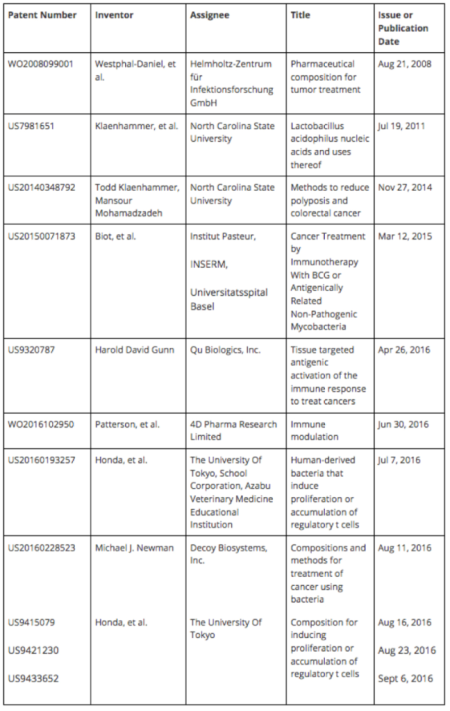
    Given that the majority of the human microbiome is found in the gut, it is not surprising that most microbiome-based therapeutic approaches have been used to treat gastrointestinal disorders, such as inflammatory bowel disease (IBD) and Clostridium difficile infections.  However, growing evidence suggests that targeting the microbiome can have broader therapeutic implications, demonstrating the ever-evolving nature of the microbiome field.  Specifically, microbiome modulators could be used to either enhance or suppress the immune response and would thus be considered immunotherapy.  Part VIII of this Series reviewed how altering the microbiome could be used in combination with checkpoint blockade.  As a continuation to Part VIII, this article will explore how microbiome modulators could be used as single agent immunotherapy to treat autoimmune disease, inflammatory disease, and cancer.  Bolded patent documents are further summarized in the table at the end of this installment.

    Microbiome-based Immunotherapy to Treat Cancer

    Altering the microbiome to treat cancer is not a new idea.  William Coley, a New York surgeon, administered streptococcal cultures to sarcoma patients.  Later known as 'Coley's toxin', these cultures caused tumor regression.  Similarly, an attenuated form of Mycobacterium bovis, bacillus Calmette-Guérin (BCG), is an FDA-approved immunotherapy for the treatment of bladder cancer and has also been used to treat melanoma.  Originally developed as a vaccine against tuberculosis, BCG is delivered directly to the bladder and stimulates a local immune response at the site of the cancer.  See patent application US20150071873 regarding a modified BCG therapy.

    Several other patent documents reflect this effort to modulate the microbiome in order to elicit an anti-cancer immune response.  PCT patent application publication WO2008099001 refers to the administration of bacteria that have been modified to contain a gene encoding a therapeutic that would act to diminish leukocytes, resulting in a reduction in solid tumor size.  Patent US7981651 discloses Lactobacillus strains that would contain a gene encoding a protein with "oxalate degrading activity".  A known component of kidney stones, oxalate has also been shown to induce production of reactive oxygen species as well as induce breast cancer.  Interestingly, both methodologies from the above-mentioned WO2008099001 and US7981651 documents could prove effective in not only altering the microbiome composition in order to modify the immune response but could also allow for delivery of multiple tumor-targeted therapies.  Also, both tumor therapies (gene products) can be produced using an inducer molecule, which would allow for exquisite control over dosing.

    Patent US9320787 is directed to administration of attenuated or fully inactive Escherichia coli in order to treat colon cancer.  The E. coli would be administered at a site distant from the tumor and induce monocyte activation.  Patent application US20160228523 refers to the use of inactive gram-negative bacteria, such as Salmonella or Escherichia, in order to treat various types of cancers, including carcinomas, lymphomas, and sarcomas, and inhibit tumor growth and metastasis.  The patent also discloses combination therapies with checkpoint inhibitors.

    Patent application US20140348792 discloses the administration of a strain of the gram-positive bacterium Lactobacillus acidophilus that lacks a gene that is necessary for production of lipoteichoic acid (LTA), an essential component of the cell wall that elicits a pro-inflammatory response in the human body.  Conditional knockout mice displaying pre-cancerous colonic polyps were treated with both wild-type and LTA-deficient L. acidophilus.  Those mice treated with the latter displayed decreased colonic inflammation, indicating that the LTA-deficient L. acidophilus strain may have anti-inflammatory effects [Proc. Natl. Acad. Sci. USA 109, 10462–10467 (2012)].  The claims of the patent also recite the combination of the LTA-deficient L. acidophilus strain with a second probiotic bacterium in order to induce colon cancer regression.

    Microbiome-based Immunotherapy to Treat Autoimmune and Inflammatory Diseases

    Patent documents US20160193257, US9415079, US9421230, and US9433652 refer to the use of Clostridium spores to induce production of regulatory T cells (Treg) and were filed by Kenya Honda of RIKEN Center for Integrative Medical Sciences in Japan.  Honda's work is featured in such high-profile journals as Cell, Nature, and Science.  Particularly, he discovered that secretion of the chemical butyrate by Clostridia induces Treg production [Nature 504, 446–450 (2013)], which is the basis for the aforementioned patents.  Honda is also co-founder of Vedanta Biosciences (PureTech Ventures).  Of note, Vedanta is also co-founded by Ruslan Medzhitov, Professor of Immunobiology at Yale University.  Vedanta claims to have both microbiome modulators that attenuate the immune system, e.g., which could be used to treat autoimmune disorders, as well as those which enhance immune response, e.g., which could be used to treat cancer.  Vedanta's lead "compound", VE202, is a 17-strain Clostridia cocktail that induces Treg production and would be used to treat IBD as well as graft-versus-host disease.  A similar patent application, WO2016102950, refers to the use of a Bacteroides strain for treatment of autoimmune and inflammatory disorders by modulating immune responses via increased Treg production.

    The Future of Microbiome Research

    Current research has established a link between the host patient microbiome composition and various disease states, such as psoriasis, asthma, and cardiovascular disease.  However, the key question of association versus causation is still up for debate, i.e., whether changes in the microbiome are causative of disease or changes caused by disease influence the microbiome.  Although this cause-and-effect relationship is still somewhat unclear, targeting the microbiome still has wide therapeutic implications.  For this reason, the pharmaceutical industry is starting to take notice.  Johnson & Johnson, Roche, and Pfizer, to name a few, are collaborating with smaller biotechs that have made the microbiome their niche.  For example, the Johnson & Johnson-owned Janssen Pharmaceuticals is licensing Vedanta's proprietary technology with reported payments of up to $339 Million.  The data generated out of such collaborations will undoubtedly contribute to better understanding of the microbiome as a whole and, furthermore, will aid in the ability to further manipulate the microbiome for therapeutic purposes.

    Table

    * David Puleo is a Ph.D. Candidate in the Pharmacology Department at Yale University.  Prior to attending Yale, David graduated from Boston College with a B.S. in Biochemistry, after which he worked for two years in the Center for Proteomic Chemistry at Novartis Institutes for BioMedical Research in Cambridge, MA.
    ** Dr. Sabatelli is a Partner with Dilworth IP

    For additional information regarding this topic, please see:

    • "The Emergent Microbiome: A Revolution for the Life Sciences — Part VIII, The Microbiome and Immunotherapy I," October 31, 2016
    • "The Emergent Microbiome: A Revolution for the Life Sciences — Part VII, The Microbiology of the Built Environment," October 5, 2016
    • "The Emergent Microbiome: A Revolution for the Life Sciences – Part V, Patents Relating to Obesity and Metabolic Disorders," February 28, 2016
    • "The Emergent Microbiome: A Revolution for the Life Sciences – Part IV, Obesity and other Metabolic Disorders," February 18, 2016
    • "Jackson Laboratory Hosts Microbiome Symposium Related to Cancer and Immunology," January 19, 2016
    • "The Emergent Microbiome: A Revolution for the Life Sciences – Part III, Psychobiotics," October 13, 2015
    • "The Emergent Microbiome: A Revolution for the Life Sciences – Part II, 2015 Patent Trends," August 11, 2015
    • "The Emergent Microbiome: A Revolution for the Life Sciences – Part I, R&D Leaders," August 10, 2015

  • By Andrew Williams

    Supreme Court Building #2On Tuesday, December 6, the Supreme Court will hear oral arguments regarding the interpretation of 35 U.S.C. § 271(f)(1), with the pertinent section highlighted:

    Whoever without authority supplies or causes to be supplied in or from the United States all or a substantial portion of the components of a patented invention, where such components are uncombined in whole or in part, in such manner as to actively induce the combination of such components outside of the United States in a manner that would infringe the patent if such combination occurred within the United States, shall be liable as an infringer.

    The sole question that will be decided by the Supreme Court in the Life Technologies Corporation v. Promega Corporation case is:

    Whether the Federal Circuit erred in holding that supplying a single, commodity component of a multi-component invention from the United States is an infringing act under 35 U.S.C.§ 271(f)(1), exposing the manufacturer to liability for all worldwide sales.

    Because the statutory language also concerns "active inducement," and LifeTech supplied the component in question to itself, albeit outside the United States, the petitioner had also posed the question whether a single entity can actively induce itself.  The Court, however, did not take up this issue.  Interestingly, Chief Judge Prost had dissented-in-part from the Federal Circuit opinion, but only to this second issue regarding inducement (see "Promega Corp. v. Life Technologies Corp. (Fed. Cir. 2014)").  As such, her separate comments did not impact the Supreme Court's decision to hear this case.

    The technology at issue centers on the existence of "short tandem repeats" ("STR") of DNA in the human genome that can be used create a DNA "fingerprint" unique to an individual.  For example, the sequence ATT (adenine-thymine-thymine) can be differently repeated at a particular location depending on the individual.  While no particular "allele" is sufficient to differentiate one person from all others, the analysis of multiple alleles can be.  Therefore, STR profiling can be used in many fields, such as forensic science.  The various loci can be amplified using the polymerase chain reaction ("PCR") to make detectable amounts of DNA.  It is additionally beneficial to amplify more than one loci simultaneously in a reaction, which is referred to as "multiplexing."  The patented technology concerns multiplexing PCR.

    The patent that is at issue in this case is directed to a kit for use in such a multiplexing reaction, which contains (1) a mixture of primers; (2) a polymerizing enzyme such as Taq polymerase; (3) nucleotides; (4) a buffer solution; and (5) control DNA.  LifeTech sells kits with all of these components.  However, only the Taq polymerase is manufactured in the United States, and is subsequently shipped overseas to a facility in the United Kingdom for assembly.  These kits are sold world-wide.  The District Court ruled on summary judgement that LifeTech's sales of its STR kits for uses other than forensic investigations conducted by police officers fell outside of a license field-of-use.  The damages calculation that went to the jury included both U.S. sales under 35 U.S.C. § 271(a) and kits made and sold outside the U.S. under 35 U.S.C. § 271(f)(1).  The District Court subsequently granted LifeTech's JMOL motion, finding that Promega failed to present sufficient evidence to sustain the jury verdict under both of these statutory sections.

    In considering the same question that is before the Supreme Court, the Federal Circuit held "that there are circumstances in which a party may be liable under 271(f)(1) for supplying or causing to be supplied a single component for combination outside the United States."  Therefore, the Court concluded that there was substantial evidence for the jury's verdict.  The Federal Circuit took the position that the second reference to "such components" in the statute references "the components of the patented invention," not that which much be supplied.  Therefore, the dictionary definition of "substantial," which is "important" or "essential," and the definition of "portion," which is a "section or quantity within a larger thing; a part of a whole," can include a "single important or essential component . . . ."  Moreover, the Court pointed out that the Dictionary Act, at 1 U.S.C. § 1, instructs that "words importing the plural [can] include the singular."

    The Federal Circuit also addressed the previous Supreme Court case interpreting § 271(f)(1):  Microsoft v. AT&T Corp., 550 U.S. 437 (2007).  In that case, the exported product was a "master version" of software for an operating system that was copied and installed outside the United States.  The Supreme Court held that abstract software code was not a "component" as referenced in the statute, and that copies made outside the United States were not "supplied" for the purposes of the infringement analysis under this section.  The Federal Circuit pointed out that the Supreme Court was actually considering the export of a single "component" — the master version.  And, even though the Court held that such a master version was not a § 271(f)(1) component, it did not make any pronouncement that a single component could not satisfy this statutory section.  In fact, the Federal Circuit went as far as to say that the Court could have found, or otherwise instructed, that infringement under this section requires more than one component.  But the Supreme Court did not.  Therefore, the Federal Circuit rested on its ordinary reading of the statute.

    Before the Supreme Court on Tuesday, LifeTech is arguing that "a substantial portion of the components" cannot be satisfied by a single component.  In making its argument, LifeTech also looked to the plain text, but focused on the proximity of the phrase "substantial portion" to the term "all," which necessitates a quantitative meaning.  In other words, the argument goes, the statute is referring to the number of components supplied, not their subjective importance.  Moreover, because § 271(f)(2) refers to infringement for exporting a single U.S. component that is especially made or adapted for infringement, subsection (1) must refer exclusively to multi-component infringement.  LifeTech also pointed out that the Microsoft case warned against giving "§271(f) an expansive interpretation," because the presumption should be that United States patent law "governs domestically but does not rule the world."  Finally, LifeTech pointed out that 271(f)(1) was enacted in response to the Supreme Court's decision in Deepsouth Packing Co. v. Laitram Corp., and was intended to prevent the circumvention of U.S. patent law by supplying disassembled parts, leaving only the trivial step of assembly outside of the borders.  Because the Federal Circuit's interpretation would go beyond that goal, LifeTech asserted that the decision should be reversed.

    Promega is arguing that the Federal Circuit was correct in its interpretation of the statute.  First, Promega asserted that there is nothing in the statute that suggests that a single component cannot be very important to the overall invention.  Therefore, the analysis should be both a quantitative and qualitative one, where consideration is given to both amount and importance.  Promega characterized LifeTech's proffered interpretation as "a rigid, bright-line rule," likely in view of the Supreme Court's disdain for such rules.  It also focused on the legislative history, but noted that Congress was more concerned was preventing U.S. manufacturers from evading U.S. patent law, and therefore was more focused on the "intent" of the infringer more than the quantity of components.  Moreover, there is no danger of "unduly expansive liability for innocent U.S. suppliers of commodity components," because there is still "specific intent required to establish active inducement."  Finally, Promega pointed out that the Microsoft case was inapposite because in that case, a "U.S. made-master was never actually used in an infringing device."  In contrast, according to Promega, every kit in the present case is "powered" by a Taq polymerase made in the U.S.  This case does not implicate the presumption against extraterritoriality, Promega asserted, because the conduct occurs here in the U.S.

    Not surprisingly, there was amicus interest in this case, with positions on both sides of the issue.  The United States government filed an amicus brief in support of petitioner LifeTech, as did the company Agilent Technologies, the Federation of German Industries (known as Bundesverband der Deutschen Industrie e.V.), and a collection of Intellectual Property Professors (although only five such professors attached their names to the brief).  In contrast, the Wisconsin Alumni Research Foundation and the New York Intellectual Property Law Association filed amicus briefs in support of Promega.  Finally, two intellectual property organizations, the IPO and the AIPLA, filed amicus briefs in support of neither party.  Nevertheless, both of these organizations argued that the statute should be interpreted to allow a single component to result in liability under 271(f)(1).  Therefore, even though these organizations did not support Promega, the outcomes they both advocated would benefit the respondent.

    We will continue to report on this case as the Supreme Court considers the issue.

  • By Andrew Williams

    Federal Circuit Seal"It appears to me that en banc consideration is warranted." — Judge Taranto (concurring in Click-To-Call Technologies, LP v. Oracle Corp.).

    "I write separately, however, to note that I believe the Supreme Court's language in Cuozzo leaves room for us to question our reasoning in Achates and to suggest that we do so en banc." — Judge O'Malley (concurring in Click-To-Call Technologies, LP v. Oracle Corp.).

    "I write separately to convey my sense that this Court has jurisdiction to address the time bar question despite the statutory requirement that the Board's institution decisions "shall be final and nonappealable." — Judge Reyna (concurring in Wi-Fi One, LLC v. Broadcom Corp.).

    Supreme Court SealIn the Cuozzo Speed Technologies, LLC v. Lee case, the Supreme Court held that a PTAB's decision to institute an IPR proceeding was not subject to judicial review.  The question in that case centered on the correct interpretation of 35 U.S.C. § 314(d) ("No appeal. – The determination by the Director whether to institute an inter partes review under this section shall be final and nonappealable.").  However, that case involved the specific situation where the PTAB had instituted trial on grounds that were not explicitly identified in the petition.  Justice Breyer, writing for the Court, concluded that it was the intent of Congress to bar the review of decisions about whether the "reasonable likelihood" standard of ultimately prevailing in the case had been met.  Justice Breyer also believed that institution decisions could not be reviewed when "a patent holder grounds its claim in a statute closely related to that decision to institute."

    This did not mean, though, that the Supreme Court viewed all questions related to institution as unreviewable:  "[We] need not, and do not, decide the precise effect of §314(d) on appeals that implicate constitutional questions, that depend on other less closely related statutes, or that present other questions of interpretation that reach, in terms of scope and impact, well beyond 'this section.'"  For example, constitutional questions related to due process could still be appealed.  In addition, if the Patent Office were to partake in "shenanigans," the Federal Circuit could set aside the decision as "'contrary to constitutional right,' 'in excess of statutory jurisdiction,' or 'arbitrary [and] capricious.'"

    One of the situations that the Supreme Court did not address was whether a Court can review a Board's decision whether a third-party is a real-party-in-interest, which can implicate the IPR time bar set forth by 35 U.S.C. § 315(b) ("An inter partes review may not be instituted if the petition requesting the proceeding is filed more than 1 year after the date on which the petitioner, real party in interest, or privy of the petitioner is served with a complaint alleging infringement of the patent.").  The Federal Circuit had previously decided this question in Achates Reference Publ'g, Inc. v. Apple Inc., which issued before the Supreme Court's Cuozzo decision.  The Court concluded it could not review any decision related to the statutory time-bar, for example whether a petitioner was barred from filing an IPR petition because it had been sued in district court more than one year beforehand.  At the time of Cuozzo, we suggested that this type of situation might fall within the "shenanigans" standard and thus allow review of such cases (see "Cuozzo Speed Technologies, LLC v. Lee (2016) — Question 2 — PTAB Shenanigans and Reviewability").  However, the Federal Circuit subsequently decided in Wi-Fi One, LLC v. Broadcom Corp. that it still could not review time-bar decisions, even in view of Cuozzo v. Lee ("We see nothing in the Cuozzo decision that suggests Achates has been implicitly overruled.").  The Court even disagreed that the time-bar issue was an example of "shenanigans" ("To hold that such a ruling falls within the narrow exception to the Supreme Court's unreviewabiltiy holding would render routine procedural orders reviewable, contrary to the entire thrust of the Cuozzo decision.").  Therefore, barring further Supreme Court review, the only hope for change is for the Federal Circuit to take up the question en banc.

    Such a possibility is not out of the question, however, as there are signs that point toward the entire Court taking up this question.  First, in the Wi-Fi One case, Judge Reyna concurred in the decision because he agreed that Wi-Fi One had failed to show that the petitioner, Broadcom, was in privity with a Texas defendant.  Nevertheless, he wrote that he believes that the legal distinction between institution decisions and final decisions compelled the conclusion that decisions about the time bar were "final," and therefore subject to review.  Then, recently, the Federal Circuit issued the Click-To-Call Technologies, LP v. Oracle Corp. case.  That case was itself on remand from the Supreme Court, after the Court had granted certiorari, vacated the previous judgement, and remanded (GVR'ed) for further consideration in view of Cuozzo v. Lee.  The Federal Circuit, in a five page per curiam decision, also concluded that Achates had not been overturned by the Cuozzo decision, and besides it was also bound by the Wi-Fi One case.  But two of three judges on that panel wrote separate concurrence to express their belief that the issue should be addressed en banc.  The third judge was Leonard P. Stark, Chief District Judge of the U.S. District Court for the District of Delaware, sitting by designation.

    Judge O'Malley focused on the difference between a petition for a PTAB post-grant proceeding (whether IPR, CBM, PGR, or derivation) and the act of institution by the PTAB as provided for by the statute.  Believing that Congress established this distinction, she pointed out that "315(b)'s bar on institution in necessarily directed to the PTO, not those filing a petition to institute."  Aschates, therefore, got it wrong when it concluded that the time bar did not impact the Board's authority to invalidate.  Instead, the statute commands that an IPR proceeding "may not be instituted" by the Board if the petition is time barred.  "Because only the Director or her delegees may 'institute' a proceeding, § 315(b)'s bar on institution is necessarily directed to the PTO, not those filing a petition," Judge O'Malley wrote.

    Judge O'Malley also found support in the Cuozzo decision itself.  The Supreme Court had used as an example a hypothetical of what to do if a panel institutes an IPR proceeding based on § 112 indefiniteness.  Of course such a decision would be reviewable because it would fall outside the statutory framework for IPRs, which limit challenges to specific parts of §§ 102 and 103.  Judge O'Malley pointed out that the same reasoning applied to the time bar.  Cuozzo v. Lee involved a challenge to the PTAB's conclusion that the information presented in a petition warranted review.  An appeal of a time-bar determination, however, goes to "the fundamental statutory basis on which Congress has authorized the Director to institute an IPR proceeding."  As a result, Judge O'Malley suggested that the Court "collectively assess whether our reasoning in Achates comports with the precise language in the statutory provision it analyzes," and make a determination whether it should remain the law.

    To complement Judge O'Malley's analysis, Judge Taranto provided his own reasoning why he thought the en banc Court should consider the issue.  He began by noting that a high standard must be met before concluding that any statutory provision creates an exception to the default rule favoring reviewability.  In addition, he noted that Cuozzo v. Lee was clear in two respects — (1) § 314(d) bars review of some institution determinations, and (2) the specific determination of the Board in the Cuozzo case fell within this bar.  But the Court stopped short of prohibiting any determination related to institution.  Therefore, Judge Taranto noted that IPRs were different than other aspects of the patent statute, concluding that:  "A statutorily proper petitioner – one entitled to file the petition when filed – is an essential statutory requirement for the PTO to conduct an IPR."  For example, the PTO is able to unilaterally institute ex parte reexaminations.  This is even reflected in the PTO regulation, where the timing rules for IPRs are treated as a matter of "Jurisdiction."

    Judge Taranto identified several reasons why the time bar was distinct from the issue decided in Cuozzo v. Lee.  First, the determination of who is a statutorily proper petitioner is unrelated to the substance of the allegation.  Second, even though the Supreme Court has determined that other decisions are "unreviewable," such as a grand jury's finding of probable cause and the denial of summary judgement, all of these determinations are unlike the time bar.  Third, relatedly, the time bar is different than institution decisions for ex parte reexamination and the old inter partes reexamination.  Fourth, and finally, the "proper-party" requirement is a clear structural limit on the Patent Office's ability to cancel issued patents under the IPR scheme.  Nevertheless, Judge Taranto acknowledged that there might be even more reasons why time-bar determinations should be reviewable.  As such, Judge Taranto believes en banc review is warranted.

    The Federal Circuit may take up the issue as the en banc Court sooner than later.  Wi-Fi One filed a petition for en banc review on October 17, 2016, and Broadcom filed its response on November 18, 2016.  We will, of course, continue to monitor the issue and report on any interesting developments.

  • CalendarDecember 6, 2016 – "From Chevron to Cuozzo: Practical Impacts of Administrative Law on PTO Proceedings" (Federal Circuit Bar Association) – Boston, MA

    December 8, 2016 – "Means-Plus-Function Patent Claims After Williamson: Navigating the New Standard — Assessing Impact on Prosecution, Litigation and IPRs" (Strafford) – 1:00 to 2:30 pm (EST)

    December 13, 2016 – "Patent Infringement: Structuring Opinions of Counsel — Leveraging Opinion Letters to Reduce the Risks of Liability and Enhanced Damages" (Strafford) – 1:00 to 2:30 pm (EST)

    December 20, 2016 – "Demonstrating Patent Eligibility Post-Alice: Impact of McRo and Other Recent Cases — Navigating the Nuances and Leveraging Guidance From Federal Circuit and PTAB Opinion" (Strafford) – 1:00 to 2:30 pm (EST)

    January 18, 2017 – "Top Patent Law Stories of 2016" (McDonnell Boehnen Hulbert & Berghoff LLP) – 10:00 am to 11:15 am (CT)

    ***Patent Docs is a media partner of this conference or CLE

  • MBHB Logo 2McDonnell Boehnen Hulbert & Berghoff LLP will be offering a live webinar on the "Top Patent Law Stories of 2016" on January 18, 2017 from 10:00 am to 11:15 am (CT).  For the past ten years, the Patent Docs weblog has presented an annual, end-of-the-year review of the top stories in patent law.  In this presentation, Patent Docs co-authors Donald Zuhn, Kevin Noonan, and Michael Borella will take a look back at the top patent stories of 2016, many of which will likely impact patent applicants and practitioners in the coming year.

    While there is no fee to participate, attendees must register in advance.  Those wishing to register can do so here.  CLE credit is pending for the states of California, Illinois, New Jersey, New York, North Carolina, and Virginia.

  • Computerized Restaurant Ordering Menu Patents Found to Be Directed to Unpatentable Subject Matter

    By Joseph Herndon

    Federal Circuit SealThe U.S. Court of Appeals for the Federal Circuit reviewed a Patent Trial and Appeal Board (PTAB) decision in three Covered Business Method (CBM) reviews between Apple, Inc. et. al v. Ameranth, Inc.  The decisions addressed the subject matter eligibility of certain claims of U.S. Patent Nos. 6,384,850, 6,871,325, and 6,982,733.  Ultimately, the Federal Circuit affirmed the Board's decisions finding certain claims unpatentable under § 101, and reversed the Board's decisions confirming the patentability of certain claims under § 101.  Thus, the Federal Circuit found all challenged claims unpatentable under § 101 as directed to unpatentable subject matter.

    The Patents at Issue

    Ameranth, Inc. owns the patents, of which two of the patents have the same specifications (parent and continuation) and the third patent is largely the same as the other patents (continuation-in-part).  The patents disclose a first menu that has categories and items, and software that can generate a second menu from that first menu by allowing categories and items to be selected.  The patents describe a preferred embodiment for use in the restaurant industry.  In that embodiment, a menu consists of categories such as appetizers and entrees, items such as chicken Caesar salad, modifiers such as dressing, and sub-modifiers such as Italian and bleu cheese.  The menu can be configured on a desktop computer and then downloaded onto a handheld device.  The menu may be displayed to a user and then another menu may be generated in response to and comprised of the selections made.

    FIG.7Figure 7, reproduced above, represents a point of sale interface for use in displaying the claimed menus in a preferred embodiment.  The specifications note that ordering prepared foods has historically been done verbally, either directly to a waiter or over the telephone, whereupon the placed order is recorded on paper by the recipient or instantly filled.  They explain that the unavailability of any simple technique for creating restaurant menus and the like for use in a limited display area wireless handheld device or that is compatible with ordering over the internet had prevented widespread adoption of computerization in the hospitality industry.  Dependent claims further link ordered items to a certain table in the restaurant (e.g., the device is positioned at a table to be used by customers).  Claim 1 of the '850 patent is representative and is reproduced below.

    1.  An information management and synchronous communications system for generating and transmitting menus comprising:
        a central processing unit,
        a data storage device connected to said central processing unit,
        an operating system including a graphical user interface,
        a first menu consisting of menu categories, said menu categories consisting of menu items, said first menu stored on said data storage device and displayable in a window of said graphical user interface in a hierarchical tree format,
        a modifier menu stored on said data storage device and displayable in a window of said graphical user interface,
        a sub-modifier menu stored on said data storage device and displayable in a window of said graphical user interface, and
        application software for generating a second menu from said first menu and transmitting said second menu to a wireless handheld computing device or Web page,
        wherein the application software facilitates the generation of the second menu by allowing selection of catagories [sic] and items from the first menu, addition of menu categories to the second menu, addition of menu items to the second menu and assignment of parameters to items in the second menu using the graphical user interface of said operating system, said parameters being selected from the modifier and sub-modifier menus.

    CBM Patents?

    Petitions for CBM review of the patents were filed and the Board found that each patent met the statutory definition of "covered business method patent," and instituted CBM reviews.  In its final decisions, the Board found certain claims in each of the patents unpatentable under 35 U.S.C. § 101, and other claims patentable.

    Ameranth appeals the Board's decision that the patents are CBM patents eligible for CBM review.  The term "covered business method patent" means "a patent that claims a method or corresponding apparatus for performing data processing or other operations used in the practice, administration, or management of a financial product or service, except that the term does not include patents for technological inventions."

    On appeal, Ameranth did not argue the financial product element of the statute, but rather argued that the patents fall within the "technological inventions" exception because they recite technological features, including specific software which was distinctive over the prior art.  But the Federal Circuit disagreed, finding that the claims do not solve technical problems using technical solutions.  The specifications disclosed that the hardware used in the claimed systems was "typical," and that the programming steps were "commonly known."

    Second, the neither the solutions nor the problems recited in the claims were found to be technical.  Ameranth had argued that the patents solved the problem of how to display and synchronize computerized menus on non-standard devices/interfaces, but the claims did not recite a solution to this problem, as they do not include recitations about how to display or synchronize the menus, but instead include descriptions about menu generation.  Similarly, Ameranth had argued that the '733 patent was intended to solve a problem in restaurant ordering when customers wanted something unusual and unanticipated, but it was found that this was "more of a business problem than a technical problem."

    Thus, the determination that the patents were CBM patents and eligible for CBM patent review was upheld.

    Section 101 Determinations

    To determine whether a claim is eligible under § 101, the Federal Circuit first determines whether the claims at issue are directed to a patent-ineligible concept, and if they are, then considers the elements of each claim both individually and "as an ordered combination" to determine whether the additional elements "transform the nature of the claim" into a patent-eligible application.

    Claims the Board Found Unpatentable

    At the first step, the Board determined that the claims in all three patents are directed to the abstract idea of "generating a second menu from a first menu and sending the second menu to another location."

    The Federal Circuit noted that for step one, they must determine whether the claims "focus on a specific means or method that improves the relevant technology" or are "directed to a result or effect that itself is the abstract idea and merely invoke generic processes and machinery."  In doing so, the Federal Circuit affirmed the Board's conclusion that the claims in these patents are directed to an abstract idea.  The patents claim systems including menus with particular features.  They do not claim a particular way of programming or designing the software to create menus that have these features, but instead merely claim the resulting systems.

    In the second step, the Board found that the recited central processing unit, data storage device, and operating system components were "typical" hardware elements.  The specifications state that the discrete programming steps are commonly known.  But Ameranth argued that none of the claims are directed to something conventional or routine, and pointed to the term "second menu is manually modified after generation" in claim 1 of the '733 patent.  However, the Board explained that manual modification of a menu could also include printing the second menu and then writing on it with a pen, and cited other examples for which modification of the menu is routine, and was ultimately considered to be insignificant post-solution activity.  The Federal Circuit agreed.

    The preferred embodiment of the claimed invention described in the specifications is a restaurant preparing a device that can be used by a server taking orders from a customer.  The claimed invention replaces a server's notepad or mental list with an electronic device programmed to allow menu items to be selected as a customer places an order. As noted above, the specifications describe the hardware elements of the invention as "typical" and the software programming needed as "commonly known."  The invention merely claims the addition of conventional computer components to well-known business practices.

    Thus, the Federal Circuit affirmed the Board's conclusion in step two that the elements of the patents' claims — both individually and when combined — do not transform the claimed abstract idea into a patent-eligible application of the abstract idea.

    Claims the Board Found Patentable

    The Board had found some dependent claims satisfied section 101, but the Federal reversed that decision.

    First, looking at the dependent claims that involve linking orders to specific customers, these claims require that the second menu, after being modified, can be linked to a specific customer at a specific table.  Ameranth argued to the Board that these claims were patentable because they recited limitations that were unconventional or unique in 2001 because the very capability of linking a particular order to a particular customer at a table was novel then and unique to mobility and wireless handhelds.

    The Federal Circuit noted that, generally, a claim that merely describes an effect or result dissociated from any method by which it is accomplished is not directed to patent-eligible subject matter.  Here, the linked orders claim limitation calls for the desired result of associating a customer's order with said customer, and does not attempt to claim any method for achieving that result.  These claims cover the process of a restaurant server taking an order from a customer and keeping track of what customer placed that order, when done using a computer.  The Federal Circuit found that linking of orders to customers is a classic example of manual tasks that cannot be rendered patent eligible merely by performing them with a computer.  Merely appending this preexisting practice to the independent claims is an insignificant post-solution activity.

    Next, the Federal Circuit analyzed the dependent claims that involve handwriting and voice capture technologies, and claim features include that the second menu is manually modified by handwriting or voice recording.

    The Federal Circuit noted that the patent refers to the use of handwriting and voice capture technologies without providing how these elements were to be technologically implemented.  Ameranth conceded that it had not invented voice or handwriting capture technology, and that it was known at the time it filed its applications to use those technologies as ways of entering data into computer systems.  Because Ameranth claims no more than the use of existing handwriting and voice capture technologies using a computer system, appending these preexisting technologies onto those independent claims did not make them patentable.

    Thus, on appeal, the Federal Circuit affirmed the Board's decisions finding certain claims unpatentable under § 101, and reversed the Board's decisions confirming the patentability of certain claims under § 101, resulting in all challenged claims being found unpatentable under § 101.

    Apple, Inc. v. Ameranth, Inc. (Fed. Cir. 2016)
    Panel: Circuit Judges Reyna, Chen, and Stoll
    Opinion by Circuit Judge Reyna

  • By Kevin E. Noonan

    Federal Circuit SealDiligence is a patent concept whose applicability was severely restricted under the changes in U.S. patent law created under the Leahy-Smith America Invents Act.  Diligence is important when determining whether an invention was invented prior to an act intervening between invention and patent application filing, in a "first-to-invent" regime.  There is much less for the principle to do when patentability is judged under a first-inventor-to-file rubric (although there may be instances when the process from conception through reduction to practice may be subject to a diligence inquiry even under the revised law).  Nevertheless, because there are millions of patents in force that were obtained under the traditional invention standard, diligence issues have not yet been relegated to the dustbin of history, a circumstance illustrated by the Federal Circuit's decision in Perfect Surgical Techniques, Inc. v. Olympus America, Inc.  Particularly relevant is the differing opinions on the proper diligence standard taken by the majority and by one of the panel judges.

    The case arose as an inter partes review of U.S. Patent No. 6,030,384 directed to a surgical instrument; claim 1 illustrates the technology (which is otherwise not particularly relevant to the issues before the Court):

    A bipolar surgical instrument comprising:
        a shaft having a proximal end and a distal end;
        a pair of opposed jaws at the distal end of the shaft;
        a first electrode member on one of the jaws;
        a second electrode member on one of the jaws, wherein the first and second electrode members are electrically isolated from each other; and
        an actuating mechanism for moving the jaws between an opened and closed configuration, wherein electrode members lie parallel to and laterally spaced-apart from each other when the jaws are closed, wherein at least one of the electrode members comprises a plurality of tissue penetrating elements which project toward the opposed jaw.

    The PTAB invalidated this and other claims in the '384 patent for anticipation or obviousness over Japanese Application Publication No. H10- 33551 A , a prior art reference under 35 U.S.C. § 102(a).  The lynchpin of the Board's decision was diligence — were the patentees diligent between a time just prior to the publication date of the reference and the date when they reduced their invention to practice?  The PTAB decided they were not, and thus the Japanese patent publication was prior art and the claims were invalid variably for anticipation or obviousness.

    The Federal Circuit vacated and remanded, in an opinion by Judge Moore joined by Judge O'Malley and in part by Judge Schall, who also dissented in part.  The panel first dismissed as harmless error a procedural argument under 37 C.F.R. § 42.63(b) raised by the patentee regarding whether the requestor had properly filed a translation of the reference (finding against the patentee).  Turning to the diligence issue, the opinion notes that pre-AIA § 102(g) provided that a patentee could antedate a reference by showing "earlier conception and reasonable diligence in reducing to practice."  (To be precise, diligence in this context is used to show entitlement to earlier conception when the inventor did not "abandon, suppress or conceal" her invention.)  The facts considered by the Board and reviewed by the panel were as follows (and are important in assessing the implications of the panel's decision so are set forth in detail here).  The inventor hired a patent attorney (Mr. Heslin) to draft and file the application that resulted in the '384 patent.  The attorney sent the inventor an initial draft on January 28, 1998, and the application was filed on May 1, 1998 (providing the constructive reduction to practice date).  The critical period began on February 9, 1998 (one day prior to the publication date of the Japanese application).  Thus, a little more than three months (93 days) constitute the time that the Board and the panel considered whether the inventor and attorney's actions were diligent.

    The inventor's testimony and evidence regarding his diligence was summarized in the opinion as follows.  The inventor testified that he worked diligently "within the reasonable limits of my busy medical practice and teaching schedule."  That schedule included working "roughly 80 hours per week, during which he would perform approximately four to six surgeries."  As for the dates having evidentiary support, the inventor stated that he "submitted comments on the initial draft application on March 2, received questions from Mr. Heslin on or around March 4 and 12, participated in a conference with Mr. Heslin on March 16, and received second draft application from Mr. Heslin on April 13."  The inventor also testified that he carefully reviewed this draft prior to its filing on May 1st.

    The corroborating evidence to this testimony (required to support any inventor's testimony in a priority dispute; Brown v. Barbacid, 436 F.3d 1376, 1380 (Fed. Cir. 2006)) included a declaration from Attorney Heslin, his billing records and letters between inventor and attorney.  Attorney Heslin's testimony was consistent with and corroborated the inventor's statements and diligence timeline.  He also included letters and other exhibits consistent with his testimony.  The Board found no fault or deficiency with this evidence; however, in its view these activities were not sufficient to establish diligence to defeat the Japanese application as an invalidating reference, particularly with regard to three time periods:  from "(1) February 10 to March 1; (2) March 12 to March 15; and (3) April 13 to May 1."

    In reviewing this conclusion, the panel noted that whether a patentee can antedate a reference under §102(g) is a question of law based on underlying facts, citing In re Steed, 802 F.3d 1311, 1316–17 (Fed. Cir. 2015).  Insofar as the factual inquiry is concerned, the Federal Circuit reviews the PTAB's determinations for substantial evidence.  Here, the opinion notes that the Board "repeatedly characterized" the diligence burden as being "continuous exercise of reasonable diligence" (emphasis in opinion), citing several instances from the Board's final written decision.  This standard was "too exacting and in conflict with our precedent" according to the majority; indeed, the opinion goes on to expressly repudiate this standard, saying "[a] patent owner need not prove the inventor continuously exercised reasonable diligence throughout the critical period; it must show there was reasonably continuous diligence" (a distinction apparently with a difference, at least for the majority), citing Tyco Healthcare Grp. v. Ethicon Endo-Surgery, Inc., 774 F.3d 968, 975 (Fed. Cir. 2014) (emphasis in the opinion).  The opinion goes on to state that there is no requirement, under the proper standard, that an inventor work every day during the diligence period, and moreover that "periods of inactivity" during the period do not "automatically vanquish" a claim to reasonable diligence.  Rather, it is the totality of the evidence of diligence (as illustrated in Monsanto Co. v. Mycogen Plant Sci., Inc., 261 F.3d 1356, 1362 (Fed. Cir. 2001)) that must show reasonable diligence, evaluated under the "rule of reason," citing Price v. Symsek, 988 F.2d 1187, 1195 (Fed. Cir. 1993).  In the majority's opinion:

    Our holdings in these cases are consistent with the purpose of the diligence inquiry.  In determining whether an invention antedates another, the point of the diligence analysis is not to scour the patent owner's corroborating evidence in search of intervals of time where the patent owner has failed to substantiate some sort of activity.  It is to assure that, in light of the evidence as a whole, "the invention was not abandoned or unreasonably delayed.  . . .  That an inventor overseeing a study did not record its progress on a daily, weekly, or even monthly basis does not mean the inventor necessarily abandoned his invention or unreasonably delayed it.  The same logic applies to the preparation of a patent application:  the absence of evidence that an inventor and his attorney revised or discussed the application on a daily basis is alone insufficient to determine that the invention was abandoned or unreasonably delayed.  One must weigh the collection of evidence over the entire critical period to make such a determination.

    The opinion distinguishes the facts here (and the standard generally) from those in In re Mulder 716 F.2d 1542, 1542–46 (Fed. Cir. 1983), cited by the Board in support of its decision, on the basis that in Mulder the patentee showed no evidence whatsoever for diligence, even though the critical period was for only two days.

    The Board erred, according to the majority, by fixating on those periods of inactivity and chiding the patentee for not providing specific evidence of his activities (regarding the patent or otherwise) that would carry its erroneously enhanced burden of continuous activity to establish diligence.  Moreover, the majority found fault with the Board's summary dismissal of Attorney Heslin's evidence, which the opinion expressly characterizes as error because he was acting as the inventor's agent and his activities should have been attributed to and inured to the benefit of the inventor.

    While being sharply critical of the Board's findings regarding the inventor's diligence, the majority vacated and remanded to give the Board the opportunity to review the record using the correct standard (and thus provided the required deference to the Board's fact-finding under Dickenson v. Zurko and other Supreme Court precedent), while specifically mandating the evidence the Board should consider on remand.  The panel also unanimously vacated the Board's claim construction and directed that the art be applied to the claims on remand consistent with the claim construction provided in the opinion.

    Judge Schall dissented only to the extent that the majority's views on the diligence issues required vacatur and remand of the Board's invalidity determinations.  He took the view that the Board's determination was supported by substantial evidence; as is frequently the case, the dissent and the majority opinions review (and cite) the same factual evidence and come to completely opposite conclusions.  As the majority notes in a footnote, it is only the first alleged period of lack of diligence — between February 10 to March 1 — that convinced Judge Schall that the Board's decision was correct (he states later in his dissent that he finds the Board's handling of the other two periods to be "troubling").  And Judge Schall's view of the Federal Circuit's case law on diligence is that only some of the cases support the majority's standard.  Others, including Griffith v. Kanamaru, 816 F.2d 624, 629 (Fed. Cir. 1987) more expressly require continuous diligence consistent with the Board's view.  But regardless of how various decisions frame the standard, Judge Schall believes that the test is whether a "party seeking priority 'account for the entire period during which diligence is required,'" relying on Gould v. Schawlow, 363 F.2d 908, 916 (C.C.P.A. 1966).  Put simply, "establishing diligence requires that the inventor account for his or her activities during the entire critical period.  Where there are stretches of inactivity, the inventor must provide a reasonable justification for those gaps with corroborating evidence."

    The inventor here did not meet that standard according to Judge Schall's dissent, and he would have affirmed the Board's invalidity decision on that basis (although his analysis in the opinion is focused on the "contours of [the Board's] methodology" in arriving at his conclusion).  And he also disagrees with Perfect Surgical's contention that the Board erred in not considering the evidence as a whole, because Judge Schall's understanding of the law is that what a patentee must do is account for each period of inactivity in order to establish diligence.  Ultimately the dissent faults Precision Surgical for not providing the evidence Judge Schall believes was necessary to establish diligence and thus for failing to carry its burden as the party attempting to show prior invention.

    This opinion, and particularly the dissent, provides a nice synopsis of Federal Circuit case law and examples of instances where the Court found, or did not, that diligence had been established in various circumstances and periods of delay.  While the sun shining on the value of this law is a setting one, until diligence issues have been permanently extinguished it provides a valuable resource for a rather arcane area of the patent law.

    Perfect Surgical Techniques, Inc. v. Olympus America, Inc. (Fed. Cir. 2016)
    Panel:  Circuit Judges Moore, Schall, and O'Malley
    Opinion by Circuit Judge Moore; opinion concurring in part and dissenting in part by Circuit Judge Schall