• CalendarMarch 8, 2017 – "How to Structure PTAB Proceedings and Appeals before the Federal Circuit" (American Bar Association Center for Professional Development and Section of Intellectual Property Law) – 1:00 to 2:00 pm (ET)

    March 9, 2017 – "After Life Tech v. Promega: Litigation and Business Strategies for Patent Owners and Defendants" (Intellectual Property Owners Association) – 2:00 to 3:00 pm (ET)

    March 9, 2017 – "How to Use Broadest Reasonable Interpretation to Your Advantage in Patent Prosecution — Establishing Scope of Claims, Avoiding Sect. 112(f), Preserving Enforceability" (Strafford) – 1:00 to 2:30 pm (EST)

    March 9-10, 2017 - Advanced Patent Law Seminar (Chisum Patent Academy) – Cincinnati, OH.

    March 14, 2017 – "Post-Grant Review at the PTAB: What Petitioners and Patent Owners are Doing and What Lies Ahead?" (McDonnell Boehnen Hulbert & Berghoff LLP) – 10:00 am to 11:15 am (CT)

    March 15, 2017 - Intellectual Property Law Symposium (Federal Circuit Bar Association and Intellectual Property Law Association of Chicago) – Chicago, Illinois.

    March 16, 2017 - Biotechnology/Chemical/Pharmaceutical (BCP) customer partnership meeting (U.S. Patent and Trademark Office) – Alexandria, VA

    March 16, 2017 – "Advice of Counsel Defense in Patent Litigation: Protecting Attorney-Client Privilege — Limiting Scope of Discovery, Safeguarding Confidential Communications and Information" (Strafford) – 1:00 to 2:30 pm (EDT)

    ***Patent Docs is a media partner of this conference or CLE

  • USPTO Building FacadeThe U.S. Patent and Trademark Office will be holding its next biotechnology/chemical/pharmaceutical (BCP) customer partnership meeting on March 16, 2017 at the USPTO Headquarters (Alexandria, VA).  The agenda for the meeting is as follows:

    • Welcoming and Opening Remarks (10:00 – 10:10 am EDT) — Jerry Lorengo, Director, TC1600, USPTO; Daniel Sullivan, Director, TC1600, USPTO; and Wanda Walker, Director, TC1600, USPTO

    • Rationale Statements in 35 U.S.C. 103 (10:10 – 11:10 am) — Cassandra Spyrou, Supervisory Review Quality Assurance Specialist, OPQA, USPTO

    • The Role of Inherency in Making an Obviousness Determination (11:10 – 12:00 pm) — William Smith, Of Counsel, BakerHostetler

    • Lunch (12:00 pm – 1:00 pm)

    • 37 CFR §1.132 Practice, Unexpected Results (1:00 – 1:40 pm) — Scarlett Goon, QAS, TC1600, USPTO

    • Range Analysis (1:40 – 2:40 pm) — Jean Witz, SPE, CRU, USPTO

    • Break (2:40 – 2:50 pm)

    • Interview Practice (A Practitioner’s Perspective) (2:50 – 3:50 pm) — Charles Andres, Associate, Patent and Innovation, WSGR

    • Interview Training (USPTO) (3:50 – 4:30 pm) — Frederick Krass, SPE, TC1600, USPTO

    • Closing Remarks (4:30 – 4:40 pm) – Directors, TC1600, USPTO

    Additional information regarding the BCP customer partnership meeting, including registration information for those wishing to attend the meeting or register for online participation, can be found here.

  • IPO #2The Intellectual Property Owners Association (IPO) will offer a one-hour webinar entitled "After Life Tech v. Promega: Litigation and Business Strategies for Patent Owners and Defendants" on March 9, 2017 from 2:00 to 3:00 pm (ET).  Paul Berghoff of McDonnell Boehnen Hulbert & Berghoff LLP, Irena Royzmanm of Patterson Belknap Webb & Tyler LLP, and Bradford Schmidt of Agilent Technologies will consider what new legal battles are likely to follow from last month's U.S. Supreme Court decision in Life Tech. v. Promega, and also discuss strategies for patent prosecution and global supply chain management going forward.

    The registration fee for the webinar is $135 (government and academic rates are available upon request).  Those interested in registering for the webinar can do so here.

  • Federal Circuit Bar AssociationThe Federal Circuit Bar Association (FCBA) and Intellectual Property Law Association of Chicago (IPLAC) will be co-sponsoring an Intellectual Property Law Symposium on March 15, 2017 from 8:45 am to 5:00 pm (CT) at the University Club of Chicago in Chicago, Illinois.  The program will include presentations on the following topics:

    • Willful Infringement After Halo: Back to The Future?
    • Case Management in the Northern District of Illinois and Eastern District of Wisconsin: considerations for different types of patent cases
    • True or False – PTAB Trials and Alice Motions Simplify the Case?
    • Lunch keynote — Hon. James F. Holderman will address "The Benefits and Detriments of Private vs. Public Dispute Resolution"
    • Is Your Data Safe? Cybersecurity and Protection of Trade Secrets under the Defend Trade Secrets Act
    • Patent Cases to Watch in 2017
    • Ethical Considerations – Subject Matter Conflicts

    IPLACThe registration fee for the webinar is $250 (FCBA or IPLAC members) or $295 (non-members).  Additional information regarding the program, including an agenda, list of panelists, and registration details, can be found here.

  • Strafford #1Strafford will be offering a webinar/teleconference entitled "Advice of Counsel Defense in Patent Litigation: Protecting Attorney-Client Privilege — Limiting Scope of Discovery, Safeguarding Confidential Communications and Information" on March 16, 2017 from 1:00 to 2:30 pm (EDT).  Michael E. McCabe, Jr. of Funk & Bolton and Eleanor M. Yost of Carlton Fields Jorden Burt will provide patent counsel with an examination of the role of advice of counsel defense in patent infringement cases in the aftermath of Halo, and the temporal and subject matter scope of the potential waiver of the attorney-client privilege and work product protection when an accused infringer relies upon such a willfulness defense. The panel will also discuss the Krausz decision and offer guidance to counsel and companies for protecting privileged communications and attorney work product when relying upon an advice of counsel defense.  The webinar will review the following issues:

    • What is the practical impact of recent Supreme Court and federal court decisions on utilizing opinions of counsel in defense of willful infringement while protecting privileged communications and attorney work product?
    • What considerations regarding possible waiver of the attorney-client privilege and work product immunity should counsel consider before asserting the advice of counsel defense in a patent infringement litigation?
    • What are the best practices for counsel and corporations to preserve the attorney-client privilege and work product immunity?

    The registration fee for the webinar is $297.  Those interested in registering for the webinar, can do so here.

  • By Donald Zuhn

    U.S. Chamber of CommerceLast month, the U.S. Chamber of Commerce released its 5th annual International IP Index, entitled "The Roots of Innovation," which provides an "IP report card" for 45 world economies that account for 90% of the global gross domestic product.  The Index's ratings are based on an analysis of 35 indicators in six categories: (1) patents, related rights, and limitations; (2) copyrights, related rights, and limitations; (3) trademarks, related rights, and limitations; (4) trade secrets and market access; (5) enforcement; and (6) membership and ratification of international treaties.

    According to David Hirschmann, president and CEO of the Global Intellectual Property Center (GIPC) of the U.S. Chamber of Commerce, the Index "shows that a clear pack of leaders has emerged" with regard to IP protection:  the United States, United Kingdom, Japan, and European Union.  However, he also noted that "all that invest in the systemic recognition and protection of IP stand to reap the benefits: foreign investments, healthier home-grown industries that export innovative products, and a reputation as a place where the world can do business."  Mark Elliot, executive vice president of GIPC, indicated that "[s]ome developed countries, including Canada and Australia, continue to implement policies that undermine their proud traditions of IP-led innovation," and that "even world leaders such as the U.S. have room to grow and improve."

    The Index identified several IP developments, including:

    • Several economies recognized the value of leveraging international partnerships through Patent Prosecution Highways (PPH).

    • IP-intensive industries continued to face challenges in the Indian market with regard to the scope of patentability for computer-implemented inventions.

    • A number of governments attempted to limit the scope of patentability via both judicial decisions and legislation.  While the Canadian government continued to apply the heightened patent utility standard, the Indonesian Patent Law introduced a heightened efficacy requirement for patentability and outlawed second use claims.

    • Both individual governments and representatives of the multilateral institutions encouraged public officials to utilize compulsory licenses and expanded exceptions and limitations in the name of increasing access.  In Colombia, the government threatened to use a compulsory license in an attempt to drive down the price of innovative medicine.

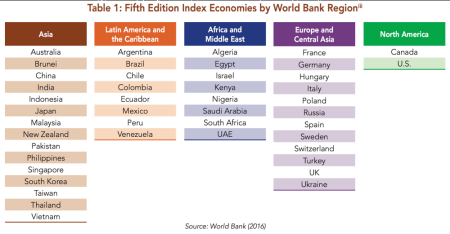
    The 45 economies benchmarked by the GIPC are shown in Table 1 of the report (click on table to enlarge), divided by World Bank region.

    Table 1
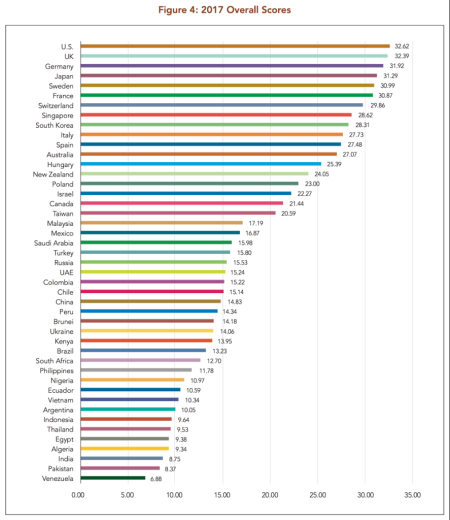
    With the addition of five new indicators in the latest edition of the IP Index, the maximum possible score increased from 30 to 35.  Overall scores for the 45 benchmarked economies are shown in Figure 4 of the report (click on Figure to enlarge), with the U.S. (32.62), UK (32.39), and Germany (31.92) finishing in the top three.

    Figure 4
    With respect to the scores for Category 1 (patents, related rights, and limitations), the UK, Switzerland, Sweden, Germany, and France all finished with a score of 7.5.  The remaining scores for this category are shown below (click on Figure to enlarge).

    Category 1
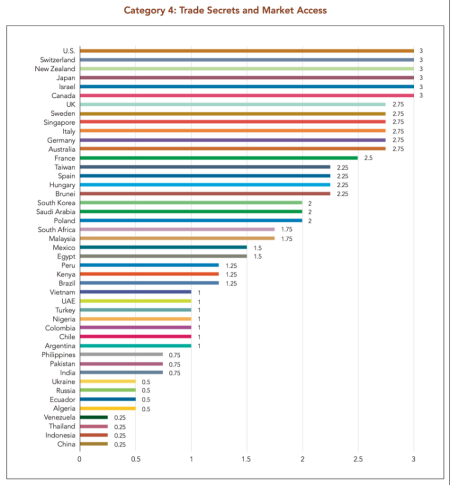
    For Category 4 (trade secrets and market access), the U.S., Switzerland, New Zealand, Japan, Israel, and Canada all finished with a score of 3.  The remaining scores for this category are shown below (click on Figure to enlarge).

    Category 4
    The bulk of the IP Index provides individual reports for each of the 45 benchmarked economies.  The report for the U.S. indicates that the overall score dropped from 95% (i.e., a score of 28.61 out of 30) in the 4th edition of the Index to 93% (i.e., a score of 32.62 out of 35) in the latest edition of the Index.  With respect to patentability requirements, the report notes that "the patenting environment in the U.S. continues to be affected by uncertainty as to how to interpret Myriad and other key decisions, and greater clarity, consistency, and closing of gaps with international best practices is crucial to upholding a supportive innovation environment."  The report also points out that a group of court decisions –- particularly, McRO v. Bandai Namco, BASCOM v. AT&T Mobility, and Amdocs v. Openet Telecom –- "suggests that software patents that otherwise meet patentability criteria may be considered patent-eligible and clarifies that claims directed to software are not automatically considered to be patent-ineligible abstract subject matter."

    In discussing patent opposition developments in the U.S., the Index indicates that:

    Despite the intention of the new opposition mechanisms, the ease of challenging patents during the post-grant period, particularly via inter partes review, has led to a high rate of trials (particularly for life sciences claims) and of rejections (between 40% and 65% depending on the type of technology), with challenges considered by some experts to be disproportionately funded by bad faith actors.

    In view of the above, the Index concludes that "the opposition system in the U.S. still represents a potential channel for bad faith actors and can involve a great deal of cost and uncertainty for patent owners compared to other post-grant opposition systems."

    As for trade secret developments, the Index highlights passage of the Defend Trade Secrets Act in 2016, noting that "[t]he new framework aids in enhancing the protection of trade secrets across the U.S."

    The GIPC also provided a Supplemental Statistical Analysis with the IP Index.  A summary of selected portions of the supplemental analysis will be provided in a subsequent post.

  • By Kevin E. Noonan

    CoverEarlier this month, Bloomberg Law and the American Intellectual Property Law Association released a report entitled "Patent Owners, Petitioners not Far Apart on PTAB Value."  This report was the result of a research study performed in November and December of 2016 by AIPLA and Bloomberg Law, asking respondents their views on the Patent Trial and Appeal Board (PTAB), and in particular, the effects of post-grant review (particularly inter partes review proceedings) on patent litigation, value, licensing and other topics.

    The study surveyed a total of 334 respondents, comprising 167 patent attorneys and agents, 62 in-house and 105 outside counsel.  Overall, two thirds of respondents rated the benefits of IPRs to be 7 or greater (on a scale of 1-10).  These results were variable with circumstance:  85% of petitioners in active litigation and 48% of patent owners rated the benefits of IPRs to be greater than 7 on that scale, with 42% of petitioners in litigation but only 16% of patent owners rating IPRs as a 10.  The seemingly anomalous receptivity from patent owners may reflect resignation, but perhaps even more so the recognition that surviving an IPR raises litigation estoppel, enhances the perception of validity, and inspires confidence in enforcement, due to the broader scope of claims as considered by the PTAB and the lower evidentiary standard for petitioners compared with patent infringement litigation defendants.  Both petitioners (88%) and patent owners (68%) believe IPRs provide lower cost benefits over district court litigation and similar statistics (80% petitioners, 57% patent owners) show that respondents believe that IPRs speed up litigation.

    Petitioners (64%) appreciate the technical expertise of PTAB APJs, but 32% of patent owners believe that expertise is the reason for adverse PTAB outcomes.  Petitioners (39%) and patent owners (49%) agree that the lack of a presumption of validity is an important aspect of IPRs that operate in their favor or against them, respectively, and similar responses were obtained (petitioners, 31%; patent owners, 48%) regarding the broadest reasonable interpretation standard for claim construction before the PTAB.  Similarly, the majority of both patent owners and petitioners responded that IPR outcomes influence patent infringement litigation.

    Finally, the value of licenses and the value of patents decreased somewhat, although license value was less strongly affected (26% vs. 43%).  And the majority (60%) of respondents reported no change in patent application budgets as a result of infringers having the IPR option.

    Bloomberg and AIPLA do not claim any statistical significance for this survey, inter alia, due to the small sample size.  While somewhat intriguing, it will likely take a generation for any clear cut trend to emerge regarding the effects of IPRs on patenting, innovation, and whether the oft-invoked justifications for these and other post-grant review provisions yield the benefits their proponents so loudly predicted.

  • Federal Circuit Finds That USPTO Board Interpreted CBM Statute Too Broadly

    By Joseph Herndon

    Federal Circuit SealIn an appeal of a Covered Business Method (CBM) patent review, the Federal Circuit overturned a decision by the U.S. Patent and Trademark Office's Patent Trial and Appeal Board that U.S. Patent No. 7,631,191 is a CBM patent, and vacated the Board's determination that the claims were unpatentable as obvious in view of the cited prior art.  This is another decision by the Federal Circuit reining in the scope of what constitutes a CBM patent, and hopefully, preventing future Board panels from using the CBM too liberally.

    The Patent-at-Issue

    Secure Axcess owns the '191 patent entitled "System and Method for Authenticating a Web Page."  According to the patent, the invention relates generally to computer security, and more particularly, to systems and methods for authenticating a web page.  Claims 1 and 17 are illustrative:

    1.  A method comprising:
        transforming, at an authentication host computer, received data by inserting an authenticity key to create formatted data; and
        returning, from the authentication host computer, the formatted data to enable the authenticity key to be retrieved from the formatted data and to locate a preferences file,
        wherein an authenticity stamp is retrieved from the preferences file.

    17.  An authentication system comprising:
        an authentication processor configured to insert an authenticity key into formatted data to enable authentication of the authenticity key to verify a source of the formatted data and to retrieve an authenticity stamp from a preferences file.

    The '191 patent, in discussing the invention, explains that an Internet user might be misled to the wrong website without proper authentication.  To illustrate the problem, the '191 patent uses http://www.bigbank.com vs. http://www.b[l]gbank.com (with an 'l' instead of an 'i').  Also, despite typically referring to Internet "users," the patent occasionally refers to "customers," and "consumers".  The written description further explains that "[t]he web server can be any site, for example a commercial web site, such as a merchant site, a government site, an educational site, etc."  Thus, it is clear that many examples and applications of use of the invention described in the '191 patent include authentication of data for use in financial activities.

    Procedural History–Board

    The Board reasoned that because the '191 patent is directed to solving problems related to providing a web site to customers of financial institutions, the '191 patent covers the ancillary activity related to a financial product or service of Web site management and functionality and so, according to the legislative history of the AIA, the method and apparatus of the '191 patent perform operations used in the administration of a financial product or service.

    The Board also observed that the patent owner's allegations of infringement by approximately fifty financial institutions was a factor weighing toward the conclusion that the '191 patent claims a method or apparatus that at least is incidental to a financial activity, even if other types of companies also practice the claimed invention.

    Federal Circuit's Response

    Congress defined a "covered business method patent" as a patent that claims a method or corresponding apparatus for performing data processing or other operations used in the practice, administration, or management of a financial product or service.

    The Federal Circuit found that the statutory definition by its terms makes what a patent "claims" determinative of the threshold requirement for coming within the defined class.  But since a claim in a patent does not live in isolation from the rest of the patent, the written description bears importantly on the proper construction of the claims.  Thus, the Federal Circuit determined that the statute requires that it is the claims, in the traditional patent law sense, properly understood in light of the written description, that identifies a CBM patent.

    The Federal Circuit further analyzed the "financial product or service" prong of the CBM definition, and found that the statutory definition of a CBM patent requires that the patent have a claim that contains, however phrased, a financial activity element.  The claim need only require one of a "wide range of finance-related activities," examples of which can be found in the cases which the Federal Circuit has held to be within the CBM provision, but it must be in the claim.

    The fact that the patent owner has allegations of infringement by approximately fifty financial institutions, or the patent owner's choice of litigation targets, is not a determinative factor and could be influenced by a number of considerations, such as the volume of a particular target's perceived infringement; the financial condition of the target; which targets are most likely to be willing to settle rather than bear the cost of litigating; available and friendly venues; and so on.  Those choices do not necessarily define a patent as a CBM patent, nor even necessarily illuminate an understanding of the invention as claimed.

    Just because an invention could be used by various institutions that include a financial institution, among others, does not mean a patent on the invention qualifies under the proper definition of a CBM patent.

    The Federal Circuit thus determined that the Board erred in deciding this case as a CBM under its overly-broad statutory definition, and the Board's other determinations, including claim constructions as they bear on obviousness and the obviousness determination itself, were vacated.

    Dissent

    Judge Lourie authored a dissent, providing the opinion that the claims of the '191 patent are surely claims to a method or corresponding apparatus for performing data processing or other operations used in the practice, administration, or management of a financial product or service.

    Judge Lourie stated that the '191 patent makes clear that the invention is to be used in the management of a financial service.  However, there was no evidence provided that the invention "must" be used in the management of a financial service, and the claims were drafted to include broader applications.

    Judge Lourie went on to use the fact that Secure Axcess has sued 50 banking institutions as evidence of what they believe their invention is "used" for.

    Judge Lourie argued that if a method claim otherwise satisfies the requirements of 35 U.S.C. § 112, it need not recite an ultimate use, and the written description of the '191 patent tells us that the invention is to be used for financial management.

    Judge Lourie opined that the majority escaped the clear purport of the invention by ranging into a discussion of the meaning of claims in patent law, and ignored the statutory language "used in the practice."  Again, Judge Lourie argued that the claims need not recite usage, and the written description provides that for us.

    Judge Lourie concluded by saying that common sense is not precluded from use in interpreting statutes and claims, and suffice it to say that the relation of this invention to the financial world is one of substantial identity compared with an incidentally-used invention like a lightbulb or ditch-digging.

    Absent from the dissent's analysis, however, is anything in the claim itself that can be considered a financial activity.  Following the dissent's analysis would require importing limitations of "use" into the claim in instances where the claim was drafted more broadly.  Thus, it appears the majority has a more sound analysis in place, and when the claim language is clear on its face and drafted to include uses not limited to financial activities, the patent should not be considered eligible for CBM patent review.

    Secure Axcess, LLC v. PNC Bank National Association (Fed. Cir. 2017)
    Panel: Circuit Judges Lourie, Plager, and Taranto
    Opinion by Circuit Judge Plager; dissenting opinion by Circuit Judge Lourie

  • By Kevin E. Noonan

    Federal Circuit SealIn an otherwise unremarkable albeit precedential decision, the Federal Circuit set forth an explication of when the Patent Trial and Appeal Board has, and has not, given the court enough information to determine whether its factual determinations are supported by substantial evidence.  And in its decision handed down today in Icon Health & Fitness, Inc. v. Strava, Inc., Judge O'Malley provided a coda regarding when failure to provide such evidence should result in remand or reversal of the Board's decision.

    The case arose from inter partes reexamination (under the American Inventor Protection Act of 1999, a predecessor to inter partes review under the Leahy–Smith America Invents Act of 2011) of U.S. Patent No. 7,789,800.  The claims are directed to a portable system that permits a user to retrieve one or more exercise programs from a remote server that have motivational content during exercise.  During the reexamination (Control No. 95/002,359), in response to allegations of unpatentability from the third party requestor and determinations by the PTO, a number of claims were found to be obvious.  The PTAB affirmed this decision and patentee Icon Health appealed.

    The Federal Circuit treated the rejected claims in five groups, affirming in part, vacating in part and remanding (which prompted Judge O'Malley to dissent in part).  The Federal Circuit rejected Icon's argument that the Board erred in relying on Strava's expert's opinion that the claims were obvious, for overreaching by opining on questions of law (wherein the opinion "go[es] well beyond supplying opinions regarding factual matters by 'improperly opining as to the legal conclusion of obviousness'").  As an initial matter, the panel opinion considered whether this argument had been waived for (admittedly) not being asserted before the Board.  Citing Automated Merch. Sys., Inc. v. Lee, 782 F.3d 1376, 1379 (Fed. Cir. 2015), the opinion sets forth the considerations courts use for deciding whether waiver applies, including whether (1) "the issue involves a pure question of law and refusal to consider it would result in a miscarriage of justice"; (2) "the proper resolution is beyond any doubt"; (3) "the appellant had no opportunity to raise the objection" below; (4) "the issue presents significant questions of general impact or of great public concern"; or (5) "the interest of substantial justice is at stake," as well as "whether the issue has been fully briefed, a party will be prejudiced by consideration of the issue, or no purpose will be served by remand."  Balancing these factors the Court decided that "[b]ecause the issue has been fully briefed, the record is complete, there will be no prejudice to any party, and no purpose is served by remand," it would consider Icon's arguments even though they had not been advanced before the Board.  On the merits, the Court held that the Board could rely on Strava's expert opinions because "the PTAB is permitted to weigh expert testimony and other record evidence and, in so doing, rely on certain portions of an expert's declaration while disregarding others."  On the ultimate legal question of obviousness, the opinion noted that it has permitted expert testimony to include such statements ("it would have been obvious that") so long as the expert declaration contains statements in support of factual findings (saying an expert's evidence is considered "in the context of the whole declaration").

    For those claims where the panel vacated and remanded, the Court held that either the Examiner or the Board or both failed to set forth the factual bases for deciding that the claims were obvious.  Claims 57-62 and 65 are directed to a cradle having electrical contacts and a computing device to mate with the cradle.  The panel agreed with Icon that the PTAB's decision was not supported by substantial evidence, because neither the Examiner nor the Board made factual findings to support an obviousness determination nor recited an explanation of how the facts supported the ultimate decision that the claims were obvious.  The deficiency was not that the Board relied upon the Examiner's fact-findings but that those findings were based entirely upon attorney argument by Strava.  Because "[a]ttorney argument is not evidence" (other than an admission) it could not support the Board's obviousness determination by substantial evidence.  The panel came to a like result for claims 46 and 74, directed to embodiments comprising a microphone for a user voice-activated controller, as well as claims 98-100, directed to embodiments comprising an accelerometer.

    Icon made similar arguments for Claim 86 (for embodiments where the cradle comprised a wireless interface), but the Court rejected them.  For this claim, the Board incorporated factual findings that the Examiner had actually made, and for which the Court found an adequate evidentiary basis.  Moreover, the Board also explained its decision to the Court's satisfaction on review.  The Court came to a similar conclusion regarding claims 43 and 71, for embodiments comprising a virtual reality display.  Finally, the panel also rejected Icon's allegations that one of the prior art references taught away from the claimed invention, and that the Board had improperly relied upon a written description argument to support rejection of these claims.

    Judge O'Malley dissented in part based on the panel's decision to remand for further considerations.  In her view (shared with Judge Newman, in In re Van Os, 844 F.3d 1359, 1362 (Fed. Cir. 2017)), the PTO (and PTAB) bear the burden of establishing unpatentability during examination (and reexamination).  Failing to do so should not result in remand (essentially, giving the Office another bite at the invalidity apple), but in the Court reversing the Board and affirming the validity of claims 46, 57-62, 65, 74 and 98-100.  These differing approaches can be understood based on whether inter partes reexamination is considered to involve the patentee and the Board (with the third party requestor providing counterpoint to the Board's deliberations) or whether the public interest should be the principal factor in the outcome.  Insofar as reexaminations and post-grant reviews generally are thought to be best used to ensure valid patents are granted by the PTO, procedural issues like those that concern Judges O'Malley and Newman are trumped by the importance of "getting it right."  Thus, the Board should be permitted on remand to properly consider the evidence and come to the "correct" conclusion.  This seems to be the view held by the Patent Office and the majority of the Federal Circuit.  It is also likely shared by the Supreme Court in light of that Court's concerns with patenting improperly preventing the free use of technology and falling outside the bounds of limited "monopoly" just sufficient to promote progress according to the Founders' intent.

    Icon Health & Fitness, Inc. v. Strava, Inc. (Fed. Cir. 2017)
    Panel: Circuit Judges O'Malley, Reyna, and Wallach
    Opinion by Circuit Judge Wallach; concurring-in-part and dissenting-in-part opinion by Circuit Judge O'Malley

  • By James Cherry* & Adam Denley** —

    Australian FlagThe scope for enforcement of Swiss-style claims may be broader in Australia than for method of medical treatment claims.  Second medical use inventions can be claimed in an ever increasing number of claim formats depending on the jurisdiction.  While such inventions in Europe are now claimed in purpose-limited-product format, or so called 'EPC2000' format, and in the U.S. are pursued in method of medical treatment format, the humble Swiss-style claim has been again shown to be of immense value in Australia even though methods of treatment claims are also an allowable format.  So much so, that an injunction against a competitor was granted solely on the basis of infringement of Swiss-style claims.

    How did this occur?

    The basic legal test is that the exclusive patent rights conferred on a patentee in Australia includes the right to offer an invention for sale.  Should a patentee have a product or composition of matter claim then an offer by a third party of a product which falls within the scope of that granted claim will, or course, be an infringement.  However, it is less clear what conduct infringes a patent for a second, or subsequent, medical use invention.

    In the recent pregabalin court case1 it was held that for method of medical treatment claims, an offer to sell a product referred to in those method claims cannot be an infringement as infringement requires the actual method of treatment to be performed.  Australia does have statutory contributory infringement provisions which are enlivened where the supply of a product occurs and the use of that product by a person would be an infringement.  However, these contributory infringement provisions were found not to apply where a third party merely offers to supply a product, but does not in fact supply that product.

    This then leaves the often forgotten Swiss-style claim which arose in Europe to circumvent the exclusion of methods of medical treatment as patentable subject matter.  This claim format, "Use of substance X in the manufacture of a medicament for the treatment of condition Y", is often overshadowed by method of treatment format as it avoids claiming the medical treatment in a rather unusual way by claiming the manufacture but obtaining novelty and inventiveness from the condition to be treated.  The injunction granted in the pregabalin case was on the basis that it was an infringement of a Swiss-style claim to offer to supply a pharmaceutical product that results from the use of a method of manufacture the subject of the granted Swiss-style claims.  This clearly highlighted a benefit of the granted Swiss-style claims that was not afforded by the granted method of medical treatment claims.

    Australian courts have confirmed that Swiss-style claims have different scope than method of medical treatment claims (see our previous article here), and this pregabalin decision shows that the scope for enforcement of Swiss-style claims is also different and perhaps broader.

    1 Apotex Pty Ltd v Warner-Lambert Company LLC (No 3) [2017] FCA 94.

    * Mr. Cherry is a Principal with and the Managing Director of FPA Patent Attorneys.
    ** Dr. Denley is an Associate Principal with FPA Patent Attorneys.

    This article was reprinted with permission from FPA Patent Attorneys.