• IPO #2The Intellectual Property Owners Association (IPO) will offer two one-hour webinars on March 14 and 16, 2017.  In the first webinar, entitled "Divided Infringement: Development of the Law Since Akamai En Banc," which will be held on March 14, 2017 from 2:00 to 3:00 pm (ET), John Carlin of Fitzpatrick, Cella, Harper & Scinto, Michael Joffre of Sterne, Kessler, Goldstein & Fox PLLC, and Frank Nuzzi of Siemens Corp. will describe and analyze how courts are applying Akamai v. Limelight.  In the second webinar, entitled "Divided Infringement in the Life Sciences: Patent Prosecution Perspective," which will be held on March 16, 2017 from 2:00 to 3:00 pm (ET), Courtenay Brinckerhoff of Foley & Lardner LLP, Darrell Fontenot of Alexion Pharmaceuticals, and Michael Fuller of Knobbe, Martens, Olson & Bear LLP will look at claim drafting strategies after Eli Lilly v. Teva Parenteral in such fields as personalized medicine and companion diagnostics, measuring the efficacy of treatment through biomarkers, and methods involving pretreatment.

    The registration fee for each webinar is $135 (government and academic rates are available upon request).  Those interested in registering for either webinar can do so here.

  • USPTO SealThe U.S. Patent and Trademark Office will be offering the next webinar in its Patent Quality Chat webinar series from 12:00 to 1:00 pm (ET) on March 14, 2017.  The latest webinar, which will focus on "Training for the Examination of High Quality Patents," will be hosted by Gary Welch, Academy Class Manager, Office of Patent Training, and Bao-Thuy Nguyen, Patent Training Advisory, Office of Patent Training.  The presenters will present details about how we train new patent examiners and managers, refresh seasoned patent examiners and managers, and inform practitioners.

    Instructions for viewing the webinar can be found here.

    Additional information regarding the Patent Quality Chat webinar series can be found on the USPTO's Patent Quality Chat webpage.

  • Strafford #1Strafford will be offering a webinar/teleconference entitled "USPTO Examiner Interview Strategies: Preparing for and Conducting Interviews to Advance Patent Prosecution" on March 21, 2017 from 1:00 to 2:30 pm (EDT).  Adriana L. Burgy of Finnegan Henderson Farabow Garrett & Dunner, Kenneth E. Horton of Kirton McConkie, and Marvin Petry of Stites & Harbison will provide guidance to patent counsel on leveraging interviews with the USPTO patent examiners to prosecute patents more efficiently, and insight into conducting the interviews and offer strategies for interacting with patent examiners.  The webinar will review the following issues:

    • What should be included in an interview agenda and what should be avoided?
    • How can patent counsel use an examiner interview to the client’s advantage?
    • How and when should patent counsel interact with examiners for effective and efficient prosecution?

    The registration fee for the webinar is $297.  Those interested in registering for the webinar, can do so here.

  • Technology Transfer Tactics will be offering a webinar on "Determining Inventorship for University IP" on March 16, 2017 from 1:00 to 2:00 pm (Eastern).  Sherry L. Murphy of Myers Bigel, PA will help attendees fully understand the parameters of each type of inventorship and avoid the damaging consequences of inventorship disputes.  The webinar will cover the following topics:

    • Why Inventorship is important
        – Legal requirements
        – Potential consequences of errors
    • Overview of Inventorship legal standards
    • Changes regarding Inventorship under the America Invents Act
    • Inventorship evaluation tips
        – Questions to ask contributors
        – When to obtain more in-depth legal advice
    • Special considerations involving:
        – Inter-Institution collaboration
        – Industry Sponsorship
        – Students

    The registration fee for the webinar is $197.  Those interested in registering for the webinar, can do so here.

    Technology Transfer Tactics

  • LexisNexisLexisNexis will be offering a webinar/teleconference entitled "An Alchemist's Approach to Patent Prep and Prosecution" on March 14, 2017 at 2:00 pm (EST).  Megan McLoughlin and David Stitzel of LexisNexis® IP. Will provide insider secrets and tips that will help attendees cost-effectively draft and prosecute for the best possible outcomes.  The webinar will explore and outline:

    • Surprising patterns in patent examiner behavior
    • Common pitfalls in U.S. patent prosecution
    • Cost-effective ways to save time and money
    • Patent quality – common or not?
    • How to efficiently perfect the draft
    • Wisdom for patent analytics

    Those interested in registering for the webinar, can do so here.

  • Federal Circuit Finds Motion Tracking System to be Patent-Eligible

    By Michael Borella

    Federal Circuit SealAfter the dark days of 2014 and 2015, in which exactly one Federal Circuit decision out of over twenty 35 U.S.C. § 101 challenges was found to meet the requirements of that part of the statute, we have seen clouds disperse to some extent.  Last year, five out of twenty-one § 101 cases for which the Federal Circuit provided a full opinion resulted in the claims therein being deemed patent-eligible.  And in 2017, we are off to a quick start so far, with this case being the second in which the Court has made such a determination.

    The dispute here is over U.S. Patent No. 6,474,159, the independent claims of which recite:

    1.  A system for tracking the motion of an object relative to a moving reference frame, comprising:
        a first inertial sensor mounted on the tracked object;
        a second inertial sensor mounted on the moving reference frame; and
        an element adapted to receive signals from said first and second inertial sensors and configured to determine an orientation of the object relative to the moving reference frame based on the signals received from the first and second inertial sensors.

    22.  A method comprising determining an orientation of an object relative to a moving reference frame based on signals from two inertial sensors mounted respectively on the object and on the moving reference frame.

    In the words of the Court, the '159 patent is directed to "an inertial tracking system for tracking the motion of an object relative to a moving reference frame."  The reference frame is typically a starting point of the object's motion, and the inertial sensors (e.g., accelerometers and gyroscopes) allow tracking of the object in three-dimensional space with respect to that starting point.  These systems, however, are subject to drift, in which small measurement errors accumulate into larger errors in estimates of the object's position.  To accommodate, the systems periodically take measurements, by way of a secondary position-determining mechanism, that effectively resets the reference frame to the object's current position.

    The claimed invention was motivated by the observation that inertial tracking of the position of an object on a moving platform (e.g., an aircraft) is inherently inaccurate in current systems where the secondary position-determining mechanism measures the object's position relative to the platform.  Both the object's and the platform's inertial sensors track their respective motion relative to the reference frame of the earth, which leads to inaccuracies during error correction.

    Unlike previous systems, the invention specifies that the "platform . . . inertial sensors directly measure the gravitational field in the platform frame," while the "object . . . inertial sensors then calculate position information relative to the frame of the moving platform."  This allows one to determine the position of the object with respect to the platform, and does not require determining the position of the platform as it moves about.

    Thales brought an action against the U.S. government and a government subcontractor in the U.S. Court of Federal Claims, contending that the helmet mounted display system in the F-35 Joint Strike Fighter infringes numerous claims of the '159 patent.  The Claims Court found these claims ineligible for patenting under § 101, because they "(1) are directed to the abstract idea of using laws of nature governing motion to track two objects, and (2) provide no inventive concept beyond the abstract idea."  Thales appealed.

    The Federal Circuit began its substantive analysis with an overview of patentable subject matter law.  In a nutshell, the Supreme Court's Alice Corp. Pty. Ltd. v. CLS Bank Int'l case set forth a two-part test to determine whether claims are directed to patent-eligible subject matter.  One must first determine whether the claim at hand is directed to a judicially-excluded law of nature, a natural phenomenon, or an abstract idea.  If so, then one must further determine whether any element or combination of elements in the claim is sufficient to ensure that the claim amounts to significantly more than the judicial exclusion.  But generic computer implementation of an otherwise abstract process does not qualify as "significantly more."  On the other hand, a claimed improvement to a computer or technological process is not abstract.

    The Court leaned heavily on Diamond v. Diehr as controlling precedent.  In that case, the Supreme Court found claims to meet the requirements of § 101 despite inclusion of an abstract idea — a mathematical formula.  But the claimed invention in that case was eligible because it "described a process of curing rubber beginning with the loading of the mold and ending with the opening of the press and the production of a synthetic rubber product that has been perfectly cured—a result heretofore unknown in the art."  Thus, the claims were directed to an improved technological process rather than just abstract math.

    The Court found the clams of the '159 patent "nearly indistinguishable" from those of Diehr for purposes of the § 101 inquiry.  While the former claims do not explicitly recite mathematical formulas, the Court found that the invention relies upon underlying equations that are derived from the specific arrangement of sensors as recited.  Furthermore, "the equations—dictated by the placement of the inertial sensors and application of laws of physics—serve only to tabulate the position and orientation information in this configuration."  Like the advances of Diehr, "the claims here result in a system that reduces errors in an inertial system that tracks an object on a moving platform."  The Court expounded upon these improvements, heavily referencing the specification of the '159 patent when doing so.

    Ultimately, the Court concluded that "the claims are directed to systems and methods that use inertial sensors in a non-conventional manner to reduce errors in measuring the relative position and orientation of a moving object on a moving reference frame."  In the Court's view, the invention applied laws of physics to solve this problem, and the mere presence of a mathematical equation in the solution "does not doom the claims to abstraction."  Therefore, the claims are not directed to an abstract idea, and the Court did not have to proceed to part two of Alice.

    This case is similar to Amdocs (Israel) Limited v. Openet Telecom, Inc., where the Federal Circuit found patent-eligibility in broadly-drafted claims.  Notable in both cases is that the Court's reasoning depended greatly on the improvements engendered by the inventions, as described in their respective specifications.  This, of course, reiterates what many of us have been expounding for the last few years — when drafting a software or business method patent application post-Alice it can pay off to clearly define the problem being solved, as well as how the solution improves upon previous approaches.  Not unlike Amdocs, this case is more evolutionary than revolutionary, but at least it reflects a consistent line of reasoning coming from the Federal Circuit.

    Thales Visionix Inc. v. U.S. (Fed. Cir. 2017)
    Panel: Circuit Judges Moore, Wallach, and Stoll
    Opinion by Circuit Judge Moore

  • By Donald Zuhn

    Federal Circuit SealLast month, in In re Depomed, Inc., the Federal Circuit affirmed the determination by the U.S. Patent and Trademark Office Patent Trial and Appeal Board that two instituted grounds in an inter partes review rendered claims 1, 3-5, and 10-13 of Depomed's U.S. Patent No. 6,723,340 unpatentable as obvious.

    The '340 patent relates to vehicles for drug delivery, and more particularly to a controlled-release tablet comprising a solid monolithic matrix that comprises a combination of poly(ethylene oxide) and hydroxypropyl methylcellulose.  The claimed controlled-release tablet provides gastric retention, wherein the drug being delivered is retained in the stomach for a prolonged duration, by using matrix material that provides drug formulation particles that are small enough to be swallowed comfortably, but that swell to a larger size upon contact with gastric fluids.  In the case of the claimed controlled-release tablet, the poly(ethylene oxide) ("PEO") and hydroxypropyl methylcellulose ("HPMC") are both matrix materials that possess swelling and controlled release properties.  According to the '340 patent specification, combining PEO and HPMC yields "a swellable, sustained-release tablet [that] provides unexpectedly beneficial performance, avoiding or substantially reducing the problems [with using either matrix material alone] and offering improved control and reliability while retaining both the ability to swell for gastric retention and to control release."

    Endo Pharmaceuticals, Inc. filed a petition for inter partes review of the '340 patent alleging that claims 1-5 and 10-13 were unpatentable as obvious under 35 U.S.C. § 103 on five prior art grounds, and the Board instituted an IPR on claims 1, 3-5, and 10-13 on three obviousness grounds:  (1) International Publication No. WO 98/55107 ("Shell 1998") alone, (2) Shell 1998 in combination with a 1993 article ("Papadimitriou"), and (3) Papadimitriou in combination with U.S. Patent No. 4,871,548.  The Board concluded in its final written decision that claims 1, 3-5, and 11-13 were unpatentable as obvious in view of Shell 1998, and that claims 1, 3-5, and 10-13 were also unpatentable as obvious in view of Shell 1998 and Papadimitriou.

    DepomedDepomed appealed the Board's determination to the Federal Circuit, Endo withdrew as a party to the appeal, and the Director of the USPTO intervened pursuant to 35 U.S.C. § 143.  On appeal, Depomed argued that: (1) the Board erred in failing to account for the unexpected results of combining PEO and HPMC, (2) the Board's obviousness conclusion improperly relied on hindsight bias, and (3) the Board applied an incorrect legal standard to assess long-felt, but unmet, need.

    With respect to Depomed's first argument, the Federal Circuit determined that substantial evidence supported the Board's finding that Depomed's evidence of unexpected results was weak and entitled to little weight.  According to the opinion, the Board explained that Shell 1998 discloses a finite number of identified, predictable polymers that could be used individually or in combination, of which HPMC and PEO are "particularly preferred" polymers.  In agreeing with the Board's conclusion that the claims are obvious in view of Shell 1998, the Board stated that:

    Shell 1998 discloses (1) a finite number of matrix polymers, of which HPMC and PEO are preferred; (2) that matrix polymers "can be used individually or in combination"; and (3) that "[c]ertain combinations will often provide a more controlled release of the drug than their components when used individually."   . . .  The express disclosure that combinations of polymers will often yield better results than when used alone undermines Depomed's suggestion that the difference between using HPMC and PEO individually and using them in combination would not have been expected.

    With respect to Depomed's second argument, the Federal Circuit disagreed with Depomed's assertion that a person of ordinary skill in the art would have had no motivation to combine HPMC and PEO because Shell 1998 discloses polymer combinations solely for the purpose of overcoming deficiencies in the controlled release properties of certain polymers in their individual capacities, and HPMC and PEO did not exhibit those deficiencies in their individual capacities.  Instead, the Court agreed with the Board's finding that Shell 1998 "does not limit which polymers could be combined or suggest that certain polymers would not function properly in a combination matrix."

    With respect to Depomed's third argument, the Federal Circuit agreed with Depomed's assertion that the Board incorrectly required evidence demonstrating a failure of others to establish a long-felt but unmet need.  Nevertheless, the Court determined that substantial evidence supported the Board's assignment of little weight to Depomed's evidence of long-felt but unmet need, and agreed with the Board's ultimate conclusion that the claims are obvious in view of Shell 1998.  The Court therefore determined that the Board did not err in holding claims 1, 3–5, and 10–13 of the '340 patent unpatentable as obvious, and affirmed the Board's decision.

    Judge Reyna authored a concurring opinion to express two concerns.  First, he noted that he was "troubled that the Board improperly employed a two-step approach in its obviousness analysis," explaining that the Board "first made initial conclusions of obviousness and only later considered Depomed's objective indicia of nonobviousness."  Judge Reyna indicated that "[d]eferring consideration of objective indicia until after deciding a claim would have been obvious allows hindsight bias to creep into step one (the prima facie showing) and limits the meaningfulness of step two," adding that "in an IPR, the Board should not first make an obviousness determination only later to consider the patentee's objective indicia of nonobviousness," since "[d]oing so risks succumbing to the very hindsight bias."  In Judge Reyna's view, the Board therefore erred by considering Depomed's objective indicia only after determining that certain claims would have been obvious.

    Judge Reyna was also concerned with the Board's assignment of "weight" to the evidence, explaining that "results are either unexpected or they are not," and adding that "[o]ur case law does not ask whether results are 'really unexpected' or just a 'little unexpected.'"  According to Judge Reyna, "[t]he Board must decide a binary issue: either the challenged claims would have been obvious or they would not have been obvious," and not "whether evidence of unexpected results 'outweighs' the similarity between the challenged claims and the prior art."  However, despite these two concerns, Judge Reyna did not believe remand was necessary because "Depomed's objective indicia, even if analyzed under the proper framework, do not compel a conclusion of nonobviousness in view of Shell and Papadimitriou."

    In re Depomed, Inc. (Fed. Cir. 2017)
    Nonprecedential disposition
    Panel: Circuit Judges Dyk, Reyna, and Stoll
    Opinion by Circuit Judge Stoll; concurring opinion by Circuit Judge Reyna

  • By John Cravero and Richard Martin

    USPTO SealAbout the PTAB Life Sciences Report:  Each month we will report on developments at the PTAB involving life sciences patents.

    McKesson Corp. v. My Health, Inc.

    PTAB Petition:  IPR2017-00312; filed November 29, 2016.

    Patent at Issue:  U.S. Patent No. 6,612,985 ("Method and system for monitoring and treating a patient," issued September 2, 2003) claims a method for tracking compliance with treatment guidelines as well as a system for tracking compliance in treating patients comprising an assessment processing system.

    Petitioners McKesson Corp., McKesson Technologies Inc., InTouch Technologies, Inc., and Medical Depot, Inc. are challenging the '985 patent on nine grounds as being anticipated under 35 U.S.C. § 102(b) (grounds 1, 6, and 8) or as obvious under 35 U.S.C. § 103(a) (grounds 2-5, 7, and 9).  View the petition here.

    Related Matters:  According to the petition, the '985 patent is currently the subject of the following litigations:  My Health, Inc. v. McKesson Technologies Inc., 2:16-cv-00881, Eastern District of Texas (Marshall Division); My Health, Inc. v. InTouch Technologies, Inc., 2:16-cv-00536, Eastern District of Texas (Marshall Division); My Health, Inc. v. DeVilbiss Healthcare, LLC, 2:16-cv-00544, Eastern District of Texas (Marshall Division); My Health, Inc. v. MyNetDiary, Inc., 2:16-cv-00866, Eastern District of Texas (Marshall Division); My Health, Inc. v. ALR Technologies, Inc., 2:16-cv-00535, Eastern District of Texas (Marshall Division); Human Design Medical, LLC v. My Health, Inc., 1:16-cv-00767, District of Delaware; and Fit4D, Inc. v. My Health, Inc., 1:16-cv-01076, District of Delaware.  
The '985 patent has been the subject of four prior IPR petitions, all of which were terminated prior to a final written decision:  IPR2013-00320 (Cardiocom, LLC, filed 05/31/2013; granted 11/19/2013; terminated 02/20/2014); IPR2014-00435 (Click4Care, Inc., filed 02/14/2014; terminated 06/06/2014); IPR2015-00102 (Biotronik, Inc., filed 10/21/2014; granted 04/16/2015; terminated 07/28/2015); and IPR2015-01218 (Robert Bosch Healthcare Systems, Inc., filed 05/18/2015; terminated 07/28/2015; denied 05/23/2016), and IPR2016-01111 (Dr. Reddy's Laboratories, Ltd., filed 05/31/2016; pending).


    Smith & Nephew, Inc. v. ConforMIS, Inc.

    PTAB Petition:  IPR2017-00372; filed November 30, 2016.

    Patent at Issue:  U.S. Patent No. 8,377,129 ("Joint arthroplasty devices and surgical tools," issued February 19, 2013) claims a patient-specific instrument system for surgery of a diseased or damaged knee joint of a patient.

    Petitioner Smith & Nephew, Inc. is challenging the '129 patent on two grounds as obvious under 35 U.S.C. § 103(a).  View the petition here.

    Related Matters:  According to the petition, the '129 patent is currently the subject of the litigation:  ConforMIS, Inc. v. Smith & Nephew, Inc., 1:16-cv-10420-IT (D. Mass.).


    Smith & Nephew, Inc. v. ConforMIS, Inc.

    PTAB Petition:  IPR2017-00373; filed November 30, 2016.

    Patent at Issue:  U.S. Patent No. 8,551,169 ("Joint arthroplasty devices and surgical tools," issued October 8, 2013) claims a method for making a patient specific surgical instrument for use in implanting an orthopedic implant in a patient.

    Petitioner Smith & Nephew, Inc. is challenging the '169 patent on two grounds as obvious under 35 U.S.C. § 103(a).  View the petition here.

    Related Matters:  According to the petition, the '169 patent is currently the subject of the litigation:  ConforMIS, Inc. v. Smith & Nephew, Inc., 1:16-cv-10420-IT (D. Mass.).


    Mylan Pharmaceuticals, Inc. v. Dr. Falk Pharma GmbH
    Foxhill Capital Partners, LLC v. Dr. Falk Pharma GmbH

    PTAB Petition:  IPR2016-01386; filed July 8, 2016.

    PTAB Petition:  IPR2016-01409; filed July 16, 2016.

    PTAB Trial Instituted Document filed November 30, 2016.

    Patent at Issue:  U.S. Patent No. 8,865,688 ("Compositions and methods for treatment of bowel diseases with granulated mesalamine," issued October 21, 2014) claims methods of maintaining remission of ulcerative colitis with administration of granulated mesalamine.

    Petitioners Mylan Pharmaceuticals, Inc. (IPR2016-01386) and Foxhill Capital (GP), LLC; Foxhill Capital Partners, LLC; Foxhill Opportunity Fund, LP; Laura Pollack Weiner; MycoNovo, Inc.; Neil Anthony Weiner; and William D Hare (IPR2016-01409) are challenging the '096 patent on four grounds as obvious under 35 U.S.C. § 103(a).  View the petitions here (IPR2016-01386) and here (IPR2016-01409).  Administrative Patent Judges Lora M. Green, Grace Karaffa Obermann, and Elizabeth M. Roesel (author) issued a decision instituting inter partes review of whether claims 1 and 16 of the '688 patent are unpatentable under 35 U.S.C. § 103(a) as obvious over the 2007 Press Release, Endonurse, and Davis-1985 in view of Marakhouski or Brunner.  The Judges also ordered that Case IPR2016-01386 and Case IPR2016-01409 be joined and administratively terminated under 37 C.F.R. § 42.72, and all further filings in the joined proceedings to be made in Case IPR2016-00297 (Petitioners, Generico, LLC and Flat Line Capital, LLC.; filed 12/08/2015; instituted 06/10/2016; pending).

    Related Matters:  According to the petitions, the '688 patent is currently the subject of the following litigations:  Salix Pharmaceuticals, Inc. et al. v. Novel Laboratories, Inc., 1-15-cv-00027 (DED); Salix Pharmaceuticals, Inc. et al. v. Novel Laboratories, Inc., 1-15-cv-00213 (DED); and Salix Pharmaceuticals, Inc. et al. v. Mylan Pharmaceuticals Inc. et al., 1-15-cv-00109 (N.D.W.V.).


    Luye Pharma Group Ltd. v. Alkermes Controlled Therapeutics, Inc.

    PTAB Petition:  IPR2016-01096; filed May 31, 2016.

    PTAB Trial Instituted Document filed November 30, 2016.

    Patent at Issue:  U.S. Patent No. 6,667,061 ("Preparation of injectable suspensions having improved injectability," issued December 23, 2003) claims a composition suitable for injection through a needle into a host.

    Petitioners Luye Pharma Group Ltd., Luye Pharma (USA) Ltd., Shandong Luye Pharaceutical Co., Ltd., and Nanjing Luye Pharmaceutical Co., Ltd. are challenging the '061 patent on two grounds as obvious under 35 U.S.C. § 103(a).  View the petition here.  Administrative Patent Judges Lora M. Green (author), Robert A. Pollock, and Jacqueline T. Harlow issued a decision instituting inter partes review of whether claims 1-13, 22, and 23 of the '061 patent are rendered obvious by the combination of Johnson and Kino; and claims 1-3, 6-9, 12, 13, and 17-23 are rendered obvious by the combination of Gustafsson, Ramstack, and the Handbook.

    Related Matters:  According to the petition, the Petitioner concurrently filed with IPR2016-01096 an additional petition for inter partes review of the '061 patent (IPR2016-01095).  The Judges decided the two petitions concurrently.  IPR2016-01095 was denied institution on all grounds.


    Merck Sharp & Dohme Corp. v. Wyeth LLC

    PTAB Petition:  IPR2017-00378; filed December 1, 2016.

    Patent at Issue:  U.S. Patent No. 8,562,999 ("Formulations which stabilize and inhibit precipitation of immunogenic compositions," issued October 22, 2013) claims a formulation comprising: (i) a pH buffered saline solution, wherein the buffer has a pKa of about 3.5 to about 7.5, (ii) an aluminum salt and (iii) one or more polysaccharide-protein conjugates, wherein the formulation is comprised in a siliconized container means and inhibits aggregation induced by the siliconized container means.

    Petitioners Merck Sharp & Dohme Corp., and Merck & Co., Inc are challenging the '999 patent ontwo grounds as obvious under 35 U.S.C. § 103(a).  View the petition here.

    Related Matters:  According to the petition, Petitioners concurrently filed two additional petitions for inter partes review of the '999 patent.  According to the petition, the '999 patent is not involved in any other related judicial or administrative matters.


    Merck Sharp & Dohme Corp. v. Wyeth LLC

    PTAB Petition:  IPR2017-00380; filed December 1, 2016.

    Patent at Issue:  U.S. Patent No. 8,562,999 ("Formulations which stabilize and inhibit precipitation of immunogenic compositions," issued October 22, 2013) claims a formulation comprising: (i) a pH buffered saline solution, wherein the buffer has a pKa of about 3.5 to about 7.5, (ii) an aluminum salt and (iii) one or more polysaccharide-protein conjugates, wherein the formulation is comprised in a siliconized container means and inhibits aggregation induced by the siliconized container means.

    Petitioners Merck Sharp & Dohme Corp., and Merck & Co., Inc are challenging the '999 patent on two grounds as obvious under 35 U.S.C. § 103(a).  View the petition here.

    Related Matters:  According to the petition, Petitioners concurrently filed two additional petitions for inter partes review of the '999 patent.  According to the petition, the '999 patent is not involved in any other related judicial or administrative matters.


    Merck Sharp & Dohme Corp. v. Wyeth LLC

    PTAB Petition:  IPR2017-00390; filed December 2, 2016.

    Patent at Issue:  U.S. Patent No. 8,562,999 ("Formulations which stabilize and inhibit precipitation of immunogenic compositions," issued October 22, 2013) claims a formulation comprising: (i) a pH buffered saline solution, wherein the buffer has a pKa of about 3.5 to about 7.5, (ii) an aluminum salt and (iii) one or more polysaccharide-protein conjugates, wherein the formulation is comprised in a siliconized container means and inhibits aggregation induced by the siliconized container means.

    Petitioners Merck Sharp & Dohme Corp., and Merck & Co., Inc are challenging the '999 patent on three grounds as obvious under 35 U.S.C. § 103(a).  View the petition here.

    Related Matters:  According to the petition, Petitioners concurrently filed two additional petitions for inter partes review of the '999 patent.  According to the petition, the '999 patent is not involved in any other related judicial or administrative matters.

  • By Kevin E. Noonan

    Federal Circuit SealThe Federal Circuit handed down two related opinions last week, Los Angeles Biomedical Research Institute v. Eli Lilly & Co. and Eli Lilly & Co. v. Los Angeles Biomedical Research Institute, one of which raised the question of whether (and when) it is appropriate for the Court to remand decisions of the Patent Trial and Review Board (PTAB) rendered under the post-grant provisions of the Leahy-Smith America Invents Act (AIA).

    The case arose as an inter partes review (IPR) before the PTAB, wherein the Board held all claims of U.S. Patent No. 8,133,903 to be obvious.  The claims were directed to methods for treating ("arresting or regressing") penile fibrosis.  This condition has two forms:  penile tunical fibrosis, where excess collagen builds up in the tunica albuginea (a membrane surrounding the corpora cavernosa, the chambers that fill with blood during an erection), and corporal tunica fibrosis, where excess collagen builds up in the corpora cavernosa itself.  The claimed treatment is daily administration of type 5 phosphodiesterase (PDE5) inhibitors, said treatment being characterized as "long term" in the opinion.  The class of PDE5 inhibitors includes drugs like sildenafil (Viagra®) and tadalafil (Cialis®), well-known erectile dysfunction treatments; while penile fibrosis can cause erectile dysfunction, the disease is distinct from other causes of ED.

    Claim 1 of the '903 patent is representative:

    1.  A method comprising:
        a) administering acyclicguanosine3',5'-monophosphate (cGMP) type 5 phosphodiesterase (PDE5) inhibitor according to a continuous long-term regimen to an individual with at least one of a penile tunical fibrosis and corporal tissue fibrosis; and
        b) arresting or regressing the at least one of the penile tunical fibrosis and corporal tissue fibrosis, wherein the PDE- 5 inhibitor is administered at a dosage up to 1.5 mg/kg/day for not less than 45 days.

    Eli Lilly petitioned for an IPR after the Los Angeles Biomedical Research Institute (LAB) sued for infringement over the company's marketing of Cialis® for the treatment of penile fibrosis.  The Board instituted an IPR on two grounds:  anticipation (reviewed on appeal in a separate decision captioned Eli Lilly & Co. v. Los Angeles Biomedical Research Institute) and obviousness as reviewed in this opinion.  The Board found the claims obvious based on teaching that PDE5 inhibitors can be used for treating ED (which the Board construed as including penile tunical fibrosis and corporal tissue fibrosis); that ED is a disease associated with aging and, inter alia, atherosclerosis (associated in turn according to the Board with corporal fibrosis), and that long term treatment (at least 45 days) with up to 1.5 mg/kg/day (~100 mg for an average-sized adult male) was effective for treating ED caused by "diabetes, atherosclerosis, smoking, hypertension, or a combination of such factors."  The Board rejected LAB's contention that treatment with PDE5 was thought in the art to exacerbate rather than ameliorate penile fibrosis.

    The Federal Circuit vacated and remanded, in an opinion by Judge Bryson joined by Judge Moore; Judge Newman concurred in part but dissented from the judgment.  The Court first rejected LAB's claim of priority, based on failure to disclose dosages of up to 1.5 mg/kg/day in its the earliest-filed provisional application.  This portion of the opinion considers whether disclosure regarding administration of PDE5 inhibitors to rats at a specific concentration (100 mg/L) would have been understood by a person having ordinary skill in the art to be equivalent to 1.5 mg/kg/day for an adult human male and the Court's opinion that it would not.  Indeed, any such "knowledge" by a skilled person would have been based on speculation, which cannot satisfy the written description requirement according to the panel, citing Lockwood v. Am. Airlines, Inc., 107 F.3d 1565, 1572 (Fed. Cir. 1997) .

    The panel then addressed the Board's claim construction, finding that the Board had "read out of the claim" the limitation of "an individual with at least one of penile tunical fibrosis and corporal tissue fibrosis" by interpreting that phrase to mean "an individual hav[ing] symptoms that may be associated with penile fibrosis, such as [erectile dysfunction], but not that the patient be specifically diagnosed as having penile tunical fibrosis or corporal tissue fibrosis."  According to the opinion, the patent specification makes clear that "penile fibrosis may result in erectile dysfunction, but it may not" and "erectile dysfunction has alternative causes and may present without underlying penile fibrosis."  The patent claims are directed to methods for treating penile fibrosis whether or not it results in the symptoms of erectile dysfunction, and thus the Board wrongly construed this term according to the opinion.  The panel found support for its view on the correct claim construction of this term from the Court's decision in Rapoport v. Dement, 254 F.3d 1053 (Fed. Cir. 2001), where, analogously, claims for treating sleep apnea were not directed to treating the symptoms of sleep apnea.  Accordingly, the Federal Circuit found that the Board had not adopted the broadest reasonable interpretation of the claims but rather an overbroad interpretation.

    Similarly, the opinion rejected the Board's determination that the limitation "arresting or regressing the at least one of the penile tunical fibrosis and corporal tissue fibrosis" is entitled to no patentable weight, as being merely a statement of intended results of PDE5 inhibitor administration according to the claims.  The opinion based this conclusion on the placement of the limitation in the structure of the claim, not as part of a preamble but as an affirmatively recited element.  In addition, the Court found "[o]ther intrinsic evidence" (and thus appropriately subjected to de novo review) that distinguishes the phrase as it is used in these claims from situations where such limitations are present in preambles or "wherein" clauses; this conclusion is supported by examples of efficacy set forth in the specification.

    The Court concluded its review of the Board's claim construction by rejecting LAB's contention that the claim term "continuous long-term regimen" adds an additional limitation regarding steady state plasma concentration or constant dosing level in vivo, because the argument was not supported by the intrinsic evidence from the specification or prosecution history or extrinsic evidence from expert testimony.

    Turning to the Board's conclusion that the claims were obvious, the panel vacated the judgment based on its conclusions regarding the Board's improper claim construction.  Specifically, while the Board found that it would have been obvious to combine the teachings of three prior art references to arrive at a method for treating ED, "[w]hat the Board did not do [] was to find that those references taught treating a patient with penile tunical fibrosis or corporal tissue fibrosis" nor that the references would have provided the skilled worker with a reasonable expectation of success for treating these conditions.  The panel also found wanting reliance on references that taught "on-demand" dosing to support obviousness of claims that recited "long-term daily treatment" with PDE5 inhibitors.

    The Board also erred in rejecting LAB's evidence that the prior art taught that long-term treatment with PDE5 inhibitors was thought to be detrimental because it would increase fibrosis by stimulating nitric oxide production as understood in the art.

    Accordingly, the panel's ruling was that:

    The question remains whether a person of skill in the art would have had a reason to combine [the three cited references] to treat penile fibrosis with a long-term regimen of a daily dosage of a PDE5 inhibitor, and would have had a reasonable expectation of success from doing so.  Because the Board's obviousness analysis was based on an erroneous construction of the claim language and an overly broad interpretation of [one of the references], and because the Board did not address the record evidence summarized above, we remand for the Board to make new findings as to whether there was an apparent reason to combine the prior art references and whether that combination would have rendered obvious the long-term administration of PDE5 inhibitors to treat penile fibrosis.

    The opinion also mandates that on remand the Board "make the findings necessary to determine whether the references render the 'arresting or regressing' limitation obvious, but affirmed the Board's finding that the dosage limitation ("up to 1.5 mg/kg/day for not less than 45 days") is disclosed in the prior art.

    Judge Newman dissented because she believed the Board had established obviousness.  In addition, however, she voiced her belief that remand was inappropriate and contrary to the IPR provisions of the AIA.  In her view:

    The America Invents Act was enacted to remedy the lack of expedition and to add predictability in infringement disputes, by assigning to an expert administrative tribunal and presumed expert federal court the resolution of some major patentability issues, with tight procedural rules and deadlines.  It was expected that in the normal course questions of patentability under Section 102 and 103 would be reliably and speedily resolved.  Implementing this policy, when we find analytic lapses by the PTAB, it appears that the statute contemplates that we will make the determination, on the record that was made at the Board.  Indeed, the depth of briefing by the parties suggests that this was their understanding, too.

    Remands are contrary to this understanding of the intent of Congress in enacting the IPR provisions of the AIA, and thus while Judge Newman does not believe remands are never appropriate, they should be rare.

    In the companion case, the Federal Circuit affirmed the Board's determination that the asserted reference (International Publication No. WO 01/80860) did not anticipate the claims, because it did not disclose the limitation that PDE5 inhibitors be administered "at a dosage up to 1.5 mg/kg/day for not less than 45 days."  While conceding that the reference might "suggest" long-term dosing, the panel held that such suggestion is not enough to satisfy the anticipation standard, citing AstraZeneca LP v. Apotex, Inc., 633 F.3d 1042, 1055 (Fed. Cir. 2010), in support of its interpretation.

    Los Angeles Biomedical Research Institute v. Eli Lilly & Co. (Fed. Cir. 2017)
    Panel: Circuit Judges Newman, Bryson, and Moore
    Opinion by Circuit Bryson; opinion concurring in part, dissenting from the judgment by Circuit Judge Newman

    Eli Lilly & Co. v. Los Angeles Biomedical Research Institute (Fed. Cir. 2017)
    Panel: Circuit Judges Newman, Bryson, and Moore
    Opinion by Circuit Judge Newman

  • By Donald Zuhn

    USPTO SealIn January, the U.S. Patent and Trademark Office announced the addition of several new features to its patent data visualization and analysis tool, PatentsView, which allows the public to interactively engage, through a web-based platform, with a database connecting 40 years of information about inventors, their organizations, and their locations.

    The revised PatentsView interface presents three new starting points for users: relationships, locations, and comparisons.  The relationships starting point allows users to take a look at the relationships behind the 100 most cited patents granted since 2001.  Users can explore the network of inventors and assignees on those patents.  For example, the relationships visualization below (click to enlarge) shows that Californians invented 44 of the top 100 most cited U.S. patents granted since 2001, including, for example, TiVo's patent for a multimedia time warping system.

    Relationships_CA_v3_Tivo
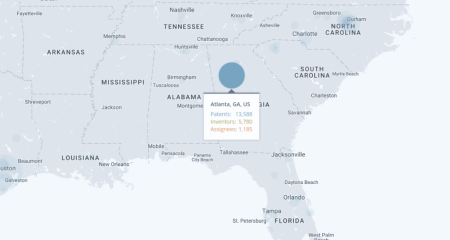
    The locations starting point allows users to explore the locations where inventors and assignees have been granted patents since 2012, by providing an interactive worldwide map of the cities where innovation originates.  For example, the locations visualization below shows the patents, inventors, and assignees for the regional innovation hub of Atlanta.

    Locations_ATL_v3
    Finally, the comparisons starting point allows users to compare the patterns in innovation across various locations and technology areas since 1976.  For example, the comparison visualization below shows that over the past two decades there have been more inventors on patents for computer hardware, data processing, and information storage technology than in any other technical field.

    Comparisons_v5
    The Office notes that from the above starting points, users can further explore comprehensive detail views for each patent, inventor, firm, and location.  The collaborative tool was developed by the USPTO's Office of the Chief Economist in conjunction with the American Institutes for Research, New York University, the University of California at Berkeley, Twin Arch Technologies, and Periscopic.