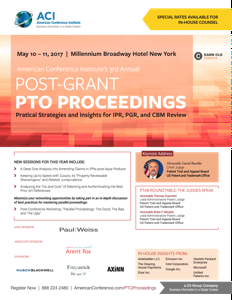
• BrochureAmerican Conference Institute (ACI) will be holding is 3rd Annual Post-Grant PTO Proceedings Conference on May 10-11, 2017 in New York, NY.  ACI faculty will help attendees:

    • Evaluate the pros and cons of making a motion to amend claims during an IPR proceeding, especially in view of the en banc In re Aqua Products Federal Circuit case;
    • Explore which decisions related to institution can be reviewed by the Federal Circuit in view of the pending en banc review of Wifi One v. Broadcom and related cases;
    • Review “injury-in-fact” standing to challenge a final Board decision in view of the Phigenix, Inc. v. ImmunoGen, Inc. Federal Circuit case;
    • Examine recent trends in CBM review proceedings;
    • Analyze the impact of recent PTAB decisions in different industries, including tech, financial services, and pharmaceutical/life sciences;
    • Develop best practices for satisfying and defending against the public accessibility standard for non-patent printed publications;
    • Identify pros and cons for filing a PGR petition versus an IPR petition; and
    • Dive into the scope of IPR estoppel.

    In particular, ACI's faculty will offer presentations on the following topics:

    • Keynote Address — The Honorable David Ruschke, CAPJ, Chief Judge, Patent Trial and Appeal Board, U.S. Patent and Trademark Office
    • Exploring Changes to the Patent System under the New Administration and their Probable Impact on PTO Proceedings
    • A Deep Dive Analysis into Amending Claims in IPRs post-Aqua Products
    • Keeping Up-to-Speed with Cuozzo, its “Properly Reviewable Shenanigans,” and Related Jurisprudence
    • Construing the Covered Business Method Classification
    • PTAB Roundtable – The Judges Speak
    • Analyzing Recent Trends and Decisions from the PTAB
    • Mastering the “Ins and Outs” of Selecting and Authenticating the Best Prior Art References
    • Parsing the PGR Process
    • Who’s the Boss? Interplay between Identification of Real Parties in Interest (“RPIs”), Privy, and Estoppel

    In addition, a post-conference workshop entitled "Parallel Proceedings: The Good, The Bad, and the Ugly " will be offered from 1:45 to 4:45 pm on May 11, 2017.

    An agenda for the conference can be found here, and additional information regarding the workshop can be found here.  A complete brochure for this conference, including an agenda, detailed descriptions of conference sessions, list of speakers, and registration form can be obtained here.

    ACI - American Conference InstituteThe registration fee is $2,295 (conference alone), $2,895 (conference and workshop).  Special rates are available for in-house counsel (see brochure).  Patent Docs readers are entitled to a 10% discount off of registration using discount code P10-999-PTD17.  Those interested in registering for the conference can do so here, by e-mailing CustomerService@AmericanConference.com, by calling 1-888-224-2480, or by faxing a registration form to 1-877-927-1563.

    Patent Docs is a media partner of ACI's 3rd Annual Post-Grant PTO Proceedings conference.

  • JMLSThe John Marshall Law School Center for Intellectual Property, Information & Privacy Law will be holding its 8th Annual Program on Ethics in the Practice of Intellectual Property Law from 8:15 am to 1:30 pm on May 5, 2017 in Chicago, IL.  The conference will consist of the following sessions:

    • What IP Lawyers Should Know About ARDC Proceedings and Client Complaints
    • Ethical Issues Faced by In-House IP Counsel
    • Conflicts of Interest in IP Practice
    • Ethical Issues for IP Lawyers Regarding Cybersecurity & Data Privacy and Protection
    • Ethical Issues in Patent Litigation
    • Ethical Issues in the Trademark Trial and Appeal Board

    Additional information about the program can be found here.  Those interested in registering for the conference online can do so here; the registration fee is $195 (general registration); JMLS Students, Faculty, Staff, and IP Advisory Board Members can register for free.

  • Strafford #1Strafford will be offering a webinar/teleconference entitled "Protecting IP Rights in Joint Development Agreements and Strategic Alliances — Structuring JDAs to Apportion Contributed, Joint and Derivative IP; Planning for Involuntary Early Endings; Avoiding Unintended Consequences" on May 11, 2017 from 1:00 to 2:30 pm (EDT).  Adam Petravicius of Jenner & Block, Sharon Tasman Prysant of Health & Technology Law Firm, and Aaron K. Tantleff of Foley & Lardner will provide guidance to counsel on negotiating and structuring joint development agreements (JDAs) to allocate IP ownership, and discuss the key provisions of the JDA to protect IP rights and avoid unintended consequences.  The webinar will review the following issues:

    • What considerations should counsel keep in mind when negotiating the JDA?
    • What issues must be addressed by the JDA regarding IP ownership?
    • What obligations will the parties have in protecting the other party’s preexisting IP once the JDA is expired or terminated?

    The registration fee for the webinar is $297.  Those interested in registering for the webinar, can do so here.

  • Federal Circuit Bar AssociationThe Federal Circuit Bar Association (FCBA) will be offering a webcast entitled "Having Your AIA Cake and Eating It Too: Recent Decisions Addressing the Scope of AIA Estoppel" on April 25, 2017 from 1:00 pm to 2:00 pm (ET).  Jason Romrell of Finnegan, Henderson, Farabow, Garrett & Dunner, LLP will moderate a panel consisting of Benjamin Hickman, Associate Solicitor, U.S. Patent and Trademark Office; Andrew Trask, Patent Litigation Counsel, Google; and J. Steven Baughman of Paul, Weiss, Rifkind, Wharton & Garrison LLP.  The panel will explore recent decisions addressing the scope of AIA estoppel and what we can expect as more cases reach the Federal Circuit.

    Those interested in registering for the webcast, can do so here.

  • Strafford #1Strafford will be offering a webinar/teleconference entitled "Protecting Trade Secrets, Confidential Information and NDAs in China — Maintaining Confidential Information, Preventing Infringement, and Enforcing Trade Secret Rights" on May 2, 2017 from 1:00 to 2:30 pm (EDT).  Helen Tang of Herbert Smith Freehills and Richard K. Wagner Steptoe & Johnson will provide guidance to counsel representing companies doing business in China on approaches for protecting and enforcing trade secret rights.  The webinar will review the following issues:

    • How does trade secret litigation work in China in comparison to the US? What have been the key recent developments in practice?
    • How does an NDA tailored for a China transaction differ from those typically used domestically in the U.S.?
    • What steps can counsel take to minimize the likelihood of infringement in China?
    • Given the challenges with prosecuting trade secret claims in China, are there any other options available?
    • How to make sense of the new Cyber Security Law and its implications for cross-border evidence collection in trade secret cases?

    The registration fee for the webinar is $297.  Those interested in registering for the webinar, can do so here.

  • Strafford #1Strafford will be offering a webinar/teleconference entitled "Overcoming 101 Rejections for Computer and Electronics Related Patents — Leveraging USPTO Guidance and Recent Decisions to Meet 101 Patent Eligibility Requirements" on May 4, 2017 from 1:00 to 2:30 pm (EDT).  Charles Bieneman of Bejin Bieneman and Isaac T. Slutsky of Brooks Kushman will provide guidance to patent counsel for overcoming § 101 rejections for computer and electronics-related patents, and review recent case law and USPTO guidance on § 101 patent eligibility and offer strategies to address § 101 rejections.  The webinar will review the following issues:

    • What are the key recent §101 decisions, not only at the Federal Circuit but in the District Courts and at the Patent Trial and Appeal Board?
    • How can specifications and claims be drafted to guard against §101 rejections?
    • What strategies and arguments can be used in patent prosecution to overcome §101 rejections?

    The registration fee for the webinar is $297.  Those interested in registering for the webinar, can do so here.

  • CPA GlobalCPA Global will offer a one-hour webinar entitled "The Hunt for Prior Art — From Filing to Challenge, Modern Patent Practice Is All About the Search" on April 27, 2017 beginning at 2:00 pm (ET).  Gene Quinn of IPWatchdog, Inc. will discuss:

    • What level of search should be undertaken prior to filing a patent application?
    • What level of search is required before filing a post grant challenge?
    • Where to look, what to disclose (Rule 56) and how much to use in an IPR petition.

    Those interested in registering for the webinar can do so here.

  • IPO #2The Intellectual Property Owners Association (IPO) will offer a one-hour webinar entitled "After Form 18: Pleading Infringement" on April 27, 2017 from 2:00 to 3:00 pm (ET).  David Donoghue of Holland & Knight LLP, Chris Freeman of Blackbird Technologies, and Mark Hannemann of Shearman & Sterling LLP will consider the spectrum of views district courts have embraced regarding the pleading standard for direct infringement since the abrogation of Form 18 in late 2015, and offer strategies for both plaintiffs and defendants.  The panel will also analyze the new challenges, such as defendants' need to reply to a detailed complaint with little time to prepare affirmative defenses, such as invalidity, and discuss how the Federal Circuit has addressed the new pleading standard in Lyda v. CBS, and whether more definitive guidance is likely to be forthcoming.

    The registration fee for the webinar is $135 (government and academic rates are available upon request).  Those interested in registering for the webinar can do so here.

  • By John Cravero

    USPTO SealAbout the PTAB Life Sciences Report:  Each month we will report on developments at the PTAB involving life sciences patents.

    Actavis Laboratories FL, Inc. et al. v Janssen Oncology, Inc.

    PTAB Petition:  IPR2017-00853; filed February 8, 2017.

    Patent at Issue:  U.S. Patent No. 8,822,438 ("Methods and compositions for treating cancer," issued February 11, 2014) claims methods for treating cancer comprising administering a 17α-hydroxylase/C17,20-lyase inhibitor, such as abiraterone acetate (i.e., 3β-acetoxy-17-(3-pyridyl)androsta-5,16-diene), in combination with at least one additional therapeutic agent such as an anti-cancer agent or a steroid.

    Petitioners Actavis Laboratories FL, Inc., Amneal Pharmaceuticals LLC, Amneal Pharmaceuticals of New York, LLC, Dr. Reddy's Laboratories, Inc., Dr. Reddy's Laboratories, Ltd., Sun Pharmaceuticals Industries, Ltd., Sun Pharmaceuticals Industries, Inc., Teva Pharmaceuticals USA, Inc., West-Ward Pharmaceutical Corp., and Hikma Pharmaceuticals, LLC are challenging the '438 patent on two grounds as obvious under 35 U.S.C. § 103(a).  View the petition here.

    Related Matters:  According to the petition, the '438 patent is involved in the following litigations:  BTG Int'l Ltd. v. Amerigen Pharms., Inc., No. 16-cv-02449-KM-JBC (D.N.J.); BTG Int'l Ltd. v. Glenmark Pharms. Inc., USA, No. 16-cv-03743-KM-JBC (D.N.J.); and Janssen Biotech, Inc. v. Mylan Pharms. Inc., No. 15-cv-00130-IMK (N.D.W. Va.).  Also, the '438 patent is the subject of IPR2016-00286 (Petitioner Amerigen Pharms. Ltd.; filed 12/04/2016; instituted 05/31/2016; pending); IPR2016-01317 (Petitioner Argentum; filed 06/29/2016; instituted and joined to IPR2016-00286 09/19/2016; pending); IPR2016-01332 (Petitioner Mylan Pharmaceuticals Inc., filed 06/30/2016; instituted 01/10/2017; pending); and IPR2016-01582 (Petitioner Wockhardt Bio AG, filed 08/10/2016; instituted 01/19/2017; pending).


    Koios Pharmaceuticals LLC v Medac Geselleschaft Fuer Klinische Spezial Praparate MBH

    PTAB Petition:  IPR2016-01370; filed July 20, 2016.

    PTAB Trial Instituted; entered February 8, 2017.

    Patent at Issue:  U.S. Patent No. 8,664,231 ("Concentrated methotrexate solutions," issued March 4, 2014) claims a method for the treatment of inflammatory autoimmune diseases comprising subcutaneously administering a methotrexate in a  pharmaceutically acceptable solvent at a concentration of more than 30 mg/ml.

    Petitioner Koios Pharmaceuticals LLC is challenging the '231 patent on six grounds as anticipated under 35 U.S.C. § 102(b) (grounds 1 and 4) or obvious under 35 U.S.C. § 103(a) (grounds 2, 3, 5, and 6).  View the petition here.  Administrative Patent Judges Jacqueline Wright Bonilla (author), Toni R. Scheiner, and Erica A. Franklin issued a decision instituting inter partes review of claims 1, 2, 4–6, 11–13, 17, and 22 under 35 U.S.C. § 102(b) as being anticipated by Grint; claims 7–10, 14–16, and 19–21 under 35 U.S.C. § 103(a) as being obvious over Grint, Arthur, Moitra, and Insulin Admin.; claim 18 under 35 U.S.C. § 103(a) as being obvious over Grint and Alsufyani; claims 1–6, 11–13, 17, 18, and 22 under 35 U.S.C. § 102(b) as being anticipated over Wyeth; and claims 1–6, 11–13, 17, 18, and 22 under 35 U.S.C. § 103(a) as being obvious over Wyeth, Brooks, Arthur, and Moitra.

    Related Matters:  According to the petition, the '231 patent is the subject of IPR2014-01091 (Petitioners Antares Pharm, Inc., Leo Pharma A/S, and Leo Pharma Inc.; filed 07/01/2014; instituted 01/06/2015; terminated 04/30/2015 through settlement) and IPR2016-00649 (Petitioner Frontier Therapeutics, LLC; filed 02/22/2016; terminated 12/08/2016 through settlement).


    Amneal Pharmaceuticals LLC v Hospira, Inc.

    PTAB Petition:  IPR2016-01578; filed August 10, 2016.

    PTAB Trial Instituted; entered February 9, 2017.

    Patent at Issue:  U.S. Patent No. 8,338,470 ("Dexmedetomidine premix formulation," issued December 25, 2012) claims a ready to use liquid pharmaceutical composition for parenteral administration to a subject, comprising dexmedetomidine or a pharmaceutically acceptable salt thereof at a concentration of about 0.005 to about 50 μg/mL disposed within a sealed glass container.

    Petitioner Amneal Pharmaceuticals LLC is challenging the '470 patent on three grounds as obvious under 35 U.S.C. § 103(a).  View the petition here.  Administrative Patent Judges Michael J. Fitzpatrick, Sheridan K. Snedden (author), and Zhenyu Yang issued a decision instituting inter partes review of claims 1-7 under 35 U.S.C. § 103(a) as being obvious over 2010 Precedex Label, De Giorgi, Eichhorn, Palmgrén, and Lavoisier.

    Related Matters:  According to the petition, the '470 patent is the subject of the following litigation:  Hospira Inc. v. Amneal Pharmaceuticals LLC, 1:15-cv-00697 (D.Del.).  Petitioner concurrently filed petitions for inter partes review of U.S. Patent Nos. 8,242,158 (IPR2016-01577; filed 08/10/2016; instituted 02/09/2017); 8,455,527 (IPR2016-01579; filed 08/10/2016; instituted 02/09/2017; pending); and 8,648,106 (IPR2016-01580; filed 08/11/2016; institution denied 02/03/2017).


    Amneal Pharmaceuticals LLC v Hospira, Inc.

    PTAB Petition:  IPR2016-01579; filed August 10, 2016.

    PTAB Trial Instituted; entered February 9, 2017.

    Patent at Issue:  U.S. Patent No. 8,455,527 ("Methods of treatment using a dexmedetomidine premix formulation," issued June 4, 2013) claims a method of providing sedation to a patient in need thereof, the method comprising administering to the patient an effective amount of a composition, wherein the composition comprises dexmedetomidine or a pharmaceutically acceptable salt thereof at a concentration of about 0.005 to about 50 μg/mL, wherein the composition is a ready to use liquid pharmaceutical composition for parenteral administration to the patient disposed within a sealed glass container.

    Petitioner Amneal Pharmaceuticals LLC is challenging the '527 patent on three grounds as being obvious under 35 U.S.C. § 103(a).  View the petition here.  In a per curiam decision, Administrative Patent Judges Michael J. Fitzpatrick, Sheridan K. Snedden, and Zhenyu Yang issued a decision instituting inter partes review of claims 1-11 and 13 under 35 U.S.C. § 103(a) as being obvious over 2010 Precedex Label, De Giorgi, Eichhorn, Palmgrén, and Lavoisier.

    Related Matters:  According to the petition, the '470 patent is the subject of the following litigation:  Hospira Inc. v. Amneal Pharmaceuticals LLC, 1:15-cv-00697 (D.Del.).  Petitioner concurrently filed petitions for inter partes review of U.S. Patent Nos. 8,242,158 (IPR2016-01577; filed 08/10/2016; instituted 02/09/2017); 8,338,470 (IPR2016-01578; filed 08/10/2016; instituted 02/09/2017; pending); and 8,648,106 (IPR2016-01580; filed 08/11/2016; institution denied 02/03/2017).


    Mylan Pharmaceuticals, Inc. v. Boehringer Ingelheim International GmbH

    PTAB Petition:  IPR2016-01565; filed August 10, 2016.

    PTAB Trial Instituted; entered February 9, 2017.

    Patent at Issue:  U.S. Patent No. 8,853,156 ("Treatment for diabetes in patients inappropriate for metformin therapy," issued October 7, 2014) claims a method of treating and/or preventing metabolic diseases in a patient for whom metformin therapy is inappropriate due to at least one contraindication against metformin comprising orally administering to the patient a DPP-IV inhibitor wherein the contraindication is selected from the group consisting of renal disease, renal impairment or renal dysfunction, unstable or acute congestive heart failure, acute or chronic metabolic acidosis, and hereditary galactose intolerance.

    Petitioners Mylan Pharmaceuticals, Inc., Mylan Laboratories Ltd., Mylan Inc., and Mylan N.V. are challenging the '156 patent on two grounds as being anticipated under 35 U.S.C. § 102(b) (ground 1) or as obvious under 35 U.S.C. § 103(a) (ground 2).  View the petition here.  Administrative Patent Judges Toni R. Scheiner (author), Brian P. Murphy, and Zhenyu Yang issued a decision instituting inter partes review of claims 1, 2, 4, 5, and 23 under 35 U.S.C. § 102 as being anticipated by Mikhail; and claims 1, 2, 4, 5, and 23 under 35 U.S.C. § 103 as being obvious over Mikhail.

    Related Matters:  According to the petition, the '156 patent is the subject the following litigation:  Boehringer Ingelheim Pharmaceuticals Inc., et al. v. HEC Pharm Group, et al., No. 3:15-cv-05982-PGS-TJB (D.N.J.).  Petitioner concurrently filed petitions for inter partes review of U.S. Patent Nos. 9,173,859 (IPR2016-01566; filed 08/10/2016; institution denied 02/03/2017); 8,846,695 (IPR2016-01564; filed 08/10/2016; instituted 01/31/2017; pending); and 8,673,927 (IPR2016-01563; filed 08/10/2016; instituted 02/03/2017; pending).


    Amneal Pharmaceuticals LLC v Hospira, Inc.

    PTAB Petition:  IPR2016-01577; filed August 10, 2016.

    PTAB Trial Instituted; entered February 9, 2017.

    Patent at Issue:  U.S. Patent No. 8,242,158 ("Dexmedetomidine premix formulation," issued August 14, 2012) claims a ready to use liquid pharmaceutical composition for parenteral administration to a subject, comprising dexmedetomidine or a pharmaceutically acceptable salt thereof at a concentration of about 4 μg/mL disposed within a sealed glass container.

    Petitioner Amneal Pharmaceuticals LLC is challenging the '158 patent on three grounds as being obvious under 35 U.S.C. § 103(a).  View the petition here.  Administrative Patent Judges Michael J. Fitzpatrick, Sheridan K. Snedden, and Zhenyu Yang (Author) issued a decision instituting inter partes review of claims 1-4 under 35 U.S.C. § 103(a) as being obvious over Precedex Label, in view of the knowledge of one of skill in the art at the time of filing, as evidenced by De Giorgi, Eichhorn, Palmgrén, and Lavoisier.

    Related Matters:  According to the petition, the '158 patent is the subject of the following litigation:  Hospira Inc. v. Amneal Pharmaceuticals LLC, 1:15-cv-00697 (D.Del.).  Petitioner concurrently filed petitions for inter partes review of U.S. Patent Nos. 8,455,527 (IPR2016-01579; filed 08/10/2016; instituted 02/09/2017; pending); 8,338,470 (IPR2016-01578; filed 08/10/2016; instituted 02/09/2017; pending); and 8,648,106 (IPR2016-01580; filed 08/11/2016; institution denied 02/03/2017).


    Amneal Pharmaceuticals LLC v Purdue Pharma L.P., P.F. Laboratories, Inc., and Purdue Pharmaceuticals L.P.

    PTAB Petition:  IPR2016-01412; filed July 16, 2016.

    PTAB Trial Instituted; entered February 14, 2017.

    Patent at Issue:  U.S. Patent No. 9,034,376 ("Pharmaceutical formulation containing gelling agent," issued May 19, 2015) claims a controlled release oral solid dosage form comprising oxycodone and a gelling agent comprising polyethylene oxide and hydroxypropylmethylcellulose.

    Petitioner Amneal Pharmaceuticals LLC is challenging the '376 patent on two grounds as being obvious under 35 U.S.C. § 103(a).  View the petition here.  Administrative Patent Judges Michael P. Tierney, Lora M. Green, and Christopher G. Paulraj (Author) issued a decision instituting inter partes review of claims 1-13 and 16-19 under 35 U.S.C. § 103(a) as being obvious over Palermo, Joshi, and the Handbook; and claims 1-13 and 16-19 under 35 U.S.C. § 103(a) as being obvious over Oshlack, Joshi, the Handbook, and Doyon.

    Related Matters:  According to the petition, the '376 patent is the subject of the following litigations:  Purdue Pharma L.P. et al. v. Amneal Pharmaceuticals LLC, 1:15-cv-00831 (D.Del.); and Purdue Pharma L.P. et al. v. Amneal Pharmaceuticals LLC, 1:15-cv-1152 (D.Del.).  U.S. Patent No. 8,337,888, which claims priority to the same earlier-filed application as the '376 Patent, was the subject of a district court proceeding in the Southern District of New York in Purdue Pharma L.P. et al. v. Amneal Pharmaceuticals LLC, No. 13-3372 (S.D.N.Y.).  The Federal Circuit upheld the invalidity of the claims of the '888 Patent on April 8, 2016.  Petitioner filed a separate petition for inter partes review challenging the same claims of the '376 Patent on other grounds (IPR2016-01413; filed 07/15/2016; instituted 01/18/2017; pending).  Also, Petitioner previously filed petitions seeking cancellation of claim 1 of U.S. Patent No. 9,060,976, which is another member of the same patent family (IPR2016-01027; filed 05/11/2016; instituted 11/09/2016; pending) and (IPR2016-01028; filed 05/11/2016; instituted 11/09/2016; pending).


    Par Pharmaceuticals, Inc. v Novartis AG

    PTAB Petition:  IPR2016-01479; filed July 22, 2016.

    PTAB Trial Instituted; entered February 15, 2017.

    Patent at Issue:  U.S. Patent No. 9,006,224 ("Neuroendocrine tumor treatment," issued April 14, 2015) claims a method for treating pancreatic neuroendocrine tumors, comprising administering to a human subject in need thereof a therapeutically effective amount of 40-O-(2-hydroxyethyl)-rapamycin as a monotherapy and wherein the tumors are advanced tumors after failure of cytotoxic chemotherapy.

    Petitioner Par Pharmaceuticals, Inc. is challenging the '224 patent on four grounds as being obvious under 35 U.S.C. § 103(a).  View the petition here.  Administrative Patent Judges Lora M. Green, Christopher L. Crumbley (Author), and Robert A. Pollock issued a decision instituting inter partes review of claims 1–3 under 35 U.S.C. § 103(a) as being obvious over Oberg 2004, Boulay 2004, and O'Donnell; claim 2 under 35 U.S.C. § 103(a) as being obvious over Oberg 2004, Boulay 2004, O'Donnell, and Tabernero; claims 1–3 under 35 U.S.C. § 103(a) as being obvious over Boulay 2004, O'Donnell, and Duran; and claim 2 under 35 U.S.C. § 103(a) as being obvious over Boulay 2004, O'Donnell, Duran, and Tabernero.

    Related Matters:  According to the petition, the '224 patent is the subject of the following litigations:  Novartis Pharm. Corp. et al. v. Roxane Labs., Inc., No. 15-474-RGA (D.Del.); and Novartis Pharm. Corp. et al. v. Par Pharm., Inc., No. 15-475-RGA (D. Del.)Claims 1 and 2 of the '224 patent were challenged in IPR2016-01461 (Roxanne Laboratories, Inc.; filed 07/22/2016; institution denied 02/13/2017).

  • By Andrew Williams

    NovartisCan a prior art reference that does not contain a teaching sufficient enough to allow it to be used in an obviousness combination nevertheless be used as a background reference for evidence of motivation to combine?  Moreover, does it matter if an adjudicating body had concluded earlier in a proceeding that the reference was "inapplicable" to present invention?  Such a situation occurred in IPR2014-00784 (Torrent Pharmaceuticals Ltd. v. Novartis AG), in which the PTAB stated in an institution decision that a particular prior art's "stated reasons for using mannitol in liquid pharmaceutical compositions are inapplicable to its potential use in connection with solid pharmaceutical compositions."  Id., Paper 11, at 13 (emphasis added).  The Board did institute trial on other grounds, and ultimately invalidated the challenged claims as obvious.  On appeal, Novartis, the patent owner, argued that it had relied on this statement made by the PTAB in the institution decision when it prepared its Patent Owner Response and otherwise fashioned its trial strategy.  In other words, Novartis claimed it would have conducted the trial differently had it known that the Board would eventually use this reference in its obviousness calculus.  Last week, however, in Novartis AG v. Torrent Pharmaceuticals Ltd., the Federal Circuit was unpersuaded, and affirmed the Board's invalidation decision.  Specifically, the Court reasoned that the Board had not changed theories midstream, and as such, the due process requirements of the Administrative Procedure Act (APA) were satisfied.  The Federal Circuit also affirmed the challenges to the PTAB's obviousness determination.

    The technology at issue in U.S. Patent 8,324,283 (the '283 patent) is solid pharmaceutical compositions of a sphingosine-1 phosphate (S1P) receptor agonist and a sugar alcohol, such as is found in the formulation of Gilenya® marketed for the treatment of certain forms of multiple sclerosis.  According to the patent, S1P receptor agonists are normally difficult to formulate as solid compositions.  However, the inventors found it was easier to do so by using a sugar alcohol excipient like mannitol.  The particular S1P receptor agonists used in Gilenya® is FTY720, or fingolimod.  The two independent claims of the '283 patent are:

    1.  A solid pharmaceutical composition suitable for oral administration, comprising:
        (a) a S1P receptor agonist which is selected from 2-amino-2-[4-(3-benzyloxyphenoxy)-2-chlorophenyl]propyl-1,3-propane-diol or 2-amino-2-[4-(3-benzyloxyphenylthio)-2-chlorophenyl]propyl-1,3-propane- -diol, 2-amino-2-[4-(3-benzyloxyphenylthio)-2-chlorophenyl]-2-ethyl-1,3-pr- opane-diol, and its phosphates or a pharmaceutically acceptable salt thereof; and
        (b) a sugar alcohol.

    19.  A solid pharmaceutical composition suitable for oral administration, comprising mannitol and 2-amino-2-[2-(4-octylphenyl)ethyl]propane-1,3-diol or a pharmaceutically acceptable salt thereof.

    IndexTorrent filed its IPR petition on May 27, 2014, alleging that all claims were obvious in view of the combination of U.S. Patent 6,004,565 (Chiba) and Pharmaceuticals: The Science of Dosage Form Design (Aulton).  Torrent also alleged two additional grounds that part of the claims were anticipated by U.S. Patent 6,277,888 (Sakai), and all claims were rendered obvious by the combination of Sakai and Chiba.  Chiba disclosed the use of immunosuppressive compounds, including fingolimod.  Aulton taught the use of tablets and capsules to administer drugs orally, and explained that mannitol was "expensive," but "commonly used."  Finally, Sakai described liquid formulations of fingolimod, and explained that the use of sugar alcohols could result in liquid solutions that were less irritating.  In its institution decision, the Board made the statement quoted above about Sakai — that the stated reasons for using mannitol were inapplicable to solid formulations.  After institution, Apotex and Mylan also filed a petition that was joined to the Torrent proceeding.

    In its Final Written Decision, the PTAB found that Chiba and Aulton strongly suggested the claimed invention, but also cited to Sakai as "directly instruct[ing] that the two ingredients should be combined."  Therefore, according to the Board, there was sufficient reason to combine Chiba and Aulton.  Part of this decision rested on a paper authored by Novartis' expert Dr. Stephen Byrn, in which he said "solution studies can be very helpful" in understanding solid state drug degradation.  At the same time, the Board also found that additional references provided motivation to use mannitol as a diluent in tableting.  Finally, the Board rejected both of Novartis' arguments related to objective indicia of non-obviousness.  First, even though the low dose stability of fingolimod when combined with mannitol may have been unexpected, the Board found that the independent claims were "not commensurate in scope" with this fact because they were not limited to a particular dose range.  Second, the Board found that the nexus for long-felt need, industry praise, and commercial success was missing because solid oral multiple sclerosis treatments were already known in the art.

    During the oral argument, the judges focused on Novartis' due process issue, and asked probing questions of both parties.  It was clear the Court was concerned that Novartis might not have been afforded proper notice and a chance to heard, as required by APA.  In other words, it wanted to ensure that the Board had not changed theories "midstream" by first rejecting Sakai, but ultimately relying on it to invalidate the claims.  After reviewing the entire record, however, the Federal Circuit concluded that the APA had not been violated.

    First, the Federal Circuit found that the use of Sakai as a background reference "relevant to one of skill in the art in deciding which excipients to use in formulating a solid oral dosage form of fingolimod" was not contrary to its rejection as an anticipatory or primary obviousness reference.  It was Chiba and Aulton that strongly suggested the combination, according to the Court, and Sakai was only cited to reinforce this finding.  The second reason was more suspect.  The Federal Circuit claimed that Novartis could not allege "surprise" because it had debated the merits of Sakai throughout the proceedings.  According to the Court, Novartis addressed Sakai in its Patent Owner Response.  However, Novartis had apparently only done this because Torrent had cited Sakai as a reason to combine Chiba and Aulton.  Moreover, Novartis' response appeared to be nothing more than a parroting of the Board's conclusion that Sakai was not relevant to solid formulations.  As Novartis alleged, it would probably have more adequately addressed Sakai if it had known that the Board would rely upon it so heavily.  Nevertheless, Novartis' position was weakened by its expert's report, which addressed Sakai in some detail.  In addition, Novartis was accused of questioning Torrent's expert "at length" on the issue.  Perhaps if Novartis was a little more silent on the issue, the outcome would have been different.  The Court finally bolstered its conclusion by noting that the Board had additionally cited to several other references, even though none of these appeared to be as relevant as Sakai to its ultimate conclusion.

    Novartis also challenged the Board's obviousness decision as allegedly not taking into account the teaching of the references as a whole.  Specifically, Novartis argued that the Board overlooked the known disadvantages of using mannitol, such as its difficulty to manufacture, its impurities, and its expense.  However, the Federal Circuit found that the Board at least addressed the cost of mannitol, but concluded that it was nevertheless "commonly used."  Moreover, the Court found that the Board's consideration of the issue was commensurate with the argument presented by Novartis in the Patent Owner Response.  As such, the Court could not fault the Board for its limited treatment of the arguments.  The Federal Circuit otherwise found that substantial evidence existed to support the Board's finding on the motion to combine Chiba and Aulton.  Finally, the Court could not fault the Board's conclusions with regard to the objective indicia of non-obviousness.  As such, it affirmed the PTAB's decision.

    Novartis AG v. Torrent Pharmaceuticals Ltd. (Fed. Cir. 2017)
    Panel: Circuit Judges Taranto, Chem, and Stoll
    Opinion by Circuit Judge Chen