• CalendarJune 1, 2017 – "Obviousness Standard: Leveraging Latest PTO and Court Guidance — Overcoming Challenges of Obviousness and Attacks on Patent Validity" (Strafford) – 1:00 to 2:30 pm (EDT)

    June 1, 2017 – "Post-Grant Patent Office Proceedings After the AIA: Lessons from the First Five Years" (West LegalEdcenter) – 12:00 to 1:00 pm (EDT)

    June 1, 2017 – "On-Sale Bar After Helsinn: What is the Scope?" (Intellectual Property Owners Association) – 2:00 to 3:00 pm (ET)

    June 1, 2017 – "Strategic Patent Portfolio Decision-Making, From Filing to Maintenance" (CPA Global) – beginning at 2:00 pm (ET)

    June 6, 2017 – "Patent Prosecution: FTO Opinions, Examiner Interactions, Patent Drafting and More" (Strafford) – 8:30 am to 5:30 pm (EDT)

    June 8, 2017 – "Biotech Patents and Section 101 Rejections: Meeting Patent Eligibility Requirements — Leveraging Recent Decisions and USPTO Guidance to Overcome Rejections" (Strafford) – 1:00 to 2:30 pm (EDT)

    June 12-14, 2017 – Summit on Biosimilars*** (American Conference Institute) – New York, NY

    June 13, 2017 – European biotech patent law update (D Young & Co) – 4:00 am, 7:00 am, and 12:00 pm (ET)

    June 14, 2017 – "Laying Your Claim: Best Practices for Patent Claim Construction in a Post-Teva World" (Dilworth IP) – 1:00 to 2:00 pm (EDT)

    June 15, 2017 – "ITC as a PTAB Antidote: Navigating Competing Administrative Trial Strategies & Pitfalls — Threading the New Patent Monetization Needle" (Strafford) – 1:00 to 2:30 pm (EDT)

    ***Patent Docs is a media partner of this conference or CLE

  • IPO #2The Intellectual Property Owners Association (IPO) will offer a one-hour webinar entitled "On-Sale Bar After Helsinn: What is the Scope?" on June 1, 2017 from 2:00 to 3:00 pm (ET).  Prof. Dennis Crouch of the University of Missouri, Deborah Fishman of Arnold & Porter Kaye Scholer LLP, and Jennifer Johnson of DuPont will explore the ramifications of the April decision Helsinn v. Teva, that reversed a lower court by holding that the 2011 America Invents Act on-sale bar provision renders patents invalid if the invention was sold prior to patenting, even if the sale did not publicly disclose the invention.

    The registration fee for the webinar is $135 (government and academic rates are available upon request).  Those interested in registering for the webinar can do so here.

  • Strafford #1Strafford will be offering a webinar/teleconference entitled "ITC as a PTAB Antidote: Navigating Competing Administrative Trial Strategies & Pitfalls — Threading the New Patent Monetization Needle" on June 15, 2017 from 1:00 to 2:30 pm (EDT).  Alexander J. Hadjis and Scott A. McKeown of Oblon McClelland Maier & Neustadt will provide guidance to patent counsel to understand and manage the interplay between PTAB trials and International Trade Commission (ITC) investigations, discuss the growing number of cases going to the ITC and the impact of PTAB proceedings and decisions on ITC investigations, and offer best practices for addressing concurrent ITC investigations and PTAB proceedings.  The webinar will review the following topics:

    • What are the implications for ITC investigations when there have already been PTAB decisions?
    • How can patent counsel capitalize on favorable PTAB decisions?
    • What difficulties do counsel face when challenging or defending patent validity in concurrent proceedings?

    The registration fee for the webinar is $297.  Those interested in registering for the webinar, can do so here.

  • Dilworth IPDilworth IP will be offering a live webinar entitled "Laying Your Claim: Best Practices for Patent Claim Construction in a Post-Teva World" on June 14, 2017 from 1:00 to 2:00 pm (EDT).  In this presentation, William Reid will summarize current law with respect to claim construction in the post Nautilus, Inc. v. Biosig Instruments, Inc. and Teva Pharmaceuticals USA, Inc. v. Sandoz, Inc. world., and arm patent practitioners with current best practices and advice regarding claim construction for their use when drafting patent applications, writing patent infringement opinions, or litigating a case.

    Those wishing to register for the webinar can do so here.

  • CPA GlobalCPA Global will offer a one-hour webinar entitled "Strategic Patent Portfolio Decision-Making, From Filing to Maintenance" on June 1, 2017 beginning at 2:00 pm (ET).  Gene Quinn of IPWatchdog, Inc.; Carlo Cotrone, Senior Intellectual Property Counsel, GE Oil & Gas; and Ed White, Vice President, Analytics, CPA Global will discuss:

    • Patent Quality vs. Quantity: The value of a patent, for better or worse, is related to the likelihood that it could be successfully enforced in litigation. That may lead some to think there is a safety in numbers, but are fewer, higher quality patents strategically preferable?

    • Why some innovations are no longer worth patenting in the U.S., or if patents are sought, applicants might want to consider waiving publication if they are not going to seek foreign rights.

    • Questions about the continued viability and value of legacy patents issued under different legal rules, which together with budget restraints must be factored into consideration when making decisions on which patents to continue to maintain.

    • Why changes to patent law have made patents much easier to successfully challenge at the Patent Office and in federal court. And why these changes have made it necessary to file faster, but better and more detailed patent applications that can survive a multitude of new procedural and legal challenges.

    Those interested in registering for the webinar can do so here.

  • By Kevin E. Noonan

    Mylan #1Last week, the Federal Circuit reviewed the rare event of a preliminary injunction being granted in a lawsuit over a chemical invention, made rarer still by the evidence of likelihood of success on the merits required for the injunction being based on the doctrine of equivalents.  And in the opinion, the panel took the opportunity to review the application of the doctrine to chemical arts cases, paradoxically but properly categorizing such application as being difficult in view of two of the leading cases on the doctrine (Graver Tank & Mfg. Co. v. Linde Air Prod. Co.; Warner-Jenkinson Co. v. Hilton Davis Chem. Co.) involving inventions in the chemical arts.

    The case arose over a triarylmethylamine dye called isosulfan blue ("ISB") and methods for preparing it, used to map lymph nodes in a variety of diagnostic methods.  The patents-in-suit — U.S. Patent Nos. 7,622,992, 8,969,616, and 9,353,050 — claimed methods for making the dye (the '992 and '616 patents) and purified compositions of the dye (the '050 patent) suitable for diagnostic reagent use.  The patents are owned by Apicore and licensed exclusively by Mylan.  Claims 1 of the '992 and '050 patents, respectively, are representative:

    The '616 patent (emphasis added):

    A process of preparing N-[4-[[4-(diethyl- amino)phenyl] (2,5-disulfophenyl)methylene]-2,5- cyclohexadien-1-ylidene]-N-ethylethanaminium, sodium salt comprising combining a suspension of isoleuco acid of the formula

    Image 1in a polar solvent with silver oxide, recovering isosulfan blue acid, and treating the isosulfan blue acid with a sodium solution.

    The '050 patent (emphasis in opinion):

    A compound N-[4-[[4-(diethylamino)phenyl] (2,5- disulfophenyl) methylene]-2,5-cyclohexadien-1-ylidene]-N-ethylethanaminium, sodium salt having a purity of at least 99.0% by HPLC.

    The dye was developed first by Hirsch Industries (according to the opinion) in 1981, which commercialized the product as a 1% solution sold as Lymphazurin®.  A successor-in-interest to Hirsch, Coviden, owned the NDA for the product and marketed it despite problems with purity (being only 94.5% pure from the evidence of record below).  The product was produced by Allied Chemical Co. and sold to Coviden by Sigma-Aldrich Co., but both the production method and purity of this product were "unknown," although record evidence established that Sigma needed to purify lead from the product, suggesting a lead compound was used in the synthesis.  When Sigma stopped supplying the product in 2000, Coviden was forced to list it as "unavailable"; this situation only resolved in 2008 when Innovassynth became Sigma's supplier of a product made using ammonium dichromate (instead of silver oxide).

    Apicore developed the inventions claimed in the patents-in-suit and its partner Synerx Pharma filed an ANDA that was approved in 2010; Mylan acquired Synerx in 2012.  Coviden withdrew from the market in 2012 and Mylan was the sole provider of ISB until Aurobindo entered the marketplace in 2016.

    AurobindoAurobindo filed its ANDA that contained an admission that it had "studied a 'number of patents' [describing] ISB manufacture and selected, inter alia, Apicore's '992 patent."  It modified the production methods disclosed in the '992 patent by substituting manganese dioxide for silver oxide as recited in the '992 patent claims; this synthesis produced ISB that was only 90-95% pure, and the final product was purified to "greater than 99.5%" using preparative HPLC.

    Mylan sued Aurobindo and the District Court entered a preliminary injunction based on all the patents-in-suit.  As explained in the Federal Circuit opinion, the District Court's analysis of the four factors comprising the standard for granting a preliminary injunction 1) likelihood of success on the merits; 2) irreparable harm to the patentee; 3) balance of the hardships; and 4) public interest) were satisfied by Mylan.  For the first prong of the test, the District Court found that Aurobindo was likely to have infringed the '992 and '616 patents under the doctrine of equivalents.  The difference between the claimed method and Aurobindo's method was the use of manganese dichromate rather than silver oxide as claimed, and this difference was "irrelevant" using either the "function-way-result (FWR)" or "insubstantial differences" tests set out in Graver Tank.  The District Court relied on expert testimony regarding the understanding of the skilled worker on the relative oxidation strengths of the compounds and the similarity on the purity yields using each reagent.  With regard to validity, the District Court found that Aurobindo had not raised a substantial question of validity for the '050 patent, based on three arguments:  "(1) under § 112 because the 'by HPLC' limitation renders the claims indefinite; (2) under § 103 because the claims would have been obvious over various combinations of art; and (3) under § 102 because the claims are anticipated by Sigma's manufacture and sale of ISB."  The Court credited Mylan's expert regarding the conventionality and understanding in the art of the term "using HPLC" in deciding that Aurobindo had not raised a substantial question of indefiniteness against the '050 patent claims.  The Court found that Aurobindo had not raised a substantial question of obviousness against the '050 patent claims because "'a purified compound is not always prima facie obvious over the [prior art] mixture' if the process to arrive at the purified compound is itself of patentable weight," citing Aventis Pharma Deutschland GmbH v. Lupin, Ltd., 499 F.3d 1293, 1301 (Fed. Cir. 2007), and here the purification process recited in the '050 patent provided such patentable weight.  In addition, the District Court credited Mylan's assertion of several secondary considerations of non-obviousness, particularly long-felt need, failure of others, and the admitted copying by Aurobindo.  Finally, Sigma's prior manufacture and sale of ISB did not raise a substantial question of anticipation against the '050 claims, because the evidence did not establish that Sigma produced ISB having a purity of greater than 99%.

    For the second prong, the District Court found Apicore would be irreparably harmed due to "lost sales; lost R&D; price erosion; and [direct competition] with an infringer."  The District Court found a "causal nexus" for this harm because Aurobindo would not have been on the market without FDA approval and would not have obtained FDA approval without infringing Apicore's claims.

    The balance of the equities prong likewise weighed in favor of Apicore and the public interest also favored granting a preliminary injunction because "the public interest in obtaining lower-priced pharmaceutical compounds cannot justify 'entirely eliminating the exclusionary rights covered by pharmaceutical patents.'"

    The Federal Circuit affirmed in part and reversed in part, in an opinion by Judge Lourie joined by Judges Moore and Reyna (thus keeping the preliminary injunction in force).  The opinion emphasizes that the standard of review is abuse of discretion and that the Court will defer to factual determinations by the District Court.  Aurobindo's appeal of the injunction focused on three arguments:  that the District Court erred in finding that its method of producing ISB infringed the '992 and '616 patents under the doctrine of equivalents; that it had not raised a substantial question of validity regarding the '050 patent; and that Apicore would suffer irreparable harm.  Aurobindo did not challenge the District Court's findings on the balance of the hardships or public interest prongs of the preliminary injunction standard.

    The issue of Mylan's likelihood of success on the merits, and its reliance in the doctrine of equivalents, gave the panel the opportunity to opine on the state of DOE law with regard to chemical inventions, and in doing so find that the District Court had erred in reaching its conclusion that Mylan would likely prevail on this issue.  But it attributed this failure to "the sparse and confusing case law concerning equivalents, particularly the paucity of chemical equivalence case law, and the difficulty of applying the legal concepts to the facts."  In attempting to bring clarity, the opinion starts with Graver Tank and sets out the two tests (FWR and insubstantial differences) arising from that Supreme Court decision.  Concerning the application of the FWR test, the panel states that "[t]he Supreme Court was surely correct in stating that non-mechanical cases may not be well-suited to consideration under the FWR test" and that this "seems to be particularly true in the chemical arts" (despite it being applied in both Graver Tank and Warner-Jenkinson, both chemical cases).  Here, the District Court applied the FWR test, and the opinion characterizes this application as being "flawed by being unduly truncated and hence incomplete."  Specifically, the panel criticized how the District Court applied the FWR test limitation by limitation to the elements of the accused infringing process, saying that "it is often not clear what the 'function' or 'way' is for each claim limitation," particularly with regard to activities in corpora.  The result, on the other hand, of a process claim is typically more readily assessed, in the panel's opinion, as frequently clear:  "why else would a claim for infringement of a process claim be brought if the claimed result is not obtained?"  But the "function" and "way" prongs of the test can overlap and cause error, which is what the panel concludes occurred before the District Court.  The difficulty, in the Federal Circuit's view, is that the District Court did not consider with regard to the "way" prong the differences between using silver oxide and manganese dioxide.  As set forth in the District Court's opinion, these oxidizing agents were assessed for DOE purposes as being related to the "function" prong, so that the Court could dismiss Aurobindo's arguments regarding differences in oxidation strength as being irrelevant (since both compounds oxidized the precursor to the final ISB product).  However, "[m]anganese dioxide and silver oxide may have the same function, but the question is whether they operate in the same way," according to the opinion (emphasis in opinion).  Moreover, there was language in the District Court's opinion indicating that differences in oxidation strength raised a question of claim construction not before the Court.  The Federal Circuit found error in this analysis of the "way" prong sufficient to reverse the District Court's finding of Mylan having established a likelihood of success at prevailing in establishing infringement under the doctrine of equivalents.

    The opinion, no doubt in an effort to clarify the application of the doctrine in chemical cases, suggests that the District Court should more profitably consider using the "insubstantial differences" test, using aspirin and ibuprofen to illustrate structural differences sufficient to fail the insubstantial differences test:
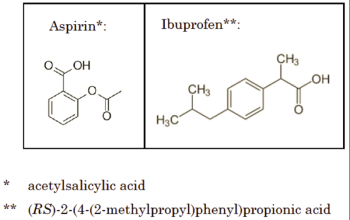
    Image 2
    but sufficient similarities to pass the FWR test:

    They each provide analgesia and anti-inflammatory activity ("function") by inhibiting prostaglandin synthesis ("way") in order to alleviate pain, reduce fevers, and lessen inflammation ("result").

    The opinion suggests the District Court review the equivalents question at trial using the insubstantial differences test as perhaps being more appropriate in chemical cases, particularly because:

    Manganese dioxide and silver oxide are substantially different in many respects.  For example, manganese and silver are in different groups of the Periodic Table.  In oxide form, manganese has an oxidation state of +4, while silver is +1.  Those differences may well be relevant to equivalence at trial.  Thus, the choice of test under the doctrine of equivalents may matter in this case.

    In its review of the propriety of granting a preliminary injunction over the '050 patent, the Federal Circuit considered the District Court's determination that Aurobindo had not raised a substantial question of patentability on the three asserted grounds.  The panel found no assertion by Aurobindo of legal error by the District Court, relying on a purported "misreading of the factual evidence."  However this basis for arguing error is fatally flawed because the Federal Circuit defers to factual finding of the District Court and requires Aurobindo to demonstrate clear error by the Court.  This the defendant did not do.  The opinion finds no error in the Court's assessment of the facts regarding anticipation, based on the lack of evidence that Sigma produced ISB having the claimed purity.  Similarly there was no clear error by the District Court in finding Aurobindo had not raised a substantial question of obviousness against the '050 patent claims, stating that "[i]t is clear from the record here that, although ISB was known in the prior art, the path to arrive at ISB with a purity of greater than 99.0% was not known before the relevant date of the '050 patent."  Moreover, the panel held that Mylan's evidence regarding secondary considerations established that "prior to the '050 patent's relevant date, a reliable source of high-purity ISB was so scarce that, at one point, Coviden was forced to notify its customers that it was "completely out of" Lymphazurin® until it could find a new supplier for ISB."  Finally, the opinion concludes that there was no clear error in finding that reciting "using HPLC" would have been indefinite to the skilled worker, a conclusion the Court appreciates even Aurobindo's expert to have admitted.

    The opinion concludes with a review of the District Court's finding that Apicore would suffer irreparable harm, based inter alia on the argument that the patented features of the inventions claimed in the patents in suit were irrelevant to Mylan's marketing the product.  The Federal Circuit finds ample evidence in the record supporting the District Court's conclusion that:

    "(1) due to Aurobindo's infringement, Apicore has, and will continue to, suffer from lost sales, lost research and development, price erosion, and having to directly compete with an infringer []; (2) there was a causal nexus between Aurobindo's infringement and Apicore's harm because Aurobindo's product "would not be on the market if [it] had not obtained [FDA] approval for a product that will likely be found to be covered by the patents"[]; and (3) "[w]ithout infringing the [process and purity] patents, Aurobindo would not be able to make the [ISB] product described in its ANDA" (based in large part on Aurobindo's admissions).

    Mylan Institutional LLC v. Aurobindo Pharma Ltd. (Fed. Cir. 2017)
    Panel: Circuit Judges Lourie, Moore, and Reyna
    Opinion by Circuit Judge Lourie

  • By Donald Zuhn

    WIPO Re-SearchOn Tuesday, the World Intellectual Property Organization (WIPO) announced a new five-year strategic plan for WIPO Re:Search to guide that initiative's activities in the fight against neglected tropical diseases, malaria, and tuberculosis.  WIPO Re:Search is a consortium of public and private sector organizations that was established in 2011 by WIPO and BIO Ventures for Global Health (BVGH) (see "Public/Private Consortium Seeks Treatments for Neglected Tropical Diseases").  The consortium allows member companies and organizations to share their intellectual property, compounds, expertise, facilities, and know-how royalty-free with qualified researchers worldwide to promote the development of new drugs, vaccines, and diagnostics for the treatment of neglected tropical diseases, malaria, and tuberculosis.  In addition to WIPO and BVGH, a non-profit organization that seeks to accelerate the development of novel drugs, vaccines, and diagnostics addressing the unmet medical needs of the developing world, the consortium now consists of 126 members in 35 countries.

    The new strategic plan includes new research, capacity building, and outreach efforts.  According to BVGH President Jennifer Dent, the new strategic plan will allow BVGH to "prioritize and provide enhanced support to the most promising product development collaborations within the WIPO Re:Search portfolio," as well as support the development of research and IP management capacity at member organizations in low- and middle-income countries, and increase public visibility around the role of WIPO Re:Search in global health innovation.

    While observing that "[t]here is continuing debate about IP, innovation and access, with disagreement as to whether IP is a barrier or a facilitator," the strategic plan notes that "WIPO Re:Search contributes to the policy discussion by providing tangible evidence that the IP frame work facilitates access to health technologies and thus enables more R&D, even in neglected fields."  The tangible evidence of WIPO Re:Search's impact includes the facilitation of 112 collaborations, of which 34 are ongoing, and an increase in membership from 31 companies and organizations to the current 126 members.  The new plan sets out four strategic goals:

    1.  Use IP assets to advance R&D for NTDs, malaria, and TB through collaborations.
    2.  Accelerate the advancement of promising compounds or leads.
    3.  Enhance global capacity for IP management and biomedical R&D.
    4.  Communicate the beneficial role of IP in innovation for NTDs, malaria, and TB.

    The consortium notes that "[t]o implement this Strategic Plan, WIPO Re:Search will need to substantially expand [its] funding base," with the initiative having 2016 expenditures of 1.7 million Swiss Francs.  According to the strategic plan, funding for those expenditures came from allocations from WIPO's regular budget, contributions from Member States through the Funds-in-Trust program (Governments of Australia and Japan), and substantial contributions from the funding Members of WIPO Re:Search:  Eisai, GlaxoSmithKline, Johnson & Johnson, Merck KGaA, MSD, Novartis, Pfizer, Sanofi, and Takeda.

  • By Andrew Williams

    Supreme Court Building #2Today, in TC Heartland LLC v. Kraft Foods Group Brands LLC, the Supreme Court reversed the Federal Circuit and held that the word "resides" in the patent venue statute, 28 U.S.C. § 1400(b), "refers only to the State of incorporation" of the alleged infringer.  As simple as that pronouncement sounds, the Court's decision will likely have profound implications for all patent litigation.  If alleged infringers only "reside" in their state of incorporation, as opposed to anywhere they are subject to personal jurisdiction, patent holders will no longer necessarily get to choose the venue in which they may file a patent infringement lawsuit.  This could potentially result in the loss of "home court" advantage, and will likely make it more difficult to sue multiple infringers located in different states.  Accused infringers, on the other hand, will be less likely to be sued in remote locations that are otherwise unrelated to the case.  The so-called "patent trolls" should be particularly impacted by this decision.  The business model for these entities often entails suing alleged infringers in patent-friendly venues like the Eastern District of Texas in an attempt to extort settlements from accused infringers.  The outcome of this case should severely curtail such activity.  This will also hopefully be the final swing of the pendulum away from the rights of patent holders, and will hopefully diminish the recent enthusiasm for patent reform legislation in Congress.

    The TC Heartland case stemmed from a lawsuit brought by Kraft Foods Group Brands LLC against TC Heartland, LLC and Heartland Packaging Corp. in the U.S. District Court for the District of Delaware.  TC Heartland is incorporated in Indiana, and has its headquarters in Carmel, Indiana.  As a result, it moved to either dismiss the action on venue grounds (among others) or transfer venue to the Southern District of Indiana.  On August 13, 2015, Magistrate Judge Burke had recommended denying the motion, and Chief Judge Stark subsequently adopted the report in all respects.  TC Heartland petitioned the Federal Circuit for a writ of mandamus to either dismiss or transfer the case, which it denied.  As suggested above, the Federal Circuit's interpretation of 28 U.S.C. § 1400(b) provided that the venue of the District of Delaware was proper if that court could exercise personal jurisdiction over TC Heartland.  The Supreme Court subsequently granted certiorari.

    The reasoning of the Supreme Court was fairly straight forward and not very surprising.  The Court began by recounting the history of the patent venue statute.  Venue for patent litigation is controlled by 28 U.S.C. § 1400(b):

    Any civil action for patent infringement may be brought in the judicial district where the defendant resides, or where the defendant has committed acts of infringement and has a regular and established place of business.

    28 U.S.C. § 1400(b).  However, the general venue statute states:

    (2) an entity with the capacity to sue and be sued in its common name under applicable law, whether or not incorporated, shall be deemed to reside, if a defendant, in any judicial district in which such defendant is subject to the court's personal jurisdiction with respect to the civil action in question and, if a plaintiff, only in the judicial district in which it maintains its principal place of business.

    28 U.S.C. § 1391(c).  In Fourco Glass Co. v. Transmirra Products Corp., 353 U.S. 222 (1957), the Supreme Court held that the general statute does not override the specific statute, and therefore the residence of an accused infringing corporation was its place of incorporation.  Importantly, the patent venue statute had not changed since that decision.  Nevertheless, in 1988, Congress amended the general venue statute to add the language "[f]or the purposes of venue under this chapter" before the beginning of the above-quoted language.  This was enough to convince the Federal Circuit that § 1391(c) now governs the definition of "resides" in 1400(b).  Thus, in VE Holding Corp. v. Johnson Gas Appliance Co., 917 F.2d 1574 (Fed. Cir. 1990), that Court held that essentially any forum was available for a patent infringement action, provided the district court had personal jurisdiction over the defendant.  Congress did subsequently pass the Federal Courts Jurisdiction and Venue Clarification Act of 2011, which made two changes relevant to this statute.  First, the newly added language above was changed to remove "under this chapter," and second, § 1391(a) was amended to include the language:  "Applicability of section. — Except as otherwise provided by law."

    The Supreme Court narrowed the question it was deciding down to "whether Congress changed the meaning of §1400(b) when it amended §1391."  In answering the question in the negative, the Court pointed out that Congress ordinarily provides a clear indication of its intent in the text of the amended provision.  This clear indication was missing from § 1391, according to the Court.  The current version does provide a default rule, but so did the version back when Fourco was decided.  Moreover, the argument that "'all venue purposes' means 'all venue purposes' — not 'all venue purposes except for patent venue'" was advanced by both Kraft and the plaintiff in Fourco.  It was not successful then, and it was not successful today.  In fact, the argument was found to be even weaker today, because the current statute includes the language "otherwise provided by law."  Finally, even though Congress amended § 1391 after the Federal Circuit's VE Holding decision, there was no indication that it meant to ratify that decision.  To the contrary, Congress actually delated the phrase "under this chapter" in 2011; language that was heavily relied upon in the earlier Federal Circuit decision.

    In this decision, the Court did not consider a few related questions.  First, in footnote 2, the Court pointed out that it was not addressing the question of what venue was proper for foreign corporations.  Second, in footnote 1, the Court made clear that its analysis related to proper venue for corporations.  It was suggested during the briefing that TC Heartland might instead be an unincorporated entity, but the Court left this consideration to the courts below on remand.  Finally, the Court made no pronouncement related to the second prong for conferring proper venue under the statute.  Thus, even though it will still be possible to sue alleged infringers:  "where the defendant has committed acts of infringement and has a regular and established place of business," the Court did not comment on what that meant.  The contours of this provision should continue to take shape in the lower courts in the months and years to come.

    This case should have a profound impact on the so-called "patent trolls."  These entities will no longer be able to take advantage of patent-friendly courts, such as the Eastern District of Texas, that otherwise have no significant connection to the lawsuit.  In fact, because any lawsuit will likely need to be filed in a venue in which the accused infringed has the advantage, patent trolls may find it more difficult to extort settlements from their victims.

    So what will be the likely outcome of this case?  Clearly, the number of lawsuits being filed in the Eastern District of Texas should fall precipitously.  But will those cases be evenly distributed across the country?  According to one of the amicus briefs, filed on behalf of 22 law, economics, and business professors, the distribution might not change dramatically.  Currently, around 60% of lawsuits are filed in five districts — the Eastern District of Texas, the District of Delaware, the Central District of California, the Northern District of California, and the District of New Jersey.  This case would still likely leave approximately 60% of patent cases in these same five districts.  The main difference is that most cases would shift out of the Eastern District of Texas, but two other districts would see a potentially commensurate uptick in filings — the Northern District of California and the District of Delaware.  This shift, as the amici pointed out, would unfortunately not result in a meaningful distribution of cases.  Only time will tell.

    On a final note, it is somewhat ironic that the TC Heartland case was initially filed in the District of Delaware, even though the alleged infringer was incorporated in Indiana.  With today's outcome, the Delaware court may have gotten rid of this one case.  However, that Court will now will likely face a deluge of patent infringement filings.  So much for "winning" at the Supreme Court.

    TC Heartland LLC v. Kraft Foods Group Brands LLC (2017)
    Opinion of the Court by Justice Thomas, joined by all Members of the Court, except for Justice Gorsuch, who took no part in the consideration or decision of the case

  • Magistrate Recommends Narrow Interpretation of Inter Partes Review Estoppel Provision

    By Donald Zuhn

    District Court for the Eastern District of TexasEarlier this month, in Biscotti Inc. v. Microsoft Corp., U.S. Magistrate Judge Roy S. Payne of the U.S. District Court for the Eastern District of Texas issued a Report and Recommendation on two motions related to Microsoft's invalidity defenses to Biscotti's infringement action.  In particular, Magistrate Judge Payne recommended that Plaintiff's Motion for Summary Judgment of Improper Incorporation by Reference be denied and that Plaintiff Biscotti Inc.'s Motion For Summary Judgment of Estoppel of Defendant Microsoft's Invalidity Art and Theories Based on a Final Written Decision in Microsoft's Inter Partes Review Petitions be granted-in-part.  This post addresses the recommendation regarding Biscotti's second motion ("IPR Estoppel Motion"), which concerns the extent to which Microsoft's IPR challenge of the patent at issue in the district court litigation should estop Microsoft from raising certain invalidity defenses at trial.

    Magistrate Judge Payne's Recommendation is related to a patent dispute initiated by Biscotti, which filed suit against Microsoft, alleging that Microsoft's Xbox One and related services, including Xbox Live, infringed Biscotti's U.S. Patent No. 8,144,182.  After Biscotti filed suit against Microsoft, Microsoft petitioned the Patent Trial and Appeal Board for inter partes review of the '182 patent.  The District Court stayed the infringement action pending the IPR, and the PTAB instituted IPR on 31 of the 53 claims in the '182 patent, declining to institute IPR on the remaining 22 claims.  Microsoft responded to the denial of IPR on the 22 remaining claims by filing three additional IPR petitions (bringing the total of Microsoft's IPR petitions challenging the '182 patent to six), but the PTAB refused to join the latter three petitions to the first three petitions, finding the latter three petitions to be time-barred.  The PTAB ultimately upheld the patentability of the 31 claims for which IPR was instituted, and the District Court lifted its stay and scheduled trial to begin next month.  Biscotti moved for partial summary judgment on the two matters related to Microsoft's invalidity defenses.

    Citing 35 U.S.C. § 315(e)(2), Magistrate Judge Payne notes that "[a]fter a final IPR decision from the PTAB, 'the real party in interest or privy of the petitioner' is barred from later asserting in district court that a claim challenged in IPR is 'invalid on any ground that the petitioner raised or reasonably could have raised during that inter partes review.'"  Magistrate Judge Payne also notes that "[t]he legislative history of this provision suggests that Congress intended to prevent the same party from challenging the validity of the same patent twice, at least based on patents or printed publications that the PTAB considered."

    According to the Recommendation, two Federal Circuit decisions have more narrowly interpreted the IPR estoppel provisions:  Shaw Industries Group, Inc. v. Automated Creel Systems, Inc., 817 F.3d 1293 (Fed. Cir. 2016), and HP Inc. v. MPHJ Technology Inv., LLC, 817 F.3d 1339 (Fed. Cir. 2016).  In Shaw, the Federal Circuit denied a petition for writ of mandamus to instruct the PTAB to reevaluate a redundancy decision, but indicated that the PTAB's redundancy decision would not have resulted in estoppel because the petitioner could not have raised a redundant ground during the IPR.  In HP, the Federal Circuit determined that grounds that are not instituted for redundancy do not become a part of the IPR.  The Recommendation observes that:

    Shaw and HP can be read in different ways.  The broad interpretation suggests that any ground not raised during post-institution IPR proceedings—regardless of whether that ground was included in the petition or not—is exempt from estoppel.  This interpretation follows from the Federal Circuit's discussion of the text of the estoppel provisions.  Namely, the phrase "during that inter partes review" in § 315(e), according to Shaw, suggests that if a ground of unpatentability was not raised in the post-institution phase of the IPR proceeding, estoppel does not apply . . . .  Although it is not clear from § 315(e)'s text that "inter partes review" necessarily includes only the post-institution portion of the IPR, as opposed to also including the petition phase, some courts appear to have literally applied the Federal Circuit's discussion in Shaw and exempted any ground from § 315(e) not raised during the post-institution phase of the IPR.

    However, the Recommendation cites a Western District of Wisconsin case, Douglas Dynamics, LLC v. Meyer Prod. LLC, which also observes that "Shaw’s narrow view of § 315(e) estoppel undermines the purported efficiency of IPR, [and that u]nder this approach, IPR is not an alternative to litigating validity in the district court, it is an additional step in the process."  The Wisconsin court notes that the Douglas Dynamics case had been filed in December 2014, set for trial in September 2016, and then returned to court in April 2017, and "it is not at all clear that the issues have been meaningfully narrowed [as a result of inter partes review]."  According to the Recommendation, "[t]he same could be said of this case, which was filed in 2013, and after Microsoft's entirely unsuccessful IPR campaign involving six different IPR petitions, Microsoft has returned to the Court in 2017 hoping to continue litigating invalidity arguments similar to those that it litigated (and lost) at the PTAB."

    Returning to the ways in which Shaw and HP can be read, the Recommendation notes that a "narrower interpretation is that only grounds raised in a petition but not instituted for procedural reasons (such as redundancy) are exempt from estoppel," which the Recommendation states would be "consistent with due process—if the petitioner tries to raise a ground but is precluded from further pursuing that ground during subsequent IPR proceedings solely because of PTAB procedures, then the petitioner should not be barred from asserting the merits of that same ground in a later PTAB or district court proceeding."  The Recommendation indicates, however, that "[i]f . . . the petitioner simply does not include a prior art reference in the petition that reasonably could have been included, the petitioner should be estopped from asserting that reference in a subsequent proceeding" (citing Douglas Dynamics, which states that "[i]f the defendant pursues the IPR option, it cannot expect to hold a second-string invalidity case in reserve in case the IPR does not go defendant's way").  Magistrate Judge Payne therefore recommends that the narrow view of Shaw and HP be adopted, noting that "the Court reads Shaw and HP to exempt an IPR petitioner from § 315(e)'s estoppel provision only if the PTAB precludes the petitioner from raising a ground during the IPR proceeding for purely procedural reasons, such as redundancy."

    In the context of the instant case, Magistrate Judge Payne recommends that because the PTAB instituted IPR of claim 36 of the '182 patent under § 103(a) based on the combination of Kenoyer, Briere, and Hurley, Microsoft should be estopped from asserting the combination of Kenoyer and Briere as a basis for obviousness at trial because Microsoft raised or could have raised that combination during IPR proceedings.  Magistrate Judge Payne also recommends that Microsoft should be estopped from asserting Kenoyer alone as a basis for finding claim 36 obvious because Kenoyer is a subset of Kenoyer, Briere, and Hurley.  With respect to Microsoft's use of certain systems as prior art to the asserted claims, the Recommendation notes that IPR is limited to invalidity grounds "that could be raised under section 102 or 103 and only on the basis of prior art consisting of patents or printed publications," and therefore, suggests that it is possible that Microsoft could not have raised a prior art "system" during IPR proceedings.  However, if it turns out that "Microsoft's purported system prior art relies on or is based on patents or printed publications that Microsoft would otherwise be estopped from pursuing at trial, e.g., patents or printed publications that a 'skilled searcher conducting a diligent search reasonably could have been expected to discover,' then Microsoft should be estopped from presenting those patents and printed publications at trial."

    Biscotti Inc. v. Microsoft Corp. (E.D. Tex. 2017)
    Report and Recommendation Magistrate Judge Payne

  • CalendarMay 24, 2017 – "Antitrust Issues in ANDA Patent Litigation" (McDonnell Boehnen Hulbert & Berghoff LLP) – 10:00 am to 11:15 am (CT)

    May 25, 2017 – "Evolving PTAB Trial Practice: Navigating Complex Procedural Rules — Strategically Using Routine and Additional Discovery, Requests for Joinder, and Motions to Amend" (Strafford) – 1:00 to 2:30 pm (EDT)

    May 25, 2017 – "Double Patenting: Defeating Double Patenting Rejections and Avoiding Terminal Disclaimers" (Strafford) – 1:00 to 2:30 pm (EDT)

    June 1, 2017 – "Obviousness Standard: Leveraging Latest PTO and Court Guidance — Overcoming Challenges of Obviousness and Attacks on Patent Validity" (Strafford) – 1:00 to 2:30 pm (EDT)


    June 1, 2017 – "Post-Grant Patent Office Proceedings After the AIA: Lessons from the First Five Years" (West LegalEdcenter) – 12:00 to 1:00 pm (EDT)

    June 6, 2017 – "Patent Prosecution: FTO Opinions, Examiner Interactions, Patent Drafting and More" (Strafford) – 8:30 am to 5:30 pm (EDT)

    June 8, 2017 – "Biotech Patents and Section 101 Rejections: Meeting Patent Eligibility Requirements — Leveraging Recent Decisions and USPTO Guidance to Overcome Rejections" (Strafford) – 1:00 to 2:30 pm (EDT)

    June 12-14, 2017 – Summit on Biosimilars*** (American Conference Institute) – New York, NY

    June 13, 2017 – European biotech patent law update (D Young & Co) – 4:00 am, 7:00 am, and 12:00 pm (ET)

    ***Patent Docs is a media partner of this conference or CLE