• District Court Denies Motion to Dismiss for Lack of Patent Eligible Subject Matter

    By Donald Zuhn

    District Court for the Eastern District of TexasEarlier this year, in Viveve, Inc. v. Thermigen, LLC, District Judge Rodney Gilstrap of the U.S. District Court for the Eastern District of Texas denied the Motion to Dismiss Pursuant to Fed. R. Civ. P. 12(b)(6) and 35 U.S.C. § 101 filed by Defendants Thermigen, LLC; ThermiAesthetics, LLC; and Dr. Red Alinsod, M.D. ("Thermigen").  In denying Thermigen's motion, the District Court determined that the patent asserted by Plaintiff Vivive, Inc. against Thermigen is not directed to a natural law or phenomenon.

    In October 2016, Vivive filed a complaint against Thermigen for infringement of U.S. Patent No. 8,961,511, which is directed to a method for remodeling female genital tissue by applying heat to certain target tissue.  According to the '511 patent, the tissue to be remodeled is tightened as "a consequence of thermal denaturation of collagen as well as a longer term healing response in the tissue that includes an increased deposition of collagen."  The '511 patent also discloses that the claimed method provides an alternative to the prior art, which indicated that such remodeling required invasive surgical procedures.

    In response to Vivive's complaint, Thermigen filed its motion to dismiss, arguing that the '511 patent is directed to non-patentable subject matter.  In particular, Thermigen asserted that the '511 patent is directed to the natural phenomenon that collagen is remodeled through exposure to heat, which Thermigen contended is a phenomenon that allegedly has previous, well known applications in treating tissue generally, and that the claimed method simply applies this phenomenon to a discrete area of the human body.

    In deciding whether the asserted claims of the '511 patent are directed to patent-ineligible subject matter, the District Court noted that in Mayo Collaborative Servs. v. Prometheus Labs., Inc. and Alice Corp. Pty. Ltd. v. CLS Bank Int'l, the Supreme Court set forth a two-step test for distinguishing patents that claim laws of nature, natural phenomena, and abstract ideas from those that claim patent eligible applications of those concepts.  In the first step, the court determines whether the claims are directed to a law of nature, natural phenomenon, or abstract idea.  If the answer to this question is "no," then the inquiry is over and the claims pass muster under § 101.  However, if the answer is "yes," then the court must determine whether the elements of the claim individually, or as an ordered combination, transform the nature of the claim into a patent-eligible application.

    In denying Thermigen's motion to dismiss, the District Court determined that "the '511 patent is not invalid as claiming unpatentable subject matter," finding that Thermigen's arguments "fail at step one [because] the '511 is not directed to a natural law or phenomenon," and further, that "even if [the '511 patent] were directed to a natural law or phenomenon, . . . under step two of the Mayo framework, the '511 patent improves an existing process for bringing about the tightening of female genital tissue."  With respect to the step one inquiry, the District Court agreed with Vivive's argument that remodeling is a process comprising a doctor's application of specific concrete steps to specific tissue under particularized conditions, which is simply predicated on the ability of collagen to be physically transformed by heat, rather than being a law of nature.

    The District Court also noted that the Federal Circuit recently took up the patentability of similar method claims in Rapid Litigation Management Ltd. v. Cellzdirect, Inc.  In that case, the Federal Circuit addressed whether method claims covering a process for subjecting hepatocyte liver cells to multiple freeze-thaw cycles used to preserve the cells for later use was directed to a law of nature.  In Rapid Litigation Management, the Federal Circuit observed "[t]hat one way of describing the process is to describe the natural ability of the subject matter to undergo the process [which] does not make the claim 'directed to' that natural ability" (emphasis in original), adding that "[i]f that were so, we would find patent-ineligible methods of, say, producing a new compound (as directed to the individual components' ability to combine to form the new compound), treating cancer with chemotherapy (as directed to cancer cells' inability to survive chemotherapy), or treating headaches with aspirin (as directed to the human body's natural response to aspirin)."

    In the instant case, the District Court determined that "the Federal Circuit's reasoning and holding in Rapid Litigation Management [is] controlling in the present case," and that "[l]ike the court in Rapid Litigation Management, here the Court is presented with a method patent comprising concrete steps, premised upon a discovery of natural law rendering the relevant subject matter amenable to certain processes."  While the claimed method in Rapid Litigation Management was based upon the ability of hepatocytes to be frozen and thawed multiple times, the District Court found that the claimed method in the instant case is based upon the ability of collagen to be denatured by heat.  The District Court also noted that like the claimed method in Rapid Litigation Management, the claimed method in the instant case provides certain advantages over the prior art.  The Court further noted that "[t]he '511 patent stands in stark contrast to those patents which the Federal Circuit has invalidated as directed to a natural law or natural phenomenon," such as Genetic Techs., Ltd. v. Merial L.L.C. and Ariosa Diagnostics, Inc. v. Sequenom, Inc., wherein "the patents typically encompass the pure observation or identification of the natural law at issue."

    With respect to step two of the Mayo/Alice inquiry, the District Court noted that even if it "was persuaded that the '511 patent was 'directed to' a natural law or natural phenomenon (which it is not), the '511 patent recites an inventive concept, rendering it subject matter patent eligible."  In particular, the Court determined that "the claims of the '511 patent recite an improved treatment technique that is inventive over known techniques in the prior art," finding that "[w]hile the denaturation of collagen through application of heat was known and used for medical and cosmetic purposes in the prior art (see '511 patent, 1:39–61), the only known methods for tightening the relevant tissue required invasive surgical procedures which carried with them the risk of scarring."  According to the Court, this constituted an improvement over the prior art.  The Court also noted that one of the Defendants, Dr. Red Alinsod, had referred to the claimed method as "a fairly new concept" that was "game changing"; the Court stated that "Defendants cannot honestly extoll the 'game changing' virtues of the process at issue in the marketplace, yet argue in the courtroom that the same procedure lacks an inventive element."

    Having decided that the answer to step one of the Mayo/Alice inquiry was "no," and further, that the claims of the '511 patent also recite an inventive concept, the District Court denied Thermigen's Motion to Dismiss Pursuant to Fed. R. Civ. P. 12(b)(6) and 35 U.S.C. § 101.

    Memorandum Opinion and Order by District Judge Gilstrap

  • CalendarJune 6, 2017 – "Patent Prosecution: FTO Opinions, Examiner Interactions, Patent Drafting and More" (Strafford) – 8:30 am to 5:30 pm (EDT)

    June 6, 2017 – "The Decline in Research: Should We Worry?" (The Center for Innovation Policy at Duke Law) – 11:15 am to 1:00 pm (ET), Capitol Visitor Center, Washington, DC

    June 8, 2017 – "Biotech Patents and Section 101 Rejections: Meeting Patent Eligibility Requirements — Leveraging Recent Decisions and USPTO Guidance to Overcome Rejections" (Strafford) – 1:00 to 2:30 pm (EDT)

    June 8, 2017 – "Pharma Lessons from the PTAB: Litigation and Prosecution" (Intellectual Property Owners Association) – 2:00 to 3:00 pm (ET)

    June 12-14, 2017 – Summit on Biosimilars*** (American Conference Institute) – New York, NY

    June 13, 2017 – European biotech patent law update (D Young & Co) – 4:00 am, 7:00 am, and 12:00 pm (ET)

    June 13, 2017 – Patent Quality Chat webinar series (U.S. Patent and Trademark Office) – 12:00 to 1:00 pm (ET) on 

    June 14, 2017 – "Laying Your Claim: Best Practices for Patent Claim Construction in a Post-Teva World" (Dilworth IP) – 1:00 to 2:00 pm (EDT)

    June 15, 2017 – "ITC as a PTAB Antidote: Navigating Competing Administrative Trial Strategies & Pitfalls — Threading the New Patent Monetization Needle" (Strafford) – 1:00 to 2:30 pm (EDT)

    June 15, 2017 – "TC Heartland: A Deep-Dive into Next-Level Issues for Companies in an Integrated Economy" (Foley & Lardner) – 7:00 to 8:00 pm (CDT)

    August 10-11, 2017 – Advanced Patent Law Seminar (Chisum Patent Academy) – Seattle, WA

    August 14-15, 2017 – Advanced Patent Law Seminar (Chisum Patent Academy) – Seattle, WA

    ***Patent Docs is a media partner of this conference or CLE

  • IPO #2The Intellectual Property Owners Association (IPO) will offer a one-hour webinar entitled "Pharma Lessons from the PTAB: Litigation and Prosecution" on June 8, 2017 from 2:00 to 3:00 pm (ET).  Eldora Ellison of Sterne Kessler Goldstein & Fox, PLLC; Cynthia Lambert Hardman of Goodwin Procter LLP; and Kerry Taylor of Knobbe, Martens, Olson & Bear LLP will spell out winning strategies specific to the biopharmaceutical industry for both patent owners and challengers, and will also highlight lessons for patent prosecutors that emerge from PTAB practice.  Topics to be discussed include:

    • The role of objective indicia of nonobviousness. Pharma patents do put up a better fight at the PTAB than other technologies: last year, a third of biotech/pharma claims survived PTAB trials, almost three times the survival rate of electrical/computer claims;
    • The surge in PGRs challenges to pharma patents on Section 112 grounds of indefiniteness and enablement;
    • The relationship between district court Hatch-Waxman litigation and PTAB challenges;
    • How to inoculate continuations or divisionals of challenged patents to relevant prior art.

    The registration fee for the webinar is $135 (government and academic rates are available upon request).  Those interested in registering for the webinar can do so here.

  • USPTO SealThe U.S. Patent and Trademark Office will be offering the next webinar in its Patent Quality Chat webinar series from 12:00 to 1:00 pm (ET) on June 13, 2017.  Greg Vidovich, Associate Commissioner for Patent Quality, and Jim Dwyer, Director, Office of Patent Quality Assurance will be discussing the latest evolution of the Office's patent quality metrics that divides them into:

    1.  Product indicators, focusing on correctness and clarity;
    2.  Process indicators, tracking efficiency and consistency; and
    3.  Perception indicators, validating our first two indicators.

    Instructions for viewing the webinar can be found here.

    Additional information regarding the Patent Quality Chat webinar series can be found on the USPTO's Patent Quality Chat webpage.

  • The Chisum Patent Academy will be offering the next session of its Advanced Patent Law Seminar on August 10-11 and August 14-15, 2017 in Seattle, WA.  The seminar is co-taught by Donald Chisum, author of the treatise Chisum on Patents (LexisNexis), and Janice Mueller, who was a tenured full Professor at the University of Pittsburgh School of Law from 2004-2011.  The registration fee for the seminar is $1,600; a maximum of ten registrations will be accepted for the seminar.  Those interested in registering for either seminar can do so here.  Additional information regarding the seminar can be obtained here or by e-mailing info@chisum.com.

    Chisum Patent Academy

  • Foley & LardnerFoley & Lardner will be offering a web conference entitled "TC Heartland: A Deep-Dive into Next-Level Issues for Companies in an Integrated Economy" on June 15, 2017 from 7:00 to 8:00 pm (CDT).  Pavan K. Agarwal, Kevin J. Malaney, and Liane M. Peterson of Foley & Lardner LLP will address such next-level issues as:

    • Determining venue for multinational corporations, as well as cases involving multiple parties residing in diverse locations
    • Potential impact on Hatch-Waxman pharmaceutical ANDA and biosimilar cases
    • Possible effects on cases brought by non-practicing entities
    • How the decision may affect pending lawsuits.

    While there is no cost to participate in the program, advance registration is required.  Those interested in attending the webinar can register here.

  • Washington - Capitol #3The Center for Innovation Policy at Duke Law will be hosting a Congressional briefing on "The Decline in Research: Should We Worry?" from 11:15 am to 1:00 pm (ET) on June 6, 2017 at the Capitol Visitor Center in Washington, DC.  Sen. Chris Coons (D-DE), Co-chair, Senate Competitiveness Caucus, will provide opening remarks, and Wesley Cohen, Duke Fuqua Business School will moderate a panel consisting of Ashish Arora, Duke Fuqua Business School; Steven Freilich, University of Delaware; Stephen Merrill, Duke Law School; Arti Rai, Duke Law School; and Pian Shu, Harvard Business School.

    Additional information regarding the briefing can be found here.  Those interested in registering for the conference can do so here.

  • By Donald Zuhn

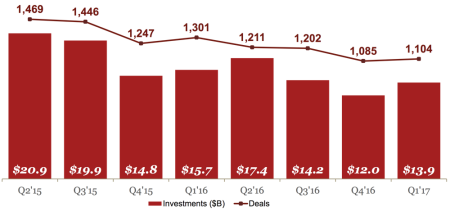
    PricewaterhouseCoopers (PWC)PricewaterhouseCoopers (PwC) and CB Insight recently released the results of its US MoneyTreeTM Report on U.S. venture funding for the first quarter of 2017.  The report indicates that venture capitalists invested $13.9 billion in 1,104 deals in the first quarter, which constituted a 15% increase in dollars and a 2% decrease in deals as compared with the fourth quarter of 2016, when $12.0 billion was invested in 1,085 deals (see chart below, which shows total venture funding from the second quarter of 2015 through the first quarter of 2017; chart from MoneyTreeTM Report).  While the increase in dollars and deals in the first quarter of 2017 reversed an eight-quarter low in both dollars and deals in the fourth quarter of 2016, first quarter funding was still $1.8 billion behind last year's pace.

    Funding by Quarter
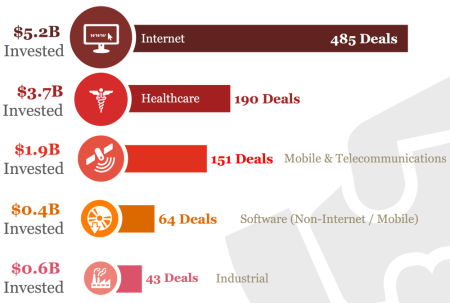
    With respect to funding by sector, the internet sector captured the top spot among the sectors tracked in the report, collecting $5.2 billion in 485 deals in the first quarter of 2017.  The healthcare sector came in second, with $3.7 billion invested in 190 deals (see chart below, which shows venture funding for the internet, healthcare, mobile & telecommunications, software (non-internet/mobile), and industrial sectors; chart from MoneyTreeTM Report).

    Funding by Sector
    The report also includes separate analyses of funding in the areas of artificial intelligence, digital health, and cybersecurity, as well as funding by geographic region and a global regional comparison.

    For additional information regarding this and other related topics, please see:

    • "Venture Funding Normalizes in 2016 After Strong First Half," February 8, 2017
    • " Second Quarter Venture Funding Increases 20% from First Quarter," October 11, 2016
    • "Venture Funding Reaches Highest Level in More Than a Decade," February 25, 2016
    • "Third Quarter Venture Funding Declines 27% from Second Quarter," October 22, 2014
    • "Software Sector Leads Pack in 2Q Venture Funding and Biotech Sector Finishes Second," July 20, 2014
    • "Software Sector Leads First Quarter Venture Funding to Thirteen Year High; Biotech Sector Finishes Second (Again)," April 30, 2014
    • "Biotech Venture Funding Rebounded in 2013 After Strong Fourth Quarter," January 26, 2014
    • "Biotech Venture Funding Sees Second Quarter Rebound," July 22, 2013
    • "Biotech Venture Funding Down 33% in First Quarter," April 30, 2013
    • "Annual Venture Funding Drops for First Time in Three Years," February 4, 2013
    • "Biotech Venture Funding Up 64% in Third Quarter," October 29, 2012
    • "Venture Funding in Life Sciences Sector Drops 9% in Second Quarter," July 22, 2012
    • "Biotech Venture Funding Drops 43% in First Quarter," May 3, 2012
    • "Venture Funding Increased 22% in 2011," February 2, 2012
    • "Life Sciences Venture Funding Drops in Third Quarter," October 27, 2011
    • "Life Sciences Venture Funding up 37% in Second Quarter," August 1, 2011
    • "VentureSource Reports 35% Increase in 1Q Venture Funding," April 26, 2011
    • "NVCA Reports Modest Gains in First Quarter Venture Funding," April 19, 2011

    • "NVCA Reports 31% Drop in Venture Funding for Third Quarter," October 17, 2010

    • "NVCA Reports 34% Increase in Venture Funding for Second Quarter," July 22, 2010

    • "NVCA Report Shows First Quarter Drop in Venture Funding," April 20, 2010

    • "Biotech/Pharma Financing Improving, R&D Spending Up," August 31, 2009
    • "NVCA Study Shows Increase in Third Quarter Venture Funding," October 23, 2009

    • "First Quarter Venture Capital Funding at 12-Year Low," April 23, 2009

    • "NVCA Study Shows Decline in 2008 Investment; BIO Study Predicts Biotech Rebound in 2009," February 16, 2009

  • By Kevin E. Noonan

    Supreme Court Building #2The U.S. Supreme Court handed down its decision today in Impression Products, Inc. v. Lexmark International, Inc., unsurprisingly reversing the Federal Circuit regarding the metes and bounds of the patent exhaustion doctrine.  The Court ruled that the doctrine precludes a patentee from using the patent laws to enforce any agreement that restricted a purchaser's post-sale ownership rights in a patented article, and that the doctrine extended to patented products sold abroad.  The decision reversed Federal Circuit precedent that permitted patentees to limit the scope of rights transferred to purchasers upon sale of a patented article, provided that such restrictions were "clearly worded" (Mallinckrodt, Inc. v. Medipart, Inc., 976 F.2d 700 (Fed. Cir. 1992)) and further expanded the scope of exhaustion to include sales made outside the U.S., which the Federal Circuit had held were outside the reach of exhausting U.S. patent rights (Jazz Photo Corp. v. International Trade Commission, 264 F.3d 1094 (Fed. Cir. 2001)).  The decision represents a culmination of the Court's delineation of the expansive scope of exhaustion regarding intellectual property rights that can be found in Quanta Computer, Inc. v. LG Electronics, Inc., 553 U.S. 617 (2008) and (in the copyright context) Kirtsaeng v. John Wiley & Sons, Inc., 568 U.S. 519 (2013).

    The case arose over the resale of laser printer toner cartridges, sold by Lexmark both in the U.S. and abroad.  The cartridges were sold at a discount under an agreement that prohibited the buyer from selling the cartridges to any third party for reloading (with "a powdery substance, known as toner, that laser printers use to make an image appear on paper").  Each cartridge contained a chip that prevented third party reloading, but technology developed in ways that the microchip could be overridden.  Petitioner/accused infringer Impression Products reloaded and sold Lexmark cartridges obtained from discount purchasers both foreign and domestic.  The District Court dismissed Lexmark's infringement suit as to U.S. sales but permitted pursuit of a patent infringement remedy for foreign sales; the Federal Circuit affirmed as to foreign sales but also permitted Lexmark's infringement case to proceed for U.S. sales as well.

    The Federal Circuit, relying on its (now-overruled) decision in Mallinckrodt, Inc. v. Medipart, Inc., 976 F. 2d 700 (Fed. Cir. 1992), held that the patent right included the right to impose "clearly communicated" post-sale restrictions that could be enforced by an infringement suit.  The Court's basis for this opinion was that the law defines infringement as "making, using, selling, offering to sell, or importing" a patented article "without authority," and thus post-sale restrictions would comprise infringement because they denied the purchaser the requisite authority for unrestricted use.  The Federal Circuit's application of the exhaustion principle was that it was presumptive but that the presumption could be expressly rebutted by such post-sale restrictions.

    As for sales made abroad, the Federal Circuit relied on its (now also overruled) decision in Jazz Photo Corp. v. International Trade Commission, 264 F. 3d 1094 (Fed. Cir. 2001), where foreign sales did not preclude an infringement suit for unauthorized importation and sale of a patented article.  This decision was based on the lack of the predicate benefit to the patentee of selling an article abroad that was protected by a U.S. patent, in view of the lack of extraterritorial effect of the patent:  there was no patent premium received by the patentee under those circumstances, and thus the Court believed exhaustion was not justified.

    The Supreme Court was presented with two questions:  can a patentee impose an express restriction on use or reuse of a patented product sold in the U.S. that is enforceable under the patent laws, and does sale of a patented article abroad exhaust the patentee's right to restrict importation of a product sold abroad?  The Supreme Court answered no to both questions, based on its view that patent exhaustion is a limitation on the patent right under the common law principle against restraints on alienating property.  The Court's opinion as to U.S. sales was unanimous, in an opinion colorfully written with regard to the facts (e.g., "[n]ot blind to this business problem [of reloading cartridges to be sold at a lower price"; "Lexmark, however, was not so ready to concede that its plan had been foiled [i.e., by thwarting the microchip limitation on reloading]") by Chief Justice Roberts.  Justice Ginsberg dissented with regard to foreign sales, which she believed should not exhaust U.S. patent rights.  Justice Gorsuch did not participate in the decision.

    With regard to resale of cartridges purchased in the U.S., the Court struck down any post-sale restrictions because it held that all patent rights were exhausted upon first sale.  The basis for this decision was limited to patent law (the Court recognized that there might be a cause of action in contract law, however ineffective), and the opinion declares that the doctrine of patent exhaustion has been consistent in U.S. law for over 160 years, citing Bloomer v. McQuewan, 14 How. 539 (1853).  The Court characterized the function of exhaustion to operate "automatically"; once a patentee sells a patented article that article becomes "private, individual property" of the purchaser subject to no further rights by the patentee.  Patent law provides the patentee with the right to set prices and negotiate with purchasers over terms of sales, but the Court opined that once the sale is made the patentee does not have the right, under patent law, to "control the use or disposition" of the product, citing United States v. Univis Lens Co., 316 U. S. 241, 250 (1942).  This principle was affirmed most recently by the Court in Quanta Computer, Inc. v. LG Electronics, Inc., 553 U. S. 617, 625 (2008), which the Court says should have removed "any lingering doubt that patent exhaustion applies even when a sale is subject to an express, otherwise lawful restriction."

    The opinion cites its decision in Kirtsaeng regarding a similar principle ("the first sale doctrine," codified at 17 U. S. C. § 109(a)) in copyright law, which decision also cited "the common law's refusal to permit restraints on the alienation of chattels."  The Court cites as ancient provenance of this "venerable principle" the common law in the 17th century (the Court citing Lord Coke to that effect) that disfavors if not affirmatively rejects (the opinion describing the common law attitude as "hostility," "antipathy," and "enmity") any restraint on the free alienation of chattels and other private property, which are "obnoxious to the public interest," citing Straus v. Victor Talking Machine Co., 243 U.S. 490, 501 (1917).

    The opinion then provides as an illustration of the "annoyance and inconvenience" to the public that would result from the Court deciding otherwise an auto repair shop, where the component parts (should they be subject to post-sale restrictions) could leave open to patent infringement liability a mechanic for servicing a privately owned vehicle.  "[The] smooth flow of commerce would sputter if companies that make the thousands of parts that go into a vehicle could keep their patent rights after the first sale," according to the opinion (in a conclusion bolstered by amici briefs that used smartphones and other articles of manufacture constituting multiple patented components).

    The opinion supports its conclusions with further citations to precedent (including Boston Store of Chicago v. American Graphophone Co., 246 U.S. 8, 17–18 (1918) and Univis) which, although being resale price restriction cases brought under antitrust law, were decided on the grounds that such restrictions were an impermissible extension of the patentees right to exclude.  And Congress has not seen fit to change the law, according to the Court; this inaction raises the presumption that Congress does not intend patented articles to be an exception to the common law rule limiting patent rights, citing Astoria Fed. Sav. & Loan Assn. v. Solimino, 501 U.S. 104, 108 (1991).

    The Court expressly identified the Federal Circuit's error (where "it got off on the wrong foot") to be grounding its decision on the extent of the "authority" that the patentee grants a purchaser, which while presumptively plenary does not (under the Federal Circuit's now overruled precedent) need to be so.  On the contrary, the Court found the patent exhaustion principle to be much more than a presumption — it is an affirmative limit on the scope of a patentee's right to exclude, the Court citing United States v. General Elec. Co., 272 U.S. 476, 489 (1926) to this effect.  The opinion sets out the principle:  the right to own (and use, and sell) property exists outside the patent right, and the law grants to patentee but a limited exception to that right, which exception is exhausted by sale by the patentee of the patented article.

    The Court states that the remedy if any must be found in contract, but recognizes that the party who would have infringement liability (remanufacturers like Impression Products) are not in privity with the patentee and thus contract law under these circumstances does not provide a remedy.  Responding to arguments by Lexmark, the Court notes that licenses and licensees are different, the Court distinguishing case law with regard to these entities with cases involving post-sale restrictions (specifically, General Talking Pictures Corp. v. Western Elec. Co., 304 U.S. 175, aff 'd on reh'g, 305 U.S. 124 (1938), which involved violation of restrictions on licensees).  The Court states that these situations do not implicate restraints on free alienation, because a patent license does not transfer title; it just "expands the club of authorized producers and sellers."  "Because the patentee [in licensing] is exchanging rights, not goods, it is free to relinquish only a portion of its bundle of patent protections," says the Court.  A patentee can condition sale by a licensee to restrict post-sale use, but the opinion states that this is a also right limited by contract and not the patent law, citing Motion Picture Patents Co. v. Universal Film Mfg. Co., 243 U.S. 502, 506–507, 516 (1917).  The opinion succinctly states the scope of the exhaustion doctrine:  "Patent exhaustion is uniform and automatic.  Once a patentee decides to sell—whether on its own or through a licensee—that sale exhausts its patent rights, regardless of any post-sale restrictions the patentee pur­ports to impose, either directly or through a license."

    With regard to sales abroad, the Court cited its Kirtsaeng decision and found the same grounding in that case as here, in the unlawfulness of restraints on the alienation of chattels.  Because this common law principle applies without regard to where the post-sale activity takes place, the distinction Lexmark (and Justice Ginsberg in dissent) made regarding foreign versus domestic sales disappears for the Court majority.  The Court finds the application of these principles in the patent context "just as straightforward" as in copyright, and moreover, sees no "theoretical or practical" sense in differentiating between patent and copyright on exhaustion, citing the "many everyday products . . . [are] subject to both patent and copyright protections."  The Court was unmoved by Lexmark's argument that, without patent protection a foreign sale would not command the patent premium on price, saying that "the Patent Act does not guarantee a particu­lar price, much less the price from selling to American consumers.  Instead, the right to exclude just ensures that the patentee receives one reward—of whatever amount the patentee deems to be 'satisfactory compensation,'" citing Keeler v. Standard Folding Bed Co., 157 U.S. 659, 661 (1895).

    Finally, the Court rejected the "middle ground" advocated by the U.S. government (permitting U.S. patent rights to be expressly reserved for foreign sales) as being "largely based on policy rather than principle":

    Exhaustion does not arise because of the parties' expecta­tions about how sales transfer patent rights.  More is at stake when it comes to patents than simply the dealings between the parties, which can be addressed through contract law.  Instead, exhaustion occurs because, in a sale, the patentee elects to give up title to an item in exchange for payment.  Allowing patent rights to stick remora-like to that item as it flows through the market would violate the principle against restraints on alienation.  Exhaustion does not depend on whether the patentee receives a premium for selling in the United States, or the type of rights that buyers expect to receive.  As a result, restrictions and location are irrelevant; what mat­ters is the patentee's decision to make a sale.

    This decision (as the Quanta and Kirstaeng decisions before it) has important ramifications for biotechnology patent claims.  There are two immediately evident examples:  cases where a patentee having method claims and composition claims limits post-sale rights by a so-called "label license" for uses for a patented article; and cases where a patented article has the biological property of replication, where the license precludes use of replicates of the article after purchase.  An example of the first type of situation are the limits placed on the practice of the polymerase chain reaction, based on patents to the amplification method and the thermostable polymerase.  The restrictions were of two types:  first, licenses to the method were granted only upon purchase of the polymerase and use of an "authorized" thermocyler.  Second, the method (and for that matter, the polymerase) was not licensed for diagnostic uses, only for scientific research.  Under the patent exhaustion doctrine set forth in the Lexmark opinion, it is likely that neither of these restrictions would be enforceable.  First, although the polymerase has other uses that would not infringe the claims of the PCR method patent, it is likely that sale of the thermostable polymerase would exhaust the method claims as well, since the thermostable characteristic of the polymerase embodies essential features of the claimed invention.  This is even more likely regarding the diagnostic use prohibition, since it represents the kind of restriction the Court prohibited in Adams v. Burke:  "when a patented item is 'once lawfully made and sold, there is no restriction on [its] use to be implied for the benefit of the patentee.'"  Adams, 17 Wall. 453, 457 (1873).

    The second type of post-sale restrictions important to biotechnology are those that restrict use of a patented article that is capable of self-replication; the most (in)famous cases of this type are the Monsanto herbicide-resistant seed cases, where the "label license" prohibited replanting seed produced using the recombinant seed purchased from the company (albeit this situation is one where there is an express license between Monsanto and purchasing farmers and the third party aspects of the Lexmark case are not present).  Monsanto won a Supreme Court challenge to its use of patent infringement lawsuits to enforce its right to restrict resale of patented soybeans, in Bowman v. Monsanto several years ago, involving a farmer who reused seed contrary to Monsanto's restrictions on reuse.  The restrictions permitted under those circumstances may be limited to the unique nature of that invention, however, wherein producing more soybeans is the intended (and perhaps only) use of the invention.  But Justice Kagen's opinion was qualified, wherein she noted that the Court's holding was "limited — addressing the situation before us, rather than every one involving a self-­replicating product" and adding that:

    We recognize that such inventions are becoming ever more prevalent, complex, and diverse.  In another case, the article's self-replication might occur outside the purchaser's control.  Or it might be a necessary but incidental step in using the item for another purpose.  . . .  We need not address here whether or how the doctrine of patent exhaustion would apply in such circumstances.

    It is clear, however, that the Supreme Court has eviscerated the Federal Circuit's interpretation of the effect of patent exhaustion on patent rights, and that in this as in many other areas, the Court has determined that its views are the correct (if not only) views regarding U.S. patent law.

    Impression Products, Inc. v. Lexmark International, Inc. (2017)
    Opinion by Chief Justice Roberts, joined by Justices Kennedy, Thomas, Breyer, Alito, Sotomayor, and Kagan; opinion concurring in part and dissenting in part by Justice Ginsburg; Justice Gorsuch took no part in the consideration or decision of the case

  • By Michael Borella

    The textbook policy rationale for the existence of a patent system is a quid-pro-quo — a tradeoff in which an inventor is granted a time-limited property right over his or her invention in return for disclosing it to the public.  Such disclosure is expected to, over time, spur further innovation, and bolster research and development.  But empirical measurements of the impact of the patent system on innovation and the economy have been difficult to come by.  Patents are just one factor influencing ongoing scientific and engineering advances, and their impact is perhaps impossible to determine in an aggregate sense.

    Heidi L. Williams of the National Bureau of Economic Research reviewed the available evidence of how patents on existing technologies might affect follow-on innovation and research investment.  Her conclusion is that more evidence is needed:  "[G]iven the limitations of the existing literature we still have essentially no credible empirical evidence on the seemingly simple question of whether stronger patent rights — either longer patent terms or broader patent rights — encourage research investments into developing new technologies."

    EFFNonetheless, in a recent article, Vera Ranieri of the Electronic Frontier Foundation (EFF) has used this essentially neutral position to argue in favor of recent changes to U.S. patent law that arbitrarily and subjectively limit patentable subject matter.  In doing so, Ms. Ranieri falls back on a number tired tropes and misconceptions about the workings of U.S. patent law, and fails to consider the damage done by these changes to the certainty function of the patent system.

    The Alice Decision

    In 2014, the Supreme Court handed down a highly controversial decision in Alice Corp. v. CLS Bank Int'l.  In a nutshell, the Court ruled that patent claims should be analyzed to determine whether they are too "abstract," and if they are, these claims should be further analyzed to determine whether they incorporate "significantly more" than an abstraction.  In doing so, the Court went well beyond the plain language that Congress set forth in 35 U.S.C. § 101, the section of the patent statute that defines subject-matter eligibility.  Furthermore, the Court purposely declined to define what it meant by "abstract" and "significantly more," essentially leaving it up to the Federal Circuit, the district courts, and the USPTO to provide meaning for these ambiguous terms.

    While not explicitly stating it, in Alice the Court effectively targeted software and business method inventions (and certain types of life science inventions, such as diagnostic methods) for an additional level of scrutiny.  In fact, the EFF's own amicus brief in Alice encouraged the Court to use the case to "reign in overbroad software patents."  Whether or not this argument ultimately swayed the Justices to rule as they did, the effect of Alice is clear — over 15,000 patent claims have been invalidated under § 101 since this decision came down, the vast majority of these in the software and business method space.  Additionally, some software and most business method claims are now harder to obtain from the USPTO, with rejection rates of over 90% in some business method art units.

    In many cases, courts have invalidated patents under § 101 without undertaking claim construction.  Let that sink in for a while — courts are throwing out patents as allegedly being abstract without determining the actual scope of the claimed invention.

    The Alice Decision Has Not Been, and Cannot Be, Applied Consistently or Objectively

    The problem with Alice is not just that it limits the scope of patentable subject matter, but that it does so in an arbitrary and subjective fashion.  Courts and the USPTO have struggled mightily with making sense of the decision.  Judge Wu of the United States District Court for the Central District of California criticized Alice for setting forth an "I know it when I see it" test.[1]  Judge Pfaelzer, a colleague of Judge Wu, wrote that the Supreme Court's patent-eligibility cases "often confuse more than they clarify [and] appear to contradict each other on important issues."[2]  Former Chief Judge of the Federal Circuit Paul Michel stated that Alice "create[d] a standard that is too vague, too subjective, too unpredictable and impossible to administer in a coherent consistent way in the patent office or in the district courts or even in the federal circuit."

    While the Federal Circuit has attempted to provide a consistent line of post-Alice case law, this has resulted in some very thin bacon slicing.  For instance, in 2014 a panel in Ultramercial v. Hulu found a complex and narrow web-based transaction to be unpatentably abstract, while another panel in DDR v. Hotels.com found a web server that combines the look and feel of two different web sites meeting the requirements of § 101.  Last year, in Synopsys v. Mentor Graphics, an invention automating circuit design procedures was found to be abstract because these procedures had been performed manually by humans.  But in McRO v. Bandai Namco Games America, an invention automating lip-synchronization in animated characters was found not abstract even though the automated procedure could be performed by humans.

    While one could argue that there are at least tenuous distinctions between the claimed inventions that were found eligible and ineligible in these four cases, the recent Recognicorp v. Nintendo case clearly illustrates the Federal Circuit's inability to apply Alice consistently.  In the decision, the panel characterized a 154-word claim as nothing more than "encoding and decoding image data," despite the panels in Enfish v. Microsoft and McRo explicitly forbidding such claim over-simplification.

    At the USPTO, despite the administrators' admirable efforts to provide clear examination guidelines with respect to Alice, it is notoriously well known amongst practitioners that different art units and different examiners will apply the Alice test in radically different ways.  Further, it is common for an applicant to receive an Alice rejection that is purely conclusory in nature — the examiner essentially saying "Your claims are abstract, no patent for you!" without any rationale or reasoning to support the rejection.  While the latter type of rejection can be rebutted, it imposes additional and unnecessary costs on the applicant to go through extra cycles of Office actions or appeals.

    Ultimately, the problem does not lie with the Federal Circuit or the USPTO.  The Alice test is inherently subjective, requiring one to look at a claim and imagine analogous "well-known, routine, and conventional" activities.  In doing so, examiners and judges often ignore key claim elements, resulting in a 10,000-foot view of the claim being analyzed, rather than the actual claimed invention.

    Due to this subjectivity, reasonable minds can differ regarding whether a claim is abstract and whether it contains something more.  There is no way for thousands of examiners and hundreds of federal judges to reach the same conclusion on a consistent basis.

    The Lack of Evidence Found in the Williams Paper Cuts Both Ways

    For sake of argument, let's assume that Ms. Williams's analysis is correct, and that there is little or no evidence identified yet that establishes innovation is spurred on by a strong patent system.[3]  Ms. Ranieri interprets this result as an invitation to slam the door on software patents, arguing that there is no need to change the law to fix problems introduced by Alice.

    But the same argument could be used to establish that there was no need for the Supreme Court to change the law in Alice either.  If the impact of patent system strength on innovation was unclear, the Court should not have instituted such a dramatic change.  Besides, Congress is better equipped than the Court to derive policy from such studies.  If anything, the dramatic growth of technology company profitability and market capitalization from the mid-1990s to the Alice decision in 2014 suggests that a strong patent system is not inconsistent with innovation and technological investment in the software market.

    Ms. Ranieri also states that the Williams paper establishes that there is no evidence that the Alice decision has "done any harm to the innovation economy or innovation generally."  But the paper does not address Alice at all, and most of its cited research was conducted prior to the 2014 date of Alice.  Given the lengthy, multi-year time scales of patent lawsuits, patent prosecution, and research and development, the three years between then and now is way too short a time period to draw such broad conclusions.

    Ms. Ranieri Mischaracterizes the Efforts to Overturn Alice

    Throughout her article, Ms. Ranieri makes misleading statements about efforts to overturn Alice.  Particularly, she focuses on proposals by the Intellectual Property Owners Association and the American Intellectual Property Law Association to rewrite § 101.  A comparison of their efforts indicates that they would replace the Alice test with an analysis of whether the claimed invention as a whole (i) exists in nature independently of human activity, or (ii) solely in the human mind.  Such a test would certainly result in fewer patents being invalidated under § 101, but would also go a long way toward clarifying the law.

    Unlike Ms. Ranieri's contentions, this would not "return us to a world where 'do it on a computer' ideas are eligible for a patent."  That world never existed.  If a claimed invention's sole difference from prior art is to perform a known series of steps on a computer, the invention is probably obvious and can be invalidated on those grounds.  In fact, the claims in Alice and many other so-called "overly broad" patents could be invalidated under the patent statute's existing novelty, non-obviousness, and written description provisions.  Ms. Ranieri's further statement that the proposed changes to § 101 would mean that "anything is patentable" aside from the aforementioned exceptions ignores the fact that eligible subject matter is just one requirement of many for a patent to be granted.

    Furthermore, Ms. Ranieri asserts that "the recent reform proposals seem like little more than a bid by lawyers to create work for themselves."  If anything, the opposite will likely be the case.  The uncertainty surrounding Alice has been a boon for § 101 focused practice, opening more patent prosecution and litigation opportunities.  While some applicants are filing fewer patents as a result of Alice, many are filing more — attempting to protect multiple narrow inventions rather than one or two broader ones.  There are more appeals in the USPTO, as well as more covered business method review proceedings as well.

    When there is a gray area in the law, lawyers are needed more than ever to help their clients navigate the ambiguities.  If the Intellectual Property Owners Association and the American Intellectual Property Law Association succeed in their efforts, the patent law will be less ambiguous and there will be far fewer billable hours spent determining whether or not a claim is abstract.  Even though such a change might have a negative impact on their bottom lines, many patent attorneys would welcome the change because the patent system is broken as long as Alice stands.

    Conclusion

    Opposition to the Alice test is not based on it making patents easier to invalidate, but that it does so in an unworkable and intellectually dishonest fashion.  This has resulted in applicants with limited financial resources being unable to pursue patent protection for legitimate technical inventions.  If such a trend is widespread and continuing, small U.S. companies will be reluctant to innovate in certain market segments because of the risk of their U.S.-based or foreign competitors getting a free ride to copying or cloning a product or service.

    This is the area that merits academic study — has Alice actually harmed innovation?  As noted above, it may be a while before we can make that determination.  But if it is the case, that would be just one more reason of many for discarding the test.

    [1] Eclipse IP v. McKinley Equipment (C.D. Cal. 2014).

    [2] Cal. Inst. of Tech. v. Hughes Commc’ns Inc. (C.D. Cal. 2014).

    [3] As far as we know, the paper has not yet been subject to thorough peer review, and therefore its conclusions should be viewed as preliminary at best.