• Strafford #1Strafford will be offering a webinar/teleconference entitled "Section 112(a) Enablement and Written Description: Leveraging CCPA and Early Federal Circuit Decisions — Capitalizing on Precedent to Withstand 112(a) Rejections and Attacks on Patent Validity and Patentability" on August 24, 2017 from 1:00 to 2:30 pm (EDT).  Thomas L. Irving of Finnegan Henderson Farabow Garrett & Dunner; Donna M. Meuth, Associate General Counsel, Eisai; Amanda K. Murphy of Finnegan Henderson Farabow Garrett & Dunner will provide guidance to patent counsel on leveraging decisions by the Court of Customs and Patent Appeals (CCPA) and the Federal Circuit regarding application of § 112 written description, and examine lessons learned through CCPA and early Federal Circuit decisions and offer strategies to overcome the challenges of § 112.  The webinar will review the following topics:

    • What lessons can patent counsel draw from CCPA decisions when making arguments of written description support and enablement?
    • What steps can counsel for patentees take to meet the written description and enablement requirements and withstand invalidity/unpatentability challenges based on written description and enablement?
    • What steps should patent counsel take going forward to avoid repeating mistakes of the past?

    The registration fee for the webinar is $297.  Those interested in registering for the webinar, can do so here.

  • Strafford #1Strafford will be offering a webinar/teleconference entitled "Navigating the Patent Prosecution Highway and Other Accelerated Filing Options — Evaluating the Different Options, Weighing the Benefits and Risks, Obtaining Patent Protection" on August 31, 2017 from 1:00 to 2:30 pm (EDT).  Ralph G. Fischer and Duane A. Stewart, III of Buchanan Ingersoll & Rooney will provide guidance to patent counsel on the use of the patent prosecution highway and other ways to fast track examination; examine the pros and cons of options and will discuss factors to consider when determining whether to pursue accelerated prosecution and which avenue to take; and offer best practices for avoiding common mistakes and obtaining patent protection.  The webinar will review the following topics:

    • What options are available to accelerate a patent prosecution, and what are the pros and cons of each?
    • What factors should patent counsel consider when determining whether seeking accelerated patent protection is the best avenue for prosecution?
    • What are the key considerations for patent counsel drafting applications when accelerated patent protection is anticipated?

    The registration fee for the webinar is $297.  Those interested in registering for the webinar, can do so here.

  • MBHB Logo 2McDonnell Boehnen Hulbert & Berghoff LLP will be offering a live webinar entitled "The Evolving 5 W's of Global IP Enforcement: The Strategic Implications of Recent Global IP Law Developments" on August 29, 2017 from 10:00 am to 11:15 am (CT).  In this presentation, MBHB attorney S. Richard Carden will review some recent developments in cases, laws and harmonization efforts and discuss how companies should take these changes into account when developing their own IP strategies.  The webinar will discuss the following topics:

    • The implications of recent and upcoming U.S. Supreme Court decisions such as TC Heartland and Oil States Energy Services
    The implications of Brexit negotiations and the current EU efforts on IP enforcement modernization
    • The implications of current international trade negotiations and agreements

    While there is no fee to participate, attendees must register in advance.  Those wishing to register can do so here.  CLE credit is pending for the states of California, Illinois, New Jersey, New York, North Carolina, and Virginia.

  • By John Cravero

    USPTO SealAbout the PTAB Life Sciences Report:  Each month we will report on developments at the PTAB involving life sciences patents.

    Celltrion, Inc. v. Biogen Inc. et al.

    PTAB Petition:  IPR2017-01230; filed March 30, 2017.

    Patent at Issue:  U.S. Patent No. 7,682,612 ("Treatment of hematologic malignancies associated with circulating tumor cells using chimeric anti-CD20 antibody," issued March 23, 2010) claims a method of treating chronic lymphocytic leukemia in a human patient, comprising administering an anti-CD20 antibody to the patient in an amount effective to treat the chronic lymphocytic leukemia, wherein the method does not include treatment with a radiolabeled anti-CD20 antibody.

    Petitioners Celltrion, Inc., Celltrion Healthcare Co. Ltd., and Teva Pharmaceuticals International GmbH are challenging the '612 patent on five grounds as being anticipated under 35 U.S.C. § 102(b) (ground 3) and as obvious under 35 U.S.C. § 103(a) (grounds 1, 2, 4, and 5).  View the petition here.

    Related Matters:  According to the petition, Petitioners concurrently filed a second petition for inter partes review of the '612 patent (IPR2017-01227; filed 03/30/2017; pending) as well as a petition for inter partes review of related U.S. Patent No. 8,206,711 (IPR2017-01229; filed 03/31/2017; pending).


    Celltrion, Inc. v. Biogen Inc. et al.

    PTAB Petition:  IPR2017-01227; filed March 31, 2017.

    Patent at Issue:  U.S. Patent No. 7,682,612 ("Treatment of hematologic malignancies associated with circulating tumor cells using chimeric anti-CD20 antibody," issued March 23, 2010) claims a method of treating chronic lymphocytic leukemia in a human patient, comprising administering an anti-CD20 antibody to the patient in an amount effective to treat the chronic lymphocytic leukemia, wherein the method does not include treatment with a radiolabeled anti-CD20 antibody.

    Petitioners Celltrion, Inc., Celltrion Healthcare Co. Ltd., and Teva Pharmaceuticals International GmbH are challenging  the '612 patent on three grounds as obvious under 35 U.S.C. § 103(a).  View the petition here.

    Related Matters:  According to the petition, Petitioners concurrently filed a second petition for inter partes review of the '612 patent (IPR2017-01230; filed 03/30/2017; pending) as well as a petition for inter partes review of related U.S. Patent No. 8,206,711 (IPR2017-01229; filed 03/31/2017; pending).


    Celltrion, Inc. v. Biogen Inc. et al.

    PTAB Petition:  IPR2017-01229; filed March 31, 2017.

    Patent at Issue:  U.S. Patent No. 8,206,711 ("Treatment of chronic lymphocytic leukemia using anti-CD20 antibodies," issued June 26, 2012) claims a method of treating chronic lymphocytic leukemia (CLL) in a human patient, comprising administering rituximab to the patient in an amount effective to treat the CLL, wherein the rituximab is administered to the patient at a dosage of 500 mg/m2.

    Petitioners Celltrion, Inc., Celltrion Healthcare Co. Ltd., and Teva Pharmaceuticals International GmbH are challenging  the '711 patent on six grounds as being anticipated under 35 U.S.C. § 102(b) (grounds 1 and 2) and as obvious under 35 U.S.C. § 103(a) (grounds 3-6).  View the petition here.

    Related Matters:  According to the petition, Petitioners concurrently filed petitions for inter partes review of related U.S. Patent No. 7,682,612 (IPR2017-01230; filed 03/30/2017; pending) and (IPR2017-01227; filed 03/31/2017; pending).


    Teva Pharmaceuticals USA, Inc. v. Allergan, Inc.; Akorn Inc. v. Allergan, Inc.

    PTAB Petition:  IPR2017-00578; filed January 6, 2017.

    PTAB Petition:  IPR2017-00596; filed January 6, 2017.

    PTAB Trial Instituted; entered March 31, 2017.

    Patent at Issue:  U.S. Patent No. 8,629,111 ("Methods of providing therapeutic effects using cyclosporin components," issued January 14, 2014) claims a topical ophthalmic emulsion for treating an eye of a human comprising cyclosporin A in an amount of about 0.05% by weight, polysorbate 80, acrylate/C10-30 alkyl acrylate cross-polymer, water, and castor oil in an amount of about 1.25% by weight; wherein cyclosporin A is the only peptide present in the topical ophthalmic emulsion.

    Petitioners Teva Pharmaceuticals USA, Inc. (IPR2017-00578) and Akorn Inc. (IPR2017-00596) are challenging the '111 patent on three grounds as being anticipated under 35 U.S.C. § 102(b) (ground 1) or as obvious under 35 U.S.C. § 103(a) (grounds 2 and 3).  View the petitions here (IPR2017-00578) and here (IPR2017-00596).  Both Petitioners also seek joinder with IPR2016-01128 through Motions for Joinder under 35 U.S.C. § 315(c), 37 C.F.R. §§ 42.22 and 42.122(b).  Administrative Patent Judges Sheridan K. Snedden, Tina E. Hulse, and Christopher G. Paulraj (author) issued decisions instituting inter partes review of whether claims 1−27 are anticipated under 35 U.S.C. § 102(b) by Ding '979; claims 1−27 are obvious under 35 U.S.C. § 103(a) over the combination of Ding '979 and Sall; and claims 11 and 16 are obvious under 35 U.S.C. § 103(a) over the combination of Ding '979, Sall, and Acheampong.  View the decisions here (IPR2017-00578) and here (IPR2017-00596).

    Related Matters:  According to the petition, the '111 patent is involved in the following litigations: Allergan, Inc. v. Teva Pharmaceuticals USA, Inc., et al., No. 2:15-cv-01455 (E.D. Tex.); Allergan, Inc., v. Innopharma, Inc. et al., No. 2:15cv1504 (E.D. Tex.); and Allergan, Inc. v. Famy Care, Ltd., No. 2:16-cv-0401 (E.D. Tex.).  Also, the '111 patent was the subject of IPR2015-01282 (Petitioners Apotex Corp. and Apotex Inc.; filed 06/04/2015; terminated through settlement 12/16/2015).  Inter partes review petitions for related patents include IPR2016-01127 (U.S. Patent No. 8,685,930 B2); IPR2016-01129 (U.S. Patent No. 8,642,556 B2); IPR2016-01130 (U.S. Patent No. 8,633,162 B2); IPR2016-01131 (U.S. Patent No. 8,648,048 B2); and IPR2016-01132 (U.S. Patent No. 9,248,191 B2).  U.S. Application No. 15/011,159, filed January 29, 2016, claims the benefit of U.S. Application No. 14/222,478 (the '191 patent), which is a continuation, via U.S. Application Nos. 13/961,828 and 11/897,177, of the '857 application.


    Teva Pharmaceuticals USA, Inc. v. Allergan, Inc.;
    Akorn Inc. v. Allergan, Inc.

    PTAB Petition:  IPR2017-00576; filed January 6, 2017.

    PTAB Petition:  IPR2017-00594; filed January 6, 2017.

    PTAB Trial Instituted; entered March 31, 2017.

    Patent at Issue:  U.S. Patent No. 8,685,930 ("Methods of providing therapeutic effects using cyclosporin components," issued April 1, 2014) claims a topical ophthalmic emulsion comprising cyclosporin A for treating an eye with keratoconjuctivitis sicca.

    Petitioners Teva Pharmaceuticals USA, Inc. (IPR2017-00576) and Akorn Inc. (IPR2017-00594) are challenging the '930 patent on three grounds as being anticipated under 35 U.S.C. § 102(b) (ground 1) or as obvious under 35 U.S.C. § 103(a) (grounds 2 and 3).  View the petitions here (IPR2017-00576) and here (IPR2017-00594).  Both Petitioners also seek joinder with IPR2016-01127 through Motions for Joinder under 35 U.S.C. § 315(c), 37 C.F.R. §§ 42.22 and 42.122(b).  Administrative Patent Judges Sheridan K. Snedden (author), Tina E. Hulse, and Christopher G. Paulraj issued decisions instituting inter partes review of whether claims 1−36 are anticipated under 35 U.S.C. § 102 by Ding '979; claims 1−36 are obvious under 35 U.S.C. § 103(a) over the combination of Ding '979 and Sall; and claims 11, 23, and 35 are obvious under 35 U.S.C. § 103(a) over the combination of Ding '979, Sall, and Acheampong.  The Judges also ordered the cases joined and administratively terminated under 37 C.F.R. § 42.72, and all further filings in the joined proceedings shall be made in IPR2016-01127.  View the decisions here (IPR2017-00576) and here (IPR2017-00594).

    Related Matters:  According to the petition, the '930 patent is involved in the following litigations: Allergan, Inc. v. Teva Pharmaceuticals USA, Inc., et al., No. 2:15-cv-01455 (E.D. Tex.); Allergan, Inc., v. Innopharma, Inc. et al., No. 2:15cv1504 (E.D. Tex.); and Allergan, Inc. v. Famy Care, Ltd., No. 2:16-cv-0401 (E.D. Tex.).  Also, the '930 patent was the subject of IPR2015-01283 (Petitioners Apotex Corp. and Apotex Inc.; filed 06/04/2015; terminated through settlement 12/16/2015).  Petitioner concurrently filed inter partes review petitions to related patents in IPR2016-01128 (U.S. Patent No. 8,629,111 B2); IPR2016-01129 (U.S. Patent No. 8,642,556 B2); IPR2016-01130 (U.S. Patent No. 8,633,162 B2); IPR2016-01131 (U.S. Patent No. 8,648,048 B2); and IPR2016-01132 (U.S. Patent No. 9,248,191 B2).


    Teva Pharmaceuticals USA, Inc. v. Allergan, Inc.; Akorn Inc. v. Allergan, Inc.

    PTAB Petition:  IPR2017-00579; filed January 6, 2017.

    PTAB Petition:  IPR2017-00598; filed January 6, 2017.

    PTAB Trial Instituted; entered March 31, 2017.

    Patent at Issue:  U.S. Patent No. 8,642,556 ("Methods of providing therapeutic effects using cyclosporin components," issued February 4, 2014) claims a topical ophthalmic emulsion for treating a human eye comprising cyclosporin A.

    Petitioners Teva Pharmaceuticals USA, Inc. (IPR2017-00579) and Akorn Inc. (IPR2017-00598) are challenging the '556 patent on five grounds as being anticipated under 35 U.S.C. § 102(b) (ground 1) or as obvious under 35 U.S.C. § 103(a) (grounds 2 through 5).  View the petitions here (IPR2017-00579) and here (IPR2017-00598).  Both Petitioners also seek joinder with IPR2016-01129 through Motions for Joinder under 35 U.S.C. § 315(c), 37 C.F.R. §§ 42.22 and 42.122(b).  Administrative Patent Judges Sheridan K. Snedden, Tina E. Hulse, and Christopher G. Paulraj (author) issued decisions instituting inter partes review of whether claims 1–20 are anticipated under 35 U.S.C. § 102(b) by Ding '979; claims 1–20 are obvious under 35 U.S.C. § 103(a) over Ding '979 and Sall; claims 14 and 19 are obvious under 35 U.S.C. § 103(a) over Ding '979, Sall, and Glonek; claims 11, 18, and 20 are obvious under 35 U.S.C. § 103(a) over Ding '979, Sall, and Acheampong; and claim 19 is obvious under 35 U.S.C. § 103(a) over Ding '979, Sall, Glonek, and Acheampong.  The Judges also ordered the cases joined and administratively terminated under 37 C.F.R. § 42.72, and all further filings in the joined proceedings shall be made in IPR2016-01129.  View the decisions here (IPR2017-00579) and here (IPR2017-00598).

    Related Matters:  According to the petition, the '556 patent is involved in the following litigations: Allergan, Inc. v. Teva Pharmaceuticals USA, Inc., et al., No. 2:15-cv-01455 (E.D. Tex.); Allergan, Inc., v. Innopharma, Inc. et al., No. 2:15cv1504 (E.D. Tex.); and Allergan, Inc. v. Famy Care, Ltd., No. 2:16-cv-0401 (E.D. Tex.).  Also, the '556 patent was the subject of IPR2015-01286 (Petitioners Apotex Corp. and Apotex Inc.; filed 06/04/2015; terminated through settlement 12/16/2015).  Petitioner concurrently filed inter partes review petitions to related patents IPR2016-01127 (U.S. Patent No. 8,685,930 B2); IPR2016-01128 (U.S. Patent No. 8,629,111 B2); IPR2016-01130 (U.S. Patent No. 8,633,162 B2); IPR2016-01131 (U.S. Patent No. 8,648,048 B2); and IPR2016-01132 (U.S. Patent No. 9,248,191 B2).


    Teva Pharmaceuticals USA, Inc. v. Allergan, Inc.;
    Akorn Inc. v. Allergan, Inc.

    PTAB Petition:  IPR2017-00583; filed January 6, 2017.

    PTAB Petition:  IPR2017-00599; filed January 6, 2017.

    PTAB Trial Instituted; entered March 31, 2017.

    Patent at Issue:  U.S. Patent No. 8,633,162 ("Methods of providing therapeutic effects using cyclosporin components," issued February 4, 2014) claims a method of treating dry eye disease comprising topically administering an emulsion comprising cyclosporin A.

    Petitioners Teva Pharmaceuticals USA, Inc. (IPR2017-00583) and Akorn Inc. (IPR2017-00599) are challenging the '162 patent on three grounds as being obvious under 35 U.S.C. § 103(a).  View the petitions here (IPR2017-00583) and here (IPR2017-00599).  Both Petitioners also seek joinder with IPR2016-01130 through Motions for Joinder under 35 U.S.C. § 315(c), 37 C.F.R. §§ 42.22 and 42.122(b).  Administrative Patent Judges Sheridan K. Snedden, Tina E. Hulse (author), and Christopher G. Paulraj issued decisions instituting inter partes review of whether claims 1–10, 12–14, 16–20, and 22–24 are obvious over Ding '979 and Sall; claims 11 and 21 are obvious over Ding '979, Sall, and Acheampong; and claim 15 is obvious over Ding '979, Sall, and Glonek.  The Judges also ordered the cases joined and administratively terminated under 37 C.F.R. § 42.72, and all further filings in the joined proceedings shall be made in IPR2016-01130.  View the decisions here (IPR2017-00583) and here (IPR2017-00599).

    Related Matters:  According to the petition, the '162 patent is involved in following litigations: Allergan, Inc. v. Teva Pharmaceuticals USA, Inc., et al., No. 2:15-cv-01455 (E.D. Tex.); Allergan, Inc., v. Innopharma, Inc. et al., No. 2:15cv1504 (E.D. Tex.); and Allergan, Inc. v. Famy Care, Ltd., No. 2:16-cv-0401 (E.D. Tex.).  Also, the '162 patent was the subject of IPR2015-01278 (Petitioners Apotex Corp. and Apotex Inc.; filed 06/04/2015; terminated through settlement 12/16/2015).  Petitioner concurrently filed inter partes review petitions to related patents IPR2016-01127 (U.S. Patent No. 8,685,930 B2); IPR2016-01128 (U.S. Patent No. 8,629,111 B2); IPR2016-01129 (U.S. Patent No. 8,642,556 B2); IPR2016-01131 (U.S. Patent No. 8,648,048 B2); and IPR2016-01132 (U.S. Patent No. 9,248,191 B2).


    Teva Pharmaceuticals USA, Inc. v. Allergan, Inc.;
    Akorn Inc. v. Allergan, Inc.

    PTAB Petition:  IPR2017-00585; filed January 6, 2017.

    PTAB Petition:  IPR2017-00600; filed January 6, 2017.

    PTAB Trial Instituted; entered March 31, 2017.

    Patent at Issue:  U.S. Patent No. 8,648,048 ("Methods of providing therapeutic effects using cyclosporin components," issued February 11, 2014) claims method of increasing tear production in the eye of a human by topically administering an emulsion comprising cyclosporin A.

    Petitioners Teva Pharmaceuticals USA, Inc. (IPR2017-00585) and Akorn Inc. (IPR2017-00600) are challenging the '048 patent on three grounds as being obvious under 35 U.S.C. § 103(a).  View the petitions here (IPR2017-00585) and here (IPR2017-00600).  Both Petitioners also seek joinder with IPR2016-01131 through Motions for Joinder under 35 U.S.C. § 315(c), 37 C.F.R. §§ 42.22 and 42.122(b).  Administrative Patent Judges Sheridan K. Snedden (author), Tina E. Hulse, and Christopher G. Paulraj issued decisions instituting inter partes review of whether claims 1–10, 12–14, 16–20, 22, and 23 are obvious over Ding '979 and Sall; claims 11 and 21 are obvious over Ding '979, Sall, and Acheampong; and claim 15 is obvious over Ding '979, Sall, Acheampong, and Glonek.  The Judges also ordered the cases joined and administratively terminated under 37 C.F.R. § 42.72, and all further filings in the joined proceedings shall be made in IPR2016-01131.  View the decisions here (IPR2017-00585) and here (IPR2017-00600).

    Related Matters:  According to the petition, the '048 patent is involved in the following litigations: Allergan, Inc. v. Teva Pharmaceuticals USA, Inc., et al., No. 2:15-cv-01455 (E.D. Tex.); Allergan, Inc., v. Innopharma, Inc. et al., No. 2:15cv1504 (E.D. Tex.); and Allergan, Inc. v. Famy Care, Ltd., No. 2:16-cv-0401 (E.D. Tex.).  Also, the '048 patent was the subject of IPR2015-01284 (Petitioners Apotex Corp. and Apotex Inc.; filed 06/04/2015; terminated through settlement 12/16/2015).  Inter partes review petitions to related patents include IPR2016-01127 (U.S. Patent No. 8,685,930 B2); IPR2016-01128 (U.S. Patent No. 8,629,111 B2); IPR2016-01129 (U.S. Patent No. 8,642,556 B2); IPR2016-01130 (U.S. Patent No. 8,633,162 B2); and IPR2016-01132 (U.S. Patent No. 9,248,191 B2).


    Fisher & Paykel Healthcare Ltd. v. Resmed Ltd.

    PTAB Petition:  IPR2017-00062; filed October 12, 2016.

    PTAB Trial Instituted; entered March 31, 2017.

    Patent at Issue:  U.S. Patent No. 9,119,931 ("Mask system," issued September 1, 2015) claims a mask system, comprising: (i) a shroud module; and (ii) a cushion module; wherein the shroud module includes a second opening positioned to align with a frame opening of the frame leading to the breathing chamber.

    Petitioner Fisher & Paykel Healthcare Ltd. is challenging the '931 patent on five grounds as being obvious under 35 U.S.C. § 103(a).  View the petition here.  Administrative Patent Judges Richard E. Rice, Barry L. Grossman (author), and James J. Mayberry issued a decision instituting inter partes review of whether claims 57, 58, 61, 68, 69, 71, and 77–79 are obvious in view of D'Souza, Ultra Mirage, Barnett, and Matula-II; claim 60 is obvious in view of D'Souza Ultra Mirage, Barnett, Matula-II, and FlexiFit; claims 62–64 are obvious in view of D'Souza, Ultra Mirage, Barnett, Matula-II, FlexiFit, and Gunaratnam-II; and claims 43, 48–50, and 70 are obvious in view of D'Souza, Ultra Mirage, FlexiFit, Barnett, Jaffre, and Matula-II.

    Related Matters:  According to the petition, the '931 patent is involved in U.S. International Trade Commission Investigation No. 337–TA–1022.  The '196 patent is also the subject of the following litigation: Fisher & Paykel Healthcare Ltd. v. ResMed Corp., Case No. 3:16-cv- 02068 (S.D. Cal.).  Petitioner concurrently filed three additional petitions for inter partes review of the '931 Patent.  See IPR2017-00061 (filed 10/12/2016; instituted 03/23/2017), IPR2017-00064 (filed 10/12/2016; denied 04/11/2017), and IPR2017-00065 (filed 10/12/2016; denied 04/11/2017).

  • Interpreting Real-Time Sensory Data from Electrical System Found to Be Abstract Idea and Patent Ineligible

    By Joseph Herndon

    Power Analytics Corp. sued Operation Technology in the U.S. District Court for the Central District of California for infringement of U.S. Patent Nos. 7,693,608; 7,729,808; 7,286,990; and 7,840,395, who responded by filing a partial summary judgment as to invalidity on the basis of the patents being invalid under 35 U.S.C. § 101.  The District Court ultimately found all patents invalid under 35 U.S.C. § 101.

    It is unfortunate that with today's application of 35 U.S.C. § 101, despite the claims reciting a physical server communicating data with a physical client terminal, in which the data includes updating system models and determining electrical system health, that the claims can somehow be considered to be too abstract to qualify as patentable subject matter.

    The asserted patents are in the field of modeling electrical systems.  They share portions of a common specification.  Each relates to computer modeling and focuses on computer simulation techniques with real-time system monitoring and prediction of electrical system performance.  The specifications of the asserted patents acknowledge that it was already known that models could be used to simulate and predict the performance of monitored electrical systems.

    The asserted patents purport to introduce the idea of comparing live, i.e., "real-time," data to predicted data.  This permits an assessment of the system's health and performance.  Depending on a level of deviation that is determined, it may also permit an update to the prediction model.  The real-time data is collected from sensors and then processed and compared to the model's predictors for those sensors.  Any deviation between live and predicted values is evaluated and potentially acted upon, such as to generate an alarm condition for the values in question and/or a calibration request that is sent to a calibration engine for updating the model.

    Figure 1 of the '608 patent, reproduced below, illustrates the system used for predictive analysis of the performance of the monitored electrical system.

    Image
    Plaintiff asserted 138 claims from the four asserted patents.  Defendants chose claim 1 of the '608 patent as representative, and that claim is reproduced below.

    1.  A system for filtering and interpreting real-time sensory data from an electrical system, comprising:
        a data acquisition component communicatively connected to a sensor configured to acquire real-time data output from the electrical system;
        a power analytics server communicatively connected to the data acquisition components, comprising,
            a virtual system modeling engine configured to generate predicted data output for the electrical system utilizing a virtual system model of the electrical system,
            an analytics engine configured to monitor the real-time data output and the predicted data output of the electrical system, the analytics engine further configured to initiate a calibration and synchronization operation to update the virtual system model when a difference between the real-time data output and the predicted data output exceeds a threshold, and
            a decision engine configured to compare the real-time data output against the predicted data output to filter out and interpret indicia of electrical system health and performance; and
            a client terminal communicatively connected to the power analytics server and configured to display the filtered and interpreted indicia.

    The other asserted claims vary.  However, each claim recites the idea of evaluating and reacting to prediction deviations along with functionally recited "engines" and "components."  Each also refers to ancillary steps such as collecting and evaluating the data and displaying the results of the evaluation.

    The District Court followed the two-step approach for resolving the section 101 challenge to the patents.  First, the court determines whether the claims at issue are directed to a patent-ineligible concept.  If so, then in the second step, the court considers elements of each claim both individually and as an ordered combination to determine whether the additional elements transform the nature of the claim into a patent-eligible application, i.e., search for an inventive concept.

    Step One – Whether the Asserted Claims are Directed to a Patent-Ineligible Concept

    As noted by the Federal Circuit in McRO, Inc. v. Bandai Namco Games Am. Inc., the step-one inquiry determines whether the claims focus on a specific means or method that improves the relevant technology or are directed to a result or effect that itself is the abstract idea and merely invoke generic processes and machinery.  837 F.3d 1299, 1314 (Fed. Cir. 2016).

    The District Court stated that the asserted claims focus on gathering information, e.g., real-time and predicted data values, and analyzing and updating a model with that information, e.g., comparing the gathered data and evaluating the prediction deviations to update the model.  The District Court concluded that this type of information gathering and analysis has been addressed by the Federal Circuit and has been held to fall into a class of claims directed to a patent-ineligible concept.  The example used for comparison was the Elec. Power Grp., LLC v. Alstom S.A. case which noted that collecting information, including when limited to particular content that does not change its character as information, is within the realm of abstract ideas.  830 F.3d 1350, 1353 (Fed. Cir. 2016).

    The District Court further noted that the claims recite the idea as a function or result, rather than a particular way of performing that function or achieving that result.  For example, claim 1 of the '608 Patent recites that "an analytics engine" is "configured to initiate a calibration and synchronization operation to update the virtual system model when a difference between the real-time data output and the predicted data output exceeds a threshold."  The language focuses on the result rather than how the operation is achieved.

    Similarly, claim 1 recites that "a decision engine" is "configured to compare the real-time data output against the predicted data output to filter out and interpret indicia of electrical system health and performance."  Again, it does not specify how the engine is configured, and none of the claims recites a particular structure for how to compare the real-time and predicted values, how to pick the threshold values, or how to update the virtual model.

    For claims implemented on a computer, the Federal Circuit has determined that it is relevant to ask whether the claims are directed to an improvement to computer functionality versus being directed to an abstract idea.  This comes from Enfish LLC v. Microsoft Corp., 822 F.3d 1327, 1335 (Fed. Cir. 2016).  Here, the District Court found that the asserted patents purport to solve a data problem, i.e., a discrepancy between the real-time and data predicted using a model, not a computer problem, and that neither the problem nor the solution is rooted in computer technology.  The District Court concluded that instead, like the patents in Electric Power Group, the asserted patents claim a purported advance in uses for existing computer capabilities, not new or improved computer capabilities.  Thus, the claims were found to be directed to an abstract idea.

    Step Two – Whether the Asserted Claims Included an "Inventive Concept"

    The Federal Circuit has noted that to satisfy this prong, the claims must include additional features that are significantly beyond well-understood, routine, conventional activity or a simple instruction to implement or apply the abstract idea on a computer.  BASCOM Glob. Internet Servs., Inc. v. AT&T Mobility LLC, 827 F.3d 1341, 1349 (Fed. Cir. 2016).

    Here, the District Court noted that, as in Electric Power Group, the field-of-use restrictions in the asserted claims, which limits them to the technological environment of electrical system monitoring, is insufficient to save them.  The District Court simplified the claims as merely reciting (i) various types of information content gathered and used, e.g., "real-time data", "predicted data," "virtual system model," contingency event," "environmental data," "real time domain model data", "real-time system reliability data, and "real time model"; and (ii) various sources of such information, e.g., "sensors," "data acquisition component," "virtual system modeling database".  The District Court concluded that none of these steps differentiates a process from ordinary mental ones, and that any further recited functions of reporting analysis results is more appropriately characterized as an insignificant "post-solution activity" that does not support the invention having an inventive concept.

    For claims that recite an "engine" to perform the function, the District Court found that the patents describe "engine" in functional terms without purporting to add any particular inventive implementation.

    The District Court concluded that the claims in the asserted patents focus on the idea of comparing live data to predicted data and updating a prediction model, which is directed to data manipulation rather than a physical transformation of an article, and thus, Diamond v. Diehr, 450 U.S.175, 177 (1980), did not apply.

    As a result, the District Court found that none of the claim elements identified by Plaintiff exceeds the abstract idea of evaluating and reacting to prediction deviations, and therefore, the asserted patents are ineligible under § 101.

    Order by District Judge John A. Kronstadt

  • By Kevin E. Noonan –

    University of California-BerkleyThe University of California/Berkeley filed its opening brief to the Federal Circuit last week, asking that Court to overturn the Patent Trial and Appeal Board's decision that there was no interference-in-fact between Berkeley's application and several U.S. patents and applications assigned to The Broad Institute.  That decision is entitled to review under the substantial evidence standard for the Board's factual determinations, but de novo review for the PTAB's legal determination that Broad's claims-in-interference would not have been obvious in view of the claimed invention in Berkeley's earlier-filed patent application.

    To recap, the Board found that there was no interference-in-fact based on these requirements:

    In this proceeding, to prevail on its argument that there is no interference, Broad must show that the parties' claims do not meet at least one of the following two conditions:

    1) that, if considered to be prior art to UC's claims, Broad's involved claims would not anticipate or render obvious UC's involved claims, or

    2) that, if considered to be prior art to Broad's claims, UC's involved claims would not anticipate or render obvious Broad's claims.

    Broad will prevail and a determination of no interference-in-fact will be made if a preponderance of the evidence indicates one of these conditions is not met.

    In considering the evidence before it, the PTAB gave great weight to contemporaneous, cautious statements in the art in view of Professor Doudna's disclosure of in vitro CRISPR activity regarding whether the system would work in eukaryotic cells.  Specifically, these statements convinced the Board that while the results "suggested the 'exciting possibility'" that CRISPR-Cas9 could be operative in eukaryotic cells, "it was not known whether such a bacterial system would function in eukaryotic cells."  And, "[i]n another report, Doudna was quoted as stating that she had experienced 'many frustrations' getting CRISPR to work in human cells and that she knew that if she succeeded, CRISPR would be 'a profound discovery.'"  UC's assertion of other statements by their inventors that could be interpreted more positively did not convince the Board that there was a reasonable expectation of success in the art for getting the CRISPR-Cas9 system to work in eukaryotic cells, the Board stating that:

    Although the statements express an eagerness to learn the results of experiments in eukaryotic cells and the importance of such results, none of them express an expectation that such results would be successful.

    The Board swept aside Berkeley's arguments that this reasoning was flawed because the standard is not the inventor's expectations but those of the worker of ordinary skill by stating that "if the inventors themselves were uncertain, it seems that ordinarily skilled artisans would have been even more uncertain."  The Board also quoted Berkeley's expert as having said (contemporaneously with Professor Doudna's report of in vitro CRISPR activity):

    There is no guarantee that Cas9 will work effectively on a chromatin target or that the required DNA-RNA hybrid can be stabilized in that context.

    The Board concluded that "[w]e fail to see how 'no  guarantee' indicates an expectation of success."

    Nor was the Board convinced based on the history of the development of CRISPR technology, which showed that many laboratories independent of the Doudna group quickly applied the new technology to manipulate eukaryotic cell genomic DNA:

    Regardless of how many groups achieved success in eukaryotic cells, we are not persuaded that such success indicates there was an expectation of success before the results from these experiments were known.  The unpublished results of research groups are not necessarily an indication of whether ordinarily skilled artisans would have expected the results achieved.  Instead of viewing such work as evidence of an expectation of success, we consider the number of groups who attempted to use CRISPR-Cas9 in eukaryotic cells to be evidence of the motivation to do so, an issue that is not in dispute.  We agree with Broad's argument that a large reward might motivate persons to try an experiment even if the likelihood of success is very low.

    On balance, the Board found that this evidence further supported their decision that there was insufficient evidence of a reasonable expectation of success to support Berkeley's allegation that their earlier work and publications would have rendered Broad's invention obvious.  This evidence was that "differences in gene expression, protein folding, cellular compartmentalization, chromatin structure, cellular nucleases, intracellular temperature, intracellular ion concentrations, intracellular pH, and the types of molecules in prokaryotic versus eukaryotic cells, would contribute to this unpredictability [regarding whether the CRISPR-Cas9 system would be operative in eukaryotic cells]."  In response to Berkeley's allegations that these considerations turned out not to be an impediment to CRISPR's activity in eukaryotic cells, the Board said "[t]he relevant question before us is whether those of skill in the art would have expected there to be problems before the experiments were done," not whether it turned out that the experiments were successful once they were tried.

    Finally, the Board rejected Berkeley's citation of other prokaryotic genetic modification systems found to work in eukaryotes, generally on the grounds that there was no "commonality" in these methods that would have refuted Broad's evidence that the skilled worker would not have had any reasonable expectation of success.

    In its brief, Berkeley found fault with both the Board's factual determinations and its legal conclusions (although wisely focusing the majority of their 64-page brief on their legal arguments).  These arguments begin with Berkeley's allegation that the PTAB applied an incorrect legal standard for obviousness that cannot be reconciled with the Supreme Court's KSR v. Teleflex Int'l precedent as has been further explicated by the Federal Circuit (most notably in In re Kubin).  Specifically, Berkeley's brief characterizes the Board's analysis as requiring "specific instructions" in the prior art regarding adapting CRIPSR as demonstrated in bacterial systems to use in eukaryotic cells.  This application of the obviousness analysis constitutes a standard "even more rigid" than the Federal Circuit's "teaching-suggestion-motivation test" that the Court "rejected" (albeit not entirely) in KSR.  Citing Kubin and In re O'Farrell, 853 F.2d 894, 903 (Fed. Cir. 1988), Berkeley contends that:

    This Court has explained how KSR applies in the context of an "unpredictable art" such as biotechnology.  Kubin, 561 F.3d at 1359-60.  In such fields, the obviousness inquiry should not focus exclusively on the degree of ex ante predictive confidence that a potential solution will succeed, because "for many inventions that seem quite obvious, there is no absolute predictability of success until the invention is reduced to practice" through experimentation.  In re O'Farrell, 853 F.2d 894, 903 (Fed. Cir. 1988).  Rather, the focus should be on the extent of the guidance provided by the prior art—and therefore the extent to which a skilled artisan must innovate beyond that guidance to achieve the solution.  Kubin, 561 F.3d at 1359-60 (the question is whether the claimed advance reflects innovation beyond "the predictable use of prior art elements according to their established functions") (quoting KSR, 550 U.S. at 417).

    The "key insight" provided by KSR, according to the brief, is that "when the prior art contains sufficient guidance to enable one skilled in the art to draw on well-known conventional techniques to achieve an advance without any genuine innovation, mere ex ante uncertainty about whether such routine efforts will succeed does not elevate a 'product . . . of ordinary skill and common sense' to the status of a patentable invention," citing KSR.  This is a theme that runs throughout the body of the arguments in the brief.  And, according to Berkeley, applying this "more rigid" standard was legal error by the PTAB.

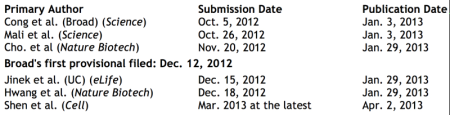
    The brief also asserts as another major theme that the Board erred for not considering contemporaneous evidence of "simultaneous invention," providing a tabulation of the scientific publications that appeared in the art just before and just after Broad's first-filed provisional application:

    Table
    The presence of this art "can be compelling evidence" of obviousness (the inverse of long-felt need and failure of others) as a secondary consideration, and Berkeley argues that the Board committed legal error in failing to properly consider this evidence.  The Board did consider this evidence, of course, but only to support its appreciation that there was express motivation in the art to apply CRISPR to eukaryotic systems, not to support Berkeley's contention that the skilled worker would have had a reasonable expectation of success.

    With regard to the question of expectation of success, the brief argues that this evidence of contemporaneous "invention" by several other groups, and the conventionality of the methods used by these groups (and Broad) in using CRISPR in eukaryotes is strong evidence that this accomplishment required no "innovation" and no "invention" independent of Professors Doudna and Charpentier's disclosure of CRISPR in prokaryotes (in the Jinek 2012 paper published prior to Broad's earliest provisional filing date).

    The brief asserts that the Board misinterpreted the scientifically cautious statements by Professor Doudna and other Berkeley experts regarding whether CRISPR was "expected" to be operative in eukaryotic cells.  The "fundamental error" in the Board's consideration of these statements was that they were "imbue[d] . . . with significance divorced from the context in which they were made," which was not as an opinion regarding whether there was a reasonable expectation of success that CRISPR would be operative in eukaryotic cells according to the brief.  Taken as a whole, according to the brief, the prior art establishes that the skilled worker would have had a reasonable expectation of success in using CRISPR in eukaryotes.

    The brief also faults the Board for not considering a provisional application by Kim (U.S. Provisional Application No. 61/717,324, filed October 23, 2012, and later published as U.S. Application No. 14/685,568) as prior art under 35 U.S.C. §102(e).  (In many ways this is the brief's strongest argument, because this reference is clearly prior art to the earliest-filed Broad provisional, and Berkeley has a strong argument that the Board not considering it was legal error.)

    Finally, Berkeley argues that Broad had not shown that it was entitled to the December 12, 2012 filing date of its earlier provisional.  According to the brief, the Board should have considered October 15, 2013 as the relevant "end date" for considering prior art; if it had done so, many of the references not considered by the Board (set forth in the table above) would have made it impossible for Broad to satisfy its burden of proof that its claims were not obvious.  Instead, the brief contends that the Board "assume without analysis" that Broad was entitled to its December 12, 2012 first provisional filing date for its "hundreds of involved claims," a conclusion Berkeley contends was error.

    Broad will have the opportunity to make its arguments in favor of the Board's decision in the coming months; oral argument should be scheduled for some time before the end of the year.

  • By Michael Borella

    USPTO SealPetitioner Cloud9 requested covered business method (CBM) review of IPC's U.S. Patent No. 8,189,566 before the USPTO's Patent Trial and Appeal Board.  Due to the claims of the '566 patent not reciting a financial element, the Board denied the petition.

    The '566 patent is directed to a trading turret system.  As described in the patent's specification:

    A trading turret system is a specialized telephony switching system that allows a relatively small number of users to access a large number of external lines and provides enhanced communication features such as hoot-n-holler, push-to-talk, intercom, video and large-scale conferencing.  These features are often utilized in the financial industry such as trading floor environments, as well as security/law enforcement, utilities, healthcare, and customer support (e.g., contact centers) environments.

    Claim 1 recites:

    A communication system, comprising:
        a turret switching system constructed to communicate to a Web server, a turret device, and to a remote communications device via a first communications network, the Web server being constructed to communicate to a client device via a second communications network, and the client device constructed to control switching across a plurality of lines; and
        an interface having a button sheet corresponding to a plurality of line selectors and constructed to seize a corresponding line by causing the client device to communicate a predetermined message to the turret switching system over the second communication network.

    In its substantive analysis, the Board first described the applicable law.  Particularly, the America Invents Act (AIA) defines a CBM patent as one that "claims a method or corresponding apparatus for performing data processing or other operations used in the practice, administration, or management of a financial product or service, except that the term does not include patents for technological inventions."  The Board focused on whether claim 1 is directed to a financial product or service, because if the answer to the inquiry is negative, then the issue of whether the patent is for a technological invention becomes moot.

    While the term "financial product or service" has been construed to include a large number of monetary matters, it does not include undertakings "incidental to," or "complementary to," a financial activity.  This was made clear by the Federal Circuit's opinion last year in Unwired Planet, LLC v. Google Inc.  Notably, in order for a claimed invention to be a financial product or service, a financial activity must actually be claimed.

    Cloud9 asserted that "[t]he claims recite a method and corresponding apparatus for providing software trading turrets which are utilized in the financial industry, such as trading floor environments," and cited to the specification for support of this viewpoint.  Consequently, Cloud9 contended that the '566 patent "claims an activity that is financial in nature: a communication system for trading."

    The Board disagreed.  Particularly, the Board pointed out that the claim language does not refer to a financial activity — instead, it recites a turret switching system.  Furthermore, the specification does not limit the scope of the claimed system to financial activity.  As noted above, the specification explicitly states that the system could also be used in "security/law enforcement, utilities, healthcare, and customer support (e.g., contact centers) environments."  Thus, the claim is not directed to a financial activity or an instrumentality used exclusively for financial activities.

    Even though the claimed invention could be used by traders, the Board noted that "[i]t is not sufficient that a user of the turret switching device may be a trader, where eventually the trader may use the system's communication functions to conduct work that results in a financial reward."  Further, "[t]he usefulness of the claimed communication system to traders does not make a patent covering that system a CBM patent."

    Accordingly, the Board ruled that the claims do not recite a financial element, and therefore the patent is not eligible for CBM review.

    This ruling is in line with Unwired Planet and other recent Federal Circuit and PTAB decisions.  However, it leaves open the possibility that a claimed invention not reciting financial activity, but only described as being useful for certain financial activities, would be considered appropriate for the CBM program.  In the weird world of business methods, either outcome would not be surprising.

  • CalendarJuly 31, 2017 – "Improve the Quality of Invention Disclosures through Researcher Outreach and Education" (Technology Transfer Tactics) – 1:00 to 2:00 pm (Eastern)

    August 2, 2017 – Biotechnology/chemical/pharmaceutical (BCP) customer partnership meeting (U.S. Patent and Trademark Office) – USPTO Alexandria Campus & Silicon Valley U.S. Patent and Trademark

    August 3, 2017 – "Patents and Export Control Compliance: Managing Risk and Avoiding Unintentional Violations — Minimizing Export Control Liability in Patent Application Preparation, Development and Analysis of Innovation, and Licensing" (Strafford) – 1:00 to 2:30 pm (EDT)

    August 3, 2017 – "After Lexmark: Patent Exhaustion Is Not Optional" (American Law Institute) – 12:30 – 1:30 pm (EDT)

    August 3, 2017 – "Opportunities and Pitfalls in Joint Development and Patent Licensing under the AIA" (Technology Transfer Tactics) – 1:00 to 2:00 pm (Eastern)

    August 8, 2017 – Patent Quality Chat webinar series (U.S. Patent and Trademark Office) – 12:00 to 1:00 pm (ET) on

    August 10-11, 2017 – Advanced Patent Law Seminar (Chisum Patent Academy) – Seattle, WA

    August 11-12, 2017 – Invention-Con 2017 (U.S. Patent and Trademark Office) – Alexandria, VA

    August 14-15, 2017 – Advanced Patent Law Seminar (Chisum Patent Academy) – Seattle, WA

    August 17-18, 2017 – "Advanced Patent Prosecution Workshop 2017: Claim Drafting & Amendment Writing" (Practising Law Institute) – San Francisco, CA

    September 12-13, 2017 – "Advanced Patent Prosecution Workshop 2017: Claim Drafting & Amendment Writing" (Practising Law Institute) – Chicago, IL

    ***Patent Docs is a media partner of this conference or CLE

  • USPTO SealThe U.S. Patent and Trademark Office will be offering the next webinar in its Patent Quality Chat webinar series from 12:00 to 1:00 pm (ET) on August 8, 2017.  Charles Kim, Director, Office of Petitions, and Namrata Boveja, Acting Deputy Director, Office of Petitions will introduce attendees to the Office of Petitions, highlight how petitions are used most effectively to advance patent prosecution, share best practices to avoid the need to file unnecessary petitions, and discuss options for filing your petitions electronically.

    Instructions for viewing the webinar can be found here.

    Additional information regarding the Patent Quality Chat webinar series can be found on the USPTO's Patent Quality Chat webpage.

  • ALIThe American Law Institute (ALI) will be offering a telephone seminar/audio webcast entitled "After Lexmark: Patent Exhaustion Is Not Optional" on August 3, 2017 from 12:30 – 1:30 pm (EDT).  Ira Blumberg of Lenovo; Neer Gupta of Verizon; and Elizabeth S. Weiswasser of Weil, Gotshal & Manges LLP will discuss the implications for protecting product sales and pricing after the U.S. Supreme Court's latest foray into patent law in Impression Products, Inc. v. Lexmark International, Inc.  Topics to be covered during the webcast include:

    • development of the law of patent exhaustion
    • summary of the Lexmark case
    • unanswered questions from the Lexmark case

    The registration fee for the program is $199.  Those interested in registering for the program, can do so here.