• Duke LawThe Center for Innovation Policy at Duke Law will be hosting a conference entitled "Is Administrative Review of Granted Patents Constitutional?" from 1:00 pm to 4:00 pm (ET) on September 22, 2017 at the Duke in DC Conference Facilities in Washington, DC.  Speakers include:  Donald Verrilli, Munger, Tolles & Olson; Erika Arner, Finnegan, Henderson; Paul Berghoff, McDonnell Boehnen Hulbert & Berghoff; John Duffy, University of Virginia Law School; The Hon. Timothy Dyk, U.S. Court of Appeals for the Federal Circuit (invited); Mark Freeman, U.S. Department of Justice; John Golden, University of Texas Law School; Jonathan Massey, Massey & Gail; Mike Messinger, Sterne, Kessler, Goldstein & Fox; Adam Mossoff, Antonin Scalia Law School, George Mason University; Arti Rai, Duke Law School; Greg Reilly, Chicago-Kent College of Law; Hans Sauer, Biotechnology Industry Organization; James Smith, Ecolab (former Chief Judge, PTAB); Rob Sterne, Sterne, Kessler, Goldstein & Fox; John Thorne, Kellogg, Hansen, Todd, Figel & Frederick; and Melissa Wasserman, University of Texas Law School.

    Additional information regarding the conference can be found here.  Those interested in registering for the conference can do so here.

  • The Knowledge GroupThe Knowledge Group will offer a live webcast entitled "Patent Infringement: Significant Developments in 2017 and Beyond" on September 15, 2017 from 3:00 to 5:00 pm (EST).  Donald R. McPhail of Taft Stettinius & Hollister LLP, Richard W. Hoffmann of Reising Ethington P.C., and Edward O'Connor of Avyno Law P.C. will provide attendees with an overview of patent infringement involving the latest developments patent holders must be aware of.  The panel will cover the following topics:

    • Patent Infringement Cases in 2017
    • Comparison of 2016 and 2017 Cases
    • Patent Litigation Trends
    • Recent Developments
    • What Lies Ahead

    The registration fee for the webcast is $99.  Those interested in registering for the webinar can do so here.  Additional information regarding the webinar can be found here.

  • By Kevin E. Noonan –

    The Patent Trial and Appeal Board of the U.S. Patent and Trademark Office recently issued a Final Written Decision in an inter partes review styled Mylan Pharm. v. AstraZeneca AB affirming the patentability of all challenged claims.  In its opinion, the Board provided a detailed example of how the Office is applying the law of chemical obviousness ten years after the Supreme Court's latest pronouncement on obviousness in KSR Int'l.  v. Teleflex, Inc. (2007).

    The challenged patent was RE44,186, a reissue of U.S. Patent No. 6,395,767.  The patent was reissued to add narrower claims specifically directed to saxagliptin, sold by AstraZeneca as Onglyza and Kombiglyze XR (the drug was originally developed by Bristol-Myers Squibb and then sold to AstraZeneca).  The challenged claims (claims 1, 2, 4, 6–22, 25–30, 32–37, and 39–42) were directed to a specific class of "cyclopropyl-fused pyrrolidine-based inhibitors of dipeptidyl peptidase IV (DP-4)" as well as methods for treating diabetes.  This biological effect stems from inhibiting glucagon, which stimulates insulin secretion as well as increasing satiety and slowing gastric emptying.  Saxagliptin is recited in claim 25, which is representative, and has the following structure:
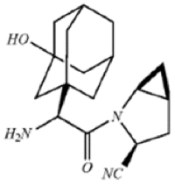
    Image 1and the chemical name (1S,3S,5S)-2-[(2S)-2-amino-2-(3-hydroxy-1-adamantyl) acetyl]-2-azabicyclo[3.1.0]hexane-3-carbonitrile.

    Mylan Pharmaceuticals filed the initial petition and was later joined by Wockhardt Bio AG, Teva Pharmaceuticals USA, Inc., Aurobindo Pharma USA Inc., and jointly by Sun Pharmaceuticals Industries, Ltd., Sun Pharma Global FZE, and Amneal Pharmaceuticals LLC.  The Board initially refused to institute the petition, but upon Mylan's petition for rehearing, the Board reversed itself and instituted the IPR on obviousness grounds.  Concurrent, consolidated ANDA litigations ended in judgment for AstraZeneca:

    AstraZeneca AB v. Mylan Pharmaceuticals Inc., 14-cv-00696 (D. Del. 2014);
    AstraZeneca AB v. Mylan Pharmaceuticals Inc., 14-cv-00094 (D.W. Va. 2014);
    AstraZeneca AB v. Aurobindo Pharma Ltd. et al., 14-cv-01469 (D. Del 2014);
    AstraZeneca AB v. Aurobindo Pharma Ltd. et al., 14-cv-00664 (D. Del 2014);
    AstraZeneca AB v. Actavis Laboratories FL, Inc., 14-cv-01356 (D. Del. 2014);
    AstraZeneca AB v. Sun Pharma Global FZE et al., 14-cv-00694 (D. Del. 2014);
    AstraZeneca AB v. Amneal Pharmaceuticals LLC., 14-cv-00697 (D. Del. 2014);
    AstraZeneca AB v. Wockhardt Bio AG et al., 14-cv-00696 (D. Del. 2014); and
    AstraZeneca AB v. Watson Laboratories, Inc., 14-cv-00666 (D. Del. 2014)

    The Board held an oral hearing on January 25, 2017 and delivered its opinion slightly longer than one year from the institution decision (May 2, 2016).

    Petitioners asserted seven references in support of their obviousness contentions; one reference (Ashworth I) discloses a compound that the Board considered as the "lead compound" in the prior art for their obviousness analysis under § 103(a).

    The claims were construed according to their ordinary and accepted meaning in the art under the broadest reasonable interpretation standard; there was no specific construction urged by the parties.  There was also no disagreement as to the level of ordinary skill in the art, nor was there any challenge to the parties' experts on this basis,

    The Board noted that it gave more weight to the Patent Owner's expert (Dr. Ann E. Weber), because she had more experience at the relevant time (when the application was filed in 2000), whereas Petitioners' expert's (Dr. David P. Rotella) experience arose during his employment at BMS during the development of saxagliptin (i.e., after that compound had been chosen for further development).  In addition, the Board considered Dr. Weber's experience in developing DP4 inhibitors for Merck, where she developed the first DP4 inhibitor for diabetes (sitagliptin) on the market.  This experience was relevant to the Board inter alia because Dr. Weber had chosen a different lead compound to develop than the Ashworth I compound Petitioners relied upon for their obviousness arguments.

    In its analysis, the Board applied the "lead compound" approach in assessing obviousness.  This constitutes a two-pronged inquiry: first, determining whether the prior art would have led the skilled worker to one or more lead compounds for further development; and then whether there was sufficient reason for the skilled worker to have modified that lead compound to the claimed compound with a reasonable expectation of success that the compound would have the desired properties (here, for the treatment of diabetes), citing Otsuka Pharm. Co., Ltd., v. Sandoz, Inc., 678 F.3d 1280, 1291–92 (Fed. Cir. 2012).  Merely identifying each feature of the claimed compound in the prior art isn't enough, according to the opinion, because the assessment is on the prior art as a whole, citing Eli Lilly and Co. v. Zenith Goldline Pharm., Inc., 471 F.3d 1369, 1379 (Fed. Cir. 2006).  Prior art that provides only general guidance isn't sufficient to satisfy this standard, under In re Cyclobenzaprine Hydrochloride Extended–Release Capsule Patent Litigation, 676 F.3d 1063, 1073 (Fed. Cir. 2012).

    For saxagliptin the features of the molecule considered in this analysis (per the Patent Owner) were the following:
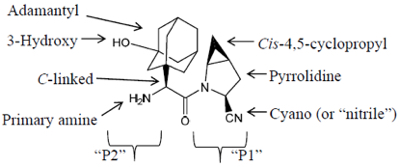
    Image 2
    The Ashworth I compound to which these features were compared had the structure:
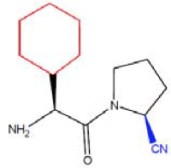
    Image 3
    This compound was characterized as being "a glycyl moiety having a primary amine (NH2), a cyclohexyl group on the β-carbon (2-position) of the glycyl moiety, and a pyrrolidine ring having a cyano (nitrile) group, designated here as CN."  Accordingly, the Board characterized the differences between this compound and saxagliptin stating "the structure of saxagliptin (claim 25) differs from [the Ashworth I] compound [] in having 3-hydroxyl adamantyl in place of the cyclohexyl group and a cyclopropyl fusion of the pyrrolidine ring."

    The first question addressed by the Board was whether the Ashworth I compound would have been used as the lead compound by the skilled worker.  The Board determined that Petitioners did not establish by a preponderance of the evidence that Ashworth I would be chosen as a lead compound.  The basis for this decision was that Ashworth I did not provide in vivo evidence and the in vitro results reported in the reference were carried out at room temperature (not tested in humans).  Further, the Ashworth I reference itself stated that further work needed to be done and there were known stability and potential toxicity problems with the compound.  In addition, further work by Ashworth showed that those researchers developed other compounds instead, including ones having a sulfur atom substitution at the 4 position of the proline ring.

    The Board noted that the only prior art DP4 inhibitors that had advanced to clinical trials in humans were:

    Image 4
    (where P32/98 was the compound identified by Patent Owner's expert as a lead compound).  A comparison of these compounds led the Board to distinguish "N-linked" compounds (as in NVP-DPP728, where the alkyl group is directly attached to the amine) and "C-linked" compounds (as in P32/98), where the alkyl group is linked to the carbon atom adjacent to the amine.  Both these compounds did not have the stability issues known for the Ashworth I compound.  In addition, while both these compounds were recognized in the prior art as being less potent than the Ashworth I compound they, and not it, were advanced to human clinical trials.

    Not only did these facts support Patent Owner's expert that the Ashworth I compound would not have been chosen as a lead compound by the skilled worker, but the Board credited her testimony based on her contemporaneous experience in not choosing the Ashworth I compound for further derivation when she was at Merck.

    Even if the Board accepted the Ashworth I compound as the lead compound the Board found that Petitioners had not established by a preponderance of the evidence that the skilled worker had sufficient reason to modify that compound to produce saxagliptin.  There were three modifications recognized by the Board as asserted by Petitioners:

    1. adding a cyclopropyl ring to the pyrrolidine portion of thee Ashworth I compound in the 4S,5S configuration;
    2. replacing the 6-carbon cyclohexyl group at the P2 position with a 10-carbon adamantyl moiety; and
    3. hydroxylating the adamantyl moiety.

    With regard to the first modification, Petitioners relied on a reference to Hannesian that fusing cyclopropane to the proline ring "flattens" the ring and increases stability.  Petitioners argued that the instability of the Ashworth I compound was known to involve intramolecular cyclization that would be reduced by this modification.  The Board found that Petitioners' position was not supported by the art (citing many examples wherein this portion of the molecule was sensitive to changes, i.e., had reduced potency when altered), and that Petitioners had not shown that the skilled worker would have had a reasonable expectation for success in producing a stabilized derivative of the Ashworth I compound by fusing a cyclopropane group to the proline ring as in saxagliptin.  Indeed, Petitioners' expert admitted that "that there wasn't anything in the literature prior to the invention of saxagliptin that actually suggested that cyclopropanation of an Ashworth I type DPP4 inhibitor would improve its stability."  He additionally testified to the unknown effects in making this modification, and that such modifications were in the nature of "exploring" what their effects might be, inconsistent with a finding of reasonable expectation of success as urged by Petitioners.  (The Board considered this equivalent to the proscription in In re O'Farrell, 853 F.2d 894 (Fed. Cir. 1988), regarding teachings to experiment in a field being not sufficient to support obviousness even when an invention might have been obvious to try.)  Similar considerations led the Board to conclude that there was no reasonable expectation of increased potency by making this modification.  These conclusions were supported by Patent Owner's expert's testimony regarding the unpredictability of these modifications (the Board cited testimony that this expert was "surprised" when she became aware of the modification and also surprised that it worked).

    The second modification, replacing the cyclohexyl group for an adamantyl group, was also not supported by the cited art in the Board's opinion.  Compounds with similar properties in the art had lower potencies, and the art did not teach more generally the use of "bulky" substituents to increase stability (by reducing cyclization).  In particular, the cited art related to N-linked not C-linked substituents:
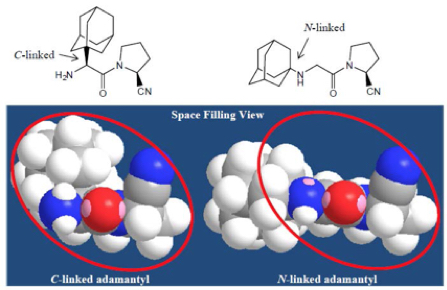
    Image 5
    The differences in shape of the resulting molecules supported the Board's disregard for the relevance of these prior art teachings, as well as its appreciation that the secondary amine disclosed in the prior art would be expect to be less available for cyclization and thus more stable.

    Regarding the final alteration, hydroxylating the adamantyl moiety, Petitioners argued that this modification would be expected to increase stability and bioavailability because, inter alia, this version was a "metabolite" of the adamantyl moiety.  The Board opined that Petitioners' proposed basis for the modification did not have the requisite reasonable expectation that such a modification would improve stability or bioavailability of the molecule, based in part on Petitioners' arguments being made with regard to adamantane rather than the adamantyl group in saxagliptin.

    Finally, the Board considered whether the evidence supported a determination that the skilled worker would have been motivated to make all these modifications together and have a reasonable expectation of successfully producing a DP-4 inhibitor having increased stability and potency as an anti-diabetic agent.  In part, this determination was based on there being insufficient evidence of the skilled worker's expectation making one modification after another on each intermediate modified product.  "In other words, Petitioners do not show that a skilled artisan would have reasonably expected that the combined modifications would have been successful based on the predictability of the individual modifications," as the Board stated in its opinion.

    Finally, the Board looked at the objective indicia or secondary considerations of non-obviousness.  Patent Owner asserted the following: 1) failure of others; 2) saxagliptin's properties were unexpected and unpredictable; 3) saxagliptin met a long-felt need; and 4) saxagliptin is commercially successful.

    Regarding failure of others, the Board found that failure of other DP-4 inhibitor compounds to obtain FDA approval (given the number of them) supported non-obviousness for saxagliptin.

    As for unexpected results Patent Owner asserted:

    1) extended, slow, tight binding; 2) improved chemical stability under physiologic conditions; 3) an active metabolite that extends in vivo efficacy; 4) an extended pharmacodynamic profile; 5) formation of favorable binding interactions with DPP-4; and 6) the ability to use a low once-daily dosing regimen to safely and effectively treat patients with type-2 diabetes.

    These arguments were persuasive to the Board.

    Regarding long-felt need, the Board found this factor also supported non-obviousness, despite there being other DP-4 inhibitor compounds in the art.

    Finally, the Board was not convinced that the commercial success factor was satisfied, based on alternative bases for this success as advocated by Petitioners (discounts, market share analysis).

    The panel hearing this IPR comprised Vice Chief Administrative Patent Judge Michael Tierney and APJs Rama Elluru and Christopher Paulraj.  The opinion was written by Judge Elluru with a concurring opinion by Judge Tierney.

  • By Juan Luis Serrano* —

    COFECEIn the first three installments of this series, we've explained the general purpose of the study, and gone through the sections of patents, marketing authorizations and strategic behavior of the study published on August 9, 2017 by the Federal Commission for Economic Competition[1].  For this fourth installment, we'll go through the first eight recommendations that COFECE issues to provide better conditions for generic drug competitions.

    For the purposes of this series, we'll refer to Mexican authorities by their acronyms; COFECE for the antitrust body, COFEPRIS for the regulatory authority, and IMPI for the patent office.

    Let's review the main contents of each recommendation by COFECE.

    "1. COFEPRIS should specify, in the list of reference drugs, the specific patents covering the drug and their expiry date, in order to provide transparency to the linkage and patent protection system.  COFEPRIS can create this list with information on patents to be provided by IMPI through a government offices inquiry."

    I consider that the idea here is correct, but it's missing a) the involvement by the patent holder, to tell the government precisely which patents are relevant to an approved reference drug, and b) a possibility for both the patent holder and the generic drug applicant to be heard on the possible invasion/invalidity of patent rights during the marketing authorization proceeding.

    An analysis could also be made on whether our Country should provide an incentive to the generic applicant to initiate an invalidity action, such as the 6-month period granted in the U.S.

    "2. IMPI and the Ministry of health should jointly evaluate the convenience of including in the Industrial Property Law regulations a limitation on the granting of secondary patents, as has been done in other countries.

    This recommendation substitutes those which are meant to provide transparency to the linkage system, and it may end up being redundant if the linkage system is improved".

    This recommendation seems to need a lot more work in order to be duly supported; whereas it is correct that some countries have indeed limited the patentability of some inventions, this should be done not just as an isolated decision, but as a full policy analysis on incentives to innovate versus generic drug competition.

    In addition, I do not agree with the argument of this recommendation being "substitute" of transparency in a linkage system.  Said transparency is necessary regardless of patentability standards, and the recommendation to limit certain patents would have a bigger impact on entry times for competing products, for obvious reasons.

    "3. Establish explicit restrictions to the linkage system in order for patents registered (sic) after the marketing authorization for a reference product is granted will not be considered for linkage analysis for the same reference product.

    This does not limit laboratories from using their patents – granted after the reference product marketing authorization has been approved – to develop second generation, or other types of drugs."

    The proposed restrictions have some sense to them, when one considers that drugs in the reference product list are the benchmark for generics to imitate.  It would be necessary however, to determine the situation with patent applications filed before the reference product designation, but granted afterwards.

    "4. COFEPRIS should grant a new marketing authorization when a laboratory requests the modification of an authorization for a reference drug, based on a marginal improvement which is associated with a new patent, that will expire after those patents granted when the initial authorization was issued.

    The registration of the original reference product would stay in force after patent expiration, in order for generic products to use it as reference.

    The purpose of this proposal is to prevent marginal innovations over a reference drug with a patent close to expiration to create an obstacle to the entry of generic products which reference the original drug, as said innovations are commonly associated to the registration (sic) of new patents".

    The main problem with this recommendation is the term "marginal innovations", which is not defined, and will certainly be seen as negative by patent holders.  Otherwise, the idea of having more than one reference product makes sense as patent infringement situations would be avoided.

    "5. COFEPRIS should promote the use of the Bolar exception through the publication of rules and criteria under which it can be requested, and periodically publish the list of innovative drugs for which patents will expire in the following 3 years."

    This is a clear reference to the orange book rules, which allow a generic drug applicant to request "paragraph III certifications" for marketing authorizations to be issued right after patent expiration.  This seems to be a positive policy recommendation.

    "6. COFEPRIS should finish completing the database of marketing authorizations and make it available online, to the public, with information beyond five years, and to keep said database updated.  The database must include public information on consultations to IMPI and response times by COFEPRIS.

    This information will provide transparency to the process of market entry, and will remove discretional spaces which may provide incentives for unnecessary entry obstacles."

    This is a welcome recommendation, which has been expressed before COFEPRIS by both innovator and generic drug companies.  The database has not been updated in years, and the current situation forces companies to go through transparency requirements which can take 2 months before a response is issued.

    "7. COFEPRIS should guarantee and communicate that the process of marketing authorization is done in a first in – first out basis, and not accumulate the issuance of the authorizations in packages or batches.

    This mechanism looks to benefit the laboratory that filed an earlier application, which constitutes an incentive to take advantage by having market presence.  The current strategy by COFEPRIS is the announcement of release of marketing authorizations in "package" forms, which does not generate adequate incentives for generic manufacturers to take a lead over competitors upon filing."

    This recommendation makes a lot of sense.  The marketing authorizations should be issued as soon as they are ready, and the current practice could be substituted with announcement of those authorizations issued in the previous semester/year.

    "8. COFEPRIS should issue technical criteria for the consideration that the generation of clinical data by an applicant represents "considerable effort."

    This measure seeks to close the door on litigation generated on alleged violations to clinical data protection.

    This recommendation appears to oversimplify a complex issue, which derives from international treaty obligations and which is not properly regulated in our laws.

    Currently, as mentioned in the study, clinical data protection is established as an obligation in NAFTA and TRIPS.  COFEPRIS issued an internal memorandum in 2012 which refers to this form of protection, but that document does not constitute a mandate and is certainly not the proper way to regulate a granted right.

    On the "considerable effort" side, there are varying positions in other countries:  In broad terms, the U.S., Canada and Europe consider that simply by obtaining a new drug product registration considerable effort was present in the clinical trials process.  In contrast, countries such as Colombia have tried to establish criteria (such as the amount of money spent) to determine if the effort was indeed considerable and thus if it merits protection.

    I think that the study addresses the problem from the wrong angle.  If the intention is to avert litigation proceedings, transparency on specific periods of protection for all interested parties will do more than a high or low bar on what is considerable effort.


    In Parts V and VI of the series on the COFECE study, we will analyze the sections on "insufficient response from the demand side" which refers to information available to physicians and patients and "Entry of generic drugs to public procurement processes".

    * Mr. Serrano is Of Counsel with ROMO DE VIVAR V.IP SERVICES, S.C.

  • Telecommunication Call Processing System Held to Be Eligible for Covered Business Method (CBM) Patent Review

    By Joseph Herndon

    USPTO SealOn August 3, 2017, the U.S. Patent and Trademark Office Patent Trial and Appeal Board (PTAB) issued a decision instituting a Covered Business Method (CBM) patent review of U.S. Patent No. 7,783,021.  In this case, Securus Technologies, Inc. ("Petitioner") filed a Petition requesting a CBM review of the patent, owned by Global Tel*Link Corp. ("Patent Owner").

    Under the statute 35 U.S.C. § 324, a CBM patent review may not be instituted unless the information presented in the Petition demonstrates "that it is more likely than not that at least 1 of the claims challenged in the petition is unpatentable."  For the present case, the PTAB determined that the information presented in the Petition established that the '021 Patent qualifies as a CBM patent that is eligible for review, and that it is more likely than not that the challenged claims are unpatentable under 35 U.S.C. § 103.  Here, we review the decision of whether the patent is in fact a CBM patent eligible for review.  (The determination of whether the patent is more likely than not unpatentable under 35 U.S.C. § 103 was made by comparing to five asserted prior art references, and is not addressed here).

    The '021 Patent

    The '021 Patent generally relates to telephone communication systems in penal institutions or similar facilities, specifically directed to systems with the capacity to allow the institutions to control, record, monitor, and report usage and access to a telephone network.  In one disclosed embodiment, the system allows an investigator to covertly monitor an inmate's conversation for suspicious activity.

    The '021 Patent describes that a platform may include a site server, which serves as the main database for the telephone management system.  It has the ability to log and record details of all telephone calls placed through the system and store them.  The site server also digitizes all information and may include a recorder for recording the telephone calls and storing them in one or more databases.  User identification and authentication means described by the '021 Patent provide access to the telephone management system using PIN verification and biometric data verification.  For example, biometric data may include voiceprints, facial architecture, signature architecture, fingerprints, retinal prints, hand geometry, and the infrared pattern of the face.

    In the Background of the Invention section of the '021 Patent, several prior art issues are addressed, such as to prevent such institutions from incurring unaccountable telephone costs, the institutions must either restrict access to outbound telephone lines or employ a telephone monitoring system to charge the responsible party for making the outbound communication, and in order for a system to be cost effective the system must critically monitor and record the activities of each individual user to properly charge each individual caller for his or her outgoing calls.

    Of the claims challenged, claims 1, 7, 16, and 20 are independent claims.  Independent claim 1 is illustrative of the challenged claims and is reproduced below:

    1.  An inmate telecommunication call processing system comprising:
        a plurality of trunk lines of a Public Switched Telephone Network (PSTN);
        at least one telephone terminal for making a telephone call, wherein said telephone terminal is located onsite at an institution;
        a central platform coupled to said plurality of trunk lines and coupled to said at least one telephone terminal for said telephone call, wherein said central platform is located offsite from said institution, and further wherein said central platform comprises one or more apparatuses for processing said telephone call;
        an administrative workstation for connecting to a said telephone terminal to monitor conversations between said institution without detection by said user; and
        at least one routing means coupled to said telephone terminal and said central platform;
        wherein said one or more apparatuses controls telephonic communication between said at least one telephone terminal and said plurality of trunk lines,
        wherein said one or more apparatuses records said conversations in said telephone call between a user associated with said at least one telephone terminal and an external party, and
        further wherein said one or more apparatuses digitizes audio and stores said audio for caller identification at said institution, and
        further wherein said one or more apparatuses communicates with an administrative workstation for billing regarding said telephone call originating from said institution.

    CBM Standing

    Section 18 of the AIA governs CBM patent reviews and limits such reviews to persons, or their privies, that have been sued or charged with infringement of a CBM patent.

    The '021 Patent is the subject of a patent infringement suit brought by Patent Owner vs. Petitioner, and thus, a first prong for CBM standing is met.

    For the second prong, a "covered business method patent" is a patent that "claims a method or corresponding apparatus for performing data processing or other operations used in the practice, administration, or management of a financial product or service, except that the term does not include patents for technological inventions."  AIA § 18(d)(1).

    1.  Financial Product or Service

    The Federal Circuit has recognized that as a matter of statutory construction, the definition of CBM patent is not limited to products and services of only the financial industry, or to patents owned by or directly affecting activities of financial institutions.  But the statutory definition of a CBM patent requires that the patent have a claim that contains, however phrased, a financial activity element.

    The claims specificly recite billing functions, and thus, the burden was on the Patent Owner to show that the claims are somehow not directed to a "financial service".  The Patent Owner contended that billing here was merely an incidental or a complementary activity for receipt of telecommunication services.

    But the PTAB disagreed.  Specifically, claim 1 recites, in part, "wherein said one or more apparatuses communicates with an administrative workstation for billing regarding said telephone call originating from said institution."  The PTAB found that specifically billing users is a financial service, and that nothing in the record indicates the system of the '021 Patent would or should be implemented without billing.  Thus, the billing activity is not incidental or complementary to other services.  As a result, the claims were found to satisfy the "financial product or service" component of the definition for a CBM patent set forth in § 18(d)(1) of the AIA.

    2.  Technological Invention

    The definition of a CBM patent in § 18(d)(1) of the AIA does not include patents for "technological inventions."  When determining whether a patent is for a technological invention, the PTAB considers:  "whether the claimed subject matter as a whole [(1)] recites a technological feature that is novel and unobvious over the prior art; and [(2)] solves a technical problem using a technical solution."  37 C.F.R. § 42.301(b).

    For the technological invention exception to apply, both prongs (1) and (2) of the inquiry must be met affirmatively, meaning that a negative answer under either prong renders inapplicable the technological invention exception.

    In this case, the PTAB found that neither prong of the technological invention inquiry was met.

    Petitioner argued that the '021 Patent claims do not recite any technological feature that is novel or unobvious over the prior art, or that solves a technical problem using a technical solution.  Pet. 19–20 (citing Ex. 1002 ¶¶ 100–13).  Petitioner contended that the claims recite known technologies, such as telephone and computer networks, with no technical innovation over the prior art, such that the claims can be carried out using conventional software and hardware components.  Id. at 19–25.

    Patent Owner pointed out that each claim recites "an administrative workstation" that monitors conversation or connects a call "without detection."  Patent Owner continued that the inventive software provides a means for patching into a call using circuitry without alerting the user or called party to the operator's presence.  Additionally, Patent Owner argued that the technical problem of the need to monitor, control, record and provide detailed records of the usage of a telephone system in a controlled institutional environment, is solved using an inventive combination of hardware and novel software.

    But the PTAB found that the challenged claims only generically recite an "inmate telecommunication call processing system," which is not specific or unconventional.  Merely reciting known technologies and their use to accomplish an otherwise non-technological method does not render the challenged claims a technological invention.

    The PTAB also found that the challenged claims do not involve a technical solution to a technical problem.  The challenged claims seek to solve the problems of monitoring of inmate calls, but the '021 Patent, however, does not describe specifically any technical issues presenting a technical problem to be solved.  The PTAB stated that the claimed solution –– to monitor conversations between said institutions without detection by said user –– is recited more as a fait accompli than a technical solution.

    Thus, the claims were found to satisfy the definition for a CBM, and the technological invention exception did not apply.  Accordingly, the '021 Patent was found to be eligible for review under the transitional program for covered business method patents, and a CBM review as to all the challenged claims was instituted.

    The result is not surprising, given that the claim specifically recites "billing" as a function to be performed.  It is curious to consider, however, whether the term "billing" was/is needed in the claim.  Billing is really referring to invoicing, or more generally, record-keeping so as to enable invoicing.  Thus, could the claim element have been phrased "wherein said one or more apparatuses communicates with an administrative workstation for billing keeping records regarding said telephone call originating from said institution"?

    In addition, the term "administrative" workstation has somewhat of a financial institution feel to it, and that term "administrative" is likely unnecessary as well.  It does not provide any further structural or functional connotation to the "workstation".  Generally then, it would seem this claim may have been able to be drafted to avoid CBM jurisdiction while still covering the technical features of the invention.

    Before Administrative Patent Judges Kevin F. Turner, Barbara A. Benoit, and Georgianna W. Braden
    Decision by Administrative Patent Judge Turner

  • By Adrian M Trioli* & Noelene Treloar** —

    Australian FlagThe Australian Full Federal Court's recent decision in Commissioner of Patents v AbbVie Biotechnology Ltd [2017] FCAFC 129 confirms that an extension of patent term for pharmaceutical substances does not extend to Swiss type claims.

    The decision highlights that Swiss type claims do not fall within the relevant legislative provisions for patent term extensions under (i) section 70 (2)(a) for a pharmaceutical substance per se, or (ii) section 70 (2)(b) for a pharmaceutical substance when produced by a process that involves the use of recombinant DNA technology.

    Background:

    Section 70(2)(b) of the Patents Act 1990 (Cth) (the Patents Act) allows for the term of a standard patent to be extended in circumstances where one or more pharmaceutical substances, when produced by a process that involves the use of recombinant DNA technology, must in substance be disclosed in the complete specification of the patent and in substance fall within the scope of the claim or claims of that specification.

    AbbVie Biotechnology Ltd (AbbVie) is the patentee of three (3) Australian patents directed to use of its blockbuster drug adalimumab, marketed under the brand name Humira™.  The drug has been successful in the treatment of diseases including rheumatoid arthritis, rheumatoid spondylitis, Chrone's disease and ulcerative colitis.

    AbbVie sought an extension of term to its Australian patents in accordance with section 70(2)(b) of the Patents Act.  In August 2015, the Deputy Commissioner of Patents denied the extension of term request on the basis that the condition in section 70(2)(b) had not been satisfied as the relevant patent claims were directed to a therapeutic use of adalimumab, and not directed to the pharmaceutical substance when produced by a process that involves the use of recombinant DNA technology.

    AbbVie appealed the decision to the Administrative Appeals Tribunal, and the Tribunal set-aside the Deputy Commissioner's decision.  The Deputy Commissioner appealed to the Full Federal Court.

    Full Federal Court Decision:

    The Full Federal Court of Australia held that adalimumab is a pharmaceutical substance produced by recombinant DNA technology.  However, the relevant patent claims were Swiss type claims directed to (i) a method or process in which adalimumab is used to produce a medicament, and (ii) a medicament containing adalimumab that is to be used for specific therapeutic purposes.  As such, the Swiss type claims were use claims (or characterised as method or process claims) and therefore did not meet the requirements of section 70(2)(b) that require product claims.  The extension of patent term from 20 years to 25 years in Australia was thereby denied.

    * Adrian M Trioli, Principal, Adrian M Trioli Patent and Trade Mark Attorney
    ** Noelene Treloar, Of Counsel, Adrian M Trioli Patent and Trade Mark Attorney

  • CalendarSeptember 6, 2017 – "Sovereign Immunity as Inter Partes Defense: Legal Guidance and Analysis of Impact on Licensing" (Technology Transfer Tactics) – 1:00 to 2:00 pm (Eastern)

    September 12, 2017 – "Addressing and Understanding the Significant Developments and Latest Decisions on Patent Eligibility" (The Knowledge Group) – 3:00 to 5:00 pm (EST)

    September 12, 2017 – "How Can the Patents Ombudsman and Pro Se Assistance Programs Work For You?" (U.S. Patent and Trademark Office) – 12:00 to 1:00 pm (ET)

    September 12-13, 2017 – "Advanced Patent Prosecution Workshop 2017: Claim Drafting & Amendment Writing" (Practising Law Institute) – Chicago, IL

    September 13, 2017 – "Patent Litigation 2017 — The Courts and Patent Trial and Appeal Board" (Federal Circuit Bar Association) – 10:45 am to 3:10 pm (EDT), Wilmington, DE

    September 13-15 – FDA Boot Camp (American Conference Institute) – Boston, MA

    September 14, 2017 – "Patent Cooperation Treaty: Evaluating the Benefits and Risks, Obtaining International Patent Protection — Navigating the PCT, Priority, Selection of International Authorities, PCT Search and Examination, and More" (Strafford) – 1:00 to 2:30 pm (EDT)

    September 14, 2017 – "Private Right or Public Right? Preview of Oil States at the U.S. Supreme Court" (Intellectual Property Owners Association) – 2:00 to 3:00 pm (ET)

    September 14-15, 2017 – "International Patent Prosecution and Practice Seminar" (John Marshall Law School Center for Intellectual Property, Information & Privacy Law, World Intellectual Property Organization, and Kuhnen & Wacker) – Chicago, IL

    September 19, 2017 – "The Continuing Influence of PTAB Proceedings on Bio/Pharma Litigation" (McDonnell Boehnen Hulbert & Berghoff LLP) – 10:00 am to 11:15 am (CT)

    September 19, 2017 – "Best Practices for Safeguarding University IP When Structuring Deals in China" (Technology Transfer Tactics) – 1:00 to 2:30 pm (Eastern)

    September 21-22, 2017 – Seminar on European Patent Law (Grünecker) – Munich, Germany

    October 2-3, 2017 – Paragraph IV Disputes master symposium*** (American Conference Institute) – Chicago, IL

    ***Patent Docs is a media partner of this conference or CLE

  • MBHB Logo 2McDonnell Boehnen Hulbert & Berghoff LLP will be offering a live webinar entitled "The Continuing Influence of PTAB Proceedings on Bio/Pharma Litigation" on September 19, 2017 from 10:00 am to 11:15 am (CT).  In this presentation, MBHB attorneys Alison J. Baldwin and Paula S. Fritsch, Ph.D. will discuss the following topics:

    • A look at who is using PTAB proceedings to challenge bio/pharma patents;
    • An analysis of how PTAB proceedings are impacting ANDA and biosimilar litigations;
    • A review of how bio/pharma patents have fared before the PTAB;
    • A discussion of strategies for petitioners and patent owners in IPRs challenging bio/pharma patents; and
    • A discussion of how the Supreme Court's decision to grant cert in Oil States Energy Services will impact PTAB invalidity proceedings in the bio/pharma space.

    While there is no fee to participate, attendees must register in advance.  Those wishing to register can do so here.  CLE credit is pending for the states of California, Illinois, New Jersey, New York, North Carolina, and Virginia.

  • IPO #2The Intellectual Property Owners Association (IPO) will offer a one-hour webinar entitled "Private Right or Public Right? Preview of Oil States at the U.S. Supreme Court" on September 14, 2017 from 2:00 to 3:00 pm (ET).  William Jay of Goodwin Procter LLP, Prof. Adam Mossoff of George Mason University, and Kent Richland, Greines of Martin, Stein & Richland LLP will offer a uniquely informed and balanced discussion of the Oil States case.  The panel includes a patent professor who is strongly identified through his writing and research with the argument that patents are private rights; a top Supreme Court litigator who recently argued on behalf of an IPR petitioner in a recent petition for cert. (that was denied) that the validity of a patent concerns a public right that can be cancelled by the agency that erroneously granted the patent; and an appellate lawyer who argued a 2011 Supreme Court case, Stern v. Marshall, that concerned the constitutionality of adjudicating matters outside of Article III courts and resulted in a major disruption of bankruptcy courts.

    The registration fee for the webinar is $135 (government and academic rates are available upon request).  Those interested in registering for the webinar can do so here.

  • USPTO SealThe U.S. Patent and Trademark Office will be offering the next webinar in its Patent Quality Chat webinar series from 12:00 to 1:00 pm (ET) on September 12, 2017.  The latest webinar, entitled "How Can the Patents Ombudsman and Pro Se Assistance Programs Work For You?" will be hosted by Mindy Bickel, Associate Commissioner for Innovation Development, and Cassandra Downs, Management/Program Analyst for the Patents Ombudsman Program, who will discuss statistics of the two programs and highlight some useful tools and resources, such as the first office action estimator, MyUSPTO, and a patent application checklist.

    Instructions for viewing the webinar can be found here.

    Additional information regarding the Patent Quality Chat webinar series can be found on the USPTO's Patent Quality Chat webpage.