• Strafford #1Strafford will be offering a webcast on "Negotiating IP Rights in Industry Sponsored Research Agreements — Structuring Ownership, Licensing, Assignment, Confidentiality, Publication and Use Provisions" on September 28, 2017 from 1:00 to 2:30 pm (EDT).  Dr. Robert H. Underwood of McDermott Will & Emery and Matthew R. Wilmot of Stoel Rives will provide guidance to counsel on negotiating and structuring industry sponsored research agreements (SRAs) to allocate IP ownership, outline challenges of SRAs with nonprofit organizations, and discuss key provisions of the SRA to protect IP rights and avoid unintended consequences.  The webinar will review the following topics:

    • What are the key considerations for counsel when negotiating the SRA?
    • What are best practices for addressing IP ownership and rights in an SRA?
    • What challenges are raised by multiple licenses and how can counsel overcome those challenges?

    The registration fee for the webcast is $297.  Those interested in registering for the webinar, can do so here.

  • West LegalEdcenterWest LegalEdcenter will be offering a live webcast entitled "Patent Venue After TC Heartland: What We've Learned So Far" on September 27, 2017 from 12:30 to 1:30 pm (EDT).  Anthony J. Fitzpatrick of Duane Morris LLP, Philip C. Swain of Foley Hoag LLP, and Gregory S. Bombard of Duane Morris LLP will cover three areas for practitioners dealing with the fallout from the Supreme Court's decision in TC Heartland:

    1. The TC Heartland decision and why it was so important;
    2. Reactions to the decision, with a review of the important district court decisions so far; and
    3. The practical consequences going forward and what patent litigators should expect as a result of TC Heartland.

    The registration fee for the webcast is $170.  Those interested in registering for the webinar, can do so here.

  • The Knowledge GroupThe Knowledge Group will offer a live webcast entitled "Addressing and Understanding the Significant Developments and Latest Decisions on Patent Eligibility" on September 28, 2017 from 3:00 to 4:00 pm (EST).  Eli Mazour of Harrity & Harrity, LLP and Dr. Andrej Barbic of Proskauer Rose LLP will discuss the latest key judicial developments, including Supreme Court, Federal Circuit, and PTAB decisions related to patent eligibility, and provide insights into the impact of these developments and offer best practices for handling patent cases.  Key topics to be addressed by the webcast include:

    • Subject Matter Eligibility Update
    • Latest USPTO Patent-Eligibility Guidance
    • Key Judicial Developments
    • Supreme Court, Federal Circuit and PTAB Decisions
    • Impact to Future Cases
    • Roadmap for Practitioners

    The registration fee for the webcast is $49.  Those interested in registering for the webinar can do so here.  Additional information regarding the webinar can be found here.

  • Judge Gilstrap's Short-lived Venue Calculus

    By Kevin E. Noonan –

    Federal Circuit SealThe Federal Circuit has spent more than a decade as the Supreme Court's favorite judicial whipping boy, usually because the Court apprehended that their appellate inferior had strayed from the Court's own precedential appreciation of U.S. patent law.  One area where the Court has recently imposed judicial discipline is venue under 28 U.S.C. § 1400(b), in last term's TC Heartland LLC v. Kraft Foods Group Brands LLC, 137 S. Ct. 1514 (2017), decision.  In that case, the Court severely restricted the Federal Circuit's interpretation of the rules of patent trial venue, no doubt in large part due to the imprecations of accused infringers unhappy at being haled into court in putatively patent-friendly jurisdictions, most notably the Eastern District of Texas.  So when defendant Cray petitioned for a writ of mandamus to overturn Judge Gilstrap's decision in its patent infringement suit brought by Raytheon Company, denying its motion to transfer venue from the Eastern District of Texas to the Western District of Wisconsin (where Cray had an unrefuted corporate presence), the Federal Circuit took reliable refuge in the last place left: the language of the statute, in reversing the District Court and issuing Cray's requested mandamus writ ordering transfer.

    The facts are straightforward.  Raytheon sued Cray for infringing patents related to advanced supercomputers and Cray moved to transfer venue on the grounds that 1) it is incorporated in Washington State; 2) it has offices in Bloomington, MN, Chippewa Falls, WI, Pleasanton, and San Jose, CA, and Austin and Houston, TX (which are not in the Eastern District).  Cray's "presence" in the Eastern District is limited to two employees who work remotely from their homes.  One of these employees was a senior territory manager and the other as a sales executive (credited with an excess of $345 million in supercomputer sales).  He received compensation for expenses ancillary to his work for Cray (business use of a cell phone, Internet access, and mileage costs), but not for the use of his home.  He kept no products there or even product literature, and his home was not advertised as a Cray place of business.

    Cray argued that transfer was proper under the Supreme Court's TC Heartland decision because it had not "maintained a regular and established place of business within that district."  The District Court applied Federal Circuit precedent, In re Cordis Corp, 769 F.2d 733 (Fed. Cir. 1985), to reject Cray's motion and did not (according to the Federal Circuit's Order issued today) consider the sales representative's activities in the district.  In addition, the Court set forth a four factor test for deciding whether venue transfer in patent cases was proper with regard to establishing whether a defendant maintained a regular and established place of business in the district:

    1) Physical presence;
    2) Defendants' representation;
    3) Benefits received from presence in the district; and
    4) Targeted interactions within the district

    (although the District Court also failed to apply this purported test to the facts in this case).

    In its Order, Judge Lourie (joined by Judges Reyna and Stoll) grounded its decision on the District Court having "misunderstood the scope and effect of our decision in Cordis, and its misplaced reliance on that precedent led the court to deny the motion to transfer," which the Federal Circuit considered an abuse of the District Court's discretion.  The TC Heartland decision refocused the inquiry on satisfaction of the maintenance of a regular and established place of business in the district, which the Order notes the Cordis panel addressed but sparsely in deciding not to grant the writ.  The Order also asserts that "the world has changed" since 1985 and "not all corporations operate under a brick-and-mortar model."  But even so, the Federal Circuit asserted that it is the language of the statute that must be considered, and that consideration was not made by the Court in the Cordis case.

    Turning to the statute, the Order focused on "the only question before the court": whether Cray's activities satisfy the "regular and established place of business" requirement.  The Federal Circuit recognizes three requirements to be considered (and all of which must be satisfied for venue to be proper): "(1) there must be a physical place in the district; (2) it must be a regular and established place of business; and (3) it must be the place of the defendant."  The panel recognized that the evolution of venue law in patent cases reflects a balance between a restrictive standard (where the infringer was incorporated) and a liberal standard (wherever a defendant could be served).  The Order specifically notes that patent venue is a more restrictive standard than, for example, personal jurisdiction or general venue statutes based on "doing business" in the district.

    The Order parses the statutory language:

    The noun in this phrase is "place," and "regular" and "established" are adjectives modifying the noun "place."  The following words, "of business," indicate the nature and purpose of the "place," and the preceding words, "the defendant," indicate that it must be that of the defendant.

    And notes that "[t]he district court's four-factor test is not sufficiently tethered to this statutory language and thus it fails to inform each of the necessary requirements of the statute."

    The panel found specific instances of error in the District Court's analysis, including that "a fixed physical location" was not required, because the statute requires a "place" from which its business is conducted (relying on dictionary definitions from the time the statute was first enacted).  Important to the decision (and the modern era), the statute cannot be satisfied "merely [with reference] to a virtual space or to electronic communications from one person to another."  The Order emphasizes that there must be a specific geographical location within the district for this statutory requirement to be satisfied.

    The second specific error by the District Court identified in the Order is a failure to find that Cray's activities in the district were "regular," defined (again with reference to ancient dictionaries) as operating in "a 'steady[,] uniform[,] orderly[, and] methodical' manner" and specifically excluding "sporadic" activity.  This regularity requirement is reinforced by the "established" limitation, which the Order relates to a showing of sufficient permanence to justify venue in a district and excluding transient activity in the district and (illustrated by Knapp-Monarch Co. v. Casco Prods. Corp., 342 F.2d 622, 625 (7th Cir. 1965), regarding semiannual display of products at trade shows).  The capacity for Cray's sales representative to move his residence out of the district at any time without Cray's approval vitiates for the Federal Circuit the permanence required by the venue statute.

    Finally, the Federal Circuit's test for establishing proper venue is expressly directed at the presence of the defendant (here, Cray) and not simply the presence of an employee; after all as the Order notes, "[e]mployees change jobs."  Factors that might permit an employee's residence in the district to satisfy this prong of the test for her employer include whether continued employment was conditions on residence in the district, or whether sale items were stored so they could be distributed within the district.  Mere representations by a defendant are not enough; the defendant must actually engage in business from the location in the district.

    Applying these factors to the case, the Federal Circuit agreed with Cray that the District Court erred in not transferring the case to the Western District of Wisconsin.  For this panel, the third factor was dispositive; the facts did not support a conclusion that the employee's home was an established place of business for Cray:

    There is no indication that Cray owns, leases, or rents any portion of [the employee's] home in the Eastern District of Texas.  No evidence indicates that Cray played a part in selecting the place's location, stored inventory or conducted demonstrations there, or conditioned [either employee's] employment or support on the maintenance of an Eastern District of Texas location.  No evidence shows that Cray believed a location within the Eastern District of Texas to be important to the business performed, or that it had any intention to maintain some place of business in that district in the event [either employee] decided to terminate their residences as a place where they conducted business.

    Further relevant to the panel's decision were distinctions between the facts here and in the Cordis case, such as Cray providing no administrative of other support (such as secretarial services) within the district, nor there being any condition that its employees reside in the district to obtain such support.

    The panel is careful to note that it is not creating any bright line rules, stating that "no one fact is controlling" in making venue determinations.  But as a consequence of this decision, neither Judge Gilstrap nor any other district court judge will be able to craft venue rules (either in favor of or against either party) outside the scope of the analytical framework announced by the Federal Circuit today.

    In re Cray Inc. (Fed. Cir. 2017)
    Panel: Circuit Judges Lourie, Reyna, and Stoll
    Order by Circuit Judge Lourie

  • By Kevin E. Noonan –

    USPTO SealThe value of the post-grant review programs (post-grant review, inter partes review, and covered business methods review) has been debated since these provisions were enacted as part of the Leahy-Smith America Invents Act in 2012.  Indeed, the legal status of these review programs under the U.S. Constitution has been challenged in a certiorari petition granted for this term in Oil States Energy Services LLC v. Greene Energy Group, LLC.  Nevertheless, these forms of review remain in the statute and have been used as Congress apparently intended to them to be, invalidating numerous patents duly granted by the U.S. Patent and Trademark Office purportedly in error.  Yesterday, USPTO Patent Trial and Appeal Board Chief Judge David Ruschke presented cumulative statistics for these proceedings, at the annual meeting of the Intellectual Property Owners group in San Francisco.

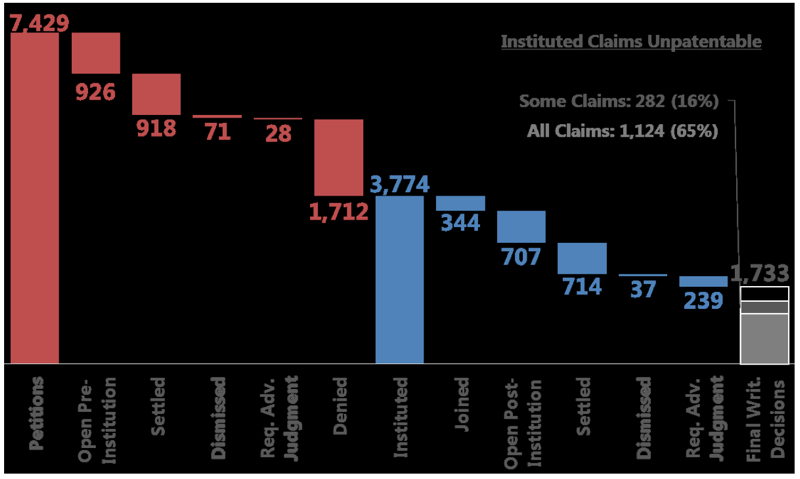
    The overall statistics illustrate that inter partes review, the flavor having the broadest scope (being applicable to all unexpired U.S. patents whether granted under the AIA or prior to its enactment), have been used most frequently:  on 7,429 filed petitions, 6,831 (92%) were IPRs.  Of the total petitions, 3,774 (a little more than 50%) were instituted.  And of those petitions that were instituted, 1,733 have reached Final Written Decision.

    The breakdown of those Decisions illustrates the experience of patent holders that have raised allegations that these review proceedings (and IPRs in particular) are "death panels" for patents.  According to USPTO statistics, 65% of these decisions resulted in all instituted claims to be unpatentable under Section 102 (novelty) or Section 103 (obviousness) of the Patent Act, while only 19% of the Decisions resulted in all claims being held patentable (the remaining 16% had mixed results).

    The technology breakdown for these resolved reviews is as follows:

    • Electrical/computer 1,053 (59%)
    • Mechanical/business methods 383 (22%)
    • Biotech/pharma 205 (11%)
    • Chemical 118 (7%)
    • Design 14 (1%)

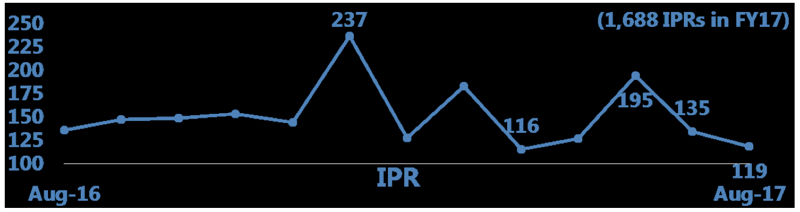
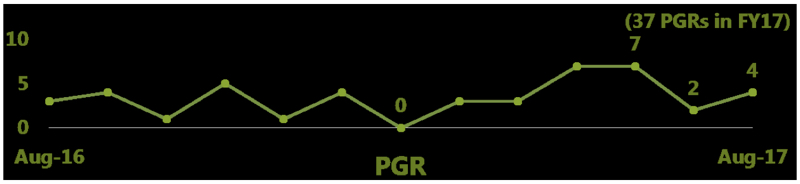
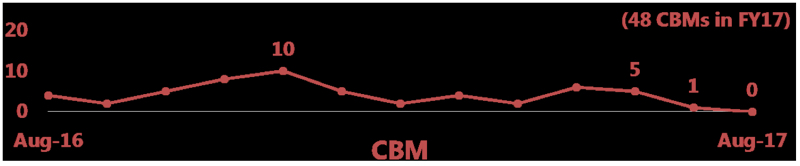
    The Chief Judge also presented graphical representations of trends in these review filings:

    Figure 1 Figure 2 Figure 3
    Institution rates are dropping, according to Office Statistics, from a high of 87% in FY2013 to 63% in FY2017 (ending August 31st).  Electrical/computer (69%) and business methods (70%) continue to have the highest rates of institution, with chemical (67%) and biotech/pharma (63%) being instituted at slightly lower (but still significant) rates.  Pre-institution settlements have increased over the time these forms of review have been available to challengers (from 9-14%) while post-settlement rates have dropped from 90% to 22% (presumably on the basis that patentees believe their chances of at least some claims surviving have increased over the period).

    The slide deck also contains a comprehensive slide graphically representing the fate of all 7,429 review petitions filed:

    Figure 4
    The USPTO in public comments consistently maintains that the post-grant review system in all its forms has had a positive impact on U.S. patent quality and that only those patents improvidently granted are at risk.  This attitude is reminiscent of the sentiment that one "has nothing to fear if they have nothing to hide," but it is certainly the case that, just as the USPTO must have erred in granting at least some of these claims, the PTAB must certainly have erred in invalidating them.  Neither reality can be reassuring to the patent community or the public that relies on the Office to shepherd patent protection for innovation in the U.S.

  • By Andrew Williams

    District Court for the District of DelawareLast Spring, the Supreme Court in TC Heartland LLC v. Kraft Foods Group Brands LLC held that the word "resides" in the patent venue statute, 28 U.S.C. § 1400(b), "refers only to the State of incorporation" of the alleged infringer.  Correspondingly, the first prong of the statute is limited as to where a patent owner can bring an infringement suit.  However, TC Heartland left open the question as to where an alleged infringer could be sued pursuant to the second prong of § 1400(b).  The statute reads in its entirety:

    Any civil action for patent infringement may be brought in the judicial district where the defendant resides, or where the defendant has committed acts of infringement and has a regular and established place of business.

    However, in ANDA litigation, as well as lawsuits filed pursuant to the BPCIA, the act of infringement is artificial and the questions that a court must address are prospective in nature.  Therefore, it is also an open question as to what it means for an FDA applicant to have committed an act of infringement as that term is used in 1400(b)?  On September 11, 2017, in the Bristol-Myers Squibb Company v. Mylan case, Chief Judge Stark of the District of Delaware set out his framework for addressing venue challenges post-TC Heartland.  Interestingly (but only coincidentally), it was ultimately Judge Stark that was reversed by the Supreme Court resulting from his adoption of the recommendation of Magistrate Judge Burke to deny TC Heartland's motion to dismiss on venue grounds.

    This case arose when Mylan Pharmaceuticals Inc. ("Mylan") submitted an ANDA to market a generic version of BMS' Eliquis®, 2.5 mg and 5 mg strength apixaban tablets.  BMS filed suit in the District of Delaware asserting U.S. Patent Nos. 6,967,208 and 9,326,945, generally directed to chemical compounds and formulations of apixaban.  On July 25, 2017, after TC Heartland was decided, Mylan moved to dismiss the case for improper venue under Federal Rule of Civil Procedure 12(b)(3).  The Court heard oral arguments in a hearing that concerned this case and other similar post-TC Heartland venue motions with both Chief Judge Stark and Magistrate Judge Burke presiding.  In denying Mylan's motion without prejudice, Judge Stark analyzed what the second prong of § 1400(b) requires in the Hatch-Waxman context.

    Who Bears the Burden of Proof?

    The first issue addressed by the Court was who bears the burden in motions to dismiss for improper venue.  The Court acknowledged that the majority of courts that have considered this issue have determined that it is the Plaintiff that must establish that the chosen district is a proper venue.  However, the Third Circuit, in which Delaware is situated, has held that it is the defendant as the moving party that has the burden.  The Federal Circuit, for its part, has not addressed this issue.

    The Court first addressed whether Federal Circuit case law would control the case.  To do this, the Court first determined whether this issue is one unique to patent law.  According to Federal Circuit precedent, the procedural aspects of 12(b)(6) and judgments as a matter of law are controlled by the laws of the regional circuits.  Because venue challenges also occur by operation of the Federal Rules of Civil Procedure, the Court concluded that improper venue motions are procedural, and controlled by Third Circuit law.  Even so, the substantive questions relating to § 1400(b) are controlled by how the Federal Circuit would apply the second prong of this statute.  Correspondingly, the Court determined that it was Mylan that had the burden of proof in establishing that venue was not proper.

    Acts of Infringement in the ANDA Context

    The next issue addressed by the Court was what would be considered an "act of infringement" such that venue would be proper.  The Court first noted that the second prong of §1400(b) is written in the present perfect tense — "where the defendant has committed acts of infringement."  The problem is that the temporal focus of a Hatch-Waxman infringement analysis is in the future, not the past or present.  In other words, the question is what will the defendant manufacture and sell in the future, not what has been sold or is being sold.  In footnote 9, the Court analogized the forward-looking nature of these cases to those of declaratory judgment actions.  The prospective nature of the analysis is necessitated in part because there is no infringement liability for activities related to the submission of the application to the FDA because of the safe harbor provisions of 35 U.S.C. § 271(e)(1).

    As a result, the "highly artificial act of infringement" in ANDA cases is the submission of application.  Nevertheless, the resulting litigation is not about whether the documents submitted to the FDA were somehow unlawful, but rather whether a patent will be infringed by the manufacture, use or sale of the drug once the application is approved.  Correspondingly, the Court concluded that in this context, "the 'acts of infringement' an ANDA filer 'has committed' includes all of the acts that would constitute ordinary patent infringement if, upon FDA approval, the generic drug product is launched into the market."

    In reaching this decision, the Court relied heavily on the Federal Circuit's decision in Acorda Therapeutics Inc. v. Mylan Pharm. Inc., 817 F.3d 755 (Fed. Cir. 2016).  The Acorda decision related to analyzing personal jurisdiction in the ANDA context, but the District Court reasoned that it was the best guidance as to how the Federal Circuit was likely to resolve these questions in the venue context.  In that case, the Federal Circuit rejected the contention that the state must wait until conduct has occurred before exercising its judicial power:  "[A]s long as the connection to the planned acts is close enough, the subject of such actions readily fits the terms of the minimum-contacts standard — conduct purposefully directed at the State that gives rise and is related to the suit."  Similarly, the Court concluded that "the most reasonable conclusion after Acorda is that an ANDA filer's future, intended acts must be included as part of the 'acts of infringement' analysis for purposes of determining if venue is proper under the patent venue statute."  The Court also noted that this reasoning stems from the fact that in the Hatch-Waxman context, the applicant has "reliably confirmed a plan to engage in real-world marketing" by the filing of the application.  In fact, the Court pointed out that there would likely never be an act of actual infringement because either the patents will be found to be invalid or not infringed during the subsequent litigation, or the ANDA filer will be kept off the market during the life of the patents.  And in the situation where the ANDA filer launches at risk, the pleadings will be amended to add claims of infringement under 35 U.S.C. § 271(a)-(c).

    In reaching this conclusion, the Court specifically rejected the argument that the act of infringement either occurs at the location where the application submission is made (in this case, the home of the FDA, Bethesda, Maryland), where the submission is made from (either whether it is mailed or where it is electronically submitted), or where the center of gravity of the work associated with the preparation and submission occurred.  The Court did acknowledge the potential problems with its interpretation.  First, the verb tense of the statutory language is inconsistent with a prospective analysis.  As a result, the term "act of infringement" would mean something different in Hatch-Waxman cases than in the non-Hatch-Waxman context.  Also, the Supreme Court had previously warned against giving 1400(b) a liberal construction.  Nevertheless, the Court reasoned that any other conclusion would be inconsistent with Acorda and the realities of Hatch-Waxman litigation.

    The Court also provided a policy reason for its conclusion.  Any contrary reading of § 1400 (b) would frustrate the goals of the expeditious resolution of the patent issues inherent in the Hatch-Waxman statute.  If courts were required to address venue-related motions to dismiss in every case, it would be difficult for them to resolve the suits during statutory 30-month stay.  Nevertheless, the Court recognized that such policy considerations were basically irrelevant to the question of statutory interpretation.

    In applying this newly articulated standard, the Court found there was an act of infringement in this case.  Specifically, Mylan did not deny that it planned to sell its product within Delaware.  And the Court has already determined the fact that the ANDA was prepared in West Virginia and electronically submitted to the FDA located in Maryland was irrelevant to the present motion.

    Regular and Established Place of Business

    The Court next turned to what it means to have a regular and established place of business.  First, the statute was parsed to reveal that what is required to meet this prong is that there be a (i) place of business that is (ii) regular and (iii) established.  The Court focused on In re Cordis, 769 F.2d 733 (Fed. Cir. 1985), as the "most recent, precedential case applying" the second part of § 1400(b), even though it recognized that the Cordis decision was based on a mandamus petition, which utilizes a more deferential standard.  The Federal Circuit in Cordis held that "in determining whether a corporate defendant has a regular and established place of business in a district, the appropriate inquiry is whether the corporate defendant does its business in that district through a permanent and continuous presence there and not . . . whether it has a fixed physical presence in the sense of a formal office or store."  Nevertheless, the Delaware Court noted that there still needs to be a "place of business," which means the defendant needs to have a physical presence is district.  As a result, there needs to be "some sort of meaningful physical manifestation in the district," an inquiry which is a factually driven.

    The Court next cataloged the activities that have been determined, in and of themselves, to not be sufficient to amount to a regular and established place of business.  These include: (1) simply doing business or being registered to do business in a district, (2) having sufficient "minimum contacts" with the district for the purposes of personal jurisdiction, (3) maintaining a website accessible within the district, and (4) shipping goods into a district, whether to an individual or for distribution by third parties.  Accordingly, the Court concluded that it "must determine whether a defendant has a regular and established place of business by conducting a fact-intensive inquiry focused on whether the defendant does its business in this District through a permanent and continuous presence here."

    Applying this test, the Court could not establish that Mylan has a regular and established place of business in Delaware.  In the event that Mylan renewed its motion, the Court did provide BMS with an opportunity to take venue-related discovery.  Along these lines, the Court did note the following facts: (1) Mylan has a nationwide and global footprint, (2) Mylan "'leverage[s] a broad network of local and global access channels that include physicians, institutions, governments, retailers and wholesalers," (3) the Mylan family includes at least 55 U.S. subsidiaries, more than 40 of which are incorporated in Delaware, and (4) Mylan has admitted that it does business in Delaware and that its products have been sold in the district.  In addition, the Court noted that Mylan is a frequent litigant in Delaware federal court.  For example, Mylan has been involved in more than 100 cases in the past ten years.  In fact, Mylan recently got a Hatch-Waxman Act case transferred from the Northern District of West Virginia (its place of incorporation) to Delaware.  Finally, there has been at least one Mylan case pending in Delaware in the past ten years.  These facts are relevant because they demonstrate that Mylan's business model is predicated on participating in large amounts of litigation.

    On the other hand, Mylan had alleged that it does not own or lease any manufacturing plants, corporate offices, facilities, or other real property in Delaware.  Also, it does not have telephone listings or mailing addresses in Delaware.  In addition, it does not have any employees working in Delaware.  Nevertheless, the Court found that Mylan was unable to meet its burden, and so it could not say that Mylan "does not have a regular and established place of business in Delaware."  Correspondingly, the motion to dismiss was denied without prejudice.

    Do the Acts of Infringement and the Regular and Established Place of Business Need to be Related?

    The Court next addressed the issue whether there must be a relationship between the accused acts of infringement and the regular and established place of business.  The Court noted that other district has concluded that the two must be related.  However, it came to the opposite conclusion.  It relied on the statutory language to support this conclusion.  For example, the statute does not require that the infringement "arise from" the regular and established place of business.  The Court did recognize that there is language in Cordis that suggested a relationship must exist.  Nevertheless, it concluded that the Federal Circuit was not actually confronted with this specific question, so that language amounted to more than dicta.

    Venue-related discovery

    Finally, because the Court dismissed the case without prejudice, it determined that granting BMS venue-related discovery was appropriate.  It explained that "discovery will include understanding the relationship among the 40 Delaware Mylan entities" and the Mylan entities involved in the present suit.  It also noted that discovery would be allowed to determine whether Mylan has sales representatives that come to Delaware to meet with doctors and hospitals.  In addition, it suggested it would allow discovery to help understand how the industry operates, and the way sales are made and marketing is done.  BMS may also allowed to explore Mylan's relationship with wholesalers.  Finally, the Court noted that BMS may take discovery to determine Mylan's relationship with pharmacies and physician in Delaware.  The Court concluded by allowing the case to proceed on the merits.


    As a reminder, readers interested in this case and other related issues should consider attending American Conference Institute's 5th Annual Paragraph IV Disputes master symposium on October 2-3, 2017 in Chicago, IL.  This author will also be in attendance, so if you are attending, please say hello.  As a reminder, Patent Docs is a media partner for this event, and its readers are entitled to a 10% discount off of registration using discount code P10-999-PTD18.

  • By Donald Zuhn

    S.D. Cal.Last month, in Natural Alternatives International, Inc. v. Allmax Nutrition, Inc., District Judge Marilyn L. Huff of the U.S. District Court for the Southern District of California denied a Motion for Reconsideration filed by Plaintiff Natural Alternatives International, Inc. ("NAI"), and determined that NAI's claim for patent infringement remained dismissed with prejudice.  In its complaint, NAI alleged, inter alia, that Defendant Allmax Nutrition, Inc. ("Allmax") infringed NAI's U.S. Patent Nos. 5,965,596; 7,504,376; 7,825,084; and RE45,947 by offering to sell and selling dietary supplements containing beta-alanine in the United States.

    In response to NAI's complaint, Allmax filed a motion to dismiss for lack of personal jurisdiction, and NAI countered with a first amended complaint adding HBS International Corp. ("HBS") as a Defendant.  Allmax again responded by filing a motion to dismiss for lack of personal jurisdiction, which the District Court denied.  Allmax then filed a motion for judgment on the pleadings and HBS filed a motion to dismiss, both of which the District Court granted, with the Court determining that all four patents-in-suit were invalid under 35 U.S.C. § 101 for claiming ineligible subject matter.  NAI then moved for reconsideration of the District Court's order dismissing NAI's claim for patent infringement on the grounds that the patents-in-suit are invalid under 35 U.S.C. § 101.

    The patents-in-suit are directed to compositions, dietary supplements, and methods of regulating hydronium ion concentrations in a subject/human.  In particular, representative claim 1 of the '596 patent recites:

    1.  A method of regulating hydronium ion concentrations in a human tissue comprising:
        providing an amount of beta-alanine to blood or blood plasma effective to increase beta-alanylhistidine dipeptide synthesis in the human tissue; and
        exposing the tissue to the blood or blood plasma, whereby the concentration of beta-alanylhistidine is increased in the human tissue.

    Representative claims 1, 7, 8, and 11 of the '376 patent recite:

    1.  A composition, comprising: glycine; and a) an amino acid selected from the group consisting of a beta-alanine, an ester of a beta-alanine, and an amide of a beta-alanine, or b) a di-peptide selected from the group consisting of a beta-alanine di-peptide and a beta-alanylhistidine di-peptide.

    7.  A composition comprising at least 0.2, 0.3, 0.4, 0.5, 1.0, 1.5, 2.0, 2.5, 3.0, 3.5, 4.0, 4.5 or 5 grams of a peptide or an ester comprising a beta-alanine per dosage.

    8.  A composition comprising at least 0.2, 0.3, 0.4, 0.5, 1.0, 1.5, 2.0, 2.5, 3.0 grams of a peptide or an ester comprising a beta-alanine in an injectable form per dosage.

    11.  A composition for humans comprising at least 200, 250, 300, 450, 500, 550, 600, 650, 700, 750 or 800 mg of a beta-alanine per dosage.

    Representative claims 1, 5, 9, and 13 of the '084 patent recite:

    1.  A human dietary supplement, comprising a beta-alanine in a unit dosage of between about 0.4 grams to 16 grams, wherein the supplement provides a unit dosage of beta-alanine.

    5.  A composition for increasing beta-alanylhistidine dipeptide in a subject, comprising a mixture of creatine and anserine or balenine in an amount for increasing beta-alanylhistidine dipeptide in a subject.

    9.  A dietary supplement, comprising a mixture of creatine and anserine or balenine.

    13.  A method of regulating hydronium ion concentration in a tissue of a subject, comprising administration of a composition comprising a mixture of creatine and anserine or balenine to the subject to increase beta-alanylhistidine dipeptide synthesis in a tissue, whereby the anaerobic working capacity of the tissue is increased.

    Representative claims 34 and 35 recite:

    34.  A human dietary supplement for increasing human muscle tissue strength comprising a mixture of creatine, a carbohydrate and free amino acid beta-alanine that is not part of a dipeptide, polypeptide or an oligopeptide, wherein the human dietary supplement does not contain a free amino acid L-histidine, wherein the free amino acid beta-alanine is in an amount that is from 0.4 g to 16.0 g per daily dose, wherein the amount increases the muscle tissue strength in the human, and wherein the human dietary supplement is formulated for one or more doses per day for at least 14 days.

    35.  A human dietary supplement for increasing human muscle tissue strength comprising a mixture of creatine monohydrate, a carbohydrate and free amino acid beta-alanine that is not part of a dipeptide, polypeptide or an oligopeptide, wherein the human dietary supplement does not contain a free amino acid L-histidine, wherein the free amino acid beta-alanine is in an amount that is from 0.4 g to 16.0 g per daily dose, wherein the amount increases the muscle tissue strength in the human, and wherein the human dietary supplement is formulated for one or more doses per day for at least 14 days.

    In its motion for reconsideration, NAI argued that the District Court had clearly erred, in its order dismissing NAI's claim for patent infringement, in concluding that the patents-in-suit are invalid under 35 U.S.C. § 101 for claiming ineligible subject matter.  Allmax and HBS contended that NAI's motion for reconsideration should be denied because the motion offered arguments and evidence that NAI either already presented, or could have previously presented, to the Court, and because all of the new arguments presented in the motion lacked merit.  Stating that "Plaintiff's attempt to relitigate Defendants' Alice motions through a motion for reconsideration is improper," the District Court denied NAI's motion for reconsideration.

    The Court also noted that NAI, in its motion for reconsideration, "generally argues that the scientific evidence in [its first amended complaint] and the patents-in-suit confirm that the inventive concept of the patents-in-suit is to unnaturally over-supplement the normal/natural levels of beta-alanine in the diet of an individual unnaturally over time to achieve an unnatural high level of carnosine synthesis in the individual."  The Court indicated, however, that even if it were to accept NAI's argument regarding the inventive concept of the patents-in-suit:

    [T]his "inventive concept" would still be insufficient to render the patents-in-suit subject matter eligible under § 101.  This "inventive concept" as described by Plaintiff still only describes a natural law: the relationship between supplementing the level of beta-alanine in an individual's diet with the carnosine synthesis that occurs in the individual's tissue.  Plaintiff contends that if the patents are directed to achieving an unnaturally high level of carnosine synthesis, then the patents are not directed to a natural law and are subject matter eligible.  . . .  Plaintiff is wrong.  Even if the patents-in-suit relate to achieving an unnaturally high level of carnosine synthesis, the relationship between beta-alanine supplements in one's diet and the achievement of an unnaturally high level of carnosine synthesis is still a natural process that exists in principle apart from any human action and, thus, is a natural law.

    Noting that the Supreme Court's decision in Mayo Collaborative Servs. v. Prometheus Labs., Inc., 566 U.S. 66 (2012) is instructive to the instant case, the District Court explained that "here, Plaintiff's proposed inventive concept merely sets forth a law of nature—the relationship between a diet containing beta-alanine supplements and the level of carnosine synthesis in the individual's tissue."

    NAI also argued in its motion for reconsideration that the District Court erred by refusing to adopt NAI's proposed claim constructions.  However, the Court reminded NAI that in performing its prior Alice analysis, the Court accepted NAI's claim constructions.  Moreover, the Court noted that "Plaintiff's claim construction argument is based on its incorrect assumption that its proposed construction for the term 'human dietary supplement' renders the claims patent eligible and valid under § 101."  Explaining that "the patents-in-suit acknowledge in their specifications that placing a natural substance into a dietary supplement to increase the function of tissues is conventional activity," the Court stated that:

    Because placing a natural substance into a human dietary supplement to increase the function of tissues is a conventional activity, employing a dietary supplement to administer beta-alanine — a natural phenomenon — to achieve a high level of carnosine synthesis in a human — applying a natural law — is insufficient to render the claims at issue patent eligible even accepting Plaintiff's proposed construction for the term "human dietary supplement."

    In response to NAI's argument that the Court refused to consider and apply U.S. Patent and Trademark Office guidance regarding subject matter eligibility, the District Court stated that "[t]he Court could not have erred by failing to consider PTO guidance that Plaintiff failed to present to the Court."  The Court also noted that the USPTO guidance was not binding on the Court.

    The District Court therefore denied NAI's motion for reconsideration and determined that NAI's claim for patent infringement remained dismissed.

    Natural Alternatives International, Inc. v. Allmax Nutrition, Inc. (S.D. Cal. 2017)
    Order Denying Plaintiff's Motion for Reconsideration by District Judge Huff

  • CalendarSeptember 12, 2017 – "Addressing and Understanding the Significant Developments and Latest Decisions on Patent Eligibility" (The Knowledge Group) – 3:00 to 5:00 pm (EST)

    September 12, 2017 – "How Can the Patents Ombudsman and Pro Se Assistance Programs Work For You?" (U.S. Patent and Trademark Office) – 12:00 to 1:00 pm (ET)

    September 12-13, 2017 – "Advanced Patent Prosecution Workshop 2017: Claim Drafting & Amendment Writing" (Practising Law Institute) – Chicago, IL

    September 19, 2017 – "The Continuing Influence of PTAB Proceedings on Bio/Pharma Litigation" (McDonnell Boehnen Hulbert & Berghoff LLP) – 10:00 am to 11:15 am (CT)

    September 21, 2017 – "'Alice' Before 'Alice'" (LexisNexis) – 2:00 pm (ET)

    September 21-22, 2017 – Seminar on European Patent Law (Grünecker) – Munich, Germany

    September 22, 2017 – "Is Administrative Review of Granted Patents Constitutional?" (Center for Innovation Policy at Duke Law) – 1:00 pm to 4:00 pm (ET), Washington, DC

    September 26, 2017 – "USPTO on Restriction Practice, Terminal Disclaimers, and Patent Term Adjustment" (Intellectual Property Owners Association) – 2:00 to 3:00 pm (ET)

    September 26, 2017 – "Best Practices for Safeguarding University IP When Structuring Deals in China" (Technology Transfer Tactics) – 1:00 to 2:30 pm (Eastern)

    September 26, 2017 – "Patent Prosecution: FTO Opinions, Examiner Interactions, Patent Drafting and More" (Strafford) – 8:30 to 5:20 pm (PDT)

    September 27, 2017 – "ITC Update: Brushing Off the PTAB and Other Recent Developments" (Intellectual Property Owners Association) – 2:00 to 3:00 pm (ET)

    September 29, 2017 – IP & Diagnostics Symposium (Biotechnology Industry Organization) – 8:15 am to 2:00 pm, Alexandria, VA

    October 2-3, 2017 – Paragraph IV Disputes master symposium*** (American Conference Institute) – Chicago, IL

    November 2-3, 2017 – Summit on IP Due Diligence*** (American Conference Institute) – Philadelphia, PA

    ***Patent Docs is a media partner of this conference or CLE

  • Biotechnology Innovation Organization (BIO)The Biotechnology Industry Organization (BIO) will be holding its fifth annual IP & Diagnostics Symposium from 8:15 am to 2:00 pm on September 29, 2017 at the Westin Alexandria in Alexandria, VA.  The Symposium review the current patent law landscape and evaluate the impact on both the genetic diagnostics and biopharmaceutical sectors, and also explore new collaborations and regulatory developments.  The Symposium will offer the following presentations and sessions:

    • Session 1 — The Walls Are Closing In – The Bleak Future of Claims Reciting Natural ‘Correlations’ and Products of Nature – Dr. Leslie Fischer, Novartis; Hans Sauer, Biotechnology Innovation Organization; and Warren Woessner, Schwegman, Lundberg & Woessner, P.A.

    • Session 2 — Adapting Patent Prosecution Practice for the Next Generation of Life Science Inventions — Patent Docs author Donald Zuhn of McDonnell Boehnen Hulbert & Berghoff LLP will moderate a panel consisting of June Cohan, Legal Advisor Office of Patent Legal Administration, U.S. Patent and Trademark Office; Benjamin Jackson, Vice President Legal Affairs, Myriad Genetics; and Kwame Mensah, Senior Patent Attorney, Immunooncology IP Lead, AstraZeneca/MedImmune.

    • Session 3 — The Regulatory Environment for Diagnostic Tests and Companion Diagnostics — Ellen Flannery, Covington; and Esther Scherb, Covington.

    • Session 4 (Working Luncheon) — Life Sciences Valuations – Where IP Fits In — Dr. Patrick Frei, CEO, Venture Valuation; and Ulrich Thiele, Director, European Patent Office.

    An agenda for the Symposium, including a list of speakers, moderators, and panelists can be obtained here.

    The registration fee for the Symposium is $70-90 (service provider rates), $40-50 (in-house counsel at R&D company rates), or $0 (academic, government & non-profit association rates). Those interested in registering for the Symposium, can do so here.

  • ACIAmerican Conference Institute (ACI) will be holding its Summit on IP Due Diligence on November 2-3, 2017 in Philadelphia, PA.  This conference will be unique because a mock fact pattern will lay the foundation for the sessions of both days.  ACI faculty will help attendees:

    • Assess patent scope, validity, and enforceability in light of current patent rules and regulations
    • Apply recent case law, legislation, and influence of post-grant proceedings into due diligence practices
    • Explore the patent landscape by conducting effective freedom to operate analyses
    • Uncover potential ownership and inventorship inconsistencies
    • Protect attorney-client privilege while avoiding contamination during the review

    The conference will offer presentations on the following topics:

    • Preparing the Due-Diligence Checklist and Forming your Team
    • Analyzing the Current Patent Landscape: AIA, Post-Grant Proceedings, Evolving Jurisprudence, and the Effects on Patent Strength
    • Uncovering Red Flag in Ownership and Inventorship
    • Diving into the Patent Portfolio: Examining the Scope, Patentability, Validity, and Enforceability
    • Focusing on Freedom to Operate: Analyzing the Market
    • Deals Gone Wild: Real-Life Horror Stories of IP Due Diligence Missteps
    • Show Me the Money: Strategies to Overcome Valuation Challenges
    • Pursuing Trade Secret Protection in the Current Anti-Patent Climate
    • Attorney-Client Privilege, Contamination and Ethical Challenges

    In addition, one post-conference workshop on "Best Practices for Managing the Entire Due Diligence Process from Both Sides' Perspectives" will be offered on November 3, 2017 from 2:00 to 5:00 pm.

    The agenda for the IP Due Diligence Summit can be found here.  More information regarding the workshop can be found here.  A complete brochure for this conference, including an agenda, detailed descriptions of conference sessions, list of speakers, and registration form can be obtained here.

    The registration fee is $2,295 (conference alone), $2,895 (conference and workshop).  Patent Docs readers are entitled to a 10% discount off of registration using discount code P10-999-PTD18.  Those interested in registering for the conference can do so here, by e-mailing CustomerService@AmericanConference.com, or by calling 1-888-224-2480.

    Patent Docs is a media partner of ACI's Summit on IP Due Diligence.